
A complete issue · 16 pages · 1903
Judge — July 25, 1903
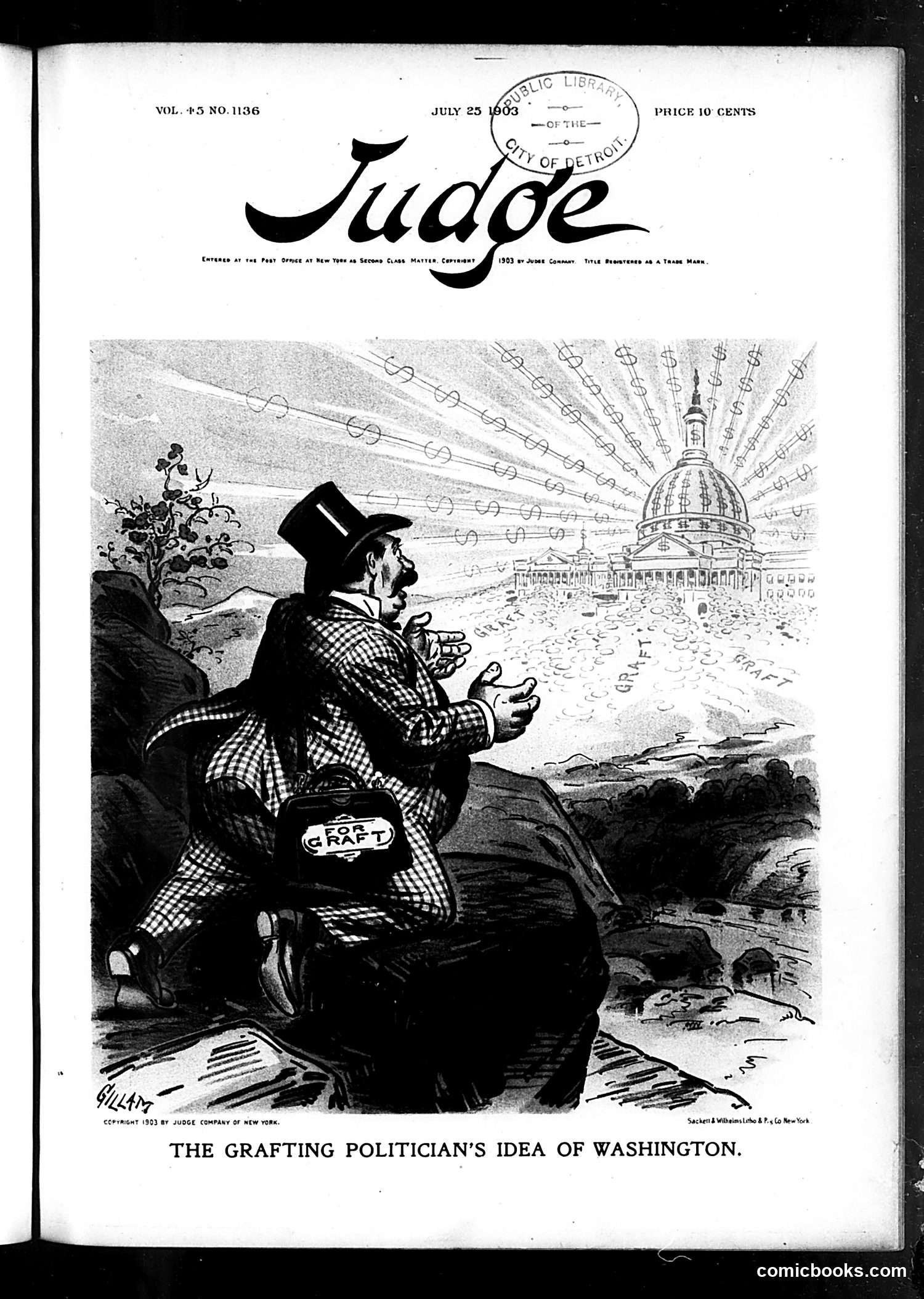
This July 1903 *Judge* cartoon satirizes political corruption in Washington. A portly, checkered-suited politician labeled "FOR GRAFT" sits contentedly overlooking the Capitol building. Rather than viewing Washington as the seat of American ideals, the cartoon suggests corrupt politicians see it as a money-making opportunity—literally: dollar signs ($) rain down from the sky toward the Capitol dome. The satirist (likely Cesare Cesari, per the signature) criticizes how grafting (bribery/kickback schemes) had perverted government. The politician's smug expression and comfortable posture emphasize how casually these officials treated their theft from public coffers. This reflects Progressive Era concerns about governmental corruption.
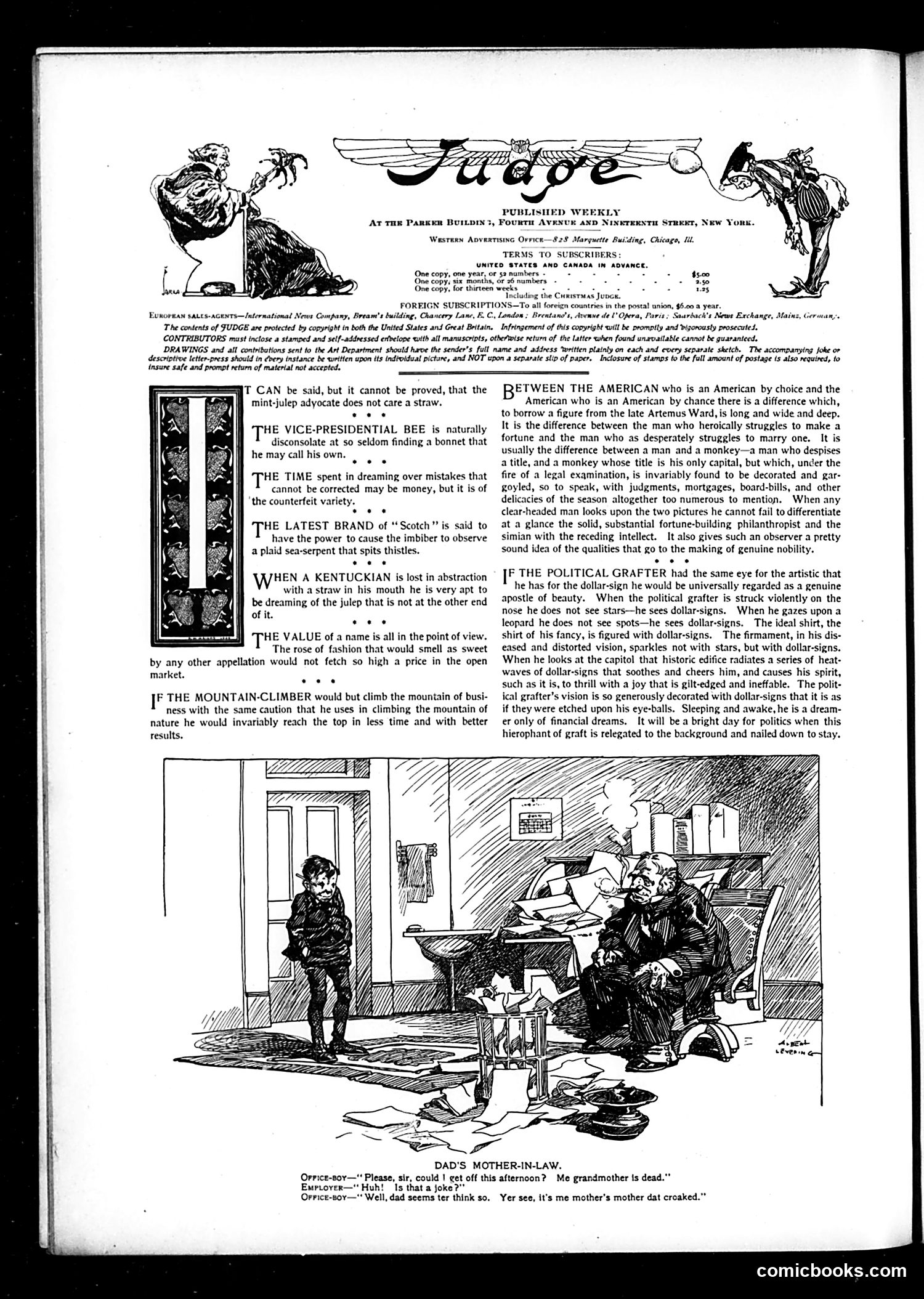
This page contains **philosophical essays and humor** rather than partisan political cartoons. The main content explores character types through satirical vignettes: **"The Vice-Presidential Bee"** mocks indecisive men who struggle to make decisions. **"The Latest Brand of 'Scotch'"** criticizes dishonest people who deceive others. The lengthy middle section contrasts Americans "by choice" versus "by chance," examining character differences between self-made men and those born to advantage—a commentary on American class mobility. **"The Political Grafter"** section satirizes corrupt politicians who cannot distinguish honest profit from theft, using dollar-sign imagery to represent their distorted moral vision. The bottom cartoon, **"Dad's Mother-in-Law,"** is a simple domestic joke about an overbearing mother-in-law. The overall tone is **moralistic satire** focused on personal character rather than specific political events or figures.
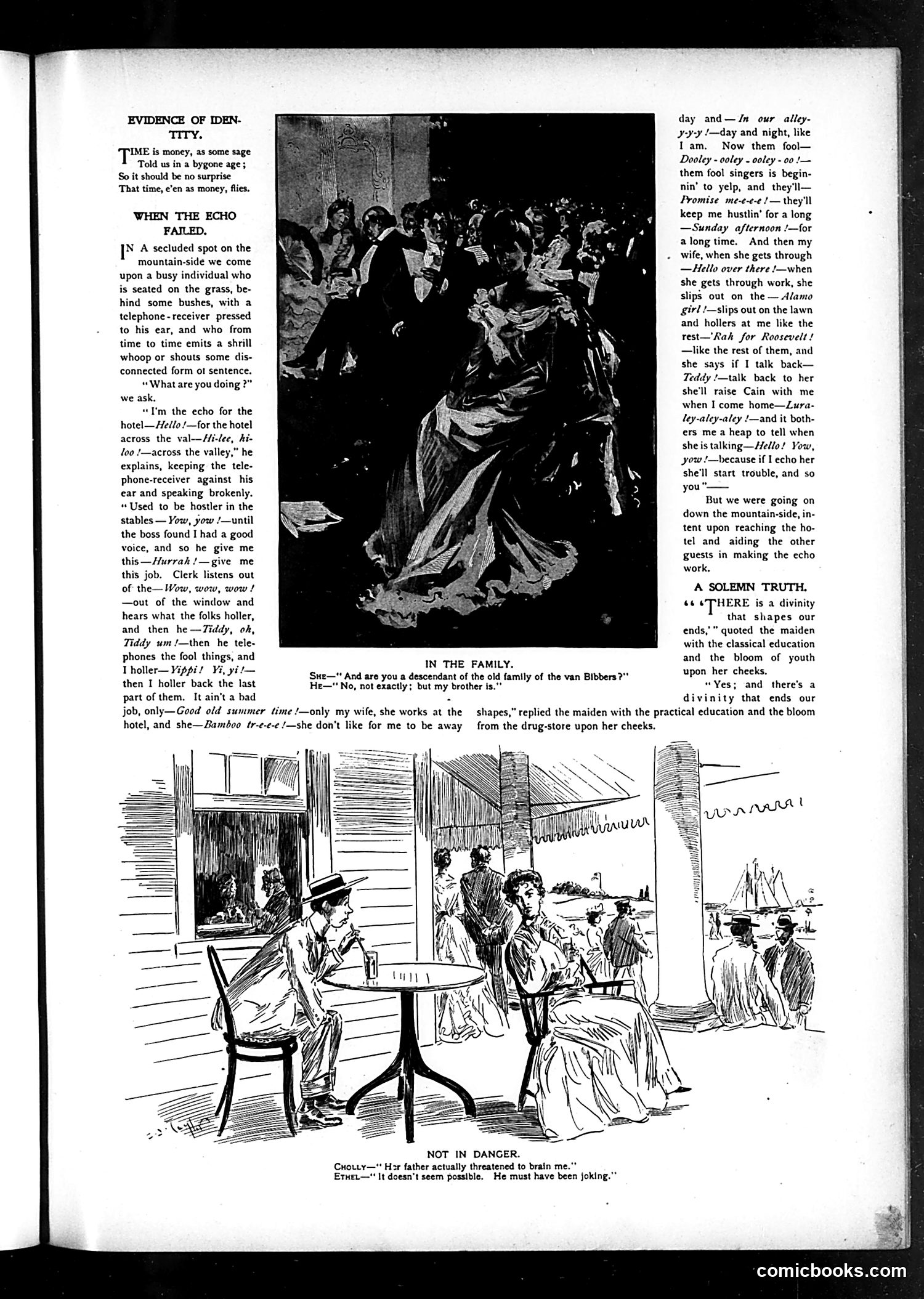
This page contains three distinct pieces: 1. **"Evidence of Identity"** and **"When the Echo Failed"** (left column): Humorous short stories about a hotel telephone operator who must answer vague caller inquiries. The satire mocks both the inefficiency of early telephone systems and callers' unclear communication. 2. **"In the Family"** (top illustration): A satirical dialogue where a maiden is asked about her aristocratic ancestry. She responds that her practical education and "bloom from the drug-store upon her cheeks" define her status—mocking pretensions of inherited nobility and suggesting cosmetics substitute for genuine breeding. 3. **"Not in Danger"** (bottom sketch): A brief domestic humor piece about a father allegedly threatening to "brain" his child, which the characters assume must be a joke—satirizing parental exaggeration. These pieces exemplify Judge's lighthearted social commentary on class, technology, and domesticity.
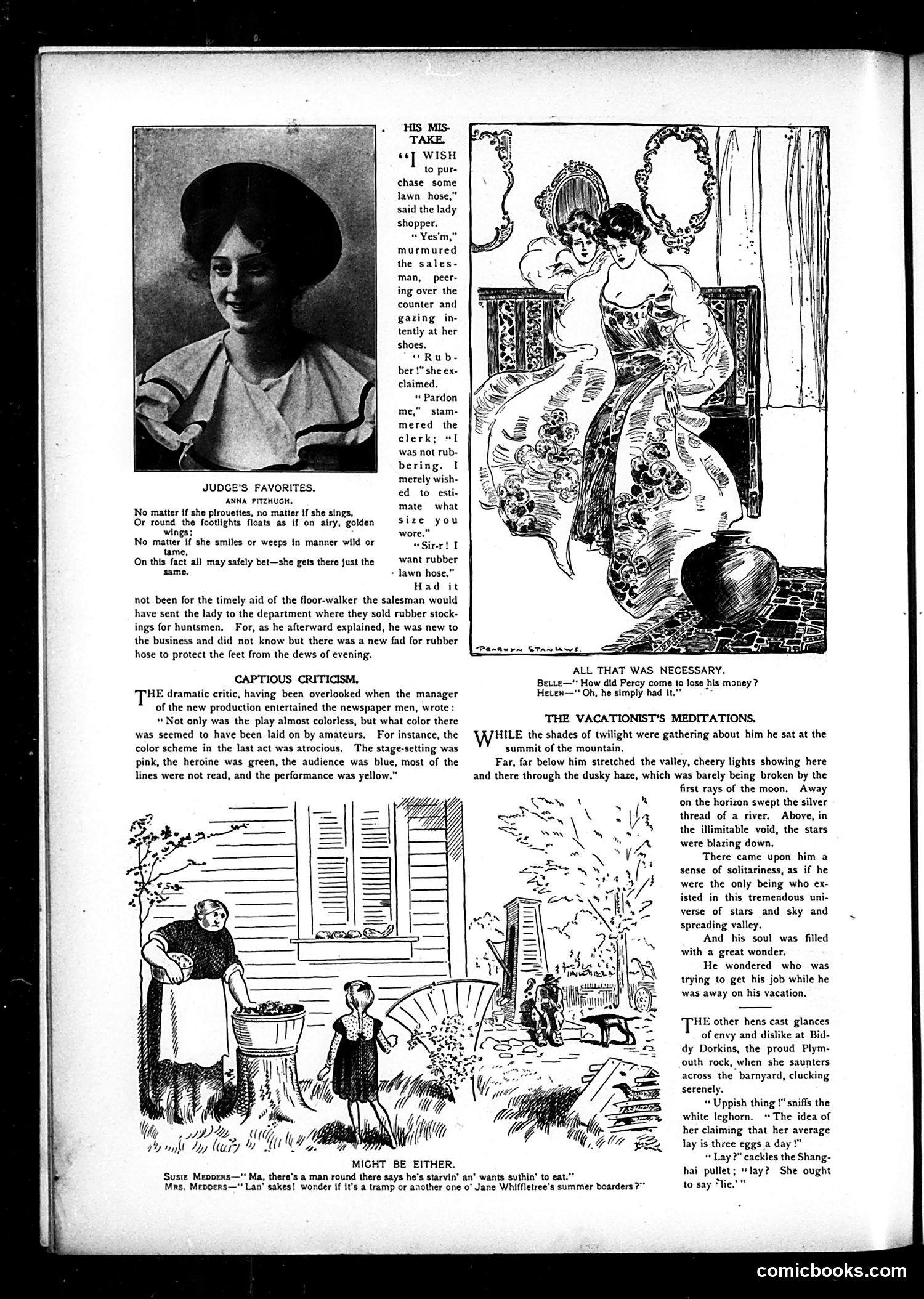
This page contains several unrelated pieces of early 20th-century humor: **"Judge's Favorites"** (top left) is a poem praising women's universal appeal regardless of appearance or manner—standard sentimental verse. **"His Mistake"** depicts a store clerk misunderstanding a customer's request for "lawn hose," humorously suggesting "rubber lawn hose" instead. The satire targets either absent-minded clerks or potentially the newer rubber products flooding the market. **"Captious Criticism"** mocks theatrical productions with amateur staging and poor color coordination—a common target of Judge's arts criticism. **"The Vacationist's Meditations"** is a romantic essay about mountain solitude and stargazing. **"Might Be Either"** is a domestic joke about whether a vagrant is starving or simply a summer boarder—poking fun at class anxieties during this period. The page is primarily lighthearted social commentary rather than political satire.
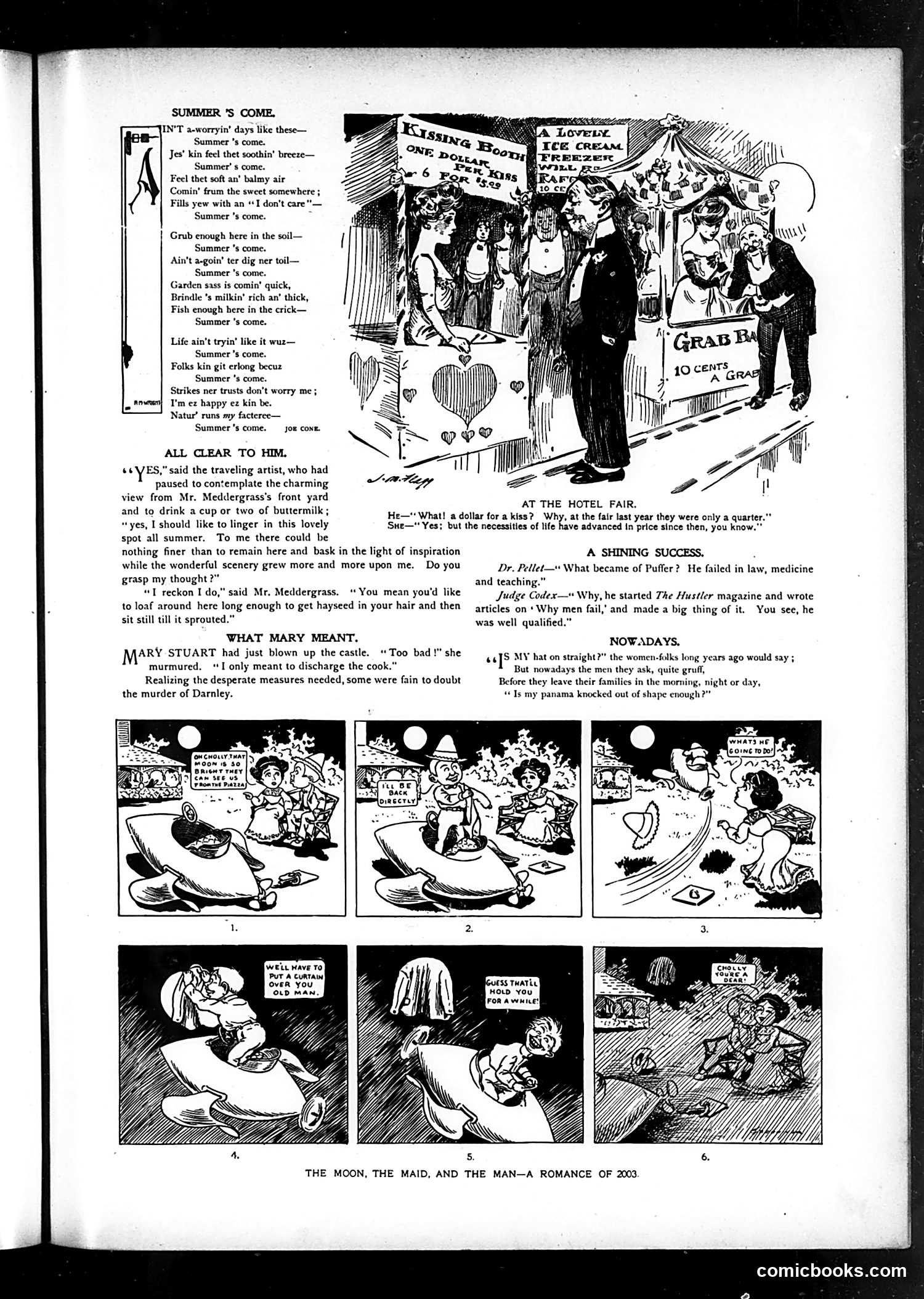
This page from *Judge* magazine contains several short satirical pieces reflecting early 1900s American anxieties and social commentary: **"Summer's Come"** is rural nostalgia—a poem celebrating agricultural life's ease during harvest season, when labor seemingly pauses and nature provides. **"All Clear to Him"** mocks bohemian artists: a traveling painter romanticizes the countryside as "inspiration," while a practical farmer recognizes he simply wants to loaf around until he becomes a rustic. **"What Mary Meant"** references Mary, Queen of Scots—a historical figure associated with castle intrigue and her husband Darnley's murder—used here for a joke about her accidentally destroying her cook instead of her castle. **"At the Hotel Fair"** is a gender-economics joke: a woman charges a dollar for a kiss, claiming inflation; the implication is that "necessities of life" (possibly suggesting sexual services) have risen in price. **"A Shining Success"** satirizes publishing: a man who failed at respectable professions succeeds by starting *The Hustler* magazine, suggesting sensationalism rewards failure better than legitimate work. The bottom comic strip appears to be a sci-fi romance set in 2003.
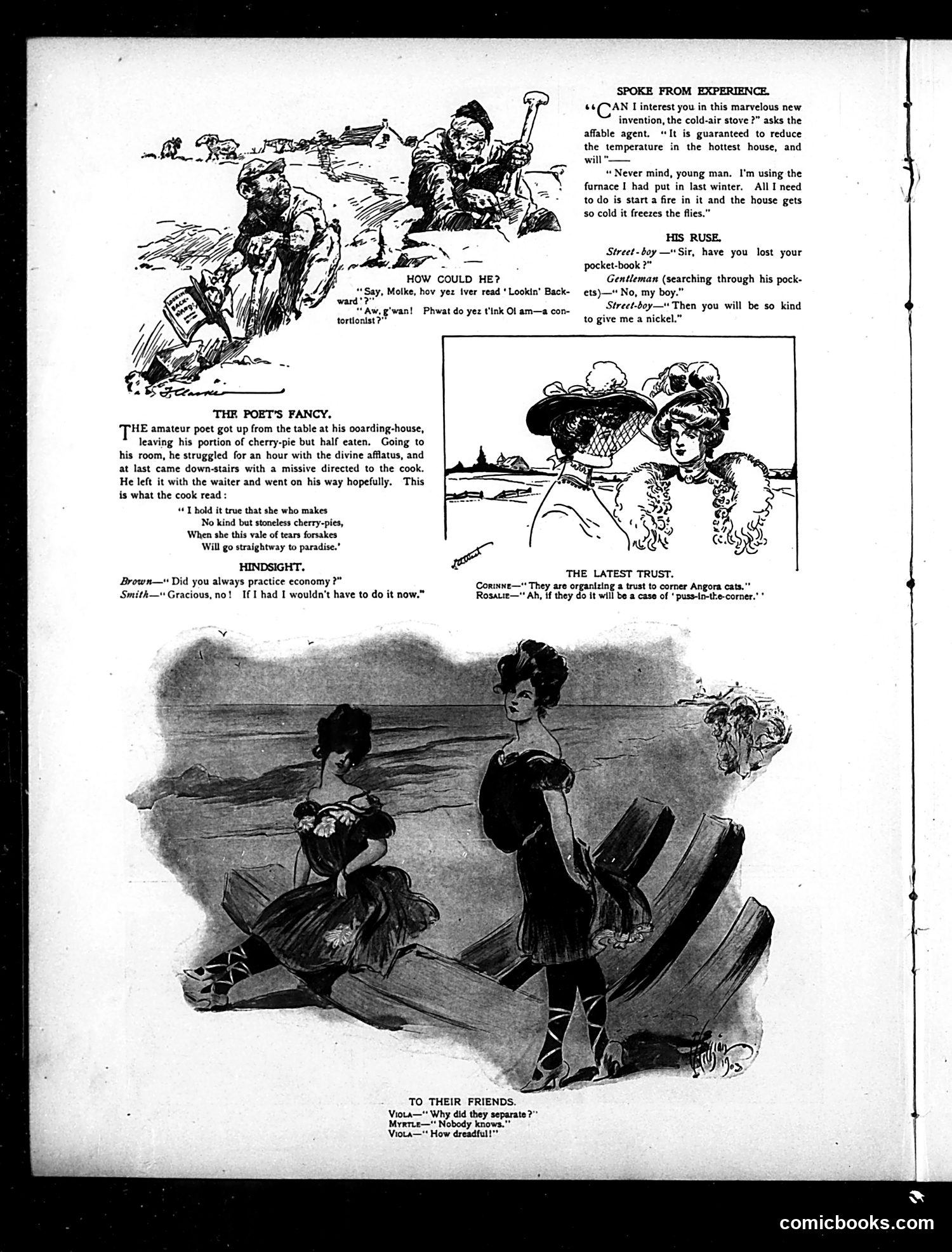
This page contains several short humorous sketches typical of early 20th-century satirical magazines: **"The Poet's Fancy"**: An amateur poet leaves a flattering note for his boarding-house cook, praising her cherry pie-making and promising her paradise. The humor lies in his absurdly flowery language to manipulate her—likely hoping for better meals. **"How Could He?"**: Two Irish-accented immigrants discuss whether one has read something while doing contortions—ethnic humor common to the era. **"Hindsight"** and **"His Ruse"**: Brief joke exchanges about economic hardship and street-child con artistry. **"Cold-Air Stove"**: A salesman pitches a new invention to reduce heat, but a customer sarcastically prefers his old furnace—which ironically works *too well*, freezing flies. **"The Latest Trust"**: A joke about monopolies ("trusts"), suggesting wealthy people are cornering the market on Angora cats for profit. The humor reflects working-class perspectives on commercialism, poverty, and dubious inventions of the period.
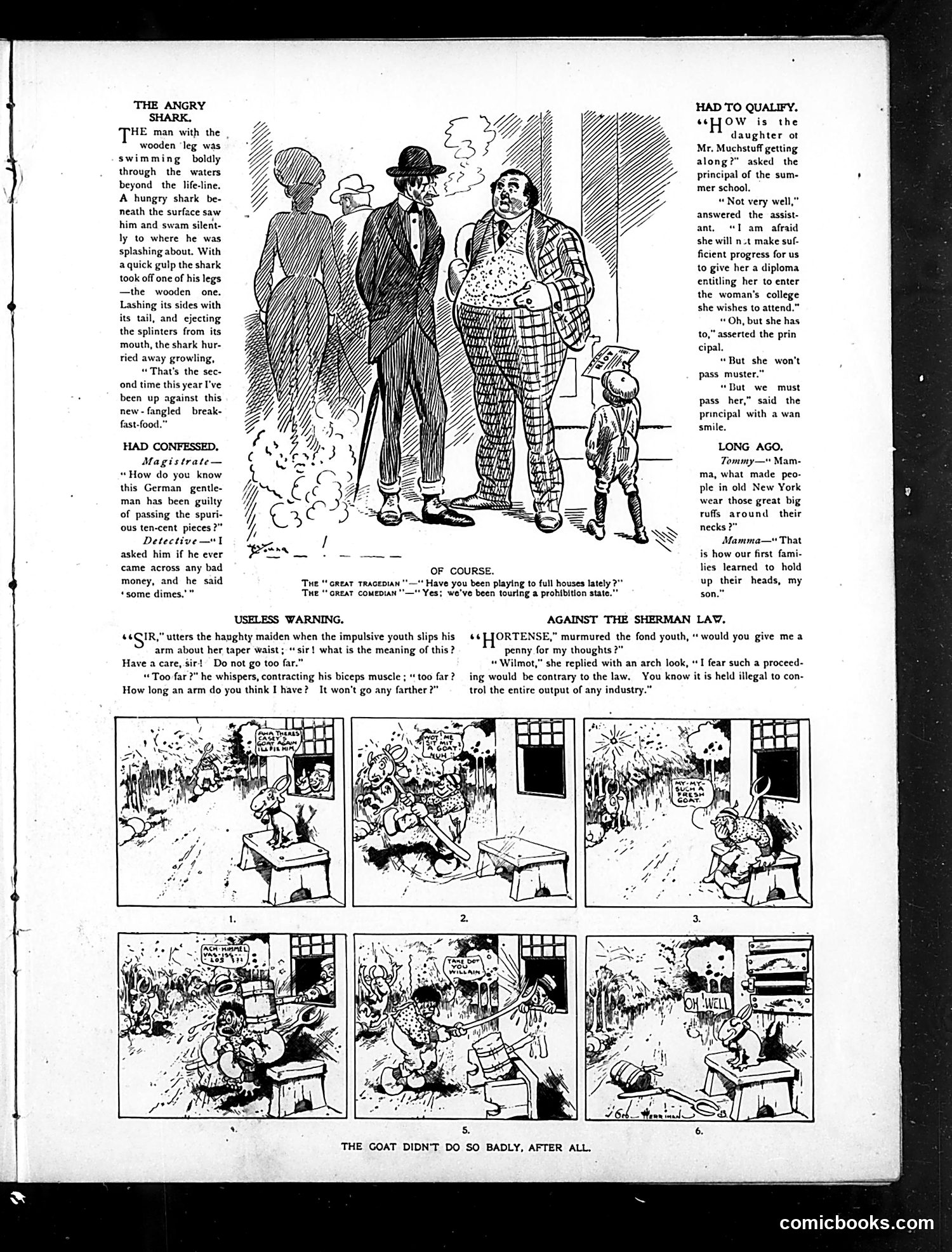
This Judge magazine page contains several satirical pieces reflecting early 20th-century American concerns: **"The Angry Shark"** jokes about "newfangled breakfast-food"—likely referencing processed foods or cereal products of the era, which were novel and sometimes considered inferior or indigestible. **"Had to Qualify"** satirizes grade inflation and institutional pressure: a principal insists on passing an unqualified student to maintain enrollment, suggesting corruption in educational standards. **"Of Course"** mocks theater touring during Prohibition (likely 1920s onward), joking that even "full houses" occur only in dry states—implying audiences seek entertainment as substitute for banned alcohol. **"Against the Sherman Law"** uses the Sherman Antitrust Act (1890) as a joke premise: a young man's attempt to "control the entire output" of a woman's thoughts is reframed as illegal monopolistic practice. This clever wordplay satirizes both romantic presumption and antitrust concerns. The comic strips below appear to depict slapstick humor involving a goat, with the caption "The Goat Didn't Do So Badly, After All."
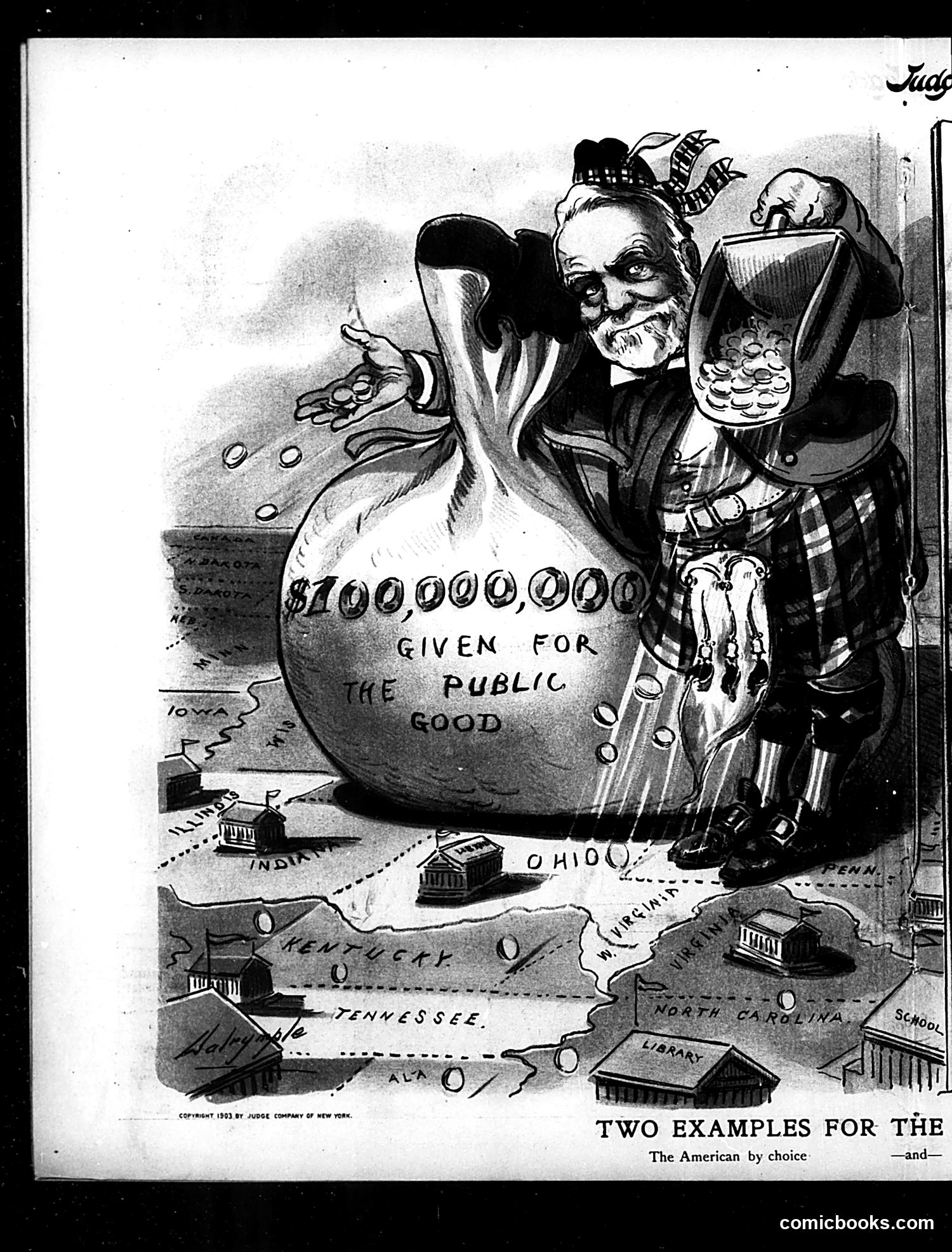
This 1903 Judge cartoon satirizes wealthy philanthropists making large public donations. The caricatured figure—appearing to be a wealthy businessman or industrialist—holds a massive bag labeled "$100,000,000 GIVEN FOR THE PUBLIC GOOD," while coins spill out. The exaggerated facial features and theatrical pose suggest mockery of ostentatious charity. The map below shows various American states with small institutional buildings (schools, libraries), implying the donations are spread across regions. The cartoon's title promises "Two Examples for the American by choice," suggesting this is comparing different philanthropic approaches or criticizing the hypocrisy between claimed generosity and actual impact. The satire likely critiques wealthy donors who publicize massive donations while their actual community benefit remains questionable—a common Progressive Era complaint about robber barons masking exploitation through strategic philanthropy.
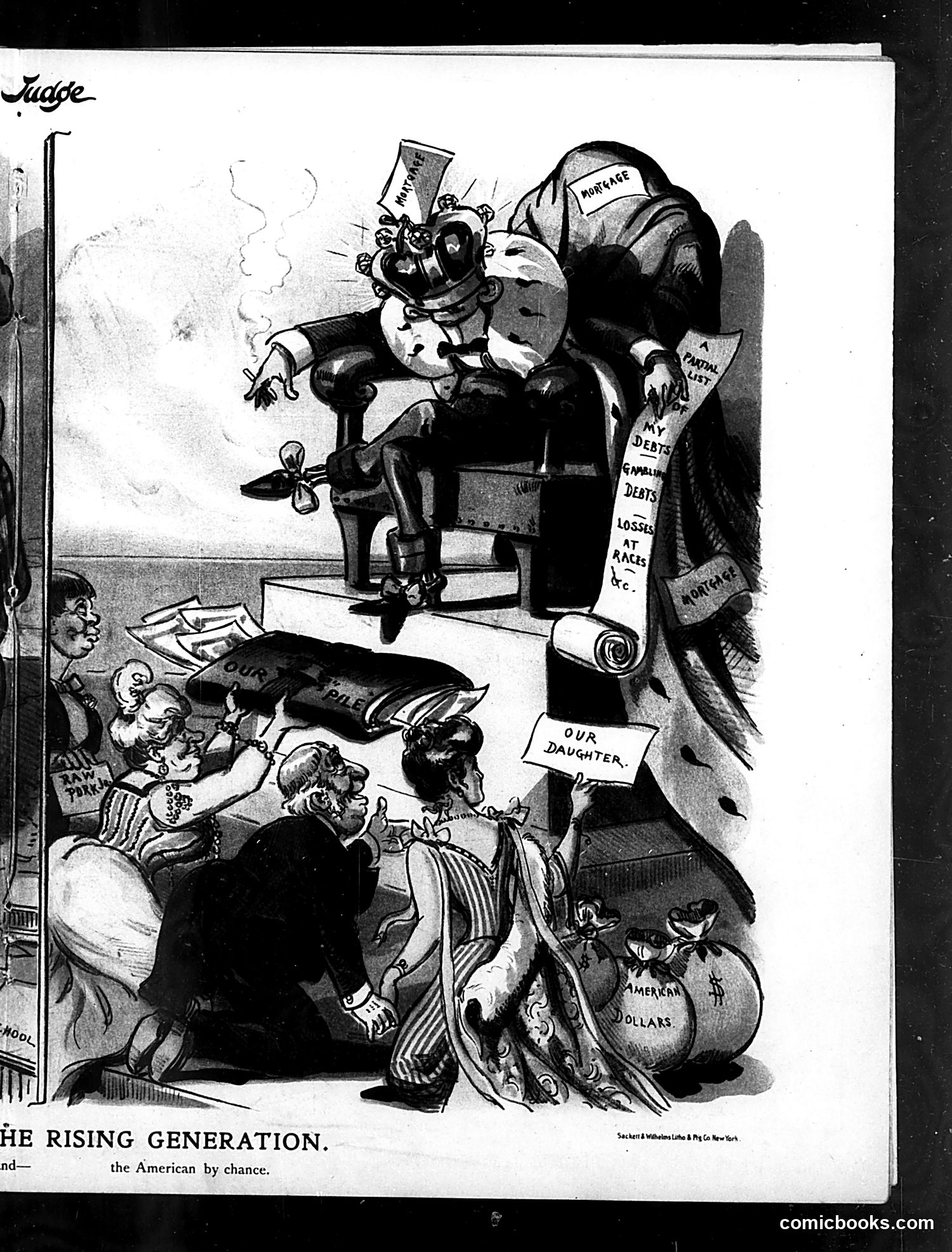
This Judge cartoon satirizes financial ruin and irresponsible parenting. A grotesque figure labeled "Mortgages" sits atop a mechanical device, crushing coins marked "American Dollars" while parents below look on helplessly at their children. Documents visible include references to "debts," "losses at races," and "our daughter," suggesting parents squander family wealth through gambling and poor financial decisions, leaving their offspring impoverished. The mechanical grinding apparatus symbolizes how accumulated debt mechanically destroys wealth. The children at the bottom represent the "rising generation" who inherit this financial devastation—made "American by chance" rather than through legitimate means. The cartoon critiques Gilded Age excess and parental financial irresponsibility that endangers the next generation's prospects.
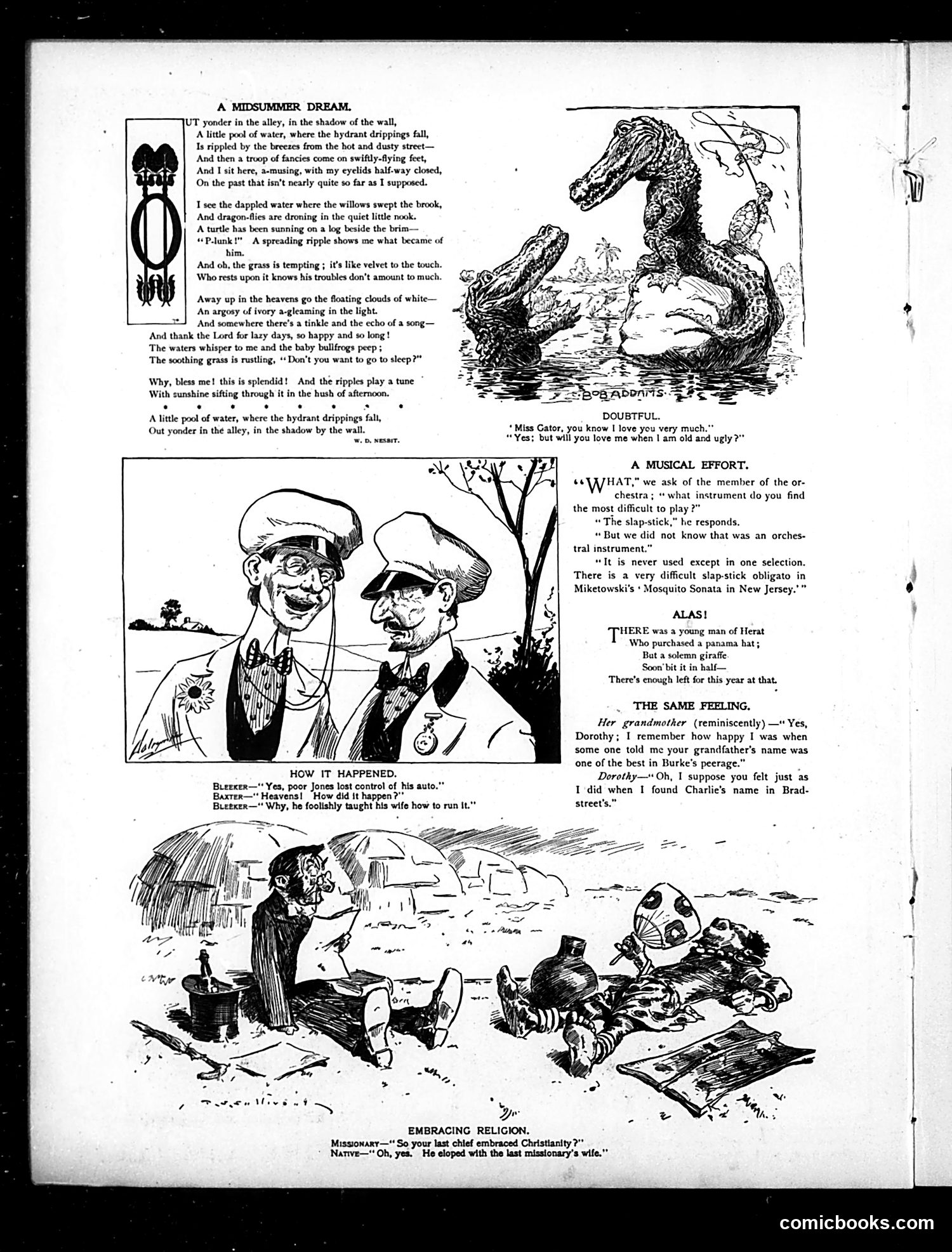
This page contains several short humorous pieces typical of early 20th-century satirical magazines: **"A Midsummer Dream"** is a nostalgic poem by W.D. Nesbit contrasting urban grime (hydrant drippings in an alley) with idealized rural memories (willows, brooks, turtles). The satire lies in romanticizing poverty—finding beauty in a dirty city puddle. **"Doubtful"** is a brief joke about a female alligator questioning her suitor's enduring love, playing on relationship anxieties. **"A Musical Effort"** mocks orchestral pretension by treating the "slap-stick" (a prop creating loud sounds, not a real instrument) as a serious orchestral piece in a fake "Mosquito Sonata." **"Alas!"** uses light verse to joke about a giraffe destroying a panama hat—absurdist humor. **"The Same Feeling"** contrasts grandmother's pride in her husband's aristocratic lineage with granddaughter Dorothy's happiness finding her boyfriend's name in a directory. **"How It Happened"** and **"Embracing Religion"** are brief jokes about automotive mishaps and missionary work, respectively.
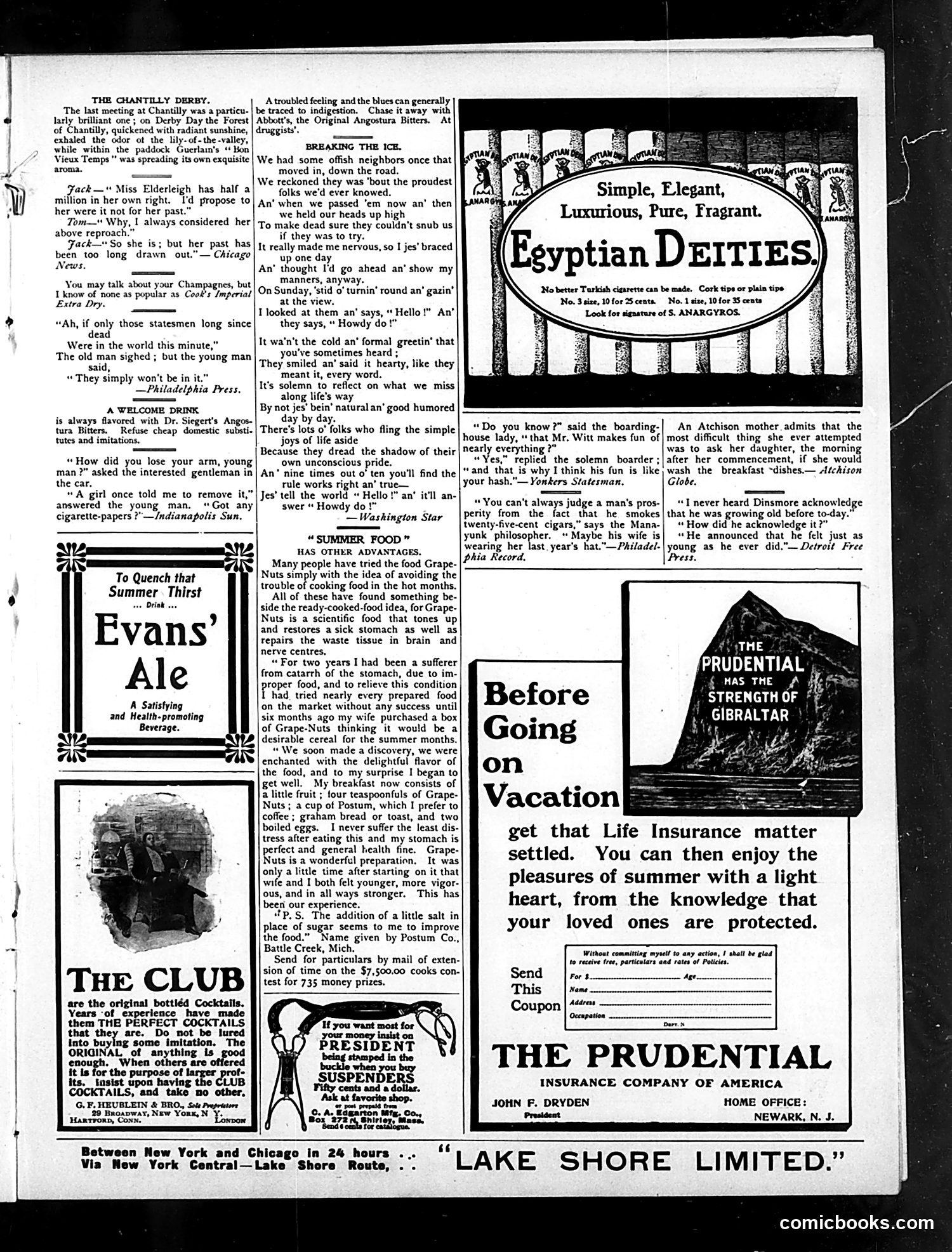
This page is primarily **advertising and light humor**, typical of Judge magazine's format. The cartoons and short jokes address everyday social situations rather than politics. The main content includes: **"Breaking the Ice"** — A rural dialect poem about overcoming social stiffness. Neighbors initially seem proud and aloof, but when the narrator approaches them naturally and says "Hello," they respond warmly. The moral: genuine friendliness overcomes social pretension. **Social humor pieces** mock courtship ("Miss Elderleigh has half a million...but her past"), amputation jokes, and Victorian propriety. The page is **dominated by product advertisements** for patent medicines (Angostura Bitters, Grape-Nuts cereal, Evans' Ale) and services (life insurance, cocktail mixes). These ads reflect early 1900s consumer culture and marketing strategies. The humor is gentle and domestic—no political satire or caricature. The page captures period attitudes about class, manners, and consumerism rather than commentary on specific events or figures.
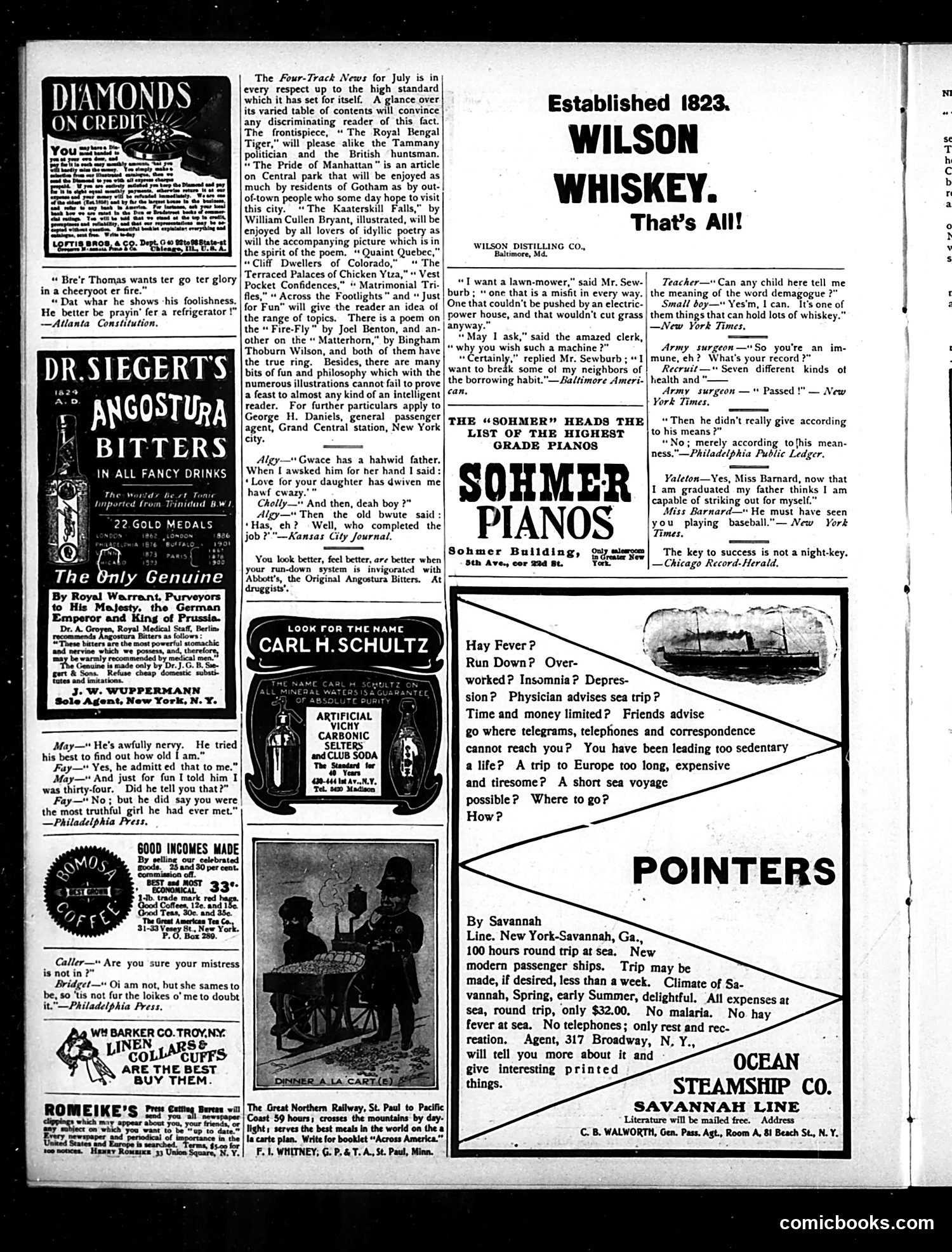
This page is primarily **advertisements and humor fillers**, typical of early 20th-century magazines. There are no significant political cartoons requiring historical context. The content consists of: 1. **Product advertisements** (Diamonds on Credit, Dr. Siegert's Angostura Bitters, Wilson Whiskey, Sohmer Pianos, etc.) 2. **Short joke exchanges**, including one ethnic dialect humor piece featuring "Bre'r Thomas" and a character using Irish-accented speech ("Bridget"), reflecting the period's casual use of racial and ethnic stereotypes in "humor." 3. **A brief editorial note** promoting *Four-Track News* magazine's July issue, mentioning articles on tiger hunting, Manhattan parks, and various travel destinations. 4. **Ocean steamship advertising** for the Savannah Line. The page reflects late-19th/early-20th-century magazine conventions: densely packed ads, brief comic exchanges, and casual ethnic caricaturing that would be considered offensive today. No sophisticated satire or political commentary is evident.
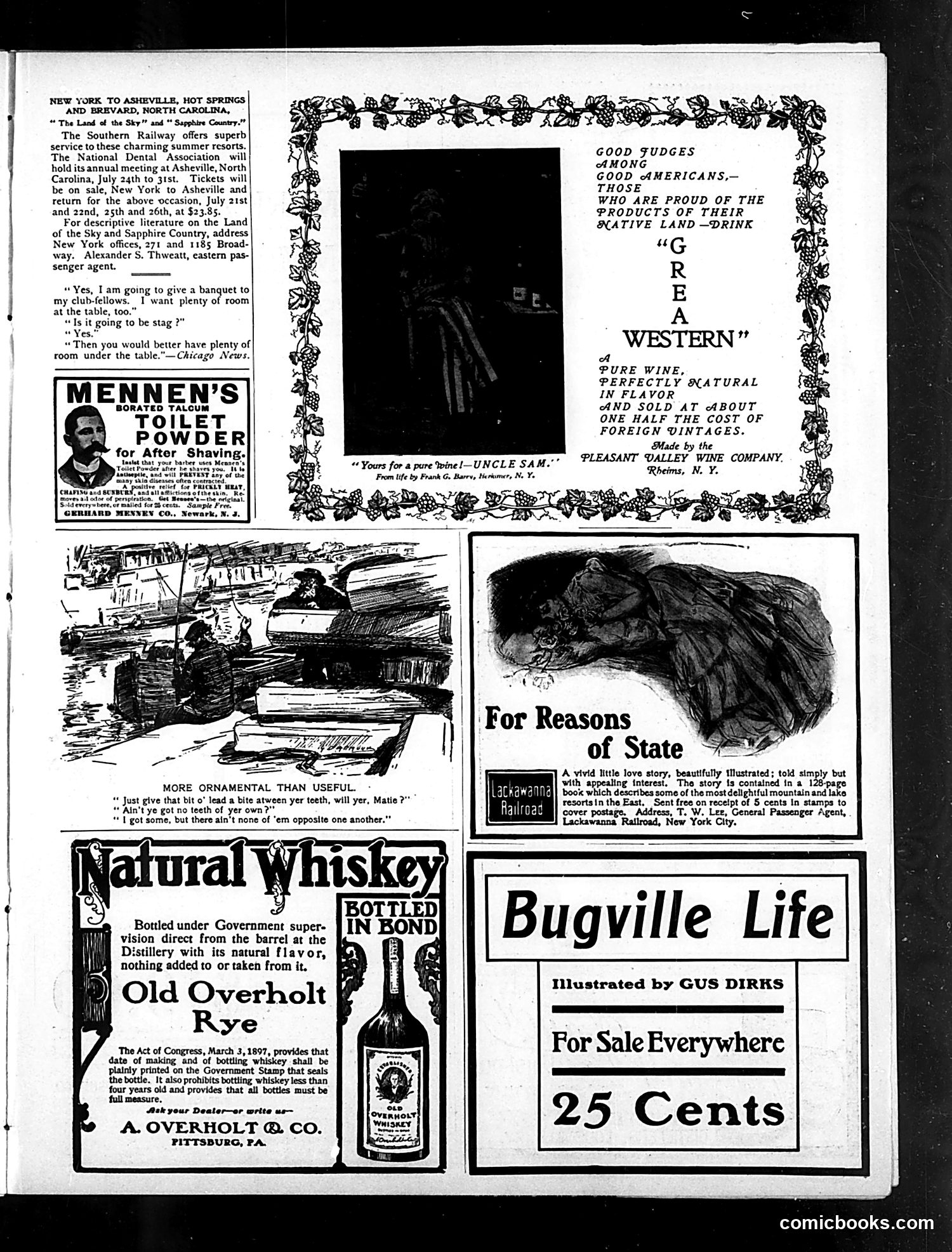
This is primarily an **advertising page** from Judge magazine, with minimal editorial cartoons. The content includes: **Main Cartoons:** - A brief joke about a stag banquet with innuendo about drinking ("room under the table") - A dental humor sketch about a man with misaligned teeth asking to borrow someone else's **Advertisements:** The page is dominated by period product ads including Mennen's talcum powder, Old Overholt Rye whiskey, and "Crea Western" wine—notably marketed with patriotic messaging ("Good Americans" should buy domestic products to support "native land"). **Notable Context:** The wine ad features "Uncle Sam" as a character endorsing American wine over foreign vintages at half the cost—reflecting early 20th-century protectionist sentiment and "Buy American" messaging that would intensify during and after World War I. The overall page reflects Judge's mixed editorial-commercial model typical of American magazines of this era.
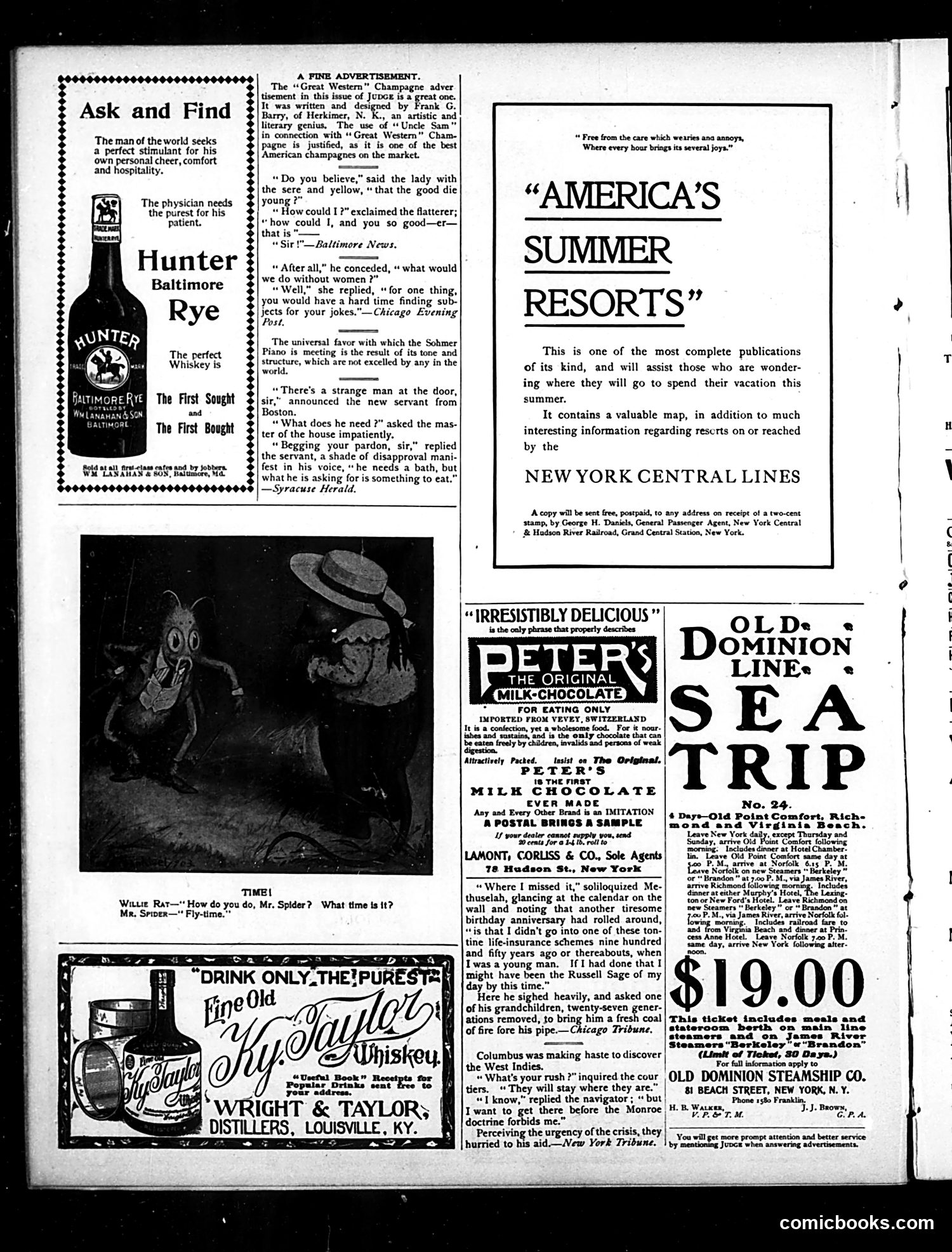
This page is primarily **advertising** rather than satirical content. It contains multiple product advertisements from the early 20th century, including: - **Hunter Baltimore Rye whiskey** (left column) - **Peter's Milk Chocolate** (center) - **Old Dominion Line sea trip** ($19.00 package, right side) - **Wright & Taylor whiskey** (bottom left) - **New York Central Lines** resort guide (top right) The only clear **cartoon** is a small image showing "Willie Ray" asking "Mr. Spider" about the time, with a caption "Fly-time!"—a simple visual pun. The page also includes brief humorous **anecdotes** in the "Ask and Find" section (left), featuring jokes about doctors, flirtation, and servants—typical light magazine humor of the era. There is **no significant political satire** on this page. It represents a typical Judge magazine layout mixing advertisements with light entertainment content.
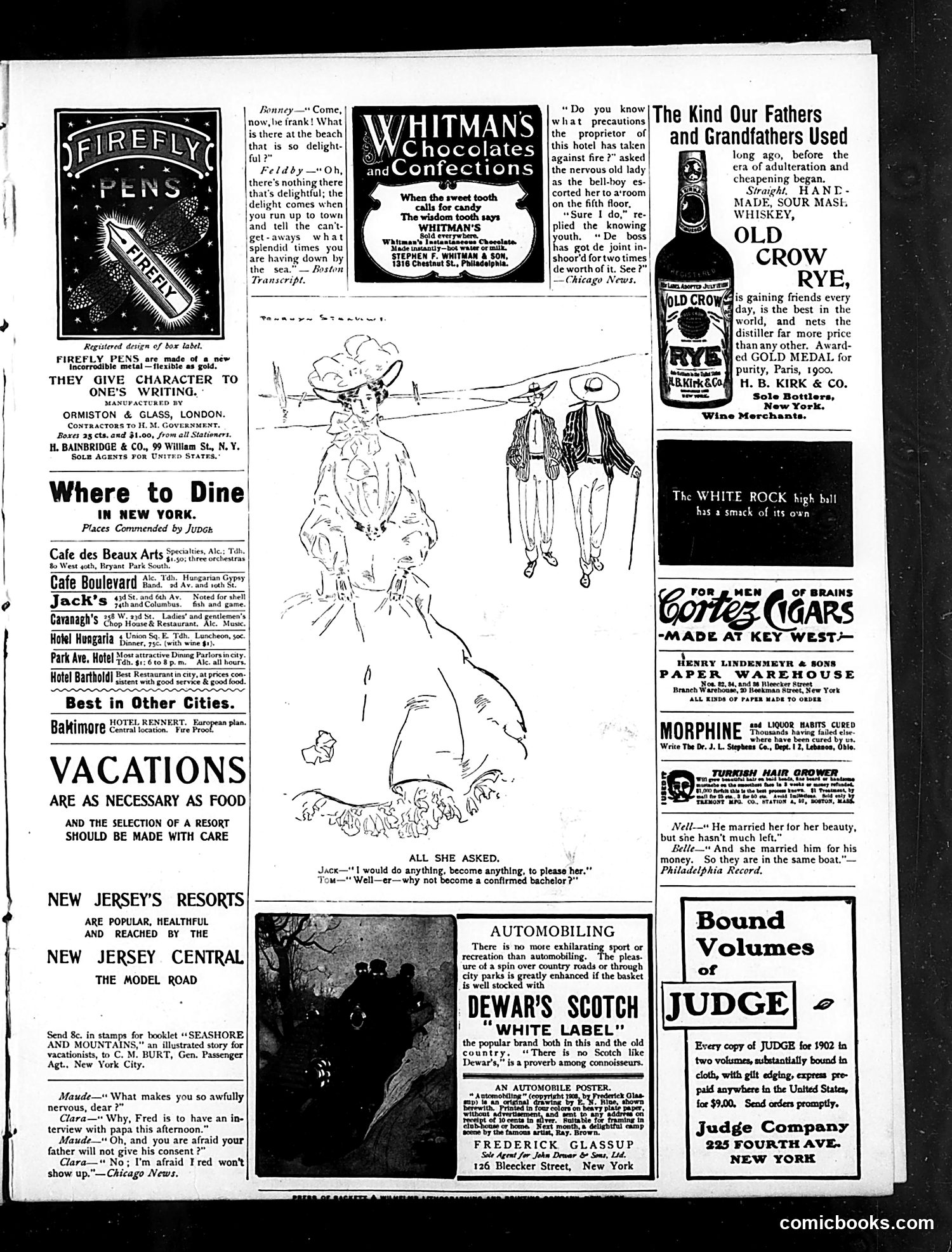
This is primarily an **advertising page** from an early 1900s issue of Judge magazine, with minimal political or social satire. The main cartoon ("All She Asked") depicts a romantic joke: a man declares he'll "do anything, become anything" to please his love interest, and his friend suggests he become "a confirmed bachelor"—implying marriage would be worse than remaining single. This reflects period anxieties about matrimonial commitment. Secondary humor appears in brief dialogue snippets: a nervous hotel guest asks about fire safety on the fifth floor; a dock worker boasts about insurance on worthless cargo; and a final quip notes a man married for beauty, a woman for money, so "they are in the same boat." The page is otherwise dominated by advertisements for Firefly Pens, Whitman's Chocolates, dining recommendations, New Jersey resorts, Dewar's Scotch, Old Crow Whiskey, Gomez Cigars, and morphine treatments—reflecting what contemporary readers considered normal commercial messaging.
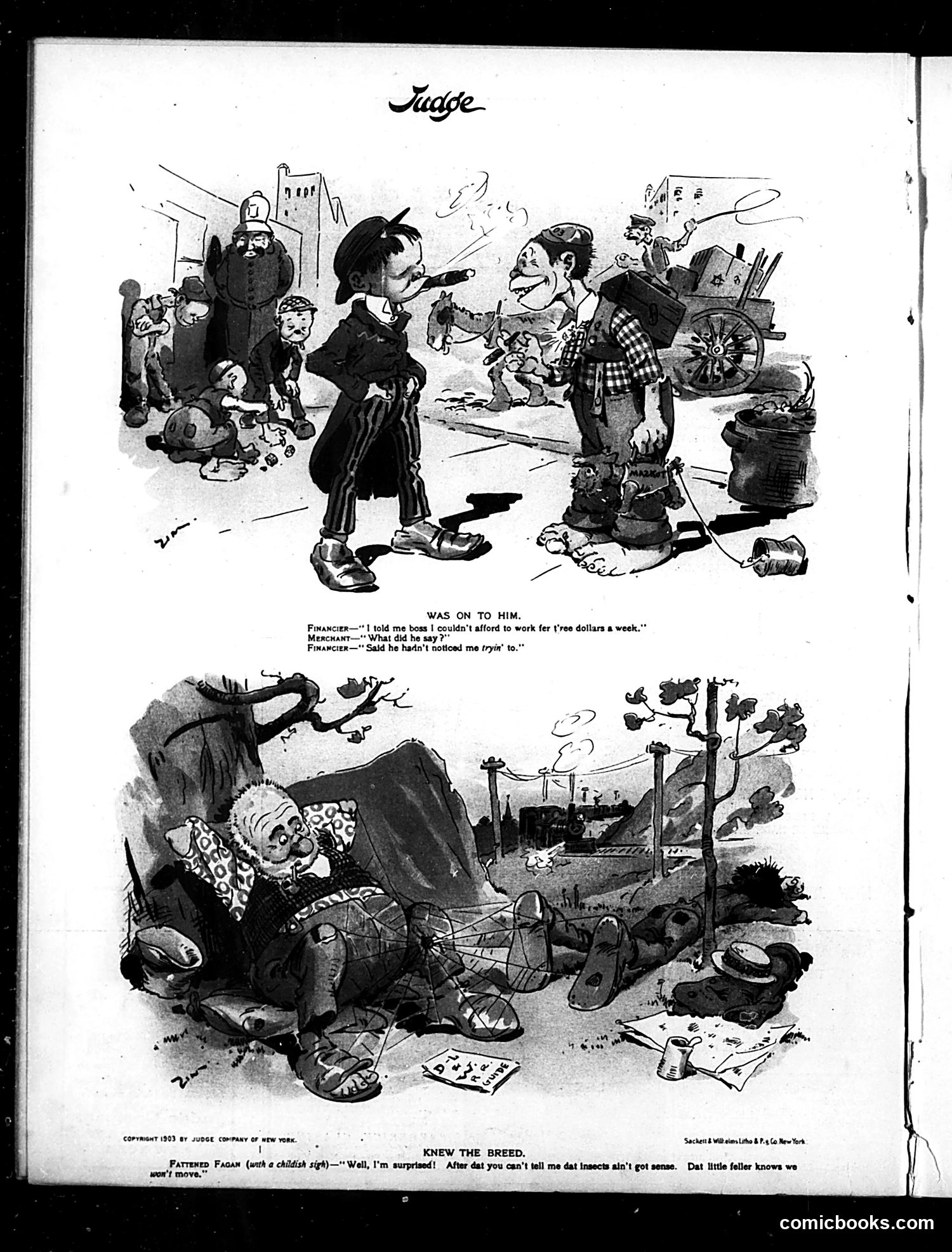
This 1903 Judge magazine page contains two satirical cartoons mocking working-class figures and labor dynamics. **Top cartoon**: A financier and merchant discuss a worker who demanded three dollars weekly wages. The financier jokes that the worker claimed he "hadn't noticed me tryin' to" pay him—mocking the worker's expectation of fair compensation while satirizing the employer's stinginess. **Bottom cartoon**: A "Fasting Farmer" (likely an Irish immigrant, suggested by the dialect) expresses surprise that insects possess intelligence because a bug didn't move when he tried to catch it. The satire mocks both rural/immigrant workers as simple-minded and suggests they lack basic reasoning. Both cartoons reflect early 20th-century American class prejudice: ridiculing laborers' wage demands and portraying working-class immigrants as intellectually inferior for comedic effect. This reflects the era's casual xenophobia and anti-labor sentiment common in mainstream publications.