
Judge, 1903-07-25 · page 10 of 16
Judge — July 25, 1903 — page 10: what you’re looking at
What you’re looking at
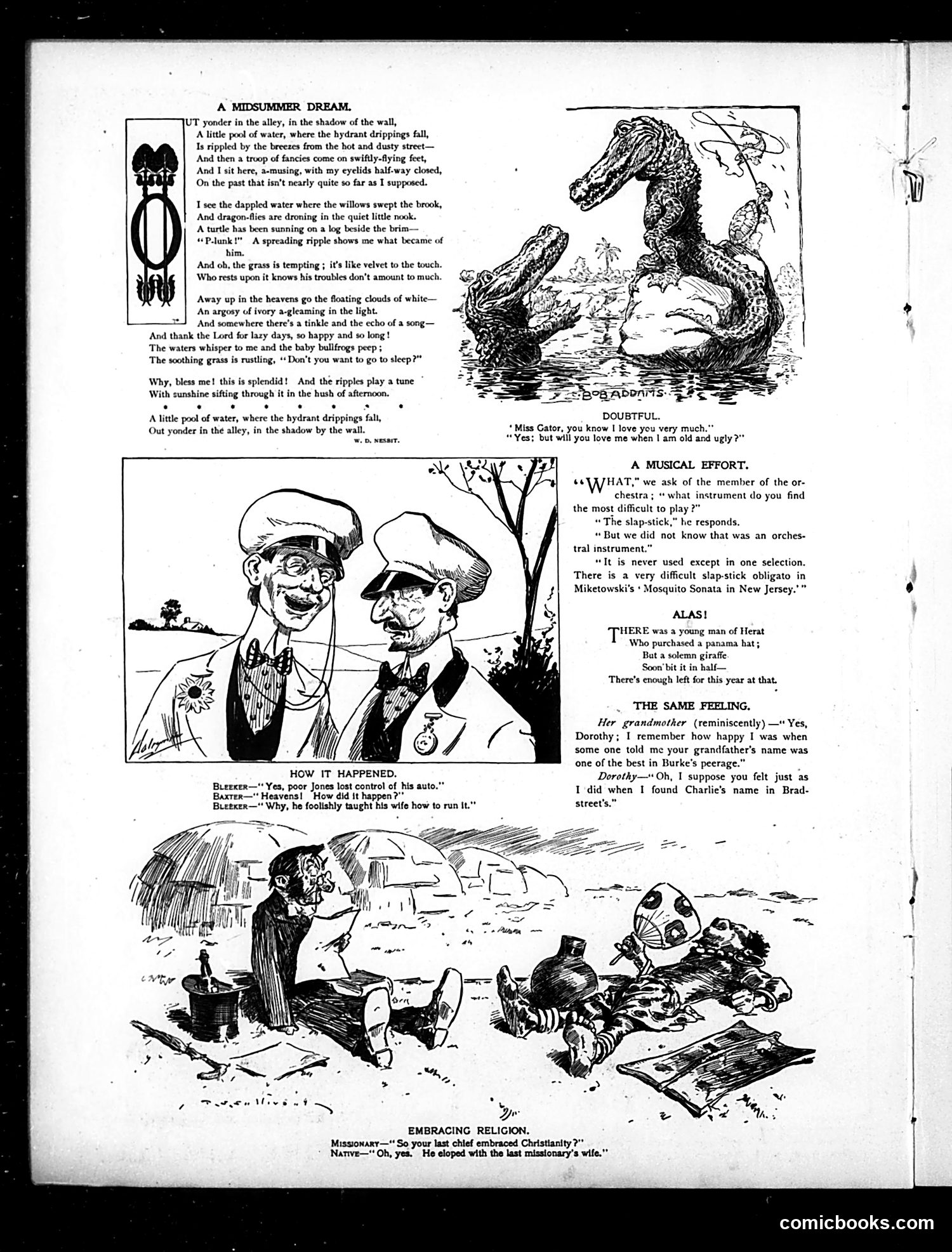
This page contains several short humorous pieces typical of early 20th-century satirical magazines: **"A Midsummer Dream"** is a nostalgic poem by W.D. Nesbit contrasting urban grime (hydrant drippings in an alley) with idealized rural memories (willows, brooks, turtles). The satire lies in romanticizing poverty—finding beauty in a dirty city puddle. **"Doubtful"** is a brief joke about a female alligator questioning her suitor's enduring love, playing on relationship anxieties. **"A Musical Effort"** mocks orchestral pretension by treating the "slap-stick" (a prop creating loud sounds, not a real instrument) as a serious orchestral piece in a fake "Mosquito Sonata." **"Alas!"** uses light verse to joke about a giraffe destroying a panama hat—absurdist humor. **"The Same Feeling"** contrasts grandmother's pride in her husband's aristocratic lineage with granddaughter Dorothy's happiness finding her boyfriend's name in a directory. **"How It Happened"** and **"Embracing Religion"** are brief jokes about automotive mishaps and missionary work, respectively.
📄 Transcribed text from this page (OCR, searchable)
Machine-transcribed from the original scan — historical spelling and the odd misread are preserved.
A MIDSUMMER DREAM. UT yonder in the alley, in the shadow of the wall, A little pool of water, where the hydrant drippings fall, Is rippled by the breezes from the hot and dusty street— And then a troop of fancies come on swiftly-flying feet, And I sit here, a-musing, with my eyelids half-way closed, On the past that isn’t nearly quite so far as I supposed. I sce the dappled water where the willows swept the brook, And dragon-flies are droning in the quiet little nook. A turtle has been sunning on a log beside the brim— “Palunk!" A spreading ripple shows me what became of him. And ob, the grass is tempting ; it’s like velvet to the touch. ‘Who rests upon it knows his troubles don’t amount to much. Away up in the heavens go the floating clouds of white— An argosy of ivory a-gleaming in the light. > = And somewhere there's a tinkle and the echo of a song— a ‘And thank the Lord for lazy days, so happy and so long! ‘The waters whisper to me and the baby bullfrogs peep ; ‘The soothing grass is rustling, “Don't you want to go to sleep?” Why, bless me! this is splendid! And the ripples play a tune With sunshine sifting through it in the hush of afternoon. . . . . . . * . A little pool of water, where the hydrant drippings fall, DOUBTFUL. Out yonder in the alley, in the shadow by the wall. * Miss Gator, you know I love you very much.” w. D. NESBIT. “Yes; but will you love me when | am old and ugly?” A MUSICAL EFFORT. 66\ HAT," we ask of the member of the or- chestra; “what instrument do you find the most difficult to play ?” «“ The slap-stick,” he responds. + But we did not know that was an orches- tral instrument.” “It is never used except in one selection. There is a very difficult slap-stick obligato i 1] Miketowski’s * Mosquito Sonata in New Jersey.’” 6 ALAS! THERE was a young man of Herat Who purchased a panama hat ; Bat a solemn giraffe Soon’ bit it in half— There's enough left for this year at that, . THE SAME FEELING. Her grandmother (reminiscently) — Yes, Dorothy ; I remember how happy I was when some one told me your grandfather's name was one of the best in Burke's peerage.” HOW IT HAPPENED. Dorothy—“Oh, I suppose you felt just as Leet bes argh conor ry ose a auto.’° I ‘did when I found Charlie's name in Brad- Bueexer—" Why, he foolishly taught his wife how to run It."* street's.” = ye EMBRACING RELIGION. “* So your last chief embraced Christianity?" Oh, yes. He eloped with the last missionary’s wife.” comicbooks.com