
Judge, 1903-07-25 · page 7 of 16
Judge — July 25, 1903 — page 7: what you’re looking at
What you’re looking at
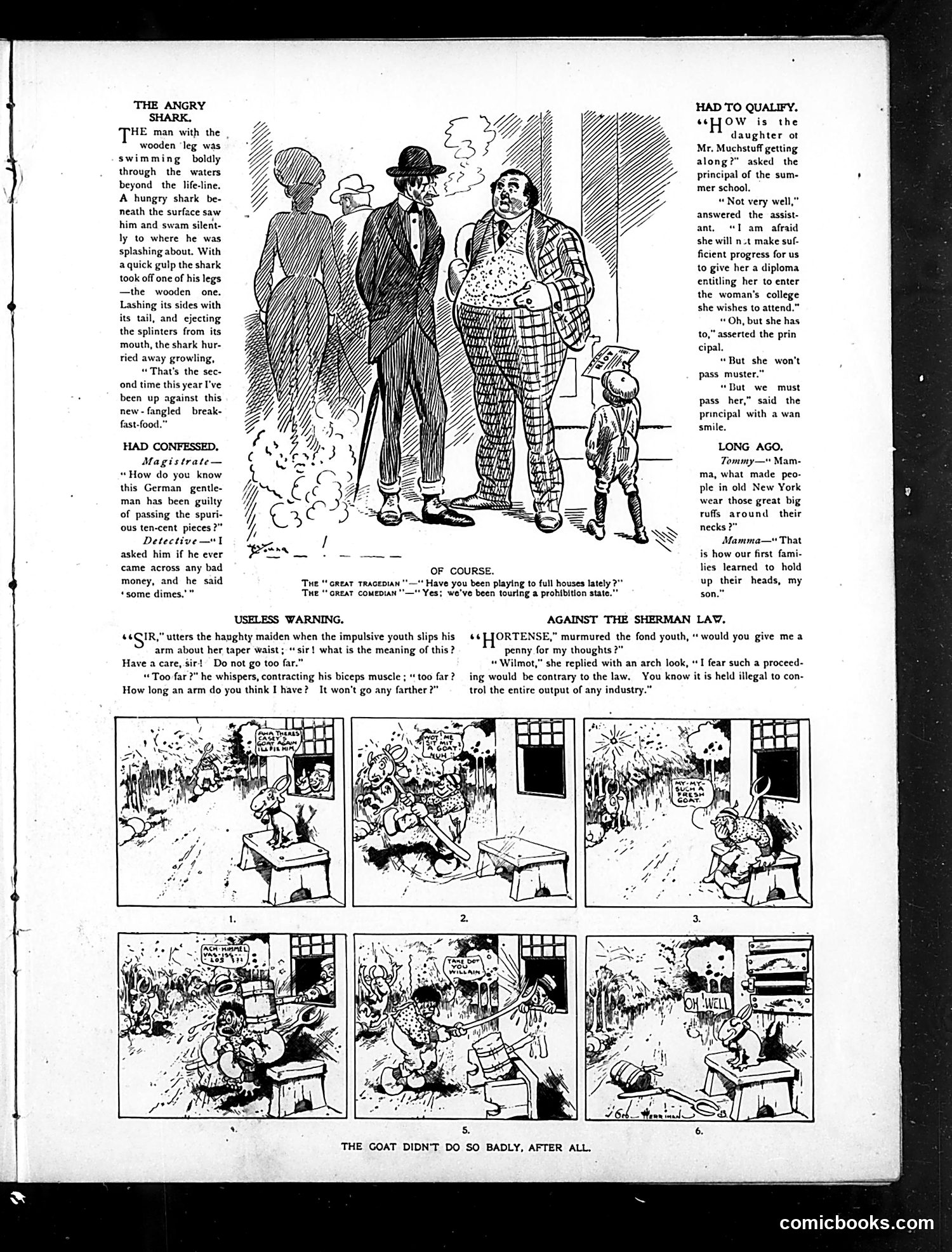
This Judge magazine page contains several satirical pieces reflecting early 20th-century American concerns: **"The Angry Shark"** jokes about "newfangled breakfast-food"—likely referencing processed foods or cereal products of the era, which were novel and sometimes considered inferior or indigestible. **"Had to Qualify"** satirizes grade inflation and institutional pressure: a principal insists on passing an unqualified student to maintain enrollment, suggesting corruption in educational standards. **"Of Course"** mocks theater touring during Prohibition (likely 1920s onward), joking that even "full houses" occur only in dry states—implying audiences seek entertainment as substitute for banned alcohol. **"Against the Sherman Law"** uses the Sherman Antitrust Act (1890) as a joke premise: a young man's attempt to "control the entire output" of a woman's thoughts is reframed as illegal monopolistic practice. This clever wordplay satirizes both romantic presumption and antitrust concerns. The comic strips below appear to depict slapstick humor involving a goat, with the caption "The Goat Didn't Do So Badly, After All."
📄 Transcribed text from this page (OCR, searchable)
Machine-transcribed from the original scan — historical spelling and the odd misread are preserved.
‘THE ANGRY SHARK. THE man with the wooden ‘leg was swimming boldly through the waters beyond the life-line. A hungry shark be- neath the surface saw him and swam silent- ly to where he was splashing about. With aquick gulp the shark took off one of his legs —the wooden one. Lashing its sides with its tail, and ejecting the splinters from its mouth, the shark hur- ried away growling, “That's the sec- ond time this year I've been up against this newfangled break- fast-food.” HAD CONFESSED, Magistrate— “How do you know this German gentle man has been guilty of passing the spuri- ‘ous ten-cent pieces ?” Detective—t asked him if he ever came across any bad HAD TO QUALIFY. ssLJOW is the daughter ot Mr. Muchstuf getting along?” asked the principal of the sum- mer school. « Not very well,” answered the assist- ant, “I am afraid she will not make suf- ficient progress for us to give her a diploma entitling her to enter the woman's college she wishes to attend.” + Oh, but she has to,” asserted the prin cipal. “But she won't pass muster.” “But we must pass her,” said the principal with a wan smile. LONG AGO. Tommy—" Mam- ma, what made peo- ple in old New York wear those great big ruffs around their necks 2” Mamma—" That is how our first fami- a OF COURSE. lies learned to hold money, and he said ‘The “GREAT TRAGEDIAN Have you been playing to full houses lately?” up their heads, my “some dimes.’” Tue “oreat comenian "—" Yes; we've been touring a prohibition state."* son.” USELESS WARNING. ‘4GIR." utters the haughty maiden when the impulsive youth slips his arm about her taper waist ; “sir! what is the meaning of this? Have a care, sir! Do not go too far.” “Too far?" he whispers, contracting his biceps muscle ; “too far ? How long an arm do you think I have? It won't go any farther 2” AGAINST THE SHERMAN LAV. S6}JORTENSE,” murmured the fond youth, penny for my thoughts 2” “ Wilmot,” she replied with an arch look, «I fear such a proceed- ing would be contrary to the law. You know it is held illegal to con- trol the entire output of any industry.” ould you give mea comicbooks.com