
A complete issue · 16 pages · 1903
Judge — June 6, 1903
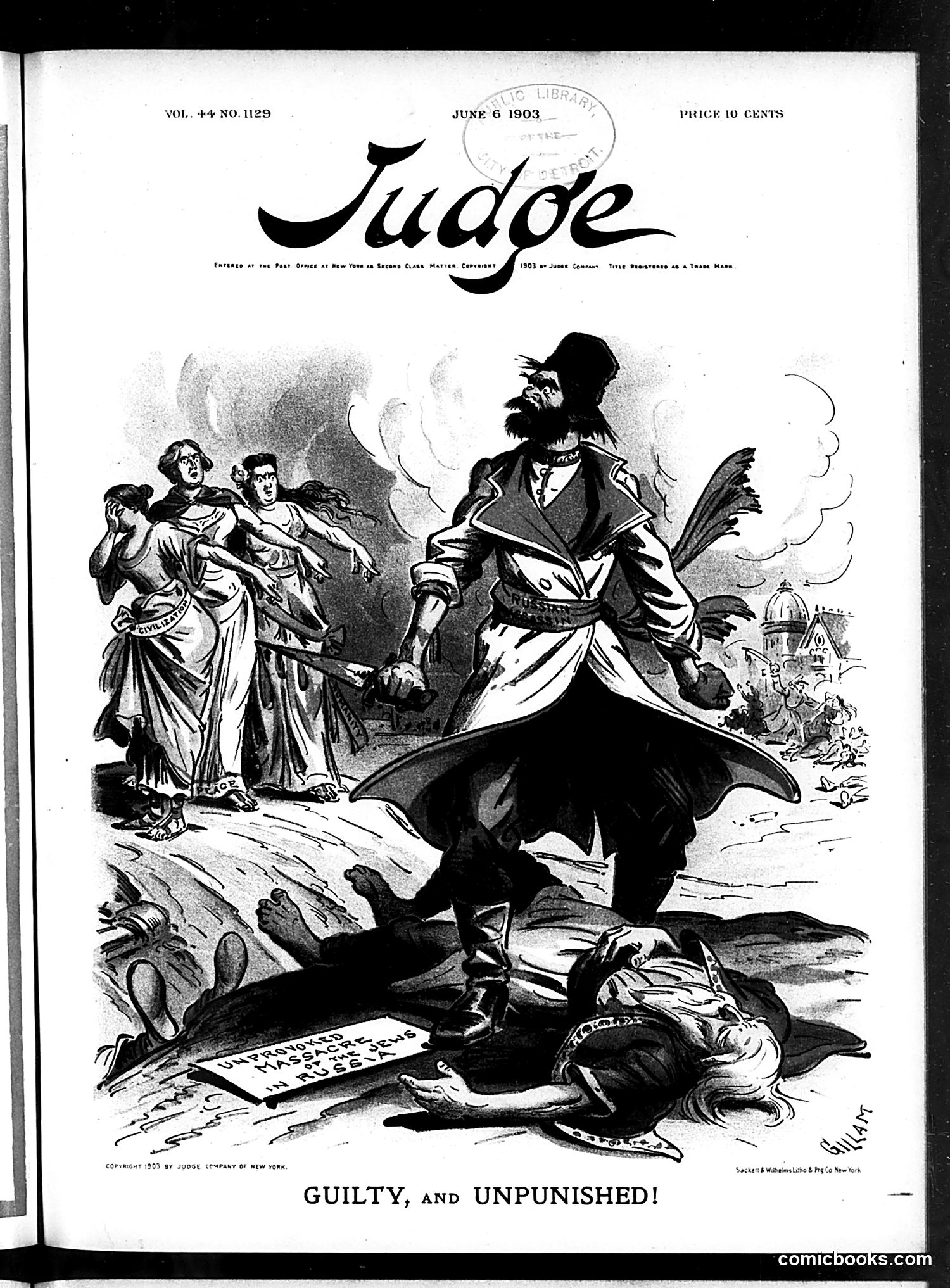
This Judge magazine cover from June 6, 1903 depicts a military or imperial figure standing triumphantly over a fallen female figure (likely representing Justice or a wronged nation). The uniformed man holds a sword while gesturing dismissively, as robed figures in the background appear distressed or powerless. The caption "Guilty, and Unpunished!" suggests the cartoon critiques a specific military or political leader who committed an offense yet faced no consequences. The imagery—with Justice defeated and formal authorities ineffectual—emphasizes impunity despite clear wrongdoing. Without additional context, the exact historical event remains unclear, though the style suggests commentary on imperial conduct or military excess during the early 1900s, possibly relating to colonial conflicts or domestic political scandal.
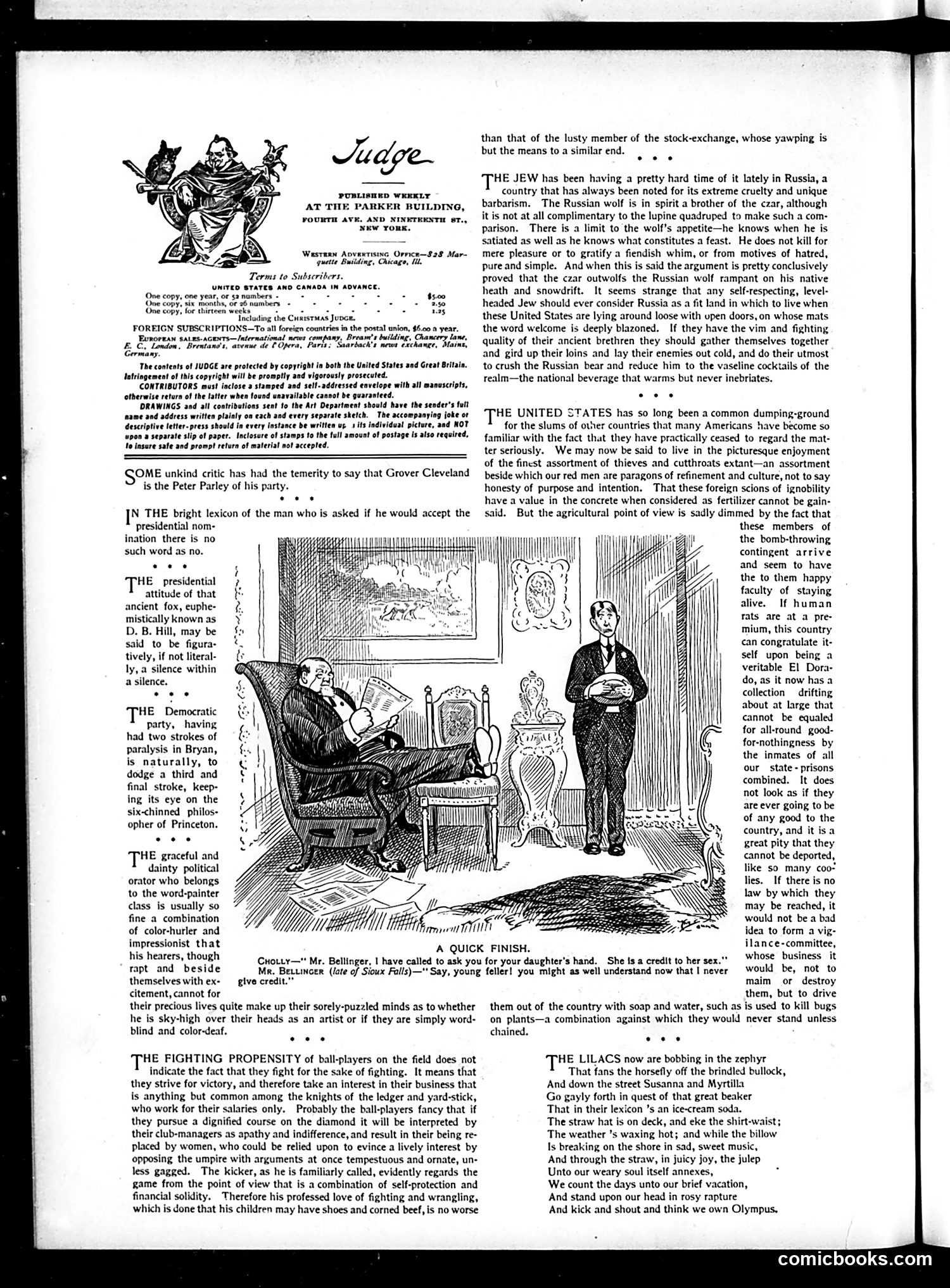
The main cartoon depicts a domestic scene where a seated man (appears to be a wealthy gentleman) is being confronted by what looks like a servant or visitor about a daughter's marriage proposal. The caption reads: "CHOLLY—'Mr. Bellinger, I have called to ask you for your daughter's hand. She is a credit to her sex.' MR. BELLINGER (late of State Penitentiary)—'Say, young fella! you might as well understand such I never give credit.'" The satire targets class mobility and hypocrisy: the father, recently released from prison, now wealthy enough to have marriageable daughters, makes a crude joke about "credit" that reveals his criminal past and lack of refinement despite his newfound status. The humor mocks nouveau-riche pretensions and suggests moral bankruptcy underlying material success.
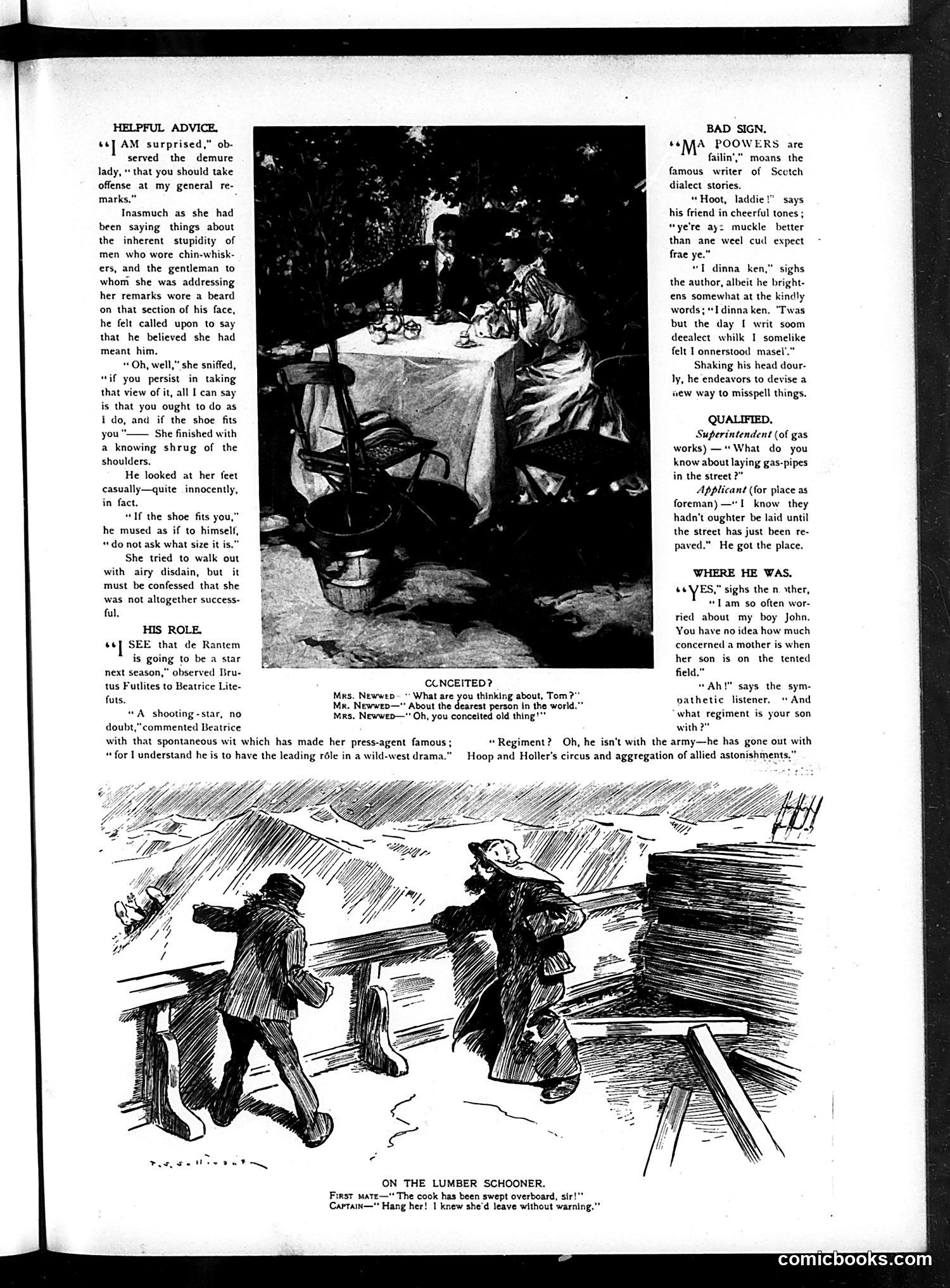
This page contains several humor pieces rather than political cartoons: **"Helpful Advice"** and **"His Role"**: Brief anecdotes about social situations—a woman criticized for her shoe choices, and casting news about an actor named de Rantem. **"Bad Sign"**: Jokes about Scottish writer Ma Poowers and misunderstandings of Scottish dialect. **"Qualified"** and **"Where He Was"**: Short humorous exchanges about job qualifications and a mother's concern about her son. **"On the Lumber Schooner"**: A sketch depicting sailors on a ship, with dialogue about an overboard cook. These are light, domestic humor pieces typical of early 20th-century satirical magazines—no significant political references or caricatures of identifiable public figures appear here. The content emphasizes wordplay, social misunderstandings, and situational comedy rather than satire.
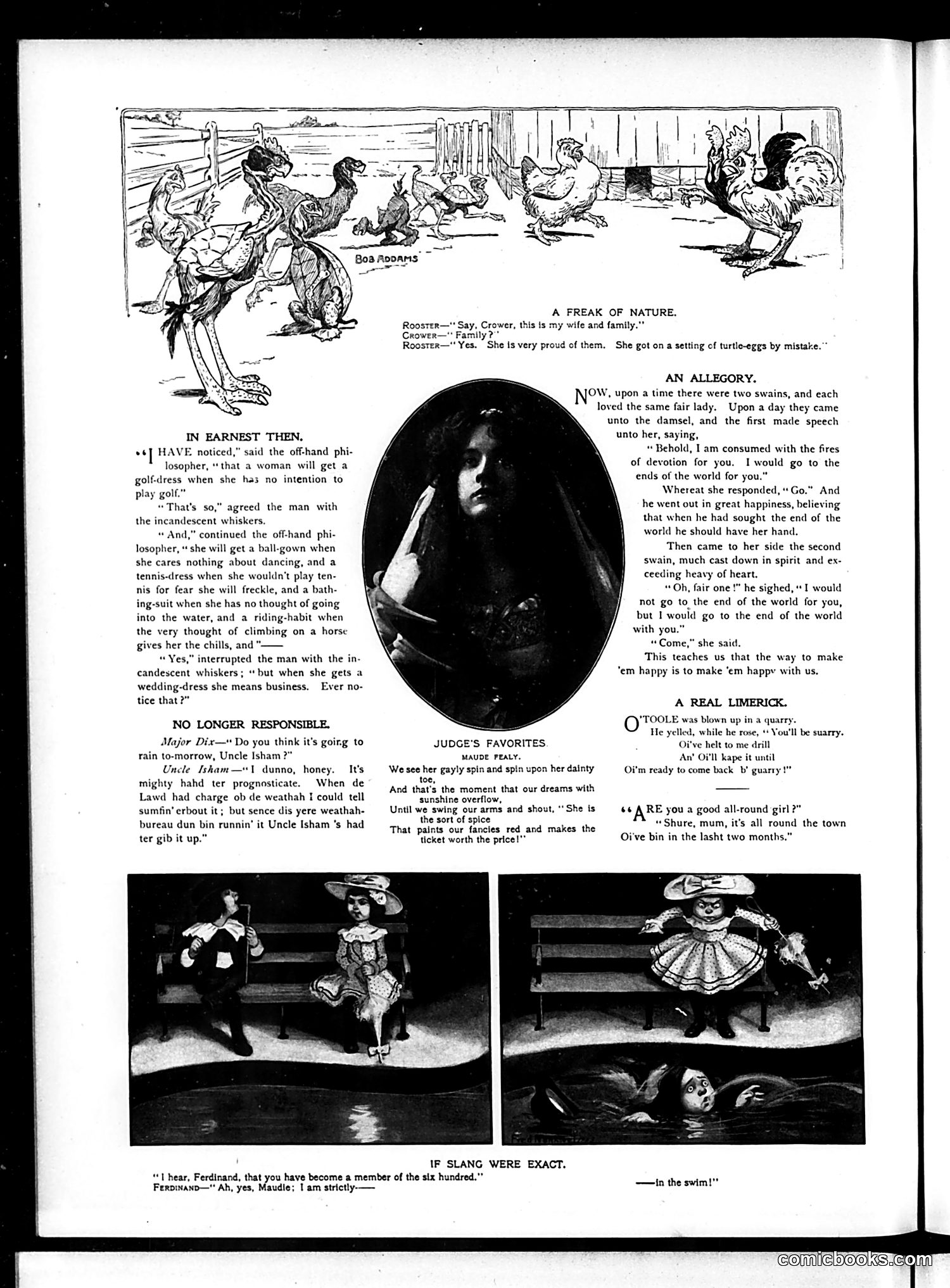
This page contains several unrelated humorous pieces typical of Judge's satirical format: **"A Freak of Nature"** depicts a rooster claiming a batch of turtle eggs as his offspring—a visual gag about misidentification and absurd paternity. **"In Earnest Then"** and **"No Longer Responsible"** are dialogue-based jokes about women's unpredictable behavior, reflecting early-20th-century gender stereotypes common to the era's humor. **"An Allegory"** presents a sentimental fable about two swans, emphasizing devotion and sacrifice in relationships. **"Judge's Favorites"** includes short verses and limericks on miscellaneous topics. The bottom images show theatrical or comedic scenes, with one caption referencing slang accuracy. Overall, this represents Judge's typical mix of visual gags, satirical commentary on social behavior, and literary humor—without identifiable political figures or specific contemporary events.
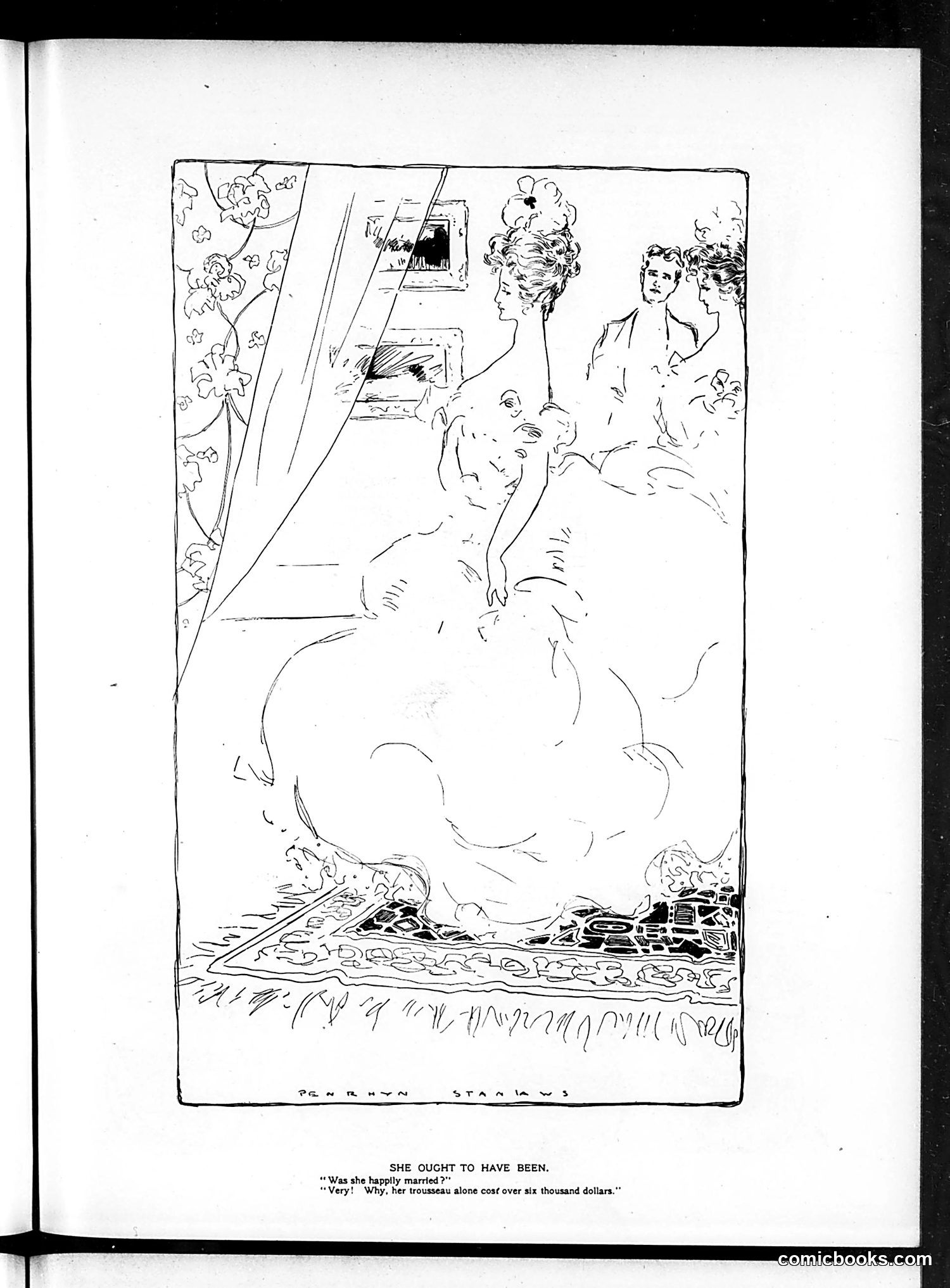
This cartoon satirizes extravagant spending on women's fashion and accessories. The illustration shows an elegantly dressed woman with three attendants examining her expensive wardrobe and appearance. The caption's dialogue mocks the costs: when asked if she's happily married, the response notes her "trousseau alone cost over six thousand dollars"—an enormous sum for the era. The satire targets the disconnect between material luxury and actual happiness or marital contentment. The title "She Ought to Have Been" suggests ironic commentary: despite the staggering financial investment in her appearance and wedding outfit, she apparently isn't happy. Judge magazine frequently critiqued Gilded Age excess and the foolish prioritization of conspicuous consumption over genuine well-being. This reflects broader Progressive Era anxieties about wealth inequality and frivolous upper-class spending.
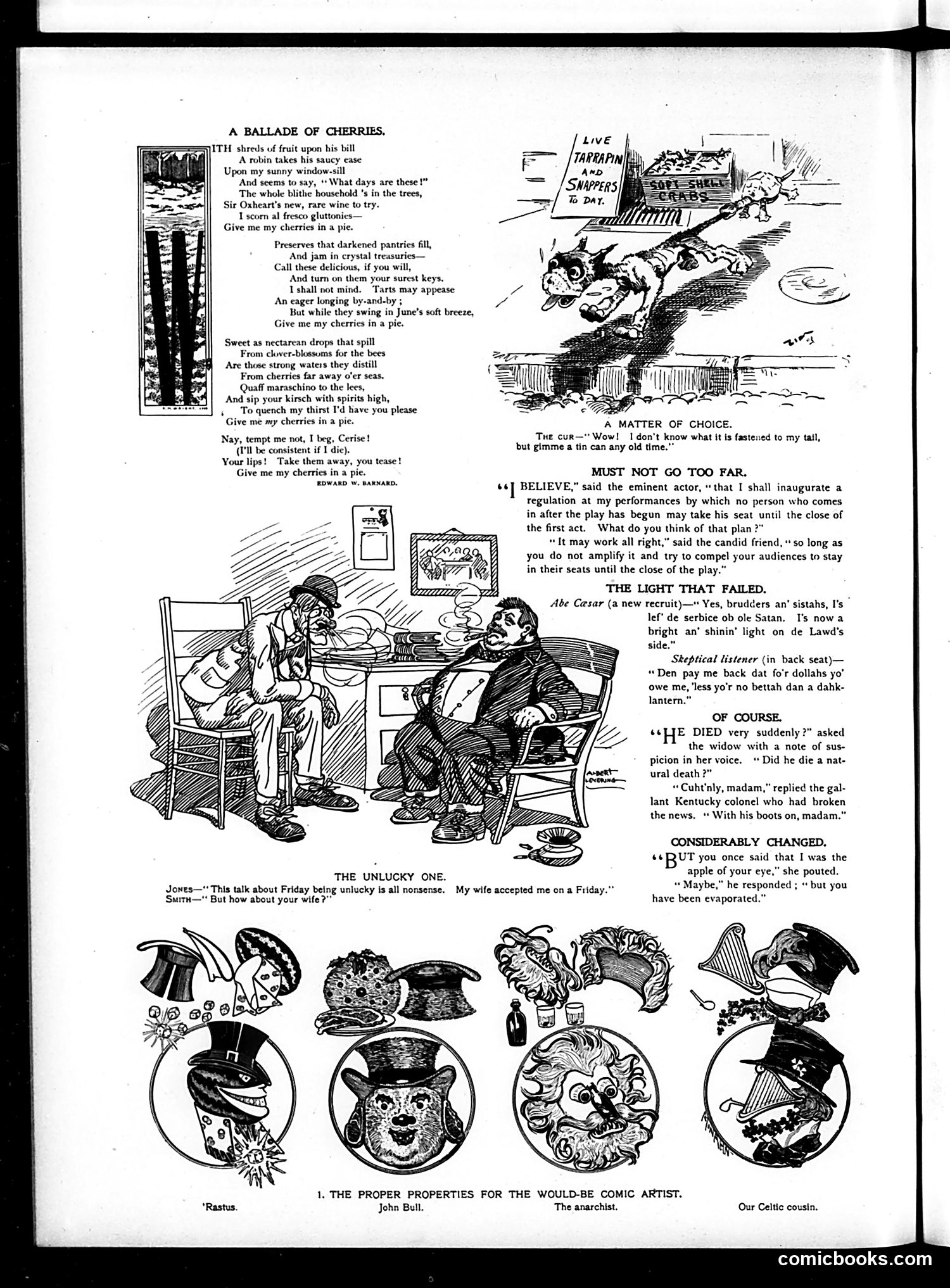
This page contains several satirical pieces typical of Judge's late 19th/early 20th-century humor: **"A Ballade of Cherries"** is a whimsical poem expressing preference for cherry pie over other preparations—purely light domestic humor with no political content. **The cartoon vignettes** mock various social types through exaggerated caricature: - "The Unlucky One" jokes about Friday marriage superstitions - "Must Not Go Too Far" satirizes theatrical actors imposing excessive audience restrictions - "The Light That Failed" mocks a religious convert who hasn't actually reformed morally - "Of Course" presents a Kentucky colonel euphemizing a man's violent death ("boots on") - "Considerably Changed" jokes about a woman's appearance changing after marriage **The bottom panel**, "The Proper Properties for the Would-Be Comic Artist," shows four ethnic/national caricatures (John Bull, "The Anarchist," and "Our Celtic Cousin") as stereotypical character types for cartoonists to employ—reflecting the period's casual, offensive reliance on ethnic stereotyping for comedy. The page is primarily entertainment rather than political commentary.
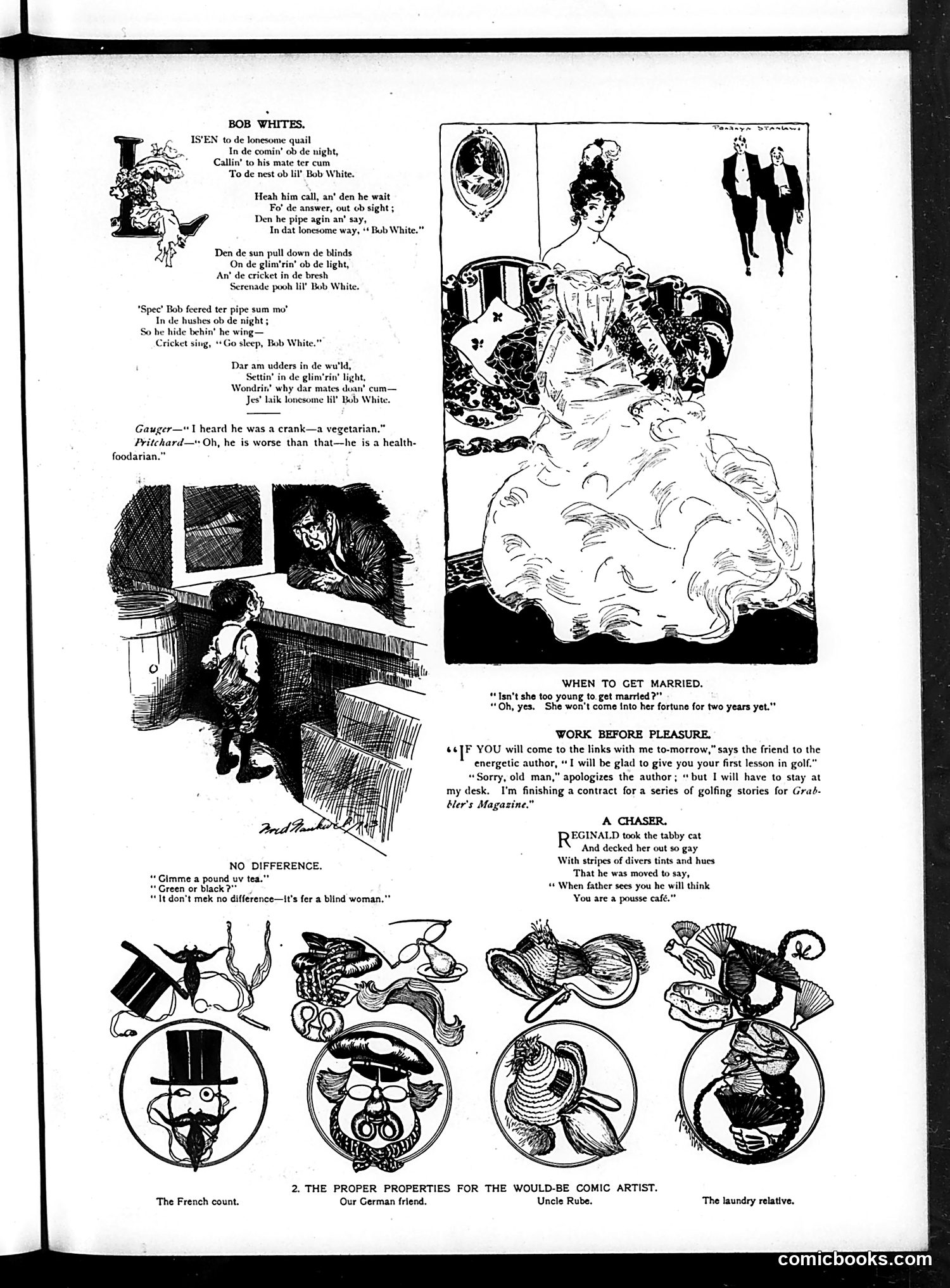
This page contains several unrelated short humor pieces typical of early 20th-century American satirical magazines. **"Bob Whites"** is a sentimental poem (in dialect) about quails calling to mates, with an unclear allegorical point—possibly about loneliness or separation, though the meaning isn't explicit. **"No Difference"** is a brief joke playing on class indifference: a customer orders tea for a blind woman and doesn't care whether it's green or black, since she can't see the difference anyway. **"When to Get Married"** jokes about marrying for money—a young woman is only marriageable once she inherits her fortune in two years. **"Work Before Pleasure"** is self-referential satire: an author declines a golf outing because he's writing golf stories for a magazine—mocking the commercialization of leisure activities. **"A Chaser"** makes a pun: a cat dressed in colorful stripes resembles a "pousse café" (a layered cocktail). The bottom section shows caricatured "types" useful for comic artists: French aristocrats, Germans, and working-class relatives—stock characters for period humor.
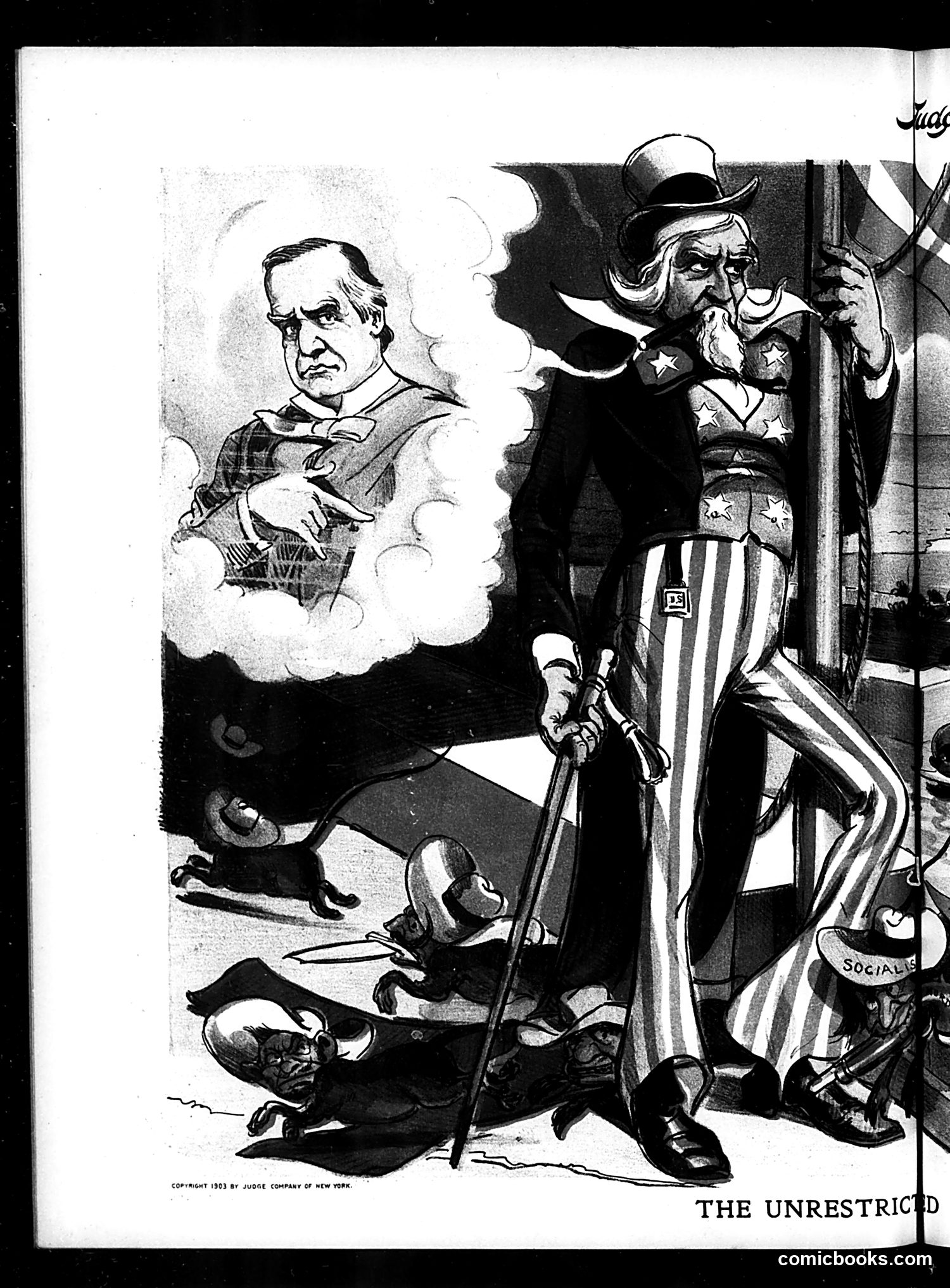
This 1923 political cartoon from *Judge* depicts Uncle Sam (the bearded figure in striped pants on the right) being influenced or controlled by a shadowy figure shown in a thought bubble on the left. The cartoon criticizes American foreign policy as being manipulated by unseen forces. The title "The Unrestricted" likely refers to unrestricted submarine warfare or unrestrained foreign intervention—major political debates of the 1920s. The contrast between Uncle Sam's outward appearance and the puppet-master figure in his mind suggests hypocrisy: America claims independence while actually being controlled by hidden interests, possibly wealthy industrialists, foreign powers, or political elites. The satire mocks America's claim to act freely in international affairs.
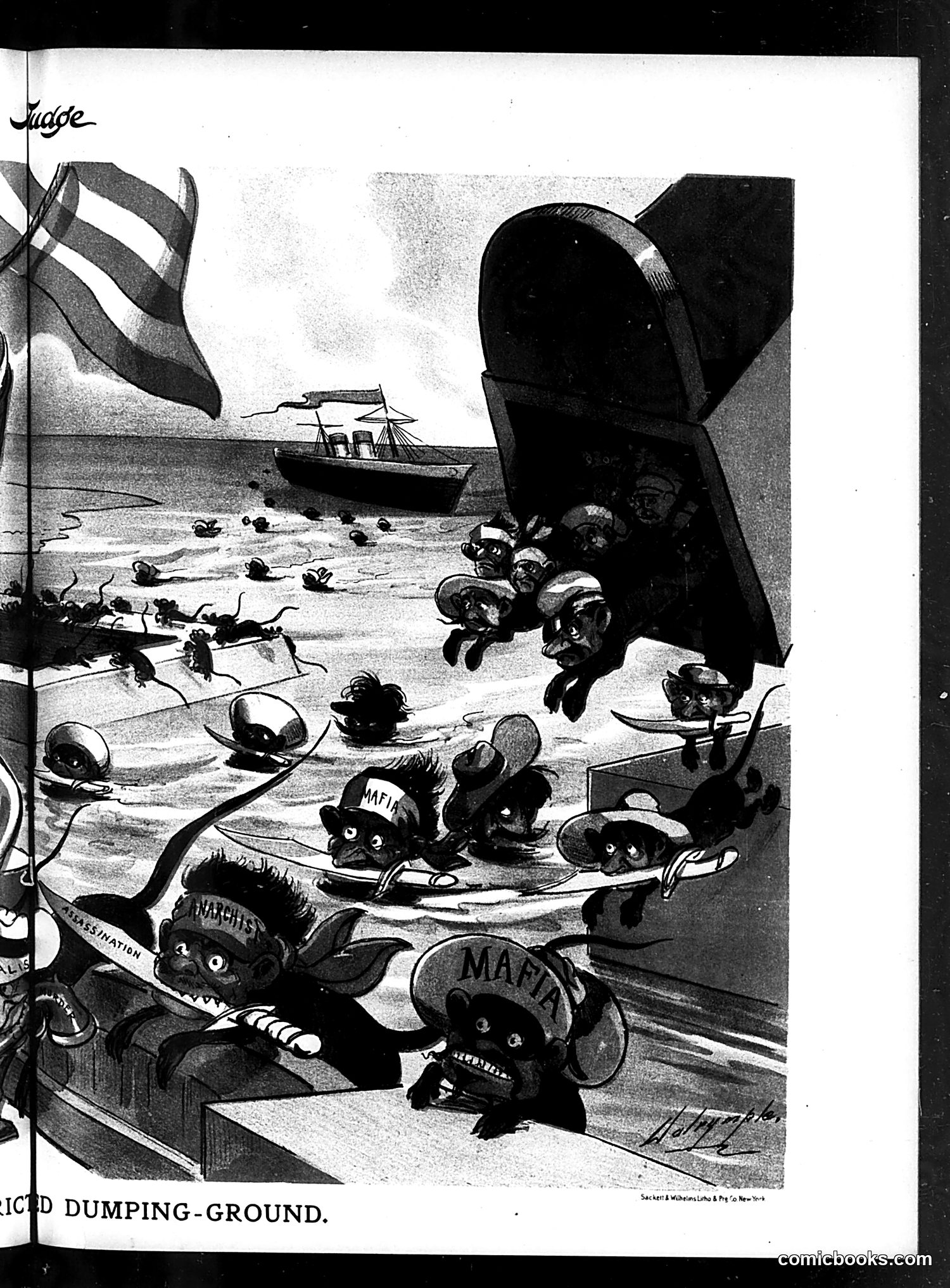
This Judge cartoon depicts anthropomorphized rats labeled "MAFIA" emerging from a large pipe or conduit onto a beach, with a boat visible in the background and what appears to be a judge's gavel in the upper left. The cartoon satirizes organized crime (the Mafia) as vermin being "dumped" into society through illegal channels. The beach setting and boat suggest smuggling or illicit importation. The title "Illicit Dumping-Ground" indicates this location serves as a point where criminal organizations unload their operations into the community. This appears to be commentary on Prohibition-era organized crime (likely 1920s-1930s Judge publication), criticizing how the Mafia infiltrated American cities through corruption and illegal activities, portrayed as an infestation of rats.
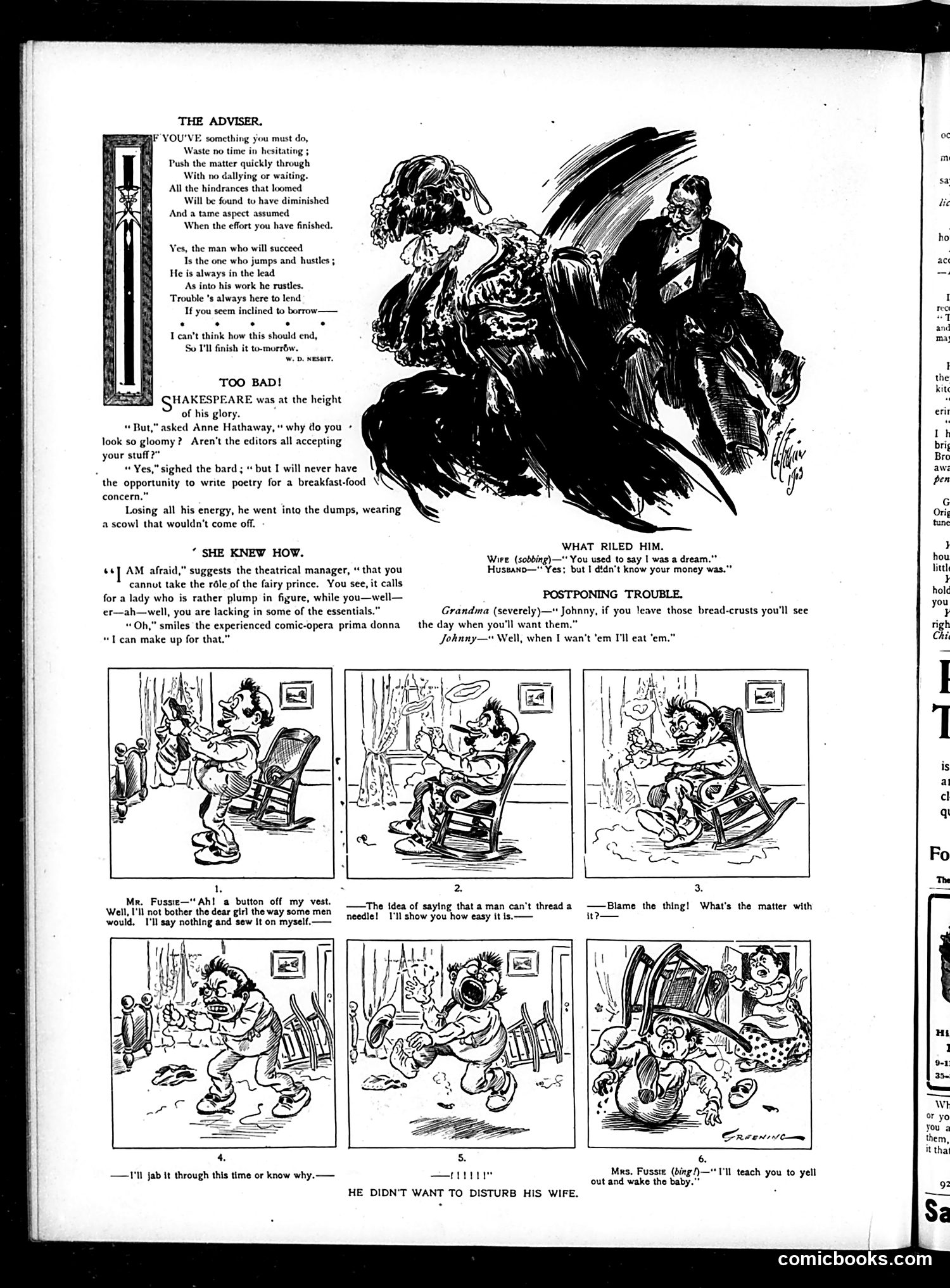
This page from *Judge* contains several satirical humor pieces typical of early 20th-century American magazines: **"The Adviser"** and **"Too Bad!"** are verse and prose jokes about procrastination and missed opportunities—Shakespeare lamenting he'll never write for cereal advertisements, a common modern commercial venture. **"She Knew How"** and **"What Riled Him"** are brief domestic humor pieces poking fun at marriage dynamics and miscommunication (a wife's dream of being idealized, financial concerns). **"Postponing Trouble"** satirizes a grandmother warning a boy about wasting food, with the boy's confident reply that he'll eat them when hungry—mocking youthful shortsightedness. **The six-panel comic strip "He Didn't Want to Disturb His Wife"** shows Mr. Fussie attempting household repairs (sewing a button) while trying not to wake his wife, escalating into chaotic disaster. The humor relies on slapstick and the era's assumption that men are incompetent at domestic tasks—a common gender stereotype of the period. All content reflects *Judge's* focus on middle-class domestic satire and gentle social observation rather than hard political commentary.
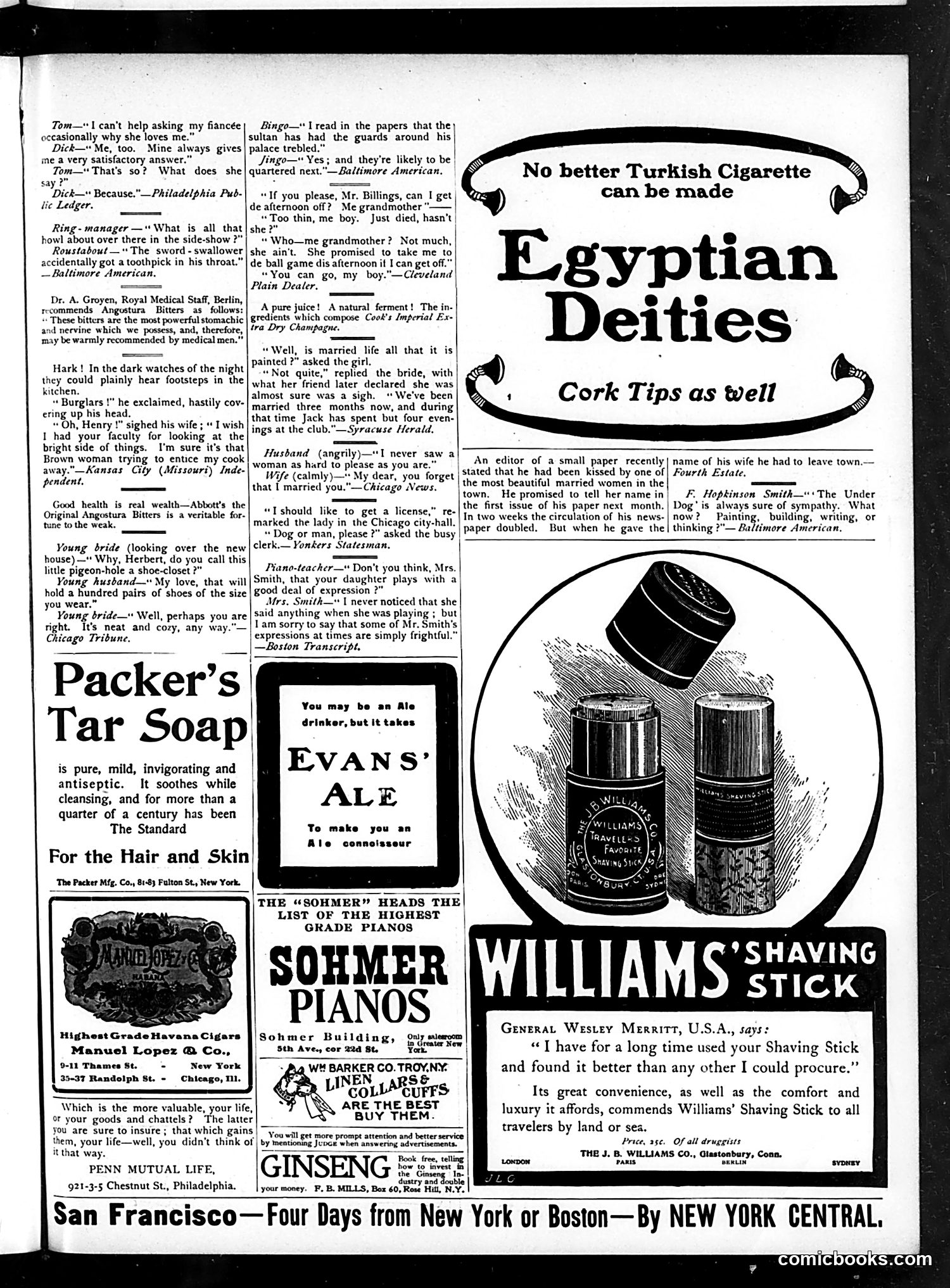
This is primarily an **advertising page** from Judge magazine, with short humorous anecdotes in the margins—typical of early 20th-century publications mixing content and ads. The brief jokes are domestic humor and mild satire: - A gag about a fiancée's vague answer ("Because") to why she loves her partner - A newlywed couple joke (the bride unhappy that her husband spends only four evenings at the club instead of more) - A sword-swallower accidentally getting a toothpick stuck—slapstick wordplay - A piano teacher's frustration that a student's father uses "frightful expressions" (profanity) The **"Bingo/Jingo" reference** to the Sultan's palace guards is topical satire about Ottoman Empire security concerns, likely from the pre-WWI era when such news was current. The **dominant feature** is advertising for products like Egyptian Deities cigarettes, Williams' Shaving Stick, Sohmer Pianos, and patent medicines—reflecting the page's commercial purpose rather than editorial content.
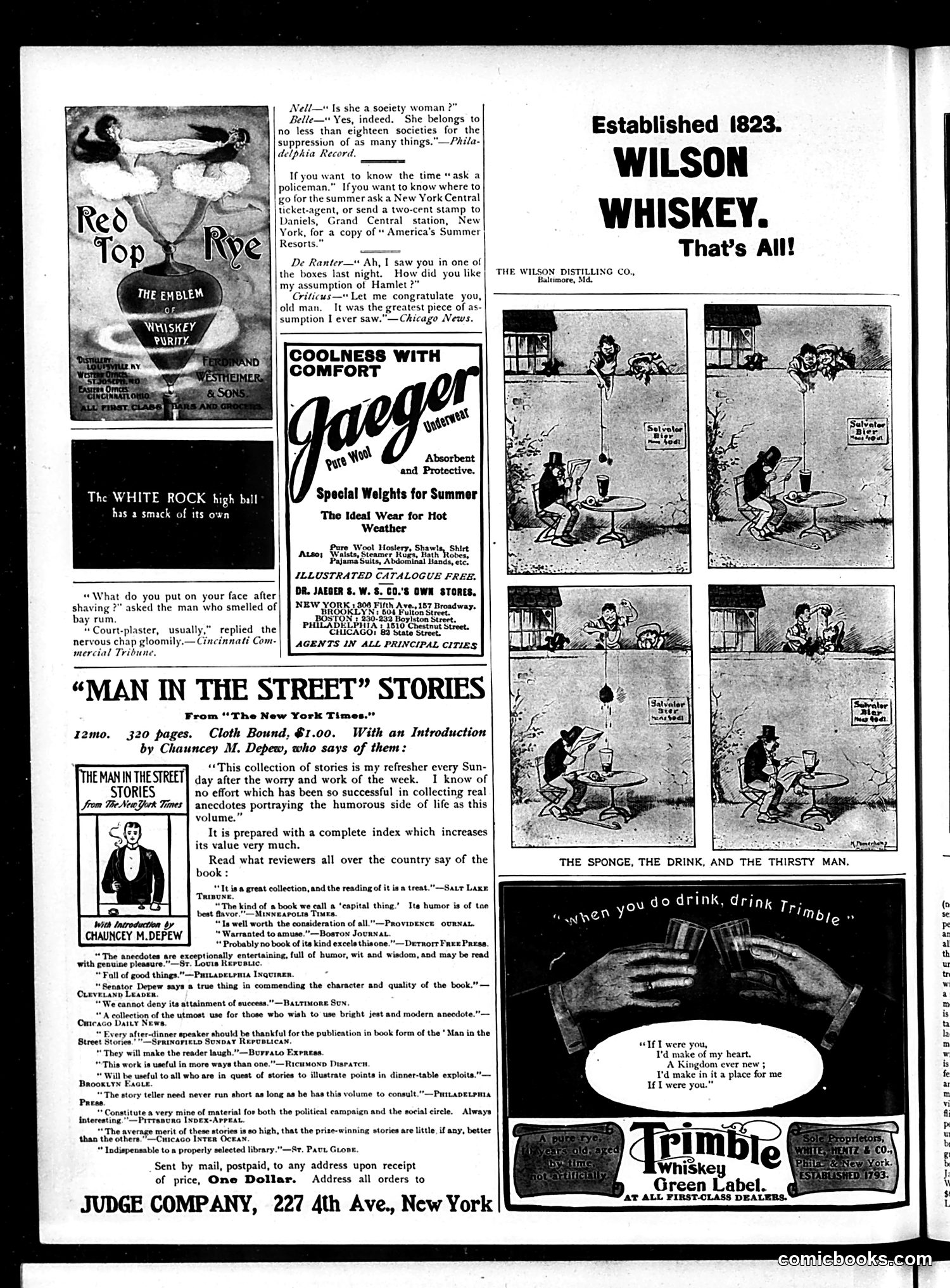
This page is primarily **advertisements and filler content** rather than political satire. The main elements include: **Small Jokes/Quips:** Brief conversational humor about society women joining charitable organizations, theater criticism ("assumption" as both acting and presumption), and a grooming product pun. **Book Advertisement:** "Man in the Street Stories" from the New York Times—a humor collection endorsed by Vice President Chauncey Depew, featuring anecdotes about everyday life. **Product Ads:** Jaeger wool clothing for summer wear, Red Top Rye whiskey, White Rock beverages, and Trimble whiskey. **Comic Strip:** "The Sponge, the Drink, and the Thirsty Man" depicts a character repeatedly visiting an outdoor bar/refreshment stand across sequential panels—likely satirizing excessive drinking or commercial consumption habits. The page reflects early-1900s American advertising and light humor rather than sharp political commentary. The dominant focus is commercial messaging aimed at affluent readers.
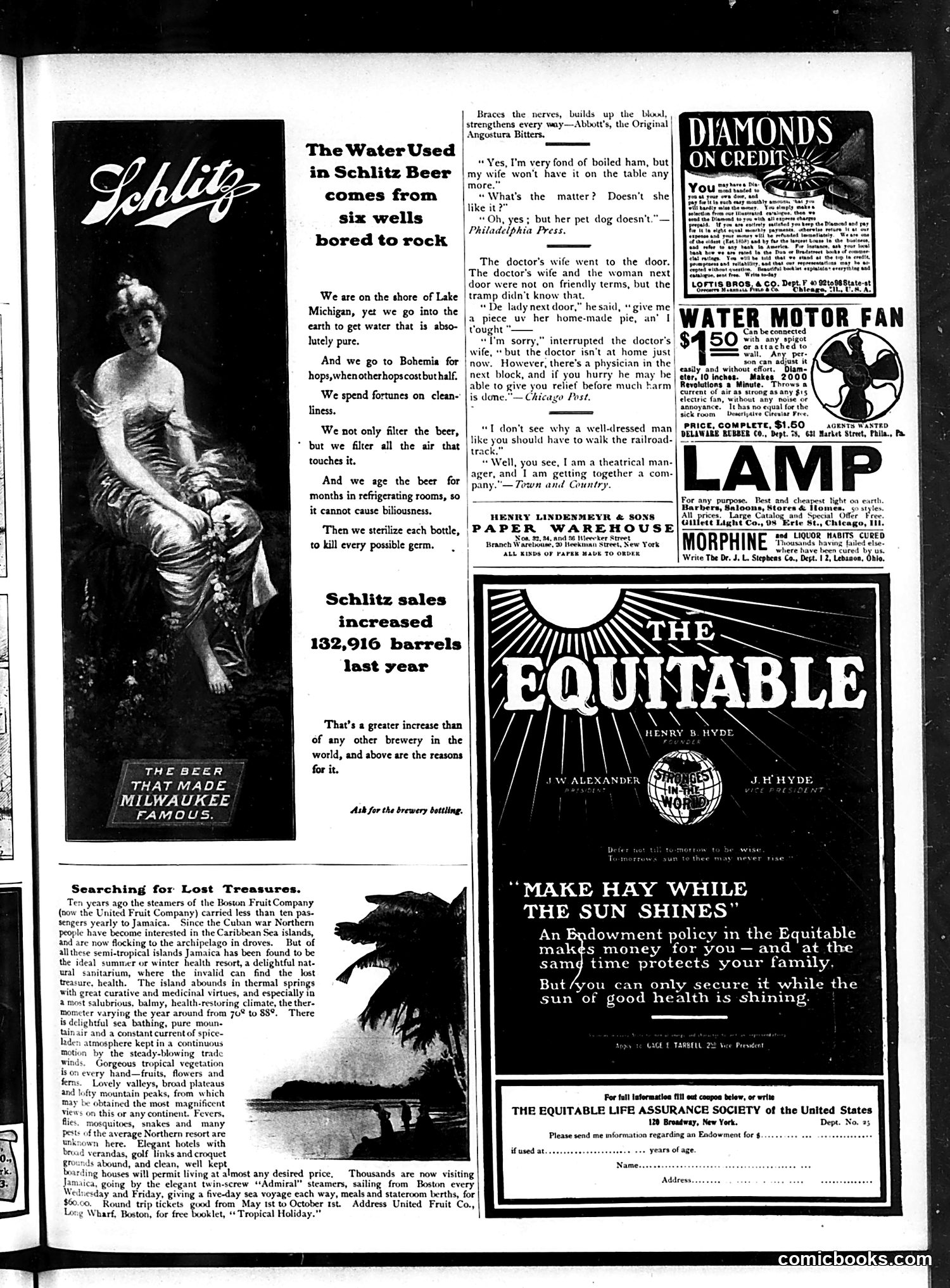
This is primarily an **advertising page** with several product promotions and brief humorous anecdotes, rather than political satire. **Main Content:** The **Schlitz Beer advertisement** dominates the left side, celebrating the brewery's purity standards (deep wells, filtered air, sterilization) and boasting a sales increase of 132,916 barrels—claiming superiority over competitors. **The humor pieces** are light social commentary: - A wife rejecting boiled ham because the family dog won't eat it (joke about dog food standards) - A tramp requesting pie from a neighbor's wife; the doctor's wife directs him to a physician instead, implying the pie would cause illness - A theatrical manager explaining why well-dressed men ride trains (to scout talent) **Other advertisements** include Jamaica tourism, water motor fans, life insurance, and various remedies. **For modern readers:** This reflects early 1900s commercial culture where breweries competed on cleanliness claims, and humor relied on class distinctions and domestic situations rather than political commentary.
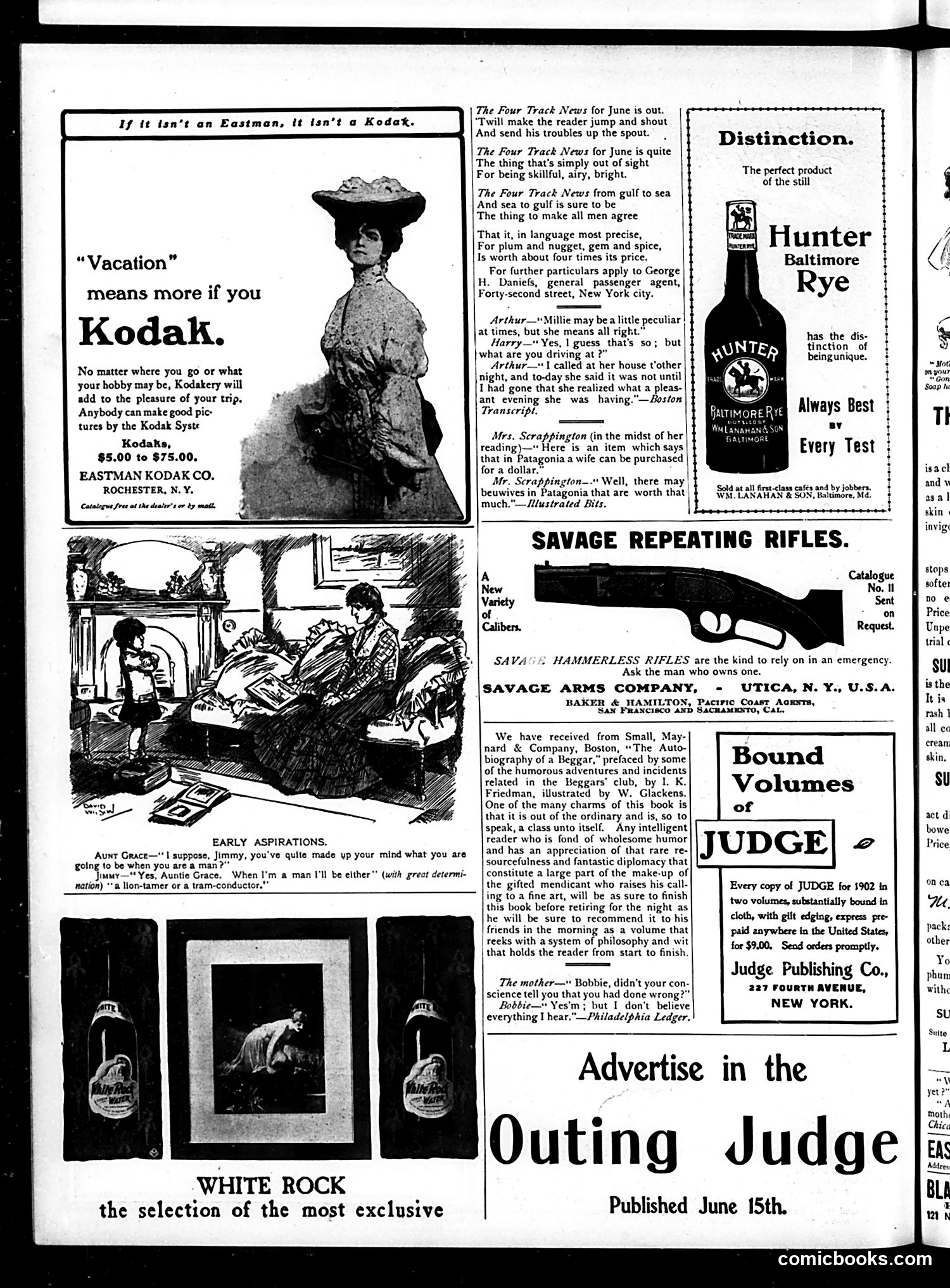
This single-panel cartoon depicts a conversation between an aunt and her young nephew about his career ambitions. Jimmy declares he wants to be either a "lion-tamer or a tram-conductor"—two wildly disparate occupations in terms of danger and prestige. The humor lies in the absurdity of a child conflating these utterly different professions as equally desirable life goals. Lion-taming represents thrilling danger and adventure, while tram-conducting (operating streetcars) was ordinary, mundane work. The joke satirizes childhood logic: Jimmy views both as equally acceptable without understanding their vast differences in status or risk. This reflects early 1900s assumptions about class distinctions and working-class occupations, where street-car operators occupied low social standing, making the juxtaposition comic to contemporary readers who would immediately recognize the incongruity.
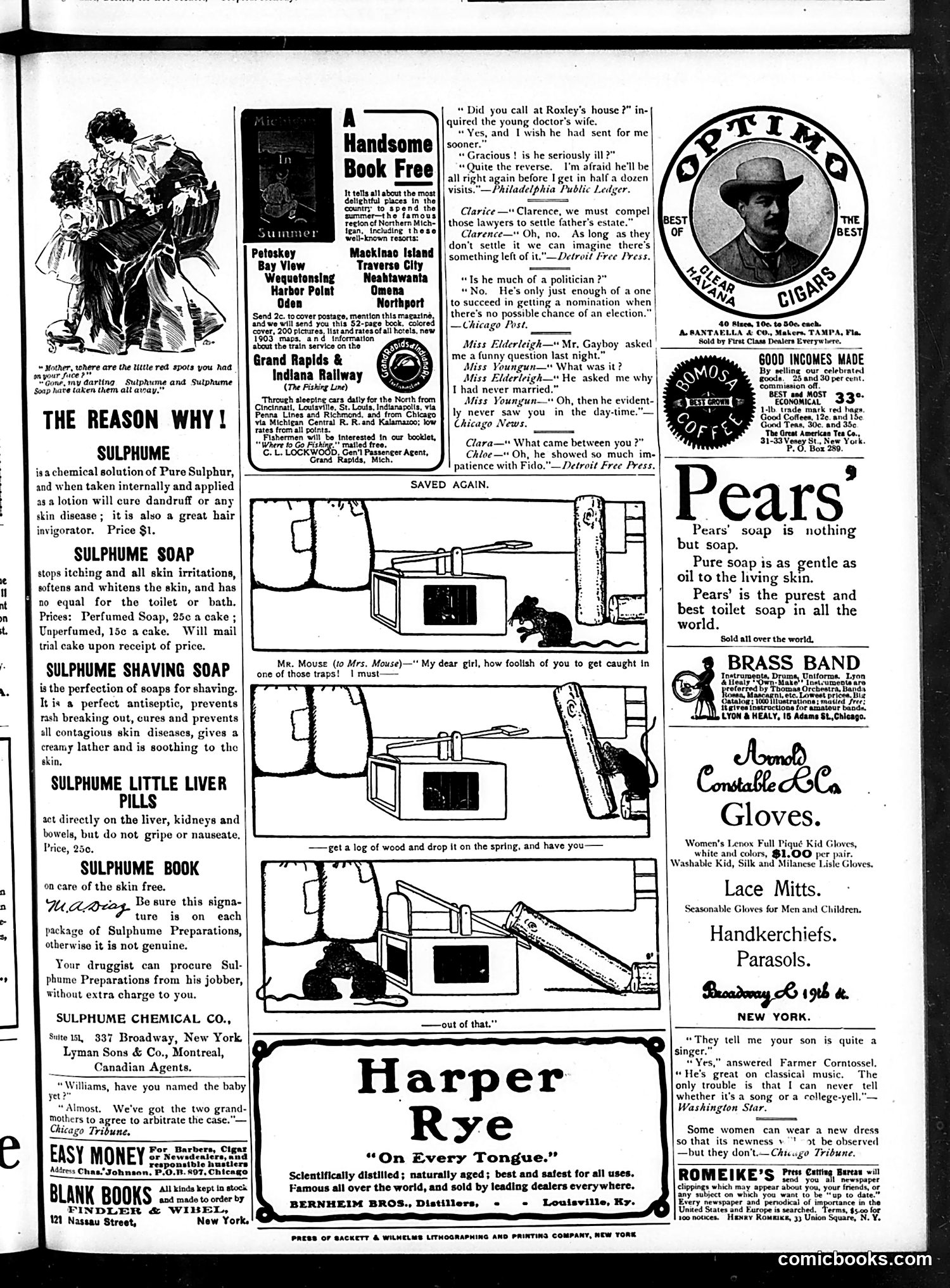
This page is primarily **advertising**, with brief satirical jokes interspersed. The main cartoon shows a mouse couple in a trap—a domestic scene where Mrs. Mouse has been caught and Mr. Mouse must rescue her, captioned "get a leg of wood and drop it on the spring, and have you—'out of that.'" This appears to be gentle, slapstick humor about marital obligation rather than political satire. The surrounding text consists of short, unmarked joke items mocking contemporary life: a doctor annoyed by unnecessary visits, lawyers prolonging estate settlements, politicians' minimal competence, and romantic misunderstandings. These are generic social observations typical of Judge's humor. The page is dominated by period advertisements for Sulphume (a sulfur-based medicinal product), Pears' soap, Harper Rye whiskey, and other consumer goods—standard fare for this era's magazines. There is **no apparent political commentary** on this particular page.
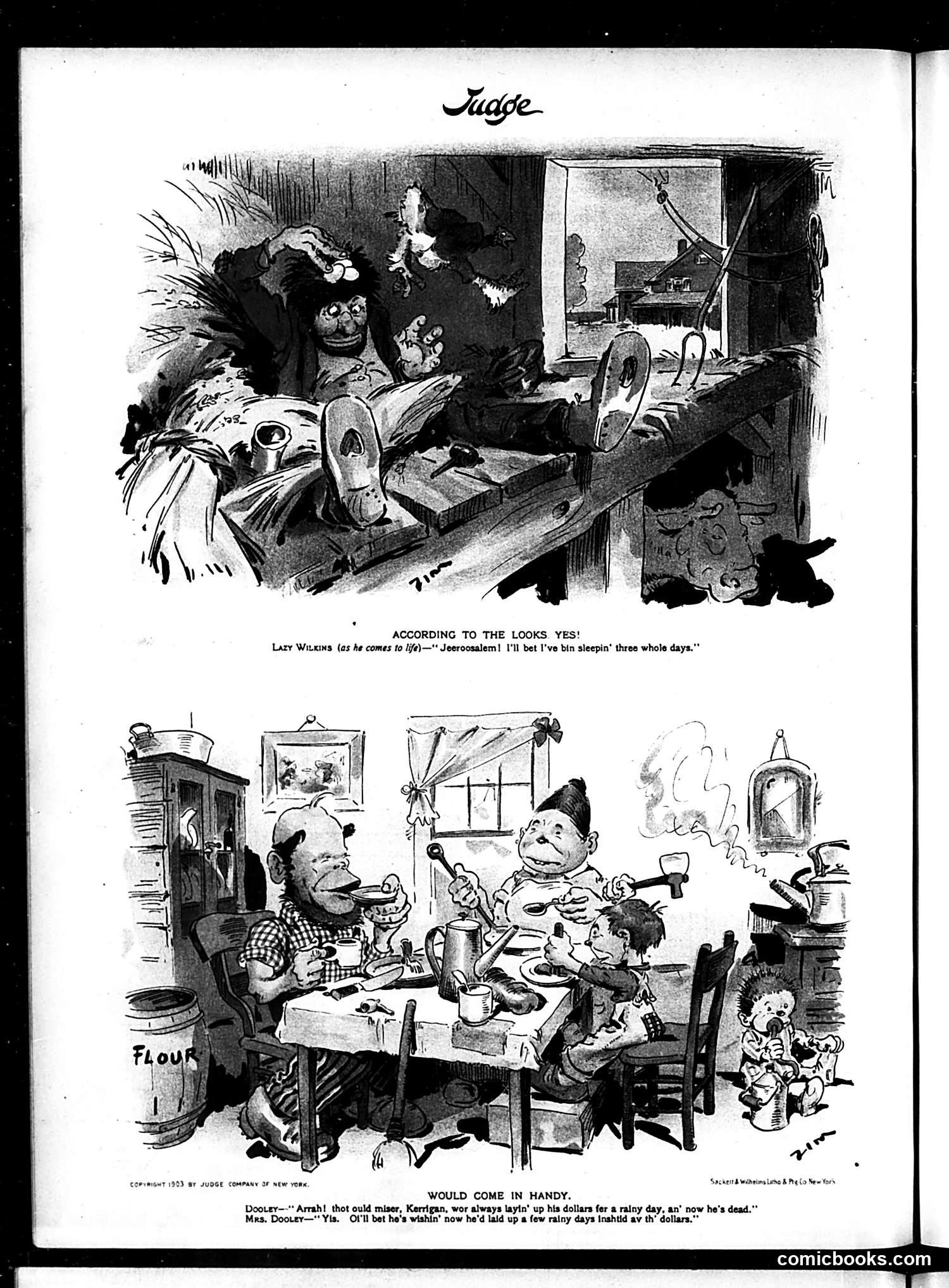
This page contains two satirical cartoons from Judge magazine (copyright 1903): **Top cartoon ("According to the Looks, Yes!"):** depicts a disheveled man ("Lazy Wilkins") waking after sleeping three days, expressing shock in exaggerated dialect. The satire targets laziness and idleness. **Bottom cartoon ("Would Come in Handy"):** features characters with Irish surnames (Dooley, Kerrigan, Mrs. Dooley) in heavy Irish-dialect dialogue. The joke: a miser named Kerrigan spent his life saving money "for a rainy day" but died without enjoying it. Mrs. Dooley quips he should have saved actual rainy days instead of dollars—satirizing the futility of hoarding wealth without living. Both cartoons use exaggerated dialect and caricature typical of early-1900s American humor, poking fun at working-class Irish immigrants and commentary on greed versus life's pleasures.