
Judge, 1903-06-06 · page 10 of 16
Judge — June 6, 1903 — page 10: what you’re looking at
What you’re looking at
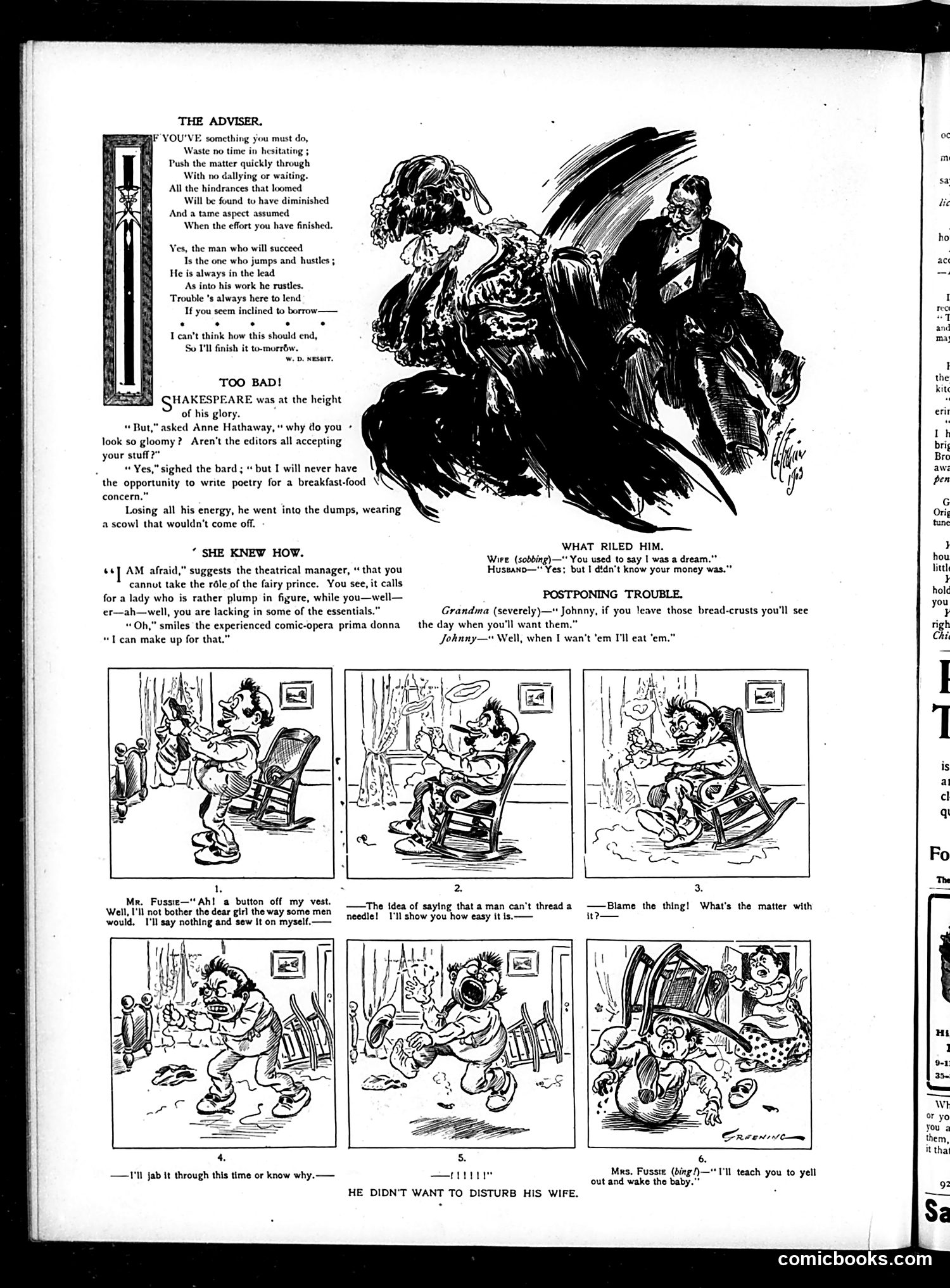
This page from *Judge* contains several satirical humor pieces typical of early 20th-century American magazines: **"The Adviser"** and **"Too Bad!"** are verse and prose jokes about procrastination and missed opportunities—Shakespeare lamenting he'll never write for cereal advertisements, a common modern commercial venture. **"She Knew How"** and **"What Riled Him"** are brief domestic humor pieces poking fun at marriage dynamics and miscommunication (a wife's dream of being idealized, financial concerns). **"Postponing Trouble"** satirizes a grandmother warning a boy about wasting food, with the boy's confident reply that he'll eat them when hungry—mocking youthful shortsightedness. **The six-panel comic strip "He Didn't Want to Disturb His Wife"** shows Mr. Fussie attempting household repairs (sewing a button) while trying not to wake his wife, escalating into chaotic disaster. The humor relies on slapstick and the era's assumption that men are incompetent at domestic tasks—a common gender stereotype of the period. All content reflects *Judge's* focus on middle-class domestic satire and gentle social observation rather than hard political commentary.
📄 Transcribed text from this page (OCR, searchable)
Machine-transcribed from the original scan — historical spelling and the odd misread are preserved.
THE ADVISER. F YOU'VE something you must do, Waste no time in hesitating ; Push the matter quickly through With no dallying or waiting. All the hindrances that loomed Will be found to have diminished And a tame aspect assumed When the effort you have finished. Yes, the man who will succeed Is the one who jumps and hustles ; He is always in the lead As into his work he rustles. Trouble 's always here to lend If you seem inclined to borrow. T can’t think how this should end, So T'll finish it to-morréw. w. D. NEBr, TOO BAD! J SHAKESPEARE was at the height of his glory. « But," asked Anne Hathaway," why do you + look so gloomy? Aren't the editors all accepting your stuff?” _"Yes,"sighed the bard ; « but I will never have the opportunity to write poetry for a breakfast-food \' concern,” Losing all his energy, he went into the dumps, wearing a scowl that wouldn't come off. . KNEW WHAT RILED HIM. a HOW. ‘Wire (sodding)—'* You used to say | was a dream.’ 66] AM afraid,” suggests the theatrical manager, * that you Huseano—"" Yes; but I didn't know your money was."* cannot take the réle of the fairy prince. You see, it calls for a lady who is rather plump in figure, while you—well— POSTPONING TROUBLE. er—ah—well, you are lacking in some of the essentials.” Grandma (severely)—" Johnny, if you leave those bread-crusts you'll see “Oh,” smiles the experienced comic-opera prima donna the day when you'll want them.” “can make up for that.” Johnny— Well, when I wan't ‘em I'll eat ‘em.” Mr. Fussie—‘Ah! a button off my vest. Well, I'li not bother the dear girl the way some men would, I'll say nothing and sew It on myself.— —The Idea of saying that a man can't thread a needle! I'll show you how easy it is. — Reenter : 6 —1'Nl jab it through this time or know why.— nnn cat ee Gea Til teach you to yell HE DIDN'T WANT TO DISTURB HIS WIFE. comicbooks.com