
A complete issue · 16 pages · 1903
Judge — March 14, 1903
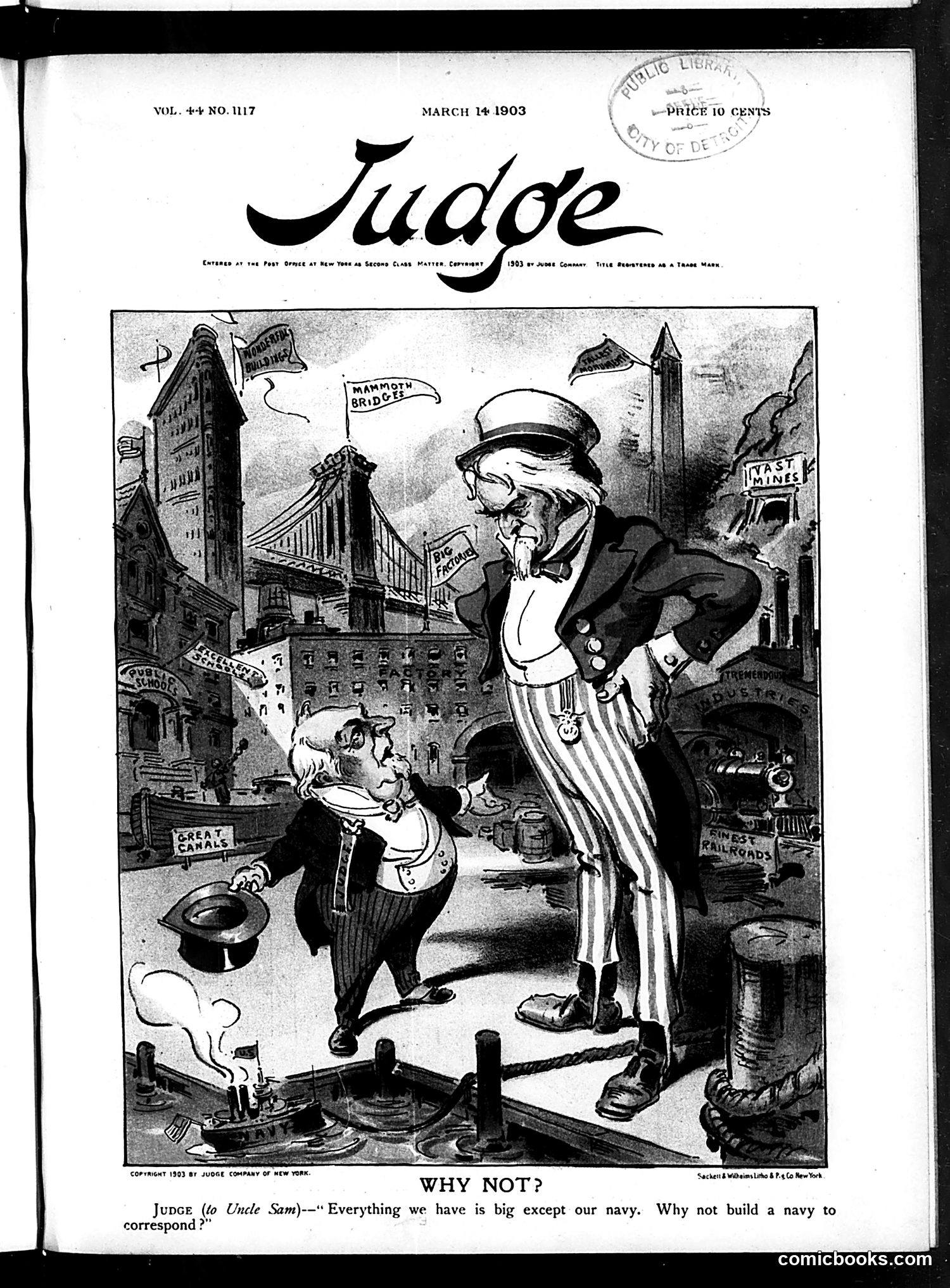
**Date & Publication:** March 14, 1903, Judge magazine (Vol. 44, No. 1117) **Cartoon Title:** "Why Not?" **Content:** The cartoon depicts Uncle Sam (tall figure in striped pants) speaking to a smaller caricatured figure labeled as representing industrial/economic interests. Behind them is a cityscape with labeled infrastructure: "Great Canal," "Vast Mines," and "Railroads." **The Satire:** Uncle Sam complains that "Everything we have is big except our navy. Why not build a navy to correspond?" This advocates for major naval expansion. The cartoon appears to support American naval building during the Roosevelt administration, likely referencing contemporary debates over naval power and American imperial interests circa 1903. **Context:** This reflects early-20th-century American expansionism and the strategic importance placed on naval supremacy.
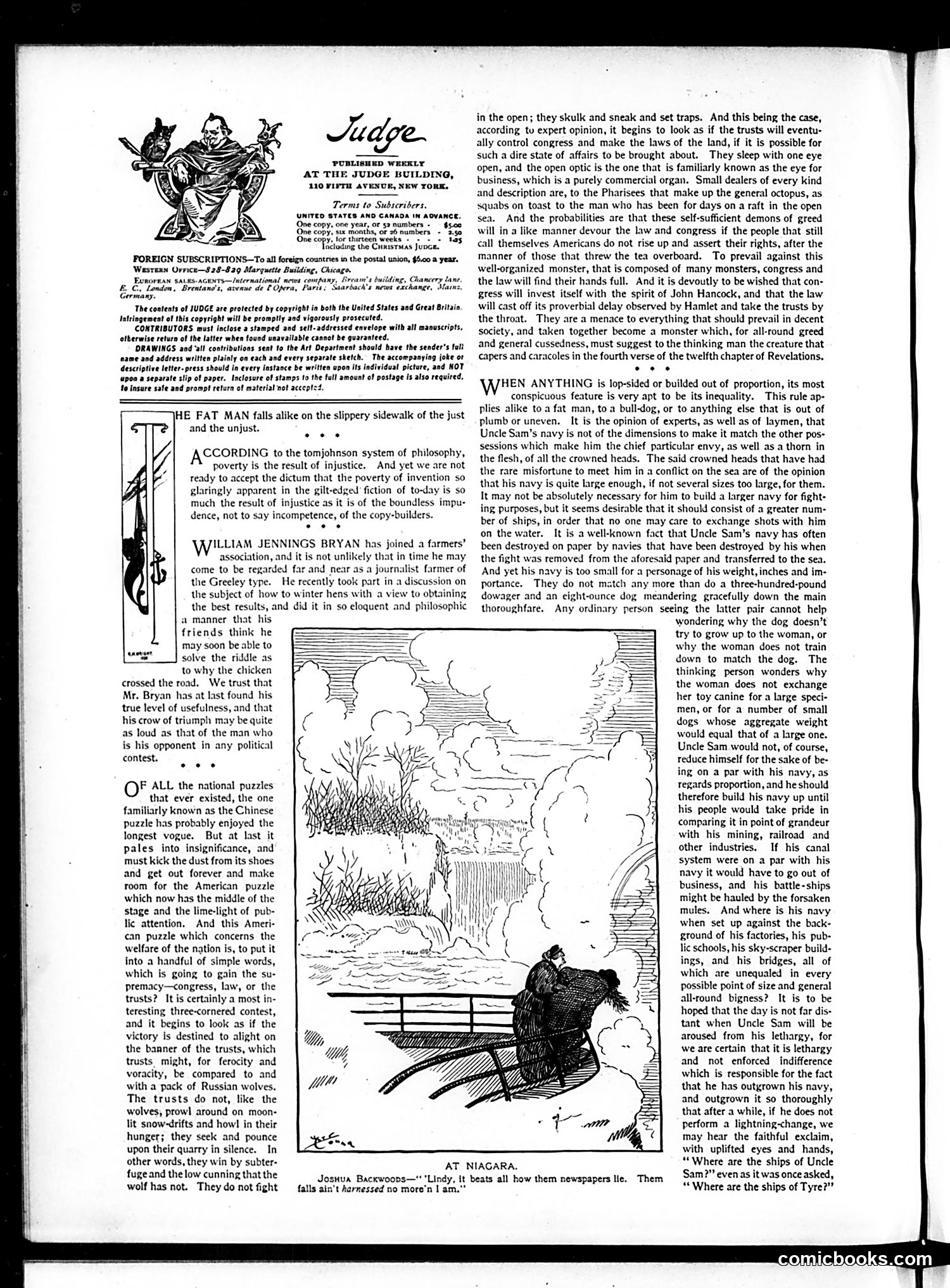
This page contains two separate pieces of satire: 1. **Editorial cartoon (top left)**: Depicts a "Peat Man" falling on icy sidewalk, illustrating the opening line about inequality. The image supports the accompanying article's discussion of disproportionate consequences—those with less power suffer more from society's problems. 2. **"At Niagara" cartoon (bottom)**: Features Joshua Backwoods, a rural character type, speaking to a woman named Lindy. The joke appears to rely on Backwoods being ignorant about current events or newspapers ("It beats all how them newspapers lie"), positioning rural Americans as out-of-touch with modern information. Both pieces employ common Judge magazine tropes: visual slapstick, rural stereotypes, and commentary on American social divisions and knowledge gaps.
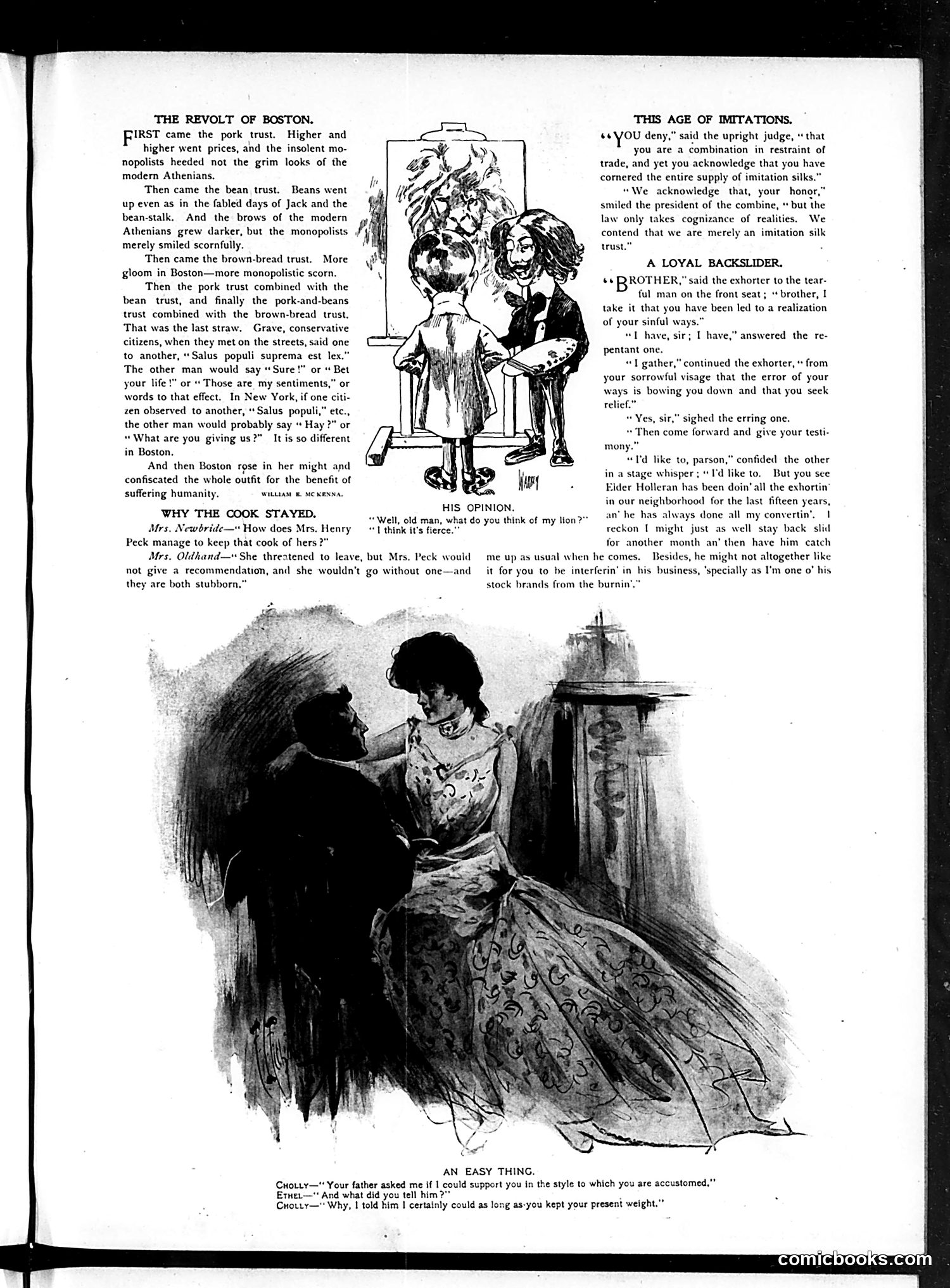
This page contains three satirical pieces about 1910s American commerce and social hypocrisy: **"The Revolt of Boston"** and **"Why the Cook Stayed"** mock consumer trust in food monopolies. They satirize how large trusts (bean trusts, pork trusts, brown-bread trusts) consolidated supply, forcing even conservative citizens to accept inferior quality while trusts controlled prices—a critique of industrial monopoly power. **"This Age of Imitations"** and **"A Loyal Backslider"** target wealthy hypocrisy about maintaining appearances while relying on imitation goods and cutting corners. A rich man lectures someone about sin while admitting he secretly uses counterfeit products. **"An Easy Thing"** (bottom) jokes about marriage economics—a woman tells her father she can support her husband as long as he maintains her expensive lifestyle. The cartoons criticize Gilded Age monopolies, consumer fraud, and upper-class moral inconsistency.
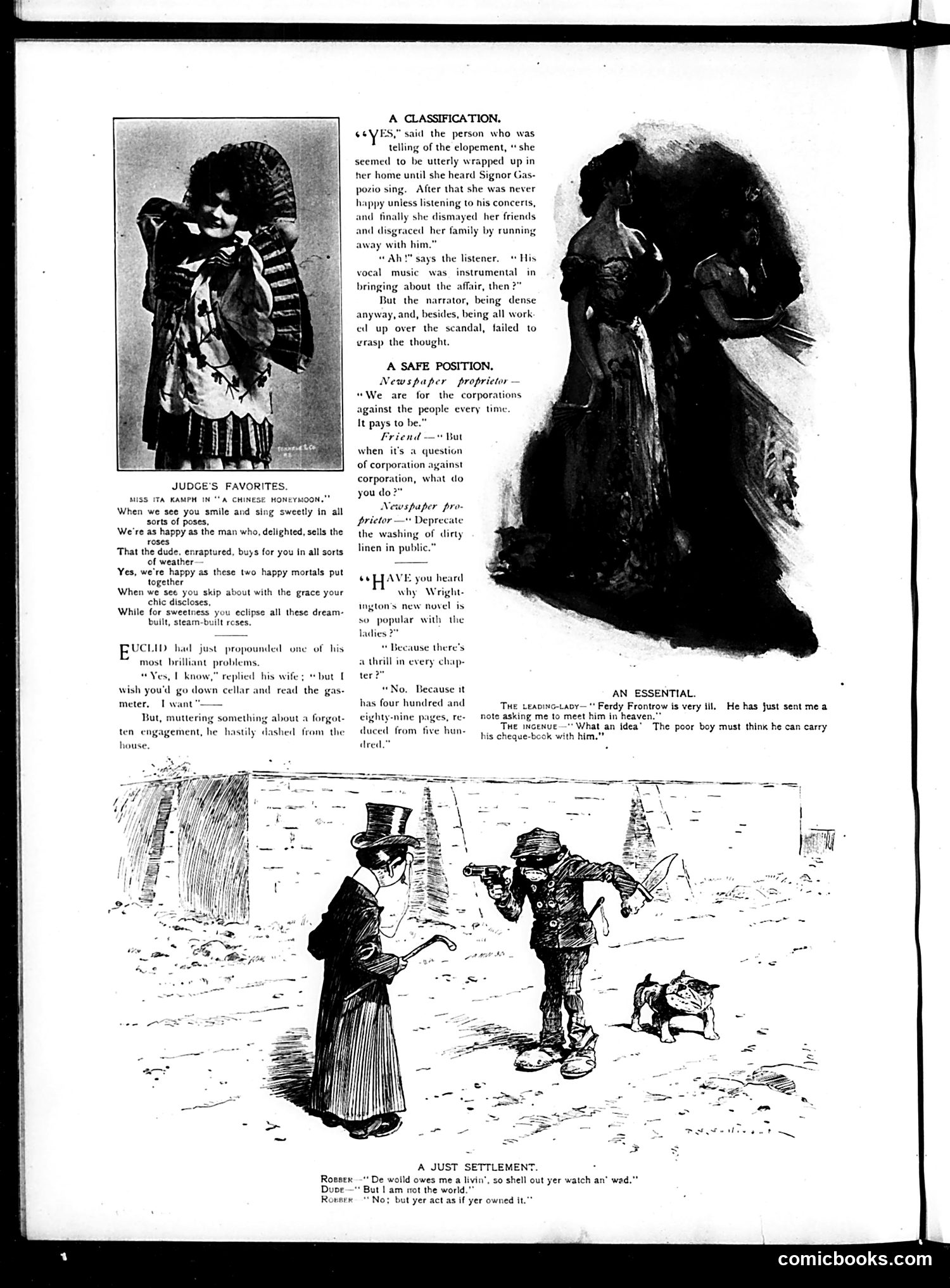
This page contains three distinct pieces of satirical content: **"Judge's Favorites"** (top left): Praises a performer in "A Chinese Honeymoon" for their charming stage presence, using flowery compliments typical of theatrical criticism. **"A Safe Position"** (center): A dialogue satirizing newspaper editors' cowardice regarding corporate power. The "Newspaper Proprietor" claims neutrality in corporation-versus-corporation disputes while avoiding criticism of business generally—mocking editorial spinelessness and dependence on corporate advertising revenue. **"An Essential"** (top right) and **"A Just Settlement"** (bottom): Brief humorous sketches about a sick man needing to settle a debt, and a robber/debtor negotiation, both illustrating financial disputes through comic situations. The page primarily satirizes early 20th-century press corruption and financial matters rather than specific political events.
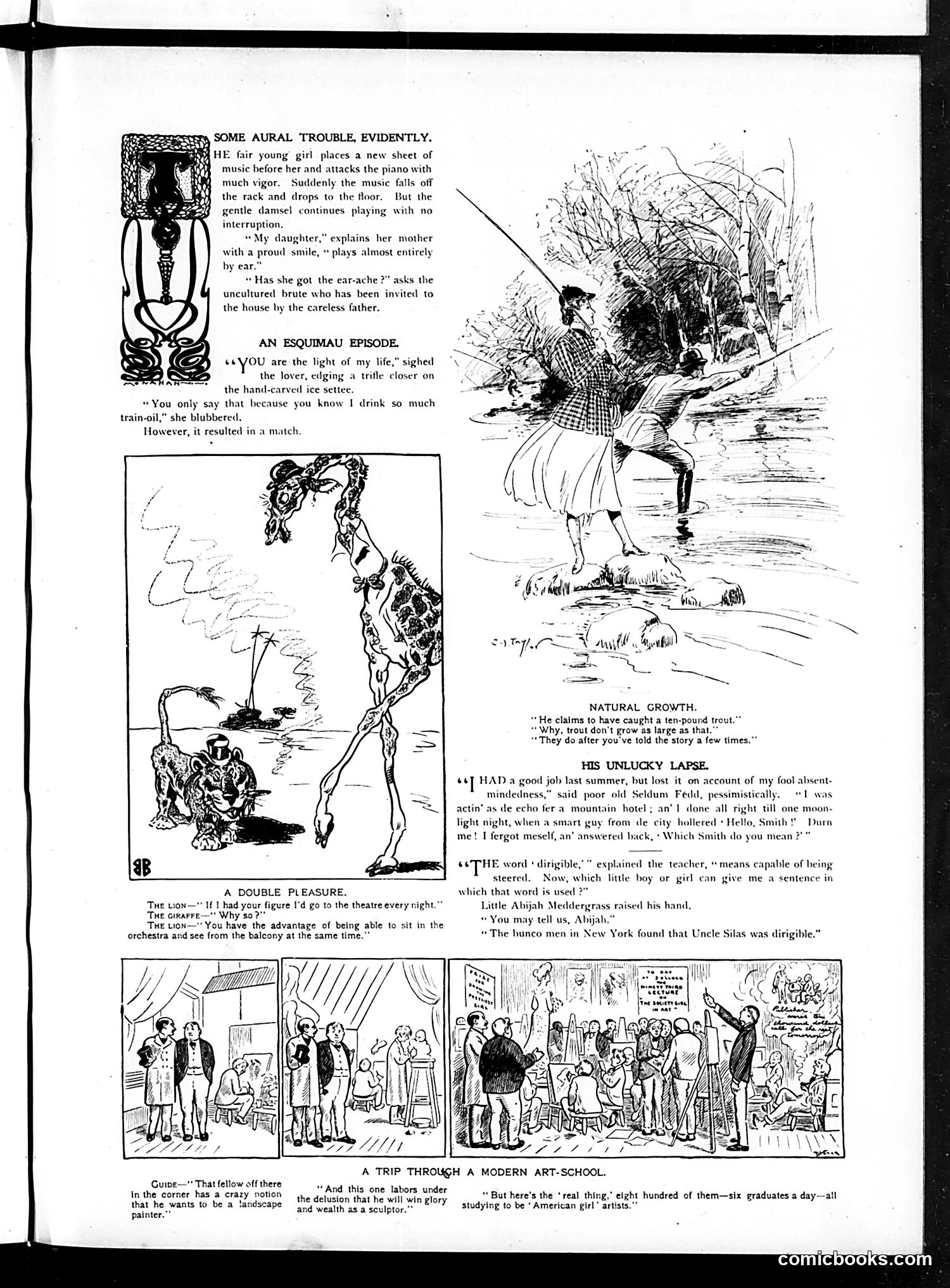
This page contains several brief satirical humor pieces typical of early 20th-century Judge magazine: **"Some Aural Trouble"**: Jokes about a young pianist who plays "by ear" after her sheet music falls. A crude guest misinterprets "plays by ear" as "has an earache"—humor based on deliberate misunderstanding. **"An Esquimau Episode"**: Stereotypical satire of Inuit ("Esquimau") courtship, with romantic clichés applied to an Arctic setting and references to "train-oil" (seal oil). Mild ethnic humor typical of the era. **"Natural Growth"** and **"His Unlucky Lapse"**: Simple wordplay jokes—one about fish stories growing larger with retelling; another about a mountain hotel echo-worker who forgets his job and accidentally responds to a guest. **"A Trip Through a Modern Art-School"**: Satirizes contemporary art education, mocking landscape painters with "crazy notions" and sculpture students, contrasting them with the "real thing"—hundreds of young women studying to become commercial "American girl" artists, suggesting art school was producing assembly-line illustrators rather than serious artists.
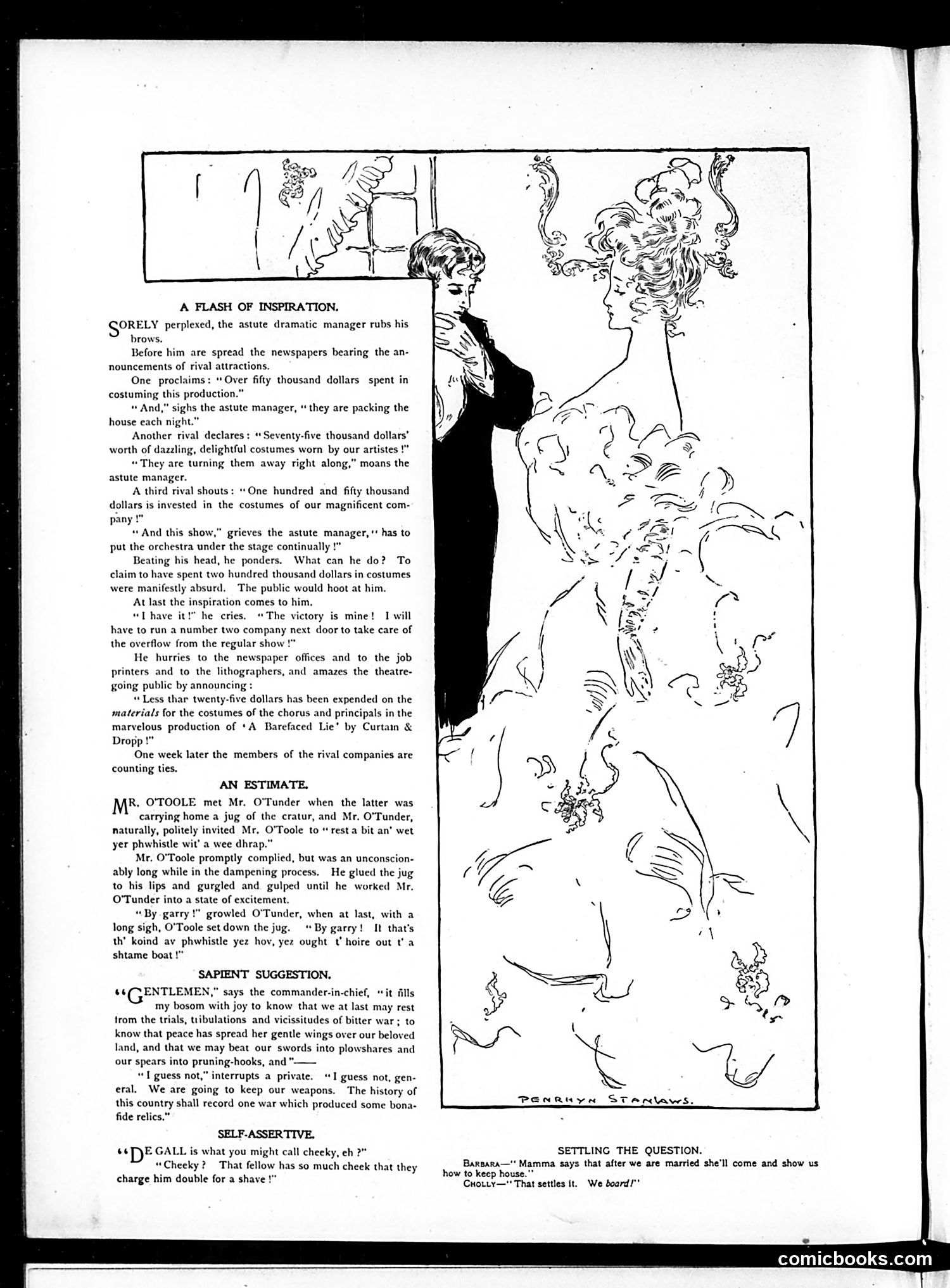
This satirical piece mocks theatrical producers engaged in a costume-spending arms race. Rival theaters compete by advertising increasingly expensive costumes—$50,000, $75,000, $150,000—to attract audiences. An astute manager, unable to match these claims credibly, achieves victory through absurdist reversal: he announces his production spent only $25, calling it "A Barefaced Lie." The joke satirizes both theatrical hype and public gullibility—the counterintuitive claim paradoxically succeeds where honest competition fails. The title "A Barefaced Lie" appears to be the fictional play's name, emphasizing the satire's meta-commentary on deception in entertainment marketing. The page's other brief comedic sketches ("An Estimate," "Sapient Suggestion," "Self-Assertive," "Settling the Question") are unrelated vignettes featuring Irish-accented characters and domestic humor typical of Judge's lighter content.
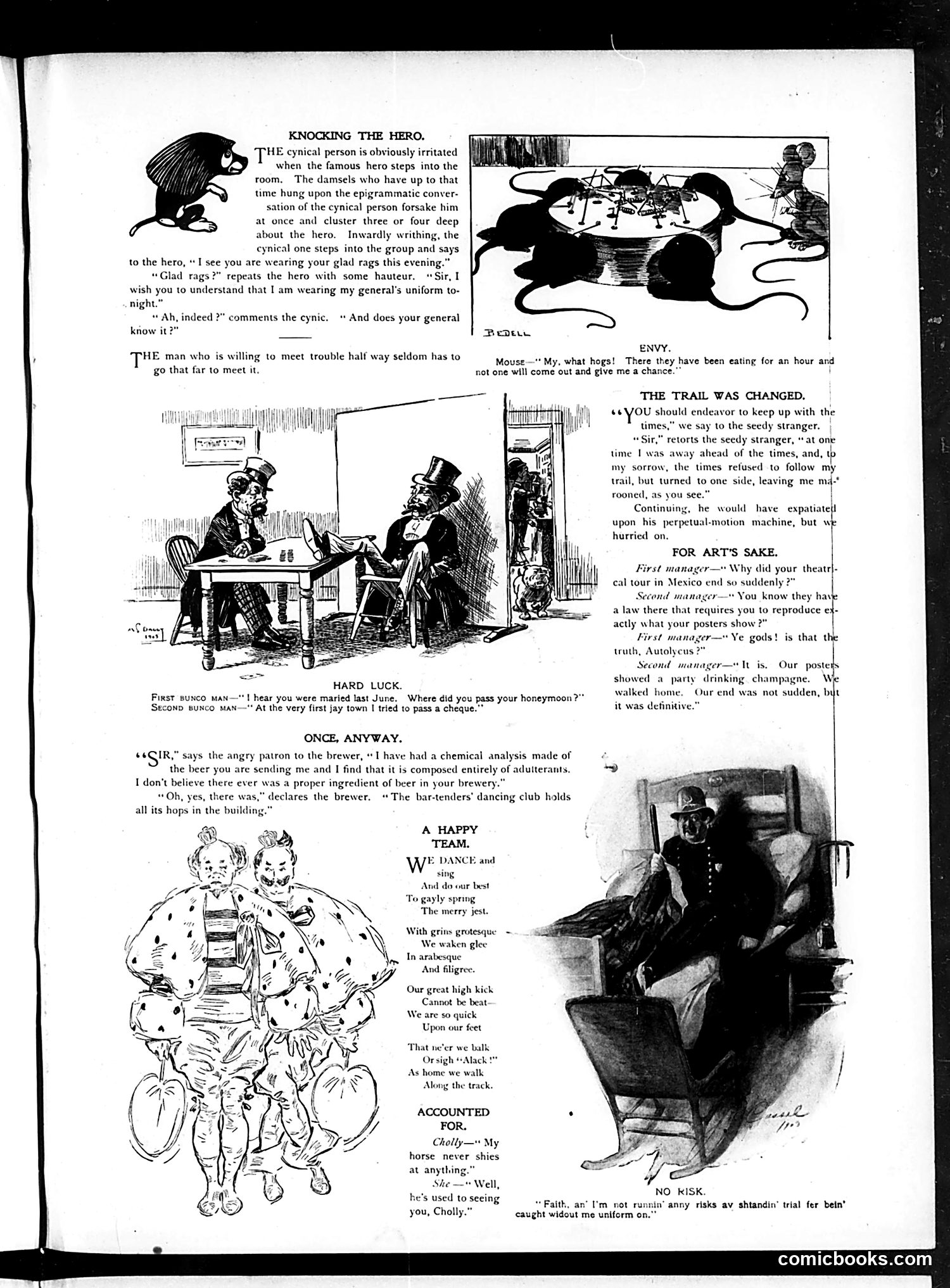
This page from Judge (an early 20th-century American satirical weekly) contains multiple unrelated humorous sketches mocking social types and situations: **"Knocking the Hero"** satirizes the envious cynic who resents a decorated military officer's social popularity, attempting to deflate him with snide remarks about his "glad rags" (formal uniform). **"Hard Luck"** depicts two con men discussing failed schemes—one mentions passing bad checks on his honeymoon, showing petty criminal incompetence. **"Once, Anyway"** mocks a brewer defending adulterated beer by claiming bar-tenders' dancing club stores "hops" in the building—a nonsensical defense. **"The Trail Was Changed"** features a derelict claiming he once led progress but society abandoned him and his "perpetual-motion machine"—poking fun at unsuccessful inventors. **"For Art's Sake"** jokes about a theatrical tour's failure due to a Mexican law requiring posters to accurately depict what's shown (they advertised champagne-drinking they couldn't afford). The sketches collectively ridicule pretension, failed ambition, and social climbing of the era, typical Judge fare targeting middle-class anxieties and absurdities.
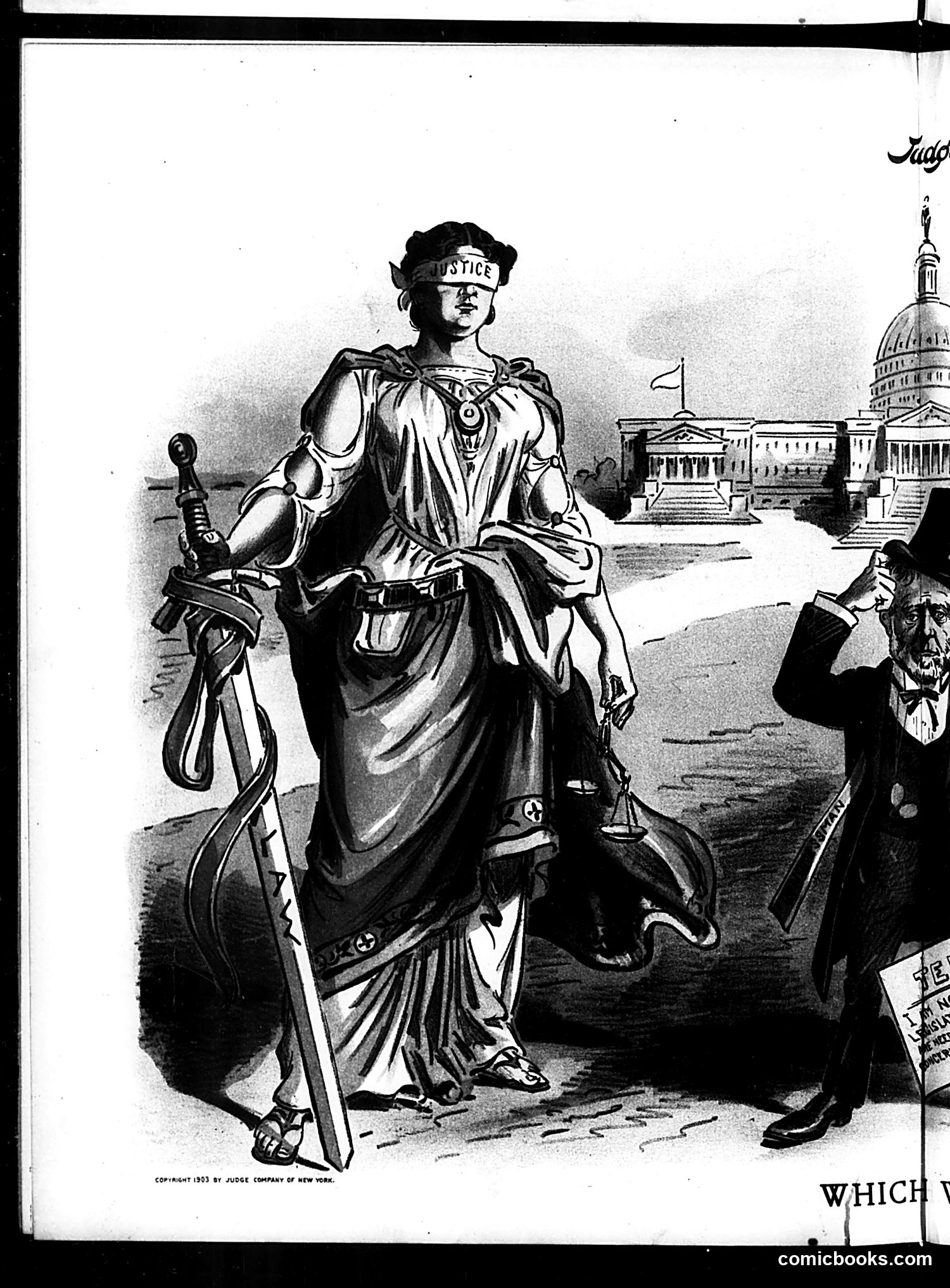
This is an allegorical cartoon depicting **Lady Justice** (blindfolded, holding scales and sword) standing before the **U.S. Capitol building**. She appears to be the central figure confronting or being approached by figures on the right—likely representing politicians or special interests. The satire appears to criticize the relationship between Justice and American government/politics. The Capitol building in the background emphasizes this is about governmental institutions. Lady Justice's prominent, authoritative stance suggests the cartoon questions whether true justice is actually being served in American politics, or whether political forces are compromising judicial impartiality. The copyright date "1903 BY JUDGE COMPANY OF NEW YORK" indicates this reflects early 20th-century concerns about political corruption or judicial independence.
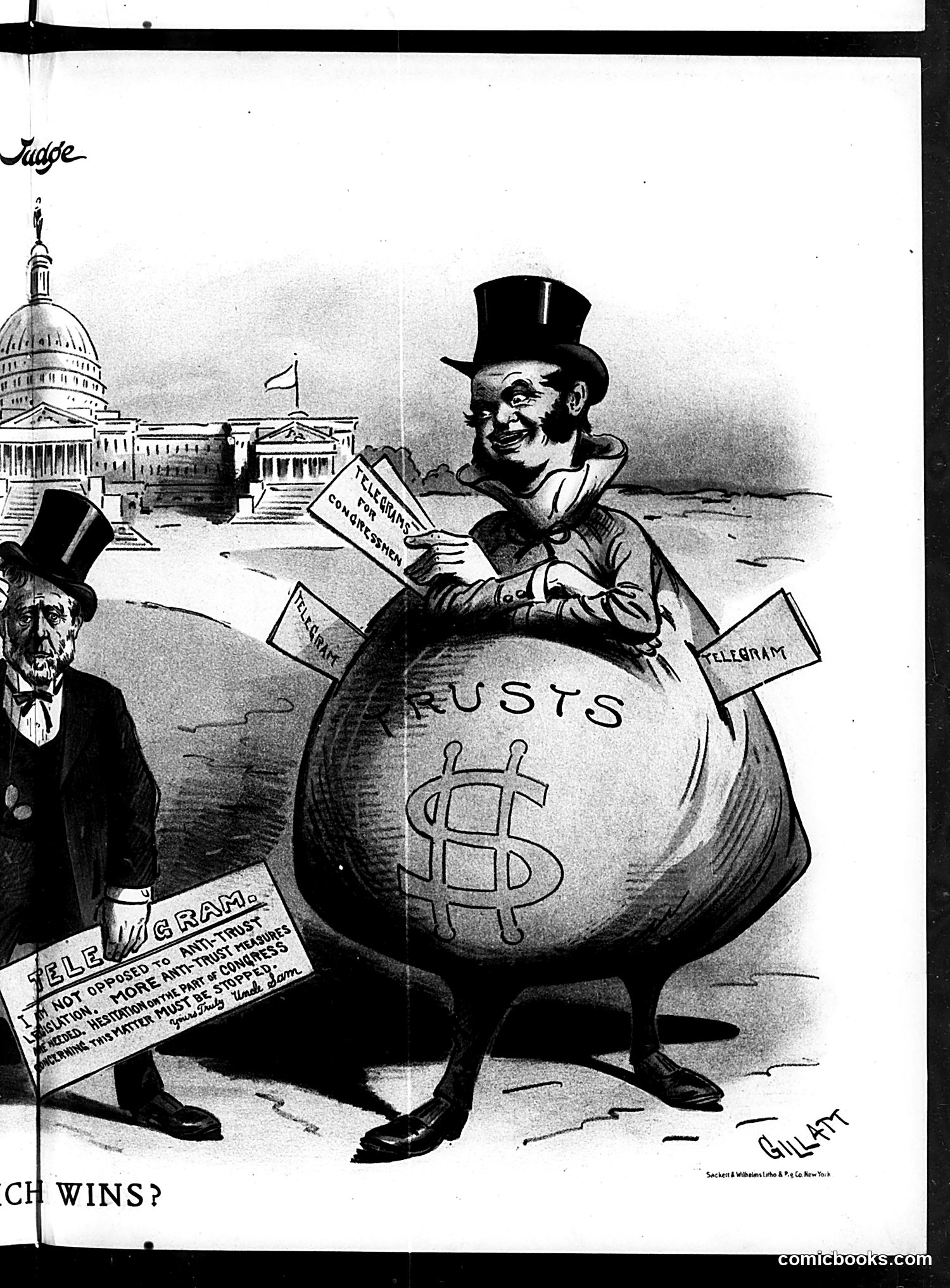
This Judge magazine cartoon satirizes **monopolistic trusts** and their influence on American government. The central figure—a wealthy capitalist in top hat—sits atop an enormous money bag labeled "TRUSTS" with a dollar sign. He holds documents labeled "RAILROADS," "TELEGRAMS," and other industries, representing corporate consolidation of economic power. The Capitol building looms in the background, suggesting political corruption. The dejected figure on the left, labeled with text about citizens needing to "trust trusts" for necessities, represents ordinary Americans exploited by monopolies. The cartoon's title "CH WINS?" (likely "WHICH WINS?"—capitalists or honest government) poses the question: will America's democratic institutions triumph, or will corporate trusts dominate? This reflects Progressive Era anxieties about unchecked corporate power and political corruption circa early 1900s.
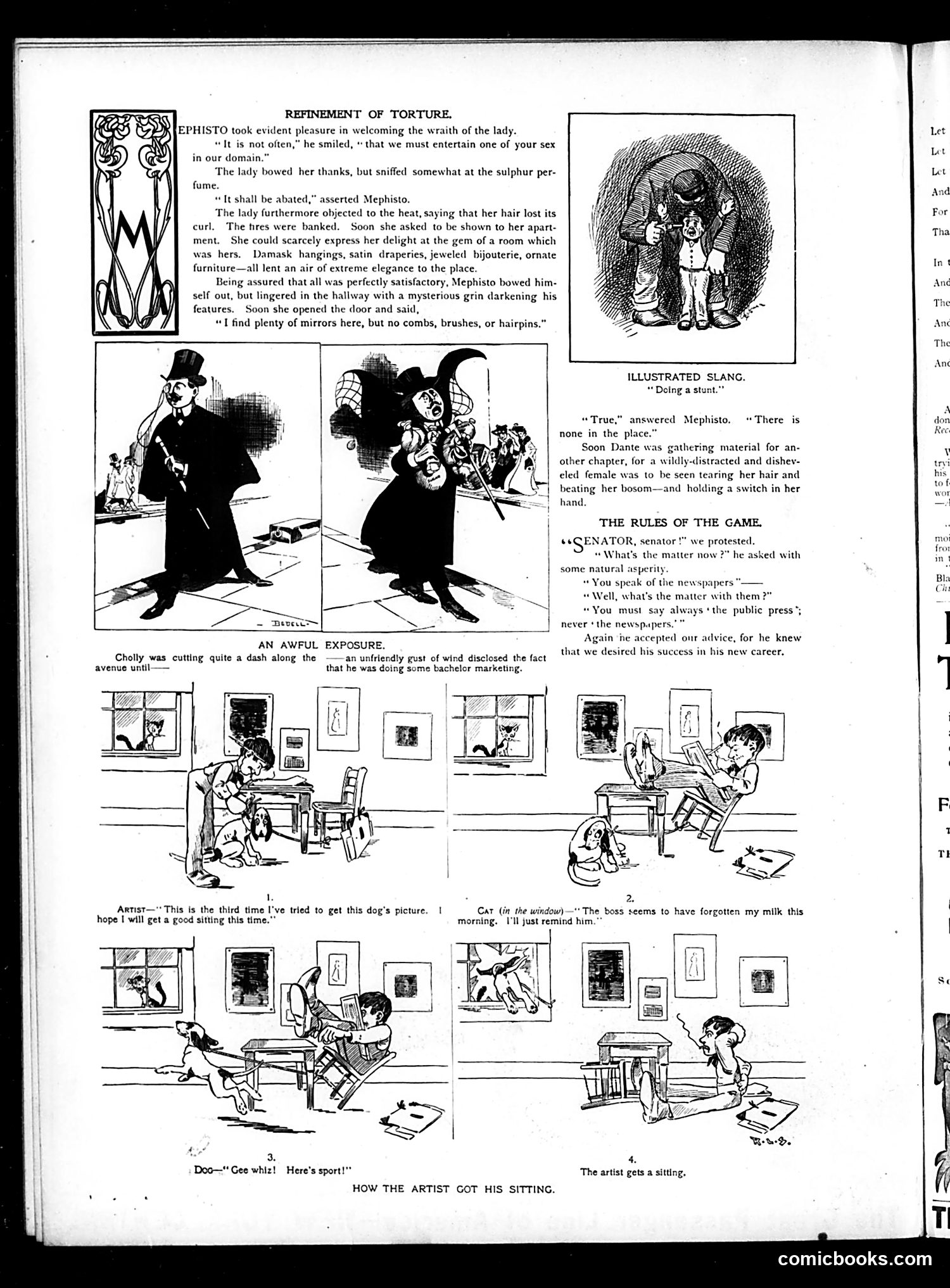
This page contains several distinct satirical pieces: **"Refinement of Torture"** (top): A Faustian joke where Mephisto torments a wealthy lady in Hell not with fire but with refined psychological torture—luxurious surroundings paired with the absence of basic grooming supplies (combs, brushes, hairpins). The satire targets vanity and the anxieties of upper-class women about appearance. **"An Awful Exposure"** (middle left): Mocks a fashionable man ("Cholly") whose pretentious stroll is undone when wind reveals he's still engaging in "bachelor marketing"—apparently shabby or undignified behavior beneath his social pretensions. **"How the Artist Got His Sitting"** (bottom): A four-panel comic about an artist struggling to photograph a dog. The punchline shows he finally succeeds by having a cat chase the dog, creating the desired action shot. It's simple visual humor about persistence and problem-solving. **"The Rules of the Game"** (right): Satirizes a senator's need for linguistic coaching—he must say "public press" instead of "newspapers" to sound more dignified, mocking political affectation and image management.
This page is primarily a **nostalgic poem with sentimental advertising**—not political satire. The main text is a whimsical piece celebrating childhood imagination, referencing fairy tales (Jack and the Beanstalk, Red Riding Hood, Bluebeard) and lamenting how children eventually lose this magical thinking. The scattered jokes and quotes throughout are **light social commentary** rather than satire: observations about romance, marriage, and class behavior. One example mocks a gentleman eating without formal evening dress at a charity ball—a minor breach of etiquette. **The advertisements dominate**: Packer's Tar Soap, Sohmer Pianos, Chartreuse liqueur, and playing cards. The page appears to be from an **early-20th-century issue of Judge magazine**, though without a visible date. There is **no clear political cartoon or sharp satirical point** on this page—it's primarily a nostalgic literary piece surrounded by period product advertisements.
This page is primarily **advertising**, not a political cartoon. It features: **Main content:** Product advertisements for Sulphume—a patent medicine marketed as a cure-all for skin conditions (dandruff, irritation, disease), offered in multiple forms: internal solution, soap, shaving soap, and liver pills. **Supporting elements:** - Small humorous anecdotes (titled "An Interpretation," etc.) typical of *Judge* magazine's filler content - An ad for Arnold Constable's Oriental Rugs - A Southern Railway advertisement for the "Palm Limited" train service to Florida **Advertising context:** By the early 1900s, *Judge* relied heavily on patent medicine ads. Sulphume represents the era's unregulated pharmaceutical market, where medicines made broad therapeutic claims without modern FDA oversight. The page lacks actual political satire or social commentary—it's a commercial page demonstrating how *Judge* monetized its readership through product endorsements.
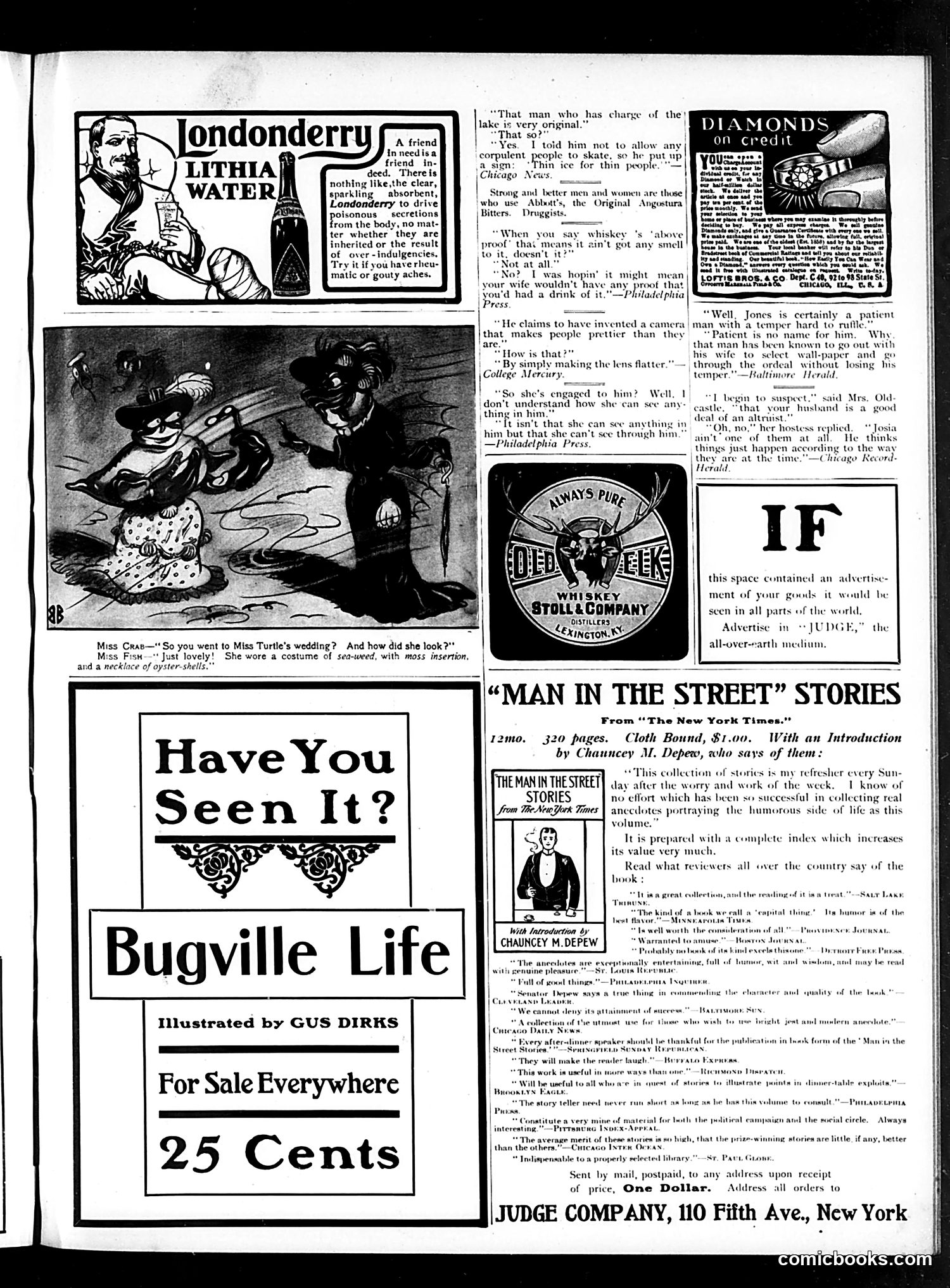
This page is primarily **advertising and book promotion** rather than political satire. The dominant feature is a full-page advertisement for *"Man in the Street" Stories*, a collection from The New York Times with an introduction by Chauncey M. Depew (a prominent politician/businessman of the era). The publisher claims it's a humorous collection of anecdotes reflecting "the humorous side of life." The page also contains several smaller **joke items** typical of Judge's satirical humor—brief, cynical quips about marriage, social pretense, and human nature (e.g., a wife lacking "proof" her husband drank, a man tolerating wallpaper selection). There are also **product advertisements** for patent medicines (Londonderry Lithia Water, Abbott's Bitters) and other goods. **Gus Dirks' illustration** for *Bugville Life* (lower left) appears to depict animal characters in a domestic scene, likely humorous social commentary through animal allegory. The overall page reflects Judge's mixed model: satirical commentary alongside advertising revenue.
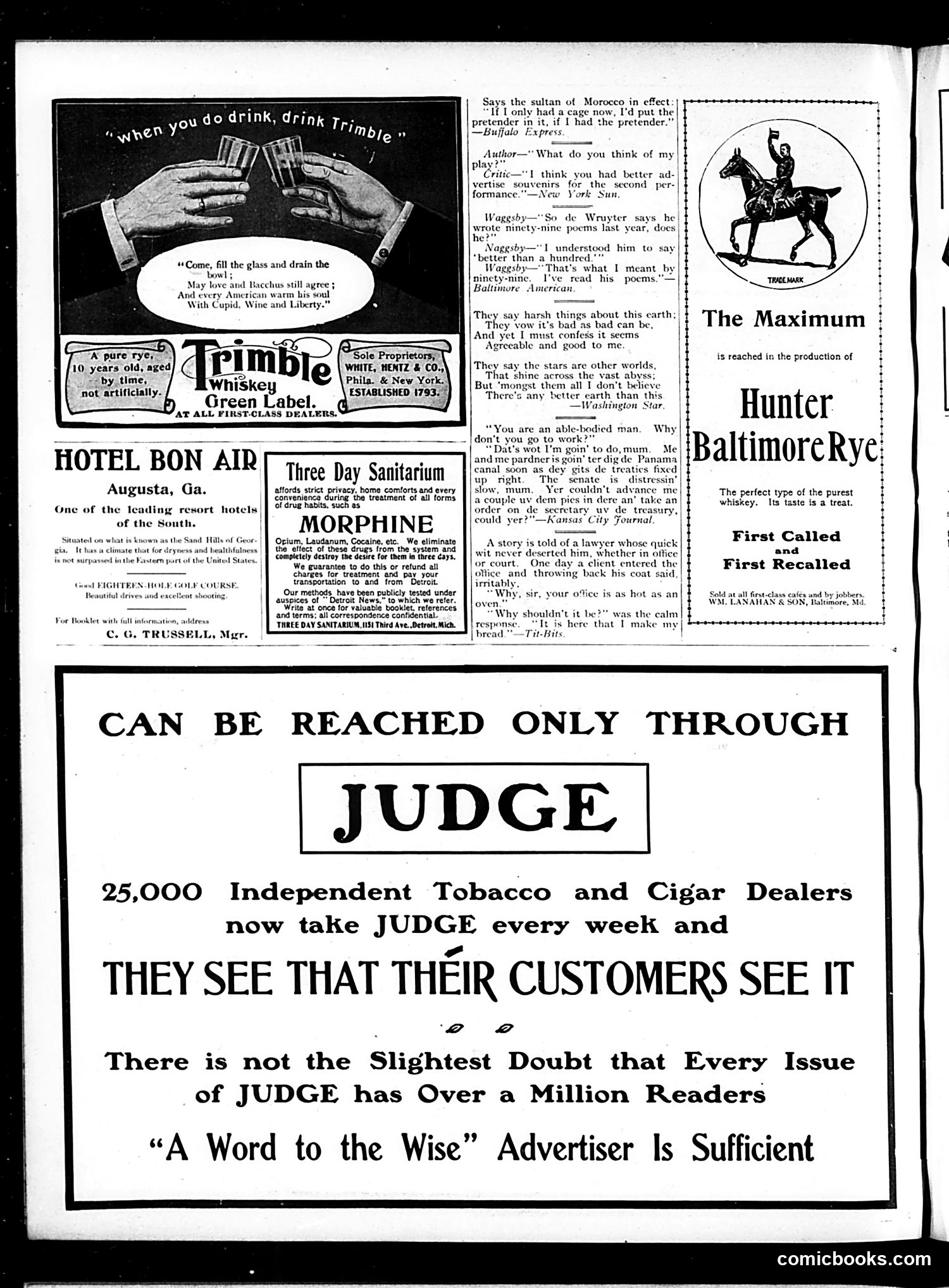
This is primarily an **advertising page** from Judge magazine, a major American satirical weekly. The page contains multiple paid advertisements interspersed with brief humorous snippets. **The cartoons/jokes** are minimal: - A **Trimble Whiskey ad** with a drinking toast (product promotion disguised as humor) - Several short **joke excerpts** about writers, lawyers, and social commentary—typical of Judge's satirical content, though disconnected from each other **Key advertisements:** - **Hotel Bon Air** (Augusta, Georgia) and a "Three Day Sanitarium" promoting drug addiction treatment—reflecting early 20th-century attitudes toward morphine and cocaine abuse - **Hunter Baltimore Rye whiskey** ("The Maximum...purity") **The large bottom section** is a **trade advertisement for Judge itself**, claiming 25,000 tobacco dealers distribute it weekly and boasting over a million readers per issue—essentially a sales pitch to prospective advertisers. This page exemplifies how satirical magazines funded themselves through advertising while maintaining editorial content.
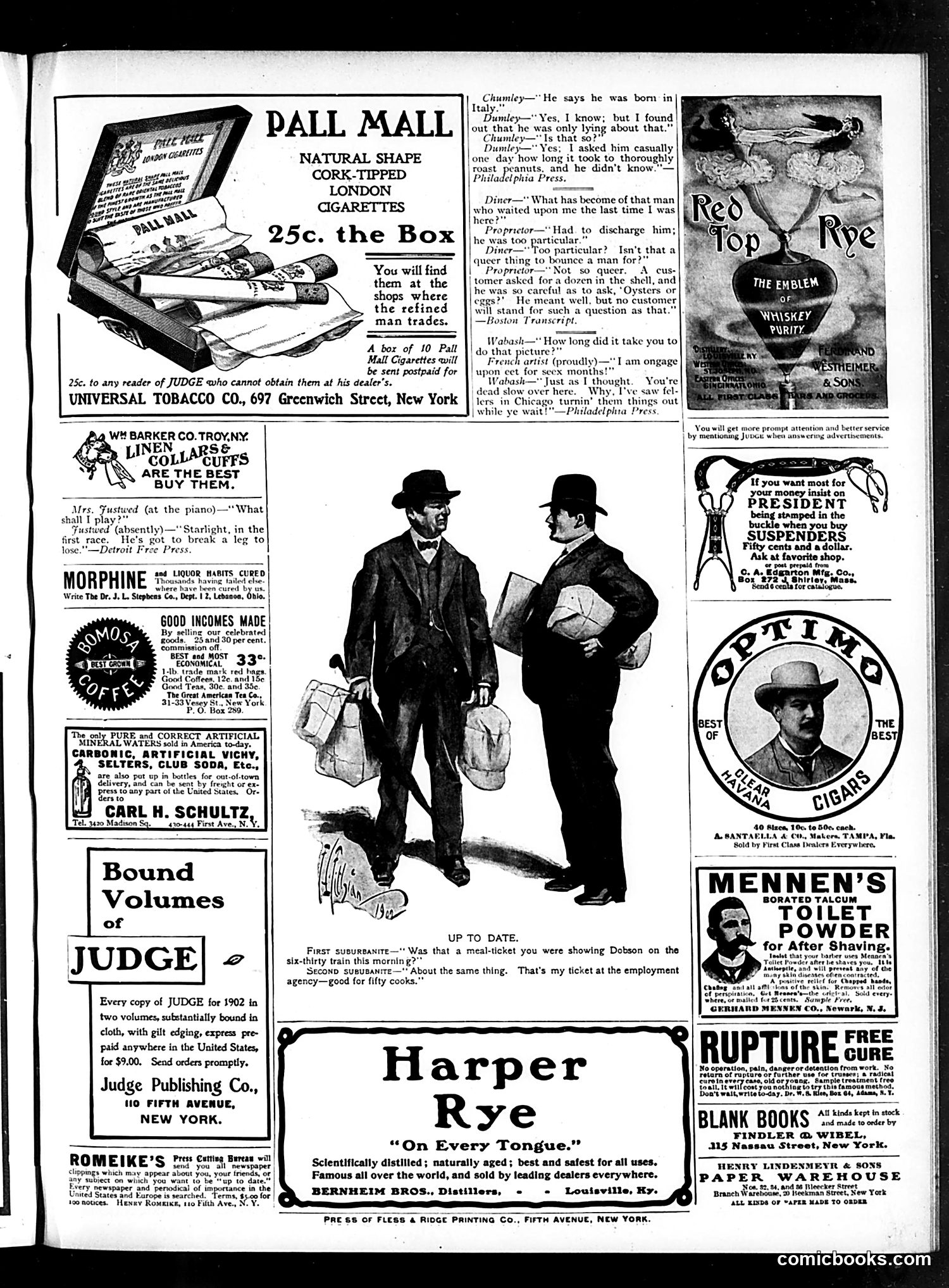
This page is primarily **advertising**, with minimal original editorial content. The advertisements—for cigarettes (Pall Mall), coffee, mineral waters, whiskey, cigars, talcum powder, and other products—occupy most of the space. The few non-advertising pieces include brief humorous dialogues: - One joke contrasts a man's false claim about his birthplace with his admission he couldn't identify roasted peanuts, suggesting fabricators betray themselves through ignorance. - Another mocks restaurant service: a diner complains a waiter was fired for being "too particular" by asking whether the customer wanted oysters or clams—implying overly attentive service annoys customers. - A third jokes about "meal-tickets" and employment agency documents—suggesting both have similar value as temporary provisions. The large central illustration shows two men in suits carrying luggage or parcels, captioned "UP TO DATE," but its specific satirical point remains unclear from the visible context. Overall, this reflects early-1900s Judge content: **light social humor** mixed with extensive advertising, without obvious political satire.
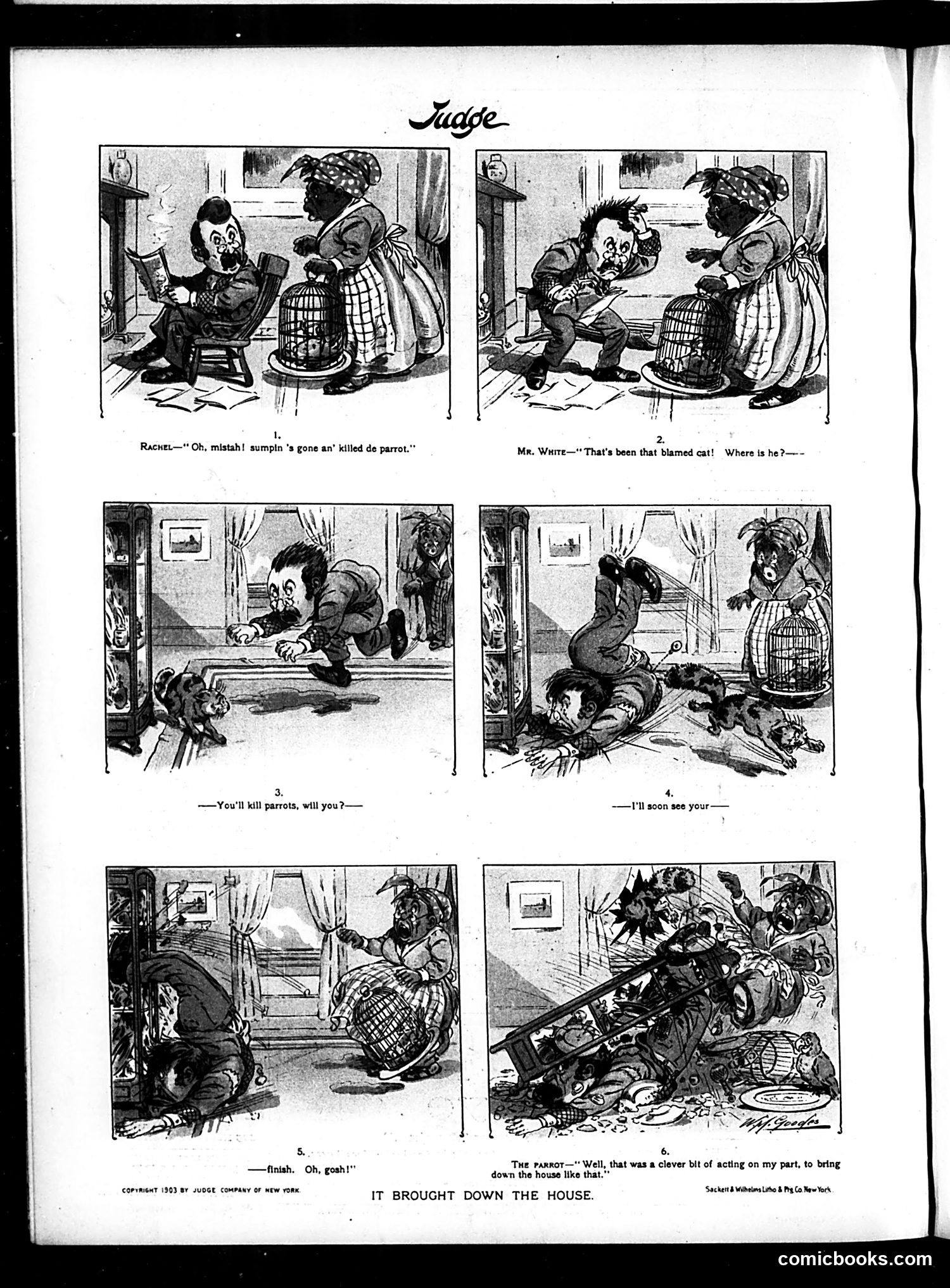
This six-panel comic depicts a slapstick domestic disaster. A couple owns a caged parrot. When the husband (Mr. White) discovers the parrot is missing, he and his wife search frantically. The parrot has escaped into the house, causing chaos—the man chases it, falls through the floor, and brings down the ceiling structure, literally demolishing their home in the final panels. The punchline plays on the phrase "brought down the house"—typically meaning an entertainer received roaring applause. Here, the parrot's "performance" literally collapsed their dwelling. It's a visual gag satirizing the unpredictability of pet ownership and domestic mishaps, common humor subjects in early-1900s Judge magazine. The exaggerated destruction emphasizes the comedic escalation throughout the sequence.