
A complete issue · 16 pages · 1903
Judge — January 10, 1903
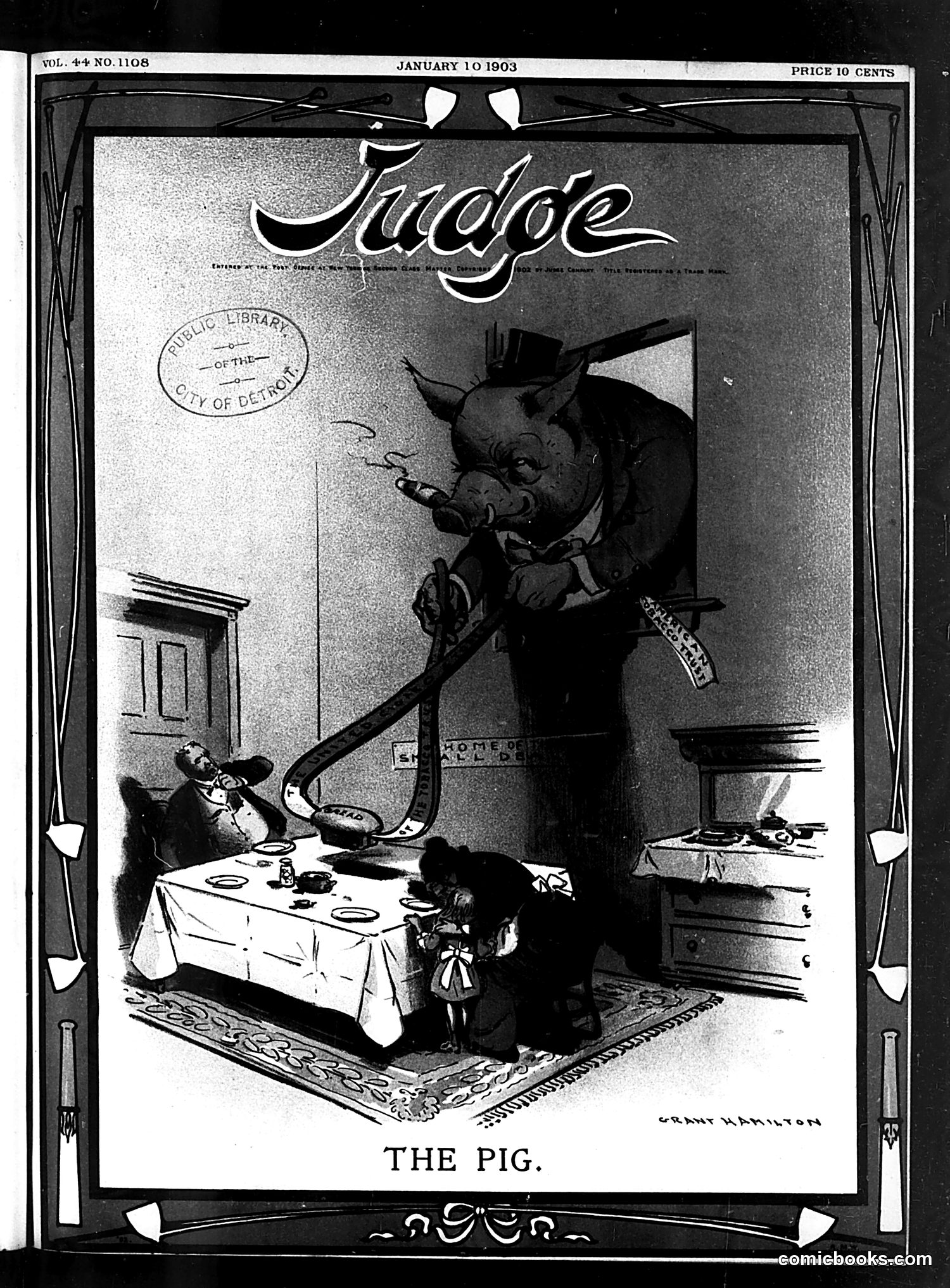
This satirical cartoon depicts a grotesque pig-headed figure towering over a dining scene, wielding a large fork or implement. The title "The Pig" suggests the figure represents greed, corruption, or excess—common metaphors in early 20th-century American political satire. The smaller figures at the table appear to be ordinary citizens or workers, dwarfed by this monstrous presence. The domestic setting with a "Home of All Joys" sign implies the cartoon criticizes how greed or monopolistic practices invaded American homes and daily life. Without additional context, the specific target remains unclear—whether this attacks business monopolies, political corruption, or labor exploitation common to the Progressive Era. The artist is credited as Grant Hamilton.
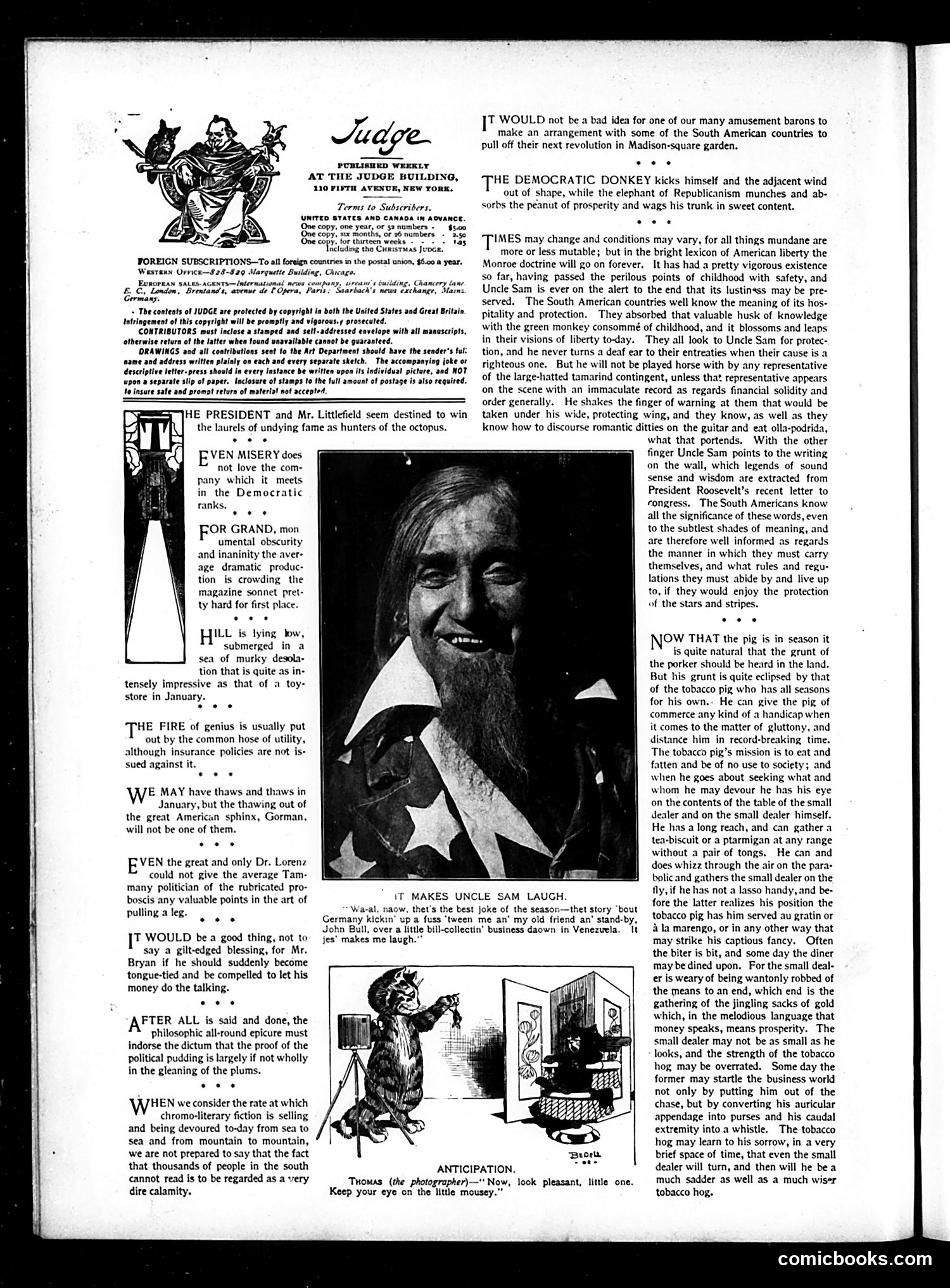
This page contains political commentary typical of Judge magazine's anti-Democratic stance. The main portrait appears to be Uncle Sam (identifiable by the characteristic beard and features), used as a symbol to critique Democratic Party politics. The text discusses South American countries seeking Uncle Sam's protection, contrasting Republican vigilance with Democratic unreliability. Multiple short satirical pieces mock Democratic incompetence—comparing their management to misery, dramatic production failures, and insurance fraud. The cartoons at bottom ("Anticipation") depict a photographer and mouse, using animal characters for social commentary, though the specific reference is unclear without additional context. Overall, the page attacks Democratic governance while promoting Republican/Uncle Sam ideals of American protection and fiscal responsibility—characteristic Judge editorial positioning from the early 20th century.
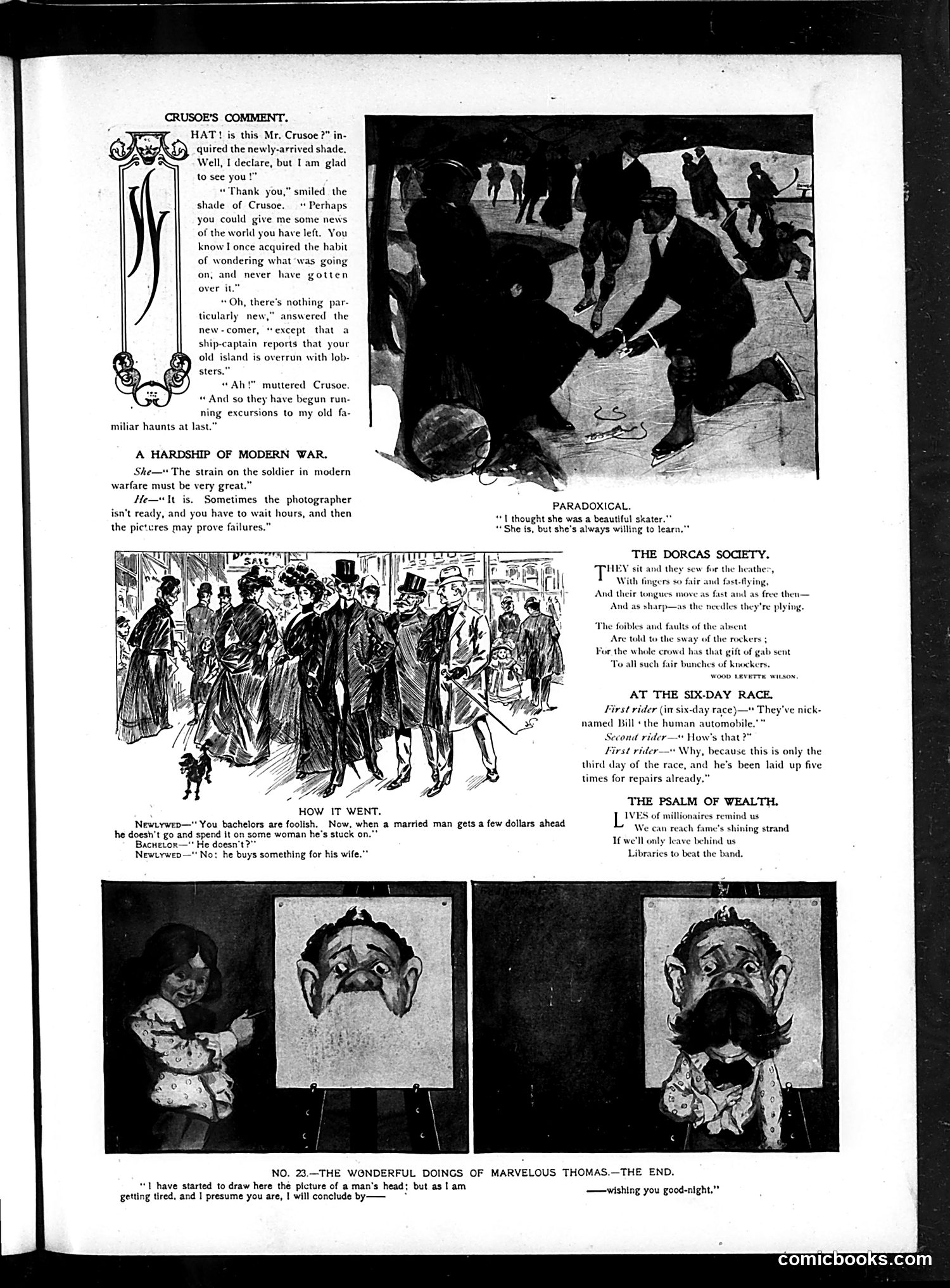
This page contains several distinct satirical pieces: **"Crusoe's Comment"** depicts a conversation about an island overrun with lobsters—likely satirizing colonial or imperial expansion anxieties about resource depletion. **"A Hardship of Modern War"** jokes about photographers needing extended time to capture combat scenes, mocking both military inefficiency and press documentation. **"The Dorcas Society"** is a humorous poem about a women's charitable organization, poking fun at their earnest but ineffectual efforts. **"At the Six-Day Race"** references the popular six-day bicycle racing craze, with casual banter about participant "Bill" and race mechanics. **"The Wonderful Doings of Marvelous Thomas"** (bottom) appears to be a recurring comic strip concluding a character's story arc, using exaggerated facial expressions for comedic effect. The page reflects early 20th-century American leisure, social institutions, and popular entertainment.
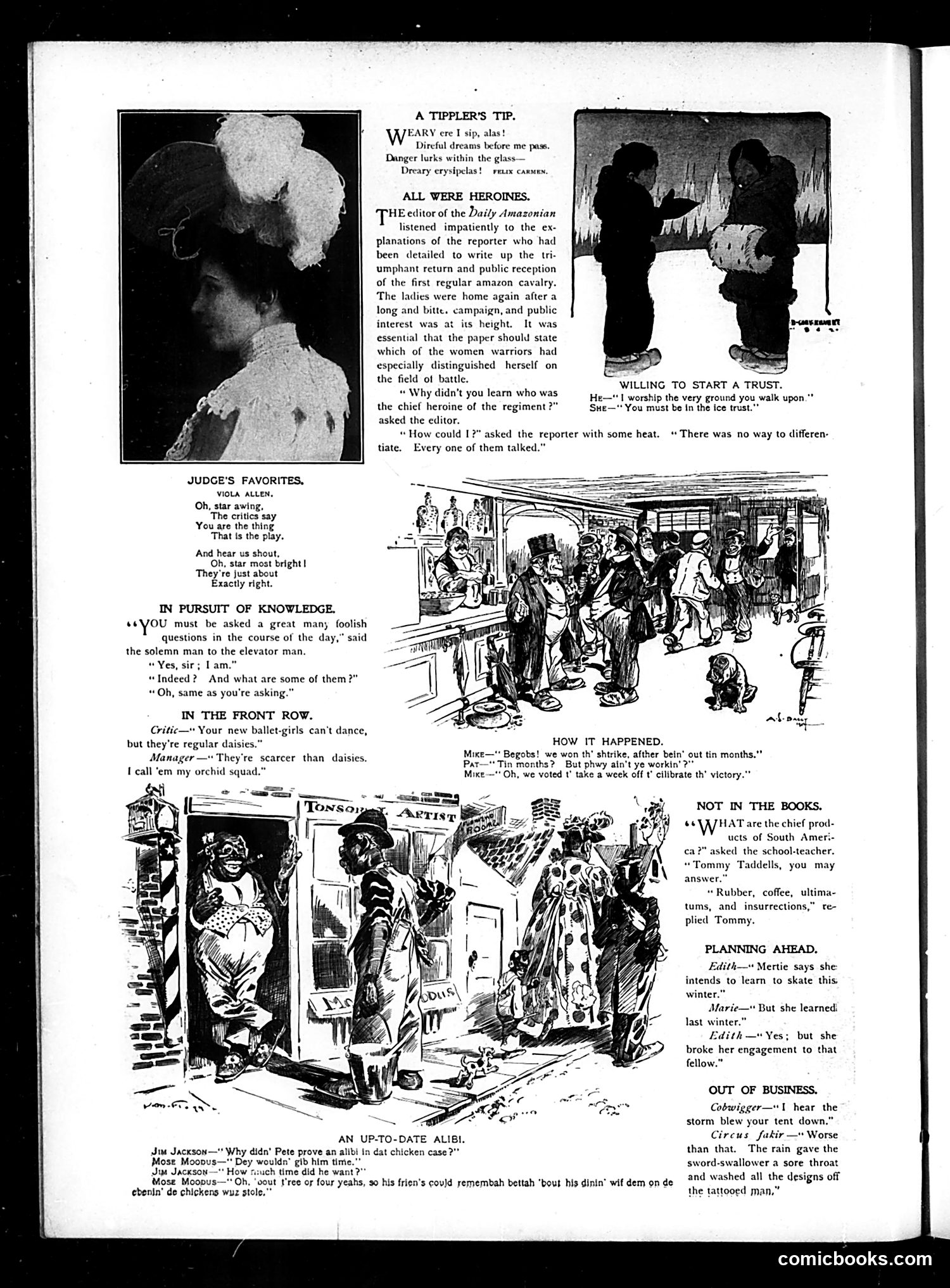
This page contains several humor sections typical of early 20th-century Judge magazine. "All Were Heroines" discusses women warriors returning from an Amazon cavalry campaign, likely referencing contemporary women's suffrage activism or military service debates. The "Alibi" section presents jokes about excuses—one references a chicken case verdict, another involves tent mishaps and tattooed men. These are general-audience humor pieces without specific political references. Other sections like "Judge's Favorites," "In Pursuit of Knowledge," and "In the Front Row" offer brief comedic dialogues on everyday topics: theater criticism, elevator etiquette, and ballet dancers. The illustrations are typical satirical line drawings. Without clearer identification of specific public figures or dated references in the text, the precise satirical targets remain unclear, though the humor targets social pretension and everyday absurdities.
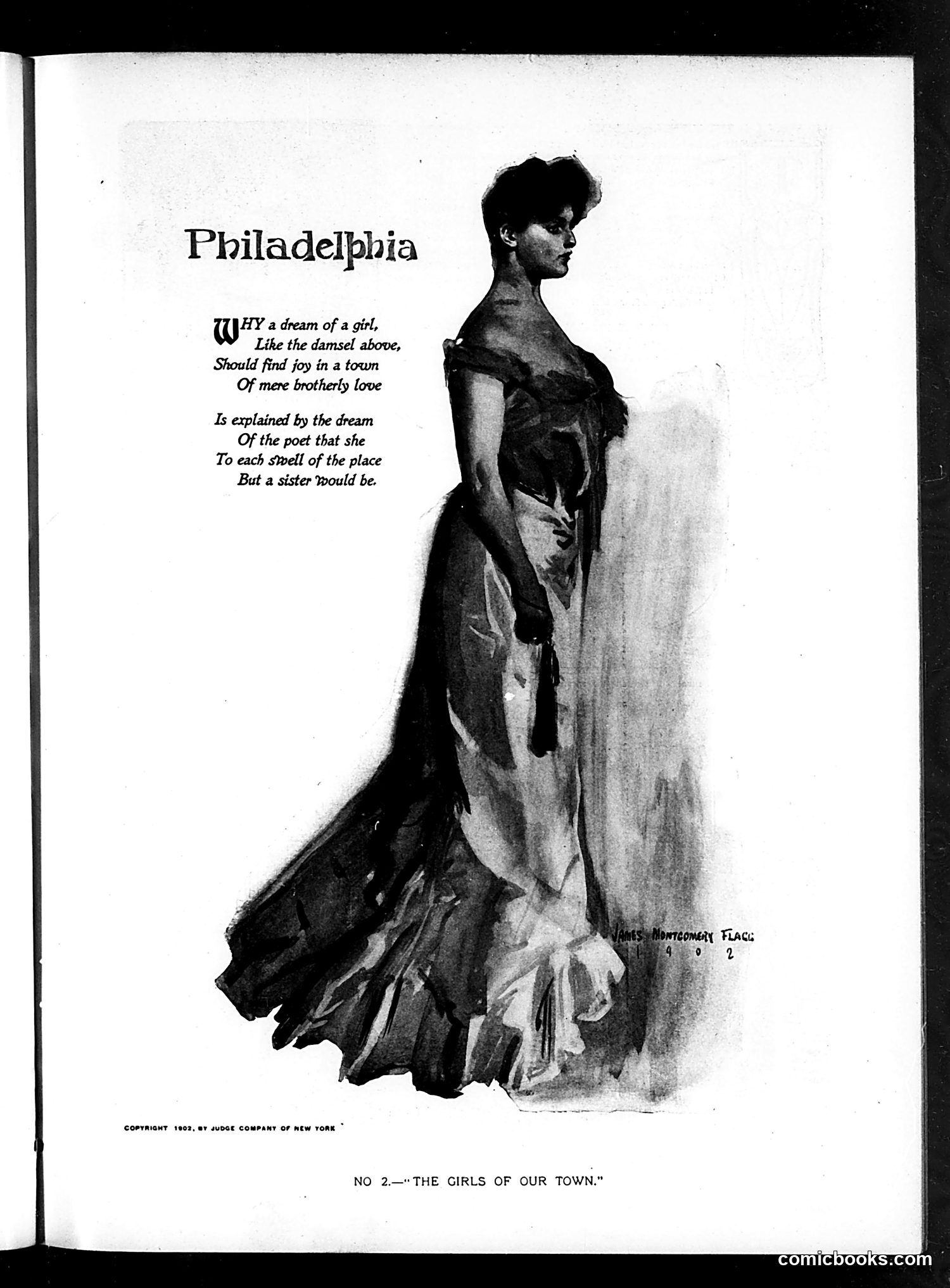
This 1902 Judge magazine illustration from the "Girls of Our Town" series presents an idealized portrait of a Philadelphia woman. The accompanying verse jokes about the city's nickname—"City of Brotherly Love"—by suggesting that local women are treated merely as sisters by suitors rather than romantic interests. The satire implies Philadelphia men are either unromantic or overly fraternal in their approach to courtship, undermining the city's reputation for affection. The elegant drawing contrasts with the humorous premise: despite the woman's attractive appearance and sophisticated presentation, she apparently inspires only platonic regard. The joke plays on regional stereotypes common in early-1900s American satirical magazines.
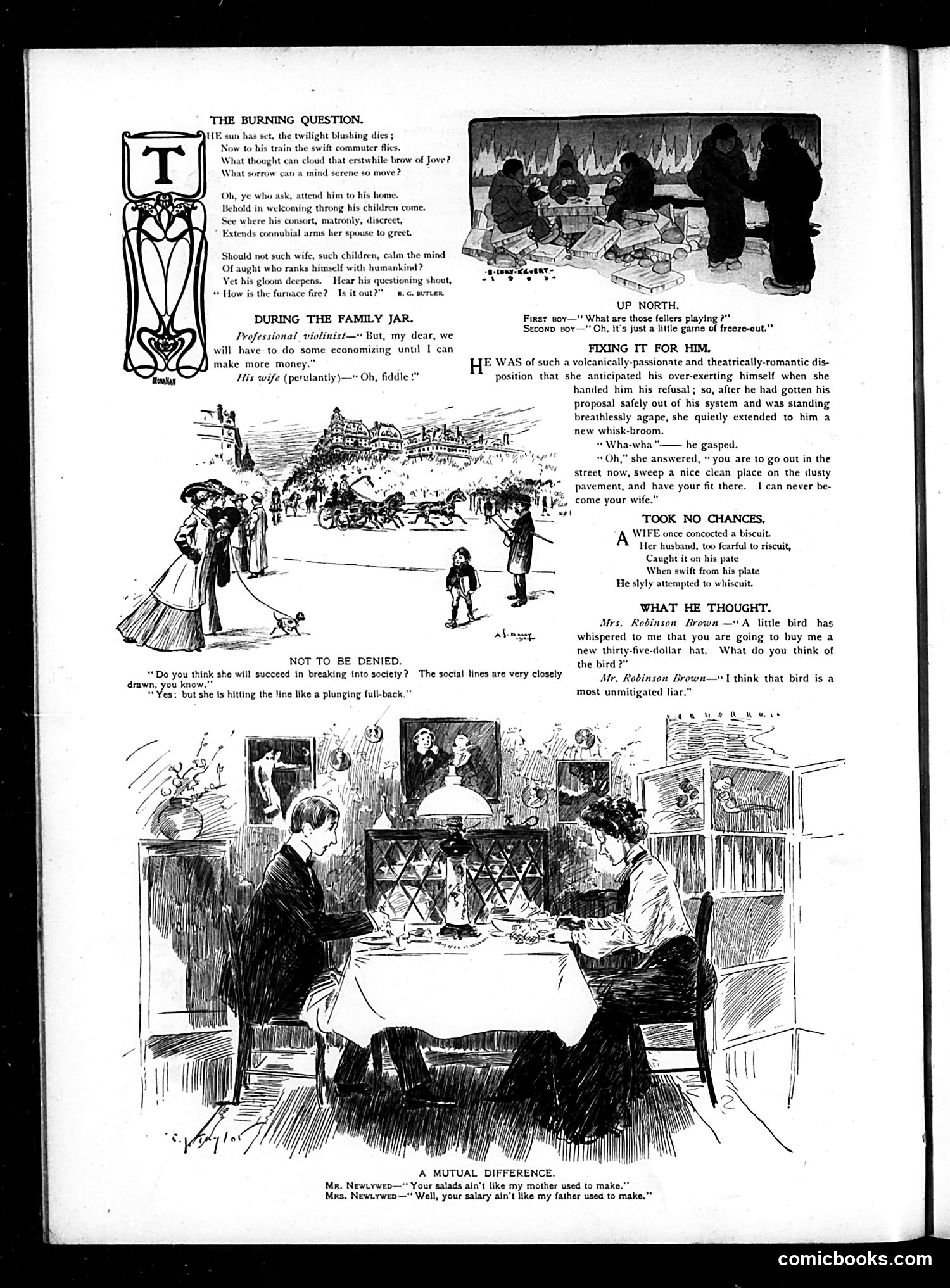
This page contains several domestic humor cartoons satirizing early 20th-century married life and gender relations. **"The Burning Question"** mocks husbands' obsession with household practicalities over family sentiment—a man returns home to loving wife and children, yet only worries: "How is the furnace fire?" **"During the Family Jar"** shows a professional musician's wife dismissing economizing concerns with "Oh, fiddle!"—a pun on his profession. **"Fixing It for Him"** depicts a woman rejecting a romantic proposal by handing the devastated suitor a whisk-broom, instructing him to have his emotional breakdown outside. The humor lies in her pragmatic dismissal of theatrical male emotion. **"Took No Chances"** is a lighthearted limerick about a wife's inedible biscuits. **"What He Thought"** satirizes wives' expensive tastes: Mrs. Brown hints at wanting a $35 hat; her husband mentally labels her "a most unmitigated liar." **"A Mutual Difference"** offers marital comeuppance: when Mr. Newlywed complains her cooking differs from his mother's, Mrs. Newlywed retorts his salary differs from her father's. The overall theme: wives as shrewd, practical, and equal bargainers in marriage.
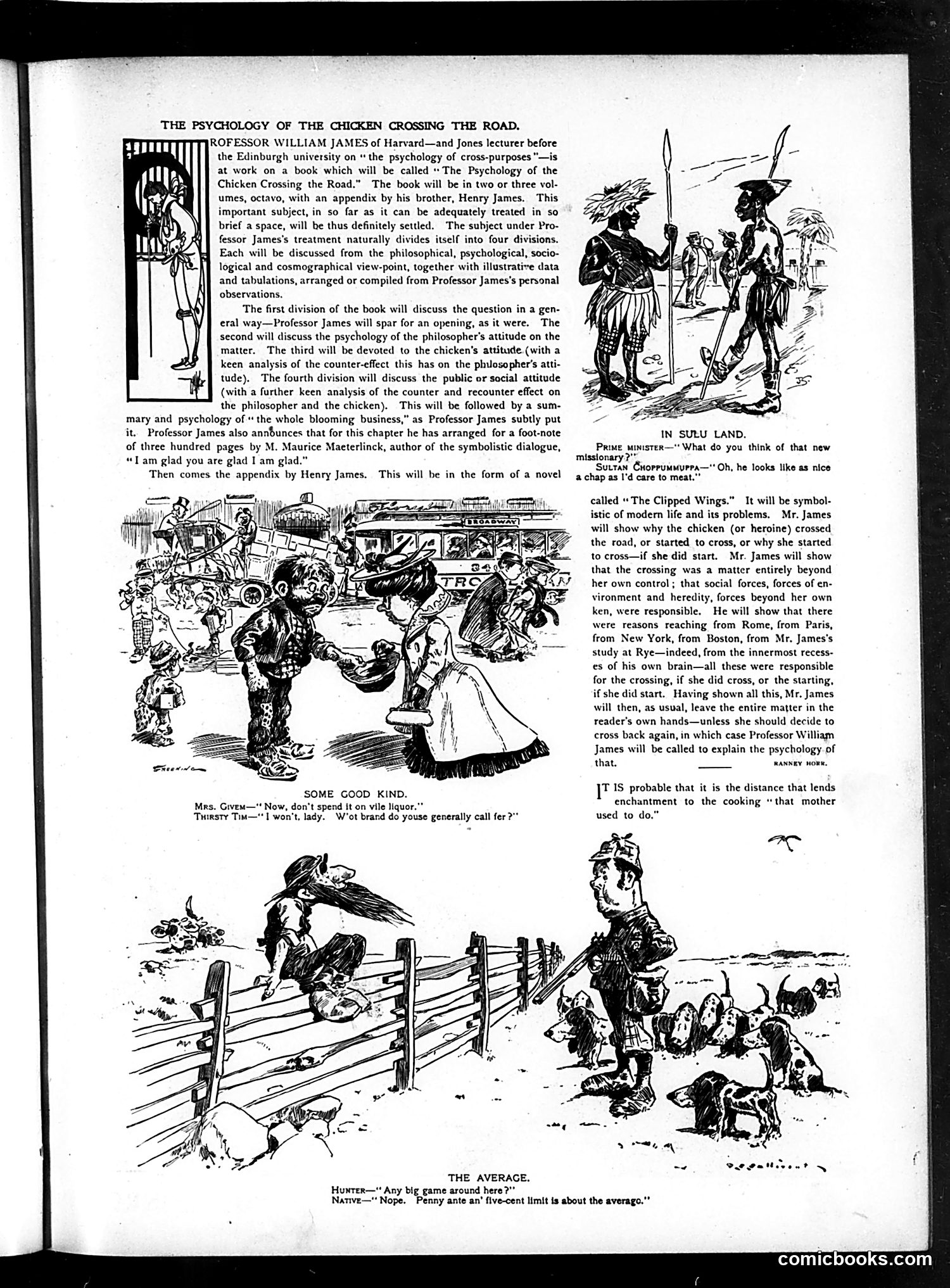
This is satire mocking the excessive intellectualization of trivial matters by Harvard philosopher William James and his brother Henry James, the novelist. The piece announces a mock multi-volume philosophical treatise analyzing why a chicken crosses a road, breaking it into absurdly complex divisions: the philosopher's attitude, the chicken's attitude, public opinion, and their various counter-effects. The satire intensifies with references to symbolist author Maurice Maeterlinck contributing a 300-page footnote, and Henry James writing a novel-form appendix arguing the chicken's crossing results from deterministic social forces reaching back to Rome and Paris—a jab at Henry's notoriously convoluted narrative style. The accompanying cartoons (unrelated vignettes) suggest this entire page ridicules overcomplicated intellectual frameworks applied to simple subjects.
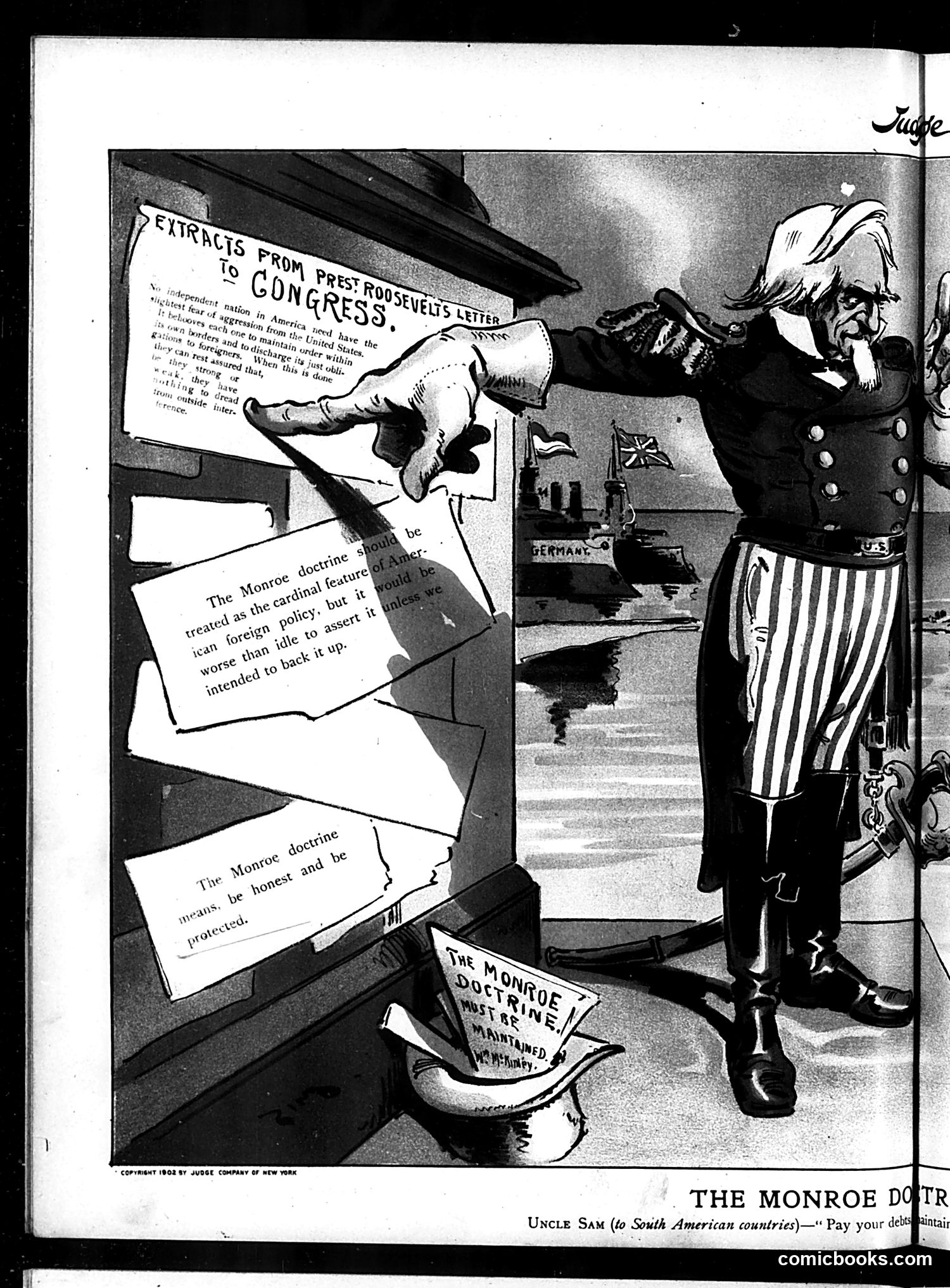
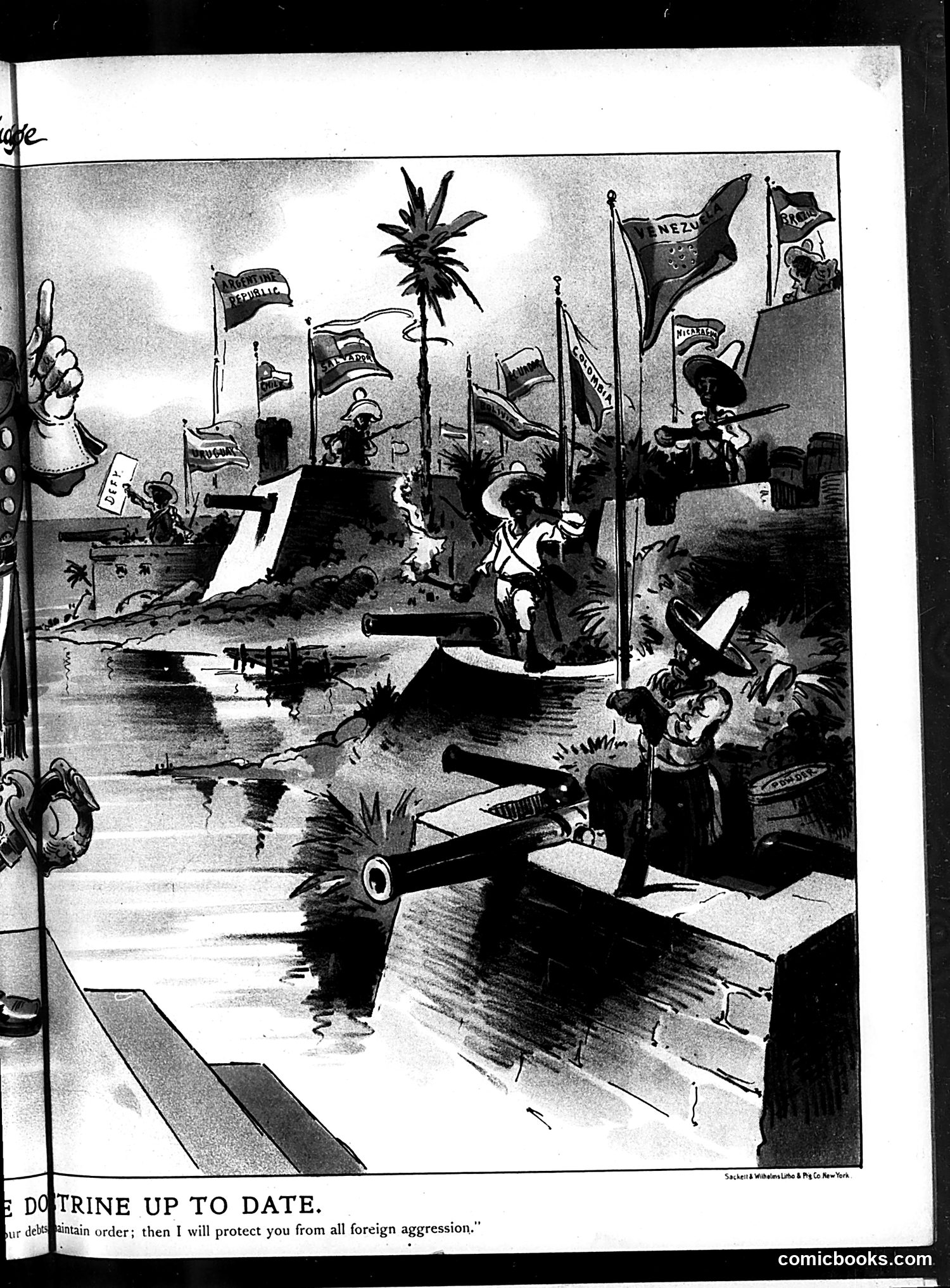
This political cartoon satirizes a military or imperialist figure (likely a European power or leader) surrounded by flags and armed forces in what appears to be a colonial or occupied territory, with a palm tree suggesting a tropical location. The incomplete caption reads: "maintain order; then I will protect you from all foreign aggression." The satire critiques the paternalistic justification for imperialism—the claim that military occupation and control are necessary to "protect" weaker nations. The cartoon suggests this is contradictory: the occupying force itself IS the aggression, despite claiming to defend against external threats. The "doctrine up to date" title indicates this mocks contemporary imperialist rhetoric as outdated rationalization. Without a visible date or specific country identification, the exact historical moment is unclear, though this appears critical of turn-of-the-century expansionism.
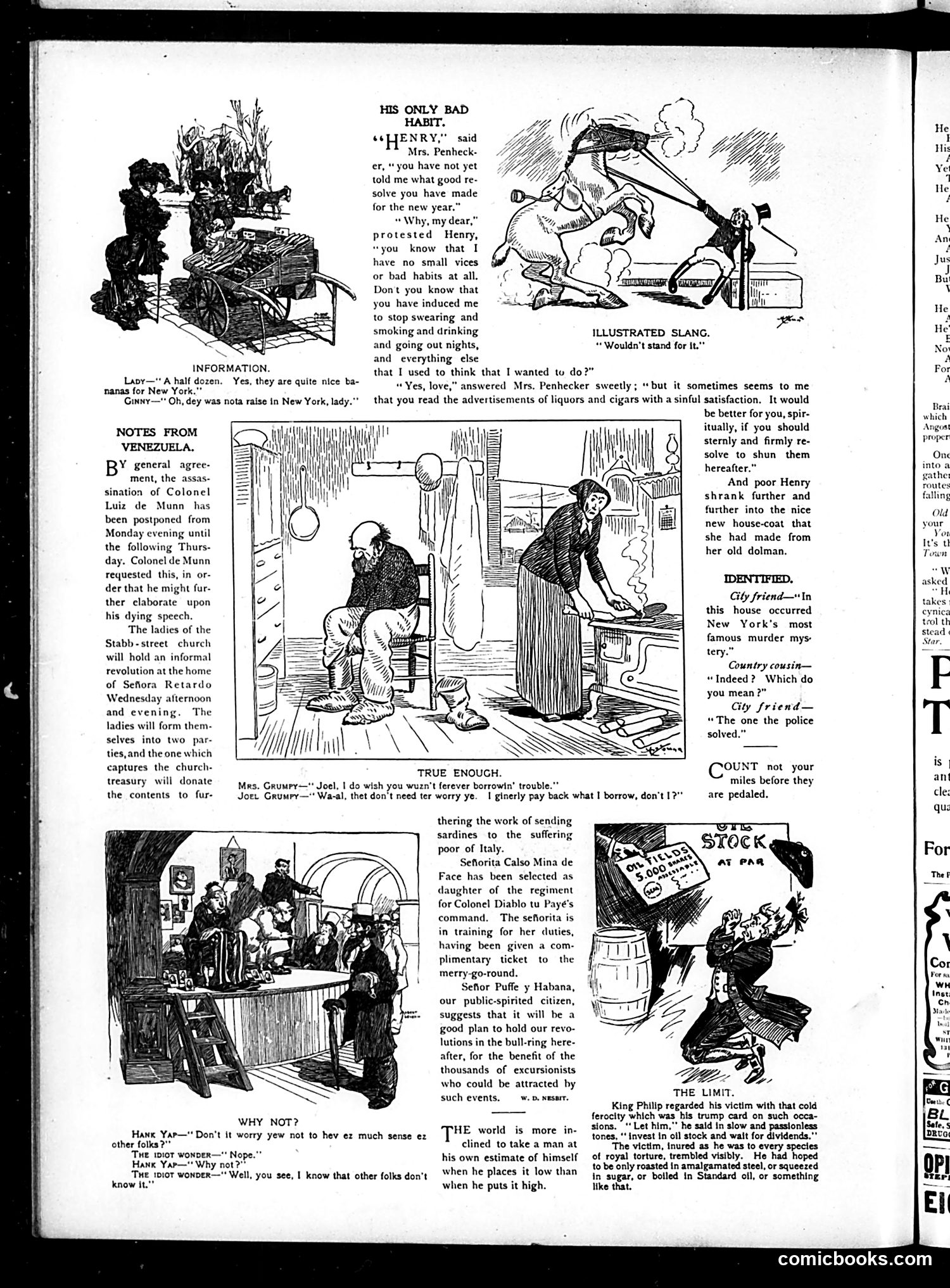
This page contains multiple satirical pieces typical of Judge magazine's social commentary: **"His Only Bad Habit"** (top): A domestic comedy where Henry claims to have no vices, having quit swearing, smoking, drinking, and socializing—yet his wife notices he still eagerly reads liquor and cigar advertisements. The satire mocks male hypocrisy about reformation and the power of advertising. **Various short humor pieces** include Venezuelan political assassination postponements (satirizing Latin American instability), and jokes about borrowing money and bicycle riding. **"The Limit"** (bottom): References King Philip's torture methods, sarcastically suggesting modern Americans prefer financial tortures (stock losses, oil boiling) to historical ones—satire on industrial-age capitalism's cruelties. The illustrations are typical Judge cartoons: detailed cross-hatching, exaggerated character expressions, and visual puns. The overall tone targets middle-class American pretension, marriage dynamics, and emerging commercial advertising culture of the early 20th century.
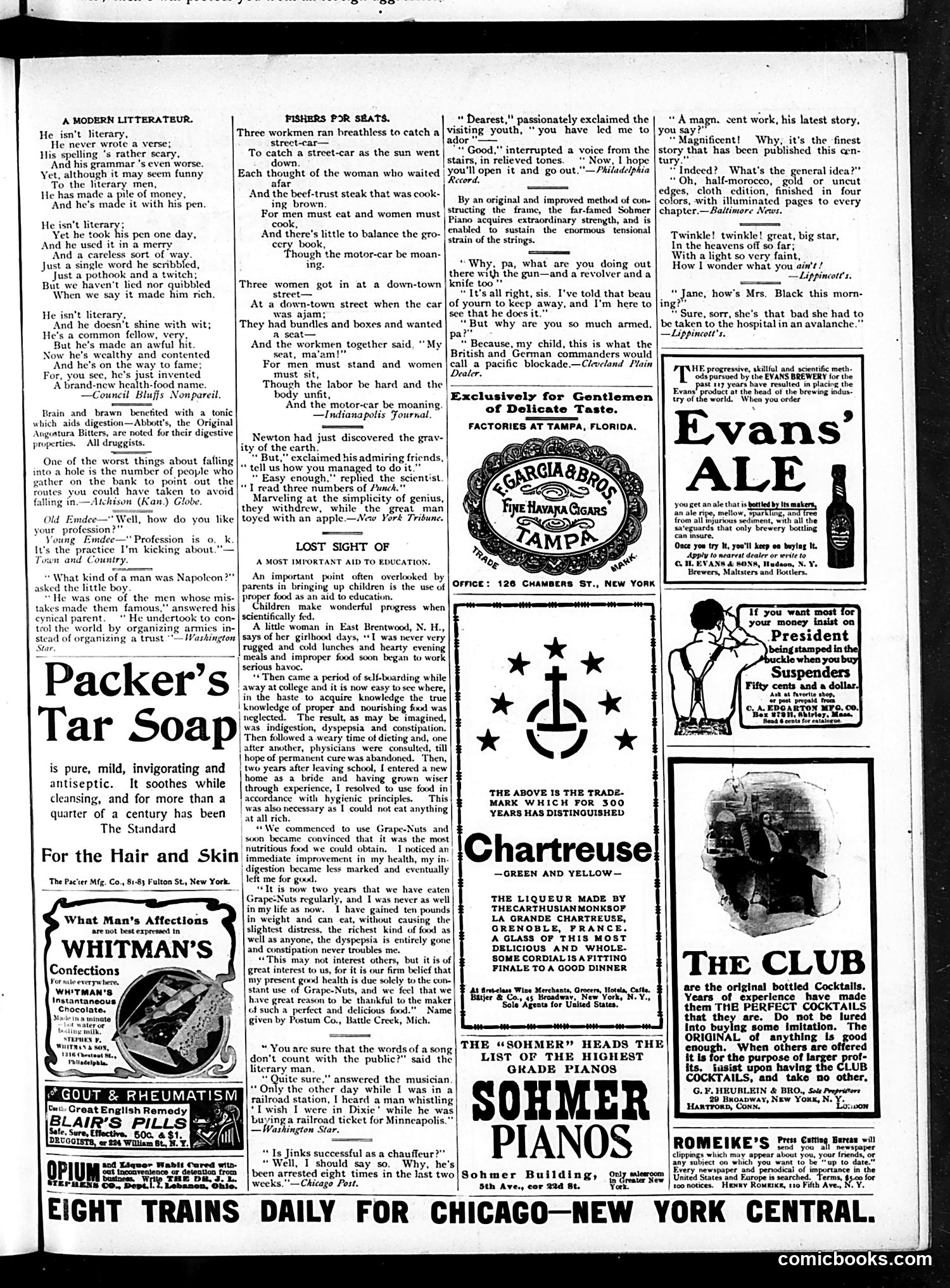
This page is primarily **advertising**, with a satirical poem about modern commercial success at the top. ## Main Satire: "A Modern Litterateur" The poem mocks a man who achieved wealth not through literary talent but by inventing a catchy **health-food brand name**. He's "not literary," has poor spelling and grammar, yet became rich simply by writing one clever marketing phrase ("a pothook and a twitch"). The satire targets the early 1900s obsession with patent medicines and health foods—the era's commercial craze where shrewd marketing often trumped actual product quality or scientific merit. It's a critique of how American capitalism rewarded promotional cleverness over genuine intellectual achievement. ## Advertisements The rest consists of period product ads: Packer's Tar Soap, Whitman's chocolates, various patent medicines (Blair's Pills, Gout & Rheumatism remedy), and—notably—**Grape-Nuts cereal**, advertised through a testimonial letter about digestive health benefits typical of the era's health-food marketing. The irony: the page itself demonstrates exactly what the poem satirizes—the commercial power of aggressive advertising.
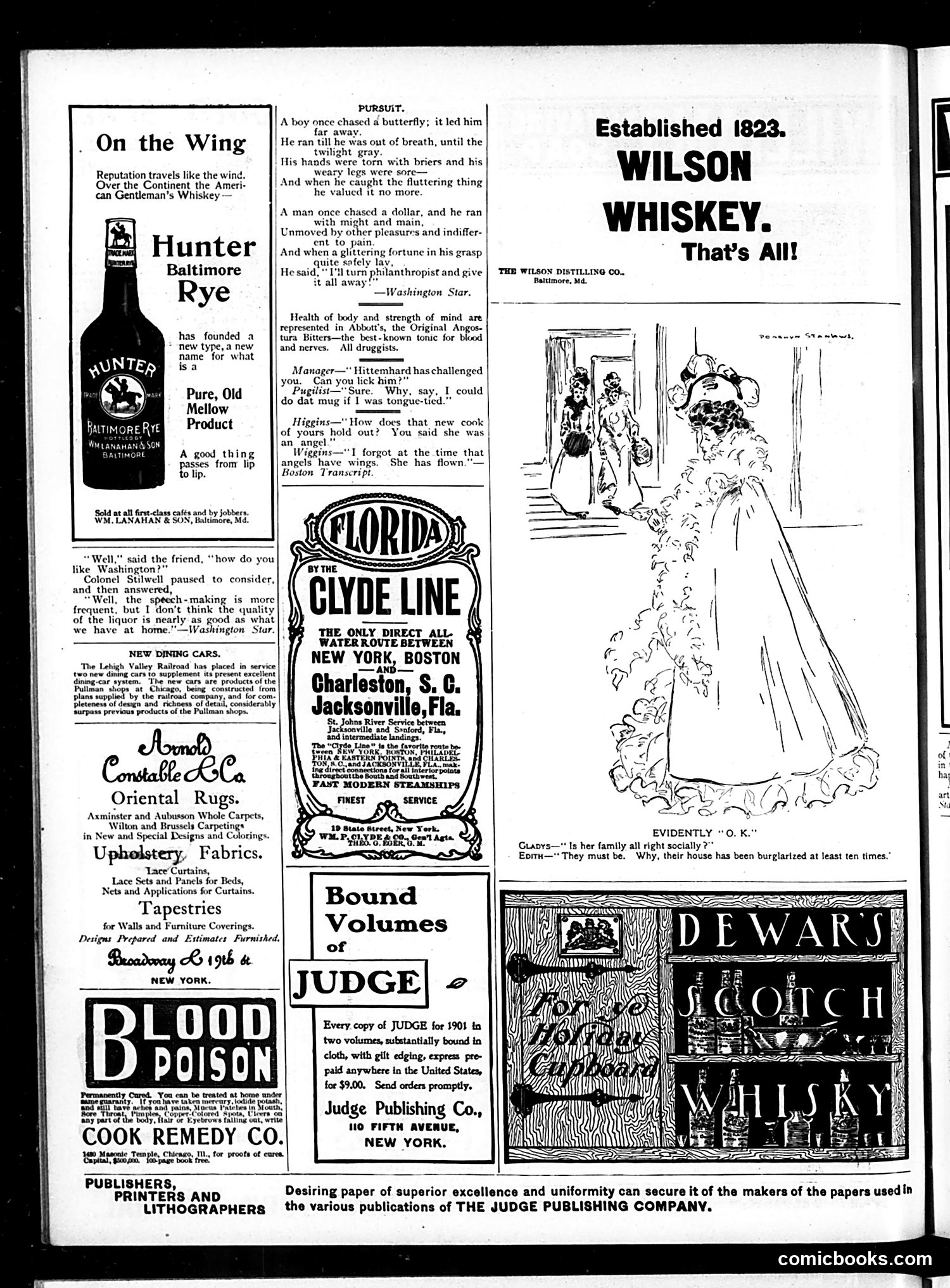
This page is primarily **advertisements** rather than editorial content, typical of early 1900s magazines. The main cartoon is small—a single-panel joke titled "EVIDENTLY 'O.K.'" showing two society women discussing a neighbor's social standing. **The Cartoon's Joke:** One woman asks if the other's family is "all right socially." The response: "They must be. Why, their house has been burglarized at least ten times." **The Satire:** This mocks upper-class social pretension by inverting respectability markers. Frequent burglaries supposedly indicate a house worth targeting—thus valuable possessions, thus wealth, thus social status. It satirizes how wealthy people judge each other primarily by material display rather than character or actual accomplishment. The rest of the page contains advertisements for whiskey, shipping lines, dining cars, Oriental rugs, and patent medicines—standard Judge fare of the era. The "PURSUIT" poem above discusses chasing fleeting goals (butterfly, money) only to devalue them when caught, offering moral commentary rather than satire.
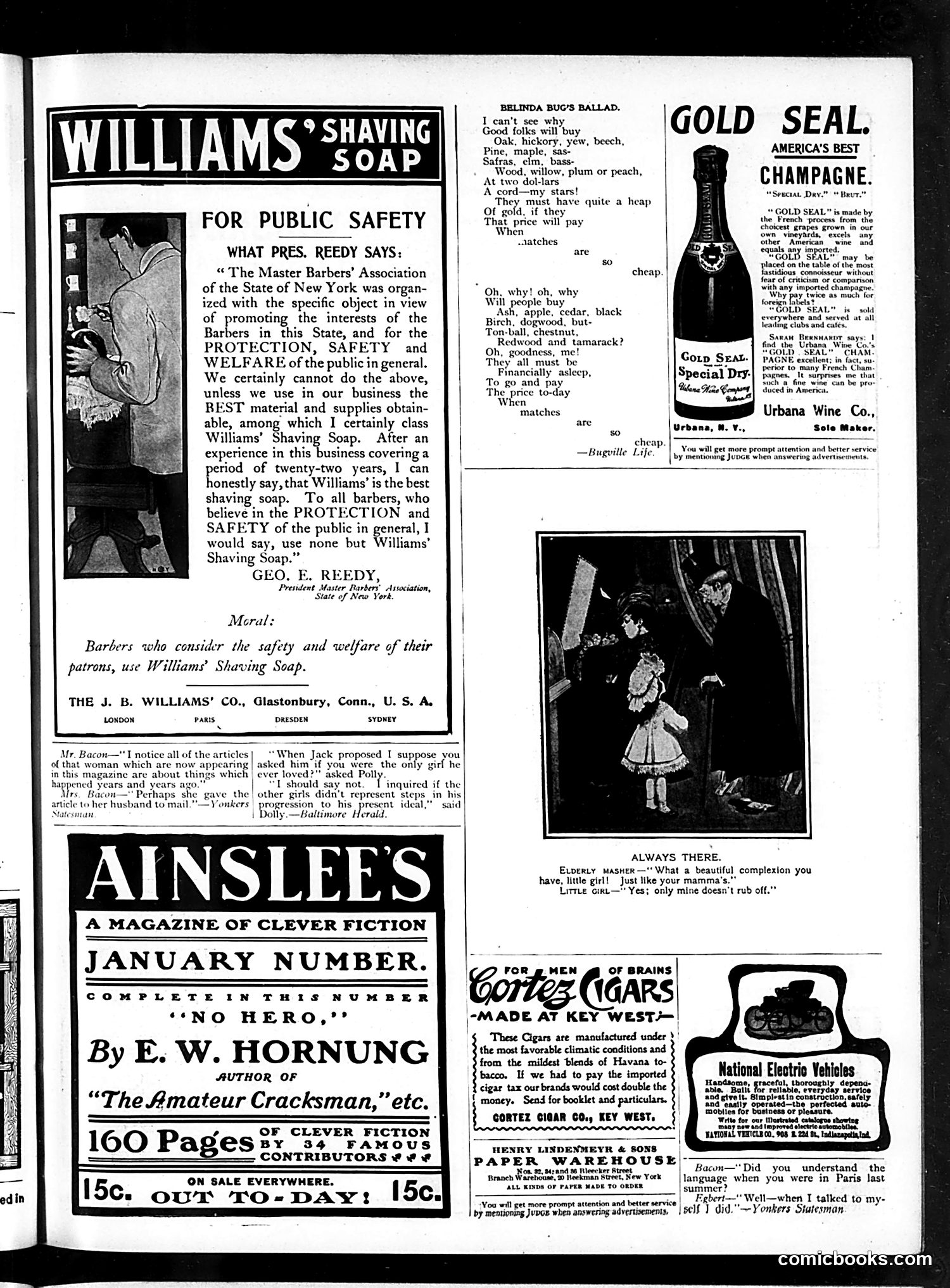
This is primarily an **advertisement-heavy page** from Judge magazine, not a political cartoon page. The content is commercial rather than satirical. The largest items are ads: Williams' Shaving Soap features a testimonial from George E. Reedy (Master Barbers' Association president) claiming the soap promotes public safety. Gold Seal Champagne advertises American-made wine. Ainslee's Magazine promotes a serial story. The small satirical **filler jokes** at bottom include: - A husband-wife exchange about her magazine articles being old news - A dating joke about a girl asking if she's her suitor's only love ("you inquired if the other girls didn't represent steps in his progression") - "Belinda Bug's Ballad" criticizing why people buy expensive firewood These are standard light humor—no identifiable political figures or major satirical targets. The page represents Judge's mixed advertising-and-jokes model typical of early 20th-century magazines.
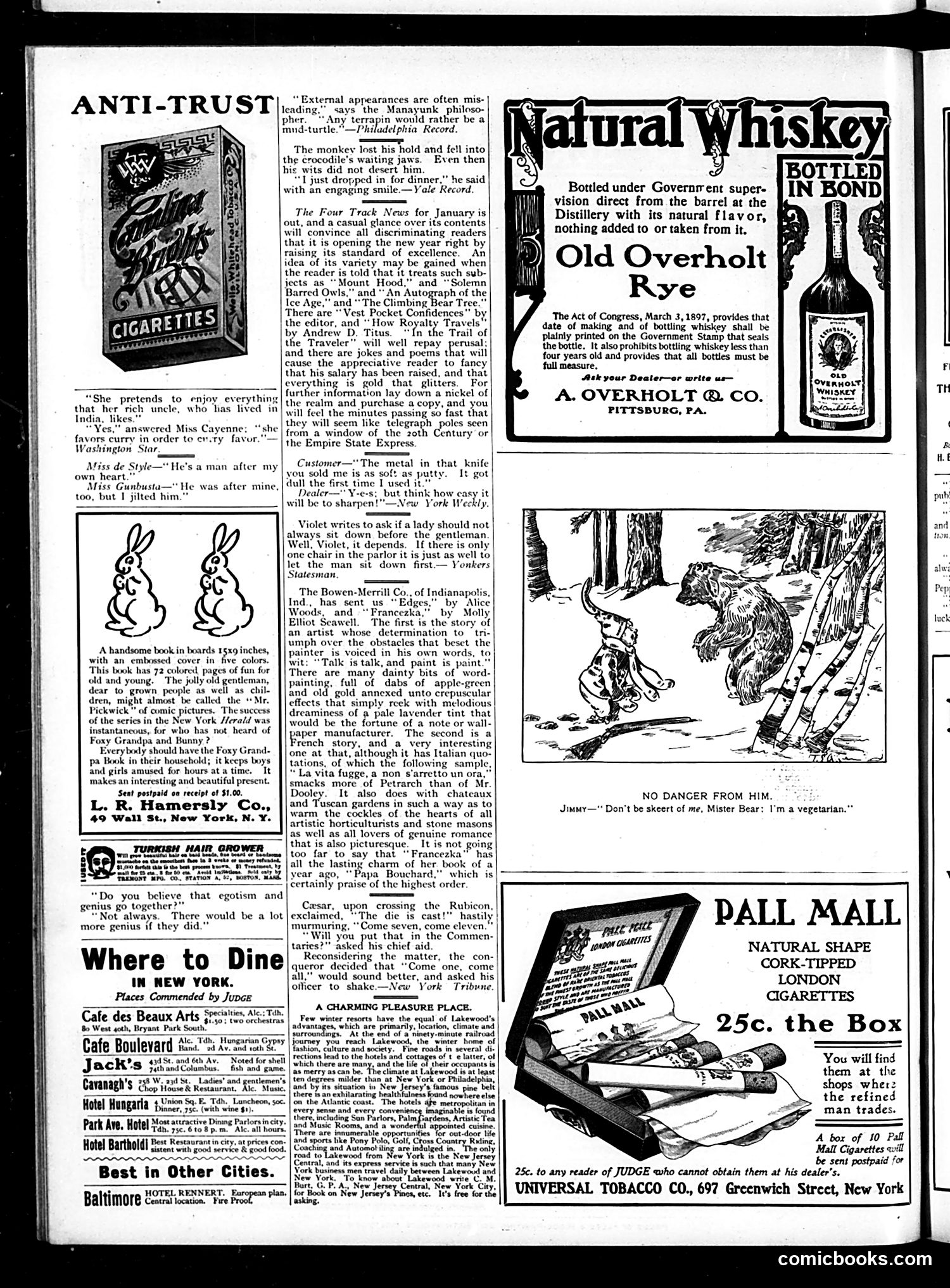
This page from *Judge* magazine contains mostly **advertisements and filler content** rather than political satire. The main items are: 1. **"Anti-Trust" cigarette ad** (left): A product advertisement with a small anecdote about a monkey's wit. 2. **"Natural Whiskey" ad** (top right): Promoting Old Overholt Rye whiskey, emphasizing government supervision and purity—likely a response to early 1900s food-safety concerns and patent medicine scandals. 3. **"No Danger from Him" cartoon** (center right): Shows a bear and rabbit; the rabbit jokes it's a vegetarian. This is mild, apolitical humor. 4. **"Pall Mall" cigarette ad** (bottom right): Marketing cigarettes at 25 cents per box. 5. **Restaurant listings** (bottom left): Advertisements for New York dining establishments. The page reflects the era's heavy reliance on advertising revenue and contains no significant political commentary or social satire.
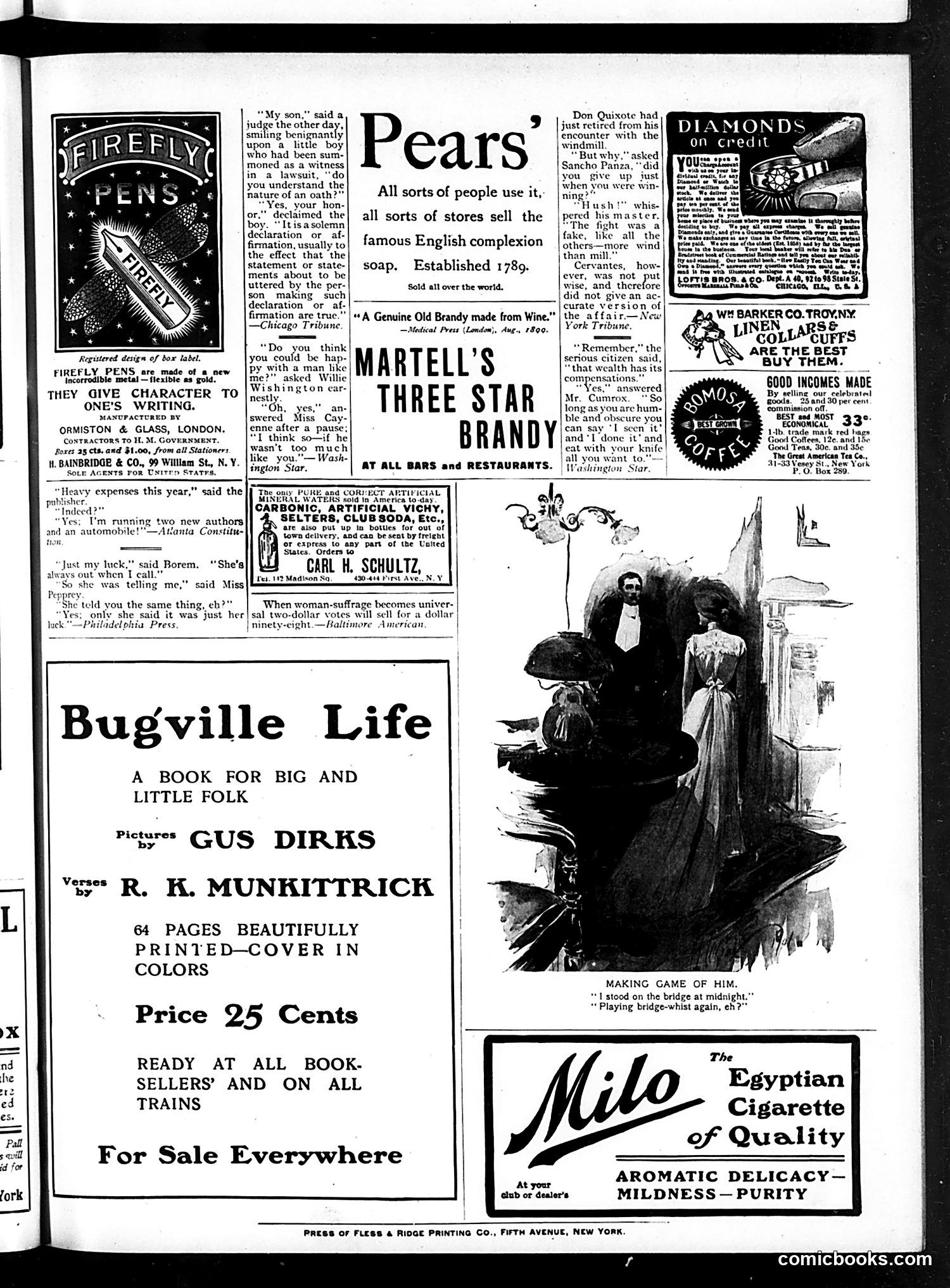
This page from Judge magazine (early 1900s) is primarily **advertisements and brief satirical jokes** rather than political cartoons. The main content includes: **The Don Quixote reference**: A joke contrasts a judge questioning a boy witness about oath-taking with Don Quixote's famous windmill encounter. The satire suggests the judge is tilting at windmills—waging futile legal battles. Sancho Panza (Quixote's companion) wouldn't "give an accurate version," implying the legal system similarly distorts truth. **The woman-suffrage joke**: A final quip predicts that universal women's suffrage will devalue votes—a cynical jab at women's political rights becoming "cheap." **Other content**: Brief humorous exchanges about marriage, poverty, and publishing, typical of Judge's satirical voice. The page is dominated by **product advertisements** (Pears' soap, Martell's brandy, Firefly pens, Bugville Life book, etc.), which was standard for magazines of this era. The visual cartoon ("Making Game of Him") depicts someone playing bridge-whist, a popular card game, with minimal satirical content.
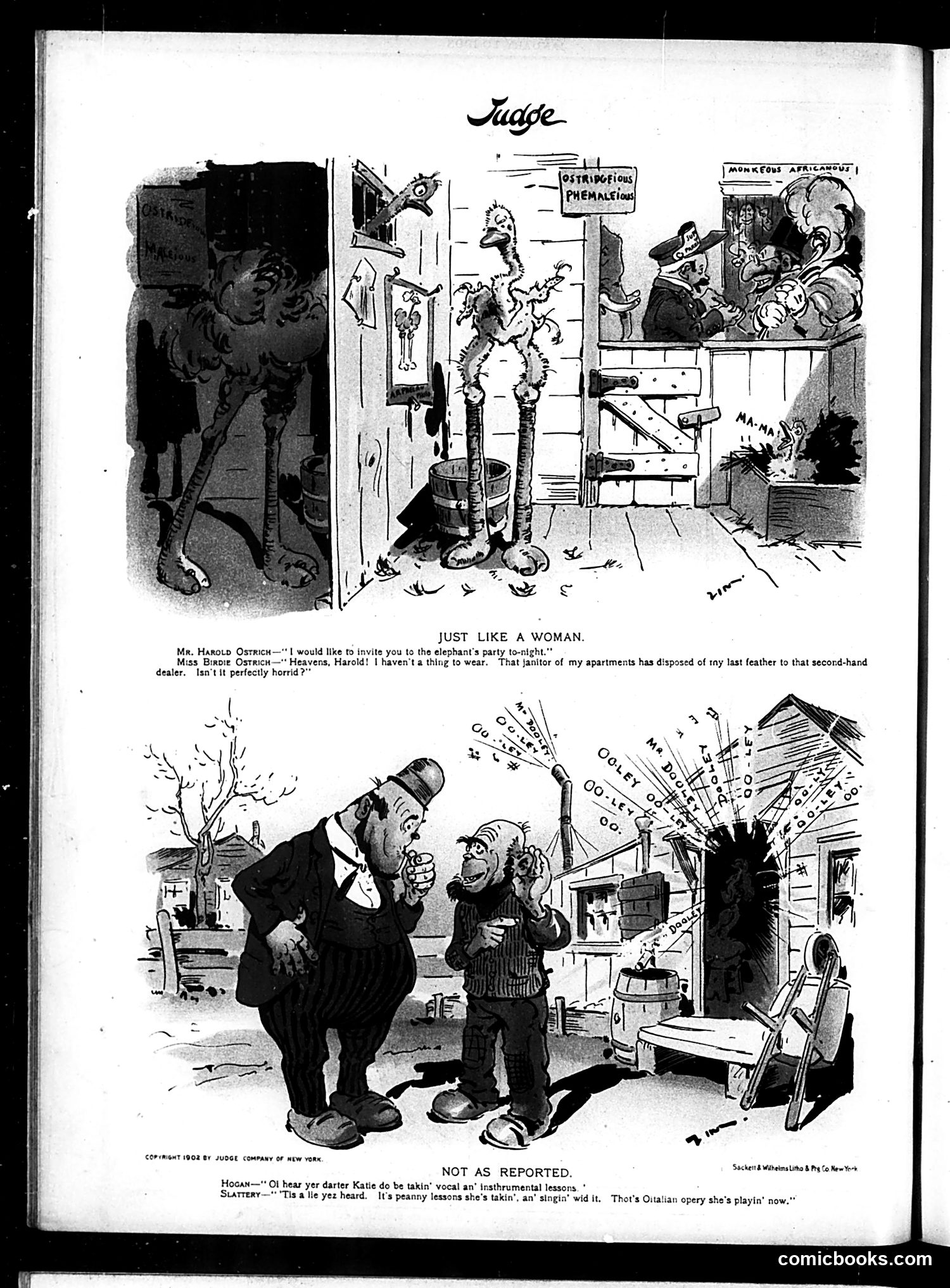
**"Just Like a Woman"** satirizes female materialism and vanity. Two anthropomorphized ostriches—Mr. and Miss Ostrich—are invited to a party, but Miss Ostrich cannot attend because she has nothing to wear; she's sold her last feather to a second-hand dealer. The joke plays on the stereotype that women are frivolous, obsessed with clothing and appearance, and poor financial managers—hence "just like a woman." **"Not as Reported"** mocks Irish immigrant working-class speech and family pretense. Two men with heavy Irish dialect discuss the latter's daughter Katie. Hogan assumes she's taking vocal and instrumental lessons (respectable), but Slattery corrects him: she's actually taking penny-whistle lessons while playing Italian opera. The humor derives from the character's defensive misrepresentation and the stereotypical Irish brogue dialogue. Both cartoons reflect early 1900s prejudices about gender and immigrants.