
Judge, 1903-01-10 · page 7 of 16
Judge — January 10, 1903 — page 7: what you’re looking at
What you’re looking at
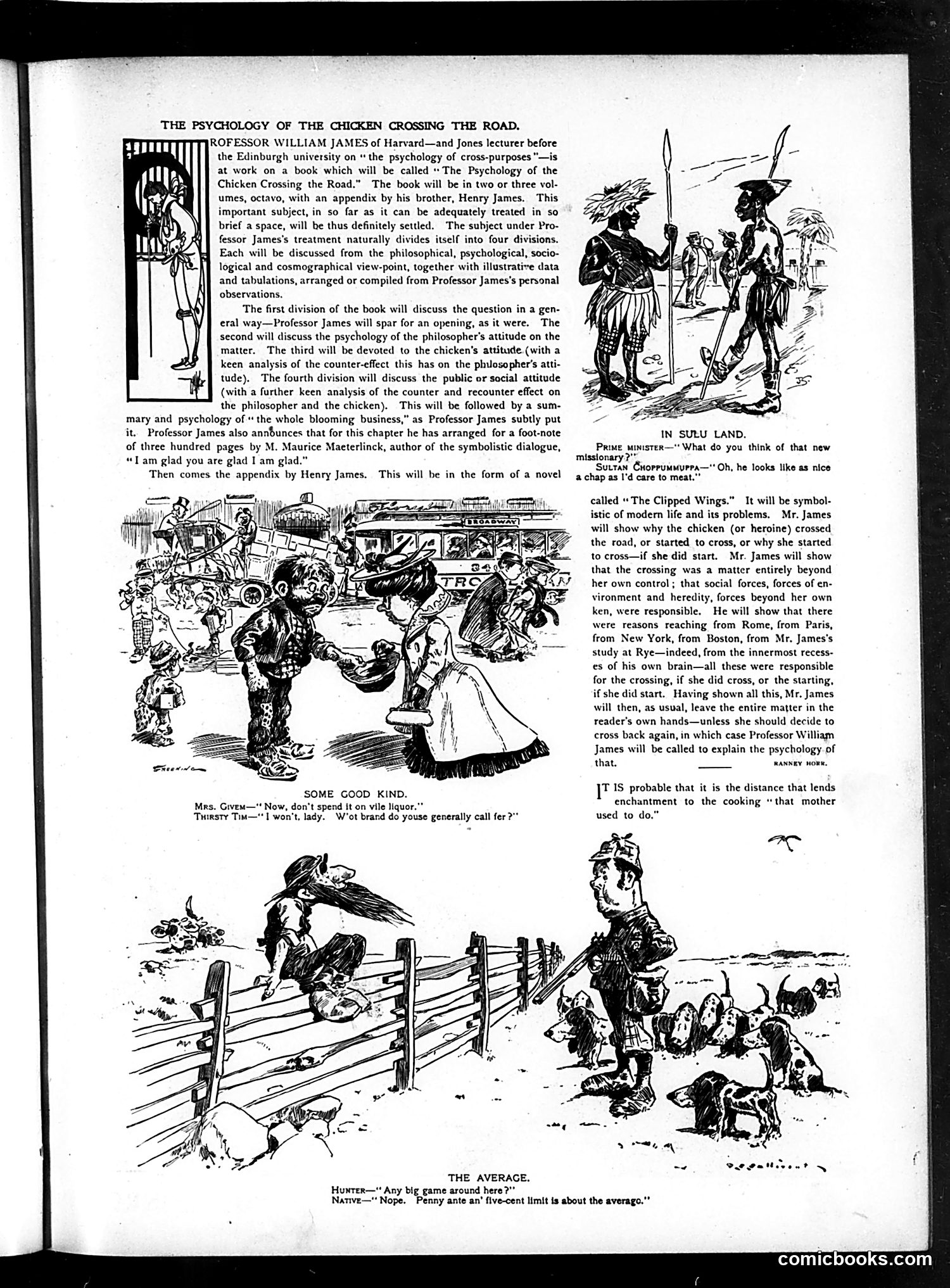
This is satire mocking the excessive intellectualization of trivial matters by Harvard philosopher William James and his brother Henry James, the novelist. The piece announces a mock multi-volume philosophical treatise analyzing why a chicken crosses a road, breaking it into absurdly complex divisions: the philosopher's attitude, the chicken's attitude, public opinion, and their various counter-effects. The satire intensifies with references to symbolist author Maurice Maeterlinck contributing a 300-page footnote, and Henry James writing a novel-form appendix arguing the chicken's crossing results from deterministic social forces reaching back to Rome and Paris—a jab at Henry's notoriously convoluted narrative style. The accompanying cartoons (unrelated vignettes) suggest this entire page ridicules overcomplicated intellectual frameworks applied to simple subjects.
📄 Transcribed text from this page (OCR, searchable)
Machine-transcribed from the original scan — historical spelling and the odd misread are preserved.
THE PSYCHOLOGY OF THE CHICKEN CROSSING THE ROAD. IROFESSOR WILLIAM JAMES of Harvard—and Jones lecturer before the Edinburgh university on «the psychology of cross-purposes "—is at work on a book which will be called “The Psychology of the Chicken Crossing the Road.” The book will be in two or three vol- umes, octavo, with an appendix by his brother, Henry James. This important subject, in so far as it can be adequately treated in so brief a space, will be thus definitely settled. The subject under Pro- fessor James's treatment naturally divides itself into four divisions. Each will be discussed from the philosophical, psychological, socio- logical and cosmographical view-point, together with illustrative data and tabulations, arranged or compiled from Professor James's personal observations. The first division of the book will discuss the question in a gen- eral way—Professor James will spar for an opening, as it were. The second will discuss the psychology of the philosopher's attitude on the matter. The third will be devoted to the chicken’s attitude (with a keen analysis of the counter-effect this has on the philosopher's atti- tude). The fourth division will discuss the public or social attitude (with a further keen analysis of the counter and recounter effect on the philosopher and the chicken). This will be followed by a sum- mary and psychology of «the whole blooming business,” as Professor James subtly put it. Professor James also annbunces that for this chapter he has arranged for a foot-note IN SULU LAND. of three hundred pages by M. Maurice Maeterlinck, author of the symbolistic dialogue, Prime minister—‘* What do you think of that new “Tam glad you are glad I am glad.” misstonary ?” SULTAN —** Oh, he looks lil Then comes the appendix by Henry James. This will be in the form of a novel sen Gerona oh hegiooks ilk ssinice called “The Clipped Wings.” It will be symbol- istic of modern life and its problems. Mr. James will show why the chicken (or heroine) crossed the road, or started to cross, or why she started to cross—if she did start. Mr. James will show that the crossing was a matter entirely beyond her own control; that social forces, forces of en- vironment and heredity, forces beyond her own ken, were responsible. He will show that there were reasons reaching from Rome, from Paris, from New York, from Boston, from Mr. James's study at Rye—indeed, from the innermost recess- es of his own brain—all these were responsible for the crossing, if she did cross, or the starting, if she did start. Having shown all this, Mr. James will then, as usual, leave the entire matter in the reader's own hands—unless she should decide to cross back again, in which case Professor William. James will be called to explain the psychology of that. RANNEY HOR, SOME GOOD KIND. I" IS probable that it is the distance that lends Mrs. Giveu—" Now, don't spend it on vile liquor."* enchantment to the cooking “that mother Tuursty Tim—"' I won't, lady. W’ot brand do youse generally call fer?" used to do. wg THE AVERAGE. Any big game around here ?"” “Nope. Penny ante an’ five-cent limit is about the averago."* comicbooks.com