
A complete issue · 16 pages · 1902
Judge — September 6, 1902
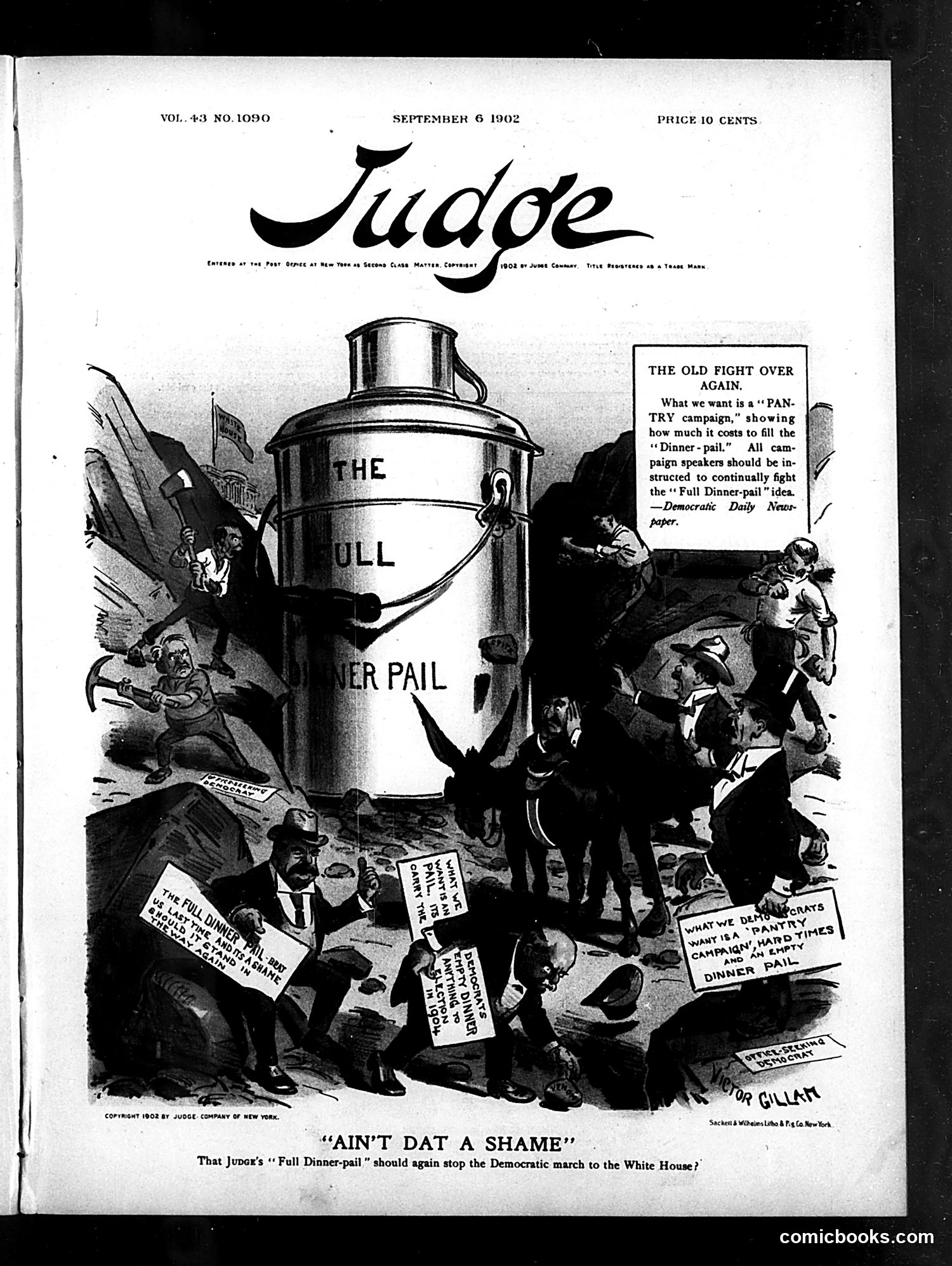
This political cartoon satirizes the Democratic Party's "Full Dinner-pail" campaign strategy. The central image shows a large dinner pail surrounded by various figures—likely Democratic politicians and supporters—struggling unsuccessfully to fill it or promote it to voters. The satire mocks the Democrats' campaign promise that their policies would ensure workers could afford full dinner pails (full meals). The cartoon suggests this promise is hollow and failing to gain traction. Various smaller signs and figures around the bucket reference the party's difficulties, with the caption "Ain't Dat a Shame" implying the campaign's embarrassing ineffectiveness. The accompanying text box frames this as an ongoing political debate about economic policy and campaign credibility leading up to what appears to be the 1902 elections.
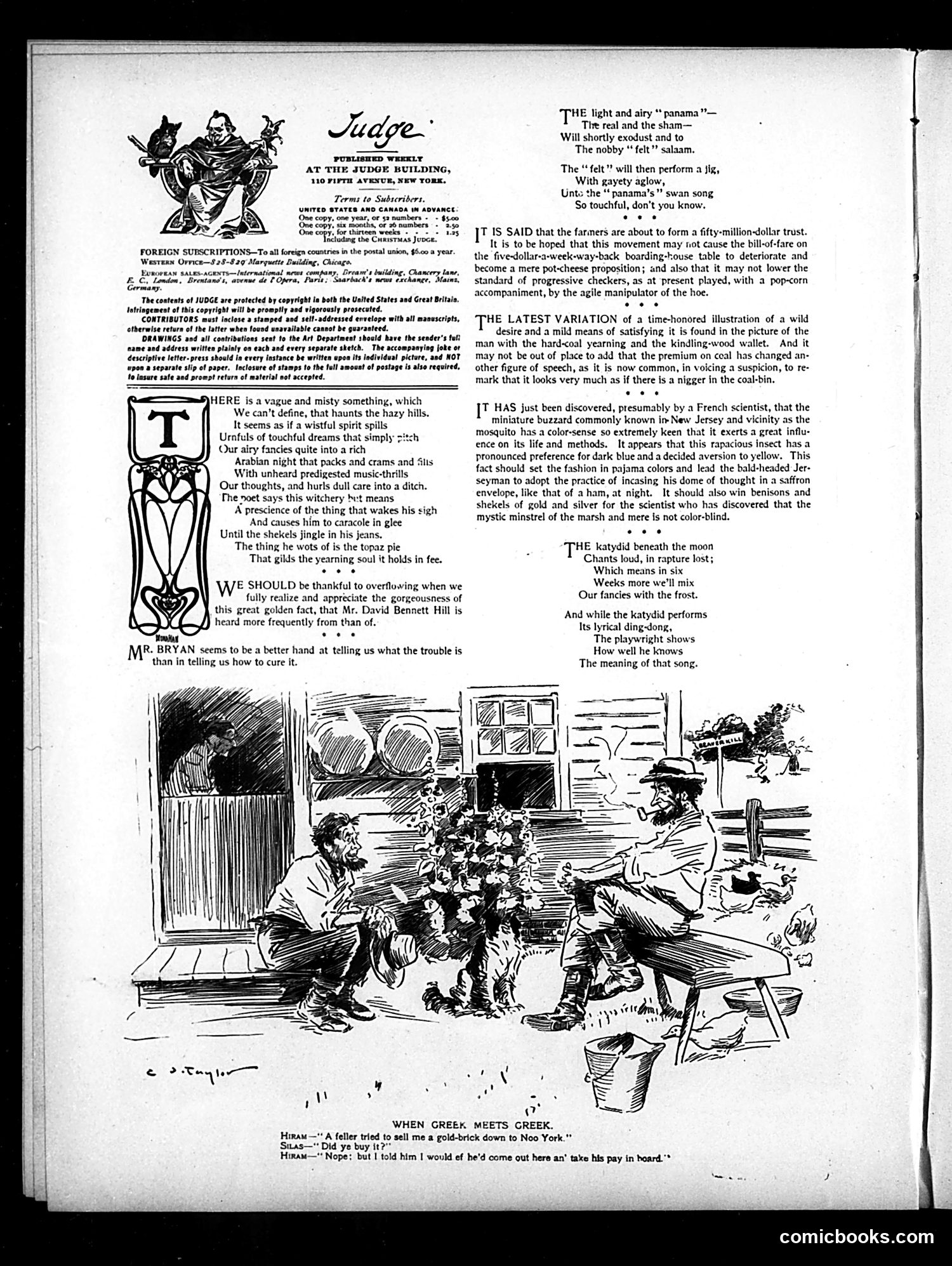
This page contains several satirical pieces typical of Judge's late 19th/early 20th-century format. The main cartoon titled "WHEN GREEK MEETS GREEK" depicts two men negotiating over flowers, with dialogue about selling a "gold-brick" to New York and payment arrangements. A "gold-brick" was period slang for a confidence scheme or worthless investment—the satire mocks common swindling tactics of the era. The upper text includes poetic commentary on various social topics, including references to "Panama" (likely the Canal), fashion preferences for dark colors among the wealthy, and observations about seasonal changes and theater. The cartoon's humor relies on depicting con-artists or shrewd businessmen attempting to outsmart each other—a common Judge theme satirizing American commercial culture and gullibility.
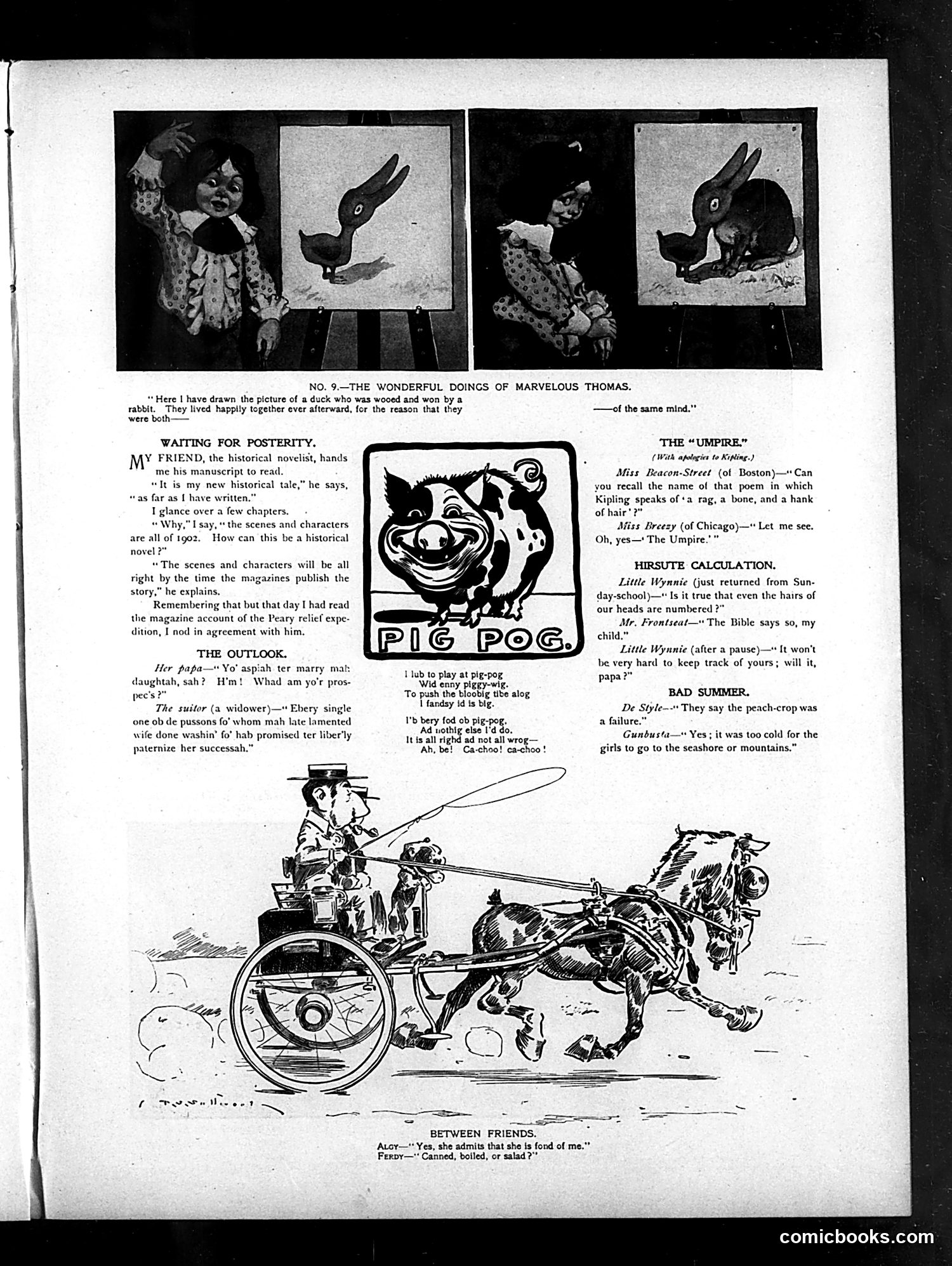
This page contains several unrelated humor pieces typical of Judge's format: 1. **"The Wonderful Doings of Marvelous Thomas"** (top): Shows a character presenting drawings of a duck to a rabbit, with a pun about animals being "of the same mind." 2. **"The Outlook"** and **"Waiting for Posterity"**: Brief joke exchanges about a historical novelist and a sailor's domestic life—standard domestic humor of the era. 3. **"Pig Pog"**: A nonsense verse with crude illustration, playing on the popularity of such whimsical rhymes. 4. **"The Umpire"** and **"Hirsute Calculation"**: Short quips referencing Kipling and Biblical knowledge. 5. **"Between Friends"** (bottom): A cartoon of a man fishing from a cart pulled by a horse, with a caption about female admiration—mild social satire on relationships. The page represents Judge's mix of puns, domestic comedy, and light satirical illustrations aimed at general Victorian-era entertainment rather than specific political commentary.
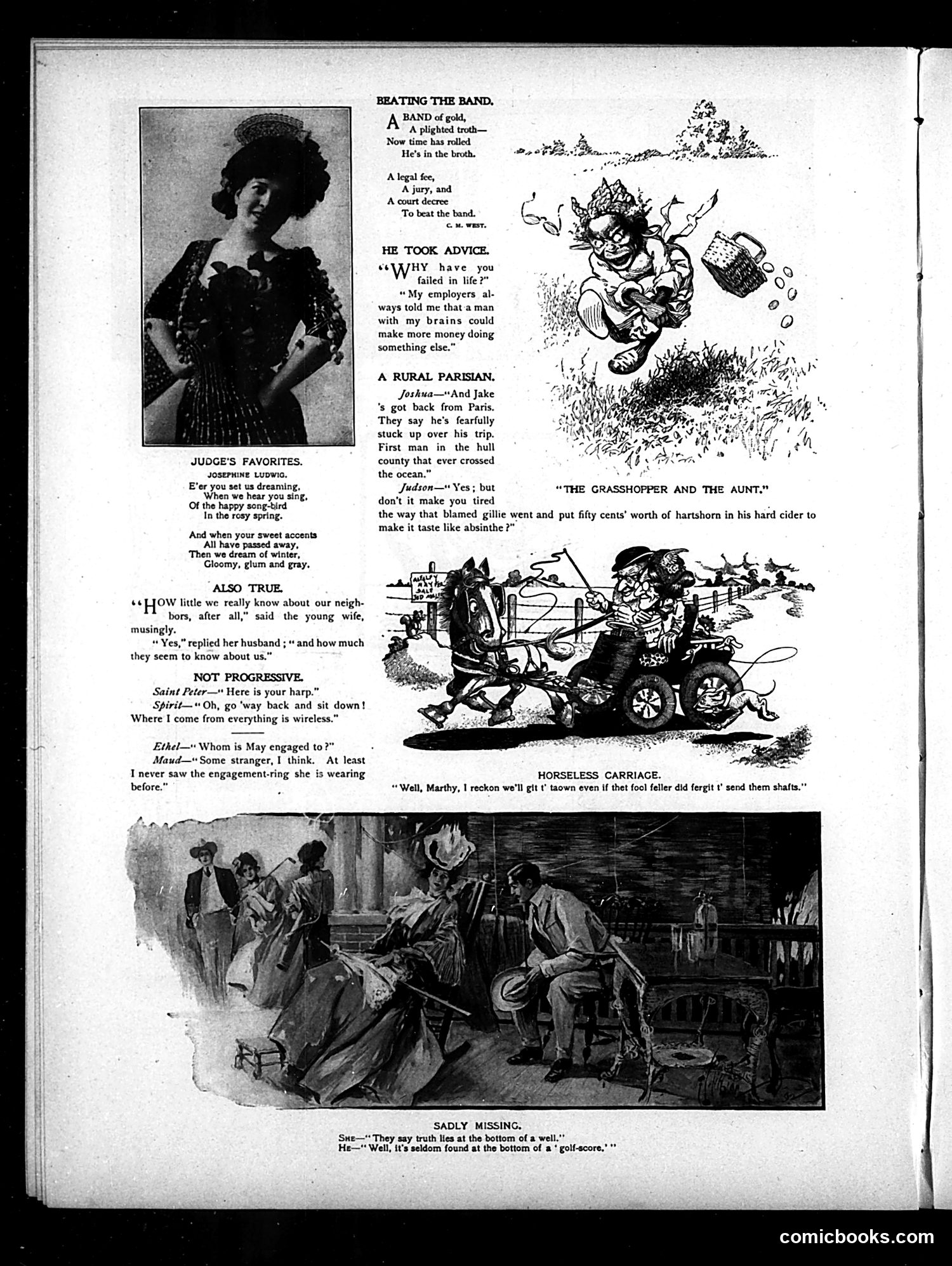
This page contains several humorous verses and cartoons satirizing everyday life and social situations, rather than targeting specific political figures. **"Beating the Band"** mocks legal absurdity—a man's brains allegedly earn him more money than his current employment. **"A Rural Parisian"** jokes about a rustic character named Jake returning from Paris, humorously claiming he's the "first man in the bull county that ever crossed the ocean." **"The Grasshopper and the Ant"** and **"Horseless Carriage"** cartoons appear to satirize modern technology and social pretensions of the era. **"Sadly Missing"** presents a domestic humor exchange about a brush found at a well versus a golf-score. The overall page reflects turn-of-the-century American humor targeting rural characters, urban pretension, and emerging technologies like automobiles.
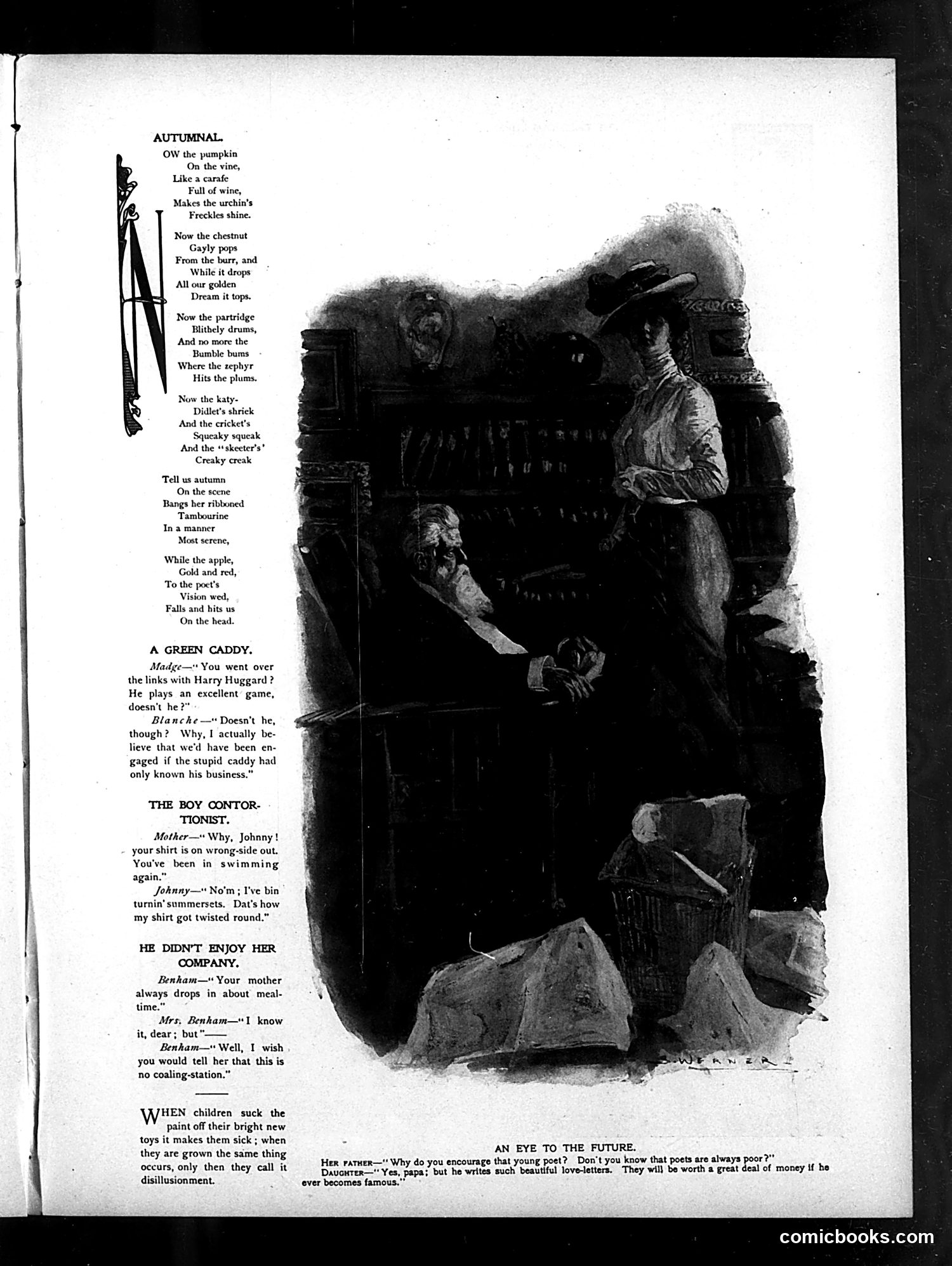
This page contains several humorous sketches and a poem typical of early 20th-century American satire. **"Autumnal"** is a whimsical poem celebrating autumn's arrival through nature imagery—pumpkins, chestnuts, partridges, crickets—ending with the joke that falling apples hit the poet on the head. **The social comedy sketches** satirize middle-class life: - Two women discuss golf, with one claiming she'd have married her partner if the caddy were competent—mocking women's golf culture - A mother scolds her boy for swimming; he blames contortions—innocent childhood mischief - A husband complains his wife's mother visits during meals, calling the house "no coaling-station"—satire on unwanted in-laws - A father warns his daughter against a poor poet; she reveals she encourages him hoping his love letters become valuable—mercenary humor about poetry's worthlessness The page satirizes Victorian/Edwardian social pretensions, gender relations, and the low status of poets in materialistic society.
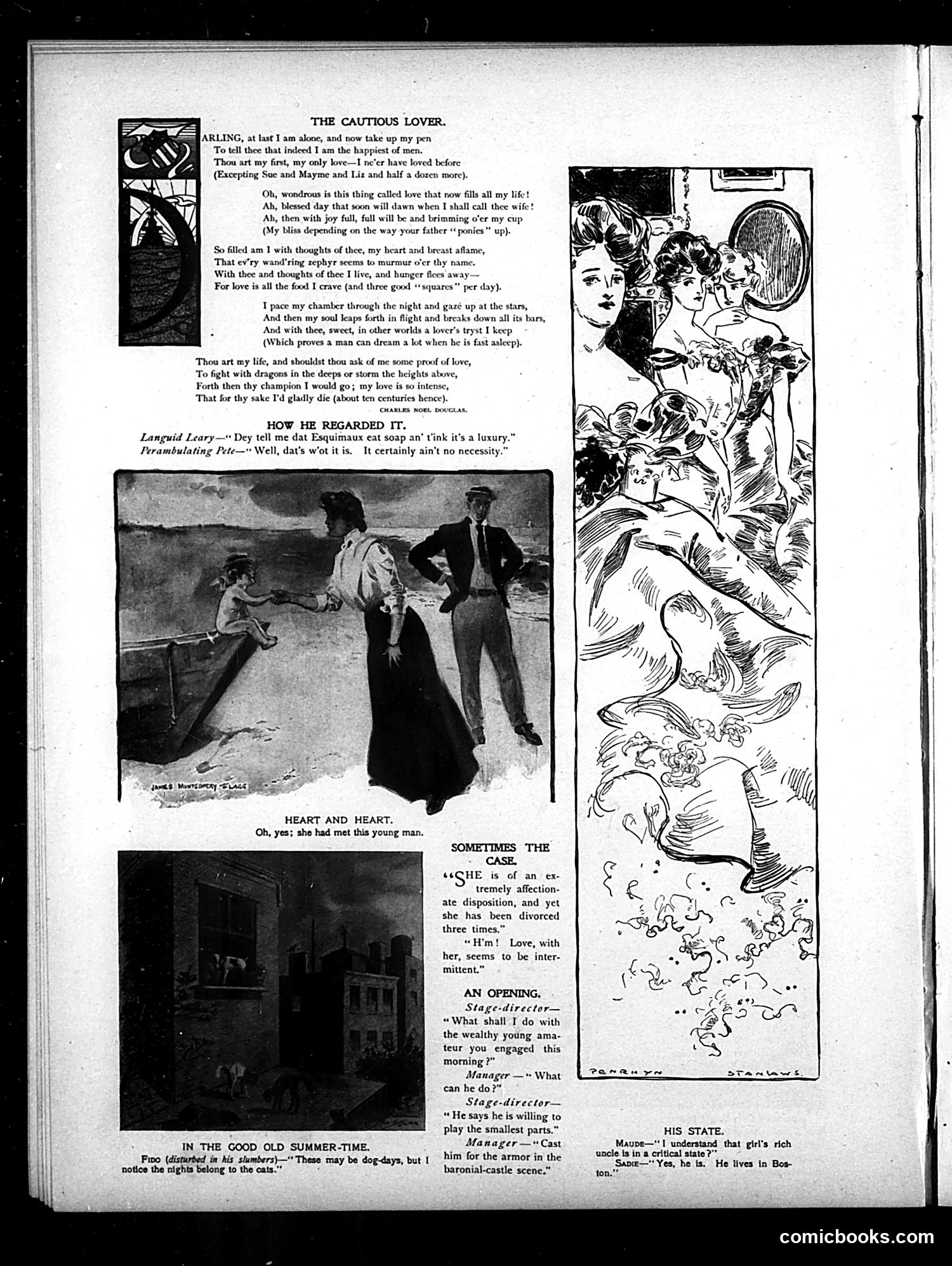
This Judge page satirizes romantic pretense through multiple comedic pieces. The main poem mocks insincere suitors who claim passionate devotion while revealing mercenary motives—the speaker professes undying love but admits dependence on the bride's father's money ("your father 'ponies' up") and dreams of comfortable living rather than genuine romance. The contradiction between flowery declarations and crass self-interest is the joke. Supporting cartoons extend this theme: "Heart and Heart" depicts a woman repeatedly divorced despite claiming deep affection, suggesting women's romantic feelings are performative; "An Opening" jokes about a wealthy amateur actor willing to take minor roles, implying money matters more than talent. The slang dialogue snippets ("Esquimaux eat soap") appear filler content typical of Judge's format. Overall, the page satirizes shallow, transactional approaches to love and marriage among the wealthy leisure class of the era.
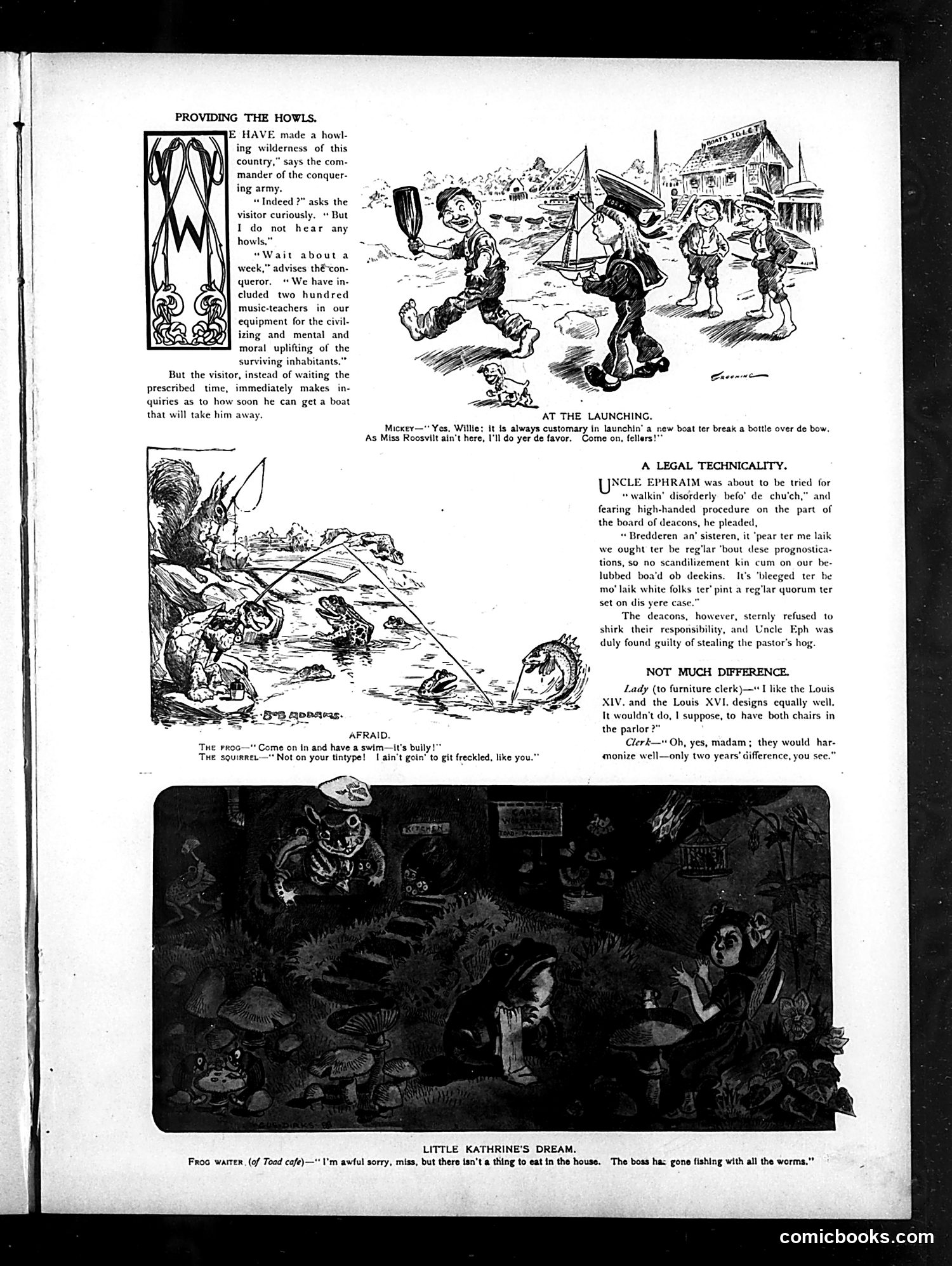
This page contains several satirical sketches mocking American society and politics circa early 1900s. **"Providing the Howls"**: Satirizes imperialist military occupation—likely referencing the Philippines or another colonial acquisition. The conqueror claims to have created a "howling wilderness," but the joke is that importing 200 music teachers will make inhabitants flee rather than appreciate "civilization." **"At the Launching"**: Appears to mock Theodore Roosevelt's family, with "Miss Roosevelt" referenced as someone important enough that breaking a bottle on her would substitute for the traditional christening ceremony—satirizing their public prominence. **"A Legal Technicality" and "Little Kathrine's Dream"**: Dialect humor featuring African American characters in rural/domestic situations—typical of the era's racist comedy conventions. **"Not Much Difference"**: Mocks furniture salesmen's sophistry, suggesting minor stylistic differences between Louis XIV and XVI furniture represent merely "two years' difference." Overall, the page blends political satire with period-typical racial caricature and class-based humor targeting pretension and commercialism.
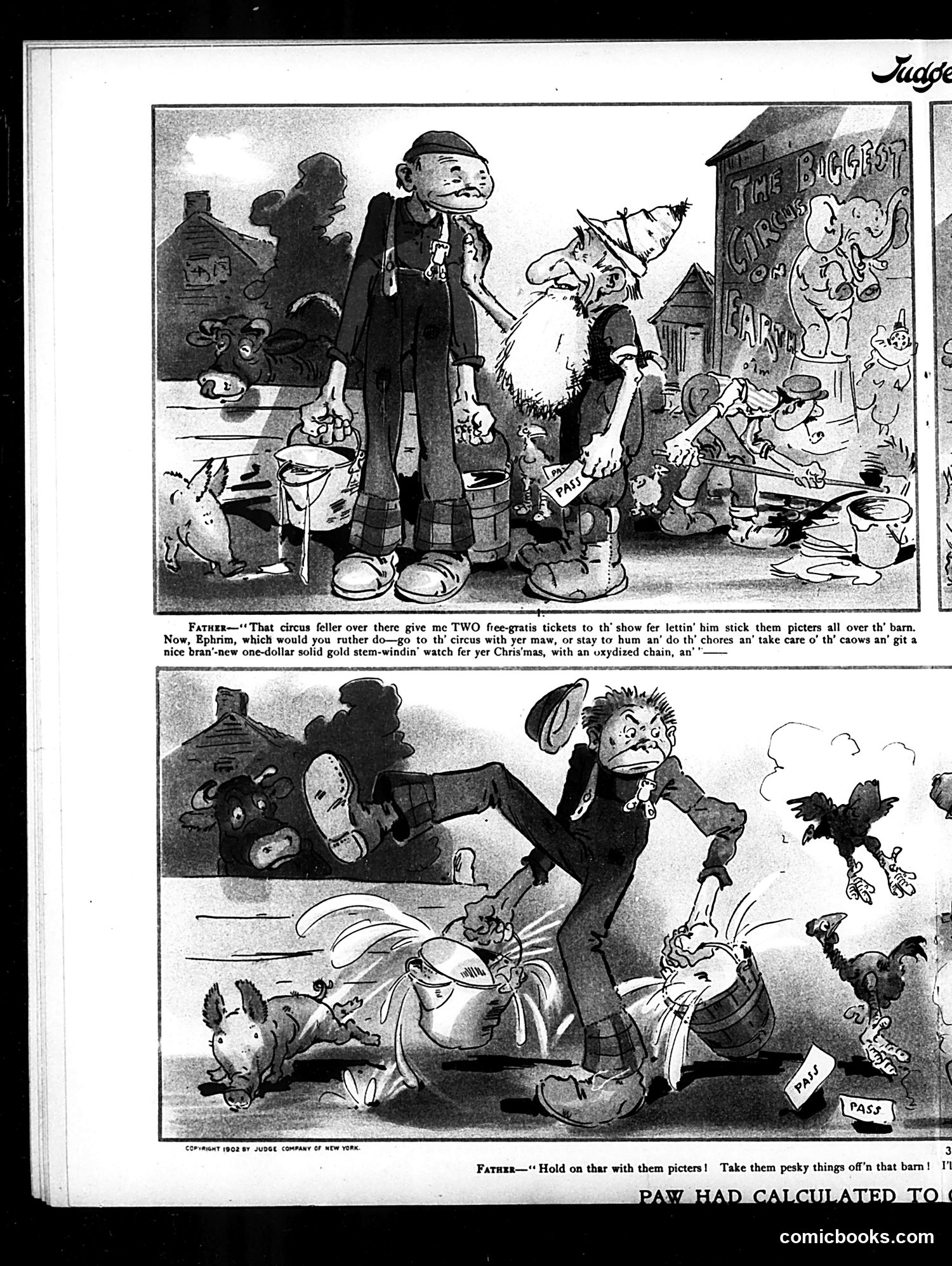
This two-panel comic satirizes rural parental manipulation and materialism. In the first panel, a father offers his son (Ephrim) a false choice: attend a circus with his mother, or stay home doing chores in exchange for a cheap gold-plated watch as a Christmas gift. The second panel shows the boy's chaotic response—he's literally being dragged away by animals and chaos, suggesting the father's "bribe" has backfired spectacularly. The satire targets the gap between rural parents' promises and reality: the father dangles a worthless "one-dollar solid gold stem-windin' watch" (clearly cheap, given the "oxydized chain" detail) as incentive for child labor. The joke mocks both the father's transparent manipulation and the absurdity of expecting a child to choose chores over entertainment—exposing the empty rhetoric of rural parental authority and consumer culture infiltrating farm life in early 1900s America.
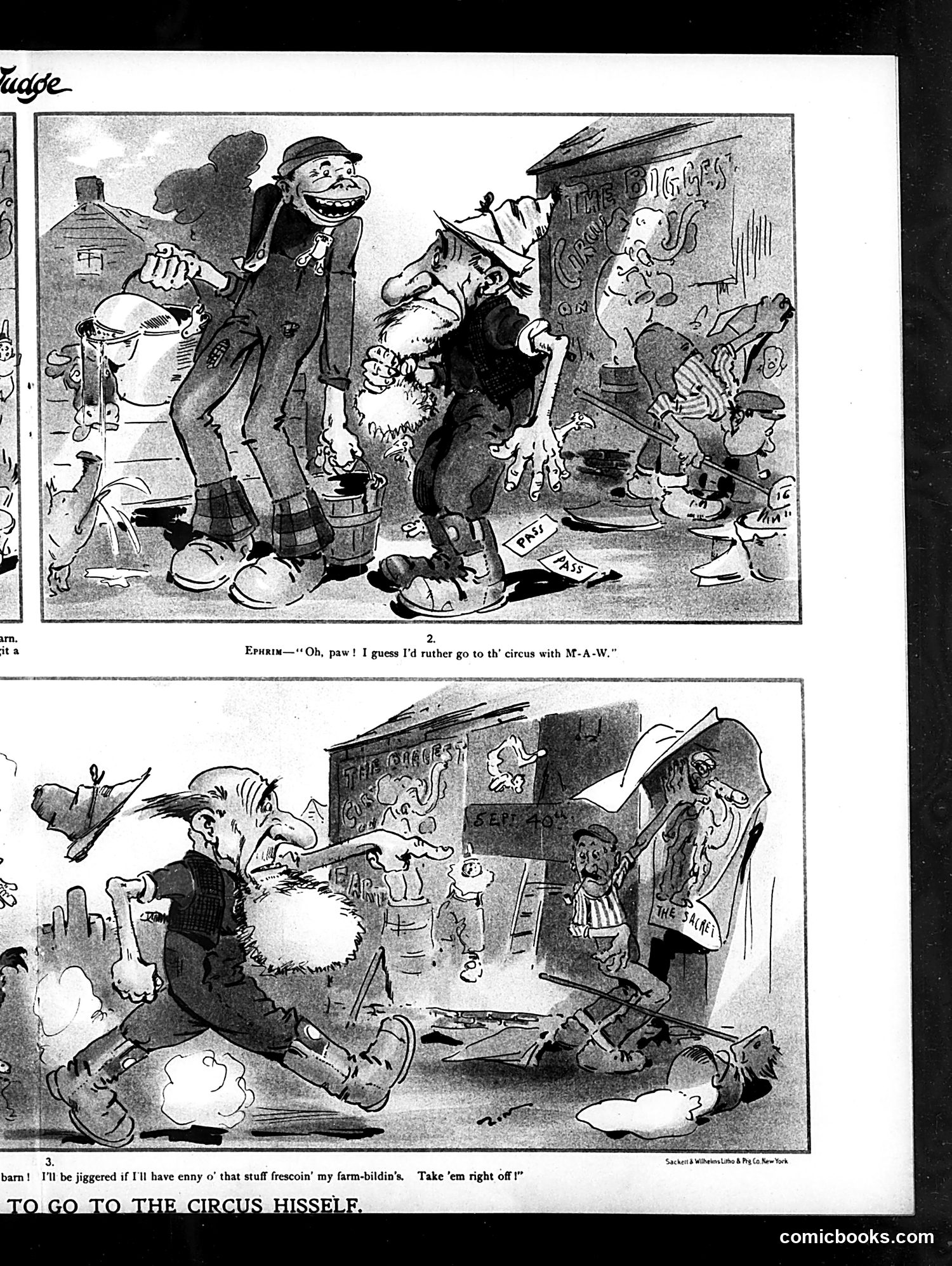
This appears to be a humorous comic strip rather than political satire, likely from the early 20th century based on the art style. Panel 2 shows a child (labeled "Ephrim") expressing a preference for attending the circus with "M-A-W" (mother) rather than going somewhere else—possibly with a father figure represented by the bearded man. The joke centers on childhood preferences and domestic humor rather than political commentary. The exaggerated caricature style and dialect spelling ("paw," "ruther," "th'") were common comedic conventions of the era, though such representations today would be considered offensive stereotypes. The title "To Go to the Circus Hisself" (panel 3, partially visible) suggests a three-panel narrative arc about circus attendance. This is straightforward entertainment comic material typical of Judge magazine's humor content.
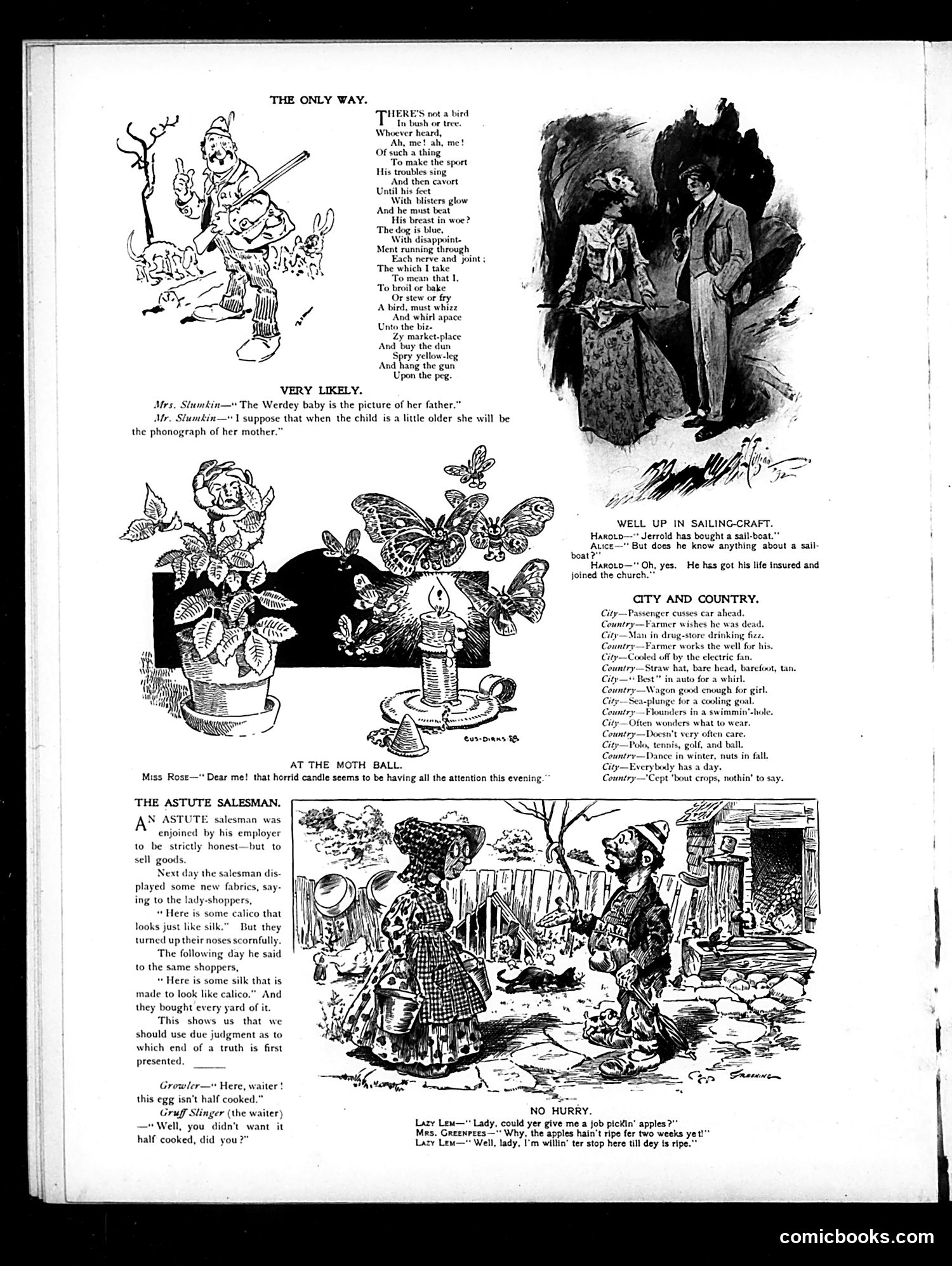
This page from the American satirical magazine *Judge* contains multiple humorous sketches and jokes typical of early 20th-century humor: **"The Only Way"** mocks hunters who complain about difficulties hunting game, then go buy pre-killed birds at market anyway—satirizing pretense and contradiction. **"Very Likely"** jokes that a baby resembles her father now, but will resemble her mother (as a "phonograph"—a recording device) once she develops her mother's tendency to repeat herself constantly. **"Well Up in Sailing-Craft"** ridicules someone who bought a sailboat but only secured it through life insurance and church membership—suggesting he's unprepared and possibly expecting disaster. **"City and Country"** contrasts urban and rural lifestyles through quick comparisons, portraying city dwellers as leisured and restless, farmers as hardworking and content. **"The Astute Salesman"** illustrates how customers respond better to flattery than honesty—when told silk "looks like calico," they buy it; when told calico "looks like silk," they reject it. **"No Hurry"** presents a lazy worker willing to wait weeks for unripe apples to ripen rather than find other work.
This satirical story mocks the inadequacy of social conventions for avoiding offense. Mrs. Gooph devises a "system" to protect her sensitive dinner guest Mr. Smiff from remarks about his disreputable ancestor Jinks by kicking her husband under the table when he approaches forbidden topics. The joke pivots on her repeated kicks—intended as warnings—actually hitting Mr. Smiff instead, causing him to wince repeatedly. Each wince encourages Mr. Gooph to continue his increasingly brutal criticisms, believing he's successfully offending the guest. Mrs. Gooph's well-intentioned scheme collapses into chaos. The satire targets both Victorian social etiquette (the absurdity of pretending sensitivity to ancestral failings) and human miscommunication—the gap between intent and outcome. The physical comedy of misdirected kicks undercuts the pretense of refined dinner-table manners.
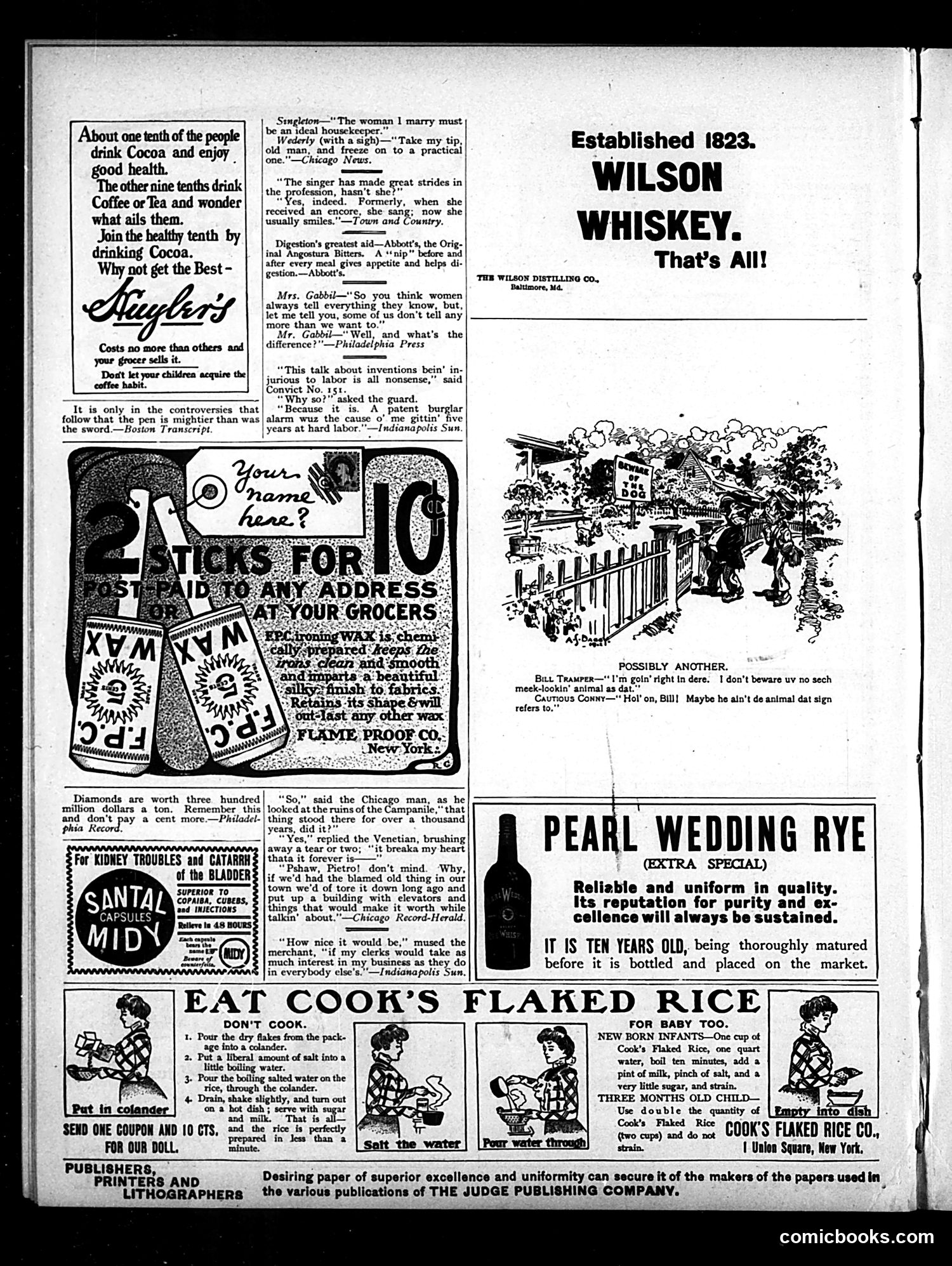
This page is primarily **advertising** rather than editorial content. The main items are product advertisements interspersed with brief humorous anecdotes and one cartoon. The single cartoon depicts two men at a fence labeled "BEWARE OF DOG"—one eager to enter ("I'm goin' right in dere"), the other cautious, suggesting the dog may not match the warning sign's implication. The humor relies on the gap between expectation and reality. The anecdotes are brief observations on contemporary life: singers who now smile instead of sing encores; the irony of a convict crediting a patent alarm for his imprisonment; a Chicagoan's dismissive attitude toward Venice's thousand-year-old Campanile. The advertisements promote patent medicines (Abbott's Bitters, Santal Capsules), whiskeys (Wilson, Pearl Wedding Rye), rice products, and cocoa—typical early-20th-century consumer goods marketed with health claims now recognized as dubious. The page reflects Judge's format: lightweight satire mixed with commercial content targeting middle-class readers.
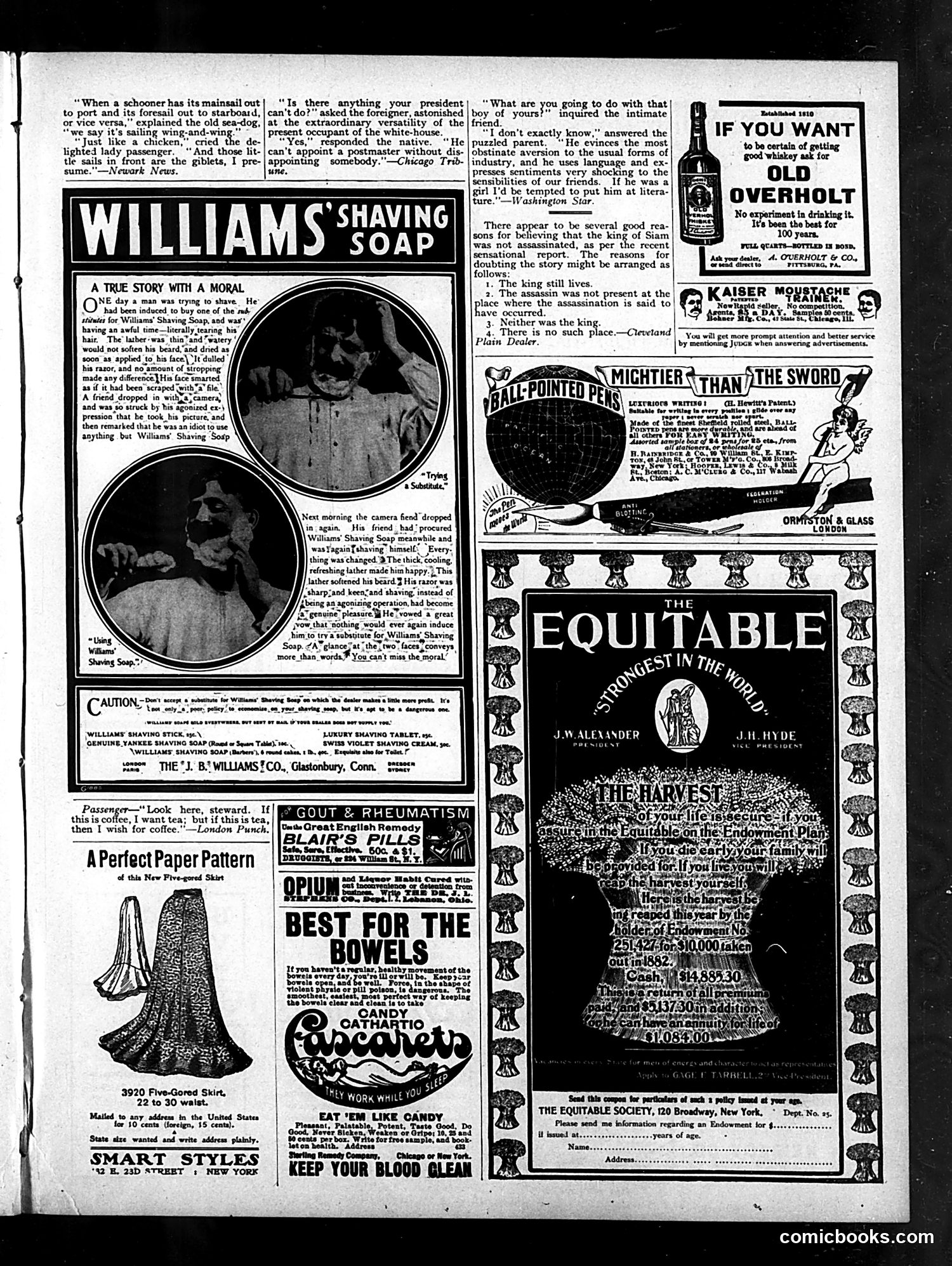
This is primarily an **advertising page** from Judge magazine, not a political cartoon. The main content is a Williams' Shaving Soap advertisement featuring a "true story with a moral"—a before-and-after narrative showing a man suffering with an inferior soap substitute, then finding relief with Williams' product. The page also includes several **brief satirical jokes** at the top: - A nautical pun about sailing terminology - A joke about the U.S. President's inability to appoint postmasters without disappointing people (criticizing patronage politics) - A joke about ambiguous tea/coffee service The remainder consists of **period advertisements**: patent medicines (for gout, rheumatism, bowels), women's fashion patterns, and liquor. **For modern context**: This reflects early 20th-century American magazine culture where satirical commentary shared space with aggressive product advertising, often using before-and-after narratives and exaggerated claims about product efficacy that wouldn't pass today's regulations.
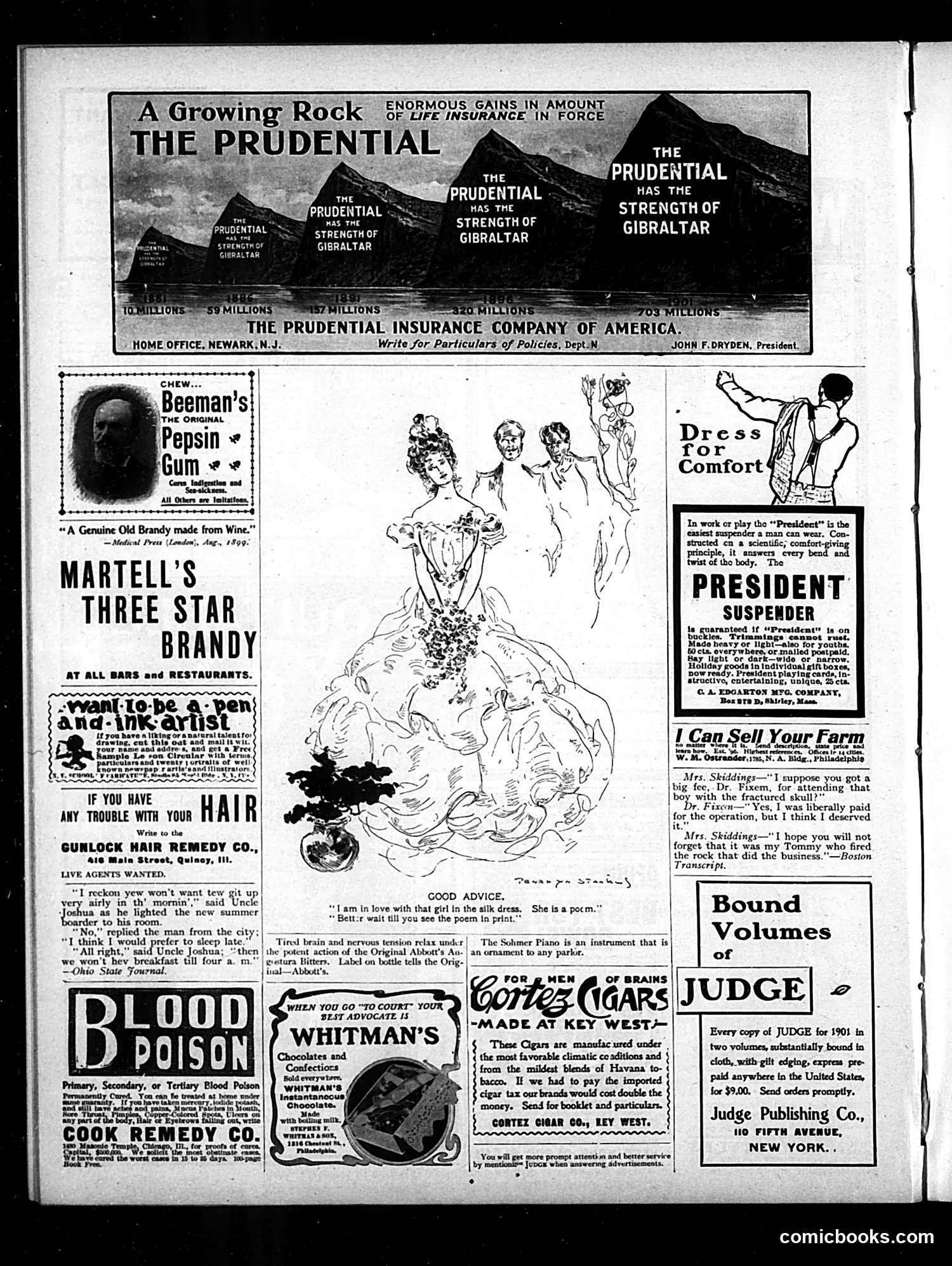
This is primarily an **advertising page** from Judge magazine, not a political cartoon. The dominant content is a Prudential Insurance Company advertisement at the top, using an ascending mountain metaphor labeled "A Growing Rock" to illustrate the company's expanding life insurance policies from 10 to 904 million dollars. The "Strength of Gibraltar" comparison emphasizes stability and reliability—common insurance advertising tropes of the era. The page contains numerous other period advertisements: Beeman's Pepsin Gum, Martell's brandy, hair remedies, the "President Suspender" (a clothing item), and various health products including treatments for blood poisoning. A small anecdote about "Tommy" firing a rock appears to be editorial filler. The modest cartoon content—including dialogue about a doctor's fee for skull fracture treatment and romantic poetry—uses gentle humor typical of Judge's light satirical approach but contains no significant political or social commentary requiring historical context.
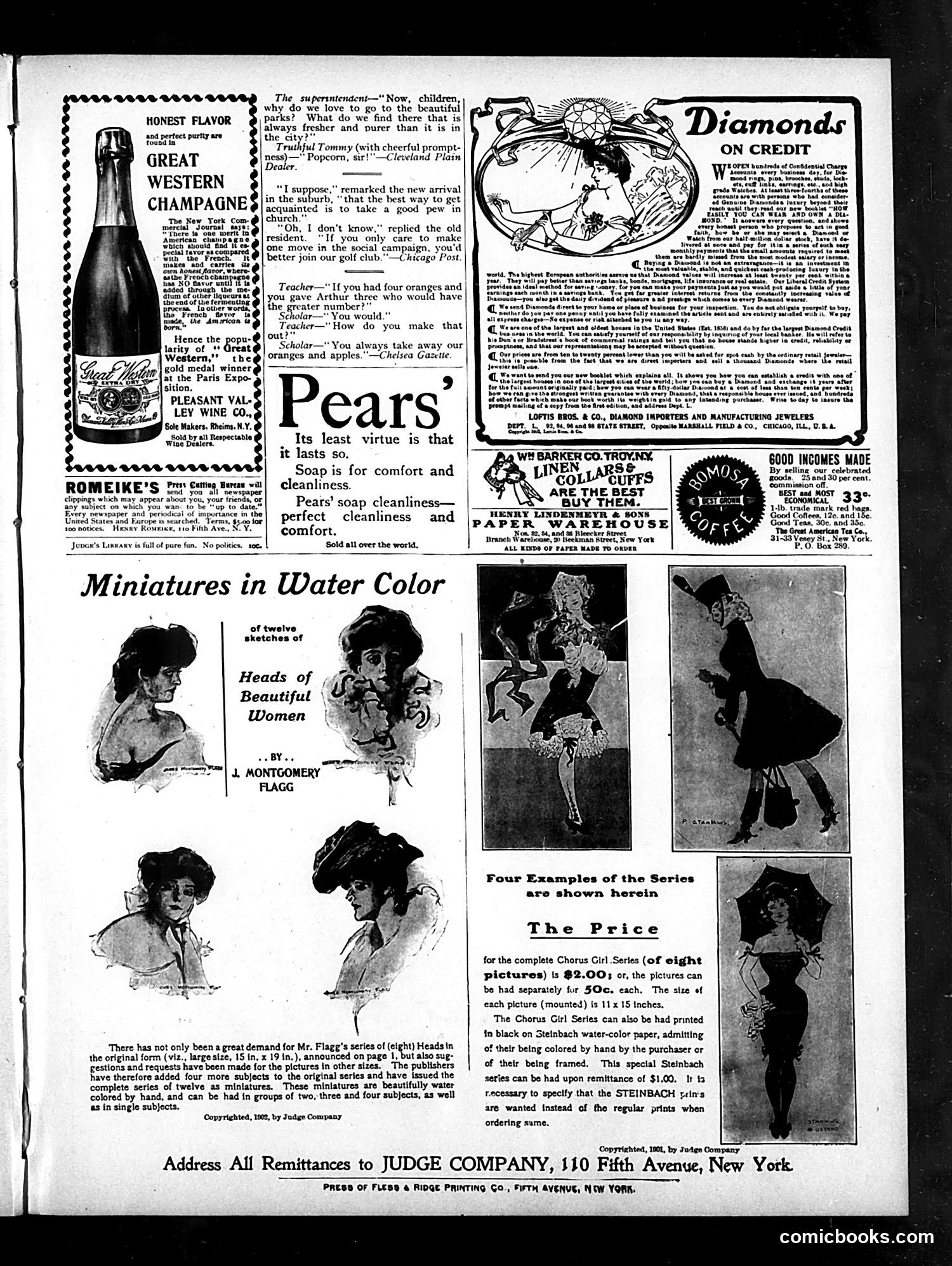
This page is primarily **advertising and product promotion**, typical of early 1900s magazine content. The editorial cartoons are minimal. The small comic dialogues scattered among ads present **gentle social satire**: - A superintendent discussing park visits satirizes earnest civic moralism - A resident counters with golf club snobbery—mocking class-conscious social climbing - A teacher-scholar exchange jokes about children's practical logic: when asked "if you give away three of four oranges, who has more?", the child answers "you would"—satirizing how adults trick children while the child exposes the adult's sophistry The bulk of the page features **product advertisements** (champagne, soap, diamonds on credit, paper warehouses) and a larger feature on **water-color miniatures** by artist Montgomery Flagg depicting "Heads of Beautiful Women" and chorus girls, available for purchase. The satire is mild and apolitical, focusing on social customs and human nature rather than politics.
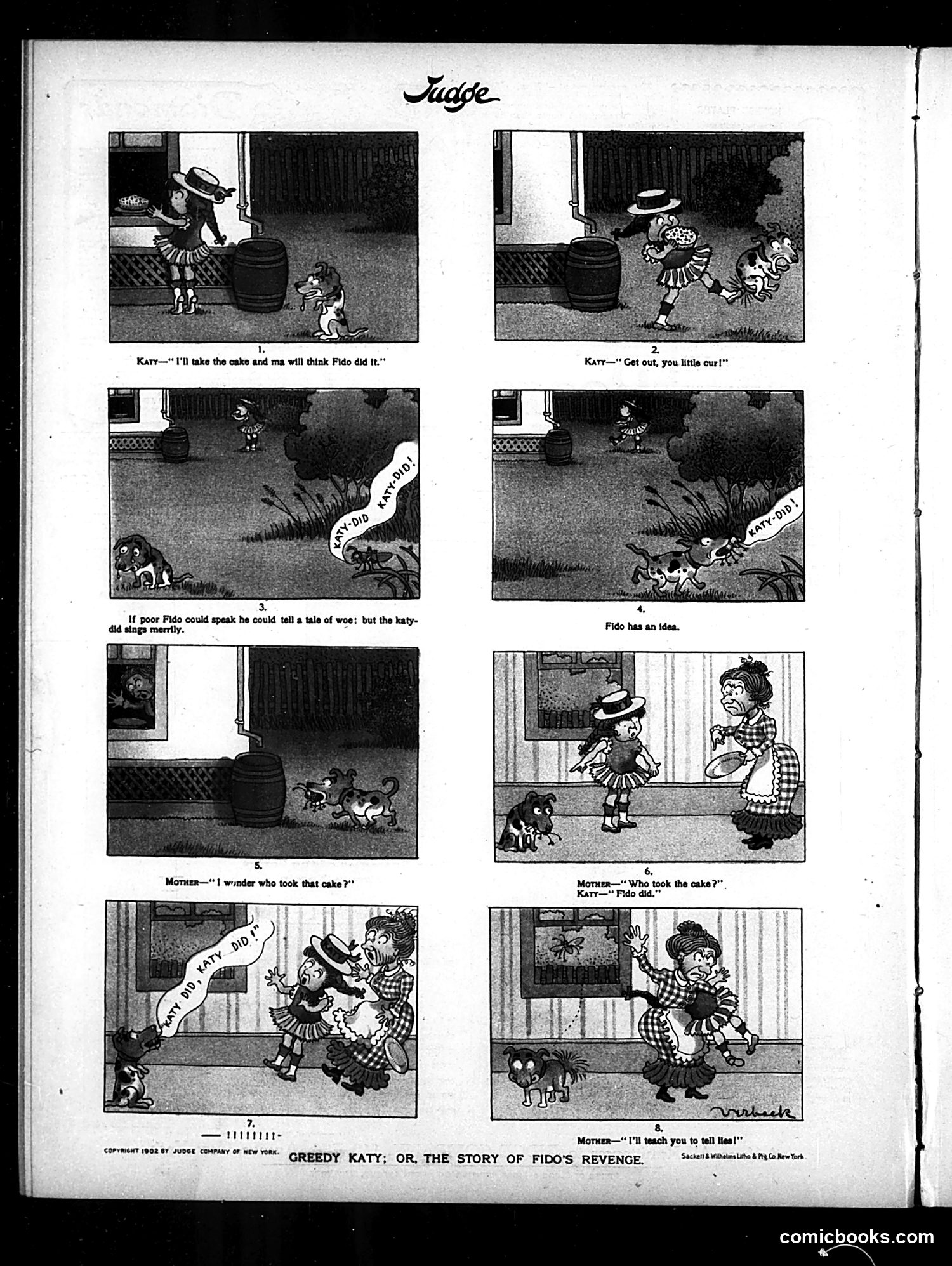
This is a children's moral tale presented as a comic strip. A girl named Katy steals a cake, blaming the family dog Fido. The dog watches silently as Katy lies to her mother about who took it. Fido gets revenge by exposing the theft—the final panels show the mother discovering the truth and punishing Katy for lying. The satire targets dishonesty and greed among children. The "katy-did sings merrily" reference (panel 3) plays on the katydid insect's name, suggesting Katy lies without consequence—until the dog's intervention. The moral is Victorian in character: lies will be revealed, and children who steal and deceive face punishment. The dog serves as an agent of justice, embodying honesty against human deception.