
A complete issue · 16 pages · 1902
Judge — August 16, 1902
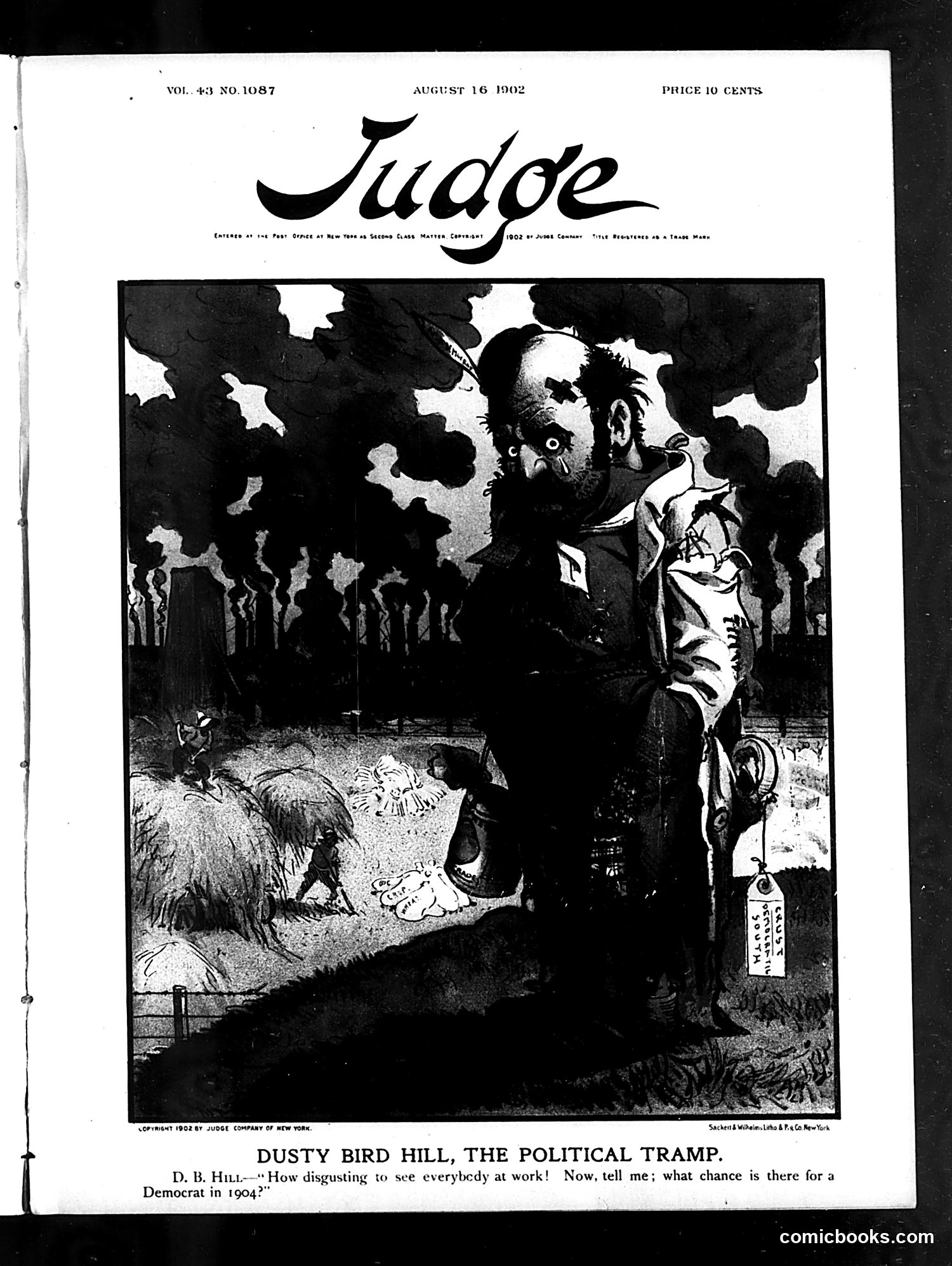
This 1902 Judge cartoon satirizes D.B. Hill (likely David B. Hill, a prominent New York Democrat), depicted as a disheveled vagrant observing workers and destruction in the background. Hill's speech—"How disgusting to see everybody at work! Now, tell me; what chance is there for a Democrat in 1904?"—mocks him as disconnected from productive labor and public welfare. The cartoon suggests Hill represents the Democratic Party as politically irrelevant or parasitic ("tramp"), unable to contribute meaningfully to American progress. The smoking industrial scene behind him contrasts the nation's productivity with Democratic impotence. This reflects early 1900s Republican dominance and criticism of opposition politics as obstructionist rather than constructive.
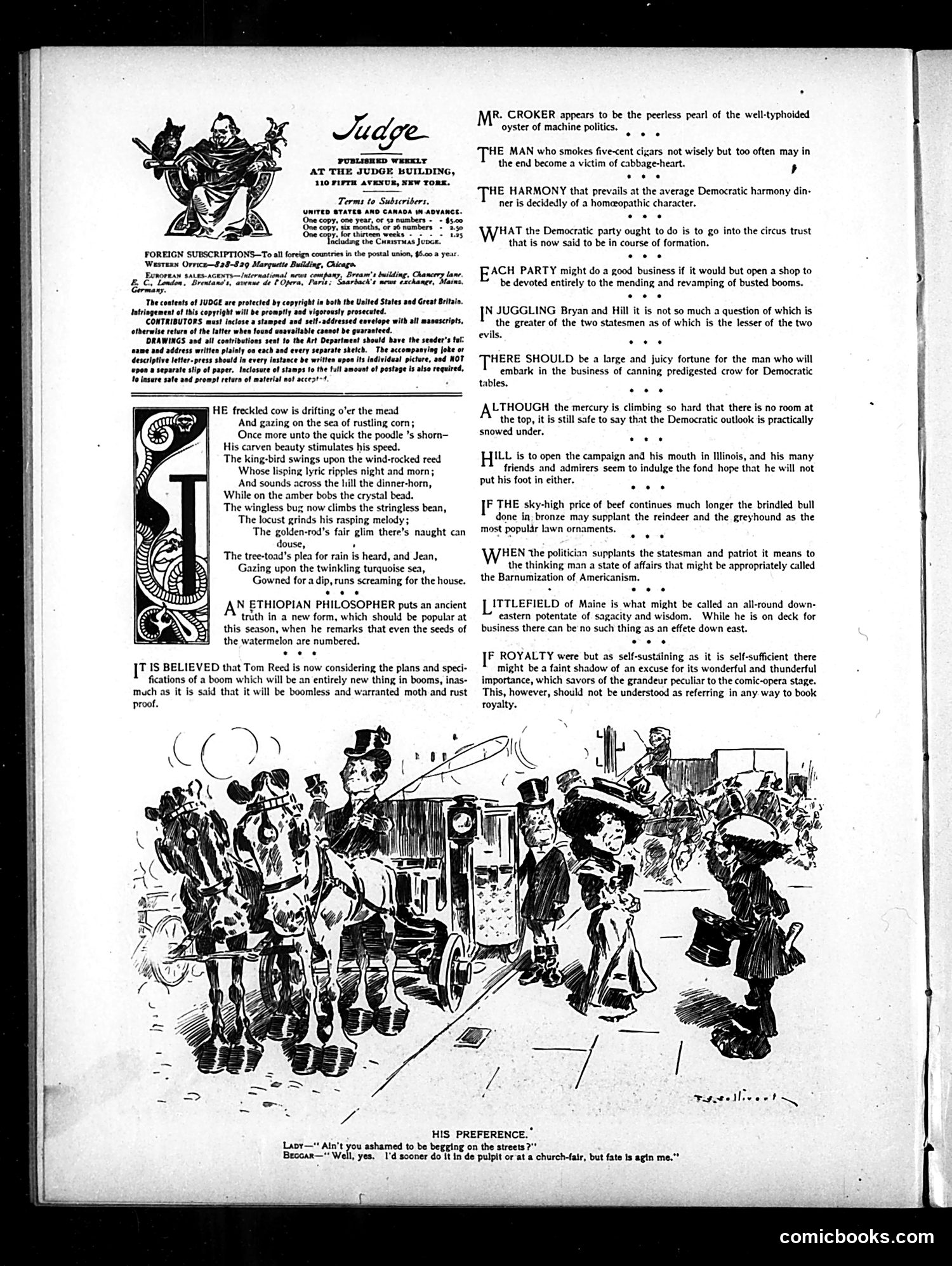
This page contains editorial commentary and a political cartoon titled "His Preference." The editorials critique Democratic Party politics, mentioning Bryan and Hill (likely William Jennings Bryan and David B. Hill, prominent 1890s Democrats), discussing party harmony and campaign strategy. The main cartoon depicts a street scene where a beggar appears to be choosing between begging on the streets versus attending a church fair or puppet show. The caption suggests the character prefers street begging. The satire likely critiques public choices or political preferences of the era, though the exact referent is unclear without additional context. The image uses caricature and social commentary typical of Judge's satirical approach to contemporary American politics and society.
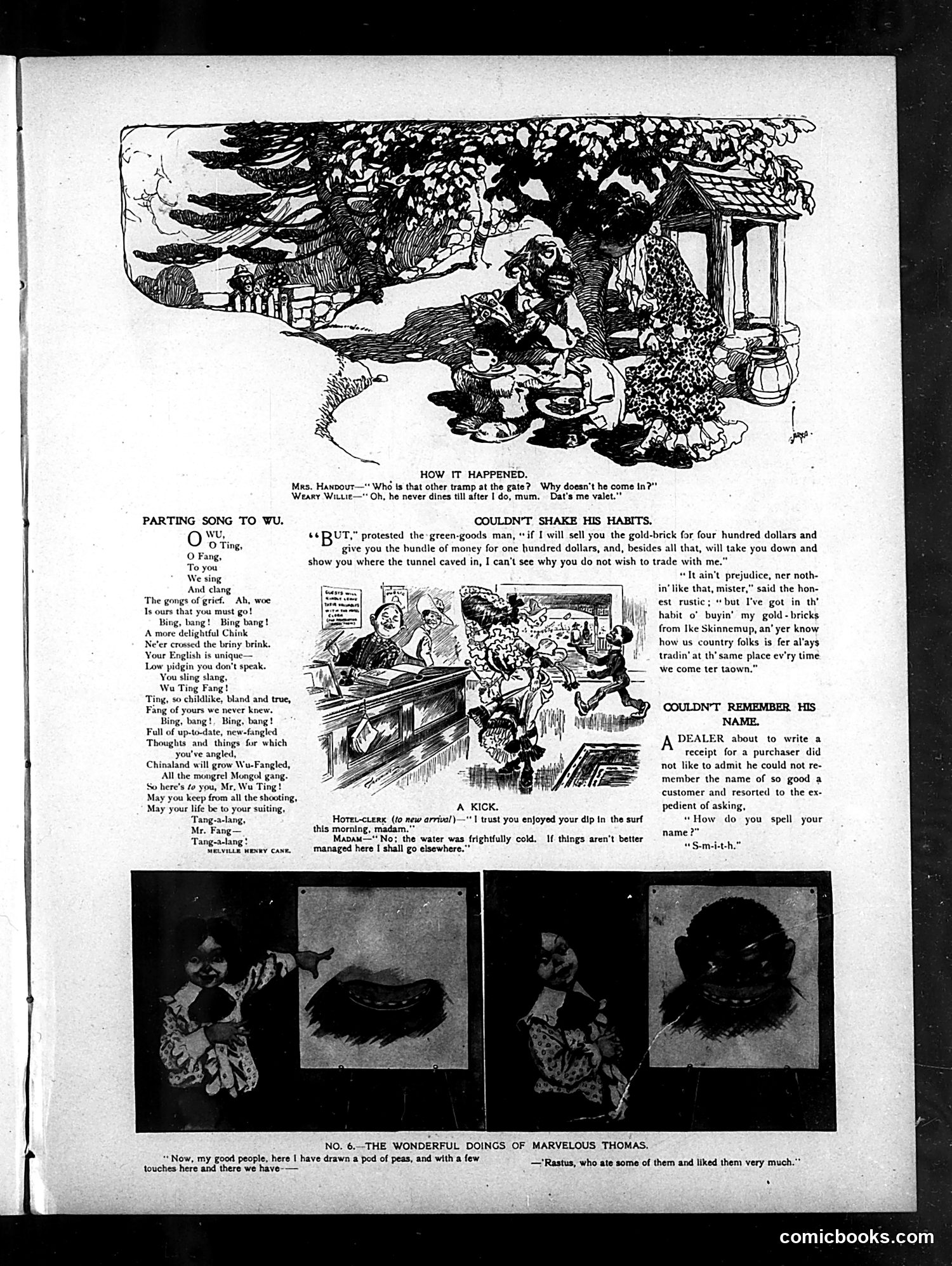
This page contains three distinct pieces of satirical content: 1. **"Parting Song to Wu"** - A poem mocking Chinese immigrant Wu Ting-fang (likely the Chinese diplomat/minister). The verse ridicules Chinese linguistic and cultural differences in xenophobic terms typical of the era. 2. **"Couldn't Shake His Habits"** and **"Couldn't Remember His Name"** - Two brief anecdotes satirizing prejudiced attitudes toward Chinese immigrants, depicting them as unwelcome and foreigners unable to assimilate. 3. **"A Kick"** - A joke about a hotel clerk's poor customer service toward an Asian guest. 4. **"No. 6—The Wonderful Doings of Marvelous Thomas"** - A photographic sequence (likely a trick photography series) showing what appears to be magical or illusion performances. The page reflects late 19th/early 20th-century American anti-Chinese prejudice through humor targeting Chinese immigrants and officials.
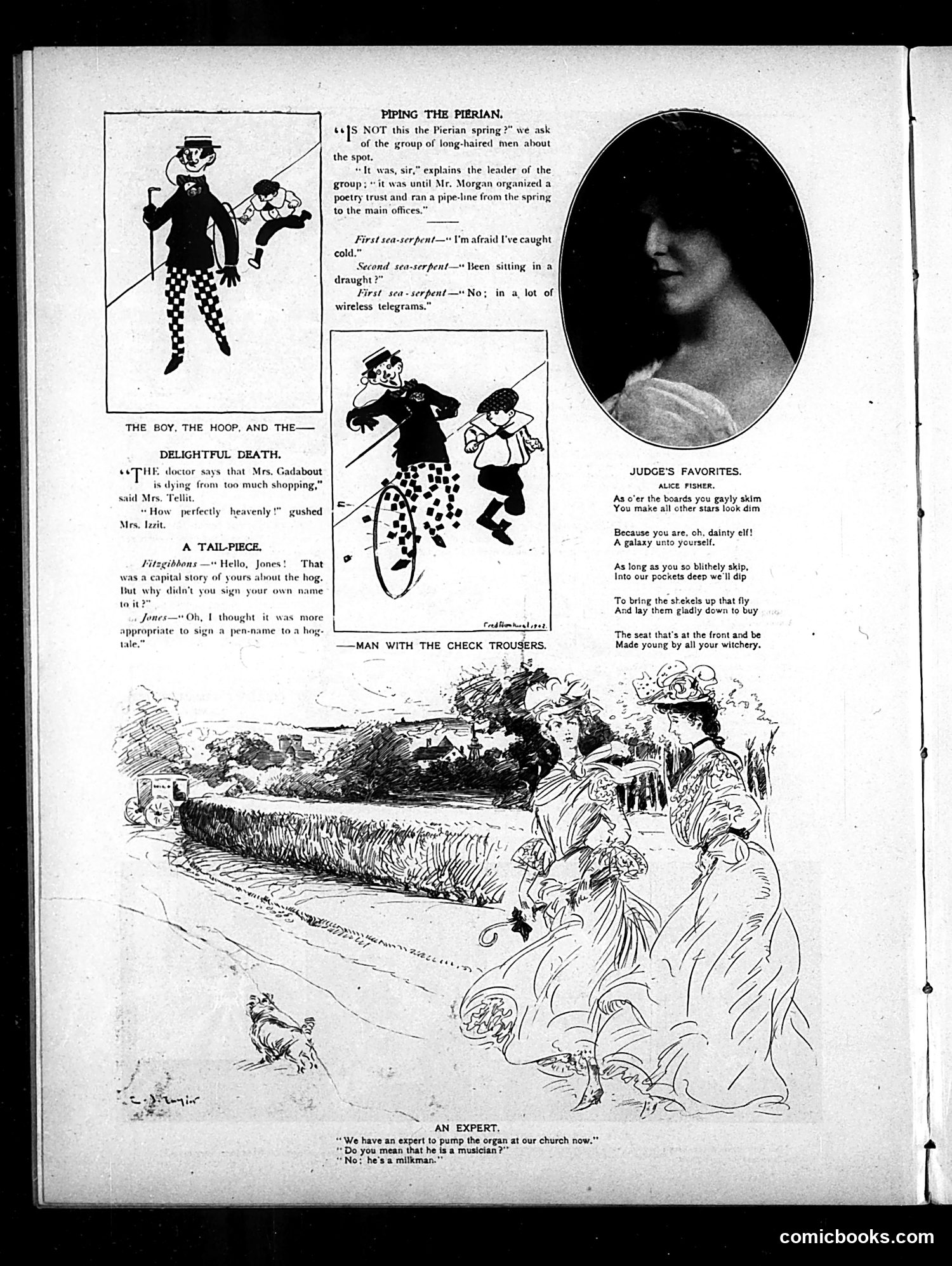
This page contains several humor pieces typical of early 20th-century Judge magazine: **"Piping the Pierian"** satirizes a poetry trust organized by a Mr. Morgan—likely J.P. Morgan, the famous financier—running a pipeline from a natural spring to main offices. The joke mocks wealthy industrialists monopolizing culture and art (the "Pierian spring" references classical poetry). **Other sketches** include gentle domestic humor ("The Boy, the Hoop, and the Delightful Death") and social commentary on fashion and behavior. **"Judge's Favorites"** features Alice Fisher with flattering verse, typical of the magazine's celebrity coverage. **"An Expert"** presents a joke about organ-playing ability, playing on class assumptions about musicians versus milkmen. The overall tone reflects upper-class satirical humor targeting wealthy industrialists and social pretension.
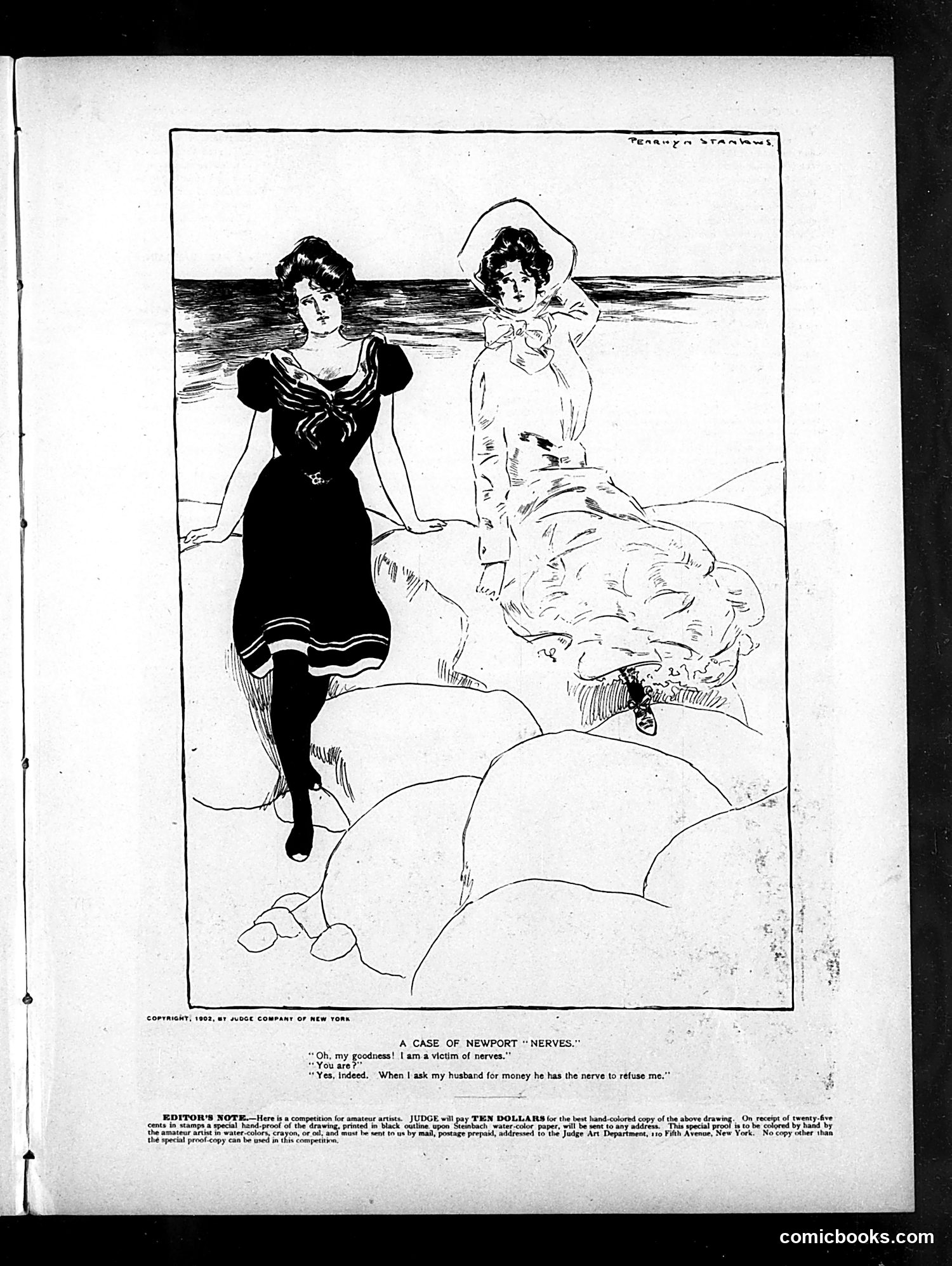
This satirical cartoon mocks wealthy women of Newport, Rhode Island—then America's premier elite seaside resort. Two fashionably dressed women discuss "nerves" (a common Victorian complaint among idle society women). The joke's punchline: one woman's "nervous condition" is actually her husband's refusal to give her money for spending. The satire targets both the pretension of wealthy wives claiming medical ailments and the absurdity of their complaints—framing financial dependence and marital control as a health crisis rather than acknowledging it as a real power imbalance. Newport symbolized American high society excess, making it the perfect setting for mocking frivolous upper-class women. The accompanying editor's note reveals this was an amateur art competition, suggesting Judge encouraged reader participation in satirizing contemporary social figures.
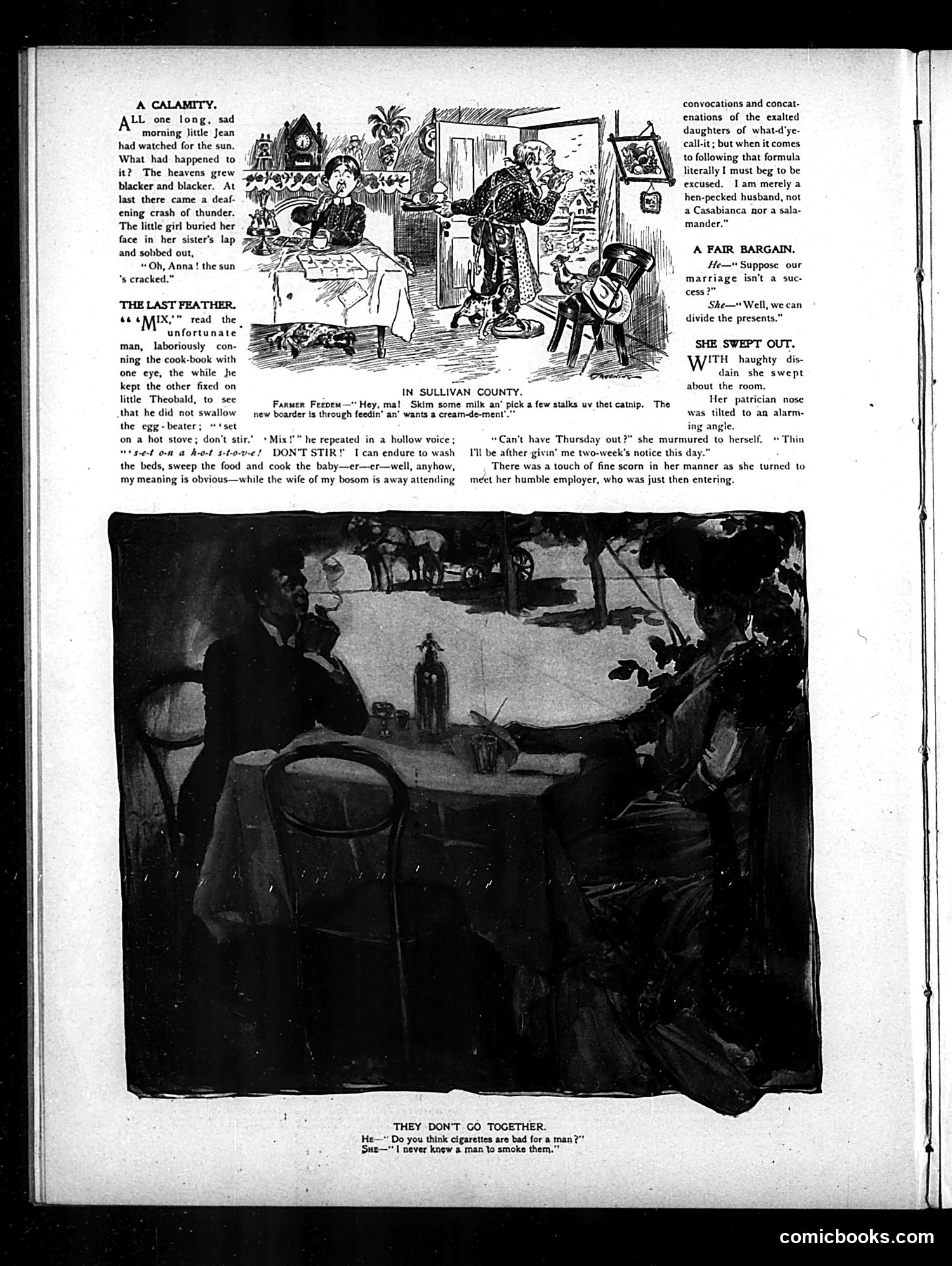
This page contains multiple humor sketches typical of early 20th-century American satirical magazines: **"A Calamity"** depicts a domestic scene where a child misinterprets a thunderstorm, thinking the sun has "cracked"—simple visual wordplay humor. **"The Last Feather"** satirizes a henpecked husband struggling to cook while his wife attends to social obligations, poking fun at gender role reversals and domestic incompetence. **"Sullivan County"** shows rural dialogue between farmers, likely using Irish-inflected dialect humor popular in the era. **"A Fair Bargain"** and **"She Swept Out"** are brief domestic comedies about marriage negotiations and class conflict between an employer and servant. **"They Don't Go Together"** is a simple joke: a woman claims never knowing a man who smokes—implying smokers aren't "real men" or are somehow deficient. The page emphasizes domestic situations, class distinctions, and gender dynamics through gentle, accessible humor rather than sharp political commentary.
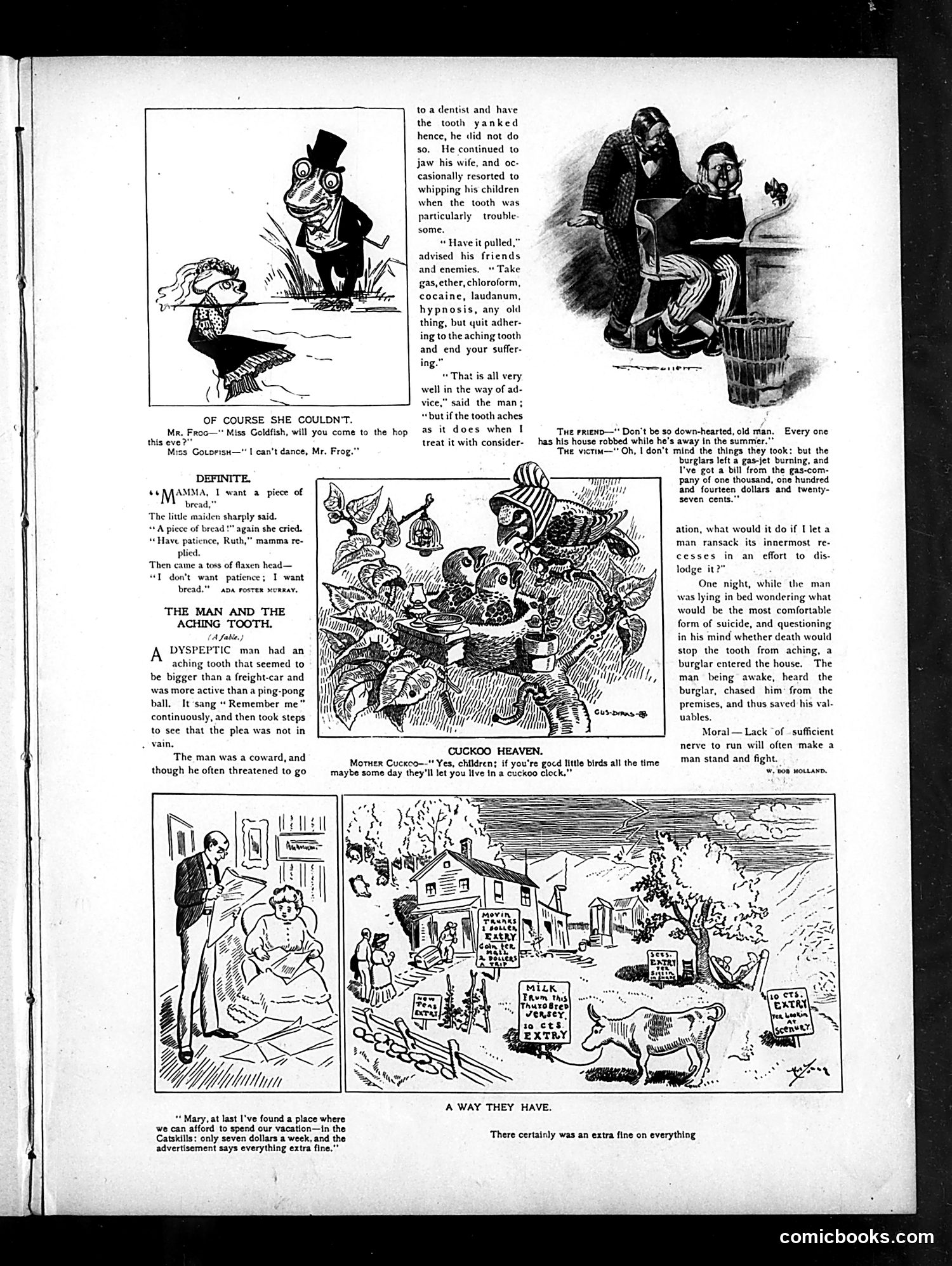
This page contains several satirical pieces typical of early 20th-century American humor: **"The Man and the Aching Tooth"** is a fable mocking cowardice and indecision. A dyspeptic man refuses to extract a painful tooth despite friends' advice, then ironically becomes brave when confronted by a burglar—suggesting that fear sometimes produces unexpected courage. The moral comments on how lacking nerve can paradoxically force action. **"A Way They Have"** satirizes vacation advertising—a man finds a cheap Catskill resort advertising "everything extra fine" for seven dollars weekly, only to discover the phrase means there's an extra fine (penalty charge) on everything. The smaller pieces mock romantic rejection (the frog) and childhood impatience for bread. The page exemplifies Judge's blend of social commentary through exaggerated situations, targeting human weakness, consumer deception, and middle-class anxieties about money and propriety.
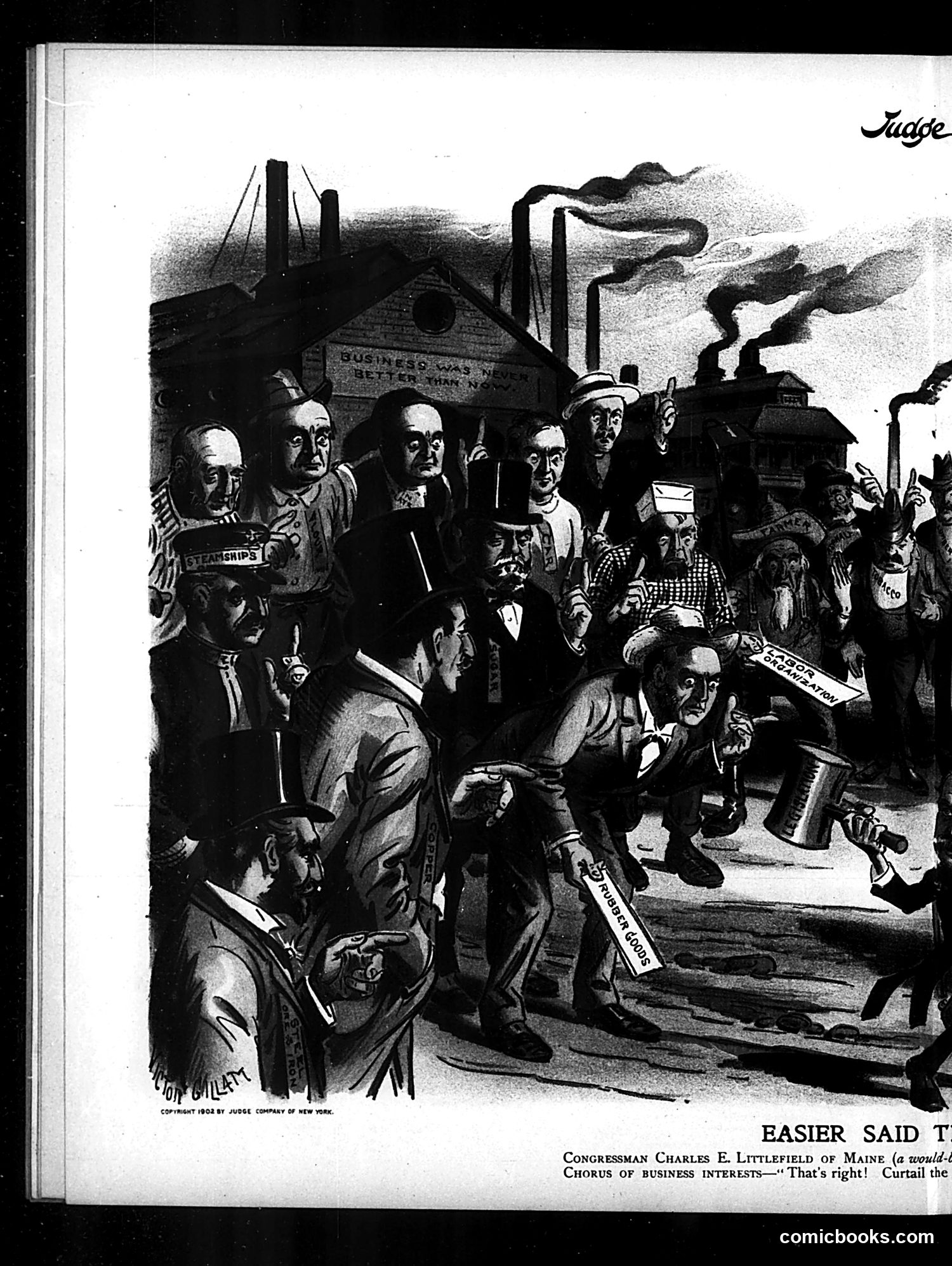
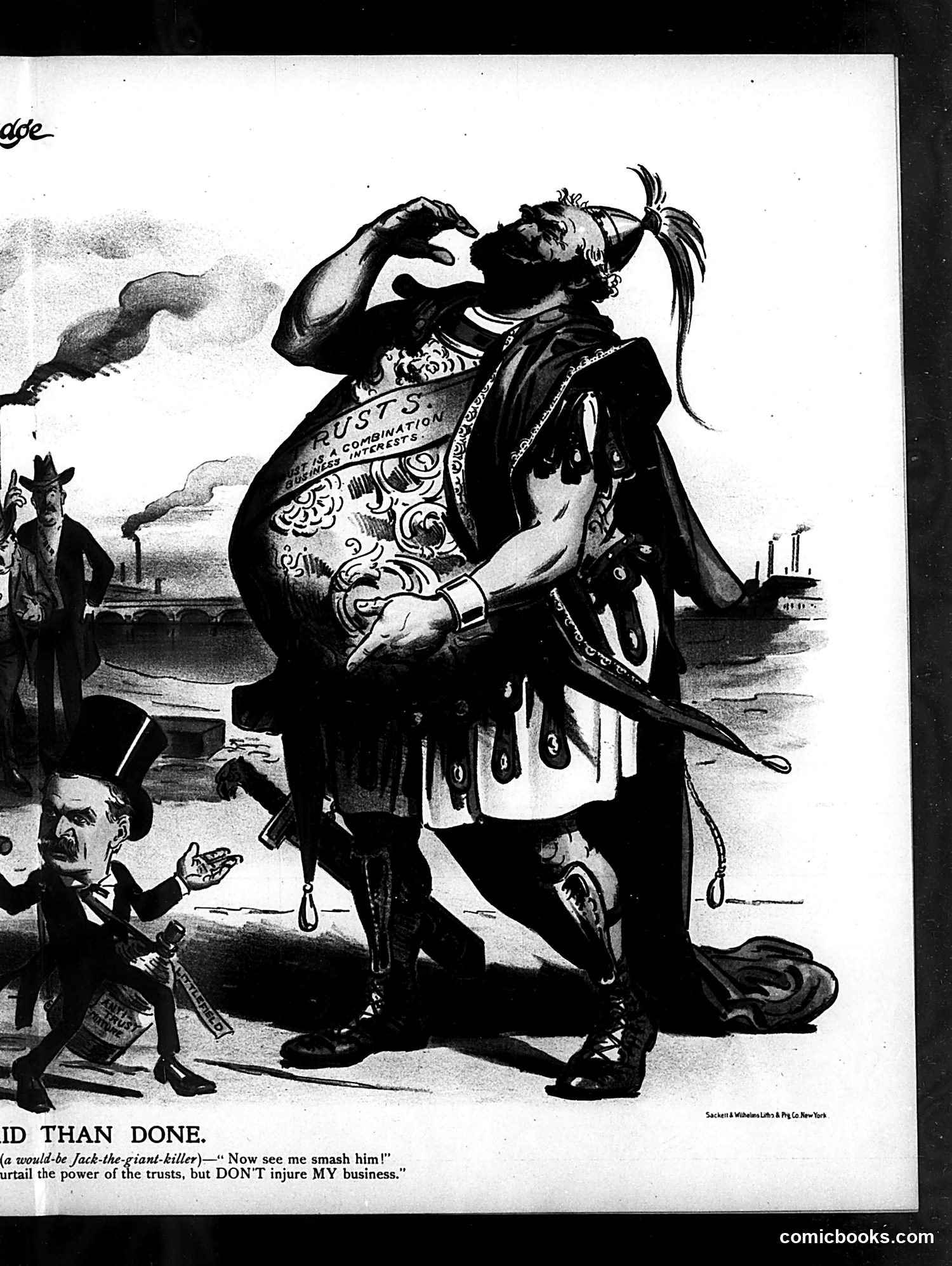
This Judge magazine cartoon satirizes Congressional efforts to restrict business activity, likely during an economic crisis or reform period. The image depicts a crowded industrial scene with factory smokestacks and numerous figures representing various business interests—identifiable by labels and period dress suggesting different industries and commercial sectors. The caption references Congressman Charles E. Littlefield of Maine, presenting him as leading a "Chorus of Business Interests" who chant "That's right! Curtail the—" (text cuts off). The satire suggests that business lobbies are hypocritically calling for government restrictions on commerce, likely because such restrictions would disadvantage their competitors while protecting their own interests. The industrial setting emphasizes that this concerns American manufacturing and commerce. The cartoon mocks the self-serving nature of business advocacy and regulatory capture—businesses wanting government intervention only when it benefits them.
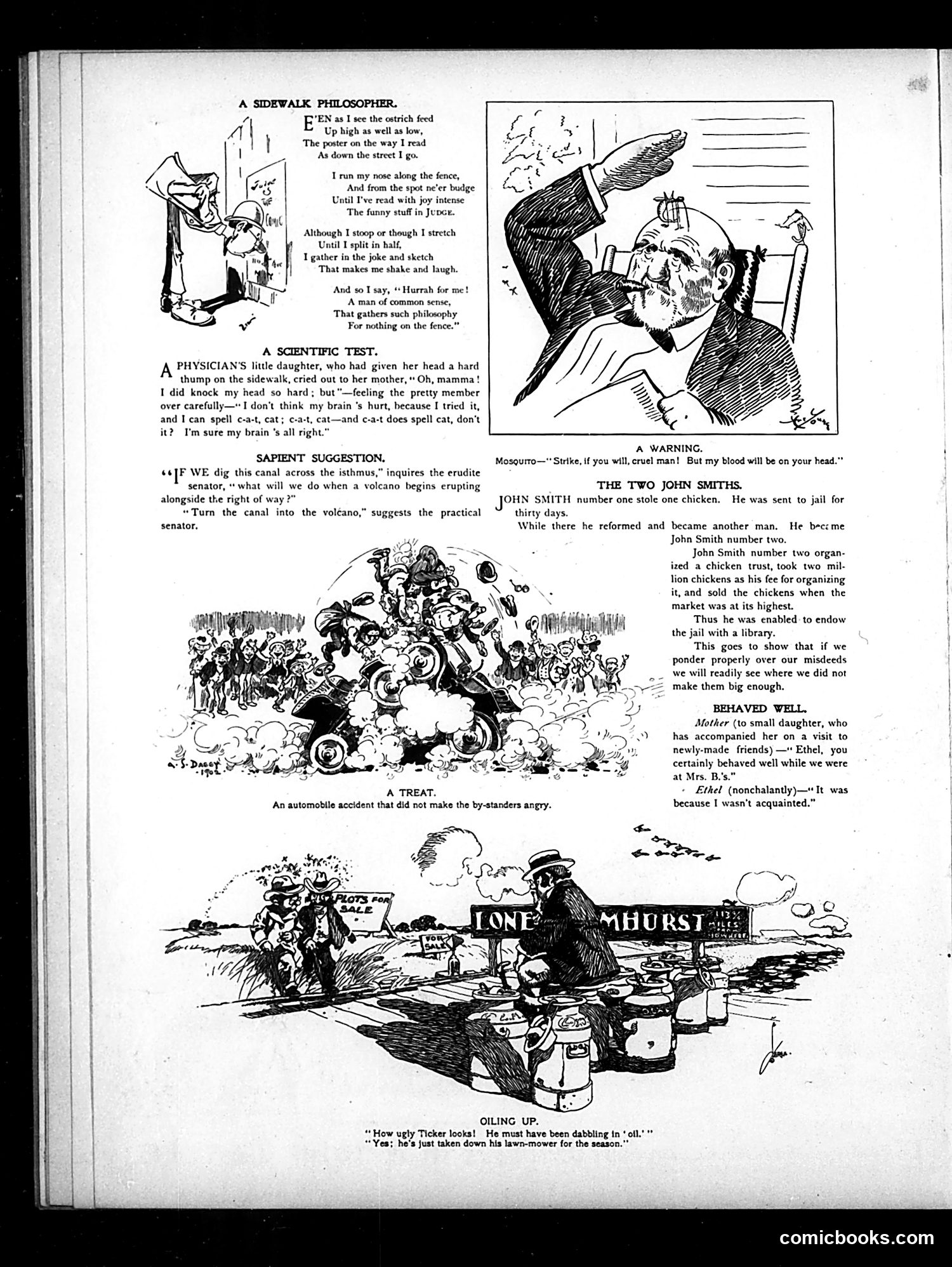
This page from Judge (a 19th-century satirical publication) contains several short humorous pieces mocking human behavior and logic: **"A Sidewalk Philosopher"** jokes that a man obsessively reads Judge advertisements on fences, claiming this makes him wise—satirizing both advertising culture and self-delusion about intellectual pursuits. **"A Scientific Test"** presents a doctor's daughter who believes spelling "cat" correctly proves her brain isn't injured, mocking flawed reasoning about intelligence. **"Sapient Suggestion"** ridicules an impractical senator's solution to volcano problems: simply "turn the canal into the volcano"—absurdist political satire. **"The Two John Smiths"** darkly jokes that stealing one chicken gets you jailed, but organizing a massive illegal chicken trust makes you wealthy enough to donate a library to that jail—satire of how the wealthy escape consequences while the poor face harsh punishment. **"Behaved Well"** observes that the daughter behaved properly only because she hadn't yet become acquainted with the hosts—cynical commentary on social hypocrisy. The page exemplifies Judge's style: short, punchy jokes targeting human vanity, political incompetence, and social corruption.
This page contains two distinct pieces: **Left side:** "A Memoir of the Brigadier" is a humorous short story (likely by Stanley Weyman, referenced in the text) mocking the romantic glorification of Napoleon's military. The unnamed narrator brags about his service under Napoleon, claiming exceptional bravery. The punchline involves Napoleon ordering him to sit on an open gunpowder can while smoking—a dangerous, absurd "test" that the narrator describes as heroic. The satire ridicules both pompous military nostalgia and the absurdity of blind obedience to authority. **Right side:** Advertisements for commercial products (Egyptian Deities cigarettes, Evans Ale, Chartreuse liqueur, Ed. Pinaud's hair products) with no apparent satirical content. **Top:** "Analects of Confucius" quotes appear to be filler content—moral aphorisms unrelated to satire. The page is primarily a satirical story wrapped around period advertisements. The humor targets inflated military pride and the willingness to perform dangerous acts for glory.
This page is primarily **advertisements and light humor**, not political satire. The main elements include: **"The Old Swimming-Hole"** (top left): A nostalgic poem about boyhood swimming, contrasting carefree youth with adult longing. It's sentimental Americana, not satire. **Whiskey & Rye Ads** (right side): Multiple liquor advertisements for Wilson Whiskey, Harper Rye, and others—standard commercial content. **Comic Vignettes** (scattered): Brief joke exchanges about chocolate, marriage, fashion ("Shake Into Your Shoes"), and a "Coming Terror" about wireless telegrams damaging hot air balloons—typical light magazine humor with no political edge. **"Picture Fun"** (bottom): A Judge Company advertisement for a humorous magazine featuring facial photography. **Overall**: This is a **commercial/entertainment page** typical of early 20th-century American magazines—heavy on advertising with filler humor and nostalgia. There's no identifiable political cartoon or social critique present.
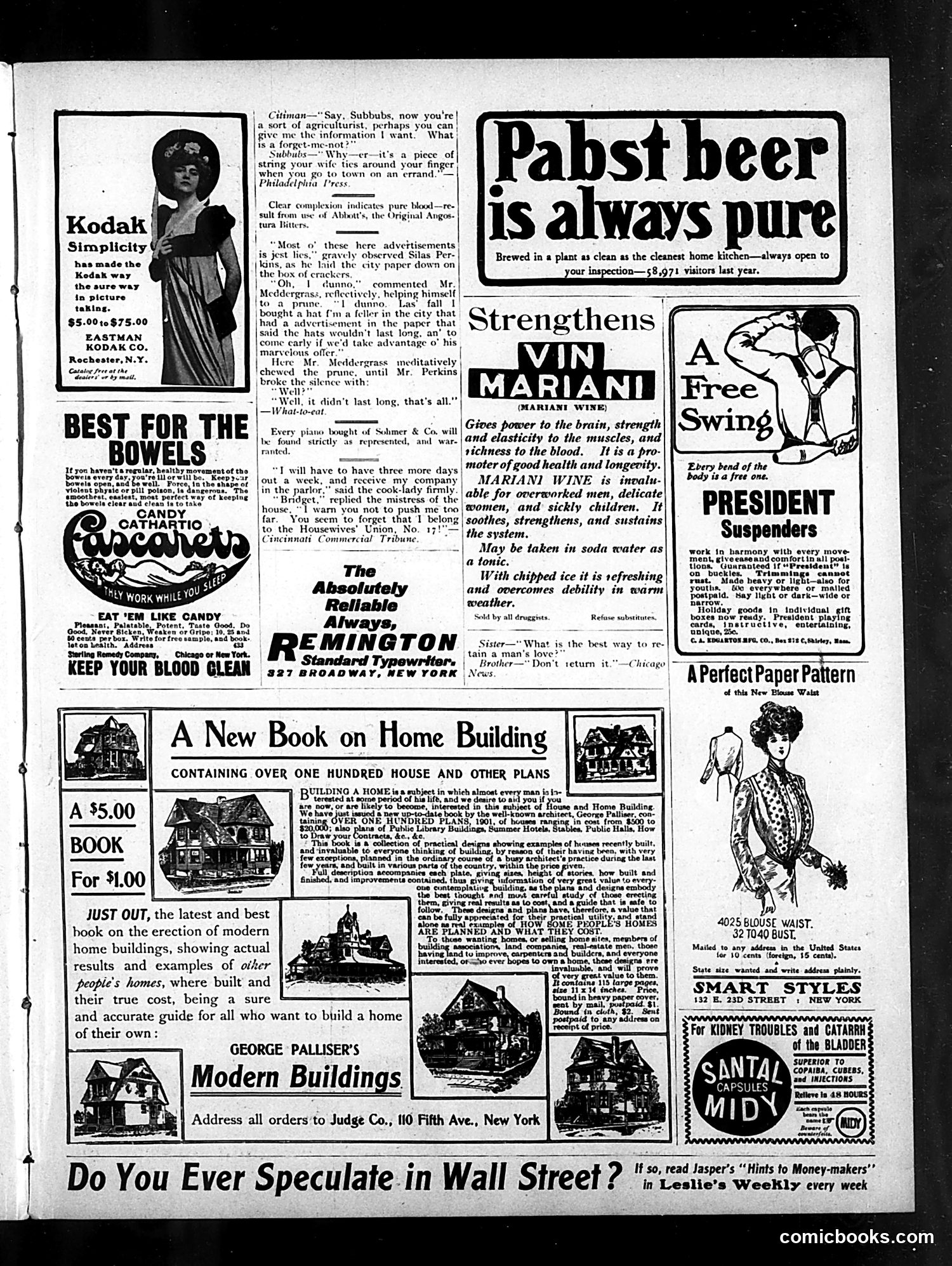
This page is primarily **advertisements and filler content** rather than satirical cartoons. The small comic items present include: 1. **"Citiman" and "Subbubs" dialogue**: A brief urban/rural exchange where a city man asks a farmer about agriculture, and the farmer (Subbubs) jokes that "agriculturist" is just a string farmers' wives tie around their fingers as reminders. Light, gentle humor about rural simplicity versus city sophistication. 2. **Cook/Housewives Union anecdote**: A household worker asserting power over her employer by invoking membership in a "Housewives' Union," suggesting early-20th-century labor organizing consciousness among domestic servants. The rest is straightforward period advertising: patent medicines (Mariani Wine, Santal capsules), home-building books, Kodak cameras, candy, suspenders, and dress patterns—typical of Judge's revenue model. No significant political satire appears on this particular page.
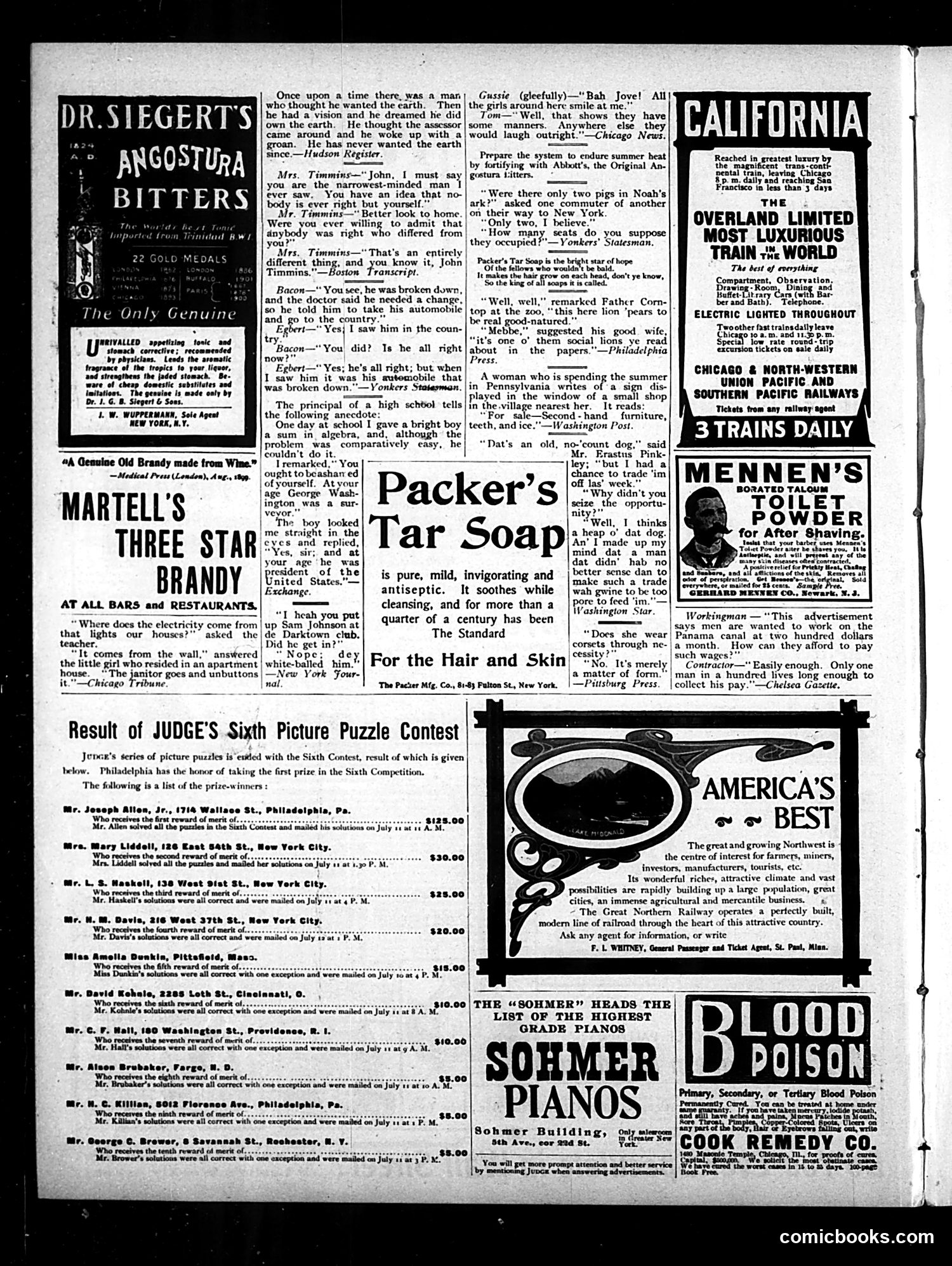
This page from Judge magazine is primarily **advertising-heavy** rather than featuring significant political cartoons. The main satirical content consists of brief **humorous dialogue snippets** scattered throughout—typical of Judge's style. These include: - A husband-wife exchange about narrow-mindedness - A school principal's anecdote about a boy struggling with algebra - Various quips about animals, trains, and everyday absurdities The **dominant feature** is the "Result of Judge's Sixth Picture Puzzle Contest," listing prize winners and amounts ($125-$10). The rest comprises advertisements for period products: Dr. Siegert's Angostura Bitters, Martell's brandy, Packer's Tar Soap, Mennen's talcum powder, Sohmer Pianos, Blood Poison remedy, and the Overland Limited luxury train. **No clear political satire is apparent.** The humor targets everyday social pretensions and domestic life rather than specific political figures or events. This appears to be a standard early-20th-century issue mixing light domestic comedy with commercial advertisements.
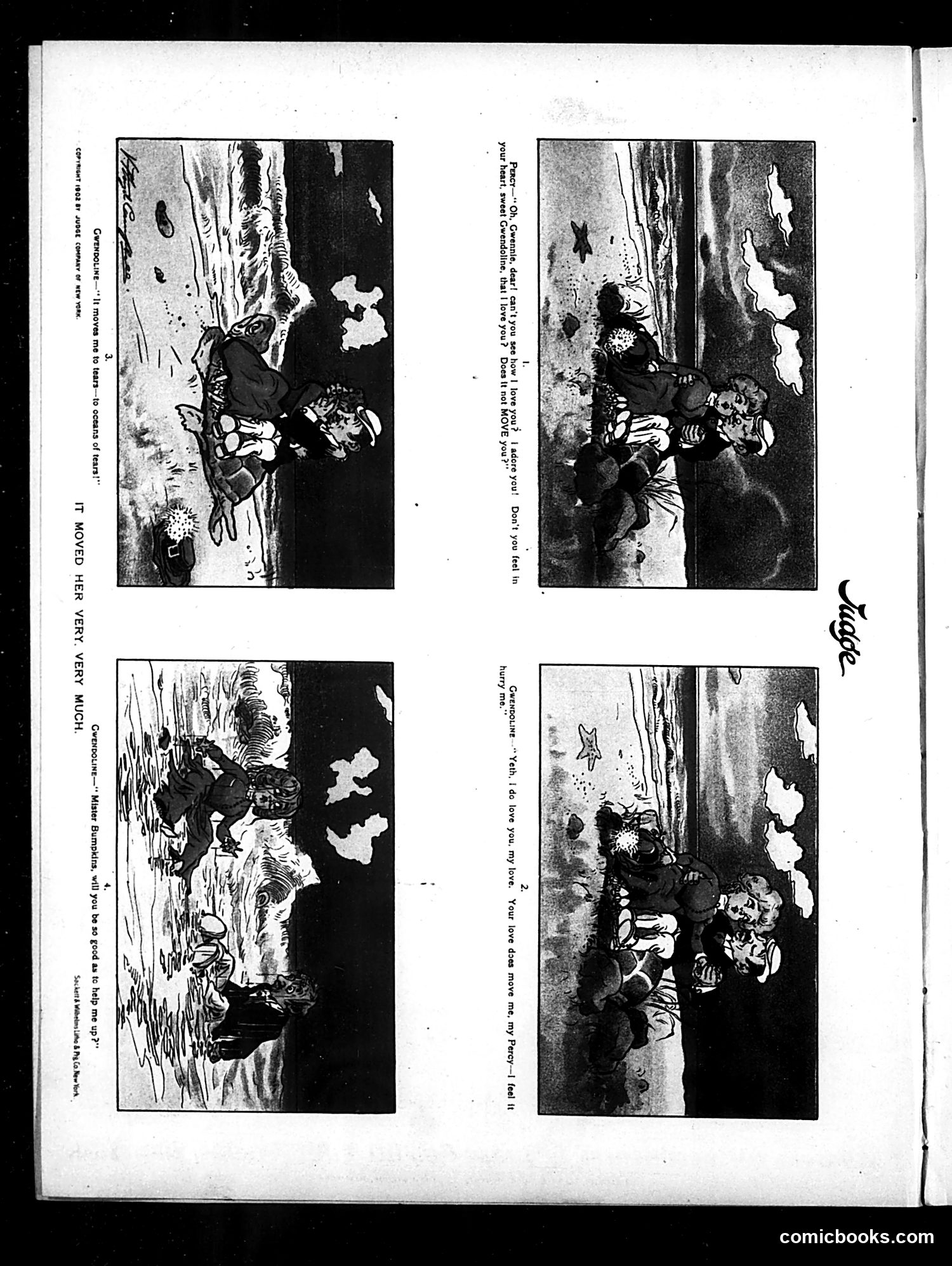
This is a romantic satire playing on the word "move." Percy professes passionate love to Gwendoline, asking if his feelings "move" her heart. She responds sentimentally that yes, his love does "move" her. The joke's punchline appears in the final panel: Gwendoline asks Mr. Bumpkins to help her up—revealing that Percy's emotional declaration literally moved her physically (perhaps he was pushing her or she was leaning against him). The humor derives from the gap between Percy's romantic, sentimental language and the mundane physical reality: his love "moved her very, very much" in the most literal sense. This reflects late-19th/early-20th-century satire mocking overly sentimental Victorian romance and the disconnect between flowery declarations and practical everyday life. The cartoonist suggests romantic posturing often masks physical comedy or awkwardness.