
Judge, 1902-08-16 · page 7 of 16
Judge — August 16, 1902 — page 7: what you’re looking at
What you’re looking at
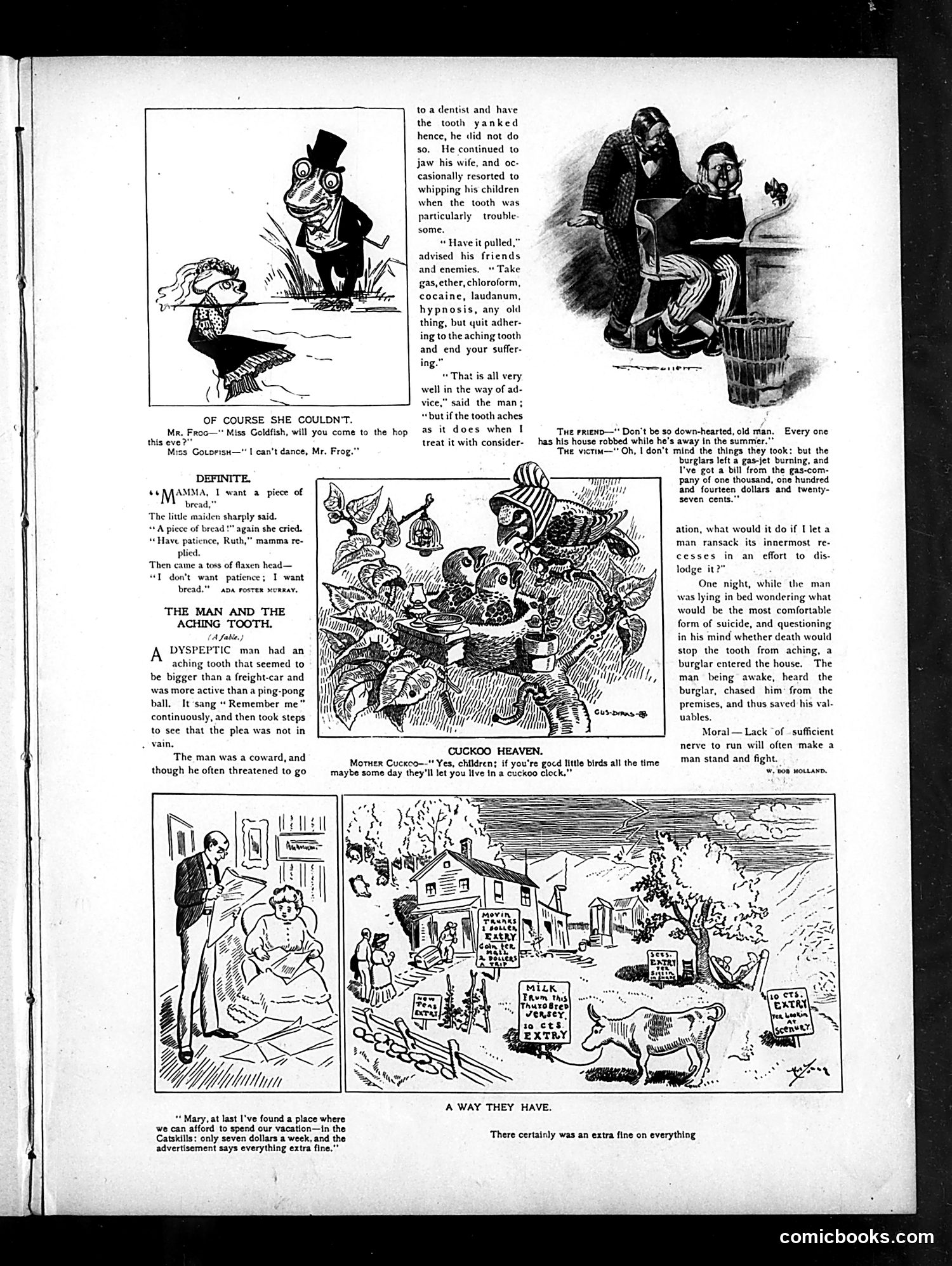
This page contains several satirical pieces typical of early 20th-century American humor: **"The Man and the Aching Tooth"** is a fable mocking cowardice and indecision. A dyspeptic man refuses to extract a painful tooth despite friends' advice, then ironically becomes brave when confronted by a burglar—suggesting that fear sometimes produces unexpected courage. The moral comments on how lacking nerve can paradoxically force action. **"A Way They Have"** satirizes vacation advertising—a man finds a cheap Catskill resort advertising "everything extra fine" for seven dollars weekly, only to discover the phrase means there's an extra fine (penalty charge) on everything. The smaller pieces mock romantic rejection (the frog) and childhood impatience for bread. The page exemplifies Judge's blend of social commentary through exaggerated situations, targeting human weakness, consumer deception, and middle-class anxieties about money and propriety.
📄 Transcribed text from this page (OCR, searchable)
Machine-transcribed from the original scan — historical spelling and the odd misread are preserved.
toa dentist and have the tooth yanked hence, he did not do so. He continued to jaw his wife, and oc- casionally resorted to whipping his children when the tooth was particularly trouble some. « Have it pulled,” advised his friends and enemies. “Take gas, ether, chloroform, cocaine, laudanum, hypnosis, any old thing, but quit adher- ing to the aching tooth and end your suffer- ing.” “That is all very well in the way of ad- OF COURSE SHE COULDN'T. Mr. Froc—" Miss Goldfish, will you come to the hop this eve?” Miss Gotorish—"' I can't dance, Mr. Frog.” DEFINITE, COJMASBIA, T want a piece of br The little maiden sharply said. +A piece of bread !” again she cried. “Have patience, Ruth," mamma re- plied, Then came a toss of flaxen head— “1 don't: want patience; I want bread." ADA roster suRRay, THE MAN AND THE ACHING TOOTH. (A fable.) A DYSPEPTIC man had an aching tooth that seemed to be bigger than a freight-car and was more active than a ping-pong ball, It’sang “Remember me” continuously, and then took steps to see that the plea was not in . vain, The man was a coward, and though he often threatened to go said the man; “but if the tooth aches as it does when I treat it with consider- Motuer Cucxco--"' Yes, children; if you're gocd little birds all the time maybe some day they'll let you live in a cuckoo clock.” Tue pRien>—' Don't be so down-hearted, old man, Every one has his house robbed while he's away in the summer."* Tne victim—" Oh, I don't mind the things they took: but the mT Myint Wy SSN In aN pS / \W~ 7 Y YU ybutnn burglars left a gas-jet burning, and V've got a bill from the gas-com- pany of one thousand, one hundred and fourteen dollars and twenty- seven cents."" ation, what would it do if Tet a man ransack its innermost re- cesses in an effort to dis- lodge it?” One night, while the man was lying in bed wondering what would be the most comfortable form of suicide, and questioning in his mind whether death would stop the tooth from aching, a burglar entered the house. The man being awake, heard the burglar, chased him: from the premises, and thus saved his val- uables. Moral — Lack “of - sufficient nerve to run will often make a man stand and fight. “Mary, at last I've found a place where we can afford to spend our vacation—in the Catskills: only seven dollars a week, and the advertisement says everything extra fine." A WAY THEY HAVE. ‘There certainly was an extra fine on everything comicbooks.com