
A complete issue · 20 pages · 1902
Judge — August 9, 1902
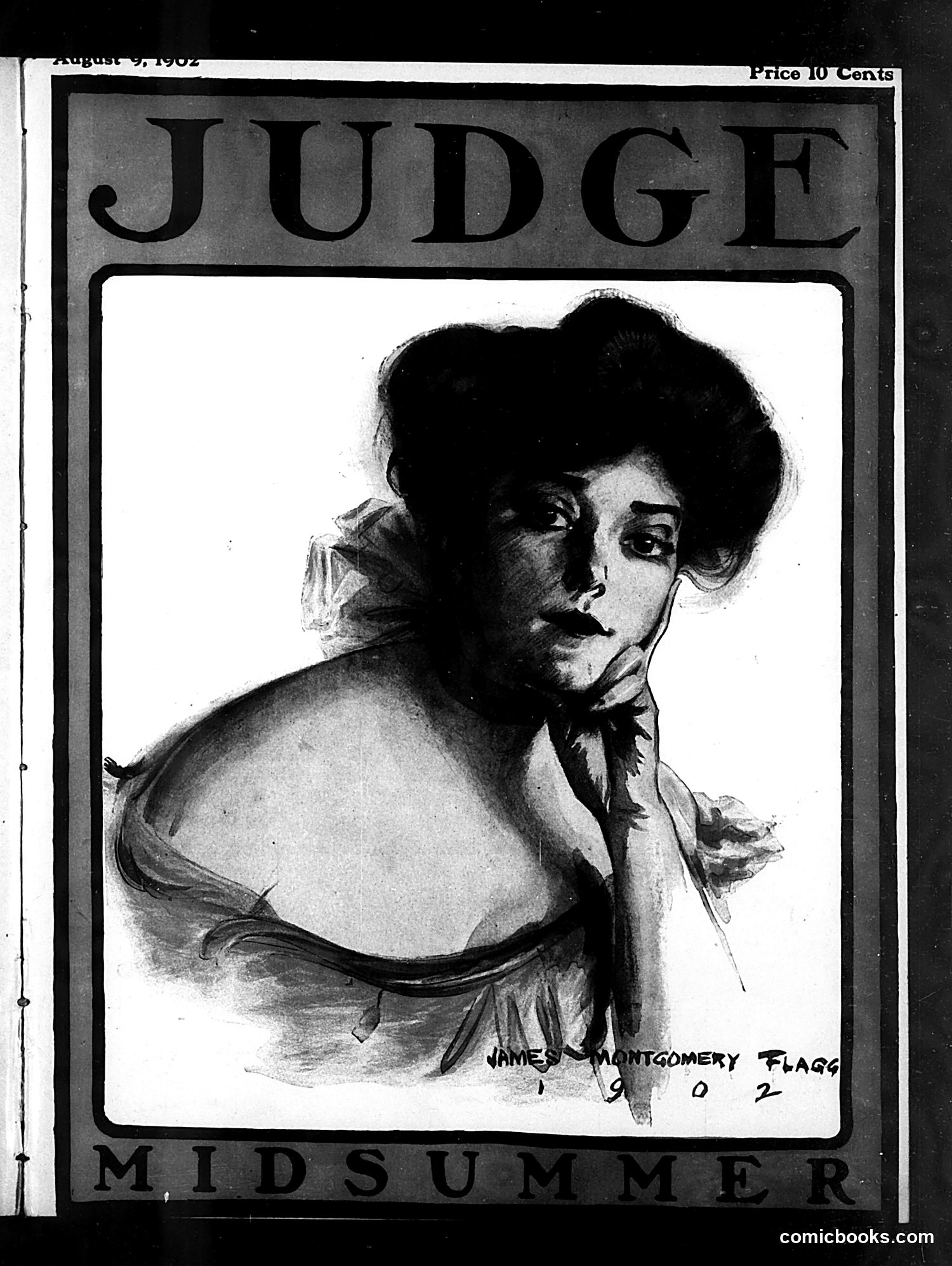
This is the cover of Judge's "Midsummer" issue, priced at 10 cents. The illustration, credited to James Montgomery Flagg (a prominent illustrator of the era), depicts a woman in classical or romantic artistic style—bare-shouldered, turned slightly away, with her hair up in the Gibson Girl fashion popular in early 1900s America. The image appears to be a straightforward aesthetic/artistic piece rather than political satire. It exemplifies the decorative portrait style Judge used for seasonal covers during this period. Without accompanying article text, the specific satirical content or social commentary—if any—remains unclear. The cover primarily functions as fashionable seasonal artwork appealing to Judge's middle-class readership.
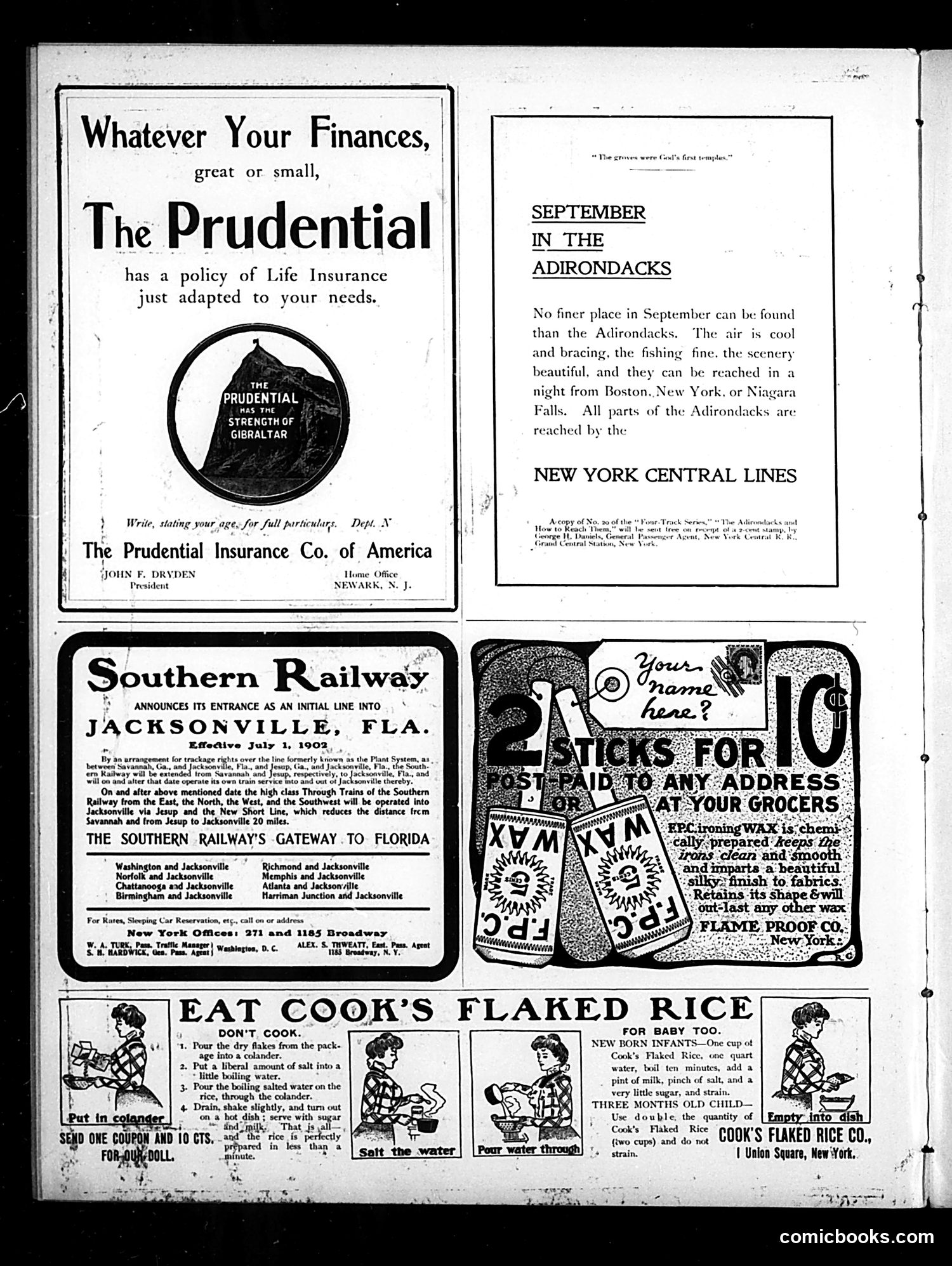
This page is **primarily advertising** from what appears to be an early 1900s issue. The content includes: 1. **Prudential Insurance ad** - A company pitch emphasizing financial security regardless of wealth level 2. **Travel/Tourism ads** - New York Central Lines promoting the Adirondacks, and Southern Railway advertising Jacksonville, Florida as an accessible destination 3. **Product advertisements** - Including a mysterious "10 cents" item (possibly a cleaning product or household good), and Cook's Flaked Rice with cooking instructions 4. **No political satire or caricature** is evident on this particular page. It functions as a commercial space rather than editorial content, which was typical for magazines of this era that relied heavily on advertising revenue. The illustrations are product-focused rather than satirical.
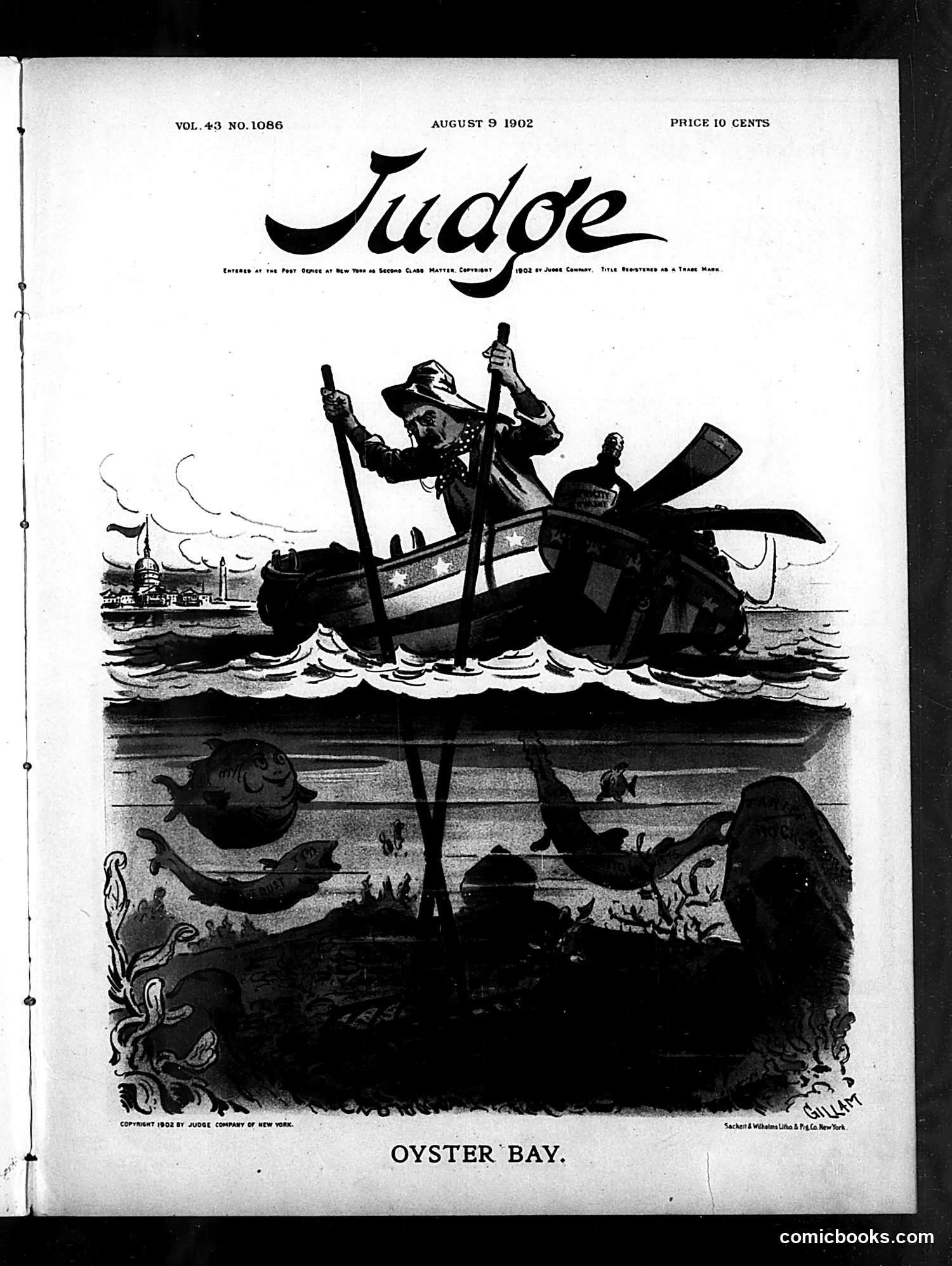
This 1902 Judge magazine cover depicts **Oyster Bay, New York**, President Theodore Roosevelt's summer residence. The cartoon shows a boat in distress above water, with two figures struggling with oars and supplies, while below the surface, various sea creatures and dangers lurk in the depths. The satire likely comments on the **precarious state of Roosevelt's presidency or policies** — the troubled boat above represents surface-level appearances of stability, while the dark depths below suggest hidden dangers, problems, or opposition threatening to capsize his administration. The maritime/nautical metaphor was common in period political cartoons. Without additional context or clearer figure identification, the specific crisis or policy being critiqued remains unclear, though Oyster Bay's prominence in the title suggests direct commentary on Roosevelt's tenure.
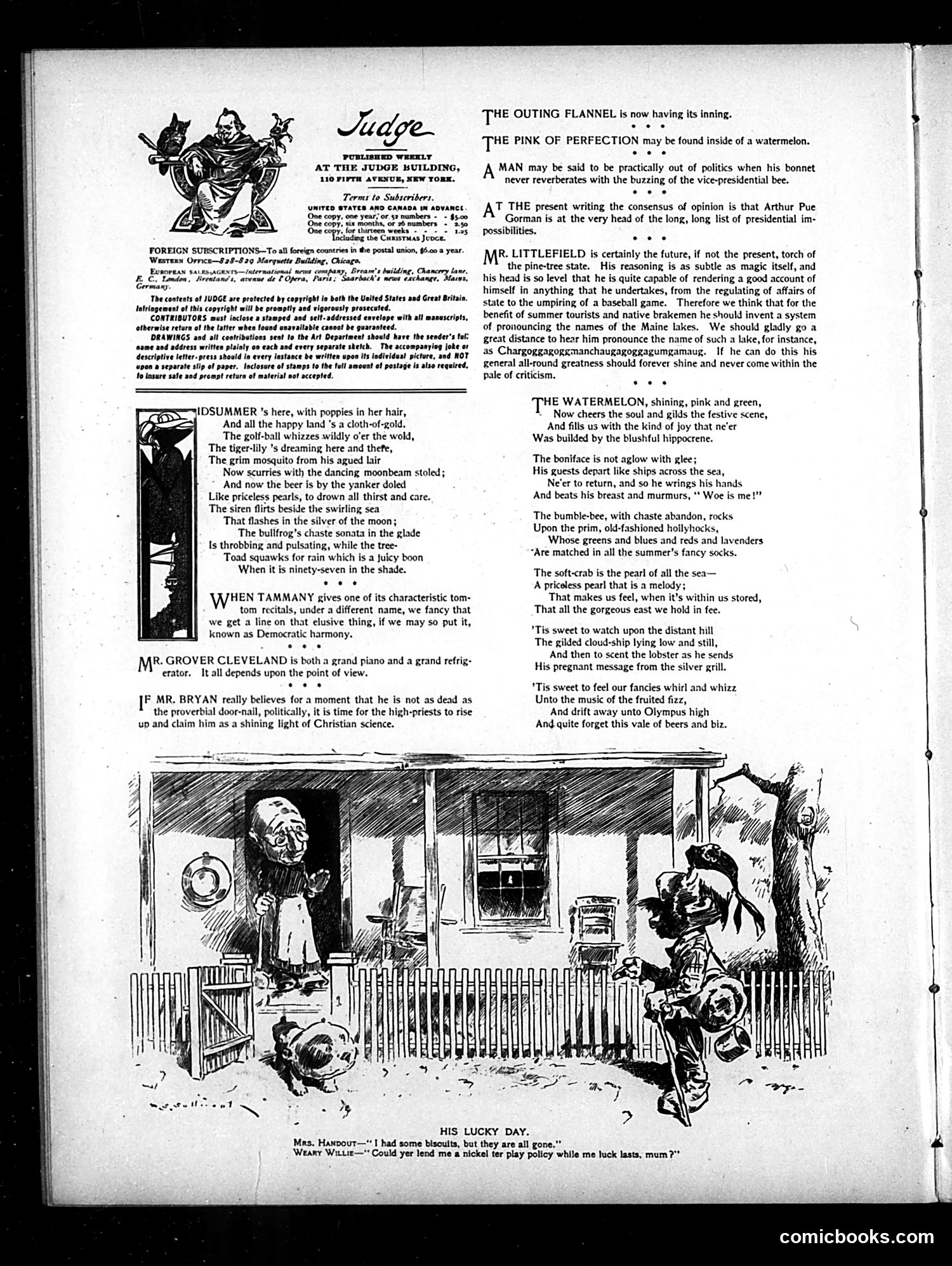
This page contains short satirical commentary pieces and poetry rather than a single cartoon. The visible content includes: **Political Commentary:** - A jab at Arthur Pue German regarding presidential ambitions - Criticism of Mr. Littlefield's future prospects in state politics - Commentary on Mr. Grover Cleveland's piano and refrigerator, making a philosophical point about perspective - A dig at Mr. Bryan regarding Christian Science **"His Lucky Day" Cartoon:** The bottom illustration shows children at a house, with dialogue between "Mrs. Handout" and "Weary Willie" about borrowing a nickel. This satirizes vagrancy and panhandling—common Judge subjects—with Willie attempting to exploit a child's luck for financial gain. The poetry section celebrates watermelons, summer pleasures, and seaside imagery in sentimental verse typical of the era's lighter magazine content.
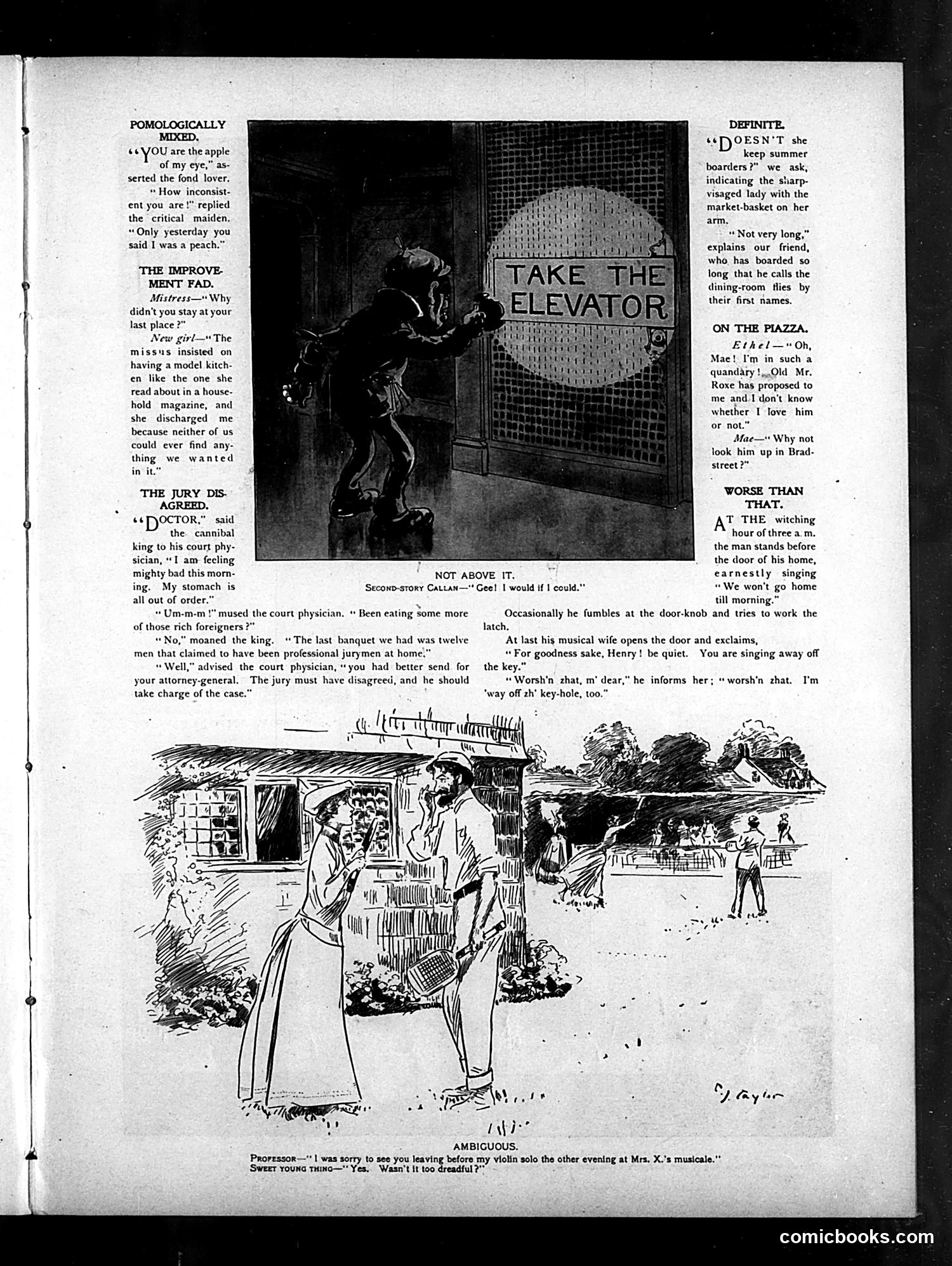
This page contains six brief satirical sketches typical of early-20th-century American humor: 1. **"Pomologically Mixed"**: A lover's inconsistency—he calls his girlfriend both "the apple of my eye" and "a peach," contradicting himself. 2. **"The Improvement Fad"**: Satire on domestic modernization. A maid quits because her employer installed a trendy "model kitchen" from a magazine that's so poorly designed nobody can find anything in it. 3. **"The Jury Disagreed"**: A cannibal king consults his physician about stomach trouble. The doctor jokes that eating professional jurymen causes indigestion because "juries must have disagreed"—implying jurymen are inherently contentious/difficult to digest. 4. **"Worse Than That"**: A drunk husband sings loudly at 3 a.m.; his wife complains he's singing off-key, making it worse than merely coming home late. 5. **"On the Piazza"**: A young woman seeks advice about a marriage proposal from an older man, suggesting she look him up in Bradstreet's (a business credit rating guide)—implying financial security matters more than love. 6. **"Ambiguous"**: A professor's vague comment about someone leaving a musical performance creates confusion about whether he meant it was dreadful or the person left dreadfully.
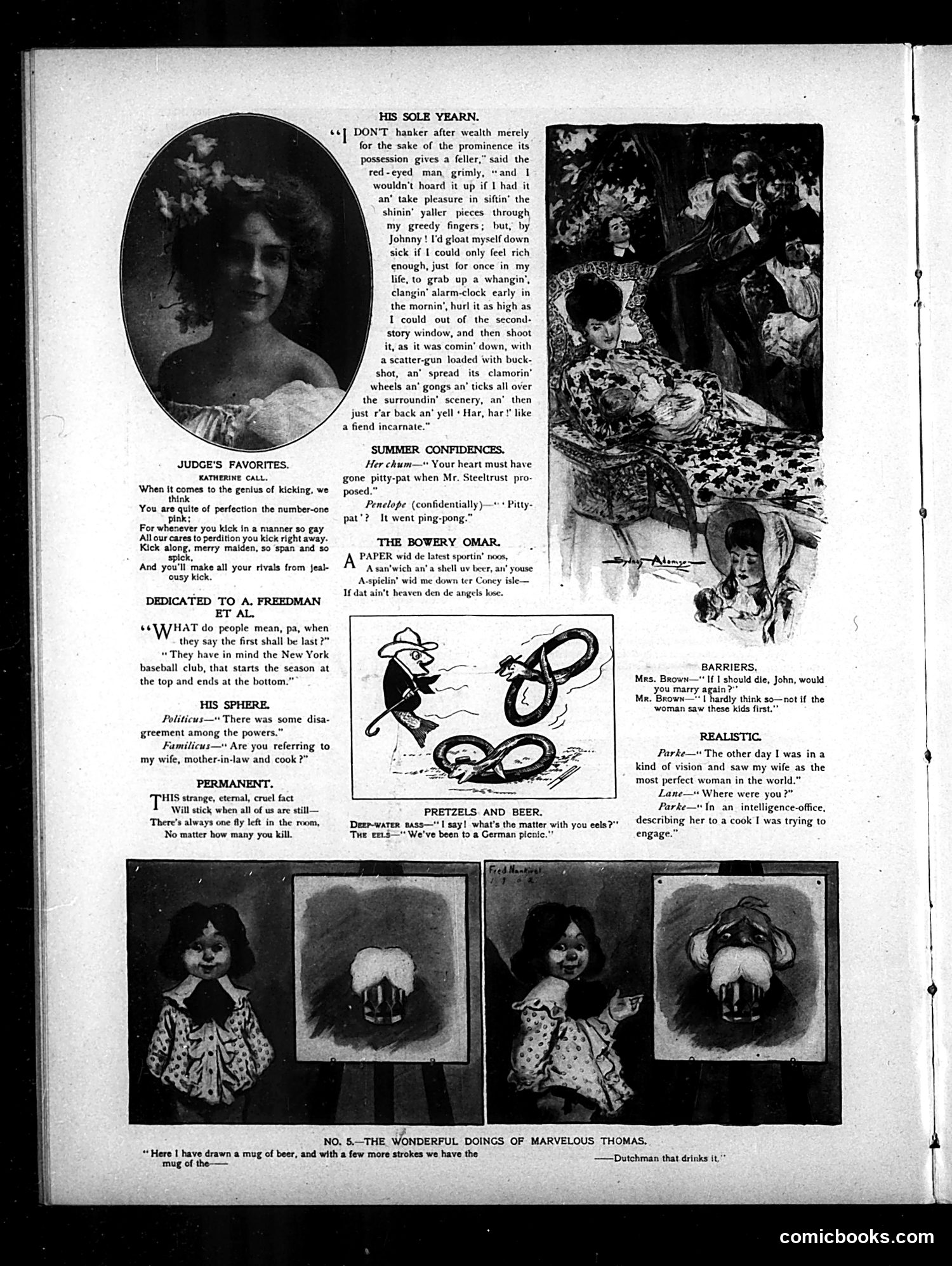
This page contains humorous short pieces typical of early 20th-century satirical magazines. Key content includes: **"His Sole Yearn"**: A working-class man fantasizes about wealth not for luxury, but to afford the petty satisfaction of destroying an alarm clock—destroying the object that forces him to wake early for labor. It's satire on working-class frustration and the daily grind. **Baseball joke**: References the New York baseball club starting the season as favorites ("top") but ending poorly ("bottom")—likely the Yankees or Giants, though unclear which season. **"The Bowery Omar"**: Mockingly presents lower-class immigrant life (Coney Island, beer, sandwiches) as "heaven," mimicking the romantic tone of Omar Khayyam's poetry. It's ethnic/class satire about immigrant aspirations. **"Marvelous Thomas"**: A visual gag showing a Dutchman drawing becoming progressively more detailed to resemble a beer mug—playing on ethnic stereotypes about German immigrants and drinking. The page emphasizes working-class humor and period ethnic stereotyping common to Judge magazine.
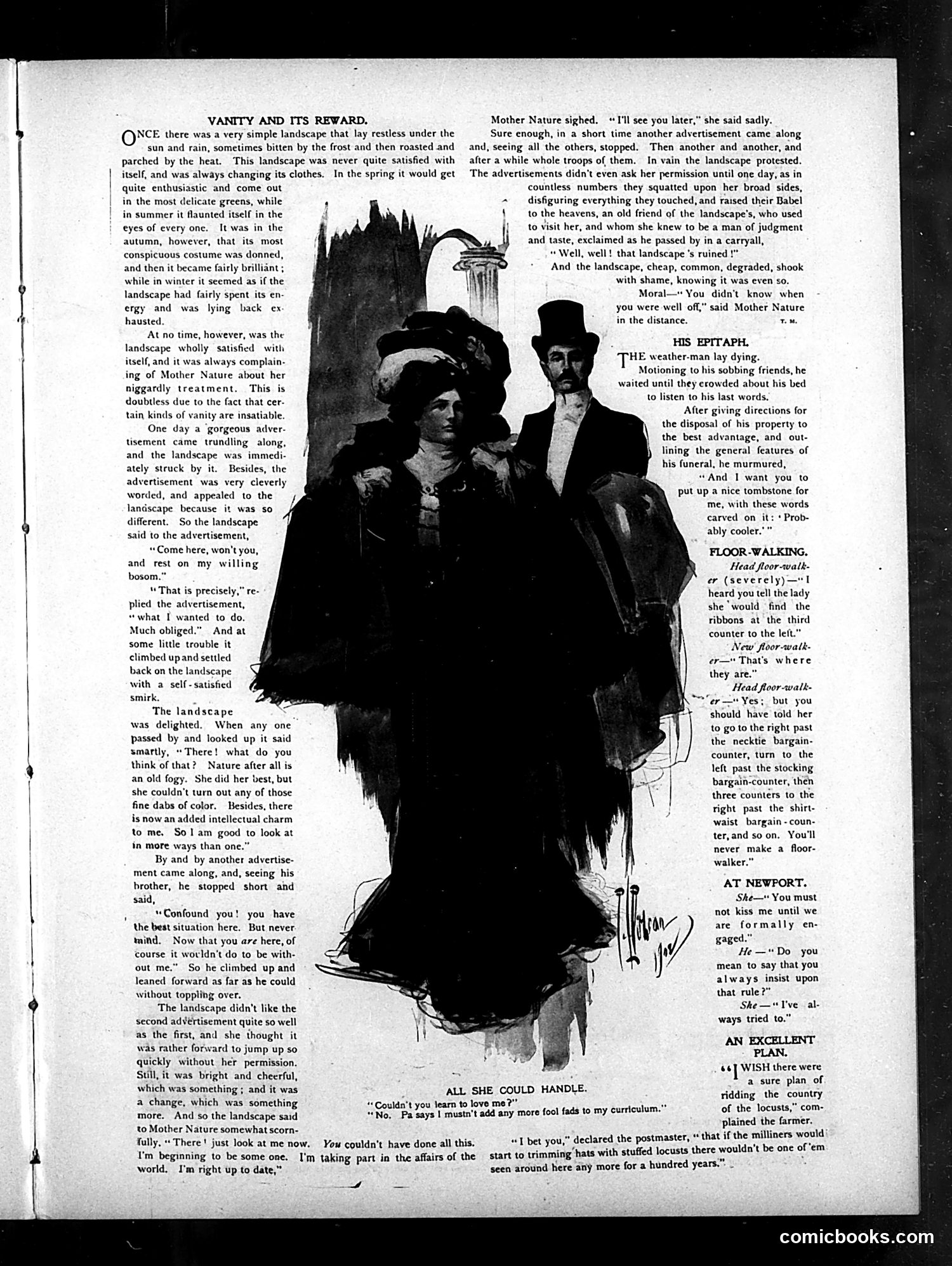
This is a cautionary fable illustrated with a satirical cartoon. The narrative personifies a landscape as a vain character who complains to "Mother Nature" about her work. When advertisements arrive and praise the landscape's appeal, it eagerly accepts them—initially just one, then many more flood in uninvited. The satire targets **commercialism and environmental degradation**. The advertisements represent billboards and commercial signage that increasingly defaced American landscapes in the early 20th century. The landscape's vanity—preferring artificial commercial praise over natural beauty—leads to its ruin as countless advertisements literally cover it. The moral warns against valuing commercial development over natural preservation: "You didn't know when you were well off." This reflects Progressive-era concerns about industrialization and advertising's visual pollution of the American countryside. The cartoon's figures are allegorical rather than political caricatures—the landscape itself is the protagonist, with Mother Nature and advertisements as symbolic characters representing natural beauty versus commercial exploitation.
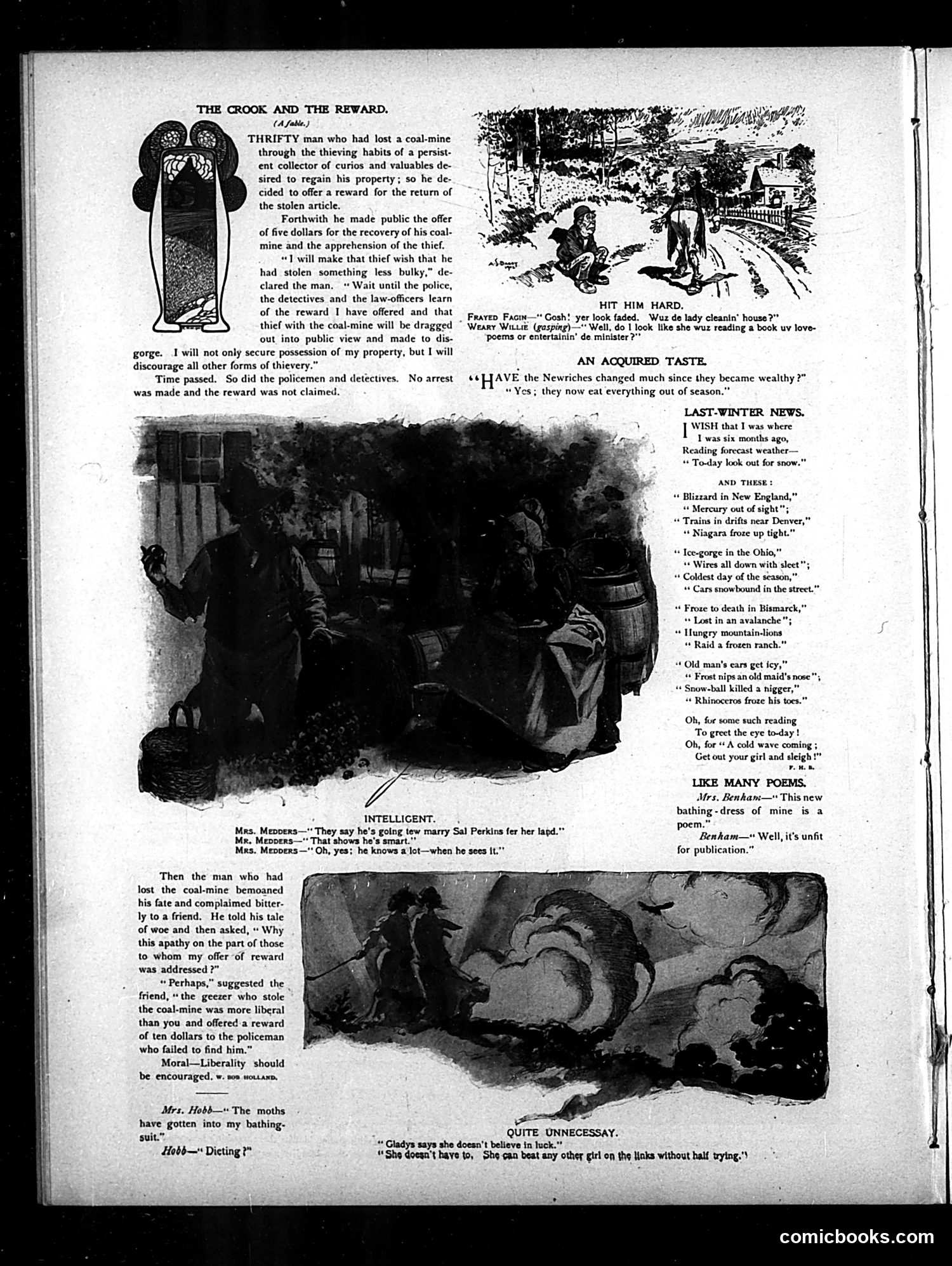
This satirical story mocks both police incompetence and perverse incentives. A thrifty man loses his coal-mine to a persistent thief and posts a $5 reward for recovery. Police and detectives do nothing—no arrest is made. When he complains to a friend, the friend suggests the thief offered the *police* $10 to *not* find him, thus encouraging the authorities' laziness through counter-incentive. The moral: "Liberality should be encouraged"—but the joke's real target is the corruption or indifference of police forces, who apparently valued bribes over their duty. The page also contains lighter humor: jokes about newfound wealth, nostalgia for harsh winters, a woman's bathing dress, and women's golf skills. The racist slur in "Last-Winter News" reflects the era's crude sensibilities typical of period satire magazines.
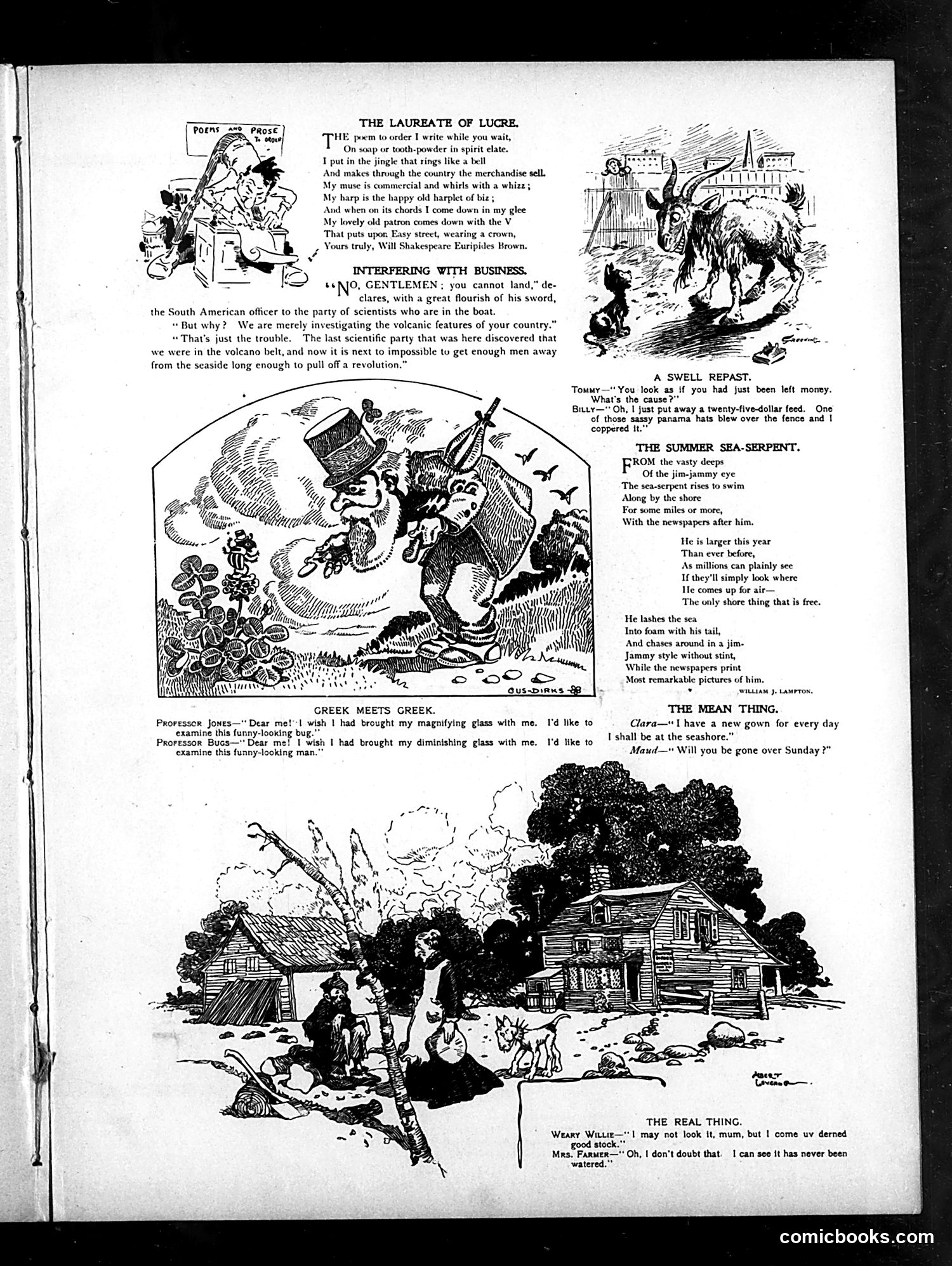
This page from *Judge* magazine contains several satirical pieces mocking early 20th-century American society: **"The Laureate of Lucre"** attacks commercialized poetry—a poet who writes jingles for soap and toothpaste advertisements rather than serious literature, personified as "Will Shakespeare Euripides Brown." The satire mocks advertising's corruption of art. **"Interfering with Business"** jokes about a South American officer blocking scientists from studying volcanoes because scientific discovery disrupts his plans to stage a revolution—the implication being that practical concerns trump knowledge. **"The Summer Sea-Serpent"** satirizes newspapers' sensationalism, where an annual sea-serpent sighting generates fabricated "remarkable pictures" for profit, despite being non-threatening. **"Greek Meets Greek"** is a brief visual gag where two professors want optical instruments to examine each other—implying they're equally peculiar specimens. The overall theme: commercial greed, journalistic fakery, and self-interest trump genuine knowledge and art.
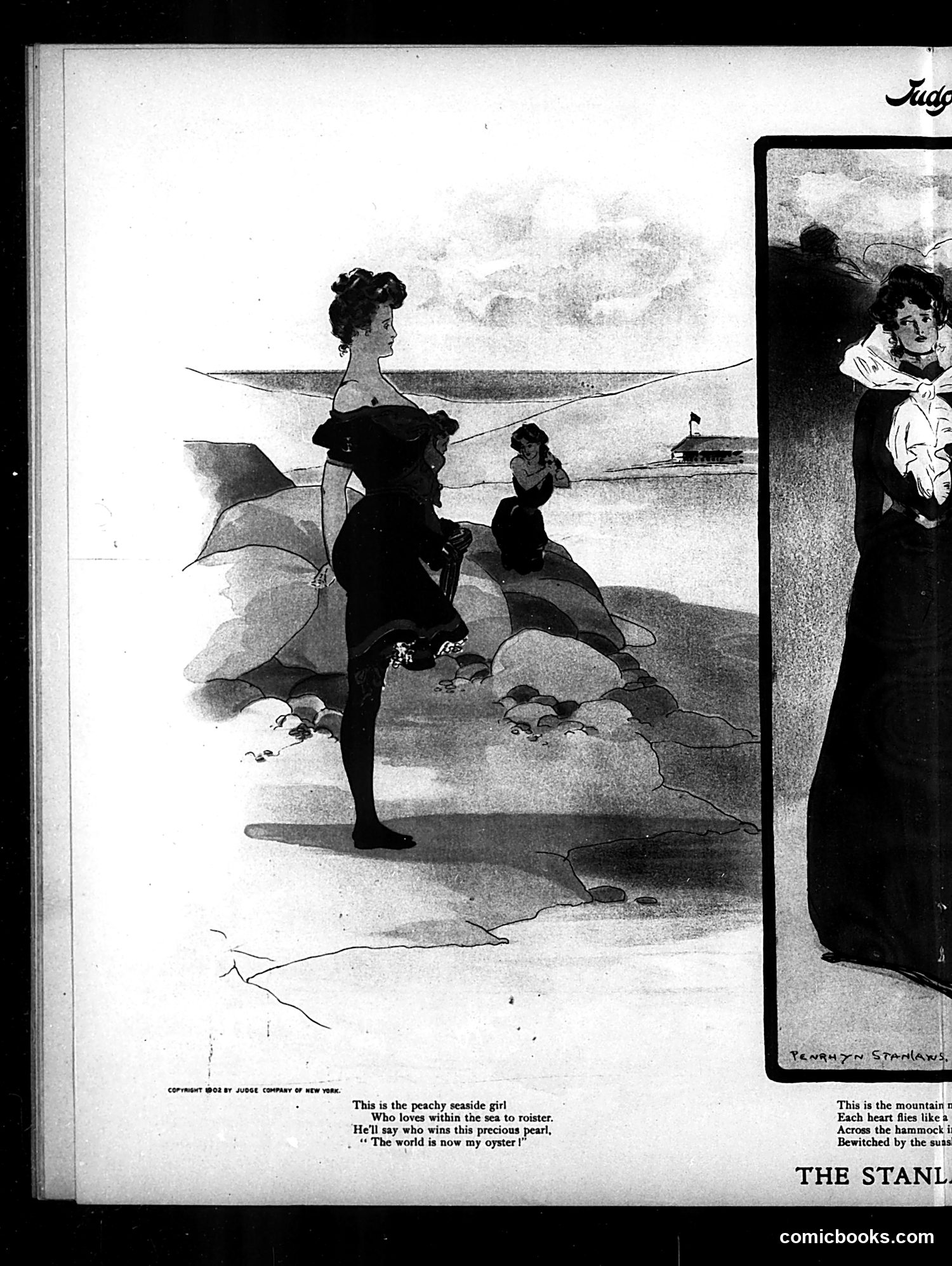
This is an illustration by Tewyn Stanlaws from *Judge* magazine depicting two contrasting female archetypes popular in early 20th-century American culture. The left panel shows "the peachy seaside girl" — a modern, athletic young woman in a bathing costume, depicted in a confident, flirtatious pose at the beach. The accompanying verse suggests she represents independence and romantic agency: suitors will compete for her affections, and she holds power ("the world is now my oyster"). The right panel (partially visible) shows "the mountain girl" in contrasting formal/conservative dress, representing a traditional feminine ideal. The satire appears to comment on changing gender roles and female independence of the era. The "seaside girl" embodies the "New Woman" — more liberated, athletic, and sexually confident — challenging Victorian propriety. The comparison between these two female types reflects anxieties and fascinations about women's evolving social positions in American society during this period.
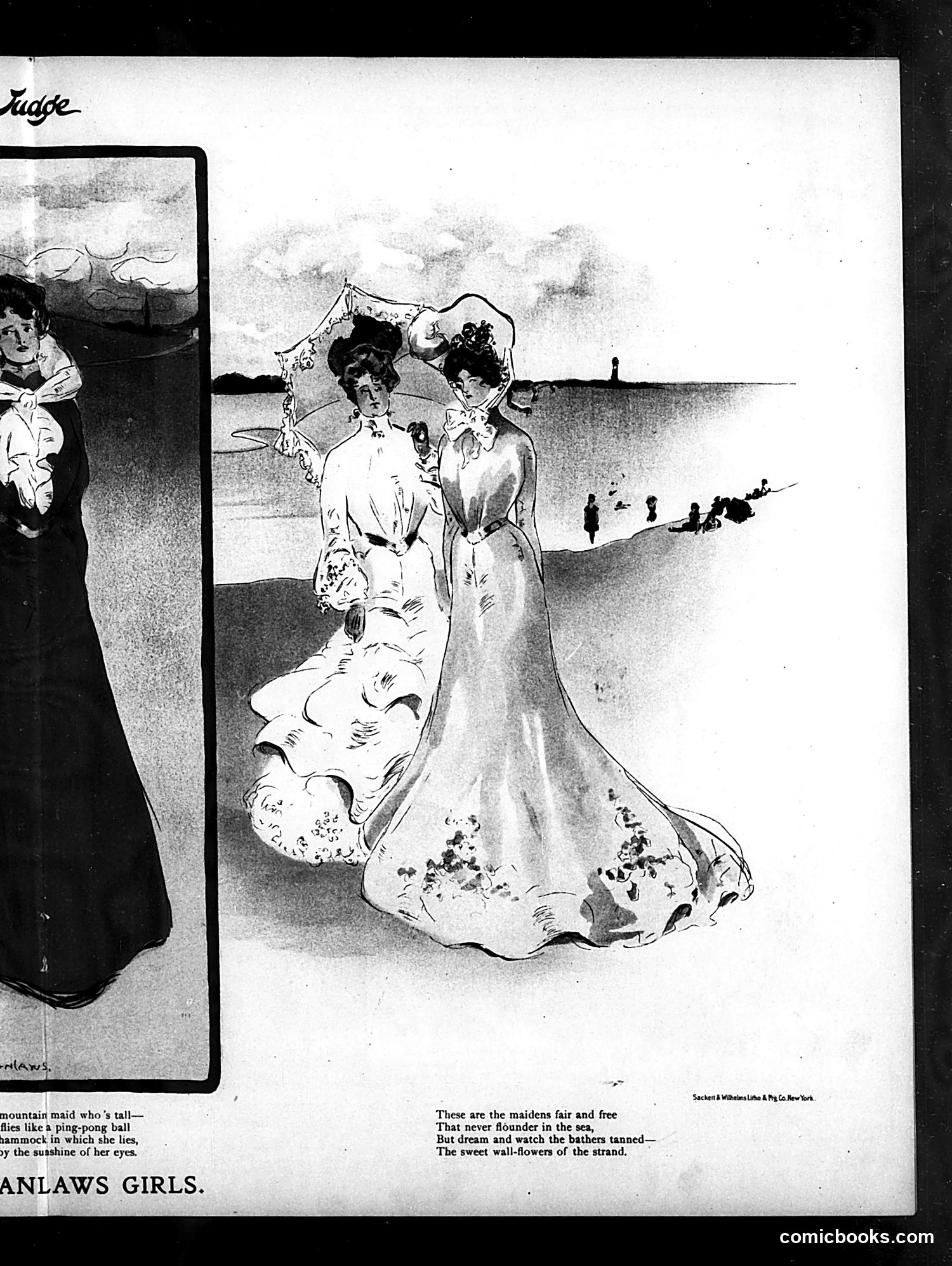
This appears to be a satirical illustration contrasting two types of young women. The left panel shows a woman in darker clothing (the "outlaw" or unconventional girl), while the right panel depicts fashionably dressed women at a beach observing swimmers. The poem's text suggests satire of social pretension: the "fair and free" maidens who watch from shore rather than participate, described as "wall-flowers of the strand"—women too timid or proper to actually engage in swimming, only observing the "bathers tanned." The humor likely mocks the era's strict social conventions around women's behavior and propriety at beaches, contrasting boldly independent girls with those constrained by genteel expectations. The title "Outlaws Girls" suggests admiration for those who break social rules, implying the beachside "maidens" are actually the outliers for their excessive propriety.
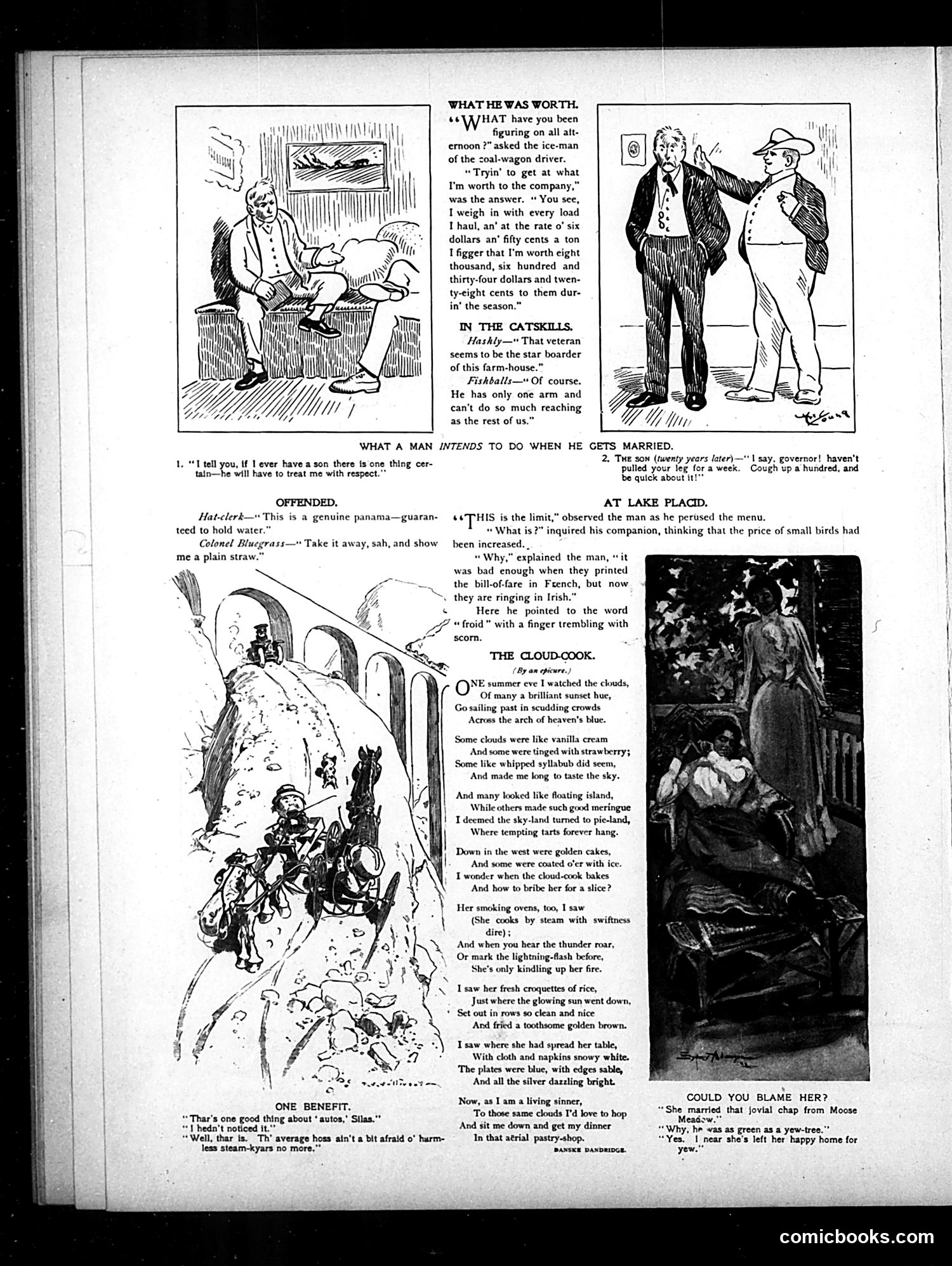
This page contains several satirical vignettes mocking American social types and pretensions: **"What He Was Worth"**: A coal wagon driver and ice man calculate the driver's monetary value to his company based on weight hauled—a joke about reducing human labor to mere commodity measurement. **"In the Catskills"**: Satirizes a one-armed Civil War veteran's prominence at a boarding house, implying he's valued only for his disability (unable to compete with other workers). **"At Lake Placid"**: Mocks a diner's snobbish complaint about a menu printed in Irish instead of French—suggesting pretentious diners' shifting linguistic anxieties. **"The Cloud-Cook"**: A whimsical poem personifying clouds as food—vanilla cream, meringues, golden cakes—reflecting genteel escapism. **"Could You Blame Her?"**: A woman marries a "green" (naive) man from "Moose Meadow," then leaves him for another man—the punchline plays on "yew" (tree) versus "you." The overall tone ridicules working-class anxiety about worth, rural naïveté, urban pretension, and romantic disappointment.
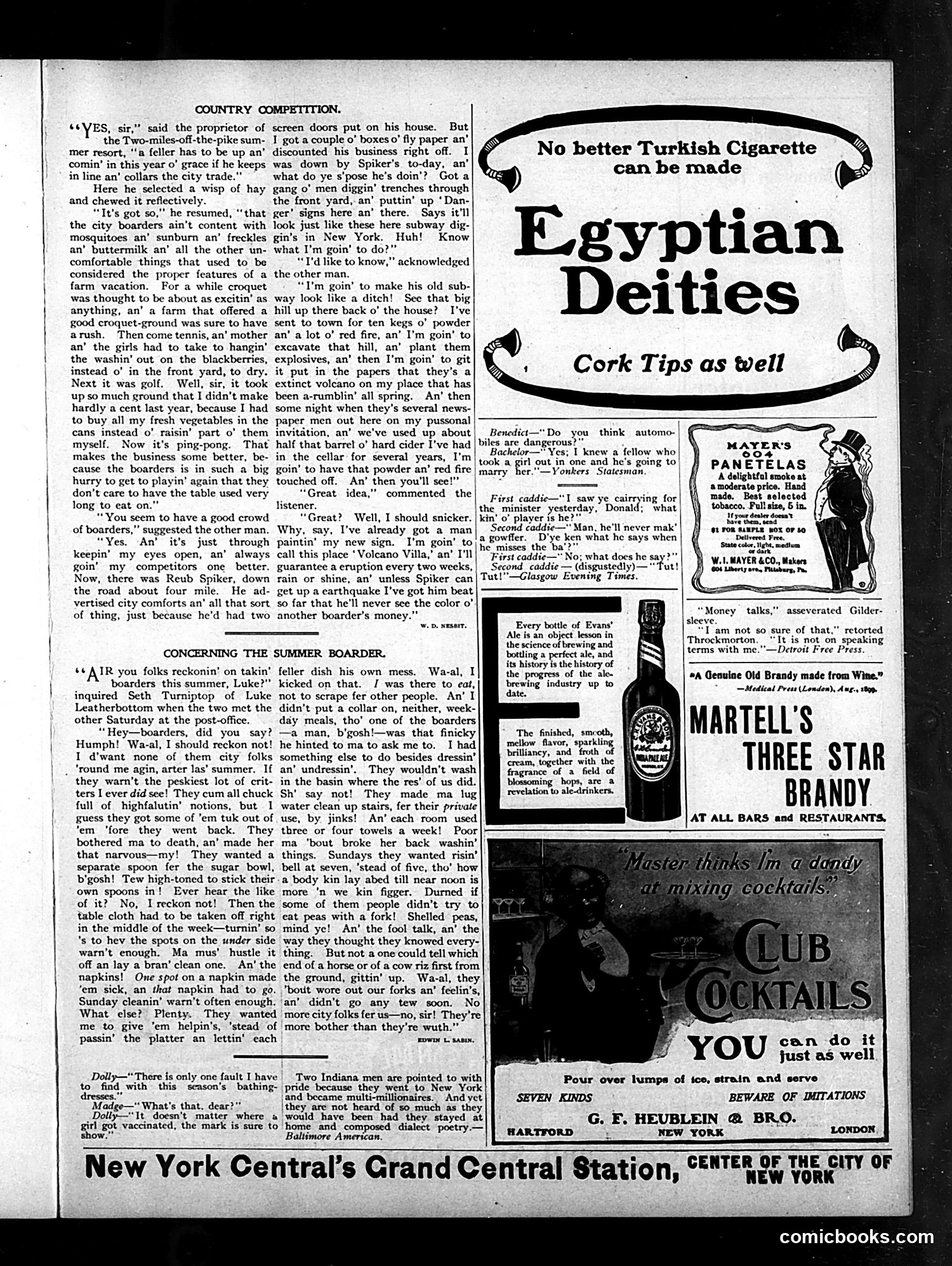
This page contains two separate rural-themed humorous dialogues satirizing summer boarding trends among city visitors to farms. **"Country Competition"** depicts a farm proprietor explaining how he maintains his boarding business by constantly one-upping competitors. He describes the progression of city boarders' demands—from croquet to tennis to golf to ping-pong—each requiring him to adapt his property. His rival, Reub Spiker, added screen doors; our protagonist countered with fly paper. Now Spiker is digging trenches to simulate New York subway construction, so the proprietor plans to dynamite a hill to create an even more elaborate "excavation." **"Concerning the Summer Boarder"** presents the opposite perspective: a farmer (Luke Leatherbottom) rejecting boarders entirely, complaining city visitors were impossibly fastidious—demanding separate sugar spoons, fresh tablecloths mid-week, frequent napkin changes—and generally neurotic about hygiene and etiquette. Both dialogues mock the cultural clash between rural simplicity and urban sophistication, satirizing both the farmers' competitive desperation to accommodate wealthy visitors and city dwellers' perceived pretentiousness and fussiness.
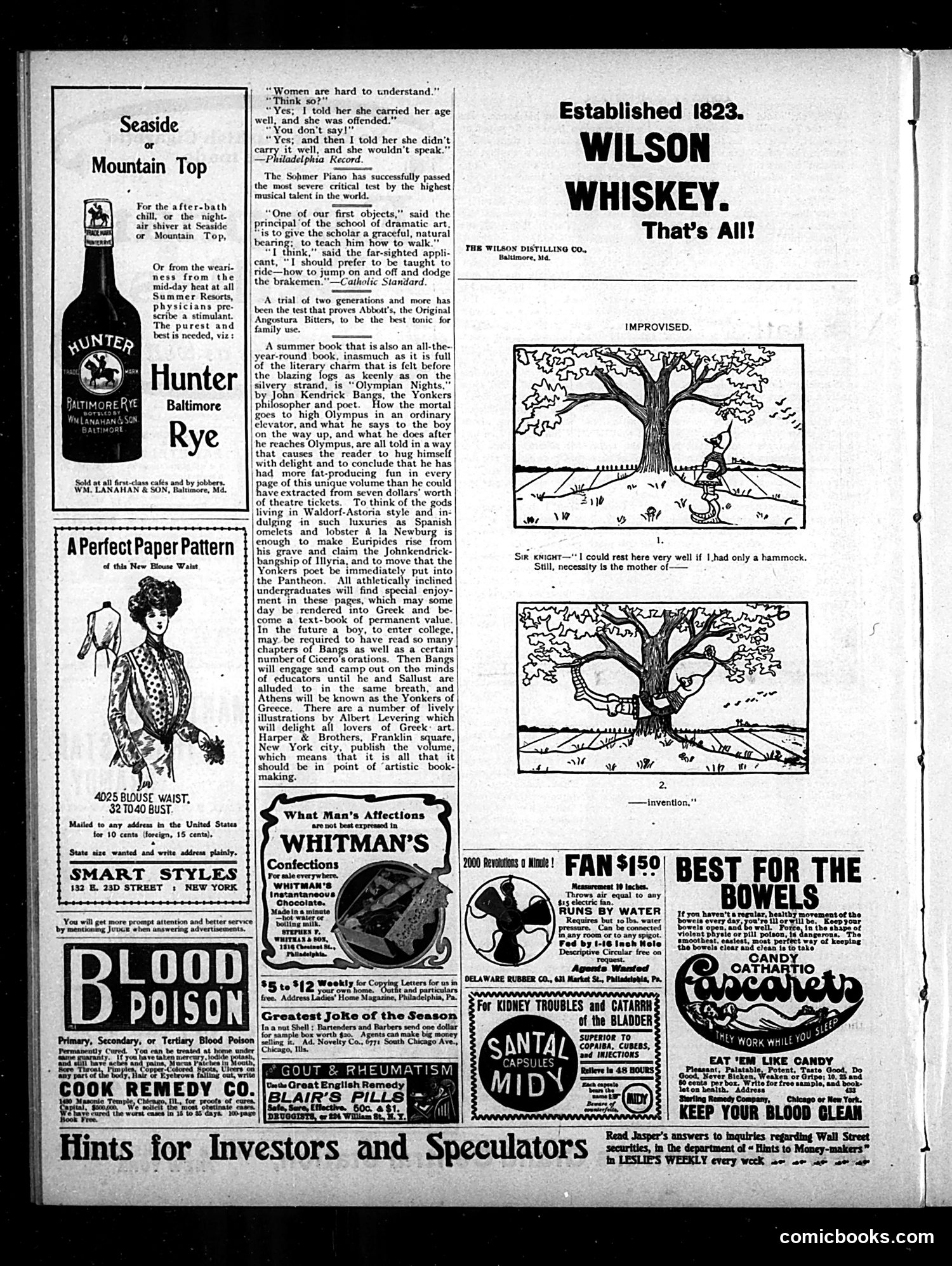
This is primarily an **advertising page** from Judge magazine, with minimal editorial cartooning. The few cartoon elements present are incidental to commercial content. The two small illustrated panels labeled "Improvised" show humorous sketches: one depicts a figure under a tree wishing for a hammock ("necessity is the mother of—"), and another shows inventive outdoor shelter-making. These are light-hearted visual gags about makeshift camping comfort. The page contains multiple product advertisements typical of early 20th-century magazines: whiskey (Wilson brand), piano (Sohmer), patent medicines (blood tonics, rheumatism pills), clothing patterns, and a "fan" for digestive health. One ad features **Whitman's chocolates**, using the sentimental Victorian marketing trope that sweets express romantic affection. The substantive text discusses John Kendrick Bangs's humorous book about Greek gods living in modern New York hotels—contemporary satire of Gilded Age luxury and social pretension, though this is book review content rather than the magazine's own editorial cartooning. The page demonstrates how early-century magazines blended advertising revenue with lightweight entertainment and literary discussion.
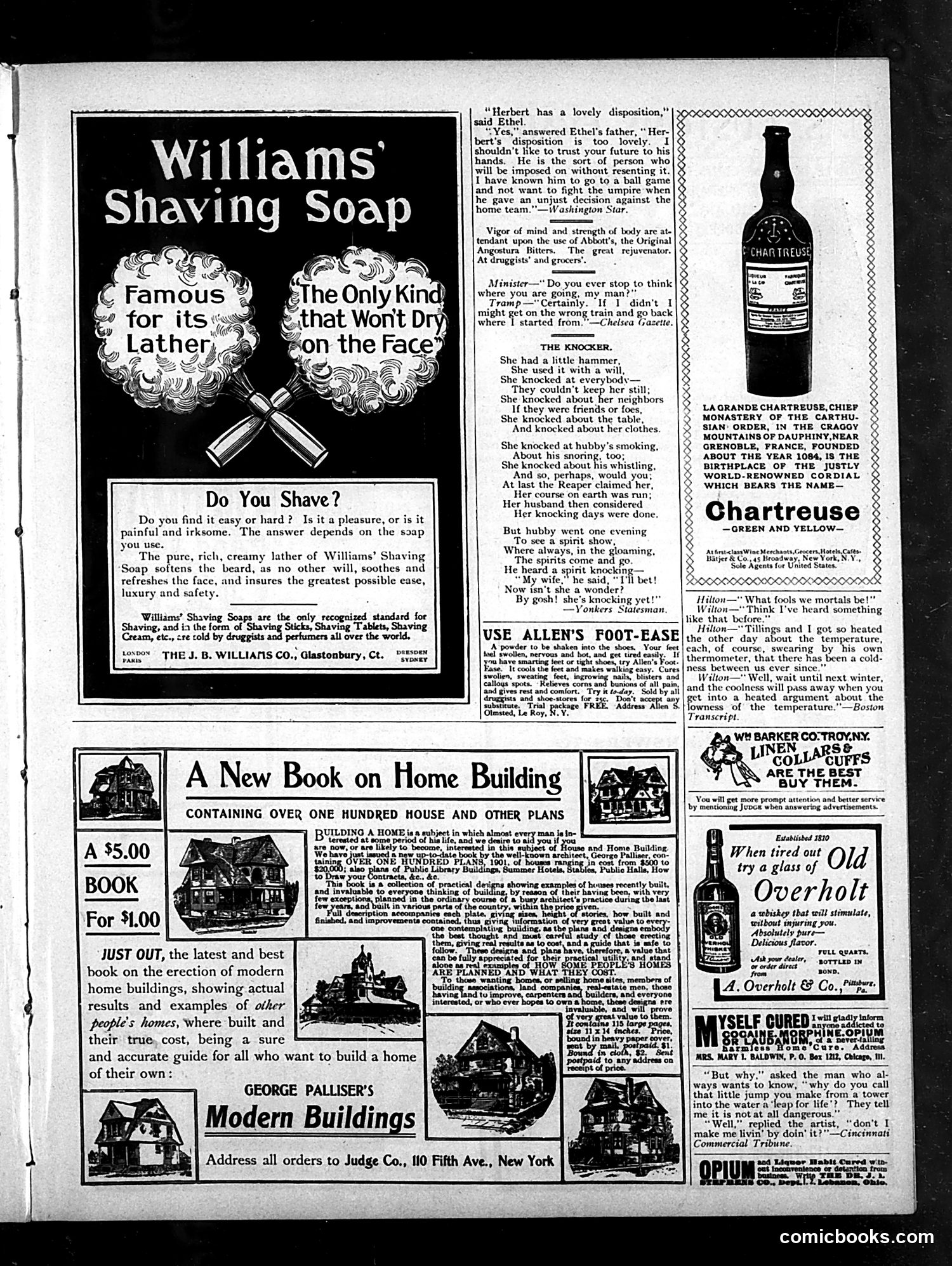
This is primarily a **advertisements page** from Judge magazine, not political satire. The dominant content includes: 1. **Williams' Shaving Soap ad** (top left): Standard product advertisement emphasizing lather quality. 2. **Small comedic anecdotes** (scattered text): Humorous domestic vignettes—one about a man too mild-mannered to fight an umpire; another called "The Knocker" about a nagging wife who continues criticizing even as a ghost. These are light social humor about personal behavior, not political satire. 3. **Various product ads**: Allen's Foot-Ease, Chartreuse liqueur, Overholt whiskey, and patent medicine for "Lumbago." 4. **Large book advertisement** (bottom): "A New Book on Home Building" by George Palliser—a $5 book being sold for $1, featuring house plans and construction advice for homebuilders. **No political cartoons or significant satire appears on this page.** It's typical of Judge's mixed content format: light domestic humor interspersed with commercial advertising.
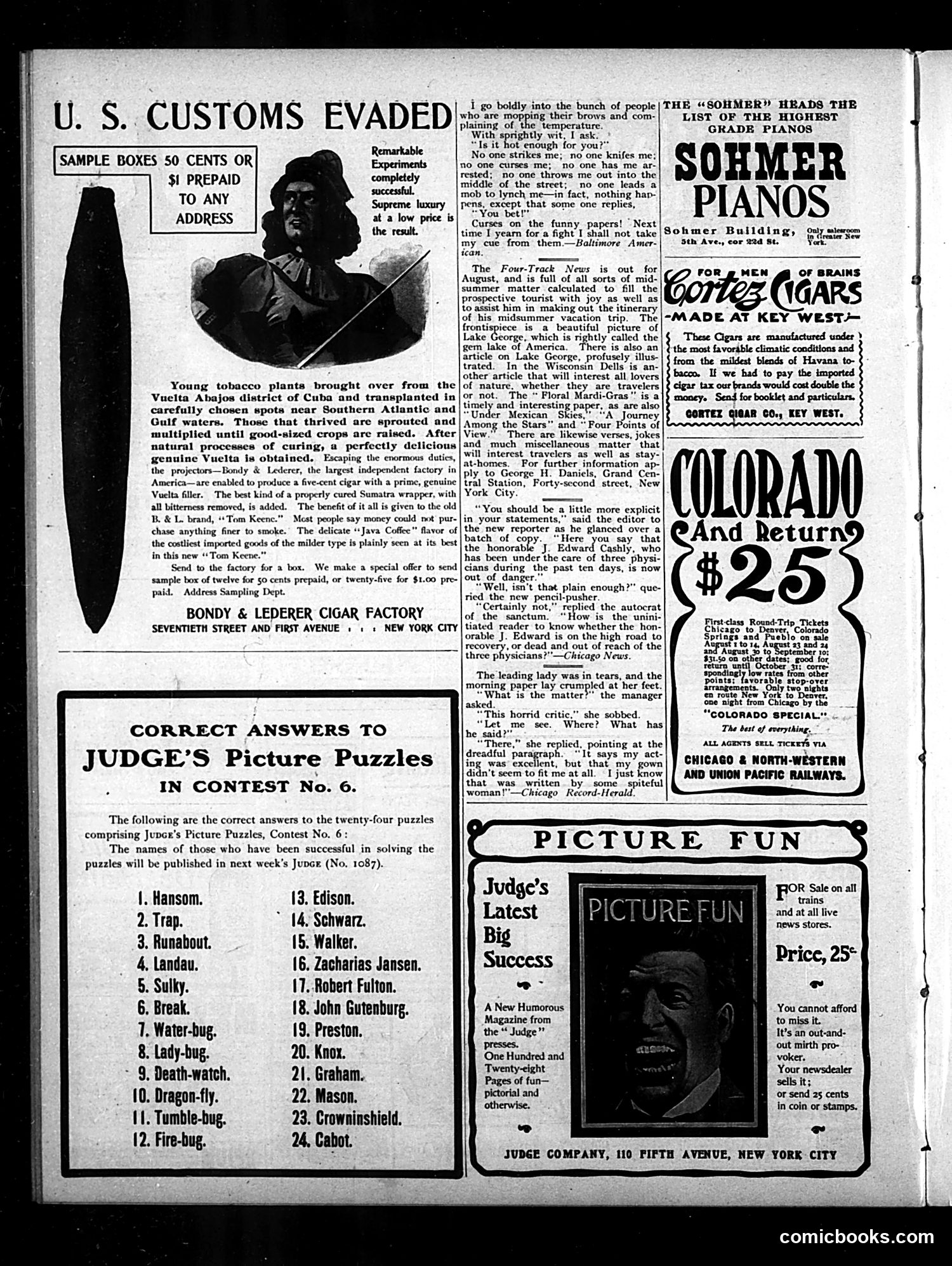
This page contains primarily **advertisements and filler content** rather than political cartoons. The main advertised item is a **customs evasion scheme** by cigar manufacturers Bondy & Lederer. They illegally imported Cuban tobacco plants to U.S. soil, cultivated them domestically, and avoided tariff duties by producing "genuine Vuelta" cigars at home. The ad openly boasts they can sell superior five-cent cigars because they've escaped "enormous duties"—essentially advertising tax evasion. The satirical humor here targets both the manufacturers' brazenness and the federal government's apparent inability to stop smuggling. The ad's frank discussion of circumventing U.S. Customs reflects early 20th-century attitudes toward tariff enforcement as somewhat comical rather than serious. The remaining content consists of puzzle-contest answers, cigar advertisements, and light humor columns—typical Judge magazine filler material unrelated to political satire.
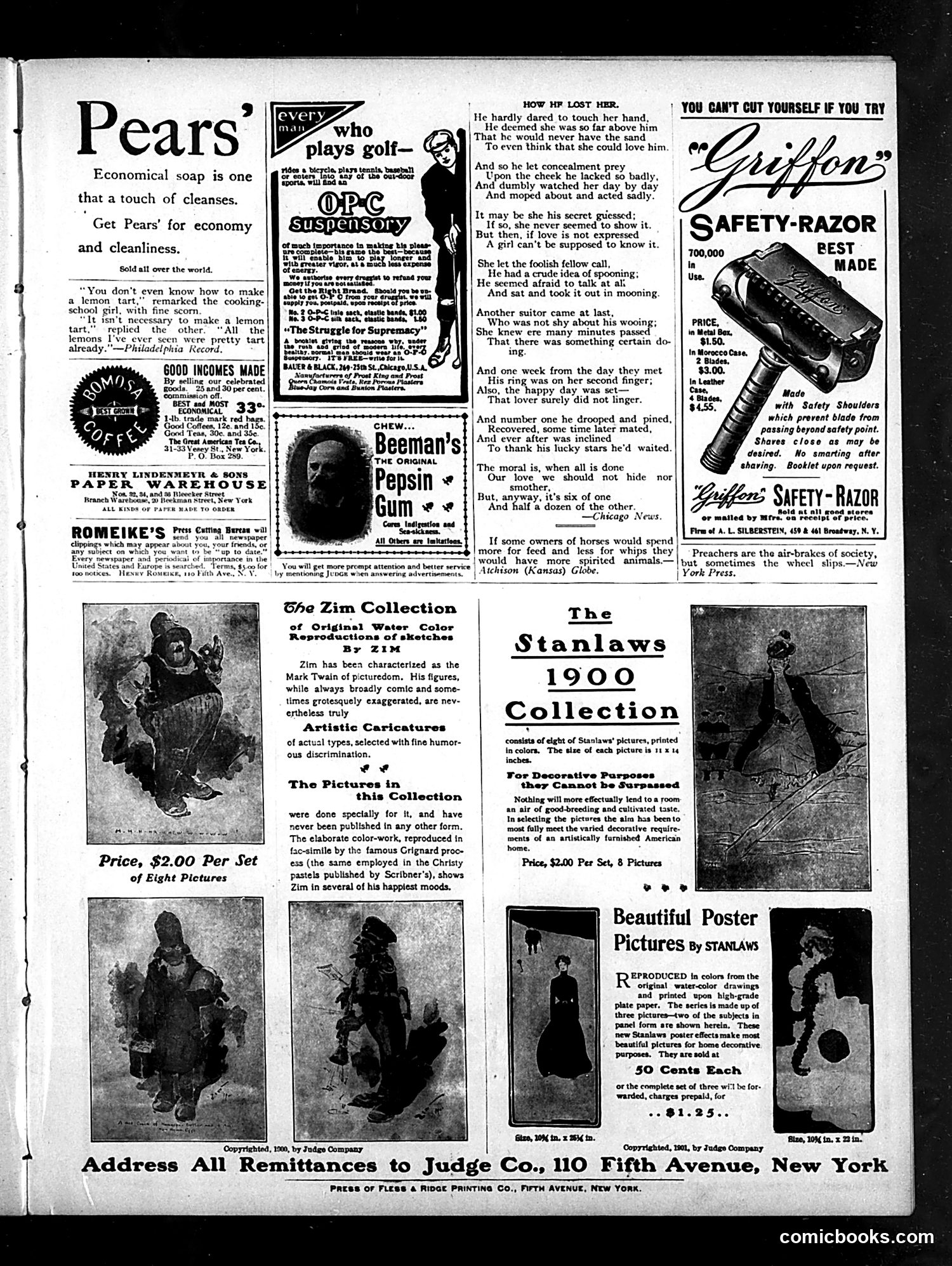
This page features a narrative poem-cartoon titled "How He Lost Her," satirizing Victorian courtship conventions through the story of a timid suitor who fails to express his love until too late. **The Satire's Point:** The poem mocks masculine passivity and emotional repression. The protagonist is so inhibited—afraid to touch her hand or speak candidly—that he merely "mopes" and watches helplessly. The twist: once he finally acts (getting engaged), his ardor cools; he becomes the one pining while she moves forward confidently. **Social Context:** This reflects turn-of-the-century anxieties about gender roles and courtship. The satire targets both the overly-cautious "gentleman" (paralyzed by propriety) and suggests women's agency—she recognizes his feelings without declaration and eventually moves on. **The Moral's Irony:** The concluding couplet—"it's six of one / And half a dozen of the other"—undercuts any serious wisdom, deflating the sentimental setup with resigned cynicism typical of Judge's comedic voice. The surrounding advertisements (Pears' soap, safety razors, collection prints) are typical period magazine filler.
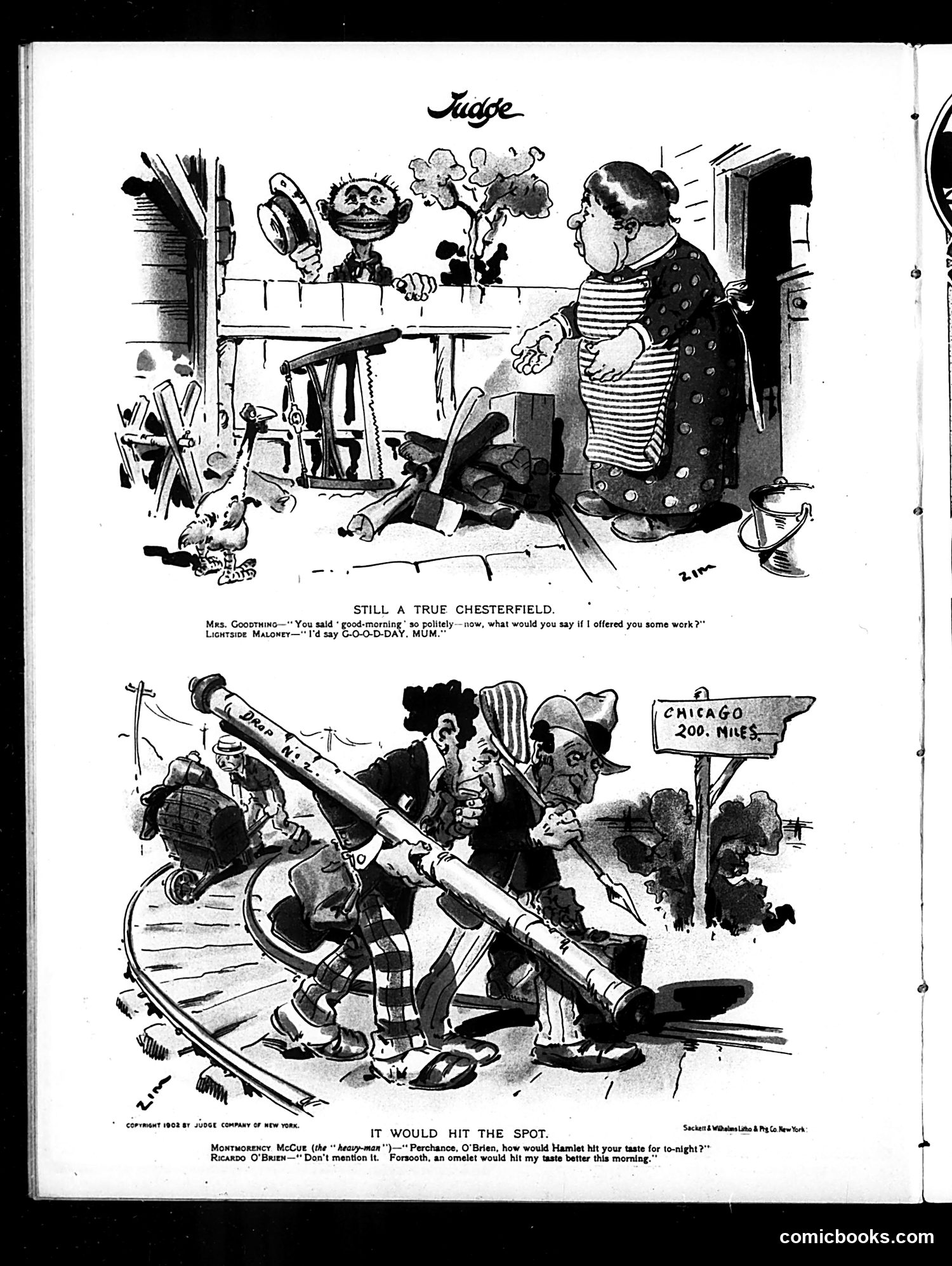
**Top cartoon ("Still a True Chesterfield"):** A poorly dressed man (Lightside Maloney) responds to a job offer with enthusiastic "G-O-O-D-DAY"—a play on the Chesterfield cigarette brand's association with politeness and refinement. The joke mocks how even impoverished people adopt affected manners, or satirizes the gap between superficial politeness and actual circumstances. **Bottom cartoon ("It Would Hit the Spot"):** Two theatrical characters (Montmorency McCue and O'Brien) discuss Hamlet as entertainment. O'Brien prefers an omelet to Shakespeare—a straightforward joke about hunger trumping culture, possibly mocking pretentious theater-speak or suggesting working-class priorities override artistic sophistication. Both use exaggerated character names and dialect to denote class/ethnic stereotypes typical of 1902 Judge humor.
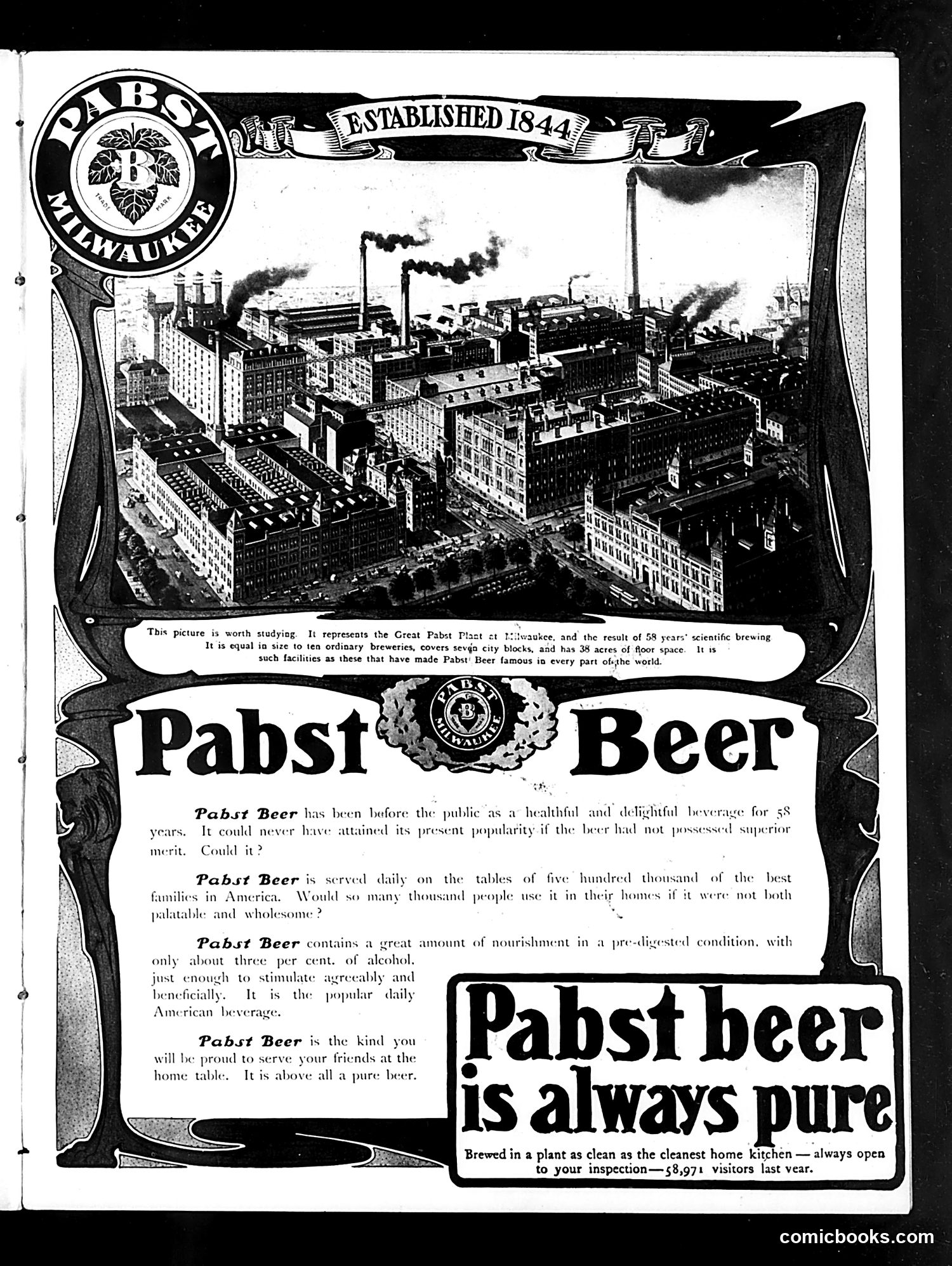
This is a **full-page advertisement**, not political satire. It promotes Pabst Beer, established 1844, featuring an aerial illustration of the Milwaukee brewery complex. The ad makes several marketing claims typical of early 20th-century beer advertising: - **Health benefits**: Claims the beer contains "nourishment in a pre-digested condition" with only ~3% alcohol - **Quality/purity**: Emphasizes the brewery is "as clean as the cleanest home kitchen" and welcomes inspection (58,971 visitors annually) - **Mass appeal**: States 500,000 American families serve it daily, implying respectability - **Prestige**: Describes the massive facility (38 acres, seven city blocks) as evidence of superior "scientific brewing" The rhetoric appeals to middle-class values—purity, family wholesomeness, and American manufacturing prowess. There's no satire here; this is straightforward promotional content that appeared in *Judge* magazine as paid advertising.
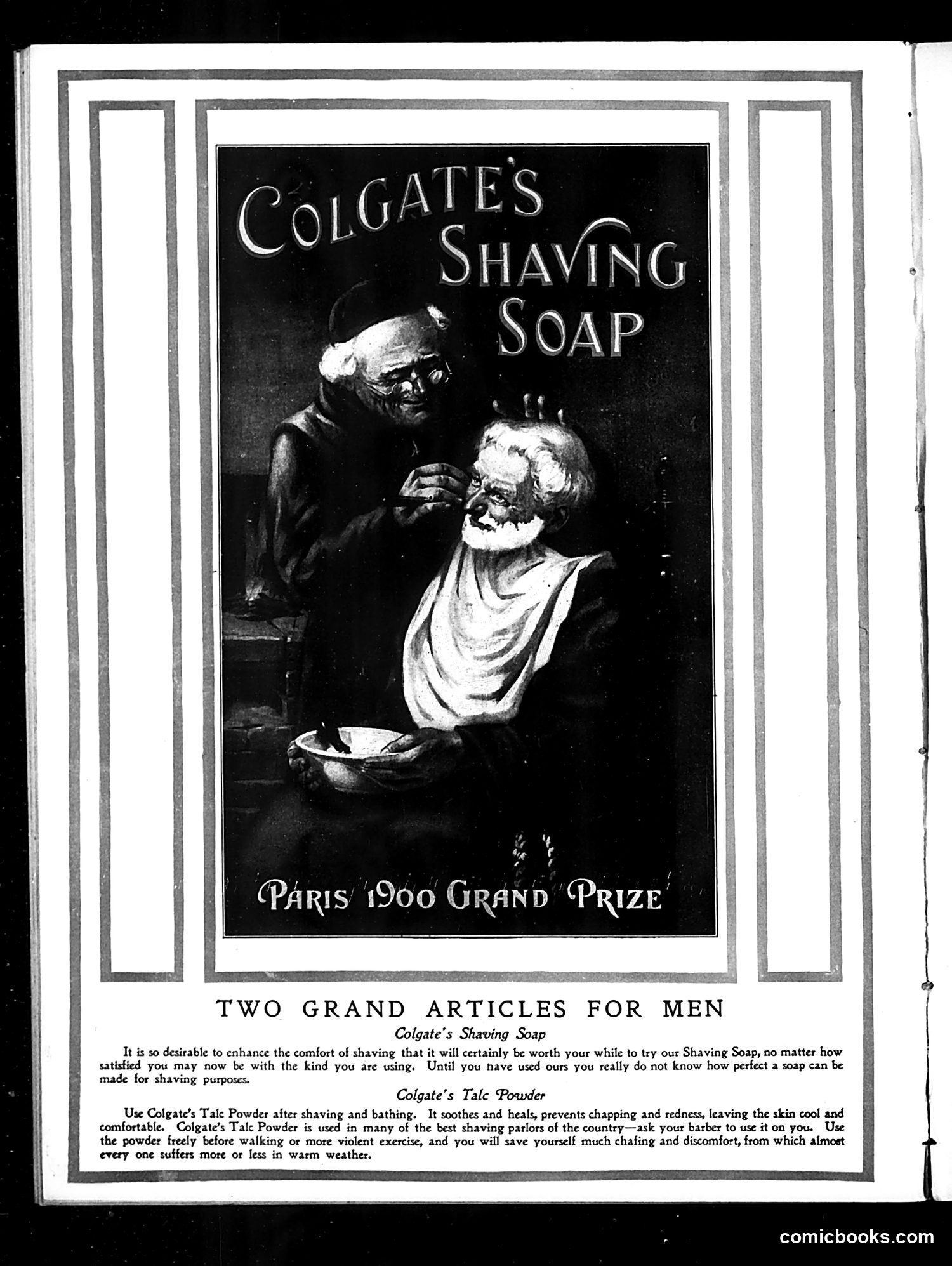
This is primarily **advertising content**, not satire or political commentary. It's a Colgate product advertisement page featuring two men's grooming products. The image depicts a barber shaving a customer in a classical style, referencing Colgate's "Paris 1900 Grand Prize" award. The advertisement uses this artistic, dignified imagery to market shaving soap and talc powder to men. The text emphasizes product quality and endorses use by professional barbers. There is **no political satire or social commentary present**—this is straightforward commercial advertising designed to appear in *Judge* magazine alongside editorial content. The classical artistic treatment (evoking old master paintings of barber scenes) lends prestige to the products, a common advertising strategy of the era.