
Judge, 1902-08-09 · page 7 of 20
Judge — August 9, 1902 — page 7: what you’re looking at
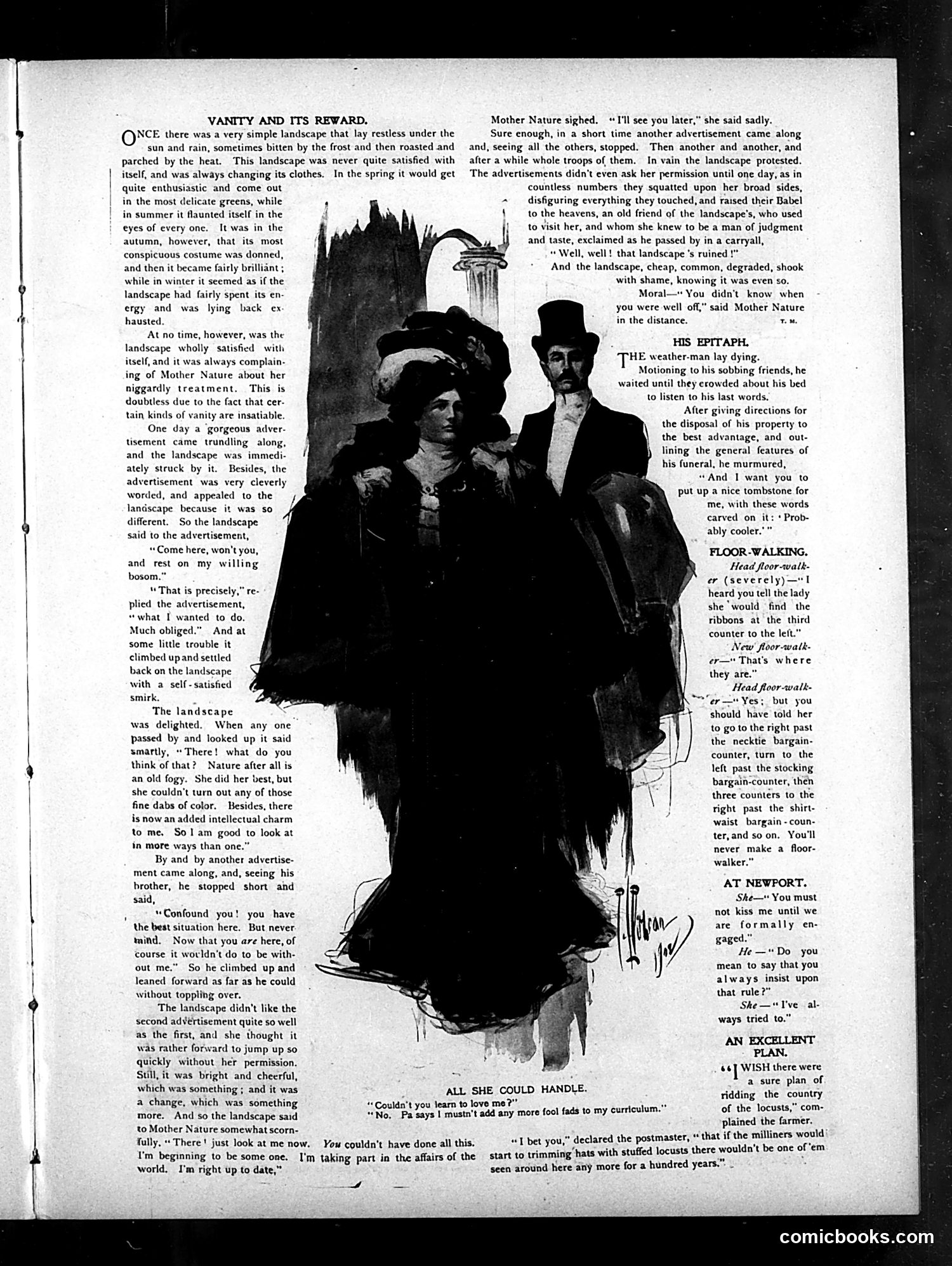
What you’re looking at
This is a cautionary fable illustrated with a satirical cartoon. The narrative personifies a landscape as a vain character who complains to "Mother Nature" about her work. When advertisements arrive and praise the landscape's appeal, it eagerly accepts them—initially just one, then many more flood in uninvited. The satire targets **commercialism and environmental degradation**. The advertisements represent billboards and commercial signage that increasingly defaced American landscapes in the early 20th century. The landscape's vanity—preferring artificial commercial praise over natural beauty—leads to its ruin as countless advertisements literally cover it. The moral warns against valuing commercial development over natural preservation: "You didn't know when you were well off." This reflects Progressive-era concerns about industrialization and advertising's visual pollution of the American countryside. The cartoon's figures are allegorical rather than political caricatures—the landscape itself is the protagonist, with Mother Nature and advertisements as symbolic characters representing natural beauty versus commercial exploitation.
📄 Transcribed text from this page (OCR, searchable)
Machine-transcribed from the original scan — historical spelling and the odd misread are preserved.
VANITY AND ITS REWARD. NCE there was a very simple landscape that lay restless under the sun and rain, sometimes bitten by the frost and then roasted and parched by the heat. This landscape was never quite satisfied with itself, and was always changing its clothes. In the spring it would get quite enthusiastic and come out in the most delicate greens, while in summer it flaunted itself in the eyes of every one. It was in the autumn, however, that its. most conspicuous costume was donned, and then it became fairly brilliant; while in winter it seemed as if the landscape had fairly spent its en- ergy and was lying back ex hausted. At no time, however, was the landscape wholly satisfied with itself, and it was always complain- ing of Mother Nature about her niggardly treatment. This is doubtless due to the fact that cer- tain kinds of vanity are insatiable. One day a ‘gorgeous adver- tisement came trundling along, and the landscape was immedi- ately struck by it. Besides, the advertisement was very cleverly worded, and appealed to the landscape because it was so different. So the landscape said to the advertisement, “Come here, won't you, and rest on my willing bosom.’ “That is precisely,” re- plied the advertisement, “what I wanted to do. Much obliged.” And at some little trouble it climbed up and settled back on the landscape with a. self-satisfied smirk. The landscape was delighted. When any one passed by and looked up it said smartly, “There! what do you think of that? Nature after all is an old fogy. She did her best, but she couldn't turn out any of those fine dabs of color. Besides, there is now an added intellectual charm to me, Sol am good to look at in more ways than one.” By and by another advertise- ment came along, and, seeing his brother, he stopped short and said “Confound you! you have ‘the best situation here. But never. mind. Now that you ave here, of course it worldn’t do to be with- ‘out me.” So he climbed up and leaned forward as far as he could without toppling over. The landscape didn't like the second advertisement quite so well as the first, and she thought it was rather forward to jump up so quickly without her permission. Still, it was bright and cheerful, which was something; and it was a change, which was something more. And so the landscape said to Mother Nature somewhat scorn- fully, “There ' just look at me now. Mother Nature sighed. “I'll see you later,” she said sadly. Sure enough, in a short time another advertisement came along and, seeing all the others, stopped. Then another and another, and after a while whole troops of them. In vain the landscape protested. ‘The advertisements didn’t even ask her permission until one day, as in countless numbers they squatted upon her broad sides, disfiguring everything they touched, and raised their Babel to the heavens, an old friend of the landscape’s, who used to visit her, and whom she knew to be a man of judgment and taste, exclaimed as he passed by in a carryall, “Well, well! that landscape ‘s ruined !” And the landscape, cheap, common, degraded, shook with shame, knowing it was even so. Moral—" You didn’t know when you were well off,” said Mother Nature in the distance. ne HIS EPITAPH. HE weather-man lay dying. Motioning to his sobbing friends, he waited until they crowded about his bed to listen to his last words. After giving directions for the disposal of his property to the best advantage, and out- lining the general features of his funeral, he murmured, “And 1 want you to put up a nice tombstone for me, with these words carved on it: ¢ Prob- ably cooler.’ FLOOR-WALKING. Head floor-watk- er (severely) —«l heard you tell the lady she ‘would find the ribbons at the third counter to the left.” New’ floor-watk- er—" That's where they are. Head floor-watk- “er —" Yes; but you should have told her to goto the right past the necktie bargain- counter, turn to the left past the stocking bargain-counter, then three counters to the right past the shirt- waist bargain -coun- ter,and so on. You'll never make a floor- walker.” AT NEWPORT. She—" You must not kiss me until we are formally en- gaged.” He—"Do you mean to say that you always insist upon that rule?” She—“ I've al- ways tried to. AN EXCELLENT PLAN. 46] WISH there were a sure plan of ridding the country of the locusts,” com- plained the farmer. 1 bet you,” declared the postmaster, “that if the milliners would ALL SHE COULD HANDLE. Ss ¥ Jearn to love me?” Rea es ays | mustn't add any more fool fads to my curriculum. You couldn't have done all this. Panga ta ‘i dn’t be one of ‘em I'm beginning to be some one. I'm taking part in the affairs of the start to trimming ‘hats with stuffed locusts there wouldn’ af world, I'm right up to date,” seen around here any more for a hundred years.” _ s comicbooks.com