
A complete issue · 16 pages · 1902
Judge — July 19, 1902
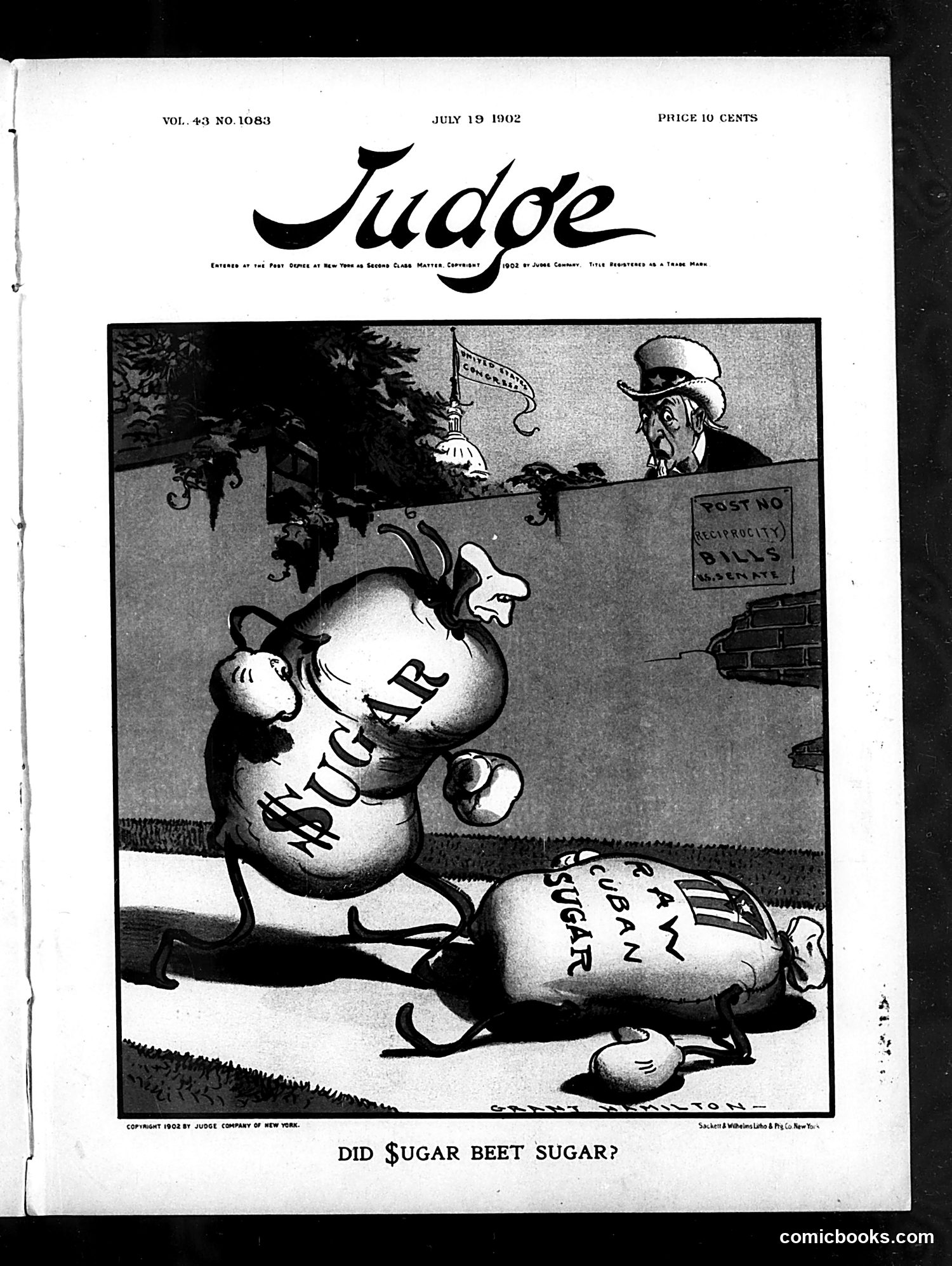
This political cartoon satirizes American sugar industry protectionism. The central figure labeled "SUGAR" appears bloated and corrupt, likely representing domestic sugar interests. The smaller figures climbing on it—marked "TRUST" and what appears to be "SUGAR BEET"—depict competing sugar producers (beet sugar versus cane sugar) exploiting the protective tariff system. The character in the top hat observing from behind a wall labeled "POST NO BILLS" appears to be Uncle Sam or a government figure, suggesting government complicity in the tariff scheme that allows these interests to gorge themselves. The title's wordplay questions whether the sugar beet industry actually produces real sugar or merely exploits protectionist policies for profit—critiquing how special interests manipulate tariffs.
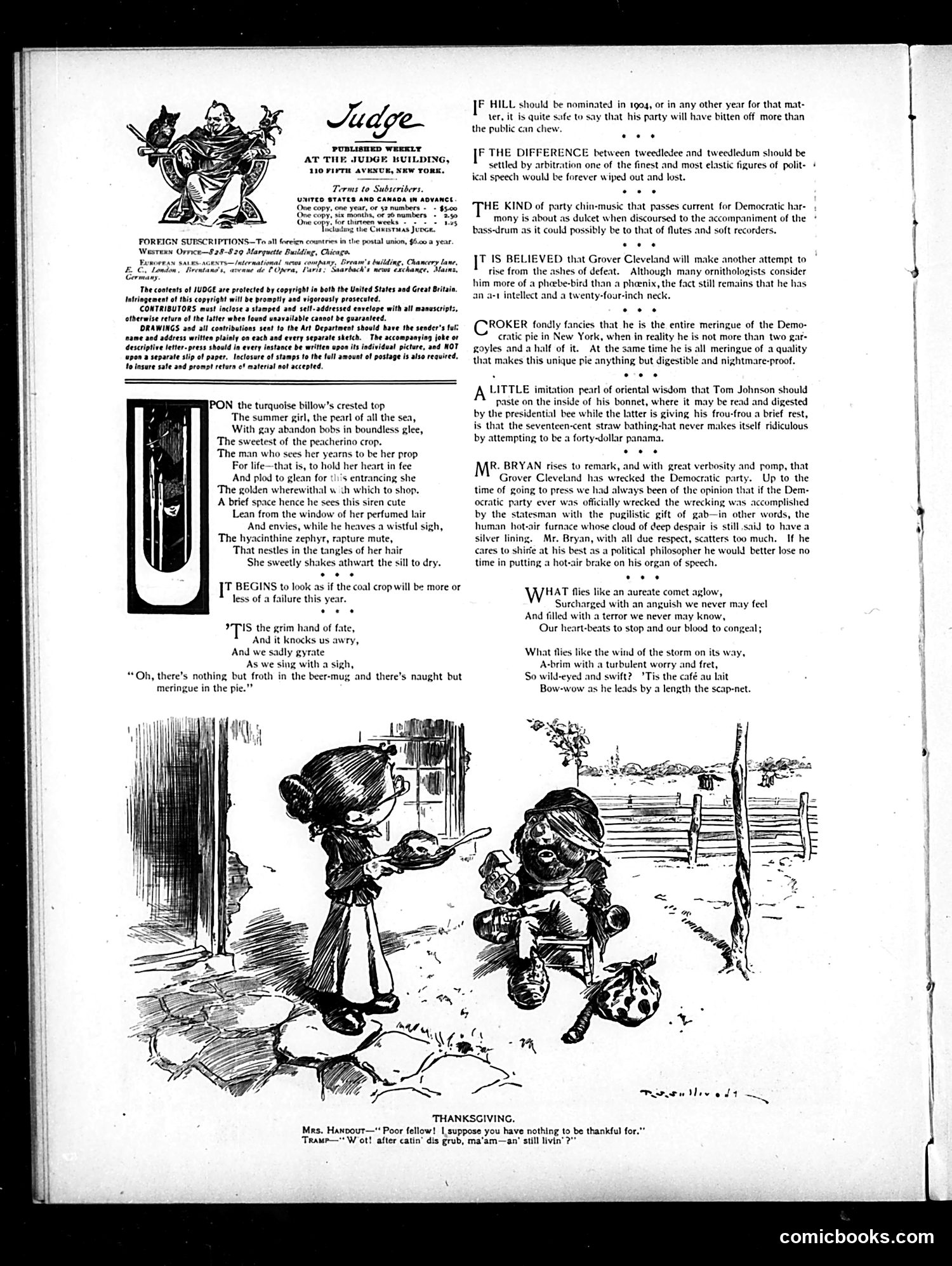
This page contains political commentary and satirical verse attacking Democratic politics and leadership, likely from the 1880s-1890s based on references to Grover Cleveland. **Key Satire Targets:** The text mocks Democratic "party chin-music" (empty rhetoric), compares Cleveland's leadership to a "phœbe-bird" rising from defeat's ashes, and ridicules the Democratic party machinery in New York as corrupt ("two gargoyles and a half"). **The Illustration:** The bottom cartoon depicts a woman (Mrs. Hangout) and a tramp in dialogue, with the caption suggesting poverty and homelessness—likely satirizing Democratic promises to help working-class Americans while failing to deliver. The overall page combines political invective against Cleveland and the Democratic party with social commentary on urban poverty, reflecting Judge's Republican editorial stance during the Gilded Age.
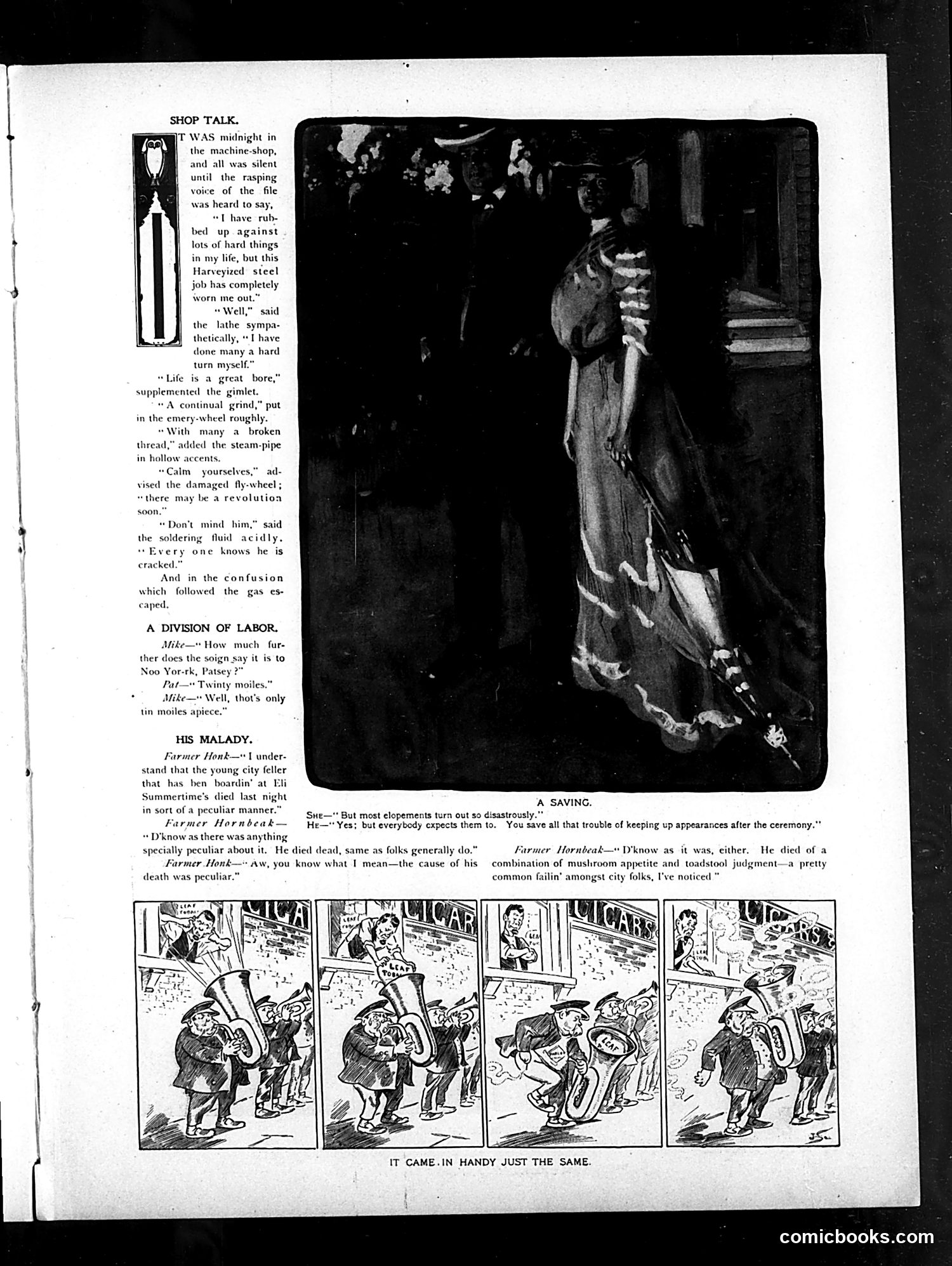
This page from Judge contains three distinct sections: **"Shop Talk"** (top left): A dialogue between machinists discussing wear from repetitive industrial work, using a damaged lathe as metaphor for human exhaustion. **"A Division of Labor"** and **"His Malady"** (center): Brief anecdotes about working-class life and death, appearing to critique inadequate wages and living conditions ("died dead, same as folks generally do"). **"A Saving"** (right): A photograph showing a woman in formal dress, captioned with dialogue about "keeping up appearances after the ceremony"—satirizing working-class pretension. **Bottom comic strip** ("It Came in Handy Just the Same"): A four-panel sequence showing a man with a large tuba that becomes damaged but ultimately serves a practical purpose—likely satirizing resourcefulness or unintended utility. The overall theme addresses early 20th-century working-class struggles: exhaustion, poverty, mortality, and the performative aspects of maintaining social respectability.
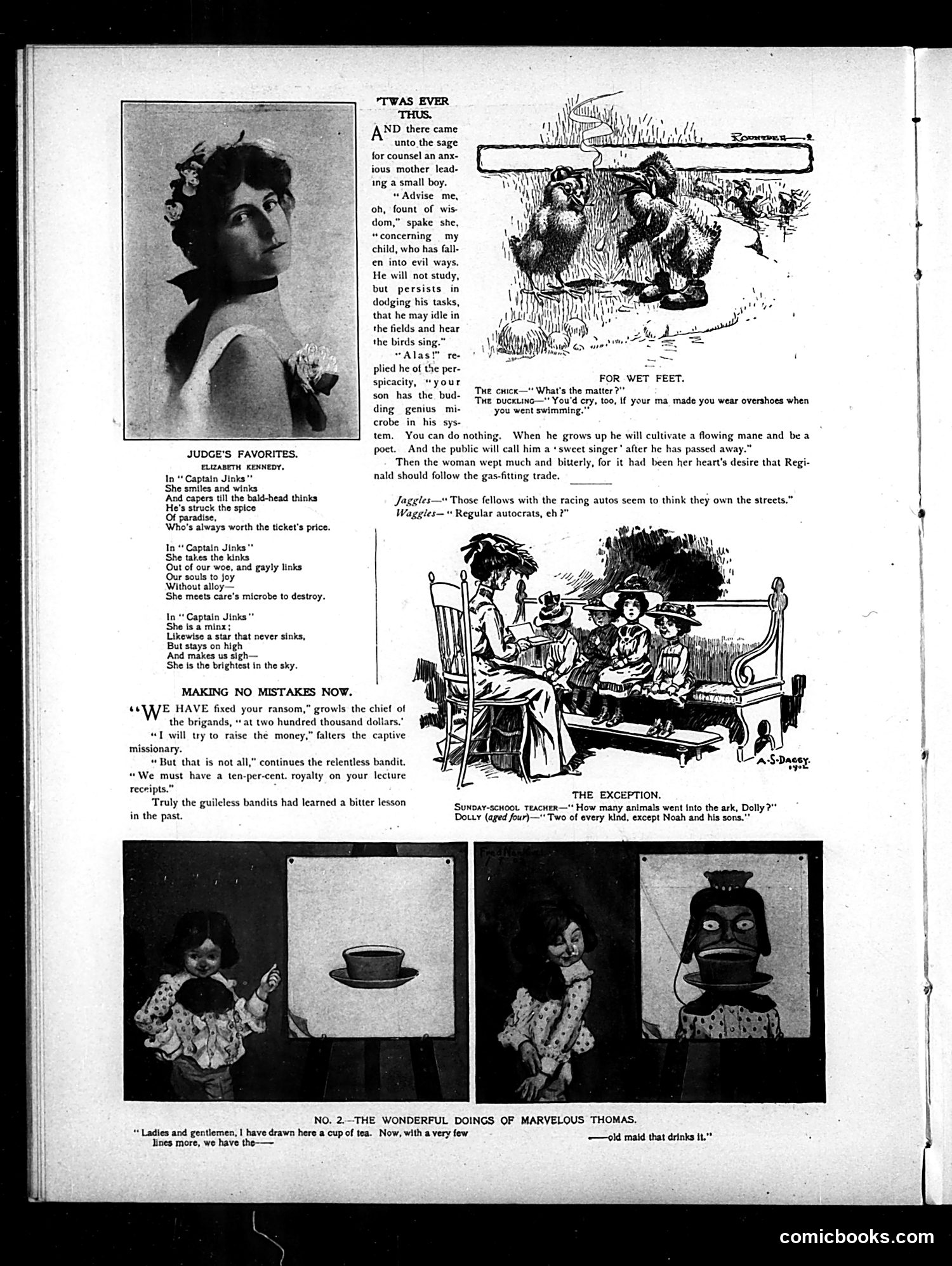
This page contains multiple satirical pieces from Judge magazine (an American humor publication): **"Judge's Favorites"** presents three poems about "Captain Jinks," a character apparently known for romantic conquests and theatrical pretension—typical subjects of turn-of-the-century satire mocking vain military or aristocratic figures. **"Making No Mistakes Now"** satirizes ransom negotiations, where a bandit demands money from a missionary. The joke plays on the "guiltless bandit" demanding a percentage royalty—mocking both criminal behavior and business practices of the era. **"The Exception"** and **"The Wonderful Doings of Marvelous Thomas"** appear to be illustrated humor pieces, likely involving wordplay or physical comedy typical of Judge's style. The overall tone reflects early 1900s American satire targeting social pretension, criminal activity, and gender dynamics.
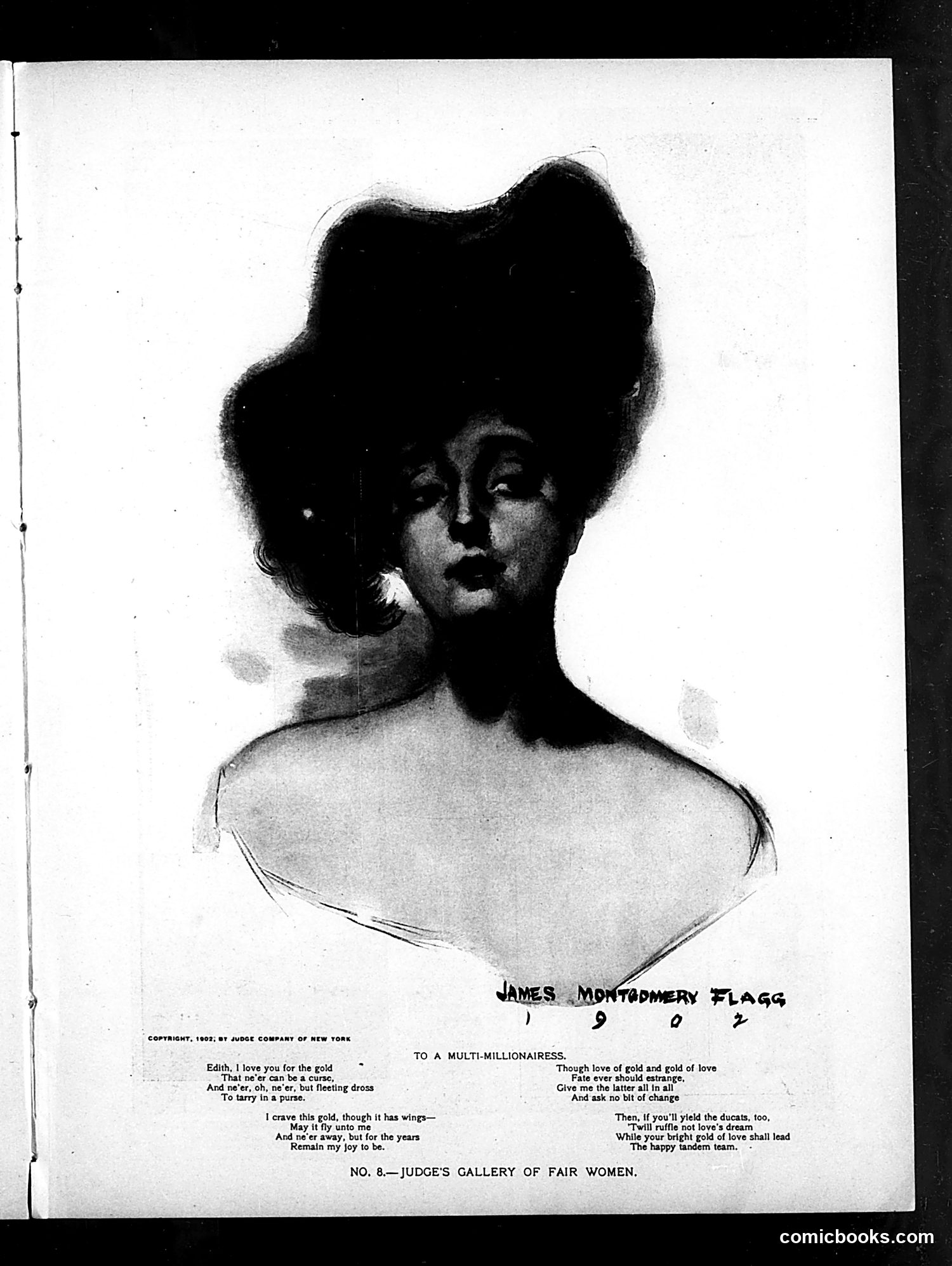
This page from Judge magazine's "Gallery of Fair Women" series features a portrait labeled "James Montgomery Flagg 1902" alongside satirical poetry mocking wealthy women and mercenary romance. The satire targets the Gilded Age phenomenon of fortune-hunting suitors pursuing rich heiresses. The poem's speaker cynically claims to love "Edith" for her wealth rather than her person, requesting she surrender her "ducats" while pretending romantic devotion. Phrases like "gold of love" and "bright gold of love shall lead / The happy tandem team" equate matrimonial prospects with financial gain. The "Gallery of Fair Women" framing suggests this is part of a series critiquing society women. The satire exposes the transactional nature of elite marriages during the Gilded Age, when wealthy heiresses—particularly those with industrial fortunes—became targets for status-seeking men. Judge's comedy here serves as social commentary on class, marriage, and greed.
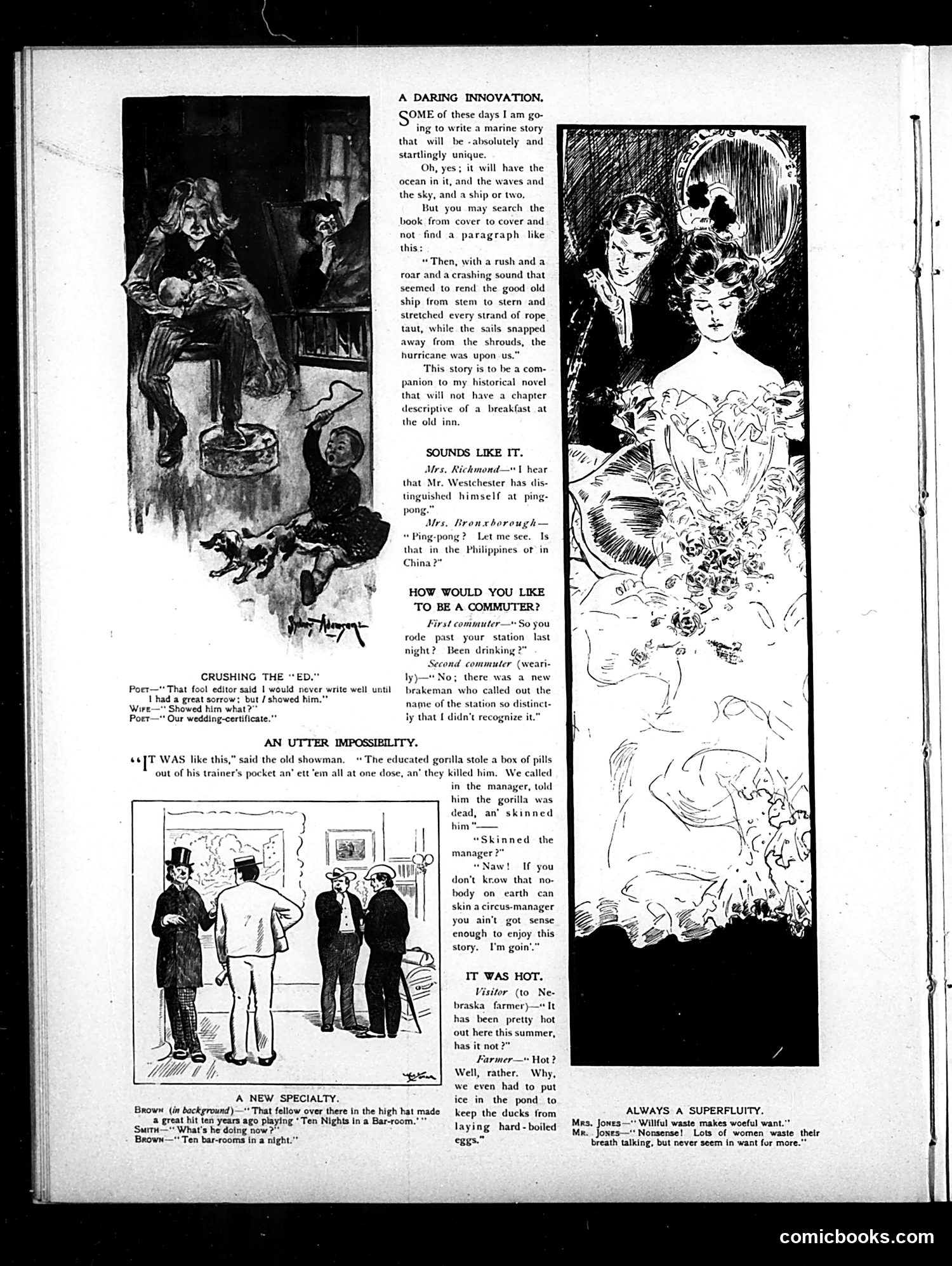
This page contains several brief humorous anecdotes typical of early-20th-century American satire: **"A Daring Innovation"** mocks overwrought literary clichés—specifically the purple prose of adventure novels, which invariably described storms with identical melodramatic language. The author proposes writing a marine story *without* such predictable descriptions. **"Sounds Like It"** jokes about Mrs. Bronxborough's ignorance: she mistakes "ping-pong" (the parlor game) for a foreign place, suggesting she's out of touch or intellectually shallow. **"How Would You Like to Be a Commuter?"** satirizes railroad inefficiency—a commuter oversleeps because a brakeman announced the station name so unclearly he didn't recognize it. **"An Utter Impossibility"** presents a tall tale about a gorilla; the showman's point is that circus managers are so morally invulnerable that even death can't "kill" them—a dig at their supposed corruption. **"It Was Hot"** uses hyperbole: the farmer's proof Nebraska heat is extreme is that they had to ice ponds to prevent boiled eggs. The cartoons target American social pretension, bureaucratic incompetence, and rural stereotypes.
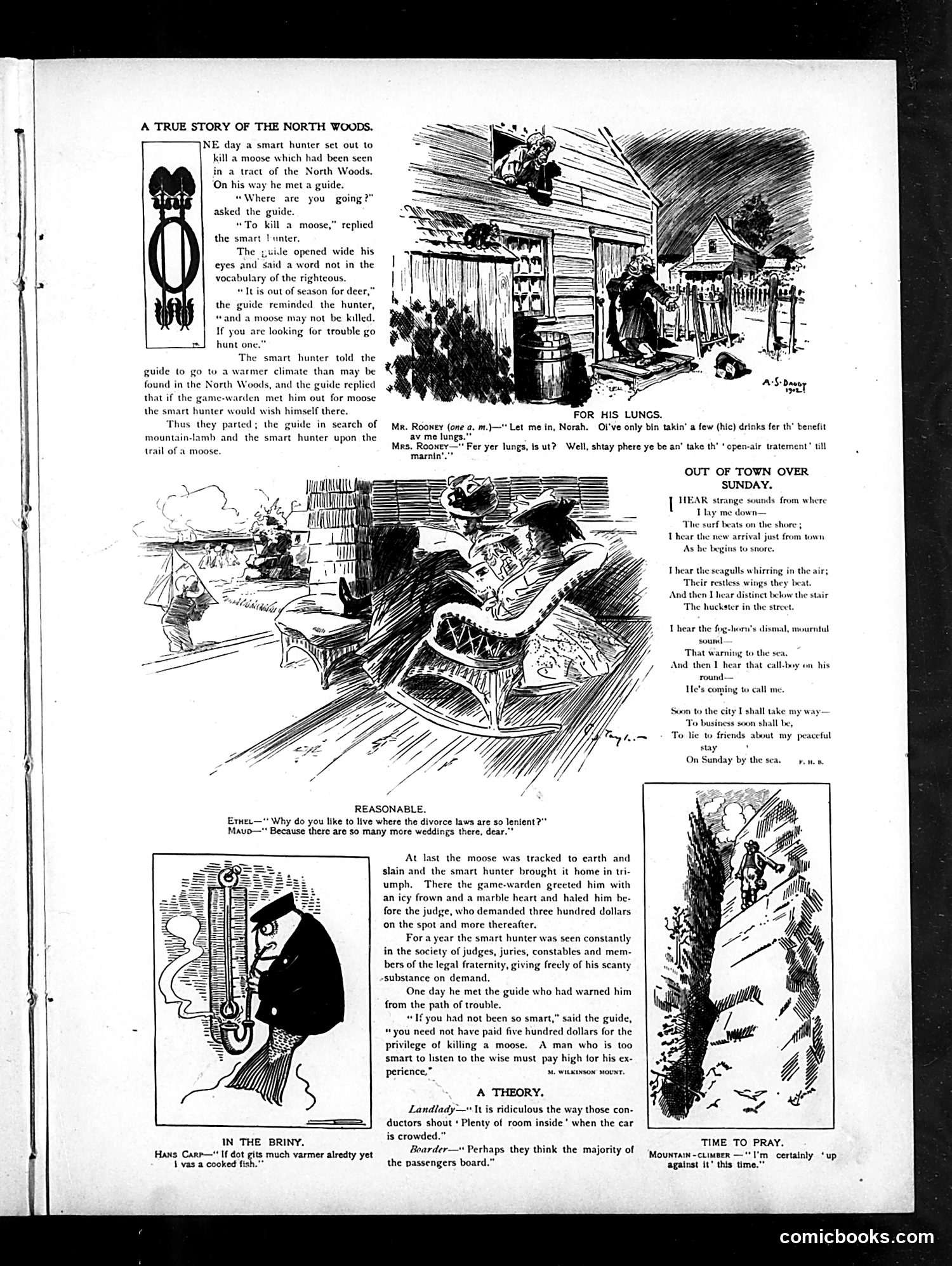
This page contains several unrelated humorous pieces typical of Judge magazine's satirical format: **Main Story**: "A True Story of the North Woods" mocks overconfident urban hunters. A "smart hunter" ignores a guide's warning about moose hunting being illegal (out of season), kills one anyway, and faces severe legal penalties—three hundred dollars initially, then ongoing fines. The moral: arrogance and refusing expert advice leads to financial ruin. The satire targets privileged city dwellers who ignore local expertise. **Side Jokes**: - "For His Lungs": Irish working-class humor about a drunk man claiming alcohol benefits his health - "In the Briny": A Hans character (ethnic humor type) complains about heat - "Reasonable": A woman prefers lenient divorce laws for "more weddings" - Brief poems and observations about urban versus rural life The page reflects early 20th-century American magazine humor: class-based satire, ethnic stereotyping, and cautionary tales about hubris.
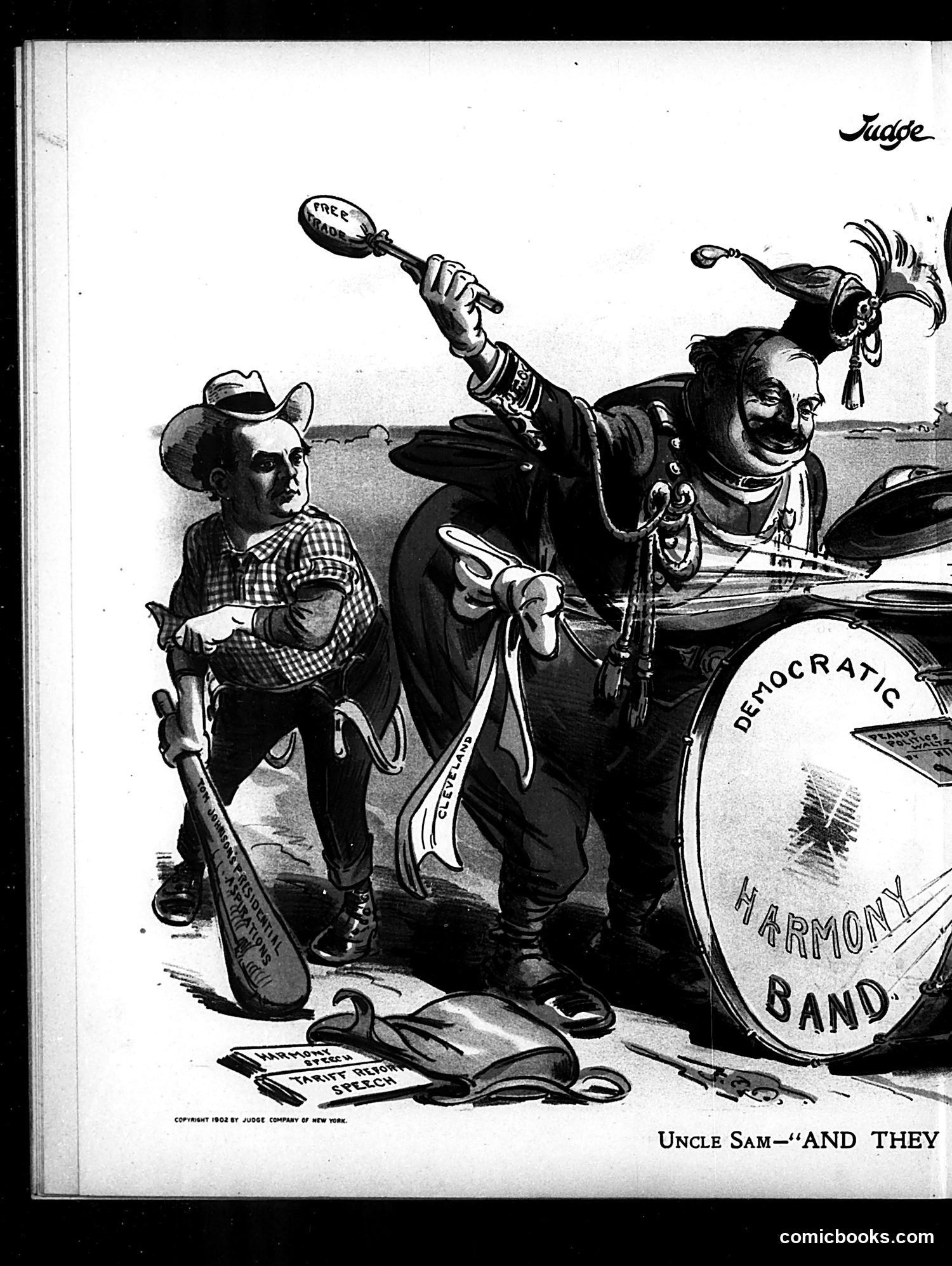
This 1902 *Judge* magazine cartoon depicts Uncle Sam (representing the U.S. government) observing a "Democratic Harmony Band." The band members appear to be caricatured Democratic Party figures engaged in discord—one holds a "Free Trade" banner while others play instruments chaotically. The satire mocks Democratic Party infighting and lack of unified platform during the early 1900s. The "harmony band" is ironically dysfunctional, suggesting Democrats cannot present a coherent message to voters. A cowboy-figure (possibly representing rural/Western interests) stands bewildered, watching the chaos. The cartoon's incomplete caption ("And They...") suggests the punchline concerns Democratic disarray contrasting with Republican organization under President Theodore Roosevelt's administration.
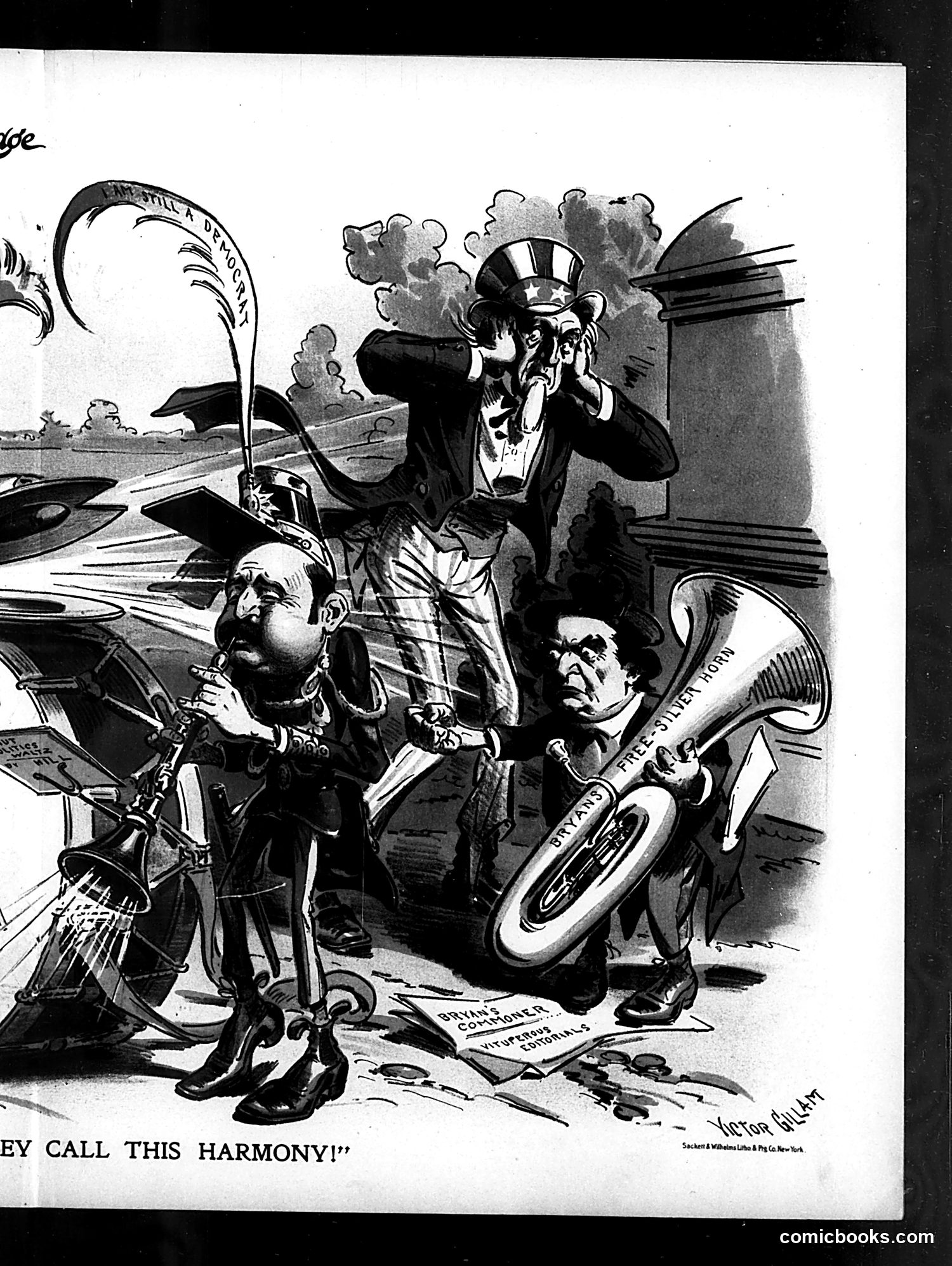
This satirical cartoon depicts three caricatured figures playing musical instruments—appearing to be military or political leaders—with Uncle Sam standing above them directing. The text "BY CALL THIS HARMONY!" suggests ironic commentary on discord being presented as cooperation. The figures seem to represent international powers or military factions attempting coordinated action, likely referencing early 20th-century diplomatic tensions or alliance-building. The musical metaphor—where "harmony" should mean agreement but clearly shows conflict—satirizes the failure of nations to work together effectively, despite public claims of unity. The cartoon's style and Judge magazine context suggest this addresses American foreign policy or international relations during a period of significant geopolitical tension, though the specific historical moment requires additional documentation to confirm definitively.
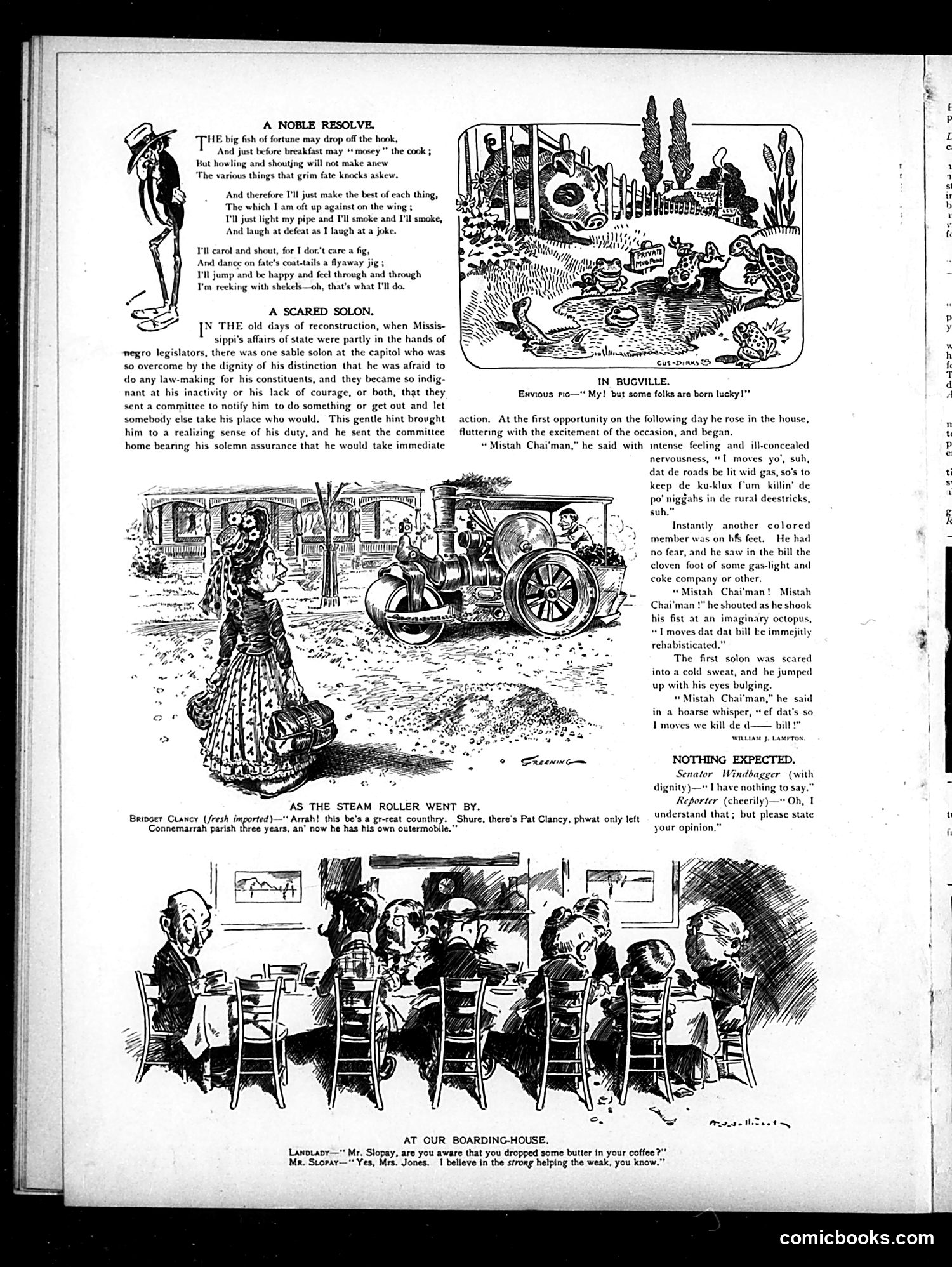
This page contains multiple satirical cartoons targeting different subjects: **"A Scared Solon"** mocks Reconstruction-era Black legislators in Mississippi. The satire depicts a Black state representative so intimidated by his position that he initially refuses to legislate. When finally pressured to act, he proposes gas lighting for rural roads—a mundane measure. A colleague immediately opposes it, suspecting corporate exploitation (the "octopus" reference suggests monopoly concerns). The original legislator panics and withdraws his own bill. The cartoon stereotypes Black politicians as fearful and easily manipulated, reflecting the racist attitudes of the Reconstruction period. **"In Bugville"** appears to be a nature cartoon with anthropomorphic creatures discussing luck. **"As the Steam Roller Went By"** features an Irish immigrant character (indicated by dialect) marveling that his countryman Pat Clancy now owns an automobile after leaving Ireland three years prior. **"At Our Boarding-House"** is a mild joke about a slovenly boarder dropping butter in his coffee, attributing it to helping "the weak." The page reflects Judge's satirical approach to contemporary social and political issues, with particular emphasis on race and immigration.
This page is primarily **advertising with brief satirical vignettes** rather than political cartoons. The small jokes scattered throughout mock middle-class life: a literary editor's absurdly weather-forecast-style description of upcoming books; newlyweds who married the wrong partners; a wife strategically encouraging her husband to buy expensive panama hats so she can justify buying her own; a barber's dark humor about preserving a customer's nose. The **main advertisement** is for **"The Changing Faces" puzzle** by J.B. Williams (a soap company)—a novelty item marketed as mysteriously ingenious. Other ads promote **Sohmer pianos**, **Angostura bitters** (as a health tonic), **Ed. Pinaud perfume**, **Evans' Ale**, and other consumer goods typical of the early 1900s. The page reflects **consumer culture and domestic humor** targeting middle-class readers, not political satire. The tone is lighthearted mockery of marriage, shopping habits, and genteel society—standard Judge magazine fare.
This page is primarily **advertising and editorial content** rather than political satire. The main elements are: **Editorial Content:** A lengthy piece praising New York Central Railroad's promotional pamphlets about summer resorts and pleasure tours. It uses florid language describing the dreams they inspire in armchair travelers—"Barmecide's feast" references those who imagine luxuries they cannot afford. **Advertisements:** - **Hunter Whiskey** and other spirits (typical for the era) - **Abbott's Tonic** (patent medicine) - **Blank books** (stationery) - **Blood Poison** remedies and digestive products (reflecting era-specific medical concerns) - **Physical Culture** (exercise promotion) **Humor:** Light, non-political jokes about class ("washin'" laundry), marriage, and automobiles—reflecting early 20th-century daily life. **Notable Context:** The patent medicine and "blood poison" ads reflect pre-FDA regulation standards; such products made dubious health claims. The tone assumes readers understand railroad travel as aspirational luxury. This appears to be a filler/advertising page rather than Judge's typical satirical cartoon content.
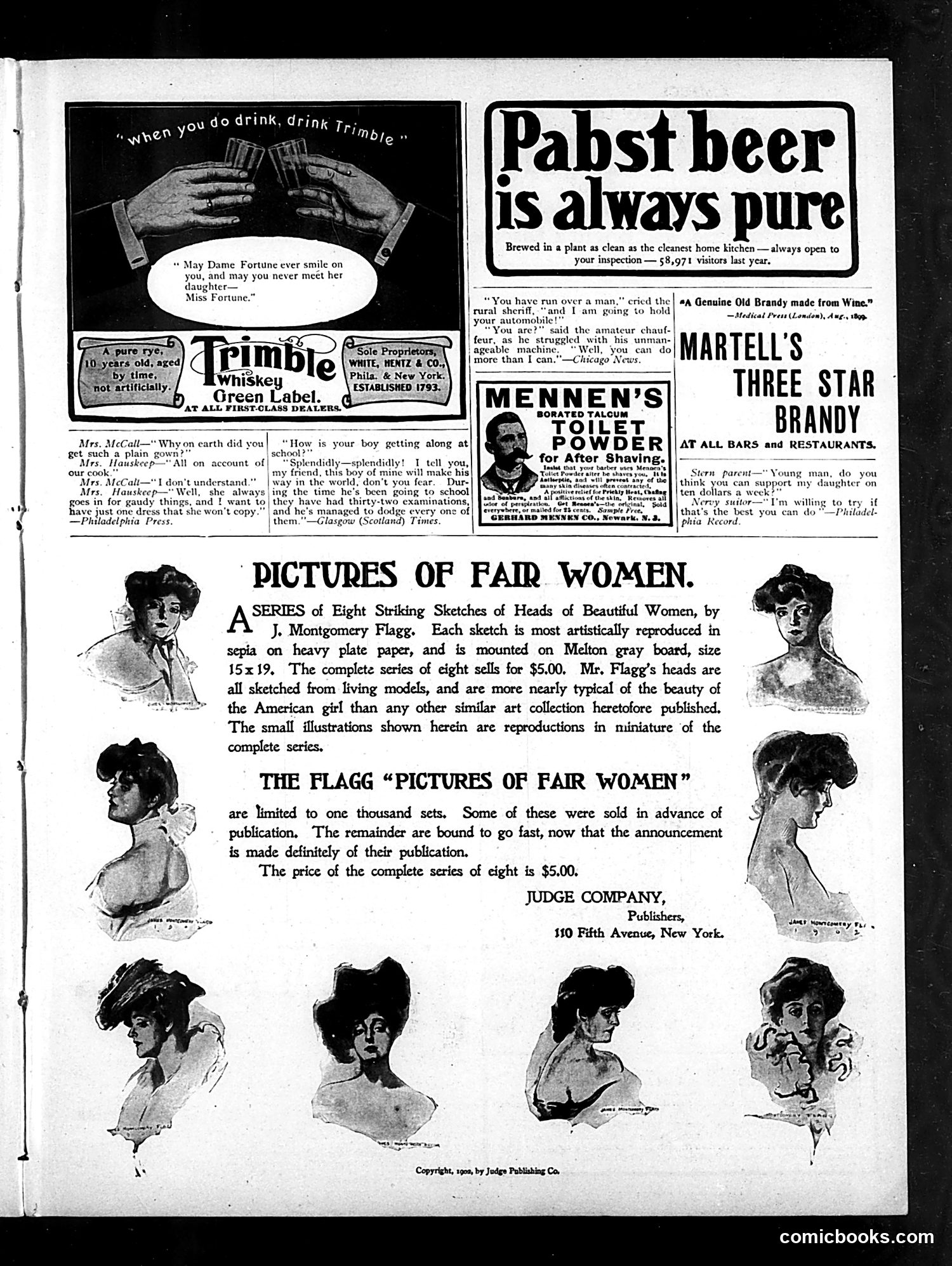
This page is primarily **advertising mixed with light humor content** from an early 1900s Judge magazine. The top section contains **product ads** (Trimble Whiskey, Pabst Beer, Martell's Brandy, Mennen's Toilet Powder) using the era's standard marketing tactics—claims of purity, hygiene, and quality. The **humor pieces** are mild domestic jokes: one about a wife's plain dress (the cook copies her fancy ones), another about a chauffeur hitting a man but claiming he "can do no more" with his car. A third involves a stern parent questioning whether a suitor can support his daughter on ten dollars weekly. The **main feature** is an advertisement for artist **J. Montgomery Flagg's "Pictures of Fair Women"**—eight portrait sketches of beautiful women, printed on heavy stock, selling for $5.00 as a limited set of 1,000. This was commercial art marketed as collectible portraiture of "American girls." Overall, this reflects early 1900s consumer culture blending alcohol/personal grooming products with genteel art collecting for middle-class audiences.
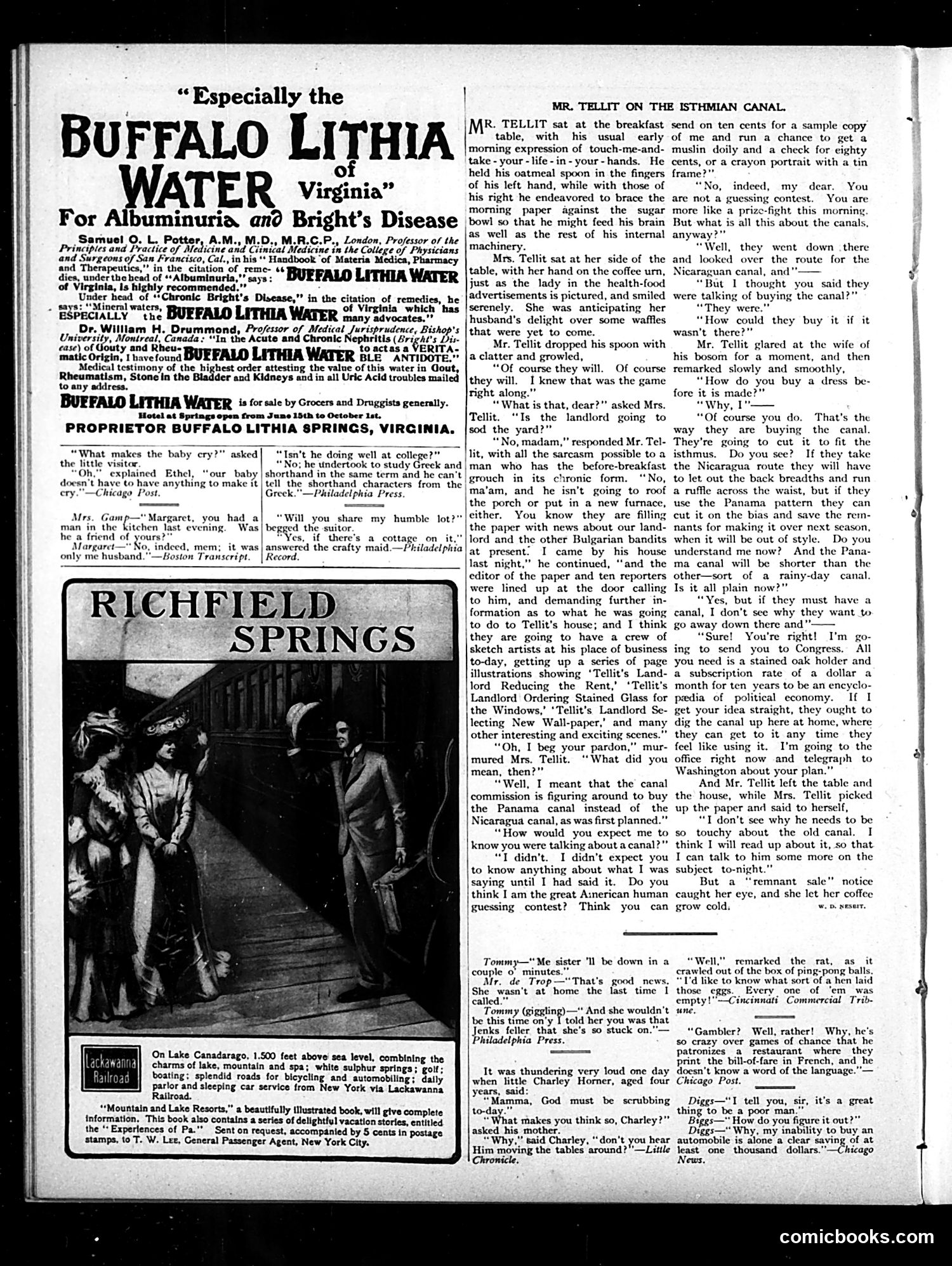
This humorous domestic scene satirizes American political discourse about the Panama Canal. Mr. Tellit, a grumpy breakfast-table fixture, interprets his wife's innocent question about home repairs as an opening to rant about canal politics. His complaint conflates personal landlord complaints with contemporary debates over the Isthmian Canal project—he sarcastically suggests that just as his landlord won't fix things, so too will politicians "fill the paper" with news while avoiding real action. The reference to "Bulgarian bandits" appears to mock European political upheaval. The joke relies on the contrast between domestic triviality and grand infrastructure politics, suggesting that American newspapers obsessed over the canal question while ordinary citizens' practical concerns went unheeded. This reflects early-1900s anxieties about Theodore Roosevelt's ambitious canal ambitions versus everyday American life's mundane frustrations.
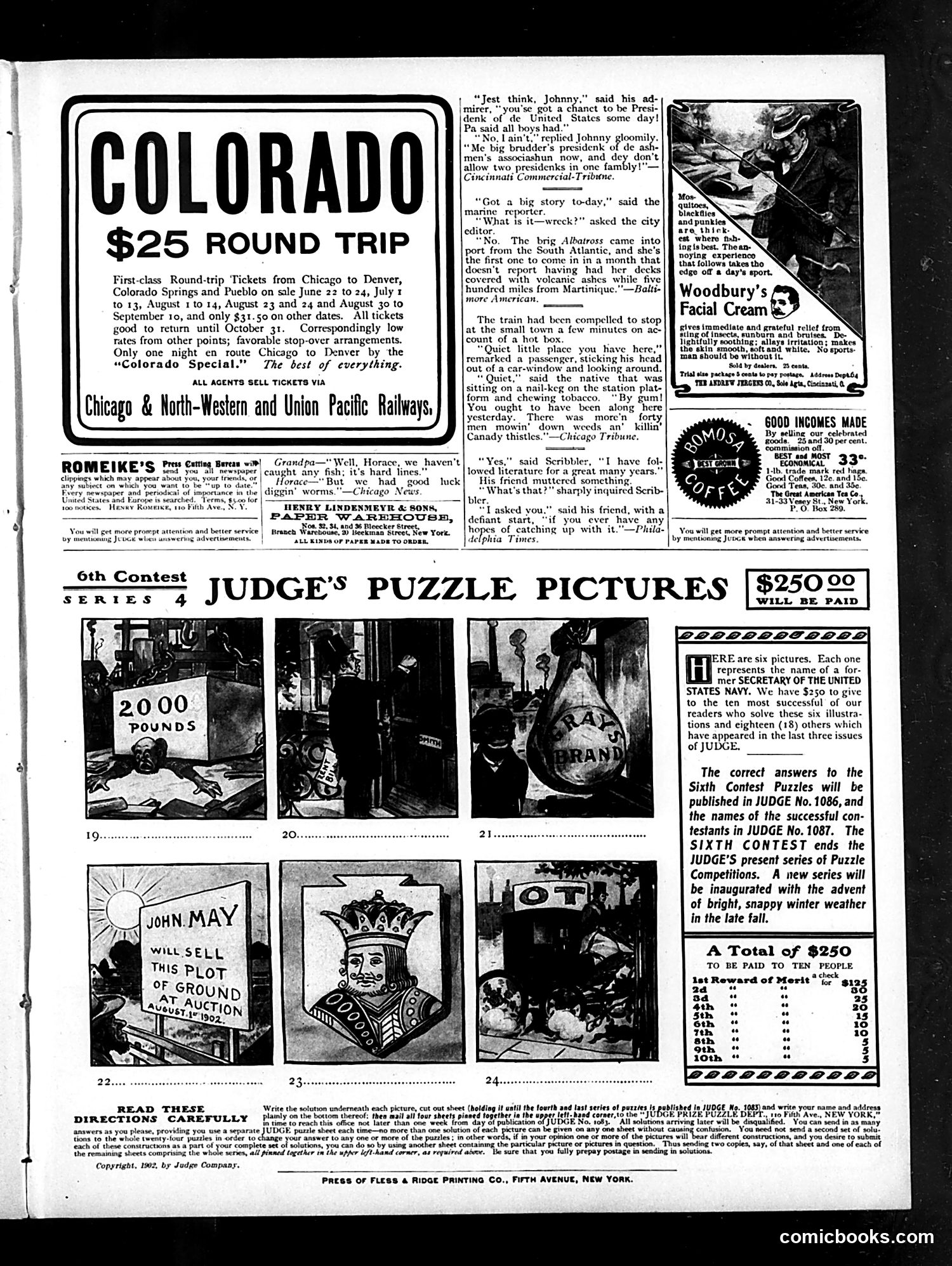
This page contains several brief satirical pieces typical of Judge's humor: **Main Cartoon (top):** A boy tells his admirer he cannot become U.S. President because his older brother is already "presidenk of de ashmen's associashun" and the family won't allow two presidents. The satire mocks both the boy's malapropisms (suggesting lower-class speech) and the absurdity of treating a minor fraternal organization presidency as equivalent to the nation's highest office—poking fun at American aspiration and democratic ideals. **Three brief humorous anecdotes** in the middle discuss volcanic ash from Martinique, a train breakdown, and a native boasting about "killin' Canady thistles"—light travel and rural humor. **Lower section:** Primarily advertisements and a puzzle contest offering $250 for solving picture-riddles representing former Secretaries of the Navy. The page is predominantly advertising-driven rather than sustained political satire.
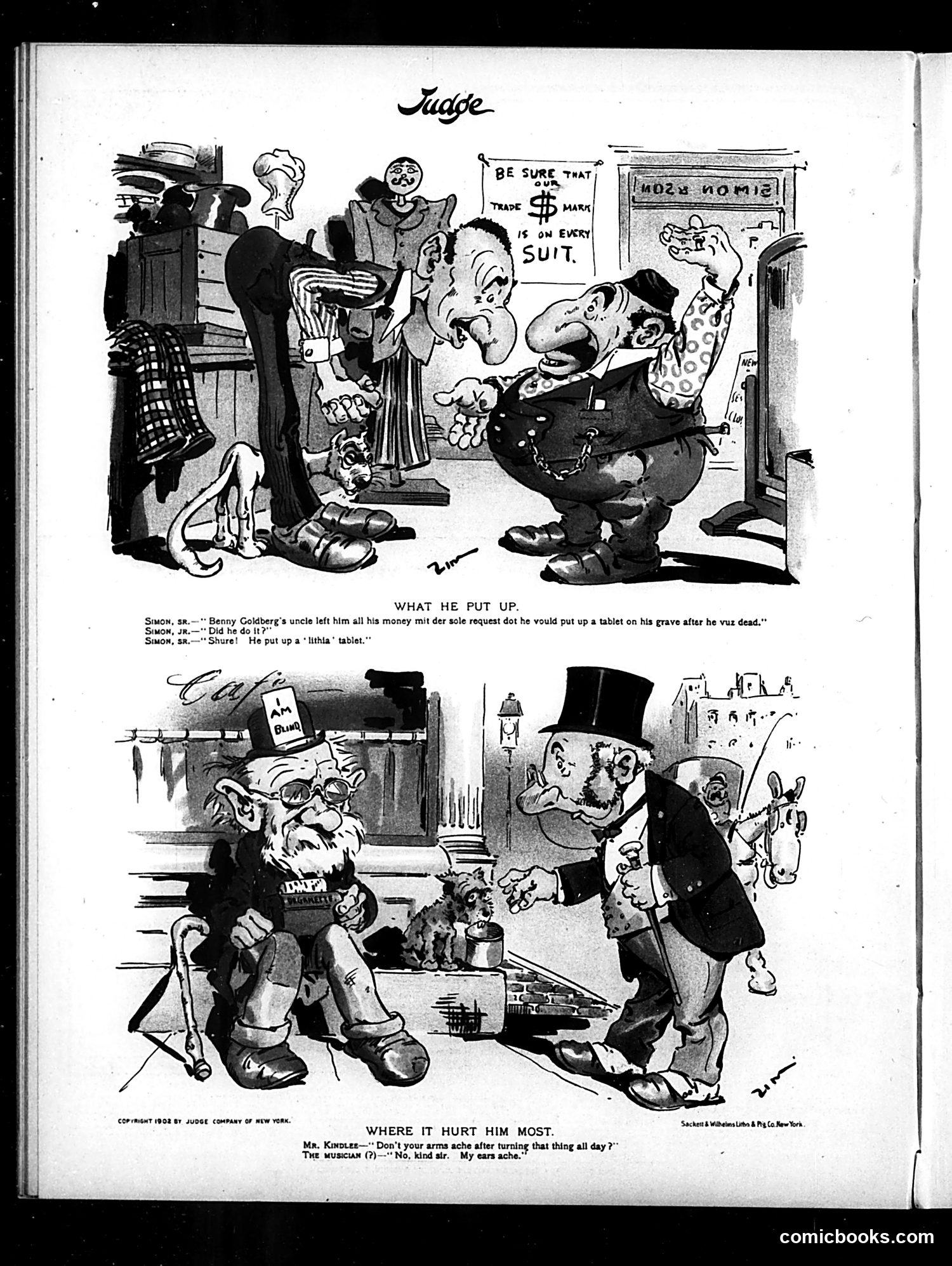
This Judge magazine page contains two ethnic-stereotype humor cartoons typical of early 20th-century American satire. **Top cartoon ("What He Put Up"):** Depicts Jewish characters (identifiable by exaggerated caricature and Yiddish-accented dialect) in a clothing shop. The joke concerns a man who inherited money with instructions to place a memorial tablet on his uncle's grave—but instead cheaply erected a small "tablet" (likely a commemorative sign), interpreting the request literally or miserly. **Bottom cartoon ("Where It Hurt Him Most"):** Shows a street musician (organ grinder) with a small dog and monkey. When asked if his arms ache from turning the organ all day, he responds his *ears* ache—suggesting the music is so terrible it's physically painful to hear. Both rely on period ethnic stereotyping and working-class humor conventions. The Jewish dialect and imagery reflect common (offensive) American cartooning tropes of this era; the musician joke uses visual absurdism common to vaudeville-influenced humor.