
A complete issue · 18 pages · 1902
Judge — June 7, 1902
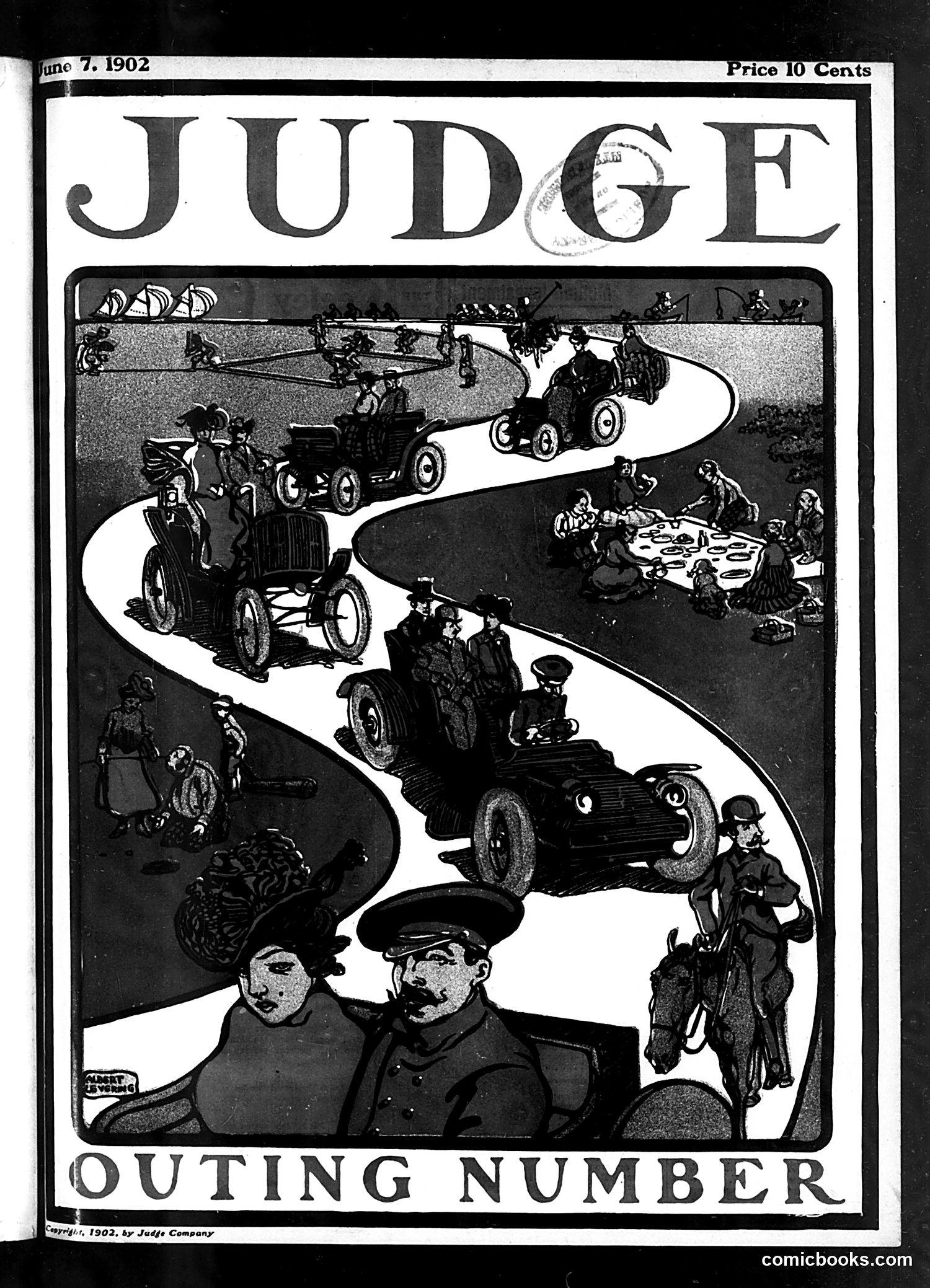
This is Judge's "Outing Number"—a special issue celebrating recreational activities. The cover illustrates early-20th-century leisure pursuits: automobiles, picnicking, cycling, and social gatherings. The satirical angle appears to mock the nouveau riche's obsession with fashionable outings and conspicuous consumption. The elaborate scene depicts well-dressed figures parading in early motorcars along a winding road, playing lawn games, and socializing—visual commentary on how wealthy Americans displayed status through recreational activities and modern transportation. The man in the foreground (lower left) likely represents an everyman observer. The overall composition satirizes the pretension and self-consciousness surrounding "fashionable" leisure in the Gilded Age, when automobile ownership and organized outings were becoming status symbols among the affluent.
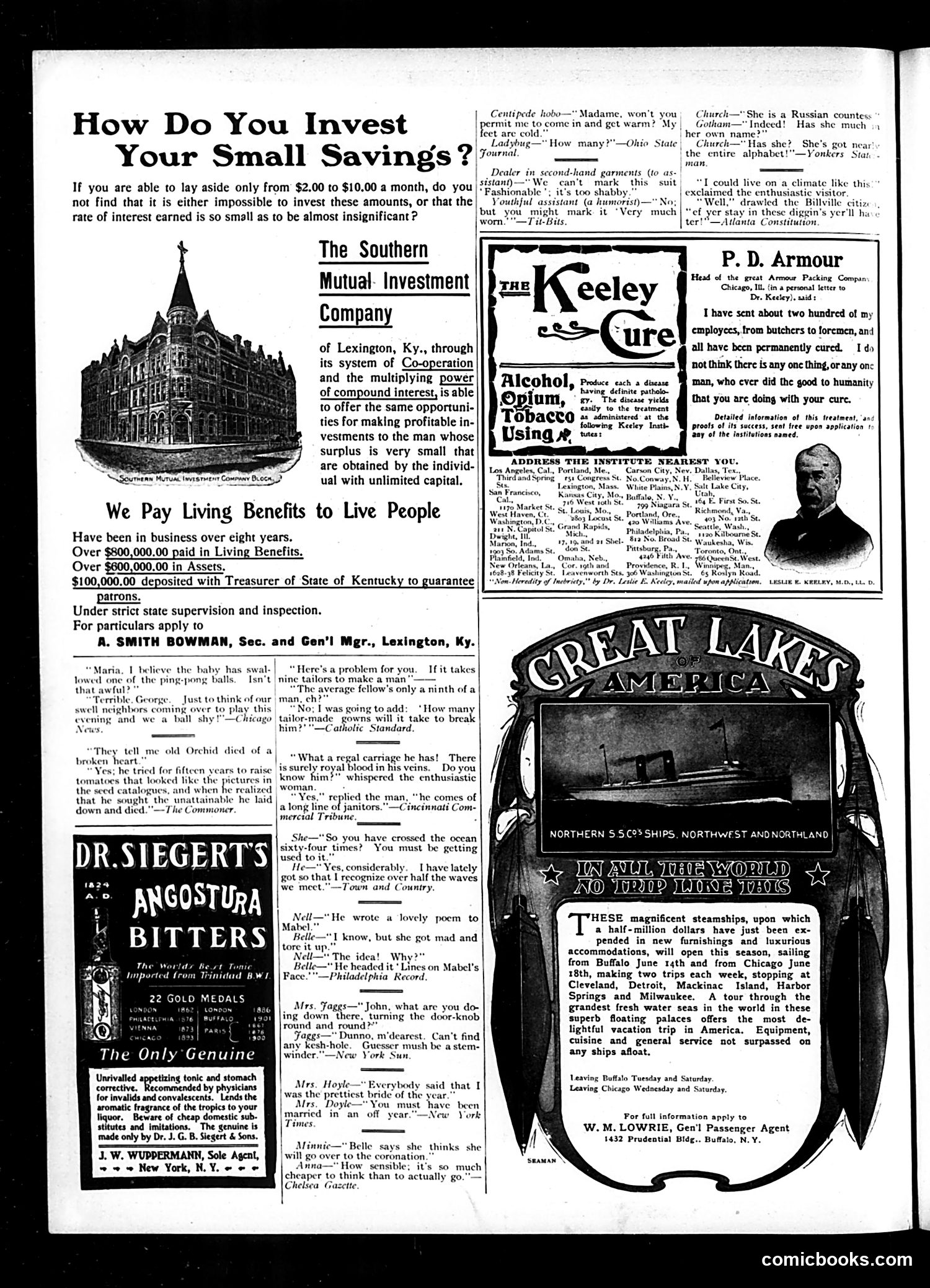
This page is primarily **advertising** rather than political satire. It contains: 1. **The Southern Mutual Investment Company** ad (Lexington, Kentucky) - promoting small savings investments with "living benefits to live people," claiming $200,000 paid in benefits and $100,000 in assets. 2. **Dr. Siegert's Angostura Bitters** - a medicinal tonic advertisement highlighting "22 Gold Medals" and claiming efficacy for "invalids and convalescents." 3. **The Keeley Cure** - advertising treatment for alcoholism, opium, and tobacco addiction. 4. **Great Lakes steamship line** - promoting luxury travel on Northern ships between Buffalo, Chicago, and ports including Cleveland and Detroit. The page reflects **early 20th-century American advertising** targeting middle-class readers seeking investment opportunities, patent medicines, and leisure travel—typical Judge magazine filler content between editorial pieces.
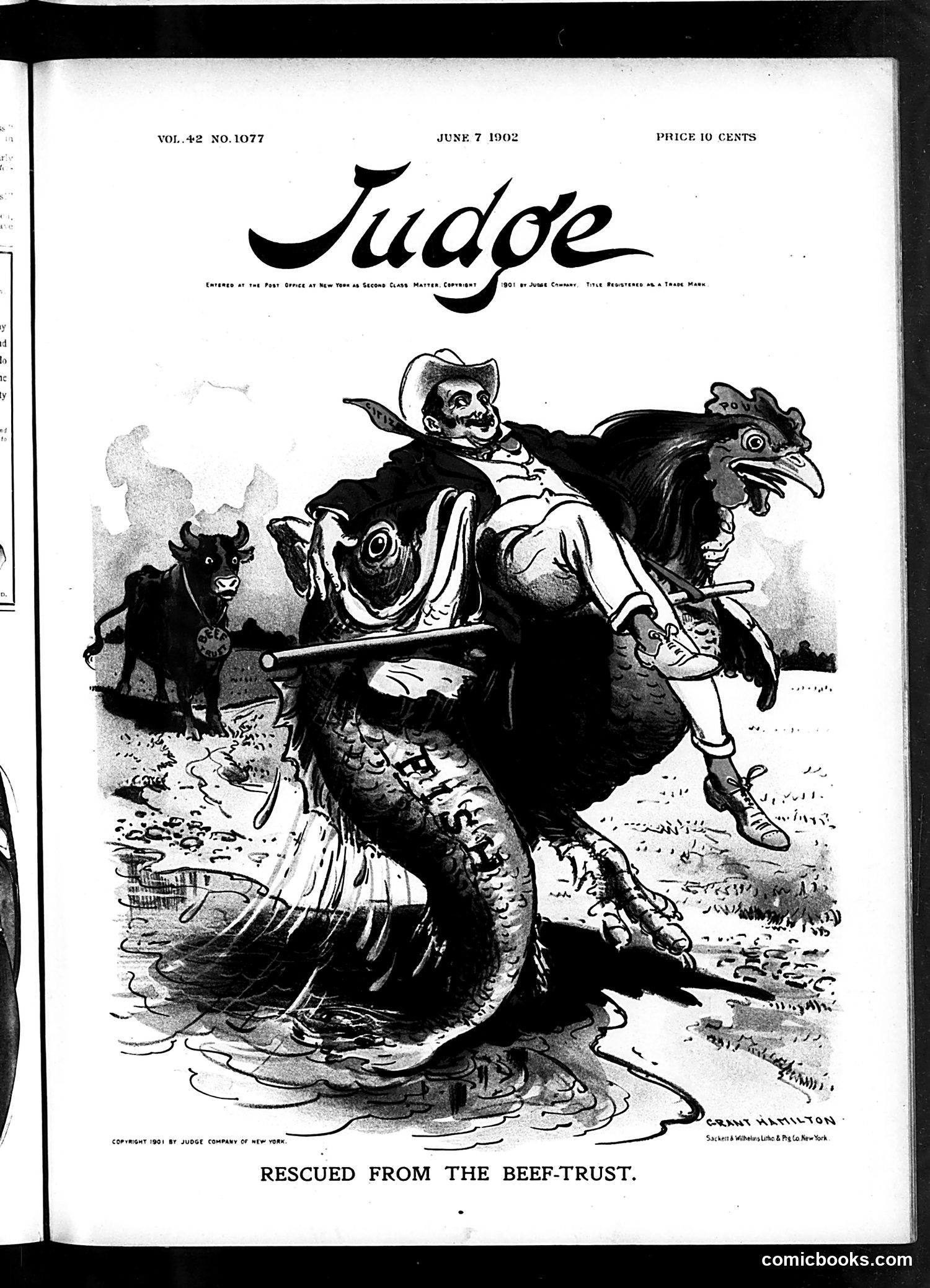
This Judge magazine cover from June 7, 1902 satirizes Theodore Roosevelt's anti-trust efforts. The cartoon depicts a grotesque creature—part bull, part demon—representing the "Beef Trust," a monopoly controlling American meat production that Roosevelt actively fought. The central figure appears to be Roosevelt himself (identifiable by his distinctive mustache and cowboy hat), riding or controlling the beast. A smaller bull on the left and a rooster on the right likely represent competing interests or political allies. The imagery suggests Roosevelt heroically battling corporate monopolies threatening American consumers and free competition. This reflects Roosevelt's aggressive trust-busting policy during his presidency, which made him popular with the public and progressives who opposed big business consolidation.
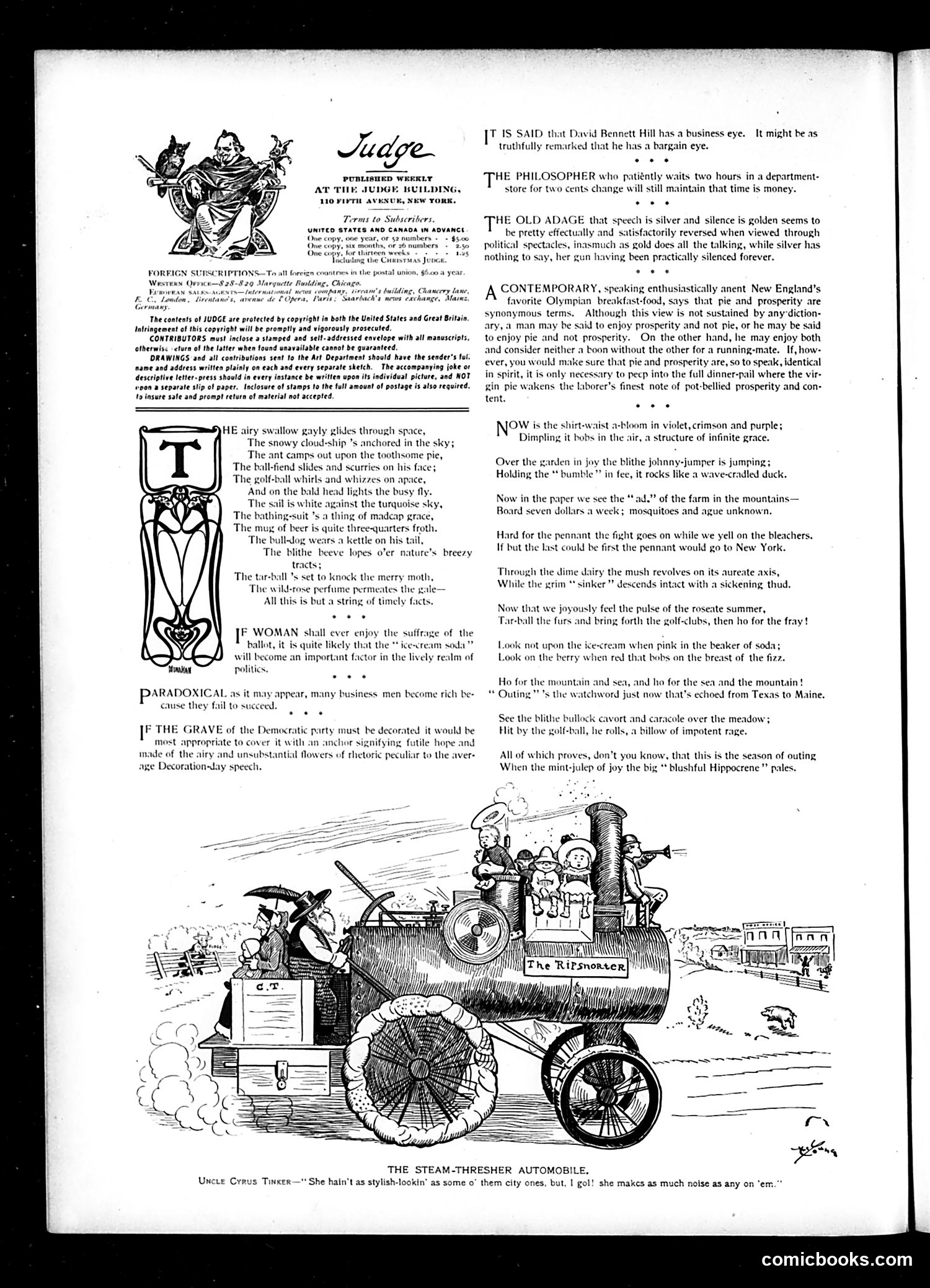
This page contains humorous essays and poems mocking contemporary social and political topics. The main cartoon at bottom depicts "The Steam-Thresher Automobile," showing an absurdly over-engineered vehicle combining threshing machinery with automobile technology. Uncle Cyrus Tinkee's quote jokes that while it lacks stylish appearance, it produces enormous noise—satirizing the loud, cumbersome early automobiles and rural inventors' impractical contraptions. The surrounding text pieces mock various subjects: David Bennett Hill's business acumen, philosophers wasting time in department stores, political rhetoric about prosperity, and New England's Olympic athletes. The humor relies on social observation and wordplay typical of early 1900s American satire, targeting both technological absurdity and contemporary public figures' pretensions.
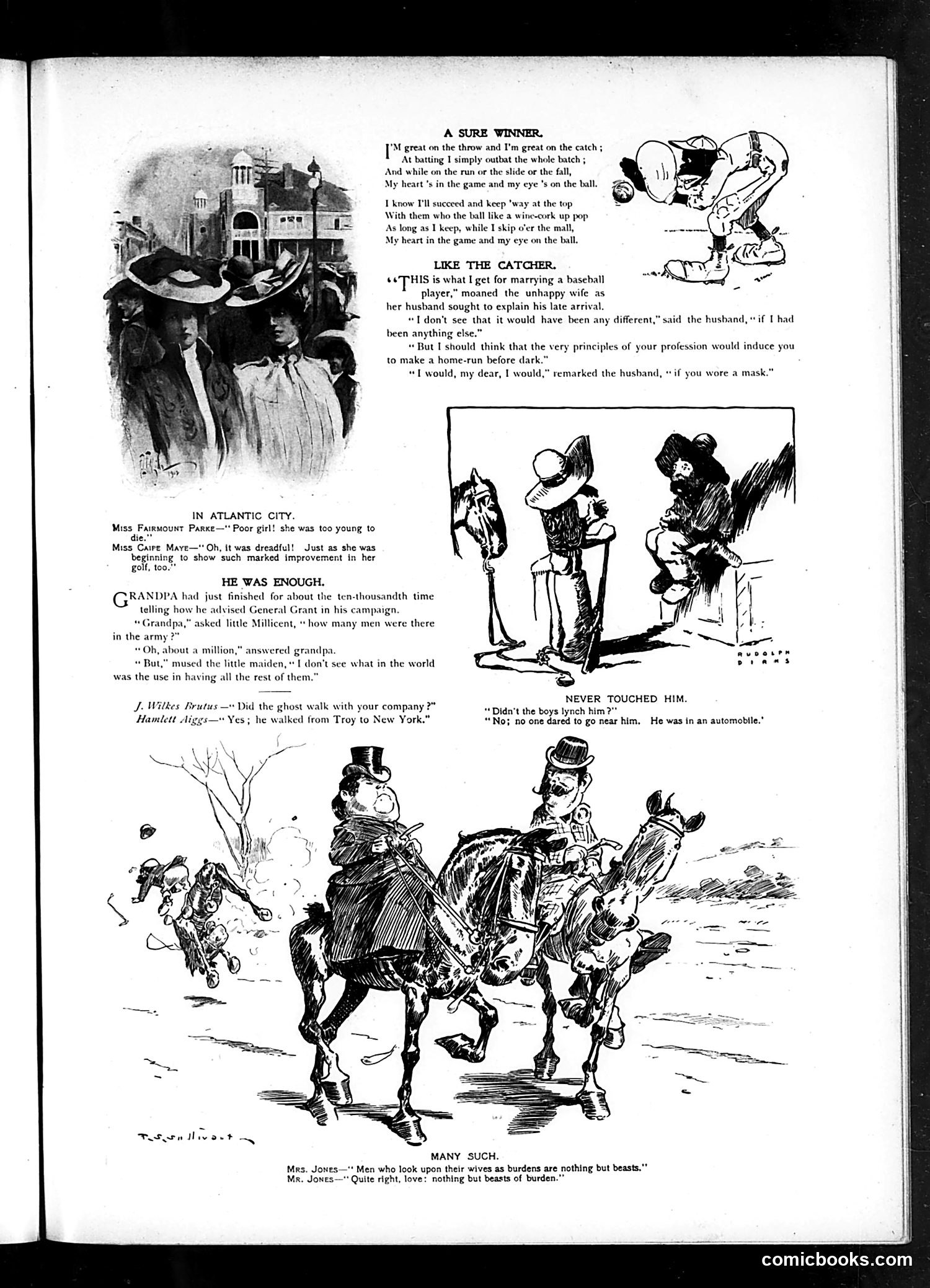
This page collects several brief humorous pieces typical of early 20th-century American satire: **"A Sure Winner"** celebrates baseball obsession through an athlete's confident monologue about keeping his "eye on the ball." **"Like the Catcher"** jokes about a baseball player's late arrival home—his wife complains he should make a "home-run before dark," and he retorts she should wear a catcher's mask (implying she'd get hit with balls). **"In Atlantic City"** satirizes wealthy leisure culture: a woman's death is lamented mainly because she'd finally improved at golf. **"He Was Enough"** mocks elderly men's war stories—a grandfather claims to have advised General Grant but can't explain why an entire army was necessary. **"Never Touched Him"** jokes darkly about an automobile protecting someone from a lynch mob—cars were still novel enough to seem invincible. **"Many Such"** offers a domestic wordplay: wives are "burdens," husbands are "beasts of burden"—a pun on the phrase's double meaning. The humor relies on period-specific references (early automobiles, golf as novelty sport) and traditional gender dynamics.
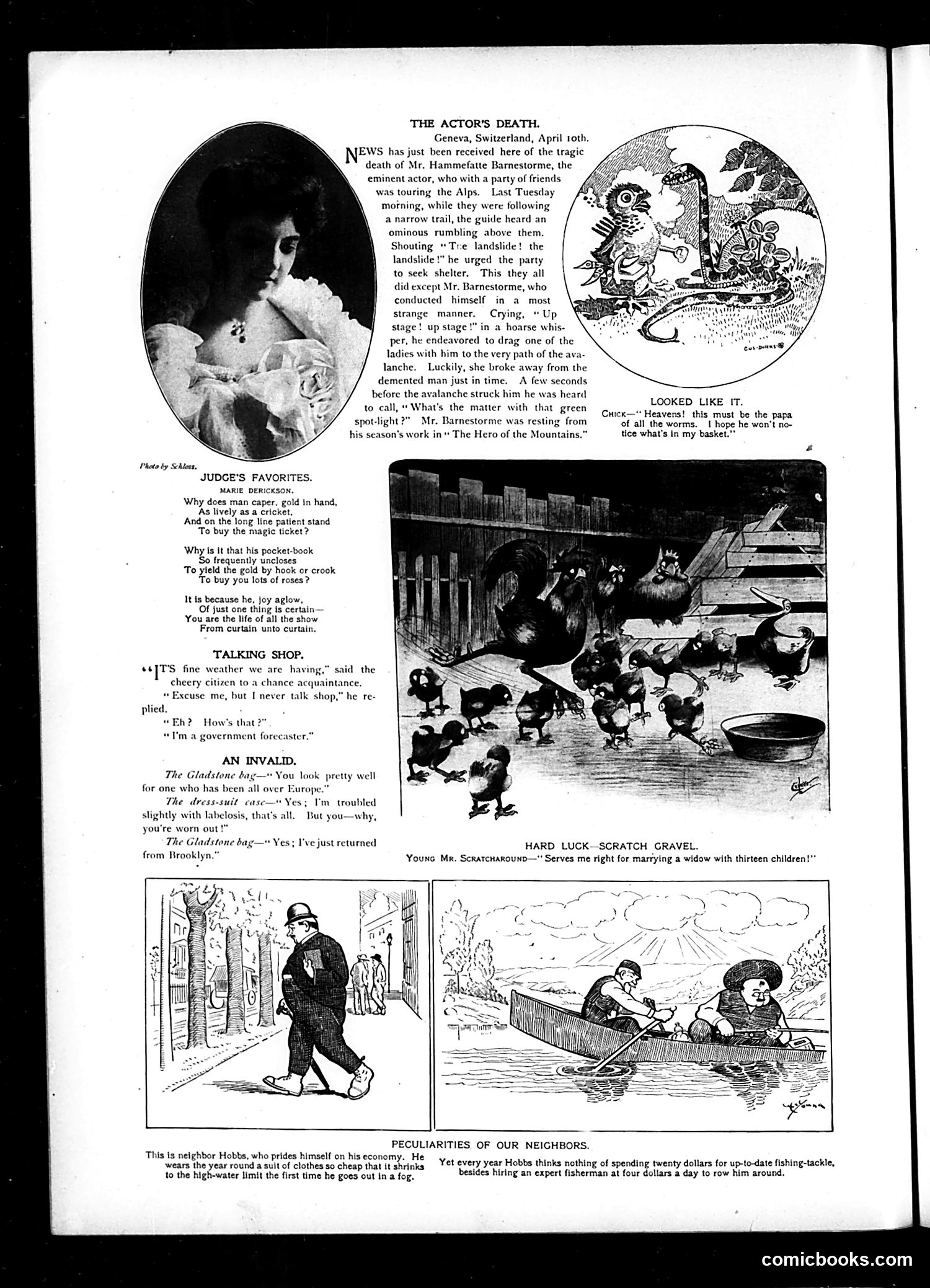
This page contains several unrelated humor pieces typical of Judge's satirical format: **"The Actor's Death"**: A darkly comic story mocking theatrical melodrama. An overly dramatic actor named Barnestorme dies in an Alpine avalanche after refusing to flee, instead shouting stage directions ("Up stage!") as if performing. The joke satirizes actors' self-absorbed theatricality—even facing death, he treats reality as a performance, complaining about a missing "spotlight." **"Judge's Favorites"** and **"Talking Shop"**: Brief humorous verses and quips on unrelated topics. **"An Invalid"** and **"Hard Luck"**: Short comic dialogues. **"Peculiarities of Our Neighbors"**: Cartoon mocking neighbor Hobbs's misplaced priorities—he's obsessively frugal about clothing yet lavishly spends on fishing expeditions, satirizing inconsistent economic values. The page reflects Judge's characteristic blend of theatrical satire, social observation, and light domestic humor aimed at early 20th-century American readers.
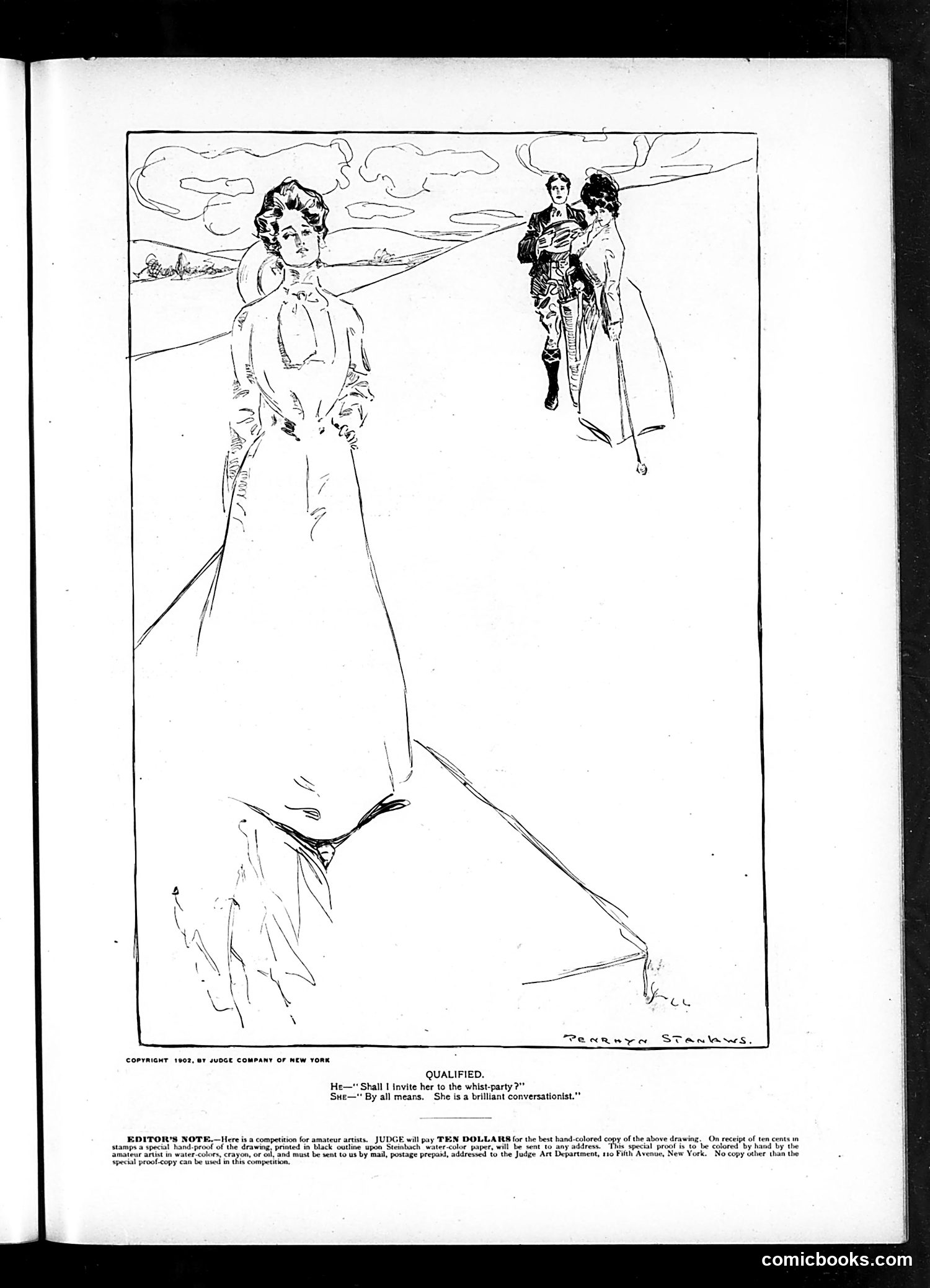
This cartoon satirizes early 20th-century social conventions around women's roles. A woman stands alone in the foreground while a couple converses in the background. The dialogue reveals the satire: the man asks whether to invite "her" to a whist party (a card game), and the woman responds affirmatively because the woman is "a brilliant conversationalist." The joke mocks how women were evaluated for social invitations not on their actual abilities—here, card-playing skill—but rather on superficial qualities like conversational talent. The woman's isolation and the dismissive reasoning suggest society deemed conversation a sufficient "qualification" for female social participation, rather than competence at the activity itself. The artwork is by Penrhyn Stanlaws, a prominent illustrator of the era.
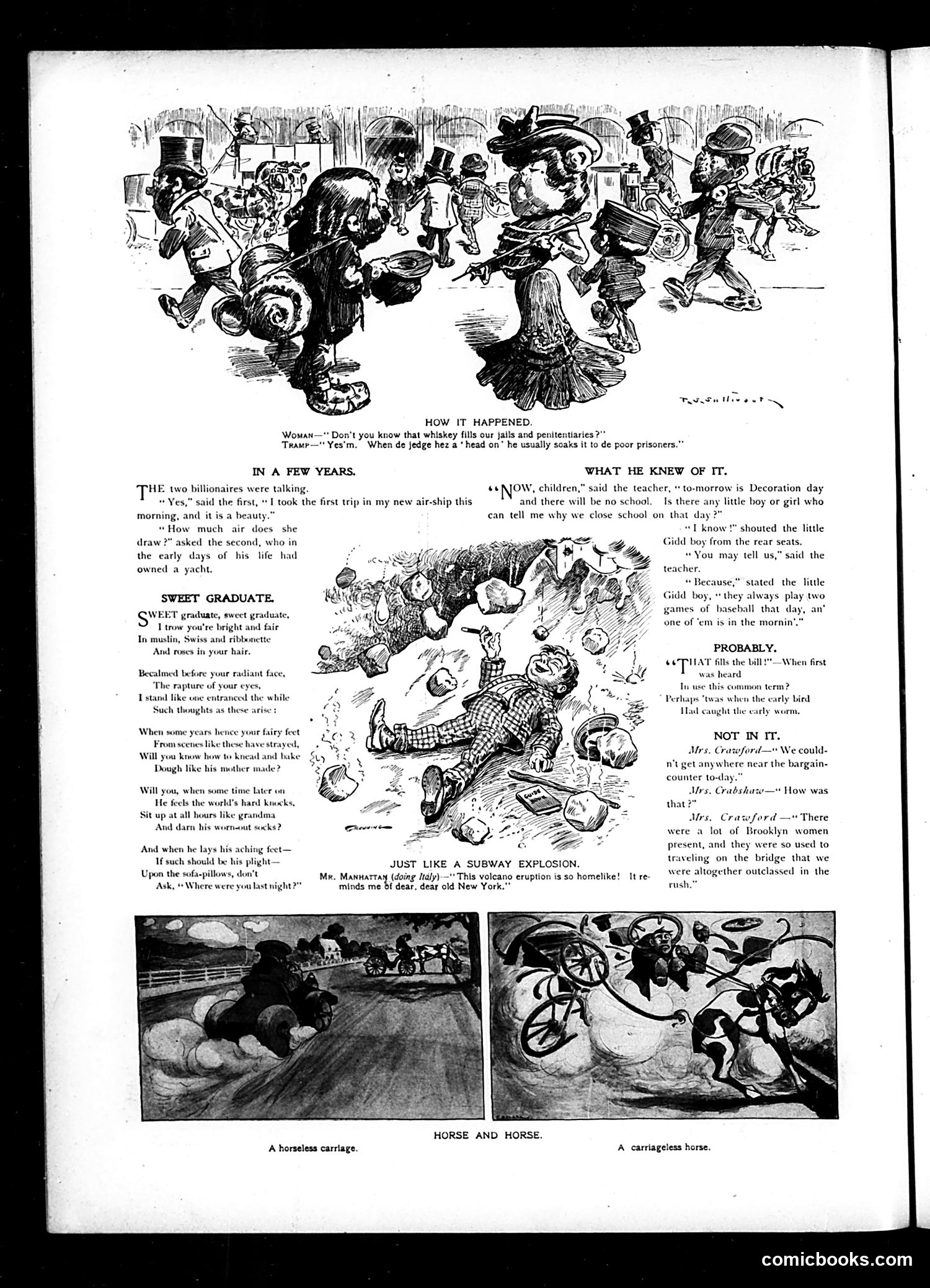
This Judge magazine page contains several satirical pieces mocking early-1900s American society: **"How It Happened"** satirizes judicial corruption: a judge, drunk ("head on"), punishes poor prisoners harshly while wealthy offenders escape—whiskey fuels both jails and judicial bias. **"In a Few Years"** mocks extreme wealth inequality: billionaires casually discuss airships and yachts, showing how the ultra-rich inhabit a separate reality from ordinary people. **"Sweet Graduate"** ironically praises an educated woman while questioning whether she'll actually know practical homemaking skills—satirizing the gap between female education and expected domestic roles. **"What He Knew Of It"** jokes that children understand Decoration Day (now Memorial Day) only because it means baseball games, not honoring the dead. **"Just Like a Subway Explosion"** compares volcanic chaos to crowded New York subways—critiquing urban congestion. **Bottom pieces** pun on "horseless carriage" and "carriageless horse"—early automobile humor. The overall tone mocks wealth disparity, judicial corruption, gender expectations, and urban chaos.
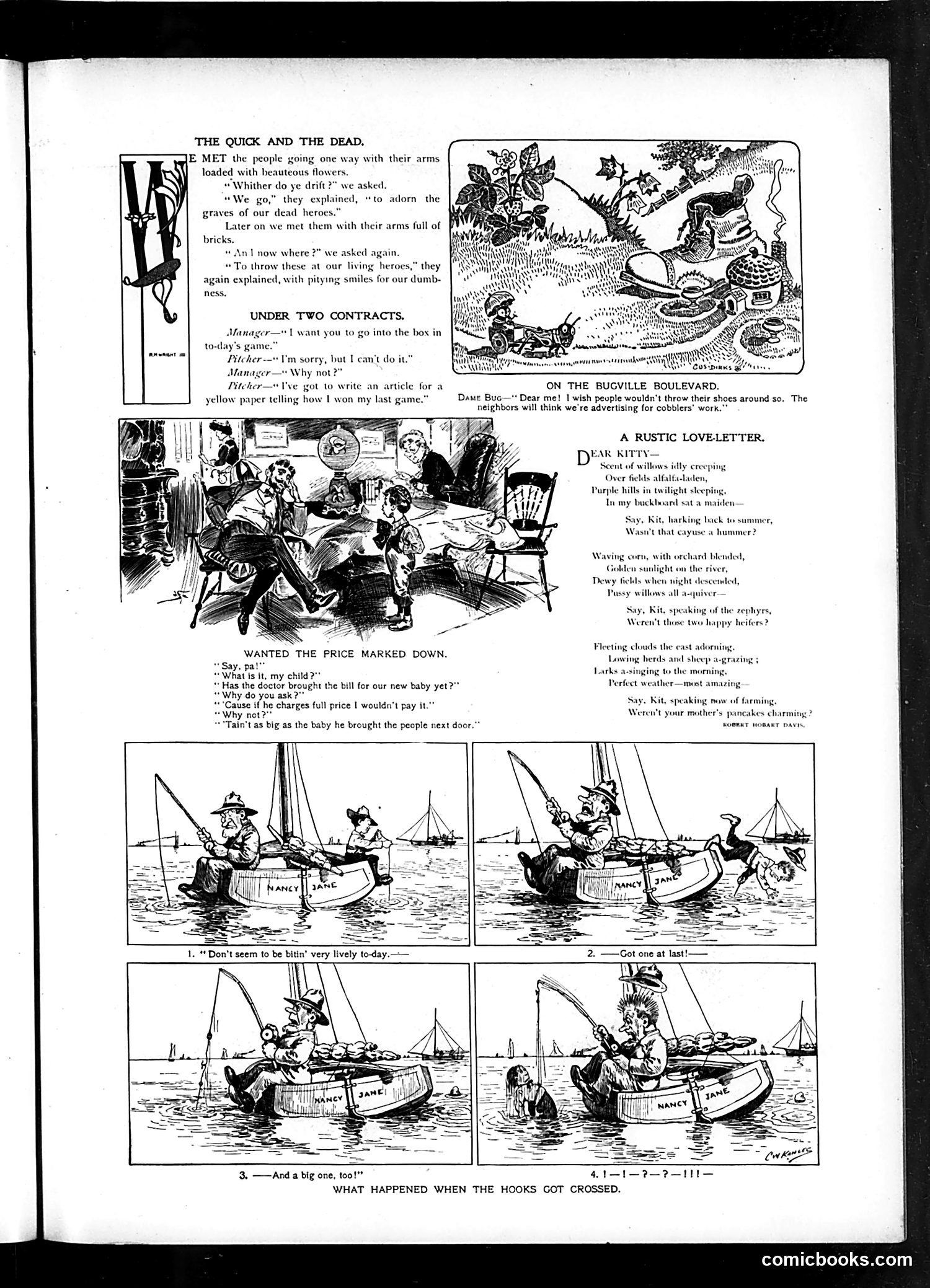
This page contains three distinct satirical pieces typical of early 20th-century American humor: **"The Quick and the Dead"** critiques public inconsistency: citizens honor fallen soldiers with flowers, yet throw bricks at living war heroes—mocking how societies romanticize the dead while neglecting or resenting those still sacrificing. **"Under Two Contracts"** is a baseball joke about a pitcher refusing to enter the batter's box because he must write a newspaper article, satirizing how athletes were increasingly becoming media personalities with competing obligations. **"A Rustic Love-Letter"** is rural Americana humor—a farmer's sentimental poem to "Kit" mixing pastoral imagery (willows, purple hills) with crude practical concerns (cayuse horses, mother's pancakes), mocking both flowery sentimentality and rustic simplicity. **"Wanted the Price Marked Down"** jokes about parents bargaining over medical bills for a newborn, treating childbirth as a commercial transaction where they expect discounts. The fishing cartoon appears illustrative of general humor rather than specific satire.
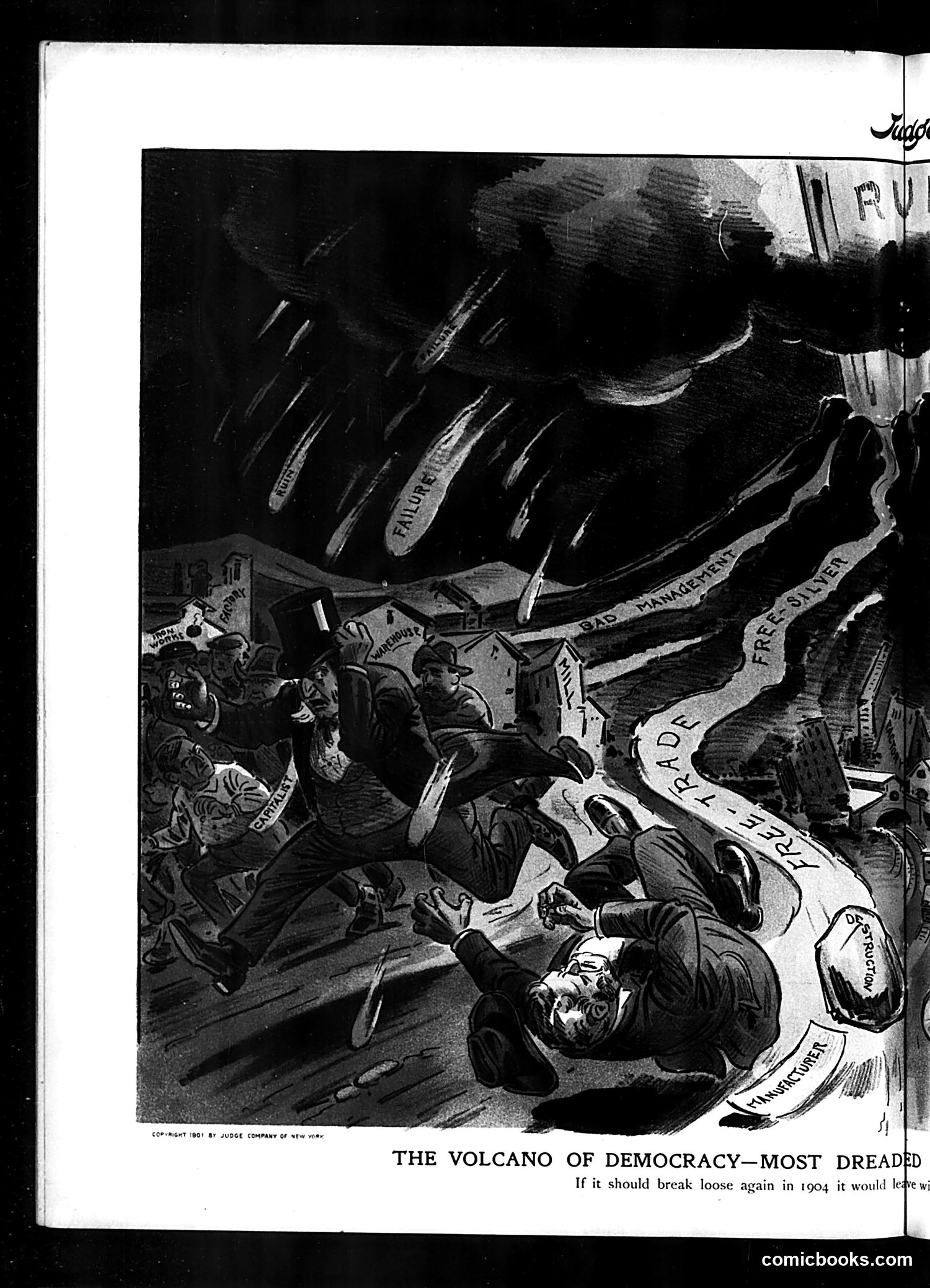
This 1901 Judge cartoon uses volcanic imagery to represent anxieties about democratic instability. The illustration depicts figures in what appears to be an underground chamber or bunker, with a massive volcano erupting overhead—labeled with various social and political tensions written on its sides and lava streams. The cartoon warns that if democratic upheaval "breaks loose again in 1904," catastrophic consequences would follow. The specific labels on the volcano appear to reference contemporary social conflicts, though the OCR text is incomplete. This reflects early 1900s fears about labor unrest, political radicalism, and social disorder threatening American stability. The "volcano" metaphor suggests these tensions are building pressure beneath society's surface—a common Progressive Era concern about whether democratic institutions could contain mounting class and political conflicts.
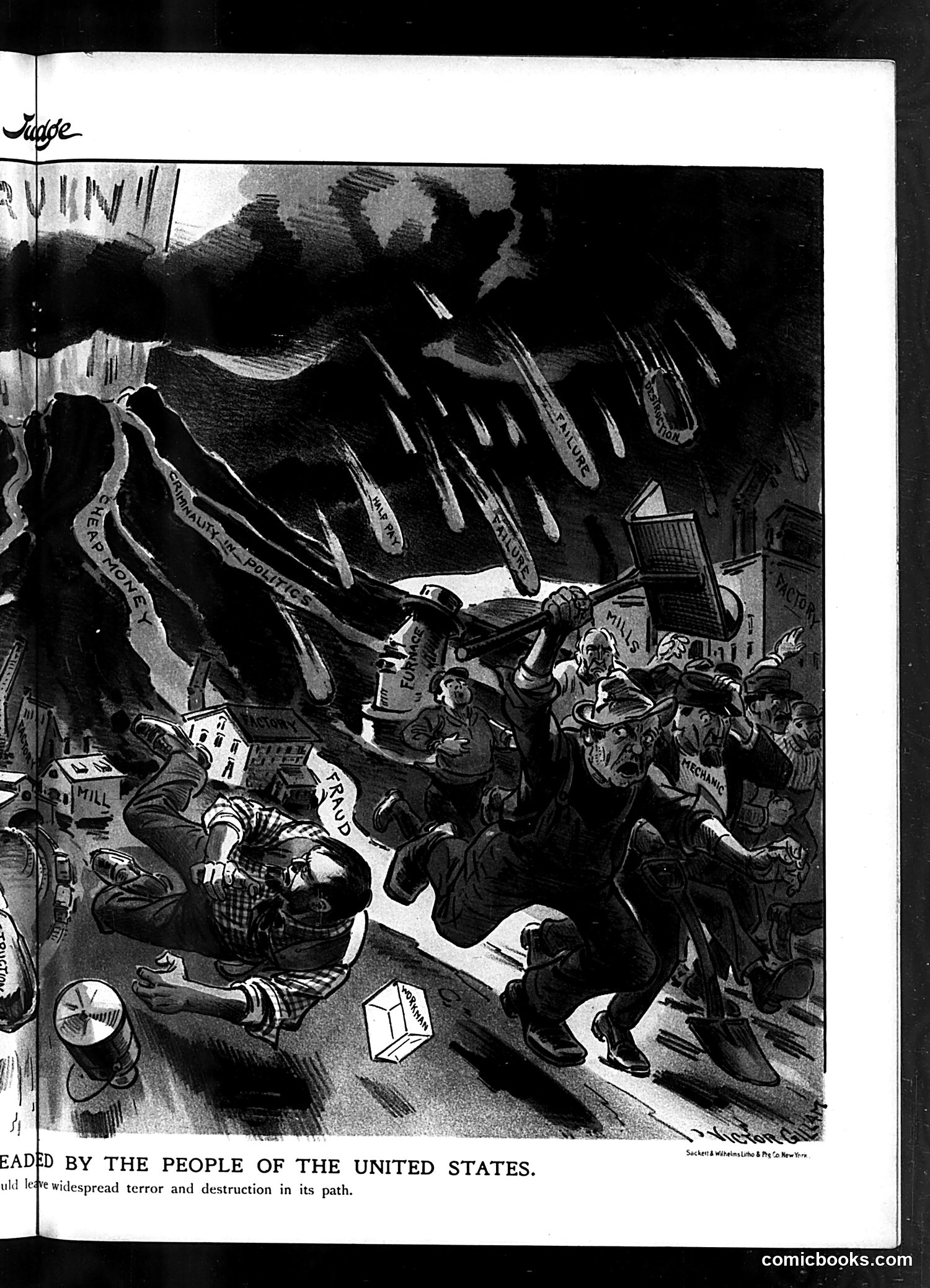
This is a dramatic political cartoon depicting anarchism as a violent threat to American society. A large, menacing shadowy figure looms over a crowd of ordinary citizens below, its massive hands reaching down toward them. The crowd appears frightened and scattered. The caption states the threat is "headed by the people of the United States" and references "widespread terror and destruction in its path." The cartoon uses the anarchist stereotype common in early 20th-century American political commentary—depicting radical ideology as an enormous, shadowy, destructive force threatening ordinary Americans. Without a visible date or artist attribution on this page, the specific historical moment is unclear, though such imagery was particularly prevalent during periods of labor unrest and anarchist activity in America.
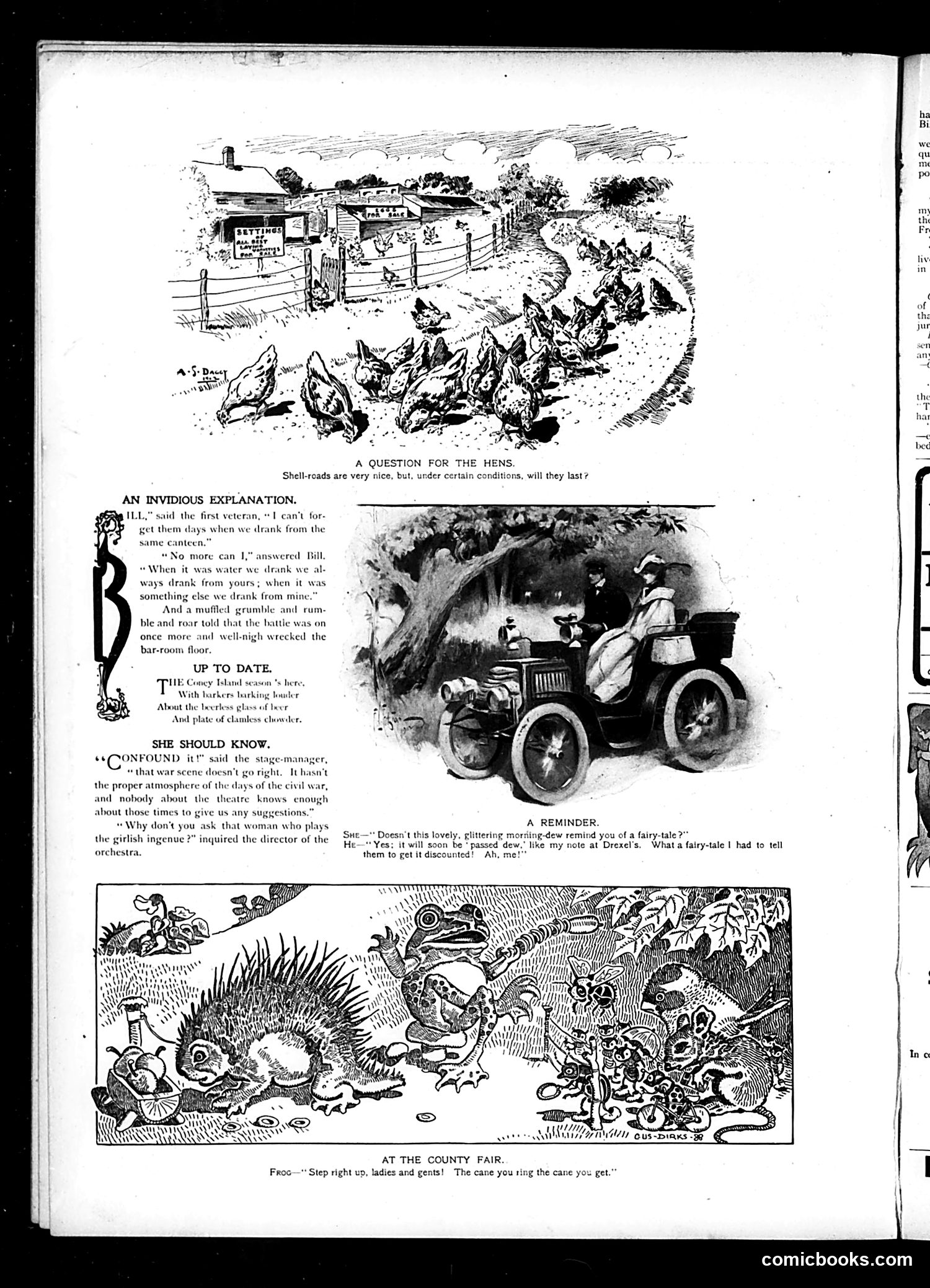
This page contains several unrelated satirical items typical of early-20th-century humor magazines: **"A Question for the Hens"** shows poultry near a farm, questioning whether shell-roads (crushed-shell surfacing) are durable for livestock areas—likely mocking rural infrastructure debates. **"An Invidious Explanation"** depicts two Civil War veterans arguing about drinking water versus alcohol during wartime, escalating into a barroom brawl. It's absurdist humor about memory and nostalgia. **"Up to Date"** jokes about Coney Island's commercialization—visitors complaining about overpriced, low-quality food (beerless chowder, clamless plates). **"She Should Know"** shows a theater director frustrated with an inaccurate Civil War scene, sarcastically suggesting he ask the young actress playing the ingénue for historical advice—mocking theatrical pretension. **"A Reminder"** depicts a romantic moment interrupted by debt collection. **"At the County Fair"** shows a carnival game operator—the caption's meaning is unclear from the OCR text provided. These are disconnected comic vignettes rather than cohesive political commentary.
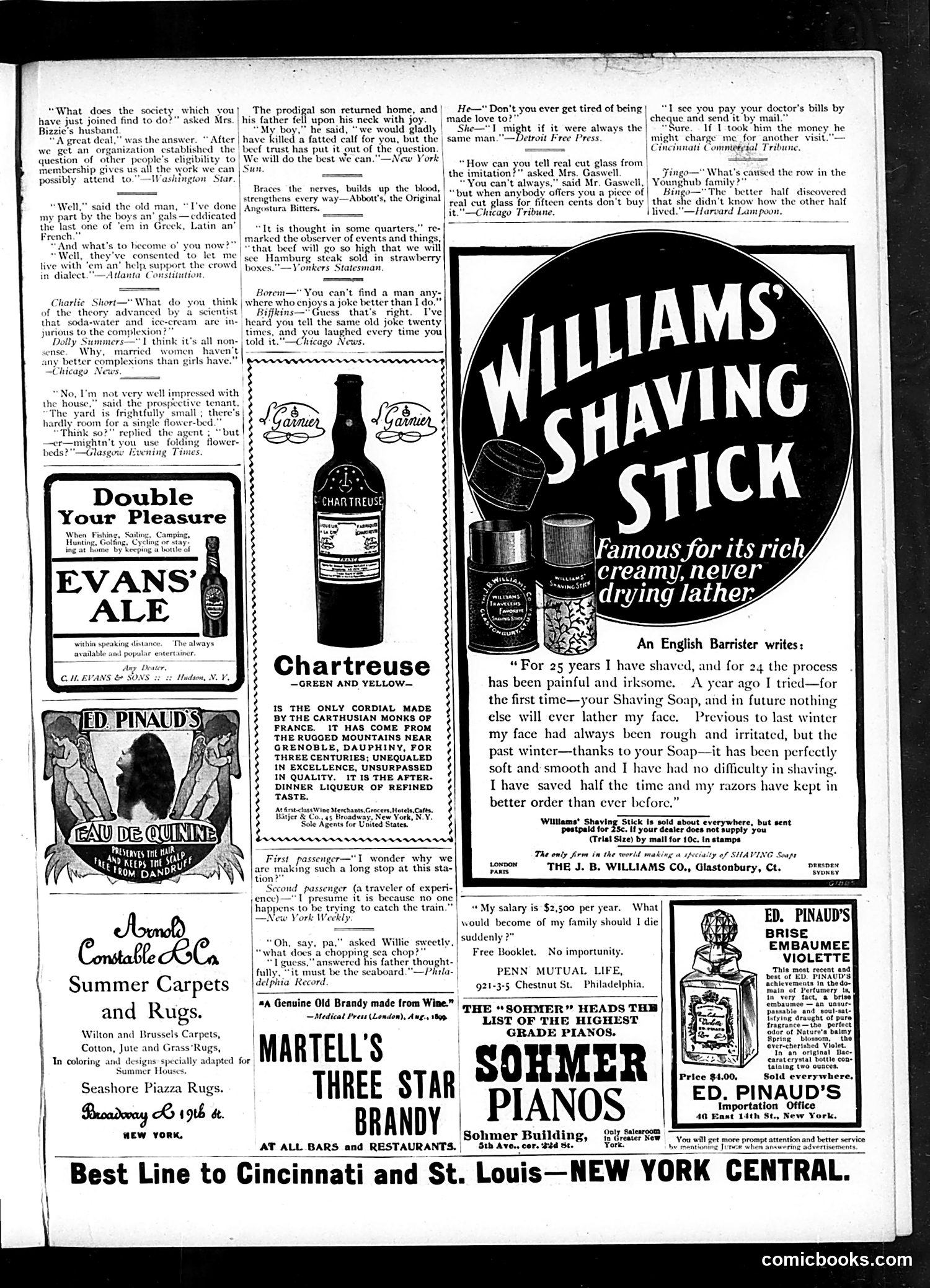
This page is primarily **advertisements and humor columns** from Judge magazine. The small cartoon/joke sections scattered throughout include period social humor: - A joke about a "prodigal son" returning home (Biblical reference) - Exchanges about marriages, courtship, and domestic life - A jab at the "beef trust"—a real historical monopoly that controlled meat prices, making beef expensive - A quip about doctors charging extra for in-person visits The bulk of the page consists of **product advertisements**: Evans' Ale, Chartreuse liqueur, Martell's brandy, Sohmer Pianos, and Williams' Shaving Stick. One ad features a testimonial from "an English Barrister" praising the shaving soap's superiority. **The satire is mild**: jokes target marital boredom, social pretension, and commercial practices rather than politics. The "beef trust" reference is the closest to social criticism—referencing actual 1900s-era monopoly concerns. The page reflects early 20th-century consumer culture and domestic comedy typical of Judge magazine.
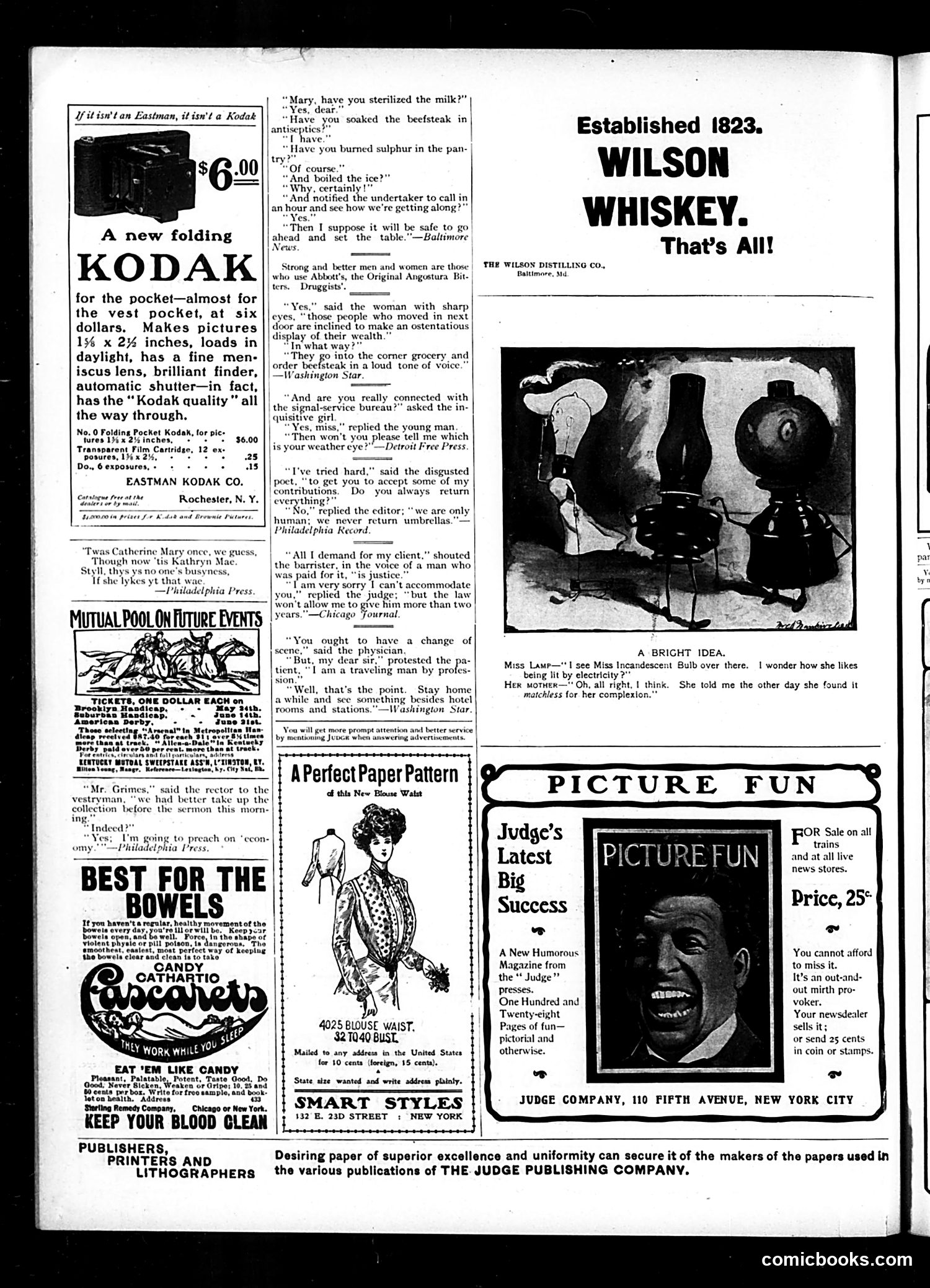
This is primarily a **classified advertising and humor page** from *Judge* magazine (established 1823), a satirical weekly. The page contains: **Advertisements**: Kodak cameras, whiskey, patent medicines (Abbott's Bitters, a laxative), and paper patterns—typical early 20th-century products. **Humor column** (center-left): Brief jokes about domestic life reflecting period anxieties. One jokes about a hypervigilant wife sterilizing milk, soaking beefsteak, and boiling ice—satirizing the contemporary "germ theory" health craze that made people obsessively cautious about food safety. Others mock social pretension (neighbors loudly ordering beefsteak to seem wealthy) and marital dynamics. **"A Bright Idea"** (center): A visual gag about an electric light bulb as a fashionable woman, with a pun on her complexion—reflecting the novelty and glamour of electric lighting in this era. The humor is mild, domestic, and class-conscious, typical of *Judge*'s middle-class audience in the early 1900s.
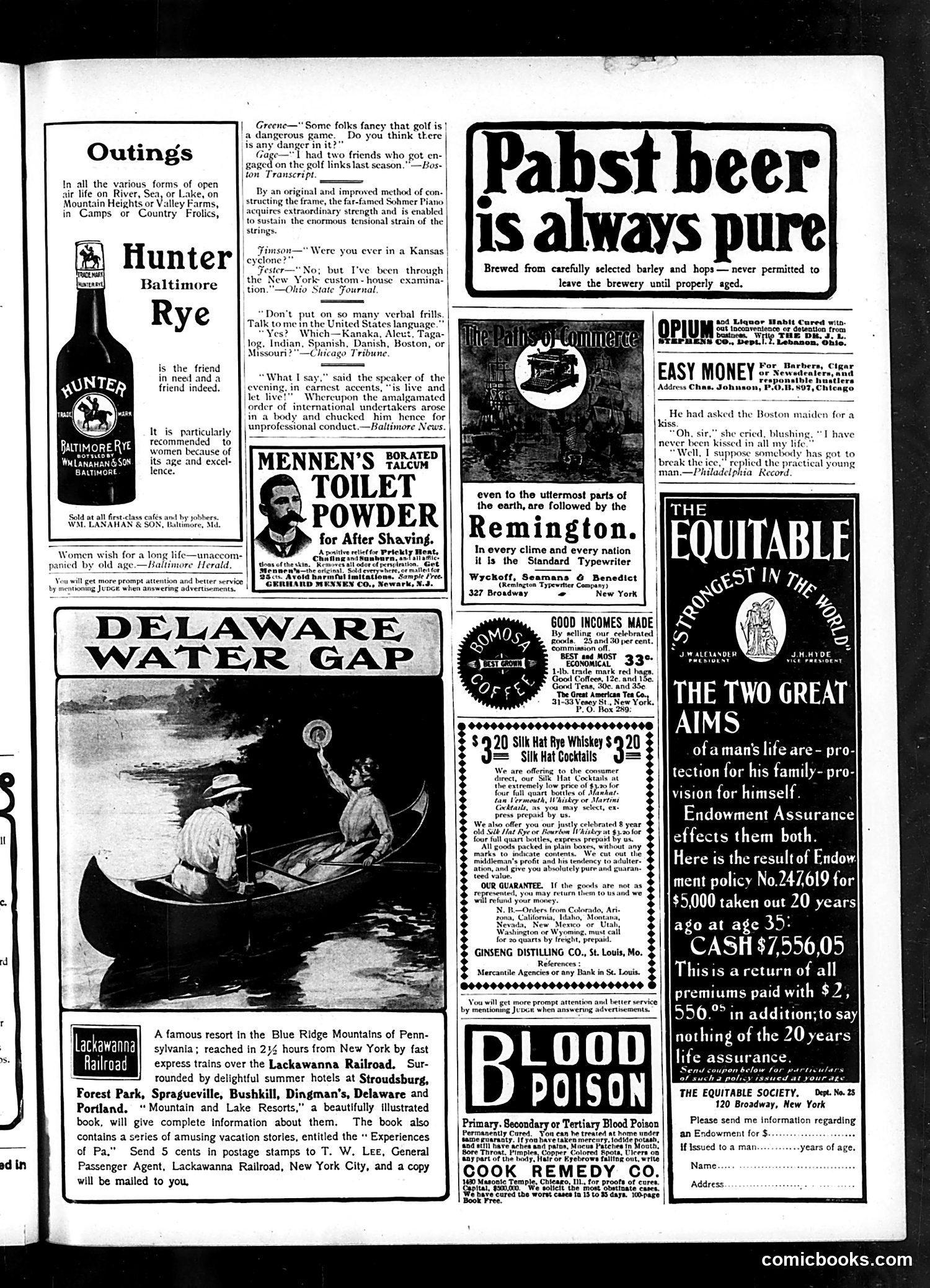
This is primarily an **advertising page** from Judge magazine, featuring various commercial advertisements alongside brief comedic snippets. The satirical content is minimal. ## The Humor: The short jokes scattered throughout employ mild social satire: - A golf joke questioning whether the sport is "dangerous" - A Kansas joke about customs inspections being worse than cyclones - A quip about "verbal frills" in language - A comment on undertakers objecting to unprofessional conduct These are lightweight observational humor typical of early 20th-century magazines—gentle jabs at everyday situations rather than sharp political satire. ## The Advertisements: The page showcases period products: Hunter Rye whiskey, Pabst beer, Mennen's toilet powder, Remington typewriters, Delaware Water Gap resort, Lackawanna Railroad, Ginseng Distilling whiskey, and medical treatments for blood poison and "liquor habit." The prevalence of alcohol and patent medicine ads reflects the pre-Prohibition era and the largely unregulated advertising landscape of the time. **There are no identifiable political cartoons or caricatures of public figures on this page.**
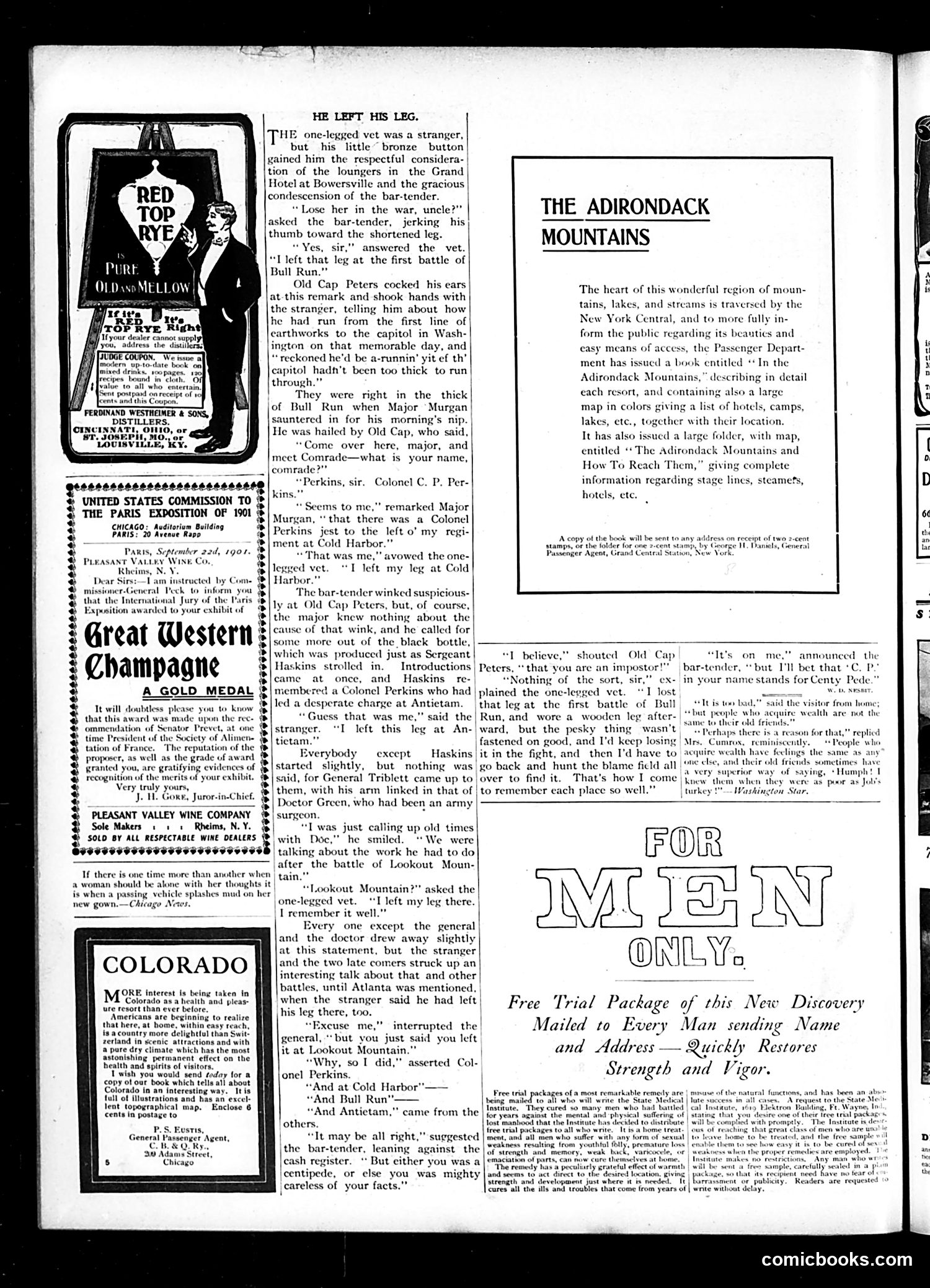
This sketch satirizes the self-aggrandizing lies told by Civil War veterans. A one-legged stranger claiming to be "Colonel Perkins" enters a bar and tells increasingly absurd stories: he lost his leg at Bull Run, then at Cold Harbor, then at Antietam, then at Lookout Mountain, then at Atlanta—each time claiming "I left my leg there." The joke is that he's claimed to have lost the *same* leg at five different battles, an obvious impossibility that everyone (except the oblivious Major Murgan) notices. The townspeople's polite silence reflects the social awkwardness of catching a veteran in an obvious lie while respecting his service. This appears to mock post-Civil War veteran culture: the exaggerated battlefield tales, the social deference granted to wounded soldiers, and the performative patriotism that sometimes masked dishonesty. The story reflects genuine skepticism about inflated war narratives circulating in the 1890s-1900s.
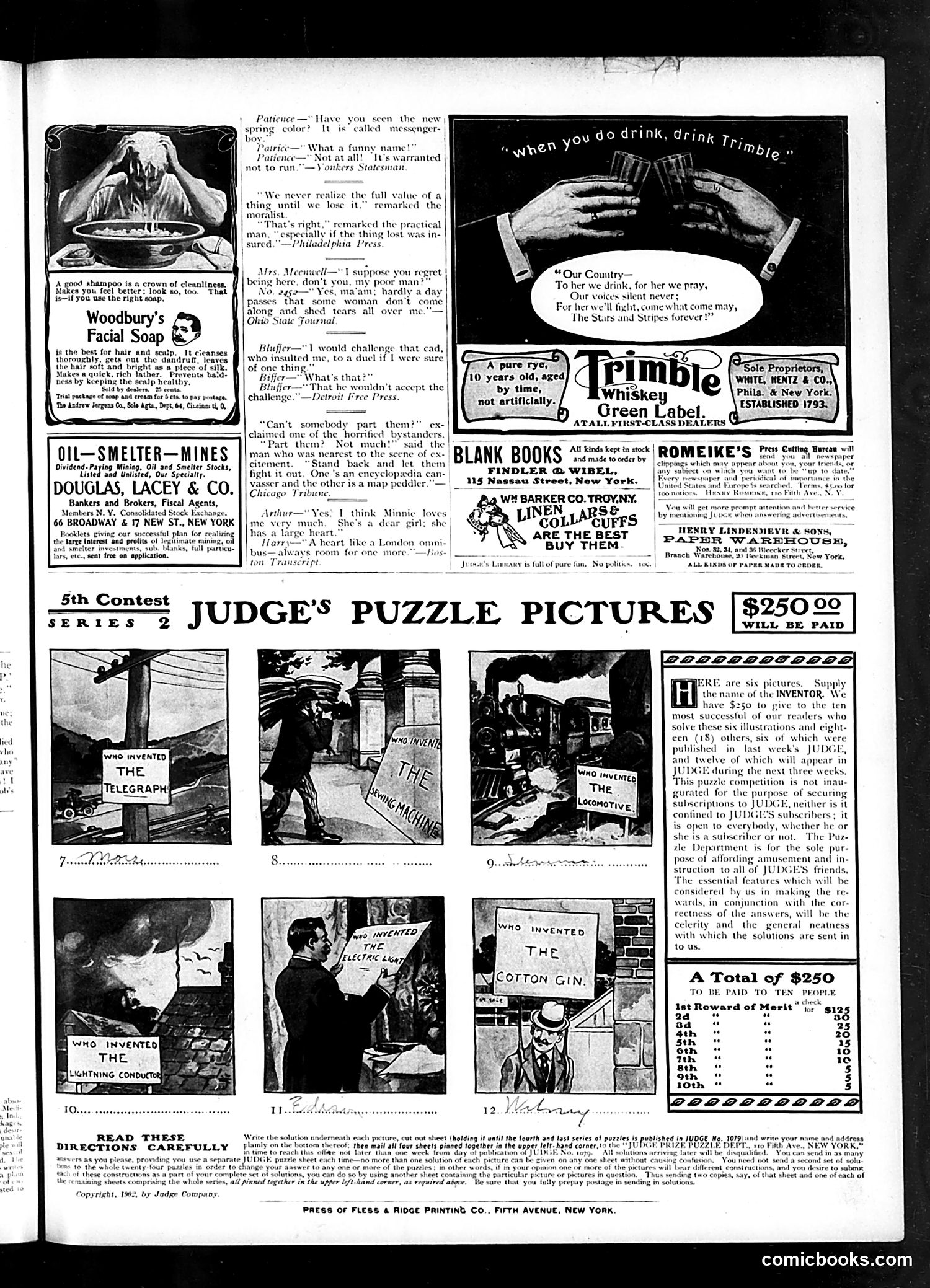
This page is primarily a **puzzle contest** rather than political satire. The main feature is "Judge's Puzzle Pictures" (Series 2, Contest 5), offering $250 in prizes for readers to identify six inventions shown in illustrated vignettes—including the Telegraph, a Sewing Machine, a Locomotive, the Lightning Conductor, an Electric Lamp, and the Cotton Gin. The page also contains scattered **light humor** and advertisements typical of the era. Small jokes mock everyday social situations: a woman named "Messenger" (pun on "mess"), a housemaid shedding tears on employers, a coward's dubious duel challenge. These are gentle domestic comedy rather than political commentary. The advertisements (Woodbury's Facial Soap, oil smelters, blank books) reflect early 1900s consumer culture. **Overall**: This is a recreational puzzle page with period humor and advertising—not a vehicle for political satire or social commentary.
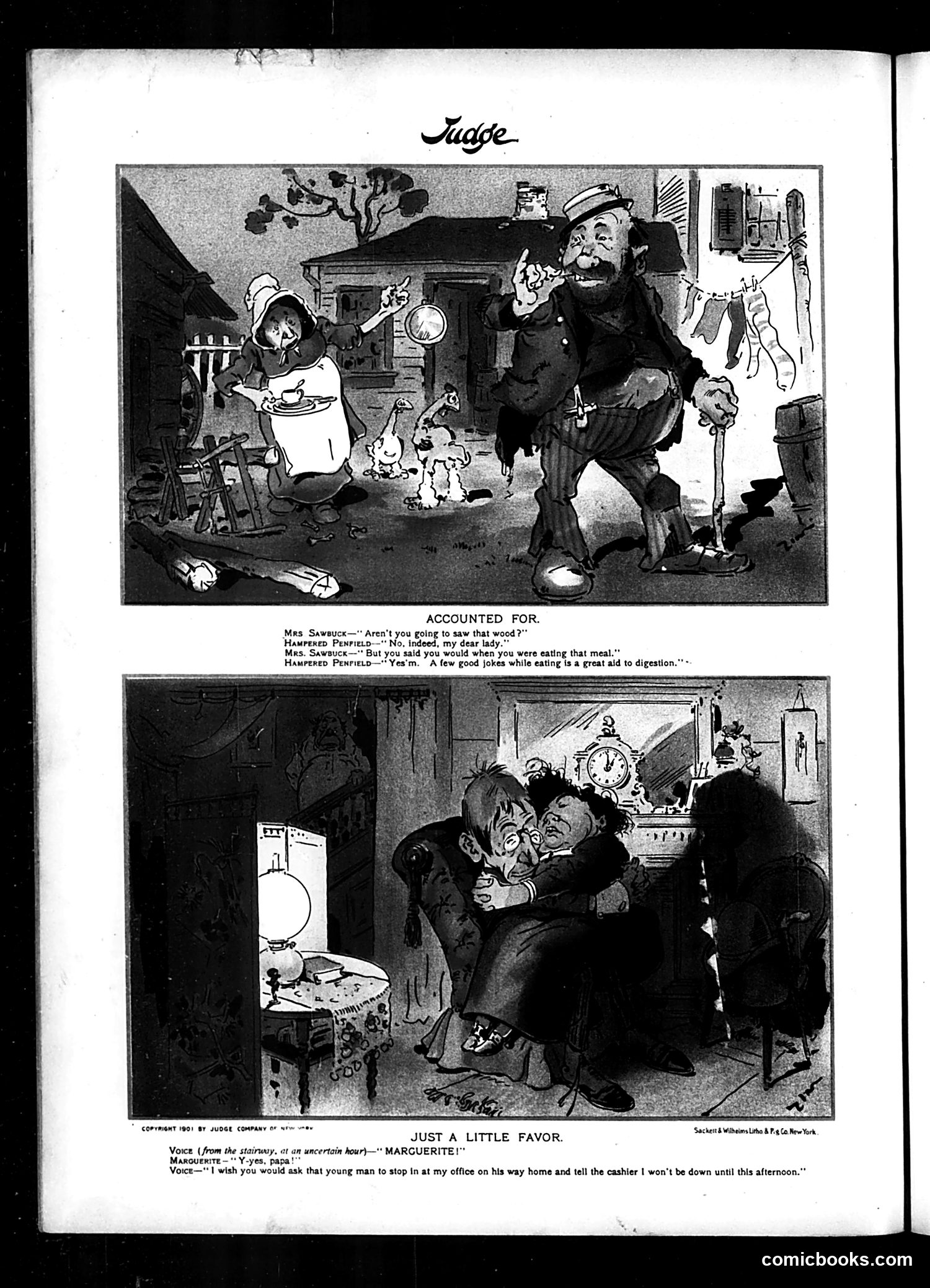
This page contains two satirical cartoons about domestic life and social hypocrisy: **Top cartoon ("Accounted For"):** A woman confronts a man about eating wood, which he denied. He claims he made a joke while eating—implying the joke aided digestion. The satire mocks men's excuses and rationalization of their behavior. **Bottom cartoon ("Just a Little Favor"):** A woman named Marguerite asks her father to stop a young man from visiting, claiming he won't leave until afternoon. Her father attempts to physically remove the persistent suitor. The humor satirizes courtship customs and overbearing parental interference with romantic visits—a common concern in early-20th-century social etiquette. Both cartoons use exaggerated caricature to mock domestic relations and gender dynamics of the era.