
Judge, 1902-06-07 · page 5 of 18
Judge — June 7, 1902 — page 5: what you’re looking at
What you’re looking at
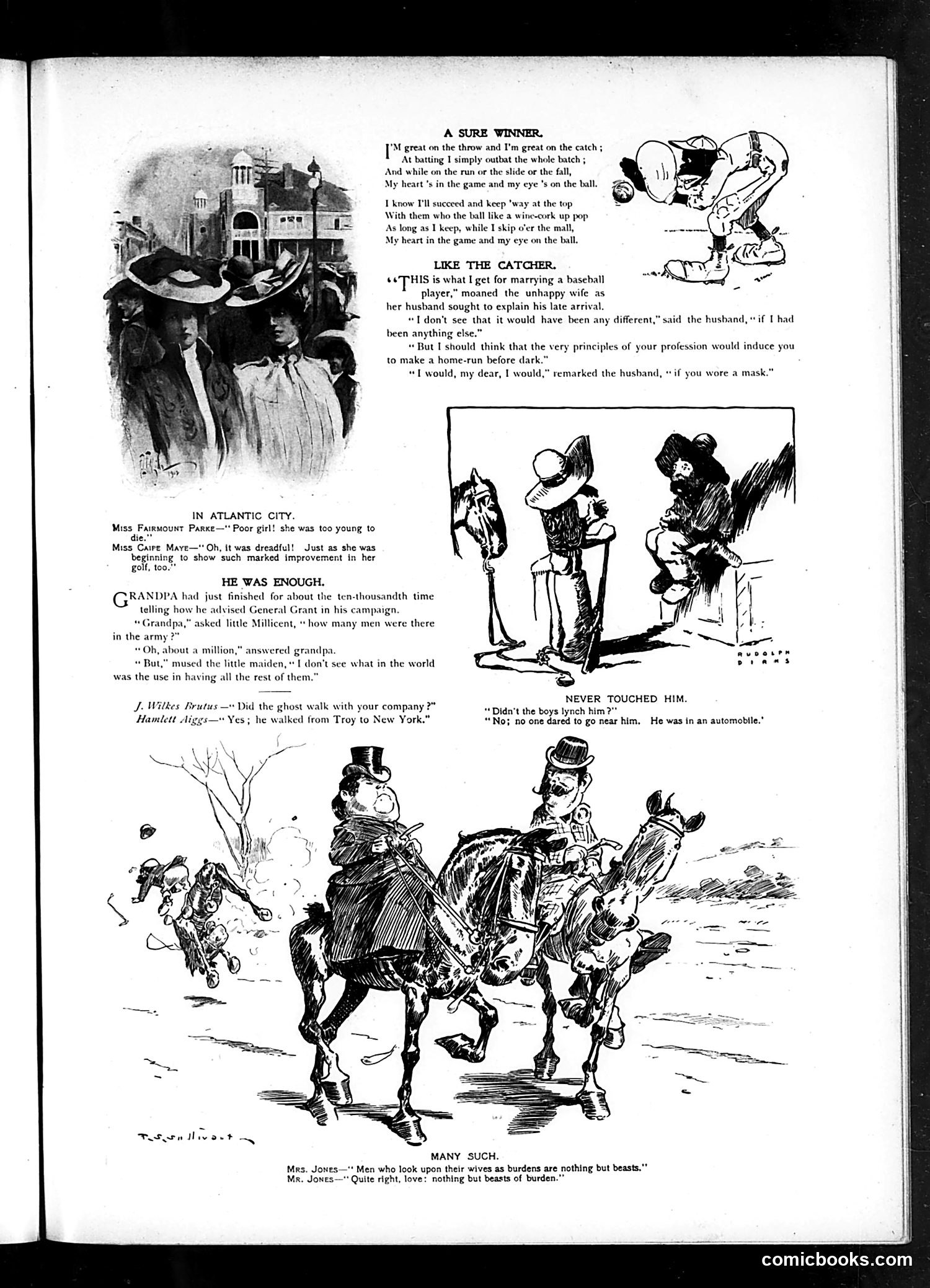
This page collects several brief humorous pieces typical of early 20th-century American satire: **"A Sure Winner"** celebrates baseball obsession through an athlete's confident monologue about keeping his "eye on the ball." **"Like the Catcher"** jokes about a baseball player's late arrival home—his wife complains he should make a "home-run before dark," and he retorts she should wear a catcher's mask (implying she'd get hit with balls). **"In Atlantic City"** satirizes wealthy leisure culture: a woman's death is lamented mainly because she'd finally improved at golf. **"He Was Enough"** mocks elderly men's war stories—a grandfather claims to have advised General Grant but can't explain why an entire army was necessary. **"Never Touched Him"** jokes darkly about an automobile protecting someone from a lynch mob—cars were still novel enough to seem invincible. **"Many Such"** offers a domestic wordplay: wives are "burdens," husbands are "beasts of burden"—a pun on the phrase's double meaning. The humor relies on period-specific references (early automobiles, golf as novelty sport) and traditional gender dynamics.
📄 Transcribed text from this page (OCR, searchable)
Machine-transcribed from the original scan — historical spelling and the odd misread are preserved.
A SURE WINNER, ['M great on the throw and I'm great on the catch ; At batting I simply outbat the whole batch ; And while on the run or the slide oF the fall, My heart 's in the game and my eye 's on the ball. I know T'll succeed and keep "way at the top With them who the ball like a wine-cork up pop As long as I keep, while I skip o'er the mall, My heart in the game and my eye on the ball, LIKE THE CATCHER. (APHIS is what I get for marrying a baseball player,” moaned the unhappy wife as her husband sought to explain his late arrival. “Tdon't see that it would have been any different,” said the husband, «if T had been anything else.” “But I should think that the very principles of your profession would induce you to make a home-run before dark.” “TL would, my dear, I would,” remarked the husband, «if you wore a mask.” IN ATLANTIC CITY. Miss Fairmount Parke—"‘ Poor girl! she was too young to di Miss Care Mave—"*Oh, it was dreadful! Just as she was beginning to show such marked improvement in her golf, too.” HE WAS ENOUGH. GRANDPA had just finished for about the ten-thousandth time telling how he advised General Grant in his campaign. “Grandpa,” asked little Millicent, “how many men were there in the army 2" “Ob, about a million,” answered grandpa. “ But,” mused the little maiden, “I don’t see what in the world was the use in having all the rest of them.” - NEVER TOUCHED HIM. Didn't the boys lynch him?" “Nos no one dared to go near him, He was in an automobile." J. Wilkes Brutus — Did the ghost walk with your company 2” Hamlett Aiggs—* Yes ; he walked from Troy to New York.” Ne Vy, Tes rn div aet ~ MANY SUCH. Mrs. Jones—* Men who look upon their wives as burdens are nothing but beasts."* Mr. Jones—" Quite right, love: nothing but beasts of burden.”