
A complete issue · 16 pages · 1902
Judge — April 26, 1902
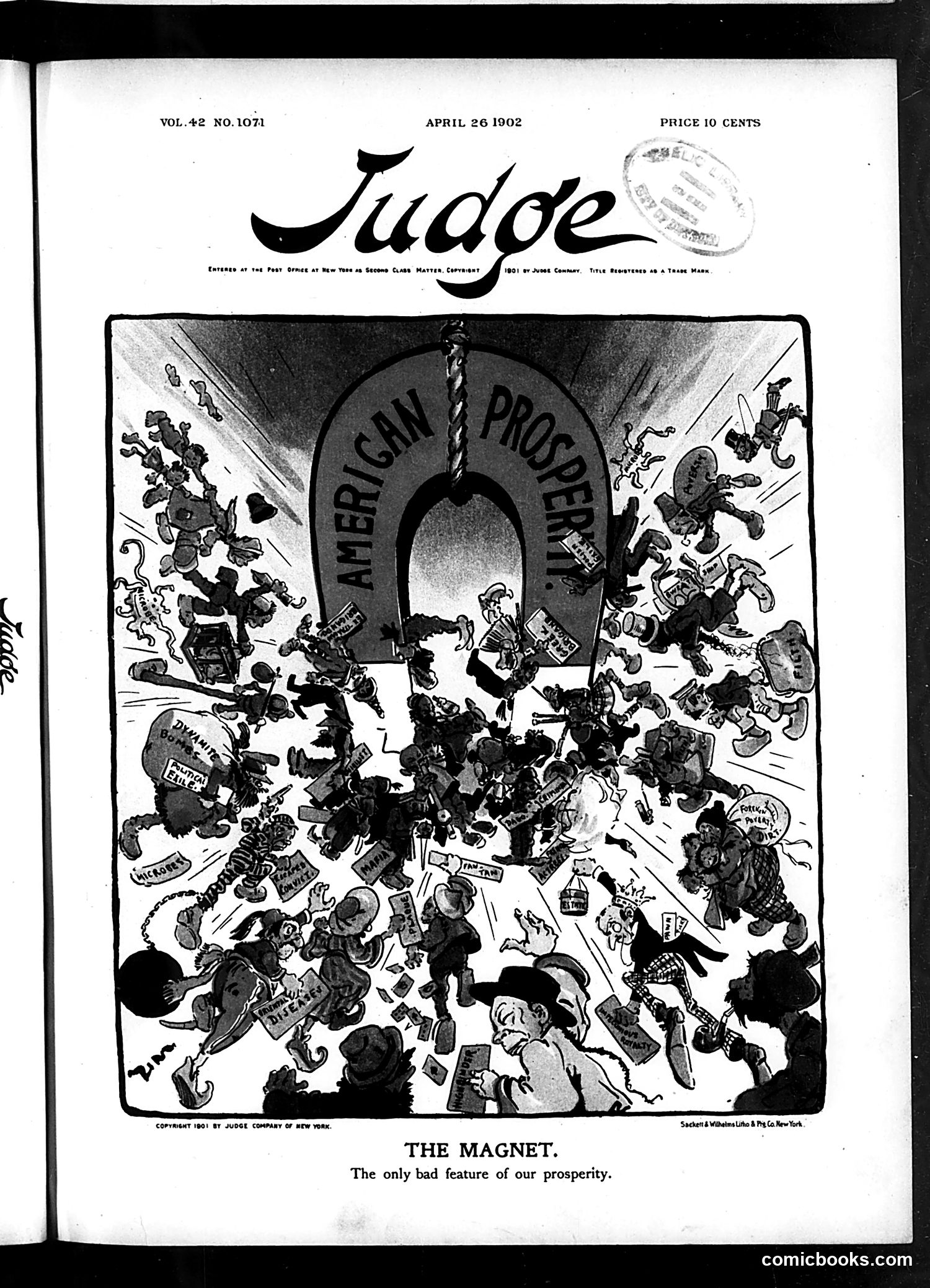
This political cartoon depicts American prosperity as a large magnet attracting various figures and objects—likely representing both desirable outcomes (wealth, commerce, industry) and problematic ones (corrupt politicians, speculators, or social elements). The caption states: "The only bad feature of our prosperity." The satire suggests that while America's economic boom around 1902 brought genuine benefits, it also attracted undesirable characters and behaviors—corruption, greed, or exploitation. The magnet metaphor implies that prosperity acts indiscriminately, drawing both legitimate enterprise and moral hazards. The cartoon critiques the dark side of the Gilded Age prosperity, suggesting that rapid economic growth inherently attracts unsavory elements to society.
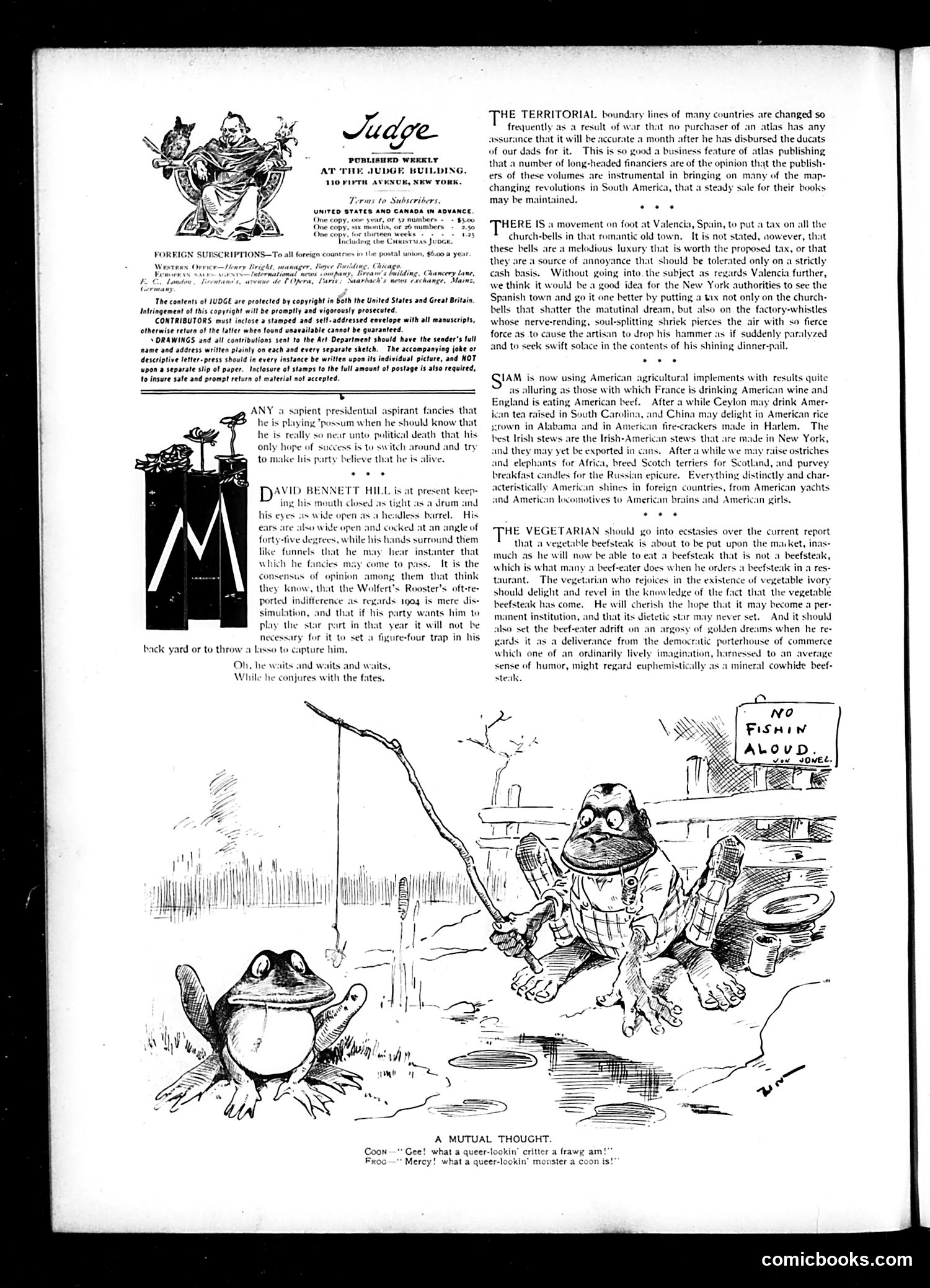
This page from *Judge* magazine contains editorial commentary and one cartoon titled "A Mutual Thought." The cartoon depicts a frog and what appears to be a toad or similar creature fishing. The frog (labeled "Coon") observes "Gee! what a queer-lookin' critter a frog am!" while the other creature (labeled "Frog") responds "Mercy! what a queer-lookin' monster a coon is!" The humor relies on mutual misperception—each animal finds the other strange while being equally unusual itself. This likely satirizes human tendency toward hypocrisy: criticizing others' peculiarities while remaining blind to one's own. The derogatory term "coon" in the label reflects period language, though the joke's actual target is self-awareness and double standards. The surrounding editorial text discusses territorial boundary changes from war, Spanish church taxation, and American agricultural exports to various nations.
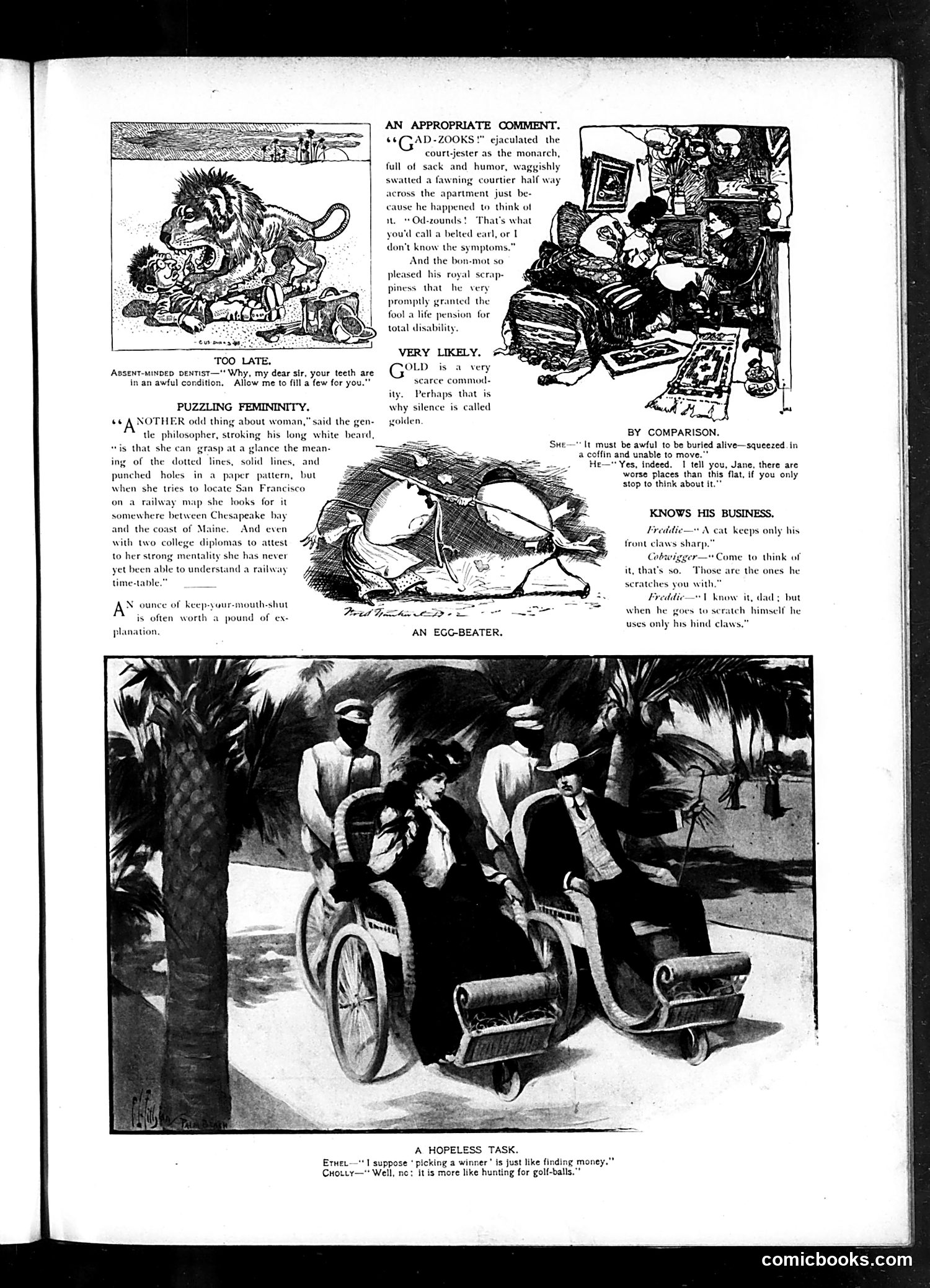
This page contains several unrelated humorous sketches and jokes typical of Judge magazine's satirical format. The cartoons include: 1. **"An Appropriate Comment"** - A lion (representing a monarch) is mocked as a "belted earl" by a courtier, satirizing royal pretension. 2. **"Puzzling Femininity"** - A philosophical observation about women's inscrutability, illustrated with a woman's face. This reflects early-20th-century gender stereotyping common to the era. 3. **"An Egg-Beater"** - A simple visual pun on the mechanical device. 4. **"A Hopeless Task"** - Shows men with steamrollers, apparently satirizing futile labor or an impossible endeavor (the specific reference is unclear). The page emphasizes Judge's characteristic blend of visual humor, wordplay, and social commentary aimed at educated readers of the period.
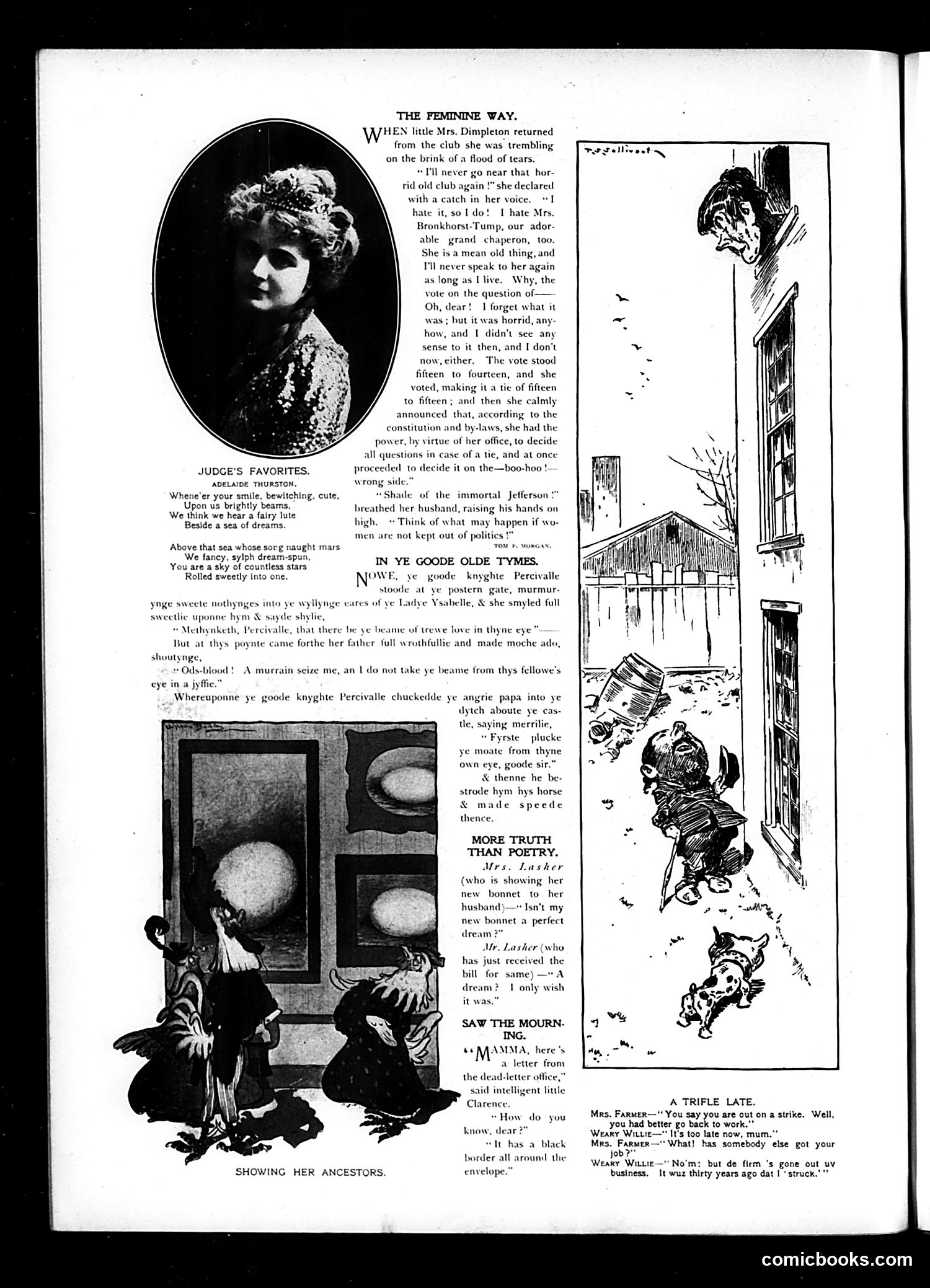
This page satirizes women's involvement in club governance and decision-making. The main narrative concerns Mrs. Dimpleton's dramatic exit from a club over a voting dispute regarding Mrs. Bronkhorst-Trump, whom she calls "a mean old thing." The satire mocks how women approach organizational power—specifically, Mrs. Dimpleton's emotional response to a procedural decision (a tie-breaking vote). The piece implies women handle authority with excessive dramatics rather than cool reasoning. Supporting content includes "Judge's Favorites" (Adelaide Thurston poem), "In Ye Goode Olde Tymes" (period satire), and "More Truth Than Poetry" (domestic humor about bonnets and bills). The overall message ridicules women's clubs as sites of petty conflict and overwrought emotional reactions to minor governance matters.
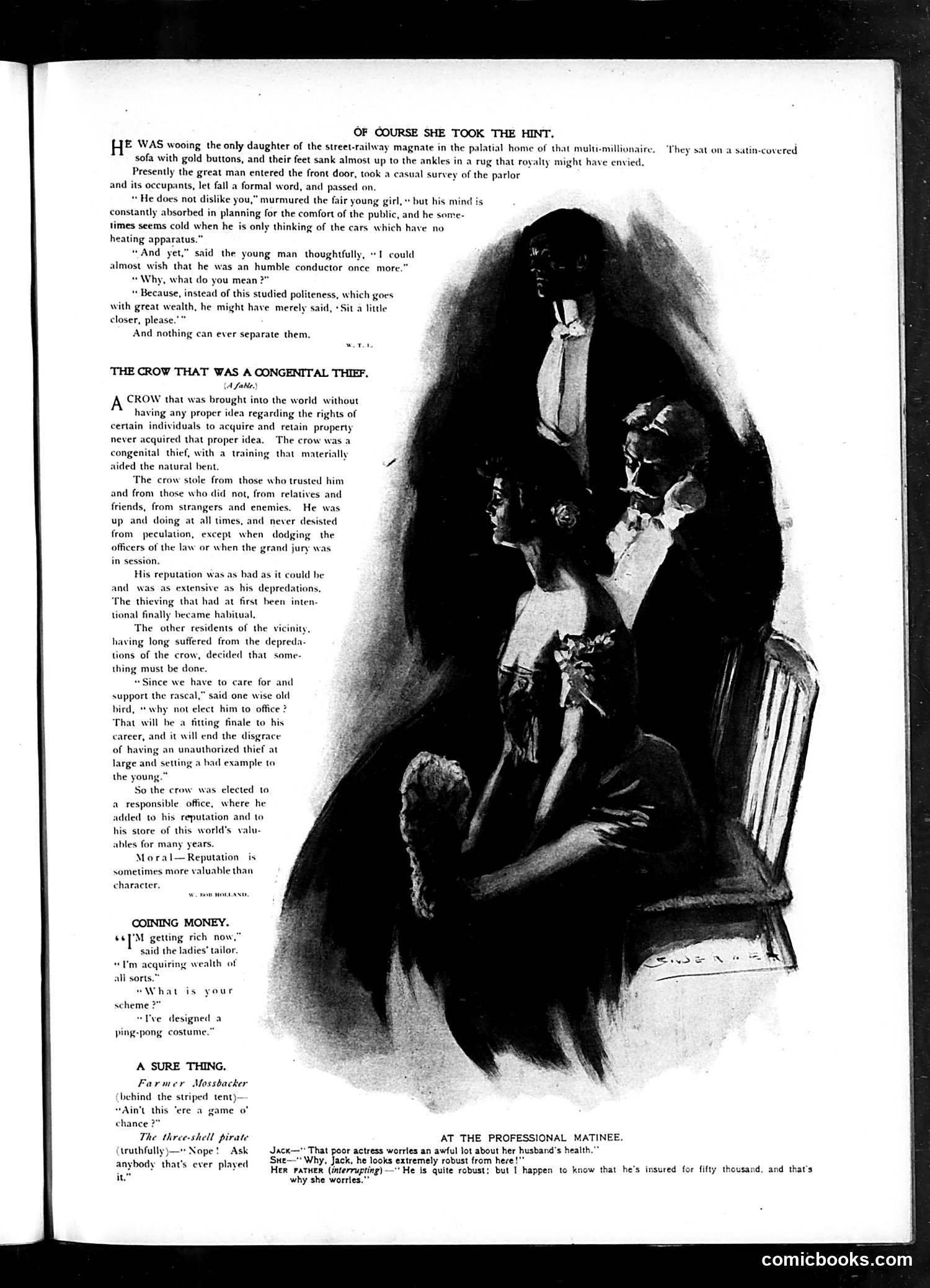
This page contains three distinct satirical pieces: **"Of Course She Took the Hint"** mocks wealthy industrialists' coldness. A street-railway magnate ignores his daughter's suitor, claiming preoccupation with "public comfort" and unheated cars. The joke satirizes how the rich use civic duty as cover for rudeness—implying the magnate would be warmer if genuinely focused on the public rather than self-interest. **"The Crow That Was a Congenital Thief"** is political allegory. A corrupt crow who steals constantly gets elected to office, where he continues stealing legally. The moral—"Reputation is sometimes more valuable than character"—critiques how politicians with bad reputations still gain power and respectability through official position, effectively legalizing their corruption. **Smaller items** include jokes about a tailor "coining money" with ping-pong costumes, and an actress whose wealthy husband's large insurance policy explains her anxious concern for his health—implying mercenary motives. The page overall satirizes wealth, corruption, and hypocrisy among the privileged classes.
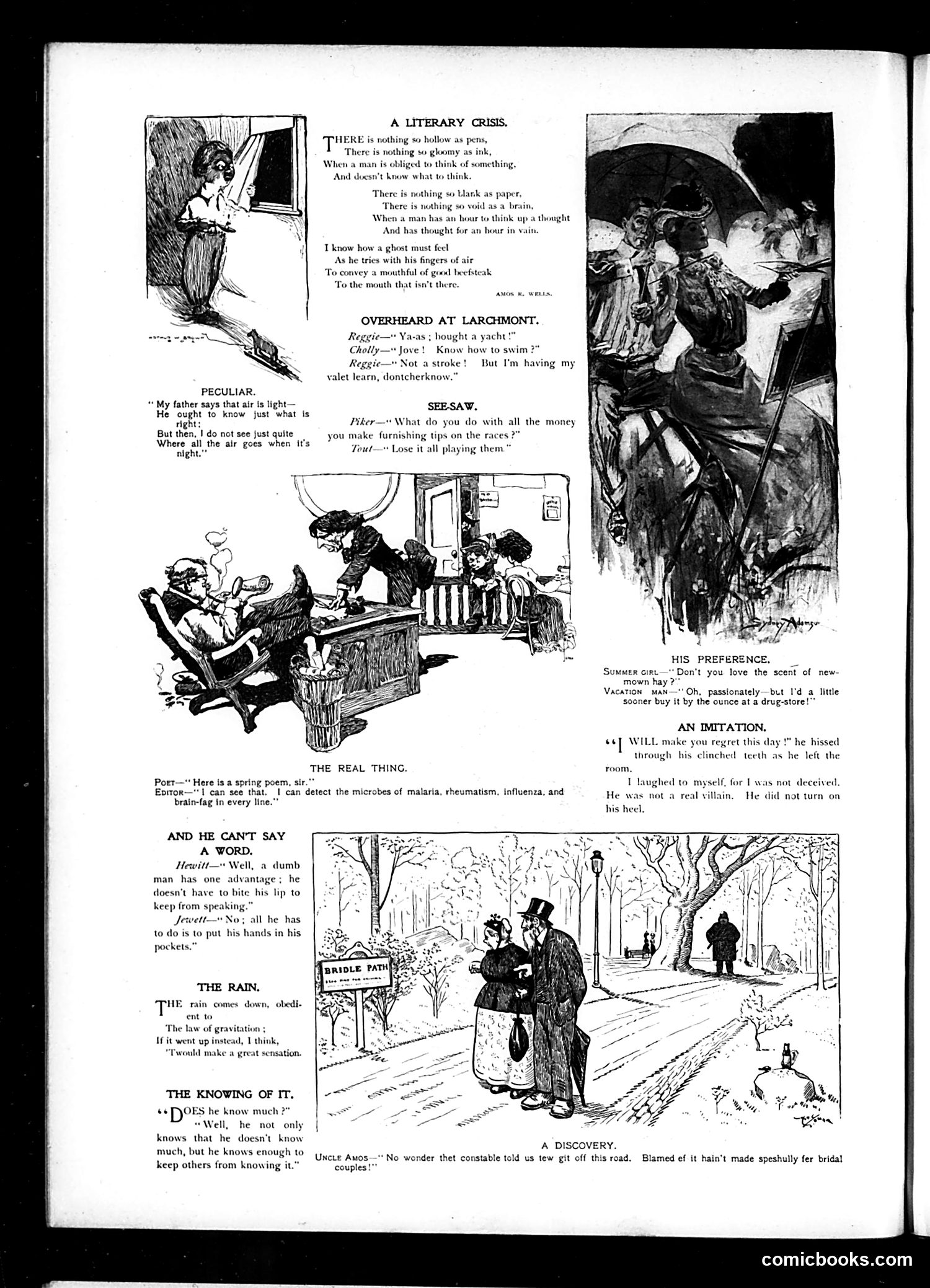
This page collects humorous short pieces typical of early 20th-century satirical magazines. The content spans social observation and wordplay rather than specific political cartoons. Notable items include "A Literary Crisis," which mocks writers struggling with blank pages and writer's block—a self-referential jab at the magazine's own contributors. "Overheard at Larchmont" satirizes wealthy yacht owners who hire help to do the actual work. "See-Saw" jokes about gamblers who lose money on horse racing tips. Several pieces target pretension: a "vacation man" preferring bottled hay-scent from a drugstore to genuine nature; a character imitating a villain ineffectually. The final cartoon features "Uncle Amos," a dialectal character (likely a racist stereotype common to period humor), commenting on a road's condition. The overall tone reflects era-specific humor about leisure-class excess, urban sophistication, and working-class observations—with minimal political content, focusing instead on universal human follies.
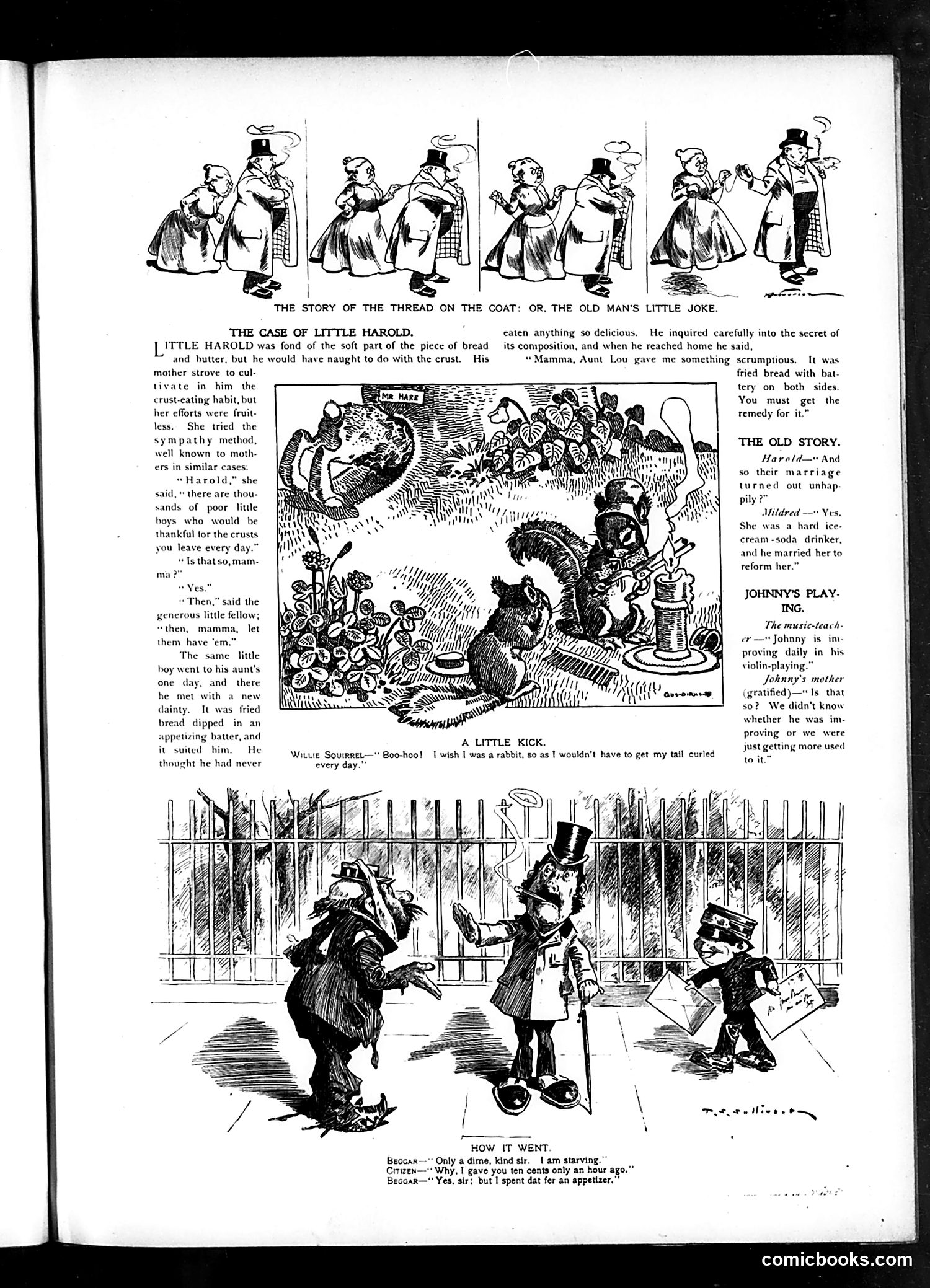
This page collects several brief humorous anecdotes typical of late 19th/early 20th-century American humor magazines. The stories mock social pretensions and child psychology: **"Little Harold"** satirizes mothers' failed attempts to teach children thrift through guilt ("poor children would be grateful"). Harold's solution—having poor children eat his unwanted crusts—mocks naive charitable thinking. **"The Old Story"** uses a brief marriage joke: a man marries a "hard ice-cream soda drinker" hoping to reform her, implying he fails—a dig at naive reformist sentiment. **"Johnny's Playing"** plays on parental self-deception; his mother assumes improving music means the child is getting better, when neighbors are simply "getting more used to it." **"How It Went"** mocks beggars' excuses: one claims a dime gift was spent on an "appetizer"—satirizing both panhandler dishonesty and absurd rationalizations. The cartoons and dialogue target middle-class hypocrisy, failed moralizing, and self-delusion—Judge's typical satirical targets.
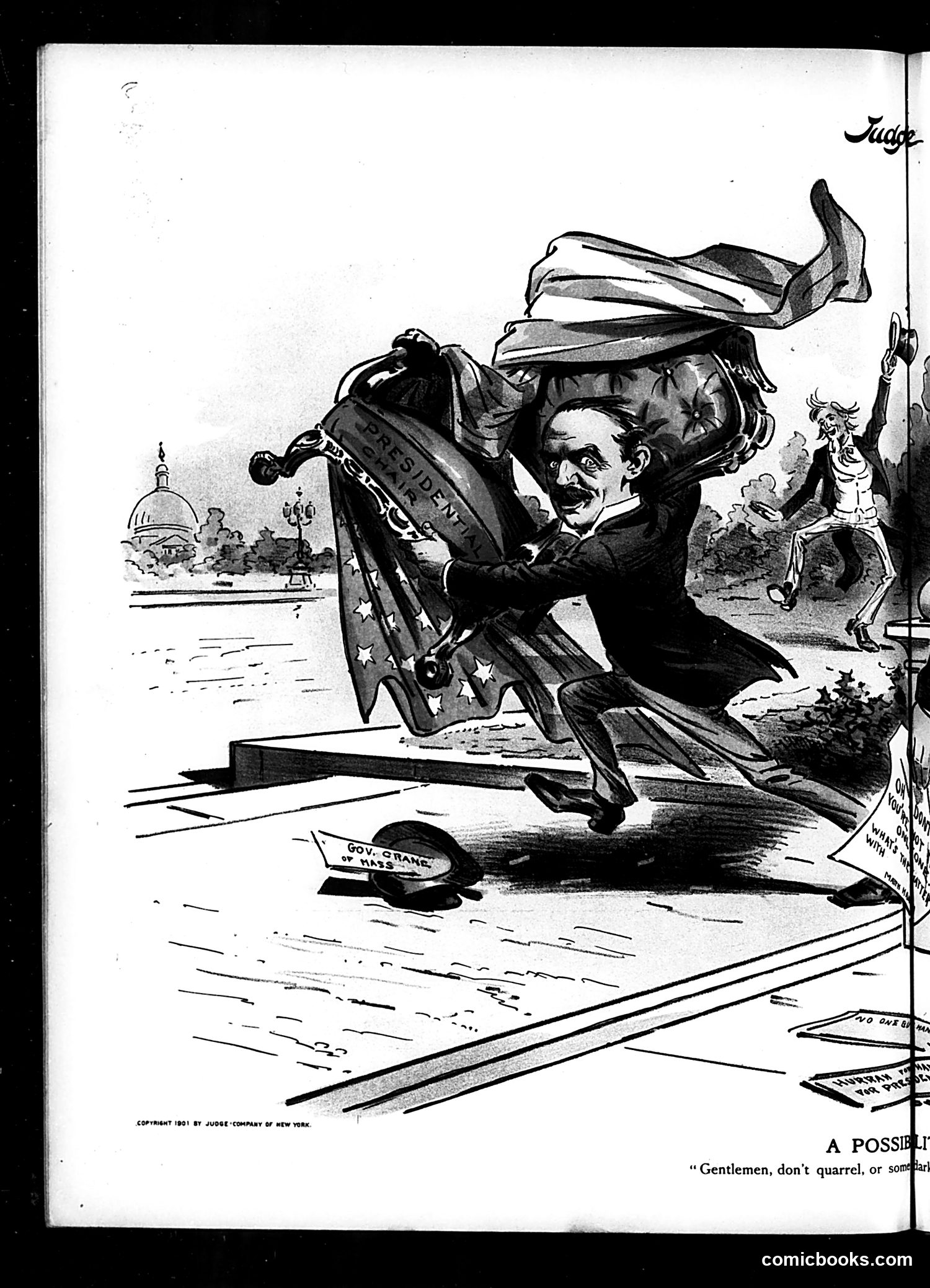
This 1901 Judge cartoon titled "A Possible..." depicts a man in formal dress frantically juggling an American flag labeled "President" while surrounded by chaos. A dome (likely the Capitol) appears in the background. The figure appears to be Governor O'Brien (visible on a label), who seems overwhelmed managing the presidency. The satire likely concerns succession or presidential ambitions—O'Brien apparently aspires to or might assume the presidency, but the cartoon suggests he's unprepared for the role's demands. The juggling motif implies the presidency requires difficult balancing acts he may bungle. The incomplete caption ("don't quarrel, or som...") suggests competing political factions were fighting over his candidacy or the office itself. Without the full text or specific date context, the exact political situation remains unclear, but this appears satirizing someone's questionable readiness for high office.
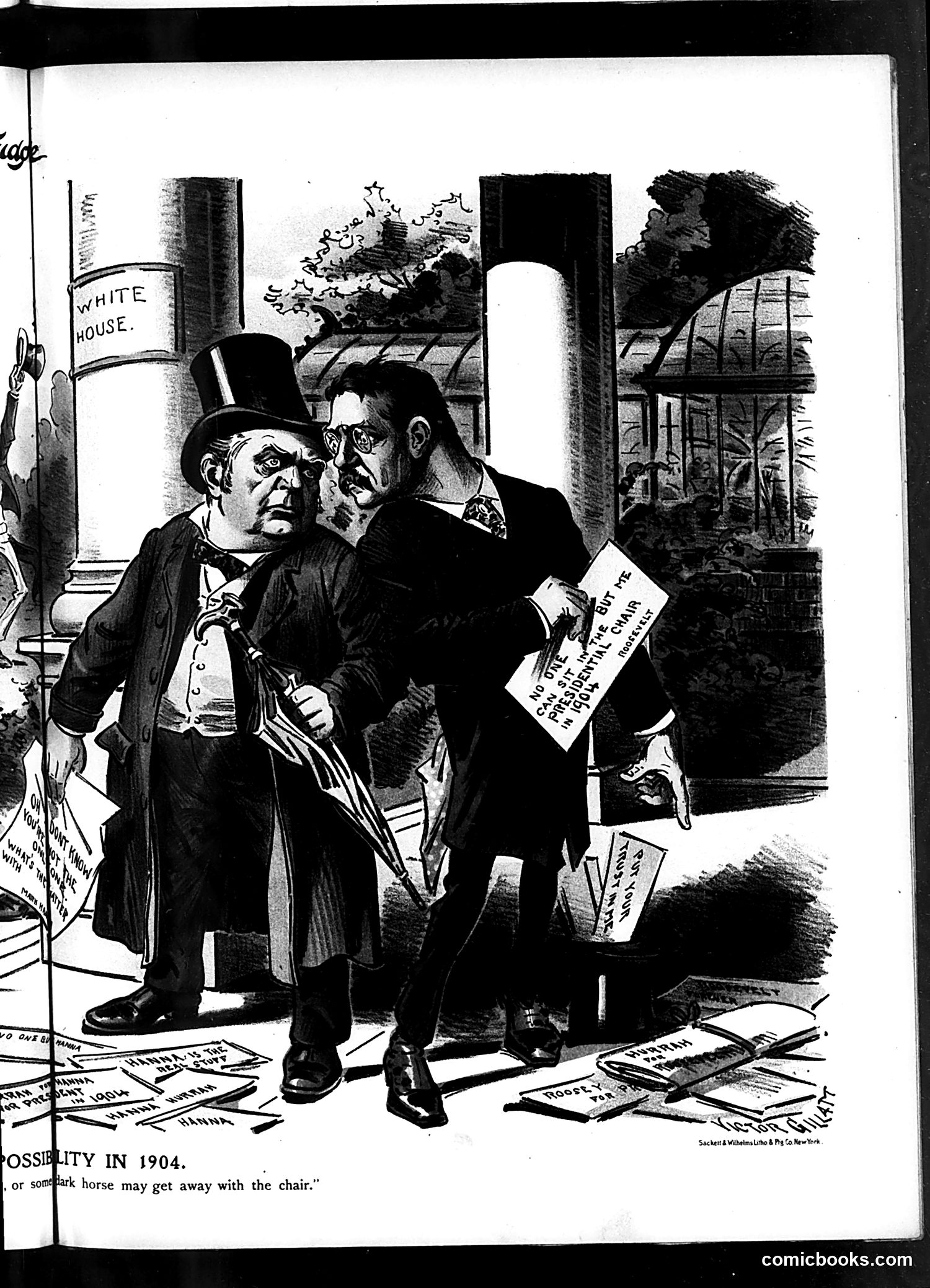
This 1904 Judge magazine cartoon depicts two men in formal dress outside the White House, surrounded by scattered papers. One figure wears a top hat and appears distressed; the other leans in conspiratorially, holding a document. The caption references "POSSIBILITY IN 1904" and mentions "some dark horse may get away with the chair," suggesting speculation about the 1904 presidential election. The scattered papers and White House setting indicate political maneuvering. The "dark horse" reference suggests uncertainty about unexpected political candidates or backroom dealing during campaign season. Without clearer identification of the specific figures or complete caption text, I cannot definitively name the individuals portrayed or specify which political actors or events are being satirized, though the cartoon clearly mocks electoral intrigue and insider politics of that era.
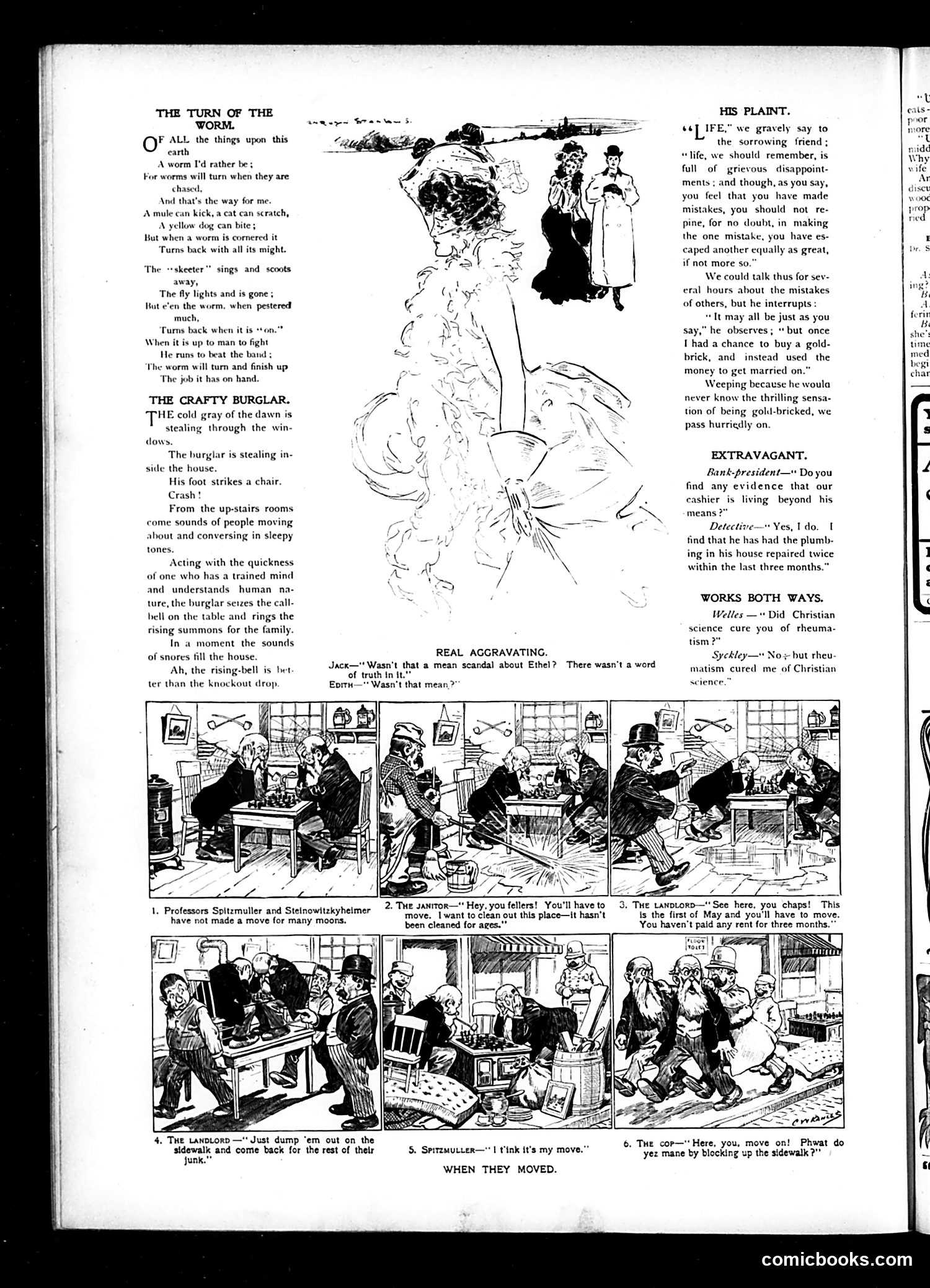
This page contains several humorous pieces satirizing early 20th-century American life: **"The Turn of the Worm"** is a poem praising worms for their backbone—they "turn" when cornered, unlike humans who "run to beat the band" when facing conflict. It's social commentary on cowardice. **"The Crafty Burglar"** depicts a clever thief who rings the household's wake-up bell, causing residents to assume it's morning and return to sleep, allowing him to rob undisturbed. It's a joke about outsmarting people through psychology. **The multi-panel comic "When They Moved"** shows two apparently vagrant professors repeatedly evicted—by janitor, landlord, and police—with the final panel showing one saying "I t'ink it's my move," suggesting they're playing checkers through it all. It satirizes homeless individuals or bohemian academics. **"Real Aggravating," "His Plaint," "Extravagant,"** and **"Works Both Ways"** are brief joke exchanges mocking human nature—scandal-mongering, complaining about missed opportunities, extravagance, and religious hypocrisy respectively. The page represents Judge's typical early-1900s satirical blend of social observation and wordplay humor.
This page is primarily **advertising**, with brief satirical exchanges at the top. The opening dialogue mocks Native American stereotypes, featuring a "Chief Man-who-eats-salt-horse" and "Thunder-in-the-middle-of-the-afternoon"—caricatured indigenous figures speaking in broken English ("Ugh!"). The joke concerns whether a squaw must carry firewood or "firewater" (alcohol)—playing on period racist tropes about Native Americans and alcohol. Below this are two brief joke exchanges: one about "Miss Pole" being cold-hearted, another about a woman sitting on unsold cough medicine as a bargain. The remainder is **period advertising**: liquor (Evans Ale, Chartreuse, Maryland Club Rye), tonics (Dr. Siegert's Angostura Bitters), garters, pianos, and life insurance. These ads reflect early 20th-century consumer culture and the patent medicine boom. The page's satirical content is minimal; it primarily served as a revenue vehicle through advertisements.
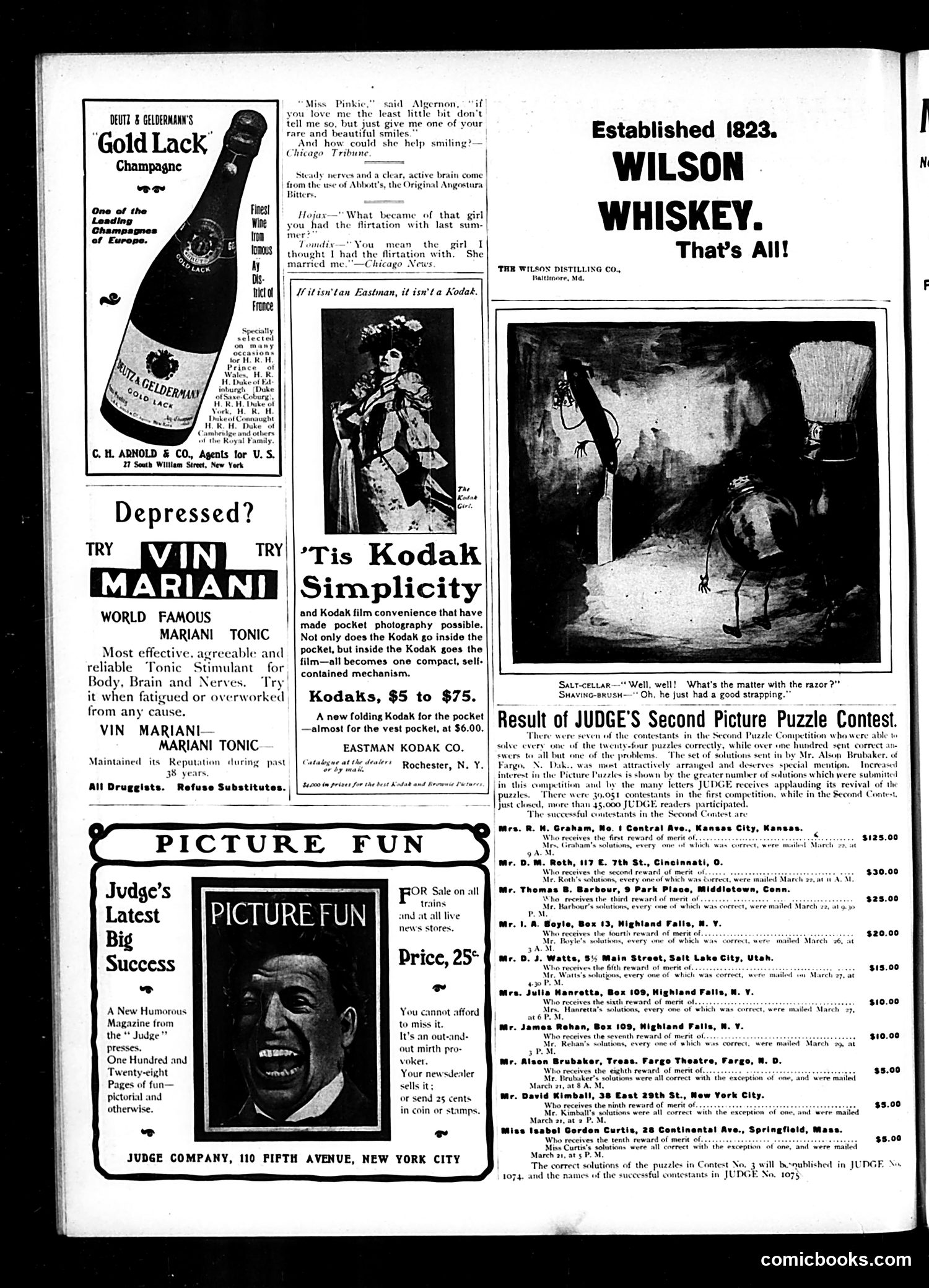
This page is primarily **advertising and contest results**, not political satire. The content includes: **Advertisements:** Multiple product pitches typical of early 1900s magazines—Gold Lack Champagne, Vin Mariani tonic (a cocaine-wine product marketed as a nerve stimulant), Kodak cameras, and Wilson Whiskey. These ads reflect period consumer goods and dubious medical claims. **Comic vignettes:** Brief, mild romantic/domestic humor (a man complimenting a woman's smile; confusion about which girl a man flirted with; a joke about a razor needing "strapping"). **Main content:** Results of Judge magazine's "Second Picture Puzzle Contest," listing winners and prize amounts ($125–$5), with their locations and solution accuracy. The page reflects Judge's function as entertainment and advertising vehicle rather than satirical commentary. The humor is gentle, domestic, and non-political.
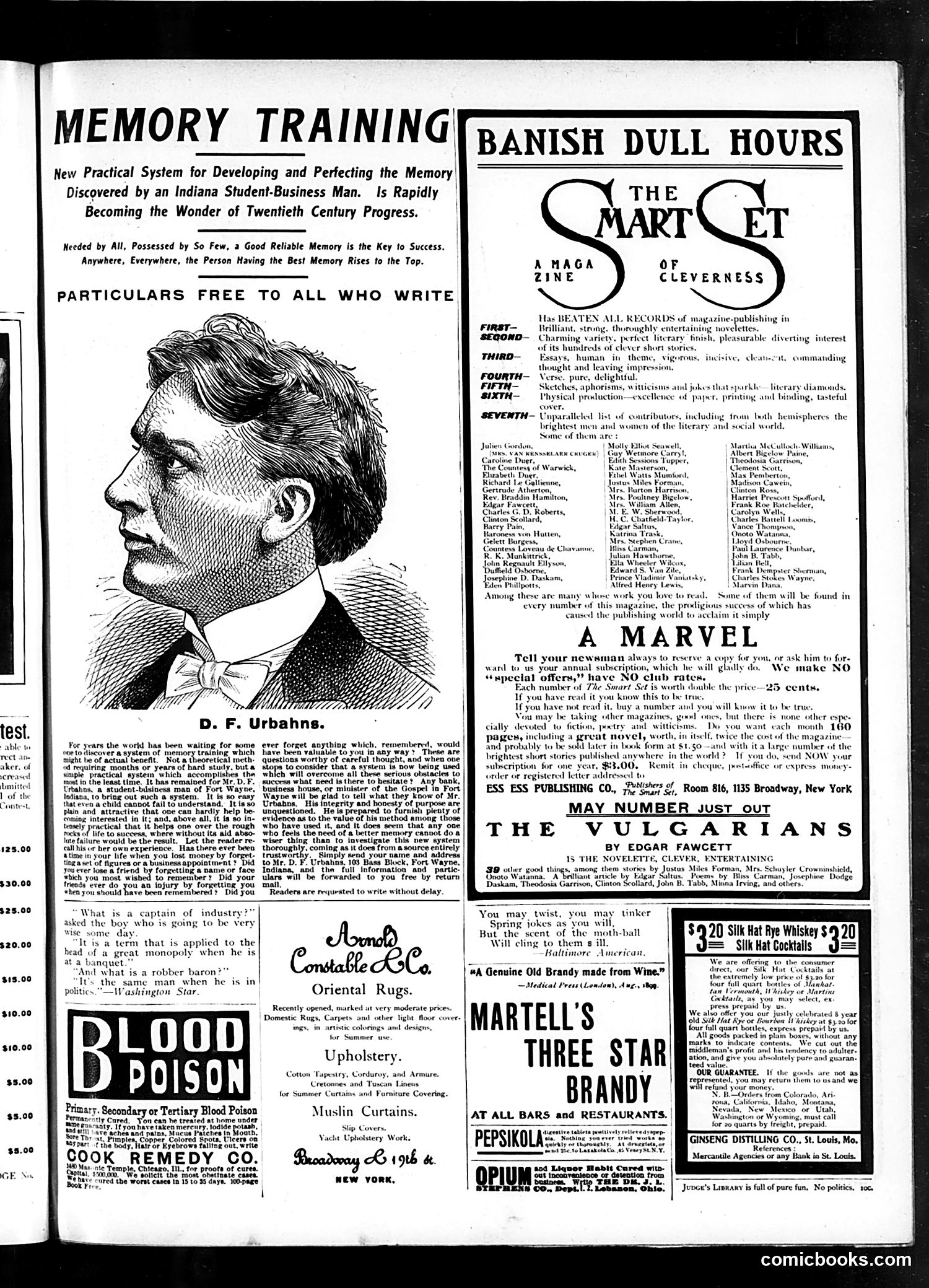
This appears to be a **mixed advertising and editorial page** from Judge magazine (early 20th century). The main content is a lengthy advertisement for a memory-training system by one D.F. Urbahns of Fort Wayne, Indiana—a "practical system" promising to improve memory for business and personal success. It relies on testimonials and appeals to readers' regrets about forgotten names, missed appointments, and lost money. The page includes a small **satirical joke** beneath an illustration: defining "captain of industry" as a monopoly head at a banquet, and "robber baron" as the same man in politics—mocking wealthy industrialists' dual reputation as both business titans and corrupt politicians (a common Progressive Era critique). The remaining space is filled with advertisements for **patent medicines** (blood poison treatment), rugs, liquor, and other goods typical of the era. The "Memory Training" feature itself is essentially advertising disguised as editorial content.
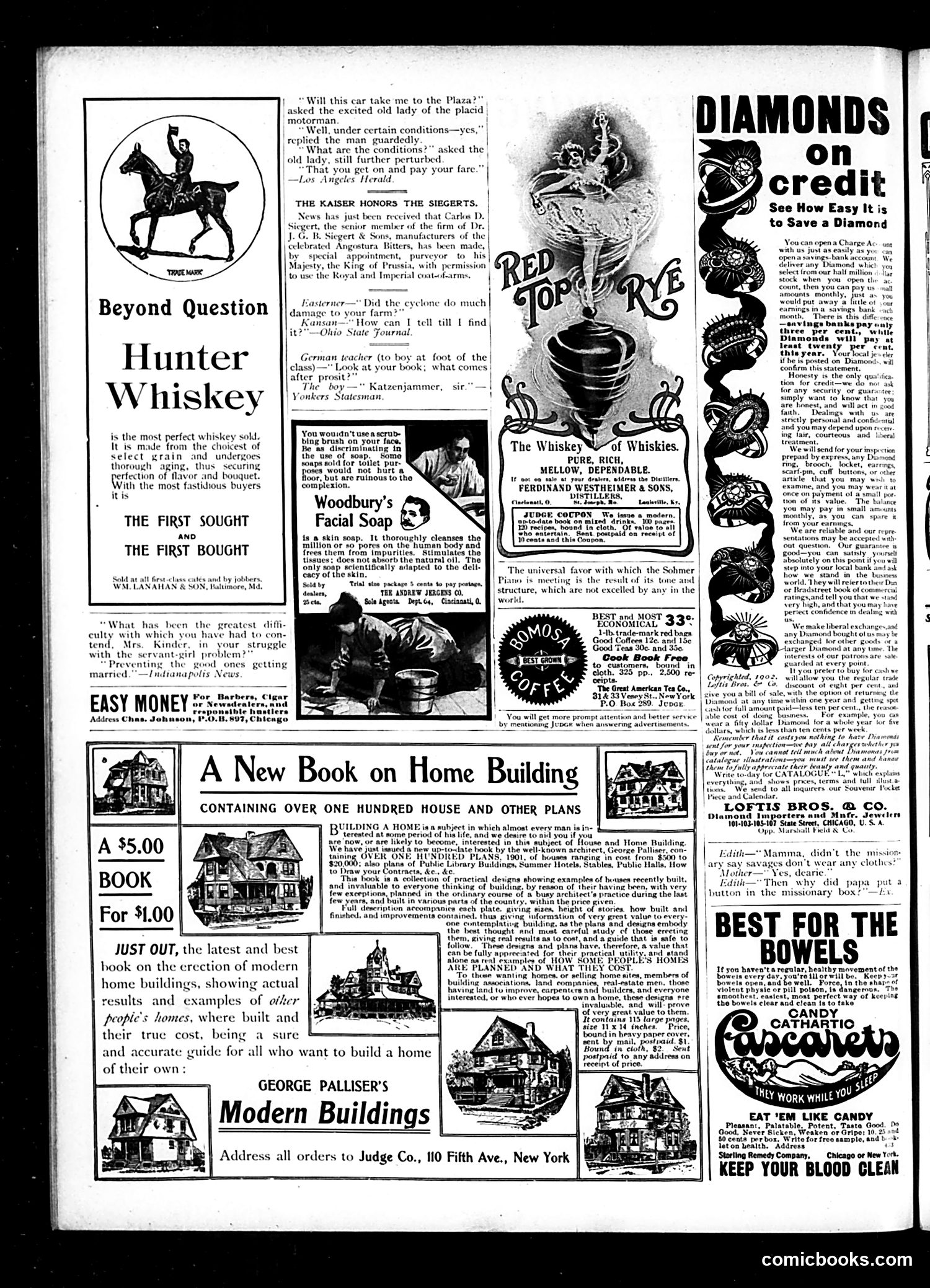
This is primarily an **advertising page** from Judge magazine, not a satirical cartoon section. The page contains product advertisements and promotional content typical of early 1900s publications. **Notable content includes:** - **Hunter Whiskey ad**: Claims it's "the most perfect whiskey sold," emphasizing quality grain and aging - **Woodbury's Facial Soap**: A skin cleansing product advertisement - **Red Top Rye whiskey**: Featured prominently with decorative imagery - **Diamonds on Credit**: A financial services ad promising easy diamond purchasing through monthly payments - **Home Building Book**: George Palliser's architectural guide advertising over 100 house plans - **Miscellaneous ads**: Coffee, candy, and blood purification products **Small satirical items** appear scattered throughout—brief joke snippets about motormen, servants, and German teachers—but these are minor filler content rather than the page's focus. The page reflects **early 1900s consumer culture**, with emphasis on credit purchasing, personal grooming products, and home ownership as achievable goals for middle-class readers.
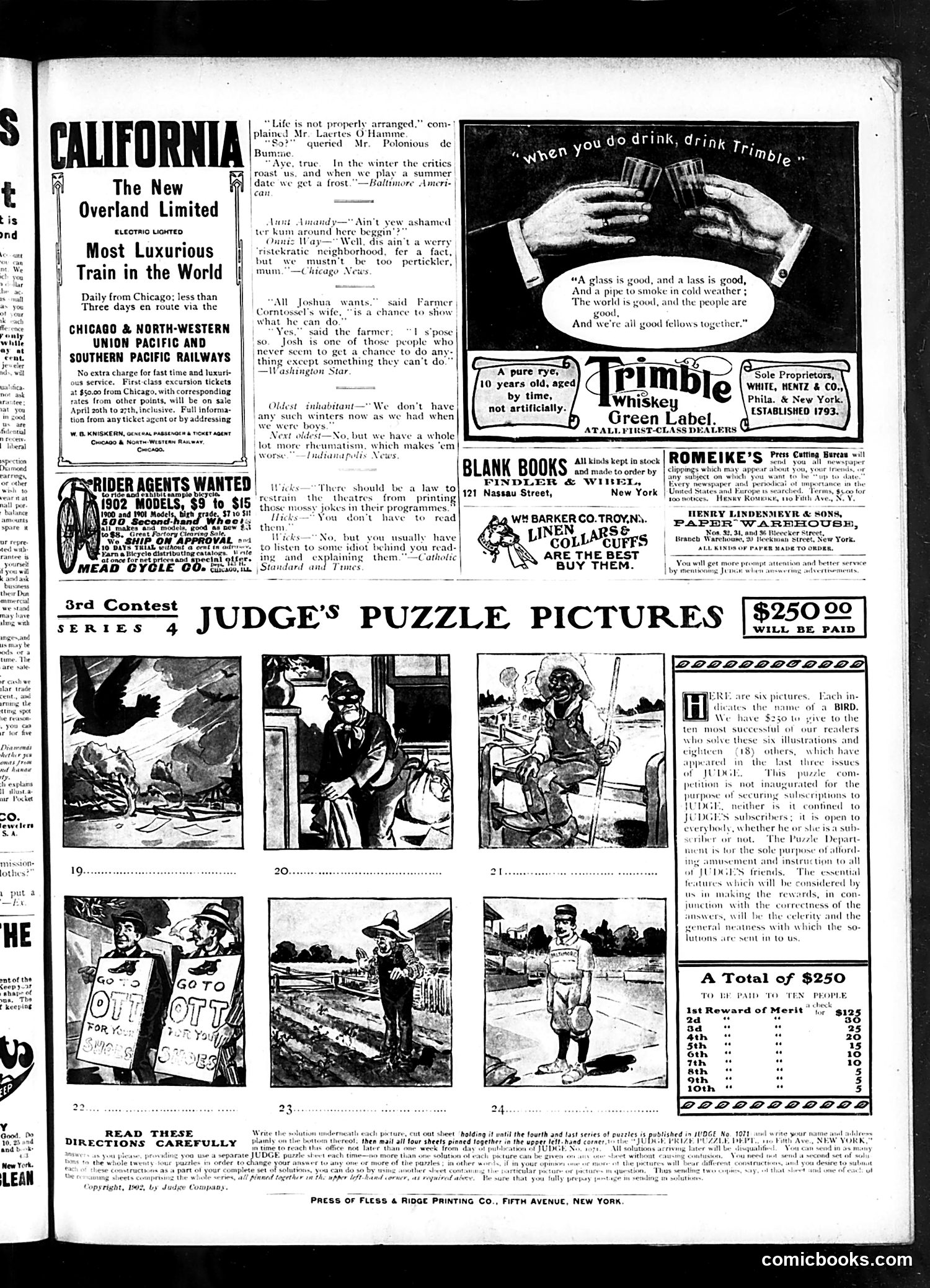
This page is primarily **advertising and contest content** rather than political satire. The dominant feature is "Judge's Puzzle Pictures," Series 4, offering $250 total in prizes for readers who identify six birds from illustrations. The page includes various advertisements (Overland Limited trains, Trimble Whiskey, blank books, shirt collars) and scattered brief comic anecdotes about theatrical criticism, neighborly relations, and weather nostalgia—typical light humor filler for a satirical magazine. One notable ad features the slogan **"when you do drink, drink Trimble"** with an illustration of clinking glasses, promoting a whiskey brand using social bonding imagery common to early 1900s advertising. The theatrical references (mentions of "Laertes O'Hamme" and "Polonius") appear to be literary allusions rather than current political commentary. Overall, this is a mundane magazine page mixing advertisements with a reader participation puzzle contest—the bread-and-butter content that funded publications like *Judge*.
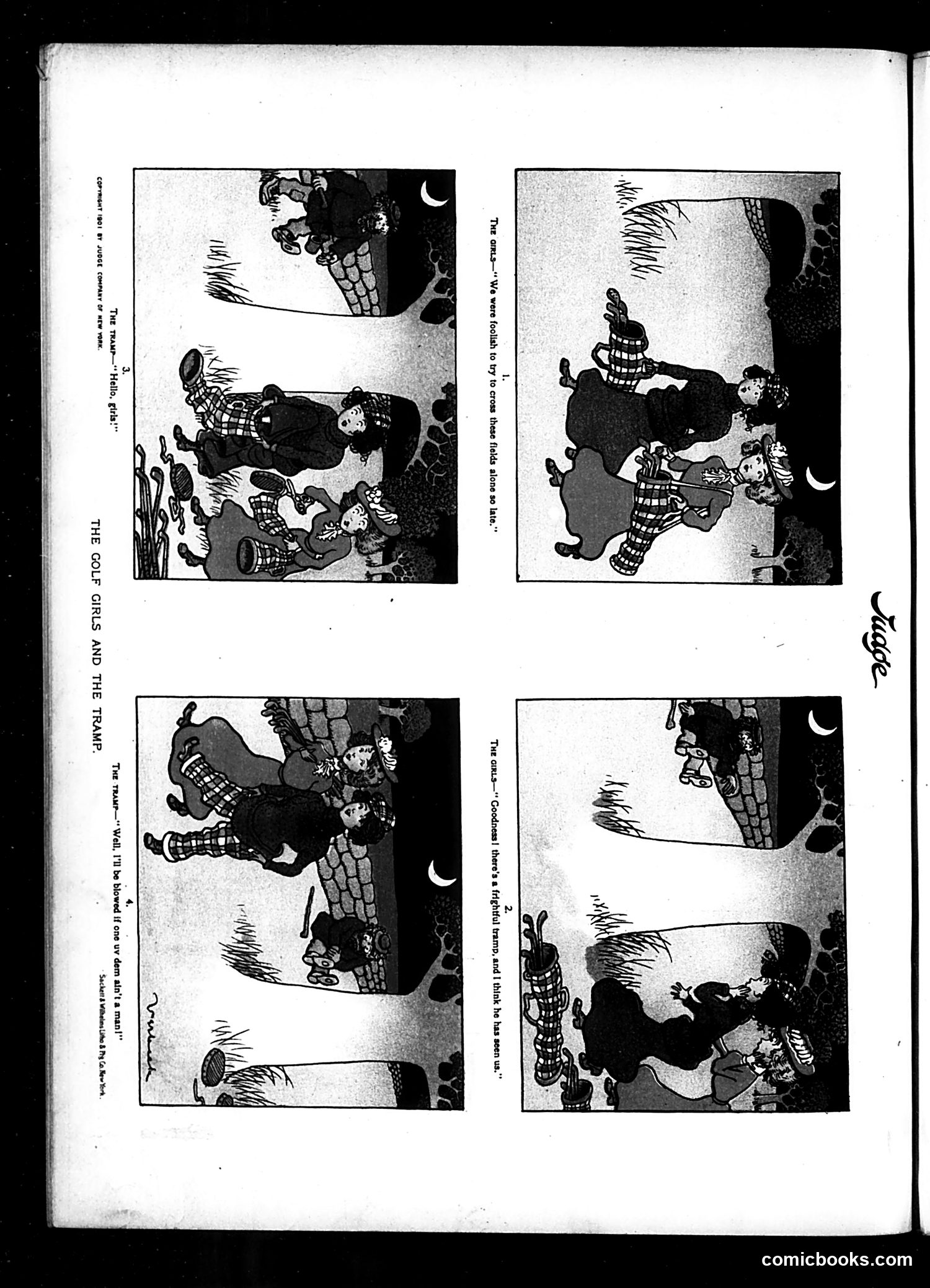
This is a four-panel sequential comic strip depicting a nighttime encounter between two figures (identified as "the girls") and a tramp on a rural road. The humor relies on mutual surprise and mistaken identity. **The Setup**: Two people are crossing fields at night and spot what they fear is a dangerous vagrant. They're clearly frightened. **The Punchline**: The "tramp" is equally shocked, exclaiming "Well, I'll be blowed if one uv dem ain't a man!" — suggesting he mistook both figures for women until discovering one is actually male. **The Satire**: This appears to be satirizing either gender presentation or cross-dressing of the era. The joke's shock value depends on one figure's unexpected masculinity being revealed. **Context for Modern Readers**: This reflects early 1900s attitudes toward gender presentation and the surprise/comedic value of such reveal humor, which would have been considered daring satire in Judge's satirical tradition.