
Judge, 1902-04-26 · page 7 of 16
Judge — April 26, 1902 — page 7: what you’re looking at
What you’re looking at
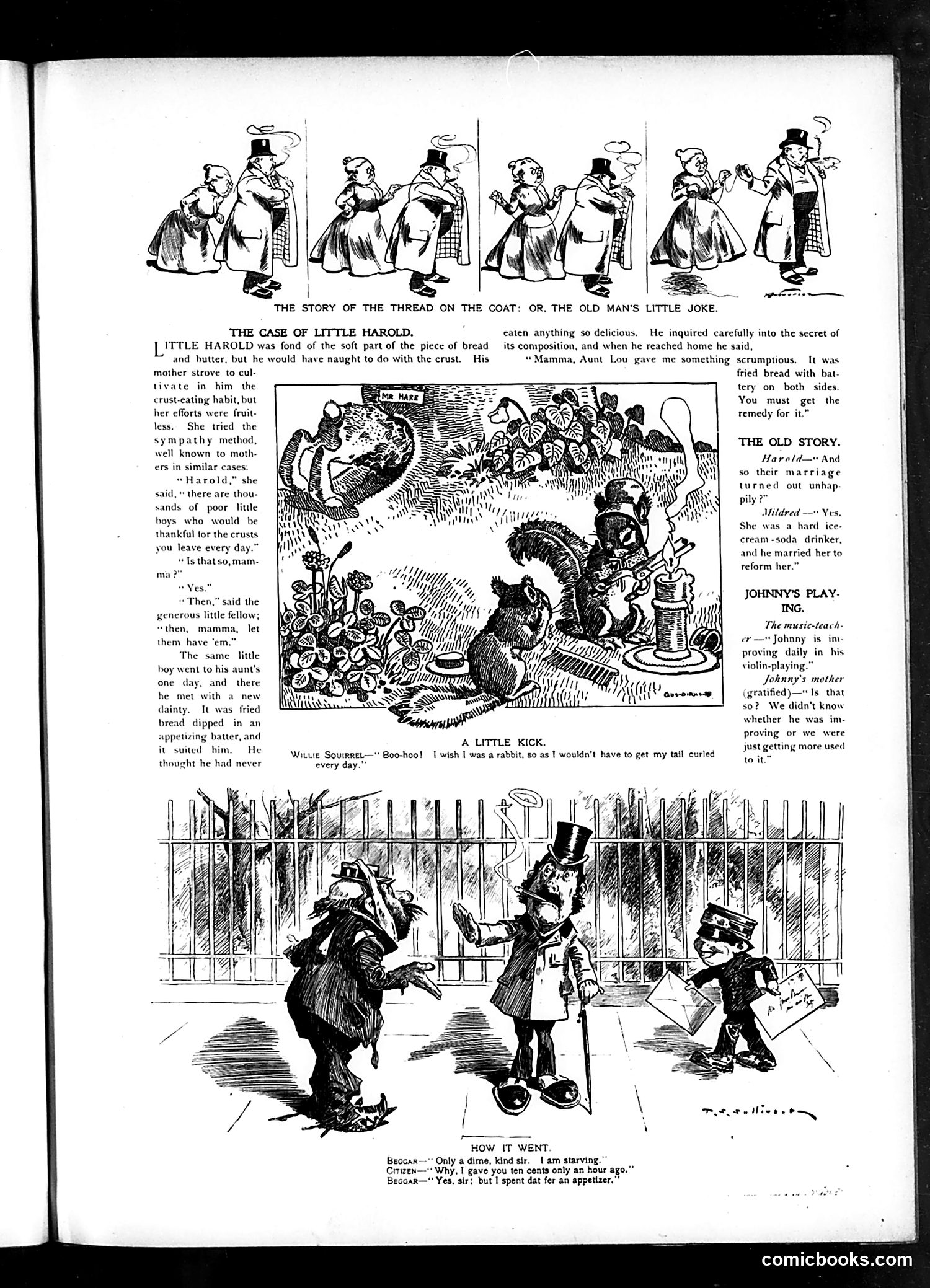
This page collects several brief humorous anecdotes typical of late 19th/early 20th-century American humor magazines. The stories mock social pretensions and child psychology: **"Little Harold"** satirizes mothers' failed attempts to teach children thrift through guilt ("poor children would be grateful"). Harold's solution—having poor children eat his unwanted crusts—mocks naive charitable thinking. **"The Old Story"** uses a brief marriage joke: a man marries a "hard ice-cream soda drinker" hoping to reform her, implying he fails—a dig at naive reformist sentiment. **"Johnny's Playing"** plays on parental self-deception; his mother assumes improving music means the child is getting better, when neighbors are simply "getting more used to it." **"How It Went"** mocks beggars' excuses: one claims a dime gift was spent on an "appetizer"—satirizing both panhandler dishonesty and absurd rationalizations. The cartoons and dialogue target middle-class hypocrisy, failed moralizing, and self-delusion—Judge's typical satirical targets.
📄 Transcribed text from this page (OCR, searchable)
Machine-transcribed from the original scan — historical spelling and the odd misread are preserved.
THE STORY OF THE THREAD ON THE COAT: OR, THE OLD MAN'S LITTLE JOKE. ‘THE CASE OF LITTLE HAROLD. eaten anything so delicious. He inquired carefully into the secret of LITTLE HAROLD was fond of the soft part of the piece of bread _ its composition, and when he reached home he said, and butter, but he would have naught to do with the crust. His mother strove to cul- tivate in him the crust-eating habit, but her efforts were fruit- less. She tried the sympathy method, & 7 d y ; \ c THE OLD STORY. well known to moth- J ; : f Iu int ni Harold— And ers in similar cases. : ? ¢g Ait) Nay so their marriage “Harold,” she =" we) 0 turned out unhap- said,“ there are thou- Ae SSS Ty Wey . i sands of poor little — FAANSN RRs ey . of por WT h TUNA Wye: Mildred — Ves. hoys who would be fata": \ tae Tl 7 : She was a hard ice- thankful for the crusts Nees cream-soda drinker, you leave every day Me R 2 ; and he married her to s that so,mam- . y g reform her.” “Mamma, Aunt Lou gave me something scrumptious. It was fried bread with bat- tery on both sides. You must get the remedy for it.” Br / y Ee b JOHNNY'S PLAY- * said the ft 7) Wj, 5 I xenerous little fellow; St is ay : “then, mamma, let o § them have ‘em.” The music-teach er —"Johnny is im- proving daily in his violin-playing.” Johnny's mother gratified) —" Is that so? We didn’t know whether he was im- proving or we were The same little hoy went to his aunt's one day, and there he met with a new dainty. It was. fried bread dipped in an appetizing batter, and xe ek it suited him. He just getting more used Witure Sourrret—"* Boo-hoo! | wish | was a rabbit, so as 1 wouldn't have to get my tail curled thought he had never every day.” HOW IT WENT. Beocax—-"* Only a dime, kind sir. I am starving. Crrizen—: Why, | gave you ten cents only an hour ago."* Becoar—"' Yes, sir; but | spent dat fer an appetizer.” comicbooks.com