
A complete issue · 16 pages · 1902
Judge — April 12, 1902
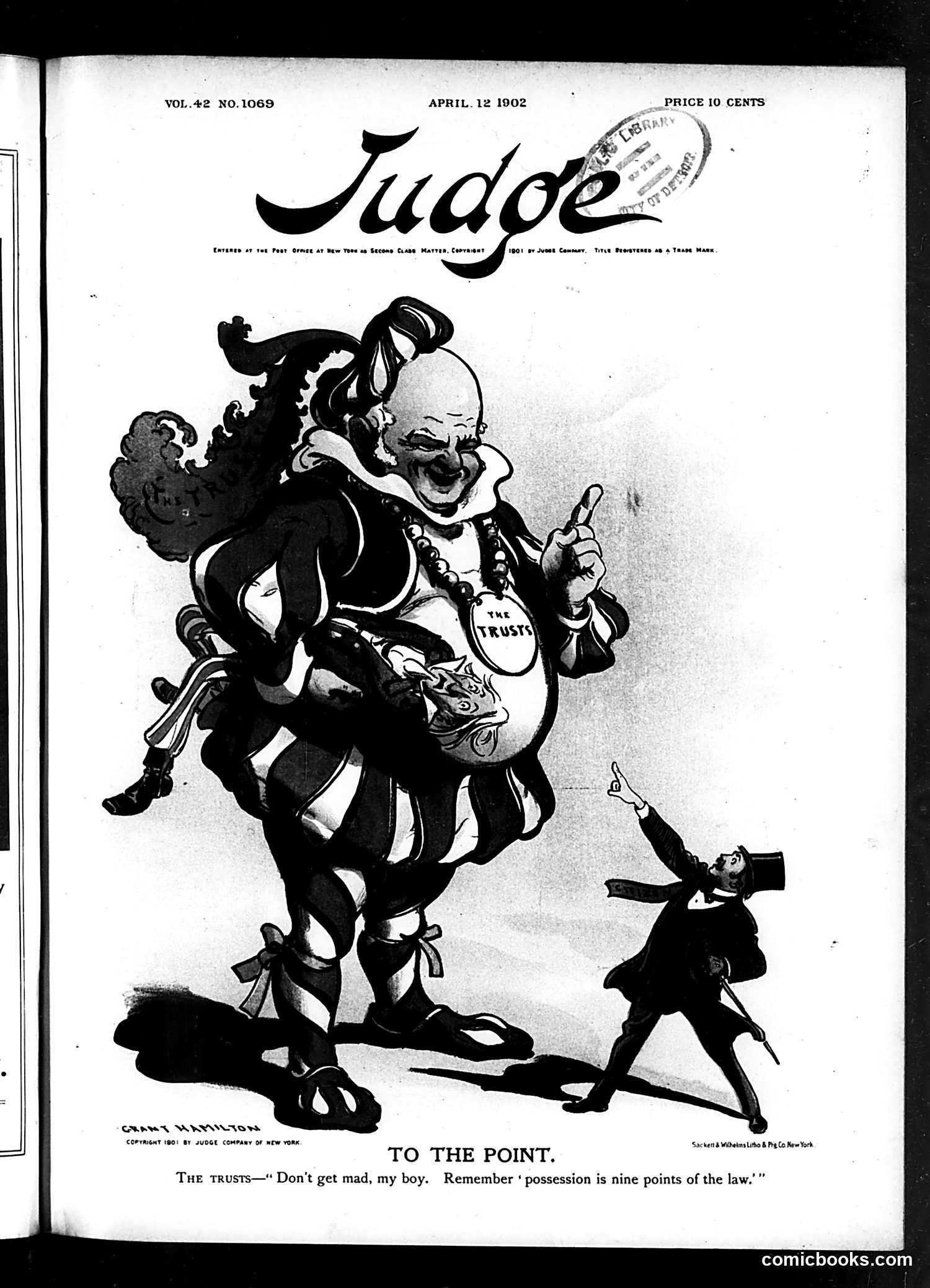
This Judge magazine cover from April 12, 1902 depicts a bloated, wealthy figure labeled "The Trusts" riding on the shoulders of a smaller man (likely representing the common citizen or worker). The trust magnate clutches a bag marked "The Trust" while a tiny figure below gestures in protest. The caption reads: "Don't get mad, my boy. Remember 'possession is nine points of the law.'" The cartoon satirizes the growing power of monopolistic business trusts in early 1900s America. It argues that wealthy industrialists had effectively seized control through legal maneuvering, leaving ordinary citizens powerless to resist. The "possession is nine points of the law" phrase ironically suggests that once trusts controlled the economy, legal remedies were futile—a critique of both corporate power and the inadequacy of existing laws to restrain it.
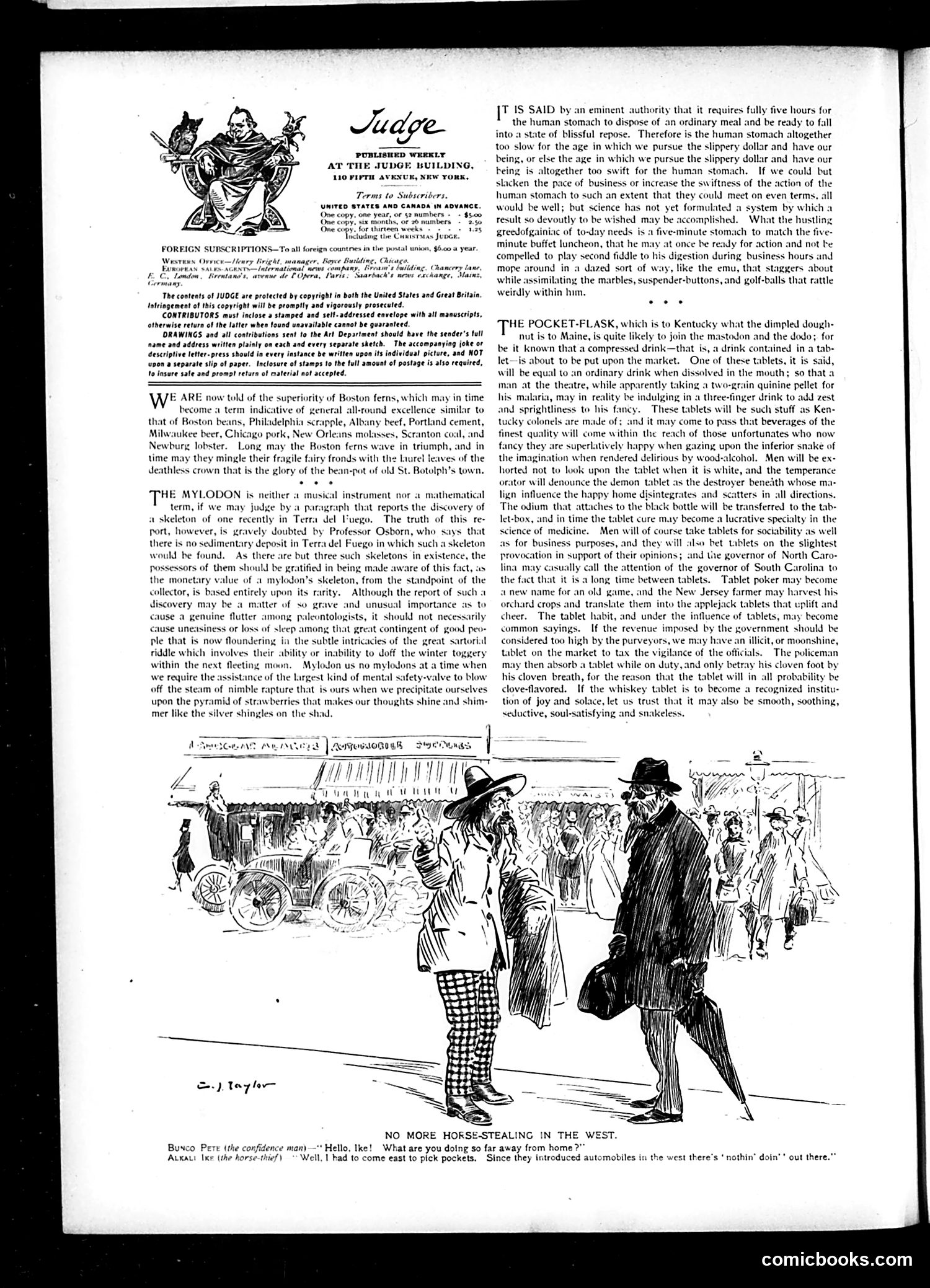
This page contains two distinct sections: editorial commentary on digestion and stomach capacity, and a political cartoon titled "NO MORE HORSE-STEALING IN THE WEST." The cartoon depicts two men at what appears to be a fair or gathering. One man, dressed in checkered pants and a light coat, confidently tells another that he's given up horse-stealing because automobiles have replaced horses in the West—making traditional theft obsolete. The satire targets the rapid technological transformation of the American frontier, suggesting that even criminal enterprises must adapt to modern progress. The joke's layers include commentary on the West's changing economy, the displacement of traditional (if criminal) practices by industrialization, and the somewhat absurd notion that a horse thief would simply pivot to automobiles.
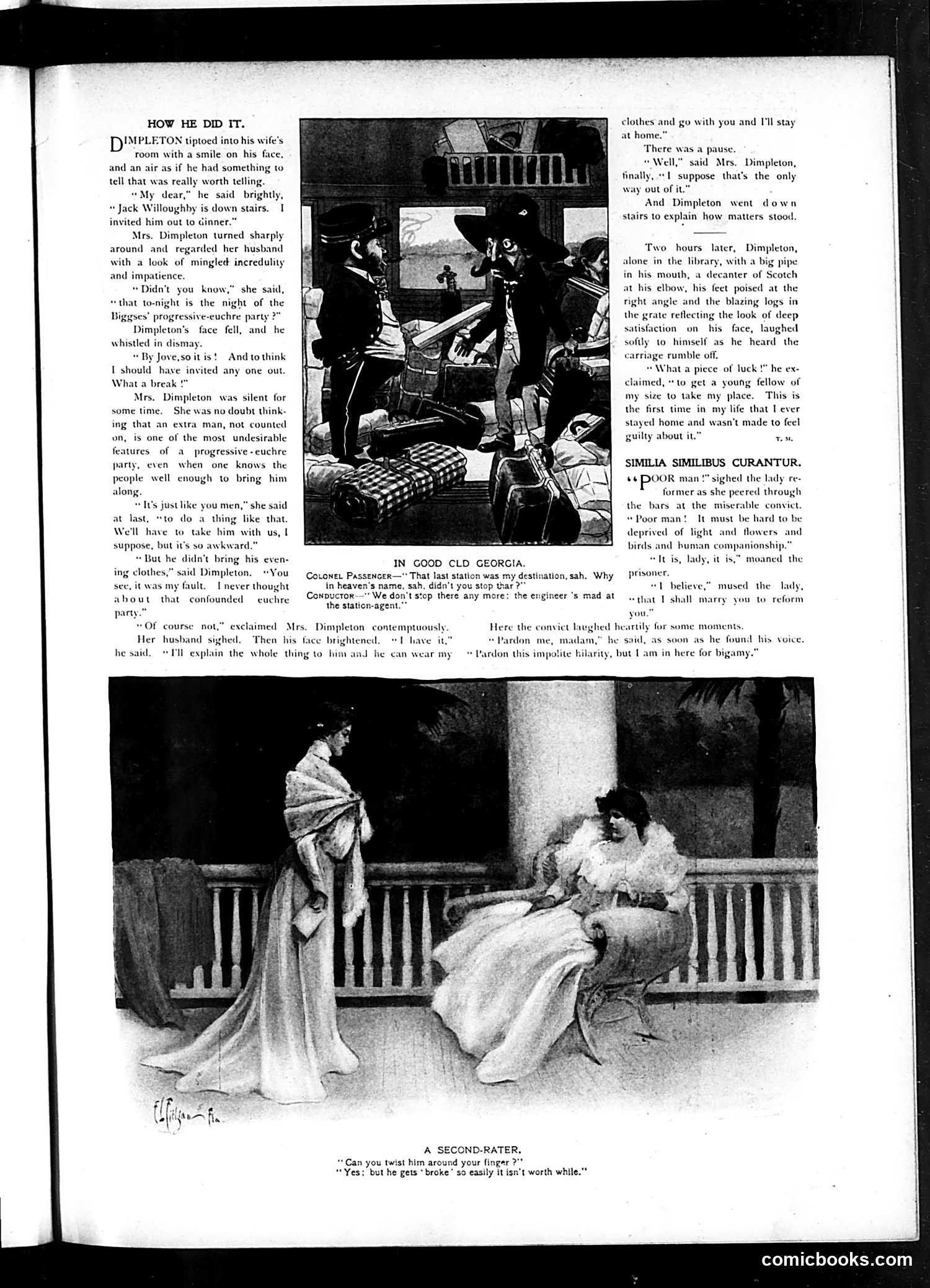
This page contains two unrelated items: **Top Section ("How He Did It"):** A domestic comedy about Mr. Dimpleton explaining to his wife why he invited an unexpected guest (Jack Willoughby) to stay. The humor relies on marital banter—Mrs. Dimpleton's skepticism about her husband's claim that hospitality was necessary, and his exasperated explanations. The illustration shows a crowded bedroom scene. This is social satire about Victorian-era middle-class manners and spousal dynamics, not political commentary. **Bottom Cartoon ("A Second-Rate"):** A woman in an elegant wrap addresses another woman reclining on a chair, asking if she can get her finger around a ring. The caption's punchline about the ring being "easily" removable implies infidelity or marital trouble. This is domestic scandal humor typical of Judge's satirical content about upper-class social life.
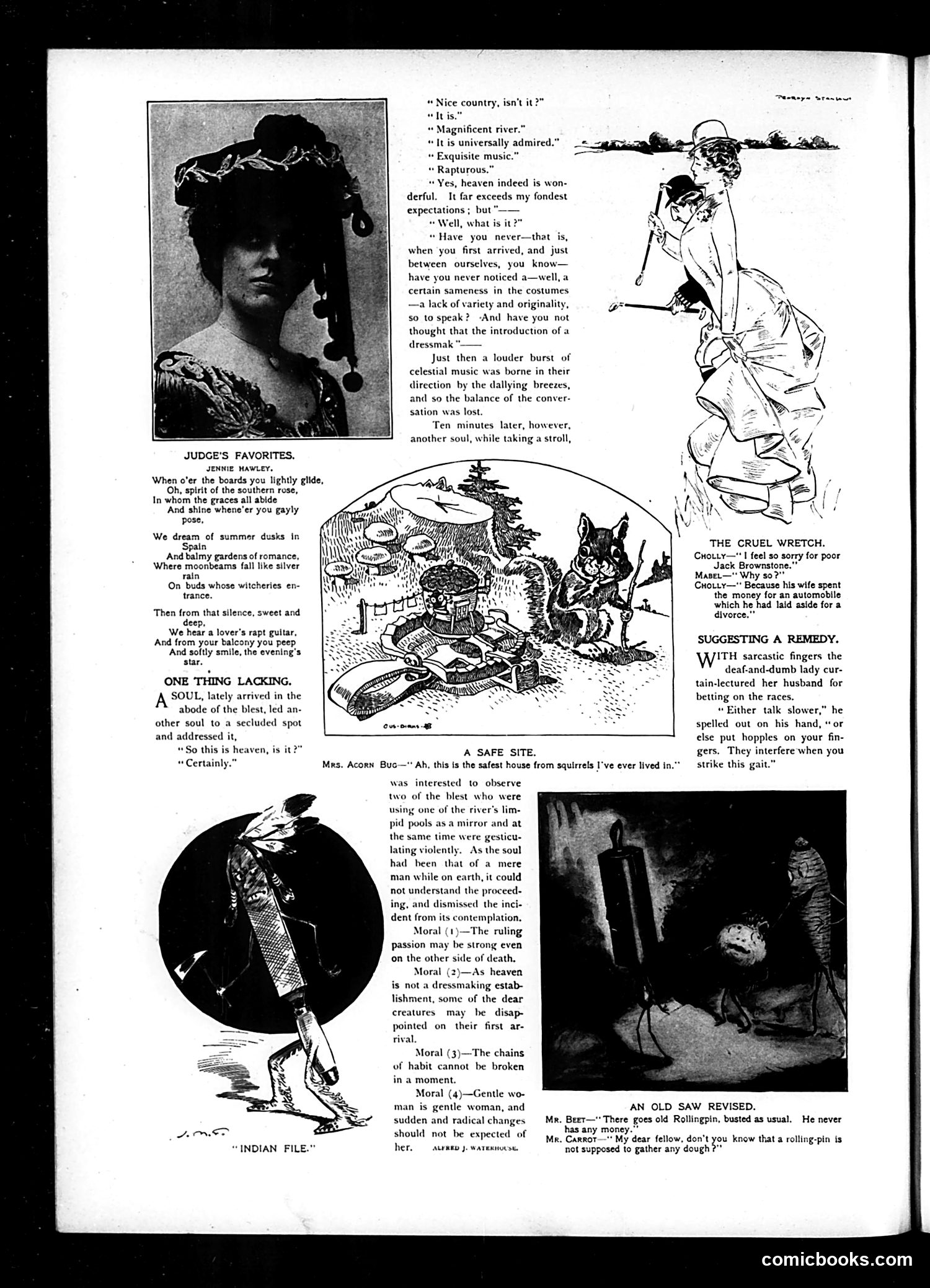
This page contains several unrelated satirical pieces typical of Judge's format: **"Judge's Favorites"** is a sentimental poem about summer and romance, paired with a woman's photograph—standard magazine filler. **"The Cruel Wretch"** mocks a husband who won't fund his wife's automobile purchase, using domestic conflict as humor. The joke relies on contemporary anxieties about new technology and marital finances. **"A Safe Site"** shows an anthropomorphic squirrel and depicts afterlife contemplation—a philosophical cartoon with unclear specific reference. **"Indian File"** appears to be a humorous illustration with minimal context provided. **"An Old Saw Revised"** plays on the phrase "rolling pin," suggesting domestic comedy about nagging wives and money. The page lacks clear political satire, instead focusing on domestic humor and social observation typical of early-20th-century American magazines.
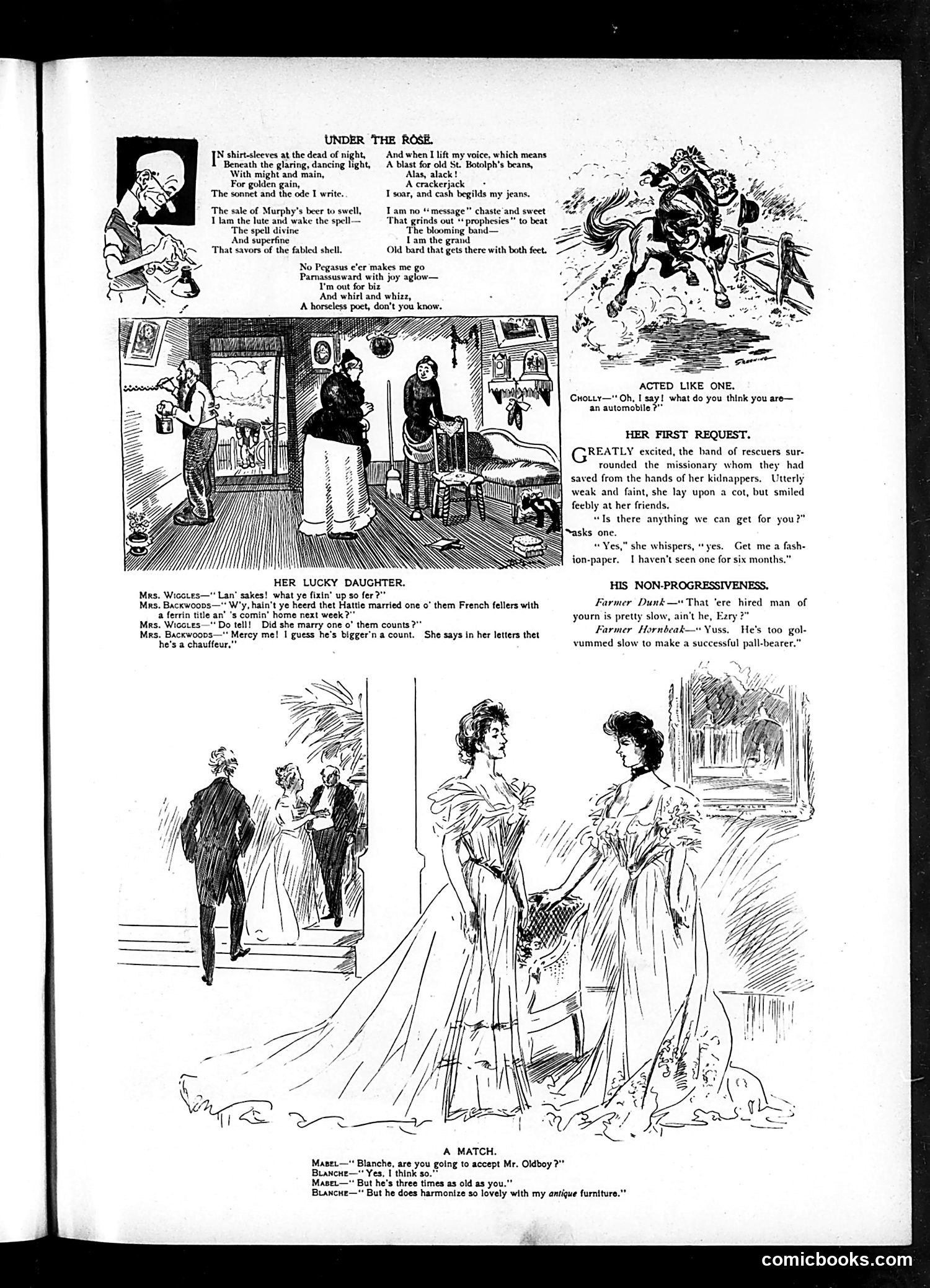
This page contains several satirical vignettes typical of early 20th-century American humor: **"Under the Rose"** mocks poets who claim artistic integrity while actually chasing commercial success—the speaker writes "sonnets and odes" but admits he's "out for biz" and cares about money ("cash begilds my jeans"). **"Her Lucky Daughter"** plays on social climbing: a rural woman's daughter marries a French "count," but the punchline reveals he's actually a *chauffeur*—a servant, not nobility. The humor lies in the mother's misunderstanding and false prestige. **"Her First Request"** jokes about missionary work: rescued from kidnappers, the missionary's first demand is a *fashion paper*, not food or rest—satirizing materialism masquerading as piety. **"A Match"** ridicules a woman accepting an elderly suitor solely because his antique furniture matches her decor, suggesting shallow materialism in marriage decisions. The page satirizes American pretension, commercialism, and status-seeking across classes—common Judge themes attacking both working-class social climbing and wealthy superficiality.
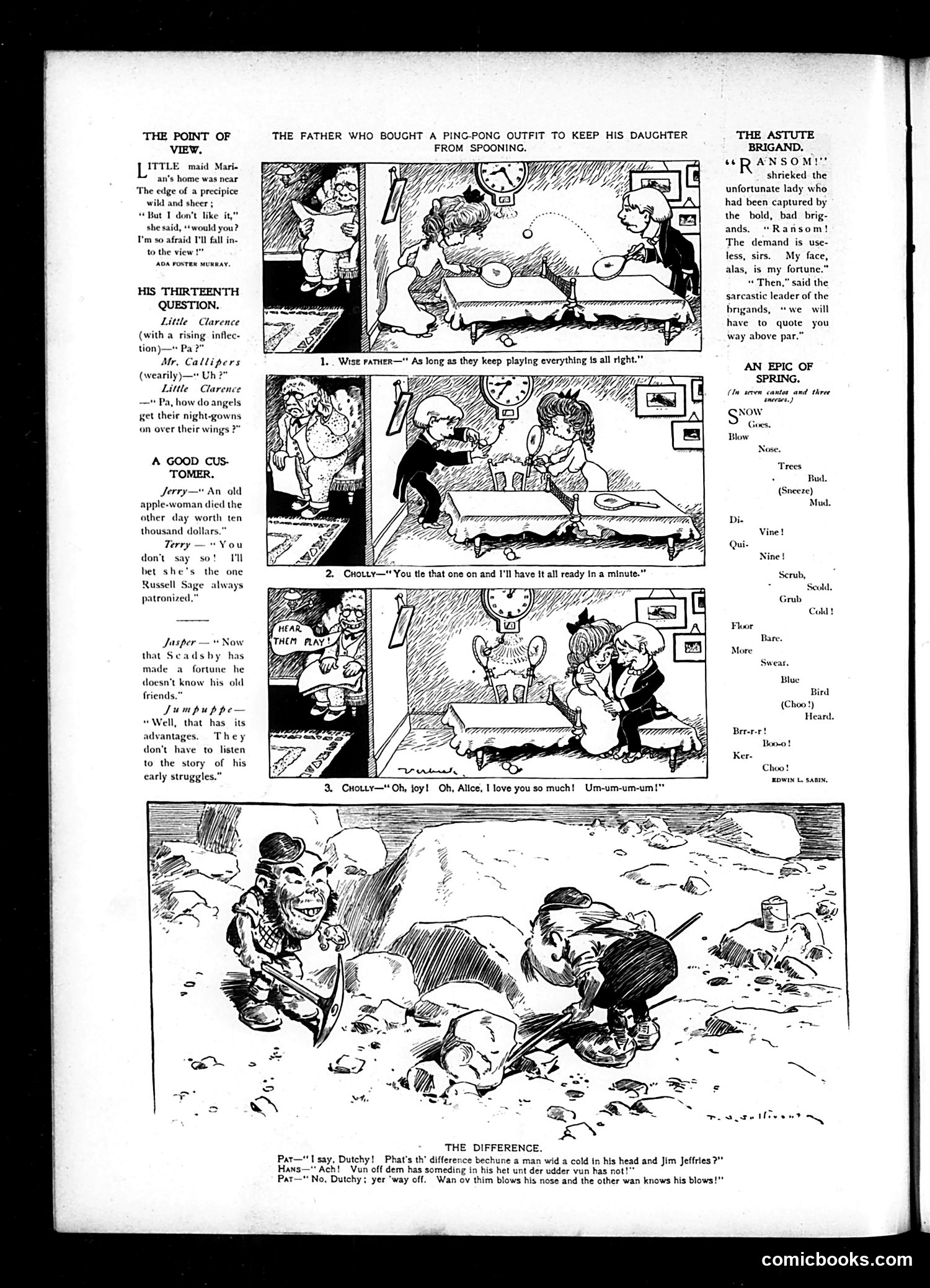
This Judge magazine page contains several satirical pieces: **Main Comic Strip**: A father buys a ping-pong table to prevent his daughter from "spooning" (courting/kissing). The humor mocks parental anxiety about courtship—the father believes the game will keep her occupied and chaperoned, reflecting early 20th-century concerns about unchaperoned youth socializing. **Side Pieces**: Include joke columns like a child's increasingly absurd questions ("How do angels put on nightgowns over their wings?") and ethnic humor featuring German and Irish dialect speakers—standard for this era's magazines, though offensive by modern standards. **Bottom Cartoon**: A crude joke comparing a man with a head cold to boxer Jim Jeffries, playing on the double meaning of "blows"—typical vaudeville-style wordplay. The overall tone reflects *Judge*'s target audience: educated, middle-class readers amused by domestic anxieties, ethnic stereotypes, and mild innuendo about courtship and romance.
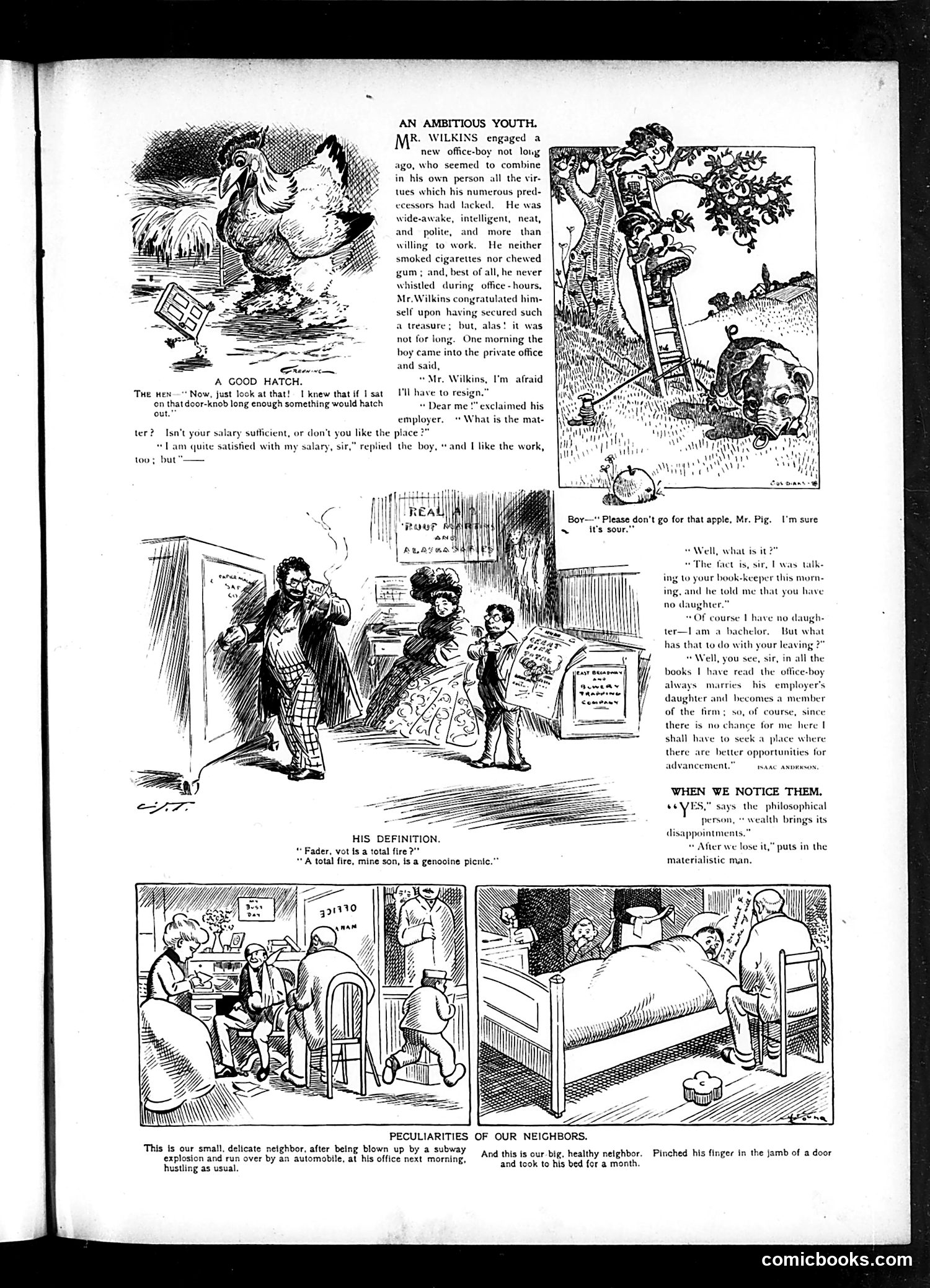
This page satirizes an office boy's unrealistic career expectations shaped by popular fiction. Mr. Wilkins hires an exemplary employee—diligent, polite, honest—only to have the boy resign because he lacks the narrative arc he's read about in books. Specifically, the boy expected to marry his employer's daughter and become a firm partner, the classic "rags to riches" plot of contemporary office-boy fiction. The satire targets both the boy's naïveté and the romanticized literature of the era that gave working-class youth false hopes. The accompanying "Peculiarities of Our Neighbors" comics provide comic relief through absurdist scenarios: a man surviving impossible disasters versus another incapacitated by minor injury—mocking disproportionate reactions to misfortune. The page ridicules the gap between literary fantasy and mundane reality, and the unrealistic ambitions such stories encouraged among young workers.
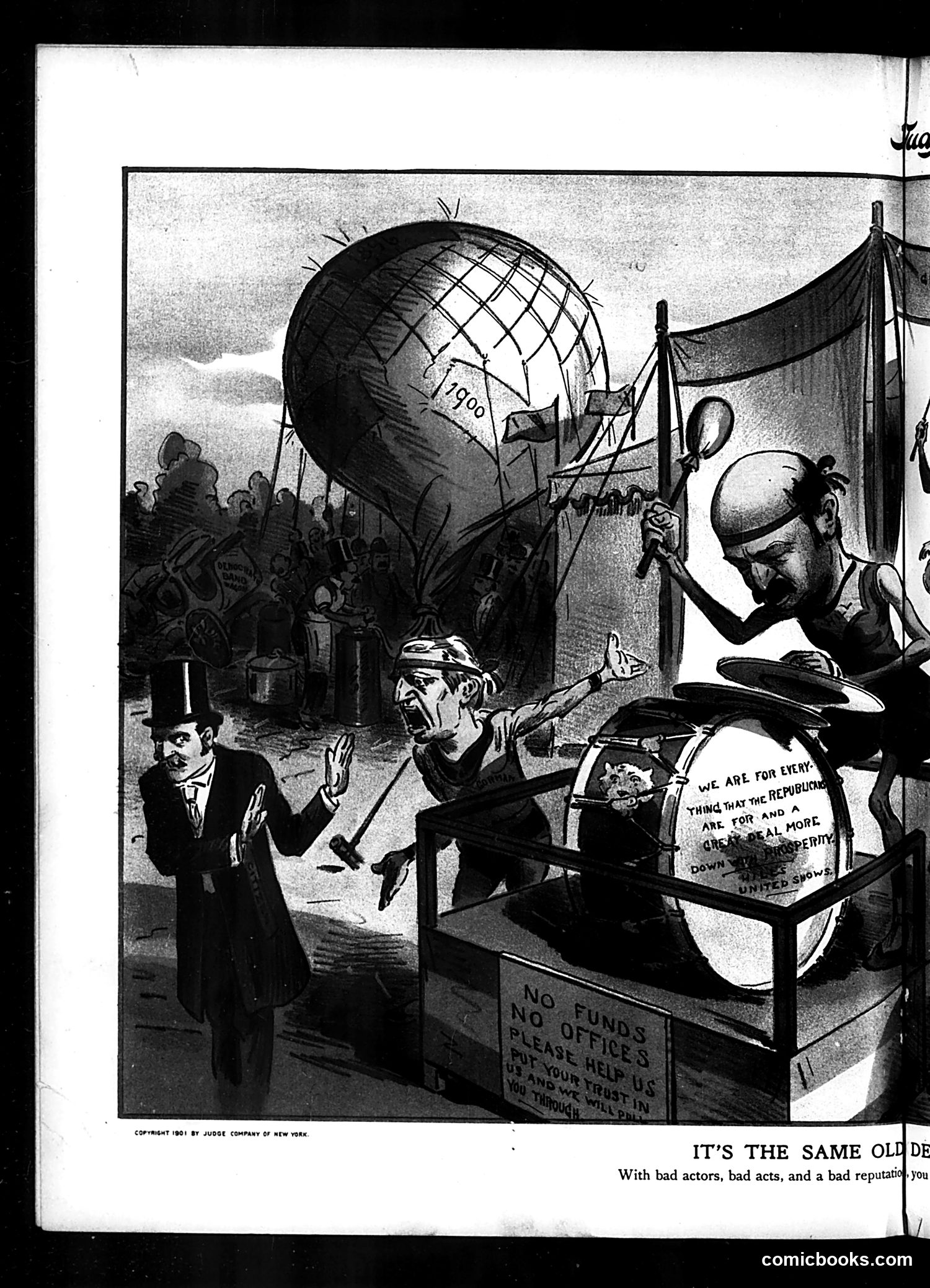
This 1901 *Judge* cartoon satirizes political corruption and fraud. A man in formal dress (left, appearing to be a politician or con artist) gestures toward a large balloon labeled "1900," while two caricatured figures on the right operate what appears to be a carnival booth or shell game. The booth displays text reading "We Care For Every Thing That the Republic Are For and More" and "No Funds / No Office / Please Help Us," suggesting false promises and financial schemes. The caption "IT'S THE SAME OLD DE[AL]" with "bad actors, bad acts, and a bad reputation" indicates the cartoon critiques recurring political deception—likely referencing ongoing corruption or broken campaign promises from the 1900 election cycle. The carnival/con-game imagery emphasizes that politicians operate like fraudsters manipulating the public.
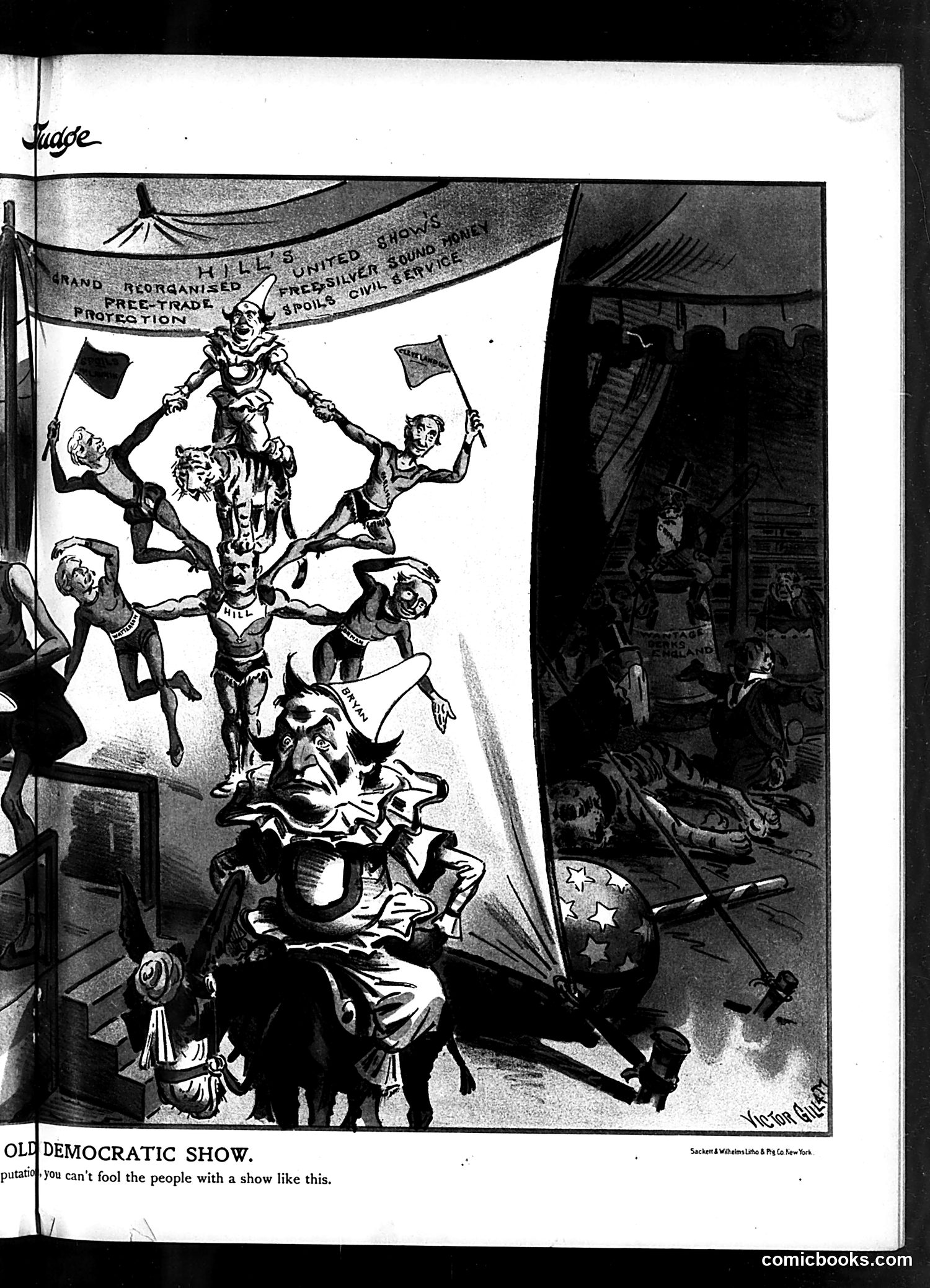
This political cartoon satirizes the Democratic Party as a traveling circus or theatrical production. A central ringmaster figure (likely representing Democratic leadership) stands atop a platform, directing smaller figures labeled with references to party organizations and promises—including "REORGANIZED," "PROTECTION," and banners mentioning "HILL SHOWS" and "UNITED FAMILY" with claims about "SPOILS & SERVICE." Below sits a skeptical audience member watching this spectacle. The caption's final line—"you can't fool the people with a show like this"—suggests the cartoon criticizes the Democrats for presenting empty theatrical gestures rather than substantive policy. The "spoils" reference likely alludes to patronage and corruption concerns. Without a clear date visible, the specific historical moment remains uncertain, but the cartoon portrays Democratic promises as mere performance designed to deceive voters.
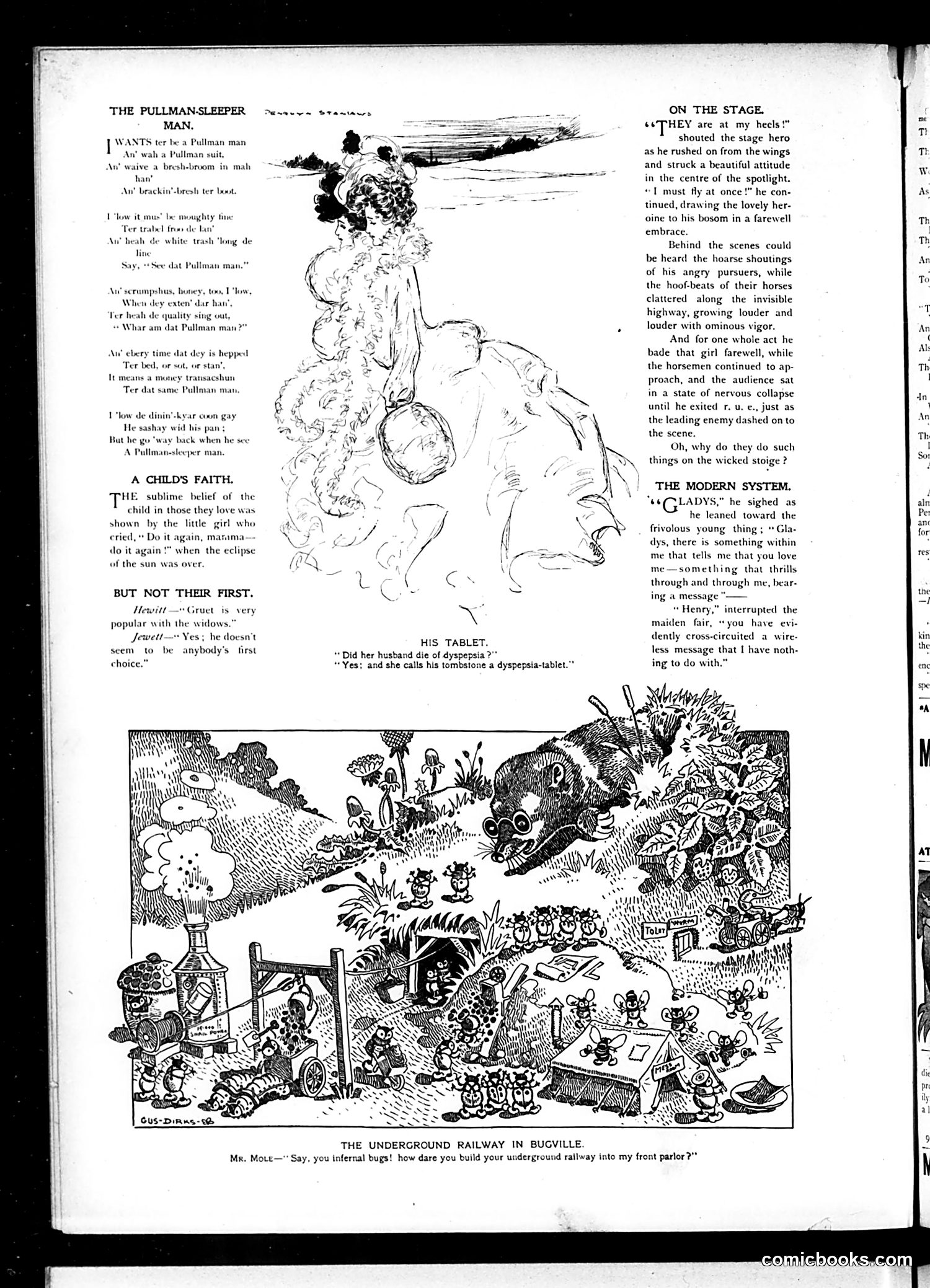
This Judge magazine page contains several satirical pieces: **"The Pullman-Sleeper Man"** (top left): A dialect poem mocking African American aspirations. It depicts a Black man's fantasy of working as a Pullman porter—a prestigious but segregated job—imagining the respect he'd receive. The satire mocks both the character's ambitions and the racial hierarchy that makes such modest employment seem dignified. **"A Child's Faith"** and **"But Not Their First"**: Brief joke pieces about romantic relationships with no deeper political meaning. **"His Tablet"** (center): A pun about a woman whose husband died of dyspepsia (indigestion), with her tombstone being called a "dyspepsia-tablet"—a play on the commercial antacid product. **"The Underground Railway in Bugville"** (bottom): An illustrated joke where insects/bugs have built a miniature railway in someone's parlor, playing on the term "underground railway" (the historical system helping enslaved people escape). The page reflects early 20th-century attitudes: racist caricature, product humor, and anthropomorphic animal comedy typical of the era.
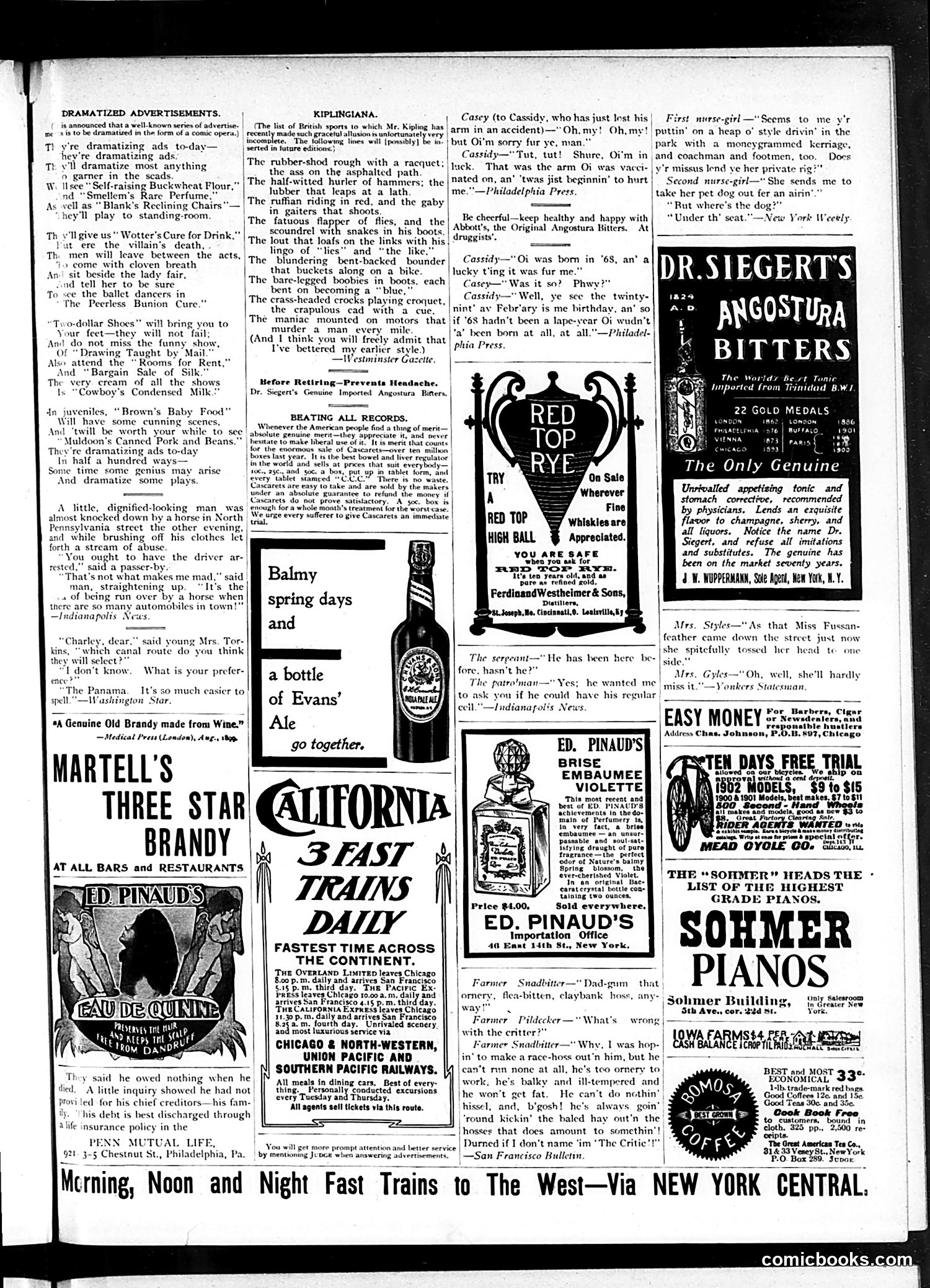
This page is primarily **advertisements and light humor**, not political satire. The main content includes: **"Dramatized Advertisements"** (top): A comedic piece imagining that companies will turn ads into comic operas—dramatizing everything from "Self-raising Buckwheat Flour" to "Peerless Bunion Cure." It's satire on aggressive advertising culture, joking that ads have become so omnipresent they'll soon dominate theater itself. **"Kiplingiana"** (center): Parodies Rudyard Kipling's style, mocking British sports and athletes with exaggerated alliteration ("The rubber-shod rough," "the gaby in gaiters"). It's literary humor targeting a famous writer's characteristic style. **Irish dialect humor** (bottom right): Brief jokes between "Casey" and "Cassidy" using stereotypical Irish-American accents and situations (farm accidents), typical of period humor. The remainder is **commercial advertising** for alcohol, pianos, bicycles, and patent medicines—the page's primary purpose. No significant political commentary appears.
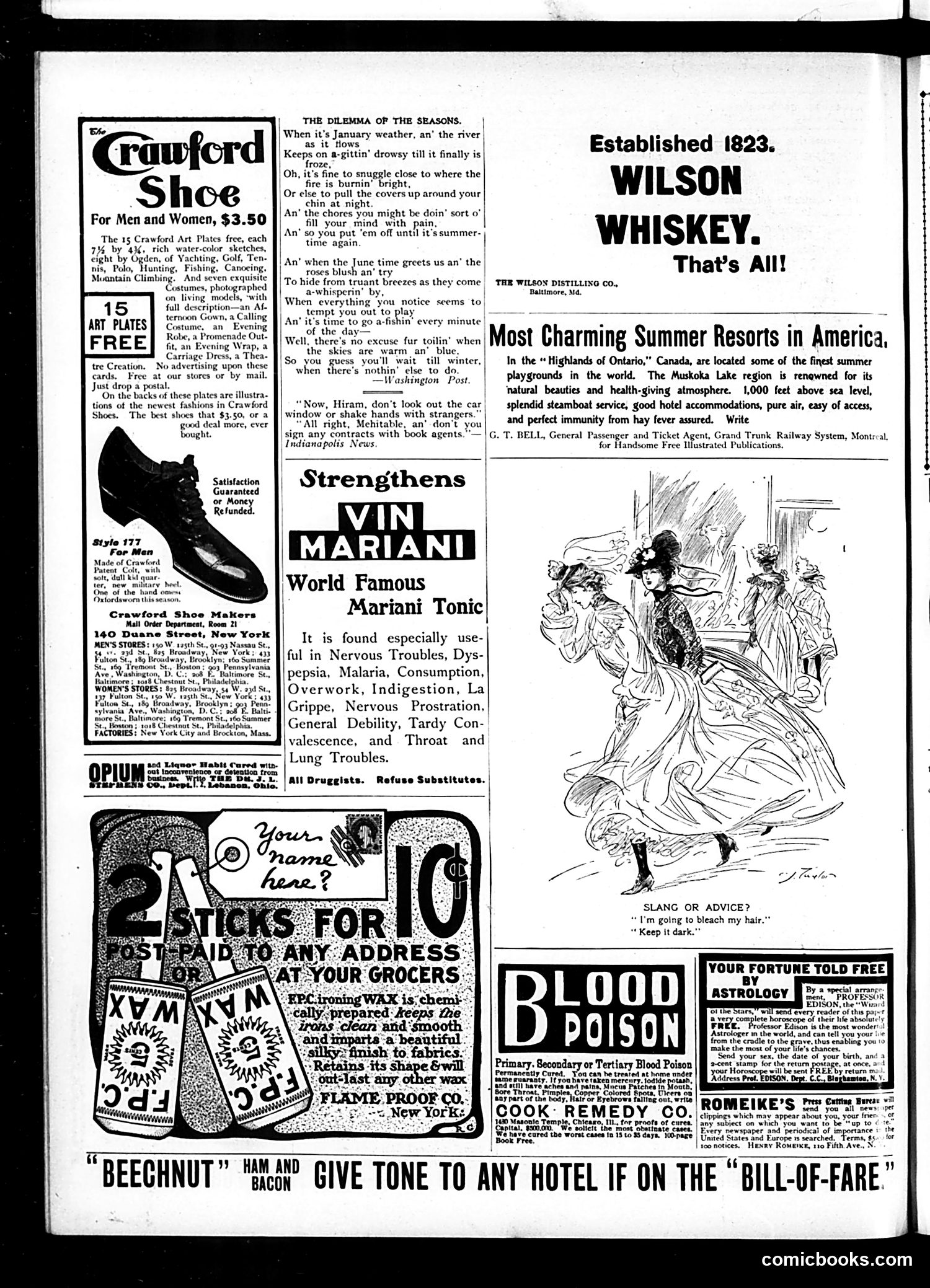
This page is primarily **advertising**, typical of early 20th-century Judge magazine. Key content includes: **Main Advertisements:** - Crawford Shoes ($3.50, mail-order) - Wilson Whiskey ("Established 1823") - Vin Mariani tonic (claimed to treat nervous troubles, malaria, consumption—a popular patent medicine of the era) - Blood Poison remedy (Cook Remedy Co.) - Beechnut ham and bacon - Various other patent medicines and services **Cartoon/Poem:** "The Dilemma of the Seasons" depicts rural life's procrastination—winter invites indoor laziness by the fire, summer tempts outdoor play. The accompanying dialogue shows a husband warning his wife against book agents while she warns him about talking to strangers—gentle domestic humor about everyday caution. **Notable Context:** These advertisements reveal pre-FDA America: unregulated patent medicines claimed to cure serious diseases. Vin Mariani was actually wine with coca leaf extract. "Blood Poison" treatments promised cures for syphilis. Such ads were standard in mainstream publications, reflecting widespread medical misinformation before modern regulation.
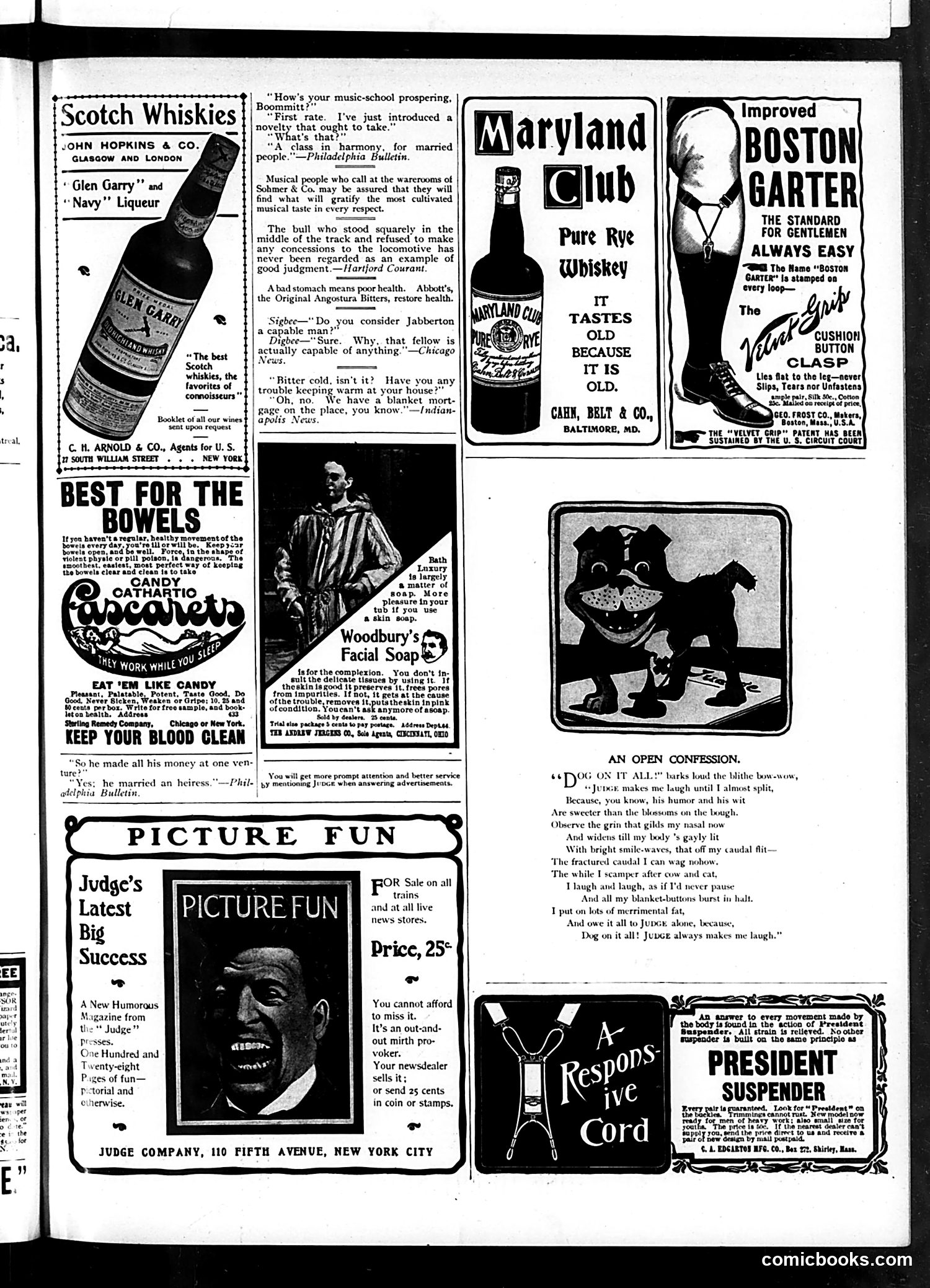
This page is primarily **advertising**, with brief humor snippets interspersed—typical of Judge magazine's format. The main content includes: **Advertisement content:** Scotch whisky, a bowel tonic ("Cathartic Goodrich"), Woodbury's Facial Soap, and Boston Garters dominate the layout. **Humor sections:** Short jokes about marriage, music education, and a bull refusing to yield to a locomotive—standard early-20th-century domestic humor with no specific political satire. **Notable items:** - "An Open Confession"—a whimsical poem from a dog praising "Jupec" (appears to be a patent medicine or product) - A "President Suspender" advertisement claiming mechanical innovation - Judge's own magazine promotion **Context for modern readers:** This reflects an era when satirical magazines survived through heavy advertising, often blending dubious patent medicines, digestive remedies, and personal grooming products. The humor is gentle, domestic, and apolitical—no identifiable political figures or events appear on this particular page.
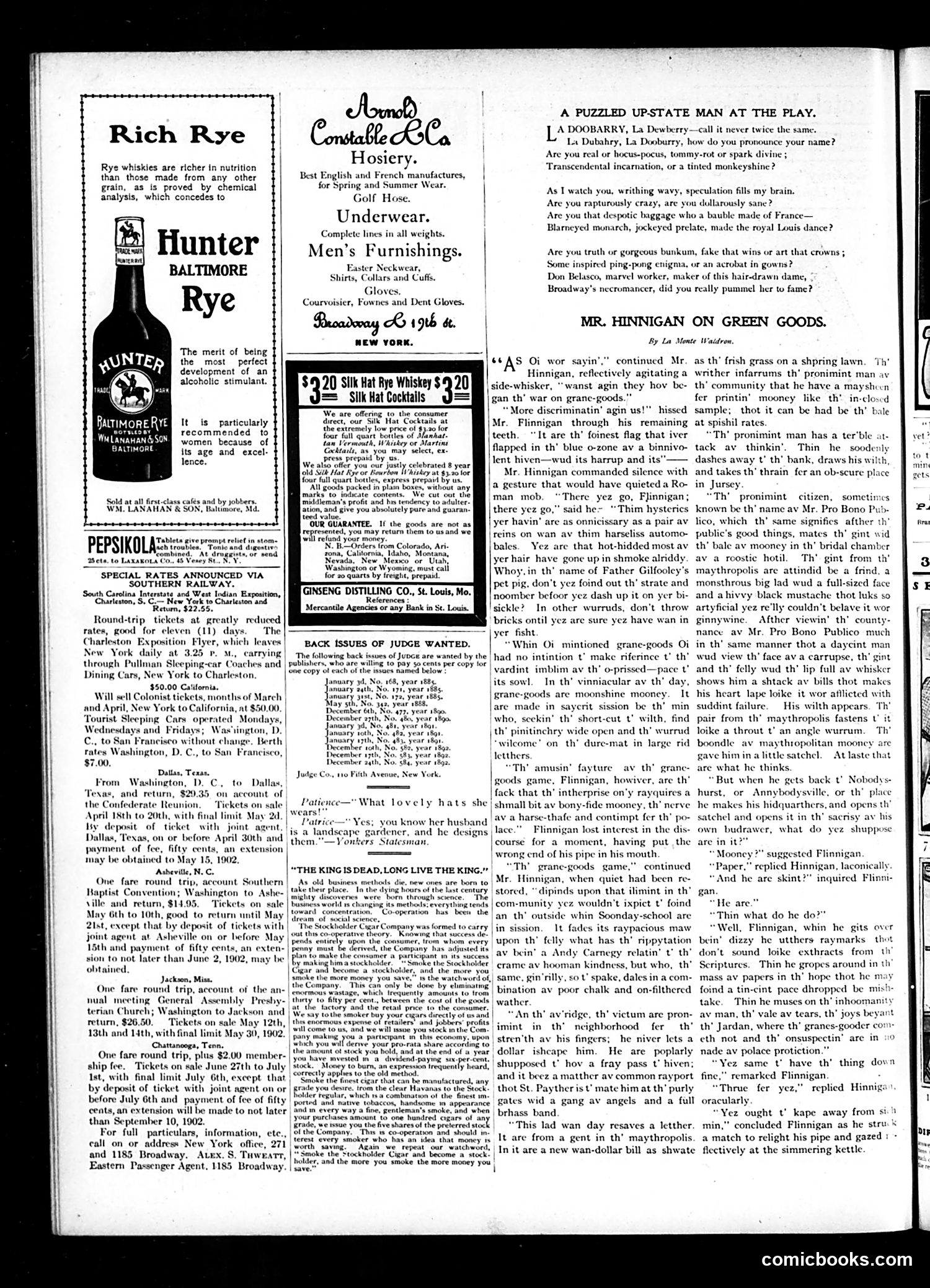
This page is primarily **commercial advertising** for whiskey and other consumer goods, typical of Judge magazine's revenue model. The main content is a "Rich Rye" whiskey ad claiming the product has superior nutritional value, particularly marketed to women—a notable claim in an era when women's alcohol consumption was socially contentious. The page also advertises railroad excursion packages (Southern Railway), hosiery, and other luxury goods. A smaller section titled "Mr. Hinnigan on Green Goods" appears to be satirical fiction, depicting an Irish immigrant character (indicated by the accent and name) being swindled in a confidence game involving counterfeit currency—a common urban swindle of the era. The satire likely mocks both naive immigrants and urban fraud schemes, reflecting period anxieties about immigration and urban vice. The page demonstrates how Judge mixed serious advertising with ethnic humor for commercial appeal.
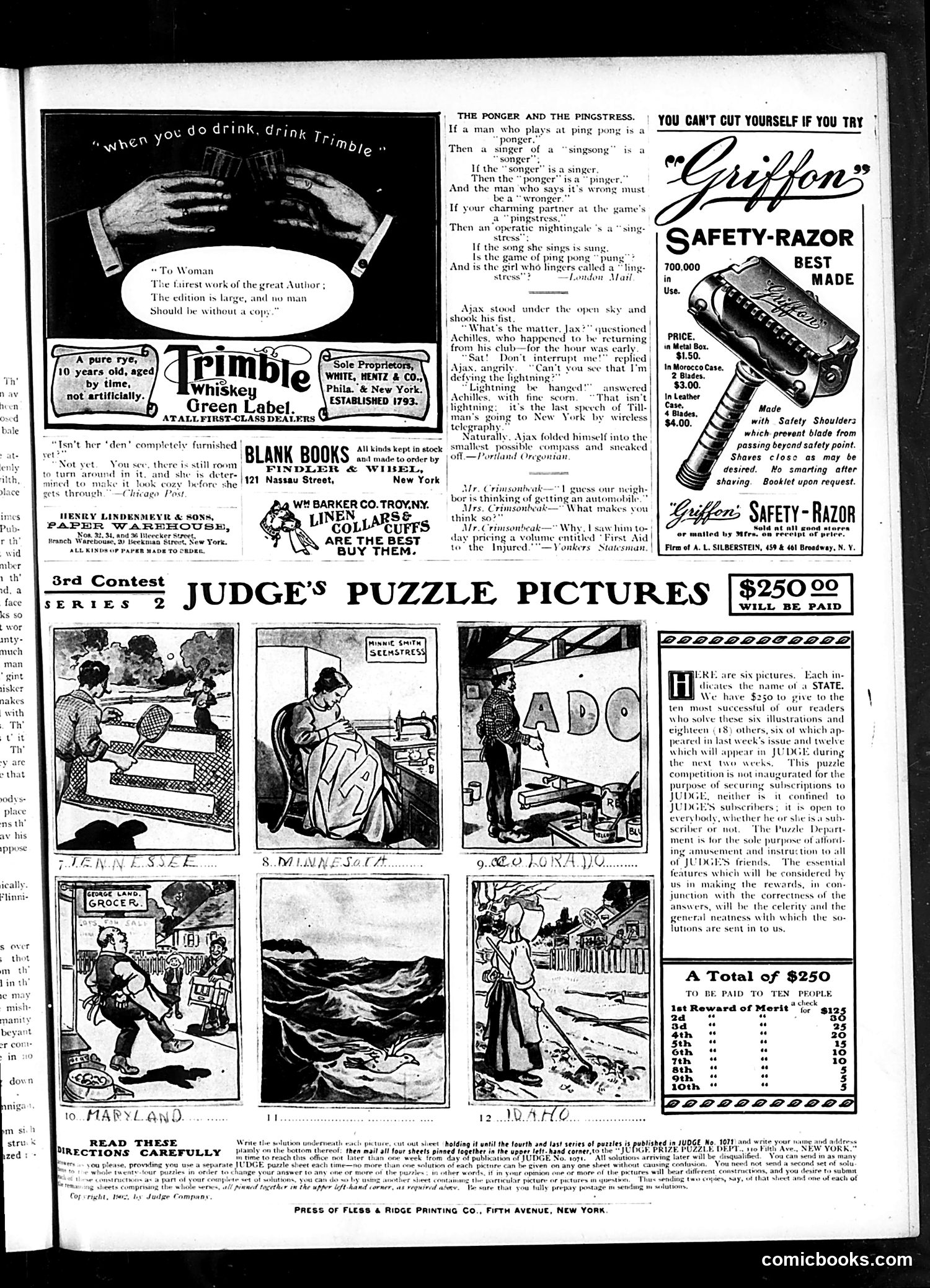
This is primarily an **advertising and puzzle page** rather than political satire. The main content includes: **"The Ponger and the Pingstress"** — A light wordplay piece joking about the terminology of ping-pong players, playing on how "-er" and "-ess" suffixes create occupational names. It's whimsical humor, not political. **Advertisements** dominate the page, promoting Trimble Whiskey, Griffon Safety Razors, blank books, and barker furniture — typical period products. **Judge's Puzzle Pictures (Series 2)** — A puzzle contest offering $250 in prizes to readers who can identify six American states from illustrations. This was an interactive feature encouraging magazine engagement and presumably subscriptions. **Brief anecdotes** appear scattered throughout (the Crimsonbeak/Ajax dialogue), offering mild humor about everyday situations. The page lacks political cartoons or social satire typical of Judge magazine's reputation. It's primarily a revenue-generating mix of advertisements and reader-participation content from what appears to be a 1911 issue.
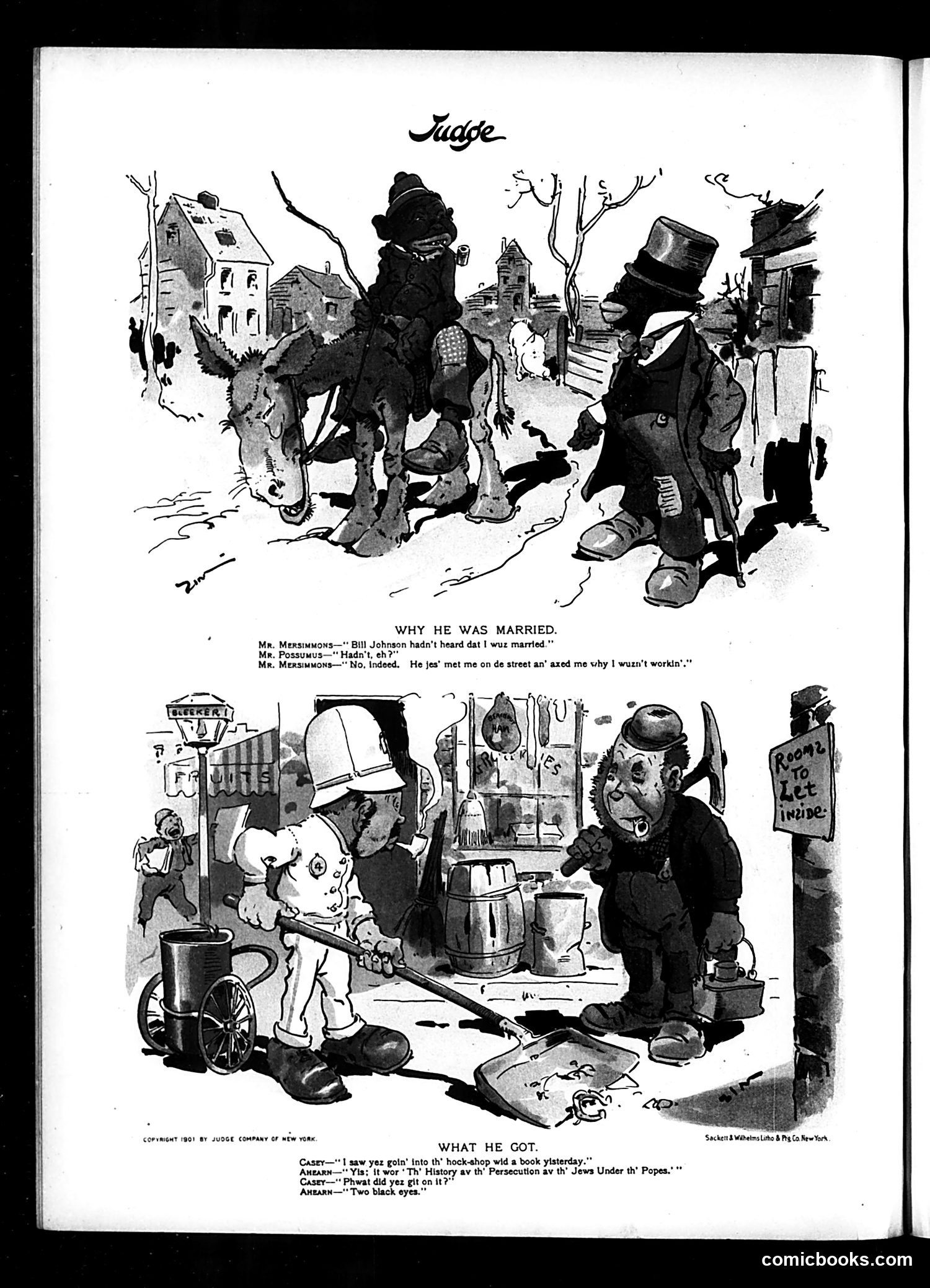
This page contains two racist caricatures using offensive dialect and stereotypes common to early-1900s American satire. **Top cartoon ("Why He Was Married"):** Features caricatured Black men in exaggerated dialect. The joke pivots on a man getting married to avoid being asked why he isn't working—implying marriage as escape from labor scrutiny. **Bottom cartoon ("What He Got"):** Depicts Irish immigrants (identifiable by the dialect and names like "Casey" and "Anearn"). A man pawns a book about papal persecution of Jews, expecting money but receives a beating instead. The "joke" relies on anti-Irish and anti-Semitic stereotypes—suggesting both groups are violent and that religious persecution is humorous. Both cartoons reflect Judge's satirical approach to immigrant and minority groups through crude stereotyping. The humor depends entirely on ethnic/racial mockery rather than social commentary. The 1901 copyright confirms this predates significant shifts in American attitudes toward such depictions.