
A complete issue · 16 pages · 1902
Judge — January 18, 1902
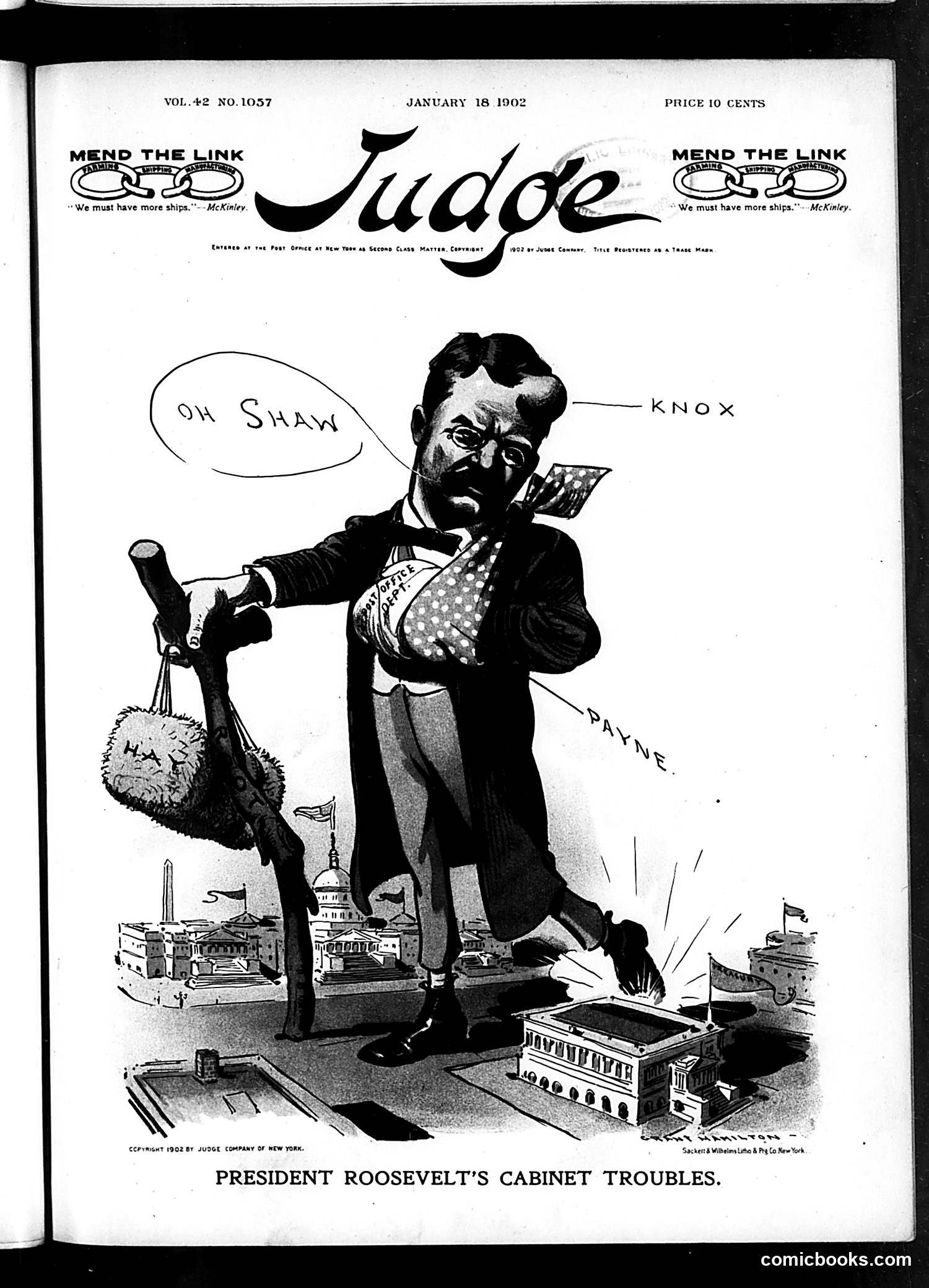
This political cartoon satirizes President Theodore Roosevelt's cabinet difficulties. The large caricatured figure labeled "Knox" (likely Secretary of State Philander C. Knox) holds a club, threatening three small buildings representing government departments or cabinet positions. A figure labeled "Payne" appears among the targeted structures. The character exclaims "Oh Shaw" (likely referencing Secretary of State John Hay or another cabinet member). The cartoon criticizes internal conflicts and power struggles within Roosevelt's administration. The club-wielding figure represents aggressive cabinet members or policies destabilizing the executive branch. The "Mend the Link" masthead suggests the administration needs repair and unity. This reflects real tensions in Roosevelt's early presidency regarding trade policy, tariffs, and personnel disputes—issues that dominated political discourse in 1902.
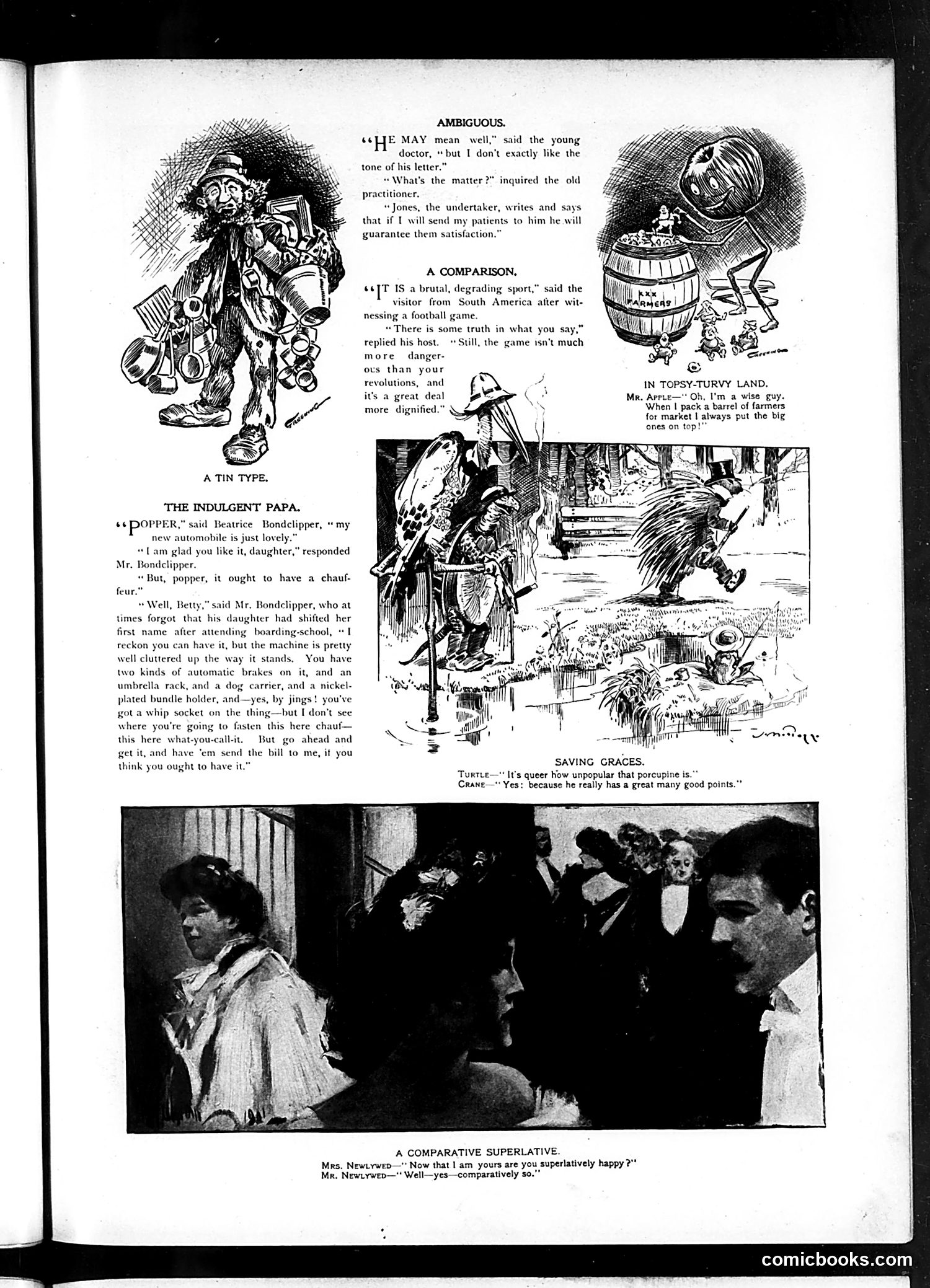
This page contains several satirical vignettes mocking American social types and pretensions: **"A Tin Type"** depicts a junk collector or ragman laden with merchandise, satirizing working-class occupations. **"The Indulgent Papa"** shows Mr. Bondelipper tolerating his daughter's automotive enthusiasm despite his concerns about safety—joking about paternal indulgence toward modern women's independence. **"In Topsy-Turvy Land"** features Mr. Apple describing his farming method, with animals reversing roles (appearing to ride farmers rather than vice versa)—absurdist humor about rural life. **"Saving Graces"** presents dialogue between Turtle and Crane about porcupines' popularity, likely referencing Aesop's fable tradition with ironic commentary. **"A Comparative Superlative"** shows a conversation between newlyweds using comparative language humorously about happiness, satirizing domestic bliss clichés.
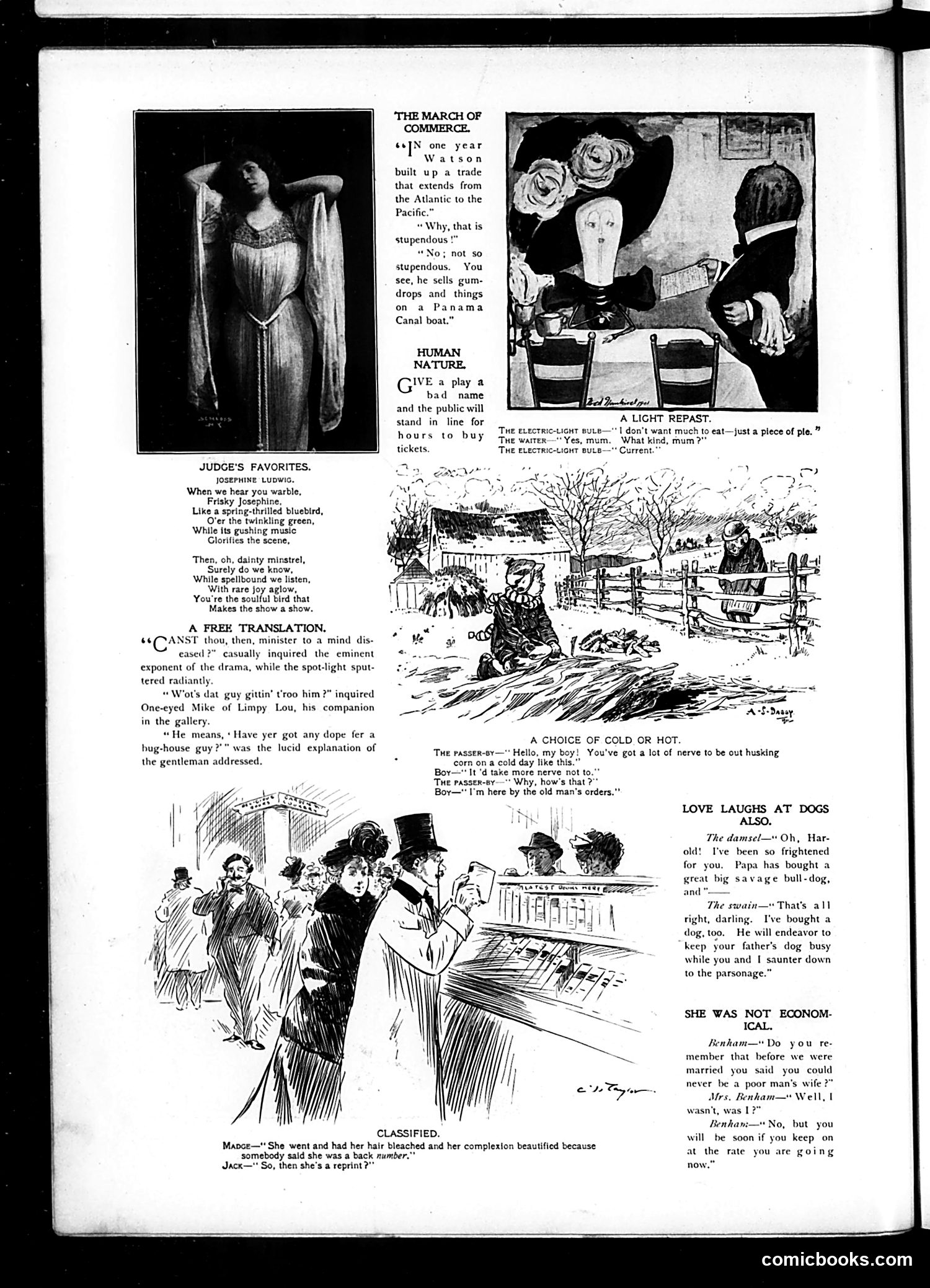
This page contains several unrelated satirical pieces typical of early 20th-century humor magazines: **"The March of Commerce"** mocks exaggerated business claims—a salesman boasts of trading across continents while actually just selling candy on a Panama Canal boat, deflating commercial bombast. **"Human Nature"** is a brief joke about how bad publicity attracts audiences to theatrical productions. **"A Free Translation"** humorously depicts miscommunication between a minister and a cement worker about dopey behavior. **"A Choice of Cold or Hot"** shows a farmboy confidently eating corn in winter, misunderstanding an idiom about nerve. **"Love Laughs at Dogs Also"** and **"She Was Not Economical"** are domestic humor sketches about marriage and spending habits—common Judge fare reflecting period anxieties about gender roles and finances. These are disconnected gags rather than unified political commentary.
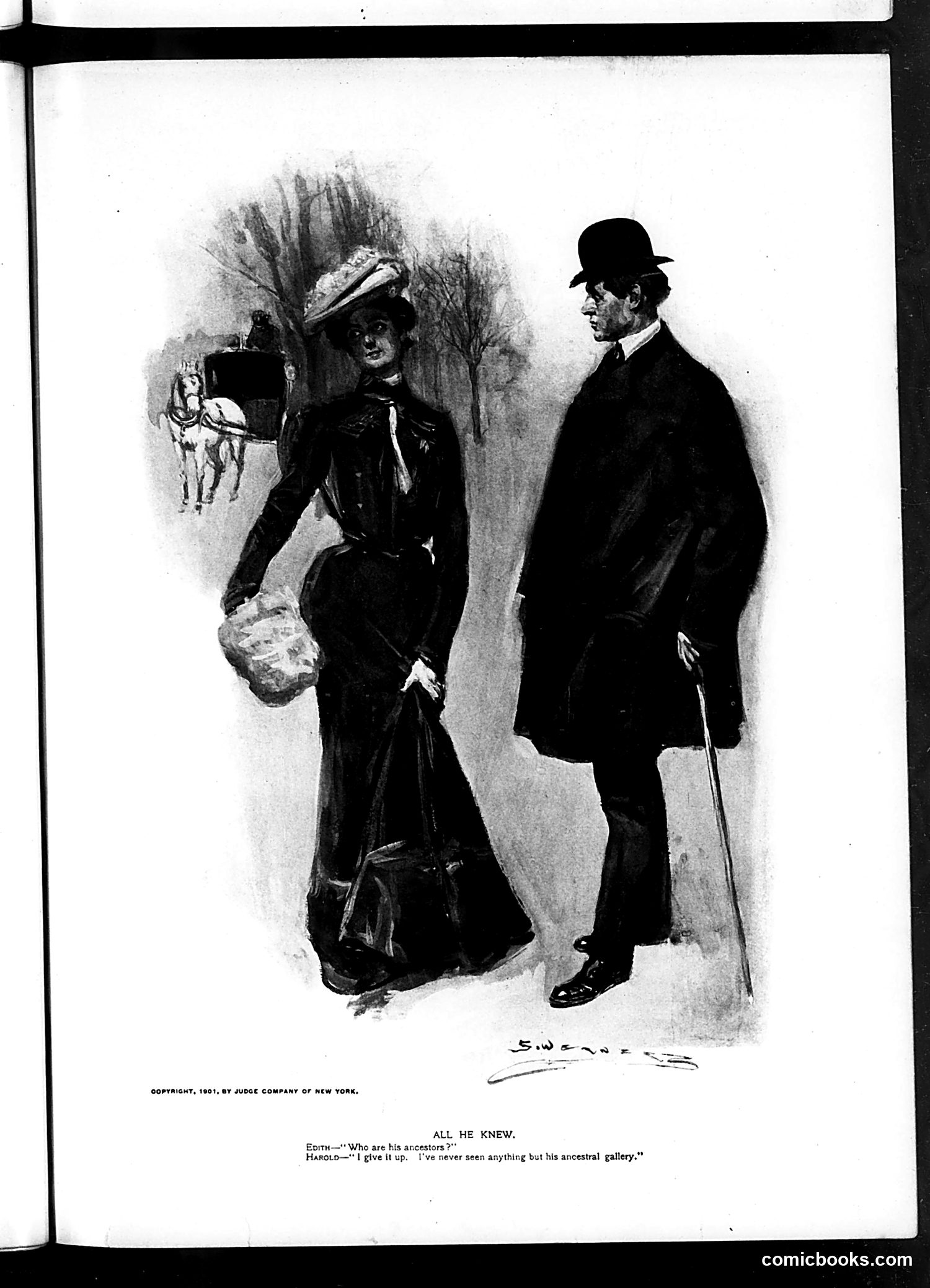
This 1901 Judge cartoon satirizes a wealthy man (Harold) who cannot identify another man's ancestors despite viewing his "ancestral gallery"—presumably paintings or portraits displayed in his home. The joke targets the American nouveau riche: men who accumulated wealth rapidly but lacked old family lineage. The cartoon mocks the pretension of displaying an "ancestral gallery" when one's own ancestry is obscure or recently acquired. The elegantly dressed figures and formal setting emphasize the class anxieties of the era, when inherited wealth and established family pedigree carried significant social status. The satire suggests that no amount of wall decoration can manufacture legitimate aristocratic credentials.
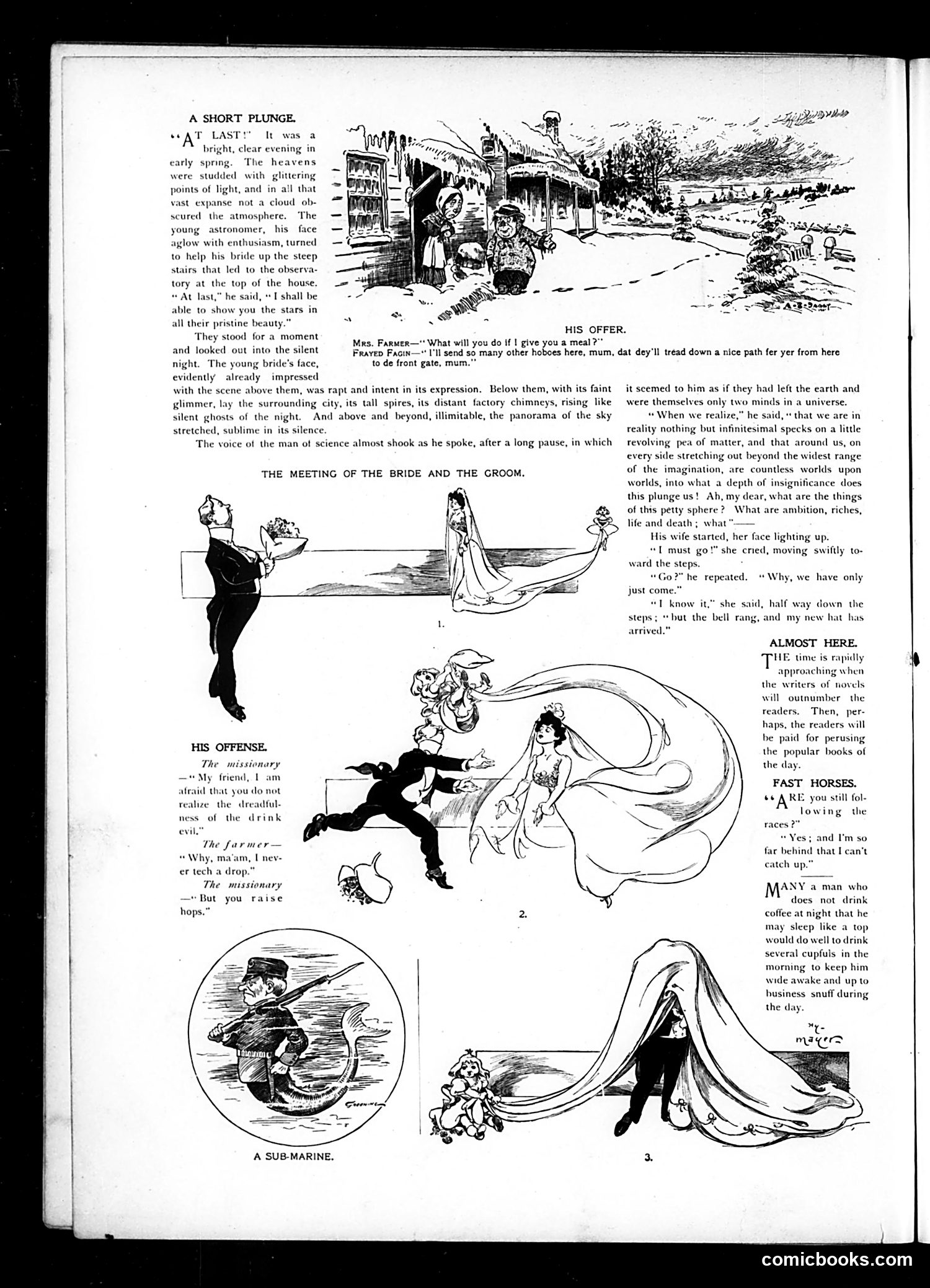
This page contains multiple short satirical pieces lampooning social pretensions and foolishness: **"A Short Plunge"**: A newlywed astronomer waxes philosophical about humanity's cosmic insignificance to his bride, only to have her abruptly abandon his lecture when her new hat arrives. The joke: her immediate indifference to his intellectual musings exposes the gap between romantic ideals and domestic reality. **"His Offer/His Offense"**: A missionary warns a farmer about "the drink evil," unaware the farmer raises hops (used in beer production). The farmer then offers to invite other hoboes to create a path to the missionary's gate—implying vagrant drunks will naturally congregate there. It's anti-missionary mockery: the pious reformer is naive and hypocritical. **"A Sub-Marine"**: Appears to be a visual gag, unclear without additional context. The other items are brief social commentary on writers vs. readers, horse racing debt, and coffee for productivity—typical Judge magazine filler humor targeting middle-class absurdities.
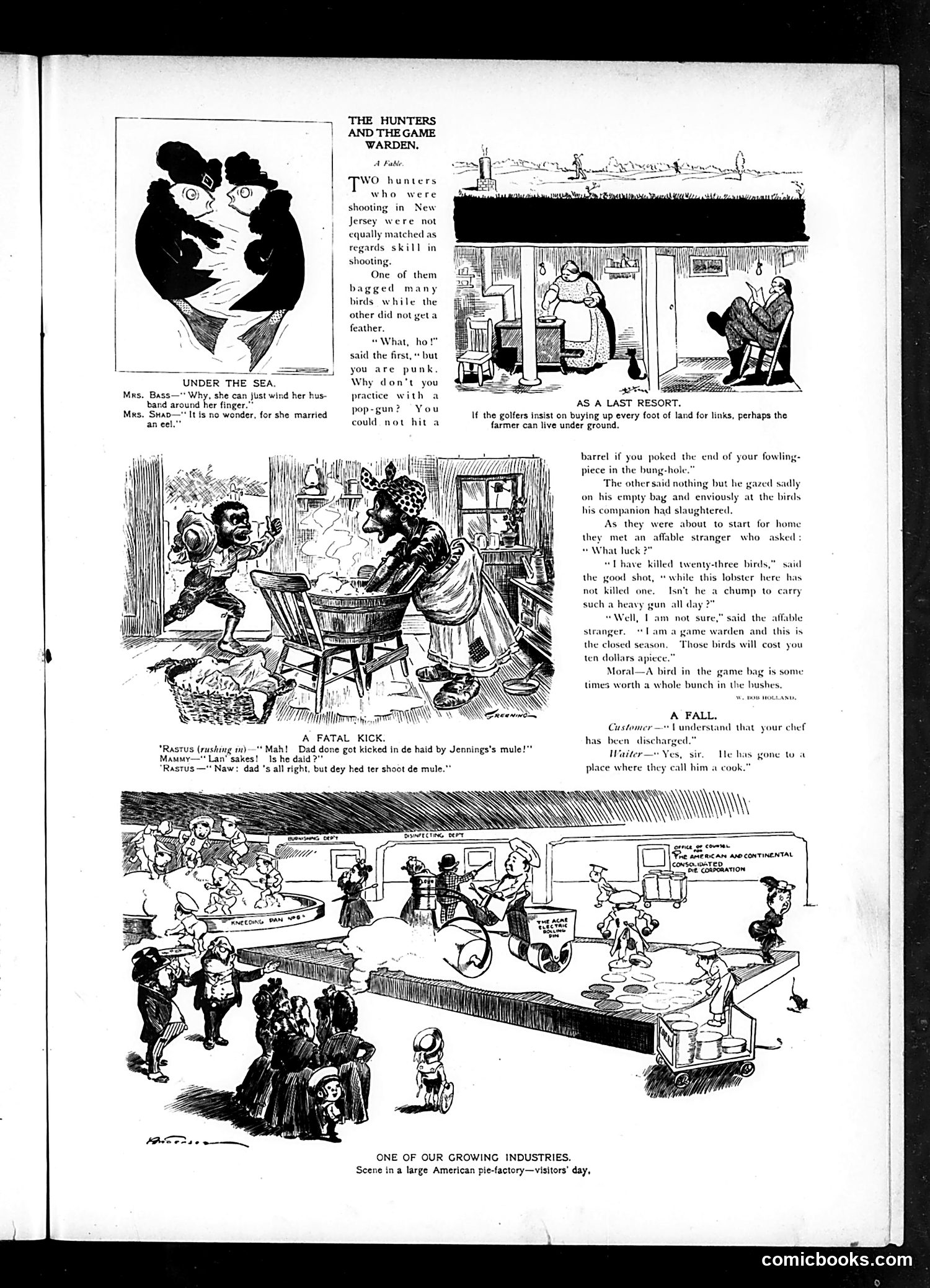
This page contains multiple satirical pieces typical of early 20th-century American humor: **"The Hunters and the Game Warden"** mocks poor sportsmanship and legal consequences. Two hunters compete; the skilled one brags about his twenty-three birds while mocking his companion's empty bag. A game warden arrives and fines the successful hunter for killing birds during closed season—the moral: boasting about illegal game proves costly. **"Under the Sea"** is a brief joke about marriage and infidelity. **"A Fatal Kick"** uses racial stereotypes common to the era, depicting African American characters in dialect humor involving a mule accident. **"As a Last Resort"** satirizes the golf industry's land acquisition, suggesting farmers might need to live underground if golfers buy all available land. **"One of Our Growing Industries"** depicts a pie factory tour, likely satirizing American manufacturing or food production practices of the period.
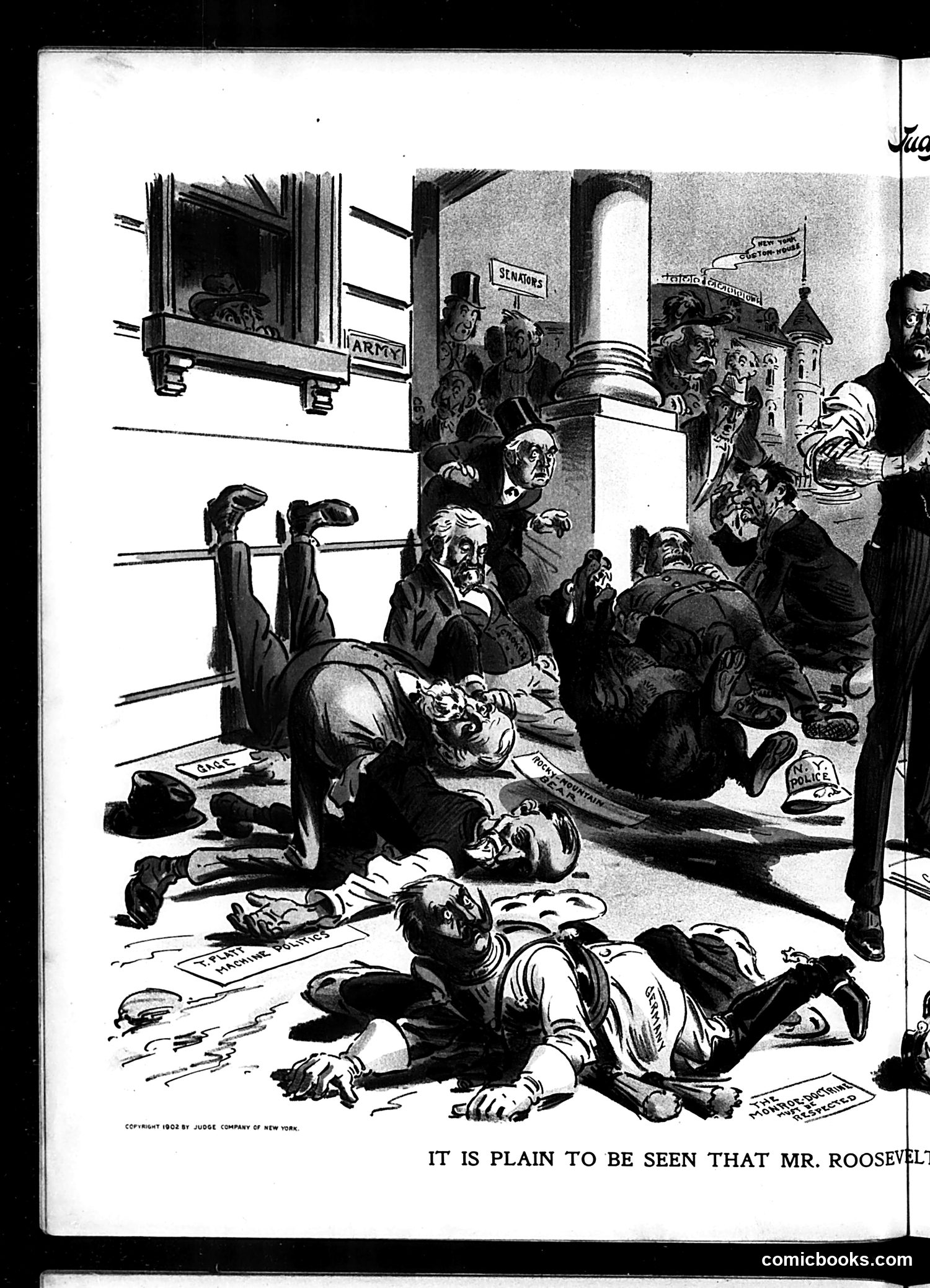
This is a satirical cartoon from *Judge* magazine criticizing President Theodore Roosevelt (referenced in the visible caption). The cartoon depicts a violent scene with bodies lying on the ground in what appears to be a formal or governmental setting, with onlookers observing from above through a window marked "ARMY." The satire appears to mock Roosevelt's aggressive foreign or domestic policies—likely his military interventionism or handling of labor disputes. The corpses and bloodshed represent casualties from his decisions, while the detached observers suggest political leadership indifferent to human cost. The specific historical context is unclear from this fragment, but the cartoon's message is that Roosevelt's policies have resulted in death and destruction, a common *Judge* critique of his administration.
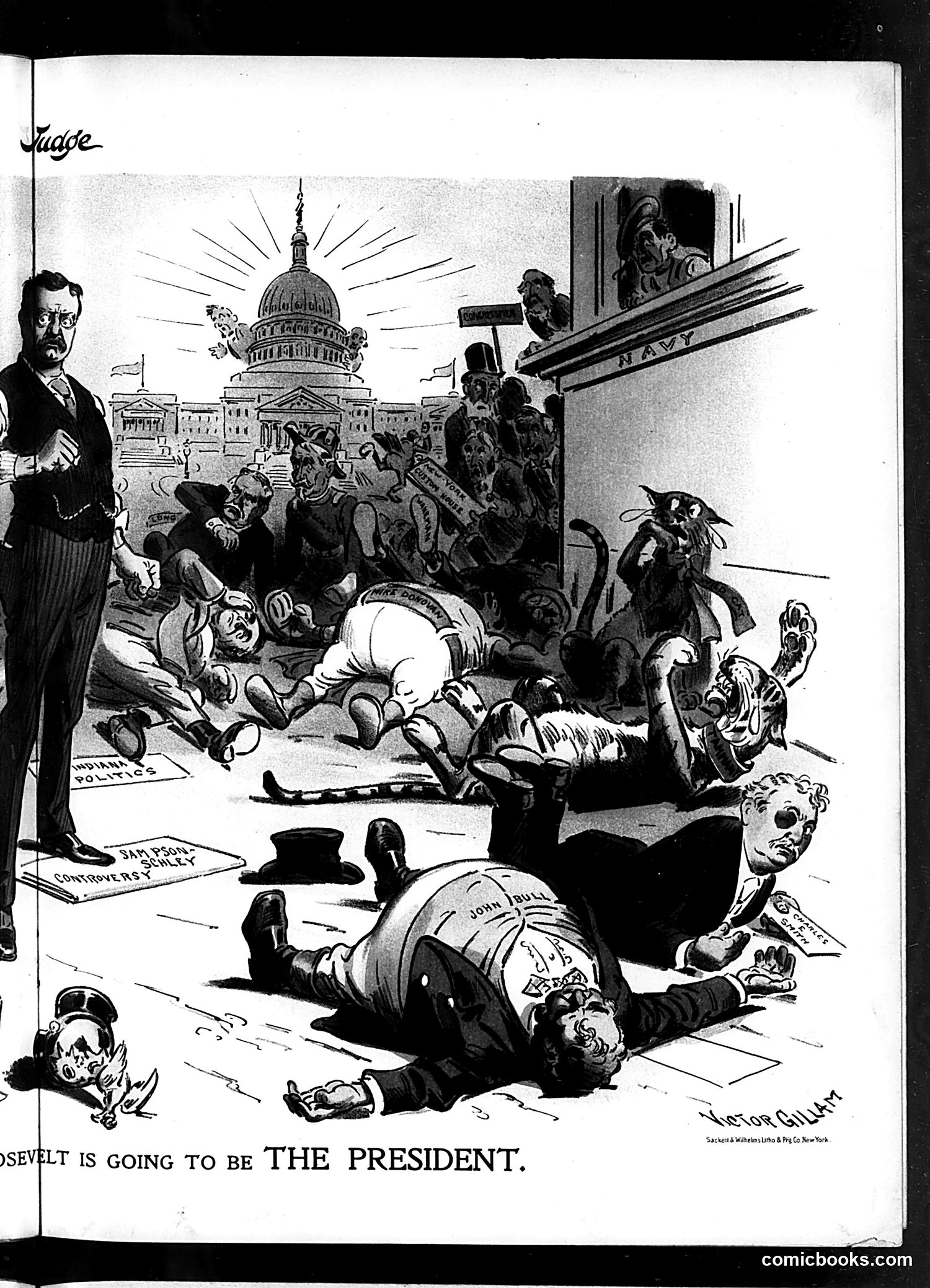
This Judge magazine cartoon satirizes opposition to Theodore Roosevelt's presidency. The caption reads "Roosevelt is Going to Be the President," likely from around 1901 when he assumed office following McKinley's assassination. The image depicts chaos at the Capitol: bodies and figures lie scattered on the ground while a well-dressed man (likely representing an opponent or critic) stands disapprovingly on the left. A Navy ship appears to the right, possibly referencing Roosevelt's famous naval policies. Various caricatured figures seem to represent political opposition or different constituencies being overwhelmed. The satire suggests that Roosevelt's political opponents are powerless to stop his rise to power—their resistance is futile and chaotic. The cartoon ridicules critics by portraying them as defeated and scattered before his inevitable presidency.
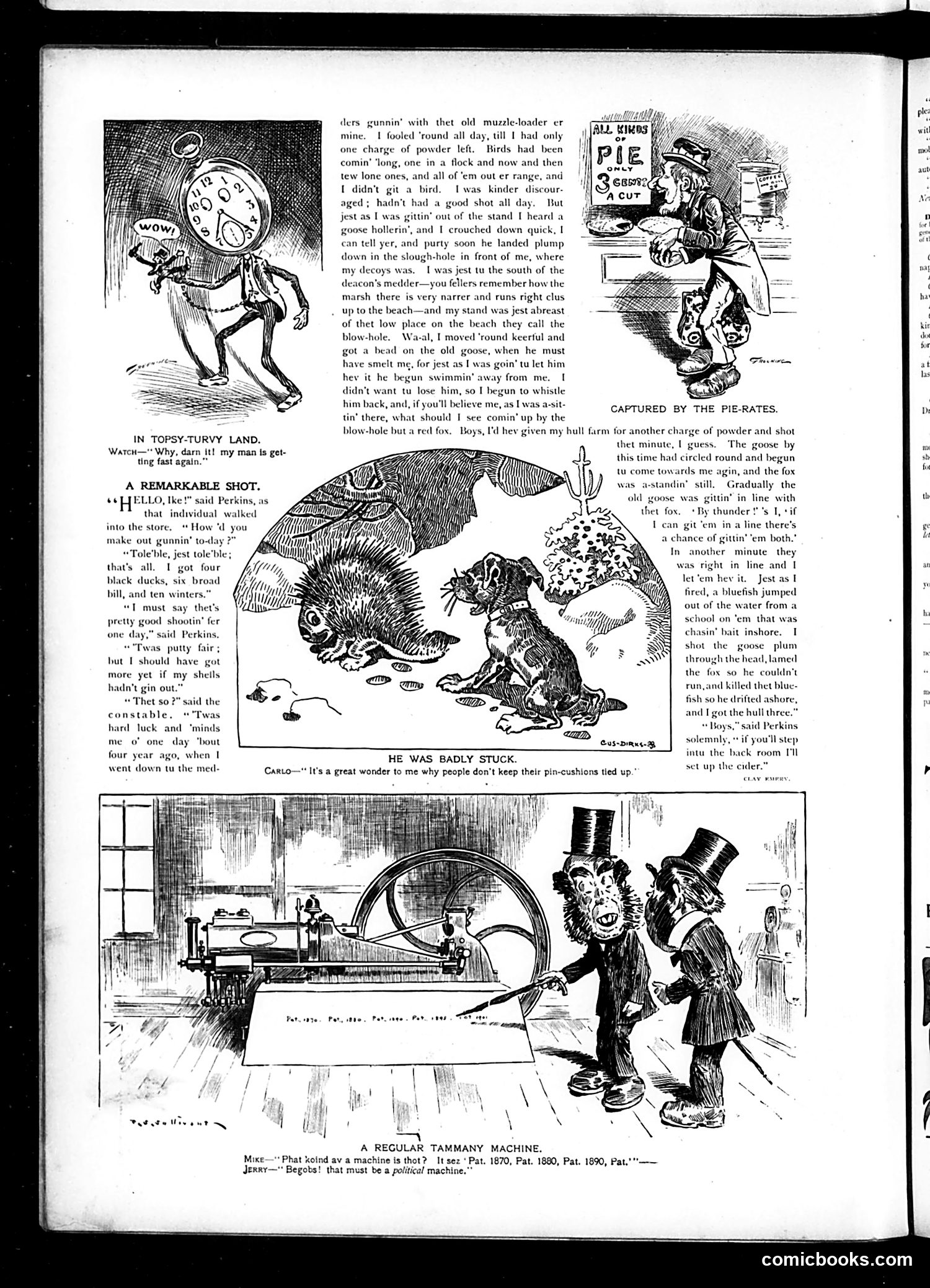
This page contains three distinct cartoons satirizing late 19th-century American life: **"In Topsy-Turvy Land"**: A tall-tale hunting story where a marksman claims one bullet killed a goose, fox, and bluefish simultaneously through improbable circumstance. The humor lies in the exaggerated frontier yarn—a common American folk narrative being gently mocked. **"Captured by the Pie-Rates"**: A domestic scene showing someone (appears to be a child or servant) with pie, likely satirizing petty domestic "crimes" or mischief. **"A Regular Tammany Machine"**: The most politically significant cartoon. It depicts a machine labeled with patent dates (1870, 1880, 1890), with two figures operating it. This directly mocks **Tammany Hall**, the Democratic political machine controlling New York City politics through corruption and patronage. The joke: Tammany functions like a mechanical device, endlessly recycling the same corrupt practices across decades—a scathing critique of urban political corruption and the "machine" keeping itself in power.
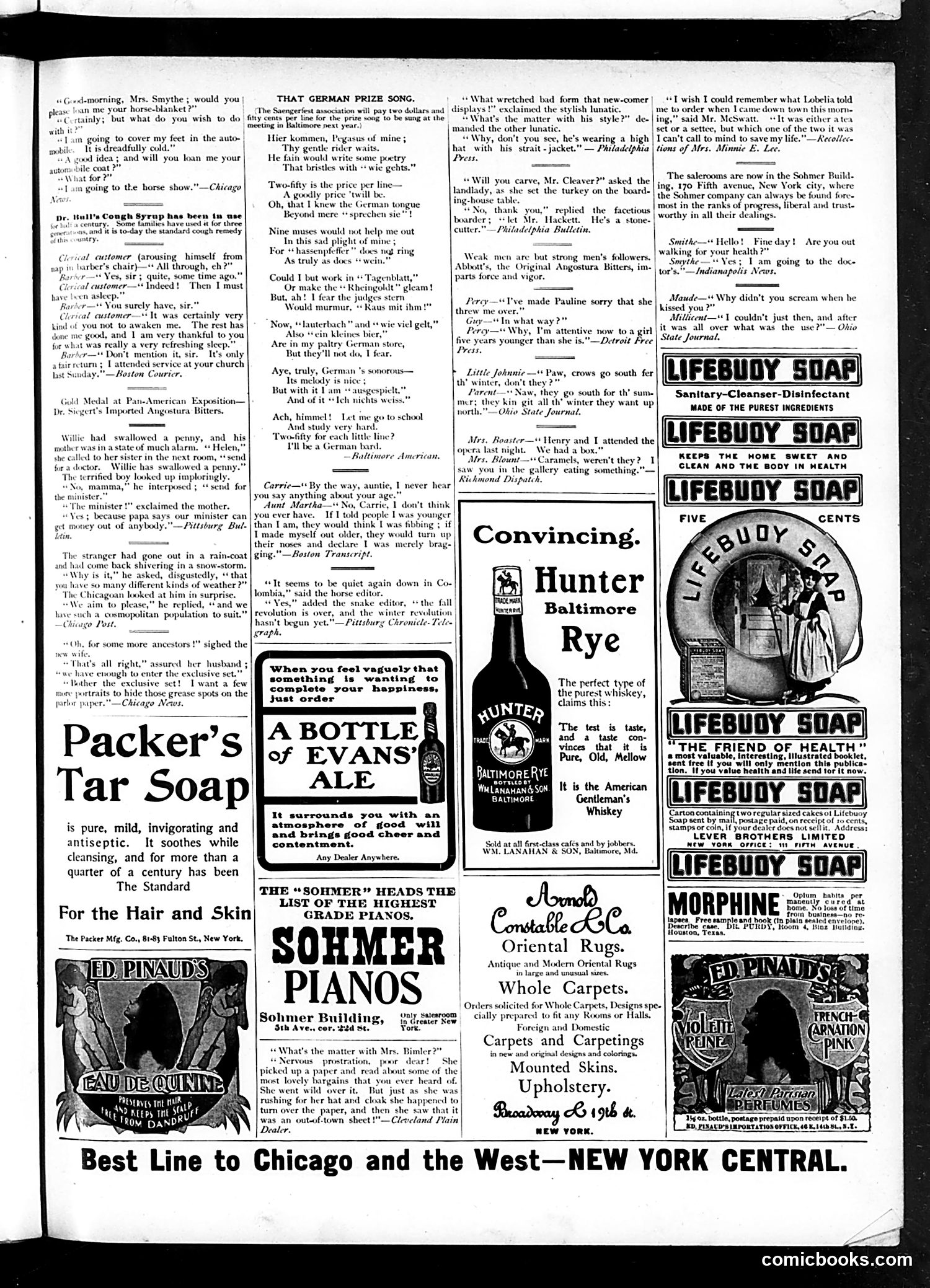
This page is **primarily advertisements** interspersed with short humorous anecdotes—typical of Judge magazine's format. The content lacks a dominant political cartoon. The humor pieces are brief, domestic jokes: a barber falling asleep while cutting hair, a child swallowing a penny, social climbing via "exclusive sets," and various puns about German language and song (referencing a "Saengerfest," a German-American singing festival). The **"That German Prize Song"** section appears to mock attempts at German poetry, playing on the difficulty of the language for English speakers—reflecting turn-of-the-century American attitudes toward German immigrants. The advertisements—Packer's Tar Soap, Lifebuoy Soap, Hunter Baltimore Rye whiskey, Sohmer Pianos, and Arnold Constable—represent typical consumer products of the era, suggesting this page addresses a middle-to-upper-class readership. **No clear political satire is visible.** This is primarily a mixed-content page of consumer advertising and light domestic humor.
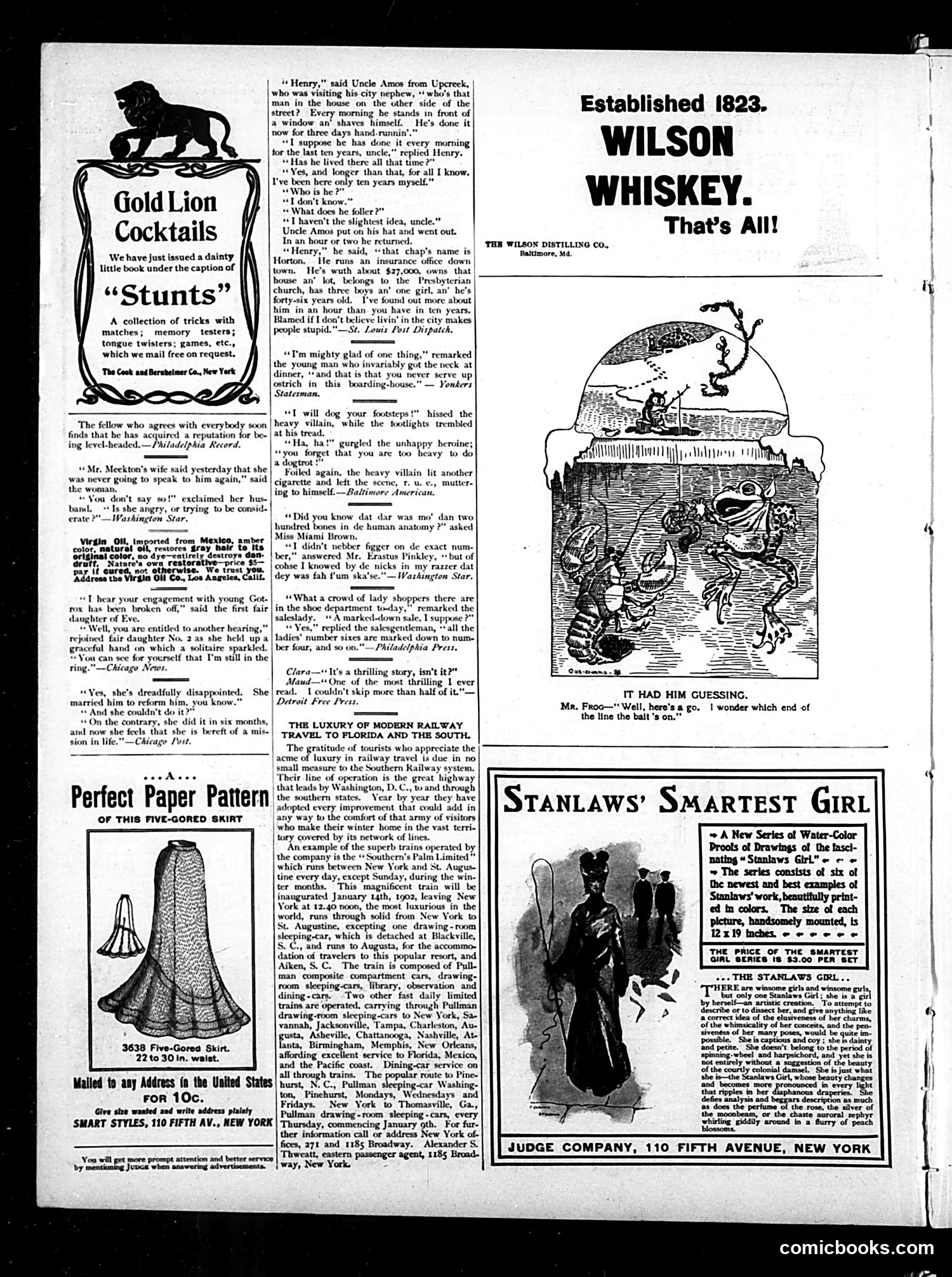
This page from Judge magazine (established 1823) is primarily **advertising and humor content**, typical of early 20th-century periodicals. ## Main Elements: **Cartoons/Humor:** The page contains several short comedic anecdotes rather than political cartoons—jokes about marriage, boarding houses, theater, and social observations. The most developed story features "Uncle Amos" from the country visiting his city nephew, humorously contrasting rural naïveté with urban detachment. After the nephew claims ignorance about his neighbor, Uncle Amos quickly learns the man's entire biography, sarcastically concluding that "livin' in the city makes people stupid." **Advertising:** Prominent ads include Wilson Whiskey (Baltimore), Gold Lion Cocktails recipe book, a paper dress pattern, and notices for Stanlaws' Smartest Girl illustration series. **No Clear Political Satire:** Unlike typical Judge content, this page lacks partisan commentary or caricatures of named political figures. The humor is gentle social observation rather than biting satire.
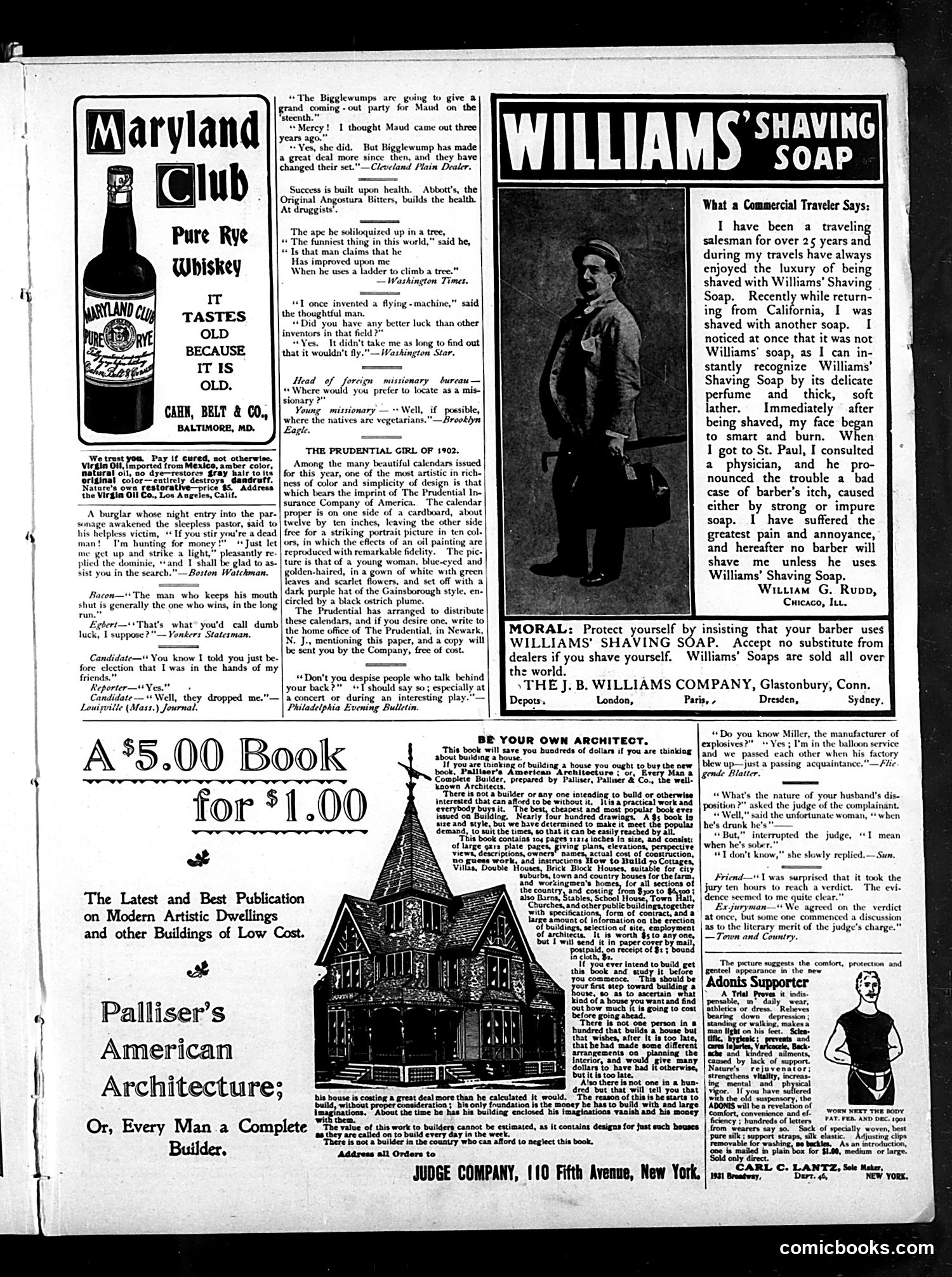
This page is primarily **advertising** rather than political satire. The dominant content is a Williams' Shaving Soap advertisement featuring a testimonial from a traveling salesman praising the product's superior lather and gentle properties. The page also contains: - A **Maryland Club Whiskey ad** (left side) emphasizing its age and quality - Several **brief humorous anecdotes** in the middle column—short jokes about various topics (a burglar/pastor, political candidates, social climbers) typical of Judge magazine's light humor - A **book advertisement** for an architecture guide - An **Adonis Supporter advertisement** (corset-like garment for men) There is **no significant political cartoon or satirical commentary** visible. The social humor is gentle and domestic rather than pointed—poking fun at minor hypocrisies (social climbing, politicians' broken promises) without addressing major political issues. This reflects Judge's mix of commercial advertising and light entertainment typical of early 1900s magazines.
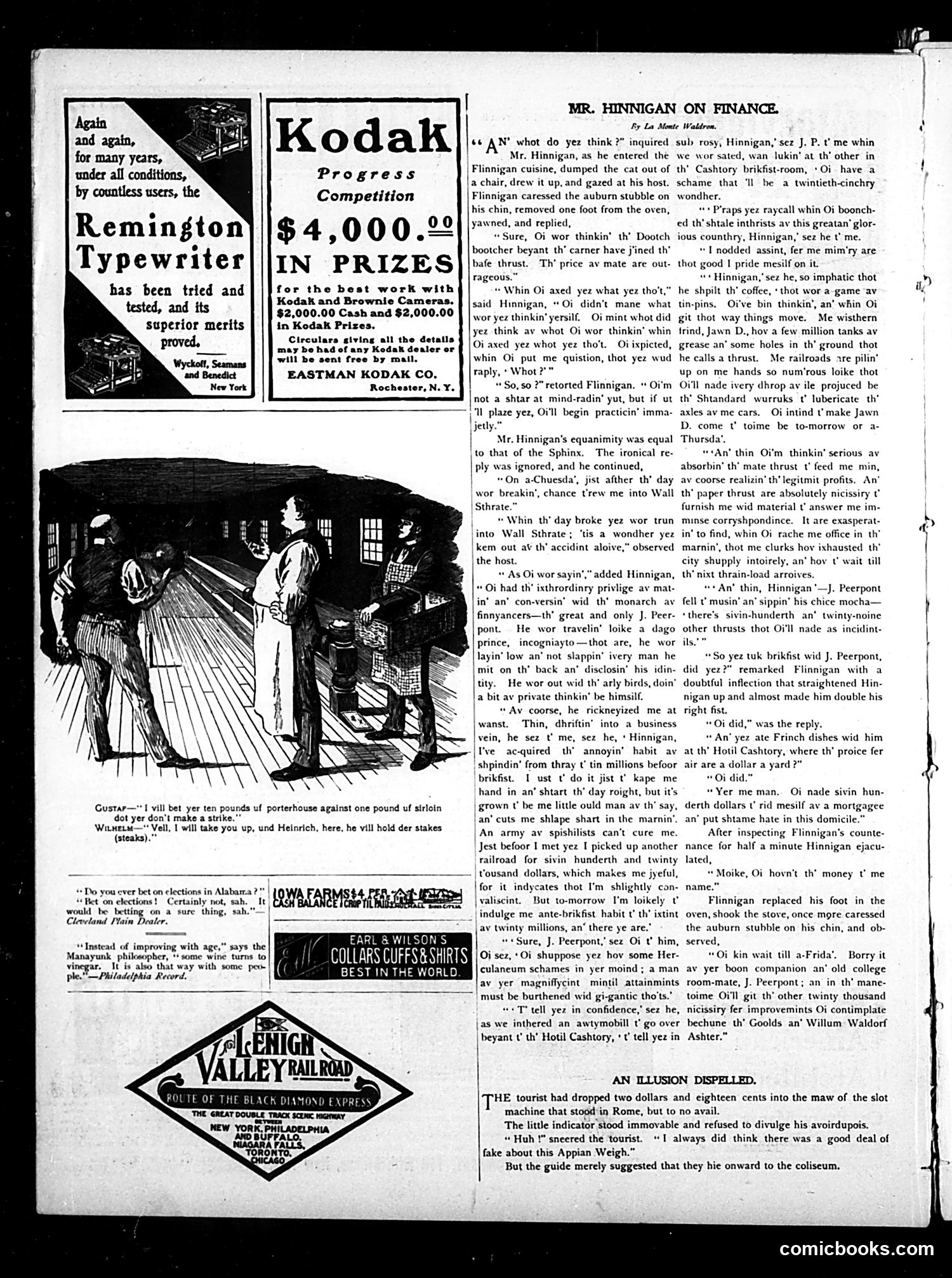
This page contains primarily **advertisements and two humorous stories** in dialect. The main cartoon shows two working-class men (Gustav and Wrinelski, with German-inflected names) betting on steaks, a pun on "stakes"—satirizing casual gambling among immigrants. The longer text is "Mr. Hinnigan on Finance," a comedic Irish-dialect story where Hinnigan recounts meeting **J. P. Morgan** (disguised as "J. Peerpont"), the famous financier, on Wall Street. The satire mocks Morgan's absurd wealth and compulsive spending—he casually acquires railroads for millions and spends $3-20 million *before breakfast* daily, treating massive financial transactions as thoughtless habits. The humor relies on **contrast**: an ordinary Irish working man conversing with America's most powerful banker, and Morgan's casual attitude toward incomprehensible sums of money. It satirizes **Gilded Age excess** and the perceived disconnect between the ultra-wealthy and ordinary citizens. The final snippet, "An Illusion Dispelled," is unrelated wordplay about a slot machine in Rome.
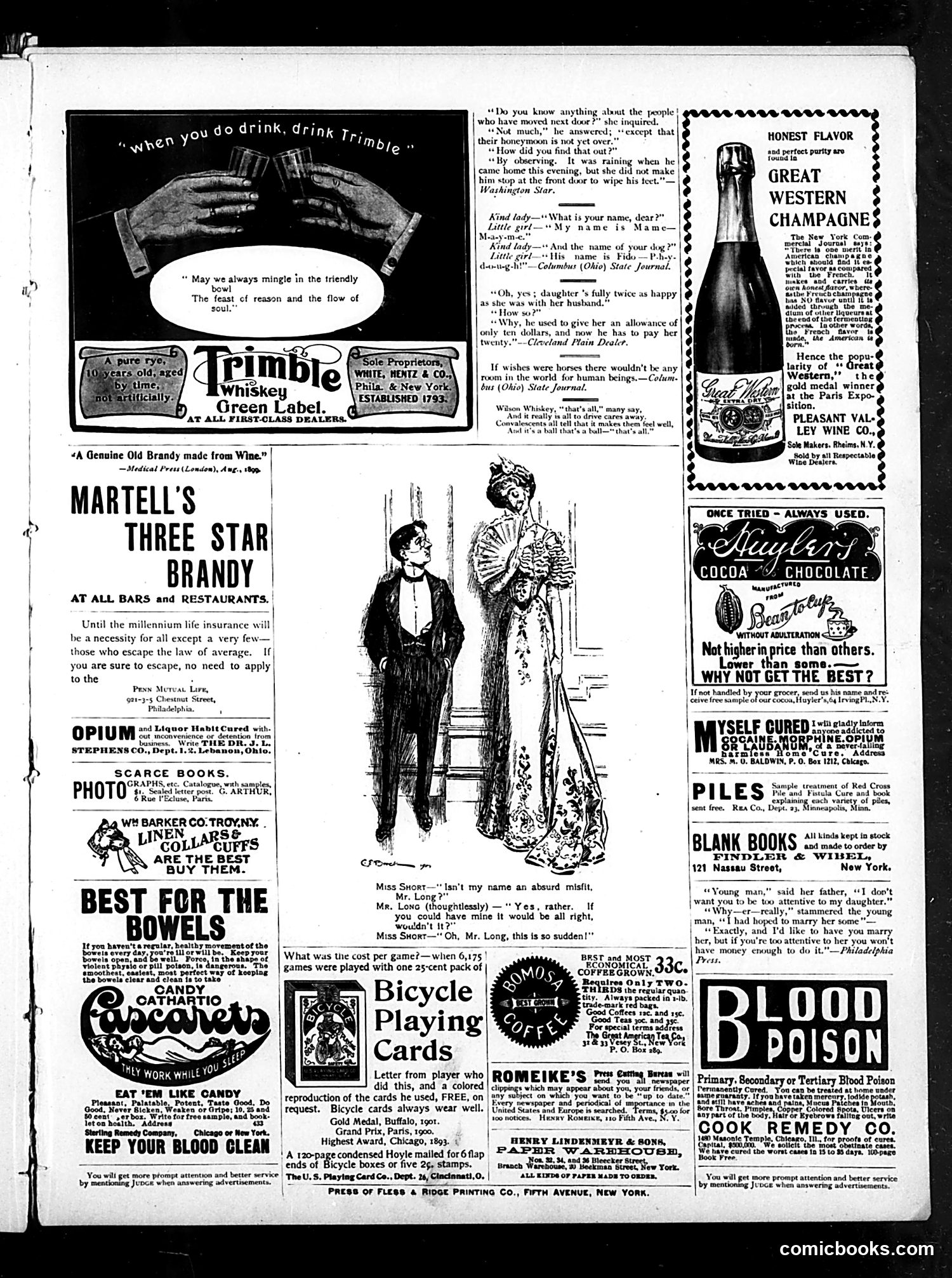
This page is predominantly **advertisements** with brief comic snippets interspersed—typical of Judge's format. The main satirical content consists of short, joke-like dialogues rather than political cartoons. ## Key Comic Elements: **The opening dialogue** jokes about a newlywed couple: a neighbor observes the husband didn't wipe his feet in the rain, deducing their honeymoon is over because the wife no longer fusses over him. This satirizes the loss of romantic attention in early marriage. **Another snippet** depicts a woman claiming she's "twice as happy" since her husband left, because he gave her a small allowance but now must pay her more—satirizing the financial and power dynamics of marriage. **"Miss Short" dialogue**: A man named Mr. Long ironically suggests the woman could marry him instead, and she feigns shock at his sudden proposal—a mild joke about his name's unfitness. The rest of the page is filled with **period advertisements** for whiskey, brandy, cocoa, playing cards, and dubious patent medicines (opium cures, "blood poison" remedies)—reflecting early 1900s consumer culture and medical quackery. The humor is gentle domestic satire, not overtly political.
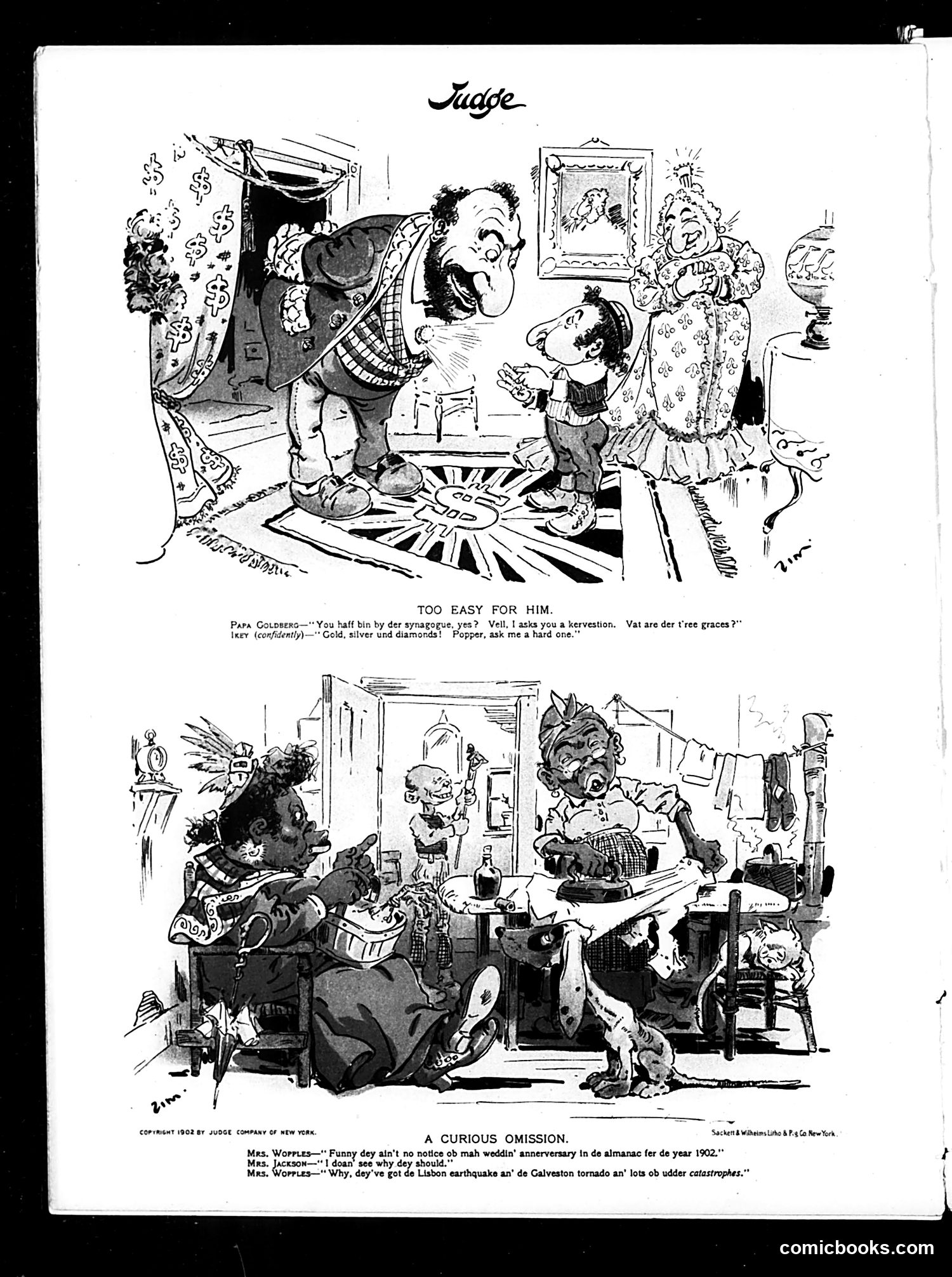
**Top cartoon ("Too Easy for Him"):** A wealthy Jewish man (Papa Goldberg, depicted with stereotypical exaggerated features) quizzes a young boy about "the three graces." The boy confidently answers "gold, silver and diamonds"—implying that Jewish people care only about material wealth. This is an antisemitic stereotype dressed as humor, mocking both Jewish religious knowledge and supposed greed. **Bottom cartoon ("A Curious Omission"):** Two Black women (Mrs. Woffles and Mrs. Jackson, drawn with exaggerated racial caricature) discuss why their wedding anniversary wasn't listed in the 1902 almanac. Mrs. Woffles complains the almanac includes disasters like the Lisbon earthquake and Galveston tornado but omits her wedding—darkly implying their lives matter less than catastrophes. Both cartoons use racist and antisemitic caricature typical of early-1900s Judge magazine, reflecting the prejudices of that era.