
Judge, 1902-01-18 · page 2 of 16
Judge — January 18, 1902 — page 2: what you’re looking at
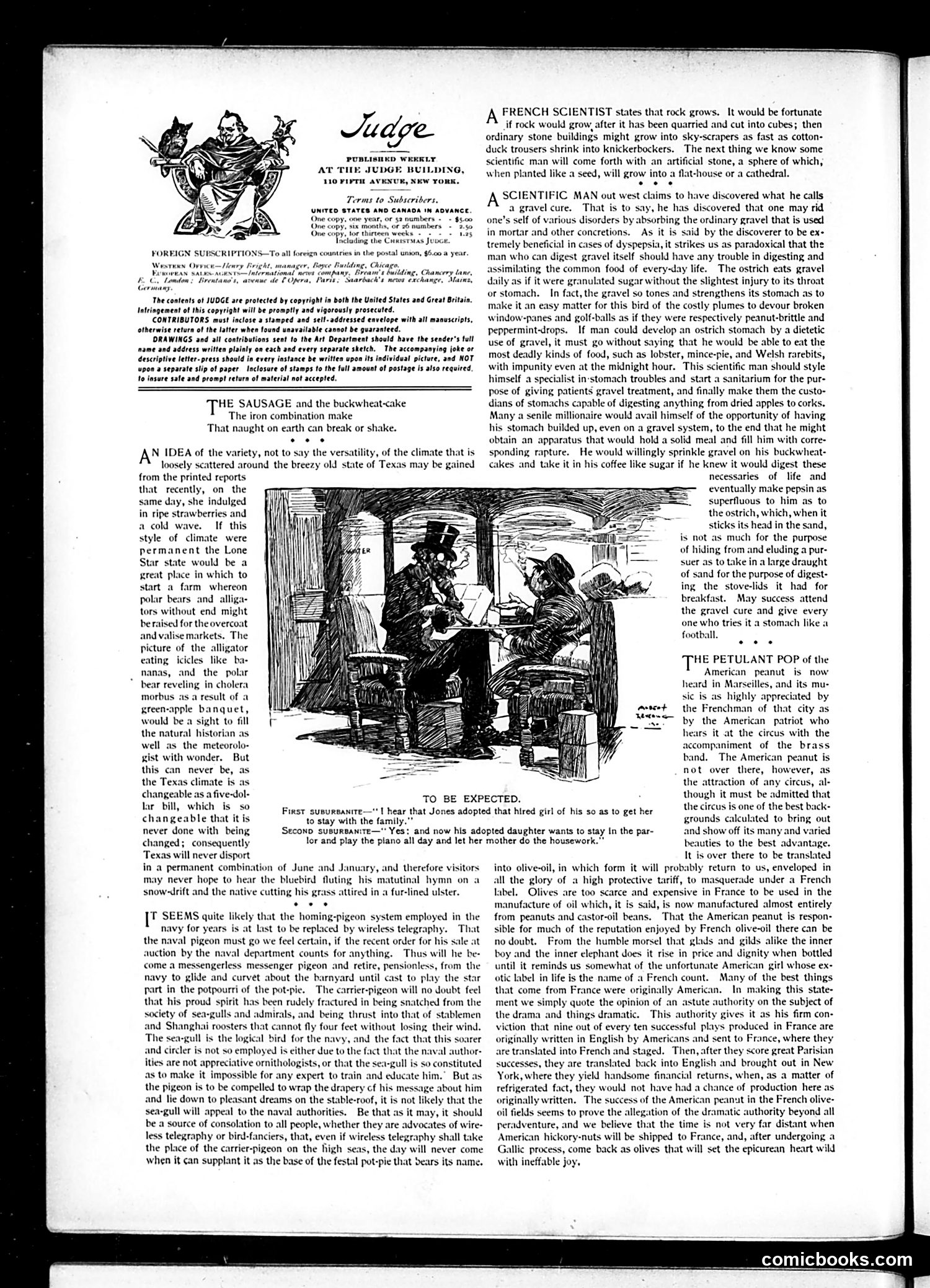
A restored page from Judge, 1902-01-18. Page through the whole issue in the reader above.
📄 Transcribed text from this page (OCR, searchable)
Machine-transcribed from the original scan — historical spelling and the odd misread are preserved.
PUBLISHED WEEKLY AT THE JUDGE BUILDING, 110 FIVTH AVENUE, NEW YORK. Terms to Subscribers, UNITED STATES AND CANADA IN ADVANCE ‘52 numbers 6 numbers ‘One copy, tor thirteen weeks sss > Aeluding the Caisratas Ju he postal union, $6.00 a year Landon?! Gormiany The coateats of JUDG Infringement of this copyright will be CONTRIBUTORS must inclose a stamped otherwise return of the latter when fo wailable cannot be guaranteed. DRAWINGS and al! 105 sent fo the Art Department should have the sender's full name and address wrilten plaialy on each and every separate sketch. The acc the United States and Great Britain. cuted. lope with all manuscripts, a separate slip to insure safe and prompt return of material not accepted. HE SAUSAGE and the buckwheat-cake The iron combination make That naught on earth can break or shake. AN IDEA of the variety, not to say the versatility, of the climate that is loosely scattered around the breezy old state of Texas may be gained from the printed reports that recently, on the same day, she indulged in ripe strawberries and a cold w If this style of climate were permanent the Lone Star state would be a great place in which to start a farm) whereon polar bears and alliga- tors without end might be raised for the overcoat and valise markets. The picture of the alligator eating icicles like ba- nanas, and the polar bear reveling in cholera morbus as a result of a green-apple banquet, would be a sight to fill the natural historian as well as the meteorolo- gist with wonder. But this can never be, as the Te; lar bill, wh s changeable that it is never done with being changed; consequently Texas will never disport in a permanent combination of June and January, and therefore visitors may never hope to hear the bluebird fluting his matutinal hymn on a snow-drift and the native cutting his grass attired in a fur-lined ulster. [T SEEMS quite likely that the homing-pigeon system employed in the navy for years is at last to be replaced by wireless telegraphy. That the naval pigeon must go we feel certain, if the recent order for his sale at auction by the naval department counts for anything. Thus will he be- come a messengerless messenger pigeon and retire, pensionless, from the navy to glide and curvet about the barnyard until cast to play the star part in the potpourri of the pot-pie. The carrier-pigeon will no doubt feel that his proud spirit has been rudely fractured in being snatched from the society of sea-gulls and admirals, and being thrust into that of stablemen. and Shanghai roosters that cannot fly four feet without losing their wind. The sea-gull is the logical bird for the navy, and the fact that this soarer and circler is not so employed is either due to the fact that the naval author- ities are not appreciative ornithologists, or that the sea-gull is so constituted as to make it impossible for any expert to train and educate him.’ But as the pigeon is to be compelled to wrap the drapery cf his message about him and lie down to pleasant dreams on the stable-roof, it is not likely that the sea-gull will appeal to the naval authorit Be that as it may, it should be a source of consolation to all people, whether they are advocates of wire- less telegraphy or bird-fanciers, that, even if wireless telegraphy sl e the place of the carrier-pigeon on the high seas, the day will never come when it can supplant it as the base of the festal pot-pie that Dears its name. to stay with the fami Second susursanite—"* Y and now his adopted daughter wants to stay In the par- lor and play the piano all day and let her mother do the housework.” A FRENCH SCIENTIST states that rock grows. It would be fortunate if rock would grow, after it has been quarried and cut into cubes; then ordinary stone buildings might grow into sky-scrapers as fast as cotton duck trousers shrink into knickerbockers. The next thing we know some scientific man will come forth with an artificial stone, a sphere of which, when planted like a seed, will grow into a flat-house or a cathedral. SCIENTIFIC MAN out west claims to have discovered what he calls a gravel cure. That is to say, he has discovered that one may rid one’s self of various disorders by absorbing the ordinary gravel that is used in mortar and other concretions. As it is said by the discoverer to be ex- tremely beneficial in cases of dyspepsia, it strikes us as paradoxical that the man who can digest gravel itself should have any trouble in digesting and assimilating the common food of every-day life. The ostrich eats gravel daily as if it were granulated sugar without the slightest injury to its throat or stomach. In fact, the gravel so tones and strengthens its stomach as to make it an easy matter for this bird of the costly plumes to devour broken window $ s as if they were respectively peanut-brittle and peppermint-dro could develop an ostrich stomach by a dietetic use of gravel, it must go without saying that he would be able to eat the most deadly kinds of food, such as lobster, mince-pie, and Welsh rarebit: with impunity even at the midnight hour. This scientific man should style himself a specialist in-stomach troubles and start a sanitarium for the pur- pose of giving patients gravel treatment, and finally make them the custo- dians of stomachs capable of digesting anything from dried apples to corks. Many a senile millionaire would avail himself of the opportunity of having his stomach builded up, even on a gravel system, to the end that he might obtain an apparatus that would hold a solid meal and fill him with corre- sponding rapture. He would willingly sprinkle gravel on his buckwhea cakes and take it in his coffee like sugar if he knew it would digest these necessaries of life and eventually make pepsin as superfluous to him as to the ostrich, which, when it sticks its head in the sand, is not as much for the purpose of hiding from and eluding a pur- suer as to take in a large draught of sand for the purpose of digest- ing the stove-lids it had for breakfast. May success attend the gravel cure and give every one who tries it a stomach like a football. oe ‘HE PETULANT POP of the American peanut is now heard in Marseilles, and its mu- sic is as highly appreciated by the Frenchman of that city as by the American patriot who hears it at the circus with the accompaniment of the brass band. The American peanut is not over there, however, as the tion of any circus, TO BE EXPECTED. First susureanrre—" | hear that Jones adopted that hired girl of his so as to get her the circus is one of the best back- grounds calculated to bring out ies to the best advantage. It is over there to be translated into olive-oil, in which form it will probably return to us, enveloped in all the glory of a high protective tariff, to masquerade under a French label. Olives are too ce and expensive in France to be used in the manufacture of oil which, it is said, is now manufactured almost entirely from peanuts and castor-oil beans. That the American peanut is respon- sible for much of the reputation enjoyed by French olive-oil there can be no doubt. From the humble morsel that glads and gilds alike the inner boy and the inner elephant does it rise in price and dignity when bottled until it reminds us somewhat of the unfortunate American girl whose ex- the name of a French count. Many of the best things come from France were originally American, In making this state- ment we simply quote the opinion of an astute authority on the subject of the drama and things dramatic. Th thority gives it as his firm con- viction that nine out of every ten successful plays produced in France are originally written in English by Americans and sent to France, where the are translated into French and ed. Then, after they score great Pari successes, they are translated k into English and brought out in New York, where they yield handsome financial returns, when, as a matter of refrigerated fact, they would not have had a chance of production here as originally written. The success of the American peanut in the French oliv oil fields seems to prove the allegation of the dramatic authority beyond all peradventure, and we believe that the time is not very distant when Ameri hickory-nuts will be shipped to France, and, after undergoing a Gallic process, come back as olives that will set the epicurean heart wild with ineffable joy.