A complete issue · 16 pages · 1902
Judge — January 11, 1902
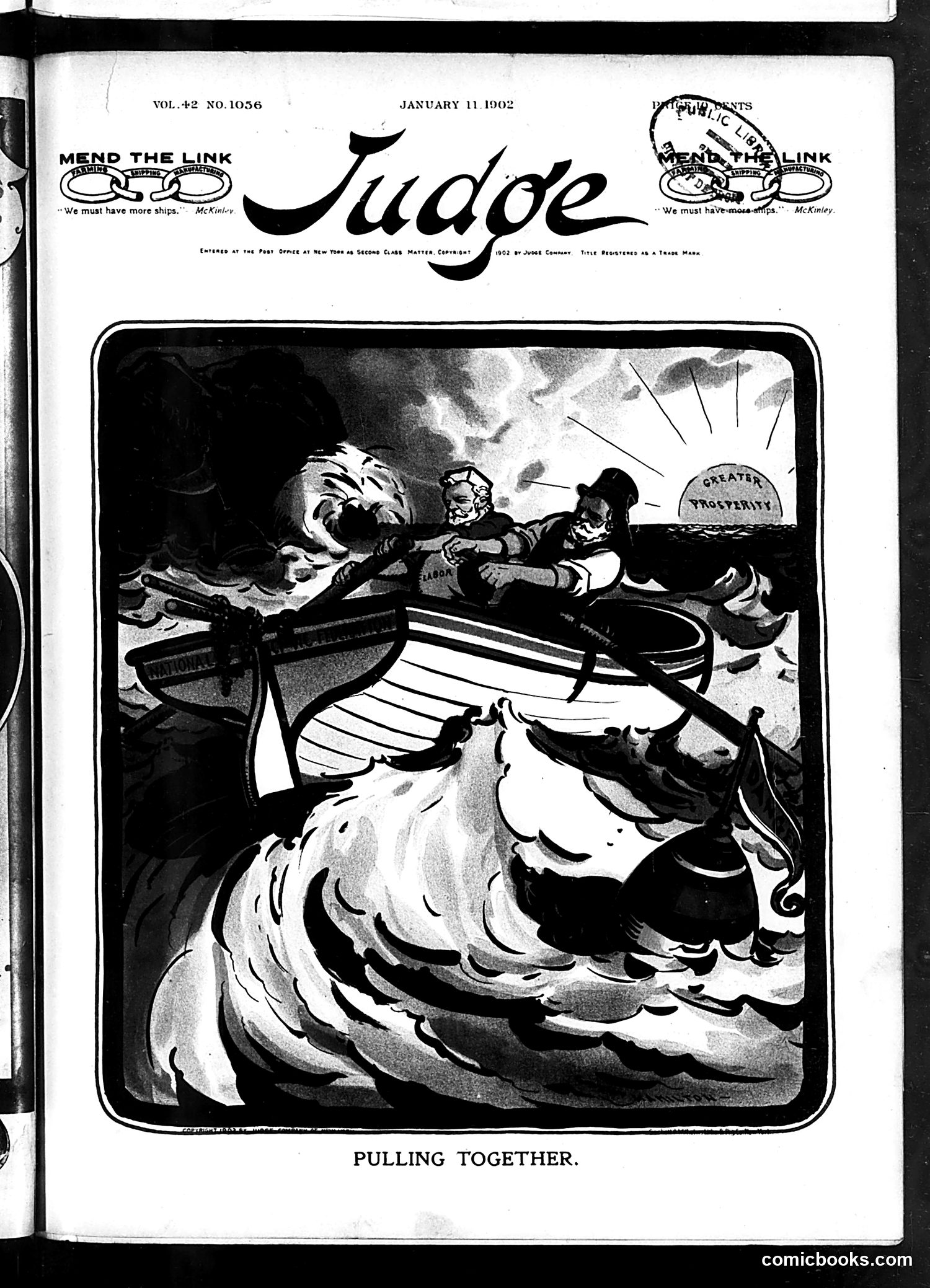
This editorial cartoon depicts several figures (appearing to represent political or business leaders) straining together to pull a large boat labeled "GREATER PROSPERITY" through turbulent waters. The imagery suggests a call for national unity and cooperative effort to achieve economic success during the early 1900s. The "Mend the Link" motto visible in the header reinforces this theme of unity—that the chain of national strength depends on all segments working cohesively. The dramatic waves and the strain on the figures emphasize that prosperity requires collective action rather than individual or factional interests. The specific political context remains unclear without additional source material, but the cartoon appears to advocate for unified national purpose during what may have been a period of economic or political tension.
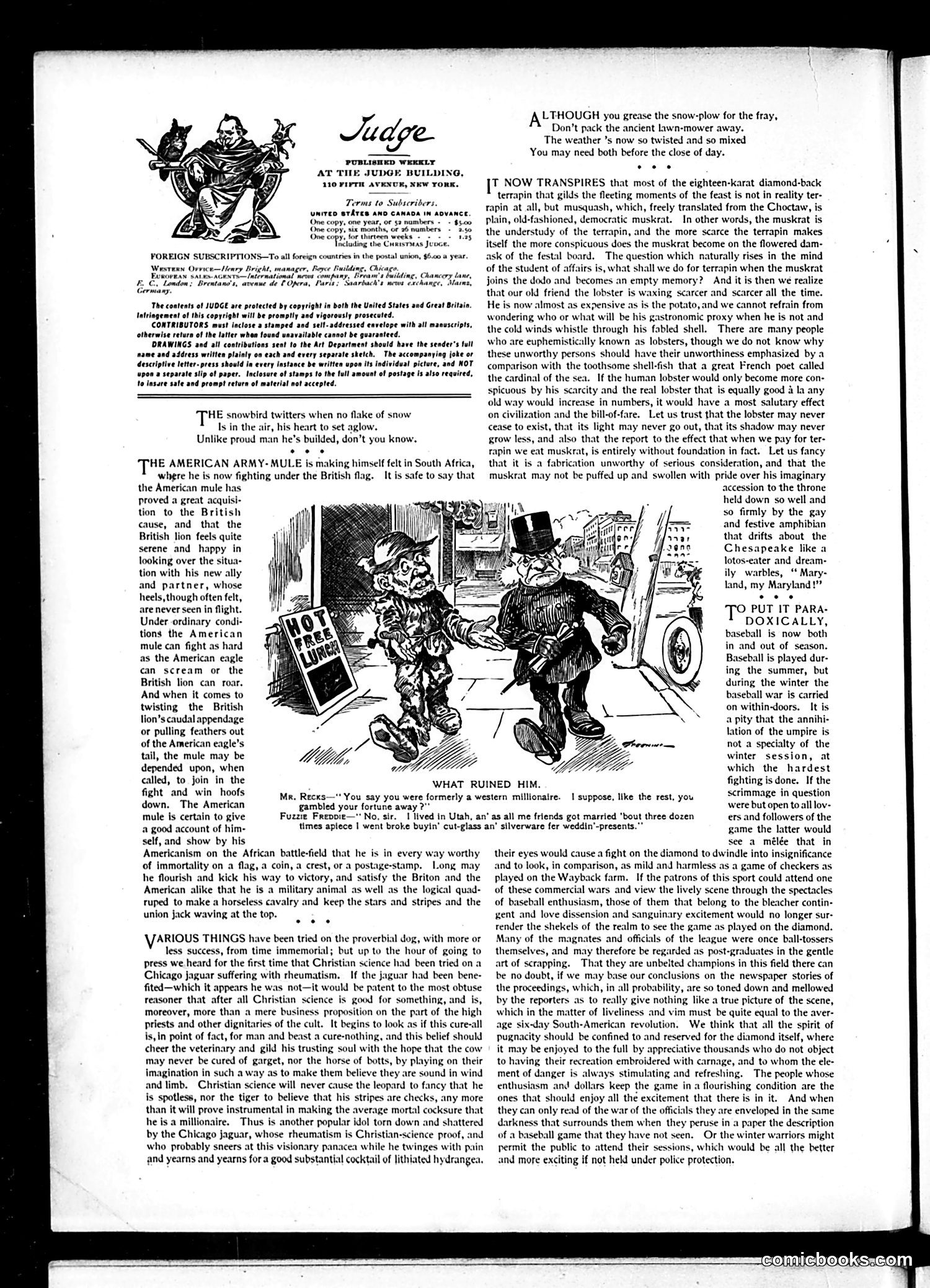
The central cartoon titled "What Ruined Him" depicts two figures discussing a third man's downfall. Based on the dialogue mentioning "western millionaire" and references to Utah and marriage, this appears to satirize a wealthy businessman destroyed by marrying multiple times—likely critiquing the social scandal of polygamy or serial marriage among the wealthy. The surrounding text discusses the American Army's role in South Africa (appearing to reference the Boer War context), mules in military service, and baseball. The satirical tone targets British-American relations, military logistics, and American social pretensions. The overall page combines political commentary on American military involvement abroad with domestic social satire about wealth, marriage, and class aspirations typical of Judge's approach to late-19th/early-20th-century issues.
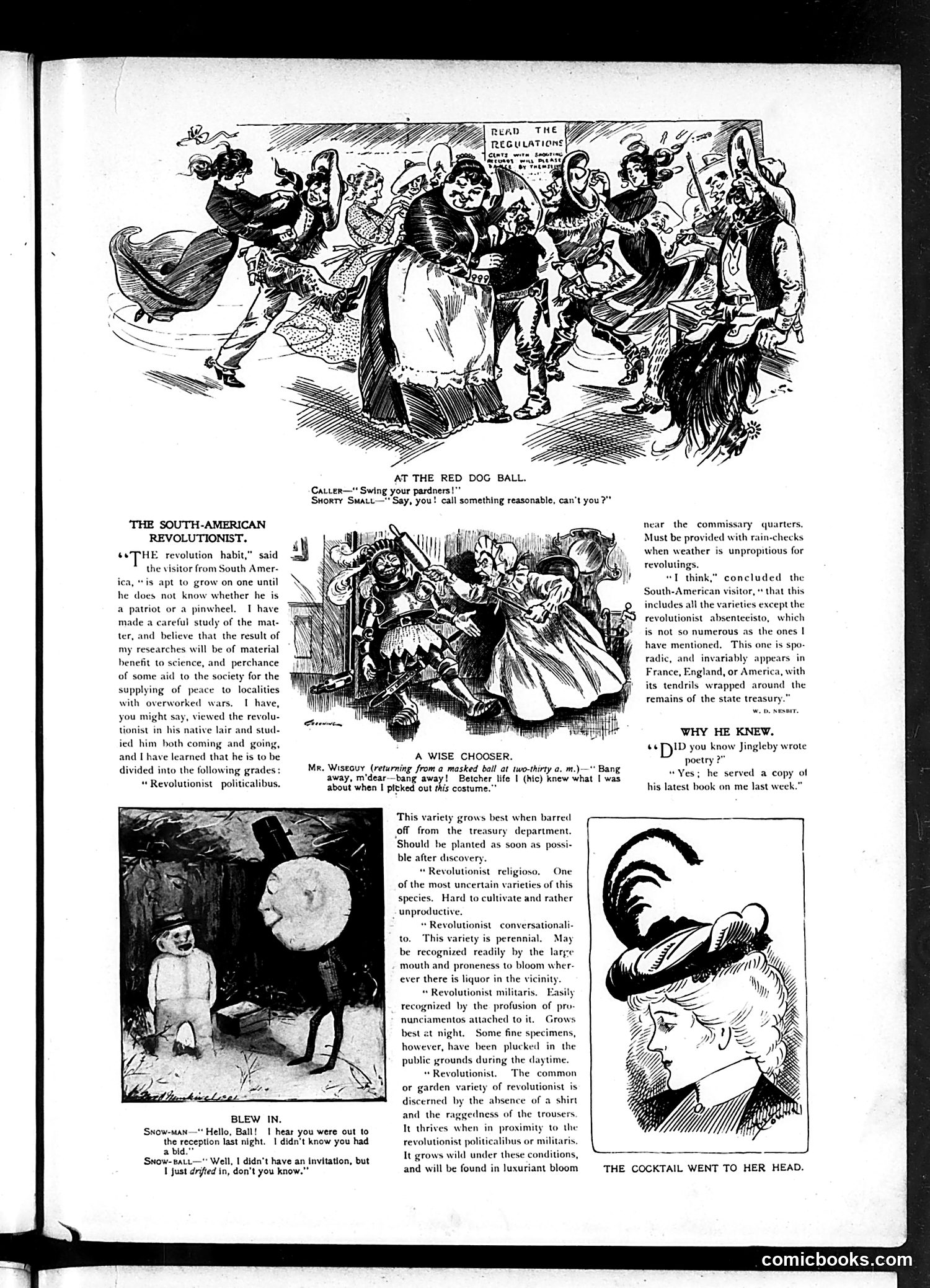
This page satirizes South American revolutionary politics through multiple sketches. "The South-American Revolutionist" features a visitor discussing various types of revolutionaries—from those motivated by ideology to those simply seeking plunder from the state treasury. The captions mock different "varieties" of revolutionists using pseudo-botanical language, suggesting they're interchangeable nuisances rather than serious political actors. The sketches depict chaotic revolutionary scenes and a character discussing "Jinglebay" poetry, mocking both the romanticization of revolution and the absurdity of revolutionary politics in South America. "The Red Dog Ball" cartoon at top shows anarchic social chaos. The overall satire dismisses South American revolutions as frivolous, disorganized, and financially corrupt—a common late-19th/early-20th century American editorial perspective viewing Latin American politics as inherently unstable and illegitimate.
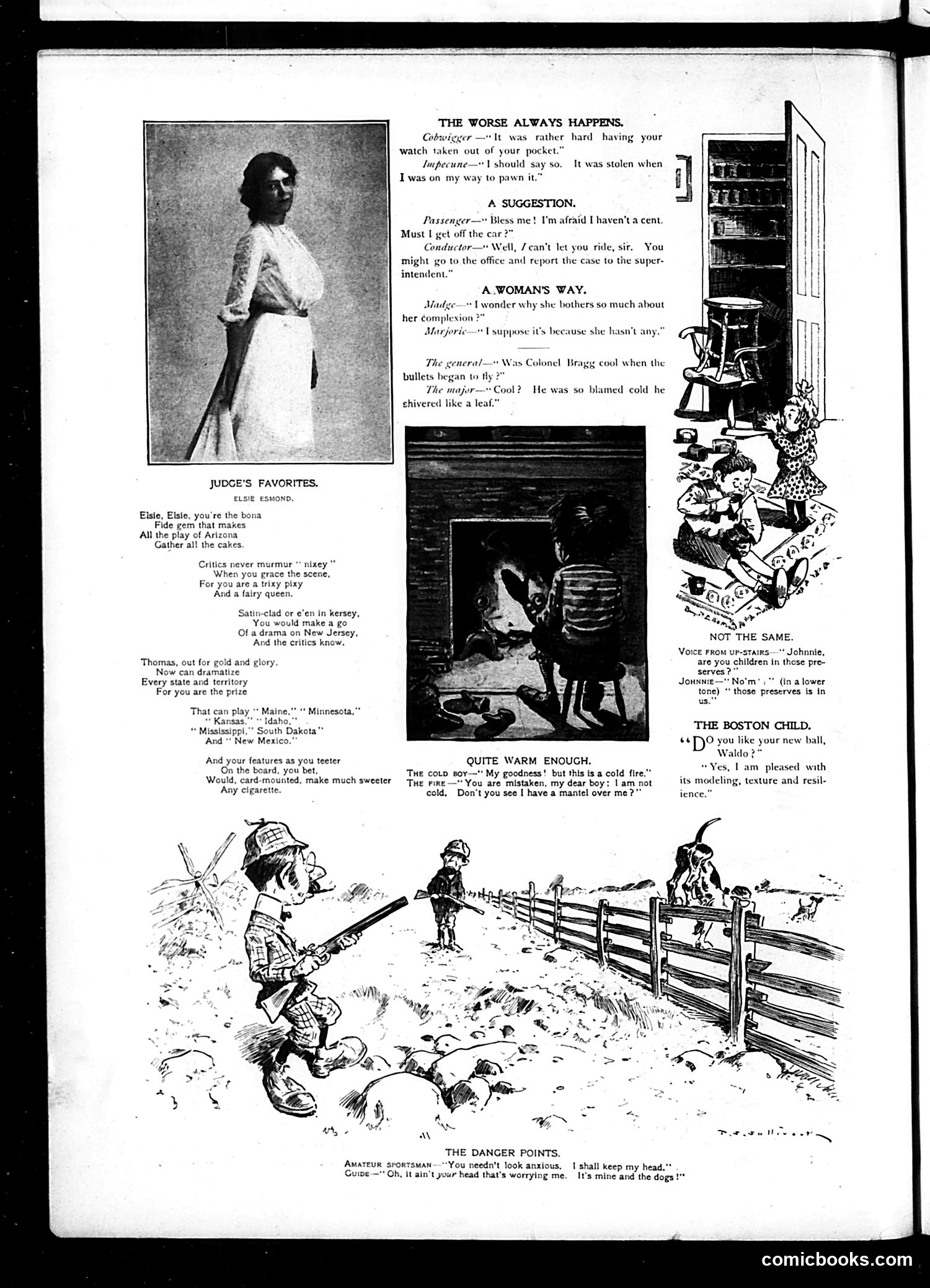
This page contains several unrelated humorous sketches and jokes typical of Judge magazine's format: **"Judge's Favorites"** celebrates actress Elsie Ferguson with a poem praising her theatrical talents across various roles. **"The Worse Always Happens"** and related sections present brief comic dialogues about everyday misfortunes—a stolen watch, a passenger without money, and observations about women's complexions and men's sensitivity to cold. **"Quite Warm Enough"** depicts a domestic scene where a wife ironically insists the house is warm while sitting near a fire, contradicting her cold husband's complaints. **"The Danger Points"** shows a hunter with dogs, focusing on shooting safety concerns. The page reflects early 20th-century Judge magazine's mix of theatrical commentary, domestic humor, and genteel satire aimed at middle-class readers—with no apparent political messaging.
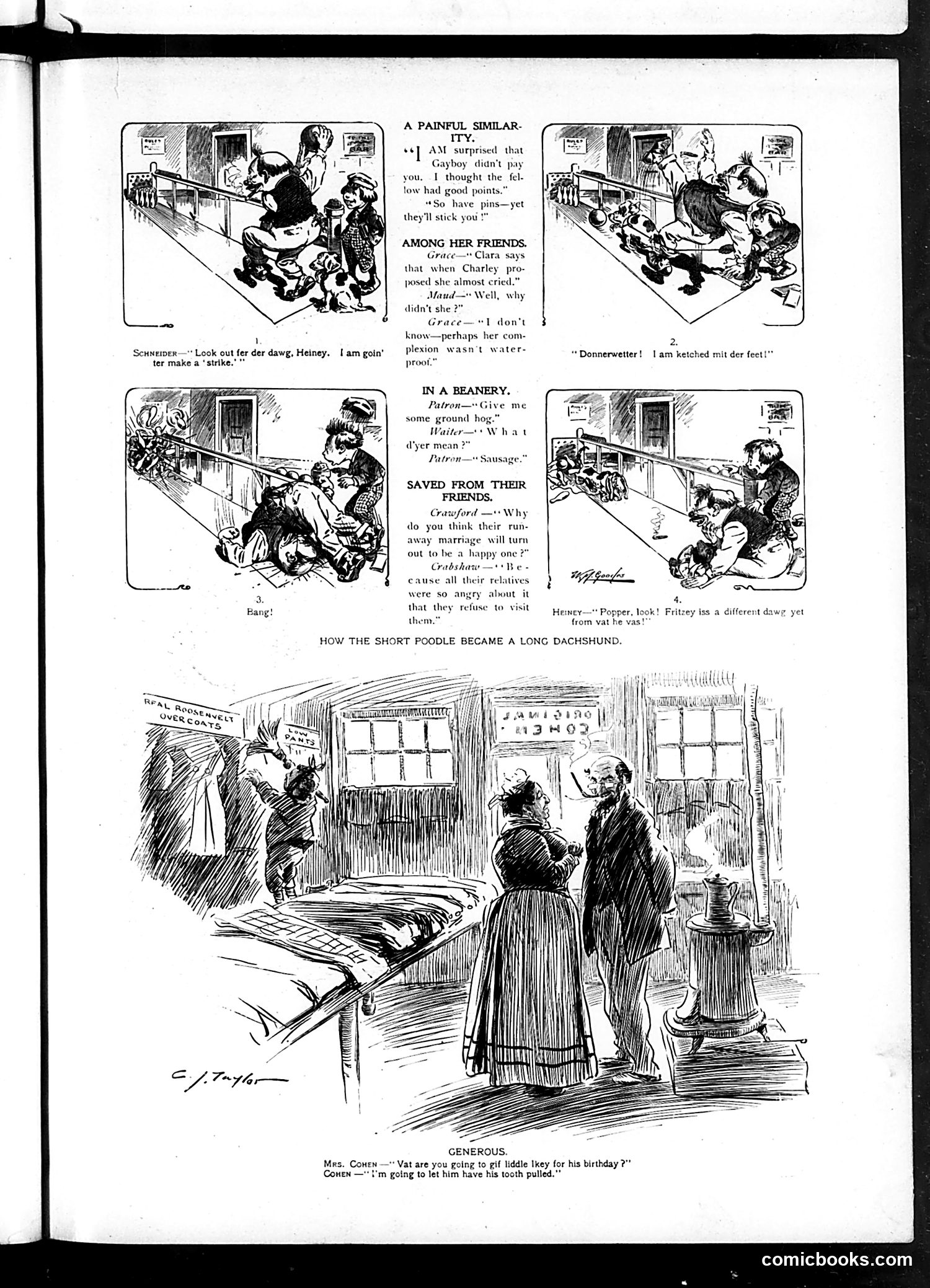
This page contains multiple satirical vignettes mocking various social groups, primarily through ethnic stereotyping common to early 20th-century American humor. **Top section**: Brief jokes about romantic disappointments and dental work, using stereotyped German and Jewish names/dialects. **Middle section** ("How the Short Poodle Became a Long Dachshund"): A visual pun showing a dog being stretched, satirizing marriage and social pressure. The caption "Saved from Their Friends" suggests the couple's relatives interfering in their relationship, literally reshaping it—a commentary on unwanted family involvement in courtship. **Bottom panel** ("Generous"): A Jewish family joke where Mr. Cohen's idea of a birthday "gift" for his son Ikey is having his tooth pulled—trading dental pain for celebration. This plays on stereotypes about Jewish frugality and dental anxiety. The page relies entirely on ethnic caricatures and dialect humor typical of Judge's era, using exaggerated names and speech patterns to demarcate outsider groups for mockery.
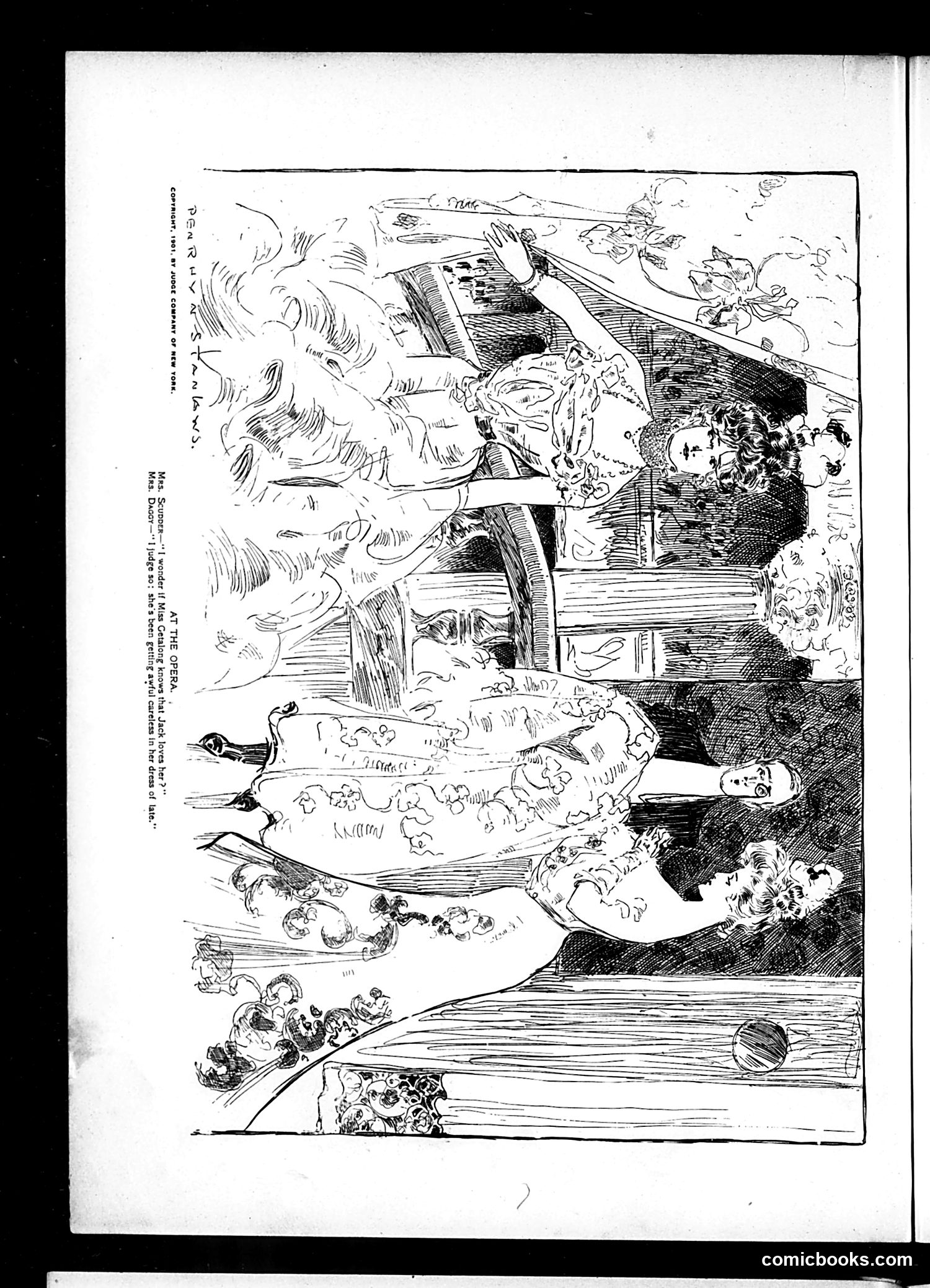
I cannot reliably interpret this cartoon due to the image quality and OCR text being largely illegible. The OCR produces only corrupted character strings rather than readable words, making it impossible to identify the specific political or social references, named figures, or historical context the satire addresses. What is visible: This appears to be a single-panel sketch from *Judge* magazine showing multiple figures in what seems to be an indoor scene with period clothing and furnishings. The drawing style and engraving technique are consistent with late 19th or early 20th-century American political satire. To properly explain this cartoon's meaning and satire, I would need either a clearer image or legible text identifying the subjects, publication date, or political context. **I cannot responsibly guess at the identities or commentary.**
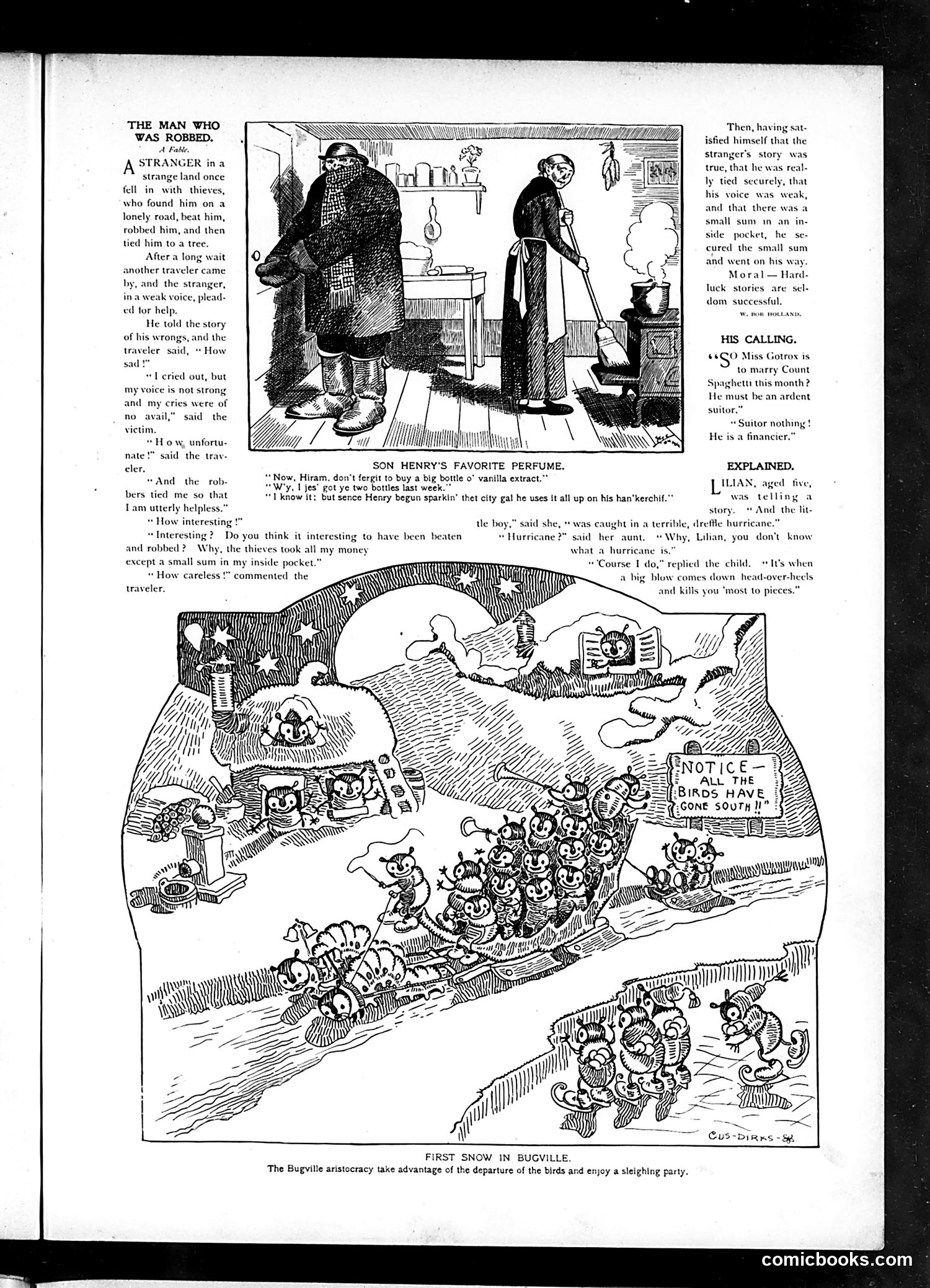
This page contains three separate satirical pieces from *Judge* magazine: 1. **"The Man Who Was Robbed"** (top left): A fable mocking those who tell sob stories. A second traveler, hearing of a man's beating and robbery, steals his remaining money anyway. The moral: "Hard-luck stories are seldom successful"—satirizing society's indifference to the unfortunate. 2. **"His Calling"** (top right): A brief joke about a nobleman marrying for money rather than romance, calling himself a "financier" instead of suitor—mocking wealthy Europeans and mercenary marriages. 3. **"First Snow in Bugville"** (bottom): An anthropomorphic cartoon showing insects enjoying winter activities after birds migrate south. This appears to be gentle, whimsical satire about the animal kingdom's social hierarchies, with "aristocracy" taking leisure time. The page blends social commentary with lighthearted humor typical of early-20th-century *Judge* content.
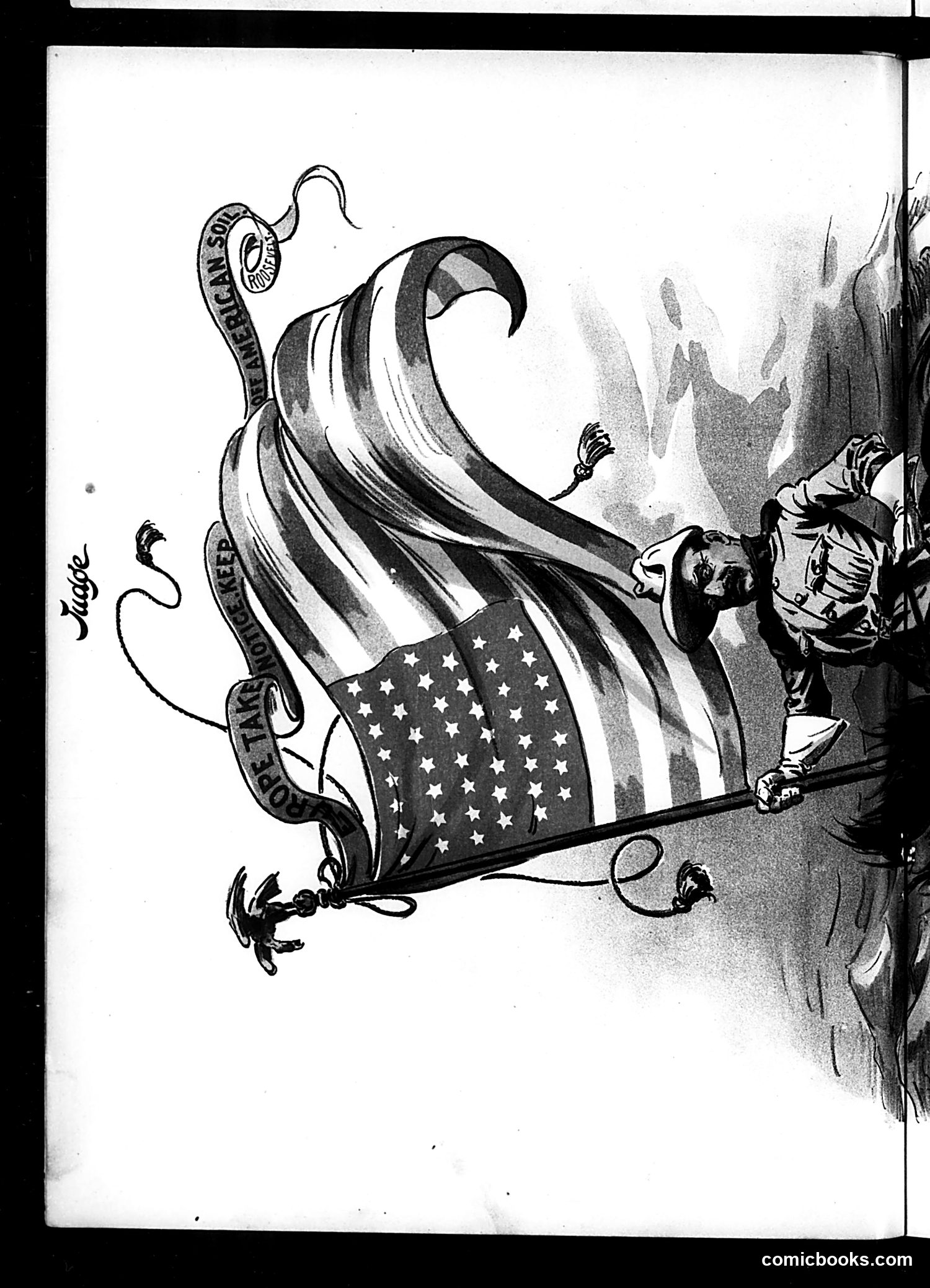
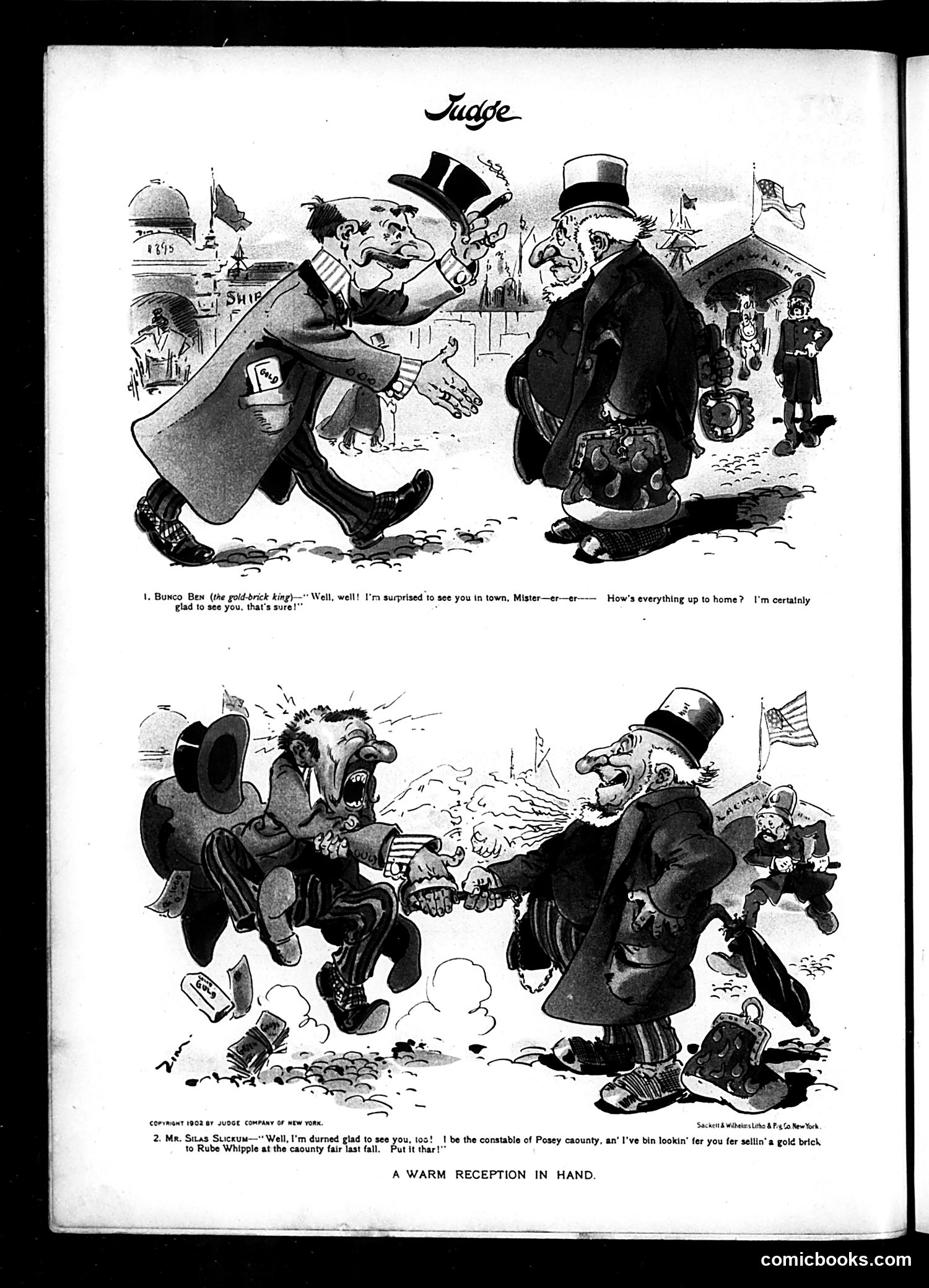
This appears to be a political cartoon from *Judge* magazine depicting an American flag being strangled or constricted by serpents labeled with text (though the specific labels are difficult to read clearly in this reproduction). The cartoonist—signed "Cesare" in the lower left—uses the snake imagery to represent threats or forces attacking American democracy and national symbols. On the right side, figures appear to be responding to or witnessing this assault on the flag. The satirical point likely critiques specific political or social dangers of the era, but without clearer visibility of the serpent labels and the publication date, I cannot definitively identify which particular threat or scandal the cartoon addresses. The style and technique suggest early-to-mid 20th century origin.
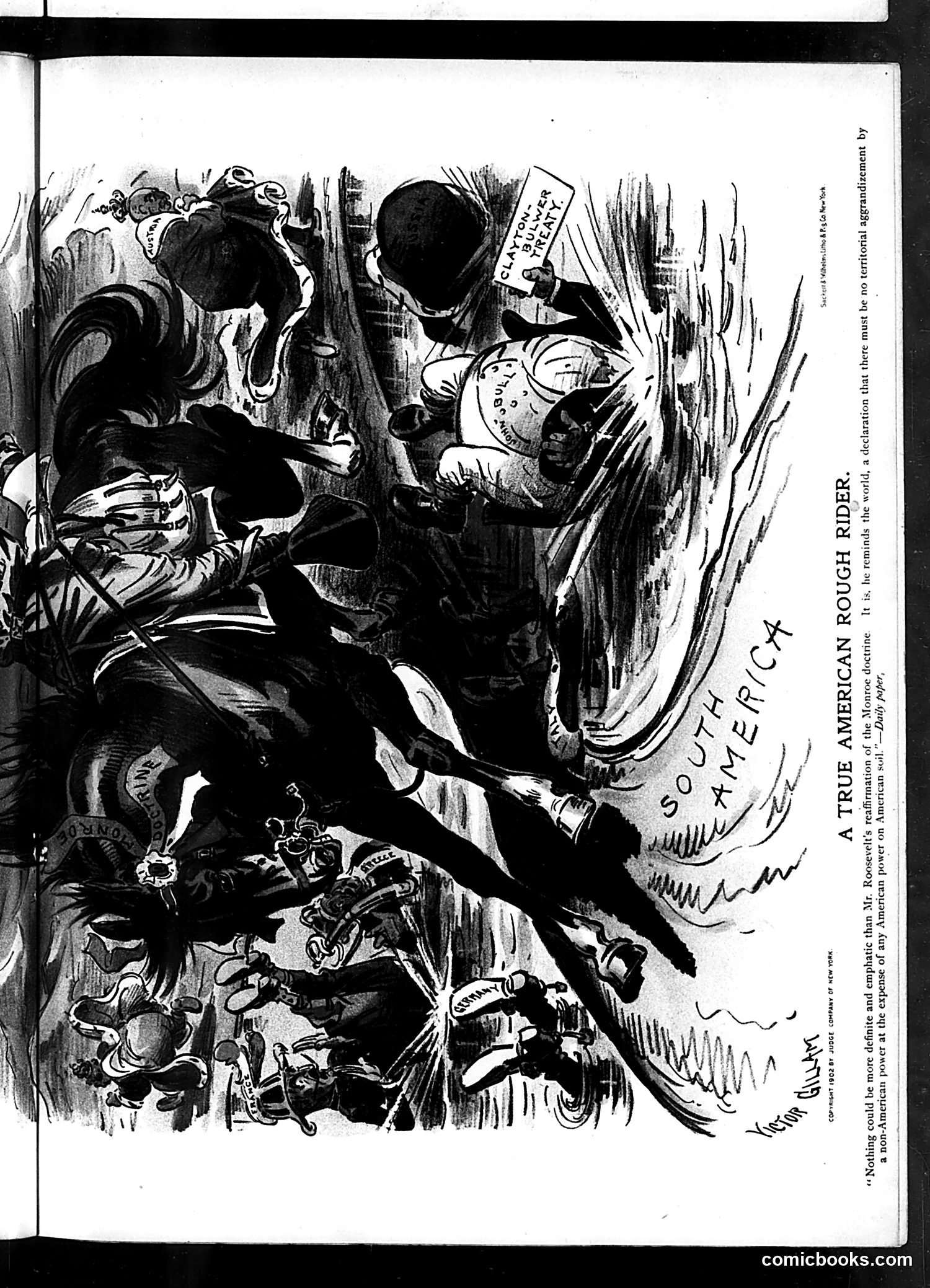
This political cartoon satirizes Theodore Roosevelt's "Rough Rider" image and persona. The caricatured figure (likely Roosevelt, given the title) is depicted riding wildly atop chaotic scenes of violence and destruction—with figures falling, fighting, and colliding below him. The satire mocks Roosevelt's aggressive, combative political style and his romanticized self-presentation as a bold, masculine leader. The title "A True American Rough Rider" uses irony; rather than showing heroic leadership, the cartoon suggests Roosevelt's reckless approach creates chaos and harm for ordinary Americans caught beneath his riding. The crowded, violent imagery criticizes his interventionist policies and pugnacious temperament as dangerous to the nation.
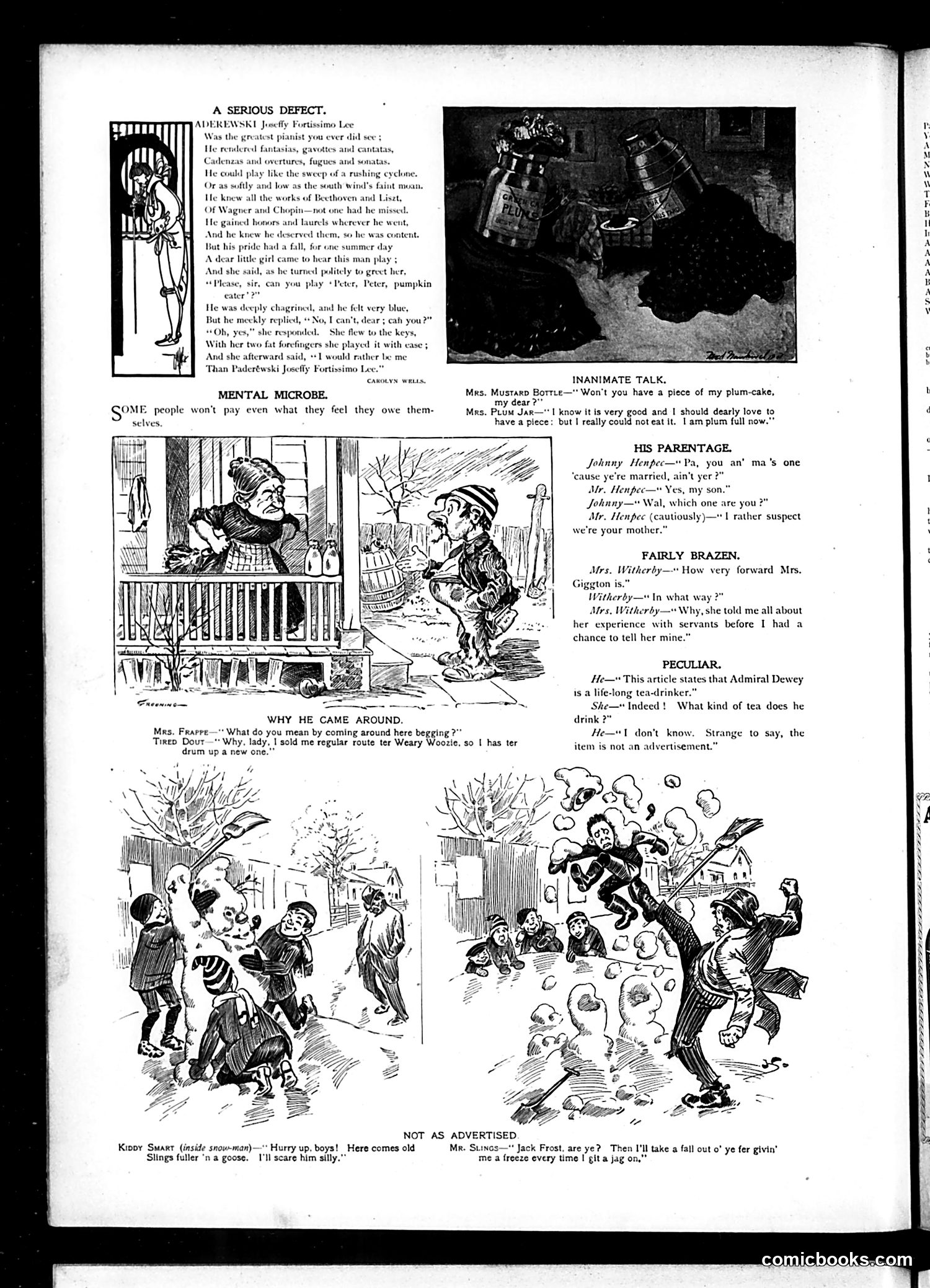
This page contains humorous short pieces typical of Judge magazine's satirical style. The title piece mocks a celebrated pianist (appears to reference real virtuosos like Paderewski) through ironic verse. A famous master of classical music—capable of performing Beethoven and Wagner flawlessly—is upstaged by a little girl playing "Peter, Peter, pumpkin eater" on the piano. The joke: technical mastery means nothing when a child's simple, cheerful performance proves more genuinely delightful. It satirizes pretension and the gap between elite cultural accomplishment and authentic human pleasure. The remaining items are brief joke-vignettes about everyday social awkwardness: a woman too polite to refuse cake, marital dynamics where the husband suspects he's the "wife," a woman being tactlessly forward about servant gossip, and a confusing pun about Admiral Dewey's "tea-drinking." These simple gags mock middle-class social conventions and gender relations—particularly women's behavior and domestic hierarchies. The humor relies on recognizable social situations rather than political content.
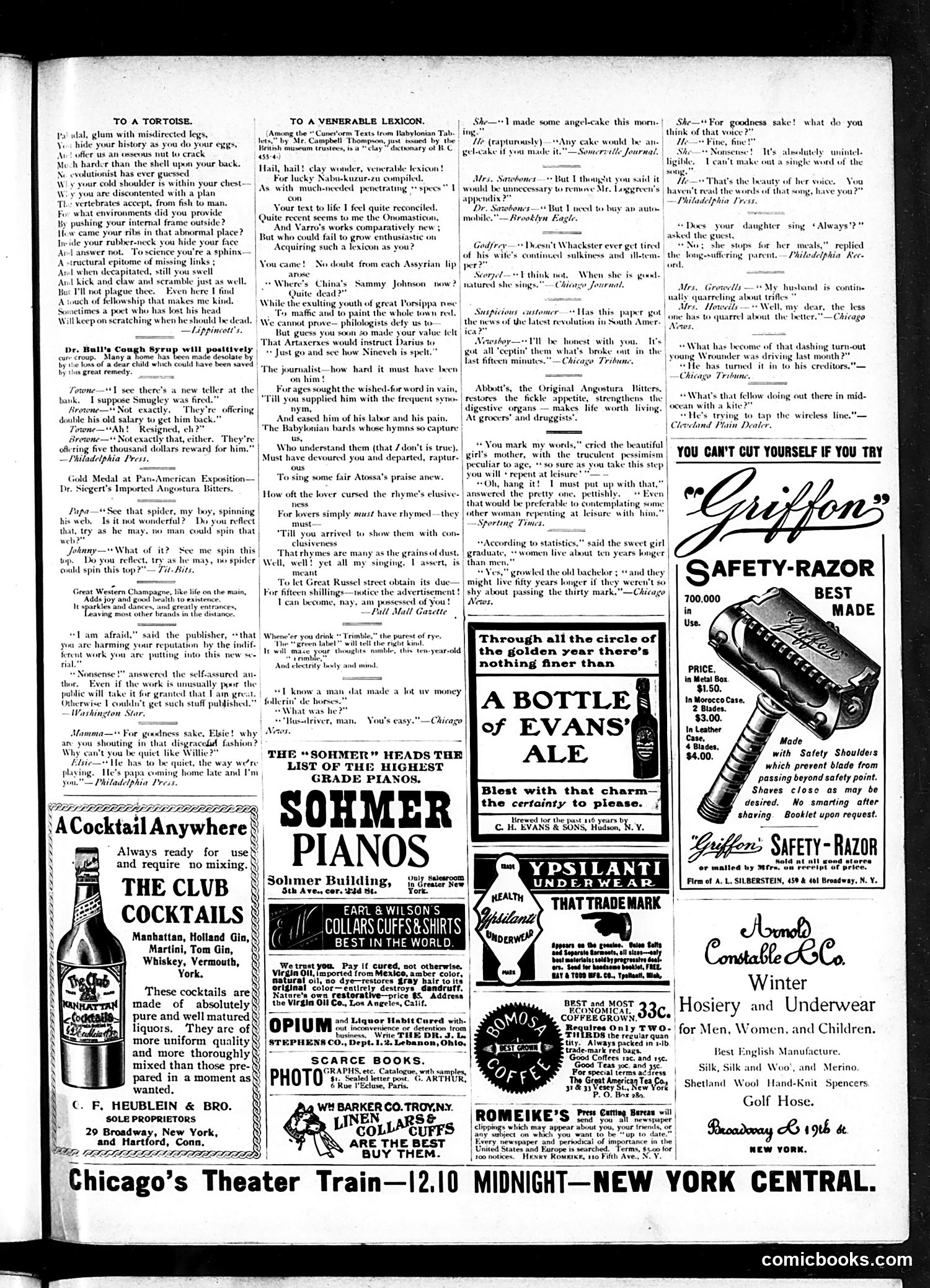
This page from *Judge* magazine consists primarily of **advertisements and light humor** rather than political cartoons. The text content includes: - Brief humorous anecdotes and dialogue jokes (typical "filler" content for magazines of this era) - Poetry pieces like "To a Tortoise" and "To a Venerable Lexicon" - Various product advertisements (Sohmer Pianos, Griffon Safety Razors, Evans Ale, etc.) The jokes reference period-appropriate domestic situations—wives' singing abilities, husbands' behavior, children's manners—using the gentle, pun-based humor common to early 20th-century publications. **No obvious political satire or caricature is visible** on this particular page. The content appears to be standard magazine filler designed to entertain readers between advertisements, reflecting contemporary middle-class concerns and gentle domestic comedy rather than sharp social or political commentary.
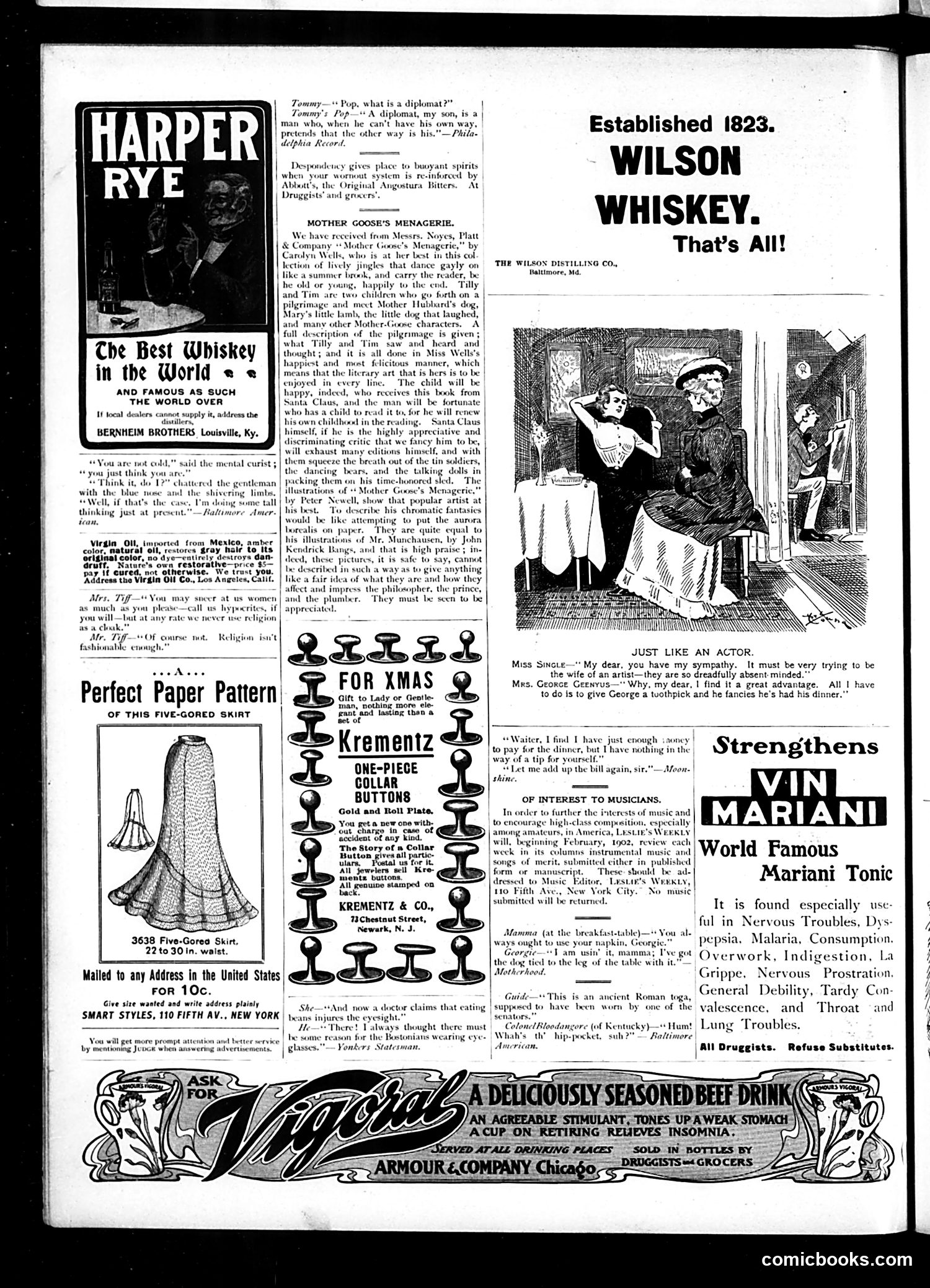
This page is primarily **advertising** with one brief political joke at the top. The main satirical content is a short joke about diplomacy attributed to "Tommy's Pop." It defines a diplomat as "a man who, when he can't have his own way, pretends that the other way is his." This is **early 20th-century political satire** mocking diplomatic deception—the idea that diplomats use rhetoric to disguise defeat as agreement. It reflects common skepticism about international negotiations and professional politicians' ability to reframe unfavorable outcomes. The rest of the page consists of period advertisements: Harper Rye whiskey, skirt patterns, Krementz collar buttons, Vin Mariani tonic, and Armour's beef drink. Several brief domestic humor snippets appear ("Just Like an Actor," "Miss Single"), but these lack political content—they're simply jokes about marriage and social manners typical of Judge magazine's lighter material. The page overall emphasizes advertising over substantive satire.
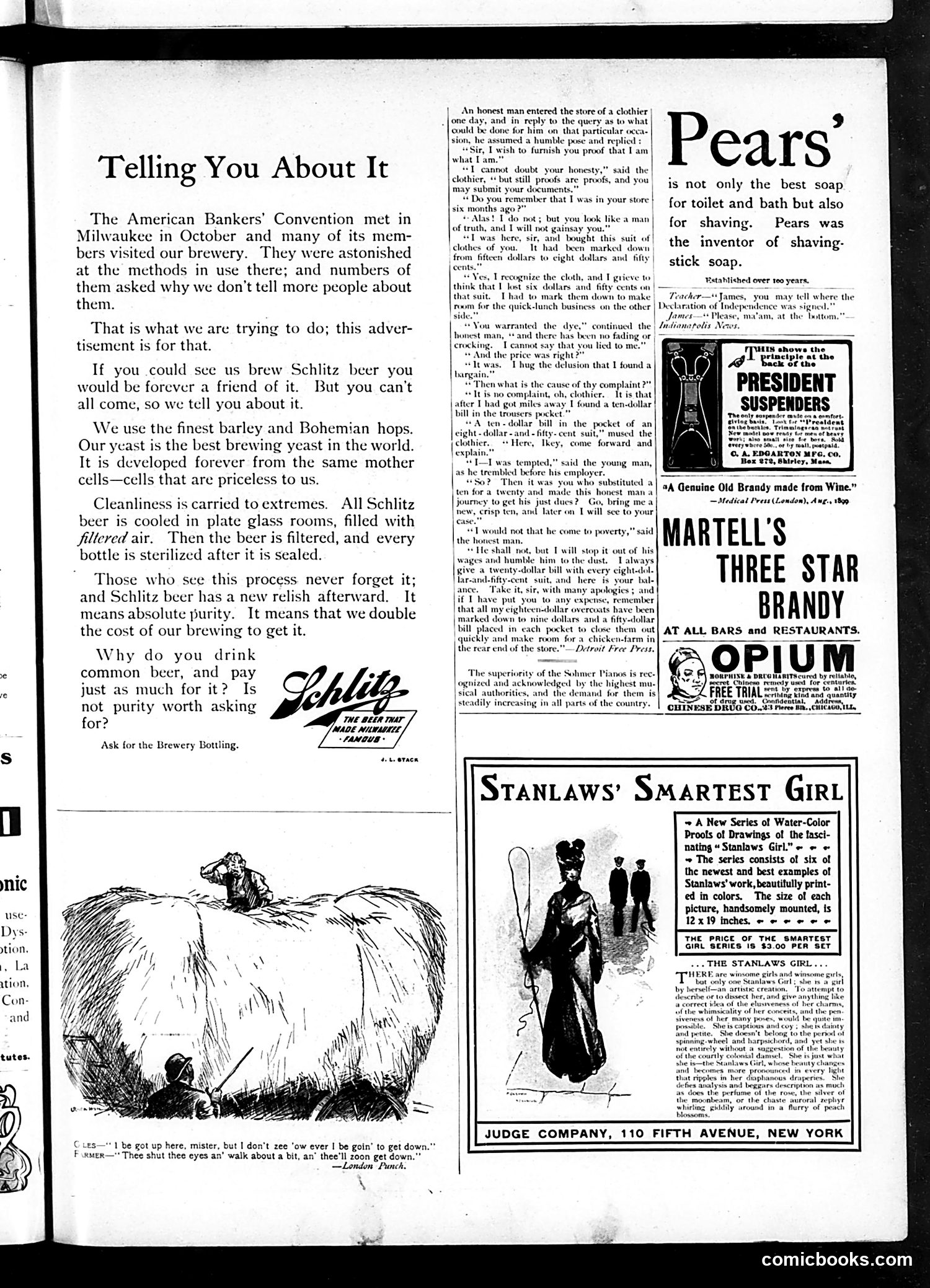
This page is primarily **advertising**, with one narrative cartoon and supporting editorial content for Schlitz beer. **Main Content:** The "Telling You About It" article explains why Schlitz brewery advertises its manufacturing process. It notes that American Bankers visiting Milwaukee were impressed by their brewing methods—using premium ingredients, developing proprietary yeast cultures, and employing extreme cleanliness (filtered air, plate glass rooms, sterilization). The pitch: purity justifies higher cost, so why drink cheaper beer? **The Cartoon:** Below is a brief London Punch reprint: a man stuck on a high place asks how to descend; he's advised to close his eyes and walk—absurdist humor about willful self-delusion. **Social Context:** The page reflects early-1900s advertising strategy: manufacturers attempting to build brand loyalty by educating consumers about production quality and hygiene standards—concepts gaining importance during the Progressive Era's food-safety movement. The remaining space features period advertisements (Pears' soap, Martell's brandy, President Suspenders) and a "Stanlaws Girl" art series promotion.
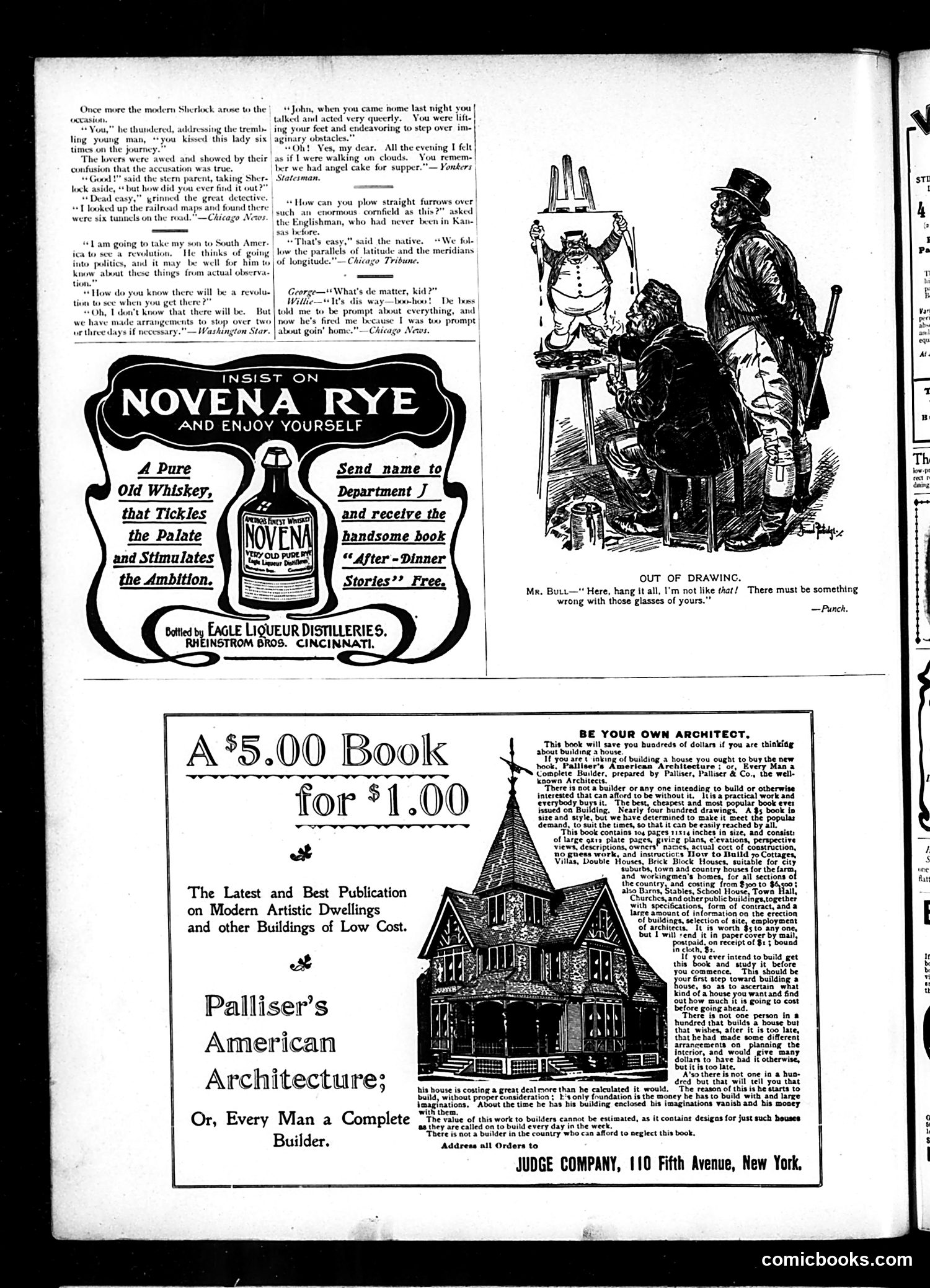
This page contains several short comic strips satirizing everyday domestic situations, typical of Judge magazine's humor style. The main visible cartoon shows a man confronted by his wife about coming home late. She's observed his suspicious behavior—he was "lifting your feet and endeavoring to step over things" and had kissed "this lady six times." His explanation: he'd eaten angel cake for supper and felt so euphoric he was walking on air. The joke relies on the absurdity of this innocent excuse contradicting her jealous suspicions. Other brief comics mock rural ignorance (a farmer unfamiliar with Kansas plowing techniques) and workplace absurdity (a worker fired for being "too prompt" going home). The page is primarily **advertising**, featuring a Novena Rye whiskey ad and a prominent promotion for "Palliser's American Architecture"—a $5 book sold for $1, aimed at men wanting to build affordable houses without hiring architects. The cartoons reflect early 20th-century middle-class anxieties: marital suspicion, rural-urban cultural gaps, and economic aspiration.
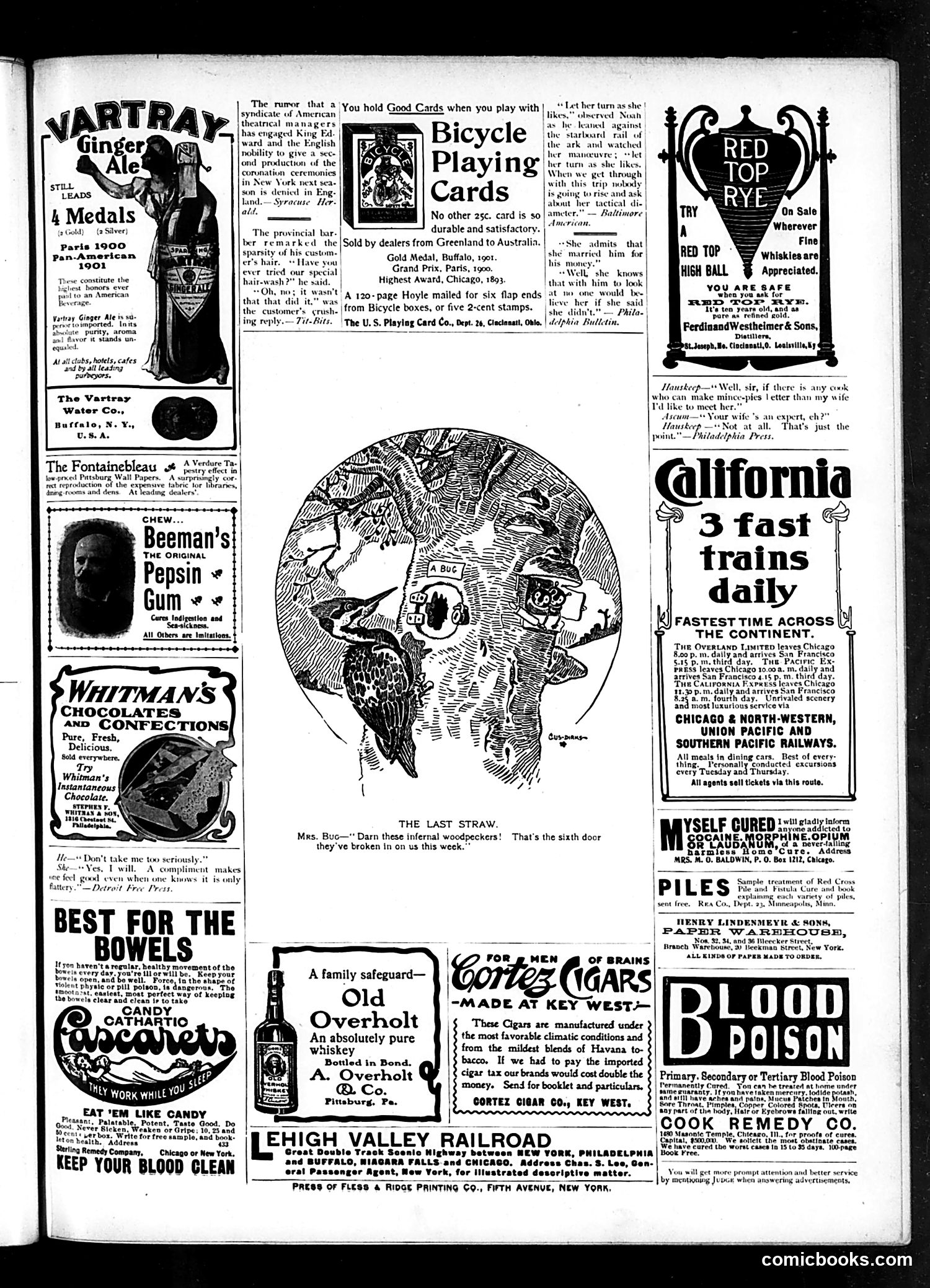
This is primarily an **advertising page** from Judge magazine, with one small cartoon at center. ## The Cartoon: "The Last Straw" The single cartoon depicts **Mrs. Buo complaining about woodpeckers** breaking through their doors repeatedly—"That's the sixth door they've broken in on us this week." The joke is visual/situational humor: the woodpeckers are literally destructive pests, and the exasperation of dealing with recurring damage. ## Context The page is dominated by **period advertisements** (1900-1910s era) promoting various products: playing cards, ginger ale, chocolates, whiskey, cigars, patent medicines (for blood poison, piles, digestive issues), laxatives, and railroad services. These ads reflect early 20th-century consumer culture and the prevalence of medicinal patent claims that would later be regulated. The cartoon itself contains **no political satire**—it's simply domestic humor about an annoying wildlife problem. The broader page reflects Judge's business model: combining light humor with lucrative advertising revenue.