
A complete issue · 16 pages · 1901
Judge — October 19, 1901
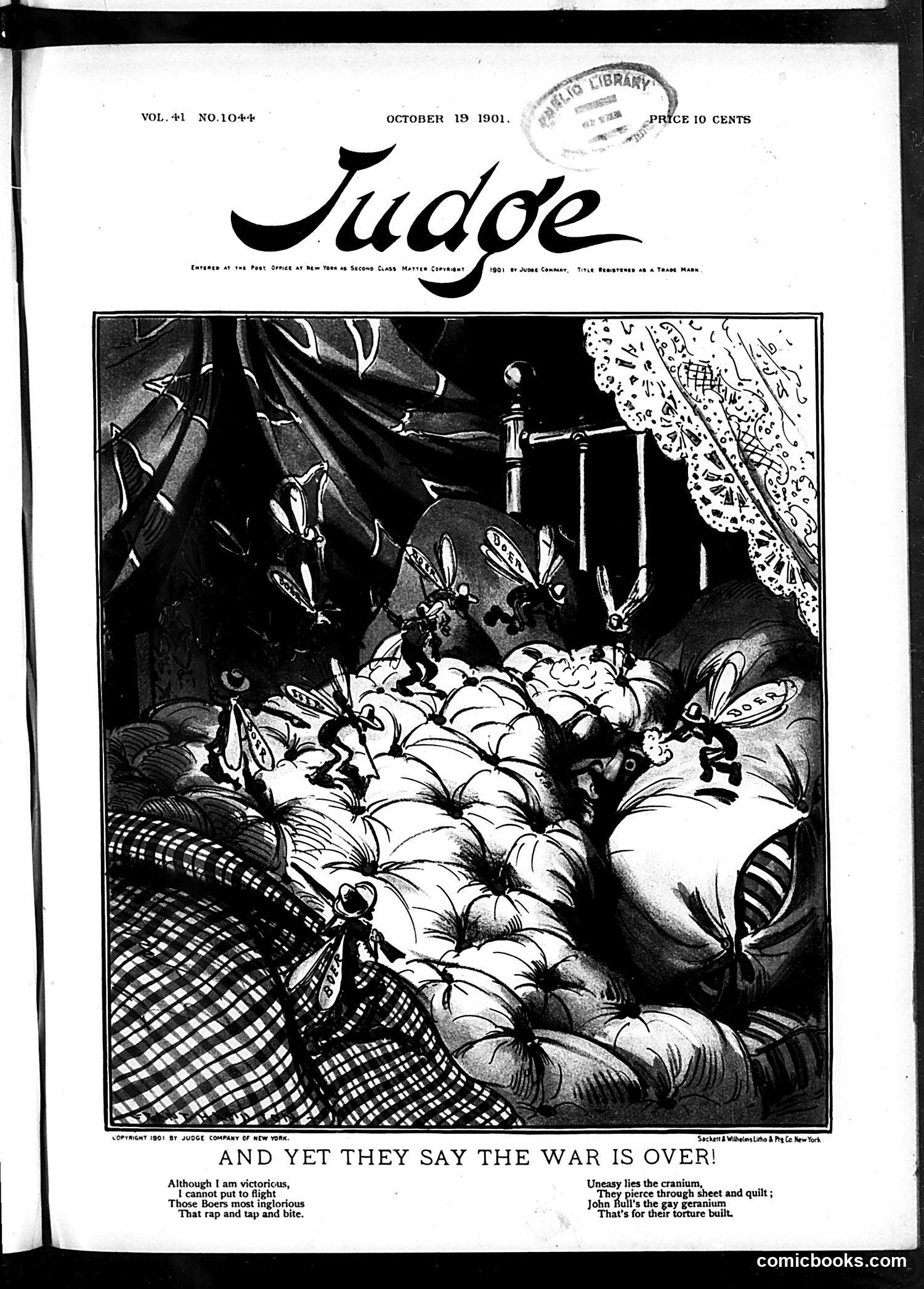
This political cartoon depicts insects (likely representing warring nations or factions) engaged in conflict within what appears to be a bedroom or intimate domestic space. The title "AND YET THEY SAY THE WAR IS OVER!" sarcastically suggests that despite claims of peace, hostilities continue. The accompanying verse references "John Bull's gay geranium" — John Bull representing Britain — implying British colonial interests remain embattled. The insects piercing through fabric and the domestic setting suggest the war's invasive persistence despite official declarations of peace. This likely references the **Second Boer War** (1899-1902), which officially ended in May 1901 but saw ongoing guerrilla resistance. The satire critiques the gap between official peace proclamations and continuing bloodshed in colonial conflicts.
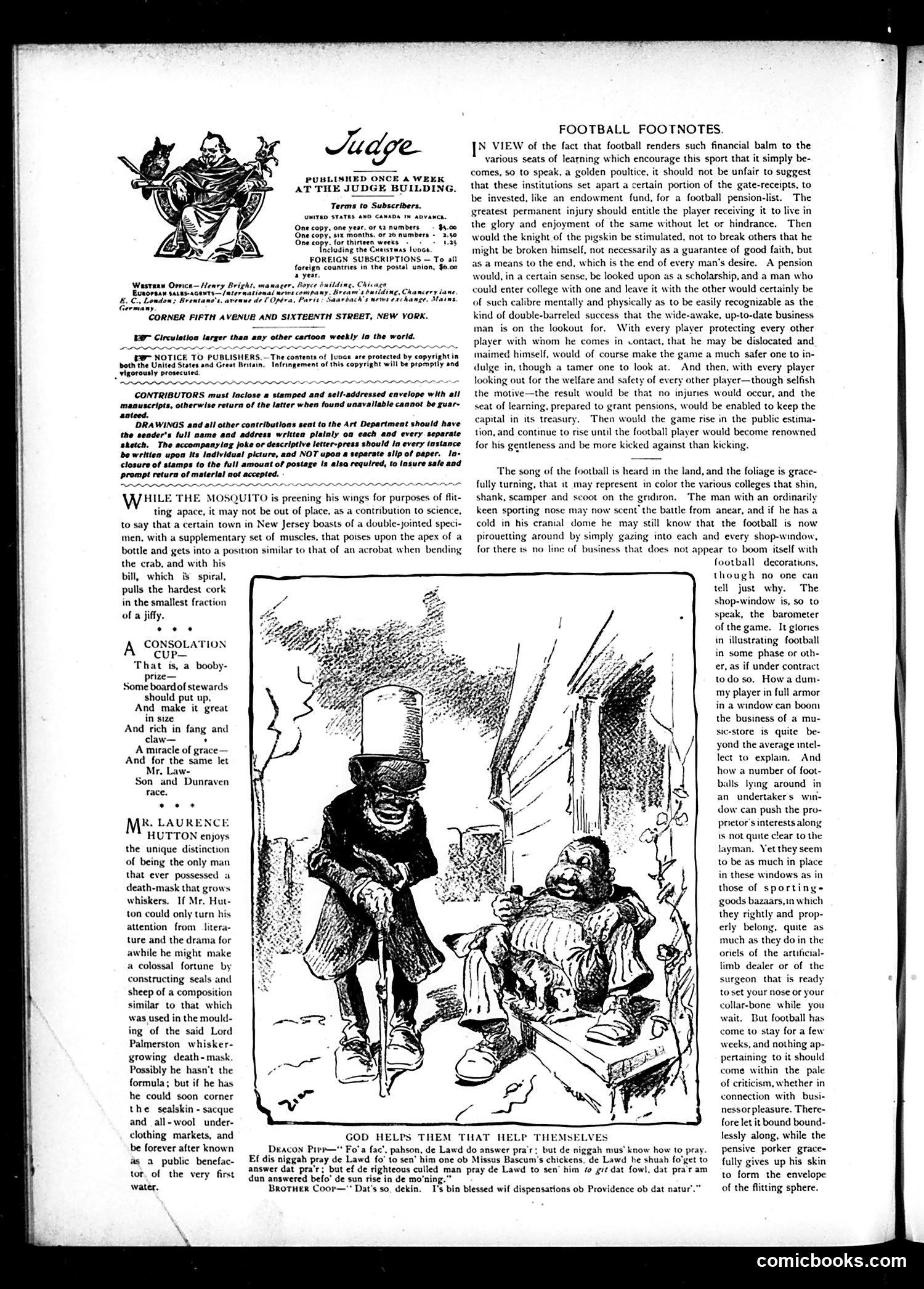
This page contains a satirical editorial titled "FOOTBALL FOOTNOTES" alongside a political cartoon. The cartoon depicts a figure in a top hat (appearing to represent a wealthy businessman or financier) speaking with a street beggar. The caption reads "GOD HELPS THEM THAT HELP THEMSELVES." The editorial critiques how football generates financial support for educational institutions while injuries to players go inadequately compensated. It advocates for establishing endowment funds and pension plans for injured players, arguing colleges should protect player welfare alongside institutional profits. The cartoon likely satirizes wealth inequality and hypocrisy—the wealthy man's invocation of "self-help" philosophy while the beggar suffers, contradicting the idea that success requires only personal effort. The piece reflects Progressive-era concerns about labor protection and fair compensation.
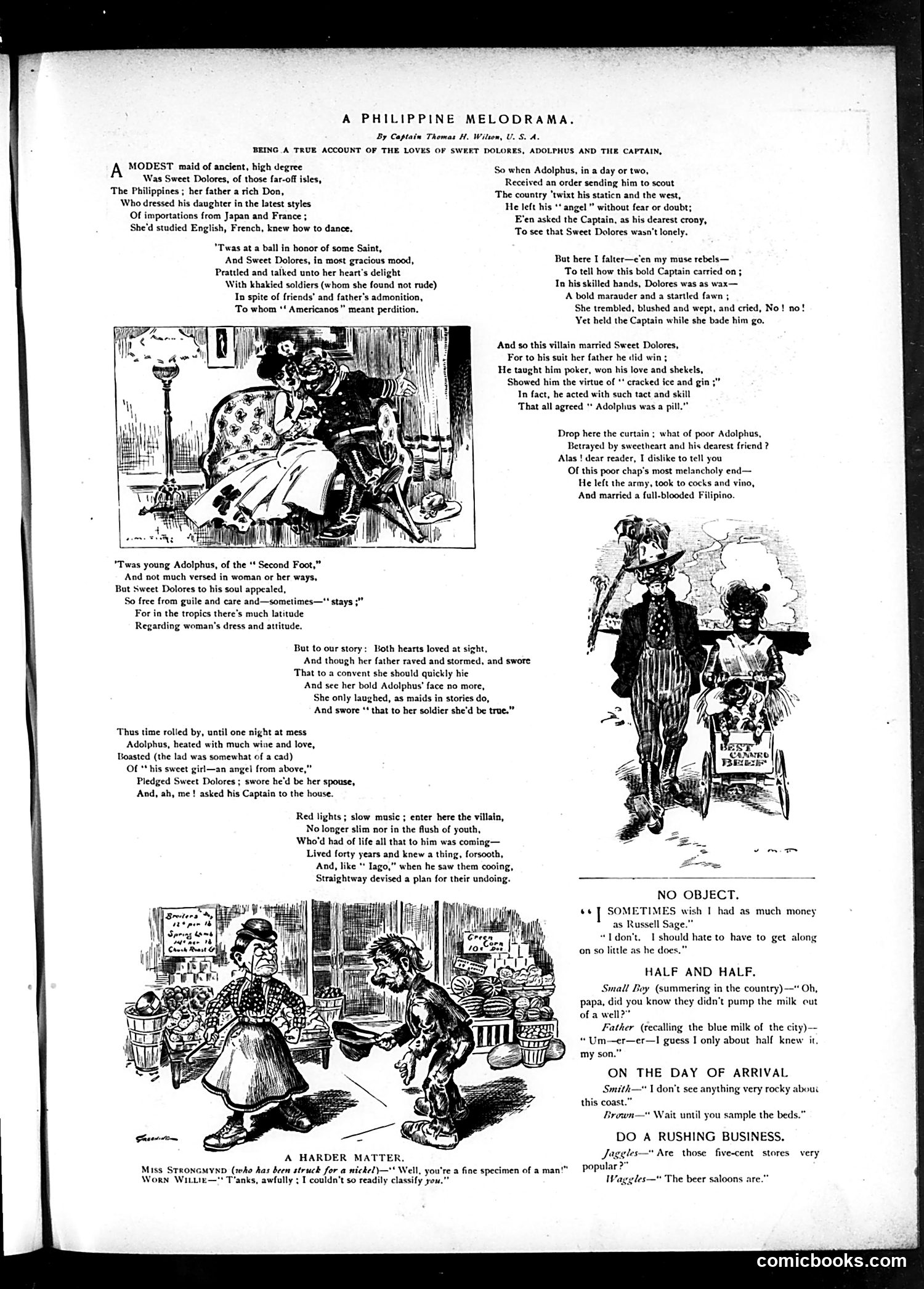
This page contains "A Philippine Melodrama," a satirical poem about American colonial interests in the Philippines. The narrative follows Sweet Dolores and Adolphus, characters representing the Philippines and American imperial ambitions respectively. The Captain represents American military/political authority. The satire mocks American interventionism: Adolphus attempts to "civilize" and control Dolores through education and domination, mirroring American justifications for Philippine colonization. The melodramatic tone undercuts these imperial pretensions—treating serious geopolitical conquest as absurd romantic comedy. The page also includes unrelated humor sections ("No Object," "Half and Half," "A Harder Matter") typical of Judge's miscellaneous content format. Overall, the page critiques American imperial expansion through absurdist parody.
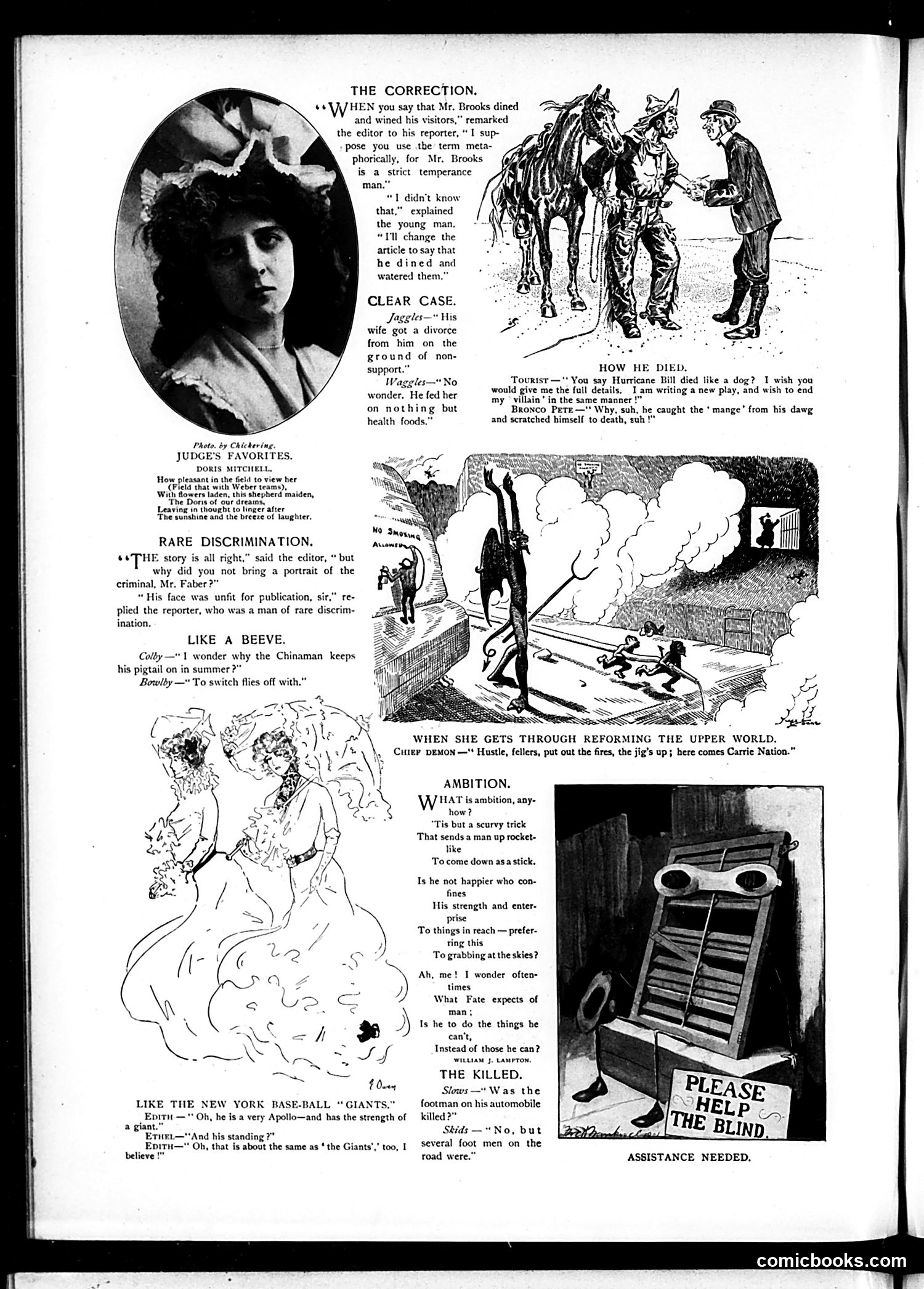
This page contains several unrelated satirical pieces and humor items typical of Judge magazine's format: **"The Correction"** mocks a reporter's mischaracterization of someone as "dining and wining" when he merely consumed "health foods"—satirizing journalistic exaggeration. **"Judge's Favorites"** features a photograph of Doris Mitchell, praising her attractiveness in theatrical roles. **"Like a Beeve"** and **"Like the New York Base-Ball 'Giants'"** are brief comedic observations comparing people to animals and sports teams. **"Ambition"** is a poem about striving for achievement. **"Assistance Needed"** shows a photograph of a mechanical device with a "Please Help the Blind" sign—likely satirizing some contemporary social issue or charity appeal, though the specific reference is unclear without additional context. The page represents typical early-20th-century American satirical humor mixing social commentary with entertainment.
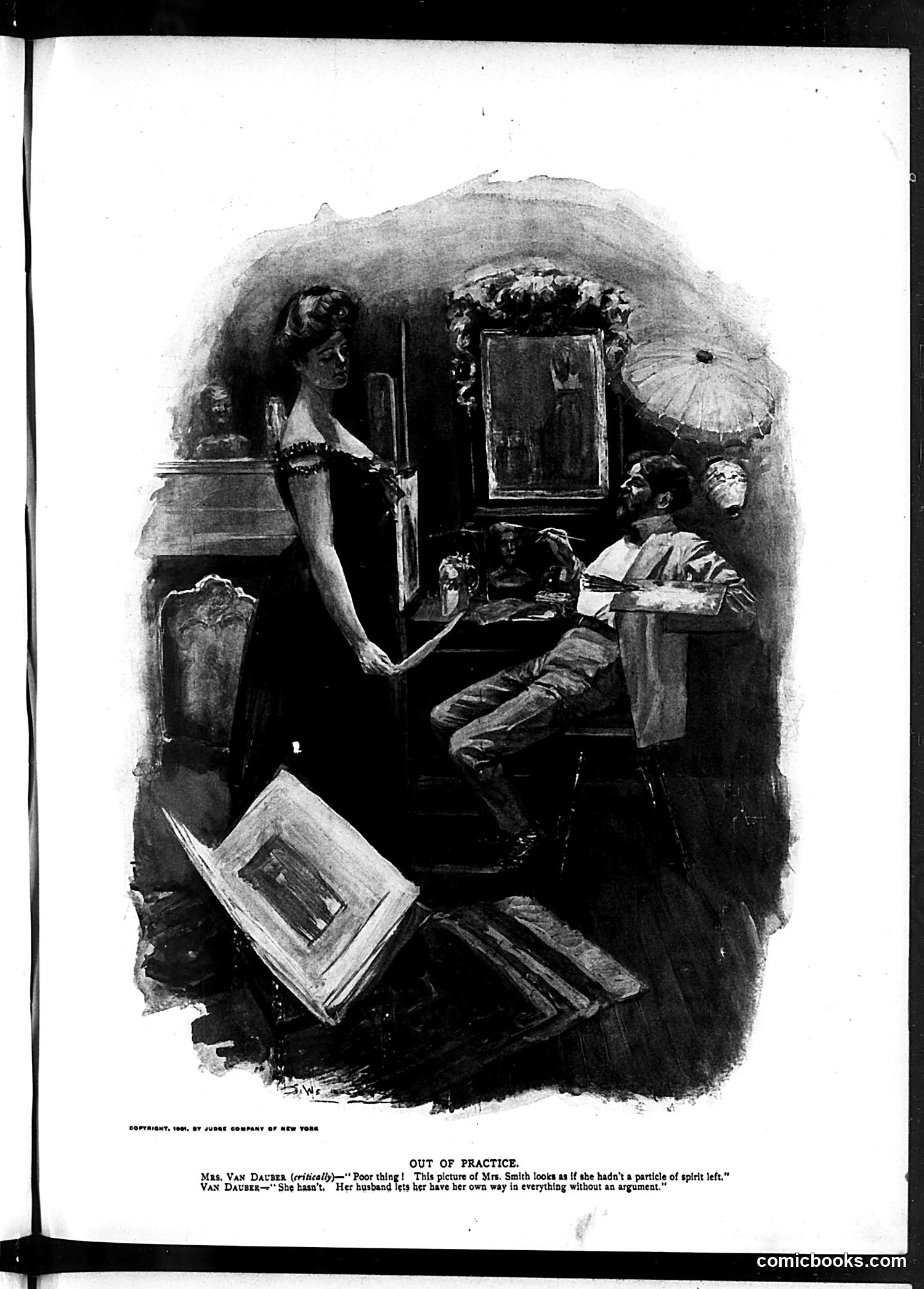
This cartoon satirizes marital dynamics through art criticism. Mrs. Van Daven examines a portrait of Mrs. Smith, noting it lacks "spirit." Van Dauper explains the cause: Mrs. Smith's husband permits her complete freedom—he never argues with her. The joke's irony targets both spouses. The husband's passive acquiescence, intended as accommodation or even kindness, supposedly drains his wife of vitality and animation. The satire suggests that women need—or thrive from—marital conflict and male opposition to maintain their vigor. This reflects early 20th-century gender assumptions: that spousal disagreement was natural/desirable, and that women without male resistance become listless. The cartoon mocks both the husband's lack of assertion and implies criticism of the wife's dependence on conflict for liveliness.
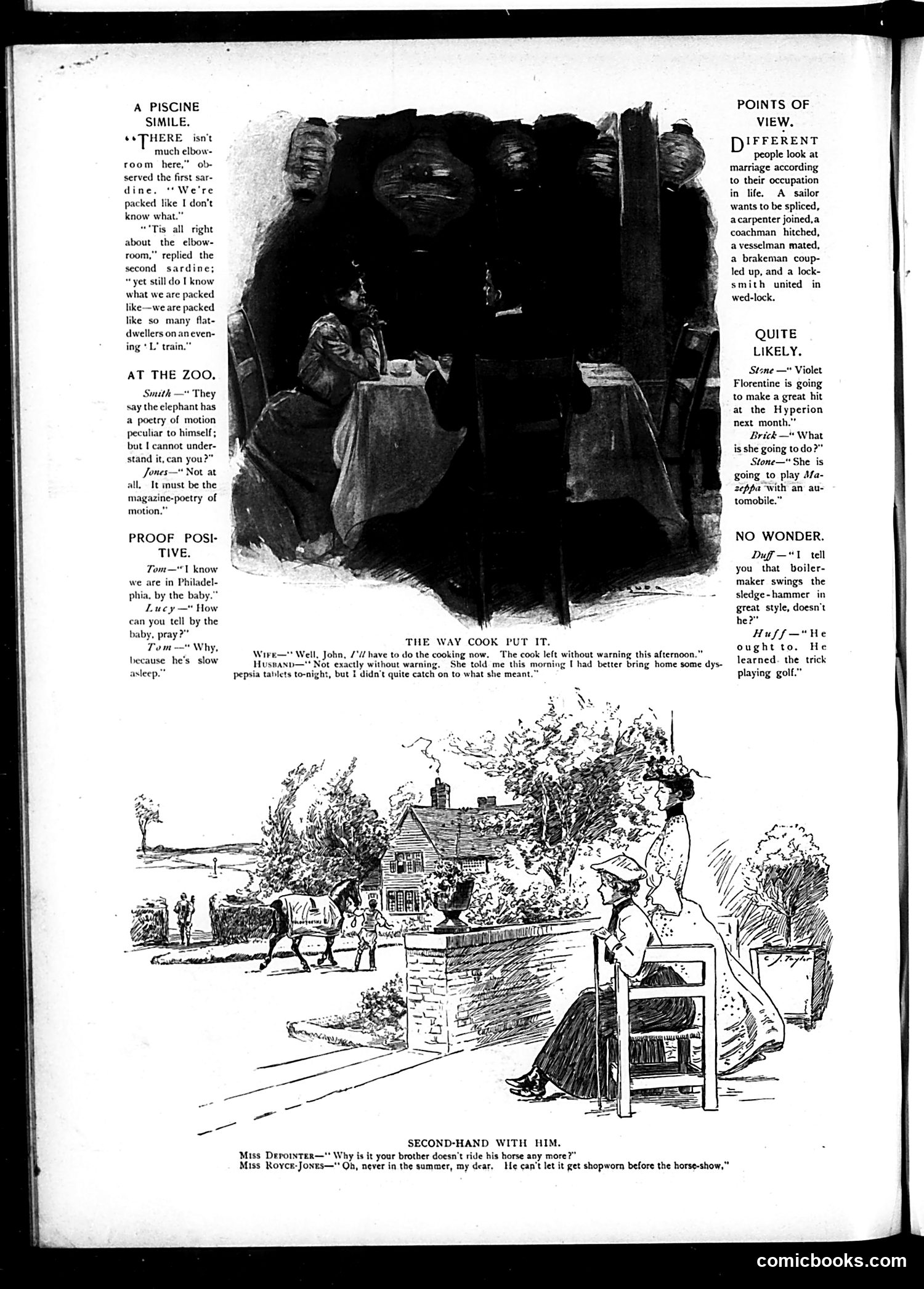
This page contains six brief satirical pieces typical of early-20th-century humor magazines: 1. **"A Piscine Simile"**: Sardines in a can compare their cramped conditions to flatdwellers in an apartment building—urban housing satire. 2. **"At the Zoo"**: Wordplay on the elephant's "poetry of motion" being actually "magazine-poetry" (likely referencing *Life* magazine's obsession with movement). 3. **"Proof Positive"**: A baby sleeping slowly "proves" they're in Philadelphia—ethnic/regional humor stereotyping Philadelphians as sluggish. 4. **"Points of View"**: Different professions view marriage through occupational terminology (sailors "splice," carpenters "join," etc.)—occupational humor. 5. **"Quite Likely"**: An actress will perform *Mazeppa* with an automobile—satirizing theatrical modernization/sensation-seeking. 6. **"No Wonder" & "The Way Cook Put It"**: Domestic humor about wives/servants and their frustrations with husbands. 7. **"Second-Hand with Him"**: A woman won't let her brother ride his horse before the horse-show to keep it "shopworn"—satire of vanity and wealthy status-seeking.
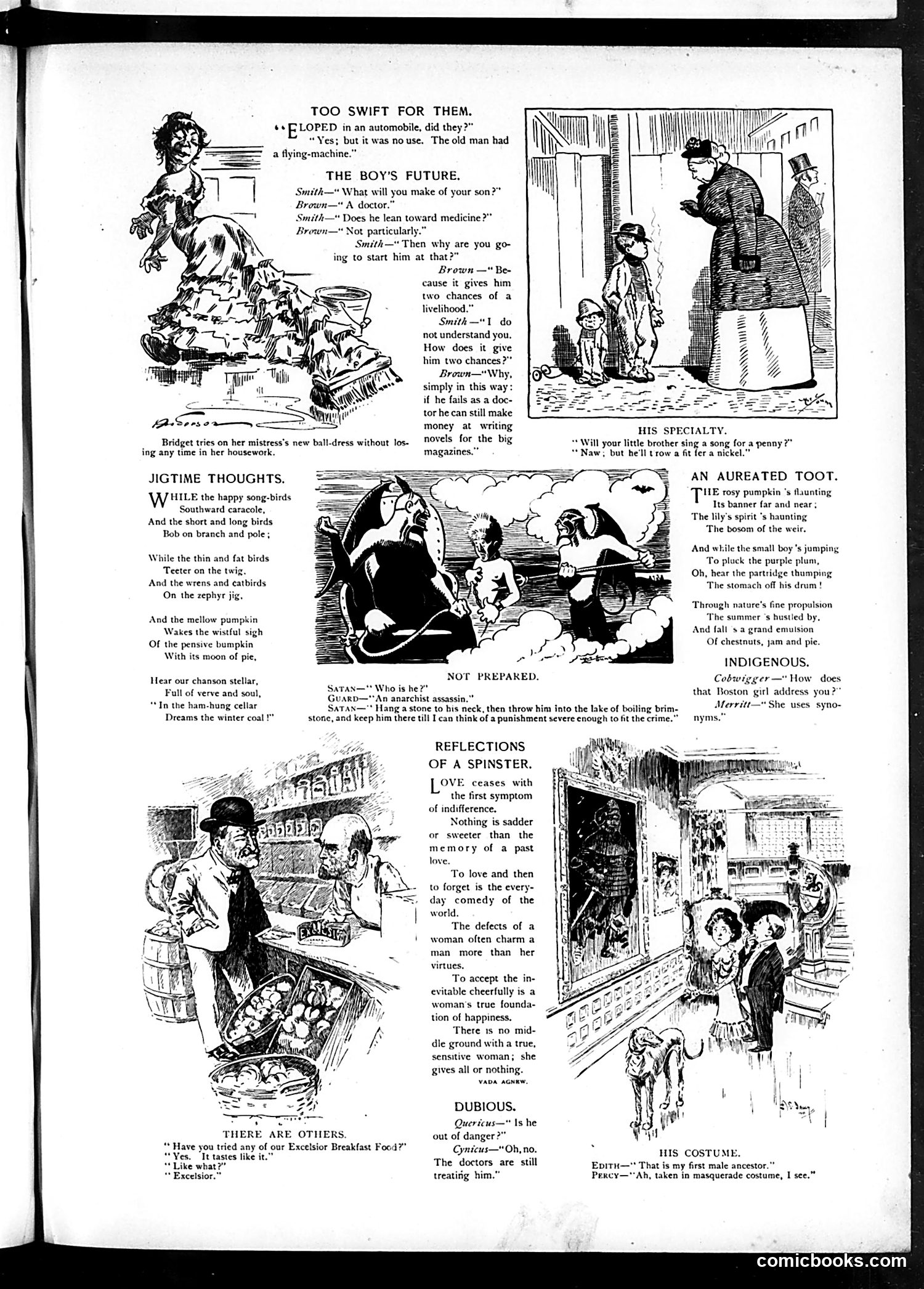
This page from the satirical magazine *Judge* contains several short humorous pieces typical of late 19th/early 20th-century American humor: **"Too Swift for Them"** jokes about modern technology's pace—an elopement by automobile is outpaced by the father's flying machine, satirizing rapid technological change. **"The Boy's Future"** mocks the medical profession's low success rate, suggesting a failed doctor can always become a pulp novelist—commentary on both medicine and the proliferation of popular magazines. **"Jigtime Thoughts"** and **"An Aureated Toot"** are sentimental nature poems, likely parodying overwrought Romantic poetry popular at the time. **"Not Prepared"** depicts Satan rejecting an anarchist assassin, reflecting contemporary anxieties about anarchist violence and assassination. **"Reflections of a Spinster"** offers cynical observations about love and women's limited life choices—typical period misogyny packaged as philosophy. Other pieces mock breakfast cereals, medical incompetence, and social pretension. The overall tone reflects period attitudes toward technology, gender, and class.
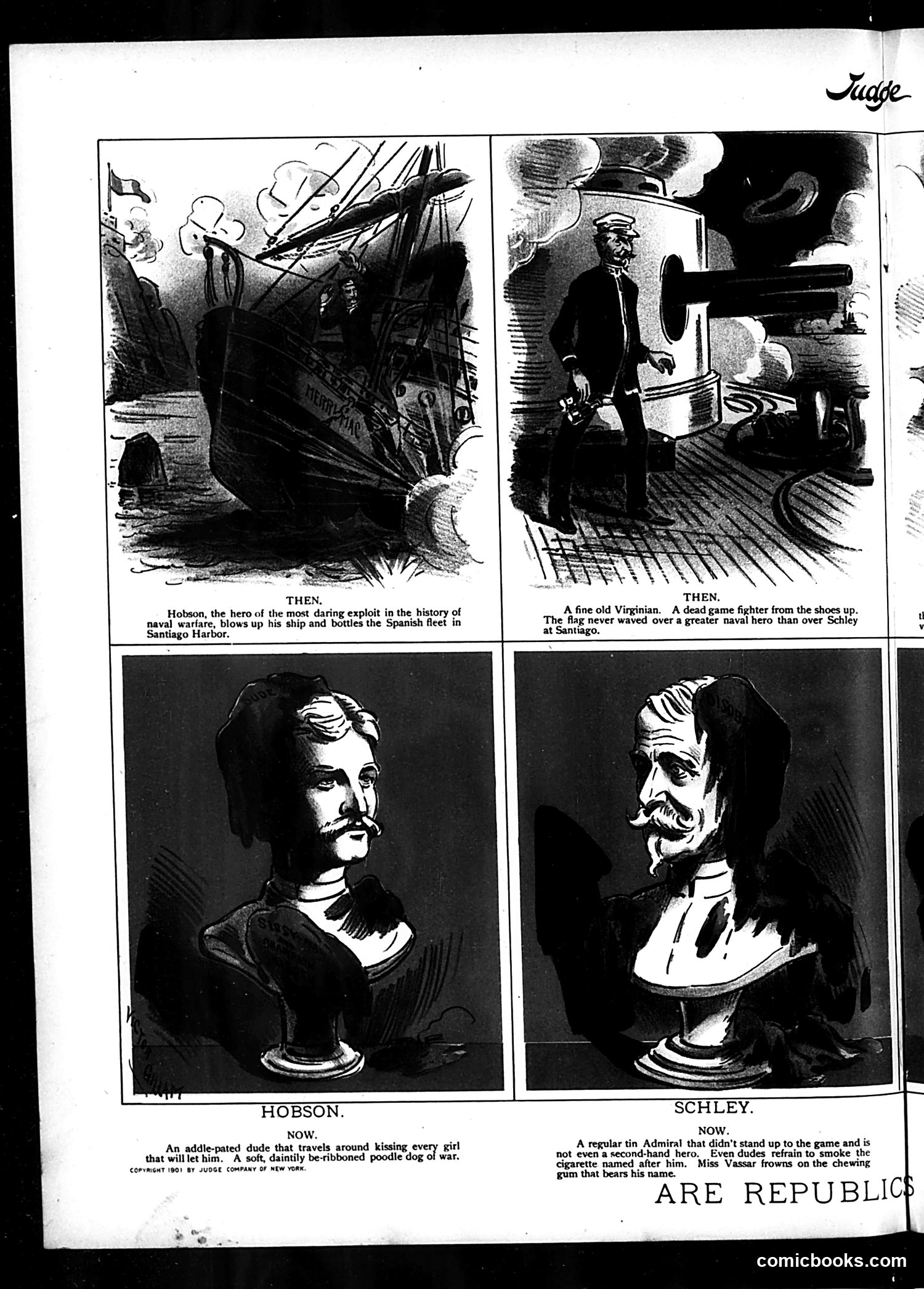
This 1901 Judge magazine cartoon contrasts two Spanish-American War naval heroes—Hobson and Schley—satirizing their post-war reputations. **The figures:** Richmond Pearson Hobson and Winfield Scott Schley were both officers at the 1898 Battle of Santiago Harbor. **The satire:** The "THEN" panels celebrate their wartime heroism. The "NOW" panels mock their subsequent celebrity and commercialization. Hobson is ridiculed as an effete socialite who kisses women and inspires a "poodle dog of war"—suggesting emasculation and frivolous fame. Schley is attacked as a fraud who didn't actually fight, yet benefits from commercial products (cigarettes, chewing gum) bearing his name. **The point:** The cartoon criticizes how military heroes become commodified celebrities, losing their dignity through marketing and social performance rather than maintaining serious public standing.
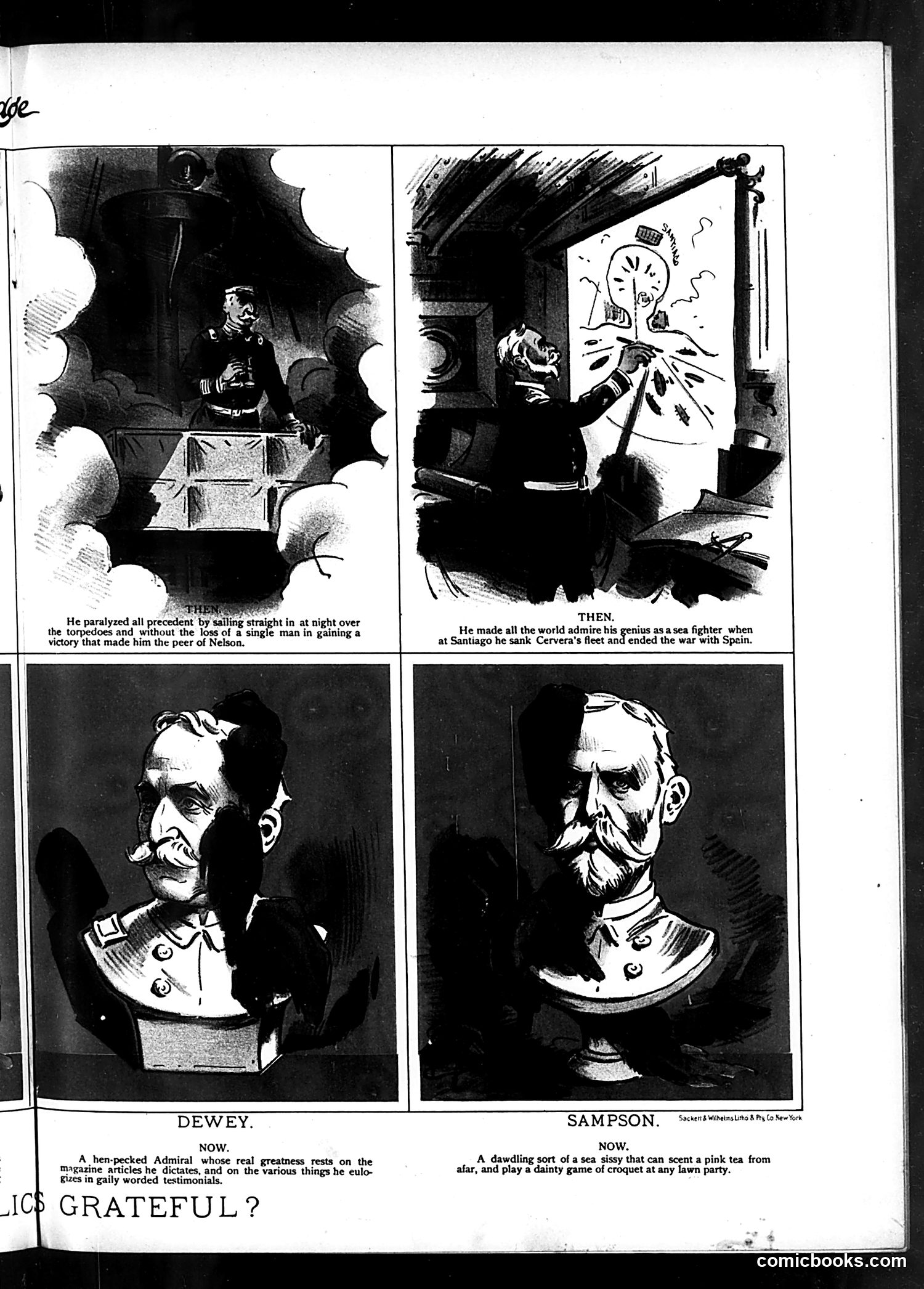
This page satirizes **Admiral George Dewey**, the Spanish-American War naval hero. The top panels show his celebrated victory at Manila Bay (sailing through torpedoes) and Santiago, establishing him as a military genius on par with Nelson. The bottom panels present a cruel contrast labeled "THEN" versus "NOW," depicting Dewey as he aged. The captions mock his current reputation as dependent on ghost-written magazine articles and flattering testimonials rather than actual accomplishment. The "sea sissy" reference—suggesting effeminacy through references to pink tea and croquet—was a cutting insult in this era, implying he'd become a vain socialite trading on past glory rather than remaining a serious military figure. The overall message: a once-great warrior has become a self-promoting has-been, more concerned with his public image than substance. This likely reflects contemporary debates about Dewey's actual postwar role and relevance.
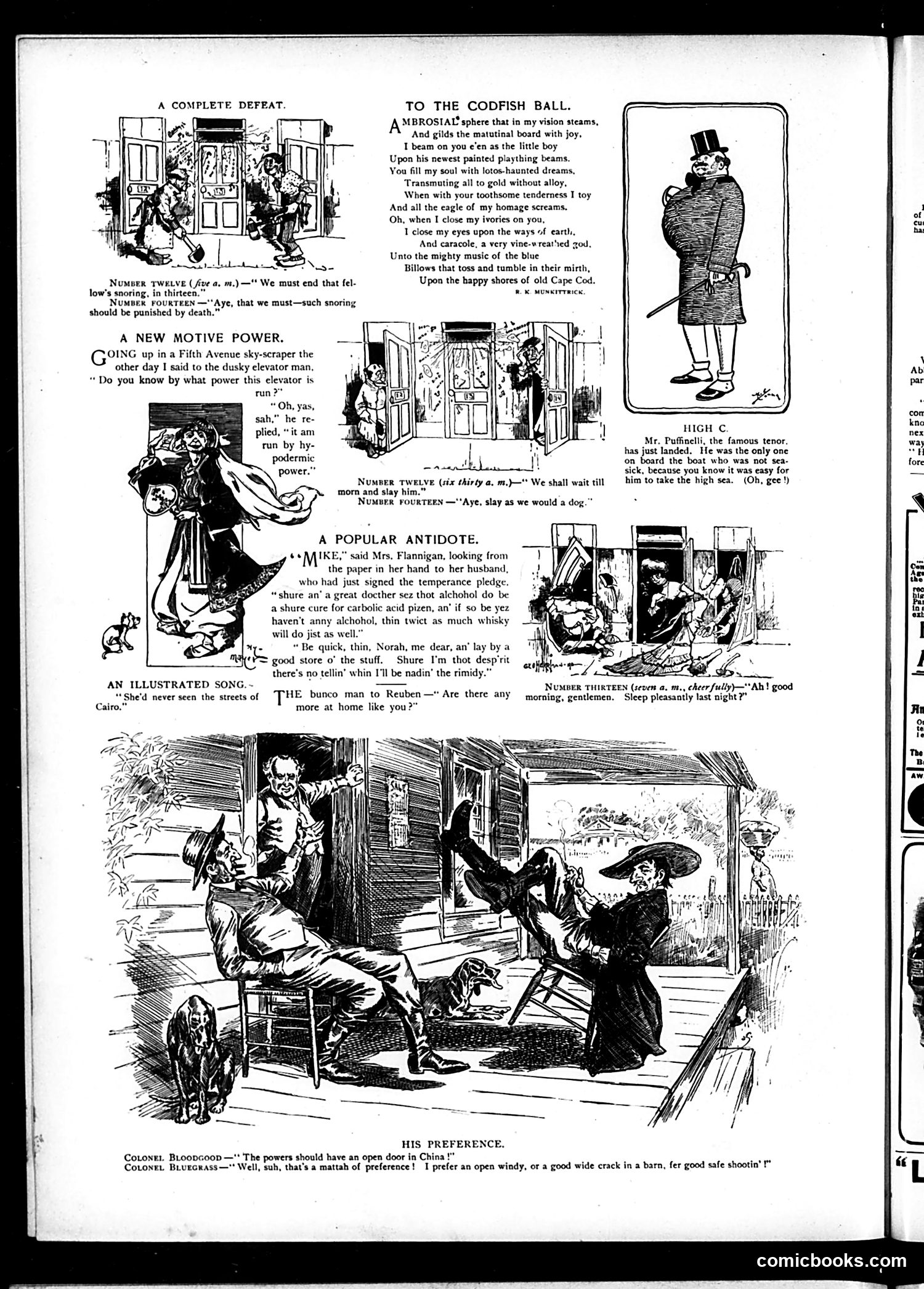
This page contains several satirical pieces typical of Judge magazine's humor: **"A Complete Defeat"** presents a mock-heroic sonnet to a codfish ball—absurdly elevating a humble seafood dish to transcendent status, satirizing overwrought romantic poetry and pretentious literary affectation. **"A New Motive Power"** jokes about an elevator operator attributing the elevator's function to "hypodermic power"—likely satirizing pseudo-scientific jargon or the era's fascination with newfangled explanations. **"A Popular Antidote"** features Irish immigrant characters (the Flanigans) where the wife misreads a medical article, believing whiskey cures carbolic acid poisoning. This satirizes both immigrant speech patterns and medical quackery. **"His Preference"** depicts two colonels debating China policy versus shooting opportunities—mocking imperialist attitudes where colonial powers prioritized personal interests over actual governance. The sketches collectively lampoon pretentiousness, pseudo-science, immigrant stereotypes, and imperial hypocrisy—typical of Judge's social satire from this era.
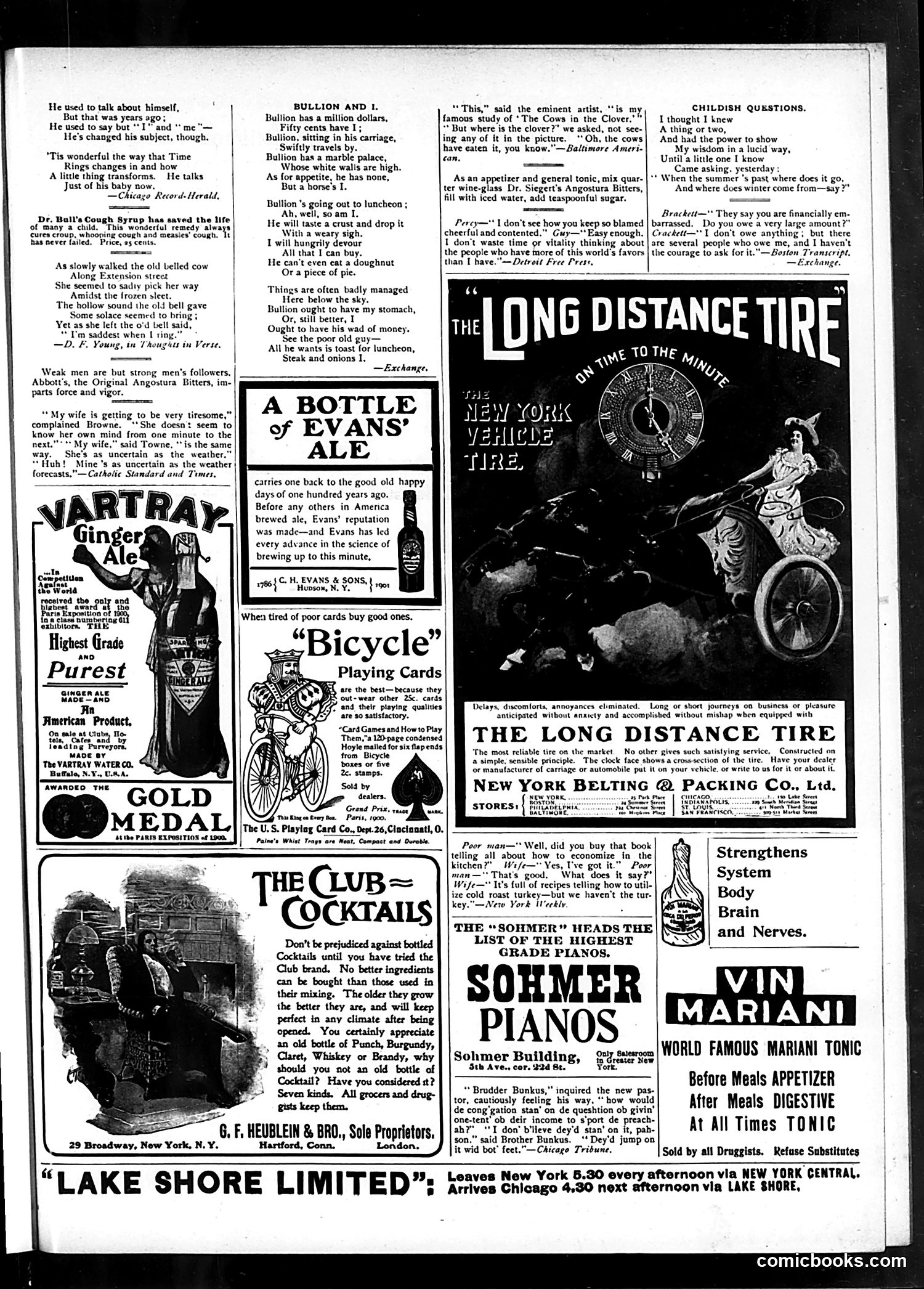
This page from *Judge* magazine is primarily **advertisements and light satirical verse** rather than political cartoons. The main satirical content is a poem titled "Bullion and I," which contrasts wealth inequality through ironic juxtaposition. A wealthy man called "Bullion" (representing the rich) owns millions, lives in a marble palace, yet has no appetite and cannot enjoy food. Meanwhile, the narrator—poor but hungry—would eagerly consume what Bullion wastes. The satire critiques how the wealthy cannot enjoy their riches while the poor struggle with want. The page also includes humorous brief anecdotes about mismatched marriages and financial embarrassment, typical of *Judge*'s satirical commentary. The bulk of the page comprises **period product advertisements**: patent medicines (Dr. Ball's Cough Syrup, Angostura Bitters), alcoholic beverages (Evans' Ale, Varthray Ginger Ale), pianos (Sohmer), playing cards, and the Long Distance Tire. No specific political figures or events are referenced; this represents the magazine's standard mix of social satire and commercial advertising.
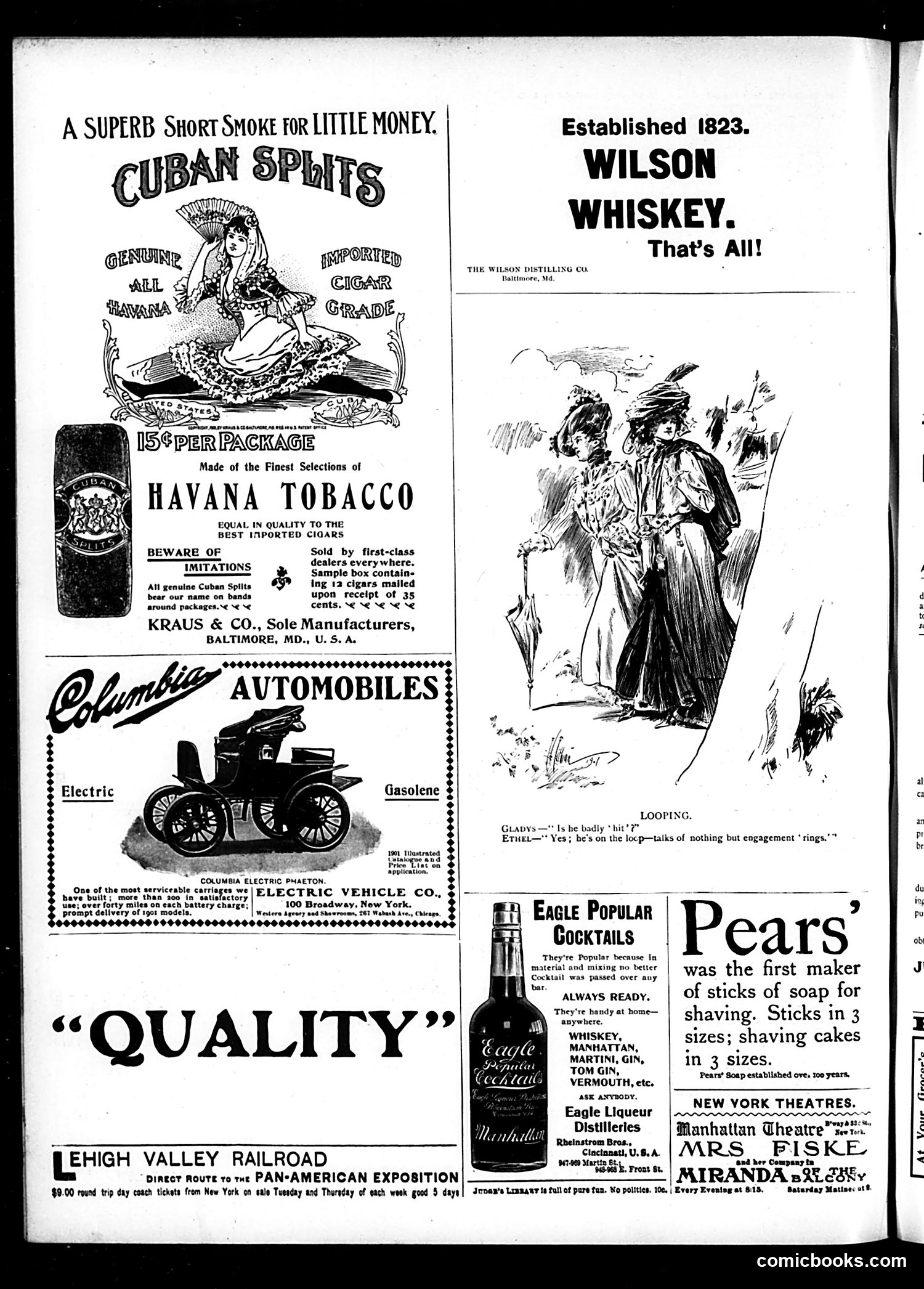
This is primarily an **advertising page** with one small cartoon joke. The sole cartoon shows two women ("Gladys" and Ethel") discussing a man who is "on the loop" — slang meaning he's obsessed with engagement rings. The joke satirizes men pursuing marriage purely for material reasons or social status, a common turn-of-the-century concern about courtship. The page otherwise contains **period product advertisements**: Cuban Split cigars (15¢), Wilson Whiskey (established 1823), Columbia electric automobiles, Eagle Popular Cocktails, Pears' soap (claiming 100+ years in business), and theatrical promotions for Manhattan Theatre and Miranda. Notable: The automobile ad emphasizes "Electric" and "Gasoline" options—this appears early in automotive history when electric cars were still competitive with gasoline engines. The Lehigh Valley Railroad advertises trips to the Pan-American Exposition (a major 1901 world's fair). The advertisements reflect early 1900s consumer culture and available luxury goods for middle/upper-class readers.
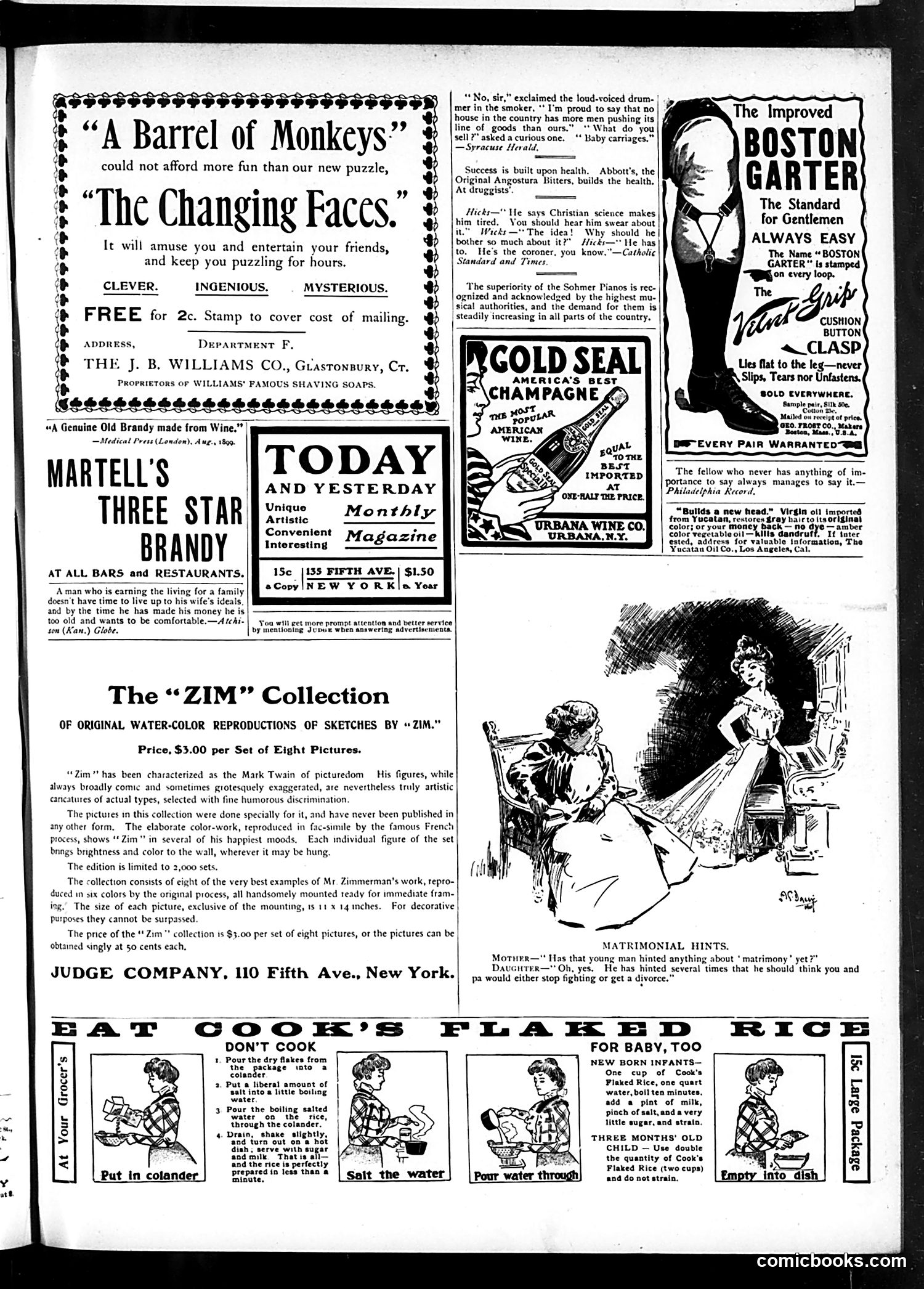
This page is primarily **advertising and product promotions** rather than editorial political satire. The main content includes: **Key Advertisements:** - "The Changing Faces" puzzle (J.B. Williams Co.) - Martell's Three Star Brandy - "Today and Yesterday" monthly magazine - "ZIM" Collection—water-color art reproductions by artist "Zim" (characterized as "Mark Twain of picturedom"), priced at $3.00 per set - Boston Garter (men's garters) - Gold Seal Champagne - Abbott's Angostura Bitters - Sohmer Pianos - Cook's Flaked Rice (bottom, with instructional illustrations) **Humorous Filler Content:** - Short joke about a drummer selling baby carriages - "Matrimonial Hints" cartoon showing a woman at a doorway - Brief quips about Christian Science and philosophy The page reflects early-20th-century consumer advertising targeting middle and upper-class readers, with minimal political content.
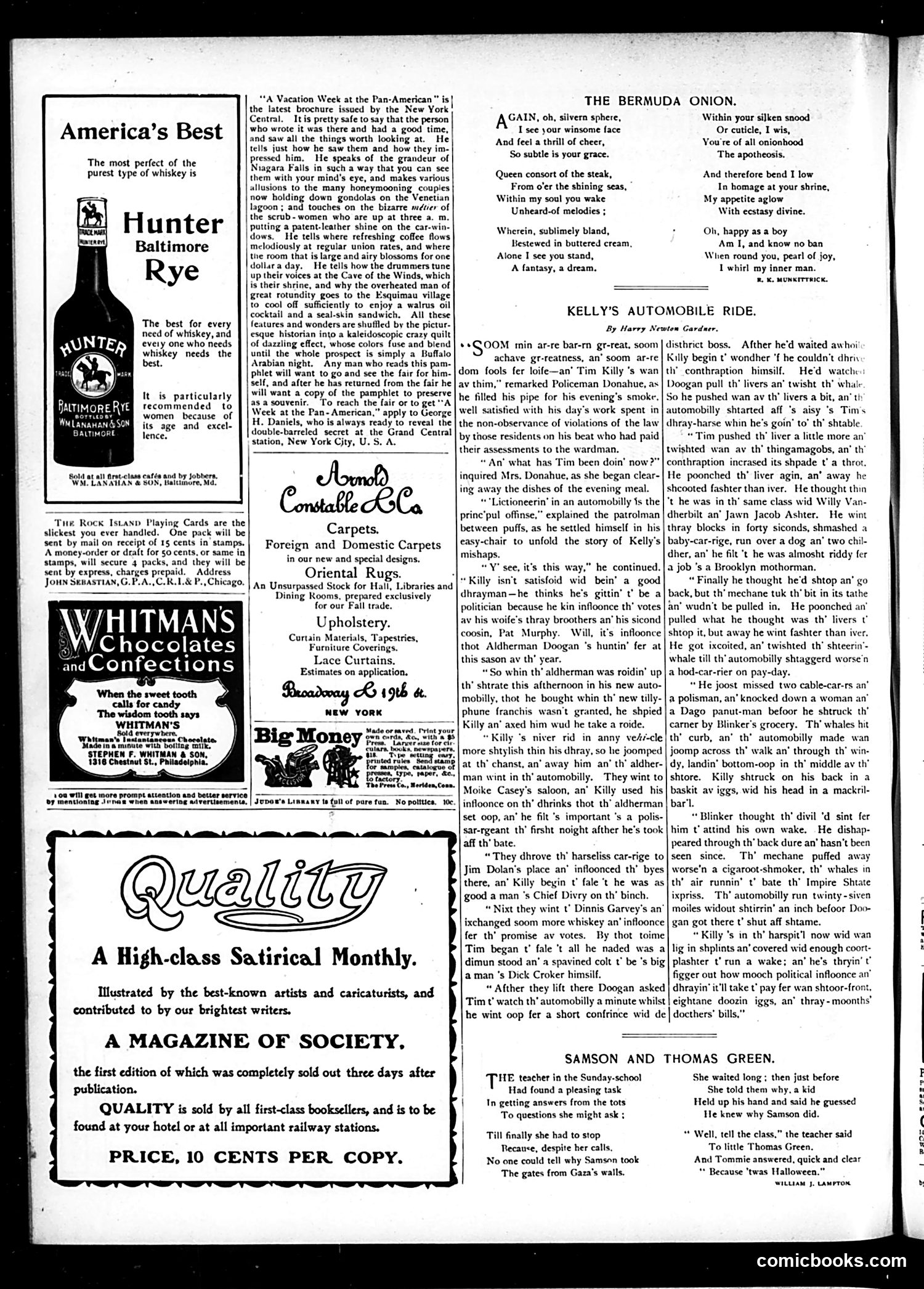
This page is primarily **advertisements and literary content** rather than political cartoons. The main elements are: **Advertisements:** Whiskey (Hunter Baltimore Rye), playing cards, chocolates, carpets, upholstery, and a satirical magazine called "Quality." **Literary Content:** - "The Bermuda Onion" — a poem about Bermuda - "Kelly's Automobile Ride" — a humorous narrative about a working-class character (Kelly) taking an automobile ride with a politician (an alderman), written in Irish-American dialect - "Samson and Thomas Green" — a poem about a Sunday school teacher The Kelly story represents **class-conscious humor** common to Judge: a laborer and politician navigate urban life via the new automobile technology, with comedic dialect and social observation. The overall page reflects Judge's focus on society, satire, and advertising rather than political cartooning.
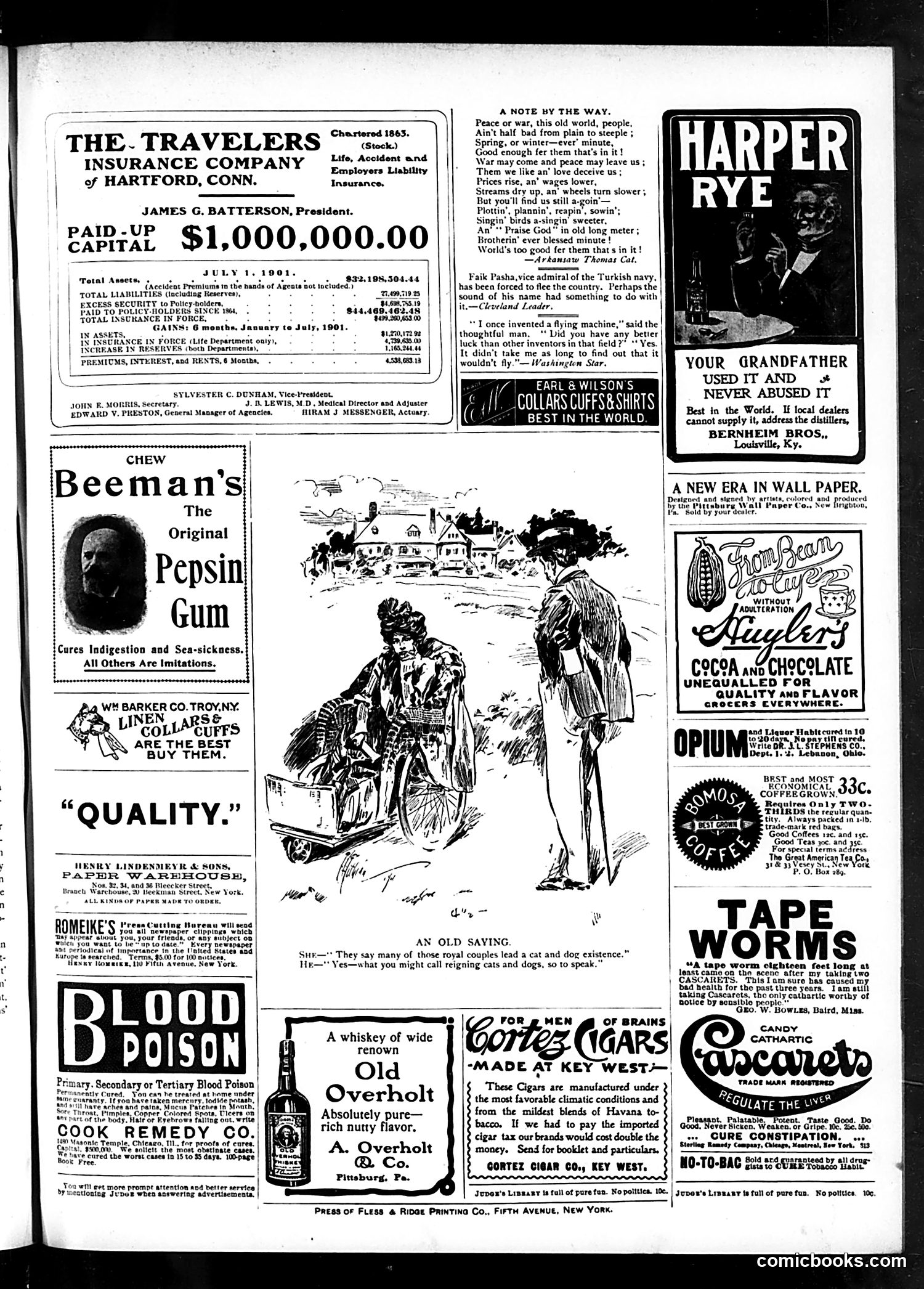
This is primarily a commercial advertising page from *Judge* magazine (July 1, 1901), with one central cartoon and modest satirical content. **The main cartoon** ("An Old Saying") depicts two figures discussing royal couples leading "a cat and dog existence"—a visual pun showing an aristocratic couple literally riding in a carriage with quarreling cats and dogs, literalizing the phrase meaning constant bickering and incompatibility. **The satirical poem** ("A Note by the Way") expresses populist optimism: despite economic uncertainty, labor unrest (referenced through "Prices rise, an' wages lower"), and social disappointment, working people endure cheerfully. It reflects turn-of-the-century American resilience. **Otherwise, the page is dominated by advertisements** for patent medicines (blood-poison cures, "tape worms"), alcohol products (Old Overholt whiskey), cigars, and various consumer goods typical of 1901. These ads reflect the medical quackery and unregulated substances common to the era.
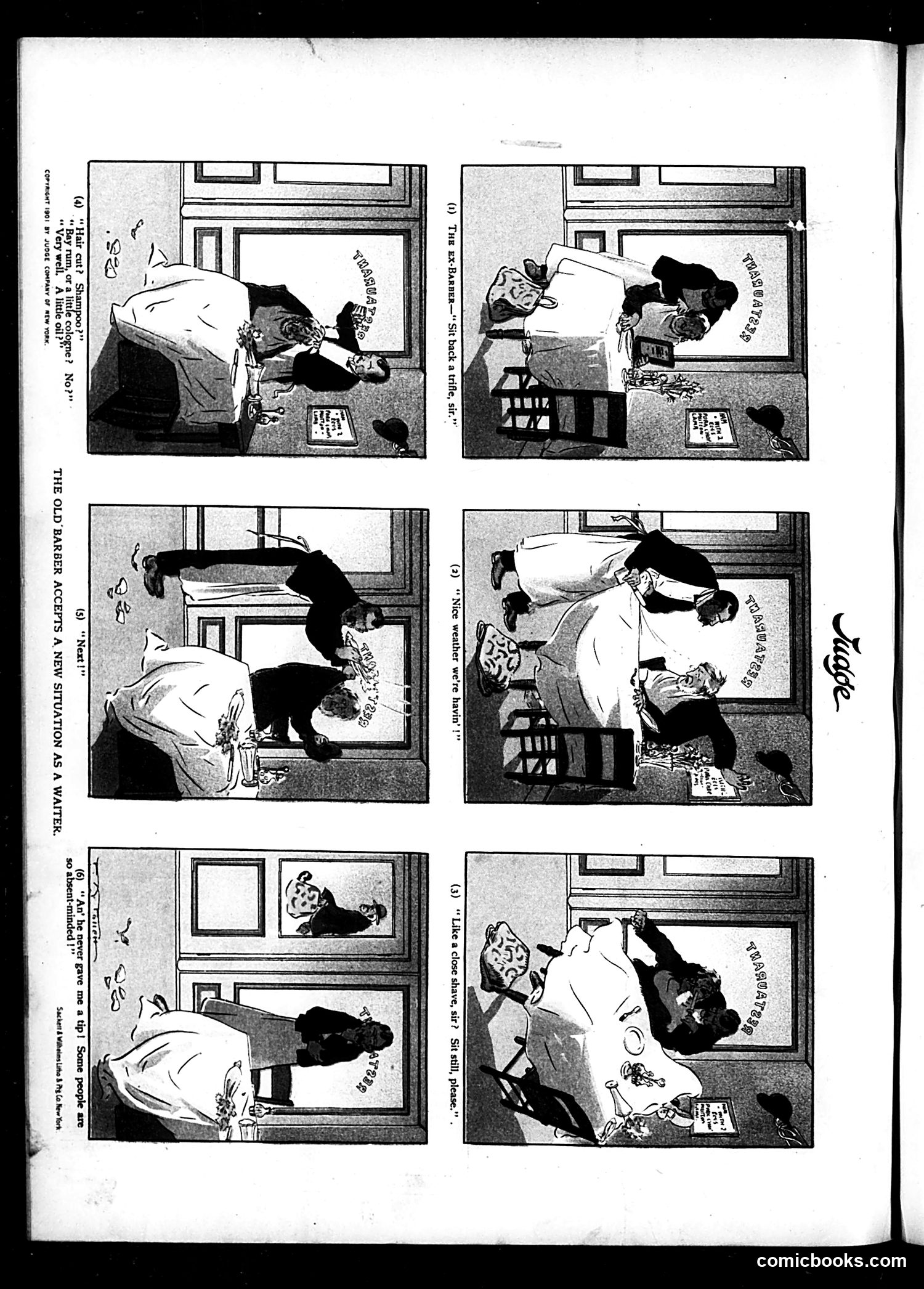
This appears to be a humorous multi-panel domestic scene titled "The Old Marker Accepts a New Situation as a Matter." The panels show a woman interacting with what seems to be a delivery person or service worker, depicted from overhead angles showing the room layout. The satire centers on absent-mindedness and social obligation: Panel (a) shows polite small talk ("Nice weather"), while panel (b) reveals the woman's actual irritation—the visitor never tipped her, which she considers inconsiderate. The humor relies on the contrast between surface politeness and inner frustration, a common theme in early 20th-century domestic comedy. The overhead perspective creates visual interest while showing the cramped living quarters typical of the era. This reflects period attitudes about tipping etiquette and class dynamics in service interactions.