
Judge, 1901-10-19 · page 3 of 16
Judge — October 19, 1901 — page 3: what you’re looking at
What you’re looking at
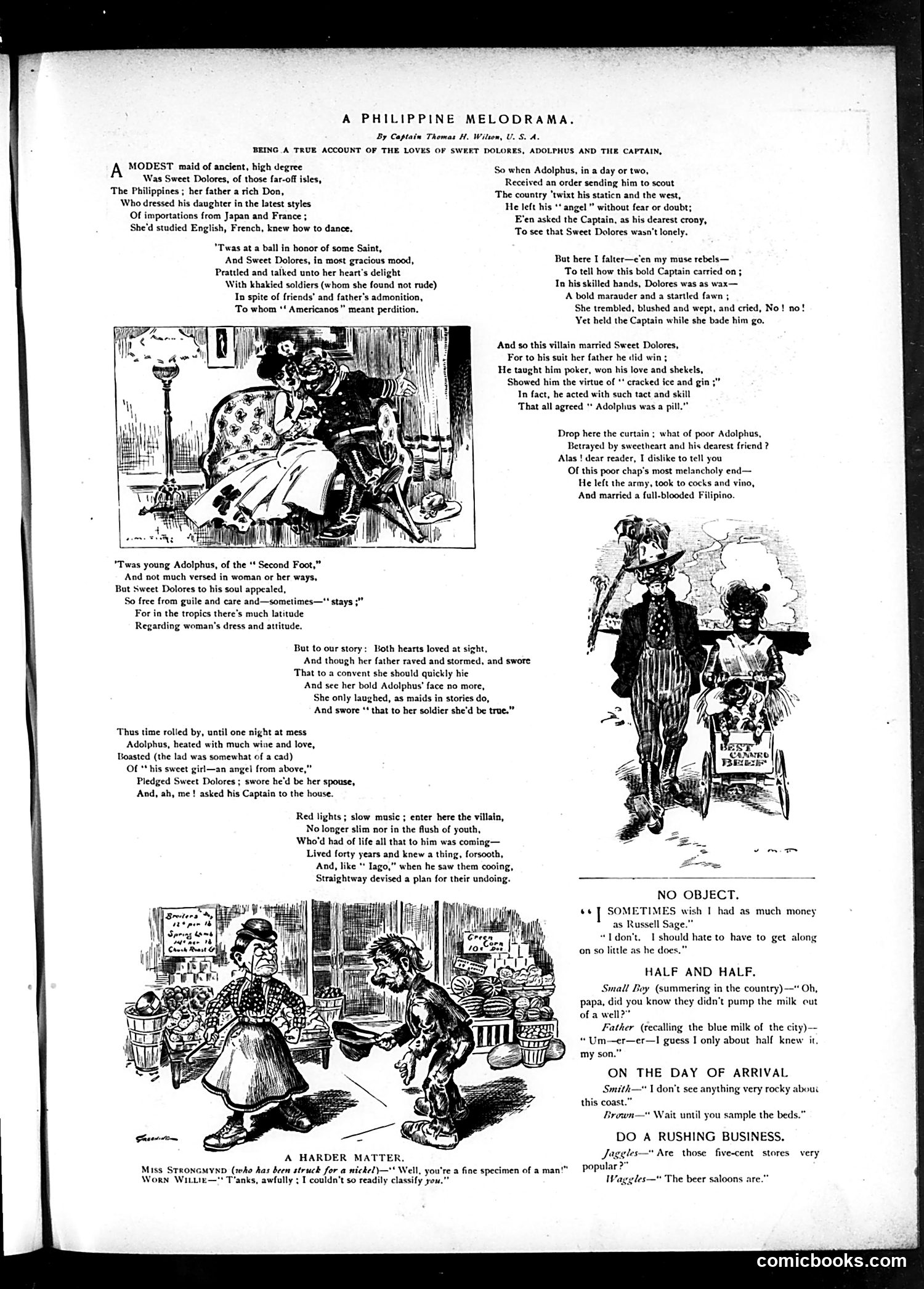
This page contains "A Philippine Melodrama," a satirical poem about American colonial interests in the Philippines. The narrative follows Sweet Dolores and Adolphus, characters representing the Philippines and American imperial ambitions respectively. The Captain represents American military/political authority. The satire mocks American interventionism: Adolphus attempts to "civilize" and control Dolores through education and domination, mirroring American justifications for Philippine colonization. The melodramatic tone undercuts these imperial pretensions—treating serious geopolitical conquest as absurd romantic comedy. The page also includes unrelated humor sections ("No Object," "Half and Half," "A Harder Matter") typical of Judge's miscellaneous content format. Overall, the page critiques American imperial expansion through absurdist parody.
📄 Transcribed text from this page (OCR, searchable)
Machine-transcribed from the original scan — historical spelling and the odd misread are preserved.
A PHILIPPINE MELODRAMA. By Capi in Thomas H, Wilton, U.S. A. BEING A TRUE ACCOUNT OF THE LOVES OF SWEET DOLORES, ADOLPHUS AND THE CAPTAIN, A MODEST maid of ancient, high degree D c So when Adolphus, in a day or two, Was Sweet Dolores, of those far-off isles, Received an order sending him to scout The Philippines ; her father a rich Don, The country ‘twixt his staticn and the west, Who dressed his daughter in the latest styles He left his ** angel ” without fear or doubt; Of importations from Japan and France ; E’en asked the Captain, as his dearest crony, She'd studied English, French, knew how to dance, To sce that Sweet Dolores wasn't lonely. ‘Twas at a ball in honor of some Saint, And Sweet Dolores, in most gracious mood, But here I falter—e'en my muse rebels— Prattled and talked unto her heart's delight To tell how this bold Captain carried on ; With khakied soldiers (whom she found not rude) In his skilled hands, Dolores was as wax— In spite of friends’ and father's admonition, To whom ‘ Americanos” meant perdition. A bold marauder and a startled fawn ; She trembled, blushed and wept, and cried, No! no! Yet held the Captain while she bade him go. iP G ] ny il { 1 i And so this villain married Sweet Dolores, i i FE For to his suit her father he did win ; iH re He taught him poker, won his love and shekels, 7 \ Showed him the virtue of ** cracked ice and gin ;” << i In fact, he acted with such tact and skill r a Nyy A 7 ‘That all agreed * Adolphus was a pill.” 1 ie " 35) \| anal Ry Neg i | Drop here the curtain ; what of poor Adolphus, es) i) Sse) a Me Betrayed by sweetheart and his dearest friend ? ‘| pA ZL '9 = }) Alas ! dear reader, I dislike to tell you th «4 Of this poor chap's most melancholy end— i He left the army, took to cocks and vino, And married a full-blooded Filipino. ‘Twas young Adolphus, of the ‘* Second Foot,” And not much versed in woman or her ways, But Sweet Dolores to his soul appealed, So free from guile and care and—sometimes—"* stays ;” For in the tropics there’s much latitude Regarding woman's dress and attitude. But to our story: Both hearts loved at sight, And though her father raved and stormed, and swore ‘That to a convent she should quickly hie And see her bold Adolphus’ face no more, She only laughed, as maids in stories do, And swore ** that to her soldier she'd be trae.” ‘Thus time rolled by, until one night at mess Adolphus, heated with much wine and love, Boasted (the lad was somewhat of a cad) Of “*his sweet girl—an angel from above,” Pledged Sweet Dolores ; swore he'd be her spouse, And, ah, me ! asked his Captain to the house. Red lights; slow music ; enter here the villain, No longer slim nor in the flush of youth, Who'd had of life all that to him was coming— Lived forty years and knew a thing, forsooth, And, like * Iago," when he saw them cooing, Straightway devised a plan for their undoing. NO OBJECT. SOMETIMES wish | had as much money as Russell Sage.” “Tdon't, I should hate to have to get along ‘on so little as he doe: HALF AND HALF. Small Boy (summering in the country) —" Ob, papa, did you know they didn’t pump the milk out of a well?” Father (fecalling the blue milk of the city)— “Um—er—er—I guess I only about half knew it, my son.” ON THE DAY OF ARRIVAL Smith— \ don't see anything very rocky about this coast. Brown Wait until you sample the beds.” DO A RUSHING BUSINESS. A HARDER MATTER. Jaggles—" Are those five-cent stores very Miss STRONGMYND (reho has been struck for a nickel)—'* Well, you're a fine specimen of a man!” popular Worn WitLie—" Tanks, awfully ; T couldn't so readi classify you." Wa gles—" The beer saloons are.” comicbooks.com