
A complete issue · 20 pages · 1901
Judge — September 28, 1901
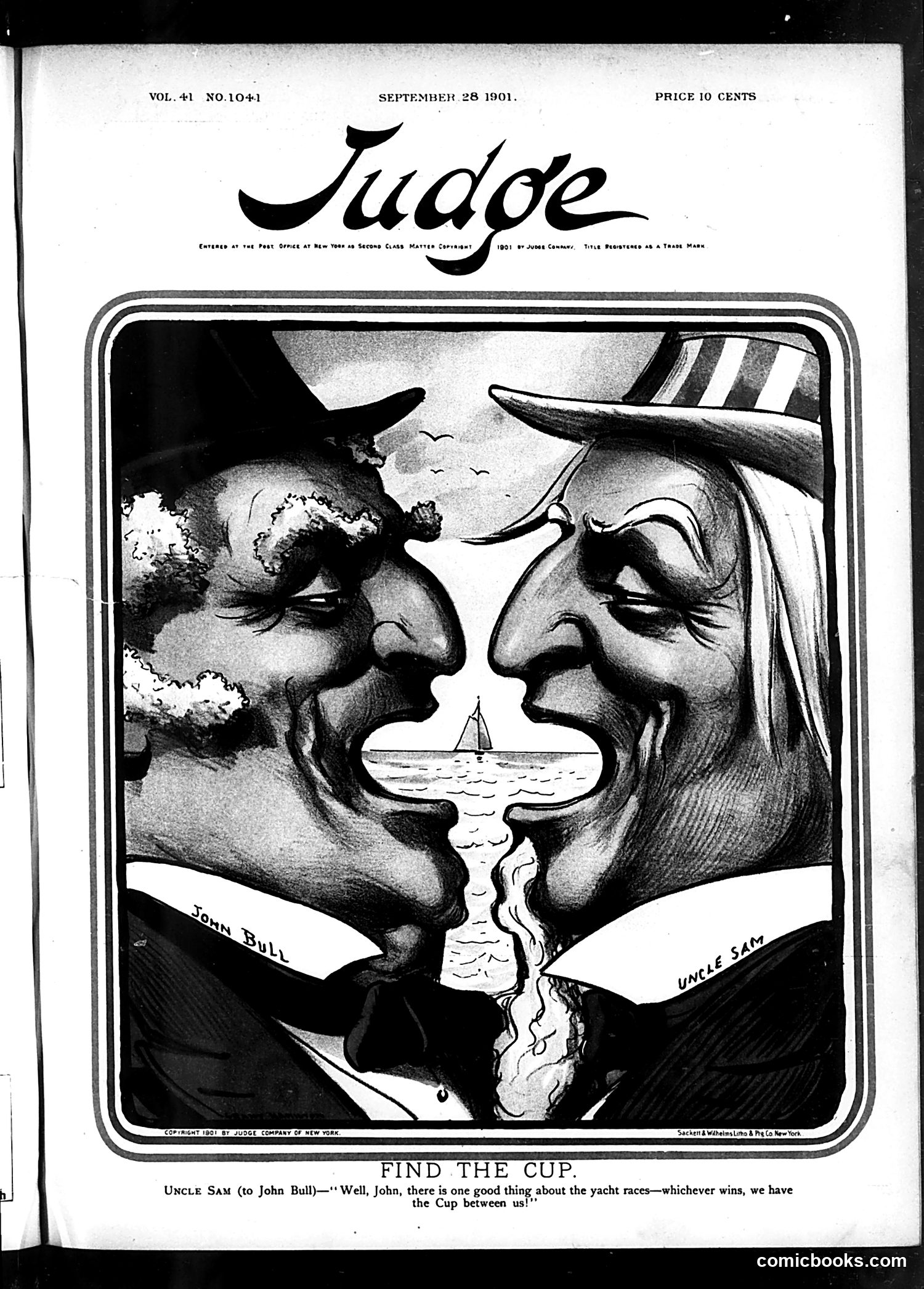
This political cartoon depicts "John Bull" (left, representing Britain) and "Uncle Sam" (right, representing America) as two grotesque caricatured heads facing each other across a sailing yacht on water. The caption shows Uncle Sam reassuring John Bull that regardless of who wins the upcoming yacht races, "we have the Cup between us." This references the America's Cup yacht racing competition. The cartoon suggests Anglo-American cooperation and shared interest in the competition's outcome, likely celebrating the relationship between the two nations during this period. The exaggerated facial features and grotesque style were typical of Judge's satirical approach to depicting national figures and international relations.
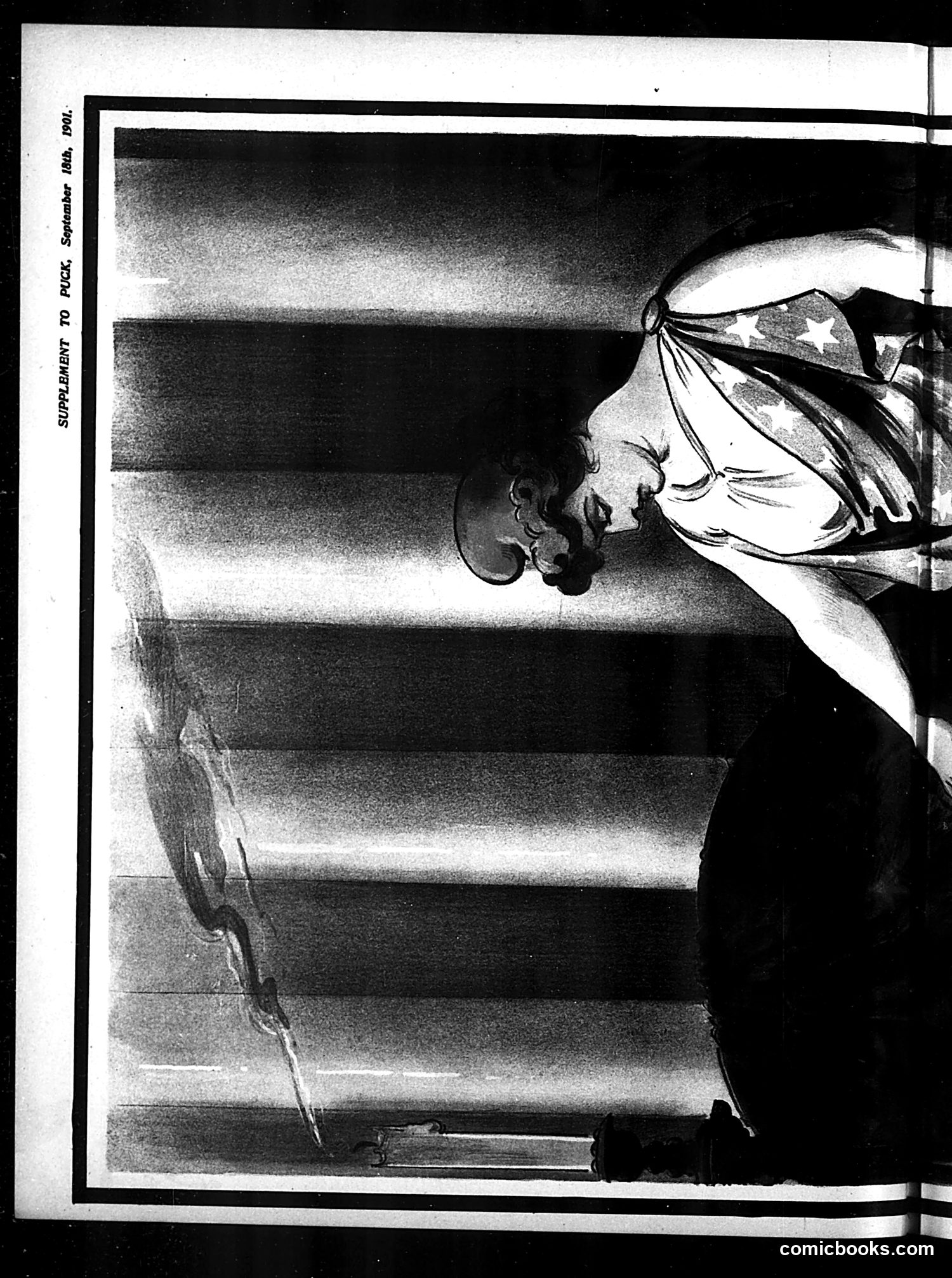
This appears to be a supplement cover for *Judge* magazine featuring a patriotic allegorical figure (likely Columbia or Liberty, identifiable by the starred headband/crown). The figure is shown in profile, gazing downward with a contemplative or sorrowful expression against a striped background—possibly representing the American flag. The image's emotional tone and downward gaze suggest commentary on a national concern or crisis. Without the full text or date visible, the specific historical event remains unclear, though the patriotic iconography and melancholic mood indicate satire about American political or social circumstances. The caption reads "SUPPLEMENT TO PUCK, September 18th, 1908" — this helps date the cartoon to that period, though the exact satirical subject cannot be confirmed from the image alone.
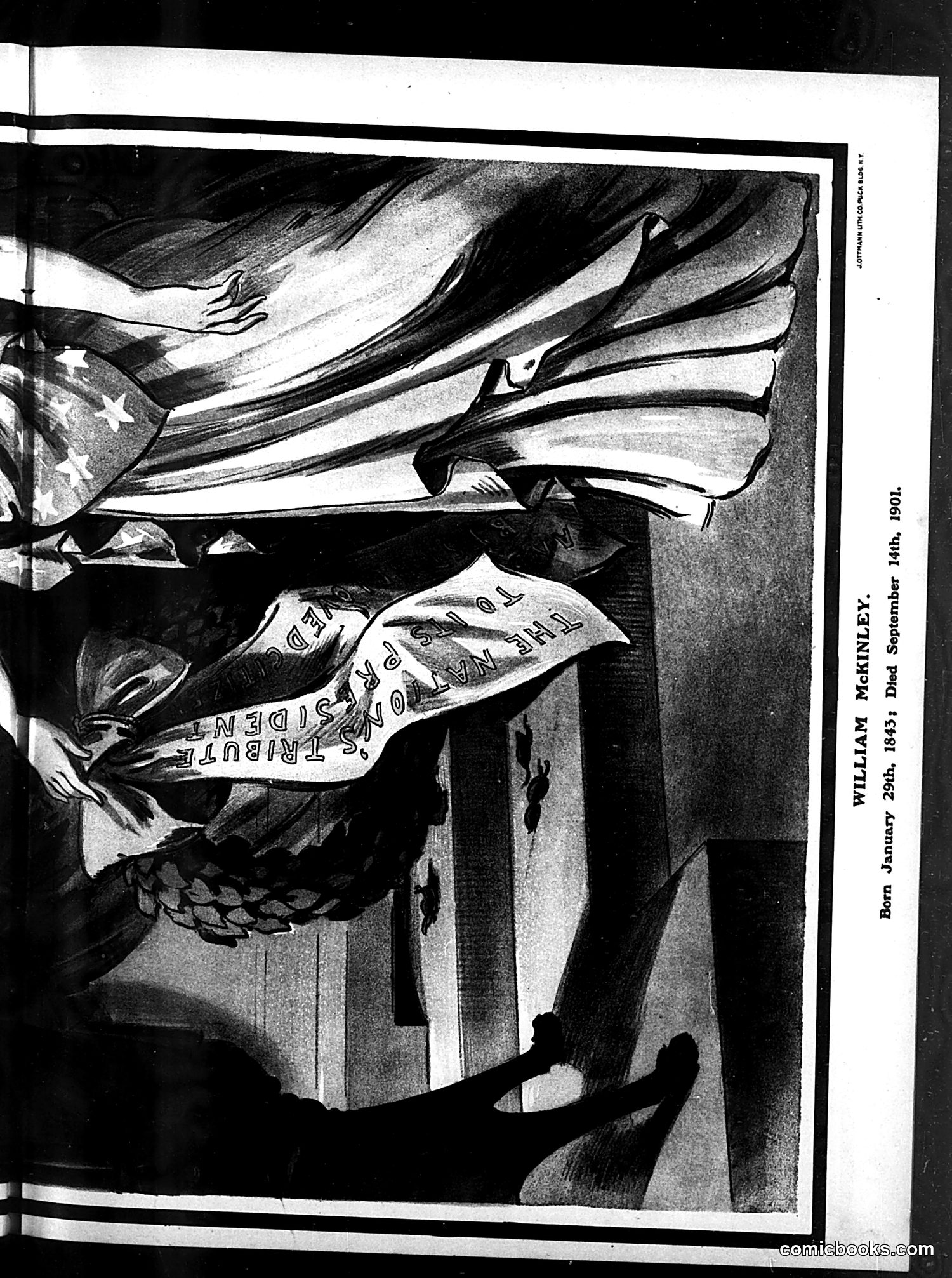
**Born January 29th, 1843. Died September 14th, 1901.** This is a commemorative page from *Judge* magazine marking President William McKinley's death in 1901 (he was assassinated by Leon Czolgosz on September 6). The illustration appears to show allegorical figures in mourning—likely representing Columbia (the female personification of America) or Liberty alongside other symbolic figures. The composition emphasizes national grief and loss. The draped flags and solemn poses suggest this is a tribute to a fallen leader during a period of significant national trauma. This type of commemorative imagery was standard in American periodicals following presidential deaths, presenting McKinley's passing as a collective national tragedy worthy of formal remembrance.
I can see this is a page from *Judge* magazine, but the image quality is too degraded for me to read the OCR text clearly or discern specific cartoon details. The page appears mostly blank or heavily faded, with only some indistinct marks visible at the bottom that might be part of an illustration or signature. Without being able to read the text or identify specific figures, caricatures, or visual elements clearly, I cannot accurately explain what political or social satire this page contains. To provide a reliable analysis for a modern reader, I would need a clearer, higher-resolution image where the text and illustrations are legible. I'd recommend checking the original source for a better-quality scan.
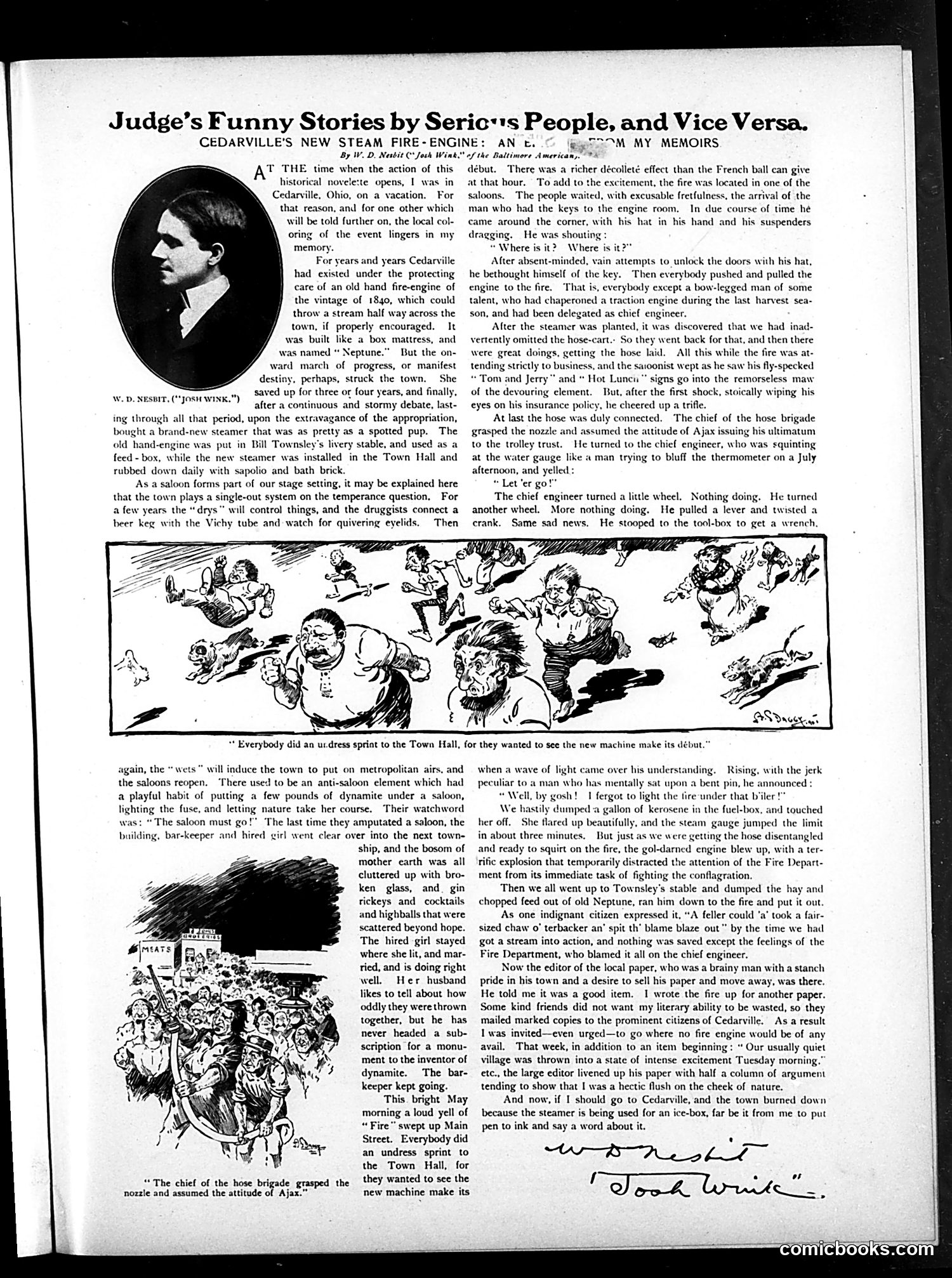
This humorous story satirizes small-town American life and technological progress. The narrative follows a rural Ohio town's purchase of a modern steam-powered fire engine to replace its antiquated hand-operated predecessor—itself a joke, as the old "Neptune" engine could barely function. The satire targets several points: the town's "temperance question" where prohibitionists literally blow up saloons with dynamite (presented matter-of-factly as normal civic discourse); bureaucratic incompetence (the key-holder arrives late, disheveled); and technological overconfidence (the new engine proves useless because they forgot the hose-cart). The accompanying cartoon depicts townspeople in frantic undress sprinting to witness the fire—suggesting both excitement over modernity and the scandalous exposure of semi-clothed citizens. The humor derives from contrasting civilizational "progress" with small-town disorganization and vice: dynamite saloon-busting treated as routine community improvement.
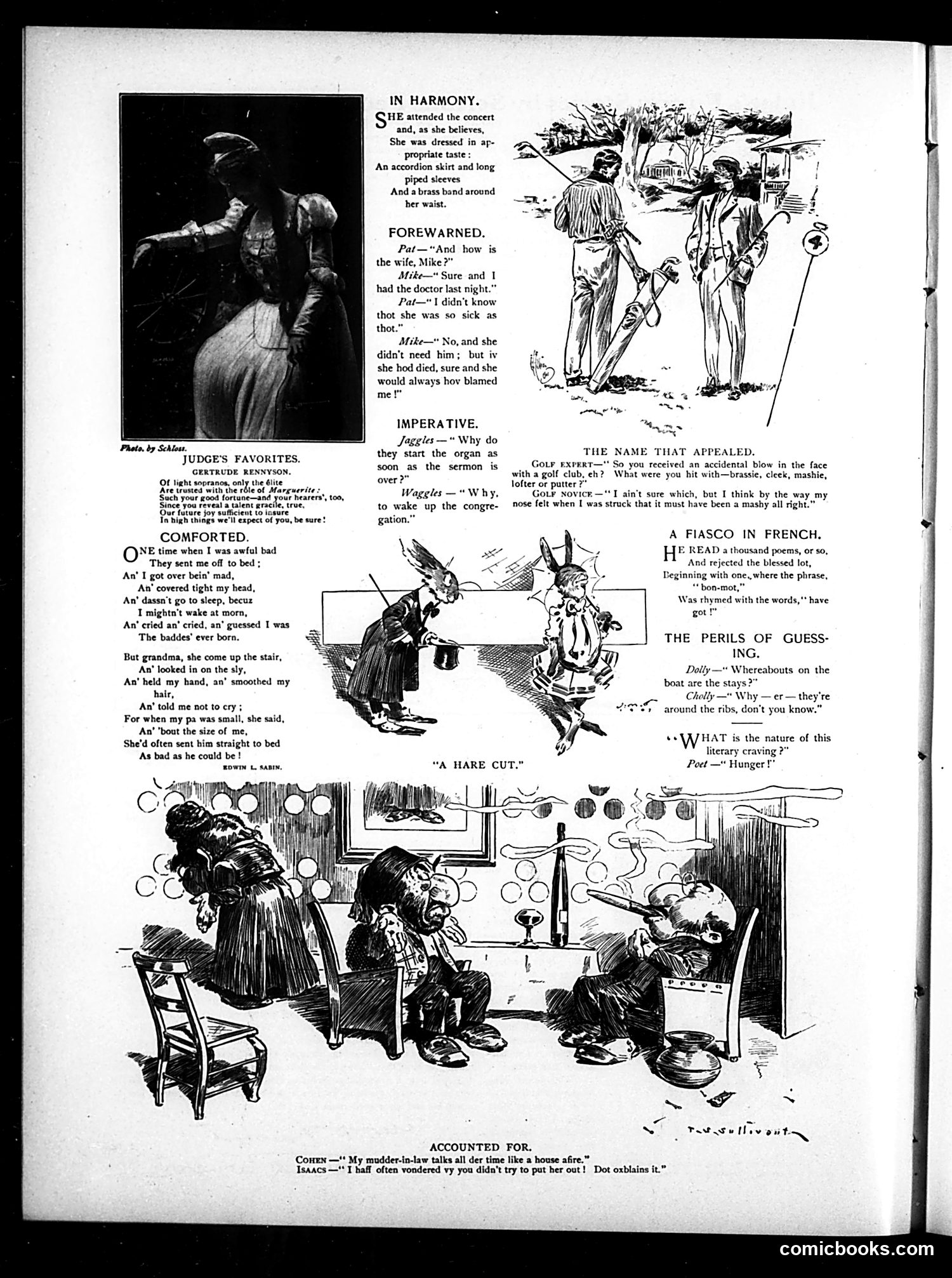
This page contains several short humorous pieces typical of early 20th-century American satirical magazines: **"In Harmony"** jokes that a woman dressed fashionably for a concert—with an accordion-pleated skirt and brass-band belt—ironically matches the music itself. **"Forewarned"** presents Irish-accented working-class characters (Pat and Mike, indicated by dialect) in a joke about marital anxiety: Mike calls a doctor preemptively, not because his wife is sick, but to have medical evidence he didn't cause her death, anticipating blame. **"Comforted"** is a sentimental poem about a grandmother consoling a punished child with reassurance from her own experience raising his father. The remaining pieces are light social comedy: "Imperative" mocks sermon timing; "A Hare Cut" and "A Fiasco in French" feature wordplay; "The Perils of Guessing" plays on golf terminology confusion; and the final caption jokes about nagging mothers-in-law. The page reflects Judge's formula: mixing sentiment, ethnic humor, domestic comedy, and gentle social observation without political content.
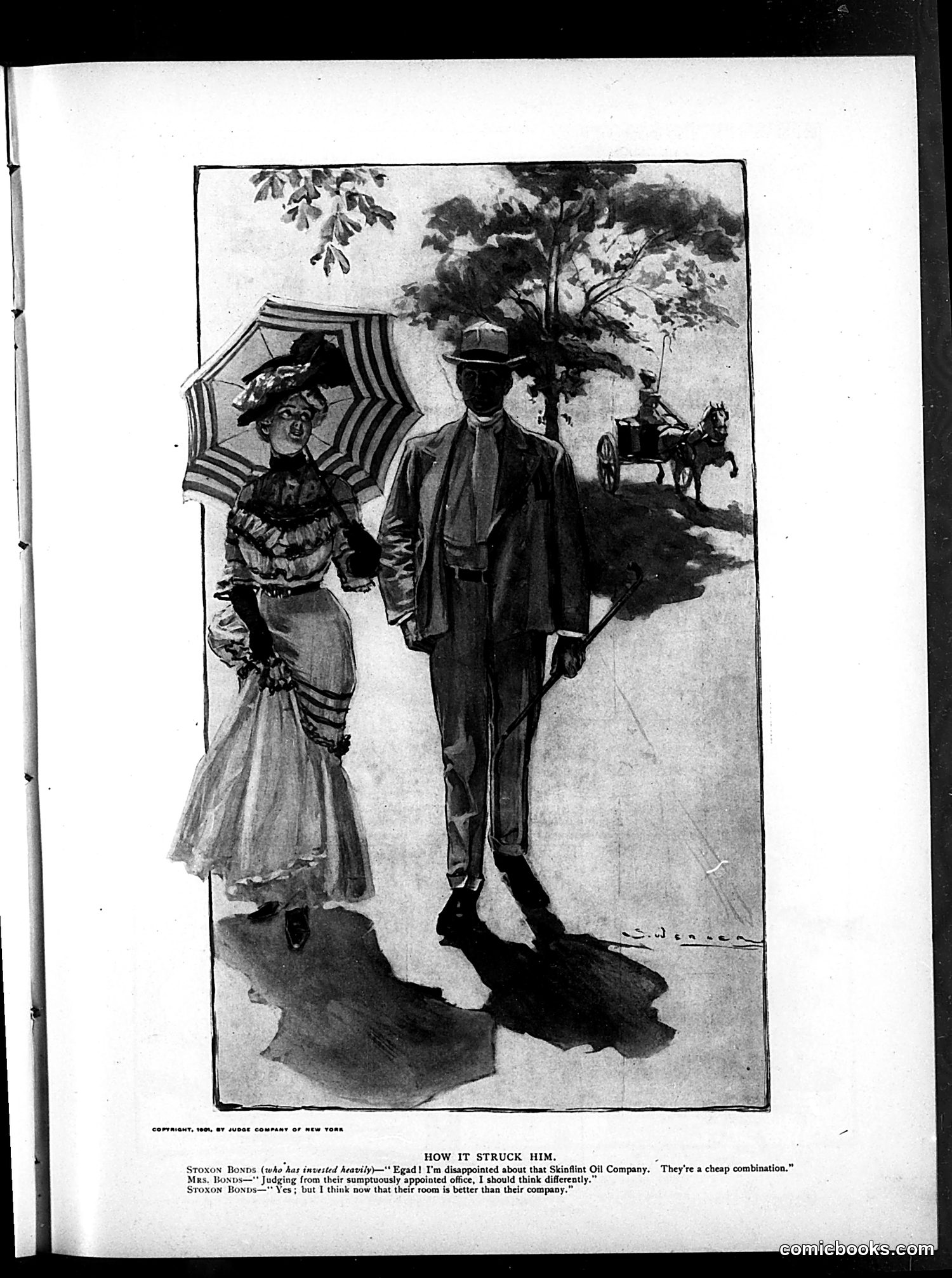
This 1908 satirical cartoon mocks wealthy investor "Stoxon Bonds," who has invested heavily in the "Skinflint Oil Company." The joke hinges on disappointment with corporate management. Bonds initially complains the company is a "cheap combination," but then contradicts himself—noting that despite the company's "sumptuously appointed office," he'd judge them differently if he visited in person. His final comment reverses this: he'd actually prefer their *room* (office space) to their *company* (their actual presence/character). The satire targets the disconnect between corporate appearance and reality: fancy offices mask poor business practices or character. The cartoon also mocks investor naïveté—Bonds is fooled by superficial trappings rather than evaluating actual business merit. The background shows a carriage and pastoral setting, emphasizing the leisure-class context of this investment complaint.
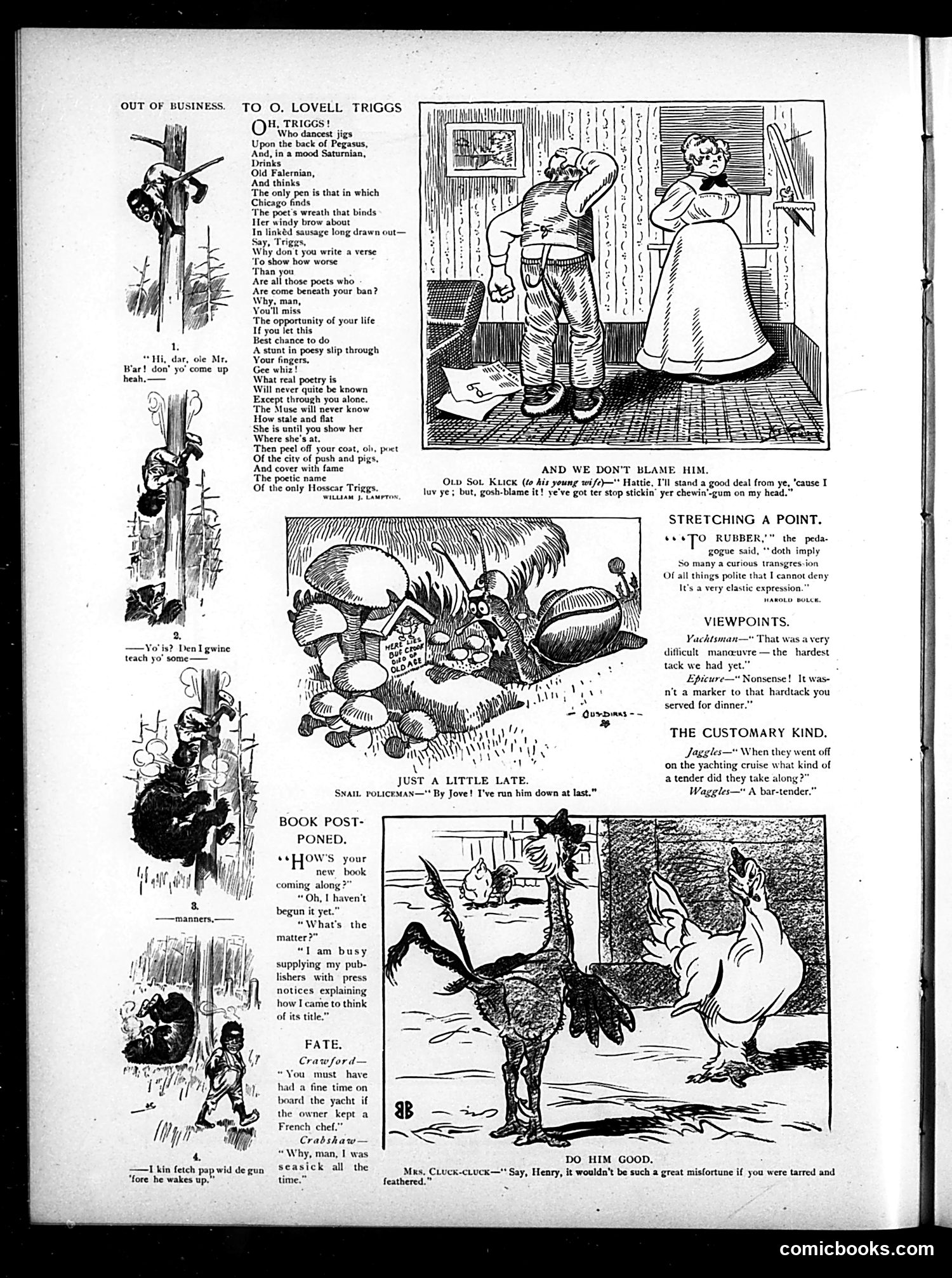
This page collects several short humorous pieces targeting early 20th-century American life and literary pretension. **"To O. Lovell Triggs"** mocks a Chicago poet, ridiculing his self-importance and suggesting he writes inflated verse about his city ("city of push and pigs," referencing Chicago's industrial/meatpacking reputation). The satire attacks literary vanity. **The domestic cartoon** jokes about a husband's complaint that his wife sticks chewing gum on his head—a crude marital complaint typical of Judge's humor. The remaining pieces are brief comedic vignettes: a snail as a slow policeman, a writer postponing his book while writing promotional blurbs, sailing anecdotes, and naval humor. Overall, this page reflects Judge's formula: attacking literary pretension, poking fun at contemporary urban life (especially Chicago), and offering light domestic/social humor. The tone is irreverent and populist, mocking both highbrow culture and everyday American absurdities.
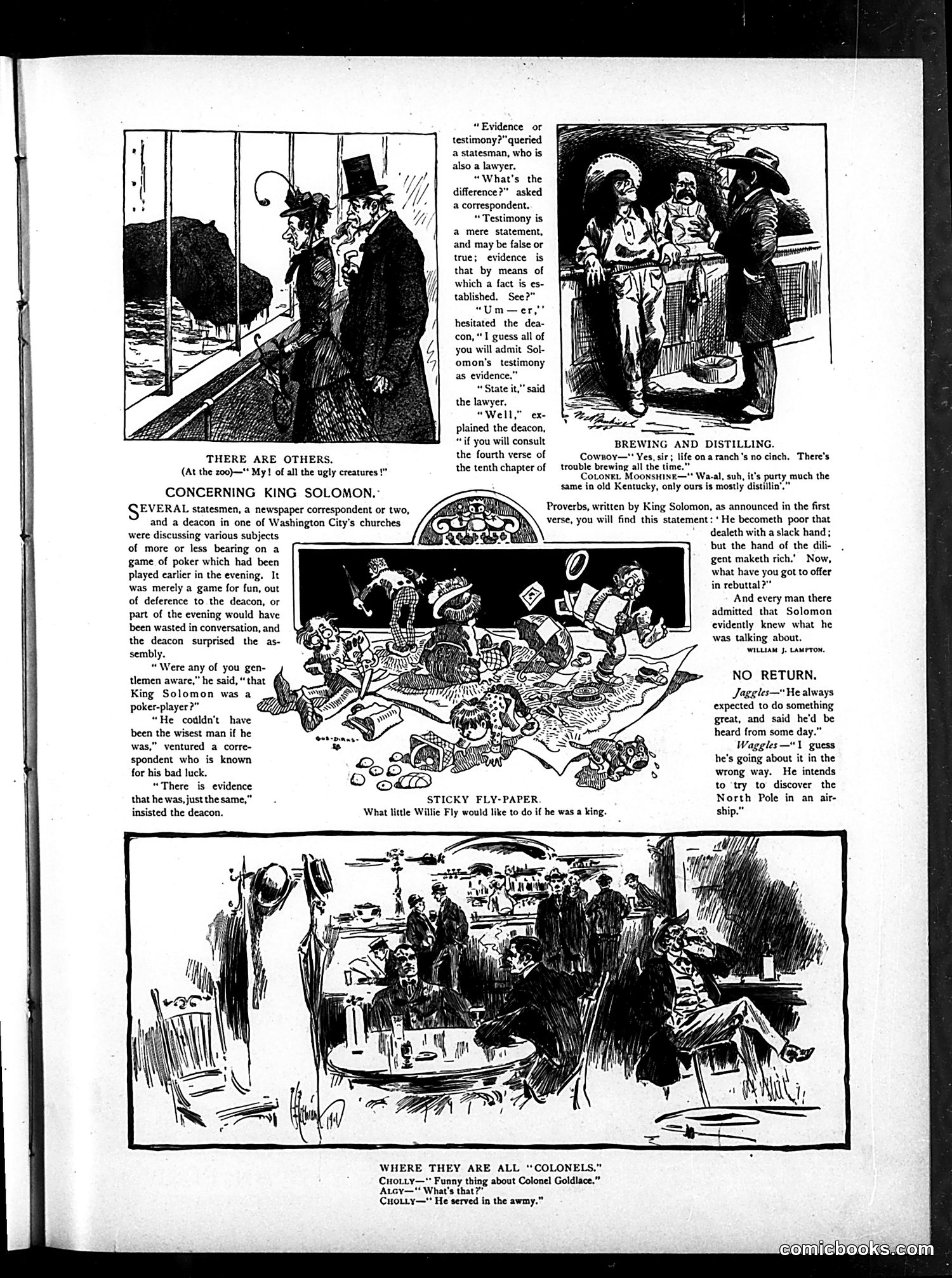
This page contains multiple satirical pieces mocking political and social pretension in late 19th-century America. **"Concerning King Solomon"** uses a poker-game anecdote to ridicule Washington politicians and clergy who invoke biblical authority to justify questionable behavior. A deacon claims King Solomon was a poker player, citing Proverbs about diligence—a transparent rationalization that amuses the assembled statesmen. **"Sticky Fly-Paper"** shows a child's fantasy of power, likely satirizing ambitions of prominent figures. **"Where They Are All 'Colonels'"** mocks the inflation of military titles. The joke that Colonel Goldlace "served in the army" suggests he fraudulently claims military rank without genuine service—a common pretension Judge ridiculed. The scattered vignettes ("Brewing and Distilling," "No Return") offer brief satirical observations on contemporary life and character types. Overall, the page targets dishonesty, false authority claims, and self-aggrandizement among Washington elites and social climbers.
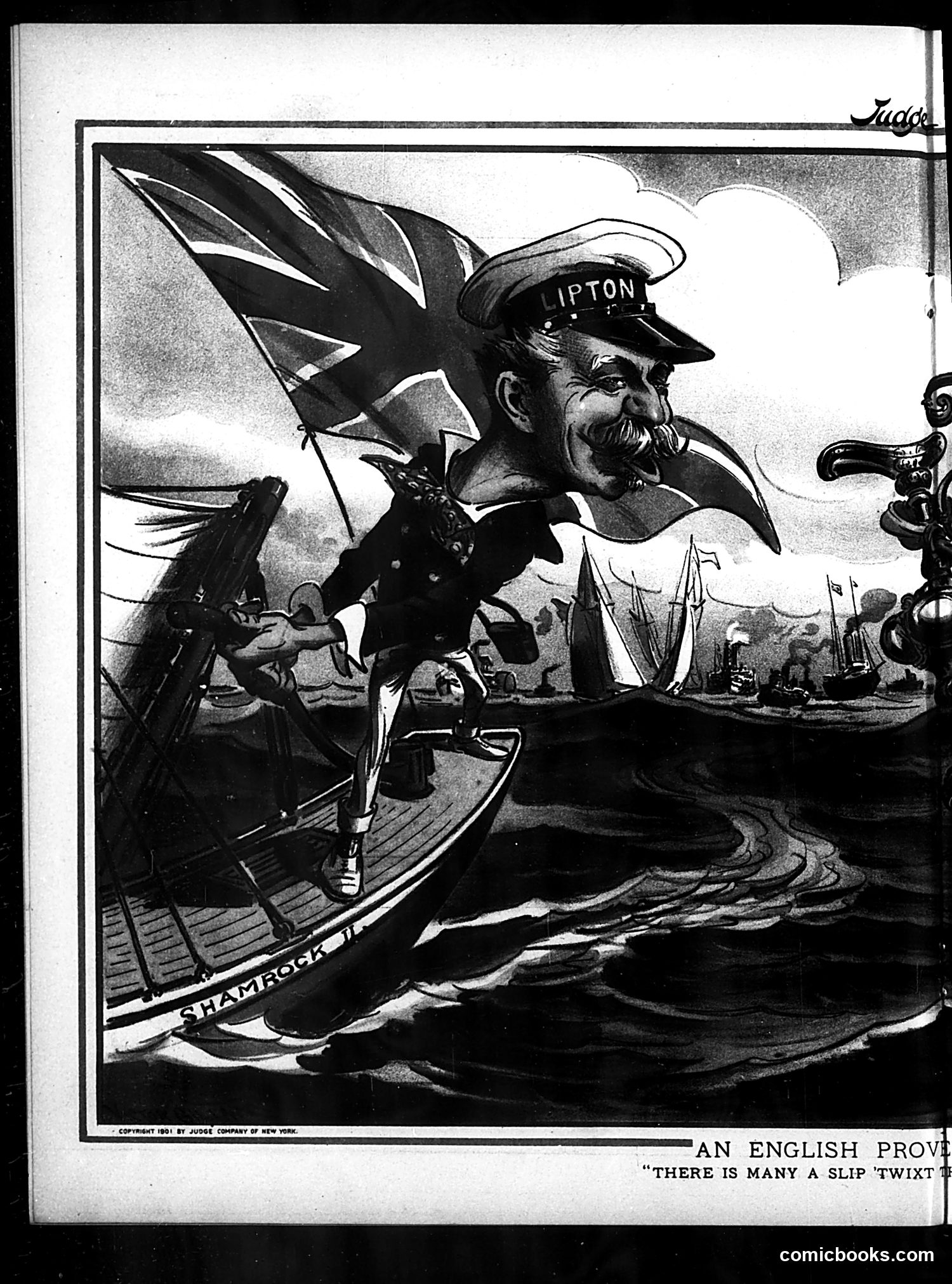
This is a political cartoon titled "An English Proverb" illustrating the saying "There is many a slip 'twixt [cup and lip]." The central figure is **Lord Lipton** (labeled on his cap), a British naval/commercial figure, depicted as a bearded sailor holding a British flag in a small boat. The cartoon appears to satirize British naval ambitions or colonial ventures—showing Lipton confidently displaying the flag while sailing toward what appears to be a distant port or settlement visible in the background. The proverb's meaning here is satirical: despite Lipton's confident display of British power and intentions, unforeseen complications or failures may occur before success is achieved. The cartoon mocks British imperial confidence by suggesting overconfidence in overseas ventures. The copyright is 1851 by Judge Company of New York.
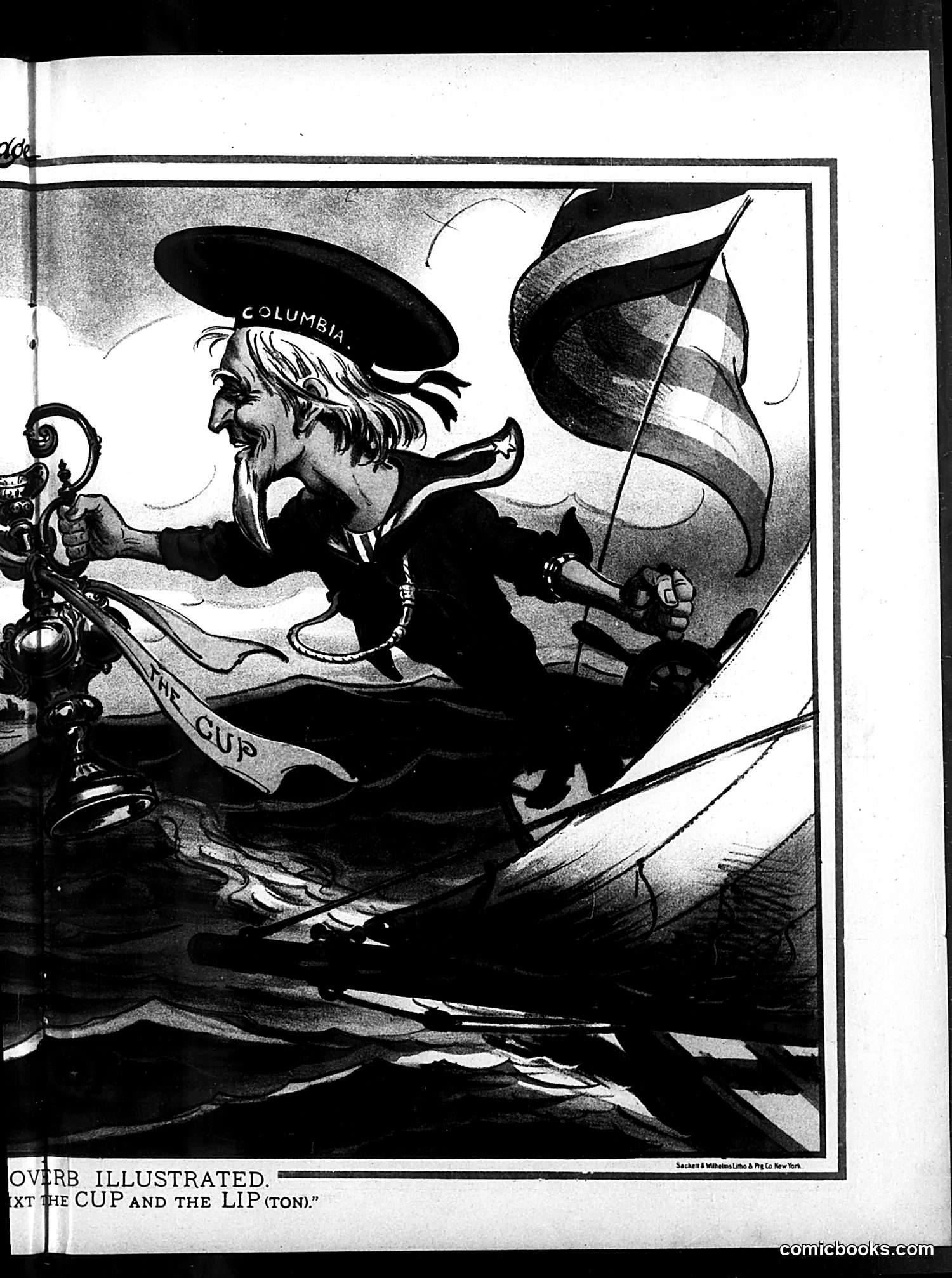
This political cartoon depicts Columbia (the female personification of America, identifiable by her labeled cap) as a sailor at the helm of a ship. She's steering toward what appears to be a large goblet or cup labeled "CUP," while a striped sail billows above. The title references the proverb "there's many a slip 'tween the cup and the lip"—meaning something anticipated may not come to pass. The cartoon likely satirizes American political or military ambitions, suggesting that despite Columbia's confident navigation toward a desirable goal, success remains uncertain. The maritime setting implies naval/imperial ventures, common subjects in Judge magazine's political satire during the imperial era. Without additional context about publication date or events, the specific target remains unclear.
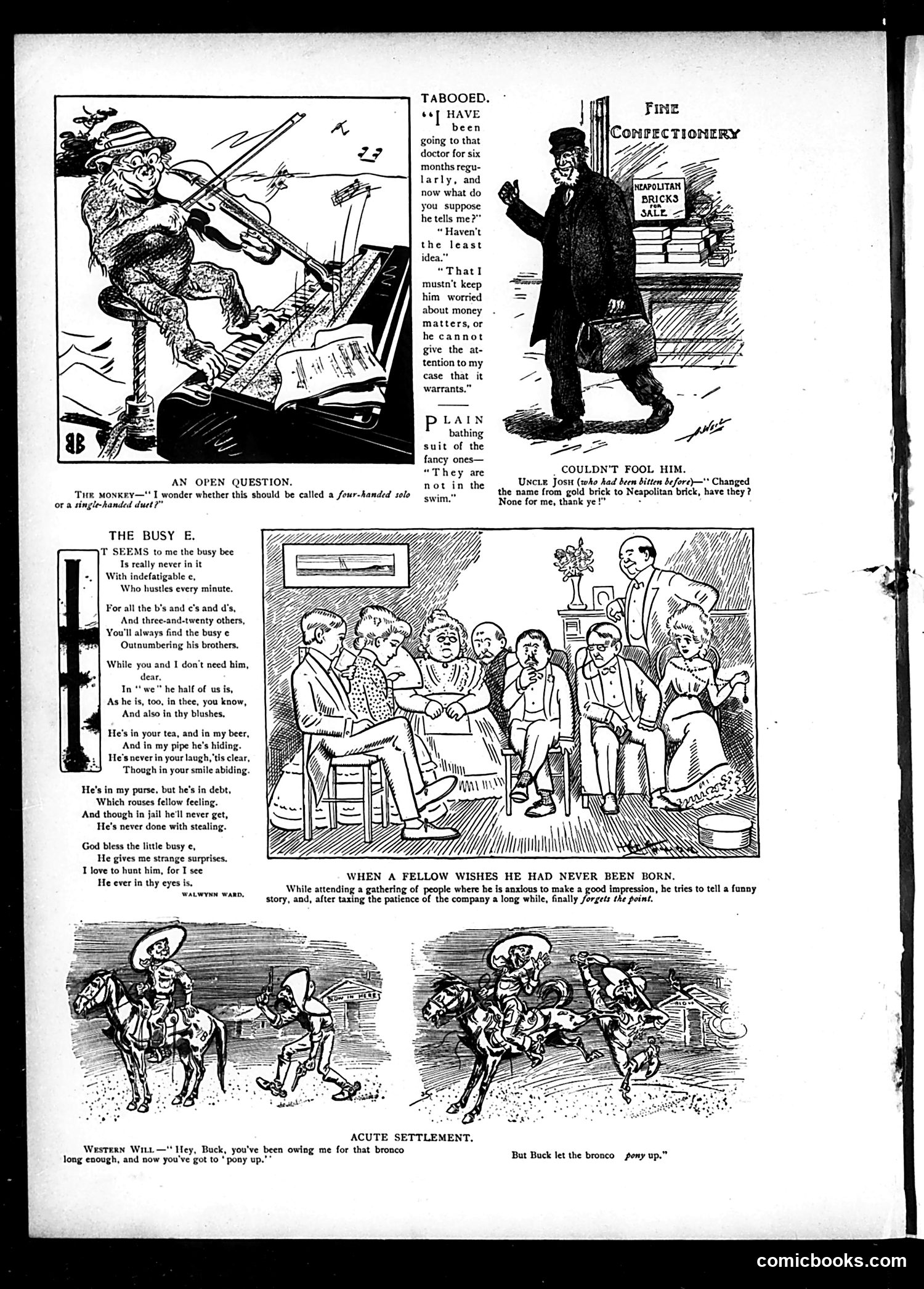
This page contains several unrelated satirical pieces typical of Judge's humor: **"Tabooed"**: A doctor demands patients stop worrying him about money matters, insisting he needs mental peace to treat them properly—satirizing physicians who avoid discussing fees. **"Couldn't Fool Him"**: Uncle Josh, previously swindled with a "gold brick" scam, refuses a similar con involving Neapolitan brick, mocking both con artists and the gullible. **"An Open Question"**: A monkey playing musical instruments poses whether four-handed performance constitutes a "solo" or "duet"—wordplay on musical terminology. **"The Busy E"**: A lengthy poem celebrating the letter "E" and its ubiquity in English words and phrases—linguistic wordplay rather than political satire. **"When a Fellow Wishes..."**: Depicts social embarrassment when someone forgets the punchline of their own joke. **"Acute Settlement"**: Puns on "pony up" (pay debt) when a cowboy literally makes a bronco rear up—Western humor relying on double meanings. The page emphasizes linguistic wit and everyday social awkwardness rather than political commentary.
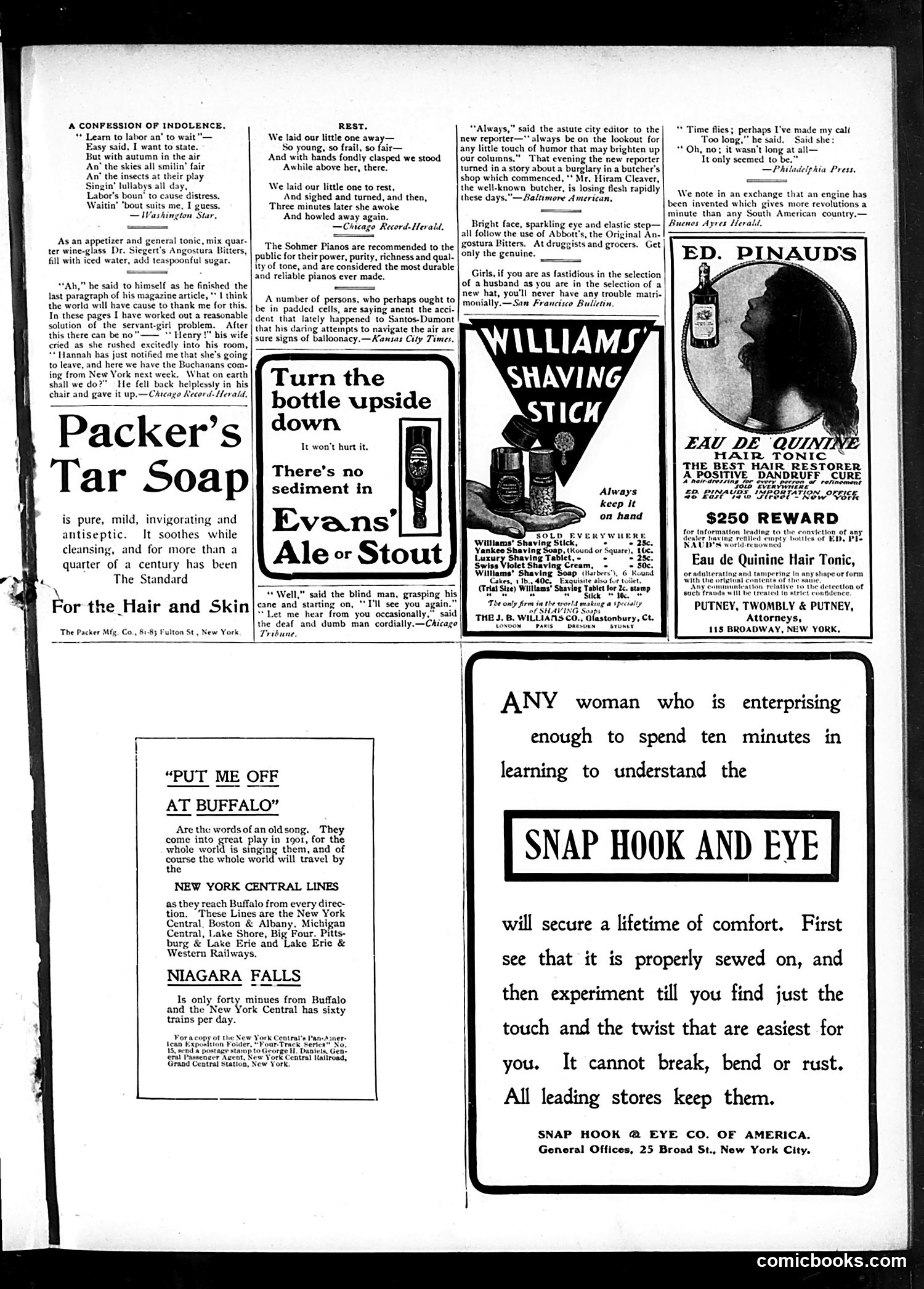
This page is primarily **advertising content** from an early 20th-century American satirical magazine, with brief humorous filler pieces scattered throughout. The small jokes target domestic life and contemporary figures: one mocks lazy servants as an unsolved social problem; another jokes about Santos-Dumont's early aviation attempts as "balloonacy" (wordplay on "lunacy"); several quip about romantic relationships and office life. A recurring theme satirizes the pretentiousness of magazine writers and newspaper editors. The advertisements—for Packer's Tar Soap, Evans' Ale, Williams Shaving products, and Ed. Pinaud's hair tonic—reflect period consumer goods marketed through casual humor and lifestyle appeals. The Snap Hook and Eye ad emphasizes practical domestic utility. The "Put Me Off at Buffalo" section promotes New York Central railroad routes, treating travel as leisure activity. Overall, this reflects Judge's model of mixing light social satire with advertising revenue—nothing here requires specialized historical knowledge beyond recognizing early 1900s consumer culture and genteel magazine conventions.
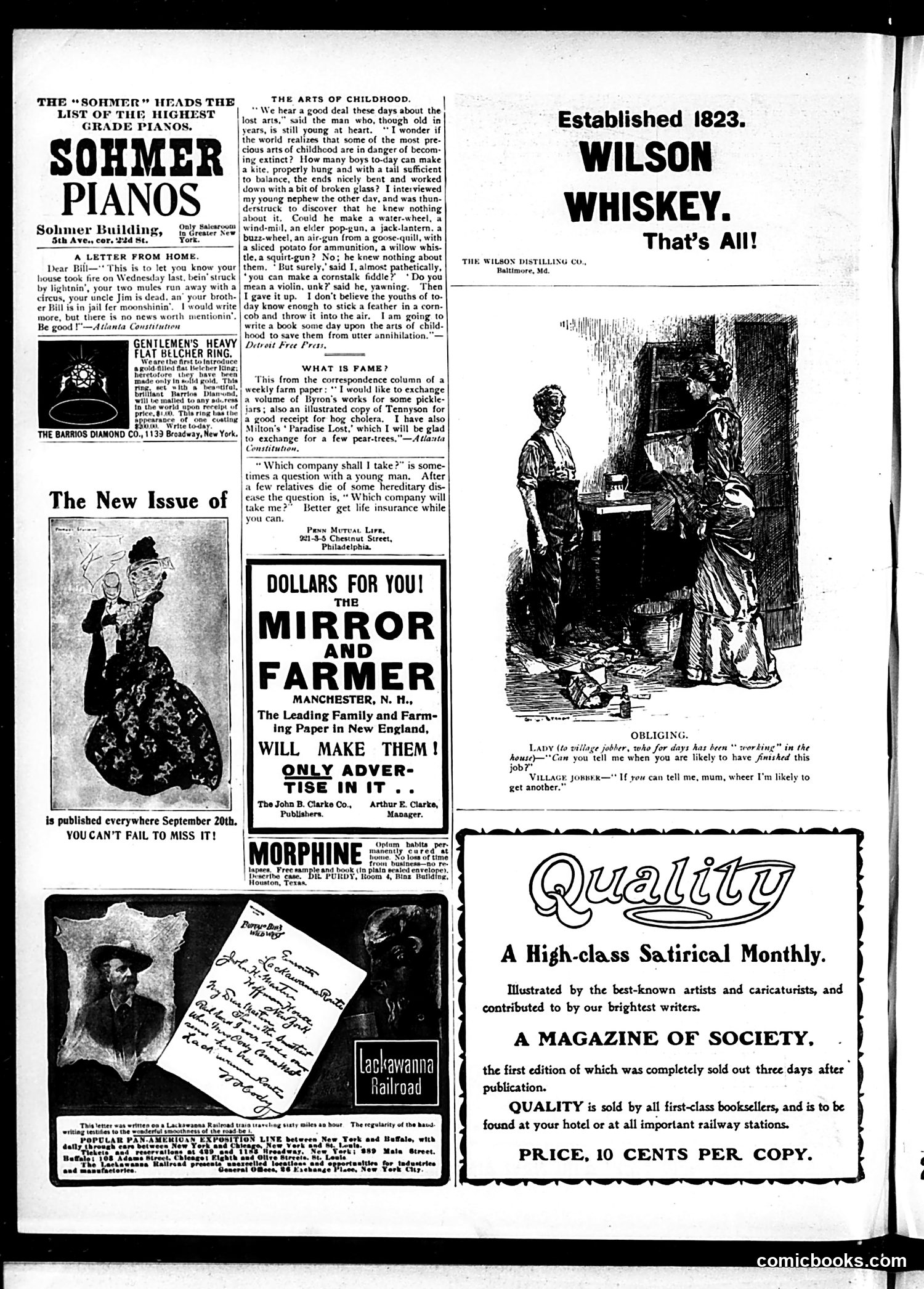
This page consists primarily of **advertisements and miscellaneous content** rather than political cartoons. The notable satirical pieces include: **"The Arts of Childhood"** column mocks urban disconnection from rural skills. An elderly narrator laments that modern boys can't make kites, water-wheels, or cornstalk fiddles—traditional pastimes—suggesting anxiety about lost Americana and industrialization's effects on youth. **"A Letter from Home"** is a darkly humorous rural dispatch listing disasters (fire, death, jail) with deadpan acceptance, satirizing rustic stoicism and backwoods indifference. **"Obliging"** presents a brief joke about a village laborer's honest admission that he can't predict when his current job ends, let alone secure the next one—satirizing working-class precarity. The page also features standard period advertising for pianos, whiskey, morphine (legal then), and *Quality* magazine itself, reflecting Judge's commercial function alongside satire.
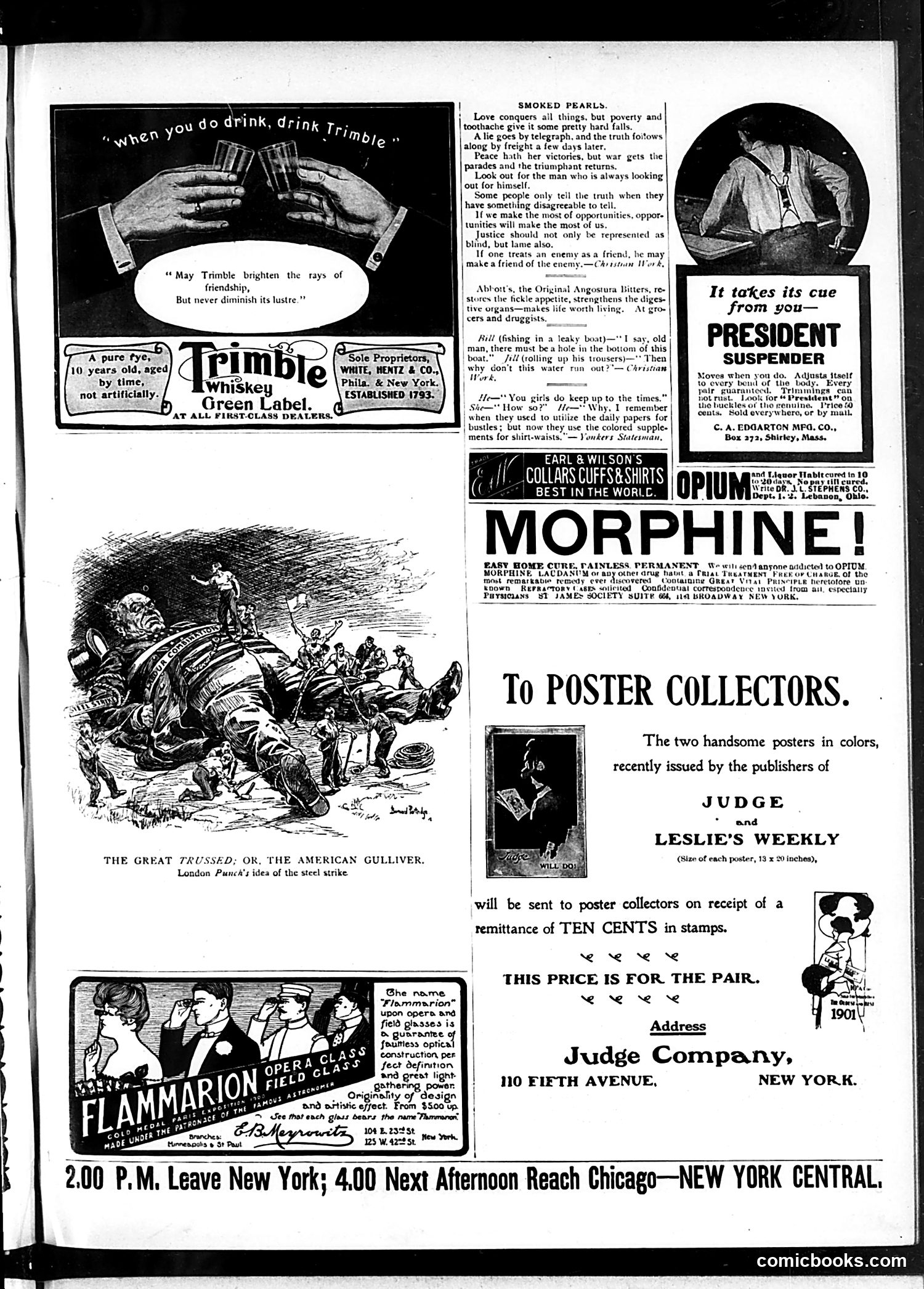
This page combines advertisements with satirical content typical of early 1900s Judge magazine. **Main Cartoon**: "The Great Trussed; or, The American Gulliver" references Jonathan Swift's *Gulliver's Travels*, satirizing the 1902 steel strike. The image depicts a giant American worker (Gulliver) tied down by tiny figures, likely representing labor being restrained by industrial powers or government forces during the strike dispute. **Satirical Quotes** ("Smoked Pearls"): Pithy observations mock human nature—lies traveling faster than truth, justice being "blind, but lame also," and the hypocrisy of treating enemies as friends. **Advertisements**: The page is dominated by period product ads (Trimble Whiskey, suspenders, morphine "cure," opera glasses) reflecting early 1900s consumer culture and the widespread, unregulated marketing of addictive substances like opium. **Context**: The steel strike reference and labor imagery suggest Judge's satirical commentary on American industrial conflict and working-class struggles of that era.
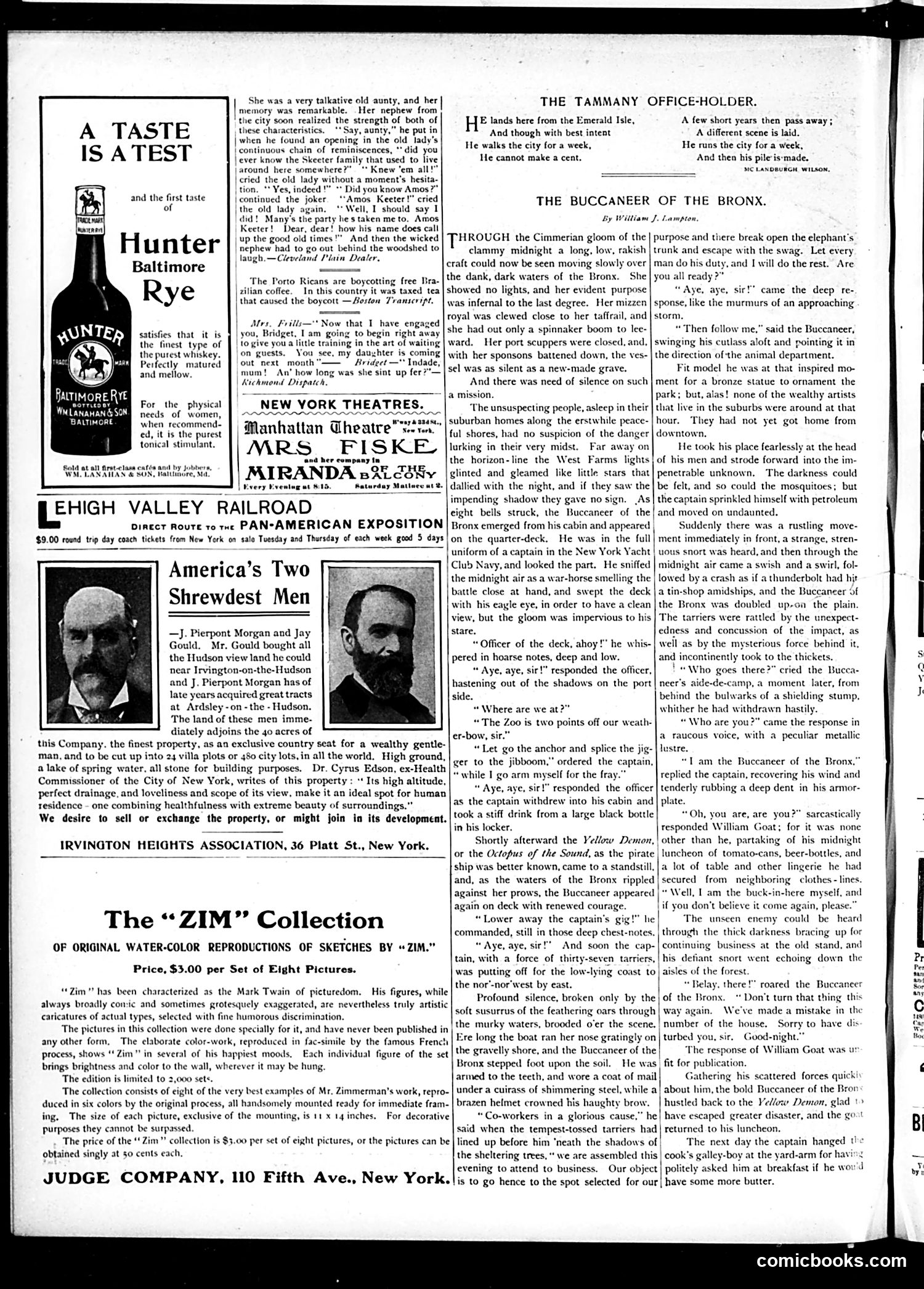
This page from *Judge* magazine is primarily **advertising and serialized fiction** rather than political satire. The page contains: 1. **Hunter Baltimore Rye whiskey ads** – Standard product advertisements with testimonial copy 2. **"The Tammany Office-Holder"** and **"The Buccaneer of the Bronx"** – Serialized short stories (by William J. Lamprey), appearing to be adventure/humorous fiction 3. **Small comedic anecdotes** – Brief joke items (about an aunt with a good memory, an Irish servant named Bridget) typical of *Judge*'s humor section 4. **Theater and real estate advertisements** – Including Mrs. Fiske at Manhattan Theatre and the Irvington Heights Association promoting land allegedly coveted by J. Pierpont Morgan and Jay Gould The only potentially satirical element is the **real estate ad's reference to Morgan and Gould** as "shrewdest men," which may mock their wealth and land acquisition, though this reads more as marketing hyperbole than biting satire. Overall, this appears to be a typical *Judge* issue mixing light entertainment with commercial content.
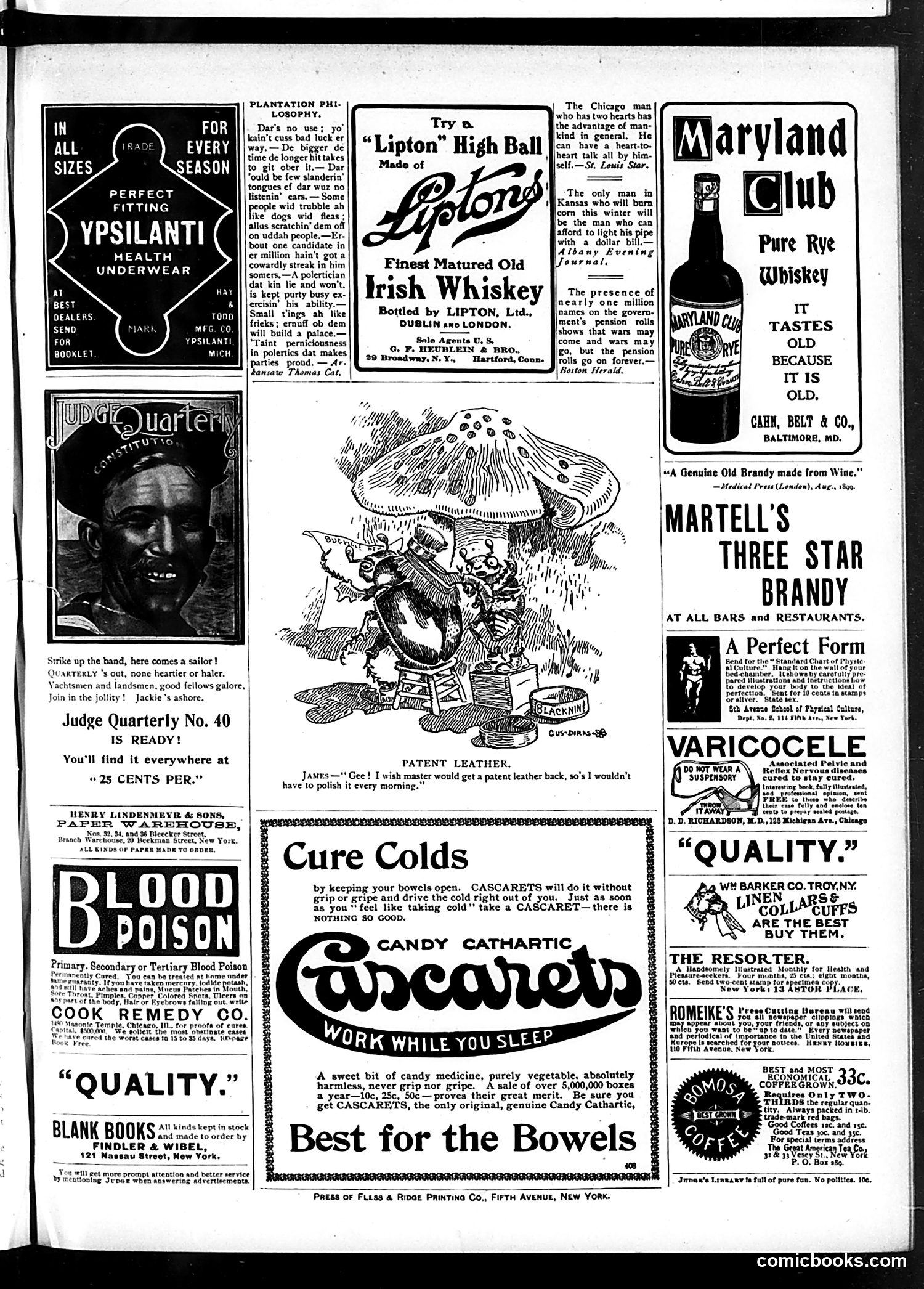
This is primarily an **advertising page** from Judge magazine, with one notable cartoon. The central cartoon depicts a **donkey labeled "Patent Leather,"** with the caption showing a servant (James) wishing his master would get a patent leather back so he wouldn't have to polish it. This is a visual pun: patent leather requires no polishing because it's pre-glossed, so the joke mocks the donkey's back as if it were leather that needs maintenance. The page also features "**Plantation Philosophy**"—a recurring Judge feature presenting folksy, dialect-laden observations attributed to unnamed Black speakers. These were common in period humor magazines, reflecting era-typical racial stereotypes through exaggerated dialect and imagery. The bulk of the page consists of contemporary **patent medicine and consumer product advertisements** (whiskey, health underwear, blood poison cures, laxatives), typical of Judge's revenue model. These ads reveal period attitudes toward health and consumption now considered dubious or unethical. The "Judge Quarterly No. 40" promotion advertises the magazine itself at 25 cents per issue.
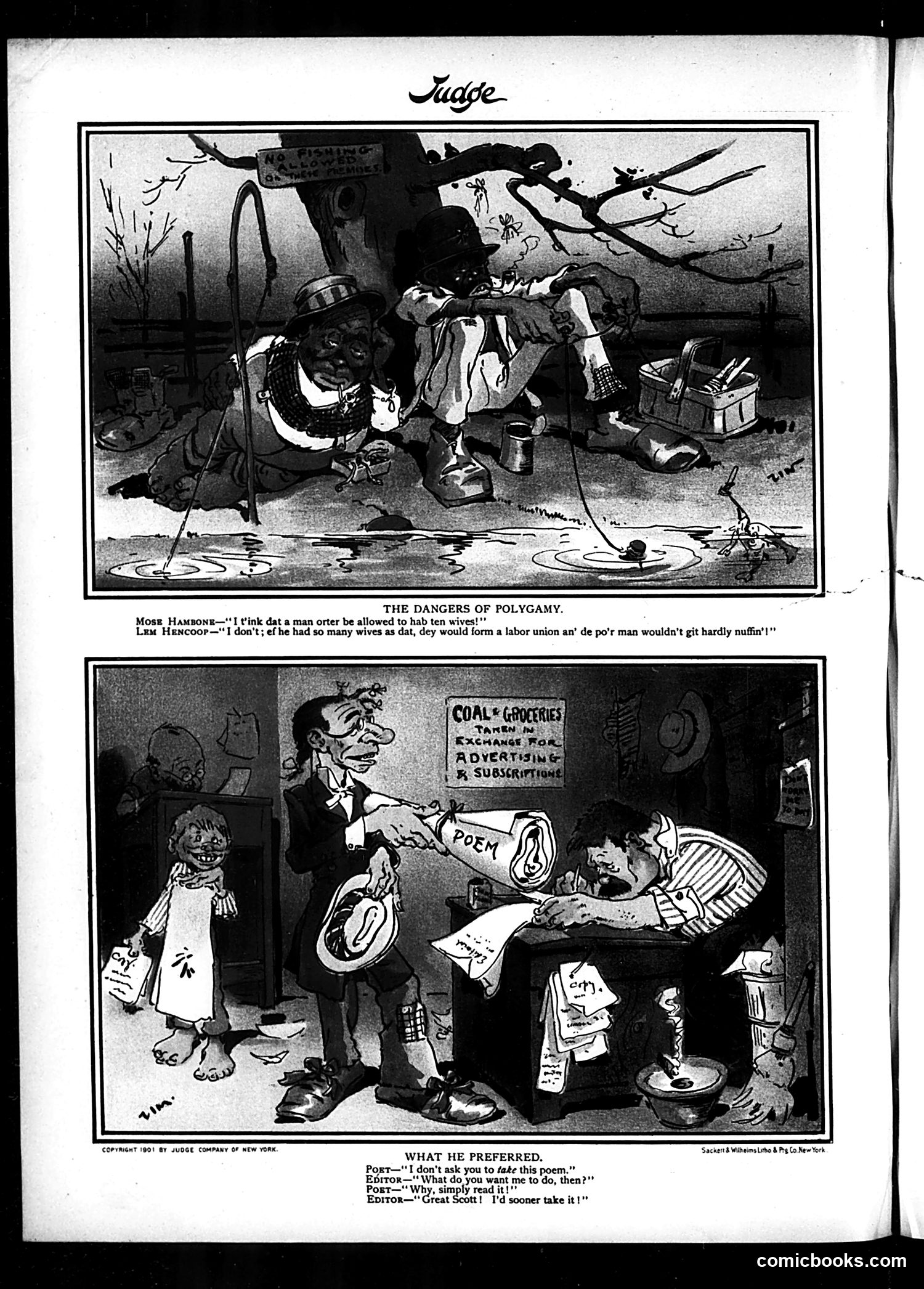
**Top cartoon ("The Dangers of Polygamy"):** Two working-class men—depicted with racist caricature—debate polygamy. One argues men should have ten wives; the other counters that multiple wives would unionize and demand fair treatment, leaving the poor man with nothing. The satire targets both polygamy (then a contemporary social concern) and labor unions, sarcastically suggesting unions are so effective they'd even exploit a husband. **Bottom cartoon ("What He Preferred"):** A poet approaches a newspaper editor, explicitly stating he doesn't want his poem *published*—only *read*. The editor, exasperated, jokes he'd "sooner take it" (accept rejection) than read it. This mocks poets who submit unsolicited work, suggesting the editor views reading bad poetry as worse punishment than rejection itself. Both reflect turn-of-century concerns: labor organizing and the glut of aspiring literary contributors submitting to publications.
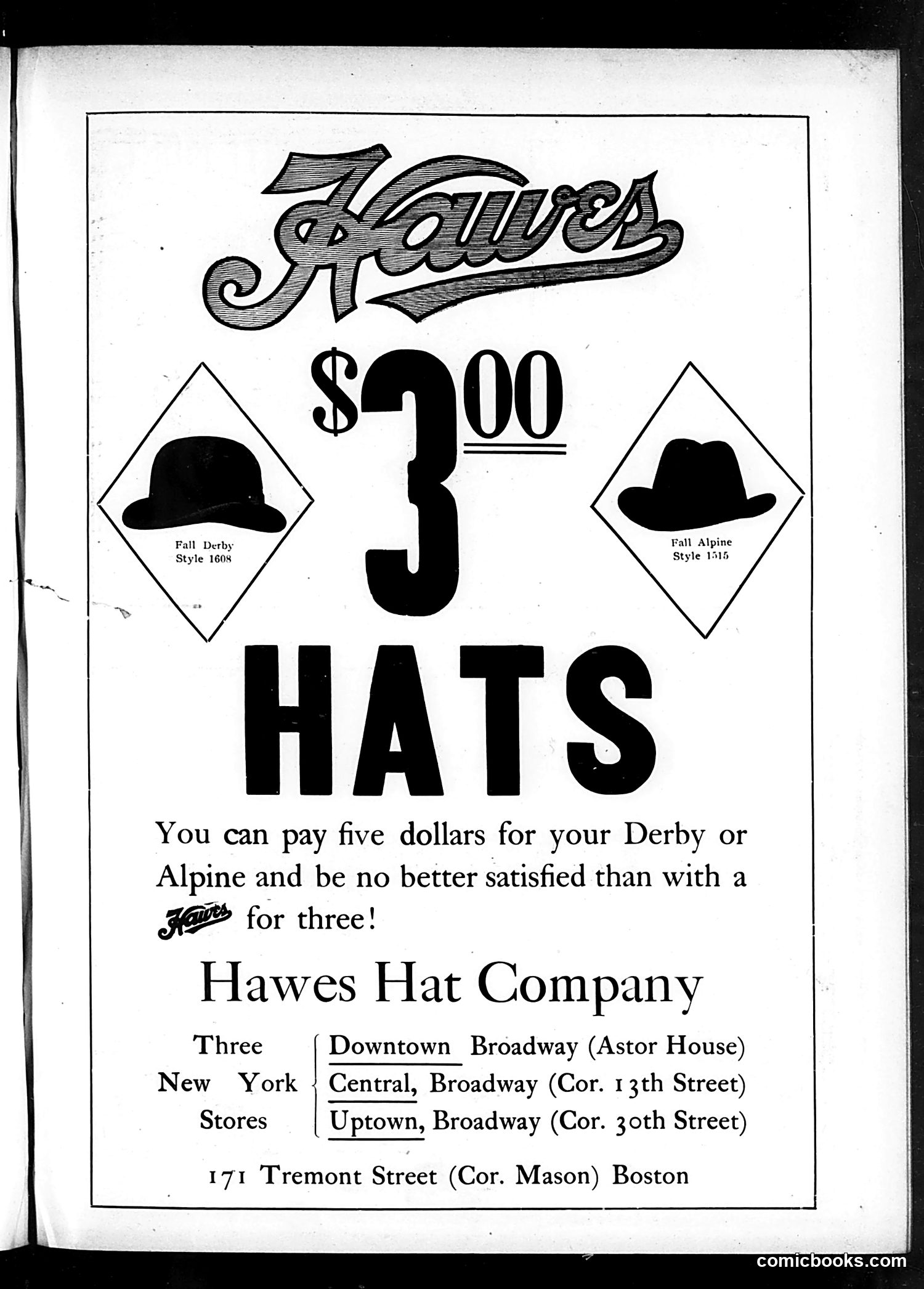
This is a **Hawes Hat Company advertisement**, not a political cartoon. It's a straightforward commercial promoting the company's "Haws" brand hats at $3.00—positioning them as superior value compared to competitor brands (Derby and Alpine styles) selling for $5.00. The ad uses two diamond-framed hat illustrations to showcase the Fall Derby (Style 1608) and Fall Alpine (Style 1515) styles. The sales pitch emphasizes quality parity at lower cost: paying five dollars for competitors yields no better satisfaction than buying Haws for three dollars. The ad lists three New York locations and one Boston store, typical of late 19th/early 20th-century hat retailer advertising. There is no satire or social commentary—merely price-based competitive positioning common to period retail advertising.
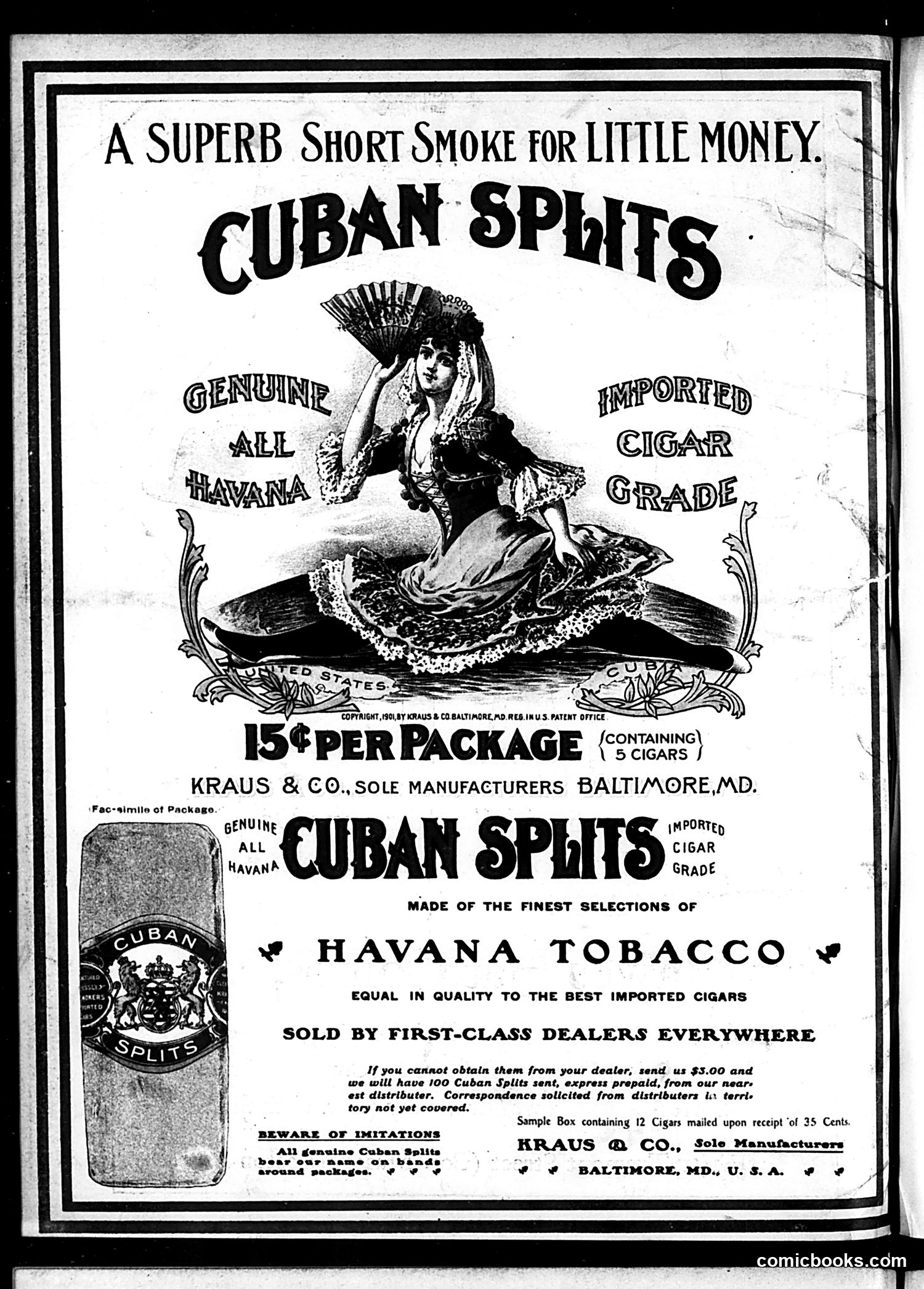
This is a **cigar advertisement**, not political satire. It promotes "Cuban Splits"—inexpensive cigars manufactured by Kraus & Co. in Baltimore, Maryland, priced at 15 cents per five-cigar package. The ad uses period imagery: a woman in Spanish/Cuban dress holding a fan, presented as exotic appeal for the product. The marketing emphasizes "Genuine All Havana" tobacco and claims quality "equal to the best imported cigars" while underselling them. Notable details for modern readers: the price point (15 cents in what appears to be early 1900s), the warning against counterfeits (suggesting a popular branded product), and the mail-order option ($3 for 100 cigars express-delivered). The advertisement ran in *Judge*, a satirical magazine, but this particular page is straightforward commercial content, not satire—typical of magazines' advertising revenue model.