
Judge, 1901-09-28 · page 5 of 20
Judge — September 28, 1901 — page 5: what you’re looking at
What you’re looking at
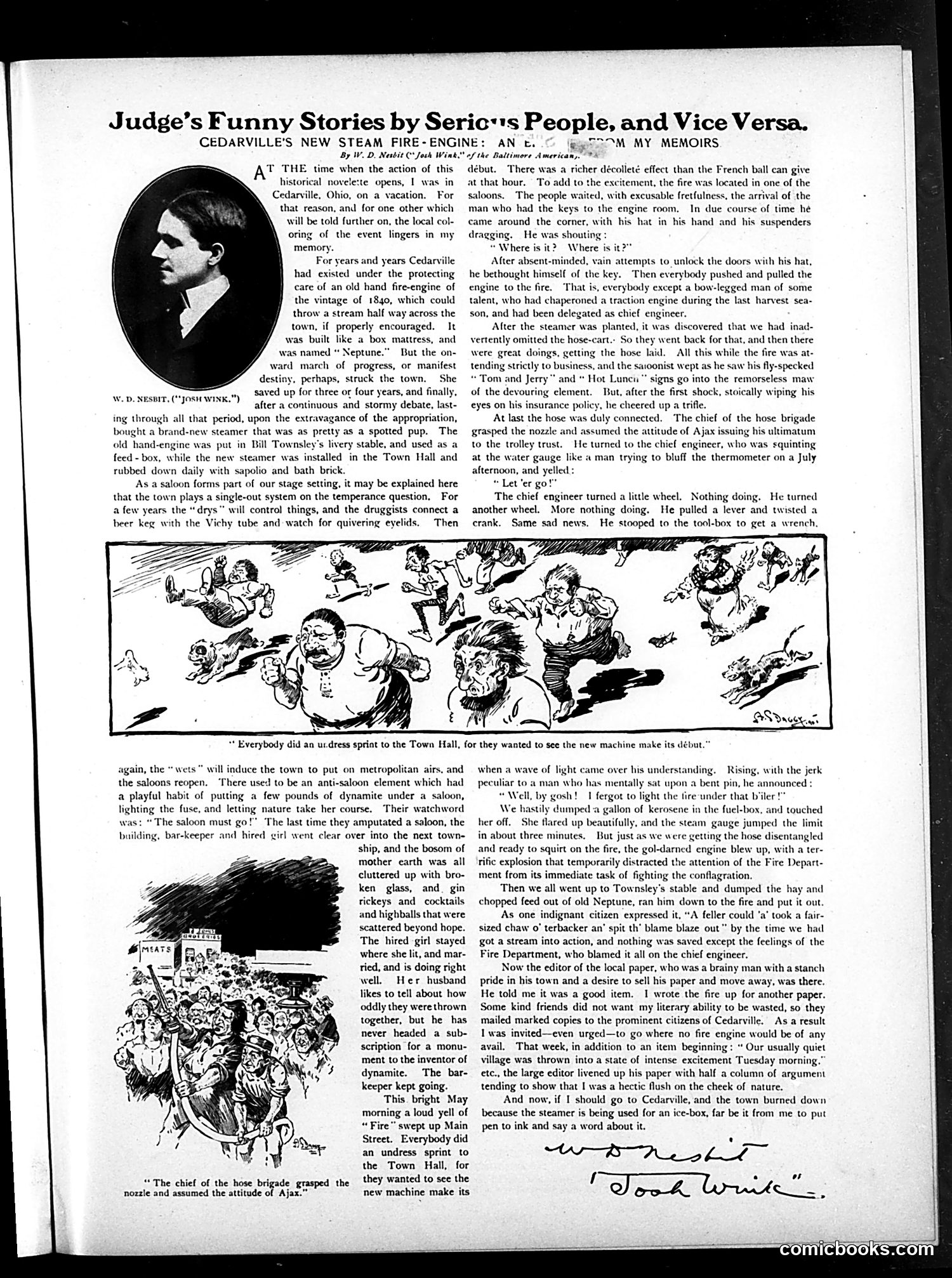
This humorous story satirizes small-town American life and technological progress. The narrative follows a rural Ohio town's purchase of a modern steam-powered fire engine to replace its antiquated hand-operated predecessor—itself a joke, as the old "Neptune" engine could barely function. The satire targets several points: the town's "temperance question" where prohibitionists literally blow up saloons with dynamite (presented matter-of-factly as normal civic discourse); bureaucratic incompetence (the key-holder arrives late, disheveled); and technological overconfidence (the new engine proves useless because they forgot the hose-cart). The accompanying cartoon depicts townspeople in frantic undress sprinting to witness the fire—suggesting both excitement over modernity and the scandalous exposure of semi-clothed citizens. The humor derives from contrasting civilizational "progress" with small-town disorganization and vice: dynamite saloon-busting treated as routine community improvement.
📄 Transcribed text from this page (OCR, searchable)
Machine-transcribed from the original scan — historical spelling and the odd misread are preserved.
Judge’s Funny Stories by Seric«'s People, and Vice Versa. CEDARVILLE’S NEW STEAM FIRE-ENGINE: AN ce @.7°7M MY MEMOIRS By W. D. Nesbit (Josh Wink." of the Baltimore American, *% T THE time when the action of this historical novele:te opens, I was in Cedarville, Ohio, on a vacation, For that reason, and for one other which will be told further on, the local col- oring of the event lingers in my memory. For years and years Cedarville had existed under the protecting care of an old hand fire-engine of the vintage of 1840, which could throw a stream half way across the town, if properly encouraged. It was built like a box mattress, and was named “ Neptune.” But the on- ward march of progress, or manifest destiny, perhaps, struck the town, She saved up for three or four years, and finally, after a continuous and stormy debate, last- ing through all that period, upon the extravagance of the appropriation, bought a brand-new steamer that was as pretty as a spotted pup. The old hand-engine was put in Bill Townsley’s livery stable, and used as a feed - box, while the new steamer was installed in the Town Hall and rubbed down daily with sapolio and bath brick. As a saloon forms part of our stage setting, it may be explained here that the town plays a single-out system on the temperance question, For a few years the “drys” will control things, and the druggists connect a beer keg with the Vichy tube and-watch for quivering eyelids, Then W. D. NESBIT, (“JOSH WINK") again, the “wets” will induce the town to put on metropolitan airs, and the saloons reopen. There used to be an anti-saloon element which had a playful habit of putting a few pounds of dynamite under a saloon, lighting the fuse, and letting nature take her course. Their watchword was: “The saloon must go!" The last time they amputated a saloon, the building, bar-keeper and hired girl went clear over into the next town- ship, and the bosom of mother earth was all cluttered up with bro- ken glass, and. gin rickeys and cocktails and highballs that were scattered beyond hope. The hired girl stayed where she lit, and mar- ried, and is doing right well. Her husband likes to tell about how oddly they were thrown together, but he has never headed a sub- scription for a monu- ment to the inventor of dynamite. The bar- keeper kept going. This. bright May morning a loud yell of “ Fire” swept up Main Street. Everybody did an undress sprint to the Town Hall, for they wanted to see the new machine make its “The chief of the hose brigade grasped the nozzle and assumed the attitude of Ajax.” “ Everybody did an ut.dress sprint to the Town Hall, for they wanted to see the new machine make its « début. There w a richer décolleté effect than the French ball can give at that hour. To add to the excitement, the fire was located in one of the saloons. The people waited, with excusable fretfulness, the arrival of the man who had the keys to the engine room, In due course of time hé came around the corner, with his hat in his hand and his suspenders dragging. He was shouting : Where is it? Where is it?” After absent-minded, vain attempts to unlock the doors with his hat, he bethought himself of the key. Then everybody pushed and pulled the engine to the fire, That is, everybody except a bow-legged man of some talent, who had chaperoned a traction engine during the last harvest sea- son, and had been delegated as chi Alter the steamer was planted, it was discovered that we had inad- vertently omitted the hose-cart.» So they went back for tha were great doings, getting the hose laid. tending strictly to business, and the saoonist wept as he saw his fly-specked “Tom and Jerry” and * Hot Luncu ” signs go into the remorseless maw of the devouring element. But, after the first shock, stoically wiping his eyes on his insurance policy, he cheered up a trifle. At last the hose was duly connected. ‘The chief of the hose brigade grasped the nozzle and assumed the attitude of Ajax issuing his ultimatum to the trolley trust. He turned to the chief engineer, who was squinting at the water gauge like a man trying to bluff the thermometer on a July afternoon, and yelled : * Let ‘er go!” The chief engineer turned a little wheel. another wheel. More nothing doing. crank. Same sad news. nd then there All this while the fire was at- Nothing doing, He turned He pulled a lever and twisted a He stooped to the tool-box to get a wrench, when a wave of light came over his understanding. Rising, with the jerk peculiar to a man who has mentally sat upon a bent pin, he announced : Well, by gosh! 1 fergot to light the fire-under that biiler !” We hastily dumped a gallon of kerosene in the fuel-box, her off. She flared up beautifully, and the steam gauge jumped the limit in about three minutes. But just as we were getting the hose disentangled and ready to squirt on the fire, the gol-darned engine blew up, with a ter- rific explosion that temporarily distracted the attention of the Fire Depart- ment from its immediate task of fighting the conflagration. Then we all went up to Townsley’s stable and dumped the hay and chopped feed out of old Neptune, ran him down to the fire and put it out. As one indignant citizen expressed it, “A feller could ‘a’ took a fair- sized chaw o' terbacker an’ spit th’ blame blaze out” by the time we had got a stream into action, and nothing was saved except the feelings of the Fire Department, who blamed it all on the chief engineer. Now the editor of the local paper, who was a brainy man with a stanch pride in his town and a desire to sell his paper and move away, was there. He told me it was a good item. I wrote the fire up for another paper. Some kind friends did not want my literary ability to be wasted, so they mailed marked copies to the prominent citizens of Cedarville. As a result Iwas invited—even urged—to go where no fire engine would be of any avail. ‘That week, in addition to an item beginning : “ Our usually quiet village was thrown into a state of intense excitement Tuesday morning.” etc., the large editor livened up his paper with half a column of argument tending to show that I was a hectic flush on the check of nature. And now, if I should go to Cedarville, and the town burned down because the steamer is being used for an ice-box, far be it from me to put pen to ink and say a word about it. nd touched