
A complete issue · 16 pages · 1901
Judge — July 20, 1901
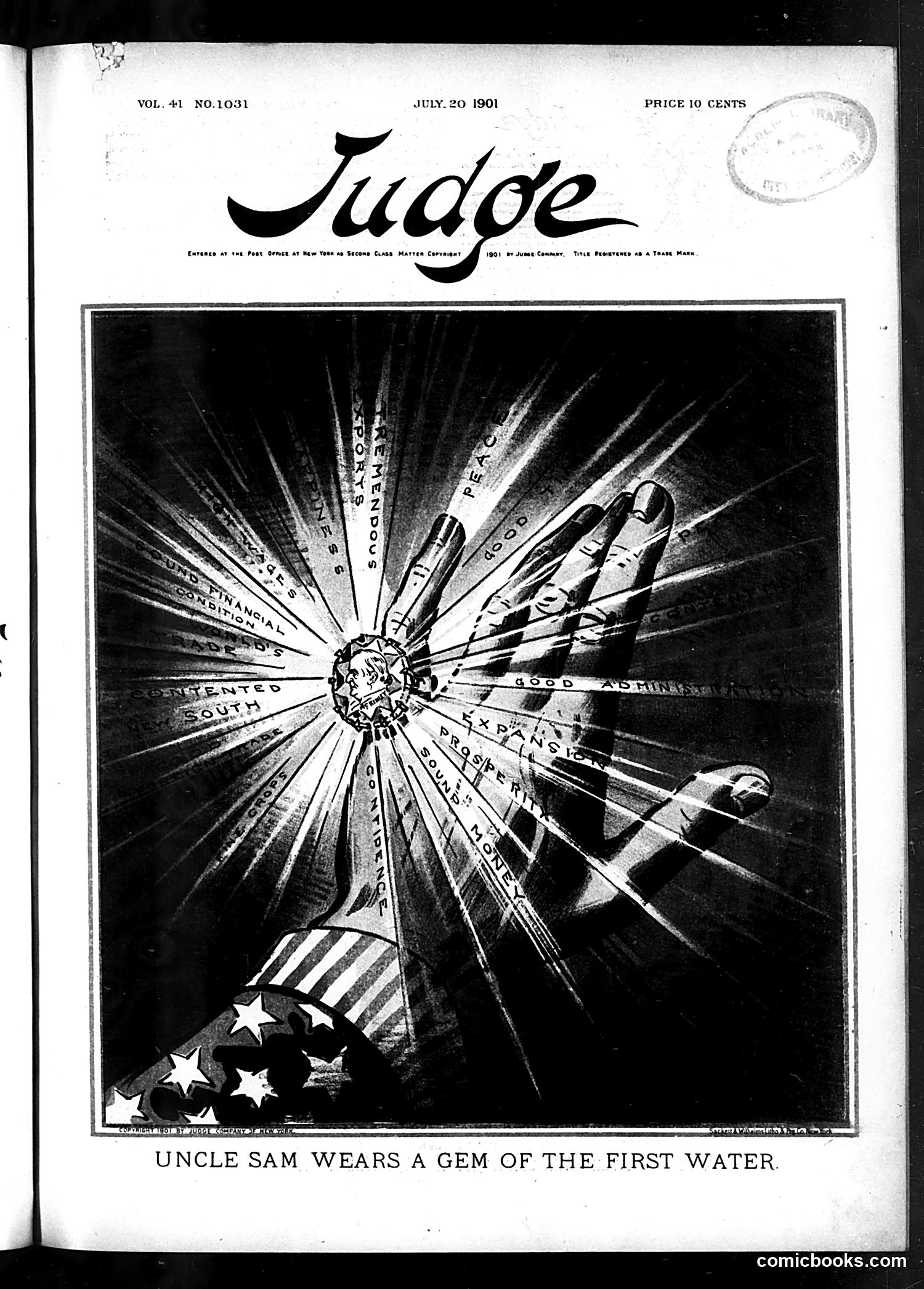
This political cartoon depicts **Uncle Sam** (identifiable by his star-spangled clothing and top hat, shown at bottom left) surrounded by radiating lines like a sun or explosion. The lines extend outward as various military vessels or warships, each labeled with different regions or concepts. The caption reads "Uncle Sam Wears a Gem of the First Water," suggesting the vessels represent America's naval power as a precious jewel. The visible text on some vessels includes references to geographic areas and military/political concepts, indicating this satirizes **American imperial expansion** at the turn of the 20th century—likely referencing U.S. military interventions and naval dominance during the Spanish-American War era (1898) and its immediate aftermath.
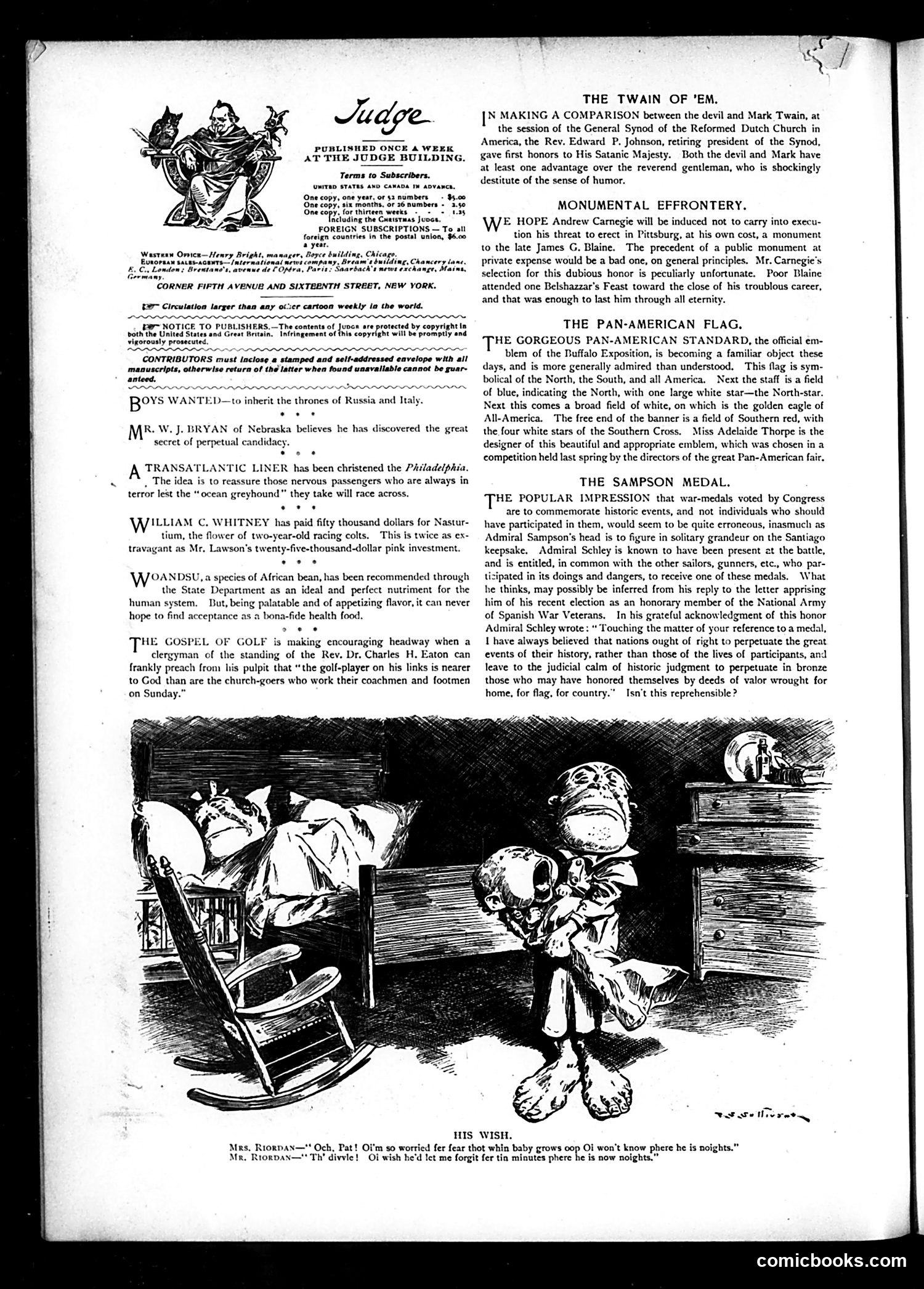
This page contains several brief satirical items rather than a single cartoon. "The Twain of 'Em" compares the devil and Mark Twain, suggesting both share a sense of humor. "Monumental Effrontery" mocks Andrew Carnegie's proposed Pittsburg monument to James G. Blaine as wasteful self-aggrandizement. "The Pan-American Flag" describes a new official standard for the Pan-American Exposition. "The Sampson Medal" critiques awarding war medals to individuals rather than commemorating events, questioning whether Admiral Sampson deserves one. The bottom illustration titled "His Wish" shows a man in a rocking chair with a small child, with the caption expressing anxiety about the child's future whereabouts—typical domestic humor of the era. The page mixes political commentary with lighter social satire.
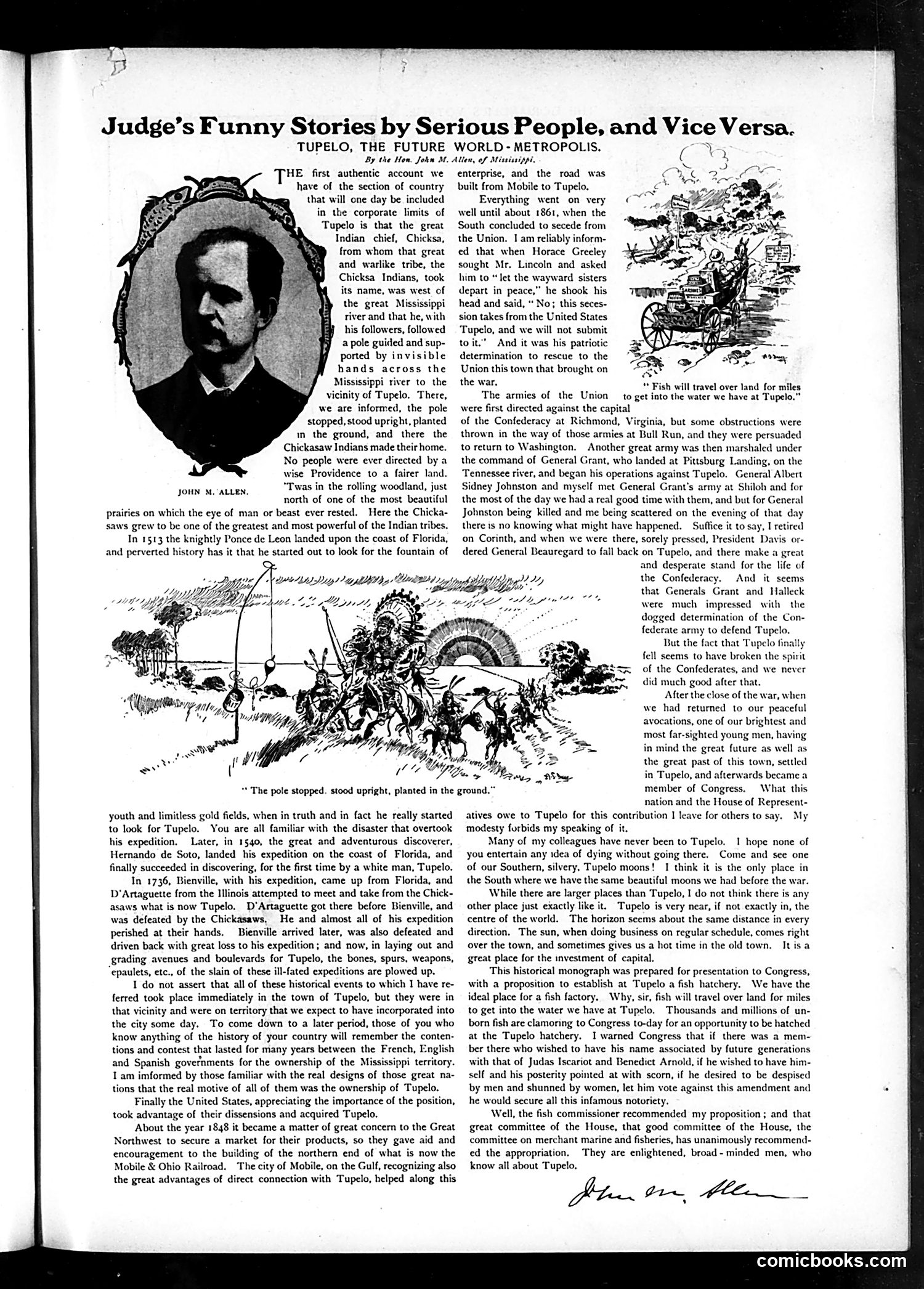
This page features an article by Hon. John M. Allen of Mississippi about Tupelo as a future metropolis. The text is largely a historical narrative about Tupelo, Mississippi—discussing Native American settlement (Chief Chickasaw), Civil War military campaigns, and post-war development prospects. The two illustrations are **not political cartoons** but rather sketches supporting the article: one shows a portrait of John M. Allen himself, and another depicts a scene of pioneers with a surveying pole, illustrating the town's frontier origins. The article's "satire" is gentle—Allen presents Tupelo's modest present with grandiose predictions of future greatness, proposing ambitious projects like a fish hatchery. The humor lies in the contrast between the town's actual significance and Allen's earnest boosterism about its potential as a major commercial center.
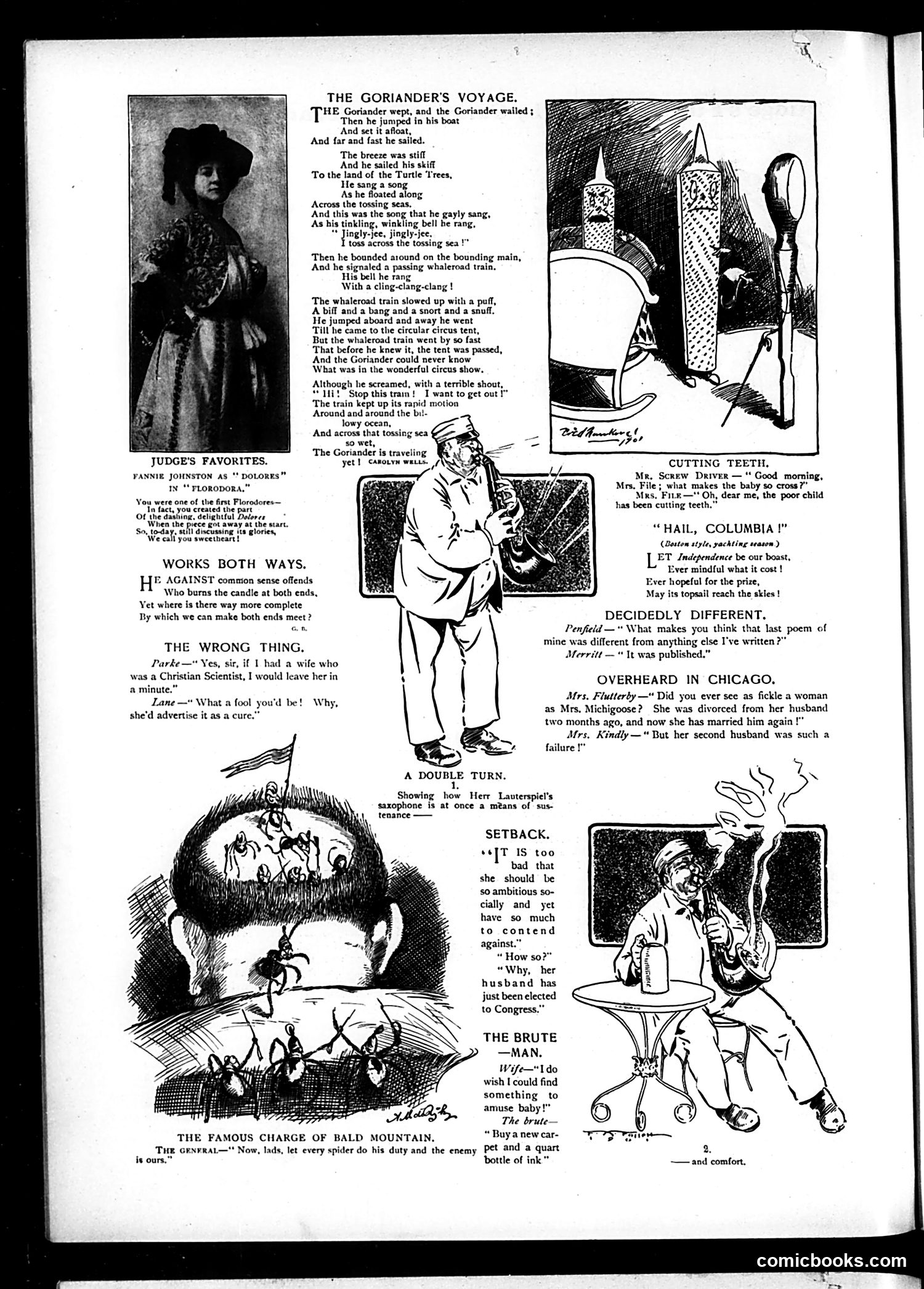
This page contains several unrelated satirical pieces and jokes typical of Judge magazine's format: **"The Goriander's Voyage"** is a whimsical poem about a character traveling by whaleroad train, illustrated with abstract imagery. **"Judge's Favorites"** features Fannie Johnson as "Dolores" in what appears to be theatrical content. **"The Wrong Thing"** and **"Works Both Ways"** are brief joke exchanges about Christian Science and common sense. **"A Double Turn"** and several other items present short humorous dialogues about marriage, ambition, and domesticity—likely satirizing contemporary social attitudes. **"The Famous Charge of Bald Mountain"** shows a military figure commanding spiders. The page lacks clear political commentary; instead, it emphasizes domestic humor, theatrical references, and absurdist comedy typical of early 20th-century American humor magazines.
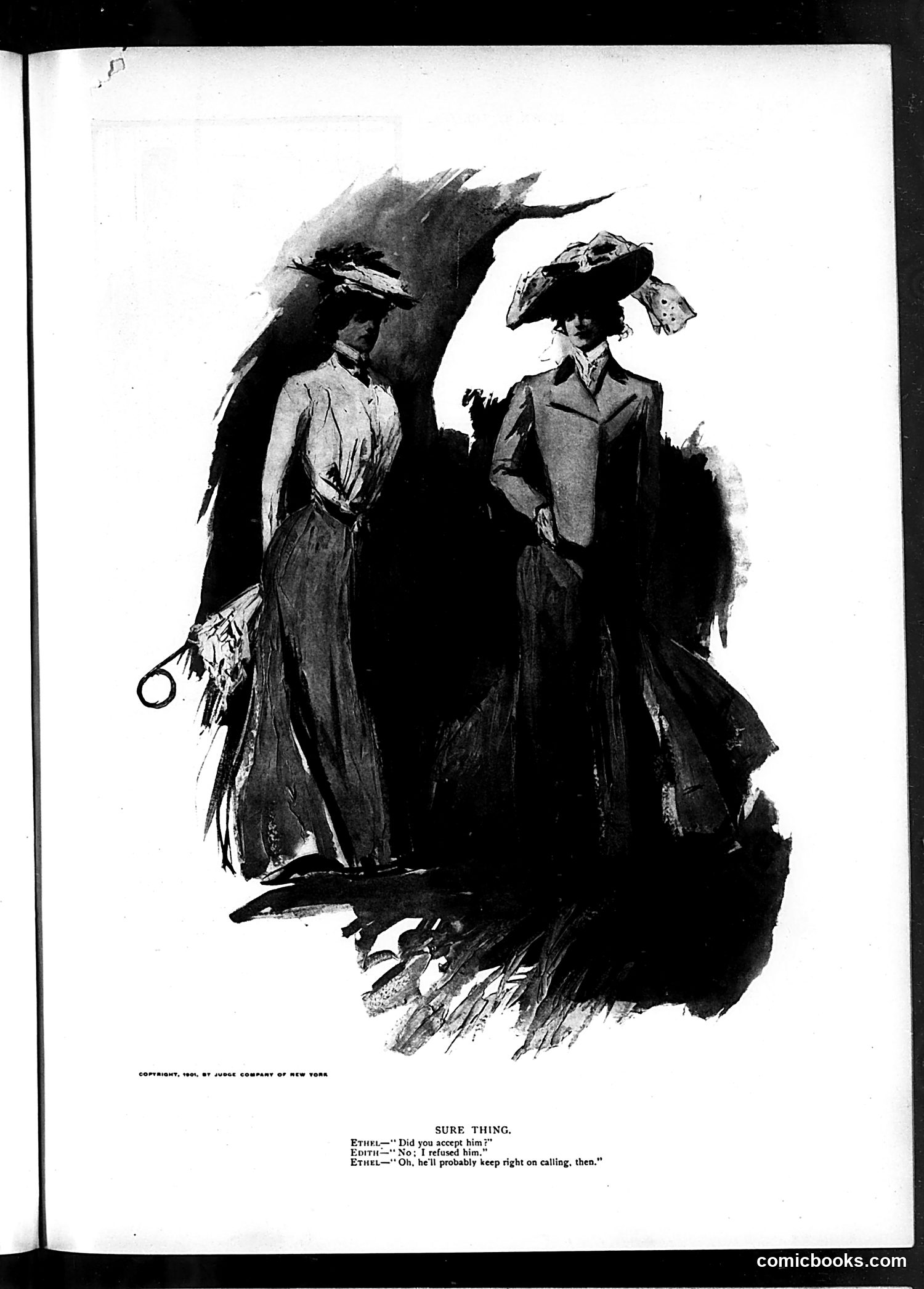
This is a satirical commentary on courtship persistence. Two fashionably dressed women discuss a suitor's proposal. When one reveals she refused him, the other responds that he'll "probably keep right on calling, then" — implying the man won't accept rejection and will continue pursuing despite being refused. The joke mocks persistent, unwanted romantic advances and the social expectation that men should relentlessly pursue women regardless of explicit rejection. It's satire on both male entitlement in courtship and the awkward social dynamics of the era, where a woman's "no" wasn't necessarily treated as final. The elaborate period clothing and sketchy illustration style are typical of Judge's early-20th-century satirical approach to social commentary.
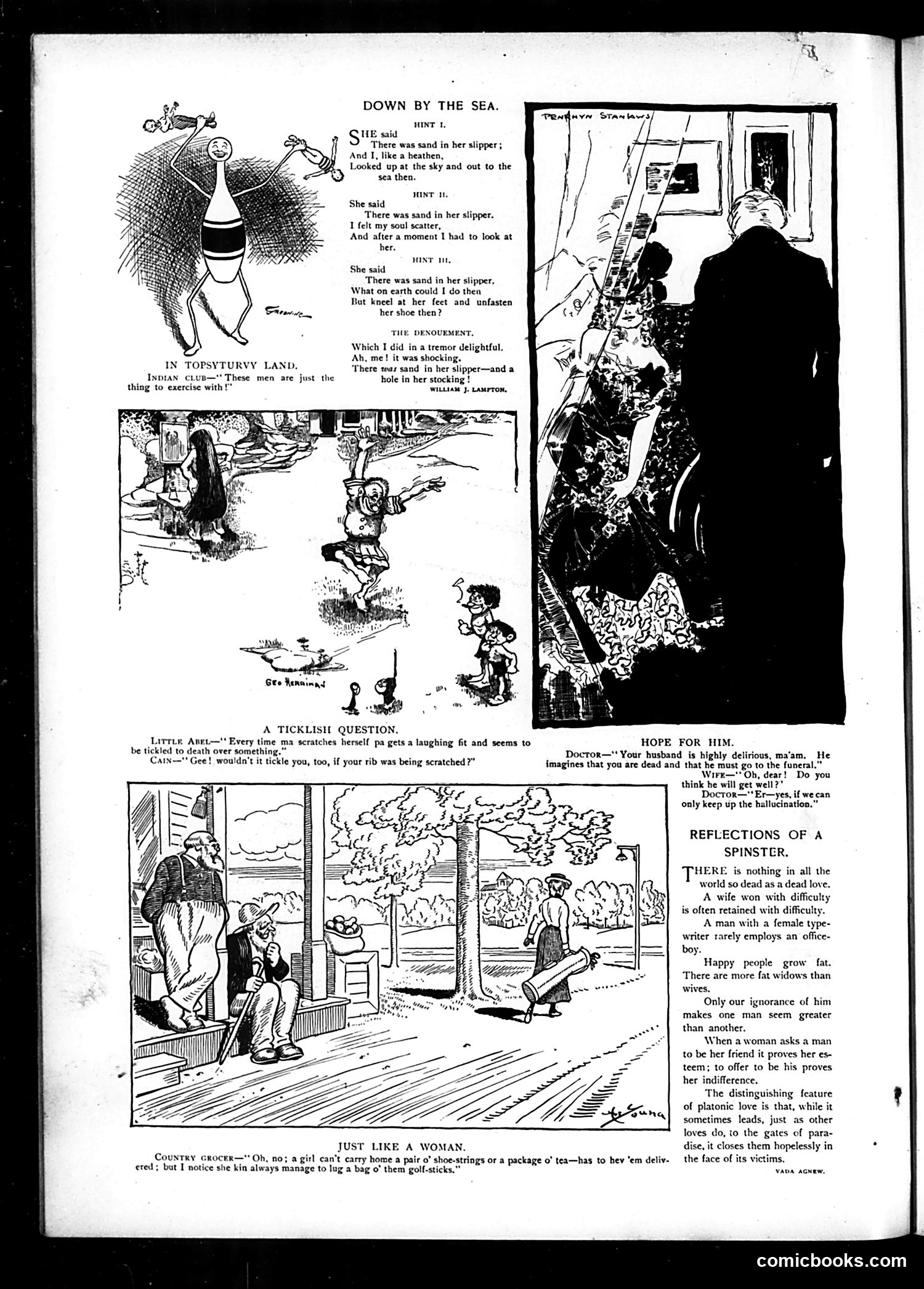
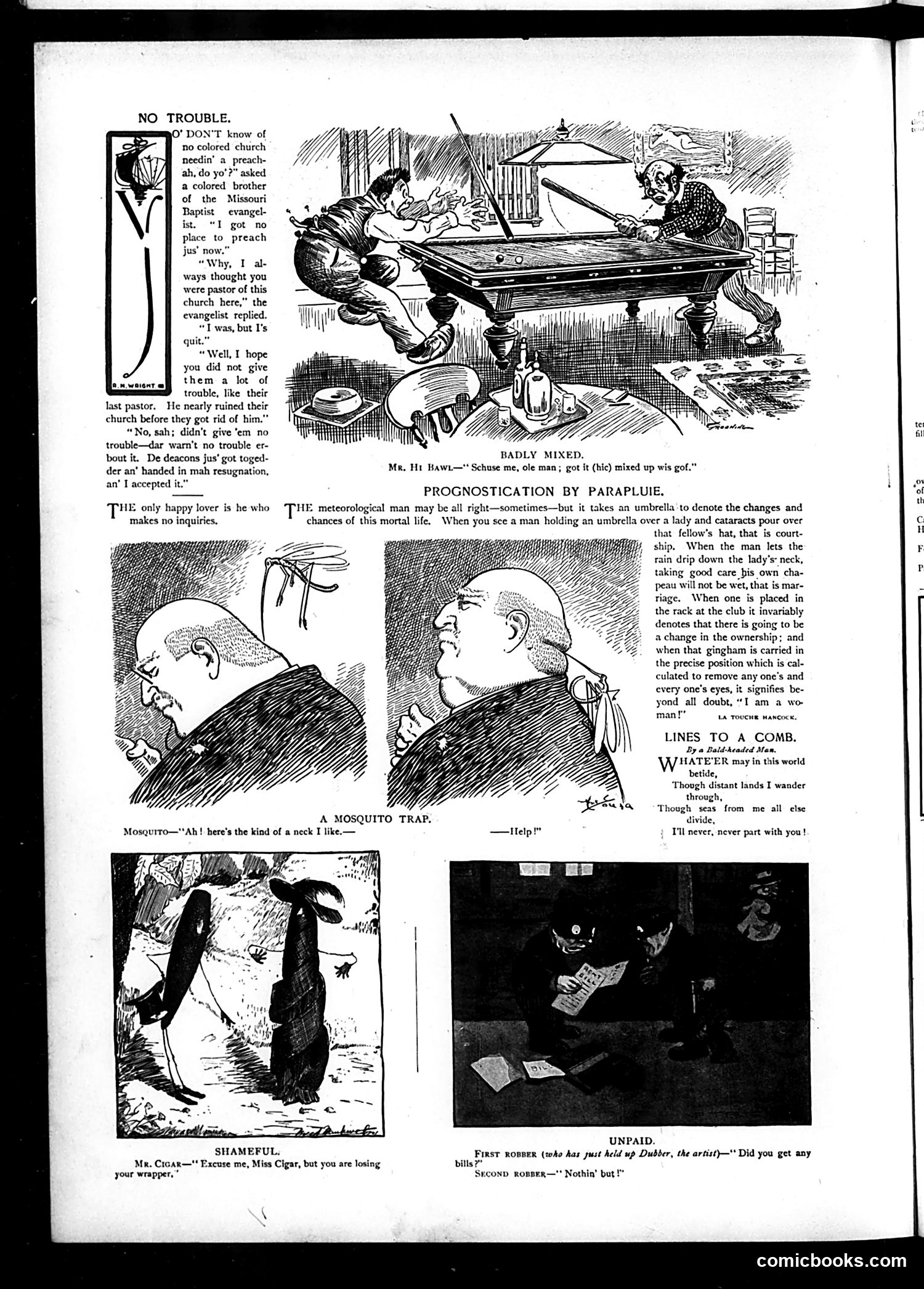
This page contains multiple satirical pieces typical of early 20th-century American humor: **"Down by the Sea"** is romantic verse with a twist—a man's poetic moment discovering sand in a woman's slipper is ruined when he also finds a hole in her stocking, deflating romantic sentiment with practical reality. **"In Topsyturvy Land"** appears to be visual absurdist humor about using Indian clubs (exercise equipment) as people. **"A Ticklish Question"** jokes about a child scratching herself causing her father laughter—implying the father finds it amusing rather than concerning. **"Hope for Him"** depicts a wife believing her husband is dying, with a doctor maintaining a "hallucination" keeping him alive—dark humor about marriages. **"Just Like a Woman"** presents a grocer's observation that women claim they can't carry small parcels but manage to transport golf clubs—poking fun at perceived female inconsistency or selective helplessness. **"Reflections of a Spinster"** offers cynical observations about love, marriage, and gender relations, suggesting platonic love's futility. The humor reflects period attitudes toward gender and relationships through exaggeration and irony.
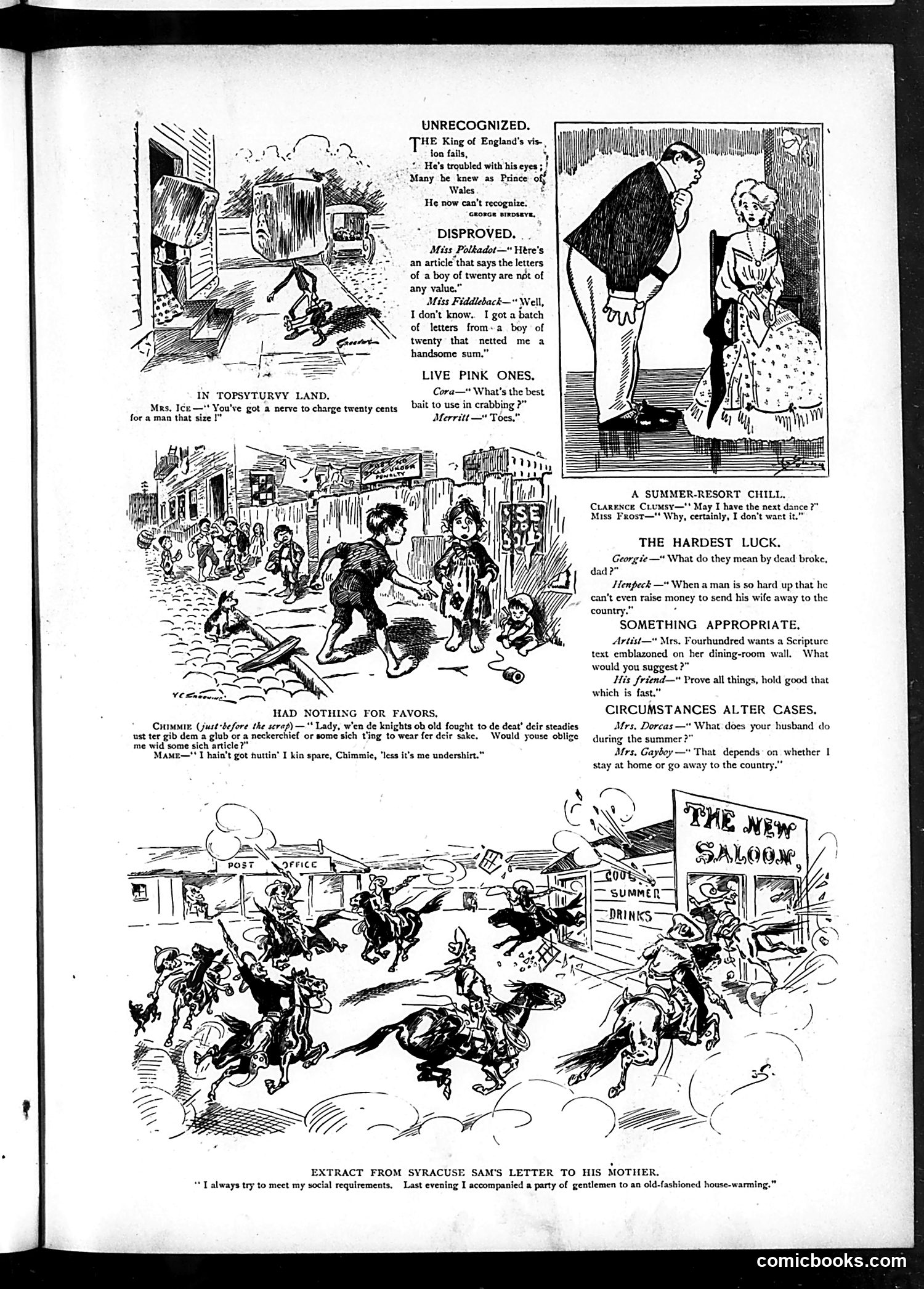
This page contains multiple short satirical humor pieces typical of early 20th-century American comedy magazines: **"Unrecognized"** mocks the King of England's failing eyesight, suggesting he can't recognize people he once knew as Prince of Wales—topical humor about aging royalty. **"Disproved"** plays on the double meaning of "letters" (correspondence vs. literary worth)—a young woman reveals love letters from a boy of twenty earned her money, contradicting an article claiming such letters have no value. **"Live Pink Ones"** and other brief exchanges are simple puns and wordplay jokes about daily life. **"The Hardest Luck"** satirizes henpecked husbands: being "dead broke" means being so financially trapped you can't even afford to send your nagging wife away for the summer—a common comedic trope. **"Something Appropriate"** jokes about wealthy people's pretensions: a rich woman wants scripture on her wall, and the artist sarcastically suggests "Prove all things, hold good that which is fast"—mocking ostentatious religiosity. The large cartoon depicts a chaotic Western saloon scene, illustrating Syracuse Sam's claim about attending a "house-warming" party—visual comedy showing drunken mayhem.
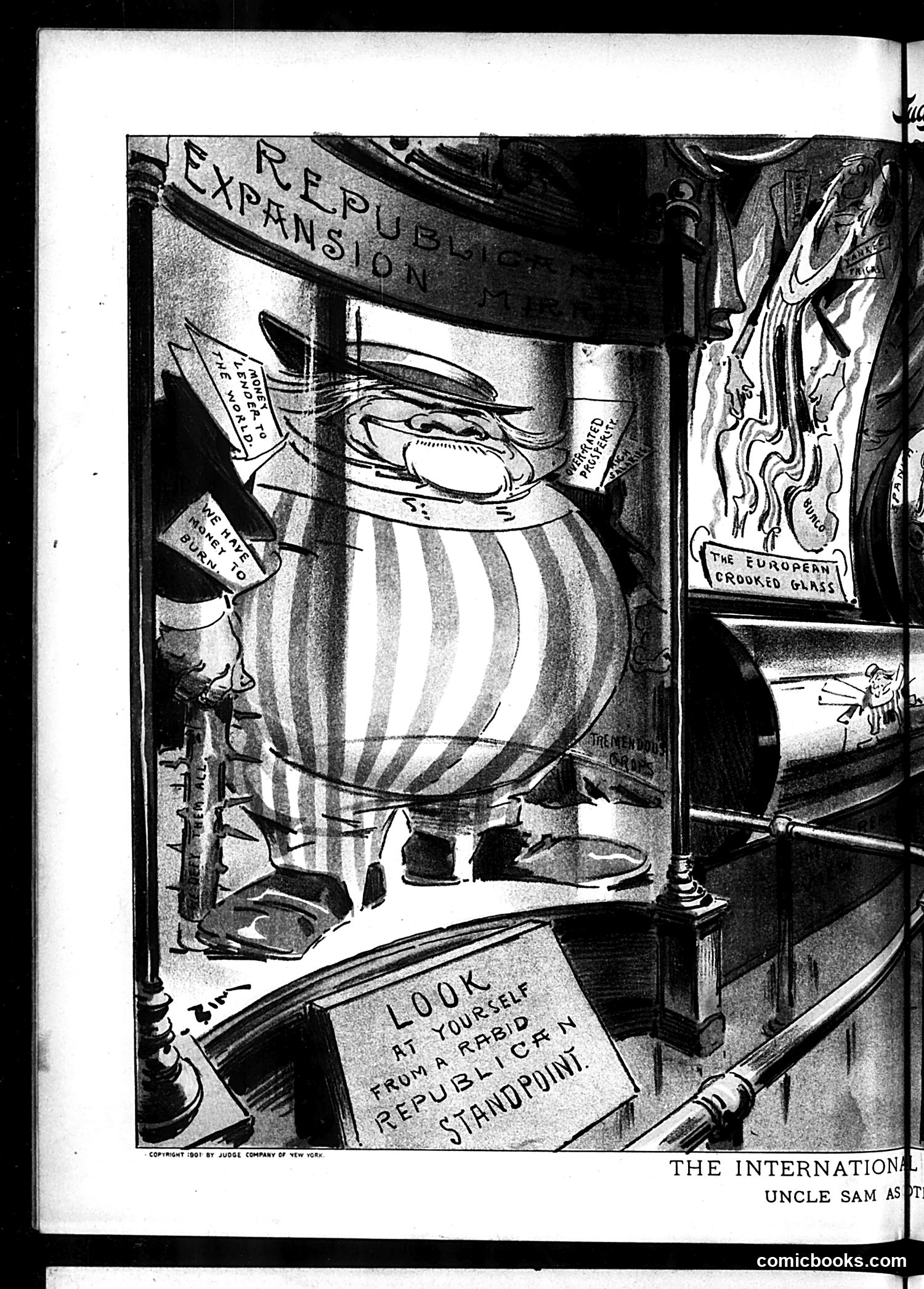
This appears to be a Judge magazine political cartoon titled "The International Uncle Sam." The central figure is Uncle Sam (identifiable by his striped pants and characteristic appearance), depicted as a large, rotund figure labeled "EXPANSION" at the top. The cartoon satirizes American imperial ambitions and overseas expansion. Labels visible include references to "The European Crooked Glass" and a note reading "Look at yourself from a Republican Standpoint," suggesting criticism of Republican expansionist policies. Various territories or colonial possessions appear to surround Uncle Sam, depicted as burdens or acquisitions. The satire appears to mock American foreign policy expansion and imperialism of the era, likely from the early 1900s based on the style and OCR date reference. The exact copyright date and specific territories referenced are unclear from the degraded image quality.
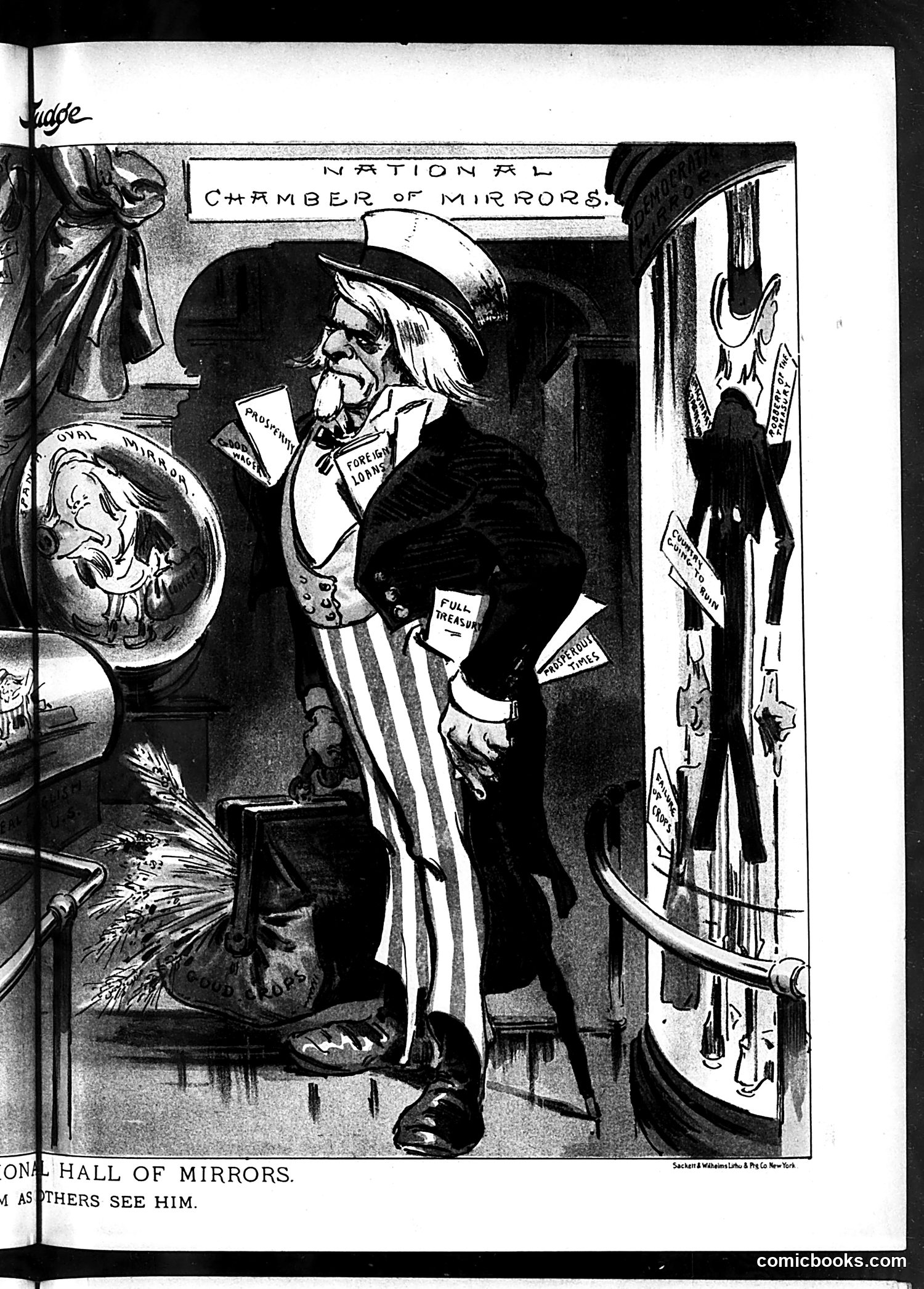
This satirical cartoon depicts a figure (appearing to be a political leader) in a "Hall of Mirrors" — a classic metaphor for distorted self-perception and deception. The central caricatured character wears a striped suit and examines various mirrors reflecting different images of himself, labeled with phrases like "Foreign Lord" and "Full Treasure." The title suggests the cartoon critiques how political figures present different versions of themselves to different audiences — their public personas versus reality. The mirrors show conflicting reflections, implying hypocrisy or contradiction between what the figure claims to be and what others actually see. The ornate chamber setting and elaborate framing emphasize the artificiality and constructed nature of political image-making. This appears to be commentary on political dishonesty or the gap between public relations and truth, a common Judge magazine satirical theme.
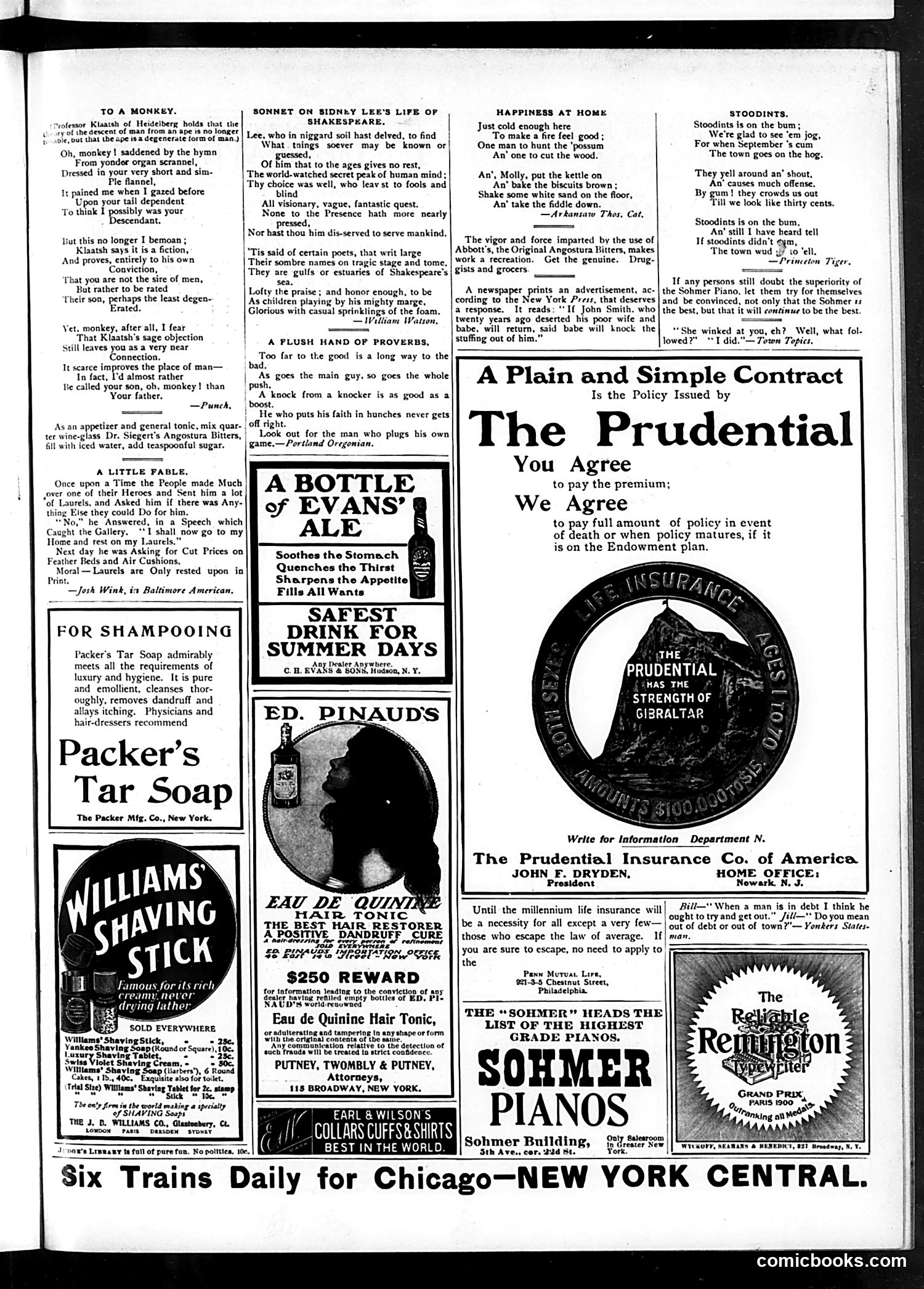
This page is primarily **advertising**, with brief literary and satirical content interspersed. The main cartoon/editorial piece is "To a Monkey," which satirizes Professor Klaatsch of Heidelberg's theory that apes are degenerate humans rather than human ancestors. The joke inverts Darwin's evolution: if apes descended from men, the speaker would rather be called the monkey's son than father—suggesting both theories are equally absurd. "A Little Fable" mocks public heroes who receive laurels and accolades, then immediately ask for mundane favors like discounts on feather beds. It satirizes how quickly celebrated public figures abandon dignity to pursue self-interest. The remainder comprises advertisements for consumer products (Evans' Ale, Packer's Tar Soap, Williams Shaving Stick, Pinaud's Hair Tonic, Sohmer Pianos, Remington typewriters, and Prudential Insurance), reflecting typical Judge magazine monetization circa early 1900s.
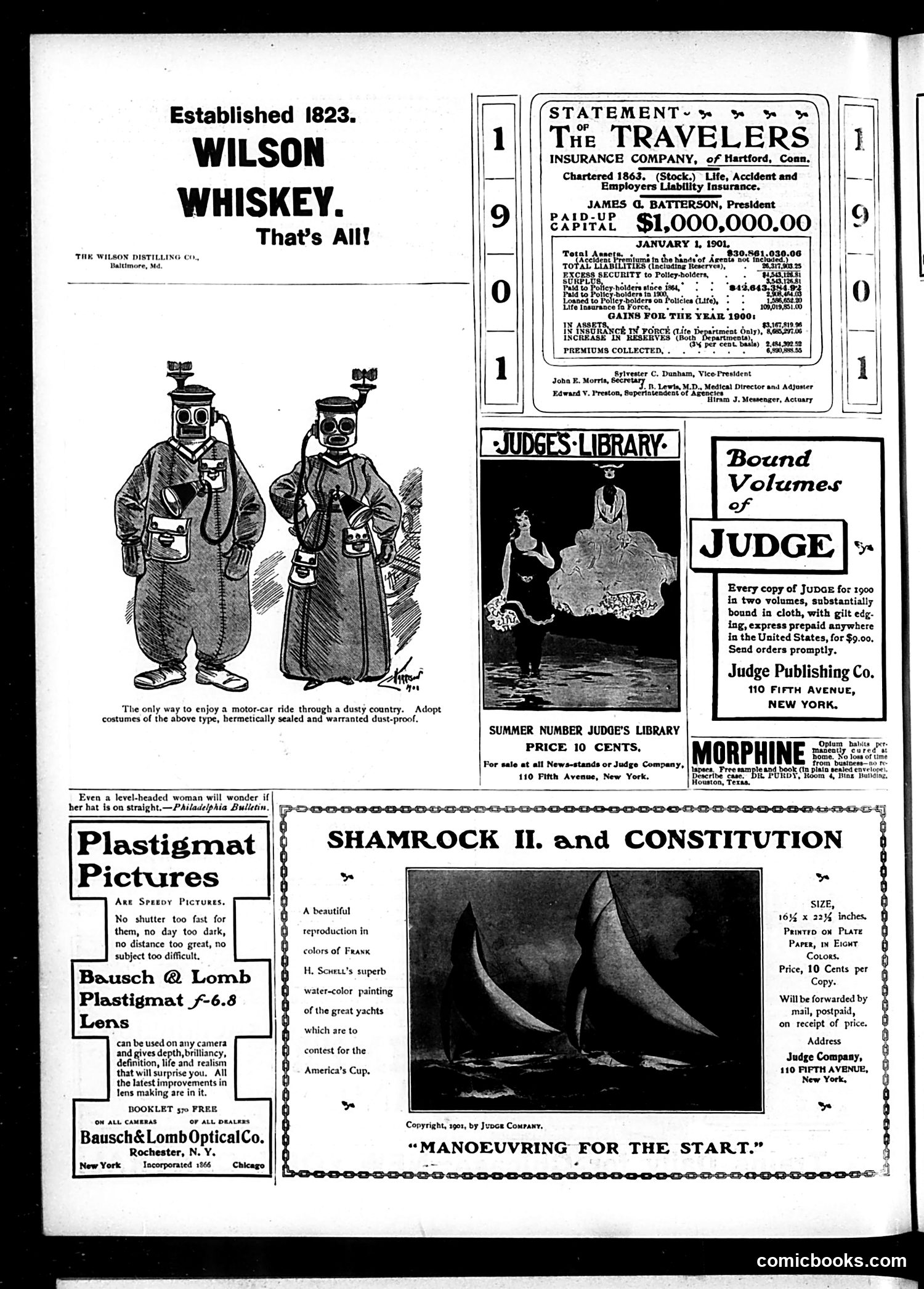
This page is primarily **advertising and financial statements** rather than political satire. The main content includes: 1. **Wilson Whiskey advertisement** (top left): A humorous ad showing two figures in hermetically sealed, dust-proof costumes for motor-car rides through dusty country—a joke about early automobiles and the dust they kicked up on unpaved roads. 2. **Travelers Insurance Company statement** (top right): A formal financial disclosure dated January 1, 1901, listing assets and gains, representing legitimate corporate advertising. 3. **Shamrock II and Constitution illustration** (center): A reproduction of H. Scutt's water-color painting depicting two racing yachts, likely referencing the America's Cup competition. 4. **Various product advertisements**: Judge's Library volumes, Morphine products, Bausch & Lomb camera lenses, and Plastigmat Pictures equipment. The page lacks significant political or social satire—it's essentially a **commercial issue dominated by advertisements and business notices** typical of early 1900s periodicals.
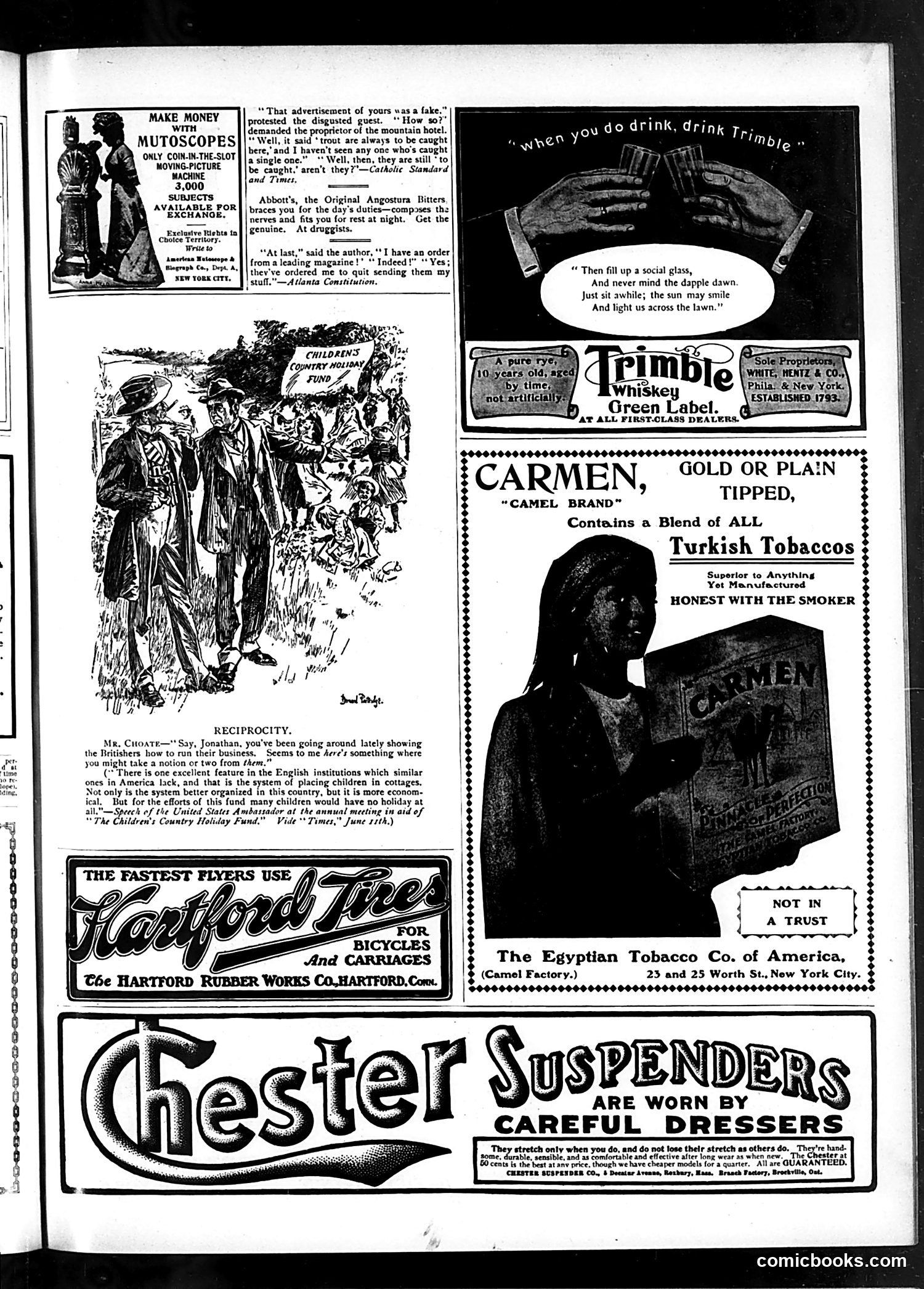
This page from *Judge* magazine contains primarily **advertisements** interspersed with several short humorous pieces. The main cartoon depicts "Reciprocity"—a political joke about U.S. Ambassador Choate lecturing the British on business, while Americans lag behind in child welfare. The humor criticizes American hypocrisy: we give advice abroad while our own institutions are inferior. Other brief jokes include: - A hotel proprietor's word-game defense ("trout are *to be* caught") - An author's rejection slip being framed as a success The advertisements are period-typical: Mutoscope machines (early coin-operated moving pictures), Trimble Whiskey, Carmen Turkish tobacco, Hartford bicycle tires, and Chester Suspenders. Notably, the Carmen tobacco ad emphasizes it's "NOT IN A TRUST"—reflecting early-1900s antitrust concerns following Standard Oil scandals. The page offers snapshot of Edwardian commercial culture alongside political satire.
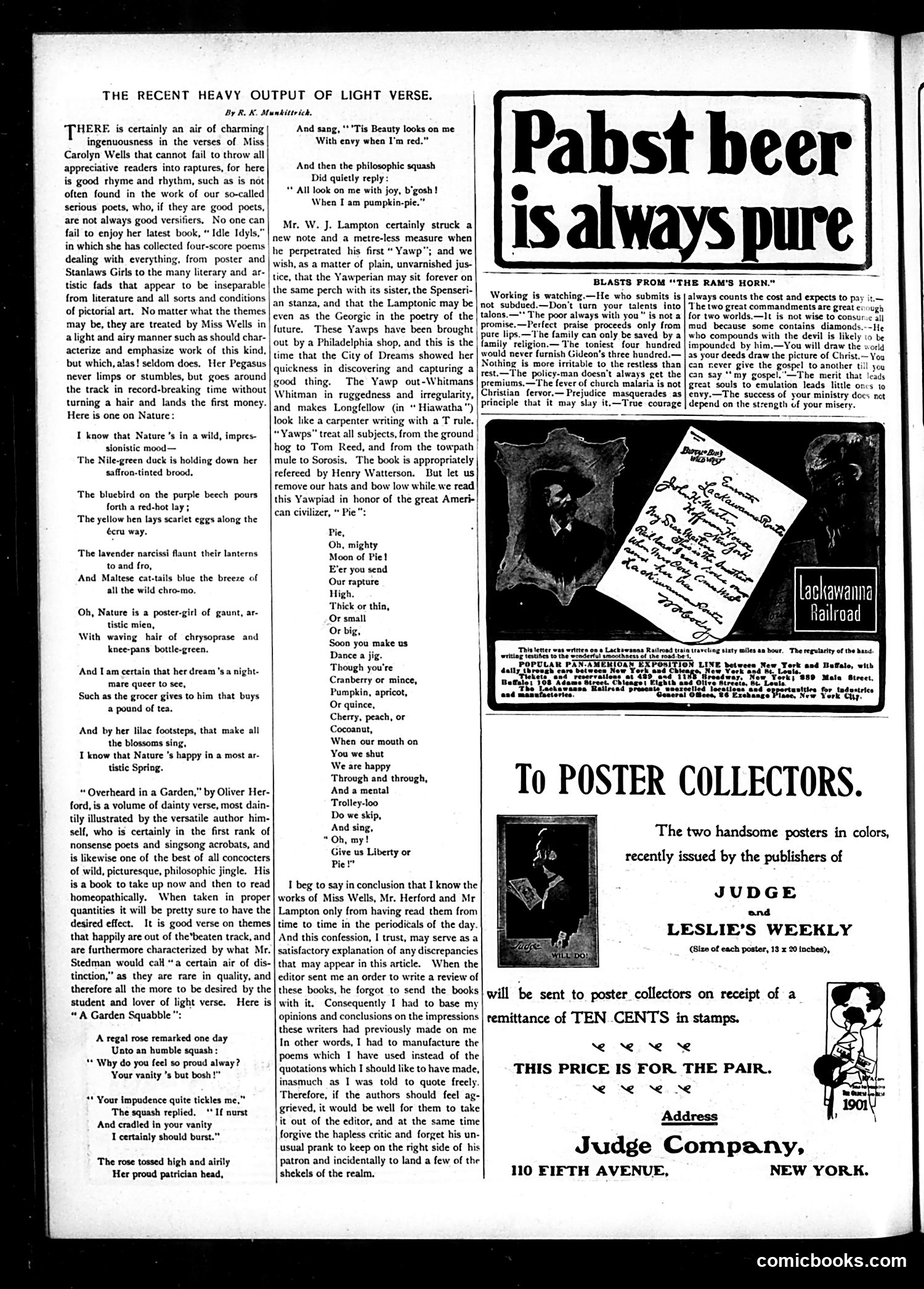
This page is primarily a **literary review** of contemporary light verse collections, not a political cartoon. The author critiques three poets—Carolyn Wells, Oliver Herford, and W.J. Lampton—praising their whimsical, accessible poetry. The satire is **literary-focused**: the review mocks contemporary aesthetic trends by having Wells's nature poem deliberately employ clashing, artificial colors ("saffron-tinted," "purple beech," "red-hot lay," "bottle-green")—a humorous jab at the era's decorative "poster art" aesthetic and Impressionistic affectations in high art circles. The referenced "Stanlaws Girls" and "poster-girl" comparisons suggest light verse was increasingly influenced by commercial advertising illustration—a somewhat trashy cultural trend for serious literature. The review celebrates these poets for writing *technically competent* verse that avoids the self-important pretension of "serious" poets, treating everyday subjects with genuine wit rather than forced profundity. The page also contains **advertisements** (Pabst Beer, Lackawanna Railroad posters) unrelated to the literary content.
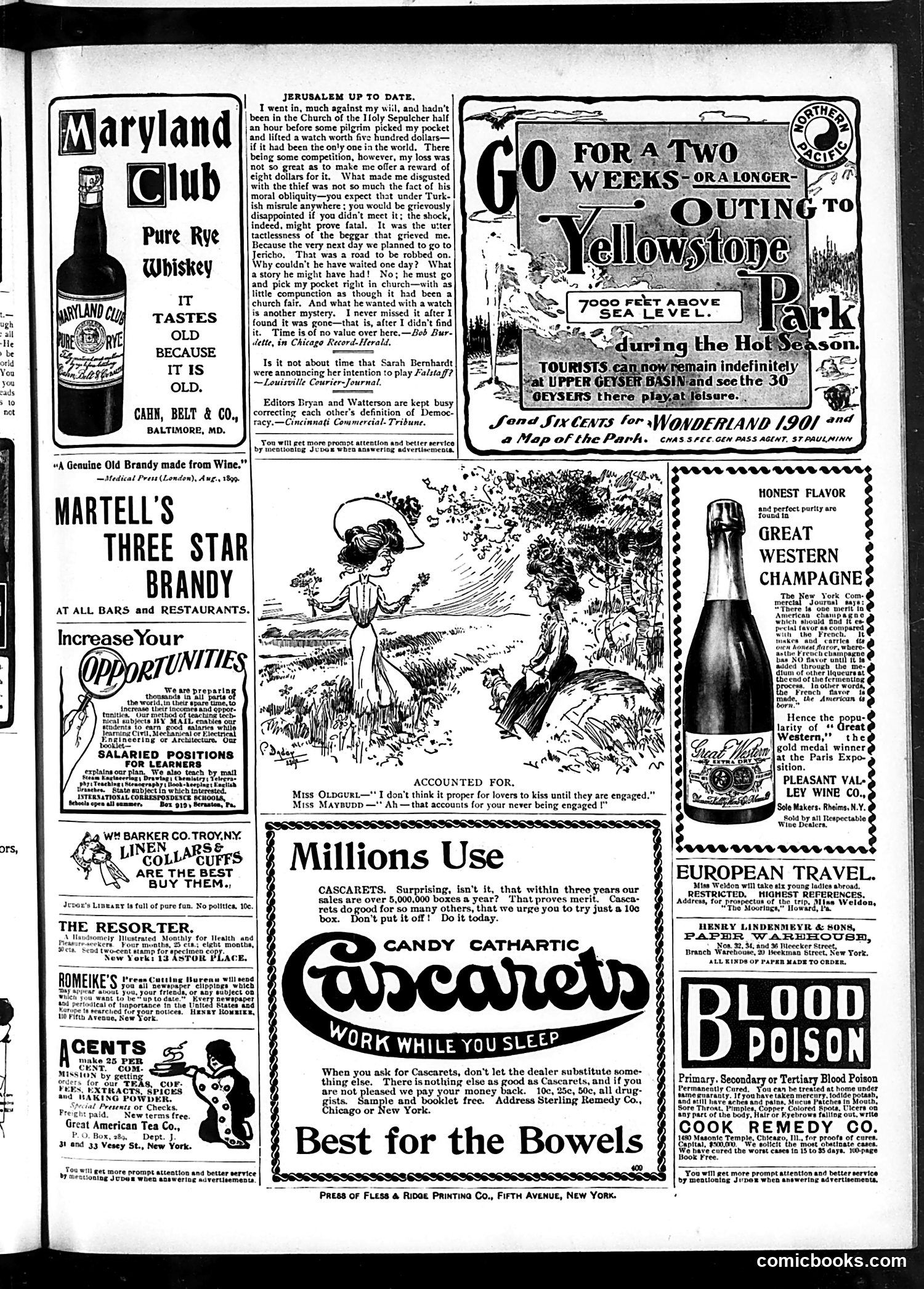
This is primarily an **advertising page** from Judge magazine, with one notable cartoon. ## The Cartoon The main illustration shows a woman in a hat confronting a man in casual dress, with text: "I don't think it proper for lovers to kiss until they are engaged" / "Ah—that accounts for your never being engaged!" This is a **romantic humor joke** about courtship expectations. The woman states a moral position about propriety; the man's response implies she's never been kissed *or* engaged—a cutting remark suggesting her strict standards have left her romantically unsuccessful. The satire targets Victorian courtship conventions by showing how rigid propriety can backfire. ## The Advertisements The page is dominated by product ads typical of early 1900s publications: whiskey (Maryland Club), brandy (Martell's), champagne, Cascarets laxative candy, and remedies like "Blood Poison" cure. These reflect common patent medicine and alcohol marketing of the era, often making exaggerated health claims now considered dubious or fraudulent. The Yellowstone Park tourism ad is notable as an early travel promotion.
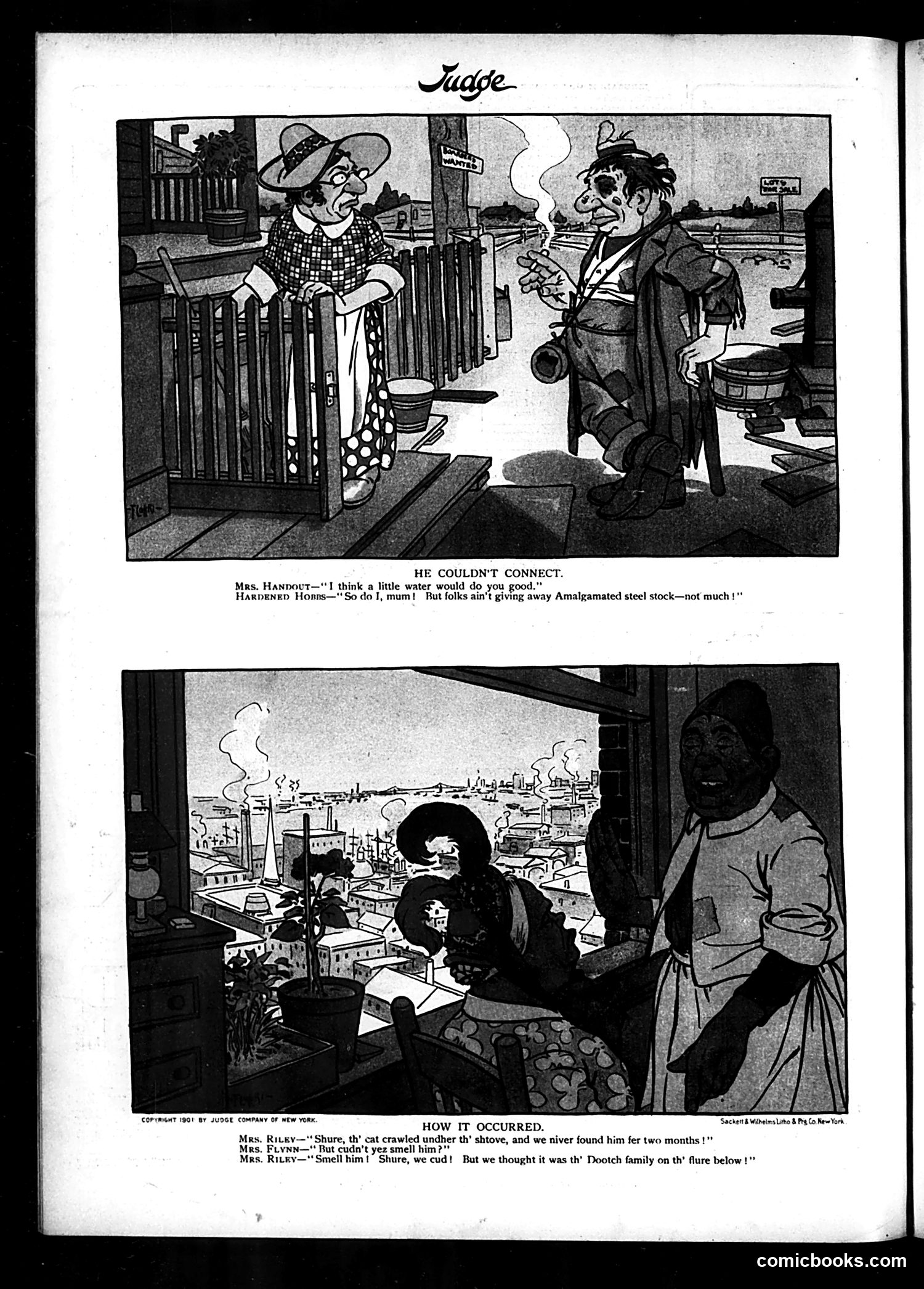
**Top cartoon ("He Couldn't Connect"):** A wealthy woman offers water to a destitute man. He refuses, saying he'd prefer Amalgamated Steel stock—satirizing the contrast between the rich's casual charity and the poor's desperate need for actual wealth/investment. The joke turns on his impossible expectation that the wealthy would simply give away valuable stock. **Bottom cartoon ("How It Occurred"):** Two Irish immigrant women discuss a cat missing for two months under a stove. One asks why they didn't smell it; the other replies they couldn't distinguish the odor from their poor neighbors ("the Dootch family") living below. This is ethnic humor stereotyping German and Irish immigrants as living in squalid, foul-smelling tenement conditions—common in early 1900s American satire. Both cartoons reflect Judge's satirical targets: economic inequality and immigrant stereotypes prevalent in that era.