
Judge, 1901-07-20 · page 14 of 16
Judge — July 20, 1901 — page 14: what you’re looking at
What you’re looking at
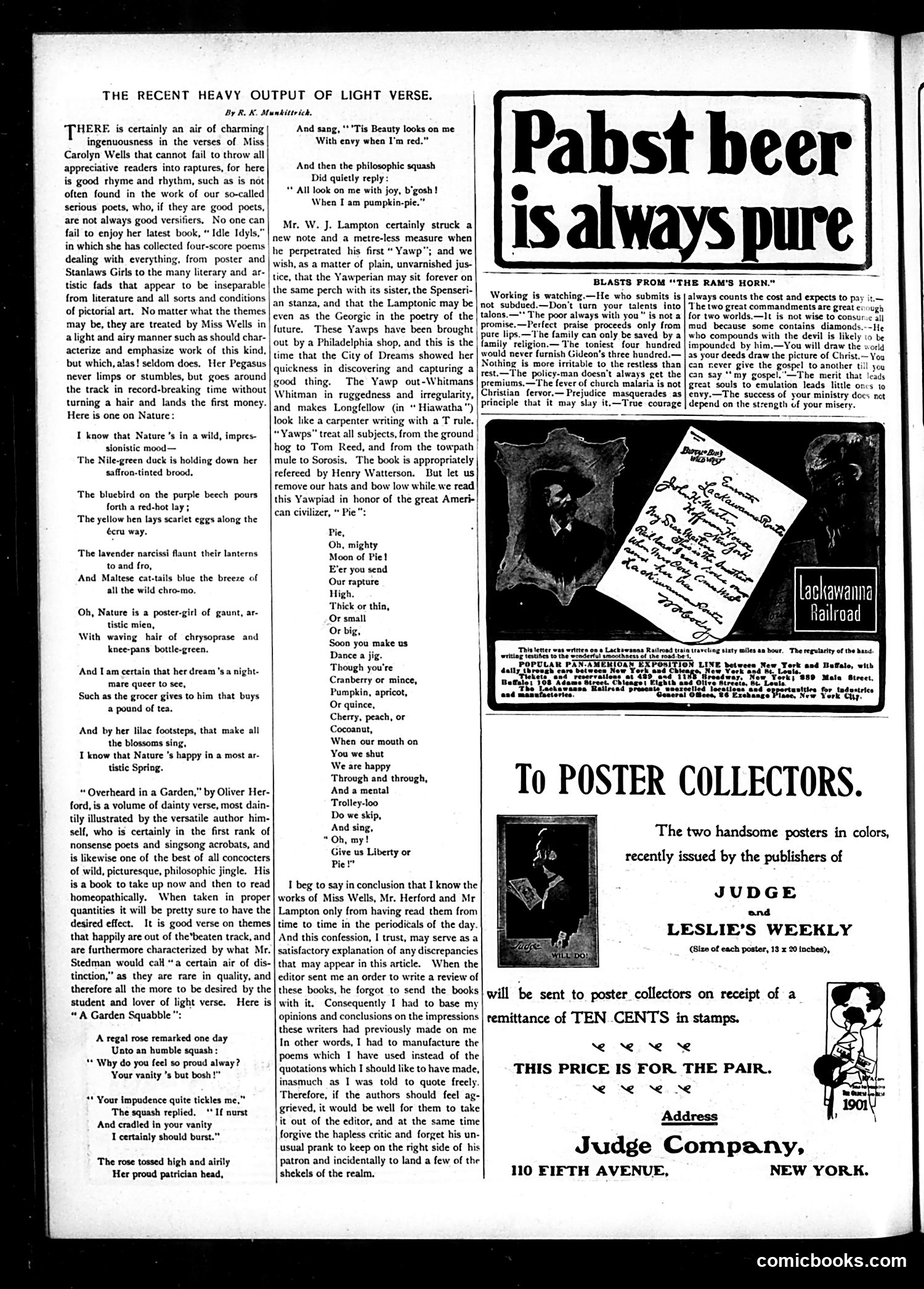
This page is primarily a **literary review** of contemporary light verse collections, not a political cartoon. The author critiques three poets—Carolyn Wells, Oliver Herford, and W.J. Lampton—praising their whimsical, accessible poetry. The satire is **literary-focused**: the review mocks contemporary aesthetic trends by having Wells's nature poem deliberately employ clashing, artificial colors ("saffron-tinted," "purple beech," "red-hot lay," "bottle-green")—a humorous jab at the era's decorative "poster art" aesthetic and Impressionistic affectations in high art circles. The referenced "Stanlaws Girls" and "poster-girl" comparisons suggest light verse was increasingly influenced by commercial advertising illustration—a somewhat trashy cultural trend for serious literature. The review celebrates these poets for writing *technically competent* verse that avoids the self-important pretension of "serious" poets, treating everyday subjects with genuine wit rather than forced profundity. The page also contains **advertisements** (Pabst Beer, Lackawanna Railroad posters) unrelated to the literary content.
📄 Transcribed text from this page (OCR, searchable)
Machine-transcribed from the original scan — historical spelling and the odd misread are preserved.
THE RECENT HEAVY OUTPUT OF LIGHT VERSE. By RK. Munkittrich, HERE. is certainly an air of charming ingenuousness in the verses of Miss Carolyn Wells that cannot fail to throw all appreciative readers into raptures, for here is good rhyme and rhythm, such as is not often found in the work of our so-called serious poets, who, if they are good poets, are not always good versifiers. No one can fail to enjoy her latest book, “ Idle Idyls,” in which she has collected four-score poems dealing with everything, from poster and Stanlaws Girls to the many literary and ar- tistic fads that appear to be inseparable from literature and all sorts and conditions of pictorial art. No matter what the themes may be, they are treated by Miss Wells in a light and airy manner such as should char- acterize and emphasize work of this kind, but which, alas! seldom does. Her Pegasus never limps or stumbles, but goes around the track in record-breaking time without turning a hair and lands the first money. Here is one on Nature: I know that Nature ’s in a wild, impres- sionistic mood— ‘The Nile-green duck is holding down her saffron-tinted brood, The bluebird on the purple beech pours forth a red-hot lay ; ‘The yellow hen lays scarlet eggs along the écru way, ‘The lavender narcissi flaunt their lanterns to and fro, And Maltese cat-tails blue the breeze of all the wild chro-mo, Oh, Nature is a poster-girl of gaunt, ar- tistic mien, With waving hair of chrysoprase and knee-pans bottle-green. And Tam certain that her dream’sa night- mare queer to see, Such as the grocer gives to him that buys a pound of tea. And by her lilac footsteps, that make all the blossoms sing, I know that Nature ‘s happy in a most ar- tistic Spring. “ Overheard in a Garden,” by Oliver Her- ford, is a volume of dainty verse, most dain- tily illustrated by the versatile author him- self, who is certainly in the first rank of nonsense poets and singsong acrobats, and is likewise one of the best of all concocters of wild, picturesque, philosophic jingle. His is a book to take up now and then to read homeopathically. When taken in proper quantities it will be pretty sure to have the desired effect. It is good verse on themes that happily are out of the’beaten track, and are furthermore characterized by what Mr. Stedman would call “a certain air of dis- tinction,” as they are rare in quality, and therefore all the more to be desired by the student and lover of light verse. Here is A Garden Squabble ": ‘A regal rose remarked one day Unto an humble squash : ** Why do you feel so proud alway? Your vanity ’s but bosh !" ** Your impudence quite tickles me,” ‘The squash replied, ‘If nurst And cradled in your vanity I certainly should burst.” The rose tossed high and airily Her proud patrician head, And sang, ** ‘Tis Beauty looks on me With envy when I'm red.” And then the philosophic squash Did quietly rep! ** All look on me with joy, b’gosh ! When I am pumpkin-pie.” Mr. W. J. Lampton certainly struck a new note and a metre-less measure when he perpetrated his first “ Yawy and we wish, as a matter of plain, unvarnished jus- tice, that the Yawperian may sit forever on the same perch with its sister, the Spenseri- an stanza, and that the Lamptonic may be even as the Georgic in the poetry of the future. These Yawps have been brought | out by a Philadelphia shop, and this is the | time that the City of Dreams showed her quickness in discovering and capturing a good thing. The Yawp out-Whitmans Whitman in ruggedness and irregularity, and makes Longfellow (in ‘ Hiawatha") look like a carpenter writing with a T rule. “Yawp: hog to Tom Reed, and from the towpath mule to Sorosis, The book is appropriately refereed by Henry Watterson. But let us remove our hats and bow low while we read this Vawpiad in honor of the great Ameri-| can civilizer, * Pie”: Pie, Ob, mighty Moon of Pie! Ever you send Our rapture High. Thick or thin, Or small Or big, Soon you make us Dance a jig. Though you're Cranberry or mince, Pumpkin, apricot, Or quince, Cherry, peach, or Cocoanut, When our mouth on You we shut We are happy ‘Through and through, And a mental Trolley-loo Do we skip, And sing, “Oh, my! Give us Liberty or Pie!” I beg to say in conclusion that I know the works of Miss Wells, Mr. Herford and Mr Lampton only from having read them from time to time in the periodicals of the day. And this confession, I trust, may serve as a satisfactory explanation of any discrepancies that may appear in this article. When the editor sent me an order to write a review of these books, he forgot to send the books with it. Consequently I had to base my opinions and conclusions on the impressions these writers had previously made on me In other words, I had to manufacture the poems which I have used instead of the quotations which I should like to have made, inasmuch as I was told to quote freely. Therefore, if the authors should feel ag- grieved, it would be well for them to take it out of the editor, and at the same time forgive the hapless critic and forget his un- usual prank to keep on the right side of his patron and incidentally to land a few of the shekels of the realm. treat all subjects, from the ground | Pabst beer Working is watching.—He who submits is not subdued.—Don't turn your talents into talons.—"* The poor always with you” is not a promise.—Perfect praise proceeds only from | pure lips.—The family can only be saved by a family religion.— The toniest. four hundred would never furnish Gideon's three hundred.— Nothing is more irritable to the restless than rest.—The policy-man doesn't always get the premiums,—The fever of church malaria is not Christian fervor.— Prejudice masquerades as principle that it may slay it.—True courage BLASTS FROM “THE RAM'S HORN.” always counts the cost and expects to pa The two great commandments are great for two worlds.—It is not wise to consu: mud because some contains diamond: who compounds with the devil is likely : impounded by him.—You will draw the » as your deeds draw the picture of Christ, can rever give the gospel to another till y can say ‘my gospel."—The merit that leads great souls to emulation leads little oncs 10 envy.—The success of your ministry docs net depend on the strength of your misery. Lackawanna Railroad 110 EIETH AVENUE, The two handsome posters in colors, recently issued by the publishers of JUDGE and LESLIE’S WEEKLY (Gizo of each poster, 18 x 20 inches), be sent to poster collectors on receipt of a remittance of TEN CENTS in stamps. we-seinwe THIS PRICE IS FOR THE PAIR. NE DS MS Address Judge Company, NEW YORK. comicbooks.com