
Judge, 1901-07-20 · page 3 of 16
Judge — July 20, 1901 — page 3: what you’re looking at
What you’re looking at
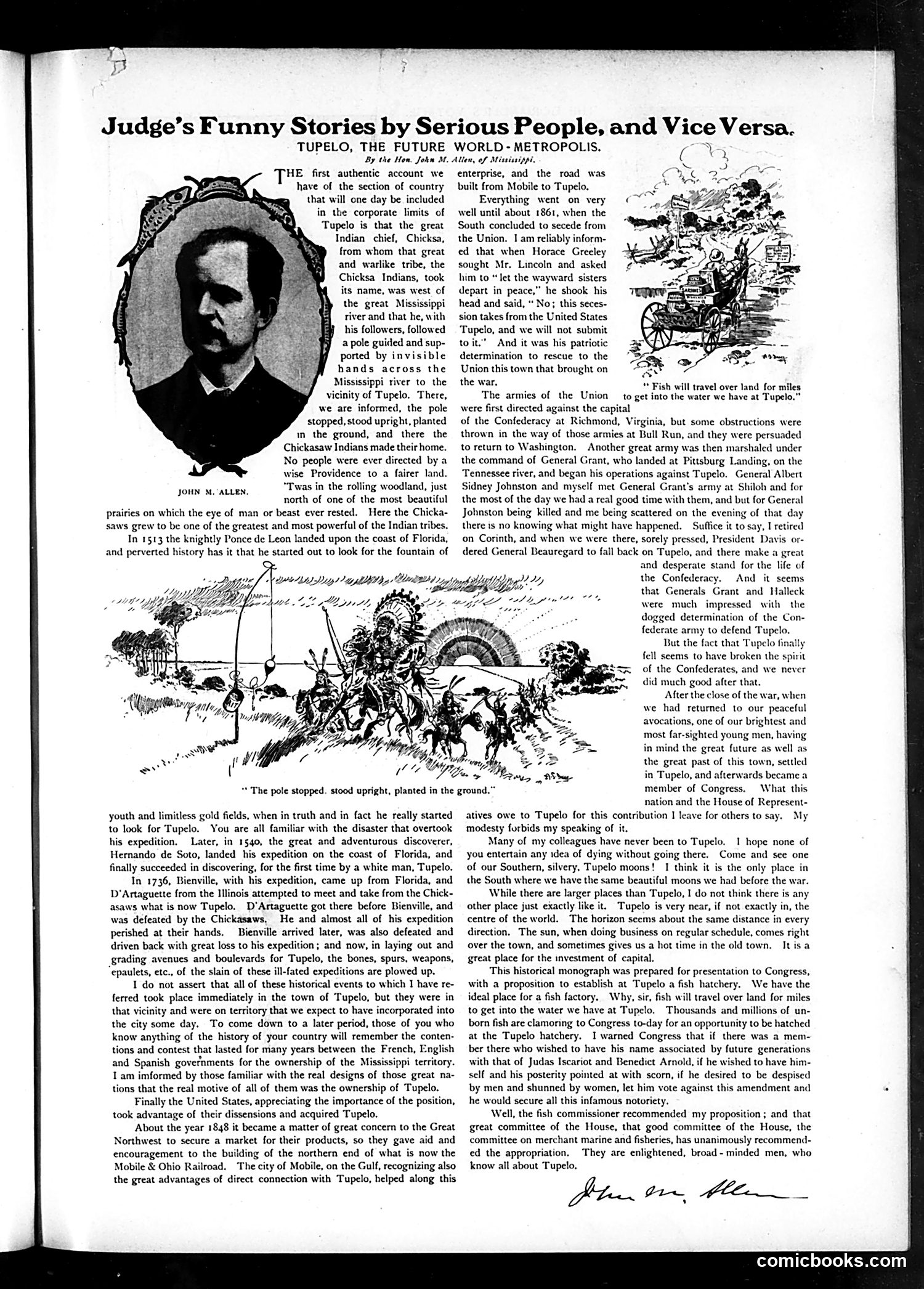
This page features an article by Hon. John M. Allen of Mississippi about Tupelo as a future metropolis. The text is largely a historical narrative about Tupelo, Mississippi—discussing Native American settlement (Chief Chickasaw), Civil War military campaigns, and post-war development prospects. The two illustrations are **not political cartoons** but rather sketches supporting the article: one shows a portrait of John M. Allen himself, and another depicts a scene of pioneers with a surveying pole, illustrating the town's frontier origins. The article's "satire" is gentle—Allen presents Tupelo's modest present with grandiose predictions of future greatness, proposing ambitious projects like a fish hatchery. The humor lies in the contrast between the town's actual significance and Allen's earnest boosterism about its potential as a major commercial center.
📄 Transcribed text from this page (OCR, searchable)
Machine-transcribed from the original scan — historical spelling and the odd misread are preserved.
Judge’s Funny Stories by Serious People, and Vice Versa. TUPELO, THE FUTURE WORLD - METROPOLIS. =) By the Hon. John M. Allen, of Mississippi. HE first authentic account we have of the section of country that will one day be included in the corporate limits of Tupelo is that the great Indian chief, Chicksa, from whom that great and warlike tribe, the Chicksa Indians, took its name, was west of the great Mississippi river and that he, with his followers, followed a pole guided and sup- ported by invisible hands across the Mississippi river to. the vicinity of Tupelo. There, we are informed, the pole stopped, stood upright, planted im the ground, and there the Chickasaw Indians made their home. No people were ever directed by a wise Providence to a fairer land. ‘Twas in the rolling woodland, just north of one of the most beautiful prairies on which the eye of man or beast ever rested. Here the Chicka- saws grew to be one of the greatest and most powerful of the Indian tribes, In 1513 the knightly Ponce de Leon landed upon the coast of Florida, and perverted history has it that he started out to look for the fountain of JOHN M. “ALLEN. yy yyy * The pole stopped. stood upright, planted in the ground.” youth and limitless gold fields, when in truth and in fact he really started to look for Tupelo. You are all familiar with the disaster that overtook his expedition. Later, in 1540, the great and adventurous discoverer, Hernando de Soto, landed his expedition on the coast of Florida, and finally succeeded in discovering, for the first time by a white man, Tupelo. In 1736, Bienville, with his expedition, came up from Florida, and D‘Artaguette from the Ilinois attempted to meet and take from the Chick- asaws what is now Tupelo. D'Artaguette got there before Bienville, and was defeated by the Chickasaws, He and almost all of his expedition perished at their hands. Bienville arrived later, was also defeated and driven back with great loss to his expedition ; and now, in laying out and grading avenues and boulevards for Tupelo, the bones, spurs, weapons, “epaulets, etc., of the slain of these ill-fated expeditions are plowed up. I do not assert that all of these historical events to which I have re- ferred took place immediately in the town of Tupelo, but they were in that vicinity and were on territory that we expect to have incorporated into the city some day. To come down to a later period, those of you who know anything of the history of your country will remember the conten tions and contest that lasted for many years between the French, English and Spanish governments for the ownership of the Mississippi territory. 1am imformed by those familiar with the real designs of those great na- tions that the real motive of all of them was the ownership of Tupelo. Finally the United States, appreciating the importance of the position, took advantage of their dissensions and acquired Tupelo. About the year 1848 it became a matter of great concern to the Great Northwest to secure a market for their products, so they gave aid and encouragement to the building of the northern end of what is now the Mobile & Ohio Railroad. The city of Mobile, on the Gulf, recognizing also the great advantages of direct connection with Tupelo, helped along this Low 2. vee ee ea enterprise, and the road was built from Mobile to Tupelo. Everything went on very well until about 1861, when the South concluded to secede from the Union. I am reliably inform- ed that when Horace Greeley sought Mr. Lincoln and asked him to “let the wayward sisters depart in peace,” he shook his head and said, “ No; this seces- sion takes from the United States Tupelo, and we will not submit to it.’ And it was his patriotic determination to rescue to the Union this town that brought on the war, h will travel over land for miles The armies of the Union to get into the water we have at Tupelo.” were first directed against the capital of the Confederacy at Richmond, Virginia, but some obstructions were thrown in the way of those armies at Bull Run, and they were persuaded to return to Washington. Another great army was then marshaled under the command of General Grant, who landed at Pittsburg Landing, on the Tennessee river, and began his operations against Tupelo. General Albert Sidney Johnston and myself met General Grant's army at Shiloh and for the most of the day we had a real good time with them, and but for General Johnston being killed and me being scattered on the evening of that day there is no knowing what might have happened. Suflice it to say, I retired on Corinth, and when we were there, sorely pressed, President Davis or dered General Beauregard to fall back on Tupelo, and there make a great and desperate stand for the life of the Confederacy And it seems that Generals Grant and Halleck were much impressed with the dogged determination of the Con- federate army to defend Tupelo. But the fact that Tupelo fin fell seems to have broken th of the Confederates, and we never did much good after that. After the close of the war, when we had returned to our peaceful avocations, one of our brightest and most far-sighted young men, having in mind the great future as well as the great past of this town, settled in Tupelo, and afterwards became a member of Congress. What this nation and the House of Represent- atives owe to Tupelo for this contribution I leave for others to say. My modesty forbids my speaking of it. Many of my colleagues have never been to Tupelo. you entertain any idea of dying without going there. Come and see one of our Southern, silvery, Tupelo moons! I think it is the only place in the South where we have the same beautiful moons we had before the war. While there are larger places than Tupelo, I do not think there is any other place just exactly like it. Tupelo is very near, if not exactly in, the centre of the world. The horizon seems about the same distance in every direction, The sun, when doing business on regular schedule, comes right over the town, and sometimes gives us a hot time in the old town, It isa great place for the investment of capital. This historical monograph was prepared for presentation to Congress, with a proposition to establish at Tupelo a fish hatchery. We have the ideal place for a fish factory. Why, sir, fish will travel over land for miles to get into the water we have at Tupelo. Thousands and millions of un- born fish are clamoring to Congress to-day for an opportunity to be hatched at the Tupelo hatchery. I warned Congress that if there was a mem- ber there who wished to have his name associated by future generations with that of Judas Iscariot and Benedict Arnold, if he wished to have him- self and his posterity pointed at with scorn, if he desired to be despised by men and shunned by women, let him vote against this amendment and he would secure all this infamous notoriety. Well, the fish commissioner recommended my proposition ; and that great committee of the House, that good committee of the House, the committee on merchant marine and fisheries, has unanimously recommend- ed the appropriation. They are enlightened, broad - minded men, who know all about Tupelo, Pbn t~, POE __ I hope none of comicbooks.com