
A complete issue · 16 pages · 1901
Judge — June 1, 1901
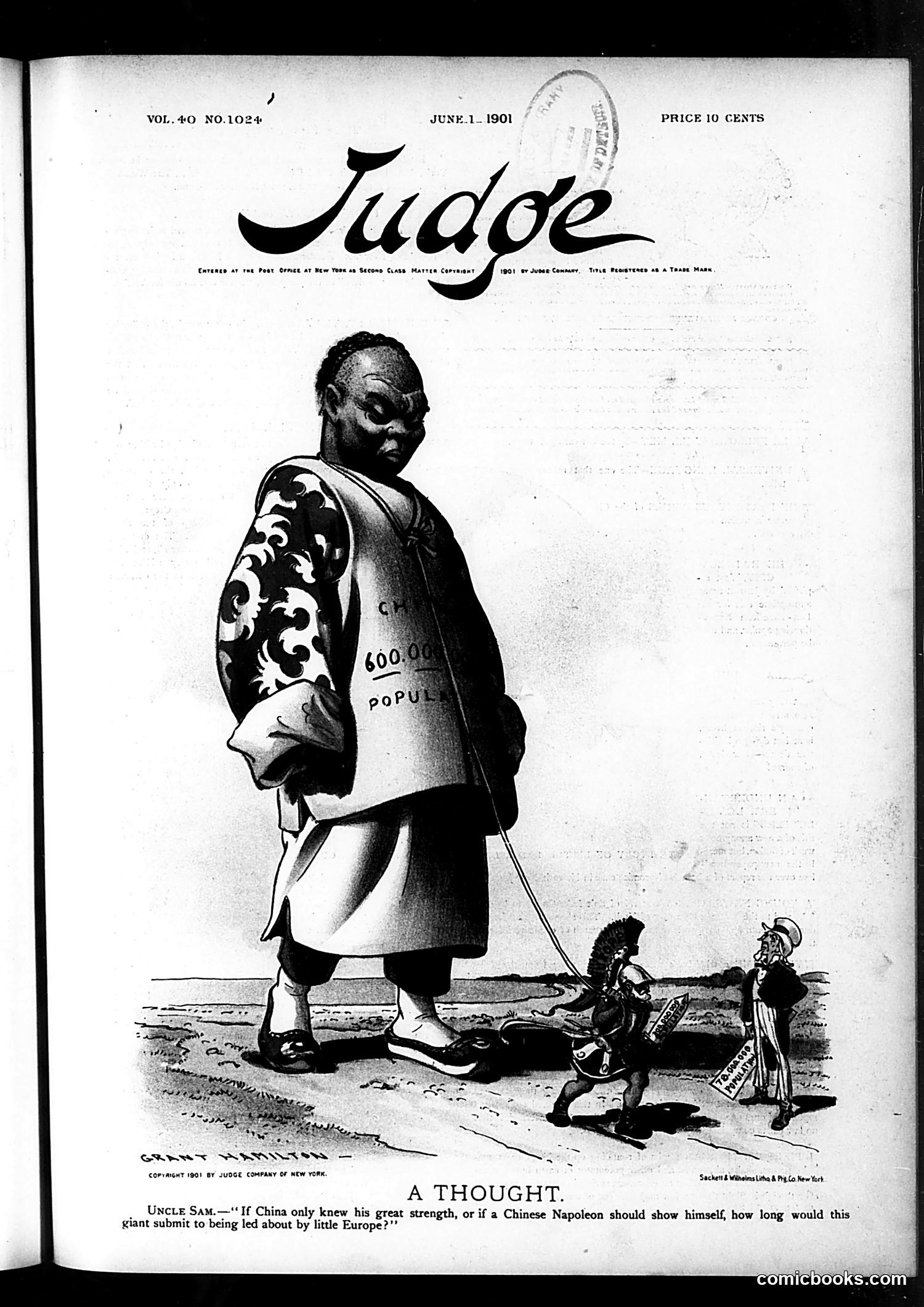
This political cartoon depicts **Uncle Sam** (representing the United States) as a giant holding a leash attached to two small figures labeled "Europe," shown as diminutive characters being led around like dogs. The accompanying caption presents Uncle Sam's imagined thought: "If China only knew his great strength, or if a Chinese Napoleon should show himself, how long would this giant submit to being led about by little Europe?" The satire addresses American anxieties about Western imperial dominance in China following the Boxer Rebellion (1900). It suggests that if China recognized its vast population and potential power, it might resist European and American colonial exploitation. The cartoon ironically positions Uncle Sam as concerned about European influence while America itself participates in China's subjugation.
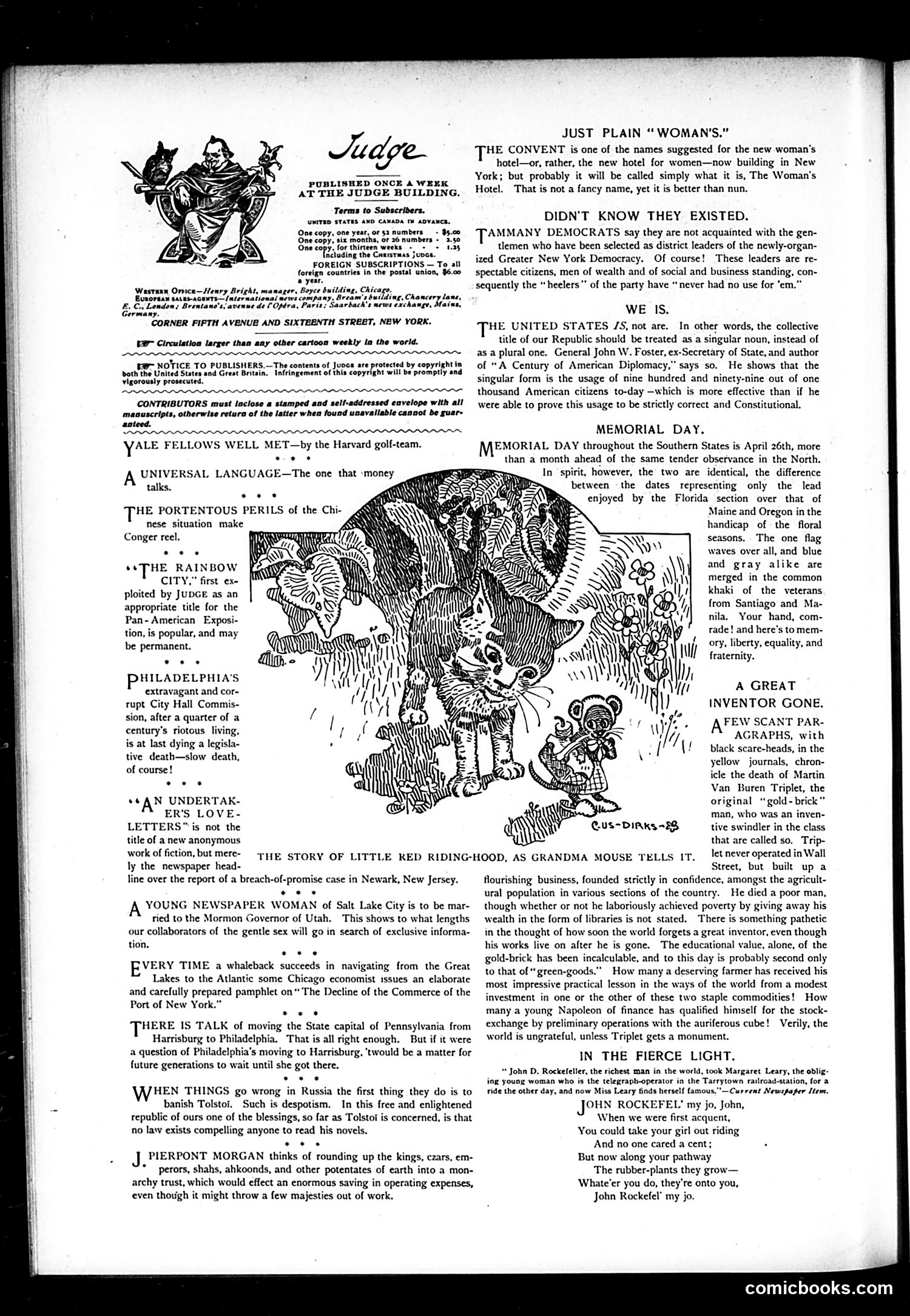
The central illustration depicts **Little Red Riding Hood with a Grandmother Mouse**, a fairy tale parody. The accompanying article discusses **Martin Van Buren Triplet**, an "original 'gold-brick' man" and financial swindler whose schemes the author claims are now forgotten. The satire appears to conflate Van Buren with the deceptive wolf in the fairy tale—both predatory figures. The "gold-brick" reference suggests fraud involving worthless items sold as valuable. Other brief items mock contemporary targets: Philadelphia's corrupt city government, Pennsylvania's capital relocation debate, and various political/social follies. Without additional historical context about Van Buren Triplet specifically, the exact political point remains unclear, but the overall tone ridicules financial charlatans and municipal corruption typical of Gilded Age satirical commentary.
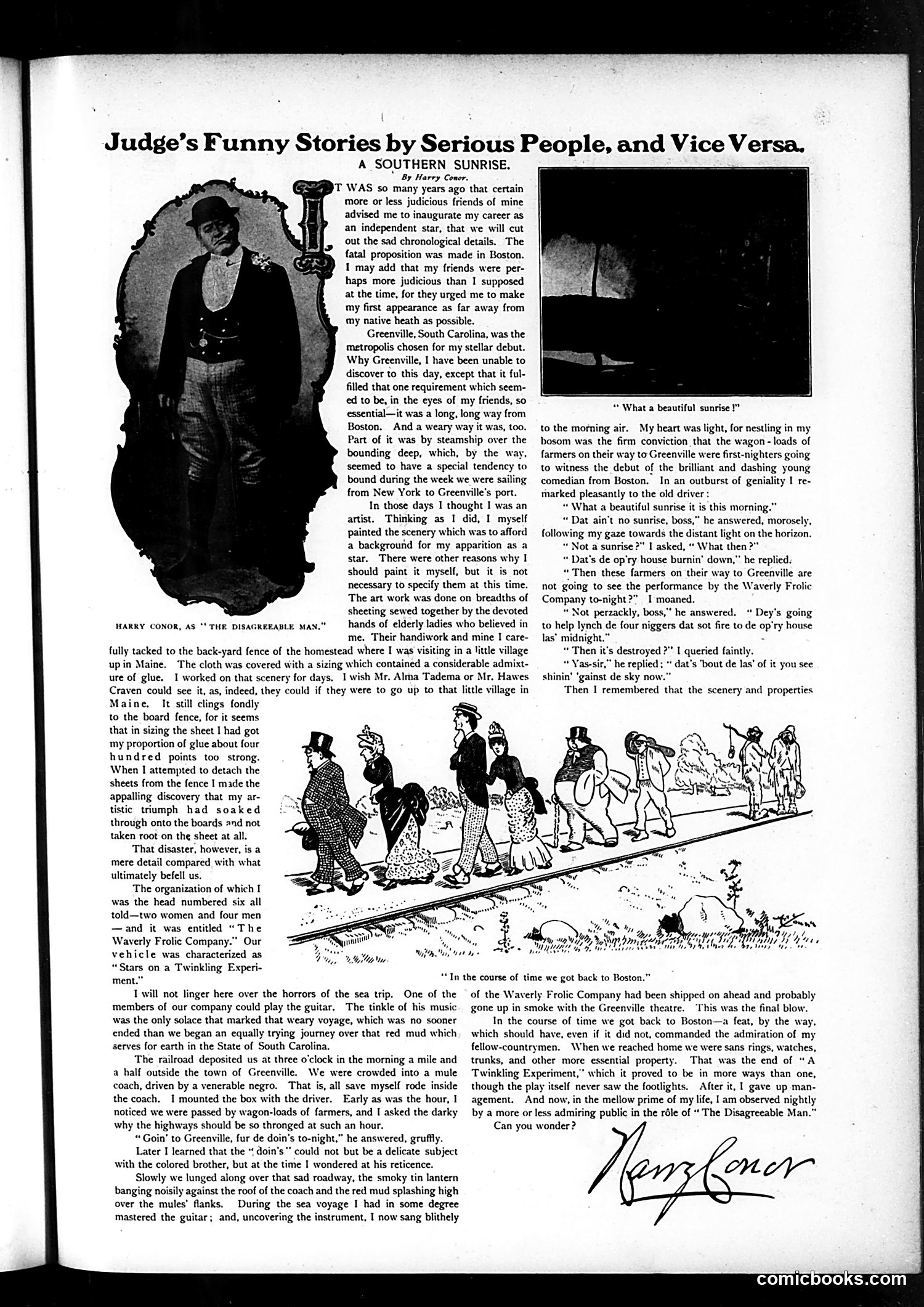
This article recounts Harry Conor's early theatrical career, specifically his debut as an "independent star" in Greenville (location unclear, likely South Carolina based on references). The piece is humorous memoir rather than political satire. The narrative describes Conor's journey from Boston to a small village, his attempt at scenic painting for theatrical backdrops, and a disastrous "Waverly Frolic Company" production. The story includes comedic details about a coach journey where he discusses a sunrise with an old driver, and mishaps during the theatrical performance. The accompanying illustrations show period costumes and a group traveling by coach. This appears to be entertainment-focused humor celebrating theatrical life's absurdities rather than political commentary.
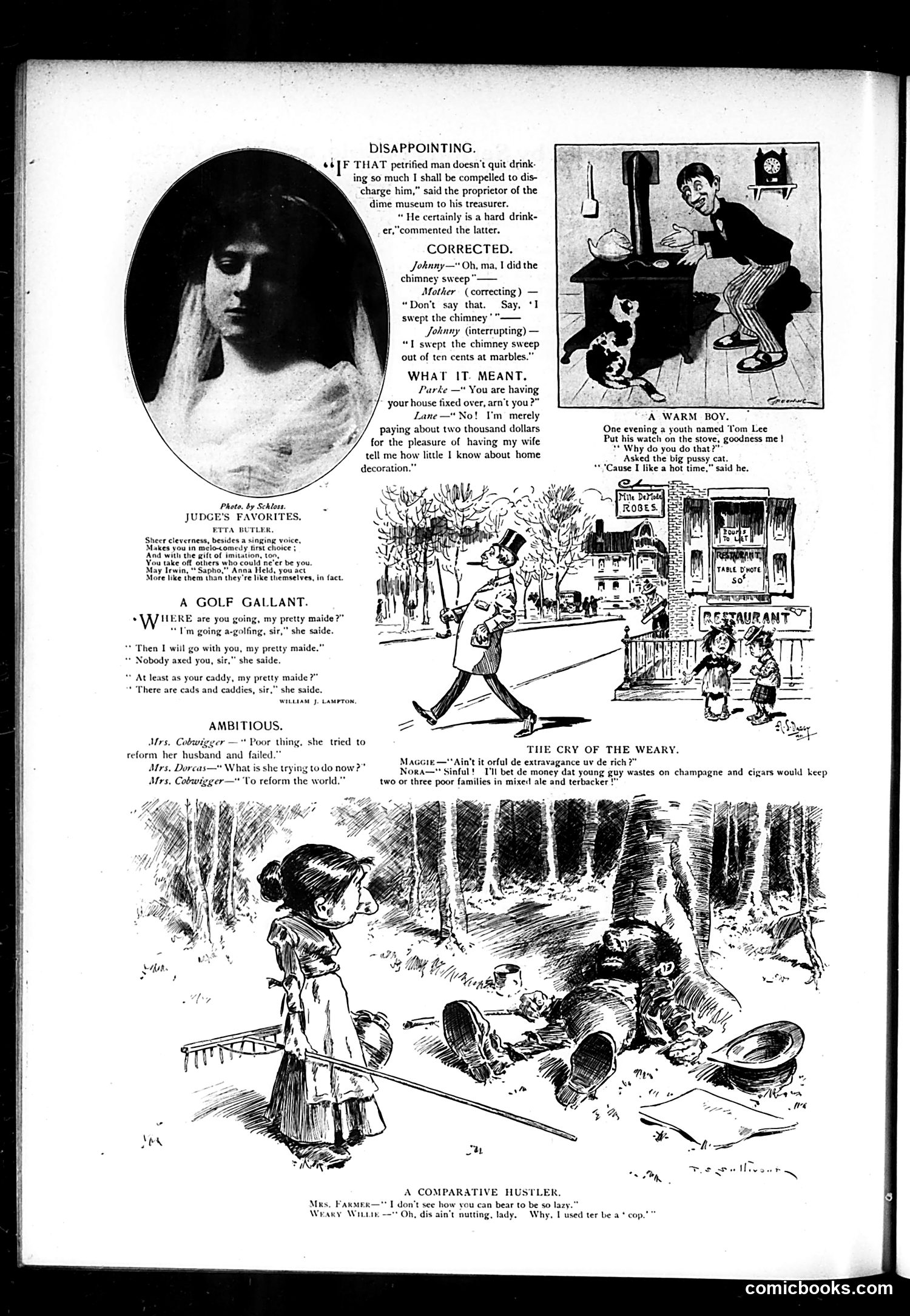
This page contains several humorous sketches and anecdotes satirizing early 20th-century American social life: **"Disappointing"** mocks a museum proprietor's complaint about a drunk patron—standard social humor about excess drinking. **"Corrected"** plays on a misheard phrase about chimney sweeping, a common wordplay joke format. **"What It Meant"** satirizes wealthy nouveaux riches unfamiliar with traditional home decoration, suggesting pretentious social climbing. **"A Golf Gallant"** presents a flirtation dialogue, typical period romance comedy. **"The Cry of the Weary"** depicts a woman complaining about champagne-fueled wealthy excess draining family finances—social commentary on conspicuous consumption among the rich. **"A Comparative Hustler"** contrasts women's financial strategies, likely commentary on gender and economic survival. The sketches reflect Judge's focus on satirizing contemporary social manners, class distinctions, and gender relations among American society.
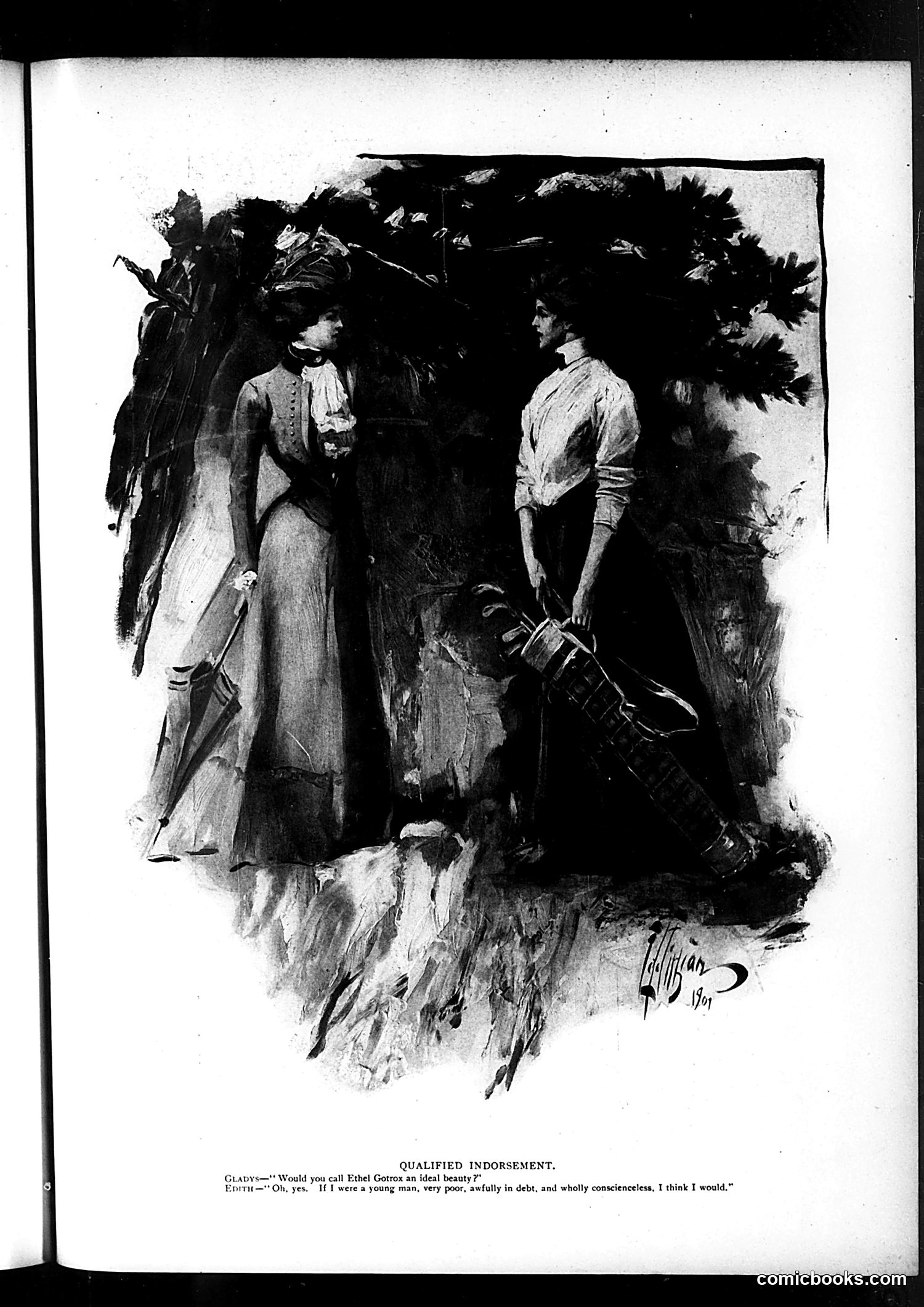
This cartoon satirizes shallow romantic assessment. Two figures discuss whether a woman named Ethel Gotrox qualifies as an "ideal beauty." The male respondent's answer is heavily qualified: he'd find her beautiful only if he were young, poor, deeply in debt, and completely without conscience. The joke targets fortune-hunting: a man without morals or means would pursue an unattractive woman if she had money. The "qualified endorsement" is actually a savage insult—he's saying Gotrox is only desirable to an unscrupulous fortune-seeker. The cartoon mocks both dishonest men who marry for money and, implicitly, wealthy women perceived as unattractive who might attract such suitors.
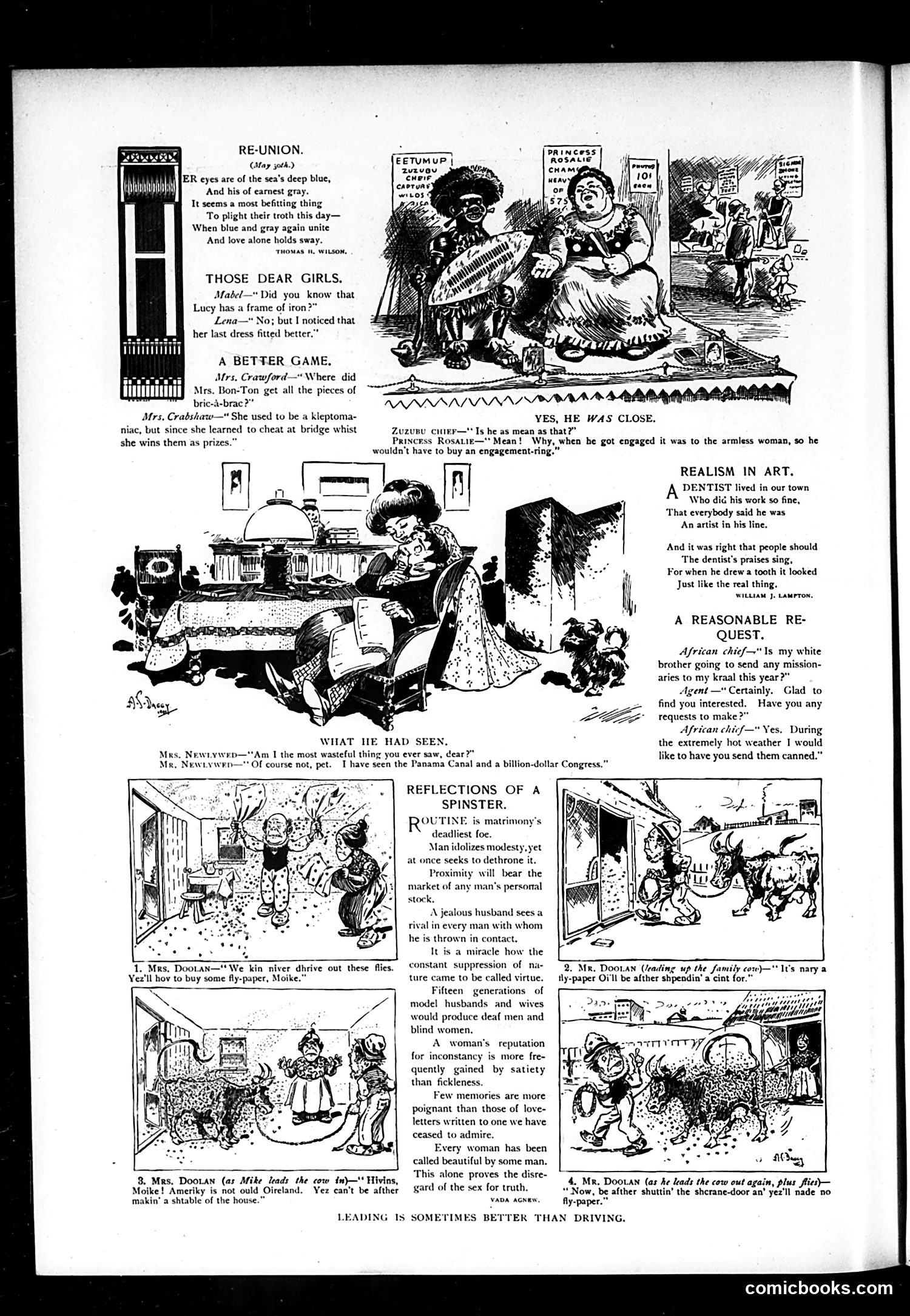
This page from Judge contains several short humor pieces satirizing early 20th-century American society: **"Re-Union"** references post-Civil War reconciliation—"blue and gray" eyes symbolize Union and Confederate reuniting through romance. **"Those Dear Girls"** and **"Better Game"** joke about women's materialism and cheating at cards for social gain. **"What He Had Seen"** compares the Panama Canal construction and Congressional spending as examples of waste—contemporary political critiques. **"Reflections of a Spinster"** offers cynical observations on marriage and women's virtue, reflecting period anxieties about matrimony. **The Doolan series** depicts Irish immigrants (indicated by dialect spelling like "Oi" and "Yez") struggling with household pests—a class-based humor common in Judge, playing on immigrant stereotypes. **"Realism in Art"** makes a simple dentist pun. **"A Reasonable Request"** contains racial stereotyping typical of the era, depicting an African chief requesting canned missionaries during hot weather. The overall tone reflects Judge's satirical approach to contemporary social issues, gender roles, immigration, and racial attitudes.
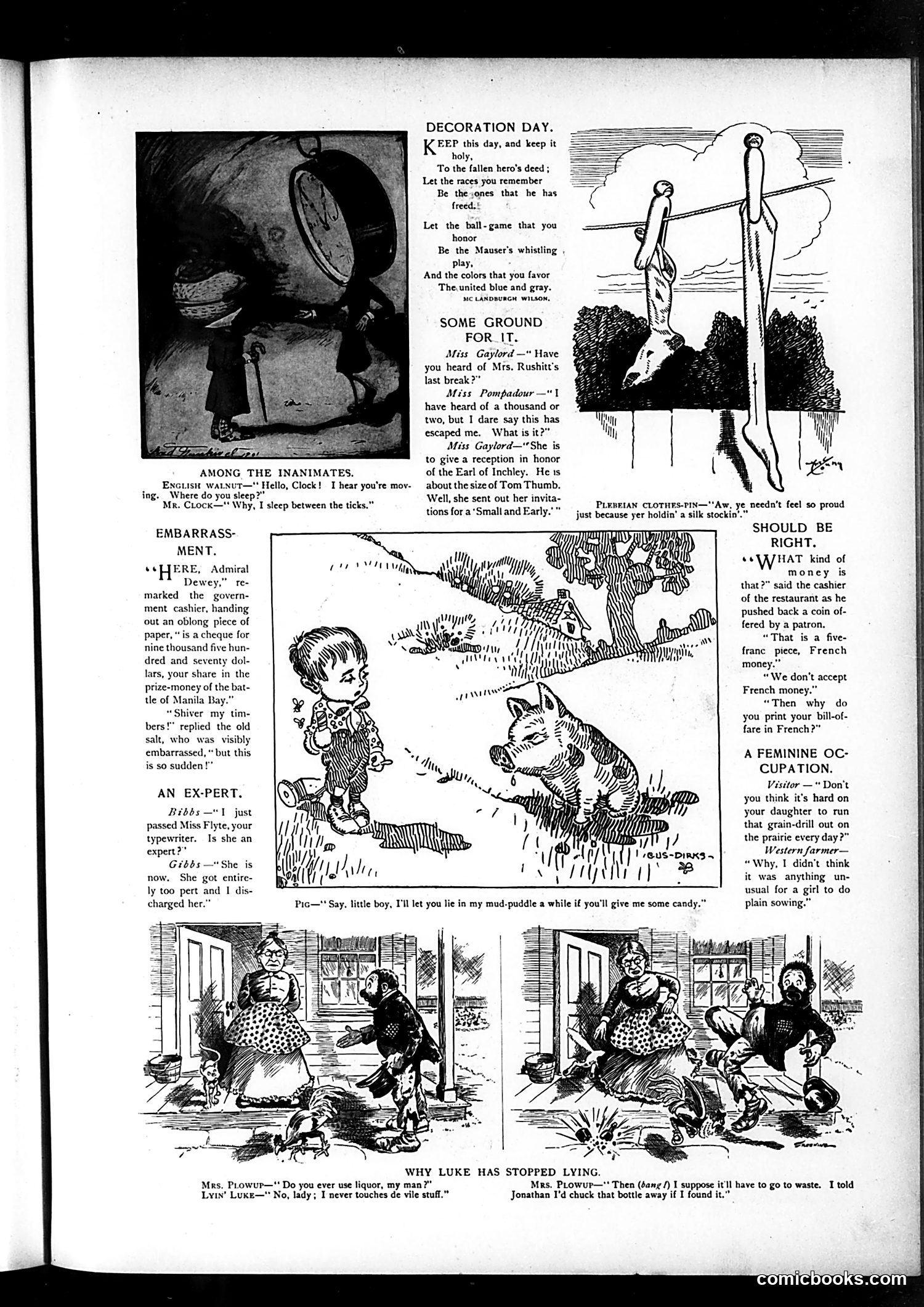
This page contains multiple satirical pieces reflecting turn-of-the-century American attitudes: **"Decoration Day"** offers patriotic verse honoring Civil War fallen, referencing the "united blue and gray" (Union and Confederate forces). **"Among the Inanimates"** is a light pun joke about a clock and ticks. **"Embarrassment"** satirizes a Spanish-American War profiteer—a government official distributing Manila Bay battle prize-money to a sailor, whose discomfort suggests society's unease with war profiteering. **"Should Be Right"** mocks French currency and dining pretension. **"A Feminine Occupation"** jokes that grain-drilling is unremarkable "sowing" work for farm girls. **"Why Luke Has Stopped Lying"** depicts an Irish laborer ("Lyin' Luke") and a farmer's wife, playing on ethnic dialect humor and rural temperance themes—she threatens to waste liquor he won't admit to drinking. The page reflects period class anxieties, xenophobia, and rural-urban cultural tensions typical of Judge's satirical approach.
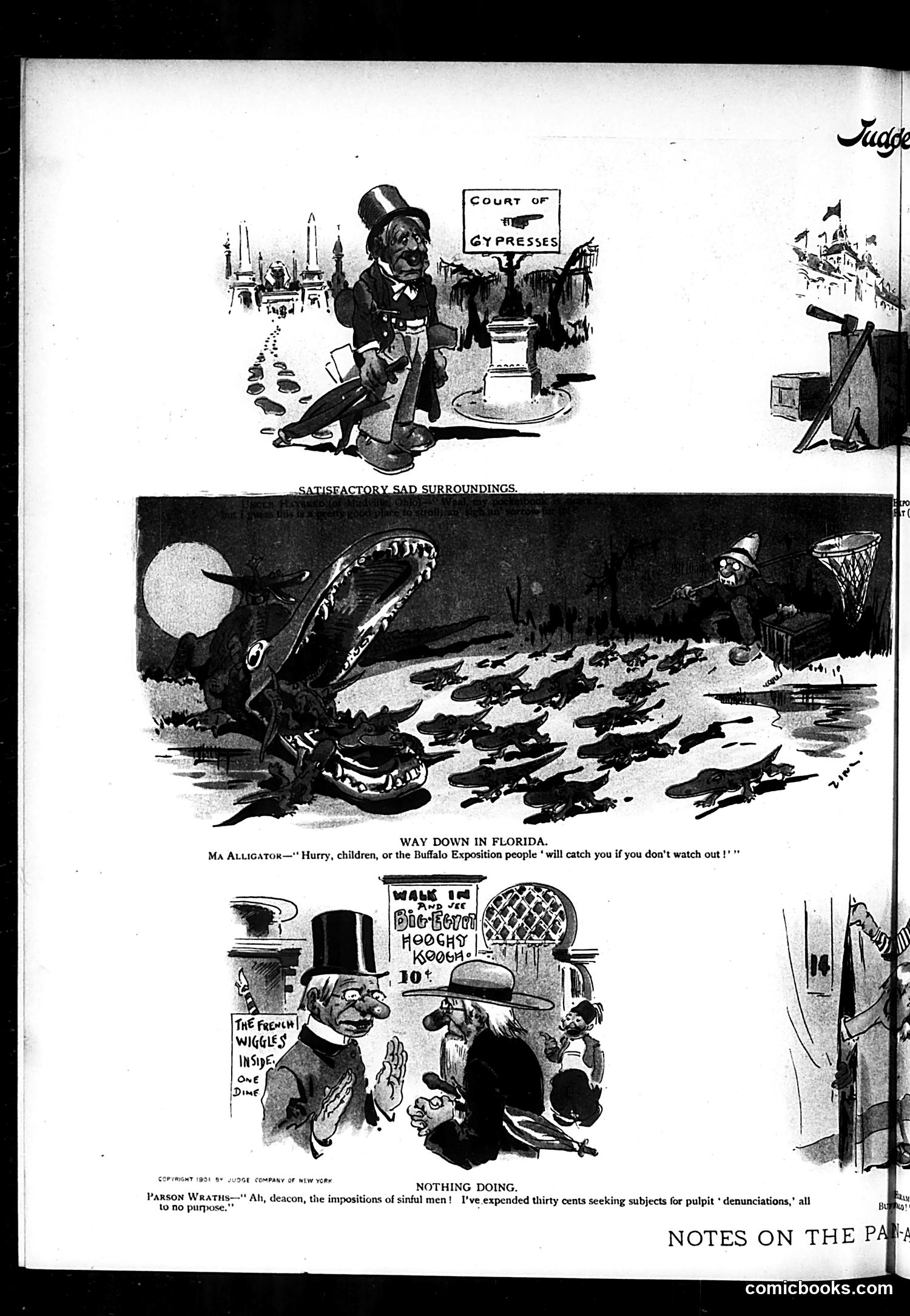
**"Way Down in Florida"** satirizes the 1901 Buffalo Exposition (Pan-American Exposition), which displayed human beings in "ethnographic" exhibits. The cartoon depicts a mother alligator warning her children to flee from exposition organizers who would capture them for display—a darkly ironic commentary on how the Buffalo Exposition treated Indigenous peoples and other non-white groups as exotic specimens to be caged and exhibited. **"Nothing Doing"** mocks a parson (minister) complaining to a deacon that he's wasted thirty cents looking for sinful behavior to denounce from the pulpit. The satire targets preachers who exaggerate or manufacture moral outrages to maintain relevance and justify their positions. Both cartoons employ Judge magazine's characteristic social criticism through caricature and dark humor.
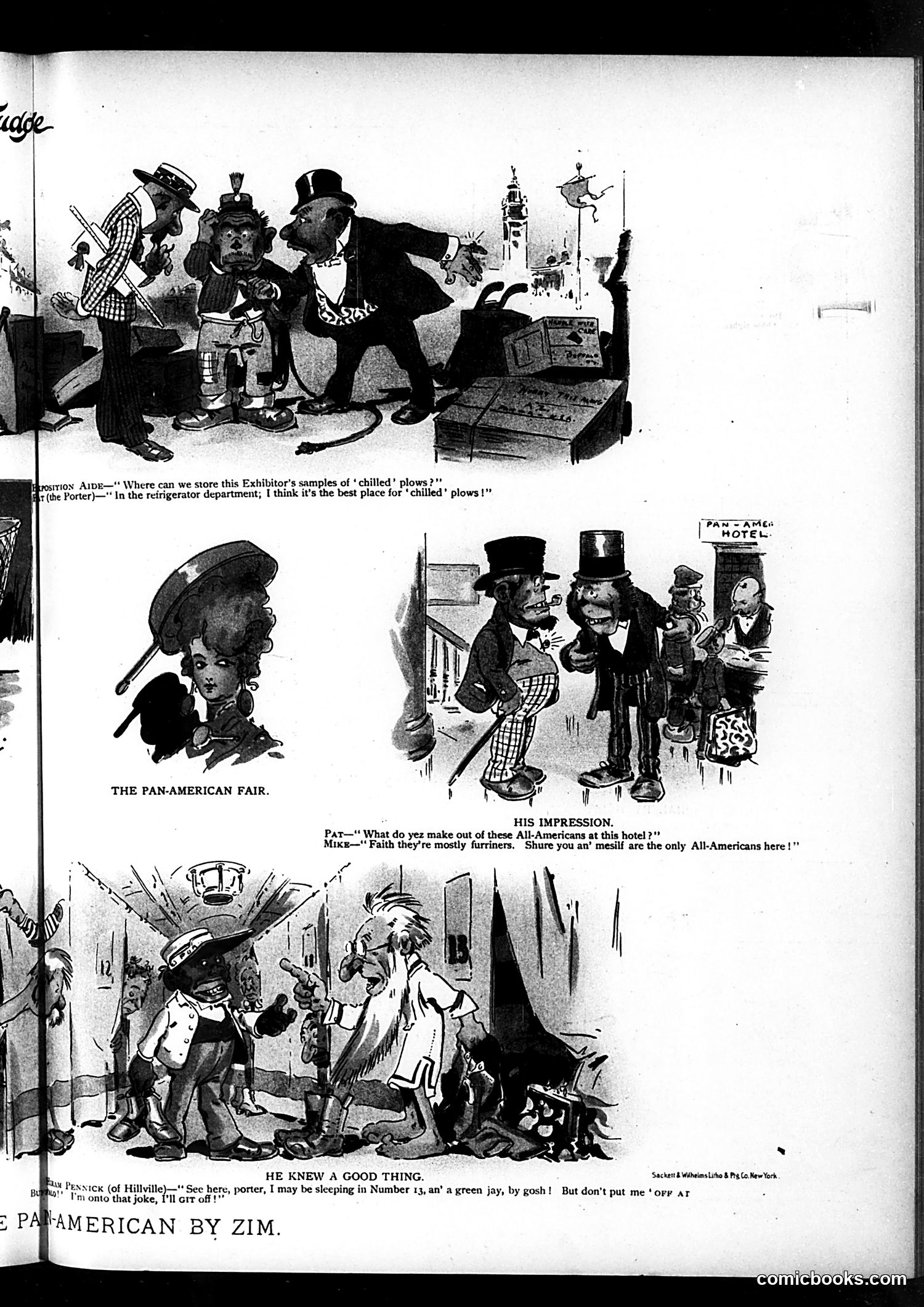
This page contains three cartoons satirizing the 1901 Pan-American Exposition in Buffalo, using Irish immigrant stereotypes (Pat and Mike) as comedic vehicles. **Top cartoon:** Exhibition organizers debate storing "chilled plows"—likely agricultural machinery samples—in a refrigerator, making a pun on the word "chilled." **Middle cartoon ("His Impression"):** Two Irish porters (Pat and Mike, identifiable by dialect) mock wealthy hotel guests as "furriners" (foreigners), ironically claiming only they represent "All-Americans." This satirizes immigration anxieties and the absurdity of excluding immigrants from American identity while relying on their labor. **Bottom cartoon ("He Knew a Good Thing"):** A porter references Room 13 (unlucky number) and a "green jay" (naive newcomer), mocking superstitious working-class attitudes while the guest dismisses the joke. The cartoons use working-class Irish characters to lampoon both nouveau-riche fair visitors and anti-immigration sentiment prevalent in early 1900s America.
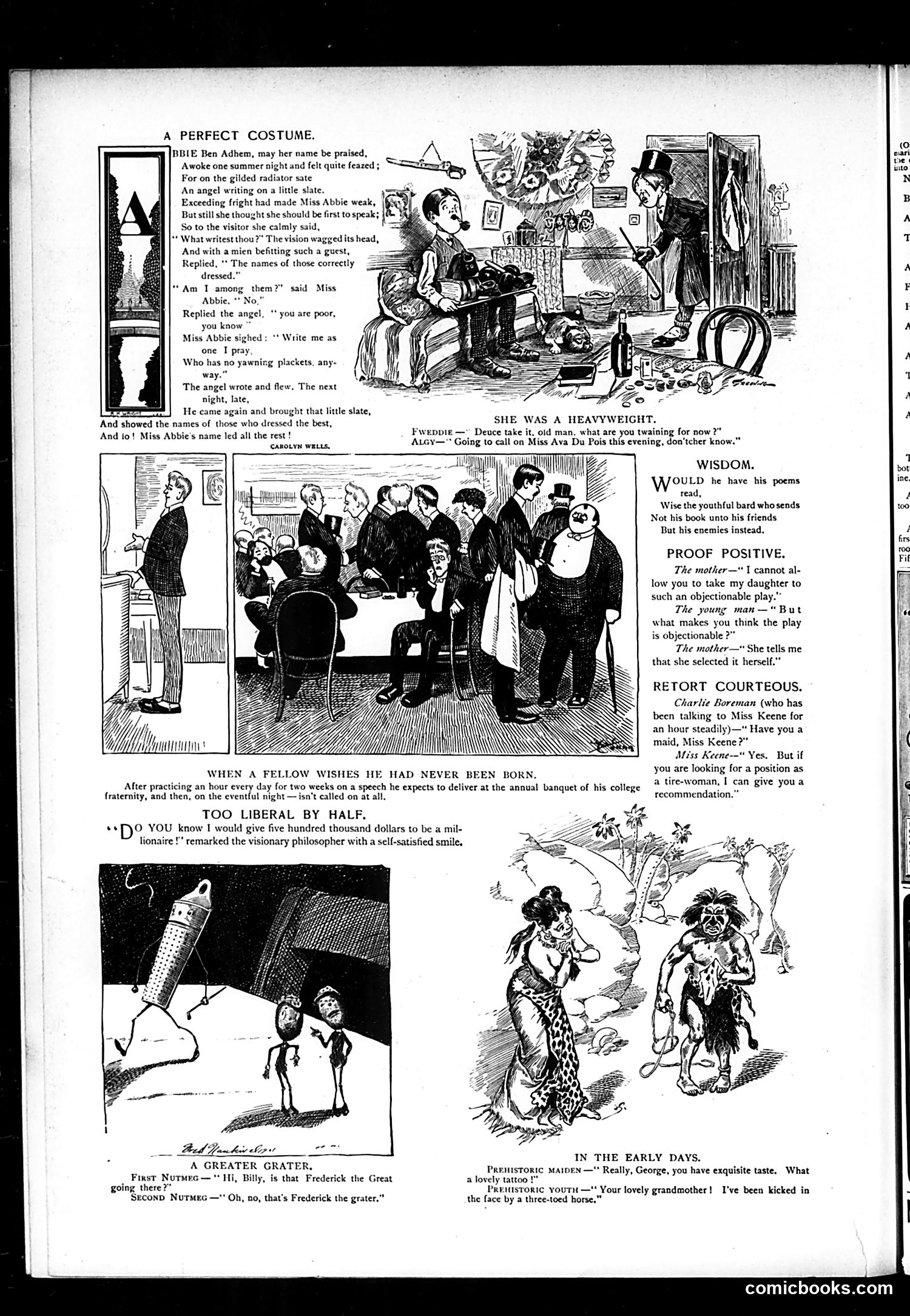
This page contains several brief satirical pieces typical of early 20th-century American humor: **"A Perfect Costume"** parodies Leigh Hunt's poem "Abou Ben Adhem." An angel records the names of the "correctly dressed," but poor Miss Abbie doesn't qualify—the satire mocks both rigid class distinctions and the obsession with proper appearance among the wealthy. **"When a Fellow Wishes He Had Never Been Born"** ridicules a college fraternity member who practices a banquet speech for two weeks only to never be called upon—skewering both verbose oratory culture and social embarrassment. **"Too Liberal By Half"** jokes about a visionary philosopher who claims he'd give $500,000 to become a millionaire—absurd logic that satirizes grandiose but impractical philosophical posturing. **"A Greater Grater"** is a pun: "Frederick the Great" becomes "Frederick the grater" (kitchen tool). **"In the Early Days"** presents prehistoric humor about a woman complimenting a man's tattoo, revealed as a kick-mark from a three-toed horse—crude slapstick suggesting "primitive" courtship. The humor throughout relies on wordplay, social pretension, and gentle ridicule of contemporary manners.
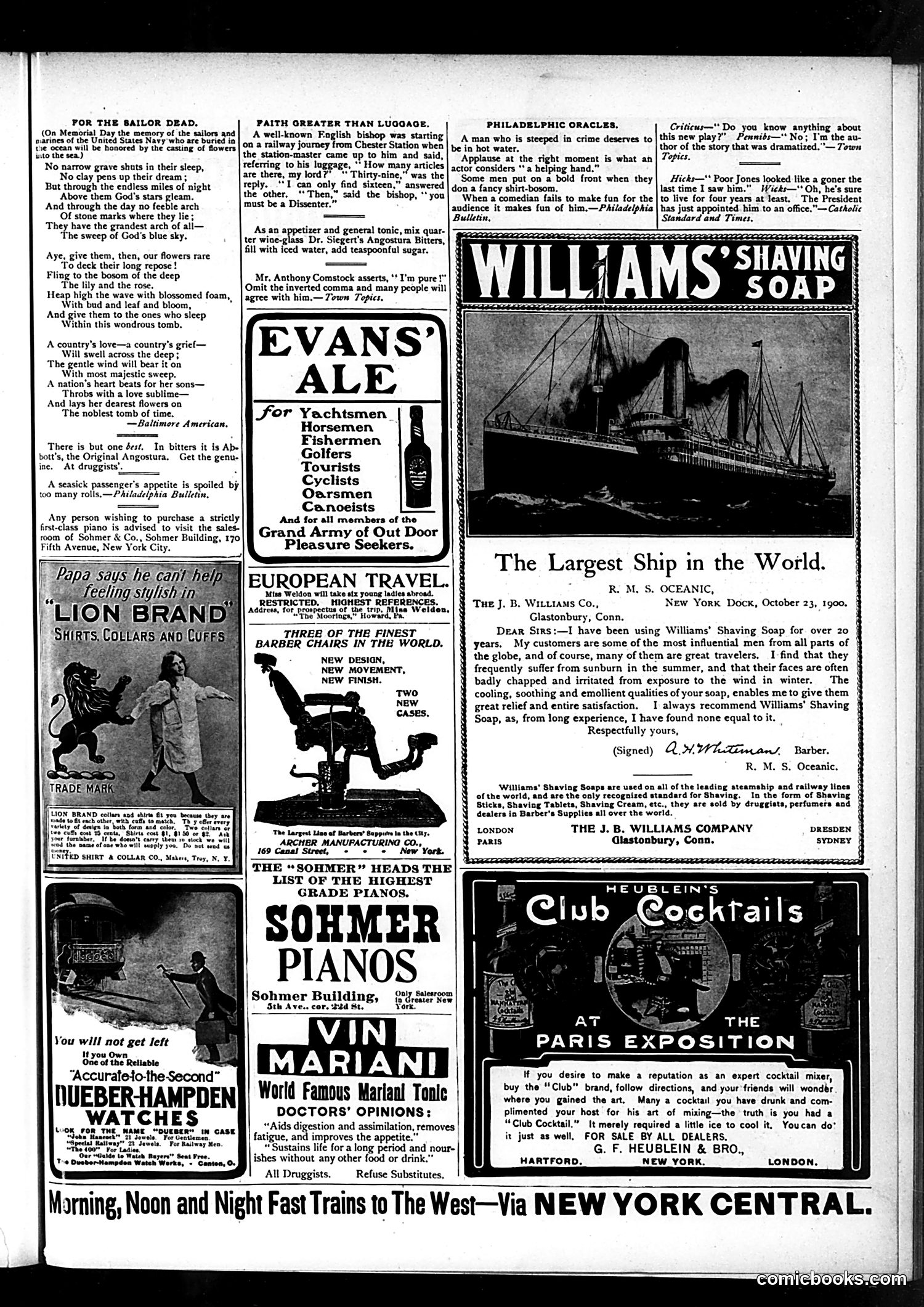
This page is primarily advertisements with some editorial content, not political cartoons. The main textual pieces are: - A poem honoring sailors who died at sea, read at Memorial Day services - A joke about an English bishop's luggage—wordplay where his inability to find items prompts him to call the station-master a "Dissenter" (religious non-conformist), implying carelessness The advertisements include Williams' Shaving Soap (featuring an R.M.S. Oceanic ocean liner), Evans' Ale, Sohmer Pianos, Lion Brand shirts, Mariani Tonic, and Heublein's Club Cocktails (promoted at the Paris Exposition). There are no discernible political cartoons on this page. It appears to be a typical issue of Judge from around 1900, mixing patriotic sentiment, light humor, and commercial advertising rather than editorial satire or caricature.
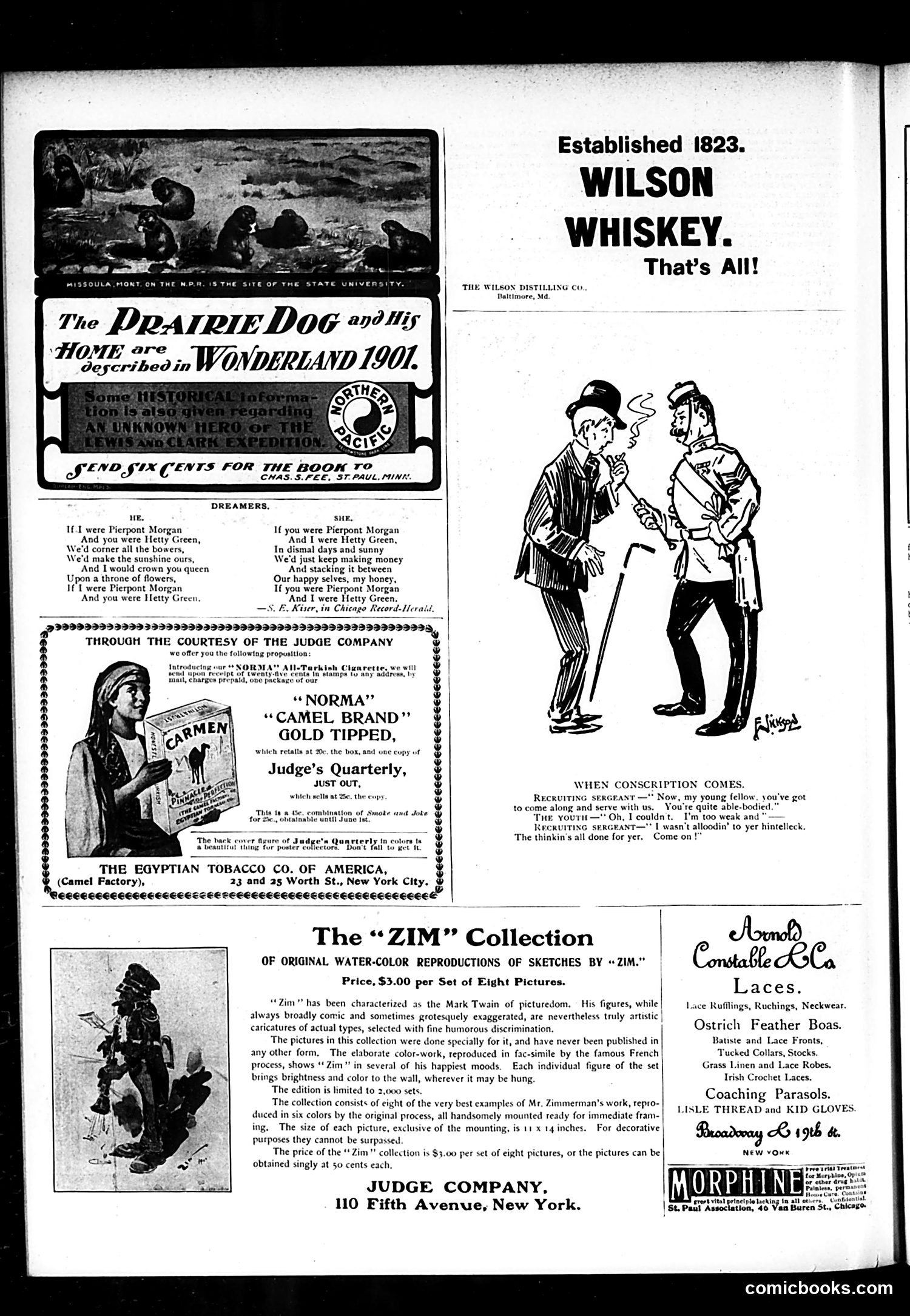
This single-panel cartoon satirizes military recruitment practices, likely from the early 1900s when conscription debates were active in America. **The figures:** A recruiting sergeant confronts a young man claiming he's too weak and unintelligent to serve. **The joke:** The sergeant dismissively responds that intelligence isn't required—"The thinkin's all done for yer. Come on!" This mocks both the perceived intellectual demands of military service (implying soldiers need not think) and the recruiting sergeant's low regard for enlisted men's mental capabilities. **The satire:** Judge magazine lampoons the military's apparent indifference to recruits' actual fitness or ability, reducing soldiers to unthinking bodies following orders. It suggests the army will take anyone, regardless of genuine qualification, while insulting both the recruits and the institution's standards. The cartoon reflects Progressive-era skepticism about militarism and institutional competence.
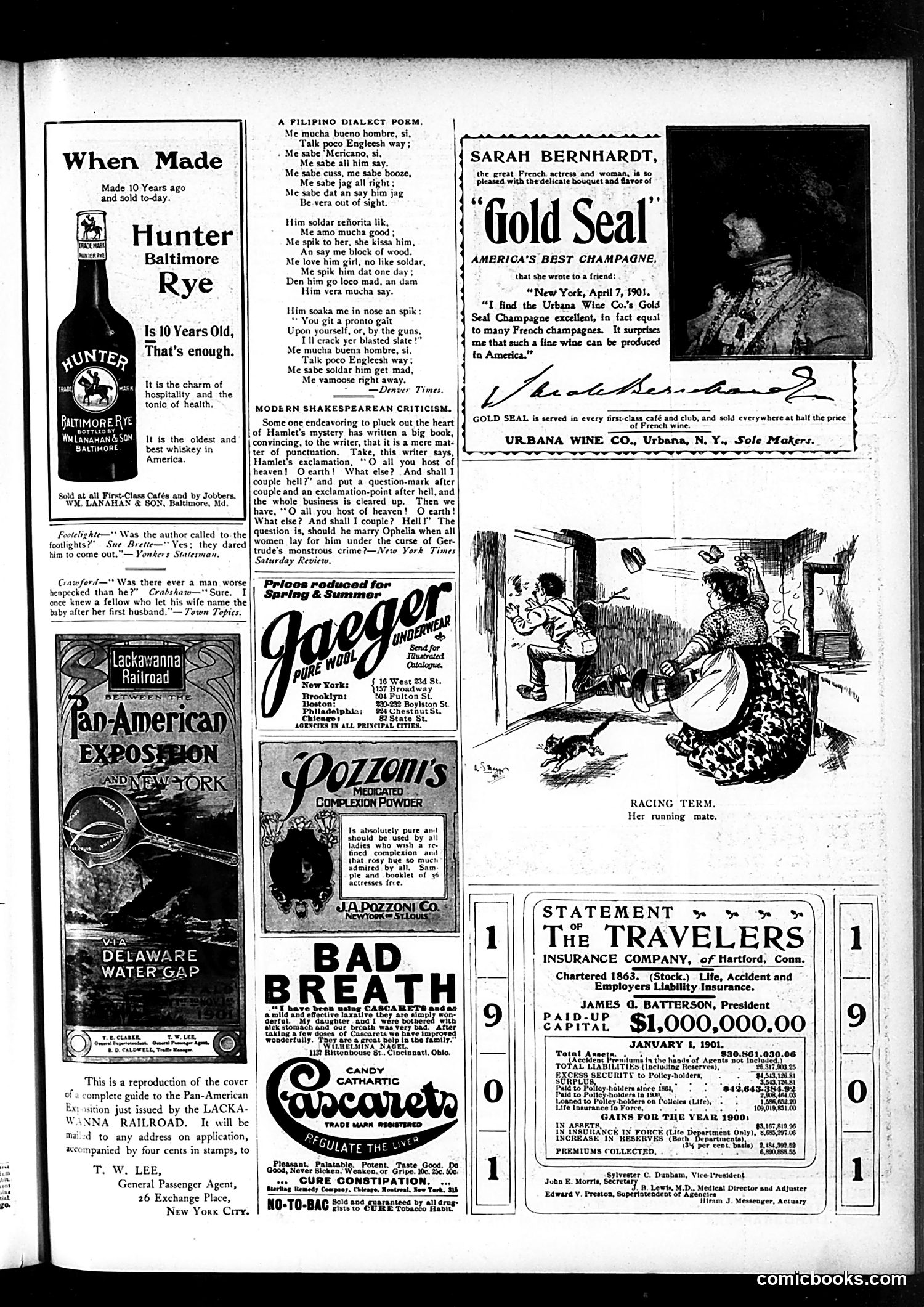
This page from *Judge* magazine is primarily **advertising**, with modest editorial content. **Key elements:** The main cartoon is a "Racing Term" illustration captioned "Her running mate"—a domestic scene depicting a woman chasing a man with a broom. This is a pun: the woman is literally his "running" companion, playing on political terminology ("running mate"). The page also includes: - A **"Pilipino Dialect Poem"** satirizing Filipino English and depicting an American soldier's romantic jealousy in broken English stereotypes—reflecting contemporary American imperial attitudes during the Philippine-American War era. - **Literary satire** mocking academic over-analysis of Shakespeare's *Hamlet*. - **Ads** for whiskey, champagne, railroad excursions, cosmetics, and insurance. The satirical humor relies on ethnic caricature (Filipino dialect) and domestic humor (nagging wife), both conventions of early-1900s American comedy magazines. The page reflects period anxieties about colonialism, marriage, and cultural superiority typical of *Judge*'s editorial voice.
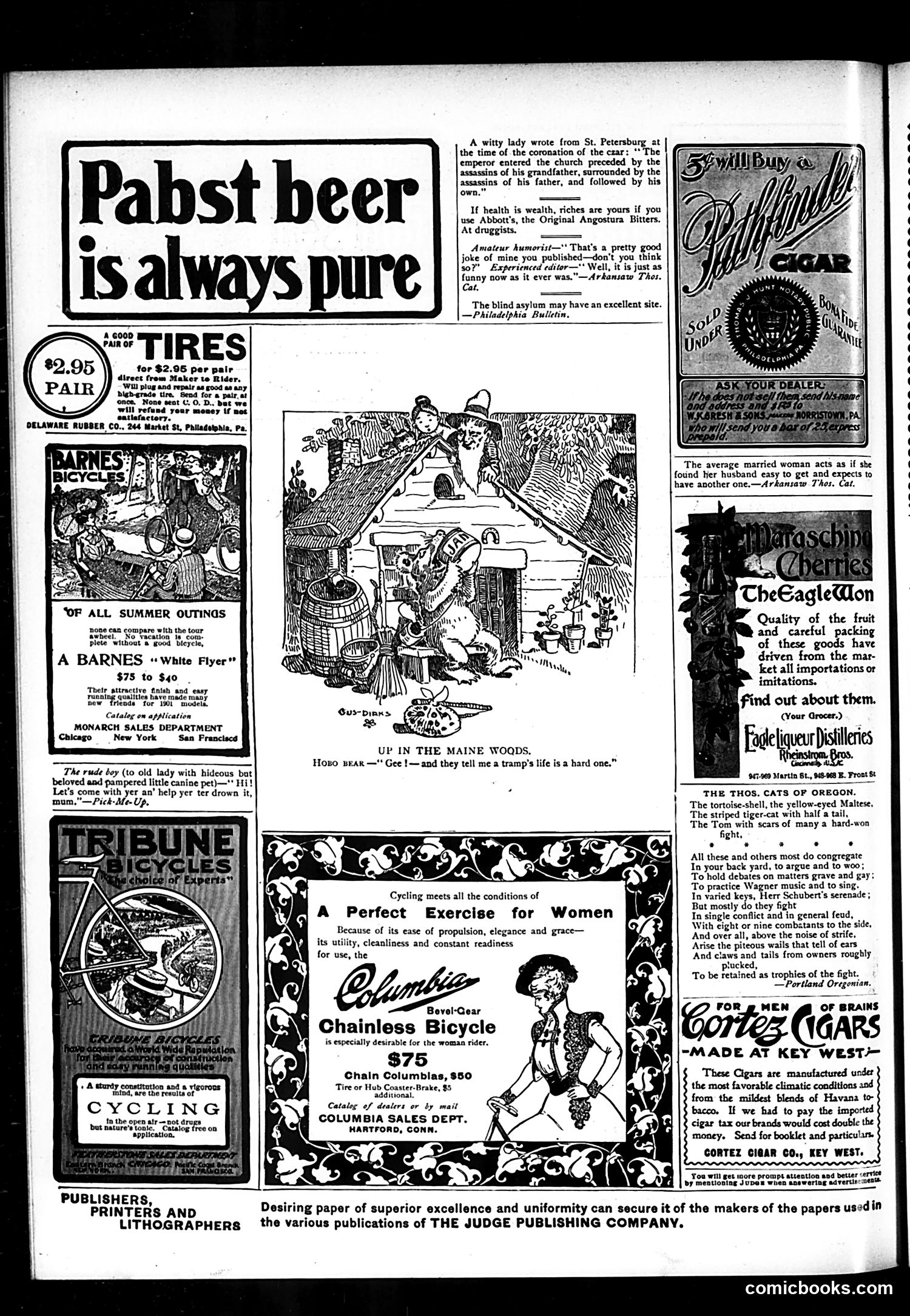
This page is primarily **advertising with minimal editorial cartoon content**. The main satirical elements are brief: **The Editorial Jokes:** - A quip about the Russian Czar's coronation (referencing political assassinations in the imperial family) - Amateur humorist vs. experienced editor exchanging barbs about joke quality - Various one-liners about married women, blind asylums, and a rude boy **The Central Cartoon:** "Up in the Maine Woods" depicts a hobo claiming his life is easy—ironic social commentary on hobos' actual hardships during the early 1900s. **The Advertisements:** Dominate the page, promoting bicycles (especially "chainless" models marketed to women as "perfect exercise"), tires, cigars, and various products typical of 1901. The Columbia bicycle ad notably emphasizes women's safety and comfort—reflecting contemporary debates about women's mobility and independence. The page reflects Judge's dual purpose: satirizing contemporary society while serving as a profitable advertising vehicle for consumer goods.
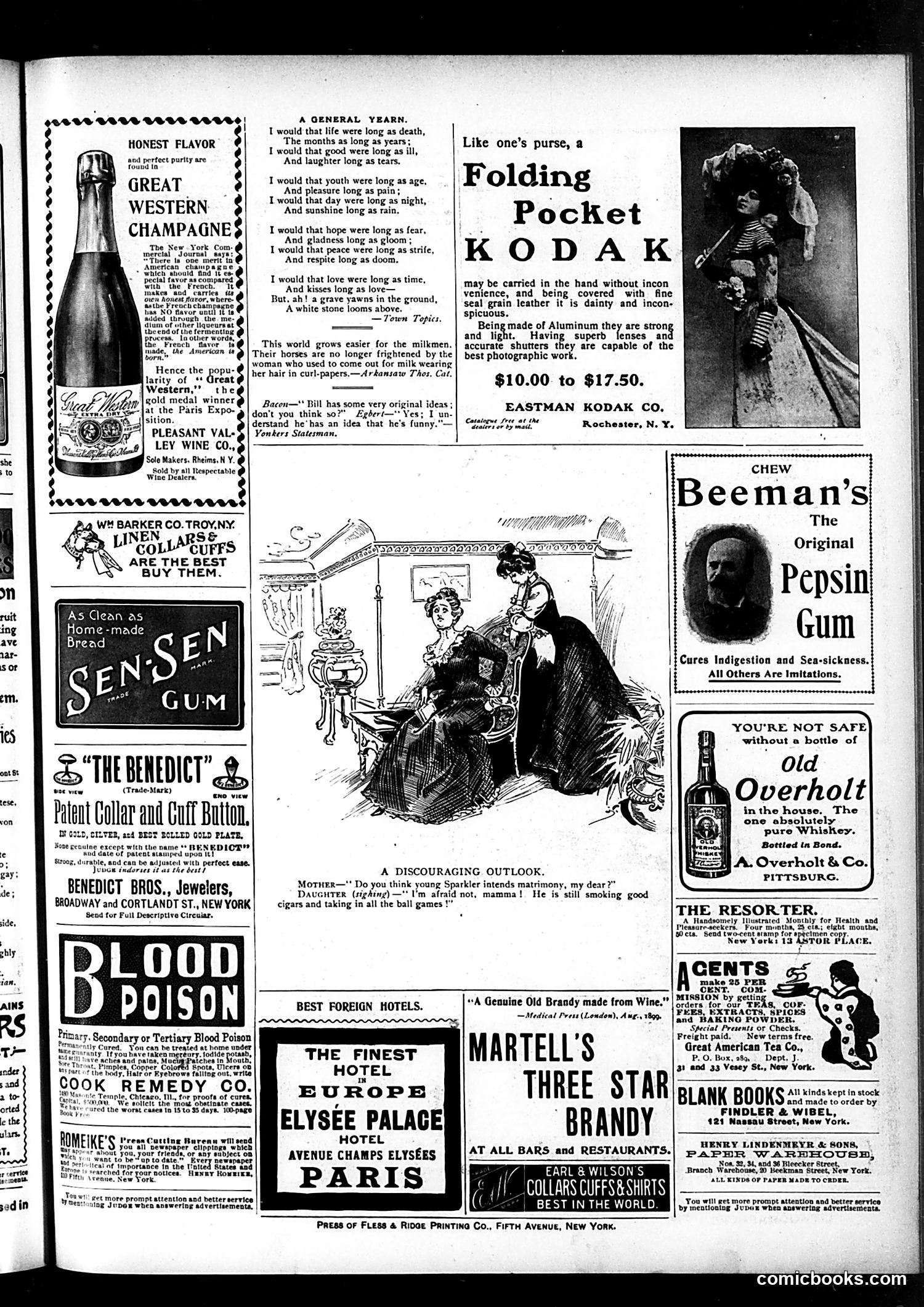
This page is primarily **advertising** with one small cartoon. The main cartoon titled "A Discouraging Outlook" depicts a mother and daughter discussing a young man named Sparkler. The daughter expresses doubt he intends marriage because he continues smoking cigars and attending baseball games—suggesting his leisure pursuits indicate he's not serious about matrimony. This reflects early-1900s social attitudes about male responsibility and courtship signals. The page is otherwise filled with period product advertisements (champagne, gum, collar buttons, blood poison remedies, hotels, brandy, tea) typical of Judge's era. The poetry at top ("A General Yearn") appears unrelated to satire—it's sentimental verse. The Kodak ad and other commercial notices dominate the layout, showing how magazines like Judge sustained themselves through advertising revenue while maintaining satirical content.
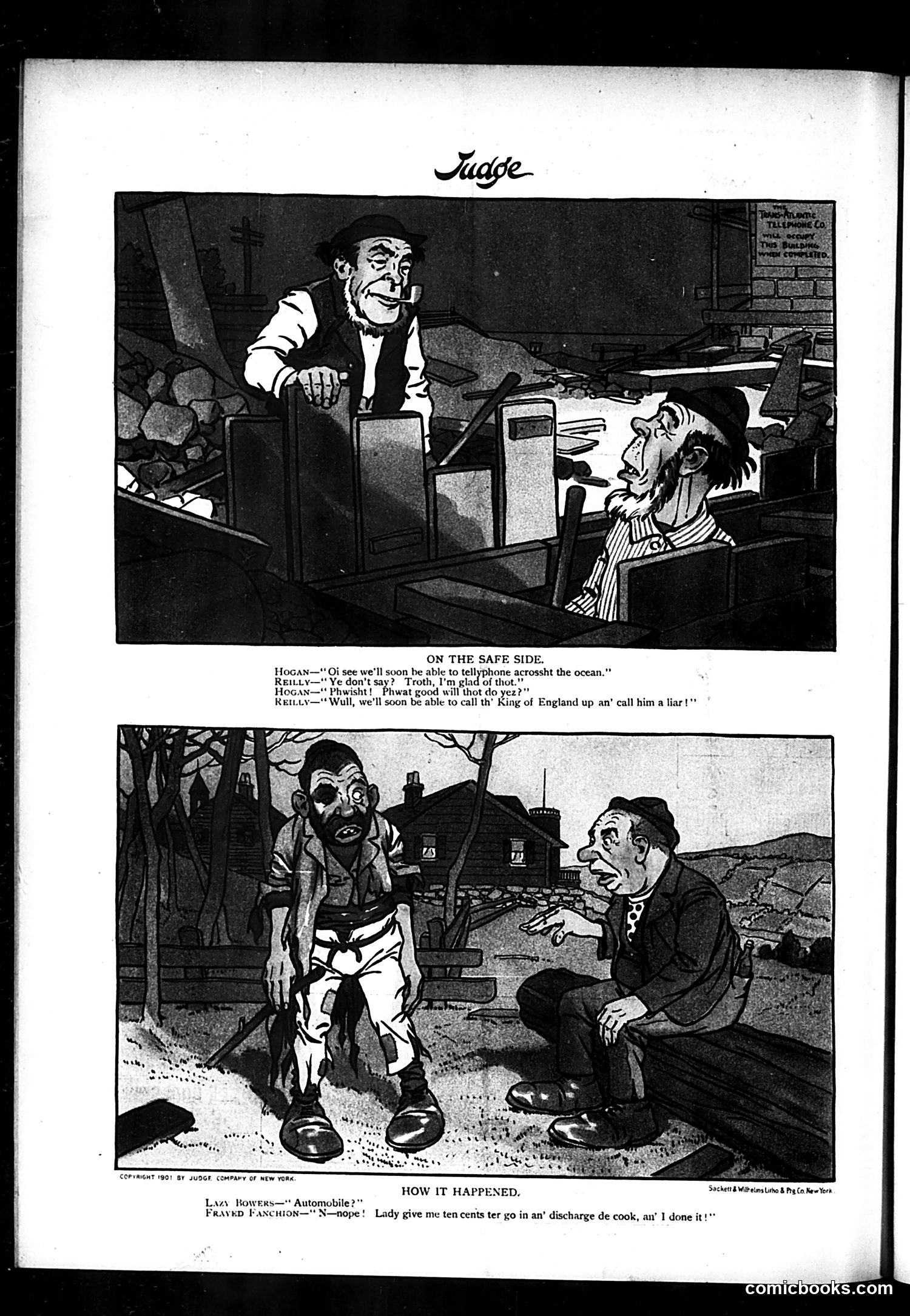
**Top cartoon ("On the Safe Side"):** Two Irish-coded characters discuss transatlantic telephone technology. The joke satirizes Irish-American immigrants' antagonism toward British authority. One character expresses eagerness to insult the King of England via telephone once the technology enables it—treating the new invention as an opportunity for safe, long-distance insubordination. The humor relies on ethnic stereotypes of Irish anti-British sentiment and the novelty of telephone technology circa 1901. **Bottom cartoon ("How It Happened"):** A poorly dressed man ("Lazy Bow") describes obtaining ten cents from a wealthy lady to fire her cook—but pockets the money instead. The joke plays on class dynamics and working-poor dishonesty: he accepted payment for a task he claims to have completed but clearly didn't. Both cartoons use caricature and dialect to reinforce period stereotypes about immigrants and the working poor.