
Judge, 1901-06-01 · page 3 of 16
Judge — June 1, 1901 — page 3: what you’re looking at
What you’re looking at
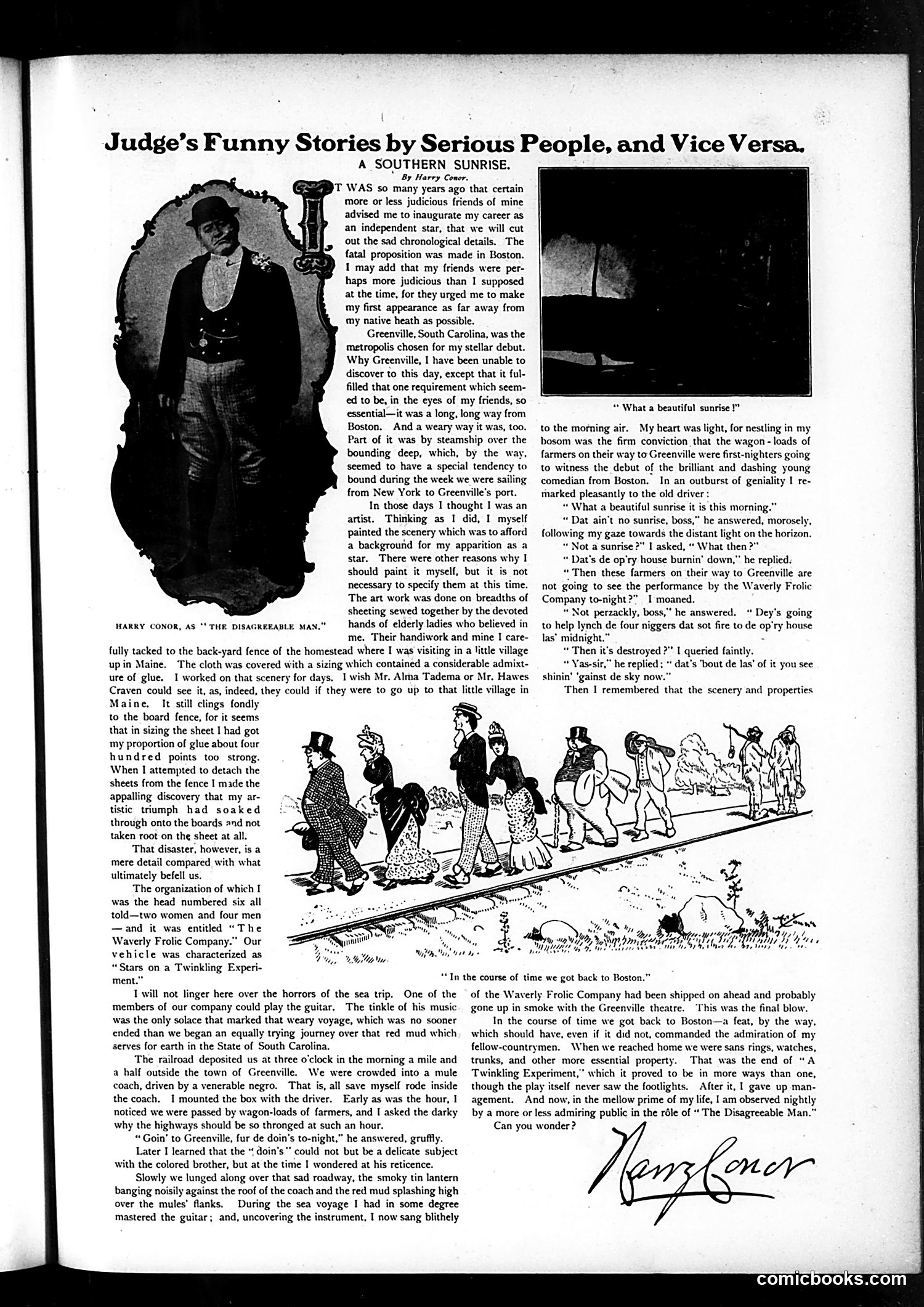
This article recounts Harry Conor's early theatrical career, specifically his debut as an "independent star" in Greenville (location unclear, likely South Carolina based on references). The piece is humorous memoir rather than political satire. The narrative describes Conor's journey from Boston to a small village, his attempt at scenic painting for theatrical backdrops, and a disastrous "Waverly Frolic Company" production. The story includes comedic details about a coach journey where he discusses a sunrise with an old driver, and mishaps during the theatrical performance. The accompanying illustrations show period costumes and a group traveling by coach. This appears to be entertainment-focused humor celebrating theatrical life's absurdities rather than political commentary.
📄 Transcribed text from this page (OCR, searchable)
Machine-transcribed from the original scan — historical spelling and the odd misread are preserved.
HARRY CONOR, AS "THE DISAGREEABLE MAN.” fully tacked to the back-yard fence of the homestead where I was Judge’s Funny Stories by Serious People, and Vice Versa. A SOUTHERN SUNRISE. By Harry Conor. )T WAS so many years ago that certain more or less judicious friends of mine advised me to inaugurate my career as an independent star, that we will cut out the sad chronological details. The fatal proposition was made in Boston. I may add that my friends were per- haps more judicious than I supposed at the time, for they urged me to make my first appearance as far away from my native heath as possible. Greenville, South Carolina, was the metropolis chosen for my stellar debut. Why Greenville, I have been unable to discover to this day, except that it ful- filled that one requirement which seem- ed to be, in the eyes of my friends, so essential—it was a long, long way from Boston. And a weary way it was, too. Part of it was by steamship over the bounding deep, which, by the way, seemed to have a special tendency to bound during the week we were sailing from New York to Greenville’s port. In those days 1 thought I was an artist. Thinking as I did, I myself painted the scenery which was to afford a background for my apparition as a star. There were other reasons why I should paint it myself, but it is not necessary to specify them at this time. The art work was done on breadths of sheeting sewed together by the devoted hands of elderly ladies who believed in me. Their handiwork and mine I care- iting in a little village up in Maine. The cloth was covered with a sizing which contained a considerable admixt- ure of glue, I worked on that scenery for d. I wish Mr. Alma Tadema or Mr. Hawes Craven could see it, as, indeed, they could if they were to go up to that little village in Maine. It still clings fondly to the board fence, for it seems that in sizing the sheet I had got my proportion of glue about four hundred points too strong. When I attempted to detach the sheets from the fence I made the appalling discovery that my ar- tistic triumph had soaked through onto the boards and not taken root on the sheet at all. That disaster, however, is a mere detail compared with what ultimately befell us. ‘The organization of which I was the head numbered six all told—two women and four men —and it was entitled “The Waverly Frolic Company.” Our vehicle was characterized as “Stars on a Twinkling Experi- ane : 3 me “ de aN upd SS ne YY, “ What a beautiful sunrise !” to the morning air. My heart was light, for nestling in my bosom was the firm conviction that the wagon - loads of farmers on their way to Greenville were first-nighters going to witness the debut of the brilliant and dashing young comedian from Boston. In an outburst of geniality 1 re- tharked pleasantly to the old driver : “ What a beautiful sunrise it is this morning.” “ Dat ain't no sunrise, boss,” he answered, morosely, following my gaze towards the distant light on the horizon. “ Not a sunrise?" I asked, What then?” * Dat’s de op'ry house burnin’ down,” he replied. “Then these farmers on their way to Greenville are not going to see the performance by the Waverly Frolic Company to-night?” I moaned. “* Not perzackly, boss,” he answered.“ Dey's going to help lynch de four niggers dat sot fre to de op'ry house las’ midnight.” “Then i ” Yas-sir, shinin’ ‘gainst de sky now. Then I remembered that the scenery and properties | queried faintly. + dat’s ‘bout de las’ of it you see Pew WY ye aene? ‘In the course of time we got back to Boston.” T will not linger here over the horrors of the sea trip. One of the members of our company could play the guitar. The tinkle of his music was the only solace that marked that weary voyage, which was no sooner ended than we began an equally trying journey over that red mud which serves for earth in the State of South Carolina. The railroad deposited us at three o'clock in the morning a mile and a half outside the town of Greenville. We were crowded into a mule coach, driven by a venerable negro. That is, all save myself rode inside the coach. I mounted the box with the driver. Early as was the hour, I noticed we were passed by wagon-loads of farmers, and I asked the darky why the highways should be so thronged at such an hour. “ Goin’ to Greenville, fur de doin’s to-night,” he answered, gruffly. Later I learned that the “ doin’s” could not but be a delicate subject with the colored brother, but at the time I wondered at his reticence. Slowly we lunged along over that sad roadway, the smoky tin lantern banging noisily against the roof of the coach and the red mud splashing high over the mules’ flanks. During the sea voyage I had in some degree mastered the guitar; and, uncovering the instrument, I now sang blithely of the Waverly Frolic Company had been shipped on ahead and probably gone up in smoke with the Greenville theatre. ‘This was the final blow. In the course of time we got back to Boston—a feat, by the way, which should have, even if it did not, commanded the admiration of my fellow-countrymen. When we reached home we were sans rings, watches, trunks, and other more essential property. That was the end of “A Twinkling Experiment,” which it proved to be in more ways than one, though the play itself never saw the footlights. After it, I gave up man- agement. And now, in the mellow prime of my life, I am observed nightly by a more or less admiring public in the réle of “ The Disagreeable Man.” Can you wonder? Cla comicbooks.com