
Judge, 1901-06-01 · page 10 of 16
Judge — June 1, 1901 — page 10: what you’re looking at
What you’re looking at
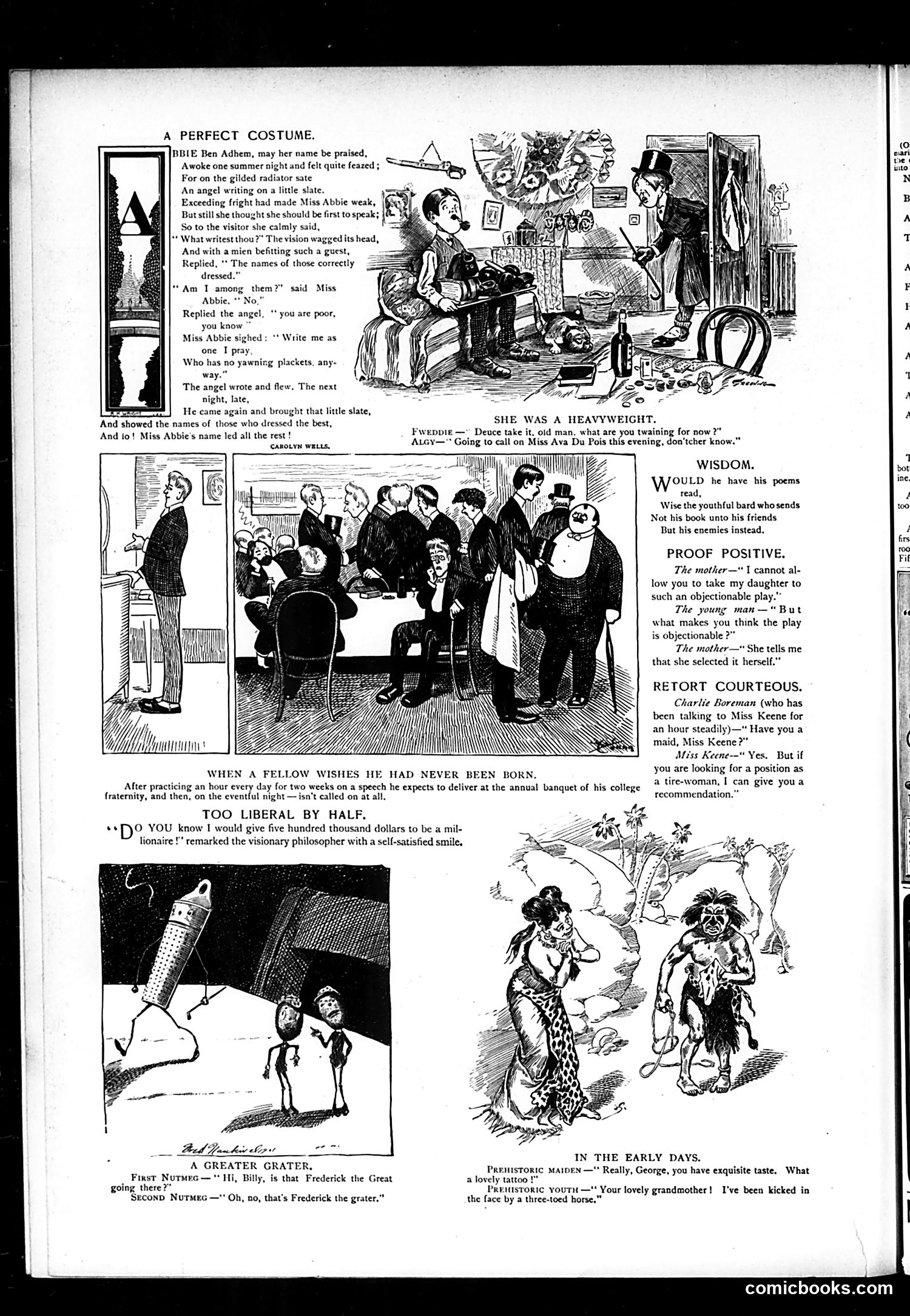
This page contains several brief satirical pieces typical of early 20th-century American humor: **"A Perfect Costume"** parodies Leigh Hunt's poem "Abou Ben Adhem." An angel records the names of the "correctly dressed," but poor Miss Abbie doesn't qualify—the satire mocks both rigid class distinctions and the obsession with proper appearance among the wealthy. **"When a Fellow Wishes He Had Never Been Born"** ridicules a college fraternity member who practices a banquet speech for two weeks only to never be called upon—skewering both verbose oratory culture and social embarrassment. **"Too Liberal By Half"** jokes about a visionary philosopher who claims he'd give $500,000 to become a millionaire—absurd logic that satirizes grandiose but impractical philosophical posturing. **"A Greater Grater"** is a pun: "Frederick the Great" becomes "Frederick the grater" (kitchen tool). **"In the Early Days"** presents prehistoric humor about a woman complimenting a man's tattoo, revealed as a kick-mark from a three-toed horse—crude slapstick suggesting "primitive" courtship. The humor throughout relies on wordplay, social pretension, and gentle ridicule of contemporary manners.
📄 Transcribed text from this page (OCR, searchable)
Machine-transcribed from the original scan — historical spelling and the odd misread are preserved.
A PERFECT COSTUME. BBIE Ben Adhem, may her name be praised, Awoke one summer night and felt quite feazed ; For on the gilded radiator sate An angel writing on a little slate. Exceeding fright had made Miss Abbie weak, But still she thought she should be first to spea! So to the visitor she calmly said, ++ What writest thou 2” The vision wagged its head, And with a mien befitting such a guest, Replied, ** The names of those correctly dressed.” **Am I among them?" said Miss Abbie, ** No,” Replied the angel, ** you are poor, you know Miss Abbie sighed: “* Write me as one I pray Who has no yawning plackets, any- way.” The angel wrote and flew. The next night, late, 3 becca He came again and brought that little slate, And showed the names of oes who dressed the best, SHE WAS A HEAVYWEIGHT. — . oT MZ WwisboM. Bas ” s Na Ze Qa WOUED he have his poems read, Wise the youthful bard who sends Not his book unto his friends But his enemies instead. PROOF POSITIVE. The mother—" 1 cannot al- low you to take my daughter to such an objectionable play.” The young man—“But what makes you think the play is objectionable ?” The mother—* She tells me that she selected it herself.” , K RETORT COURTEOUS. Charlie Boreman (who has si \ = S| been talking to Miss Keene for Miss Keene— Yes. But if WHEN A FELLOW WISHES HE HAD NEVER BEEN BORN. youare ae fof 8 postion as After practicing an hour every day for two weeks on a speech he expects to deliver at the annual banquet of his college * "'e-woman, I can give you a fraternity, and then, on the eventful night — isn't called on at all, recommendation. TOO LIBERAL BY HALF, **P)O YOU know I would give five hundred thousand dollars to be a mil lionaire !" remarked the visionary philosopher with a self-satisfied smile, Bed Gran tuic chip = = 5 = IN THE EARLY DAYS. . A GREATER GRATER, PrenisToRic MAIDEN —"* Really, George, you have exquisite taste. What First Nutmec—** Hi, Billy, is that Frederick the Great a lovely tattoo !" going there 2” ’ . ; Preiistoric youru — Your lovely grandmother! I've been kicked in Seconp Nurmec—"* Oh, no, that's Frederick the grater.” the face by a three-toed horse.” comicbooks.com