
A complete issue · 20 pages · 1901
Judge — May 11, 1901
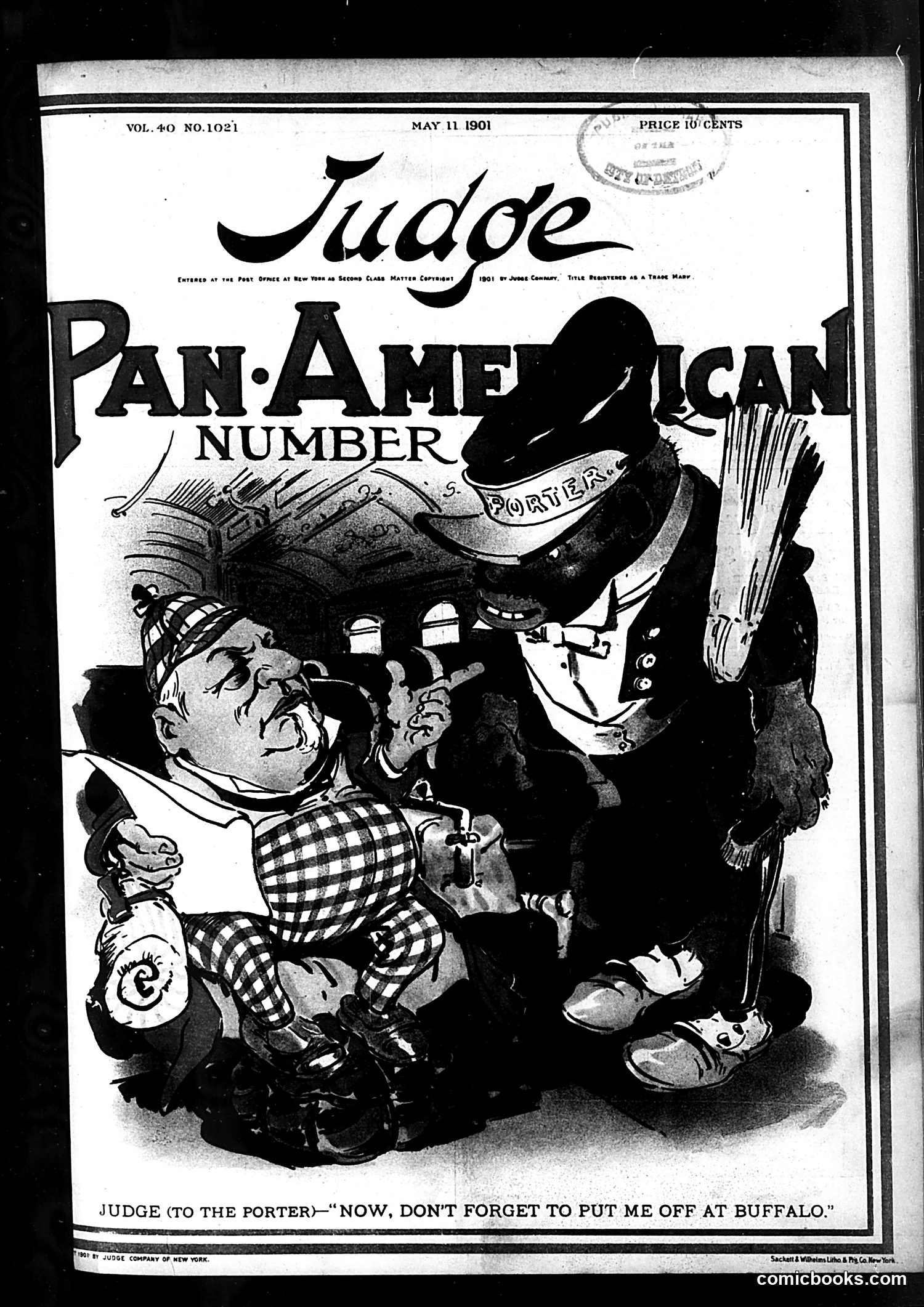
This "Pan-American Number" satirizes the Pan-American Exposition held in Buffalo in 1901. The cartoon depicts a portly figure labeled "Judge" (representing the magazine itself or American authority) dressed as a porter, speaking to a well-dressed traveler. The porter's checkered uniform and exaggerated facial features suggest caricature of working-class labor. The caption—"Now, don't forget to put me off at Buffalo"—plays on the double meaning of "put off" (to disembark/to dismiss or deceive). The joke likely mocks either the logistics of the exposition or satirizes American pretensions regarding the international event. The illustration style and imagery reflect early 20th-century satirical cartooning conventions, though the specific political target requires additional historical context about 1901 events.
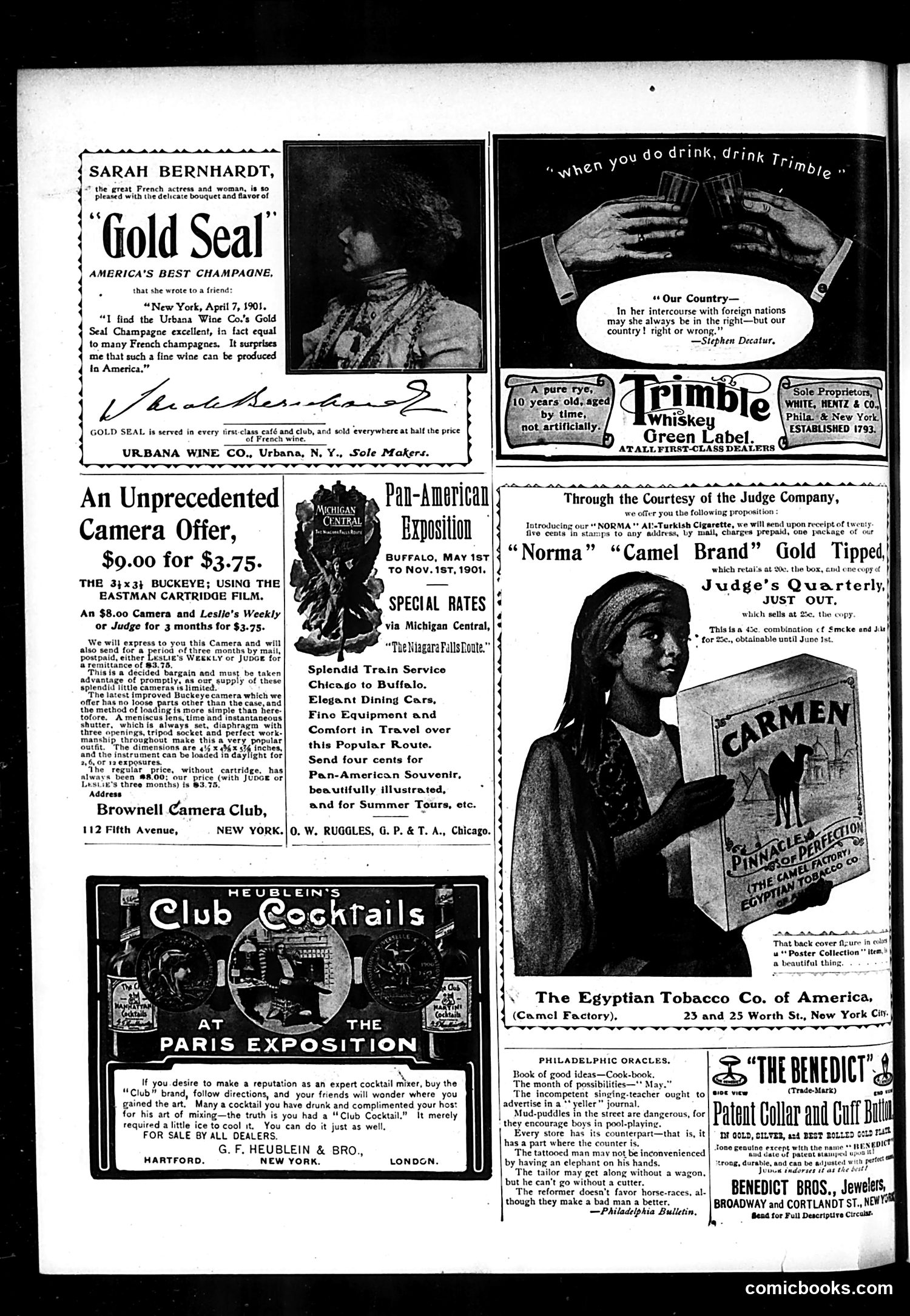
This page is primarily **advertising** with minimal satirical content. The ads include: - **Gold Seal Champagne**: Features actress Sarah Bernhardt endorsing the wine as superior to French champagne - **Trimble Whiskey**: Shows hands toasting, with a Stephen Decatur quote about national pride - **Camera equipment and Pan-American Exposition promotions** - **Egyptian Tobacco (Camel)**: Advertises cigarettes with a woman holding a pack - **Club Cocktails**: Heubleins brand promotes cocktail mixers at the Paris Exposition The only satirical element is "**Philadelphic Oracles**"—brief humorous observations about human nature (incompetent teachers, tattooed men, reformers). The page reflects **early 1900s consumer culture**, with prominent product endorsements and leisure activities. There's no significant political cartoon or social commentary beyond the minor humor column.
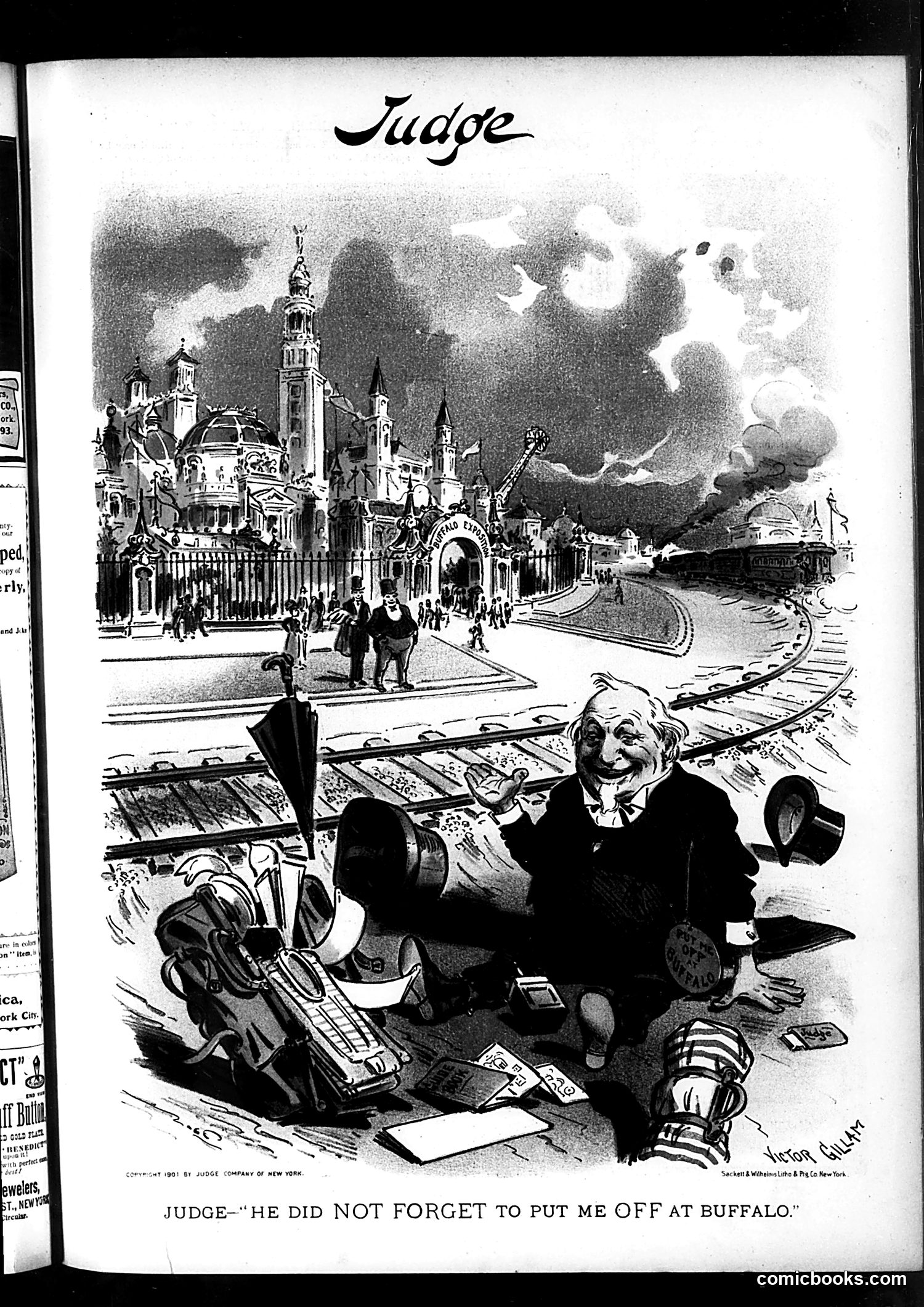
This Judge magazine cartoon satirizes a prominent figure who neglected to arrange proper transportation after a public appearance in Buffalo. The caricatured character sits amid scattered luggage and travel goods near railroad tracks, with an ornate building (likely representing Buffalo's civic architecture) in the background. The caption—"HE DID NOT FORGET TO PUT ME OFF AT BUFFALO"—suggests someone was deliberately abandoned or overlooked for travel arrangements, likely a joke about political negligence or poor hospitality. The exaggerated facial features and surrounding clutter emphasize the humiliation of the situation. Without additional context identifying the specific figure, the cartoon appears to mock either a politician's forgetfulness or deliberate slight during an official visit, making it a personal attack wrapped in travel-mishap humor.
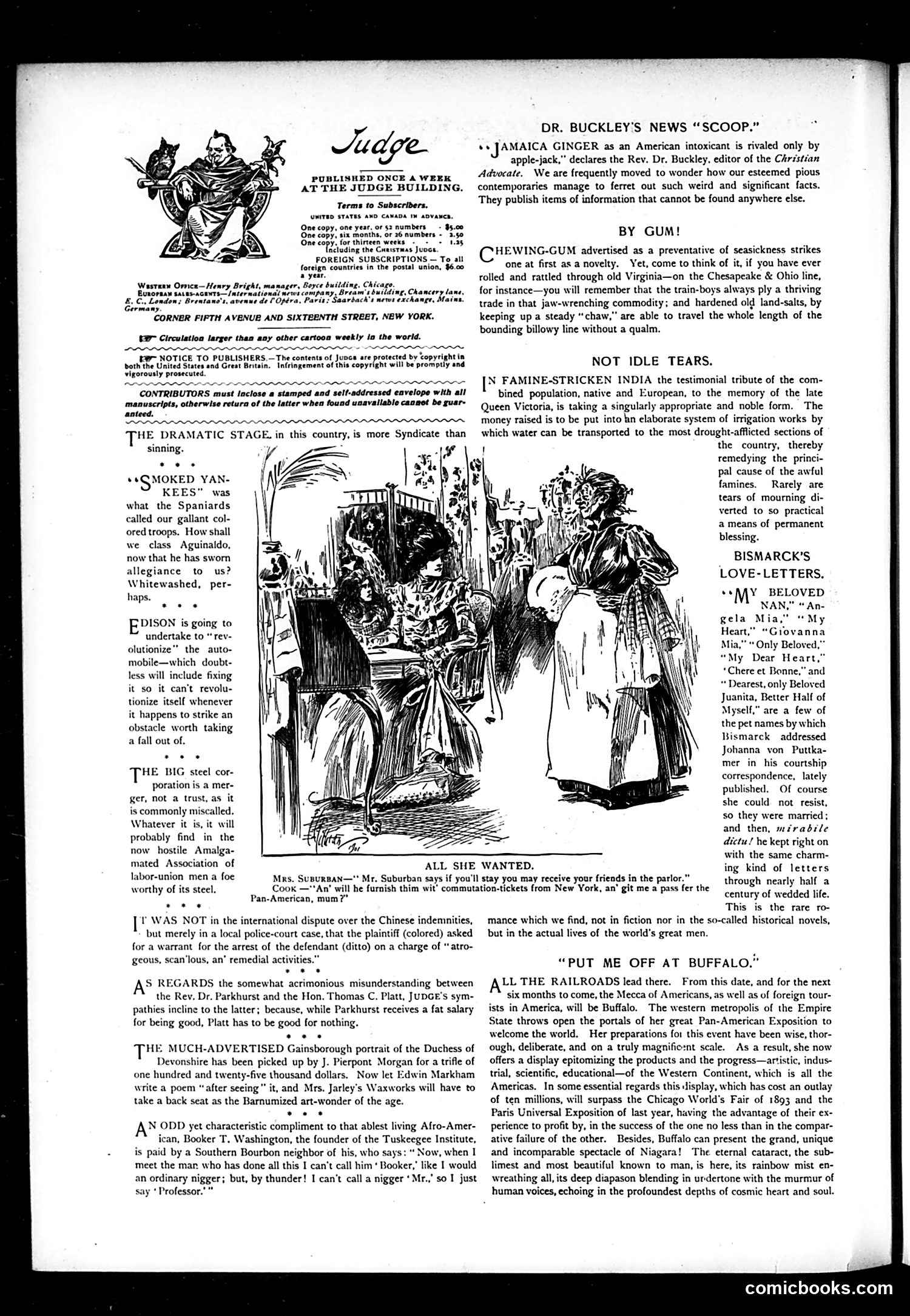
The main cartoon depicts **Mrs. Suburban** entertaining guests in her parlor, offering them "commutation-tickets from New York" and a "pass for the Pan-American." The satire targets wealthy suburban residents who ostentatiously display their travel privileges and cosmopolitan access to impress social visitors—treating railroad passes as status symbols of leisure and sophistication. The surrounding text includes commentary on various topics: Edison's automobile innovations, railroad corporations, and Bismarck's love letters. The "Put Me Off at Buffalo" section discusses Buffalo's ambitions to rival Chicago and the Paris Exposition through development and tourism promotion. The humor relies on mocking nouveau-riche social pretension and the performance of upper-class status through displays of travel access rather than genuine cultural refinement.
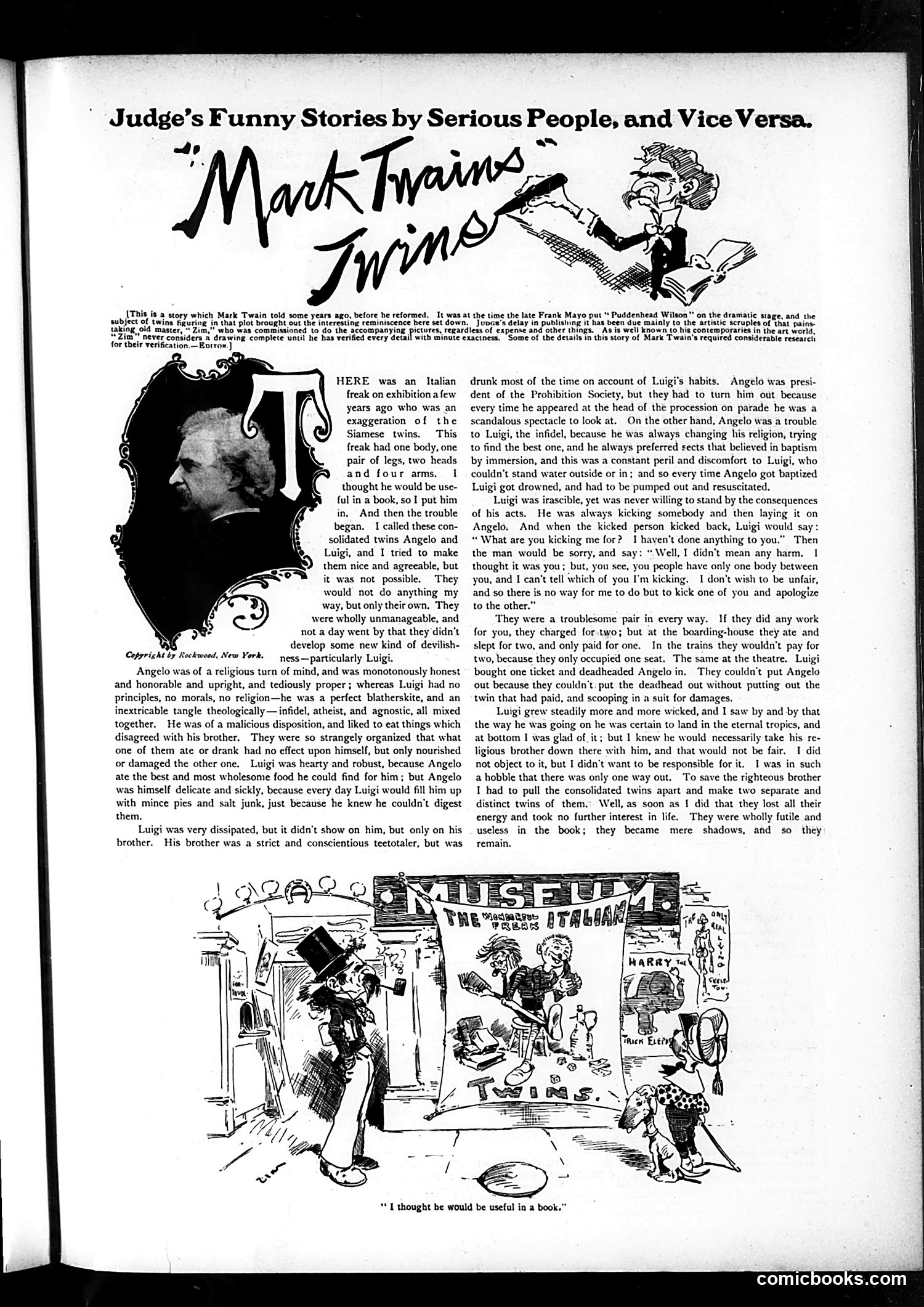
This page presents Mark Twain's humorous narrative about conjoined twins—one body with two heads and four arms—named Angelo and Luigi. The story uses their physical condition as a vehicle for moral and behavioral satire. The satire works through ironic contrast: Angelo is pious, honest, and a Prohibition Society president, yet appears disreputable because Luigi's dissipation affects their shared body. Luigi is an irreligious, unprincipled troublemaker who faces no physical consequences for his actions—his brother suffers them instead. When Luigi commits violence, he denies responsibility since his body shows no damage. The humor lies in this inverted logic: the morally upright Angelo is publicly shamed by his brother's vices, while the unprincipled Luigi escapes natural consequences. The story satirizes how moral character and physical appearance don't align, and how responsibility can be evaded through technicality or circumstance—particularly resonant in an era of Prohibition and religious hypocrisy.
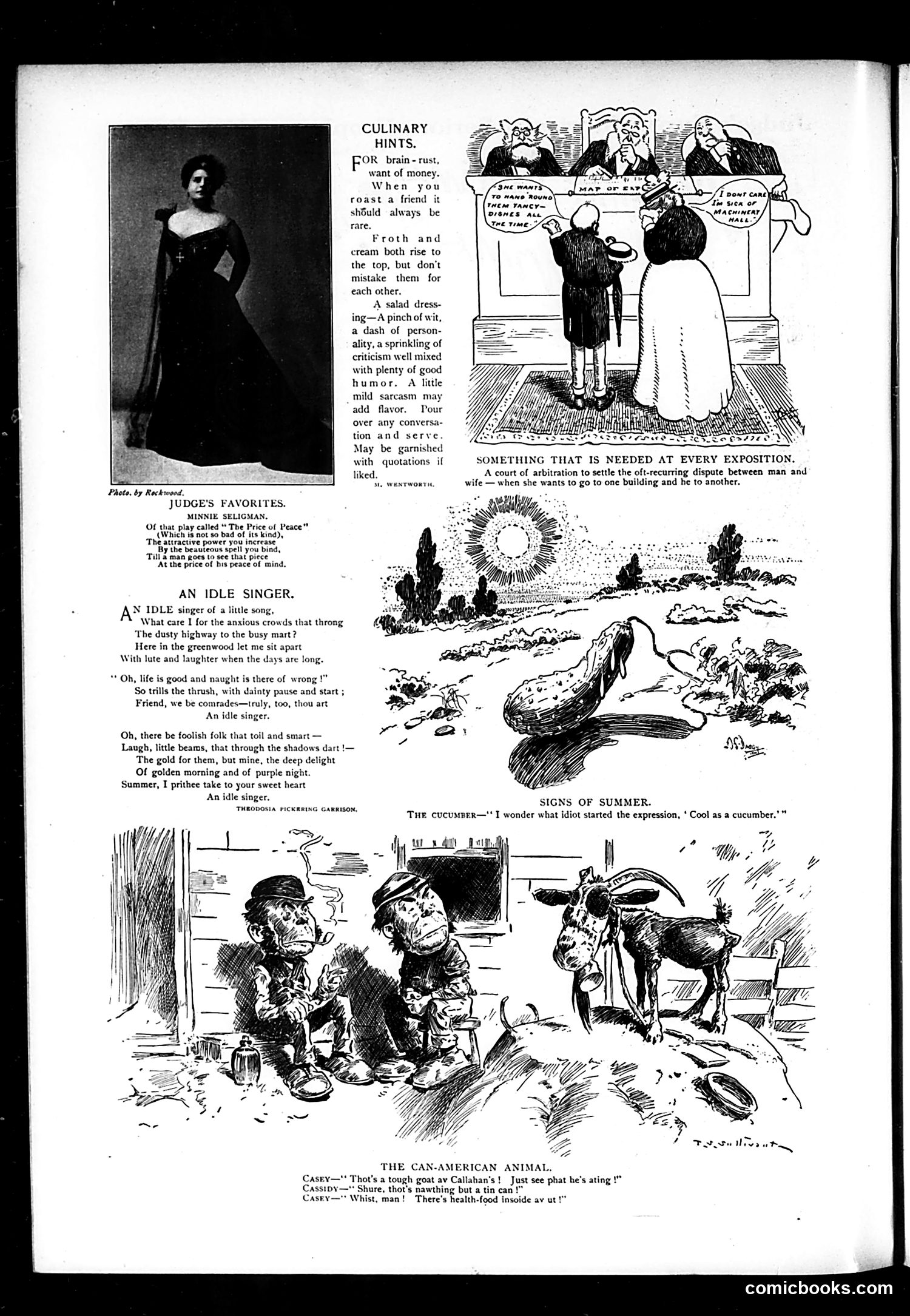
This page contains mixed content typical of Judge magazine's satirical format: **"Culinary Hints"** offers mock-serious cooking advice using food metaphors for social commentary—"roasting a friend," seasoning conversations with wit and sarcasm. It's genteel wordplay for educated readers. **"Something That Is Needed at Every Exposition"** depicts a marital dispute at a public fair, satirizing the common domestic disagreement about which building to visit—a relatable joke about married couples' conflicting interests at exhibitions. **"An Idle Singer"** is sentimental poetry celebrating pastoral leisure, likely parodying contemporary romantic verse. **"Signs of Summer"** features the "Cool as a Cucumber" joke about the expression's origins. **"The Can-American Animal"** (bottom) shows two Irish immigrants discussing a goat eating a tin can, joking that the "health food inside" justifies consumption. This relies on period ethnic stereotyping of Irish-Americans and working-class dietary practices as comical. The page blends gentle domestic satire with cruder ethnic humor typical of 1890s-era Judge magazine.
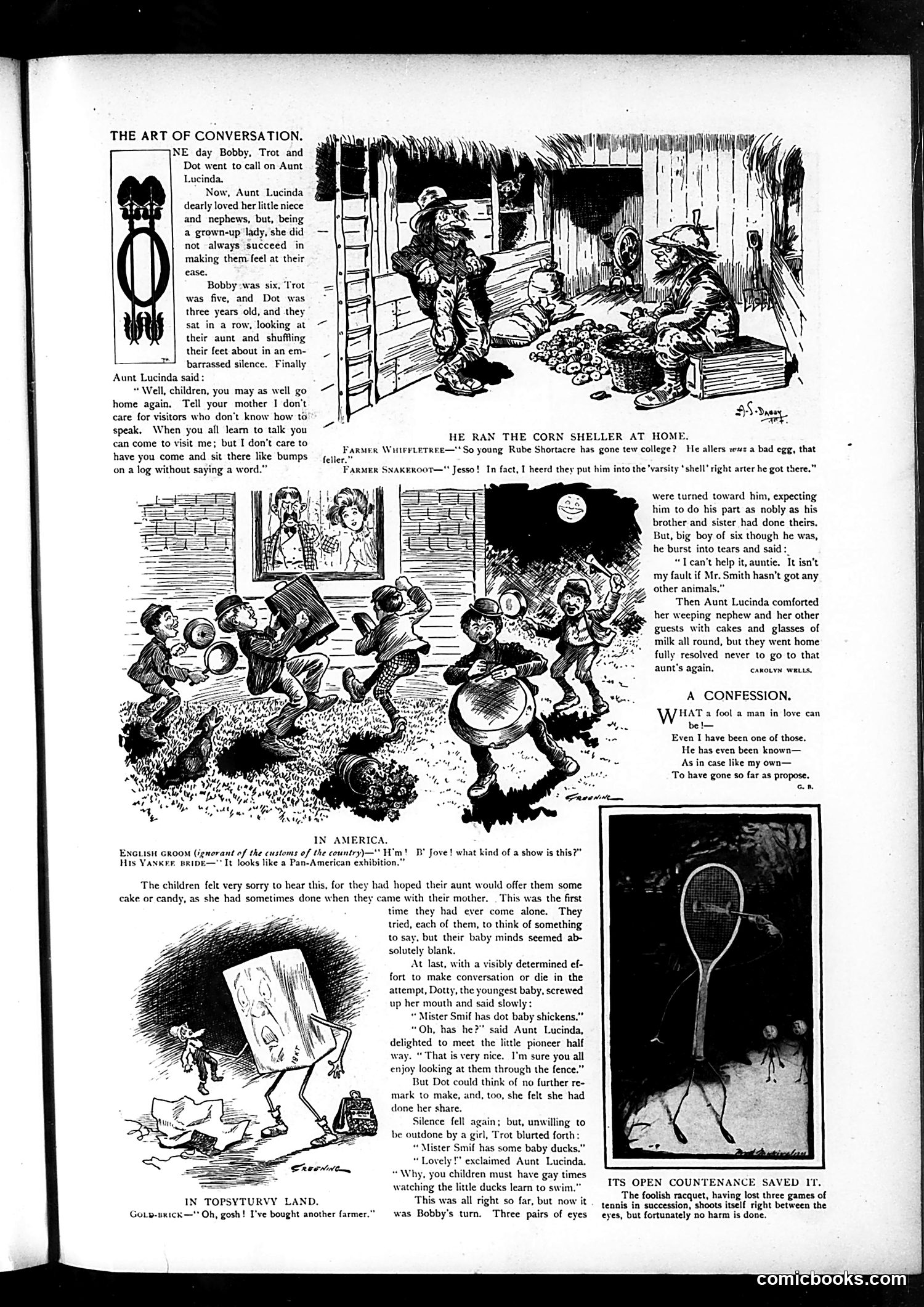
This page contains three separate humorous pieces typical of Judge's satirical style: **"The Art of Conversation"** is a children's story mocking rigid social etiquette. Aunt Lucinda represents Victorian-era propriety—she refuses to engage with children who sit silently, rudely dismissing them. The irony: when the children finally attempt conversation by mentioning their neighbor's farm animals, she becomes delighted. The satire targets adults' unreasonable expectations of children and the artificiality of "proper" conversation. **The farm dialogue** jokes about sending a poorly-behaved son to college, where he immediately joins the rowing team—suggesting colleges admitted troublemakers or that athletics was frivolous. **"A Confession"** is a brief poem about foolish romantic behavior, likely commenting on male vanity in courtship. **"In America"** mocks an English gentleman's confusion at American customs, specifically Pan-American exhibitions, suggesting cultural bewilderment at American spectacle. The page exemplifies Judge's target audience: educated, urbane readers amused by social commentary and gentle mockery of American life, class pretension, and generational differences.
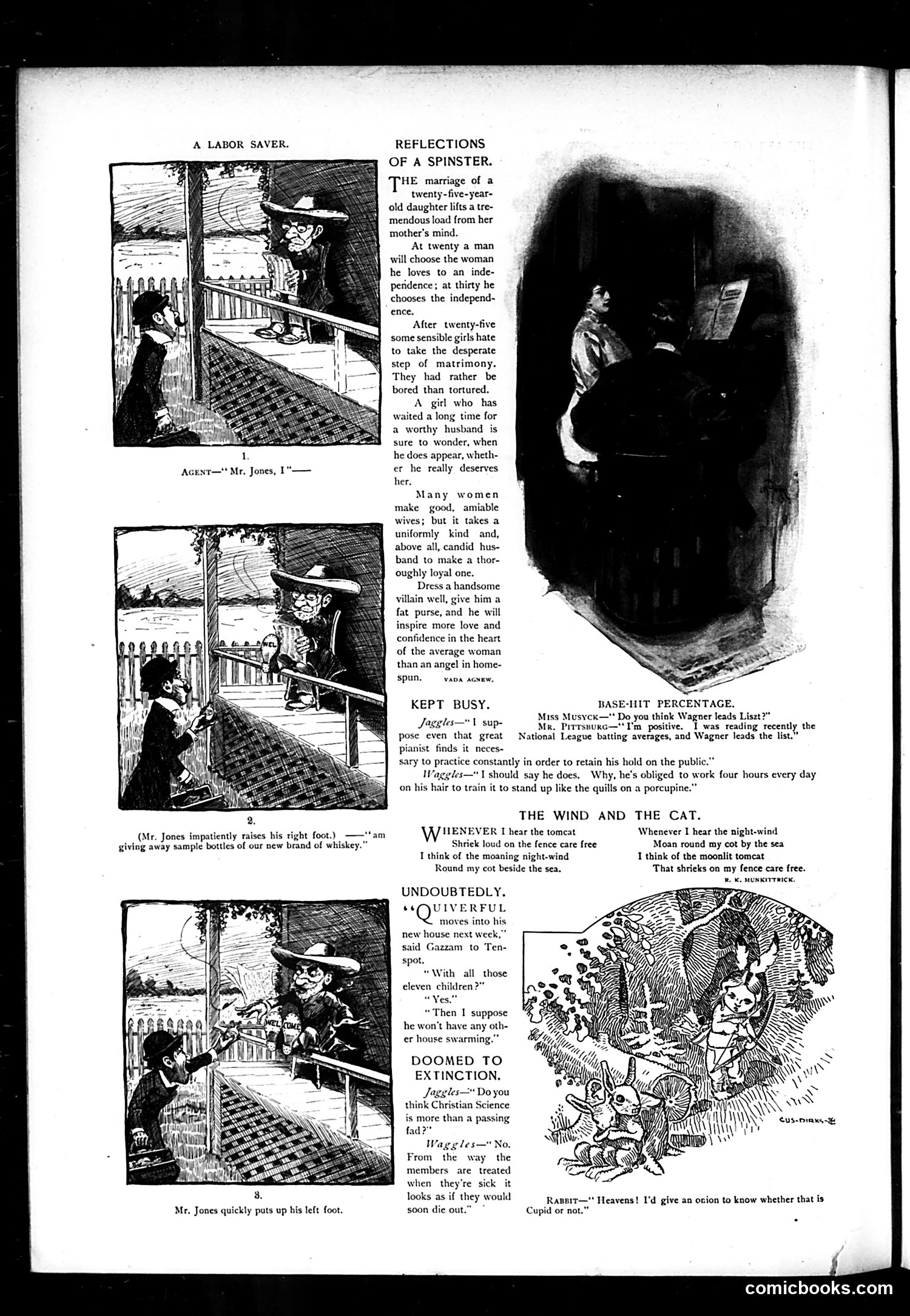
This page contains several short humor pieces typical of early-20th-century satirical magazines: **"A Labor Saver"** features a running joke about Mr. Jones demonstrating whiskey bottles to an agent—the humor lies in Jones repeatedly raising and lowering his feet to avoid the agent's sales pitch, suggesting the product is so undesirable it's physically repellent. **"Reflections of a Spinster"** is a column mocking marriage attitudes, suggesting women over 25 fear matrimony, husbands abandon romance for independence, and that a wealthy villain inspires more devotion than a virtuous poor man—satirizing both women's limited options and men's actual behavior. The remaining pieces are brief comic vignettes: musicians comparing Wagner and Liszt while confusing concert rankings with baseball statistics; a pseudo-poetic exchange comparing wind and cat noises; Christian Science being dismissed as a passing fad; and a final joke about distinguishing Cupid from something else (unclear from image). The humor targets contemporary attitudes about marriage, gender roles, entertainment, and religion through exaggeration and absurdist logic.
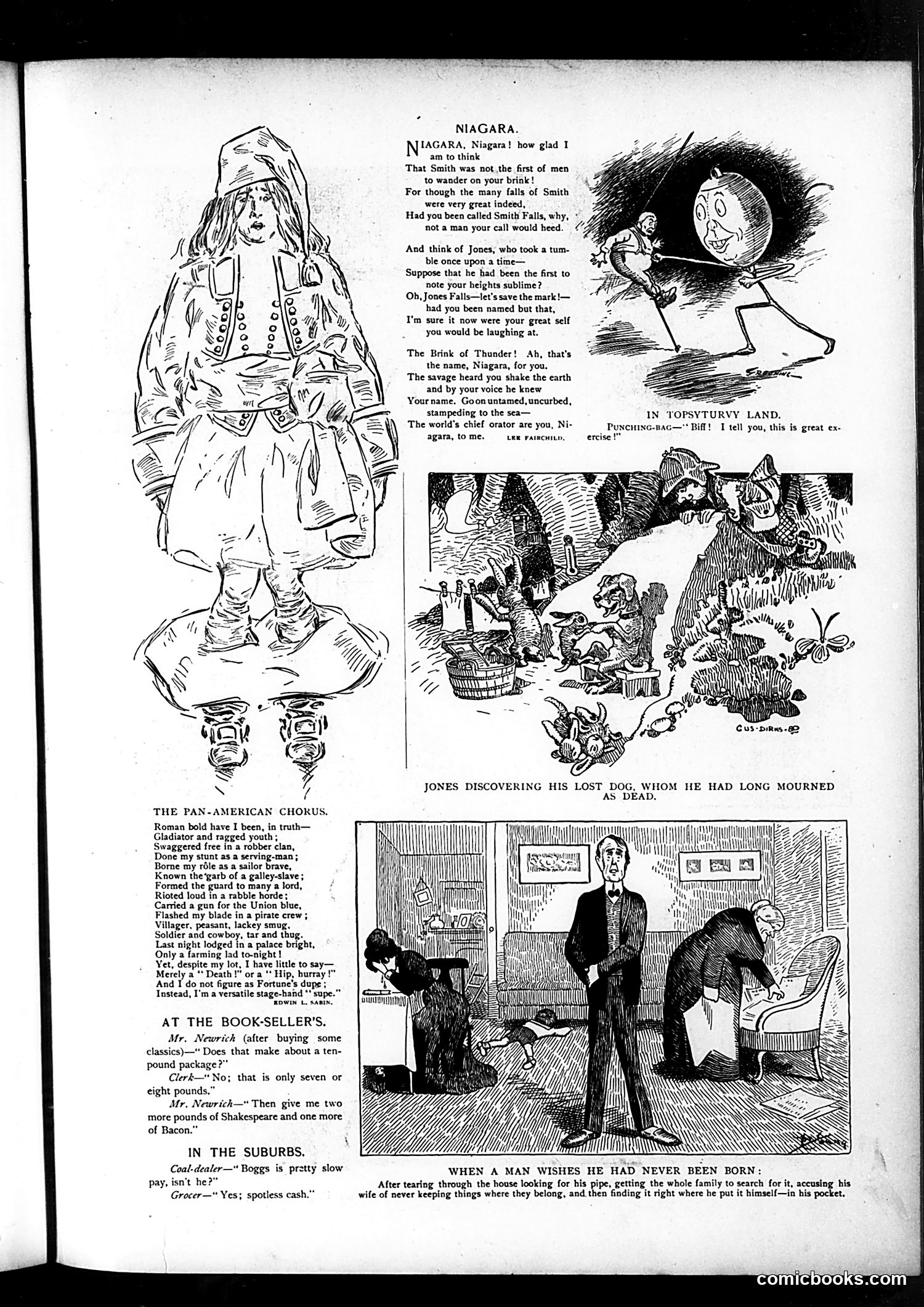
This Judge magazine page contains several discrete satirical pieces: **"Niagara"** is a humorous poem celebrating Niagara Falls' name. The satire mocks common surnames by imagining if the falls were named after ordinary people like "Smith Falls" or "Jones Falls"—suggesting the landmark owes its grandeur partly to its dignified name. **"The Pan-American Chorus"** appears to be verse about a versatile stage performer who's played many roles (soldier, pirate, peasant) but remains just a humble "supe" (supernumerary extra). **"At the Book-Seller's"** satirizes the newly wealthy Mr. Newrich, who buys classic literature by weight rather than understanding—he treats Shakespeare and Bacon as commodities to purchase by the pound, exposing his pretentious ignorance. **"When a Man Wishes He Had Never Been Born"** depicts domestic comedy: a man angrily tears the house apart searching for his pipe, only to discover he'd put it in his own pocket all along, embarrassing himself before his family. The cartoons mock vanity, social climbing, and domestic frustration rather than specific political figures.
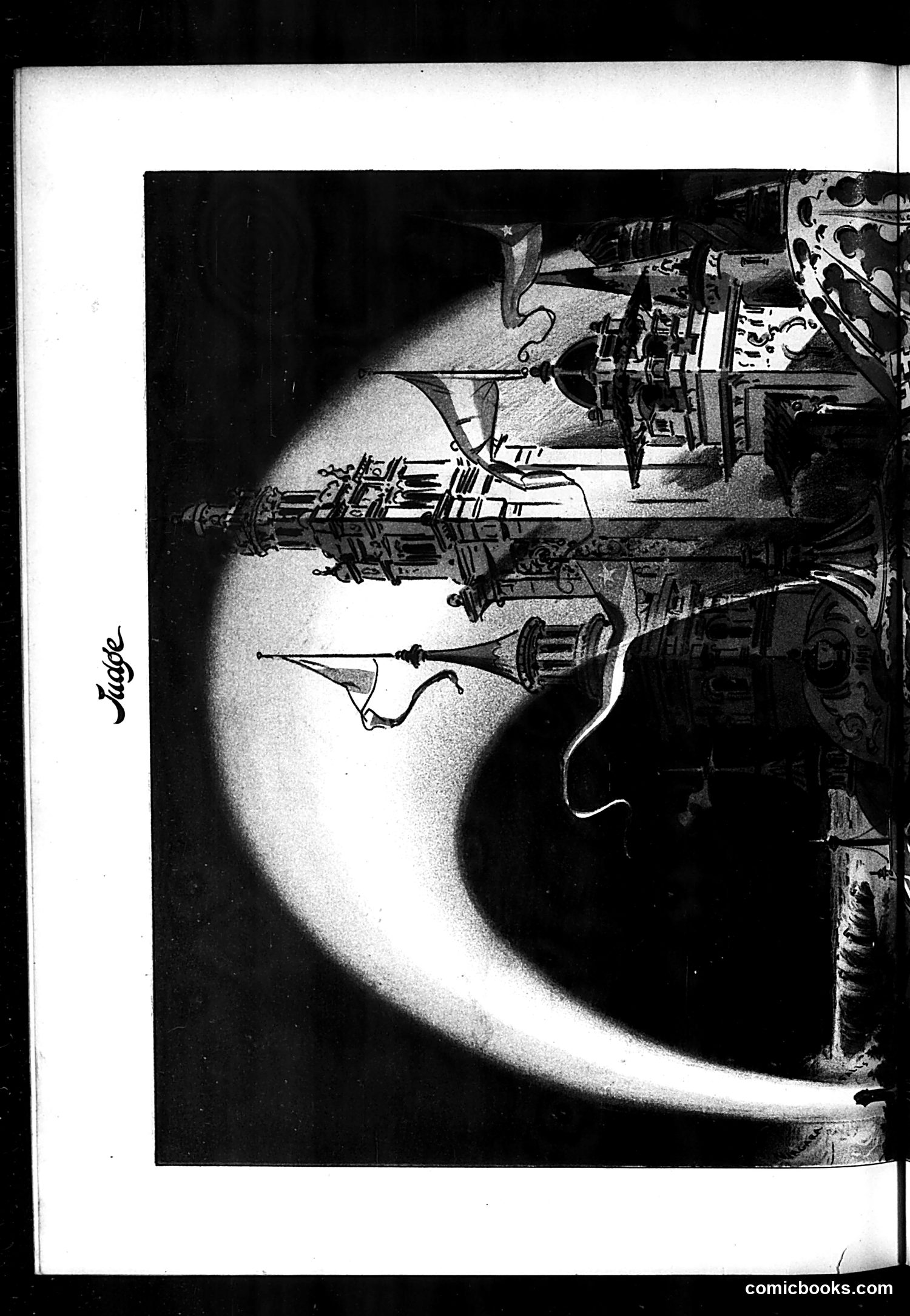
I can see this is a page from *Judge* magazine, but the image quality and orientation make it difficult to read the specific text and identify the particular cartoon with certainty. The page appears to show mechanical or industrial equipment photographed against a dark background with dramatic lighting. There's a signature that appears to read "Judge" on the left side. Without being able to reliably read the OCR'd text or clearly identify the specific figures and captions, I cannot confidently explain what political or social satire this cartoon presents to a modern reader. To provide accurate historical context, I would need clearer visibility of both the text and any human figures or labeled elements in the illustration.
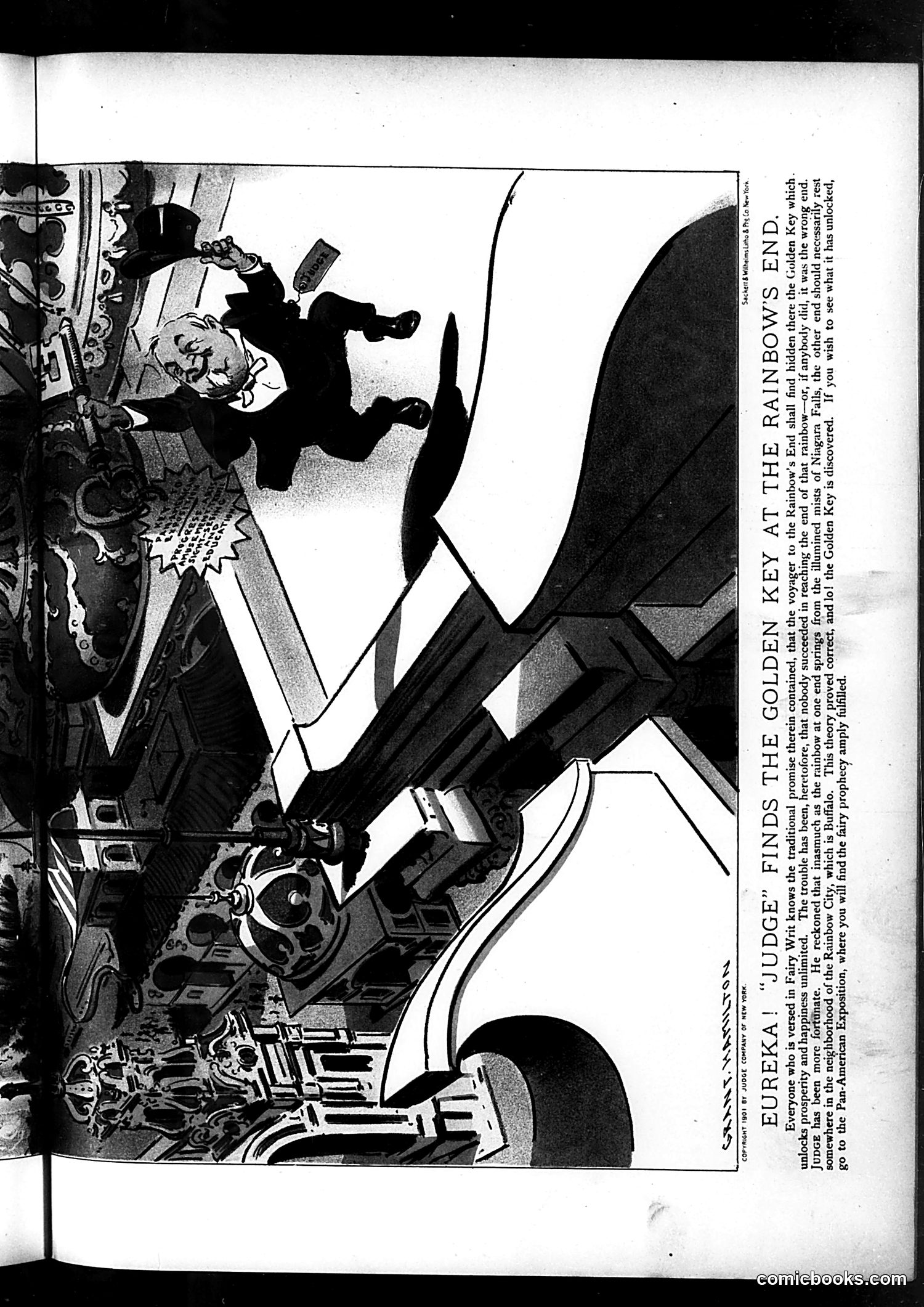
The OCR text is too corrupted to read reliably. However, the **image** shows a clear political cartoon: a large figure (appearing to be a politician or public official) is depicted upside-down or in an awkward, undignified position, with what looks like mechanical or industrial elements around them. The title references **"Eureka!"** and mentions finding "the golden key at the rainbow's end," suggesting this is satirizing someone's claimed discovery or solution to a problem—likely mocking false promises or incompetent leadership. Without legible text, I cannot identify the specific figure or historical reference with confidence. The style suggests early 20th-century American political satire from *Judge* magazine, but the exact target and context remain unclear from this page alone.
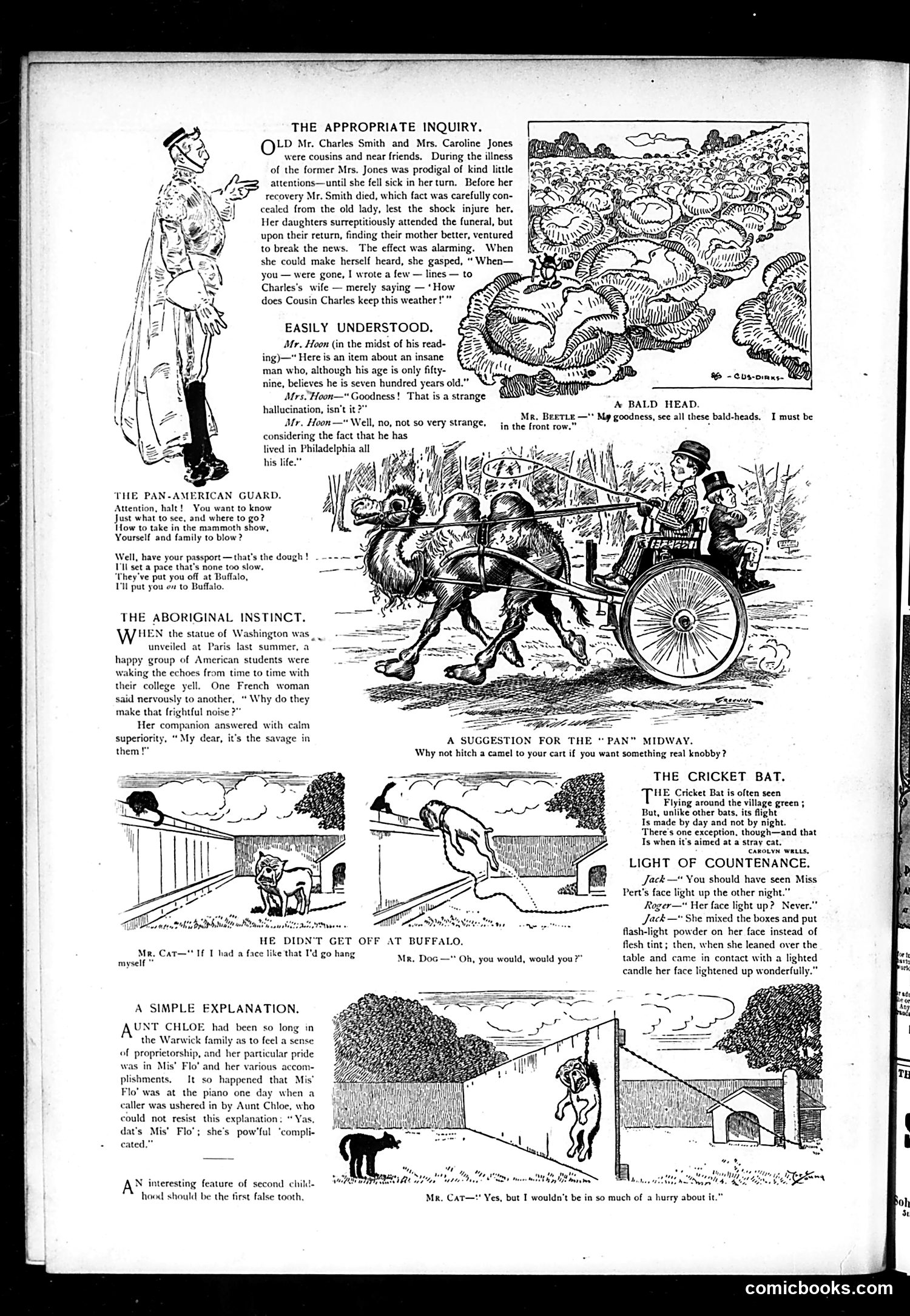
This page contains several unrelated humorous anecdotes and cartoon vignettes typical of Judge's satirical format: **"The Appropriate Inquiry"** mocks elderly people's absent-mindedness through a story about Mrs. Jones, who wrote to her deceased cousin without knowing he'd died. **"Easily Understood"** jokes about a Philadelphia man's delusion of extreme age, suggesting Philadelphia's conditions make people feel ancient. **"The Pan-American Guard"** satirizes the 1901 Pan-American Exposition in Buffalo, playing on "dough" (money) as the required "passport" for admission—critiquing commercialism. **"The Aboriginal Instinct"** contains period-typical racist commentary, mocking American college yells at a Paris unveiling as "savage." The remaining items are light comic observations: a cricket bat pun, a joke about flashlight powder on a woman's face, a dialect-heavy piece featuring "Aunt Chloe" (a Black servant character using period stereotypical speech), and brief animal humor. The page represents Judge's mix of social satire and genteel humor, with period attitudes about race evident throughout.
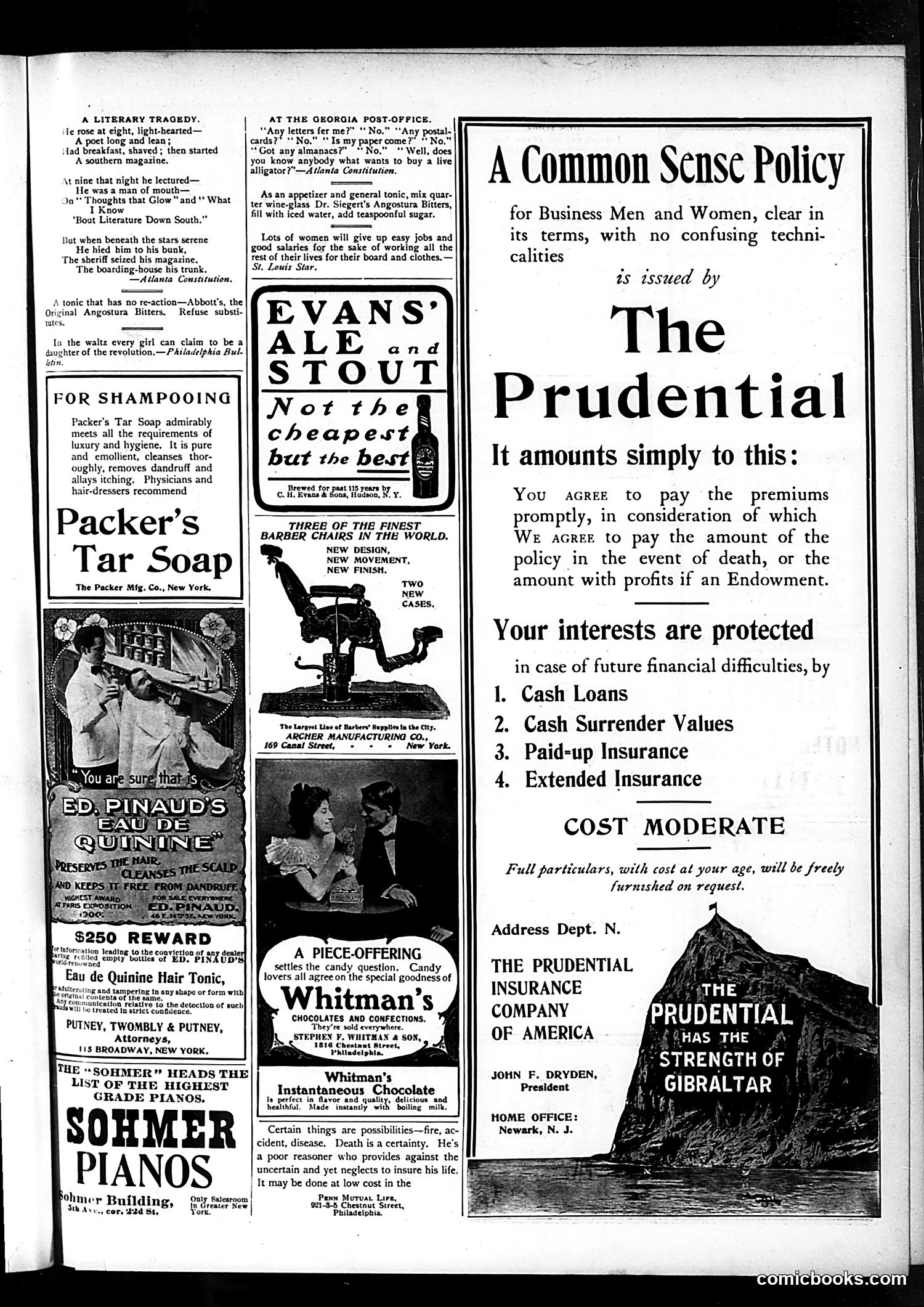
This page is primarily **advertising with minimal satirical content**. The main items are product and insurance advertisements typical of early 1900s publications. The only cartoon appears to be "A Literary Tragedy" at top left—a brief satirical poem about a Southern poet who loses his possessions after starting a magazine, likely mocking regional literary pretensions or censorship concerns in the South. The Georgia Post-Office section contains brief humorous observations about rural mail delivery and regional attitudes (e.g., customers asking about alligators), typical of *Judge*'s gentle regional humor. Otherwise, the page features conventional advertisements: Packer's Tar Soap, Sohmer Pianos, barber chairs, Whitman's Chocolates, and prominently, **The Prudential Insurance Company's "Common Sense Policy"** advertisement emphasizing straightforward, jargon-free insurance terms—a selling point suggesting competitors used confusing language. The page demonstrates how satirical magazines subsidized editorial content through advertising rather than subscriptions alone.
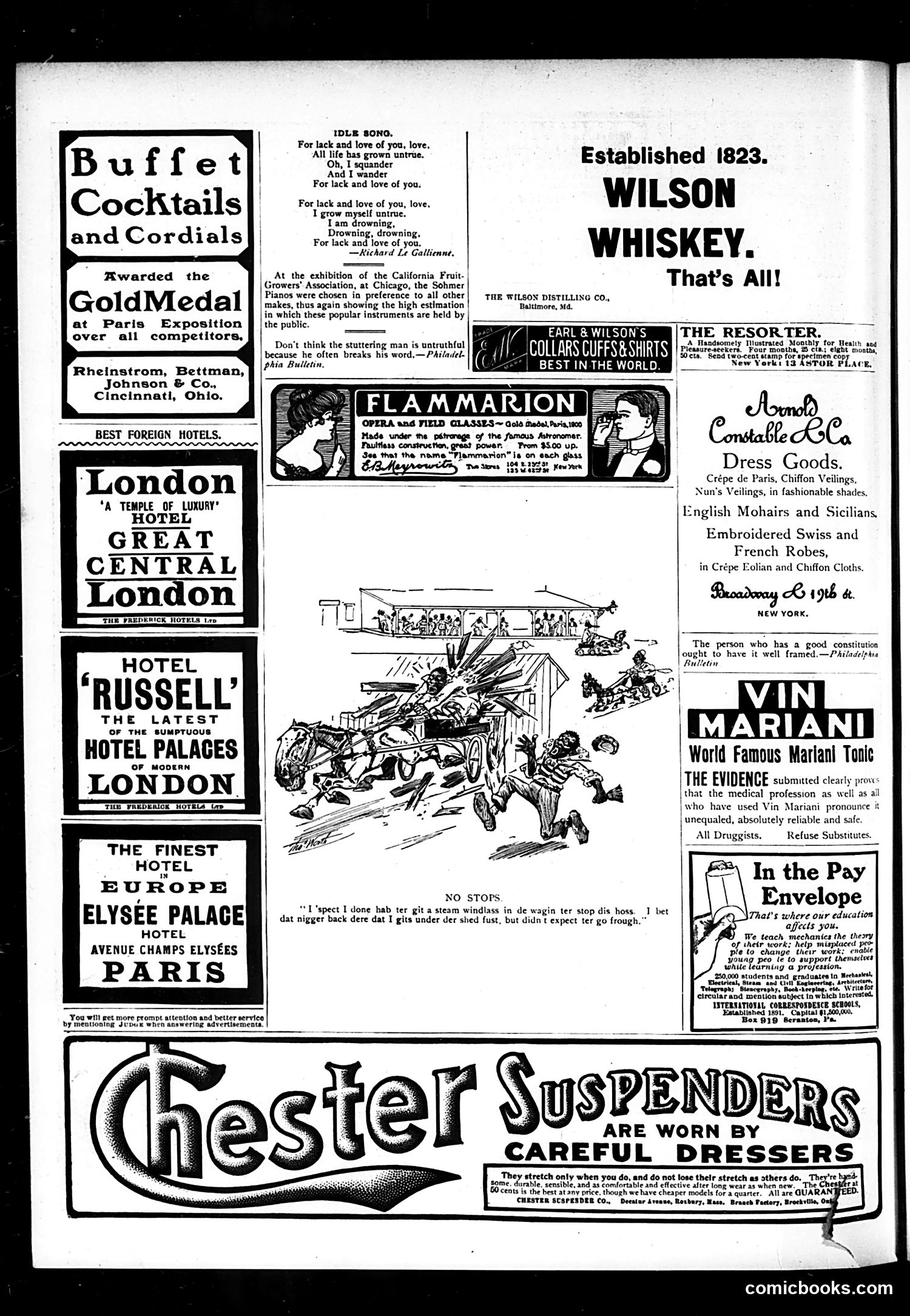
This page is primarily **advertising**, typical of early 20th-century magazines. The main content includes hotel advertisements (London hotels, Paris's Élysée Palace), product ads (Wilson Whiskey, Chester Suspenders, Vin Mariani tonic), and fashion/goods promotions. The sole cartoon appears in the center—a humorous scene depicting a man with a horse and wagon, with dialect-heavy caption: "I expect I done hab ter git a steam windlass in de wagin ter stop dis hoss." **The offensive element**: The caption uses a racist dialect and the phrase "dat nigger back dere," reflecting the casual racism common in early 20th-century American humor magazines. The joke concerns a man struggling to control a horse, but modern readers should recognize this represents the deeply prejudiced humor standards of the era—not satire of racism, but rather racism presented as comedy. The page otherwise showcases period consumer goods and services alongside this problematic content, illustrating how normalized such racist stereotyping was in mainstream publications of this time.
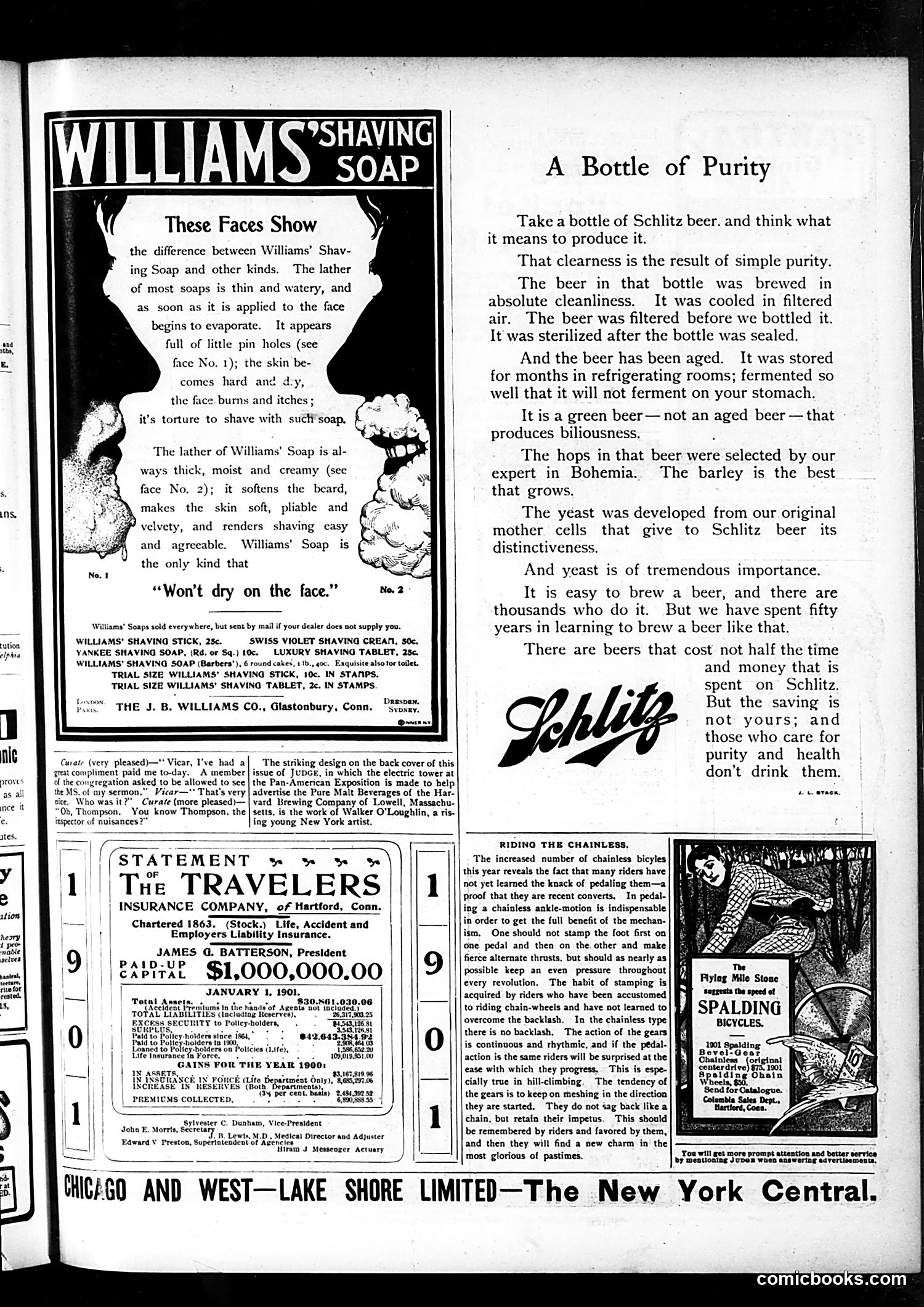
This is primarily an **advertising page** from Judge magazine (circa 1901, based on the Travelers Insurance Company statement dated January 1, 1901). The page contains three major advertisements with no political cartoons: 1. **Williams' Shaving Soap**: A before-and-after comparison showing two faces—one irritated (Face No. 1, thin lather) versus one comfortable (Face No. 2, thick lather). The satire is gentle product advertising disguised as consumer education. 2. **Schlitz Beer**: An extensive text advertisement emphasizing "purity" through detailed description of filtration, sterilization, and aging processes. This reflects early-1900s advertising's appeal to scientific progress and safety concerns (relevant given recent food-safety scandals of that era). 3. **Supporting advertisements** for bicycles, insurance, and other products. **Notable context**: The Schlitz beer ad's emphasis on purity and scientific brewing reflects genuine consumer anxieties about contaminated food and drink in the early 1900s—before modern food safety regulations. The page contains no political satire or significant cultural commentary beyond standard commercial promotion.
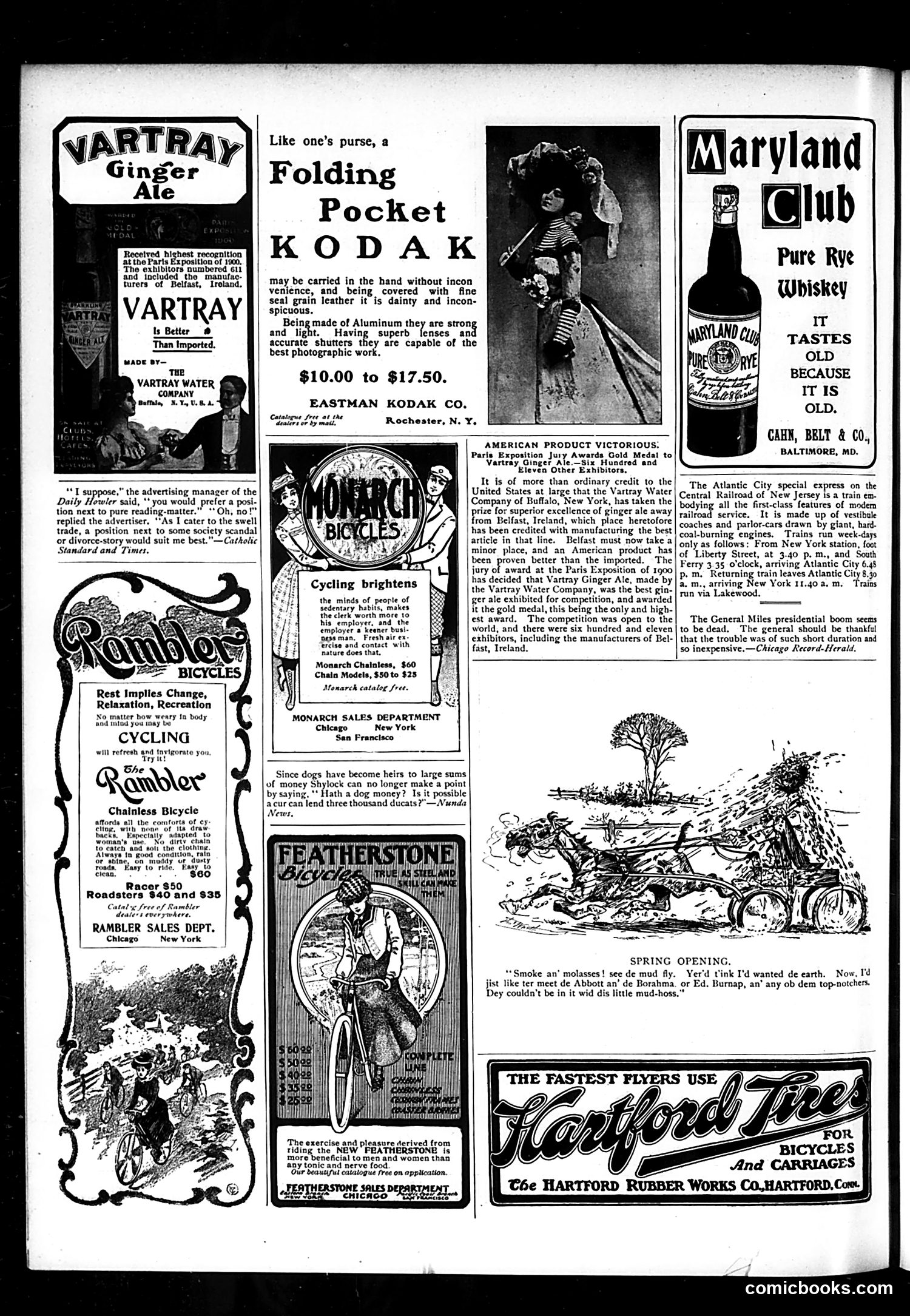
This page from Judge magazine (early 1900s based on references) is primarily **advertising**, with minimal satirical content. The advertisements promote consumer goods (bicycles, cameras, whiskey, ginger ale, tires) aimed at affluent readers—standard for this period. The notable exception is a small anecdote attributed to "Catholic Standard and Times": an advertising manager and advertiser discuss placement preferences. The joke reflects early-1900s attitudes about marketing: the advertiser prefers proximity to "society scandal or divorce-story" rather than "pure reading matter," suggesting advertisements prosper alongside sensationalism. This gentle satire mocks both consumer culture and yellow journalism tendencies. A brief political reference appears: "The General Miles presidential boom seems to be dead"—likely referring to General Nelson Miles's failed 1900 presidential ambitions. The remaining content—including an advertisement celebrating American Vartray Ginger Ale's Paris Exposition gold medal over Irish imports—reflects contemporary American commercial nationalism.
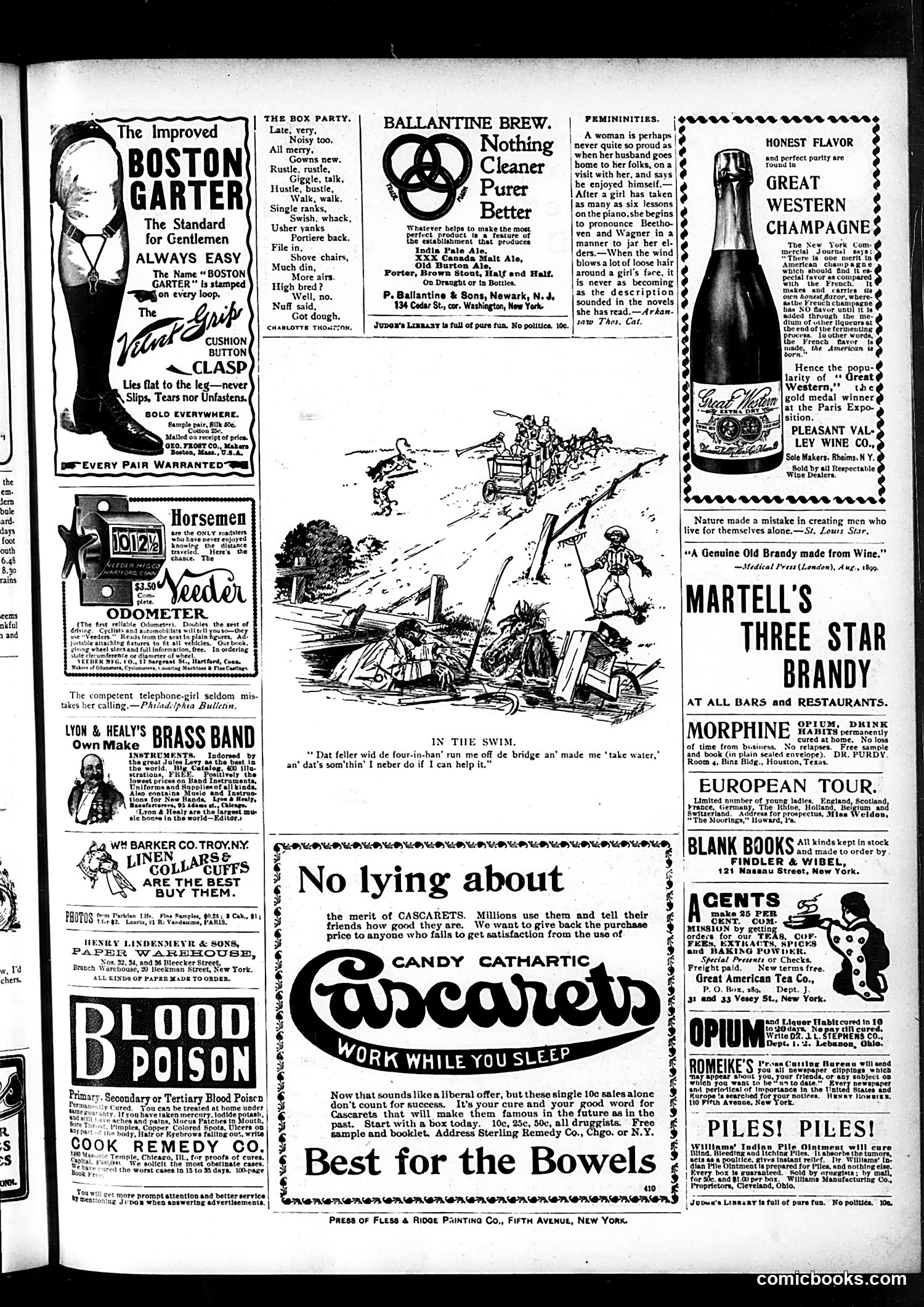
This page is primarily **advertising**, not political satire or comics in the traditional sense. However, it contains notable period content: **"The Box Party"** (poem by Charlotte Thoazton): A satirical verse mocking wealthy theatergoers attending fashionable box seats. The satire targets their pretentiousness—described as not genuinely "high bred" but merely wealthy ("Got dough")—and their disruptive behavior (rustling gowns, talking, chair-moving). This reflects upper-class social criticism common in Judge. **"In the Swim"** (cartoon): Depicts a working-class man complaining that someone in a four-in-hand tie knocked him off a bridge, forcing him to "take water." The humor relies on wordplay and class commentary about social climbing or carelessness among the better-dressed. **Advertisements**: The page shows period patent medicines (blood poison cures, morphine treatments), garters, champagne, and cascarets—typical of early 1900s American publications where dubious medical claims were unregulated. The overall tone reflects Judge's satirical approach to American society, class distinctions, and consumer culture.
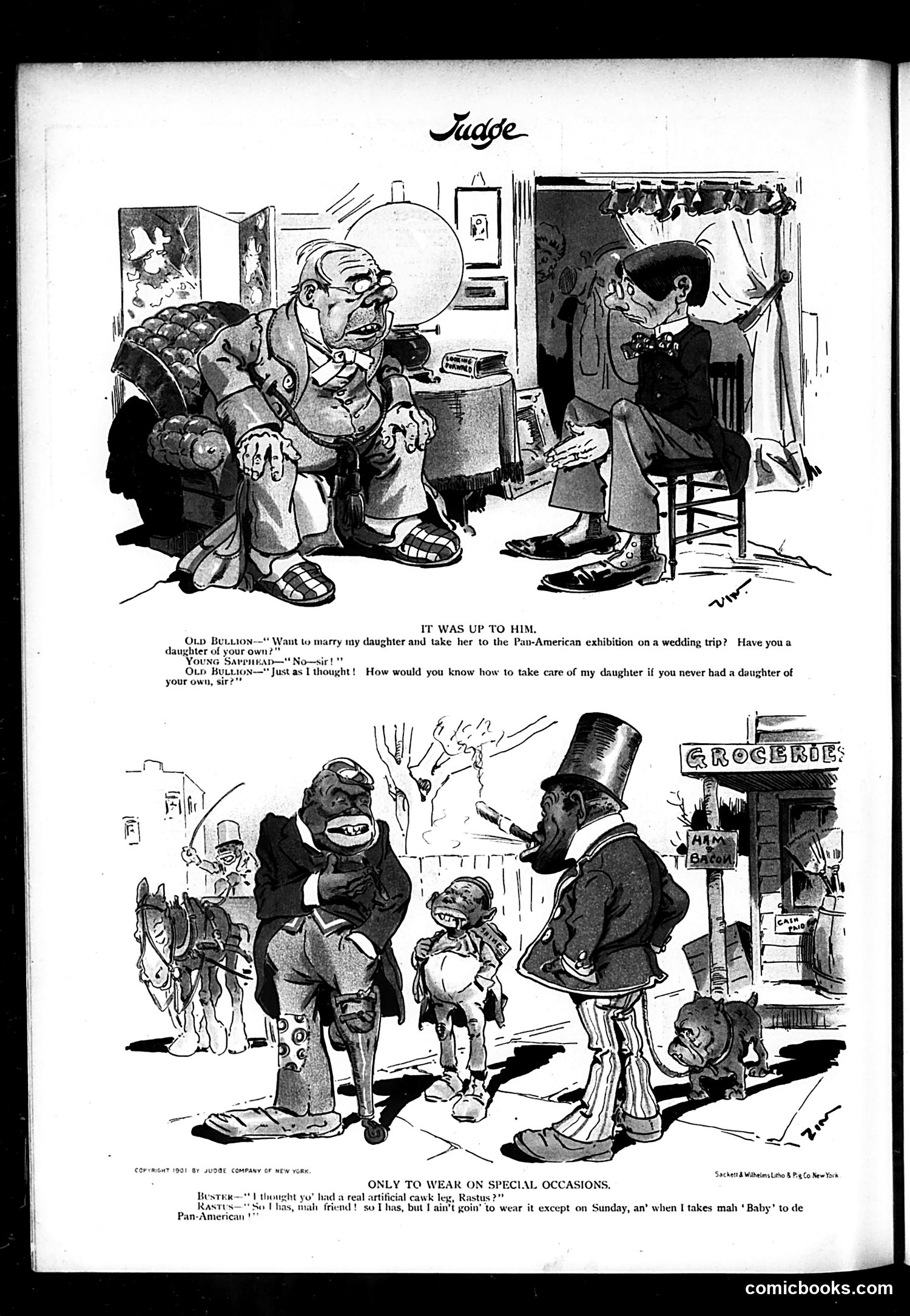
**Top cartoon:** An old wealthy man ("Old Button") interrogates a young suitor seeking to marry his daughter. The joke is the father's circular logic: he refuses to let the suitor take his daughter to the Pan-American Exhibition (a major 1901 world's fair) because the suitor has never had a daughter himself—therefore lacks experience caring for one. The satire mocks overprotective fathers and their unreasonable objections to suitors. **Bottom cartoon:** Features racist caricatures with exaggerated features labeled "Buster" and "Rastus" (stereotypical names for Black men). The humor depends on period minstrelsy conventions: Rastus claims he bought an artificial leg only to wear on special occasions—specifically Sundays and visits to the Pan-American Exhibition. This trades on dehumanizing stereotypes of the era, reflecting the deeply racist attitudes embedded in early 20th-century American popular media. Both cartoons reference the 1901 Pan-American Exposition, a major contemporary event.
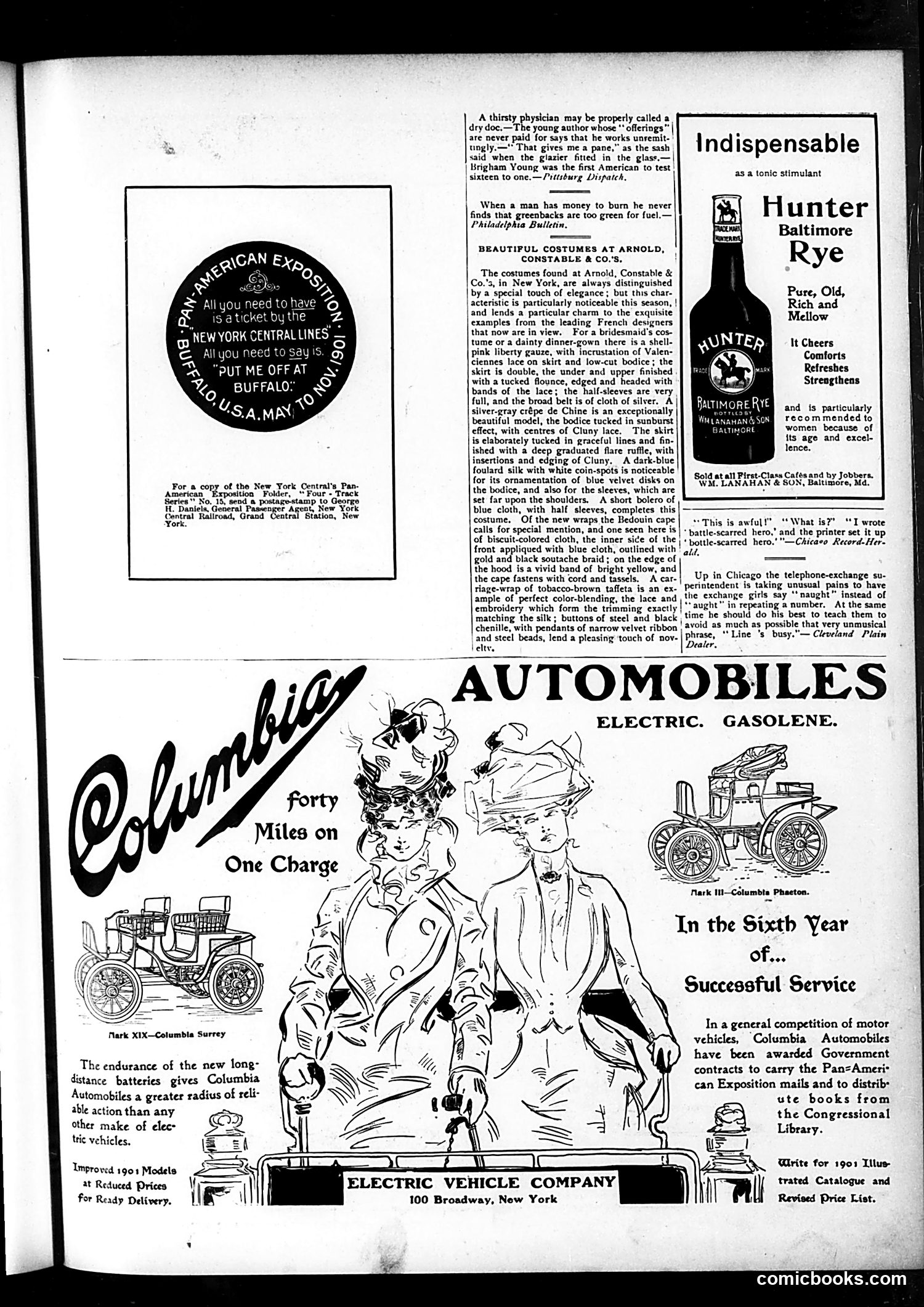
This page is primarily **advertising**, not political satire. It contains: 1. **A Pan-American Exposition advertisement** (circular logo) promoting New York Central train service to Buffalo in 1901. 2. **Three brief witty quips** about puns (physician as "dry doc," struggling author's "offerings," etc.)—typical Judge magazine humor with no political content. 3. **Product advertisements**: Columbia automobiles, Hunter Baltimore Rye whiskey, and Arnold Constable & Co. fashion. 4. **Two short anecdotal pieces**: one praising Arnold Constable's ladies' costumes in detail, and another humorously noting Chicago's telephone exchange superintendent trying to correct operators' pronunciation. **No significant political or social satire** is present. This appears to be a typical 1901 magazine page blending light humor, consumer advertising, and fashion commentary. The references are purely commercial and mundane—no caricatures or political figures are depicted.
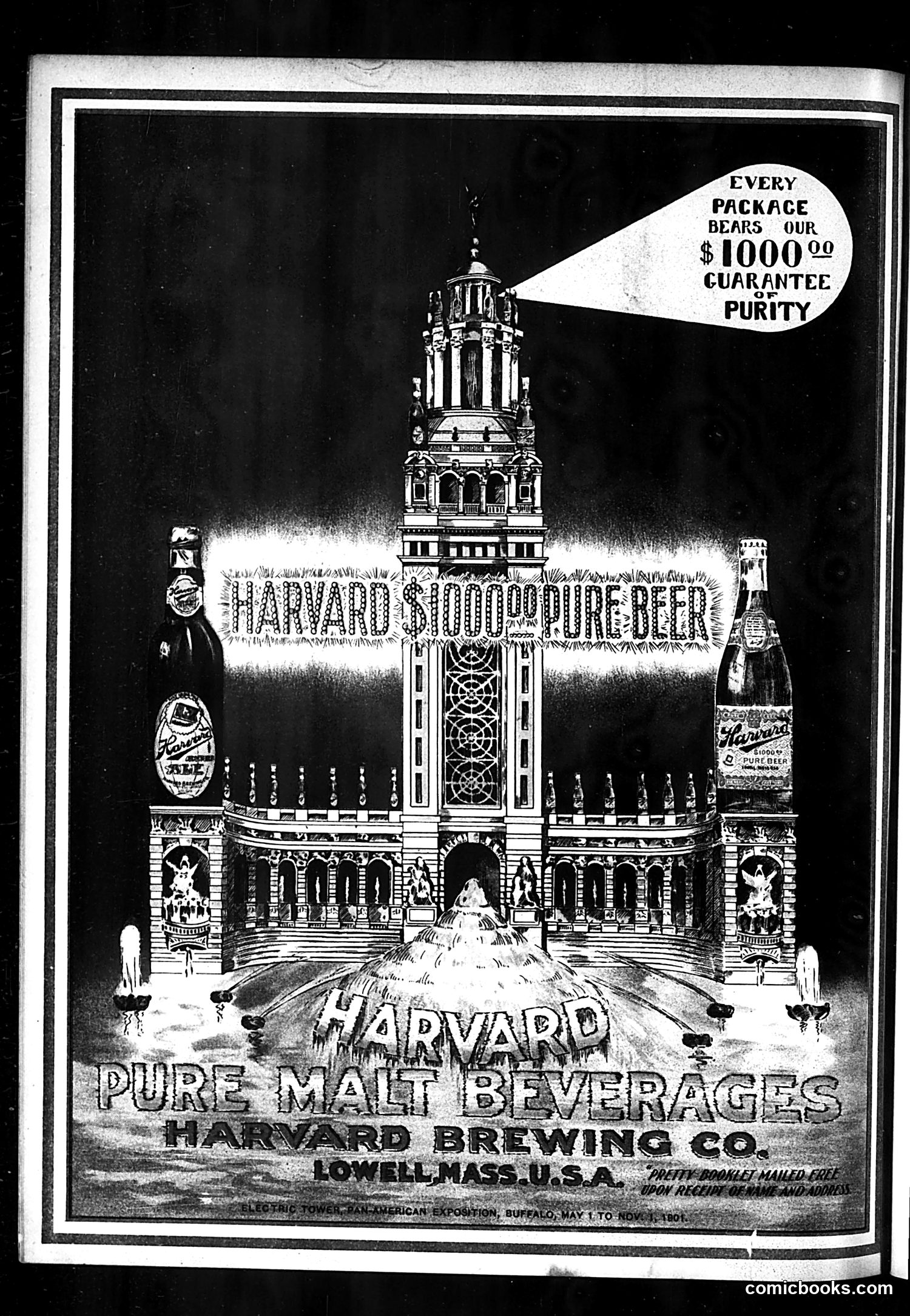
This is a full-page advertisement for Harvard Pure Malt Beverages from the Harvard Brewing Company in Lowell, Massachusetts. The ad features an elaborate illustration of a grand civic building (resembling a courthouse or city hall) with a prominent tower, flanked by beer bottles. The key marketing claim is a "$1000.00 guarantee of purity" printed prominently in the upper right. This reflects early 20th-century concerns about food and beverage safety—before modern FDA regulations, breweries competed by claiming product purity as a competitive advantage. The ornate architectural imagery suggests respectability and civic importance, positioning beer as a legitimate, quality product. The small print references the "Electric Tower, Pan-American Exposition, Buffalo, May 1 to Nov. 1, 1901," indicating this ad appeared in Judge magazine around that 1901 exposition period.