
Judge, 1901-05-11 · page 9 of 20
Judge — May 11, 1901 — page 9: what you’re looking at
What you’re looking at
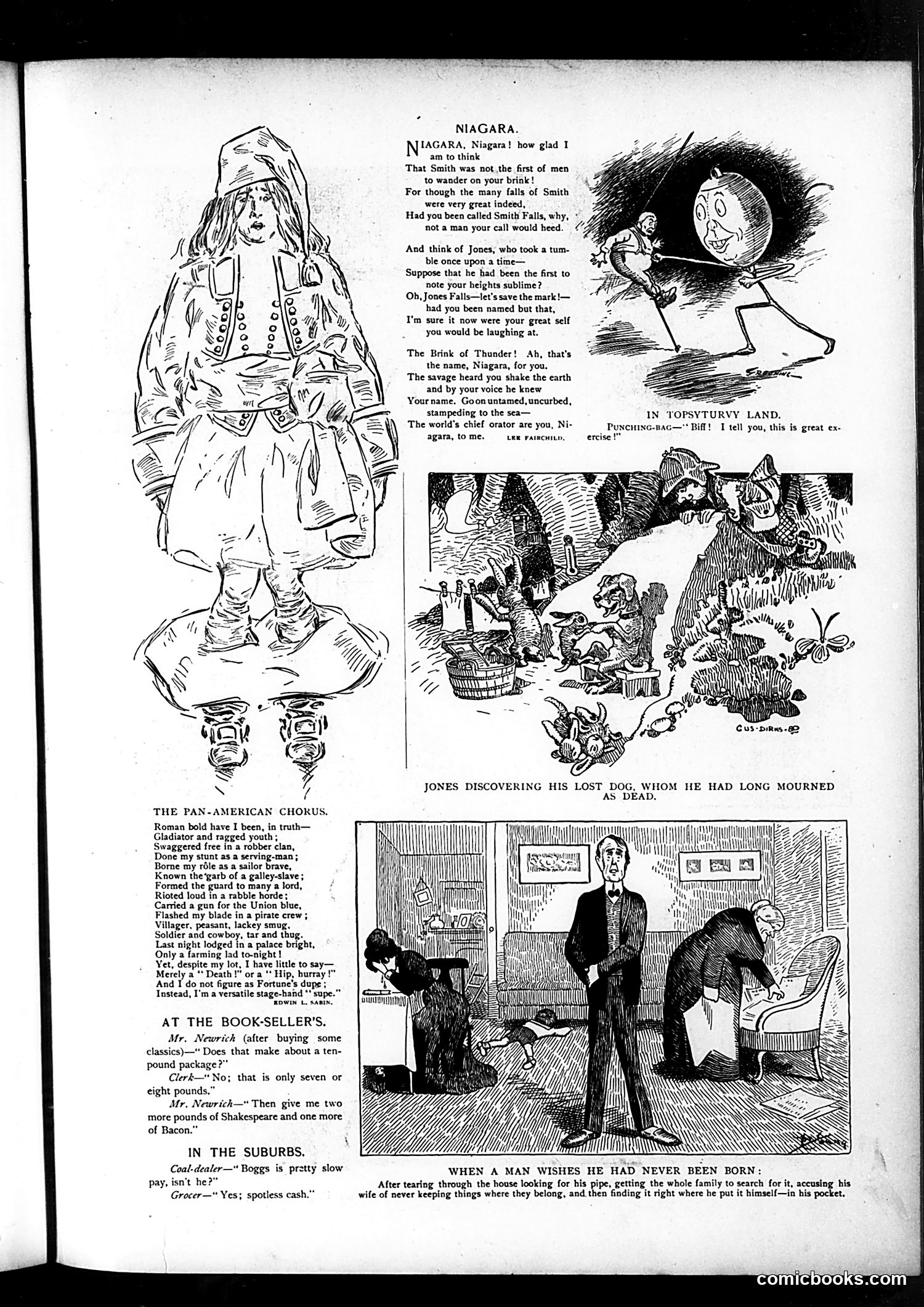
This Judge magazine page contains several discrete satirical pieces: **"Niagara"** is a humorous poem celebrating Niagara Falls' name. The satire mocks common surnames by imagining if the falls were named after ordinary people like "Smith Falls" or "Jones Falls"—suggesting the landmark owes its grandeur partly to its dignified name. **"The Pan-American Chorus"** appears to be verse about a versatile stage performer who's played many roles (soldier, pirate, peasant) but remains just a humble "supe" (supernumerary extra). **"At the Book-Seller's"** satirizes the newly wealthy Mr. Newrich, who buys classic literature by weight rather than understanding—he treats Shakespeare and Bacon as commodities to purchase by the pound, exposing his pretentious ignorance. **"When a Man Wishes He Had Never Been Born"** depicts domestic comedy: a man angrily tears the house apart searching for his pipe, only to discover he'd put it in his own pocket all along, embarrassing himself before his family. The cartoons mock vanity, social climbing, and domestic frustration rather than specific political figures.
📄 Transcribed text from this page (OCR, searchable)
Machine-transcribed from the original scan — historical spelling and the odd misread are preserved.
NIAGARA. NiAGARA. Niagara! how glad I am to think That Smith was not. the first of men to wander on your brink! For though the many falls of Smith were very great indeed, Had you been called Smith Falls, why, ° not a man your call would heed. And think of Jones, who took a tum- ble once upon a time— Suppose that he had been the first to note your heights sublime? Oh, Jones Falls—let’s save the mark!— had you been named but that, I’m sure it now were your great self you would be laughing at. The Brink of Thunder! Ab, that's the name, Niagara, for you. The savage heard you shake the earth and by your voice he knew Yourname, Goon untamed, uncurbed, stampeding to the sea— The world's chief orator are you, Ni- Punen agara, to me. i Lee raincuito, ——ercise !” JONES DISCOVERING HIS LOST DOG, AS DE, THE PAN-AMERICAN CHORUS. Roman bold have I been, in truth— Gladiator and ragged youth ; Swaggered free in a robber clan, Done my stunt as a serving-man; Borne my rdle as a sailor brave, Known the‘garb of a galley-slave; Formed the guard to many a lord, Rioted loud in a rabble horde: Carried a gun for the Union blue, Flashed my blade in a pirate crew ; Villager, peasant, lackey smug, Soldier and cowboy, tar and thug. Last night lodged in a palace bright, Only a farming lad to-night ! Yet, despite my lot, I have little to say— Merely a ‘* Death !” or a * Hip, hurray !” And I do not figure as Fortune's dupe; Instead, I'm a versatile stage-hand "* supe.” AT THE BOOK-SELLER'S. Mr. Newrich (after buying some classics) —"" Does that make about a ten- pound package?” Clerk— eight pounds, Mr, Newrich— Then give me two more pounds of Shakespeare and one more of Bacon.” IN THE SUBURBS. that is only seven or Yfy (TATA IN TOPSYTURVY LAND. H1NG-BAG—"* Biff! I tell you, this is great ex- Cus-DiRKs 82 WHOM HE HAD LONG MOURNED ‘AD. yt) \ ee uu TTT it AND AW | It Mi Mi H WW li it i i \ Y \\\ AW Ty ~ ISS NSS Coal-dealer—" Boggs is pretty slow pay, isn’t he?” Grocer—"Ves; spotless cash.” WHEN A MAN WISHES HE HAD NEVER BEEN BORN: After tearing through the house looking for his pipe, getting the whole family to search for it, accusing his wife of never keeping things where they belong, and then finding it right where he put it himself—in his pocket.