
A complete issue · 16 pages · 1901
Judge — March 16, 1901
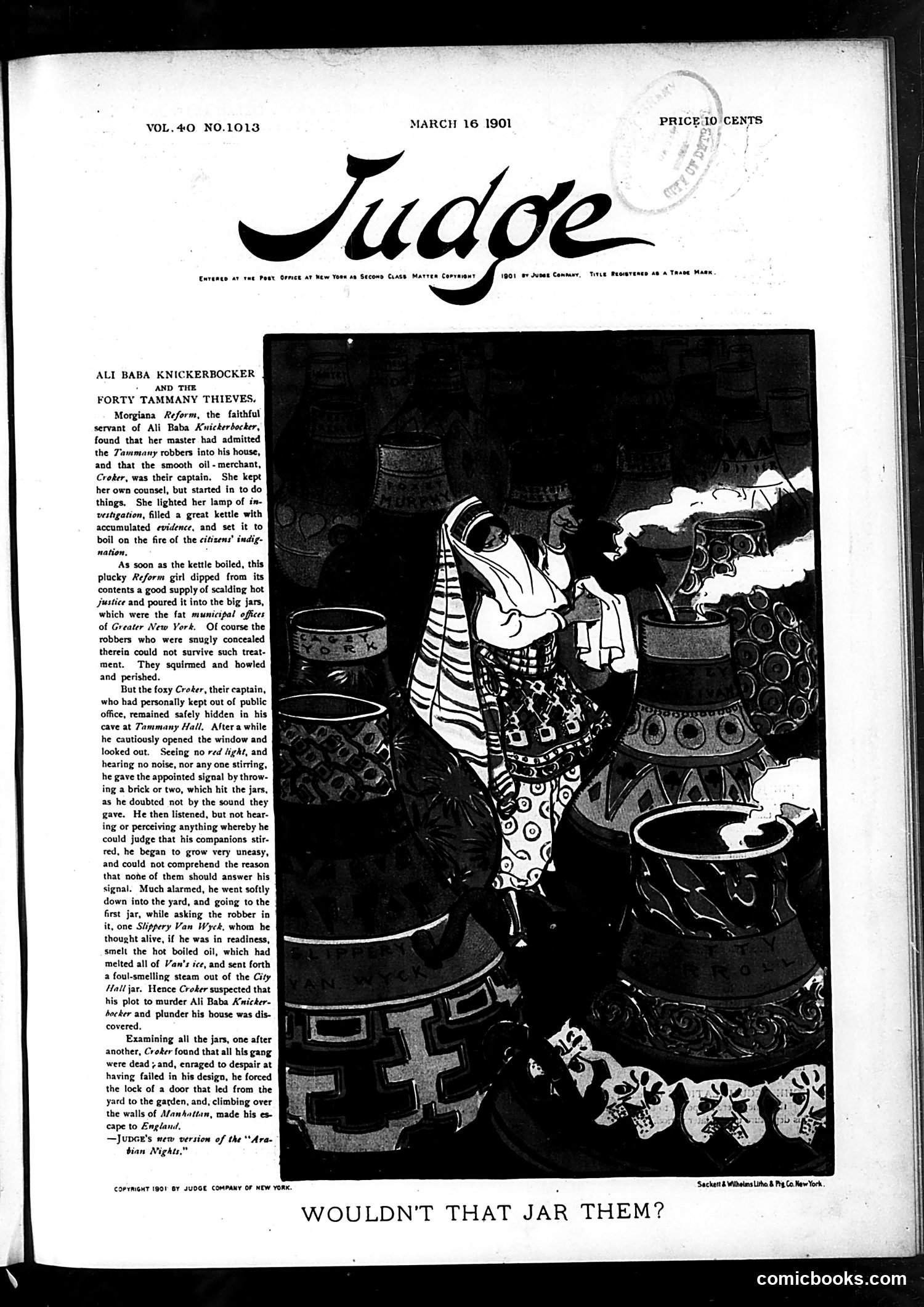
This page illustrates a story titled "Ali Baba Knickerbocker and the Forty Tammany Thieves." The narrative, shown in both text and accompanying illustration, satirizes **Tammany Hall**—New York City's powerful Democratic political machine—by comparing it to the Arabian Nights tale of Ali Baba and the thieves. The plot involves a servant named Nizam discovering that Ali Baba's master has allowed thieves into his house. The satire equates **Tammany politicians with criminals**, suggesting they've infiltrated city government to plunder resources. The illustration depicts someone discovering jars (presumably containing stolen goods or wealth), with the caption "Wouldn't That Jar Them?" implying exposure would shock the corrupt organization. This reflects early-1900s Progressive Era criticism of urban political corruption.
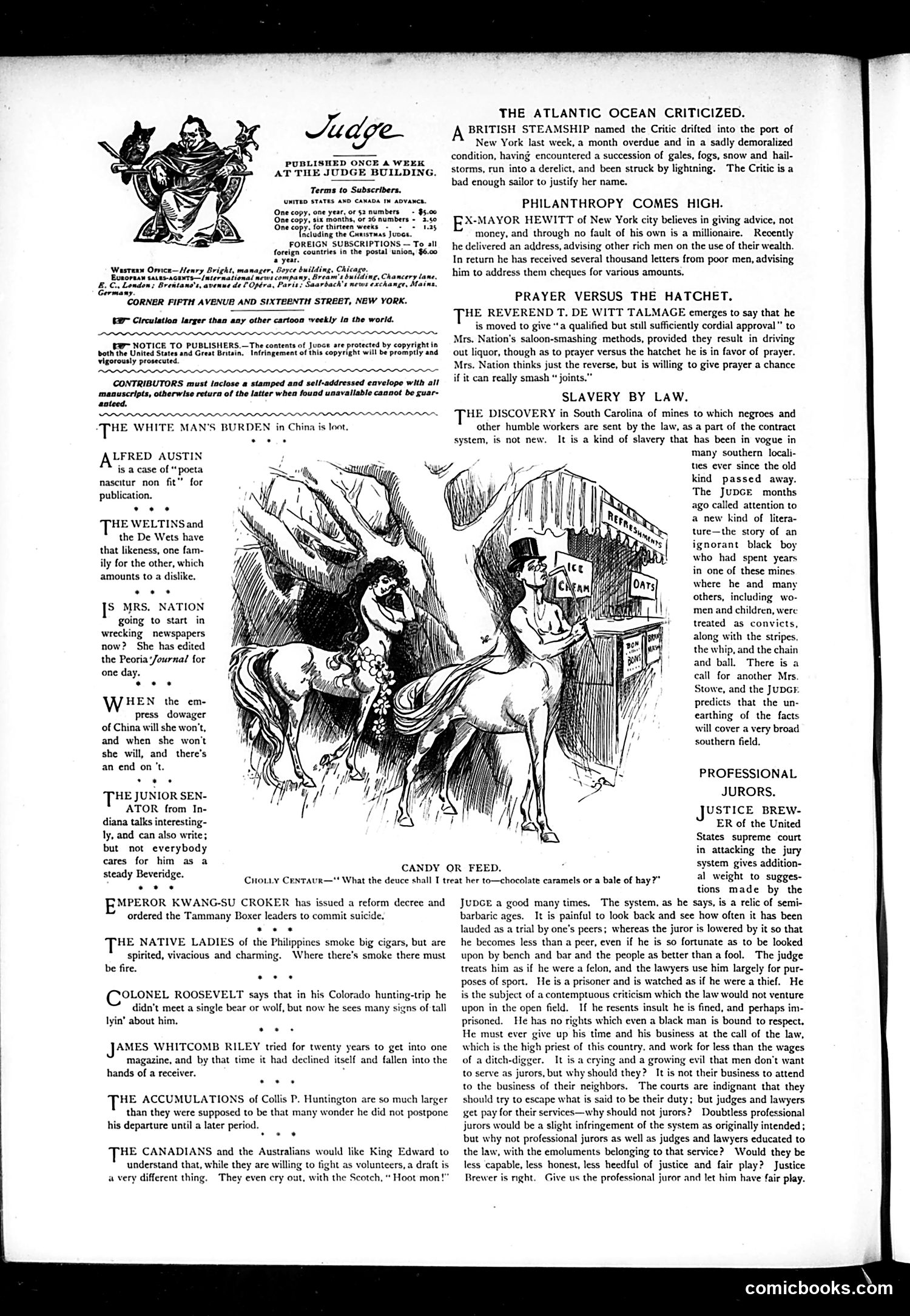
This cartoon illustrates the article "Candy or Feed," which critiques the jury system. The centaur figure—a half-man, half-horse creature—represents a juror who is being fed or treated inadequately, appearing somewhat debased or diminished by the experience. The satire targets how jurors were undervalued in American courts. The article argues that professional jurors would better serve justice than citizens summoned for duty, criticizing how the system treats jurors like "a tool" rather than respected participants. The grotesque hybrid form visually expresses the degradation Judge's editors believed jury duty inflicted on otherwise respectable citizens. The cartoon supports the piece's argument that jurors deserve better compensation and professional standing.
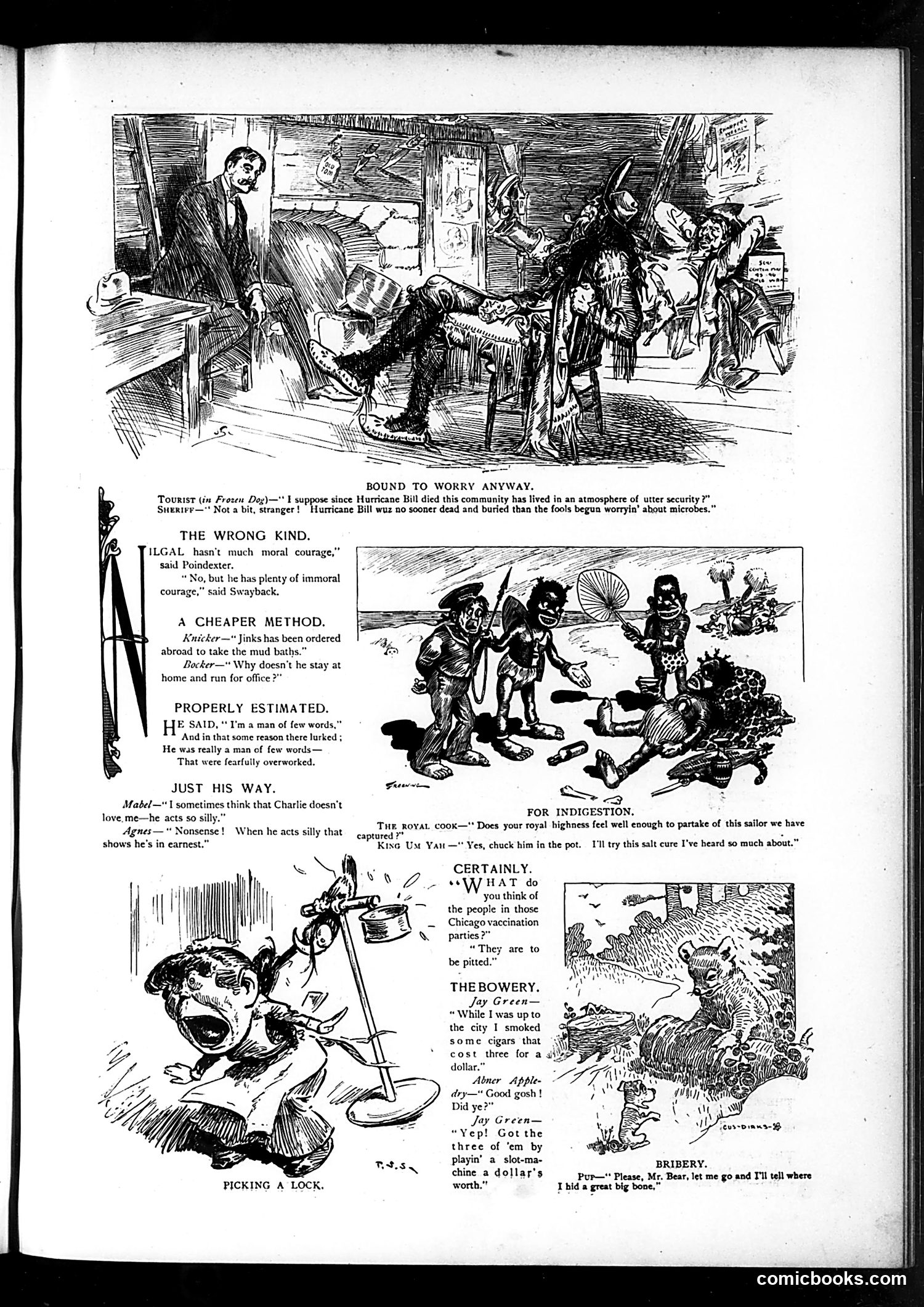
This page contains multiple short comic sketches and jokes typical of Judge's satirical format: **Top cartoon ("Bound to Worry Anyway")**: Shows a sheriff and tourist discussing Hurricane Bill, apparently referencing a real storm. The joke plays on the irony that worrying about microbes seems trivial after surviving a hurricane. **Various short joke sections** ("The Wrong Kind," "A Cheaper Method," "Properly Estimated," etc.) contain brief dialogue gags about contemporary topics: romance, travel, dining, and social pretension. **"The Bowery" section**: References Chicago's vaccination parties (likely early 20th-century public health campaigns), with characters discussing cigar prices, suggesting satire of working-class or immigrant experiences. **Bottom sketch ("Picking a Lock")**: Shows someone attempting burglary, with "Bribery" as a caption—likely satirizing corruption. The page reflects Judge's typical blend of social commentary, class humor, and contemporary references aimed at educated readers.
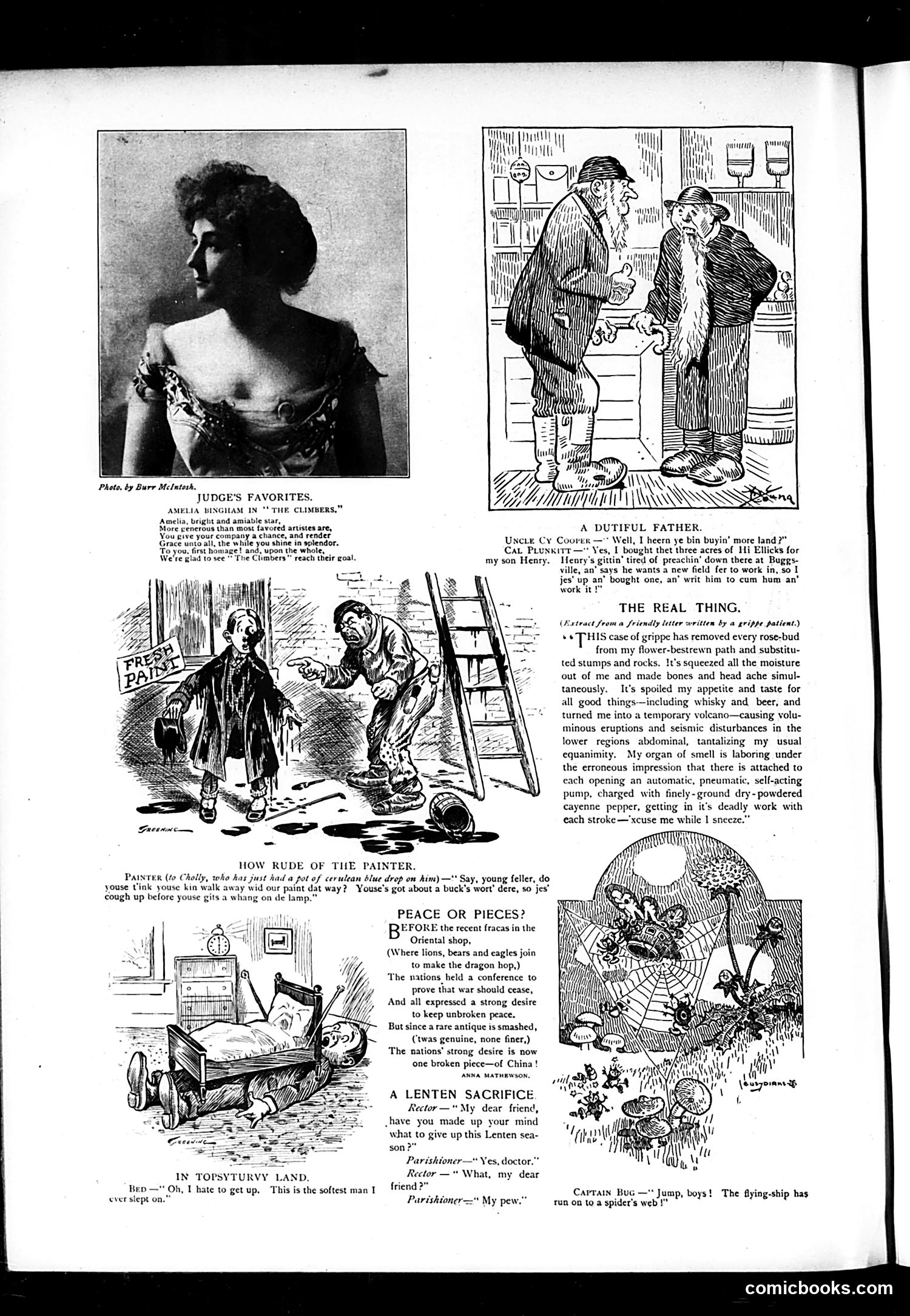
This page contains several unrelated satirical items typical of Judge magazine: **"Judge's Favorites"** features actress Amelia Bingham from "The Climbers," with a biographical poem praising her stage work. **"A Dutiful Father"** depicts Uncle Cy Cooper and Cal Plunkett discussing a boy—likely satirizing rural/working-class parenting through their dialect humor. **"How Wide of the Painter"** shows a house painter and customer in a comedic scene about painting work. **"The Real Thing"** presents a grippe (flu) patient's complaint about illness symptoms in exaggerated medical language—satirizing either hypochondria or actual disease severity. **"Peace or Pieces?"** uses Oriental shop imagery to satirize international conflict, appearing to reference contemporary war concerns and fragile peace efforts. The page mixes social humor, medical satire, and political commentary typical of early-20th-century American humor magazines.
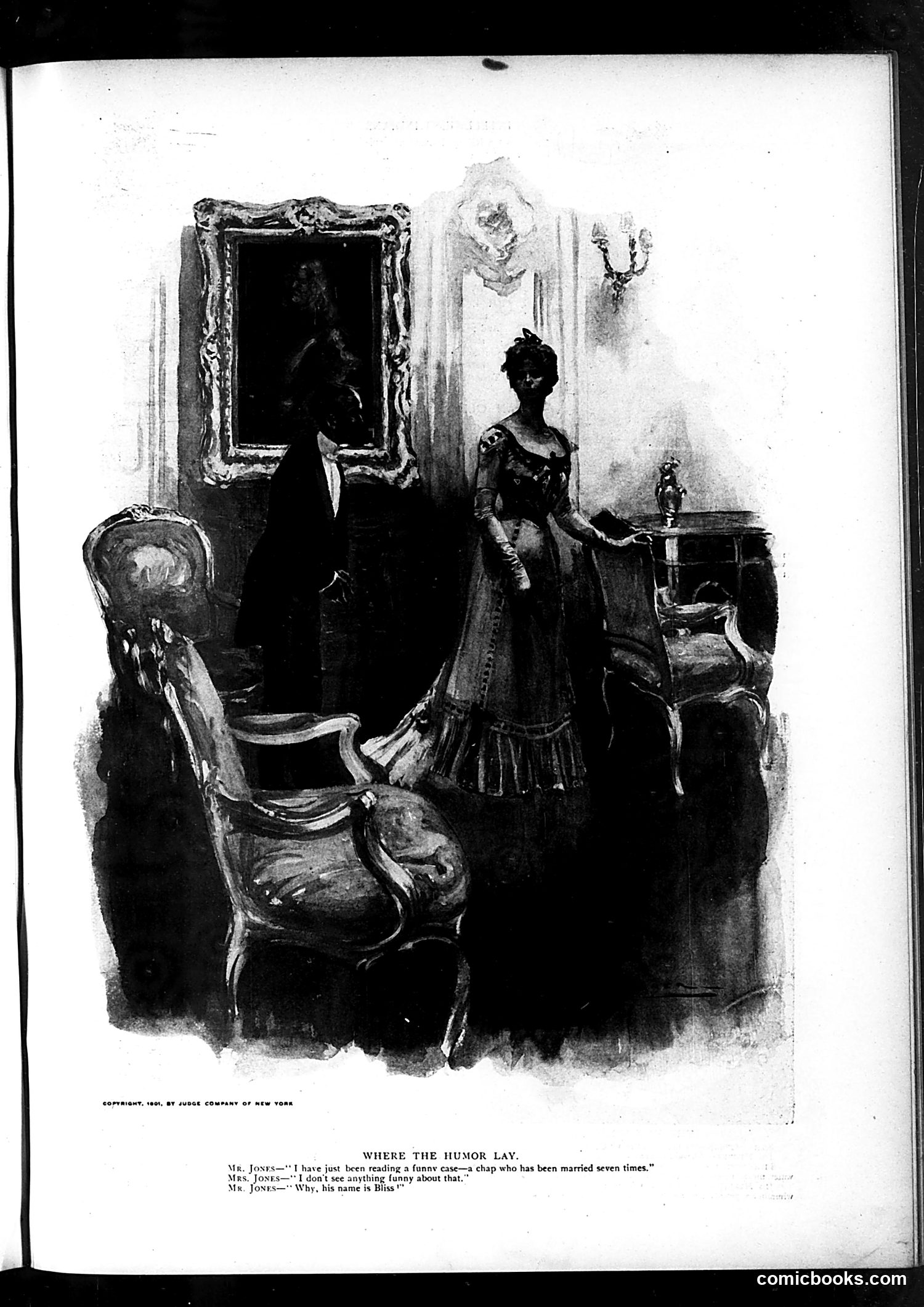
This 1901 Judge cartoon satirizes marital instability through a pun. Mr. Jones finds humor in a newspaper case about a man married seven times—the joke being that this man's surname is "Bliss," making his repeated marriages ironically contradictory. The implication is that if marriage brought genuine happiness (bliss), one wouldn't need to remarry seven times. Mrs. Jones's deadpan response—that she sees nothing funny about serial marriage itself—underscores the cartoon's point: there's dark comedy in the disconnect between the man's name and his matrimonial track record. The elegant drawing style and domestic setting reflect Judge's upper-class audience, for whom marital scandals provided entertainment and fodder for social commentary.
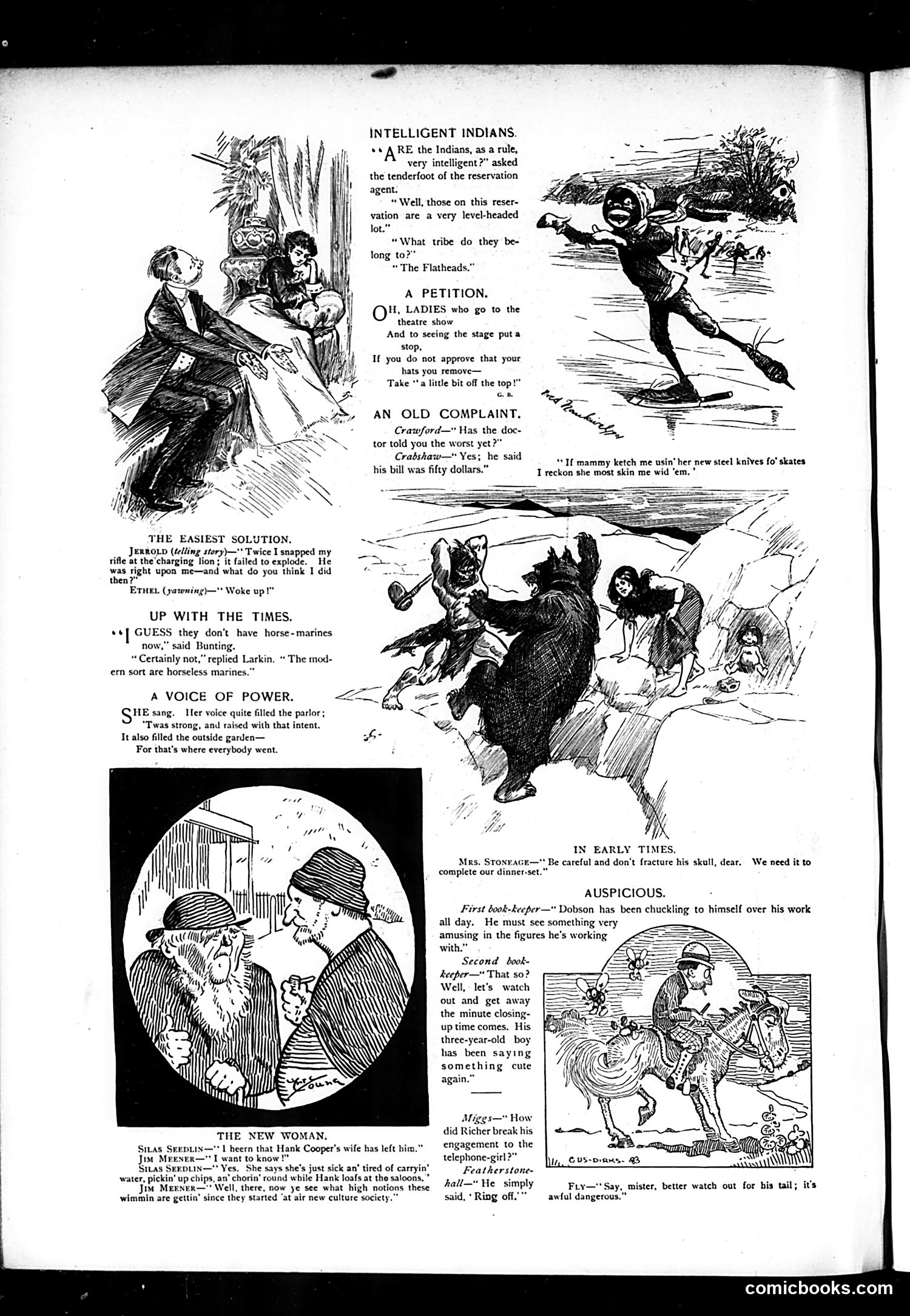
This page contains multiple brief satirical items typical of the magazine's humor: **"Intelligent Indians"** plays on a pun: the tenderfoot asks if reservation Indians are intelligent, and the agent praises them as "level-headed"—then reveals they're "Flatheads," a Native American tribe. The joke mocks both Native Americans and the agent's obliviousness. **"A Petition"** addresses women's large theater hats blocking others' views—a genuine social complaint of the era. It requests ladies remove hats at shows. **"The New Woman"** satirizes changing female independence: a wife leaves her husband because she's tired of domestic labor while he lounges at saloons, reflecting anxieties about women's evolving roles. **"A Voice of Power"** humorously suggests a woman's singing voice is so powerful it drives everyone outdoors—typical period mockery of female singers. The remaining items are brief conversational jokes about doctors' bills, modern marines without horses, and workplace observations. The page emphasizes social commentary on gender roles, Native Americans, and contemporary customs through light satire.
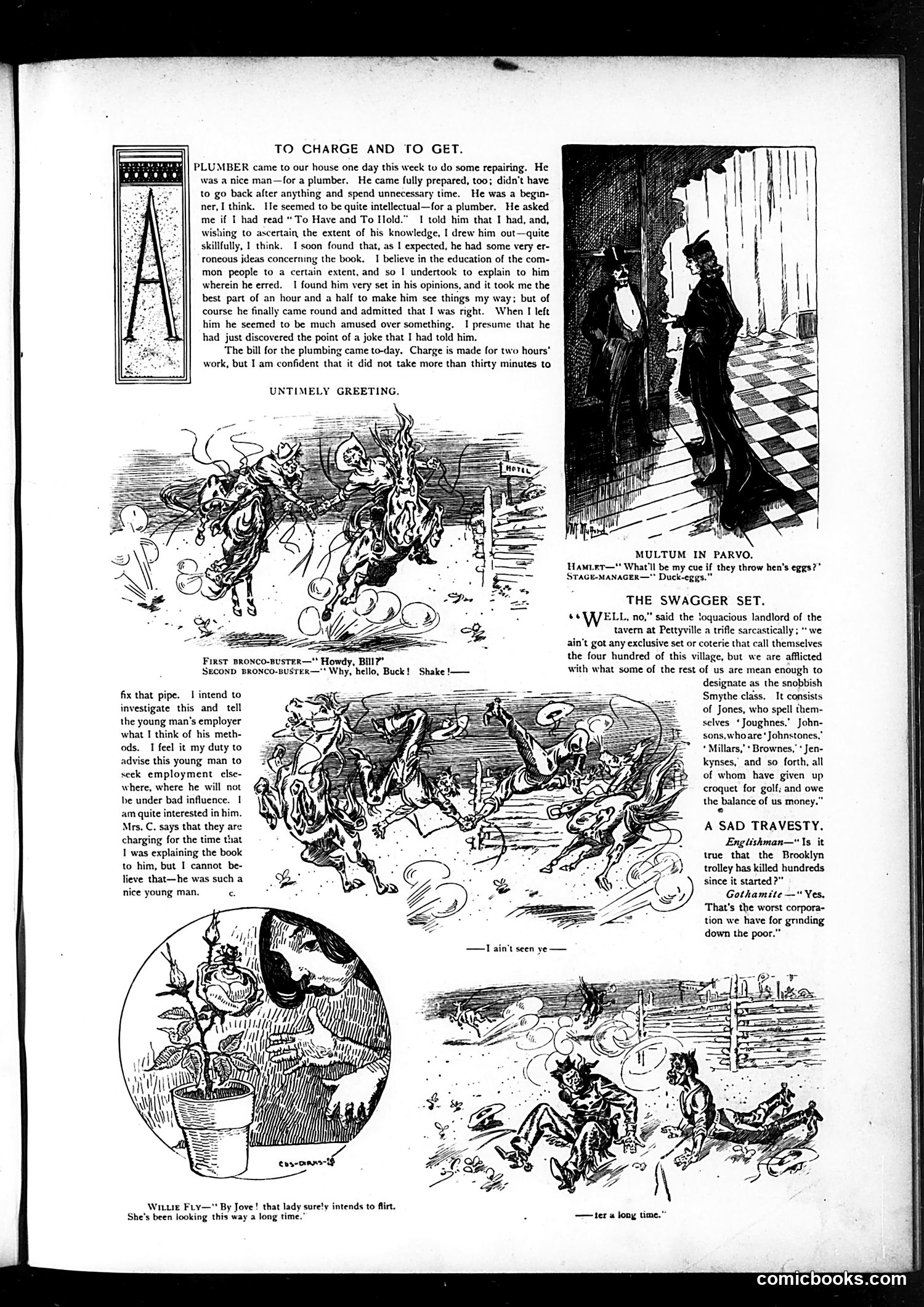
This page contains several satirical pieces typical of early-20th-century American humor: **"To Charge and to Get"** mocks middle-class pretension. A homeowner spends an hour and a half educating a plumber about a novel ("To Have and To Hold"), then receives a bill for two hours' work. The joke: the plumber charges for time spent listening to the owner's unsolicited lectures, turning the tables on the self-satisfied narrator. **The cartoon vignettes** include: - "Untimely Greeting": Two bucking broncos as crude humor - "The Swagger Set": Satirizes small-town snobbery, where families like "Joughnes" and "Johnstones" (newly respectable name-spellings) pretend to aristocratic exclusivity while remaining petty and debt-ridden - "A Sad Travesty": Mocks American industrial callousness—a Brooklyn trolley killing hundreds while corporations prioritize profit over safety The humor assumes readers' familiarity with contemporary class anxieties, urban modernization, and American social climbing.
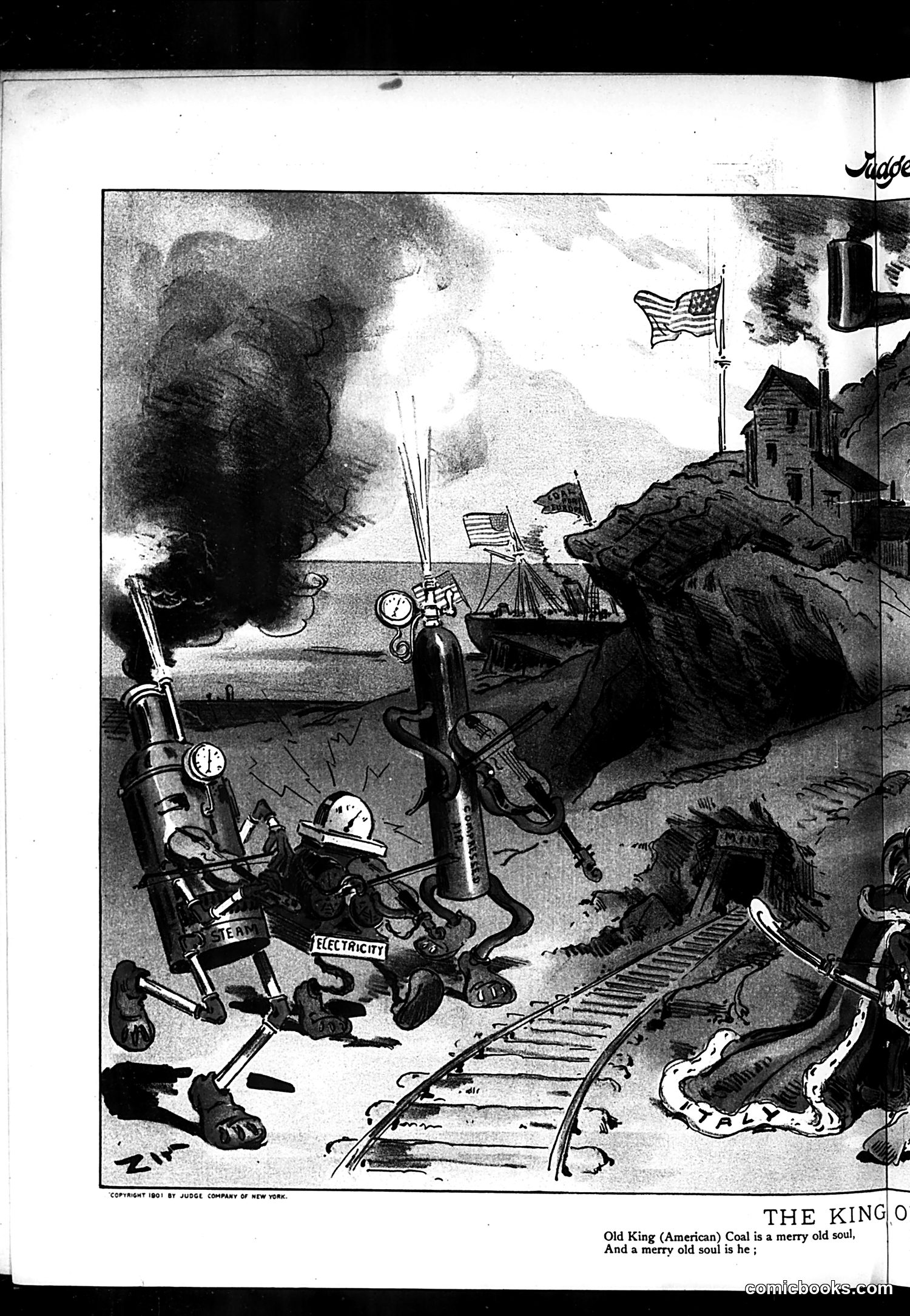
This 1901 Judge cartoon satirizes American coal as a prosperous, cheerful figure ("Old King Coal") surrounded by the industrial infrastructure it powers. The personified coal king sits contentedly amid various forms of energy and transportation: steam engines, electricity generators, and ships bearing American flags in a coastal industrial setting. The satire celebrates coal's dominant role in fueling American industrial expansion and prosperity at the turn of the 20th century. The "merry old soul" reference (from the nursery rhyme) humorously suggests coal's central importance to American economic growth and national strength during the Industrial Age. The cartoon reflects contemporary optimism about American industrial power and coal's essential contribution to the nation's economic success and international standing.
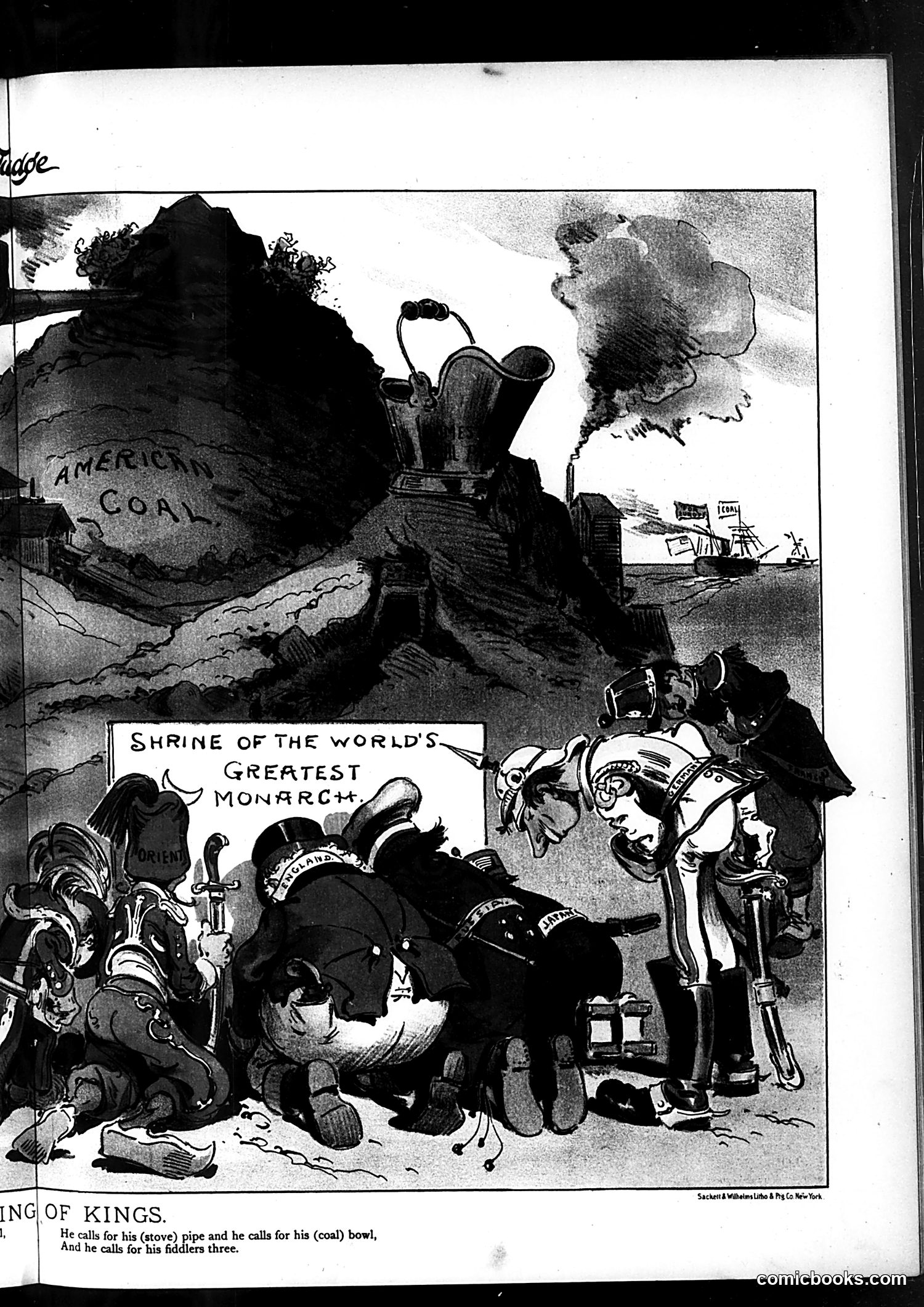
This is a satirical cartoon titled "Shrine of the World's Greatest Monarch," depicting what appears to be an Oriental or Asian ruler in elaborate dress worshipping at an altar made of American coal. The figure is surrounded by ornate vessels and ceremonial objects, with ships visible in the harbor background. The satire likely critiques American economic or imperial ambitions—specifically how the U.S. pursues wealth (coal) from foreign nations, positioning itself as a dominant power worthy of reverence. The "greatest monarch" reference is ironic. The verse below ("He calls for his stove pipe... coal bowl... fiddlers three") parodies the nursery rhyme "Sing a Song of Sixpence," suggesting absurdity or mockery of the situation depicted above. Without knowing the specific date or political context, the cartoon appears to comment on American commercial or colonial interests abroad.
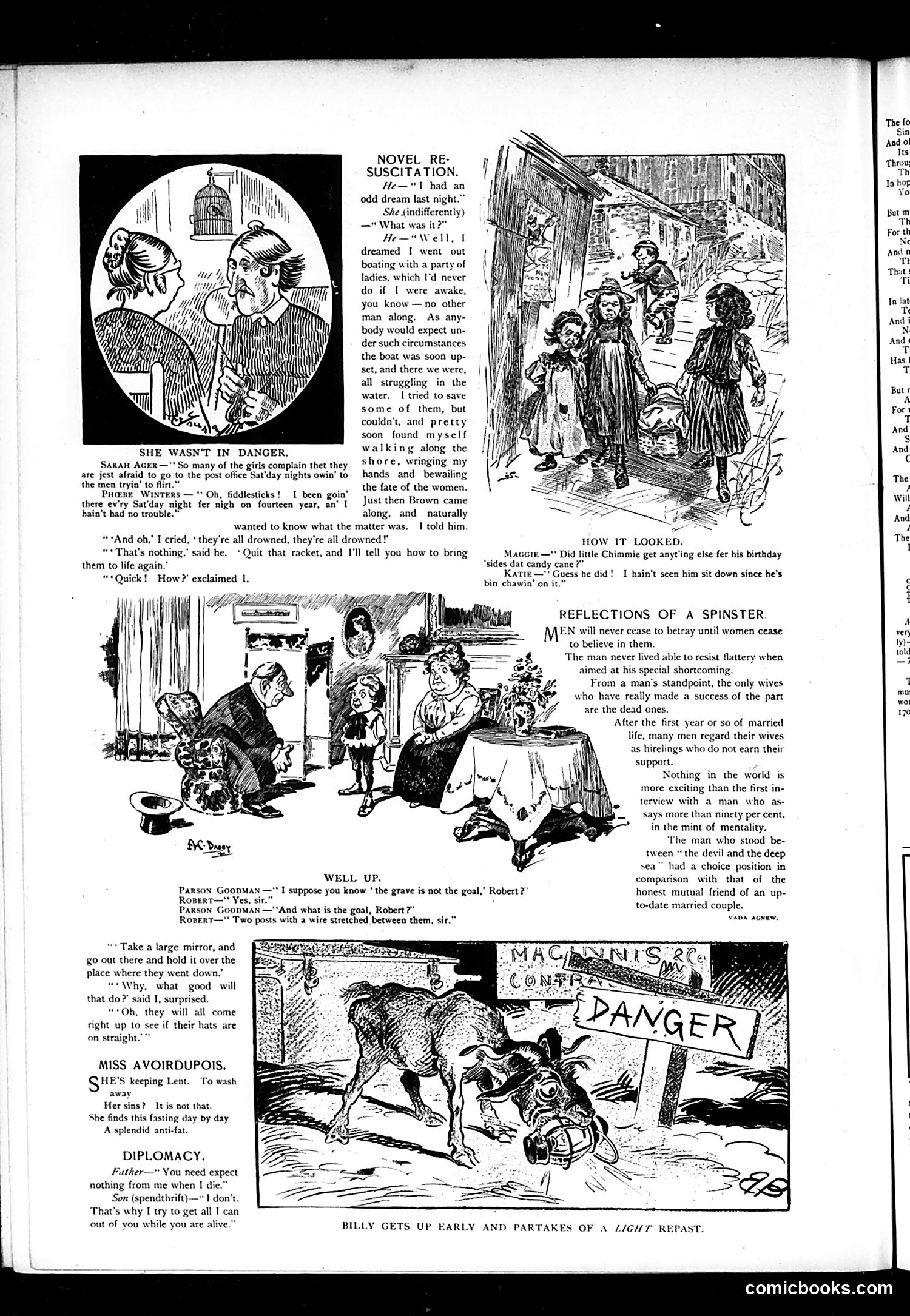
This page contains multiple satirical pieces typical of early-20th-century American humor: **"Novel Resuscitation"**: A man dreams of rescuing drowning women from a boat. The joke relies on Victorian-era gallantry—his friend reveals women will resurface to check if their hats are on straight, mocking women's vanity and superficiality. **"She Wasn't in Danger"**: Satirizes women's supposed fear of post-office visits on Saturday nights due to men flirting, contrasted with a woman who's attended for fourteen years without incident—poking fun at exaggerated feminine timidity. **"Reflections of a Spinster"**: Cynical observations about marriage and men, suggesting men regard wives as unpaid servants and that dead wives are the most successful. **Other sketches** ("Well Up," "Miss Avoirdupois," "Diplomacy"): Brief jokes about vanity, weight-consciousness, and financial manipulation. **Billy cartoon**: Shows a dog eating early morning food—simple visual humor. The page reflects period attitudes toward gender stereotypes, feminine vanity, and marital cynicism.
This page is primarily **advertising and light humor** rather than political satire. The main content includes: **Poems/Humor:** - "The Fount of Youth" — a moralistic poem warning that cosmetics and elixirs cannot truly restore youth; only inner character matters - "New Version" — a brief comic dialogue between Carrie and David joking that removing alcohol would be economically catastrophic **Notable Advertisement:** The page heavily features product ads (Williams' Shaving Stick, Evans' Ale, Sohmer Pianos, Packer's Tar Soap, etc.) with one anecdote about a Columbia University professor sarcastically suggesting a dim student write down everything he knows on a tiny scrap of paper. **Context for Modern Readers:** This reflects early 20th-century anxieties about aging, particularly women's use of cosmetics (then morally suspect), alongside humor about male drinking culture. The "fount of youth" theme was genuinely popular in contemporary discourse—a cultural fixation on combating aging that advertising exploited. There are **no clear political cartoons** on this visible page.
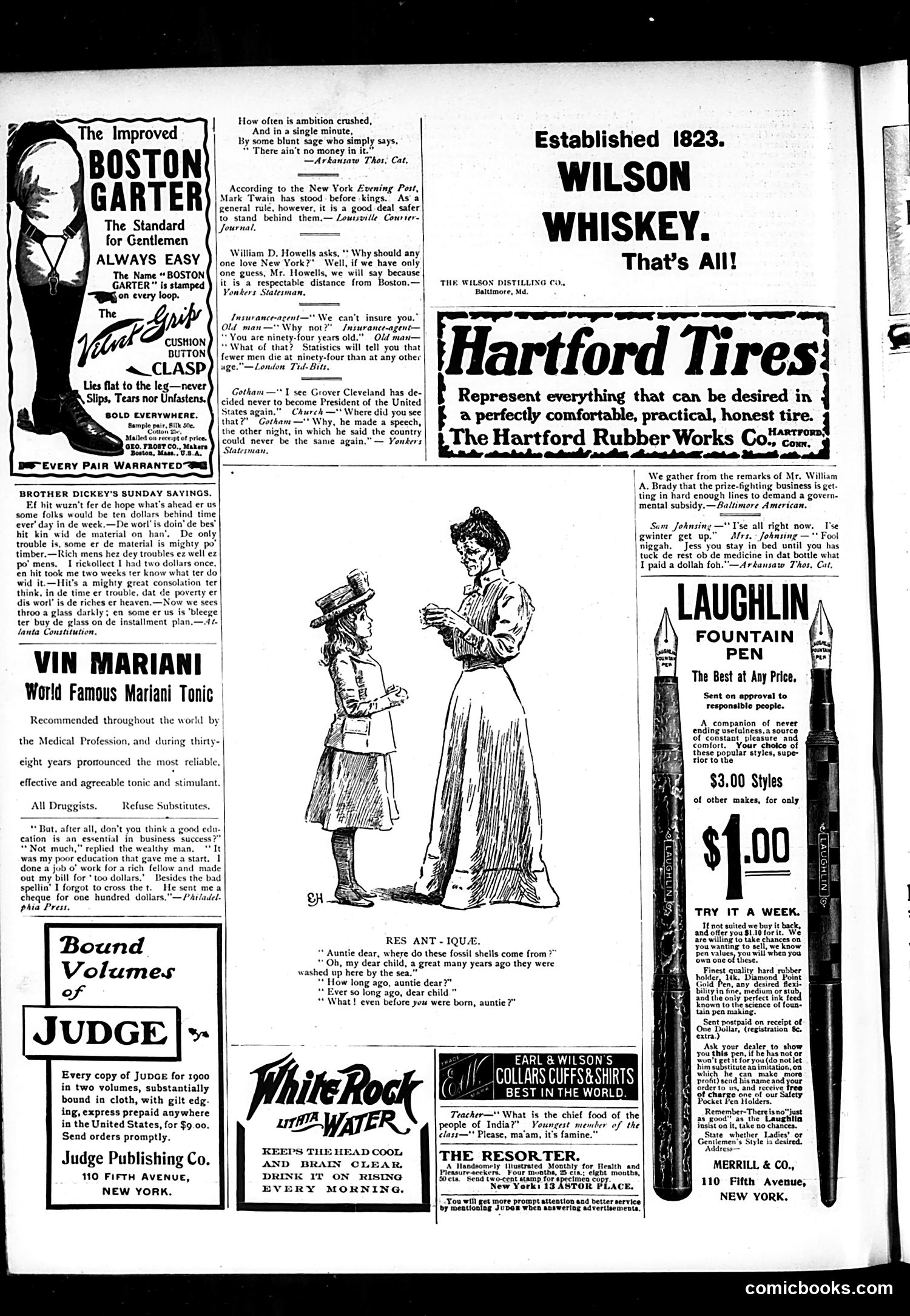
This page is primarily **advertising and humor fillers**, typical of Judge magazine's format. The centerpiece is a gentle cartoon showing an adult (likely a mother) and child in period dress, with the child asking "Auntie dear, where do these fossil shells come from?" — a setup for a joke about the child's innocence asking if shells predate even the elderly aunt. The surrounding material consists of **product advertisements** (Boston Garter suspenders, Wilson Whiskey, Hartford Tires, Laughlin Fountain Pens) and brief **humorous anecdotes** on various topics—insurance agents turning down elderly clients, Mark Twain's travels, politics, and a child's dark school joke conflating "India" with "famine." The jokes reflect **turn-of-century American humor**: wordplay, gentle mockery of politicians (Grover Cleveland), and observations about wealth and class. Nothing here indicates sophisticated political satire; it's entertainment and advertising mixed for a middlebrow audience. The lack of bylines and the brief format suggest these were standard filler material rather than commissioned works.
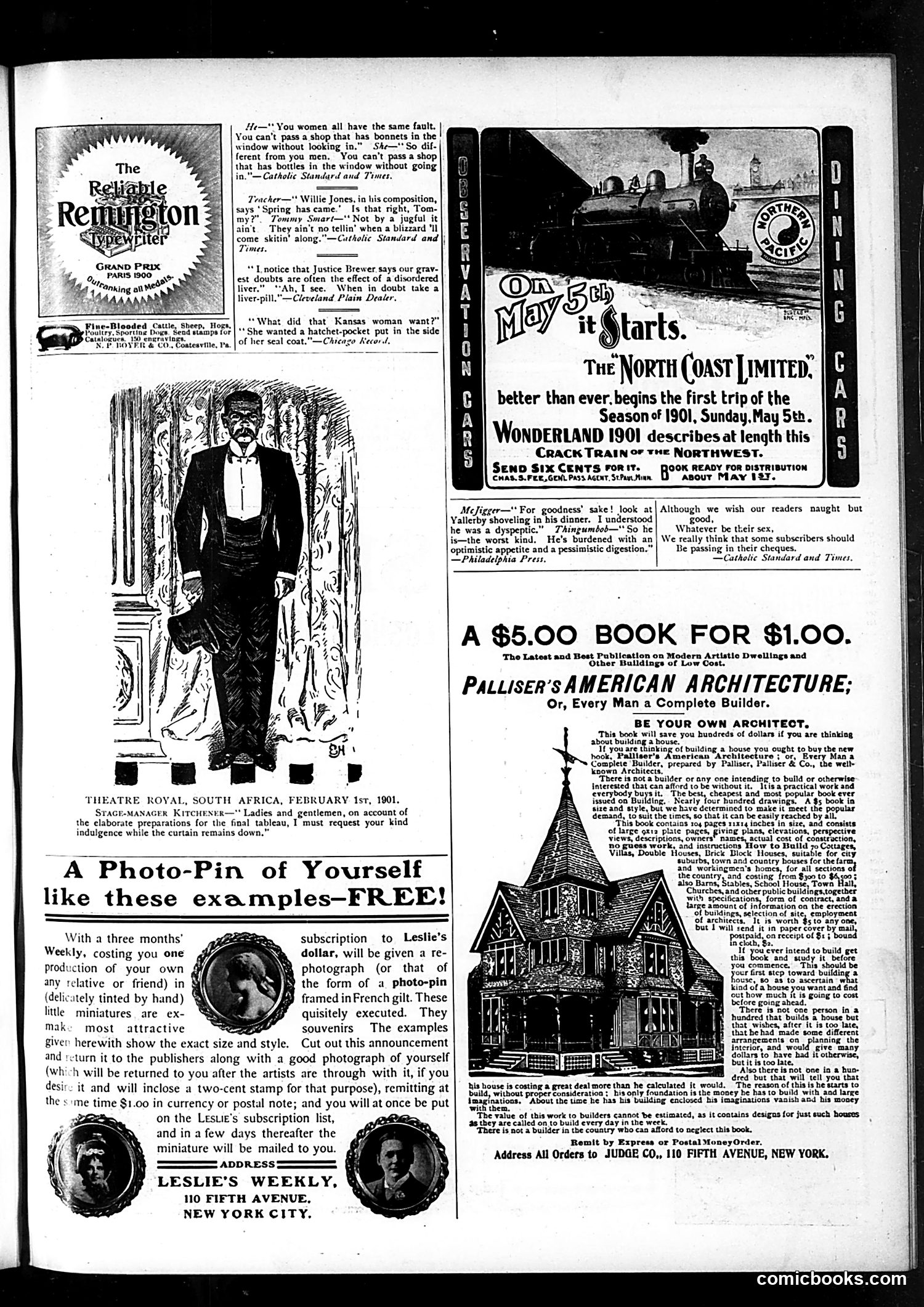
This page is primarily **advertising and humor columns**, not political cartoons. The main content consists of: **Humor Pieces**: Short, attributed jokes from contemporary newspapers about gender differences (women and shops), a child's composition, and digestion—typical Victorian-era domestic humor with no specific political target. **Notable Exception - "Theatre Royal" Caption**: The single satirical item references **Stage-Manager Kitchener** at South Africa's Theatre Royal (February 1901). This is a **Boer War reference**—Lord Kitchener commanded British forces in South Africa. The joke compares military delays in the war to a theatrical curtain delay, implying frustration with the drawn-out conflict. Kitchener became a symbol of the prolonged, costly campaign. **Otherwise**: The page features advertisements (photo-pins, train schedules, architecture books) typical of the era's magazines, suggesting this was a standard issue with light humor rather than hard-hitting satire.
This page is primarily **advertising and promotional content** rather than political satire. It includes: **"The Apple-Barrel"** — A nostalgic poem about childhood memories associated with a barrel of apples stored in a cellar, accompanied by brewery advertisements (Ballantine Brew, India Pale Ale, etc.). The poem romanticizes rural/agricultural life. **Main advertisements:** - Trimble Whiskey ("When you do drink, drink Trimble") - Ballantine Brew and other alcohol brands - Horsemen Odometer (automobile device) - Leslie's Illustrated Weekly (newspaper subscription for $1) - Stanlaws Collection (art prints of the "Stanlaws Girl," a popular illustration style of the era) **Social context:** The ads reflect early 20th-century consumer culture — automobiles becoming common, illustrated magazines gaining popularity, and alcohol prominently advertised (pre-Prohibition). The "Stanlaws Girl" references a celebrated illustrator whose idealized female figures were widely reproduced. There is no discernible political cartoon or satirical commentary on this particular page.
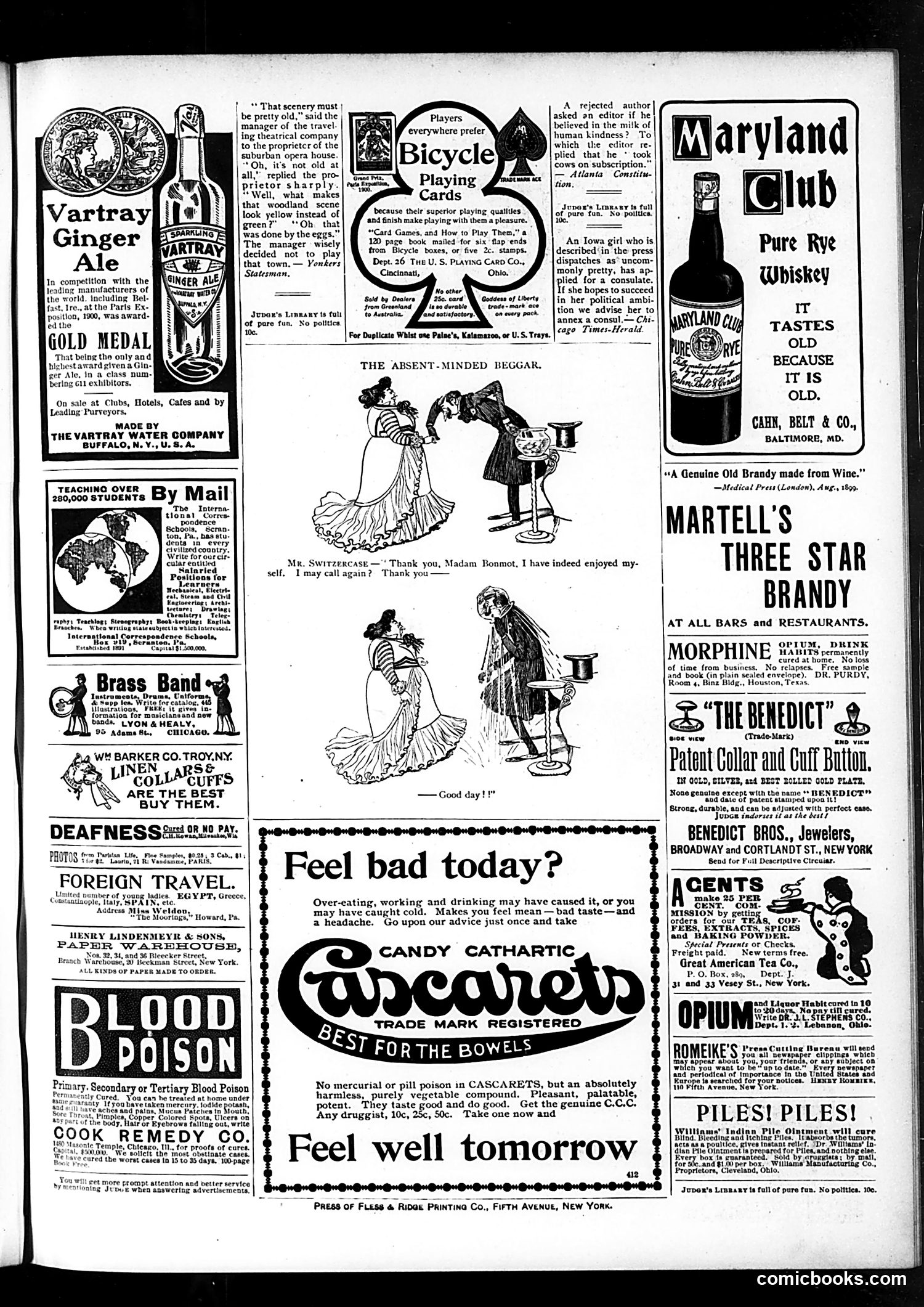
This page is primarily **advertisements** interspersed with brief humor items. The central cartoon, titled "The Absent-Minded Beggar," depicts a social interaction between two figures—a man in formal dress (Mr. Switzercase) and a woman in an elaborate dress and hat. The joke appears to reference **Rudyard Kipling's 1899 poem "The Absent-Minded Beggar,"** which was widely known and parodied at the time. The cartoon shows the man asking if he "may call again," with the woman's response ("Thank you, Madam Bonmot, I have indeed enjoyed myself") suggesting he's been courting or visiting her. The humor lies in social awkwardness—the title implies forgetfulness or obliviousness, though the specific satirical point is unclear without fuller context. The woman's name "Bonmot" (French for "witty remark") may suggest she's a clever conversationalist, adding irony to his absent-mindedness. The surrounding content includes typical period advertisements for alcohol, remedies, and travel services.
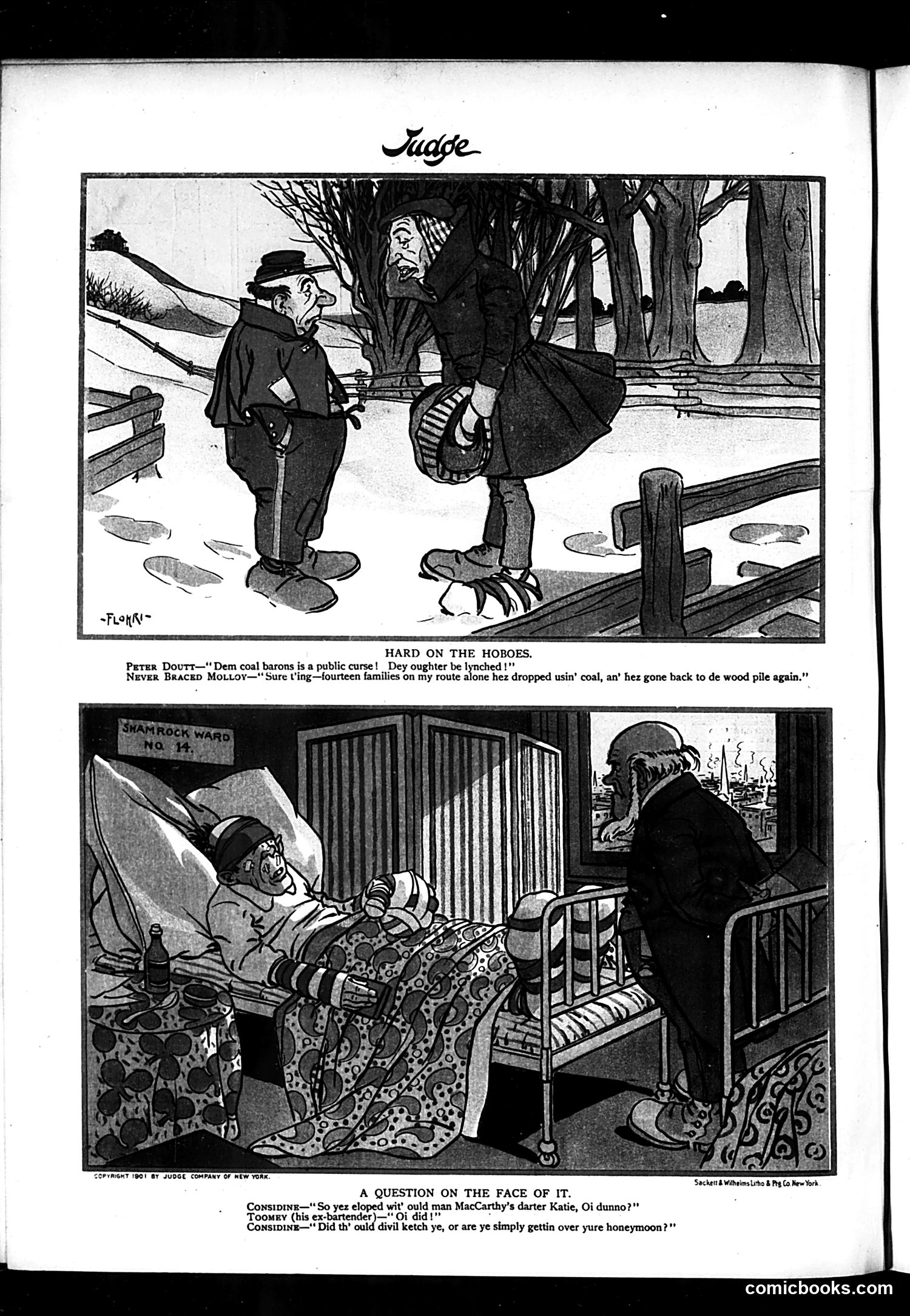
**Top Panel ("Hard on the Hoboes"):** Two working-class men discuss coal barons. One calls them a "public curse" deserving lynching; the other notes that fourteen families on his route have stopped buying coal and returned to wood fires instead. This satirizes labor unrest and economic hardship—likely referencing early 1900s coal industry disputes and the financial struggles of working families forced to abandon purchased fuel for cheaper alternatives. **Bottom Panel ("A Question on the Face of It"):** A constable questions Toomey (identified as a former bartender) about eloping with old man McCarthy's daughter Katie. The constable asks whether McCarthy caught them or if they're simply past their honeymoon phase. The humor relies on Irish dialect humor (common in period satire) and plays on expectations—the constable seems unsure which scenario is more scandalous.