
Judge, 1901-03-16 · page 1 of 16
Judge — March 16, 1901 — page 1: what you’re looking at
What you’re looking at
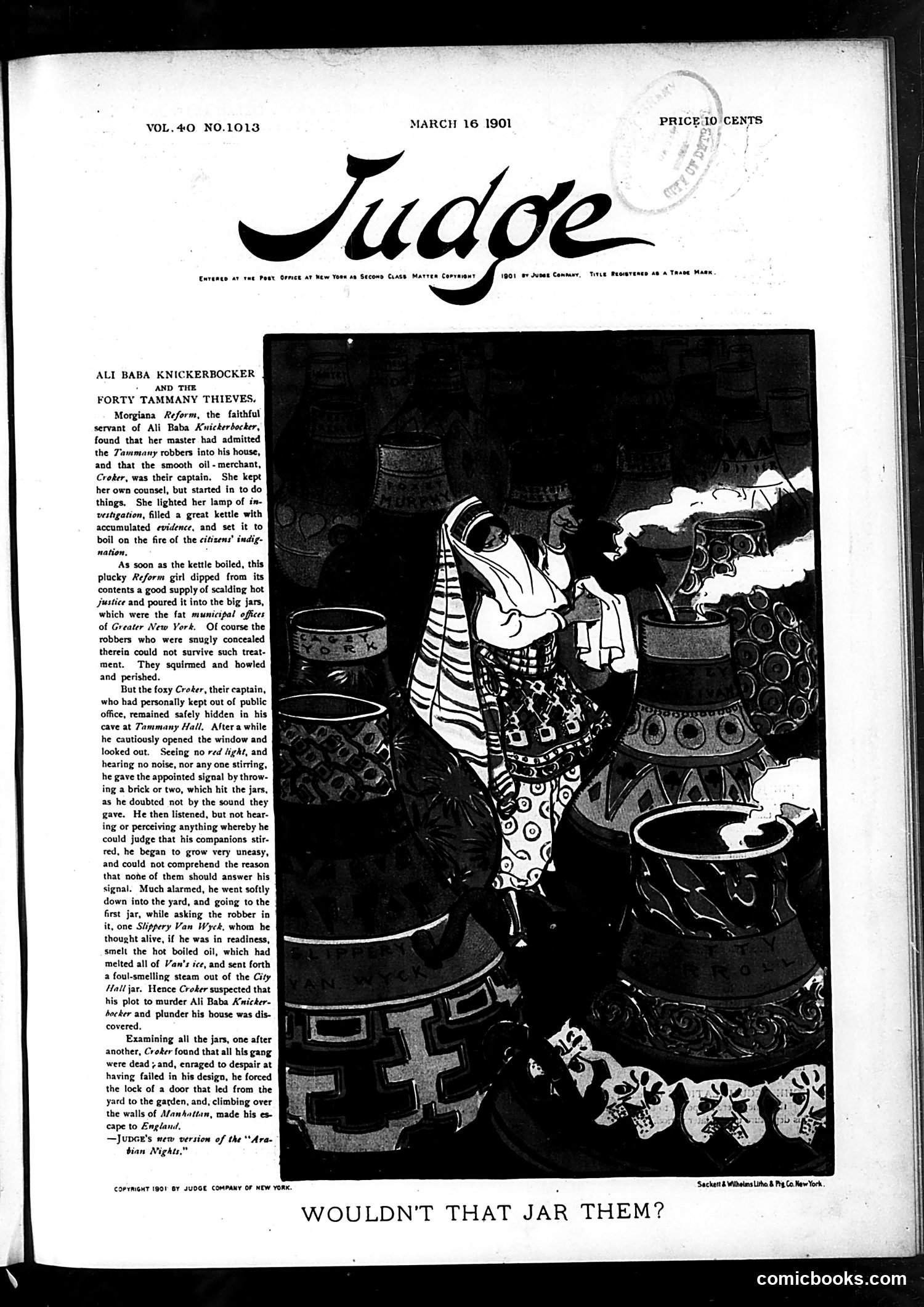
This page illustrates a story titled "Ali Baba Knickerbocker and the Forty Tammany Thieves." The narrative, shown in both text and accompanying illustration, satirizes **Tammany Hall**—New York City's powerful Democratic political machine—by comparing it to the Arabian Nights tale of Ali Baba and the thieves. The plot involves a servant named Nizam discovering that Ali Baba's master has allowed thieves into his house. The satire equates **Tammany politicians with criminals**, suggesting they've infiltrated city government to plunder resources. The illustration depicts someone discovering jars (presumably containing stolen goods or wealth), with the caption "Wouldn't That Jar Them?" implying exposure would shock the corrupt organization. This reflects early-1900s Progressive Era criticism of urban political corruption.
📄 Transcribed text from this page (OCR, searchable)
Machine-transcribed from the original scan — historical spelling and the odd misread are preserved.
ICE\LO0 CENTS VOL.40 NO.1013 MARCH 16 1901 PRICE J Ewrenen at rwe Pout OFPICE AY Mew Yous an Secon Case MATTER CorrmienT 1901 ev Junee Commer, Tents Reocare ALI BABA KNICKERBOCKER AND THE FORTY TAMMANY THIEVES. Morgiana Reform, the faithful servant of Ali Baba Knickerbocker, found that her master had admitted the Jammany robbers into his house, and that the smooth oil - merchant, Croker, was their captain. She kept her own counsel, but started in to do things. She lighted her lamp of in- vestigation, filled a great kettle with accumulated evidence, and set it to boil on the fire of the citizens’ indig- nation, As soon as the kettle boiled, this plucky Reform girl dipped from its contents a good supply of scalding hot justice and poured it into the big jars, which were the fat municipal offices of Greater New York. Of course the robbers who were snugly concealed therein could not survive such treat- ment. They squirmed and howled and perished. But the foxy Croker, their captain, who had personally kept out of public office, remained safely hidden in his cave at Tammany Hall. After a while he cautiously opened the window and looked out. Seeing no red /ight, and hearing no noise, nor any one stirring, he gave the appointed signal by throw- ing a brick or two, which hit the jars, as he doubted not by the sound they gave. He then listened, but not hear- ing or perceiving anything whereby he could judge that his companions stir- red, he began to grow very uneasy, and could not comprehend the reason that noe of them should answer his signal. Much alarmed, he went softly down into the yard, and going to the first jar, while asking the robber in it, one Slippery Van Wyck, whom he thought alive, if he was in readiness, smelt the hot boiled oil, which had melted all of Van's ice, and sent forth a foul-smelling steam out of the City Hall jar. Hence Croker suspected that his plot to murder Ali Baba A’nicker- decker and plunder his house was dis- covered. Examining all the jars, one after another, Croter found that all his gang were dead ; and, enraged to despair at having failed in his design, he forced the lock of a door that led from the yard to the garden, and, climbing over the walls of A/anhattun, made his es- cape to England, —Jupace's new version of the “Ara- bian Nights.” Co.hew York. COPYRIGHT 101 BY JUDGE COMPANY OF NEW YORK. ‘Sackert 8 Wilheins ithe & Pg WOULDN'T THAT JAR THEM? comicbooks.com