
Judge, 1901-03-16 · page 2 of 16
Judge — March 16, 1901 — page 2: what you’re looking at
What you’re looking at
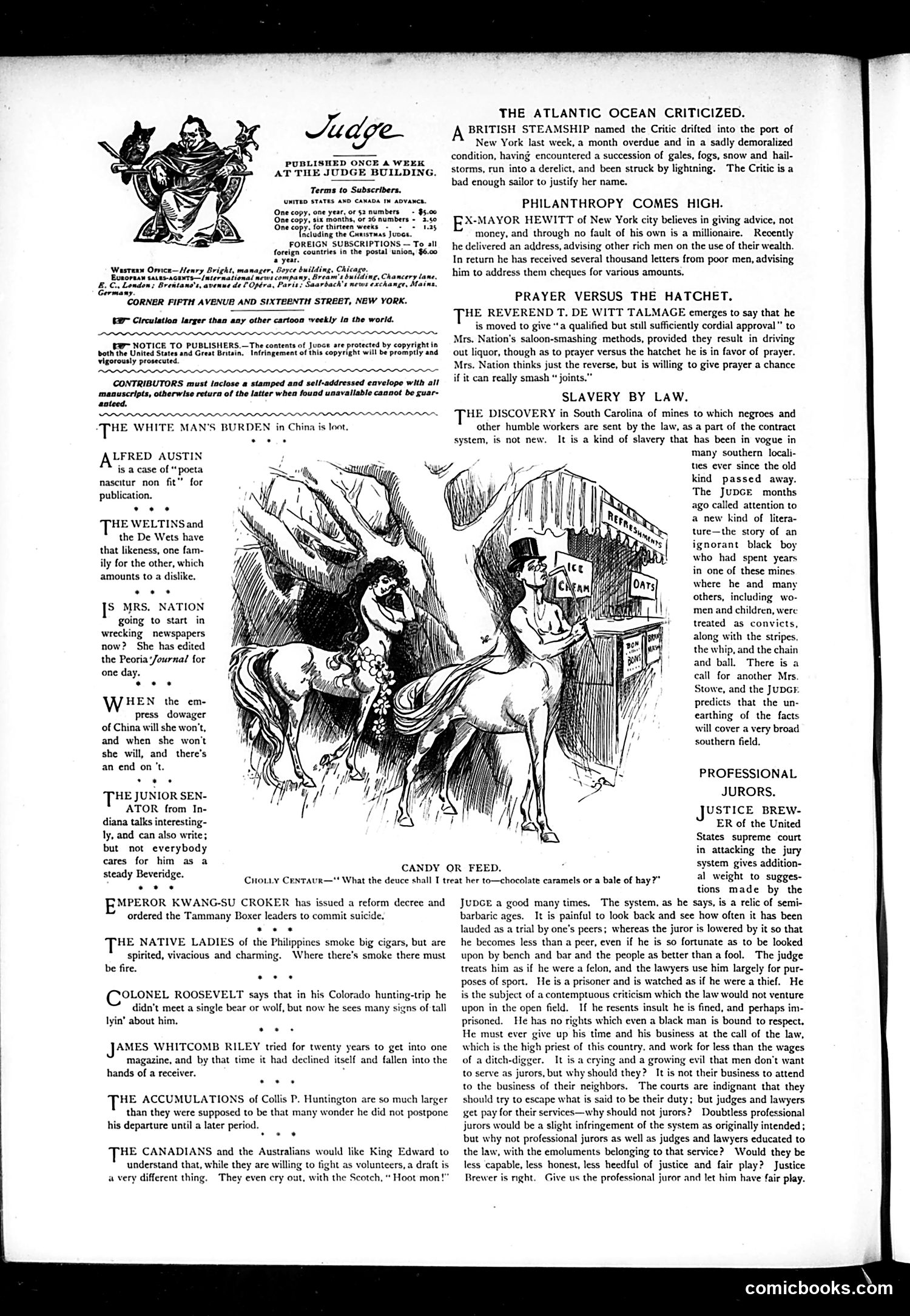
This cartoon illustrates the article "Candy or Feed," which critiques the jury system. The centaur figure—a half-man, half-horse creature—represents a juror who is being fed or treated inadequately, appearing somewhat debased or diminished by the experience. The satire targets how jurors were undervalued in American courts. The article argues that professional jurors would better serve justice than citizens summoned for duty, criticizing how the system treats jurors like "a tool" rather than respected participants. The grotesque hybrid form visually expresses the degradation Judge's editors believed jury duty inflicted on otherwise respectable citizens. The cartoon supports the piece's argument that jurors deserve better compensation and professional standing.
📄 Transcribed text from this page (OCR, searchable)
Machine-transcribed from the original scan — historical spelling and the odd misread are preserved.
dge PUBLISHED ONCE A WEEK AT THE JUDGE BUILDING. Terms to Subscribers, UNITED STATES AND CANADA IH ADVAMCR. One copy, one year, of $2 numbers ‘One copy, six months, or 26 number One copy. for thirteen weeks. - facluding the Cwristmas Juoes. FOREIGN SUBSCRIPTIONS — To all foreign countries in the postal union, $6.00 ayer. Wastaan Orrice—Henry Bright, manager, Boyce building, Chicage. Eutorean satus-acuwrs—/niermational mews company, Bream't building, Chancery lane, B.C. mz Brentans's, avenue de jarback's mews exchange, Mains, my. CORNER FIFTH AVENUE AND SIXTEENTH STREET, NEW YORK. (27 Circulation larger than any other cartoon weekly Ia the world. §@- NOTICE TO PUBLISHER: both the United States and Great Brita vigorously prosecuted. The contents of Juoce are protected by copyright in infringement of this copyright will be promptly and CONTRIBUTORS must taclose a stamped and self-addressed envelope with all manuscripts, otherwise retura of the latter when found unavailable cannot be guar- anteed. is loot, ‘THE WHITE MAN'S BURDEN in China LFRED AUSTIN is a case of “poeta nascitur non fit" for publication. vee ‘THE WELTINS and the De Wets have that likeness, one fam- ily for the other, which amounts to a dislike, S MRS. NATION going to start in wrecking newspapers now? She has edited the Peoria‘/ournal for one day. eee WHEN the em- press dowager of China will she won't, and when she won't she will, and there's an end on ‘t. THE JUNIOR SEN- ATOR from In- diana talks interesting- ly, and can also write; but not everybody cares for him as a steady Beveridge. eee EMPEROR KWANG-SU CROKER has issued a reform decree and ordered the Tammany Boxer leaders to commit suicide. eee THE NATIVE LADIES of the Philippines smoke big cigars, but are spirited, vivacious and charming. Where there's smoke there must be fire. COLONEL ROOSEVELT says that in his Colorado hunting-trip he didn’t meet a single bear or wolf, but now he sees many signs of tall lyin’ about him. JAMES WHITCOMB RILEY tried for twenty years to get into one magazine, and by that time it had declined itself and fallen into the hands of a receiver. a c THE ACCUMULATIONS of Collis P. Huntington are so much larger than they were supposed to be that many wonder he did not postpone his departure until a later period. THE CANADIANS and the Australians would like King Edward to understand that, while they are willing to fight as volunteers, a draft is a very different thing. They even cry out, with the Scotch, “* Hoot mon!” CANDY OR FEED. CHou.y Centaur—" What the deuce shall T treat her to—chocolate caramels or a bale of hay?” THE ATLANTIC OCEAN CRITICIZED. BRITISH STEAMSHIP named the Critic drifted into the port of New York last week, a month overdue and in a sadly demoralized condition, having encountered a succession of gales, fogs, snow and hail- storms, run into a derelict, and been struck by lightning. The Critic is a bad enough sailor to justify her name. PHILANTHROPY COMES HIGH. X-MAYOR HEWITT of New York city believes in giving advice, not money, and through no fault of his own is a millionaire. Recently he delivered an address, advising other rich men on the use of their wealth. In return he has received several thousand letters from poor men, advising him to address them cheques for various amounts. PRAYER VERSUS THE HATCHET. HE REVEREND T. DE WITT TALMAGE emerges to say that he is moved to give “‘a qualified but still sufficiently cordial approval" to Mrs. Nation's saloon-smashing methods, provided they result in driving out liquor, though as to prayer versus the hatchet he is in favor of prayer. Mrs. Nation thinks just the reverse, but is willing to give prayer a chance if it can really smash “joints.” SLAVERY BY LAW. THE DISCOVERY in South Carolina of mines to which negroes and other humble workers are sent by the law, as a part of the contract system, is not new. It is a kind of slavery that has been in vogue in many southern locali- ties ever since the old kind passed away. The JUDGE months ago called attention to a new kind of litera- ture—the story of an ignorant black boy who had spent years in one of these mines where he and many others, including wo- men and children, were treated as convicts, along with the stripes. the whip, and the chain and ball. There is a call for another Mrs. Stowe, and the JUDGE. predicts that the un- earthing of the facts will cover a very broad southern field. PROFESSIONAL JURORS. JUSTICE BREW- ER of the United States supreme court in attacking the jury system gives addition- al weight to sugges- tions made by the JUDGE a good many times. The system, as he says, is a relic of semi- barbaric ages. It is painful to look back and see how often it has been lauded as a trial by one’s peers; whereas the juror is lowered by it so that he becomes less than a peer, even if he is so fortunate as to be looked upon by bench and bar and the people as better than a fool. The judge treats him as if he were a felon, and the lawyers use him largely for pur- poses of sport. He is a prisoner and is watched as if he were a thief. He is the subject of a contemptuous criticism which the law would not venture upon in the open field. If he resents insult he is fined, and perhaps im- prisoned. He has no rights which even a black man is bound to respect. He must ever give up his time and his business at the call of the law, which is the high priest of this country. and work for less than the wages of aditch-digger. It is a crying and a growing evil that men don’t want to serve as jurors, but why should they? It is not their business to attend to the business of their neighbors. The courts are indignant that they should try to escape what is said to be their duty; but judges and lawyers get pay for their services—why should not jurors? Doubtless professional jurors would be a slight infringement of the system as originally intended; but why not professional jurors as well as judges and lawyers educated to the law, with the emoluments belonging to that service? Would they be less capable, less honest, less heedful of justice and fair play? Justice Brewer is nght. Give us the professional juror and let him have fair play. . \ comicbooks.com