
A complete issue · 16 pages · 1900
Judge — November 10, 1900
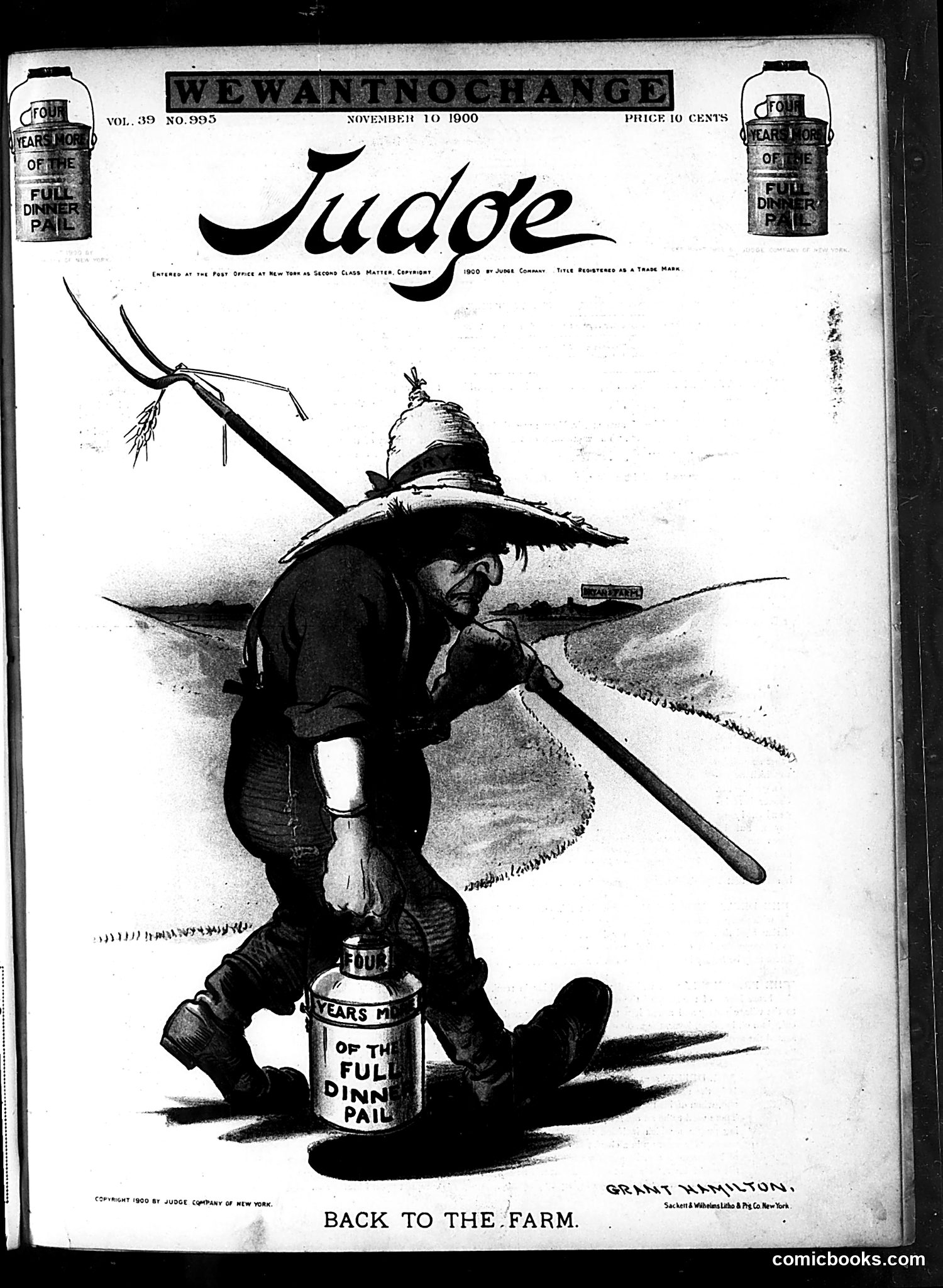
This political cartoon by Grant Hamilton satirizes a figure (likely a prominent politician or public figure of 1900) being forced to abandon city life. The caricatured man, dressed in formal attire with a large hat, is depicted as a farmer carrying agricultural tools—a rake and what appears to be a scythe. He stands on or near a can labeled "Four Years More of the Full Dinner Pail," a reference to Republican campaign messaging from the 1900 election cycle promising economic prosperity. The cartoon's title "Back to the Farm" suggests either ridicule of someone returning to rural life, or commentary on political displacement. The artist appears to be commenting on election results or political consequences affecting this figure, though the specific identity remains unclear from the image alone.
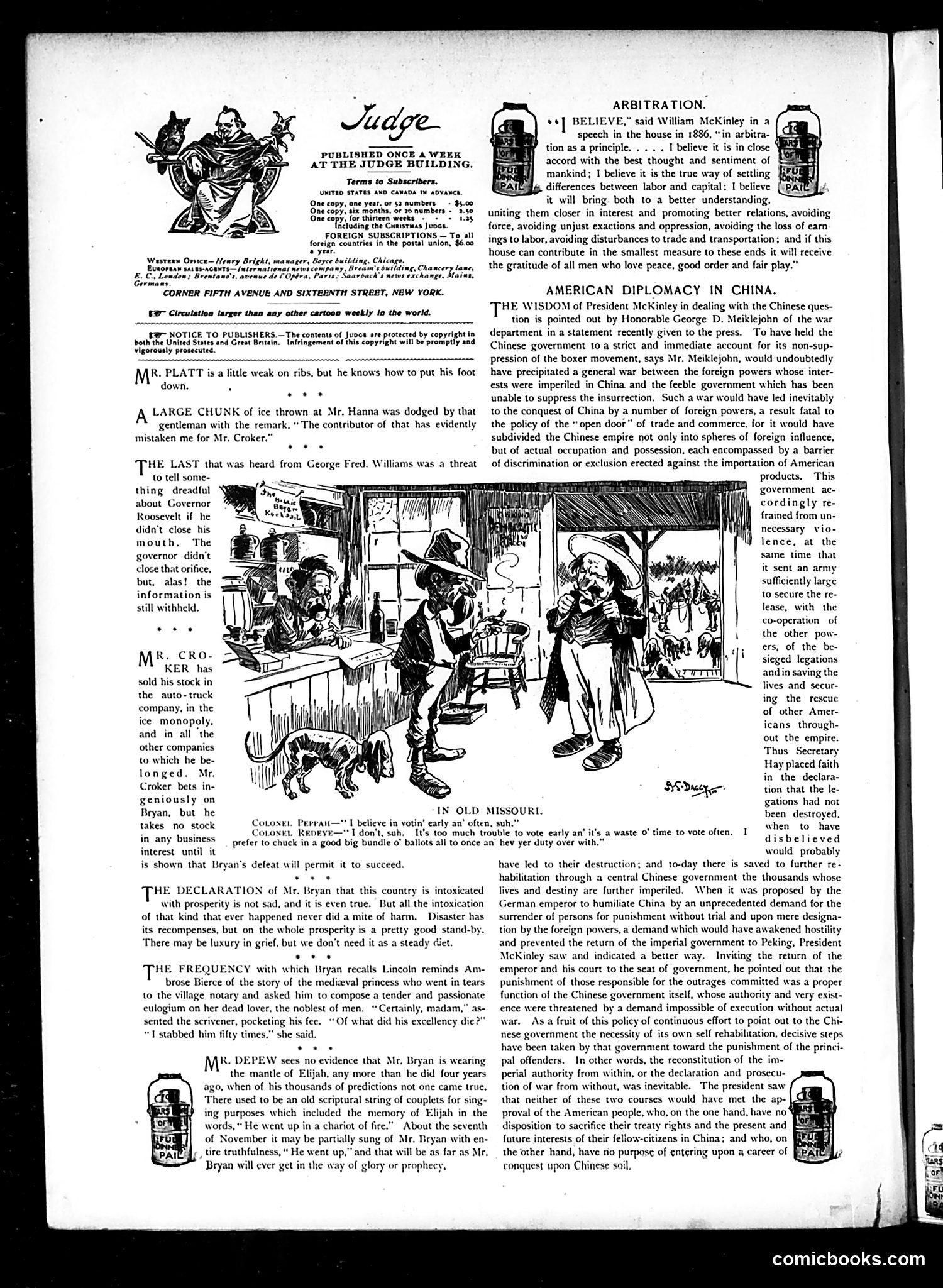
This page contains a satirical cartoon titled "In Old Missouri" depicting Colonel Pepper and Colonel Bryan discussing voting practices. The cartoon mocks early voting ("I don't believe it's too much trouble to vote early an' often. I prefer to check in a good big bundle o' ballots all at once an' have yer duty over with"). The satire targets electoral fraud and voter manipulation in Missouri politics during the Bryan era (likely 1896 or later). The characters represent rural/frontier political culture engaging in ballot stuffing and corrupt voting practices presented as casual conversation. The accompanying article "American Diplomacy in China" discusses Secretary Hay's foreign policy regarding the Boxer Rebellion and foreign intervention in China, unrelated to the cartoon.
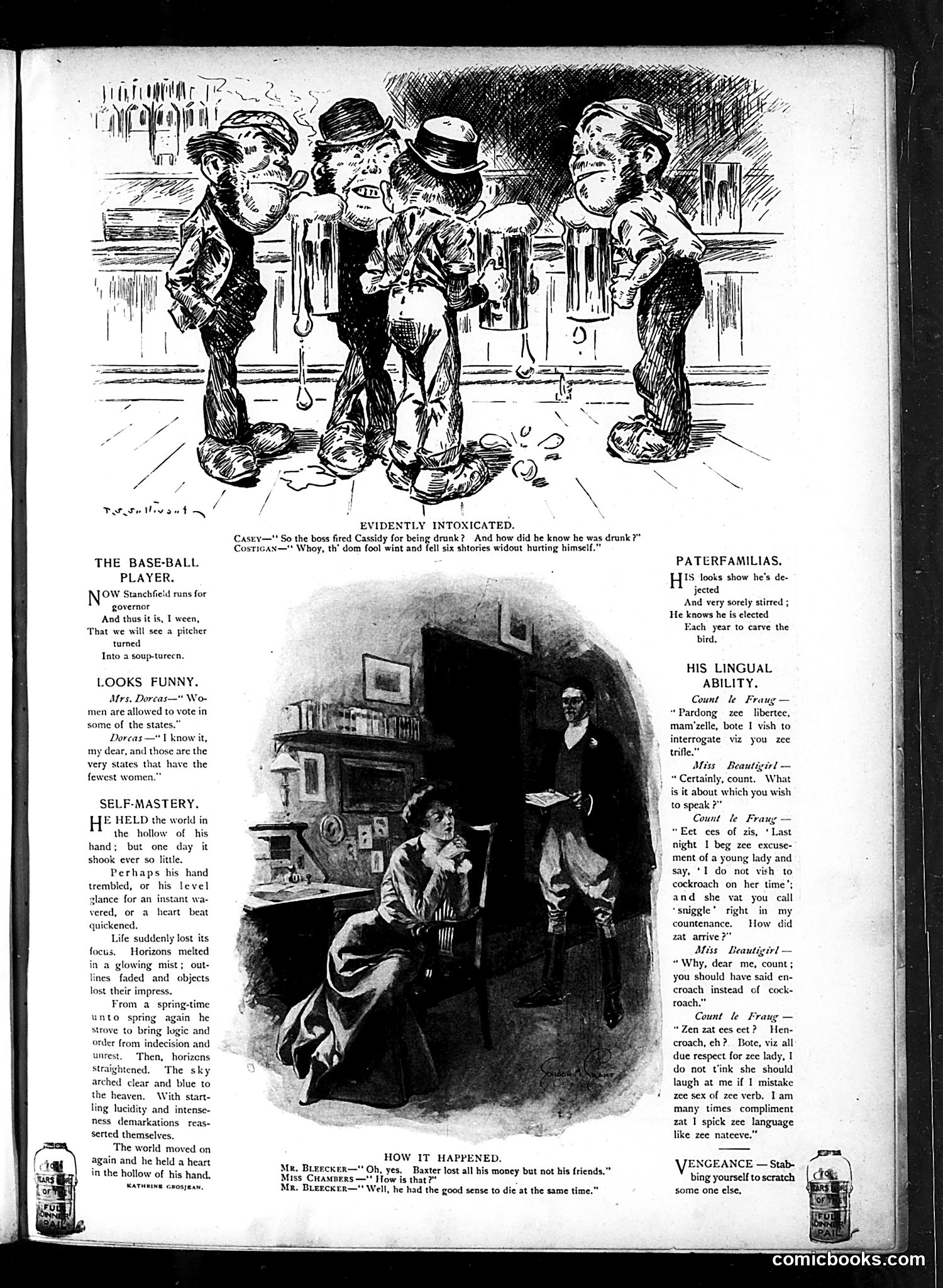
The top cartoon, "EVIDENTLY INTOXICATED," depicts four caricatured men at a bar displaying exaggerated facial features typical of period satirical art. The dialogue suggests one man (Cassidy) was fired for drunkenness and is now intoxicated himself, unable to remember details of his dismissal. The remaining content includes prose pieces with titles like "THE BASE-BALL PLAYER," "LOOKS FUNNY," and "SELF-MASTERY"—brief satirical commentaries on social behavior. A center illustration shows what appears to be a domestic interior scene related to "HOW IT HAPPENED," involving characters named Bleecker and Chambers discussing money and friendship. The right column "HIS LINGUAL ABILITY" and "PATERFAMILIAS" contain dialogue-based satire, likely mocking pretentious speech patterns or family dynamics common to the era.
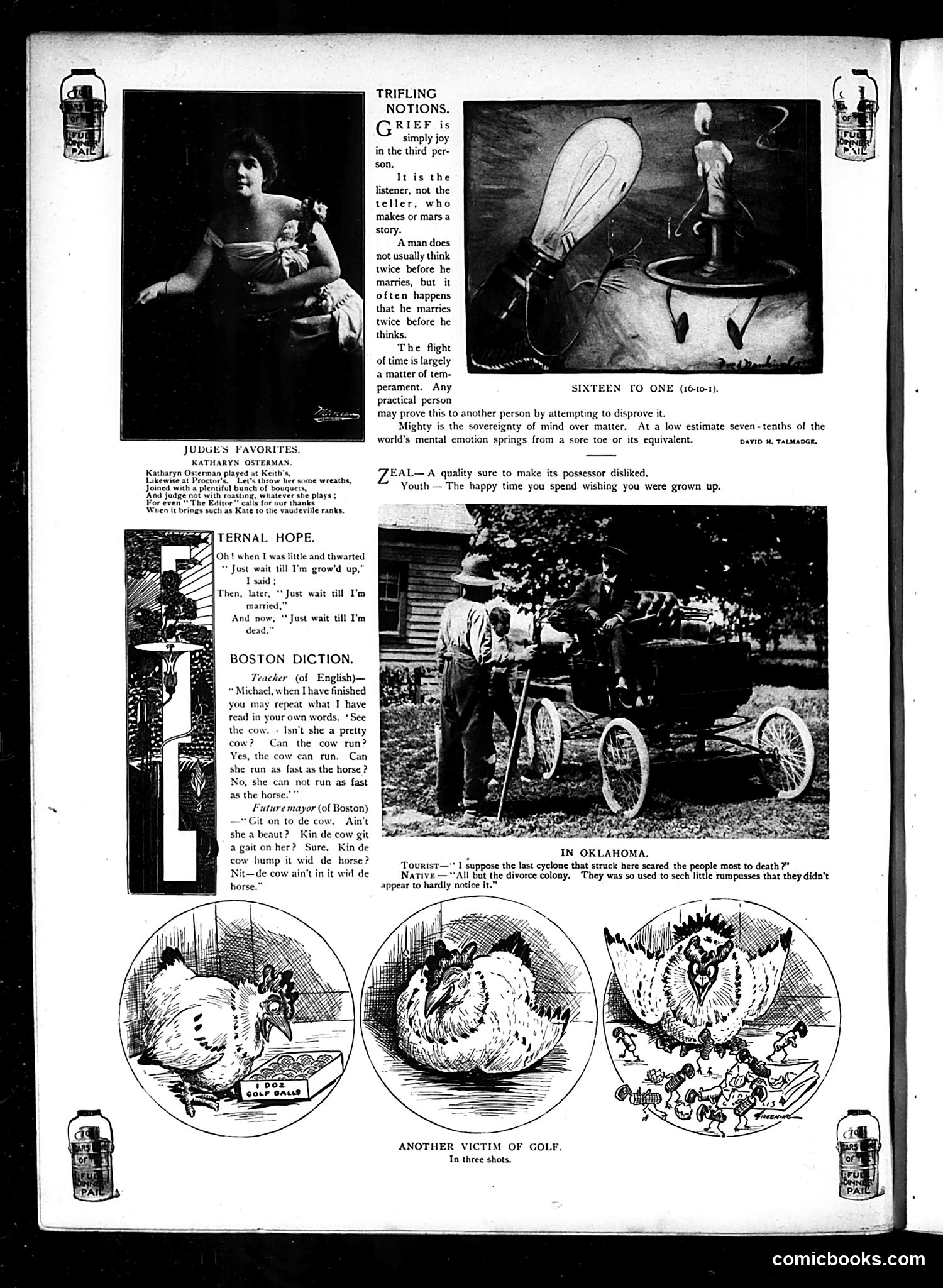
This page contains several unrelated humor pieces typical of early 20th-century Judge magazine: **"Trifling Notions: Grief"** discusses how listeners, not storytellers, create emotional impact—a philosophical observation rather than political satire. **"Judge's Favorites"** lists preferred things, including theatrical references to Katharine Cornell and Laurette Taylor (prominent actresses of the era). **"Eternal Hope"** and **"Boston Diction"** are dialect jokes playing on regional speech patterns—common humor of the period. **"In Oklahoma"** is a brief exchange mocking both tourists and natives about the state's "divorce colony" reputation. **"Another Victim of Golf"** (three circular panels) shows a golf ball's destructive transformation of a bird—visual slapstick humor. The page contains no identifiable political figures or commentary, instead offering lighthearted entertainment typical of Judge's content.
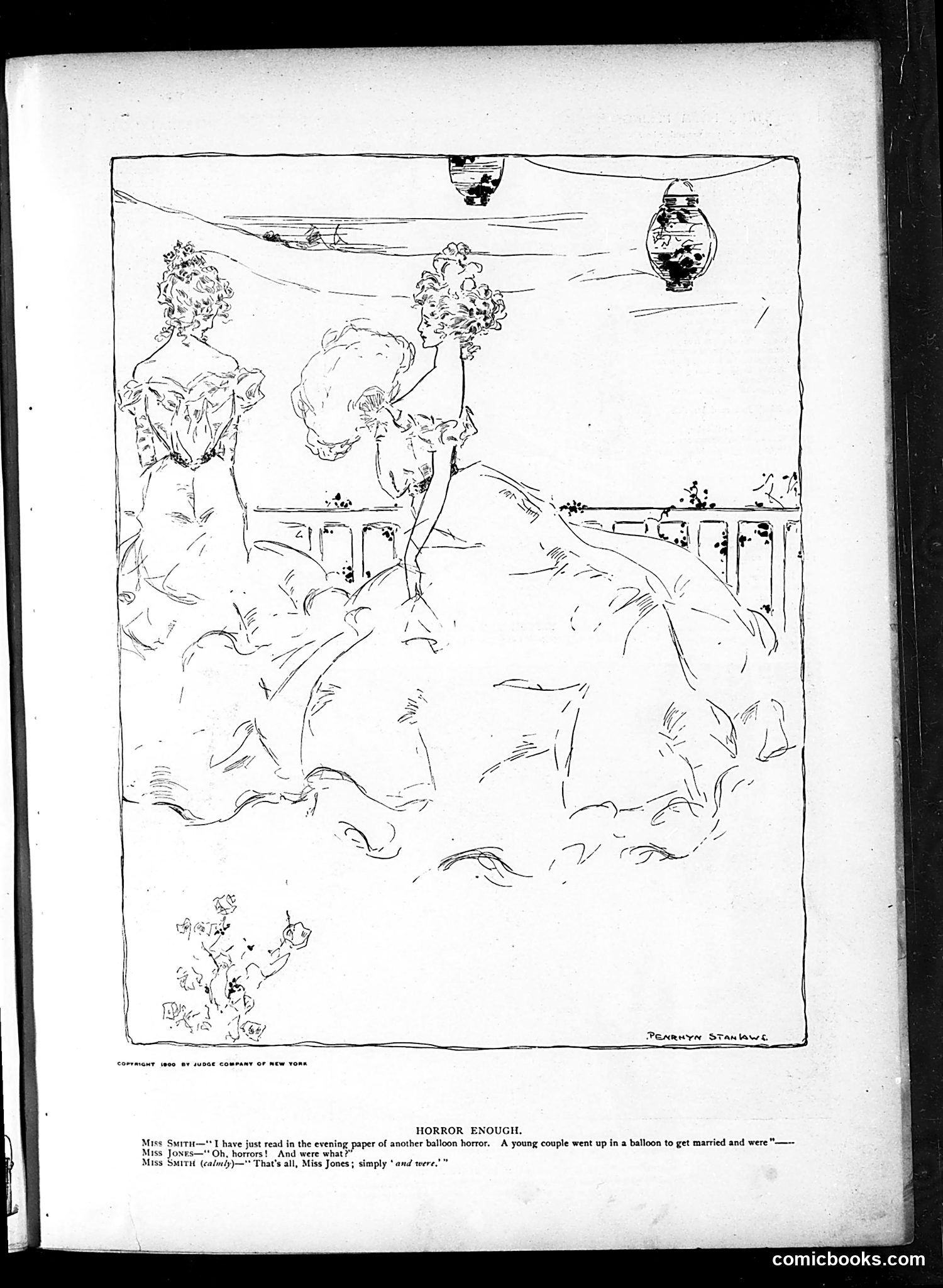
This is a humorous cartoon playing on ambiguous language. Miss Smith reports reading about a balloon accident where a couple "went up in a balloon to get married and were—" but trails off mysteriously. Miss Jones expects a tragic ending ("and were what?"), imagining some terrible disaster. Miss Smith's punchline reveals the "horror" is purely linguistic: the couple simply "were" married—the sentence just ends anticlimactically. The joke mocks sensationalist newspaper headlines and readers' expectations of dramatic tragedy. The cartoon satirizes how people anticipate worst-case scenarios, and how incomplete information fuels anxious speculation. The artwork shows well-dressed women gossiping in an interior setting, typical of Judge magazine's social satire aimed at middle and upper-class audiences.
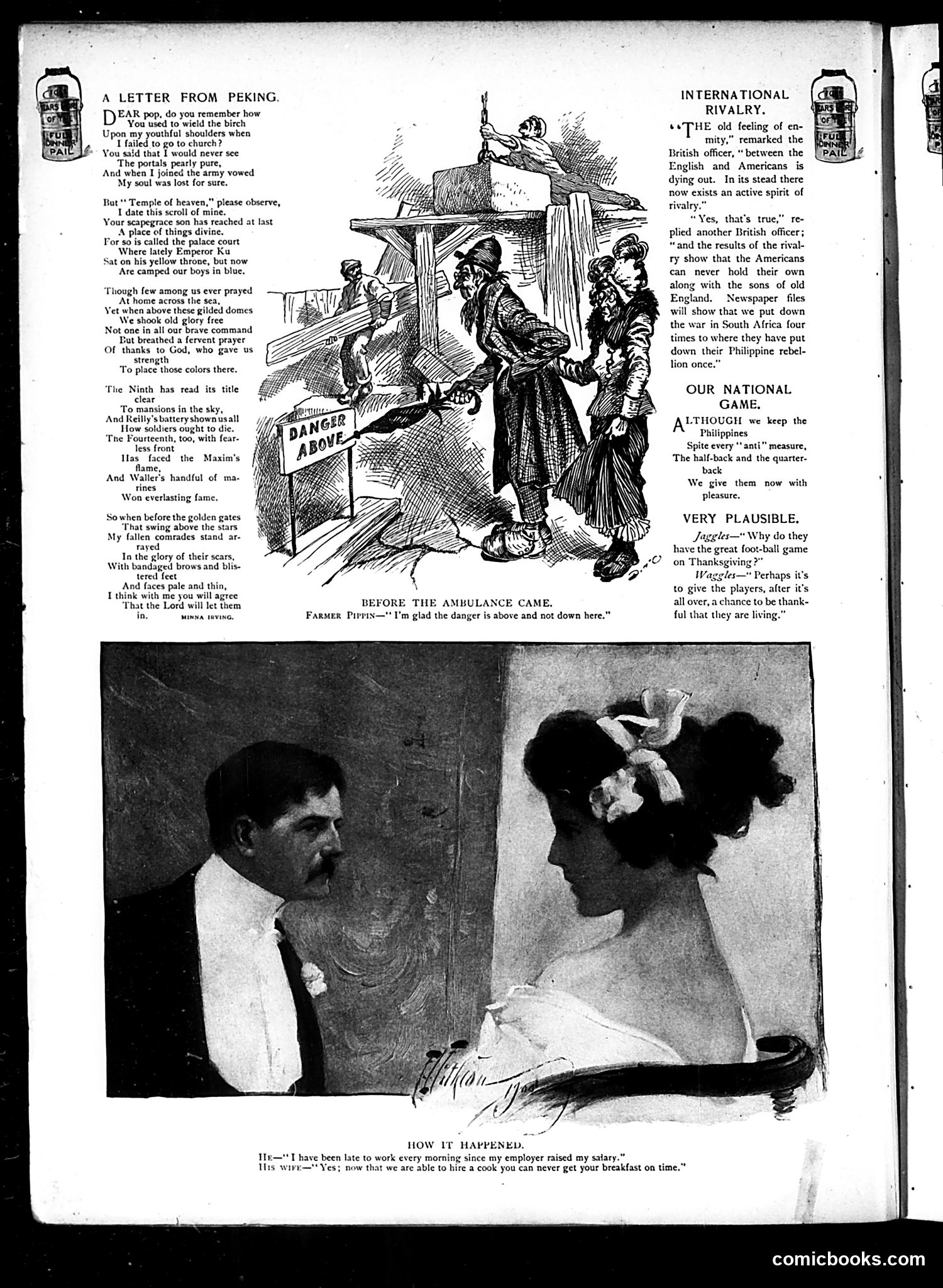
This page from *Judge* magazine contains several satirical pieces about American imperialism and military affairs, likely from the Philippine-American War era (early 1900s). **"A Letter from Peking"** celebrates American soldiers stationed in China (referencing the Boxer Rebellion aftermath), with the writer noting he's now in a "place of things divine"—the Emperor's palace—contradicting his childhood religious instruction. Units like the "Ninth," "Fourteenth," and "Waller's marines" are praised for bravery. **"International Rivalry"** satirizes British-American competition: British officers claim Americans can't match British military success, pointing out Britain suppressed the South African War four times versus America's one Philippine rebellion suppression—mocking American imperial ambitions. **"Our National Game"** makes a darker joke: while America keeps the Philippines (despite anti-imperialist sentiment), they freely give Britain American football—suggesting America's real cultural export is sports, not military dominance. The bottom illustration depicts a domestic comedy about inflation: a man's salary raise is offset by his wife hiring household help, making him perpetually late to work.
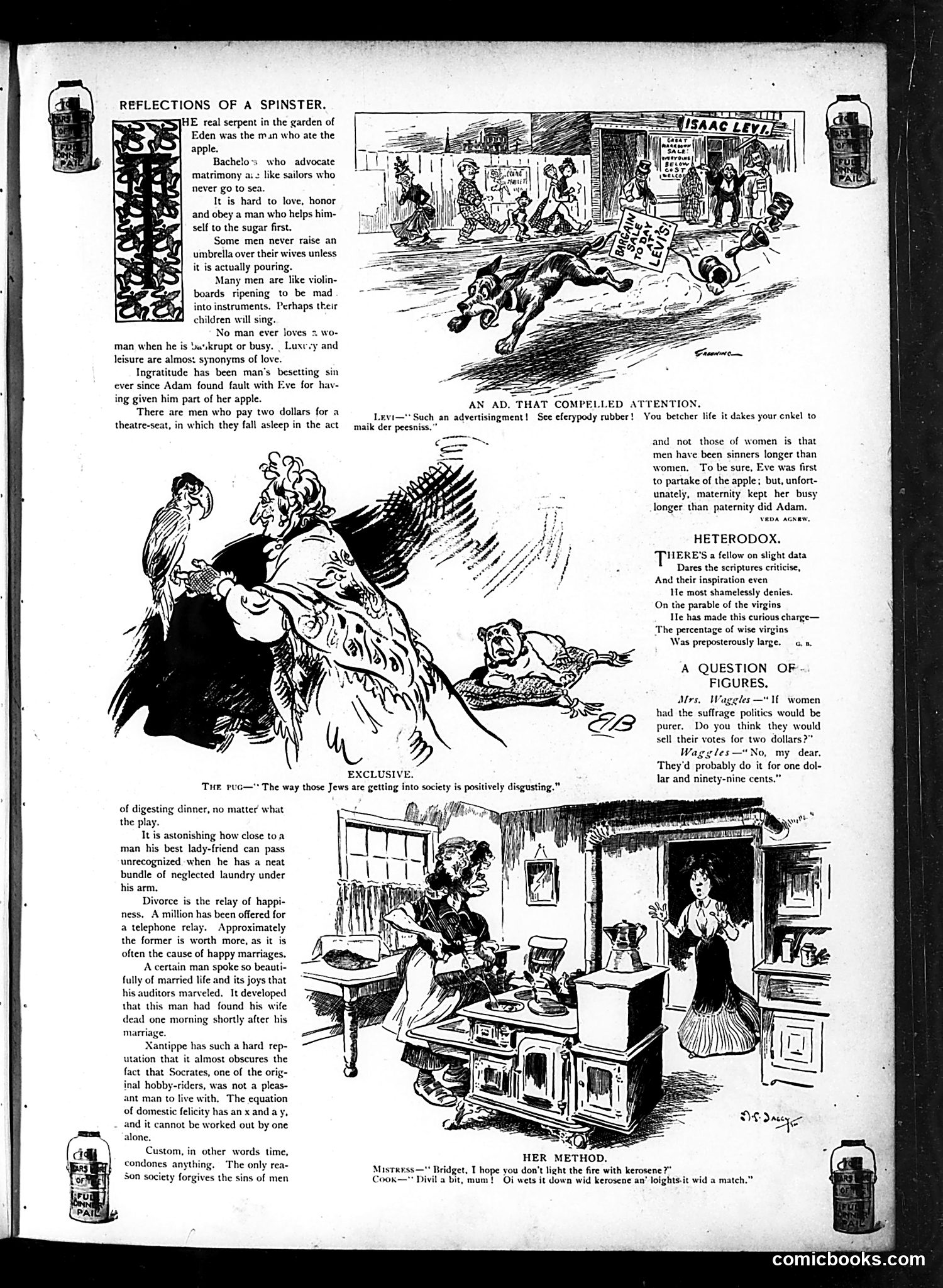
This page contains satirical commentary on gender relations and marriage, presented through cynical aphorisms and cartoons typical of early 20th-century humor magazines. **Main content:** The left column offers misogynistic "witticisms" about unmarried women's perspectives on men—claiming bachelors who advocate marriage resemble sailors who never sail, that men are ungrateful (since Adam), and that men fail as husbands through selfishness and inattention. **The cartoons mock:** - An antisemitic "exclusive" joke about Jewish people entering society - Women's suffrage (suggesting women would sell votes cheaply—$1.99 rather than $2) - Working-class Irish domestics (the "Bridget" kitchen scene) **Context:** This reflects pre-1920s attitudes: Jewish immigration anxieties, anti-suffrage sentiment, and class-based ethnic stereotyping were mainstream satirical targets. The "spinster" framing itself was dismissive—unmarried women were presented as bitter, not independent. The humor relies entirely on period prejudices now recognized as offensive.
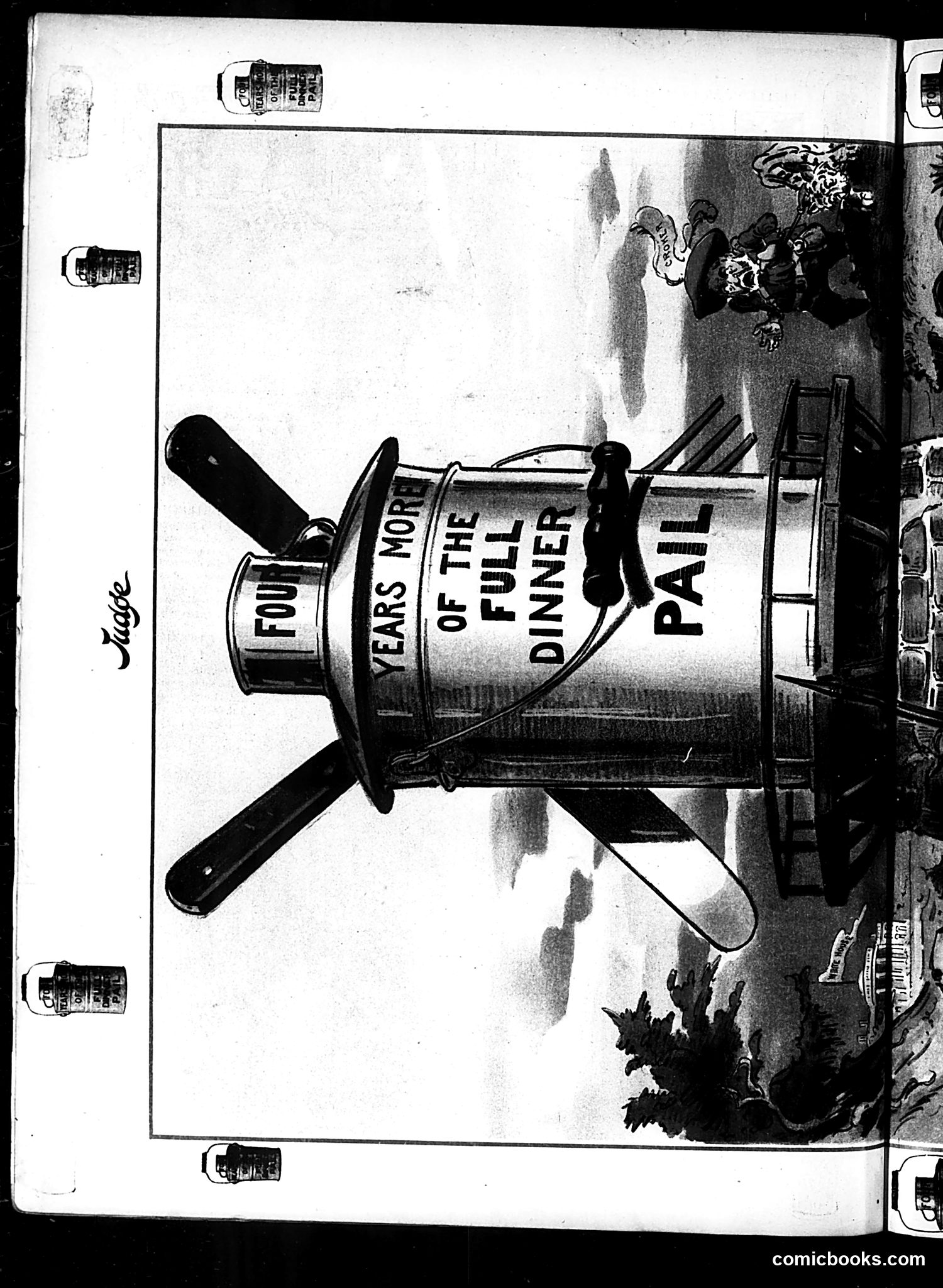
This appears to be a political cartoon from *Judge* magazine satirizing fuel policy. The image shows a large industrial drum or container labeled "FOUR YEARS MORT[?] OF THE FULL FINER PAL" (text partially obscured due to image orientation and quality). The cartoon likely critiques government or corporate handling of fuel supplies—possibly referencing fuel shortages, rationing, or inefficient energy policy during a specific historical period (likely early-to-mid 20th century). The drum's industrial nature and prominent display suggest the cartoonist is mocking either inadequate fuel reserves or mismanagement of a critical resource. The OCR text is too degraded to provide precise context about which administration or event is being targeted. Without clearer text, the specific political target remains unclear.
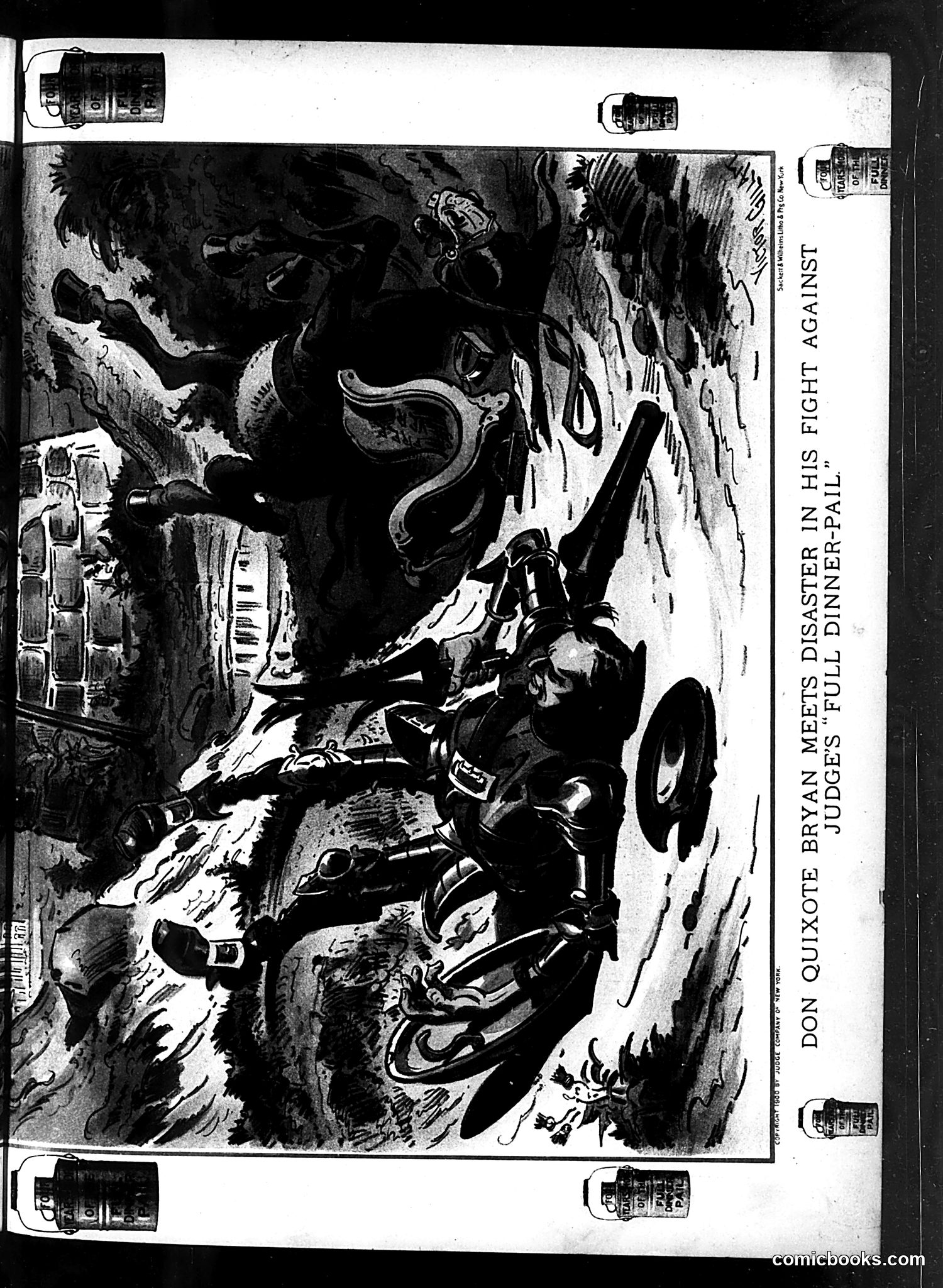
The OCR text appears corrupted and unreadable. However, the image shows a dramatic black-and-white illustration depicting what appears to be a conflict scene with figures engaged in combat or struggle, featuring weapons and dynamic action. The caption reads: "DON QUIXOTE BRYAN MEETS DISASTER IN HIS FIGHT AGAINST BUDGETS FULL DINNER-PAIL." This satirizes William Jennings Bryan (the three-time presidential candidate), comparing him to Cervantes' delusional knight Don Quixote. The "full dinner-pail" references the Republican campaign slogan promising prosperity. The cartoon suggests Bryan's economic policies or political crusades are as futile and foolish as Quixote's tilting at windmills, depicting him metaphorically defeated by economic or political forces he cannot overcome.
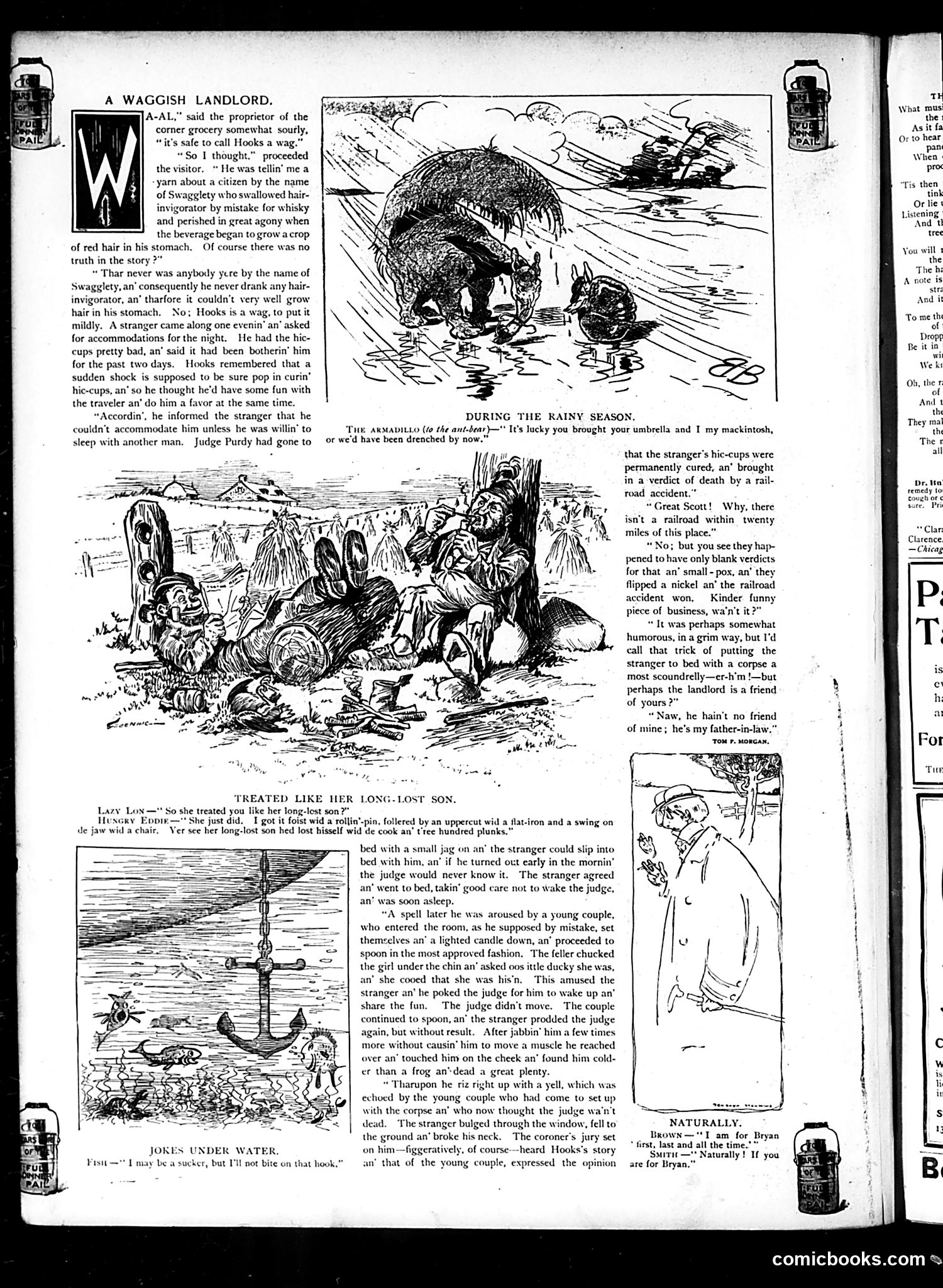
This page presents humorous tall tales set in rural America, apparently from the late 19th/early 20th century. The main story concerns a practical-joking landlord (Hooks) who tricks a drunken stranger into sleeping with a corpse to cure his hiccups. The joke relies on period-specific elements: faith in folk remedies (shock curing hiccups), casual attitudes toward death, and rural isolation. The smaller vignettes mock rural dialects and behavior—one features a man beaten by his girlfriend's mother (mistaken for her "lost son"), another shows an armadillo and ant-bear during rainy season. These aren't political cartoons but rather comic anecdotes typical of Judge magazine's satirical humor, mocking rural/frontier American customs and superstitions for urban readers' amusement.
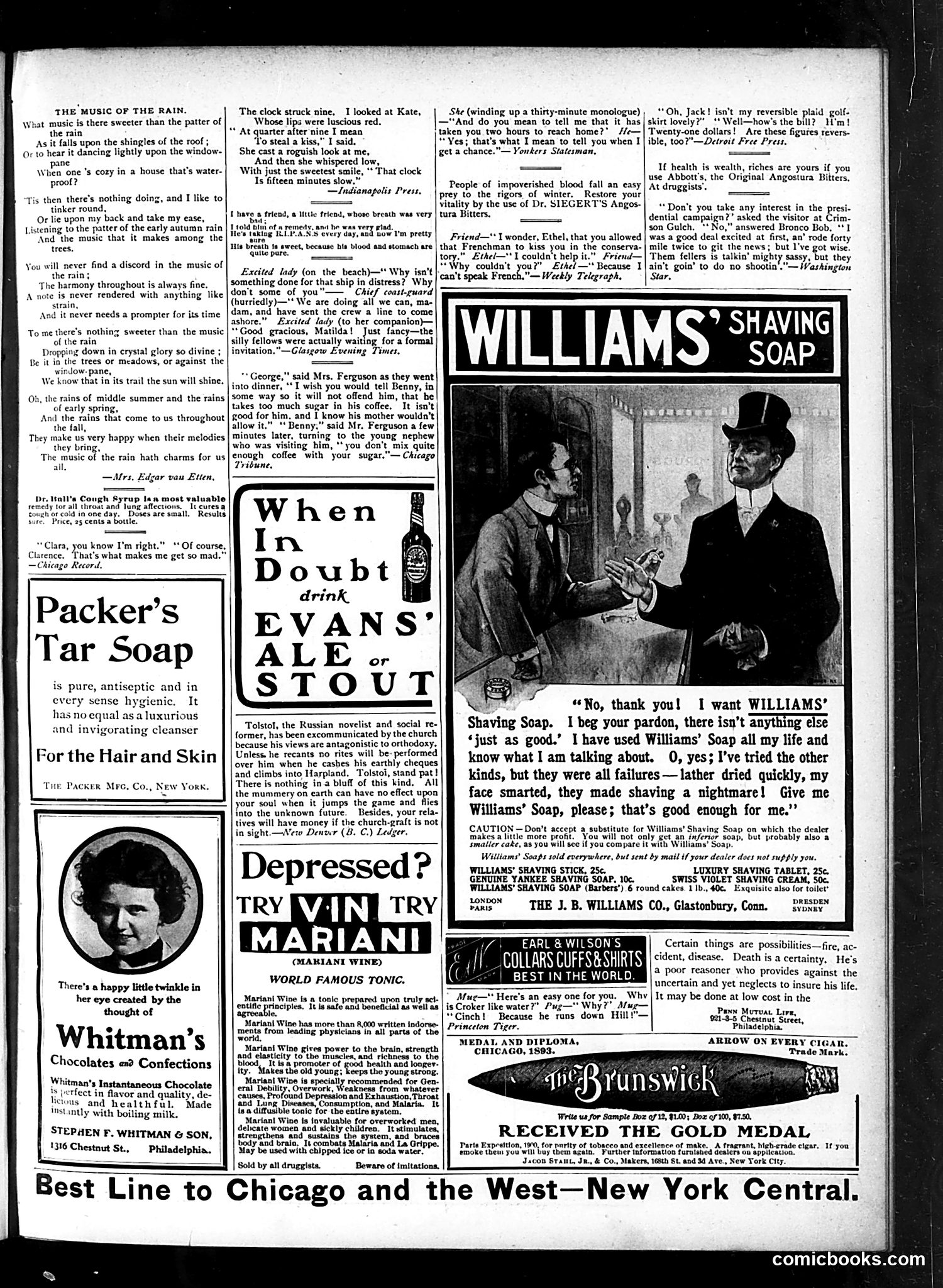
This page is primarily **advertising with some light humor content**—typical of Judge magazine's format. The main cartoon/advertisement is the **Williams' Shaving Soap** feature, showing a man being shaved. The copy presents testimonial humor: a customer claims Williams' soap produces superior shaving results compared to competitors, using exaggerated language ("nightmare," "smarted"). The "CAUTION" section humorously warns against substitutes, suggesting counterfeit soaps existed—a real consumer concern of the era. The page also contains several brief **anecdotal humor pieces** about everyday situations: romantic clock-adjusting, a coastal rescue misunderstanding, and parental advice delivered indirectly. These are gentle, domestic jokes typical of early-20th-century magazines. The **Tolstoy reference** briefly notes his excommunication by the Russian Orthodox Church for his radical views, presenting it skeptically—suggesting earthly church authority means nothing spiritually. Overall, this is a **commercial/entertainment page** with ads for soaps, chocolates, and beverages interspersed with mild domestic humor and brief news commentary. No significant political satire appears here.
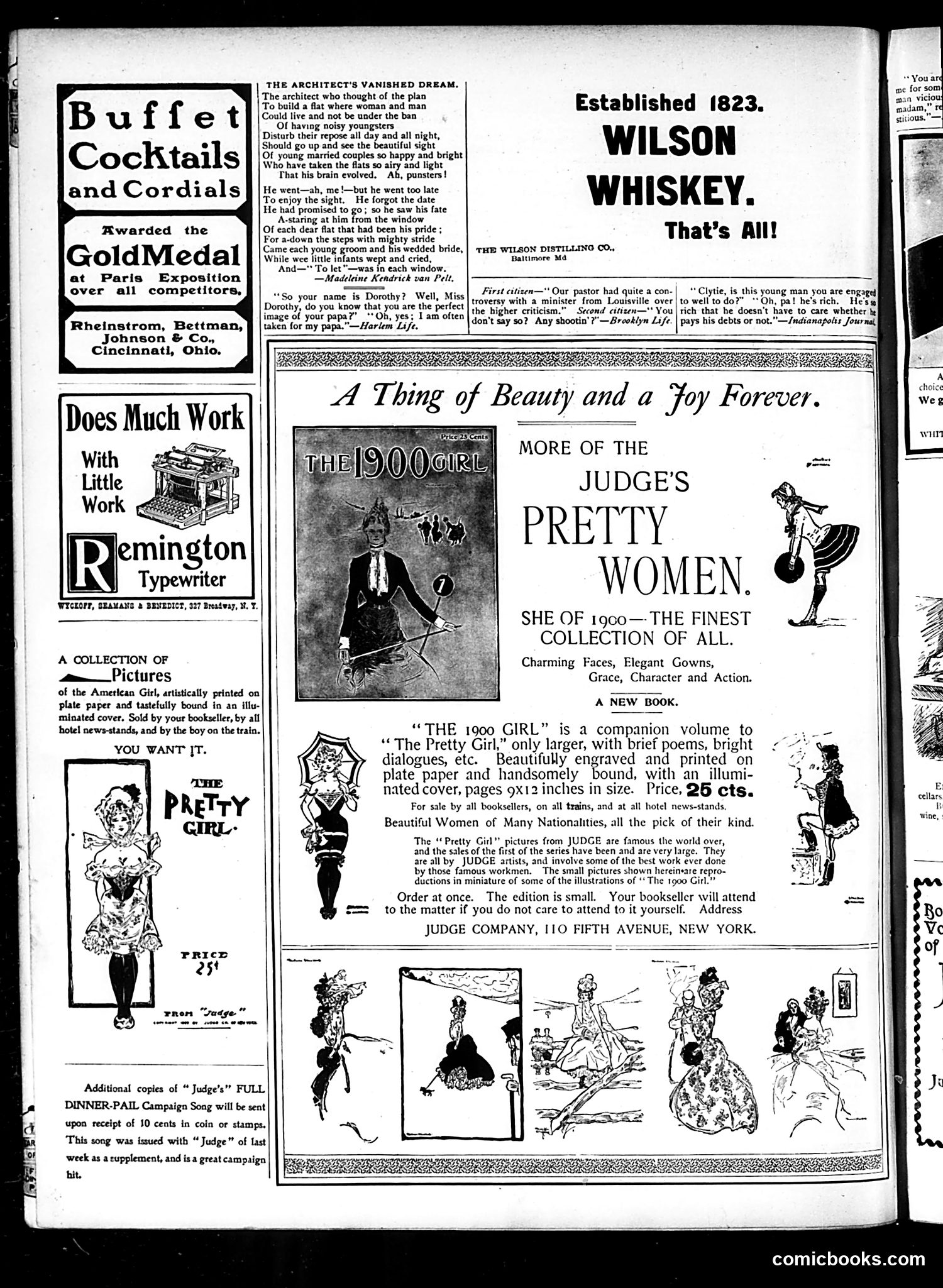
This page is primarily advertisements with one substantive satirical poem. The main content—"The Architect's Vanished Dream"—mocks a housing developer's failed utopian vision. The architect designed modern apartment flats promising couples peaceful, childless living ("no noisy youngsters"). However, he arrives too late to view his creation: every unit has been rented by young married couples who've promptly filled them with crying infants. All the "To Let" signs are gone. The satire targets turn-of-the-century optimism about modern design solving social problems. The joke: no architectural innovation can prevent newlyweds from having babies. The architect's rational, adult-centered planning collides with biological inevitability—a humorous commentary on progress-era naïveté. The remaining page content consists of period advertisements for Wilson Whiskey, Remington Typewriters, and *Judge* magazine's own publications featuring illustrations of fashionable women.
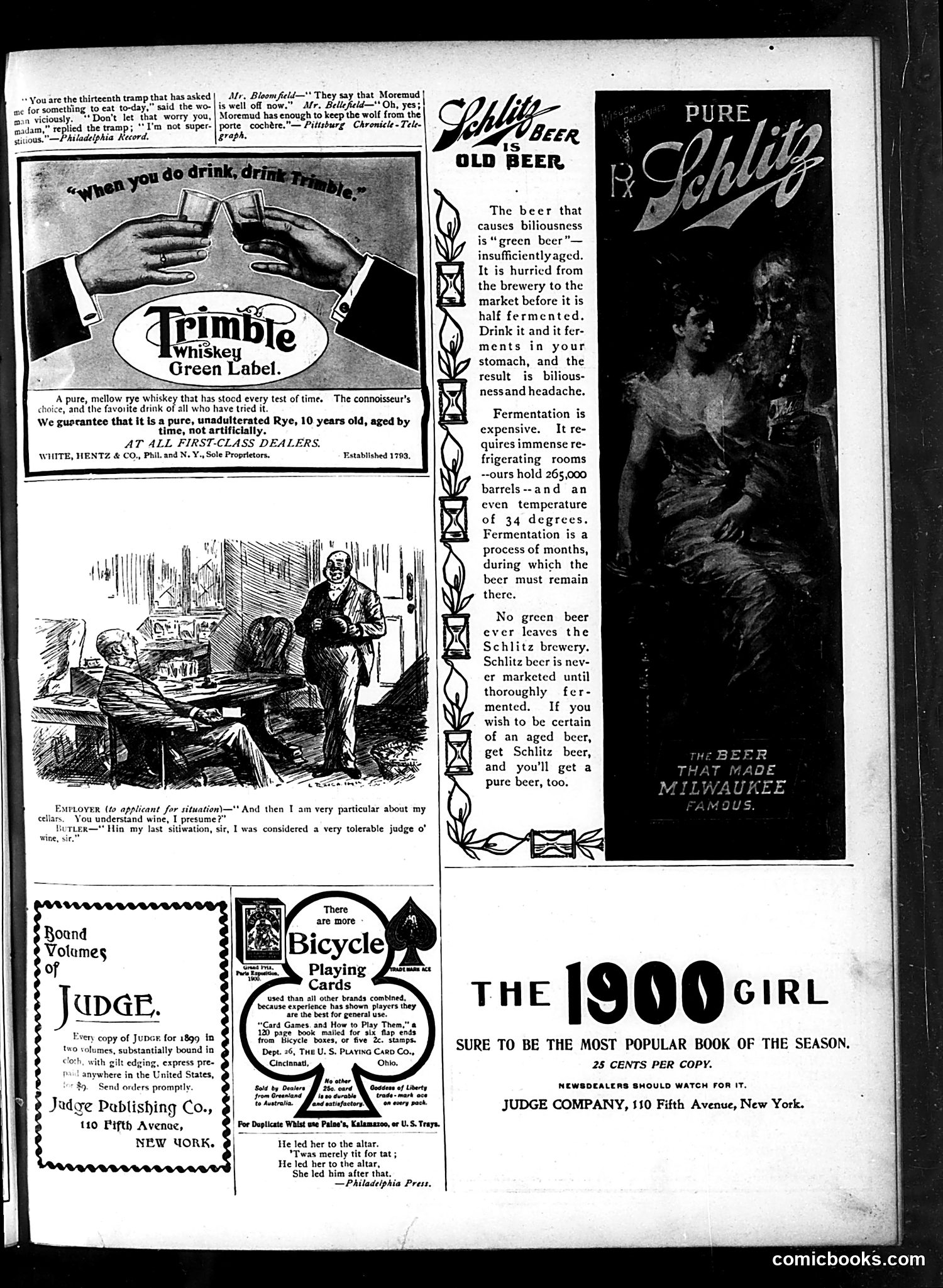
This page from Judge (circa 1899) mixes satirical cartoons with period advertisements. The main cartoon content includes: **Top left**: A tramp joke about hunger—the thirteenth beggar asking for food that day, with the tramp assuring the woman he's "not superstitious" despite the unlucky number. It's gentle humor about poverty and begging. **Middle left**: An illustration accompanying an anecdote about a job applicant claiming expertise in wine cellars, establishing himself as a "tolerable judge of wine"—a mild class-based joke about servants and pretension. **Right side**: Primarily advertisements for Schlitz beer and Trimble whiskey, with the beer ad emphasizing "old beer" (fully fermented) versus "green beer" (causing billiousness). These aren't satirical—they're straight product promotions typical of Judge's revenue model. **Bottom**: Ads for Judge's bound volumes and Bicycle playing cards, plus a brief marital joke from Philadelphia Press. The page is mostly **commercial rather than satirical**, reflecting how 19th-century humor magazines funded themselves through advertising.
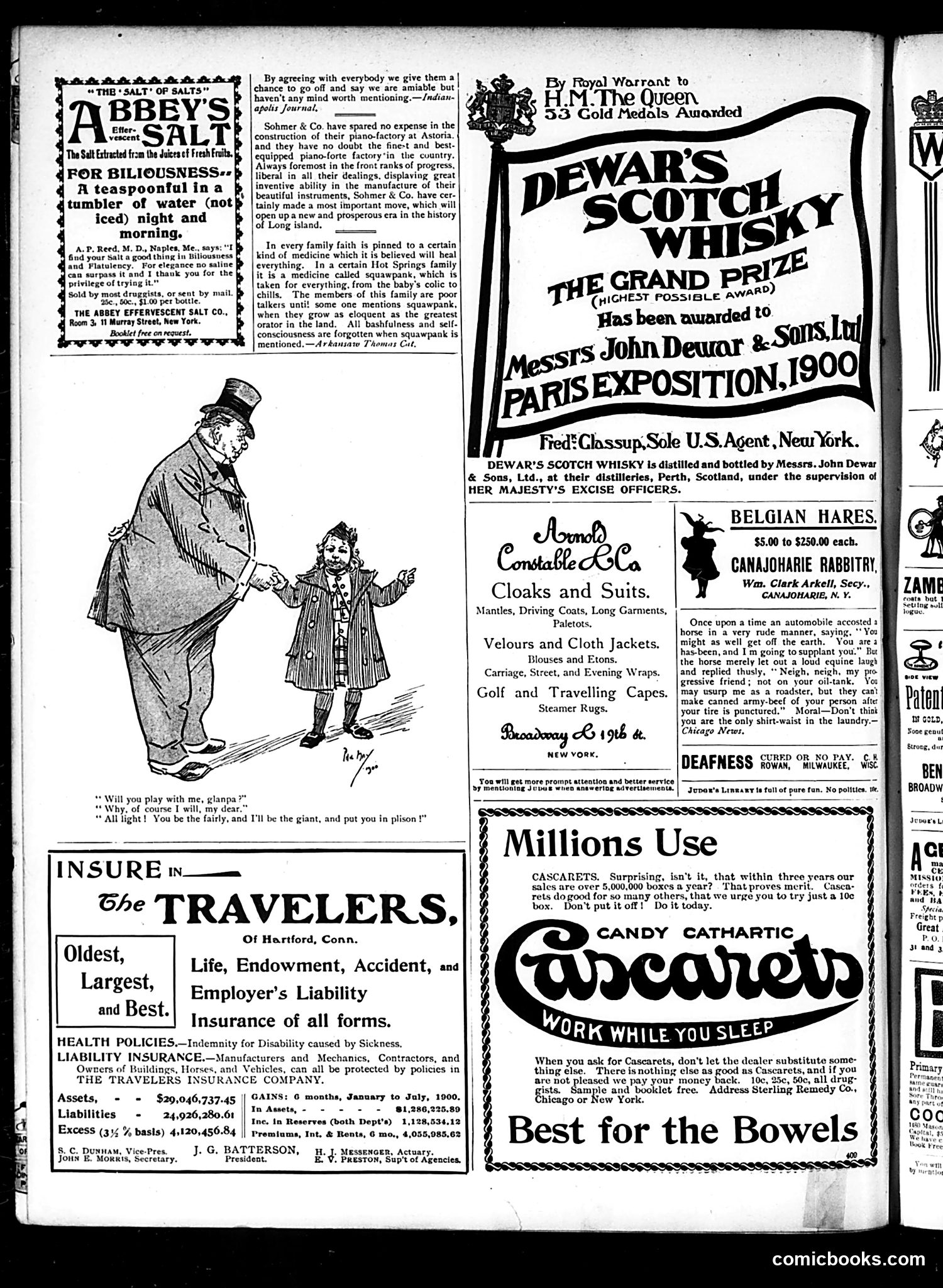
This page is primarily **advertising**, typical of early 1900s publications. The main visual content is a single **cartoon** (lower left): an elegantly dressed gentleman offering a small child a choice of roles in imaginative play—"You be the fairy, and I'll be the giant, and put you in prison!" The humor is **gentle and whimsical**: the child's innocent game proposal contrasts with the adult's sophisticated willingness to participate in her fantasy, satirizing perhaps the formality of the era's adult-child interactions or the "anything for the children" indulgence of wealthy parents. The page includes advertisements for Abbey's Effervescent Salt (a digestive remedy), The Travelers Insurance Company, Dewar's Scotch Whisky (boasting Paris Exposition 1900 awards), Arnold Constable & Co. clothing, and Cascaret candy laxatives. A quotation about "agreeing with everybody" suggests mild social commentary about spineless conformity, though it's merely a reprinted editorial quote. The content reflects early 1900s consumer culture and patent medicine marketing.
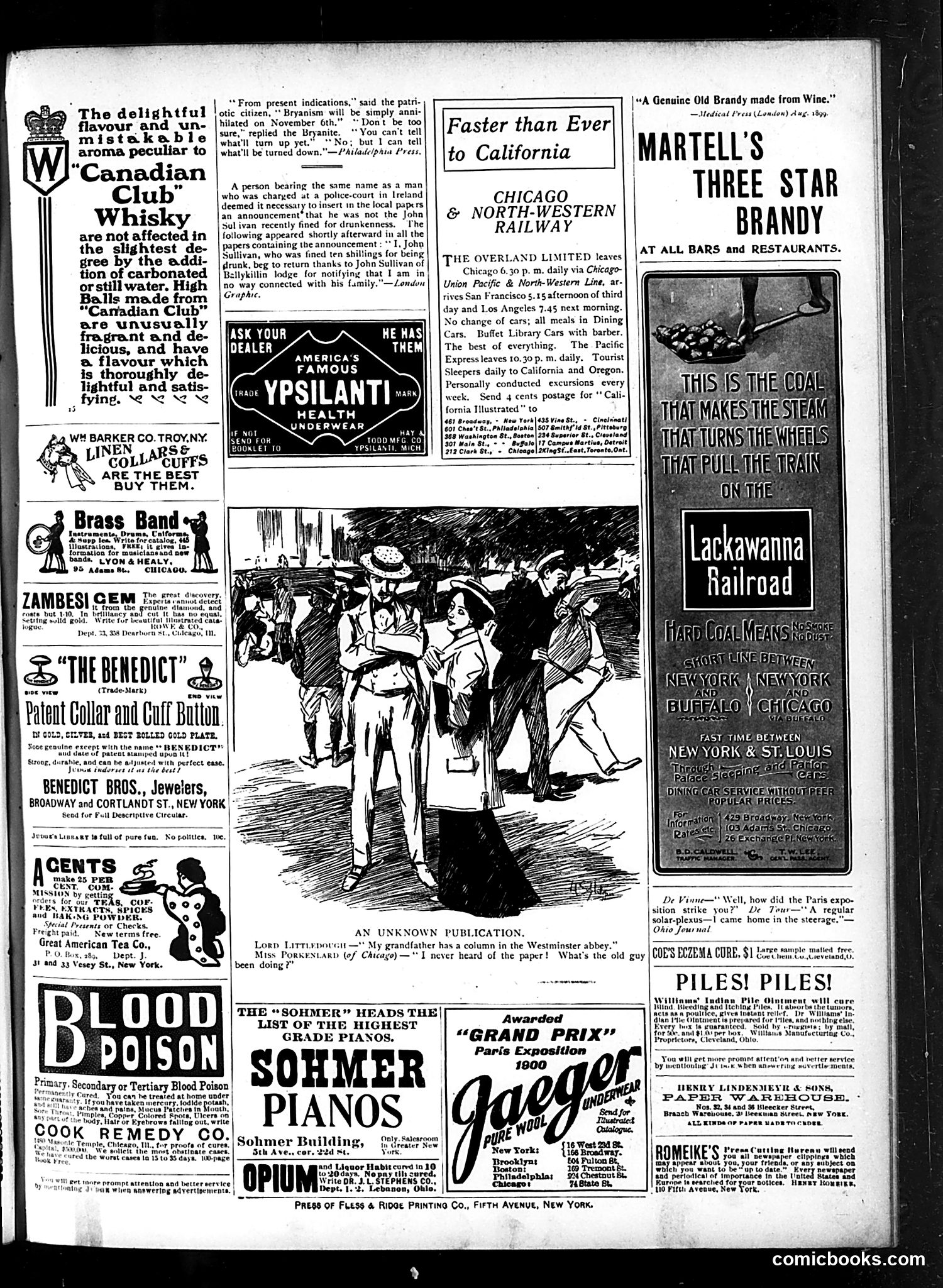
This is primarily an **advertising page** from Judge magazine, with minimal editorial content. The few cartoons present are brief, topical jokes: **Main Cartoon Content:** The central illustration depicts a crowded street scene (captioned "AN UNKNOWN PUBLICATION") showing pedestrians. The accompanying dialogue references Lord Littleborough and Miss Forkenlarke (Chicago), joking about someone's grandfather having "a column in the Westminster abbey"—the punchline being confusion between the architectural/burial site and a newspaper column. **Political Reference:** A small text joke mentions "Bryanism" being "annihilated on November 6th," referencing William Jennings Bryan's 1900 presidential campaign, suggesting confident Republican expectations. **Context for Modern Readers:** The page is dominated by period advertisements (Canadian Club whisky, Ypsilanti underwear, railroads, pianos, patent collars, remedies) typical of early-1900s magazines. The satire is light and local rather than substantive political commentary. The magazine functioned as much as an advertising vehicle as a humor publication.
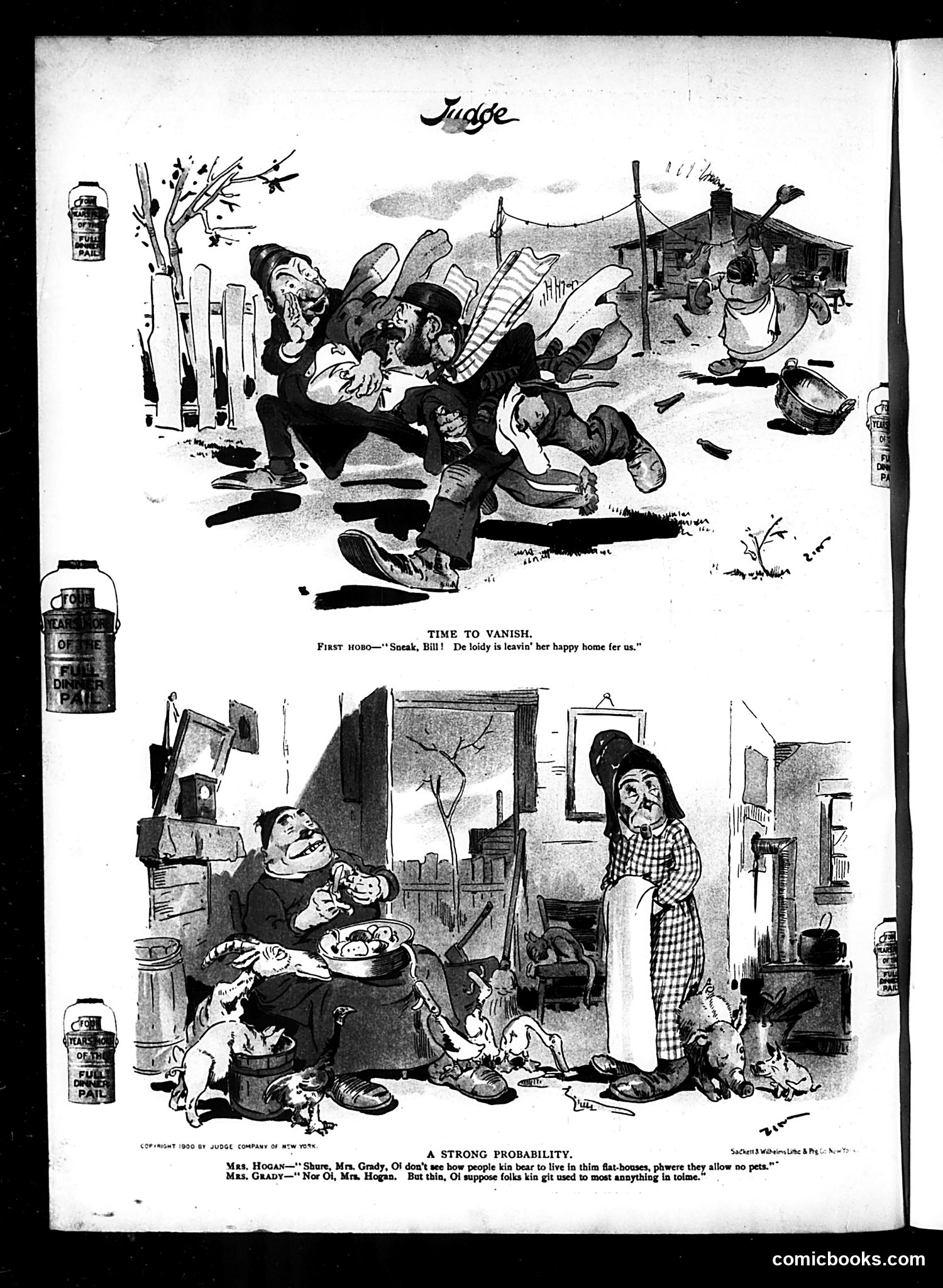
This page contains two satirical cartoons mocking Irish immigrants and tenement living conditions. **"Time to Vanish"** (top): Shows poorly dressed men fleeing a ramshackle tenement, with dialogue in thick Irish brogue. The joke satirizes the stereotype that Irish immigrants were thieves or vagrants who would steal from households—here depicted as rats abandoning ship when the "lady" leaves home. **"A Strong Probability"** (bottom): Two Irish women (identified by names like "Mrs. Hogan" and "Mrs. Grady") discuss flat-houses (tenements) that prohibit pets. The cruel irony is that they themselves—depicted as verminous and bestial with exaggerated features—are treated no better than unwanted animals in these overcrowded slums. Both cartoons perpetuate dehumanizing ethnic stereotypes common in late 19th/early 20th-century American satire, equating Irish tenement dwellers with vermin and criminals. The heavy dialect reinforces xenophobic mockery.