
Judge, 1900-11-10 · page 2 of 16
Judge — November 10, 1900 — page 2: what you’re looking at
What you’re looking at
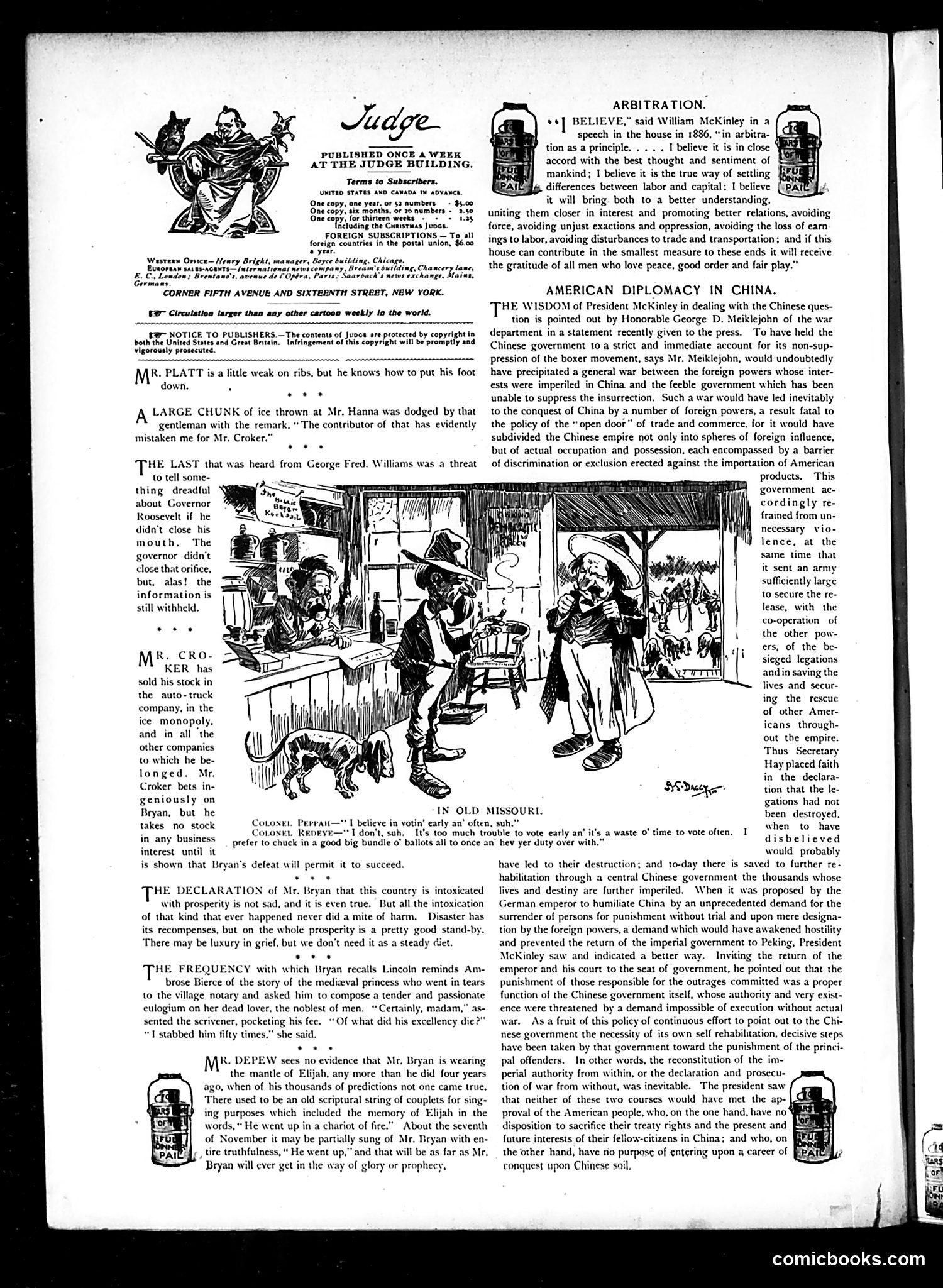
This page contains a satirical cartoon titled "In Old Missouri" depicting Colonel Pepper and Colonel Bryan discussing voting practices. The cartoon mocks early voting ("I don't believe it's too much trouble to vote early an' often. I prefer to check in a good big bundle o' ballots all at once an' have yer duty over with"). The satire targets electoral fraud and voter manipulation in Missouri politics during the Bryan era (likely 1896 or later). The characters represent rural/frontier political culture engaging in ballot stuffing and corrupt voting practices presented as casual conversation. The accompanying article "American Diplomacy in China" discusses Secretary Hay's foreign policy regarding the Boxer Rebellion and foreign intervention in China, unrelated to the cartoon.
📄 Transcribed text from this page (OCR, searchable)
Machine-transcribed from the original scan — historical spelling and the odd misread are preserved.
PUBLISHED ONCE A WEEK AT THE JUDGE BUILDIN' Terms to Subscribers. UNITED STATES AND CANADA It ADVANCE. One copy, one year, or 52 numbers One copy: six months, or 30 numbers One copy, for thirteen weeks. = acluding the Cunistaas Jose FOREIGN SUBSCRIPTIONS — To all foreign countries in the postal Union, $6.00 oye. ager, Boyce buitdi sarmacomrany: Germany 7 CORNER FIFTH AVENUE AND SIXTEENTH STREET, NEW YORK. (22> Circulation larger than any other cartoon weekly 1a the world. 9 NOTICE TO PUBLISHERS.—The contents of Juoce are protected by copyright in fi both the United States and Great Britain. Infringement of this copyri ht will be promptly and vigorously prosecuted. M®: PLATT is a little weak on ribs, but he knows how to put his foot down. LARGE CHUNK of ice thrown at Mr. Hanna was dodged by that gentleman with the remark, “The contributor of that has evidently mistaken me for Mr. Croker.” THE LAST that was heard from George Fred. Williams was a threat to tell some- thing dreadful about Governor Roosevelt if he didn’t close his mouth, The governor didn’t close that orifice, but, alas! the information is still withheld. M® CRO- KER has sold his stock in the auto- truck company, in the ice monopoly, and in all ‘the other companies to which he be- longed. Mr. Croker bets in- geniously on Bryan, but he takes no stock in any business interest until it is shown that Bryan's defeat will permit it to succeed. THE DECLARATION of Mr. Bryan that this country is intoxicated with prosperity is not sad, and it is even true. But all the intoxication of that kind that ever happened never did a mite of harm. Disaster has its recompenses, but on the whole prosperity is a pretty good stand-by. ‘There may be luxury in grief, but we don’t need it as a steady diet. THE FREQUENCY with which Bryan recalls Lincoln reminds Am- brose Bierce of the story of the medixval princess who went in tears to the village notary and asked him to compose a tender and passionate culogium on her dead lover, the noblest of men. “Certai sented the scrivener, pocketing his fee. “Of what did “1 stabbed him fifty times,” she said. ME. DEPEW sees no evidence that Mr. Bryan is wearing the mantle of Elijah, any more than he did four years ago, when of his thousands of predictions not one came true. There used to be an old scriptural string of couplet ing purposes which included the memory of words, He went up in a chariot of fire.” of November it may be partially sung of Mr. Bryan with en- _ tire truthfulness, “ He went up,’ and that will be as far as Mr, Bryan will ever get in the way of glory or prophecy, CoLoneL REDE) —"I don't, sub. prefer to chuck nly, madam,” as- s excellency die?” s for sing- ah in the About the seventh IN OLD MI CoLoNeL PErrAn—" I believe in votin’ early an’ often, sub. It's too much trouble to vote early an’ a good big bundle o° ballots all to once an’ hev yer duty over wi ARBITRATION. *6] BELIEVE,” said William McKinley in a speech in the house in 1886, “in arbitra- tion asa principle. . . . . I believe it is in close accord with the best thought and sentiment of mankind; I believe it is the true way of settling differences between labor and capital; I believe it will bring. both to a better understanding, uniting them closer in interest and promoting better relations, avoiding force, avoiding unjust exactions and oppression, avoiding the loss of earn ings to labor, avoiding disturbances to trade and transportation ; and if this house can contribute in the smallest measure to these ends it will receive the gratitude of all men who love peace, good order and fair play.” AMERICAN DIPLOMACY IN CHINA. THE WISDOM of President McKinley in dealing with the Chinese ques- tion is pointed out by Honorable George D. Meiklejohn of the war department in a statement recently given to the press. To have held the Chinese government to a strict and immediate account for its non-sup- pression of the boxer movement, says Mr. Meiklejohn, would undoubtedly have precipitated a general war between the foreign powers whose inter- ests were imperiled in China and the feeble government which has been unable to suppress the insurrection. Such a war would have led inevitably to the conquest of China by a number of foreign powers, a result fatal to the policy of the “open door” of trade and commerce, for it would have subdivided the Chinese empire not only into spheres of foreign influence, but of actual occupation and possession, each encompassed by a barrier of discrimination or exclusion erected against the importation of American products, This government ac- cordingly re- frained from un- necessary vio- lence, at the same time that it sent an army sufficiently la to secure the re- lease, with the co-operation of the other pow- ers, of the be- sieged legations and in saving the ‘es and secur- ing the rescue of other Amer- icans through- out the empire. Thus Secretary Hay placed faith in the declara- tion that the le- gations had not been destroyed, when to have disbelieved would probably have led to their destruction; and to-day there is saved to further re- habilitation through a central Chinese government the thousands whose lives and destiny are further imperiled. When it was proposed by the German emperor to humiliate China by an unprecedented demand for the surrender of persons for punishment without trial and upon mere designa- tion by the foreign powers, a demand which would have awakened hostility and prevented the return of the imperial government to Peking, President McKinley saw and indicated a better way. Inviting the return of the emperor and his court to the seat of government, he pointed out that the punishment of those responsible for the outrages committed was a proper function of the Chinese government itself, whose authority and very exist- ence were threatened by a demand impossible of execution without actual war. Asa fruit of this policy of continuous effort to point out to the Chi- nese government the necessity of its own self rehabilitation, decisive steps have been taken by that government toward the punishment of the princi- pal offenders. In other words, the reconstitution of the im- perial authority from within, or the declaration and prosecu- tion of war from without, was inevitable. The president saw that neither of these two courses would have met the ap- proval of the American people, who, on the one hand, have no disposition to sacrifice their treaty rights and the present and future interests of their fellow-citizens in China; and who, on the other hand, have rio purpose of entering upon a career of conquest upon Chinese sail, a waste 0° time to vote often, I comicbooks.com