
Judge, 1900-11-10 · page 6 of 16
Judge — November 10, 1900 — page 6: what you’re looking at
What you’re looking at
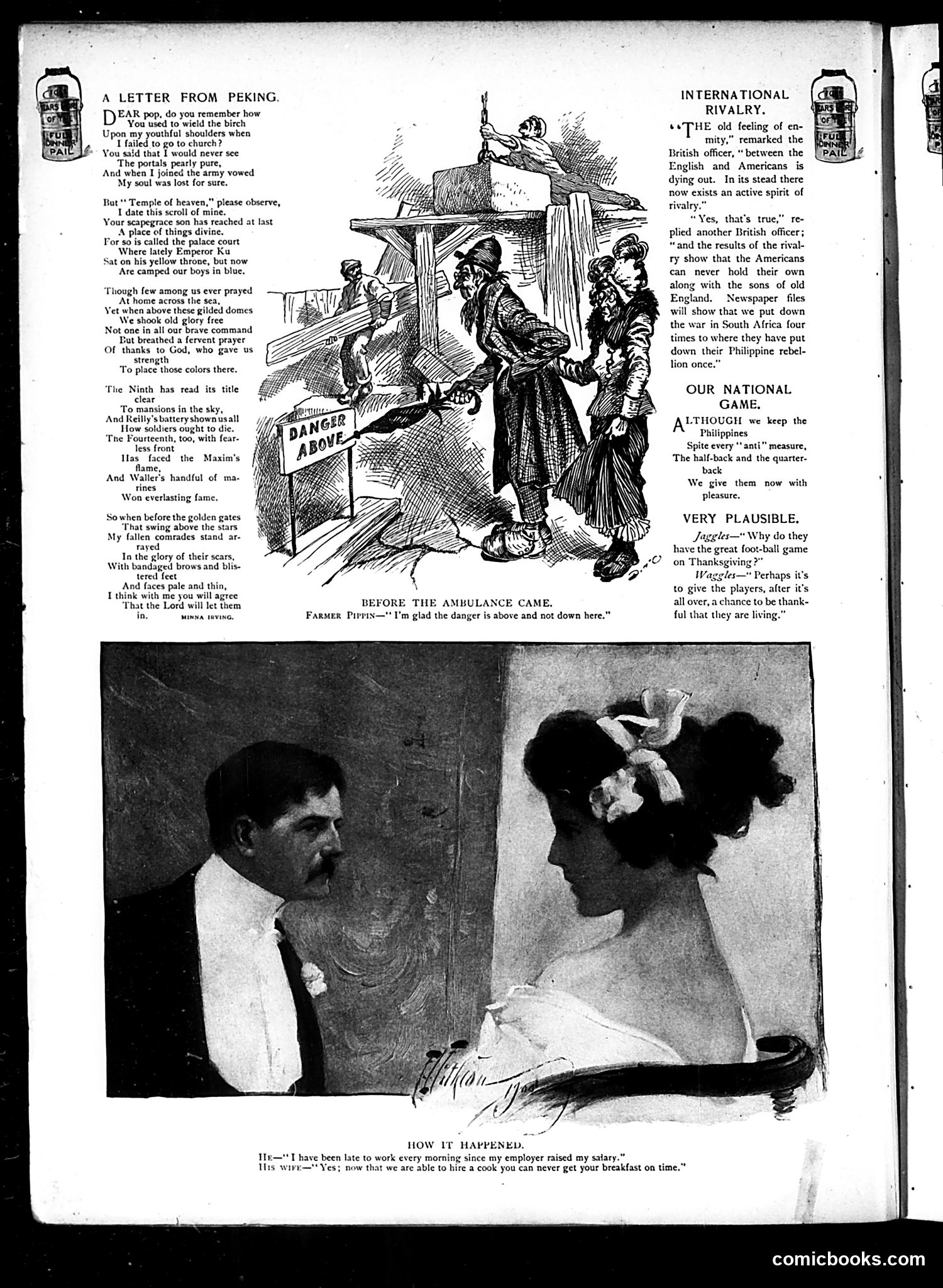
This page from *Judge* magazine contains several satirical pieces about American imperialism and military affairs, likely from the Philippine-American War era (early 1900s). **"A Letter from Peking"** celebrates American soldiers stationed in China (referencing the Boxer Rebellion aftermath), with the writer noting he's now in a "place of things divine"—the Emperor's palace—contradicting his childhood religious instruction. Units like the "Ninth," "Fourteenth," and "Waller's marines" are praised for bravery. **"International Rivalry"** satirizes British-American competition: British officers claim Americans can't match British military success, pointing out Britain suppressed the South African War four times versus America's one Philippine rebellion suppression—mocking American imperial ambitions. **"Our National Game"** makes a darker joke: while America keeps the Philippines (despite anti-imperialist sentiment), they freely give Britain American football—suggesting America's real cultural export is sports, not military dominance. The bottom illustration depicts a domestic comedy about inflation: a man's salary raise is offset by his wife hiring household help, making him perpetually late to work.
📄 Transcribed text from this page (OCR, searchable)
Machine-transcribed from the original scan — historical spelling and the odd misread are preserved.
A LETTER FROM PEKING. DEAR por. do you remember how You used to wield the birch Upon my youthful shoulders when Ptalled to go to church? You said that I would never see The portals pearly pure, And when I joined the army vowed My soul was lost for sure. Bat Temple of heaven,” please observe, I date this scroll of mine. Your scapegrace son has reached at last A place of things divine. For so is called the palace court Where lately Emperor Ku Sat on his yellow throne, but now Are camped our boys in blue. Though few among us ever prayed At home across the sea, Yet when above these gilded domes We shook old glory free Not one in all our brave command But breathed a fervent prayer Of thanks to God, who gave us strength To place those colors there. ‘The Ninth has read its title clear To mansions in the sky, And Reilly's battery shown usall How soldiers ought to die. ‘Tne Fourteenth, too, with fear- less front Has faced the Maxim's flame, And Waller's handful of ma- rines Won everlasting fame. So when before the golden gates ‘That swing above the stars My fallen comrades stand ar- rayed In the glory of their scars, With bandaged brows and blis- tered feet And faces pale and thin, I think with me you will agree ‘That the Lord will let them in, Minna tHvING, If HAPPENED. He—'*T have been late to work every morning since my employer raised my satary.” Ils wire—"* Yes; now that we are able to hire a cook you can never get your breakfast on time.” HOw INTERNATIONAL RIVALRY. seTHE old feeling of en- mity,” remarked the British officer, “ between the English and Americans is dying out. In its stead there now exists an active spirit of rivalry. Yes, that’s true,” re- plied another British officer; “and the results of the riv: ry show that the Americans can never hold their own along with the sons of old England. Newspaper files will show that we put down the war in South Africa four times to where they have put down their Philippine rebel- lion once.” OUR NATIONAL GAME, ALTHOUGH we keep the Philippines Spite every “anti” measure, ‘The half-back and the quarter- back We give them now with pleasure. VERY PLAUSIBLE, Jaggles—" Why do they have the great foot-ball game on Thanksgiving?” Waggles—* Perhaps it's to give the players, alter it's all over, a chance to be thank- ful that they are living.” comicbooks.com