
A complete issue · 16 pages · 1900
Judge — October 27, 1900
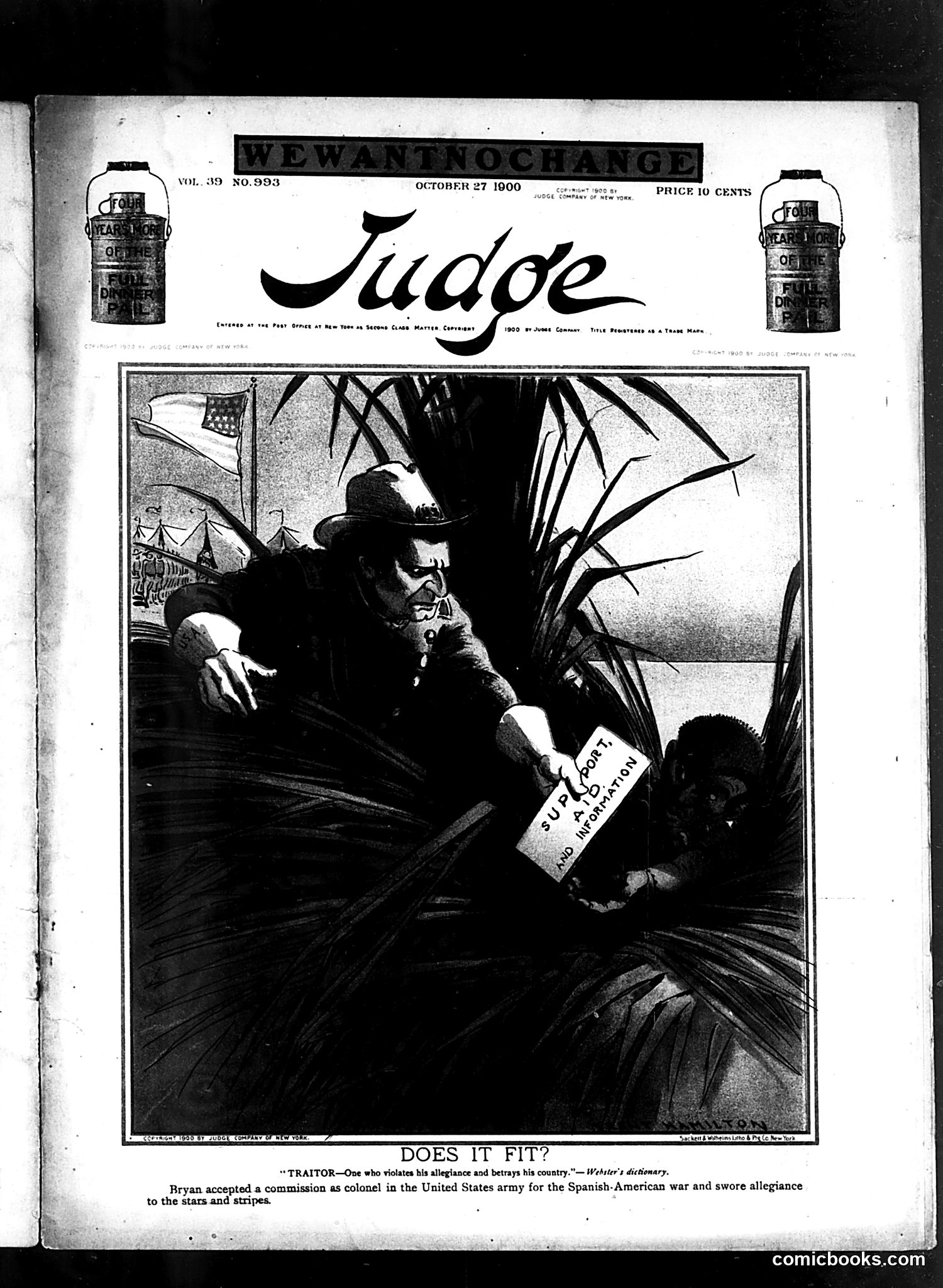
This is a political cartoon titled "Does It Fit?" depicting a figure labeled as a "Traitor" who appears to be William Jennings Bryan, a prominent Democratic politician of the era. The cartoon references Bryan's acceptance of a commission as colonel in the U.S. Army during the Spanish-American War while simultaneously maintaining his political opposition to American imperialism and the war itself. The visual metaphor—showing the figure struggling to wear or fit into patriotic insignia—satirizes the apparent contradiction between his military service and his public political positions against the war. The caption emphasizes this hypocrisy, suggesting Bryan's actions don't align with his stated principles.
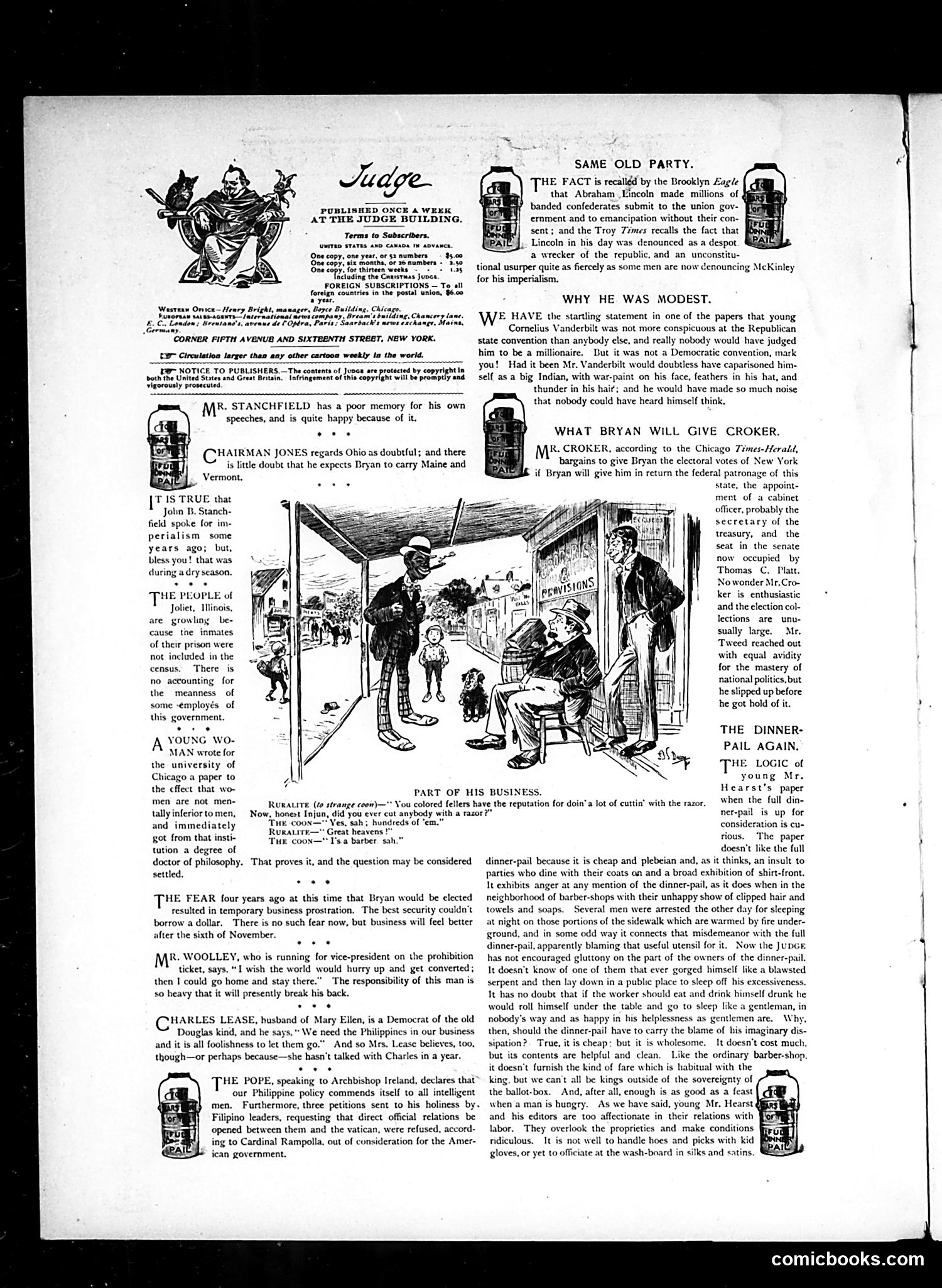
This page contains political commentary circa early 1900s. The central cartoon, titled "Part of His Business," depicts a barber (labeled "Rukalite") discussing the "dinner-pail" issue with a customer. The dinner-pail was a campaign symbol representing workers' economic security—whether prosperity would continue under current policies. The article critiques the dinner-pail as cheap political rhetoric, arguing it distracts from substantive labor issues like working conditions, fair wages, and dignity. The satire mocks politicians who invoke worker prosperity symbolically while ignoring actual workplace problems—unsafe conditions, inadequate pay, and poor treatment. The cartoon's barber-shop setting suggests ordinary workers' conversations, implying this empty rhetoric reaches and misleads the working class about what politicians actually deliver.
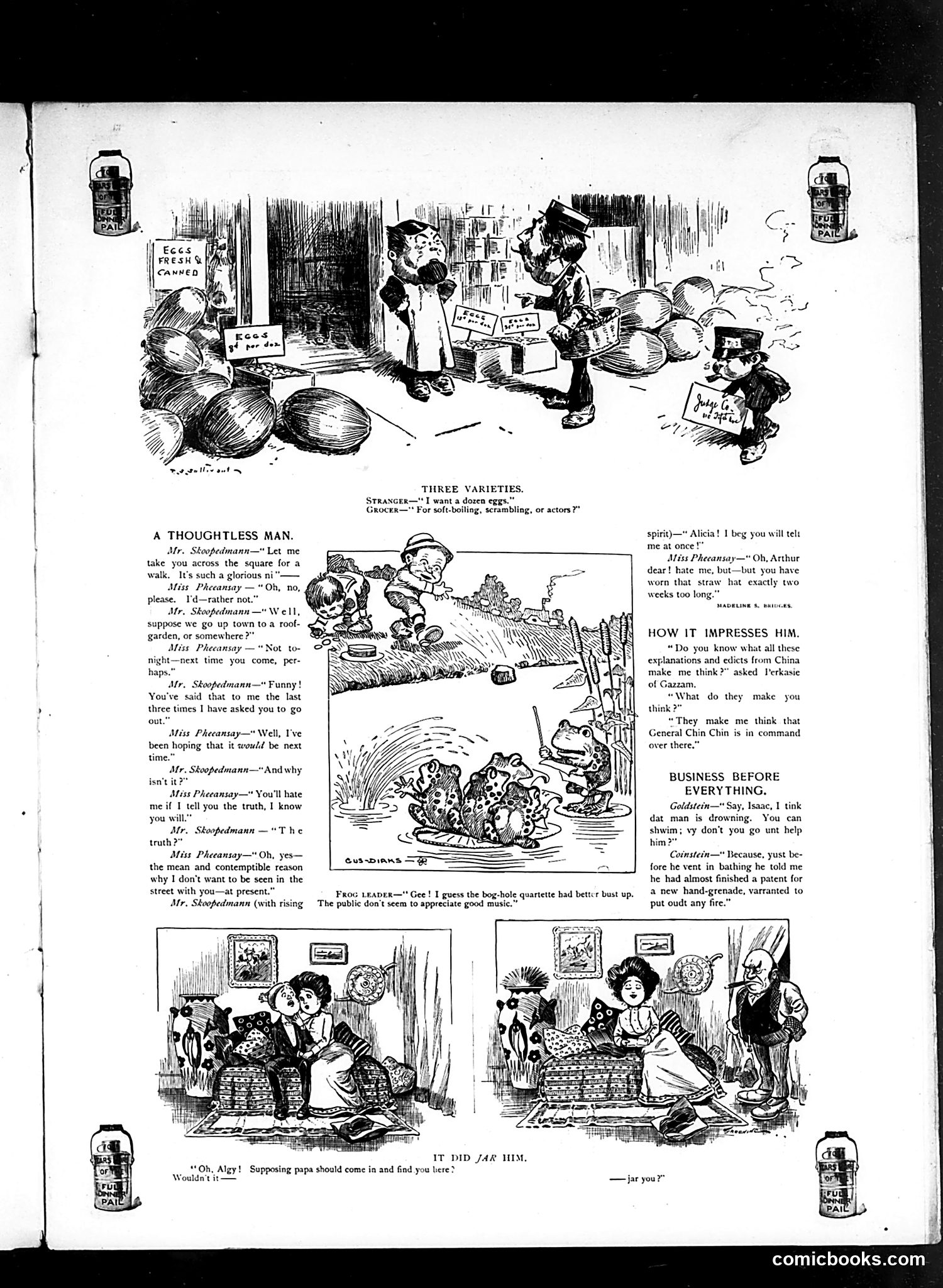
This page contains three separate satirical pieces from an early 20th-century issue of Judge magazine. **"Three Varieties"** mocks different social types' reactions to urban inconveniences—a stranger wanting directions, a grocer asking about work, and an unidentified third party. **"A Thoughtless Man"** depicts a domestic dispute where Mr. Shaftsmann repeatedly refuses his wife's requests to cross the square, go to a roof garden, and other outings. The satire targets husbands who neglect their wives' social and recreational needs—a common theme in period humor about marital dissatisfaction. **"How It Impresses Him"** and **"Business Before Everything"** (bottom panels) continue domestic humor involving wives attempting to engage husbands' attention, likely satirizing masculine preoccupation with business over family life. The page targets gender dynamics and marital relationships typical of Judge's early entertainment focus.
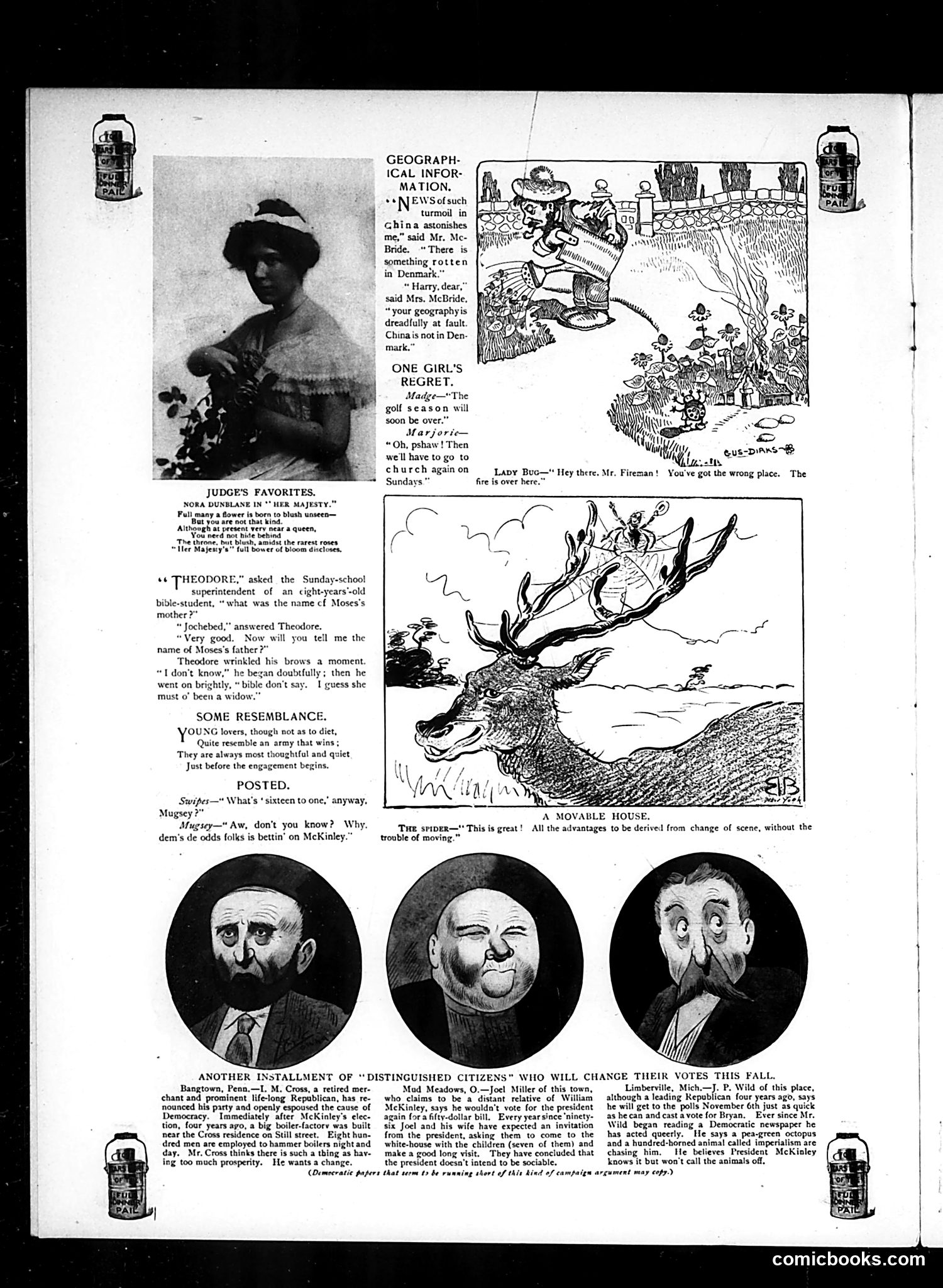
This page contains several satirical items about early 20th-century American politics. The bottom section, titled "Another Installment of 'Distinguished Citizens' Who Will Change Their Votes This Fall," features three caricatured men with exaggerated features—likely prominent Republicans considering switching parties before an election. The text identifies specific individuals: one is described as a "lifelong Republican" and boiler-factory owner; another, "Joel Millet," claims kinship to William McKinley; the third, a newspaper-reading McKinley supporter, has apparently switched to Democratic allegiance. The satire mocks wealthy businessmen and politicians whose party loyalty shifts based on personal interest rather than principle. The crude caricature style emphasizes their venality and superficiality in electoral politics. Other page content includes humor pieces and society commentary typical of Judge's satirical format.
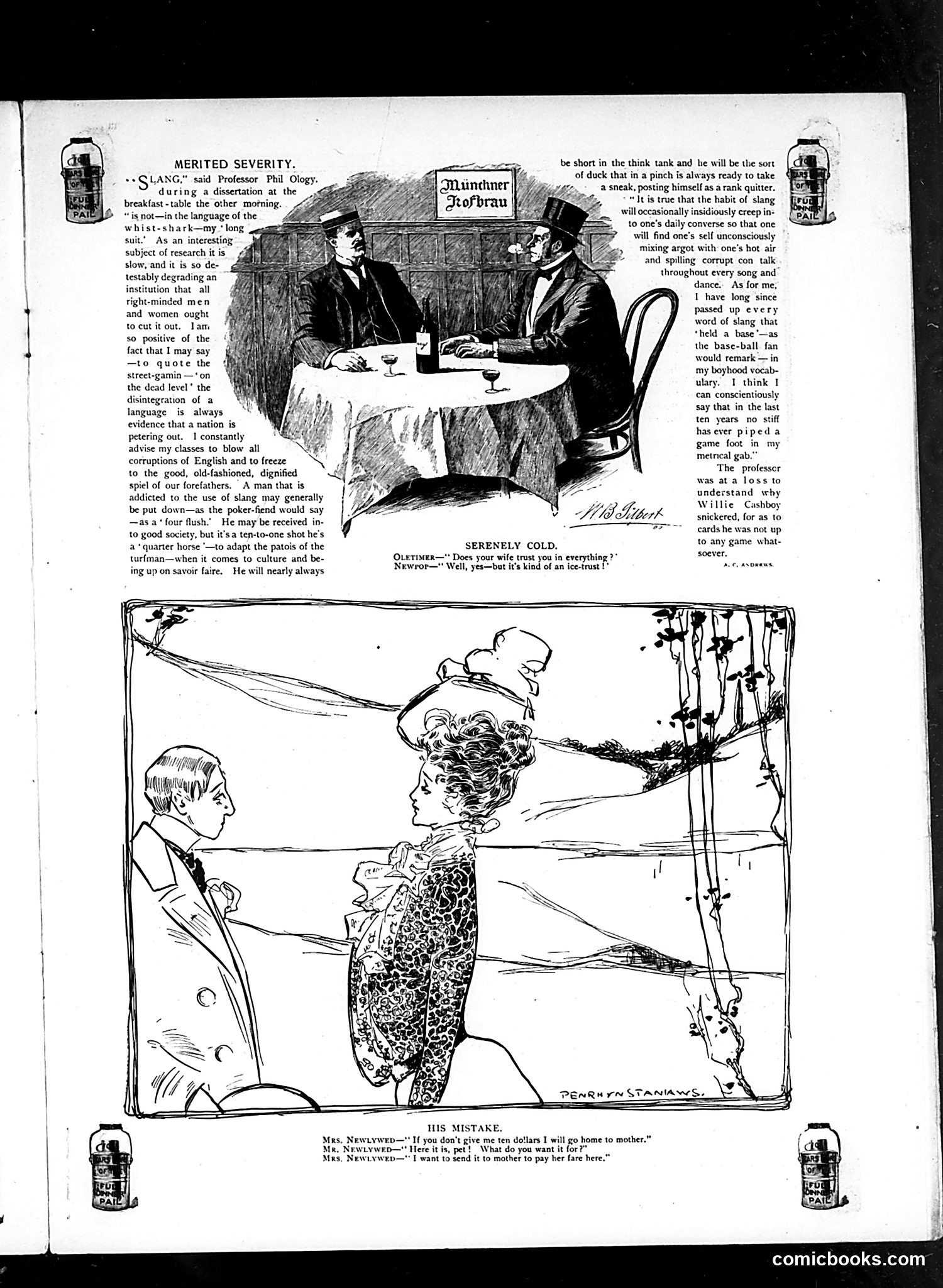
This page contains three satirical pieces from an early 20th-century American humor magazine: **"Merited Severity"** (top): Professor Phil Ology pompously lectures against slang at breakfast, ironically *using* extensive slang throughout his own speech ("long suit," "dead level," "four flush," "quarter horse"). The satire mocks pretentious academics who condemn vernacular speech while being unable to avoid it themselves—exposing the hypocrisy of linguistic snobbery. **"Serenely Cold"** (middle): A married couple's brief exchange about trust in their relationship, with the wife's ice-related pun implying their marriage is emotionally frigid. **"His Mistake"** (bottom): A newlywed wife requests ten dollars, claiming she needs it to send to her mother for travel fare. The husband complies, only to realize she's using the money for her own purposes—a joke about marital deception and the bride's true priorities. All three pieces reflect early 1900s attitudes toward language, gender roles, and marriage dynamics.
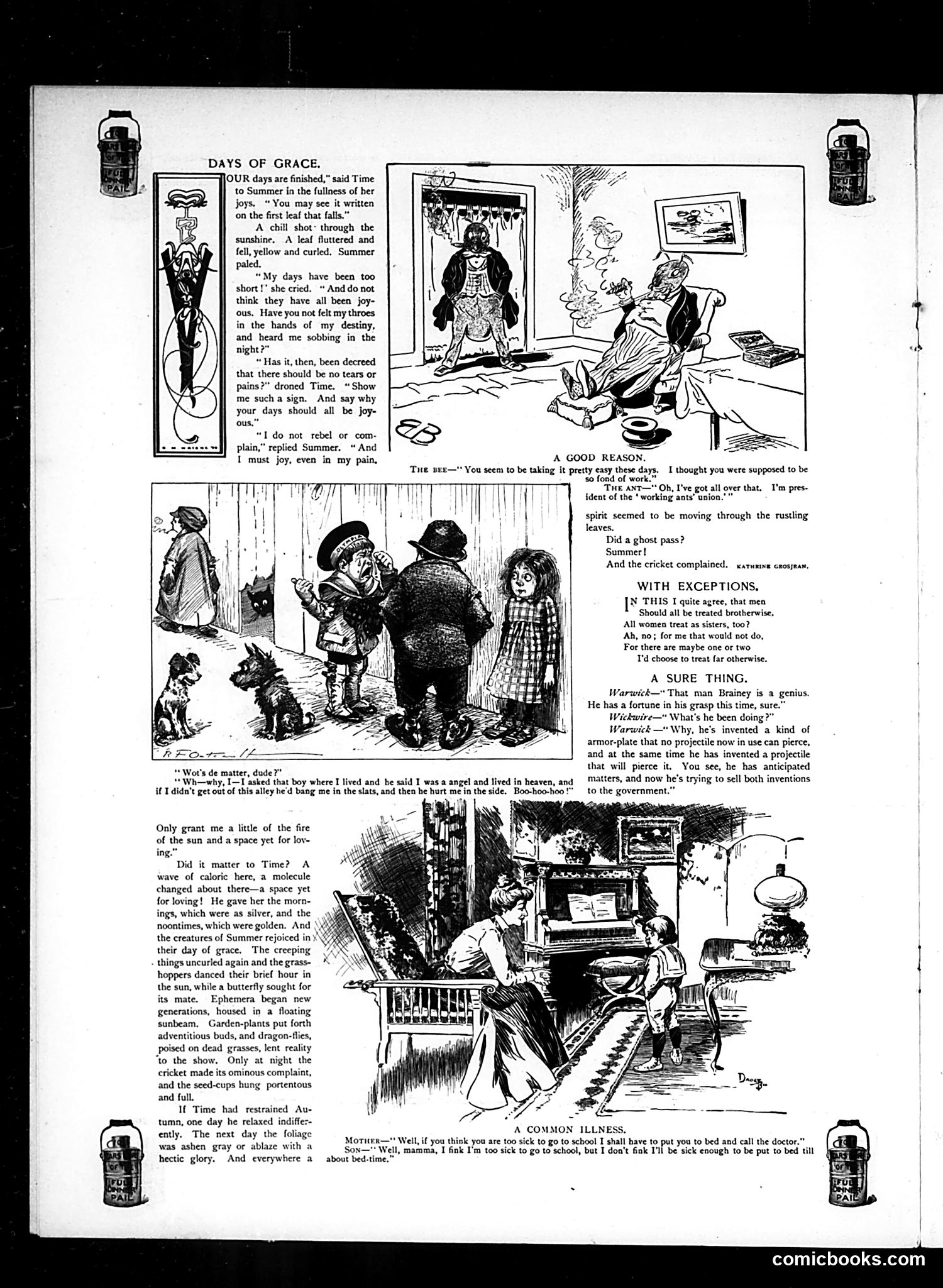
This page contains several satirical pieces typical of late 19th/early 20th-century American humor: **"Days of Grace"** (top): An allegorical dialogue between Time and Summer, personified as a woman lamenting her brevity and hardships. The piece romanticizes transience—Summer accepts her fleeting existence philosophically. This reflects period sentimentality about mortality and nature's cycles. **"A Good Reason"** (middle right): An ant character, now union president, admits he's stopped working hard. This satirizes labor unionization and worker organization, presenting it mockingly as laziness masquerading behind bureaucratic excuse-making. **"A Sure Thing"** (right): Two men discuss an inventor who's created both an armor-plate and a projectile that pierces it—ensuring guaranteed profit either way. This satirizes military-industrial profiteering and the absurdity of selling contradictory inventions to government. **"A Common Illness"** (bottom): A child malingers unconvincingly, claiming too-sick-for-school but not-sick-enough-for-bed. This humorously depicts childhood deception. The page showcases Judge's blend of sentimental storytelling, labor criticism, and social satire.
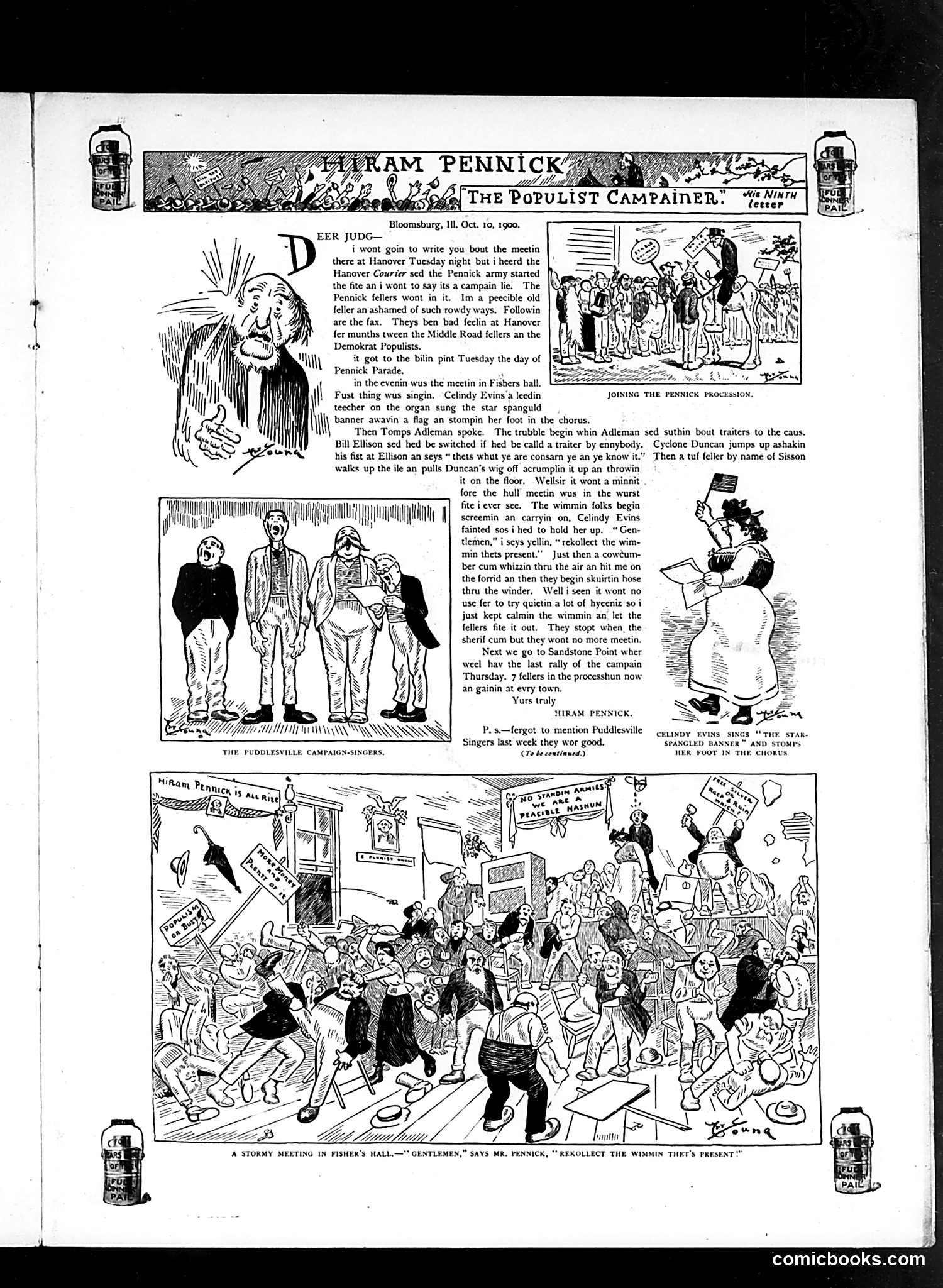
This is a satirical letter from "Hiram Pennick," a rural Populist campaigner, describing a chaotic political rally in Bloomsburg, Illinois. The humor targets the Populist Party—a third party opposing both Republicans and Democrats—by portraying its supporters as ignorant, violent, and disorganized. The letter recounts a meeting where tensions between "Middle Road fellers" and Democratic Populists erupted into a brawl during a campaign parade. Political disagreement devolved into physical violence: a wig-pulling incident, objects thrown, and chaos involving women fainting. The satire works through deliberately misspelled, dialectal language ("fite," "wimmin," "hyeeniz") portraying rural Populists as uneducated. The cartoons show both rowdy campaign scenes and the fractious hall meeting, emphasizing that Populism represented chaotic, disorganized opposition to the established parties rather than serious political alternative.
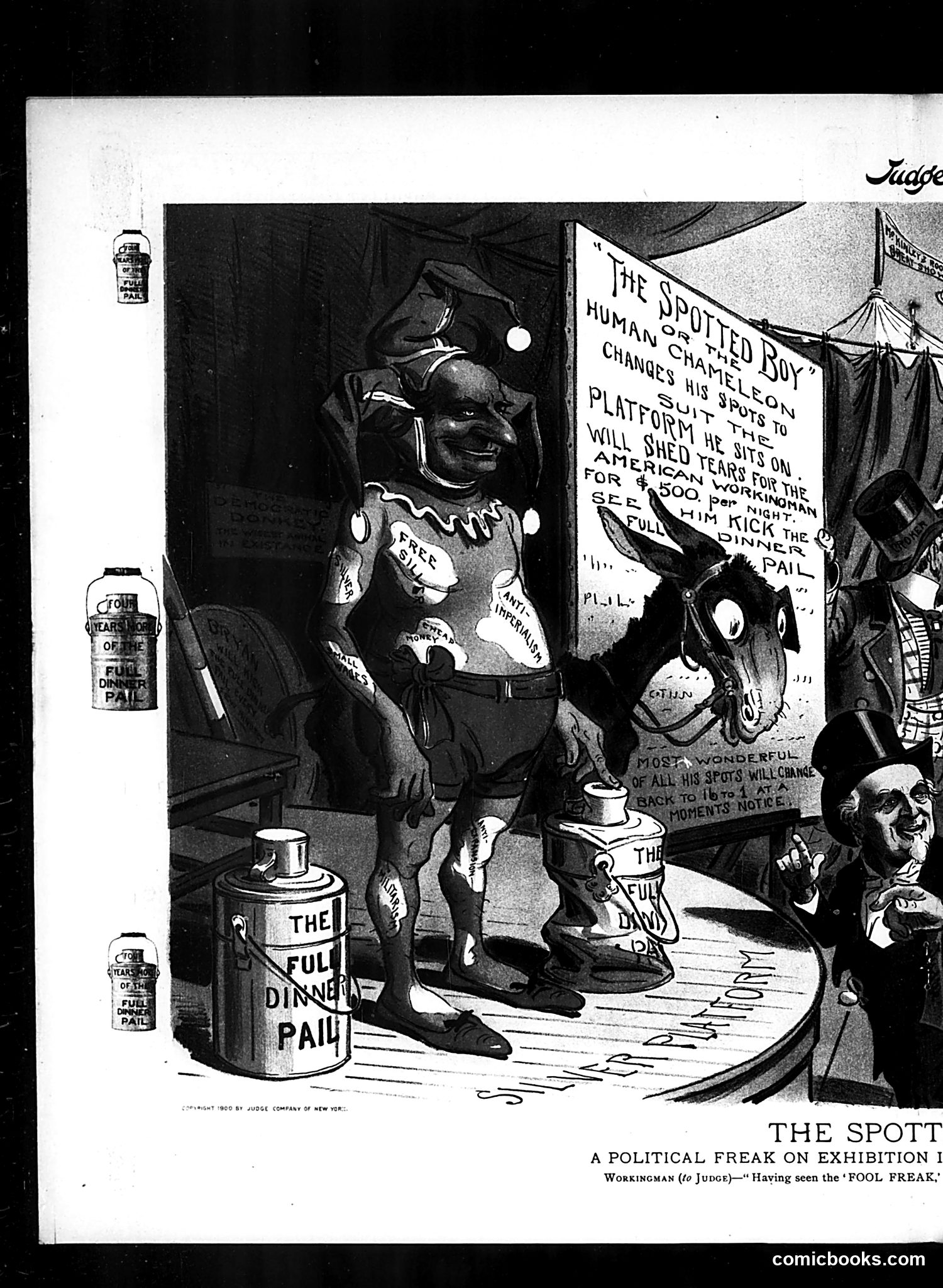
This Judge magazine cartoon satirizes a political figure as a circus "freak" on display. The central caricature—depicted with exaggerated racist imagery typical of the era—is presented as "The Spotted Boy," a human oddity for public exhibition, referencing actual "freak show" attractions of the time. The sign advertises that this "human shame" will perform on a platform for paying spectators, with promises to "shed tears" and exhibit himself. Cans labeled "The Full Dinner Pail" reference William McKinley's 1900 campaign slogan. The caption indicates a workingman's commentary to Judge magazine, suggesting this political figure is viewed as a fool or embarrassment worthy only of carnival exhibition. The satire critiques both the figure's credibility and, implicitly, public fascination with spectacle over substance. The specific identity of the targeted politician is unclear without additional context.
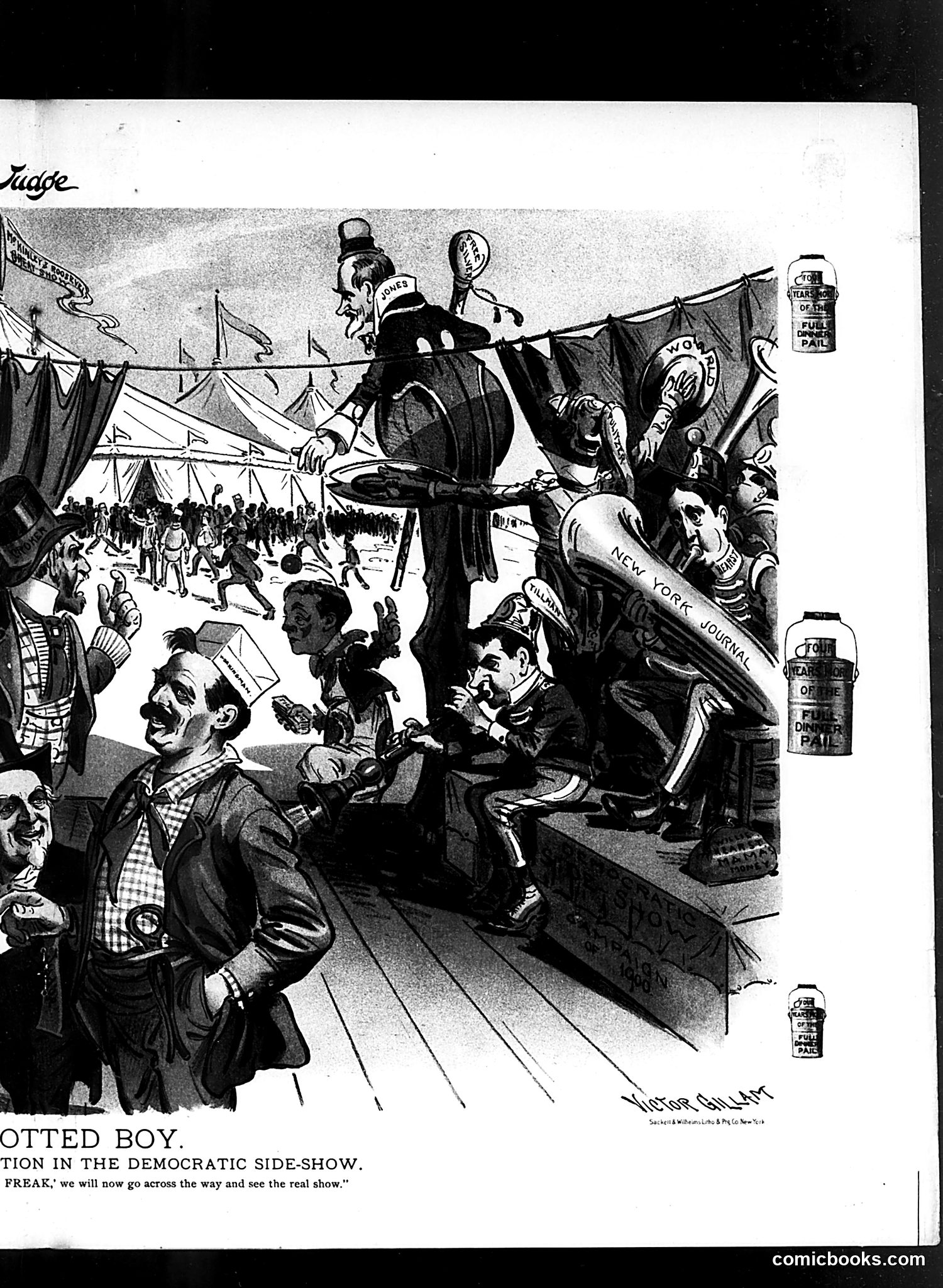
This Judge magazine cartoon satirizes the Democratic Party as a chaotic "side-show" or carnival freak exhibit. The central figure—a barker or carnival promoter in top hat—gestures dramatically at the circus-like scene below, where various political figures appear as oddities and performers. The caption quotes the barker promising to show "the real show" across the way, suggesting Democrats are merely a spectacle compared to Republicans. The cartoon criticizes Democratic Party disunity and internal conflicts by depicting their leadership and factions as carnival freaks rather than serious politicians. References to "New York Journal" visible on banners suggest this reflects specific Democratic Party disputes, likely from the 1890s-1900s era when Judge was prominent. The satire mocks Democrats' internal divisions as entertainment rather than legitimate governance.
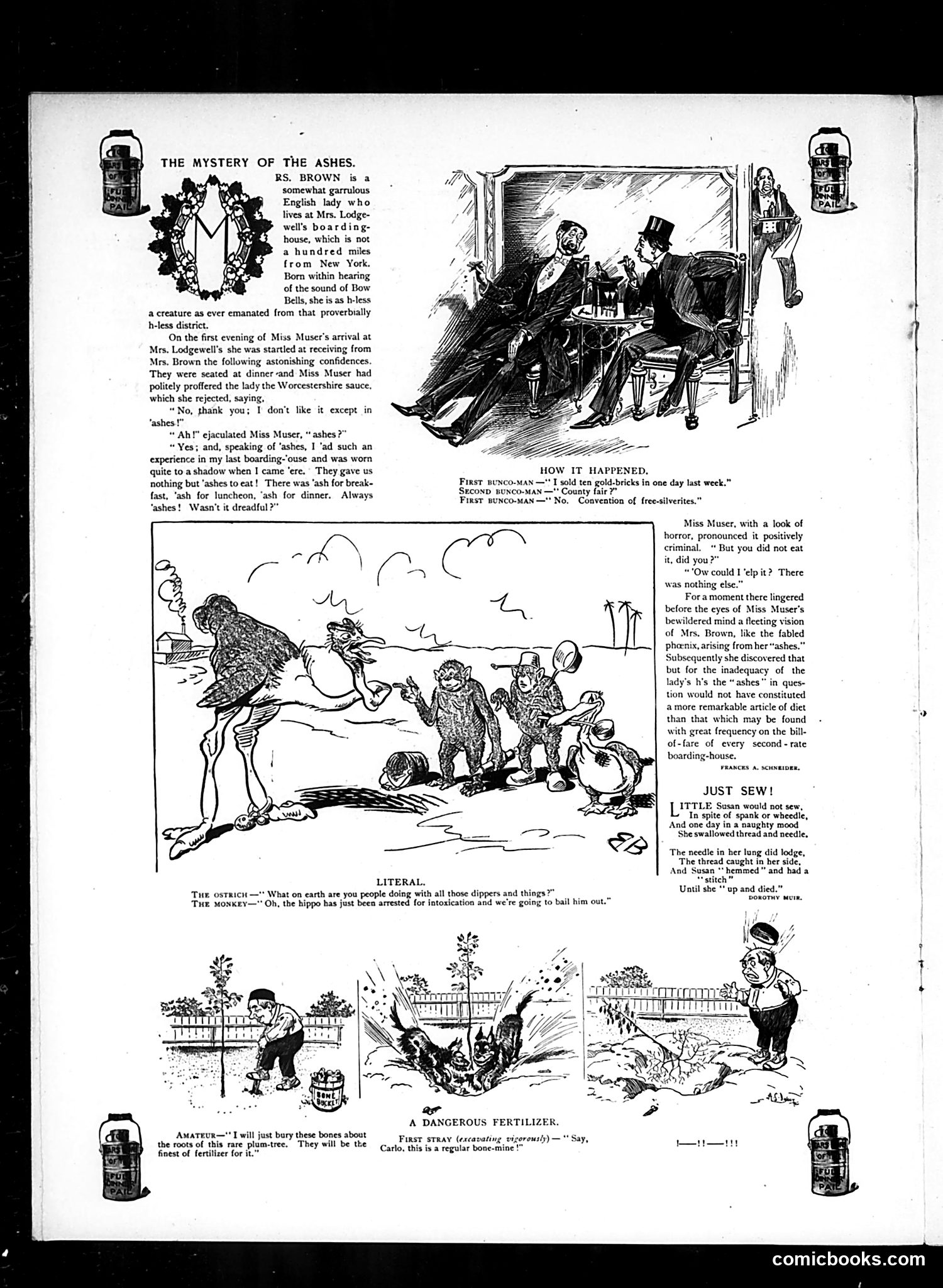
This page satirizes a common boarding-house experience through wordplay and social commentary. **Main Story:** Mrs. Brown, a garrulous English lady, complains about her previous boarding-house serving only "hashes" (chopped meat dishes) at every meal. Miss Muser initially misunderstands "hashes" as "ashes" (cremated remains), creating a darkly comic image of Mrs. Brown arising "like the fabled phoenix" from ashes. The joke reveals the low quality of cheap boarding-house food—so monotonous and unappetizing that it resembles actual garbage. **Secondary Cartoons:** - "Literal" mocks absurd misinterpretations - "Just Sew" is a children's cautionary verse about Susan's fatal needle-swallowing - "A Dangerous Fertilizer" shows a dog discovering bones buried as plum-tree fertilizer The satire targets the grim reality of budget boarding-house life in America, where poor food quality was apparently endemic and unremarkable.
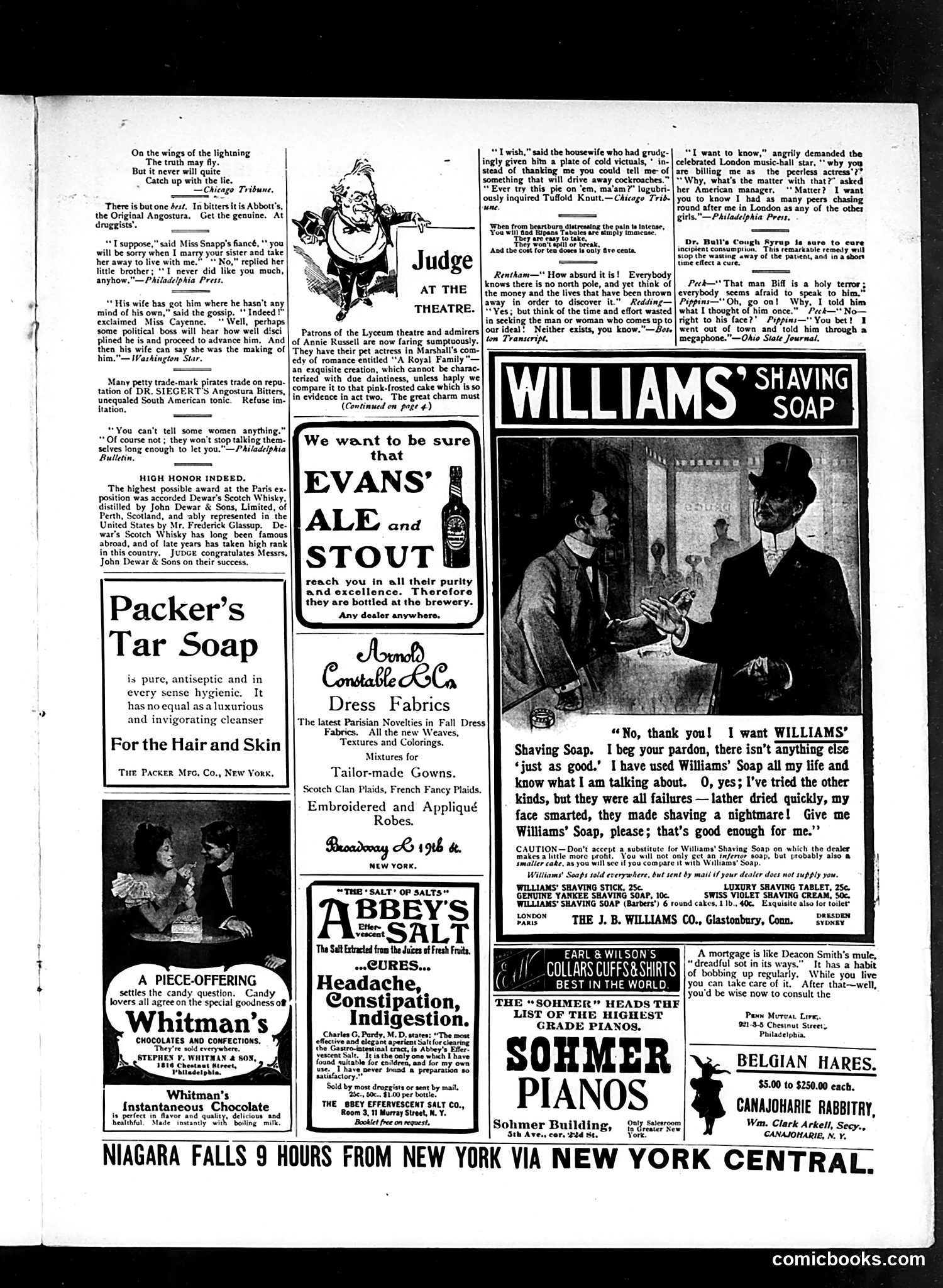
This page is primarily **advertising** with one cartoon feature ("Judge at the Theatre"). The main content consists of product advertisements for soaps, chocolates, whisky, ale, and patent medicines—typical of early 20th-century magazines. The **cartoon section** features theater criticism about Annie Russell performing in "A Royal Family" at the Lyceum Theatre, comparing her performance to a "pink-frosted cake." This is gentle theatrical satire rather than political commentary. The scattered **jokes and quips** throughout mock domestic life: a man unhappy about marrying into a family, a woman who won't stop talking, and a housewife complaining about cockroaches. These are light social humor about marriage and household problems. The advertisements themselves reflect period concerns—hygiene products, digestive remedies, and alcohol as medicinal tonics—with brand names like Abbey's Salt and Williams' Shaving Soap promoted through testimonials. There is **no significant political satire** on this particular page.
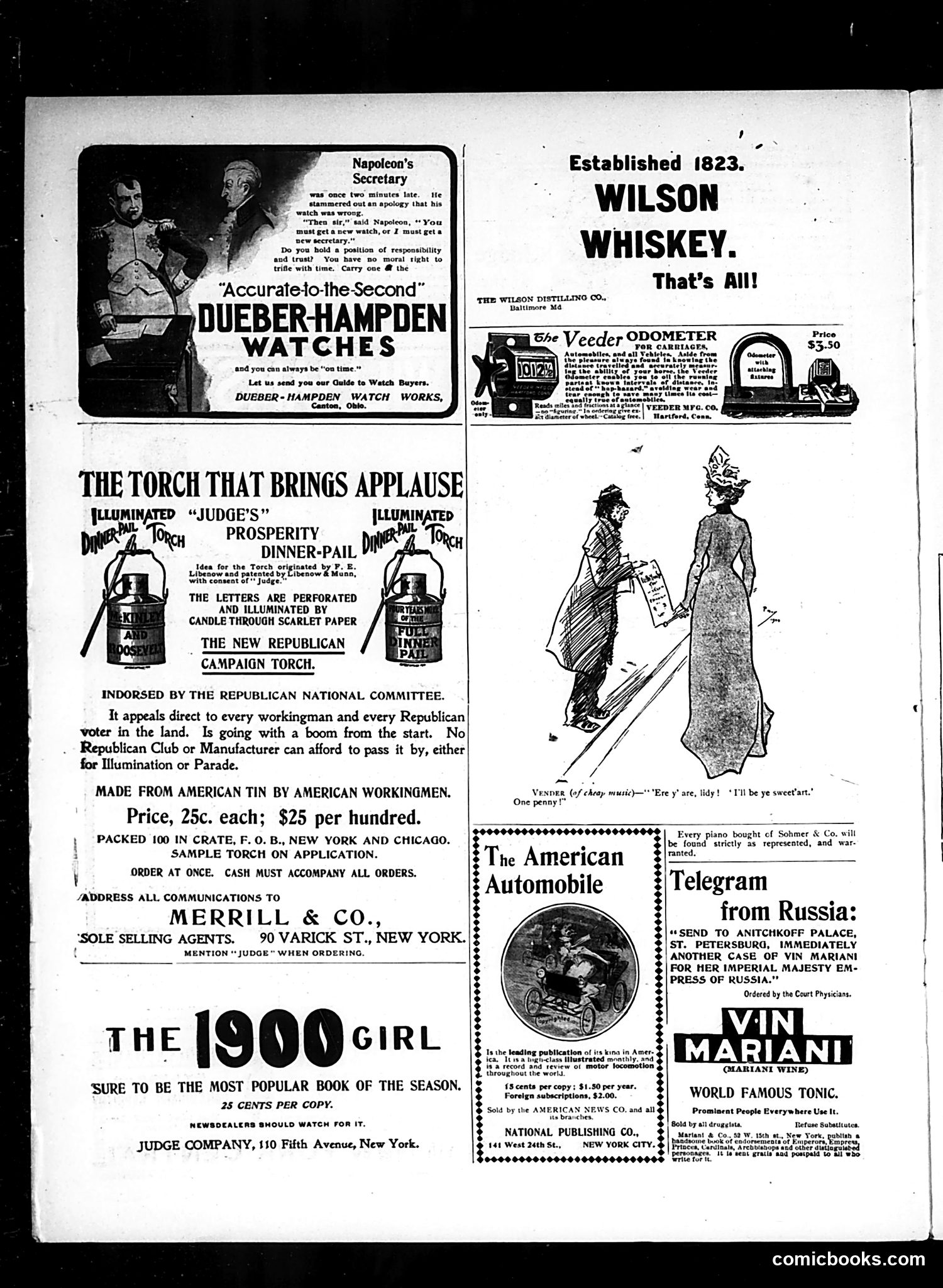
This is primarily an **advertising page** from Judge magazine, featuring product endorsements rather than satirical cartoons. The notable political content is the **Republican Campaign Torch** advertisement, endorsed by the Republican National Committee. It depicts an illuminated torch spelling "JUDGE'S PROSPERITY DINNER-PAIL"—a direct reference to the Republican slogan "a full dinner pail," used to promise economic prosperity. The torch was marketed as campaign merchandise for Republican clubs and workingmen voters, emphasizing it was "made from American tin by American workingmen." This appeals to working-class Republicans during what appears to be an early 20th-century election cycle. The page's other notable element is a small street sketch showing a vendor and woman, captioned with Cockney dialect, but this appears to be filler rather than political commentary. The remaining advertisements (watches, whiskey, automobiles, books, piano, wine) carry no apparent satirical intent—they're straightforward commercial pitches typical of Judge's revenue model.
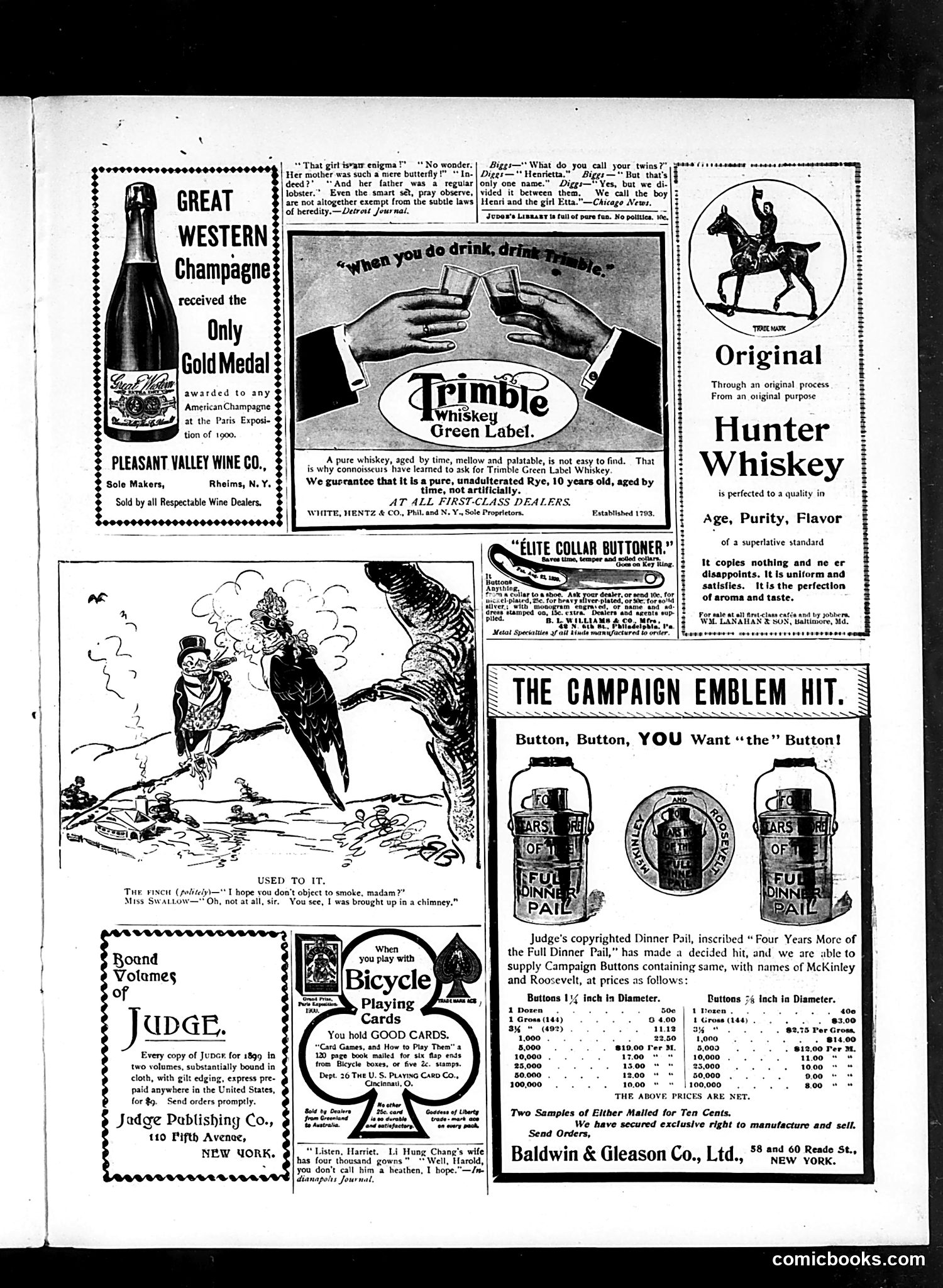
This page is primarily **advertising with one cartoon joke**. The main satirical content is a single comic strip titled "USED TO IT," depicting a conversation between a man asking a woman if she objects to smoke, and her responding she was "brought up in a chimney"—a joke playing on the assumption that chimney sweeps' children would be accustomed to smoke and soot. The bulk of the page consists of product advertisements for whiskeys, champagne, playing cards, and notably **campaign buttons featuring McKinley and Roosevelt's "Full Dinner Pail"** slogan—a 1900 election reference promising prosperity under Republican leadership. Another brief joke concerns twins named after their parents (a "butterfly" father and "lobster" mother), making an implied heredity joke. The cartoons and ads reflect early 1900s consumer culture and the contemporary presidential campaign, but contain no major political satire—this appears to be a commercial rather than editorial page.
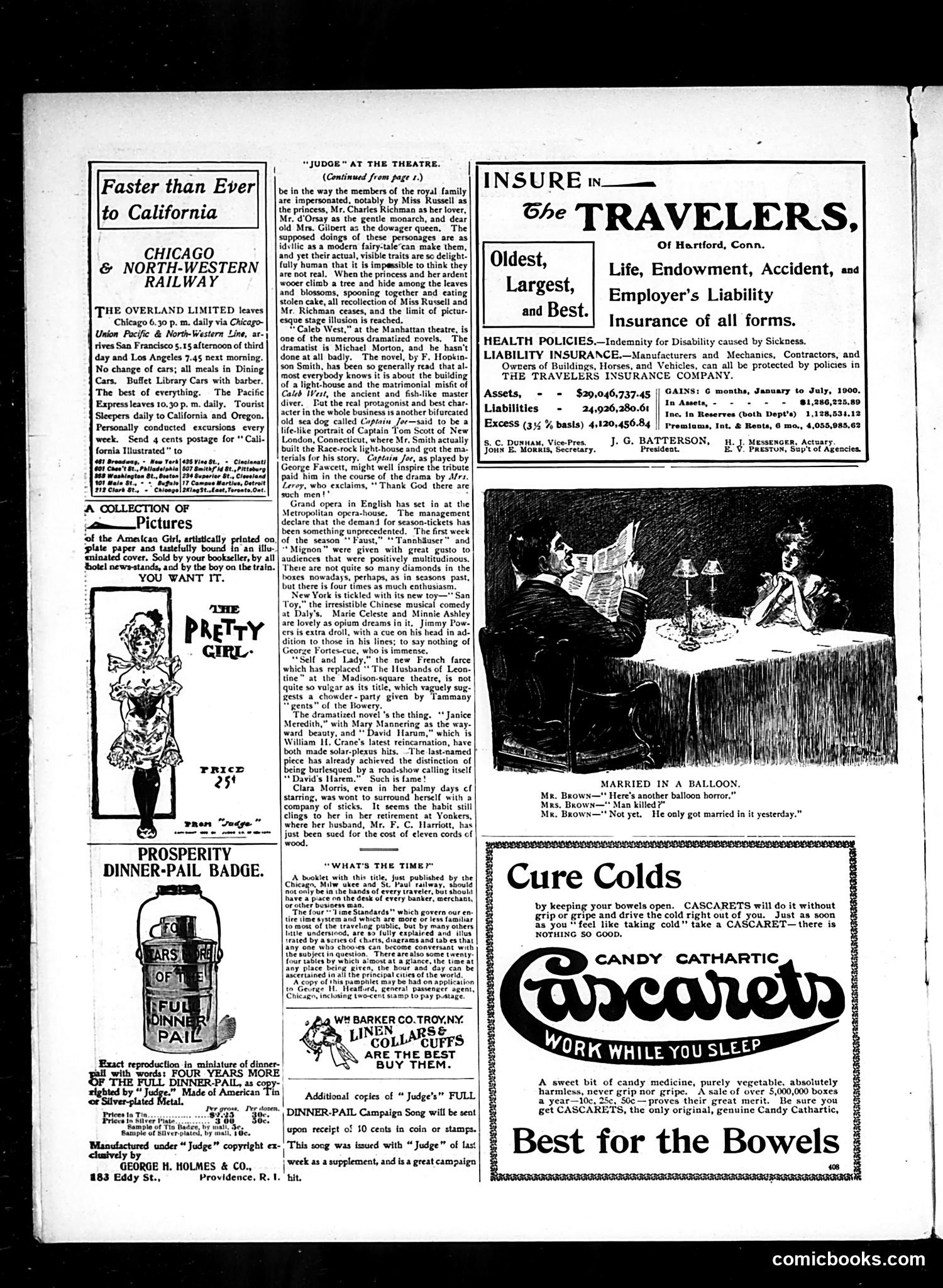
This page is primarily **advertising and theater reviews**, not political satire. The main content includes: **Theater Reviews Section:** The "Judge at the Theatre" column reviews three productions: "Judge" (a royal-family comedy starring Miss Russell), "Caleb West" (a dramatized novel about lighthouse building), and mentions of Metropolitan Opera's English-language season and a Chinese musical comedy at Daly's Theatre. **Advertisements:** - Chicago & North-Western Railway promoting California travel - The Travelers Insurance Company of Hartford - "The Pretty Girl" illustration (price 25¢) - Prosperity Dinner-Pail Badge - Cascaret candy laxative - Linene Collar Cuffs **Illustration:** A sketch captioned "Borrowed a Balloon" showing three men at a dinner table, with dialogue about borrowing and returning balloons—appears to be a domestic comedy scenario. The page reflects early 20th-century consumer culture and entertainment rather than political commentary.
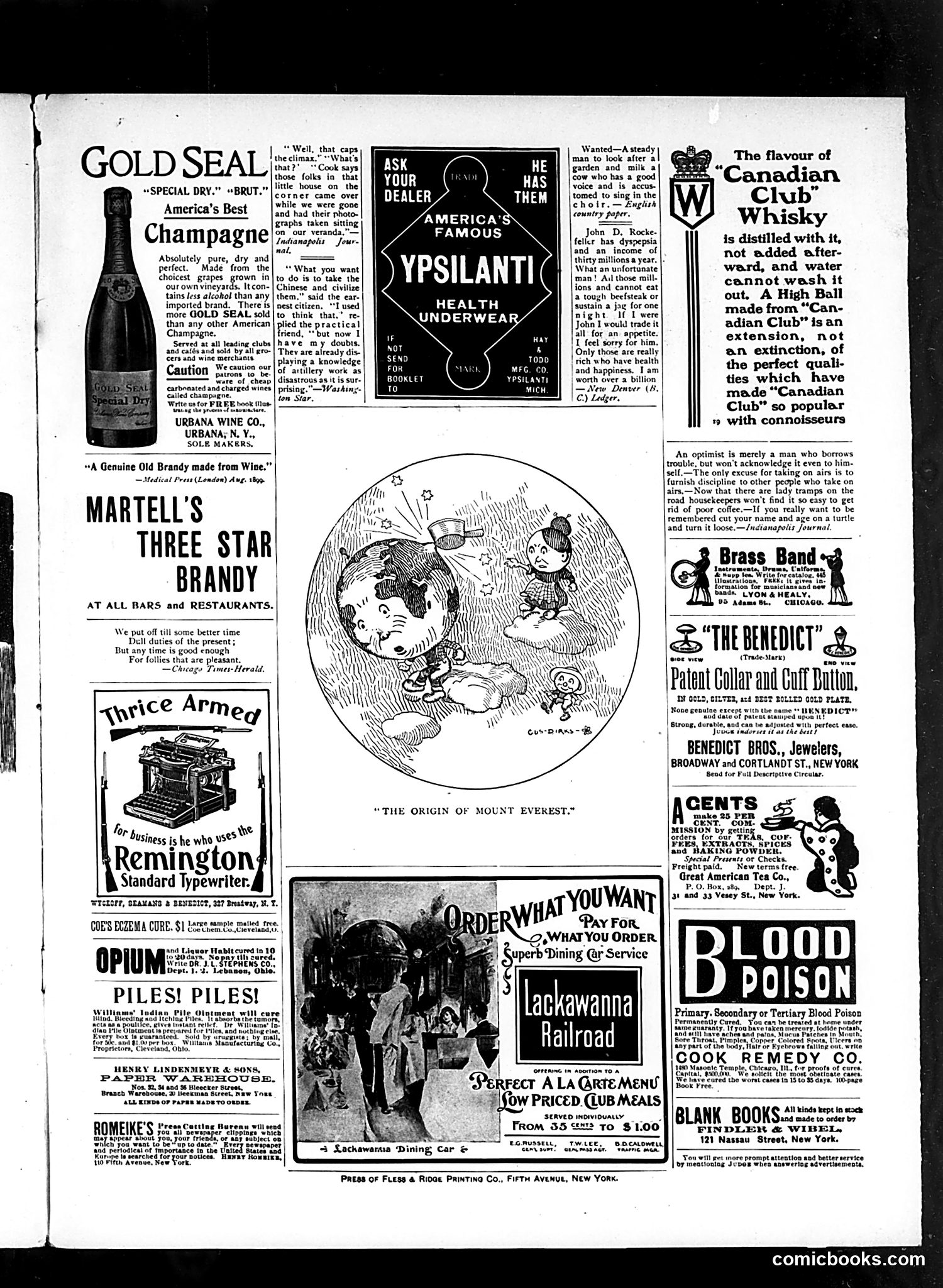
This is primarily an **advertising page** from an early 20th-century American satirical magazine, with minimal editorial content. The one notable cartoon—"The Origin of Mount Everest"—appears to be a visual joke showing small figures (possibly children or explorers) atop a large spherical form, playing on the phrase "origin of Mount Everest." The humor likely derives from an unexpected or whimsical explanation for the world's highest mountain. The page is dominated by period product advertisements: champagne, brandy, typewriters, patent medicines (opium, pile treatments), railroad dining cars, and whiskey. The scattered short humorous quotes in margins offer typical Judge-style commentary on contemporary life—observations about wealth, class, immigration policy ("civilize the Chinese"), and human nature. The advertisements themselves reflect turn-of-century consumer culture and remedies that would later be restricted or banned (notably the opium and unregulated medicinal tonics), offering modern readers insight into what was openly marketed before FDA regulations.
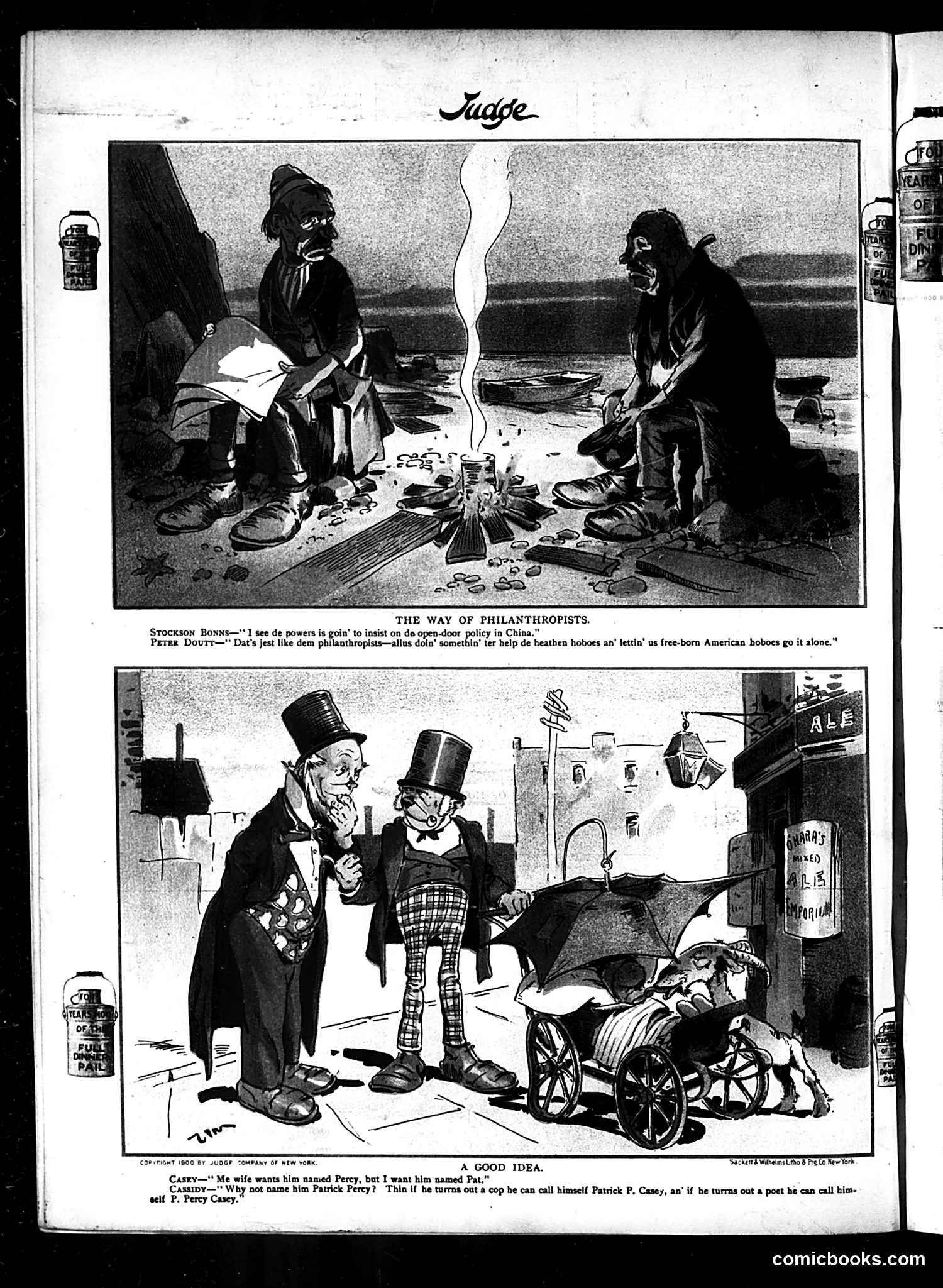
**Top cartoon ("The Way of Philanthropists"):** Two homeless men, depicted with exaggerated features and dialect, discuss foreign policy. One notes wealthy philanthropists pushing an "open-door policy in China" (trade access), while lamenting that these same wealthy do nothing for American homeless. The satire criticizes hypocrisy: charitable interests in distant "heathen" lands while neglecting poverty at home. The caricatured "hoboes" underscore class commentary. **Bottom cartoon ("A Good Idea"):** Two well-dressed men debate naming a newborn either "Percy" or "Pat." The joke: naming him "Patrick P. Casey" allows flexibility—if he becomes a cop, "Patrick P. Casey"; if a poet, similar. This puns on occupational identity and Irish naming conventions, mocking social aspiration through naming practices common in early 1900s immigrant communities.