
Judge, 1900-10-27 · page 2 of 16
Judge — October 27, 1900 — page 2: what you’re looking at
What you’re looking at
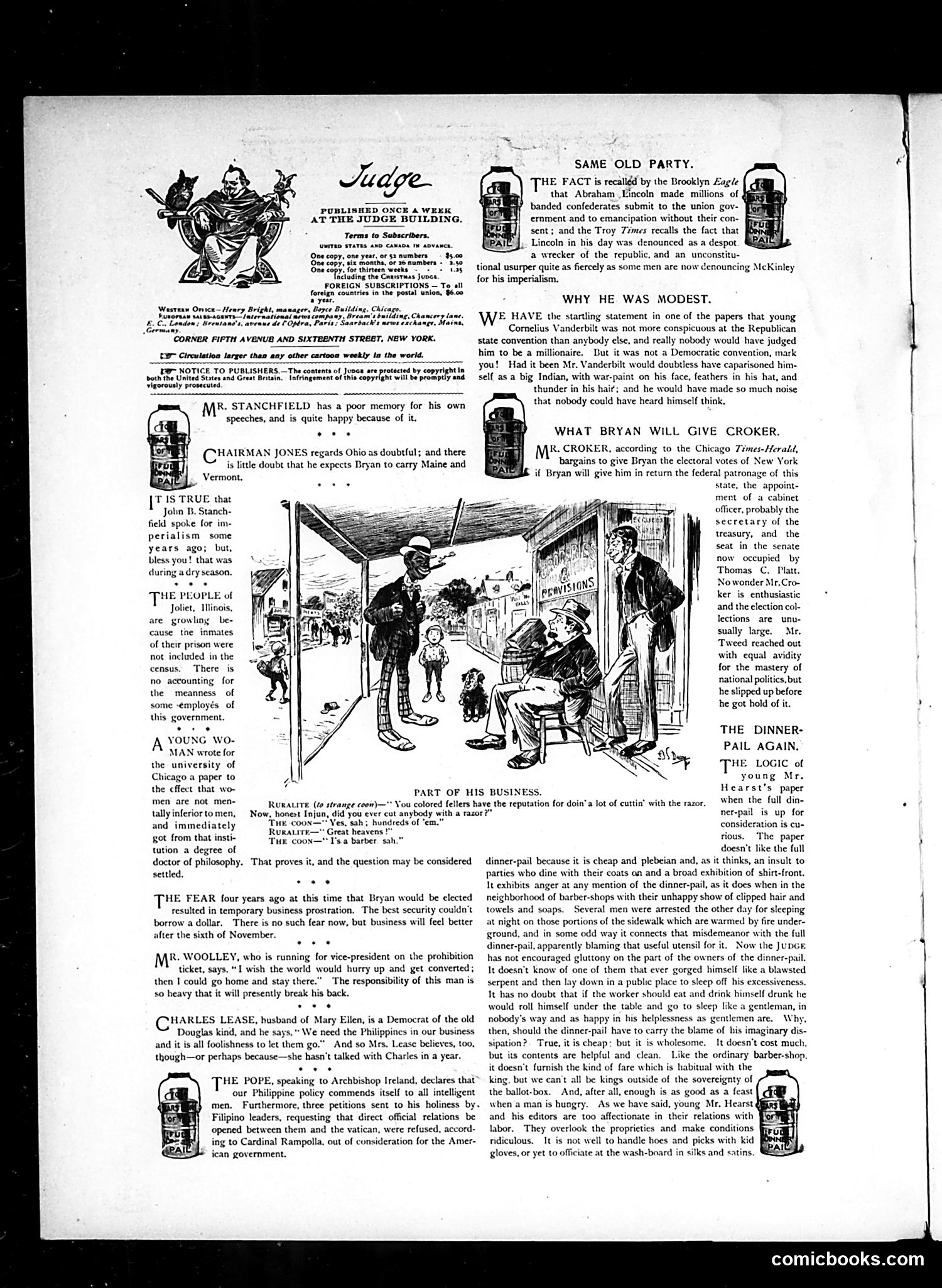
This page contains political commentary circa early 1900s. The central cartoon, titled "Part of His Business," depicts a barber (labeled "Rukalite") discussing the "dinner-pail" issue with a customer. The dinner-pail was a campaign symbol representing workers' economic security—whether prosperity would continue under current policies. The article critiques the dinner-pail as cheap political rhetoric, arguing it distracts from substantive labor issues like working conditions, fair wages, and dignity. The satire mocks politicians who invoke worker prosperity symbolically while ignoring actual workplace problems—unsafe conditions, inadequate pay, and poor treatment. The cartoon's barber-shop setting suggests ordinary workers' conversations, implying this empty rhetoric reaches and misleads the working class about what politicians actually deliver.
📄 Transcribed text from this page (OCR, searchable)
Machine-transcribed from the original scan — historical spelling and the odd misread are preserved.
AT THE JUDGE BUILDING. Terms to Subscribers. One copy, one year, or $2 numbers $5.00 ‘One copy, six months, or 26 numbers - 3.50 ‘One copy. for thirteen weeks rer’ focluding the C istaas Juoce. FOREIGN SUBSCRIPTIONS — To all foreign countries in the postal union, $6.00 ayer. Wasteam Onice— Henry Bright, manager, Boyce Bui Chicage, Fusoraan saiss-acents/atermational mevet company, Bream's building, Chancery lane. paris? Saarbachs mews eschampe, Maina, CORNER FIFTH AVENUB AND SIXTEENTH STREET, NEW YORK. £7 Circulation larger than any other cartoon weekly Ia the world. Tey- NOTICE TO PUBLISHERS.—The contents of Juoce are protected by copy both the United States and Great Britain, Infringement of this copyright will be prom sigorously prosecuted tin fy and MB: STANCHFIELD has a poor memory for his own speeches, and is quite happy because of it. (CHAIRMAN JONES regards Ohio as doubtful; and there is little doubt that he expects Bryan to carry Maine and Vermont. [71S TRUE that John B. Stanch- field spoke for im- perialism some years ago; but, bless you! that was during a dry season, OPLE of Joliet, Mlinois, are growling be- cause the inmates of their prison were not included in the There is no accounting for the meanness of some -employés of this government. A yo > WO- MAN wrote for the university of Chicago a paper to the effect that wo- men are not men- tally inferior tomen, and immediately got from that insti- tution a degree of doctor of philosophy. settled. H census. Ruratr "Ves, sah; hundreds of “em.” ‘That proves it, and the question may be considered HE FEAR four years ago at this time that Bryan would be elected resulted in temporary business prostration. The best security couldn't borrow a dollar. There is no such fear now, but business will feel better after the sixth of November. R, WOOLLEY, who is running for vice-president on the prohibition ticket, says, “I wish the world would hurry up and get converted; then I could go home and stay there.” ‘The responsibility of this man is so heavy that it will presently break his back. CHARLES LEASE, husband of Mary Ellen, is a Democrat of the old Douglas kind, and he says," We need the Philippines in our business and it is all foolishness to let them go.” And so Mrs. Lease believes, too, though—or perhaps because—she hasn't talked with Charles in a year. HE POPE, speaking to Archbishop Ireland, declares that our Philippine policy commends itself to all intelligent men. Filipino leaders, requesting that direct official relations be ‘opened between them and the vatican, were refused, accord- a ing to Cardinal Rampolla, out of consideration for the Amer- ican government. PART OF HIS BUSINESS. t0 strange coon)—"* Vou colored fellers have the reputation for doin’a lot of cuttin’ with the razor. honest Injun, did you ever cut anybody with a razor?” Furthermore, three petitions sent to his holiness by. SAME OLD PARTY. THE FACT is recalléd by the Brooklyn Zagle that Abraham Lincoln made millions of banded confederates submit to the union gov- ernment and to emancipation without their con- sent; and the Troy Times recalls the fact that Lincoln in his day was denounced as a despot a wrecker of the republic, and an unconstitu- tional usurper quite as fiercely as some men are now denouncing McKinley for his imperialism, WHY HE. WAS MODEST. WE HAVE the startling statement in one of the papers that young Cornelius Vanderbilt was not more conspicuous at the Republican state convention than anybody else, and really nobody would have judged him to be a millionaire. But it was not a Democratic convention, mark you! Had it been Mr. Vanderbilt would doubtless have caparisoned him- self as a big Indian, with war-paint on his face, feathers in his hat, and thunder in his hair; and he would have made so much noise that nobody could have heard himself think, Al WHAT BRYAN WILL GIVE CROKER. MB. CROKER, according t0 the Chicago Times-Herald, bargains to give Bryan the electoral votes of New York if Bryan will give him in return the federal patronage of this, state, the appoint- ment of a cabinet officer, probably the secretary of the treasury, and the seat in the senate now occupied by Thomas C. Platt. No wonder Mr,Cro- ker is enthusiastic and the election col- lections are unu- sually large. Mr. Tweed reached out with equal avidity for the mastery of national politics, but he slipped up before he got hold of it. THE DINNER- PAIL AGAIN, HE LOGIC of young Mr. Hearst's paper when the full din- ner-pail is up for consideration is cu- rious. ‘The paper doesn't like the full dinner-pail because it is cheap and plebeian and, as it thinks, an insult to parties who dine with their coats an and a broad exhibition of shirt-front. It exhibits anger at any mention of the dinner-pail, as it does when in the neighborhood of barber-shops with their unhappy show of clipped hair and towels and soaps. Several men were arrested the other day for sleeping at night on those portions of the sidewalk which are warmed by fire under- ground, and in some odd way it connects that misdemeanor with the full dinner-pail, apparently blaming that useful utensil for it. Now the JuDGE has not encouraged gluttony on the part of the owners of the dinner-pail. It doesn’t know of one of them that ever gorged himself like a blawsted serpent and then lay down in a public place to sleep off his excessiveness. It bas no doubt that if the worker should eat and drink himself drunk he would roll himself under the table and go to sleep like a gentleman, in nobody's way and as happy in his helplessness as gentlemen are. Why, then, should the dinner-pail have to carry the blame of his imaginary dis- sipation?. True, it is cheap: but it is wholesome. It doesn’t cost much, but its contents are helpful and clean. Like the ordinary barber-shop. it doesn't furnish the kind of fare which is habitual with the (a3 | king, but we can't all be kings outside of the sovereignty of the ballot-box. And, after all, enough is as good as a feast when a man is hungry. As we have said, young Mr, Hearst and his editors are too affectionate in their relations with labor. They overlook the proprieties and make conditions ridiculous, It is not well to handle hoes and picks with kid gloves, or yet to officiate at the wash-board in silks and satins, comicbooks.com