
Judge, 1900-10-27 · page 6 of 16
Judge — October 27, 1900 — page 6: what you’re looking at
What you’re looking at
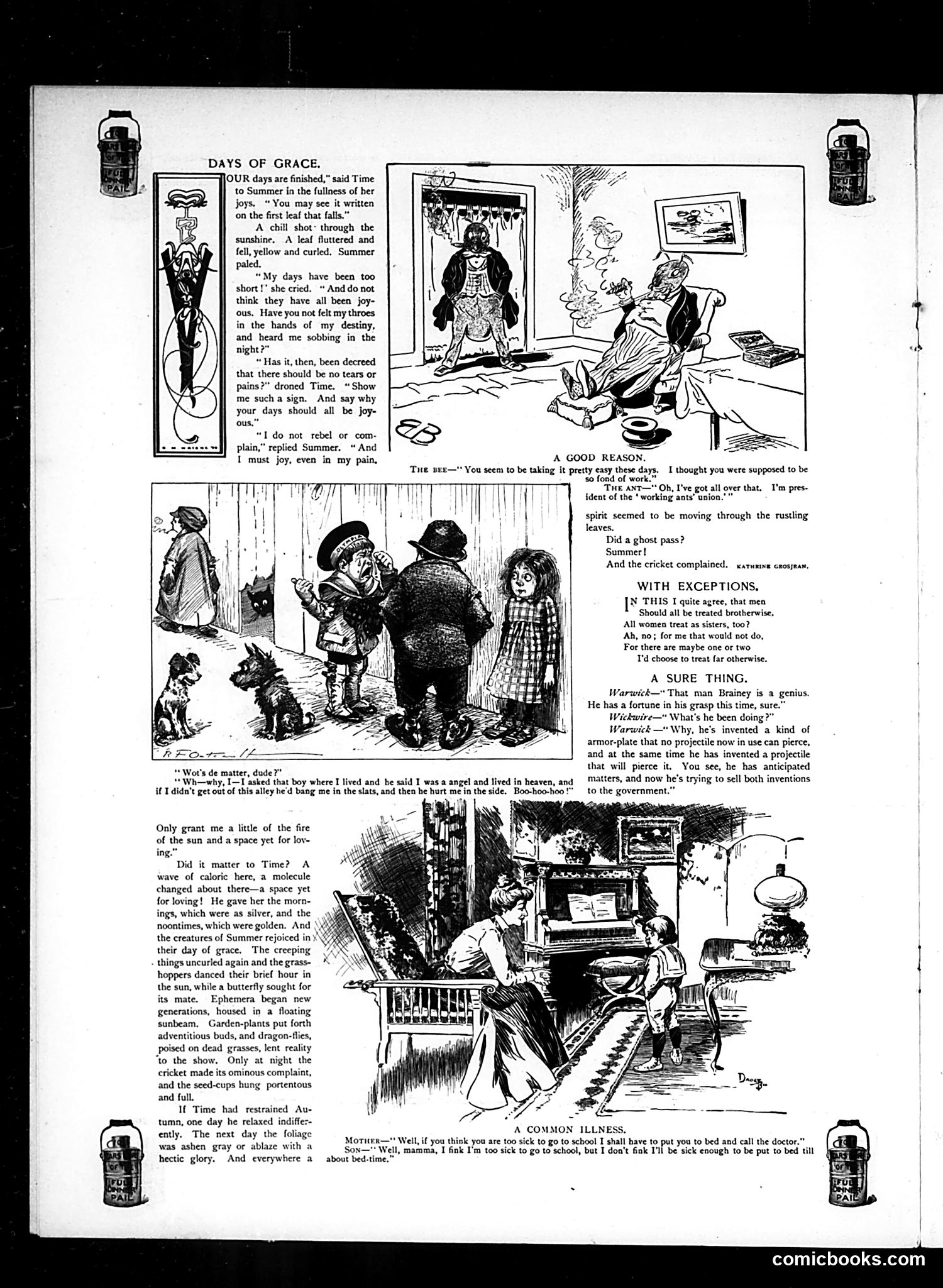
This page contains several satirical pieces typical of late 19th/early 20th-century American humor: **"Days of Grace"** (top): An allegorical dialogue between Time and Summer, personified as a woman lamenting her brevity and hardships. The piece romanticizes transience—Summer accepts her fleeting existence philosophically. This reflects period sentimentality about mortality and nature's cycles. **"A Good Reason"** (middle right): An ant character, now union president, admits he's stopped working hard. This satirizes labor unionization and worker organization, presenting it mockingly as laziness masquerading behind bureaucratic excuse-making. **"A Sure Thing"** (right): Two men discuss an inventor who's created both an armor-plate and a projectile that pierces it—ensuring guaranteed profit either way. This satirizes military-industrial profiteering and the absurdity of selling contradictory inventions to government. **"A Common Illness"** (bottom): A child malingers unconvincingly, claiming too-sick-for-school but not-sick-enough-for-bed. This humorously depicts childhood deception. The page showcases Judge's blend of sentimental storytelling, labor criticism, and social satire.
📄 Transcribed text from this page (OCR, searchable)
Machine-transcribed from the original scan — historical spelling and the odd misread are preserved.
DAYS OF GRACE, OUR days are finished,” said Time to Summer in the fullness of her joys. “You may see it written on the first leaf that falls. A chill shot through the sunshine. A leaf fluttered and fell, yellow and curled. Summer paled. “My days have been too short!" she cried. “ And do not think they have all been joy- ous. Have you not felt my throes in the hands of my destiny, and heard me sobbing in the night?” “ Has it, then, been decreed that there should be no tears or pains?" droned Time, “Show me such a sign. And say why your days should all be joy- ous.” I do not rebel or com- plain,” replied Summer. “And 1 must joy, even in my pain, A GOOD REASON. ‘ou seem to be taking it pretty easy these days. I thought you were supposed to be ‘so fond of work.” ‘THE ANT—"* Oh, I've got all over that, I'm pres- ident of the * working ants’ union.’ spirit seemed to be moving through the rustling leaves. Did a ghost pass? Summer! And the cricket complained. xaruane crosjean. WITH EXCEPTIONS, [8 THIS T quite agree, that men Should all be treated brotherwise. All women treat as sisters, too? Ah, no; for me that would not do, For there are maybe one or two T'd choose to treat far otherwise. A SURE THING. Warwick—" That man Brainey is a genius. He has a fortune in his grasp this time, sure.” Wickwire—" What's he been doing’ Warwick —" Why, he's invented a kind of armor-plate that no projectile now in use can pierce, and at the same time he has invented a projectile Foca da mares Bole that will pierce it. You see, he has anticipated Wh—why, I—I asked that boy where I lived and he said I was a angel and lived in heaven, and Matters, and now he’s trying to sell both inventions if I didn’t get out of this alley he'd bang me in the slats, and then he hurt me in the side. Boo-hoo-hoo!” to the government.” Only grant me a little of the fire of the sun and a space yet for lov ing” Did it matter to Time? A wave of caloric here, a molecule changed about there—a space yet for loving! He gave her the morn- ings, which were as silver, and the 9 noontimes, which were golden. And } the creatures of Summer rejoiced in their day of grace, The creeping things uncurled again and the grass- hoppers danced their brief hour in the sun, while a butterfly sought for its. mate. hemera began new generations, housed in a floating sunbeam, Garden-plants put forth adventitious buds, and dragon-flies, poised on dead grasses, lent reality ‘to the show. Only at night the cricket made its ominous complaint, and the seed-cups hung portentous and full. If Time had restrained Au- tumn, one day he relaxed indiffe:- ently. The next day the foliage was ashen gray or ablaze with a A COMMON ILLNESS, Moriter—"* Well, if you think you are too sick to go to school I shall have to put you to bed and call the doctor.” N—"* Well, mamma, I fink I'm too sick to go to school, but I don’t fink I'll be sick enough to be put to bed till hectic glory. And everywhere a about bed-time. comicbooks.com