
A complete issue · 26 pages · 1900
Judge — October 20, 1900
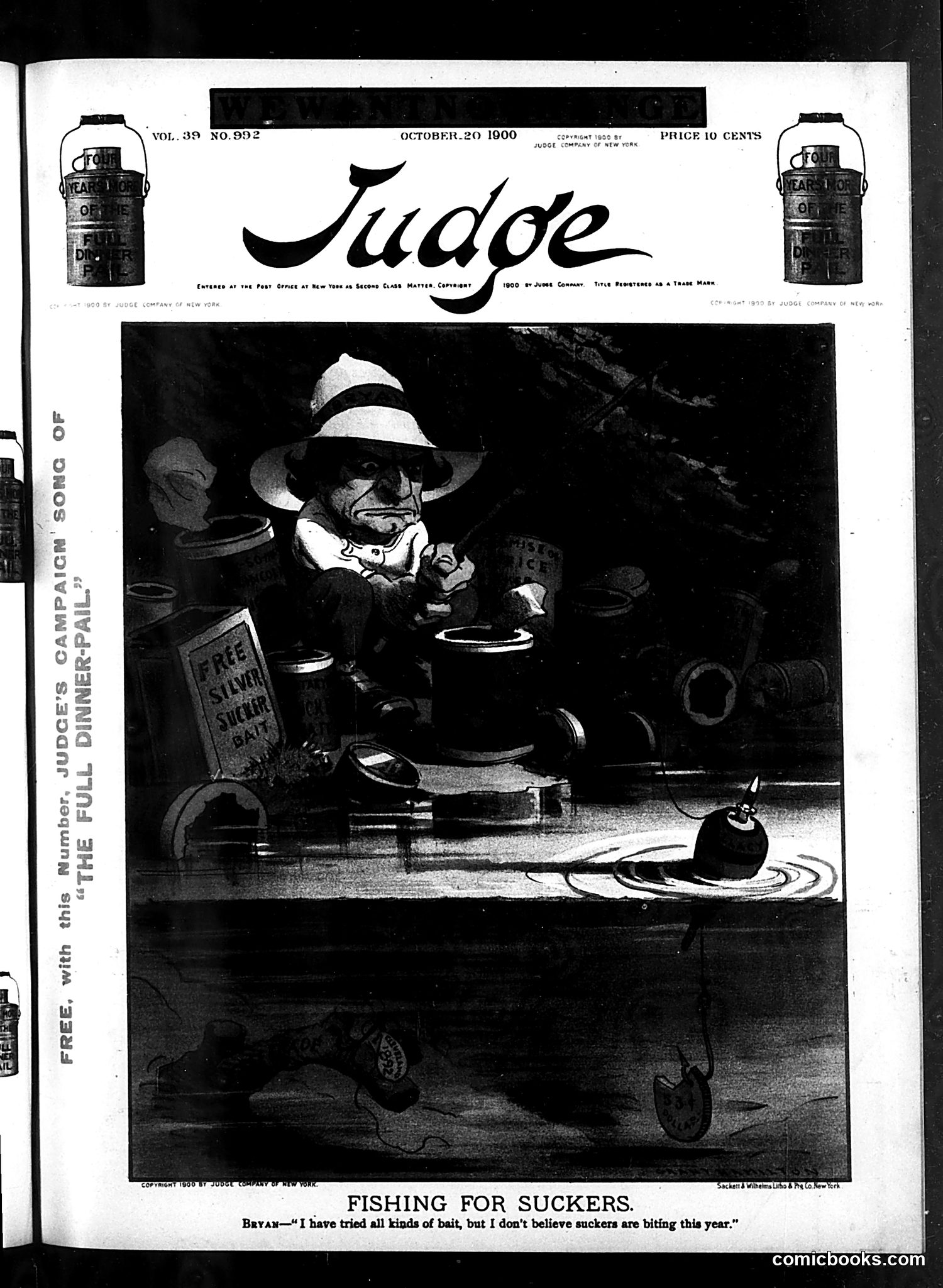
This political cartoon satirizes the 1900 presidential campaign. The figure labeled "Bryan" represents William Jennings Bryan, the Democratic candidate running against incumbent Republican William McKinley. The cartoon depicts Bryan as a fisherman using various "baits"—different campaign promises and populist appeals—trying to catch "suckers" (gullible voters). The fishing equipment and barrels surrounding him suggest he's employing multiple strategies to attract support. Bryan's caption—"I have tried all kinds of bait, but I don't believe suckers are biting this year"—mocks his campaign's ineffectiveness. Judge, a Republican-leaning publication, uses the metaphor to suggest Bryan's populist rhetoric and promises aren't persuading voters, implying the electorate is too wise to fall for his appeals.
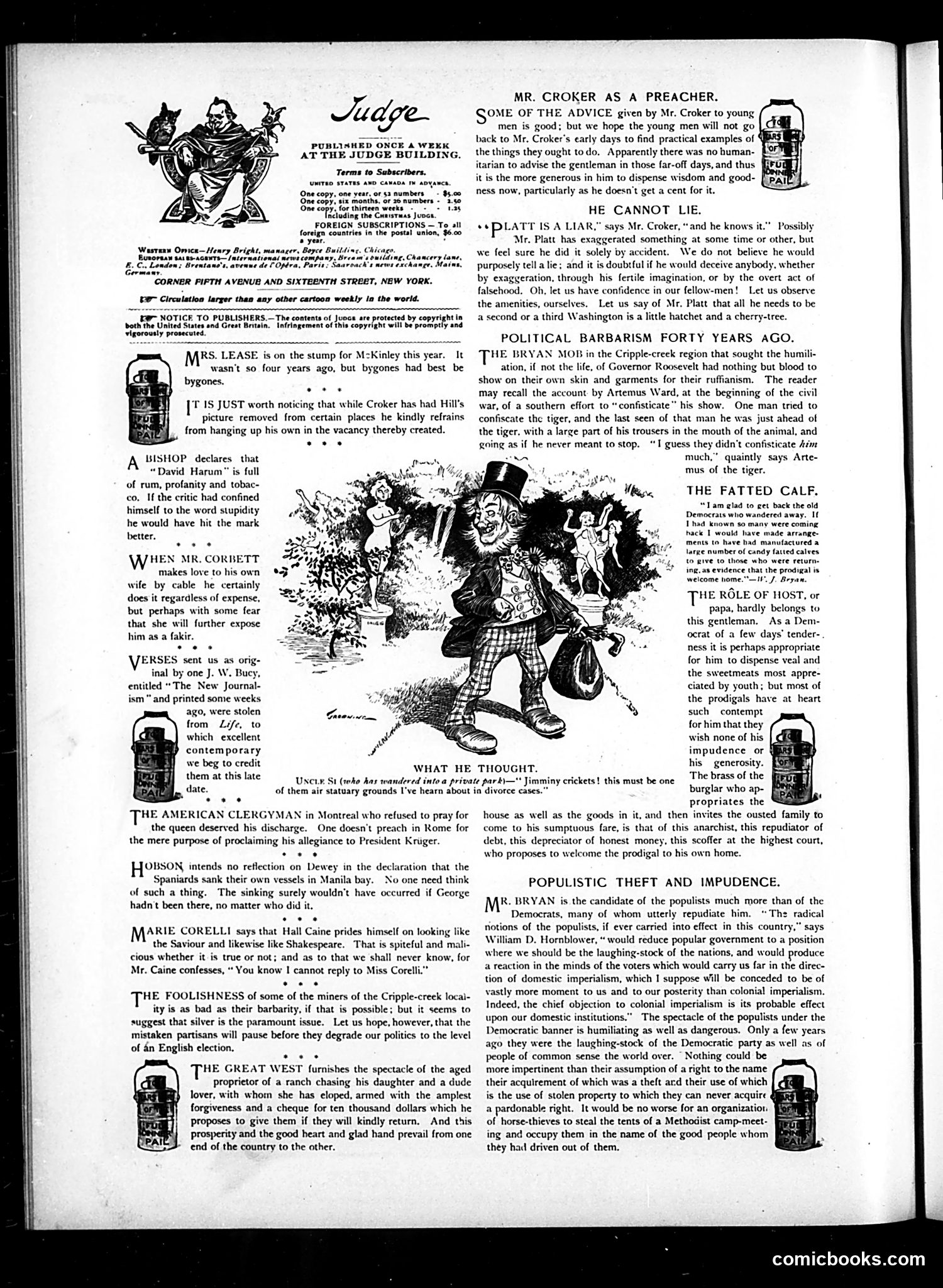
This page contains multiple satirical sections critiquing political and social figures of the era. The central cartoon depicts a man in a top hat and plaid trousers examining cricket equipment, with the caption "WHAT HE THOUGHT," mocking someone's misunderstanding of cricket as related to "divorce cases." Key sections include: **"MR. CROKER AS A PREACHER"** — criticizes Richard Croker (likely Tammany Hall boss) for dispensing moral advice despite questionable character. **"POLITICAL BARBARISM FORTY YEARS AGO"** — references historical Southern conduct during Reconstruction, mentioning Governor Roosevelt and Civil War atrocities. **"POPULISTIC THEFT AND IMPUDENCE"** — attacks Bryan and Populist Democrats as hypocritical regarding property rights and socialism. The satire targets political hypocrisy, with references to Bryan's populism and Croker's moral authority being questioned.
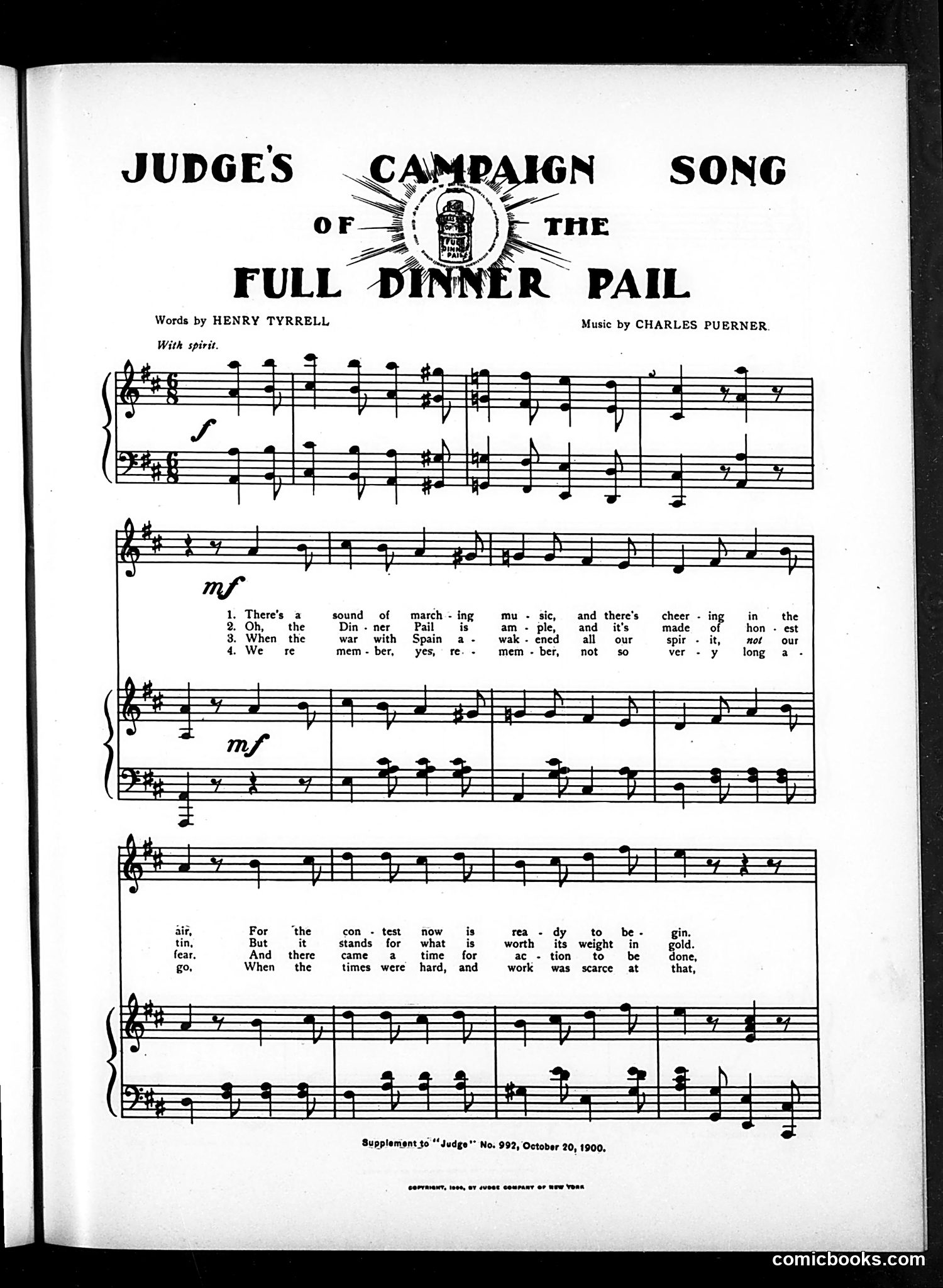
This is a musical score page rather than a political cartoon. It presents "Judge's Campaign Song of the Full Dinner Pail," with words by Henry Tyrrell and music by Charles Puerner, dated October 20, 1900. The "Full Dinner Pail" was a Republican campaign slogan from the 1900 presidential election, symbolizing prosperity and workers' economic security under Republican policies. The lyrics reference political contests and competing candidates, appearing to celebrate Republican achievements while contrasting with opposing positions. The song itself—rather than visual satire—conveys Judge magazine's political message through verse, likely promoting William McKinley's reelection campaign. This represents how satirical magazines used entertainment and song to advance political messaging during this era.
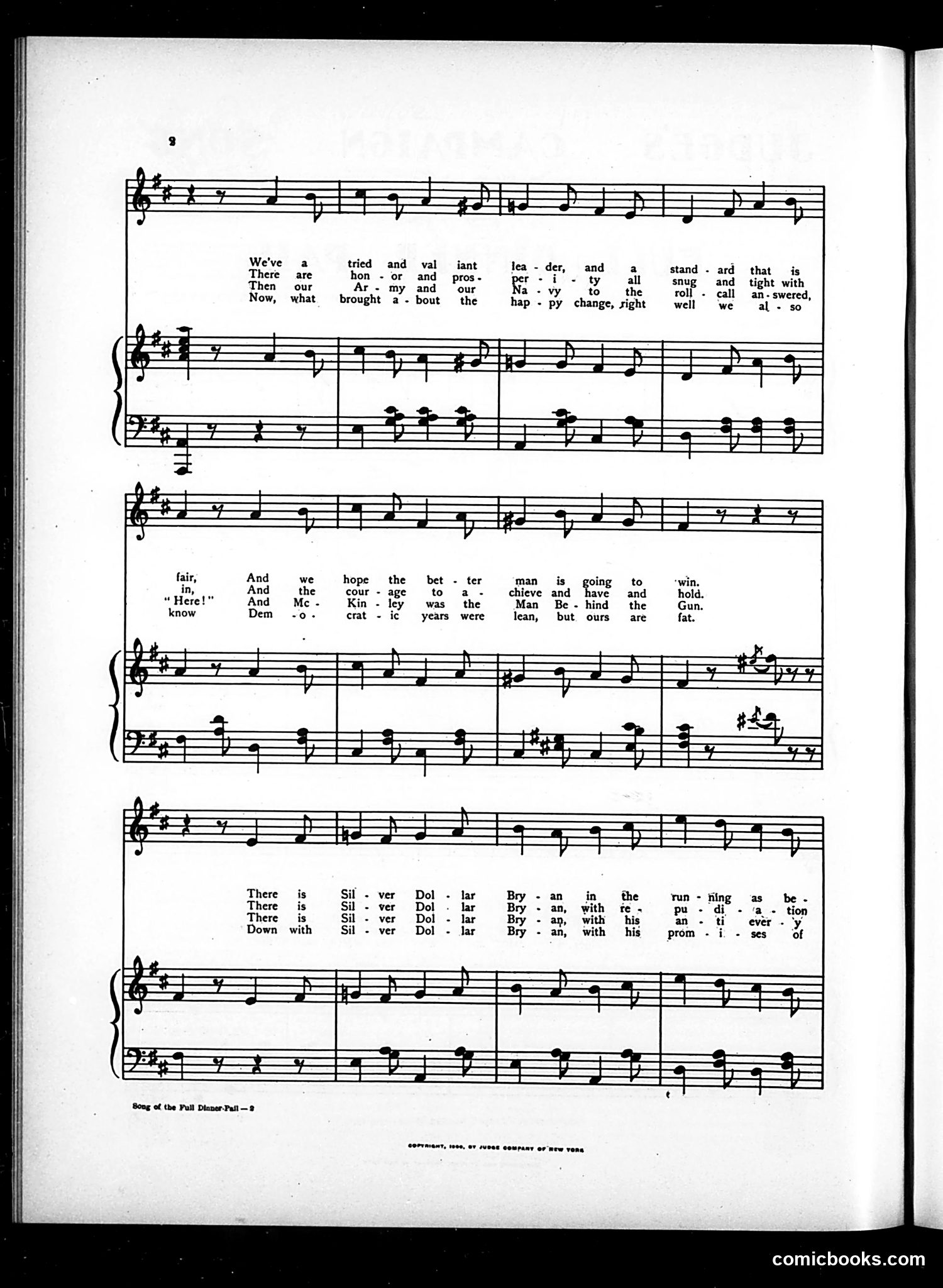
This page contains sheet music rather than a political cartoon. It appears to be a song titled "Song of the Pall Bearers' Pall" (as noted at the bottom), featuring lyrics with multiple verses presented alongside musical notation for voice and piano accompaniment. The lyrics reference political or social figures—"Silvy," "Del," "Dol," and "Bryan"—suggesting this is likely satirical commentary set to music. Without additional context about the publication date and these specific references, I cannot definitively identify which historical figures are being mocked or what events are being satirized. The song structure and Judge magazine's satirical nature suggest this was intended as humorous political commentary, but the specific targets and point of the satire remain unclear from the image alone.
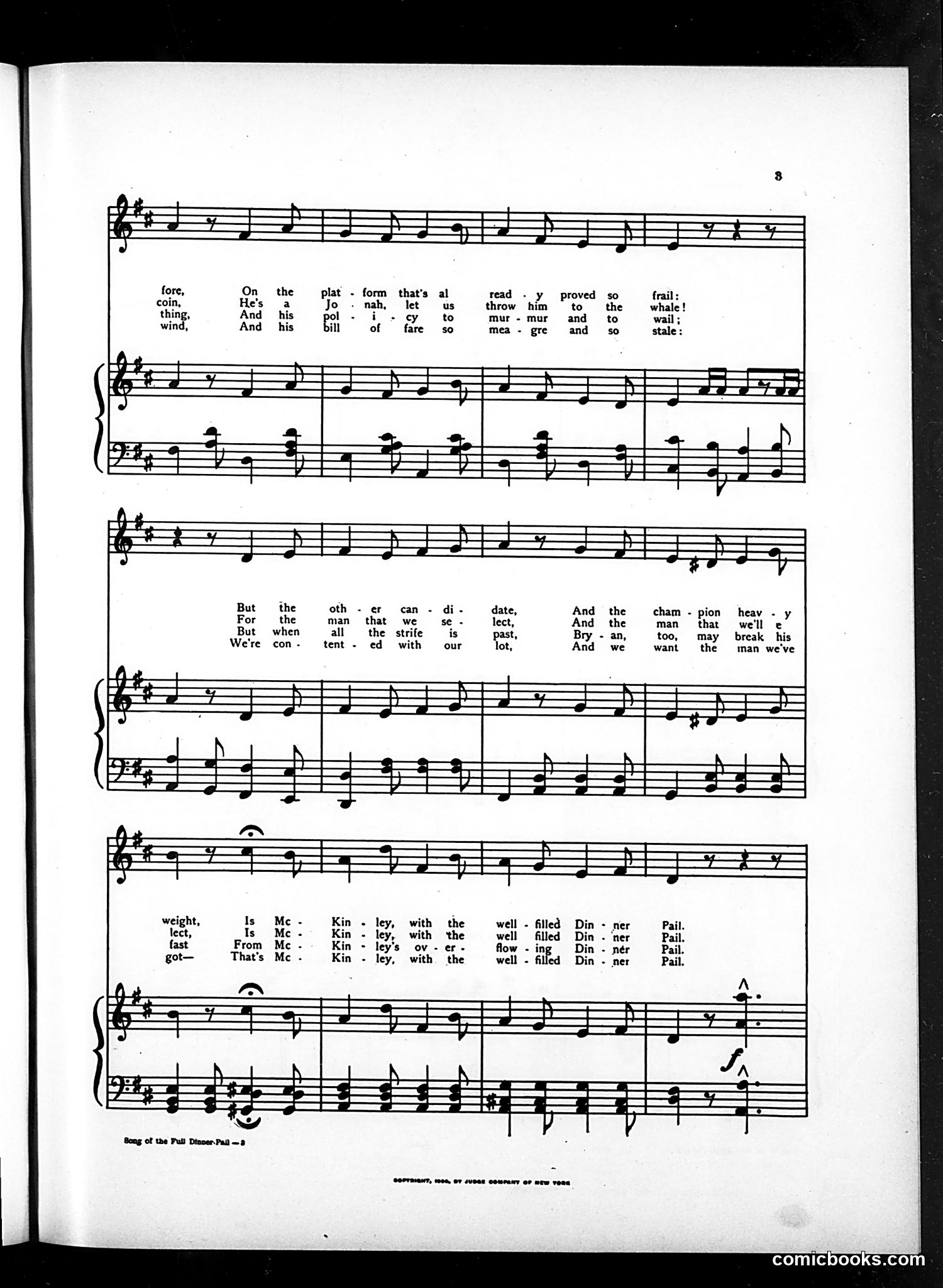
This page is a **musical score** for a song, not a political cartoon. The text appears to be lyrics set to music in a satirical song format. Based on the OCR'd fragments mentioning "McKinley" and "Bryan," this likely references the **1900 U.S. presidential election** between incumbent William McKinley (Republican) and William Jennings Bryan (Democrat). The lyrics mock both candidates and their platforms—references to "platform," "dinner," and "champion" suggest satirical commentary on their campaign promises and public personas. The song's structure presents competing political narratives in verse form, characteristic of Judge magazine's approach to political satire. The repetitive "Dinner Pail" references may allude to McKinley's "Full Dinner Pail" campaign slogan, promising prosperity. Without seeing accompanying illustrations, the exact targets remain somewhat unclear, but this is clearly partisan satire set to music—a common Judge feature for mocking contemporary political figures and elections.
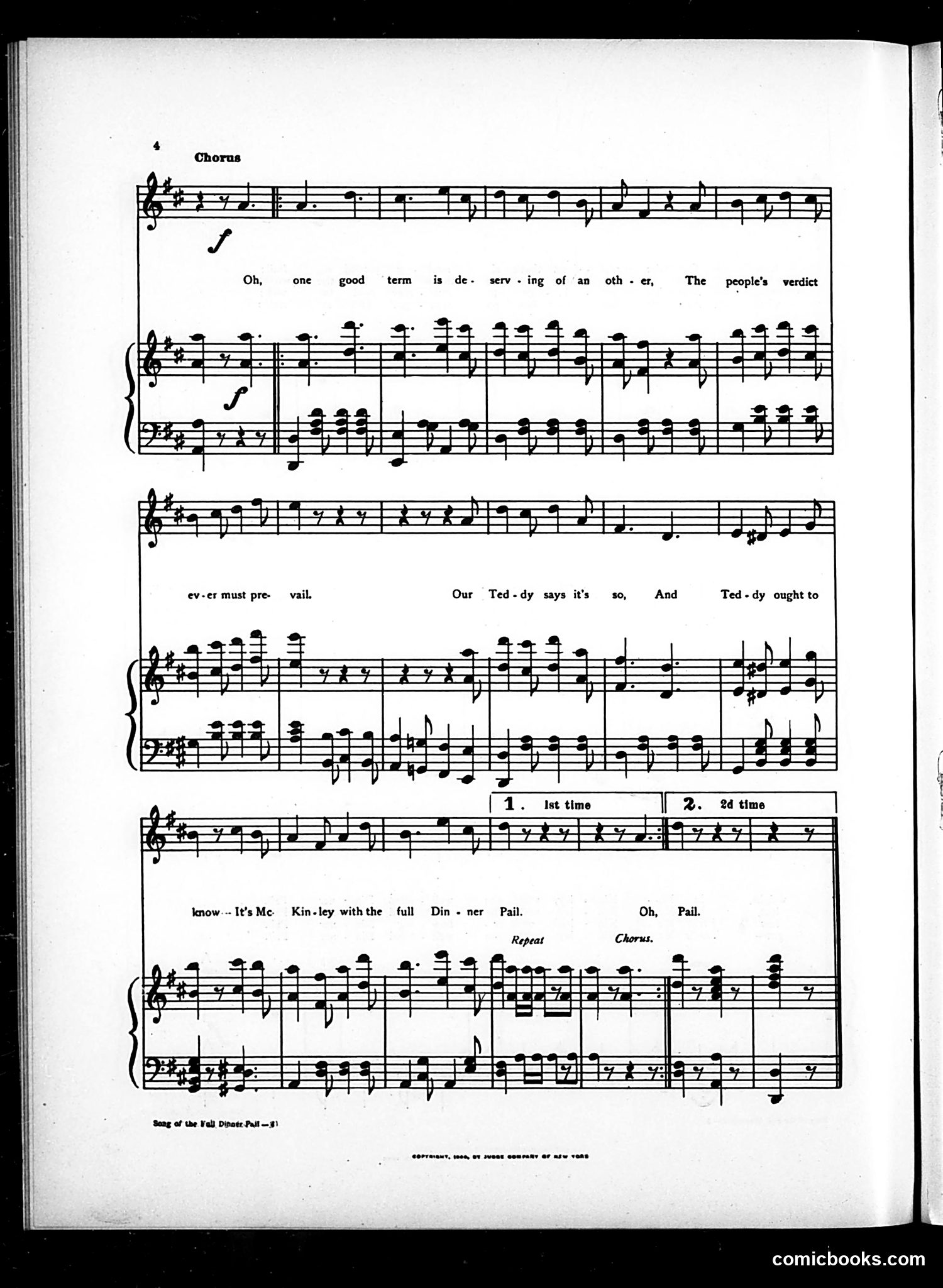
This page contains sheet music for a political song titled "Song of the Full Dinner Pail," likely from the 1900 U.S. presidential campaign. The lyrics reference **William McKinley** and the famous Republican campaign slogan "The Full Dinner Pail"—promising American workers prosperity and full employment under McKinley's presidency. The song's chorus emphasizes that "one good term is deserving of another," advocating McKinley's re-election. References to "Teddy" likely allude to **Theodore Roosevelt**, McKinley's vice president at the time. The "Full Dinner Pail" was a central Republican campaign image symbolizing economic well-being and worker prosperity. This appears to be campaign propaganda set to music for popular distribution, a common political tool in the early 20th century.
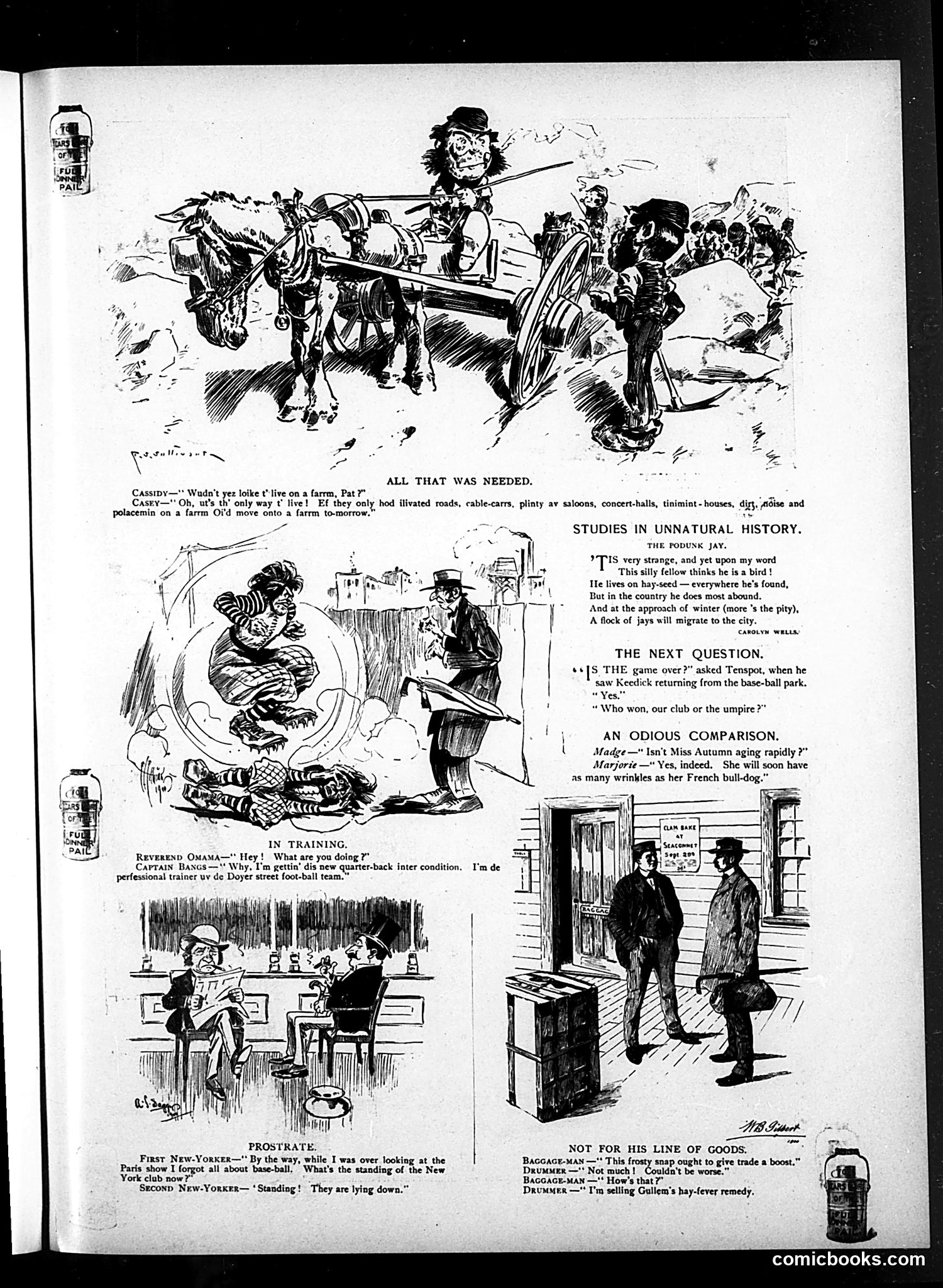
This page contains six brief satirical sketches typical of Judge magazine's humor circa early 1900s: **"All That Was Needed"**: Irish immigrant Pat fantasizes about farm life—but only if it includes urban conveniences (streetcars, saloons, police). The joke mocks rural-to-urban migration tensions and Irish stereotypes. **"In Training"**: A street-level boxing trainer works on a football player, conflating different sports in absurdist humor. **"Prostrate"**: New Yorkers discuss the baseball season. One admits he forgot about local games while viewing the Paris Exposition; the other jokes the team is "lying down" (failing badly). **"Studies in Unnatural History"**: A naturalist whimsically describes "Podunk Jays"—country folk who migrate cityward in winter, treating rural people as exotic creatures. **"The Next Question"**: A child asks if the umpire won the game, not the team—mocking umpire-fixing scandals. **"Not for His Line of Goods"**: A hay-fever remedy salesman dreads winter (when pollen disappears), eliminating sales—simple commercial humor. The page showcases Judge's blend of class commentary, immigrant humor, and contemporary sports/urban references.
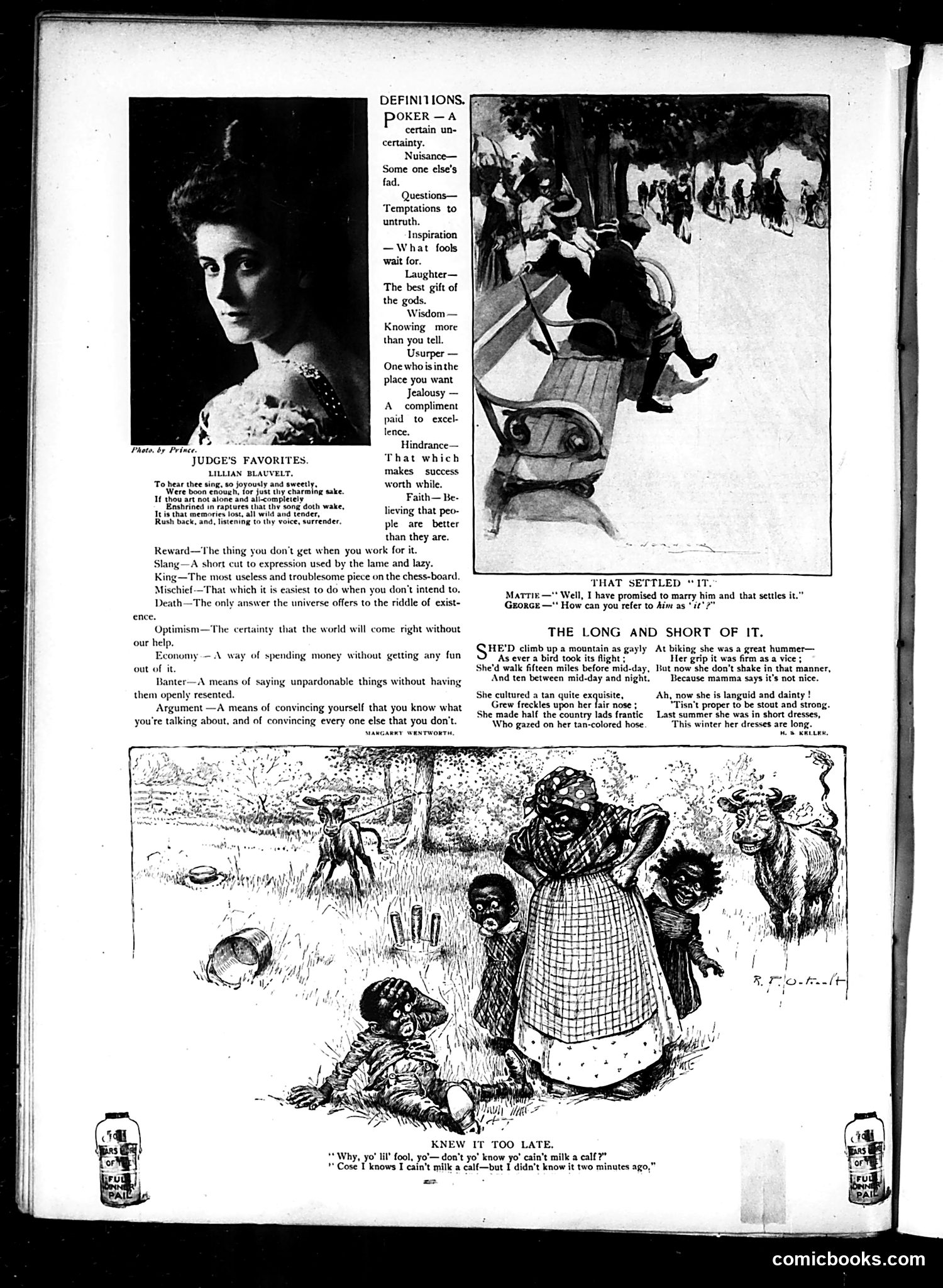
This page from the satirical magazine **Judge** contains three distinct pieces: **"Judge's Favorites"** presents **Lillian Blauvelt**, likely an entertainer or public figure, paired with witty definitions mocking human nature and social pretense (poker as "uncertainty," wisdom as "knowing more than you tell"). **"That Settled It"** is a brief comic about a woman justifying her engagement, suggesting satire of women's limited autonomy in marriage decisions. **"The Long and Short of It"** contrasts a girl's active, unfeminine behavior (climbing mountains, biking, strong grip) with her transformation into a delicate, languid woman constrained by social propriety and her mother's expectations. This satirizes how Victorian society pressured women to abandon health and vitality for performative femininity. **"Knew It Too Late"** (bottom) depicts rural dialect humor: a child discovers too late that calves can't be milked, mocking rural ignorance. The page reflects early-20th-century American social satire targeting gender expectations and class attitudes.
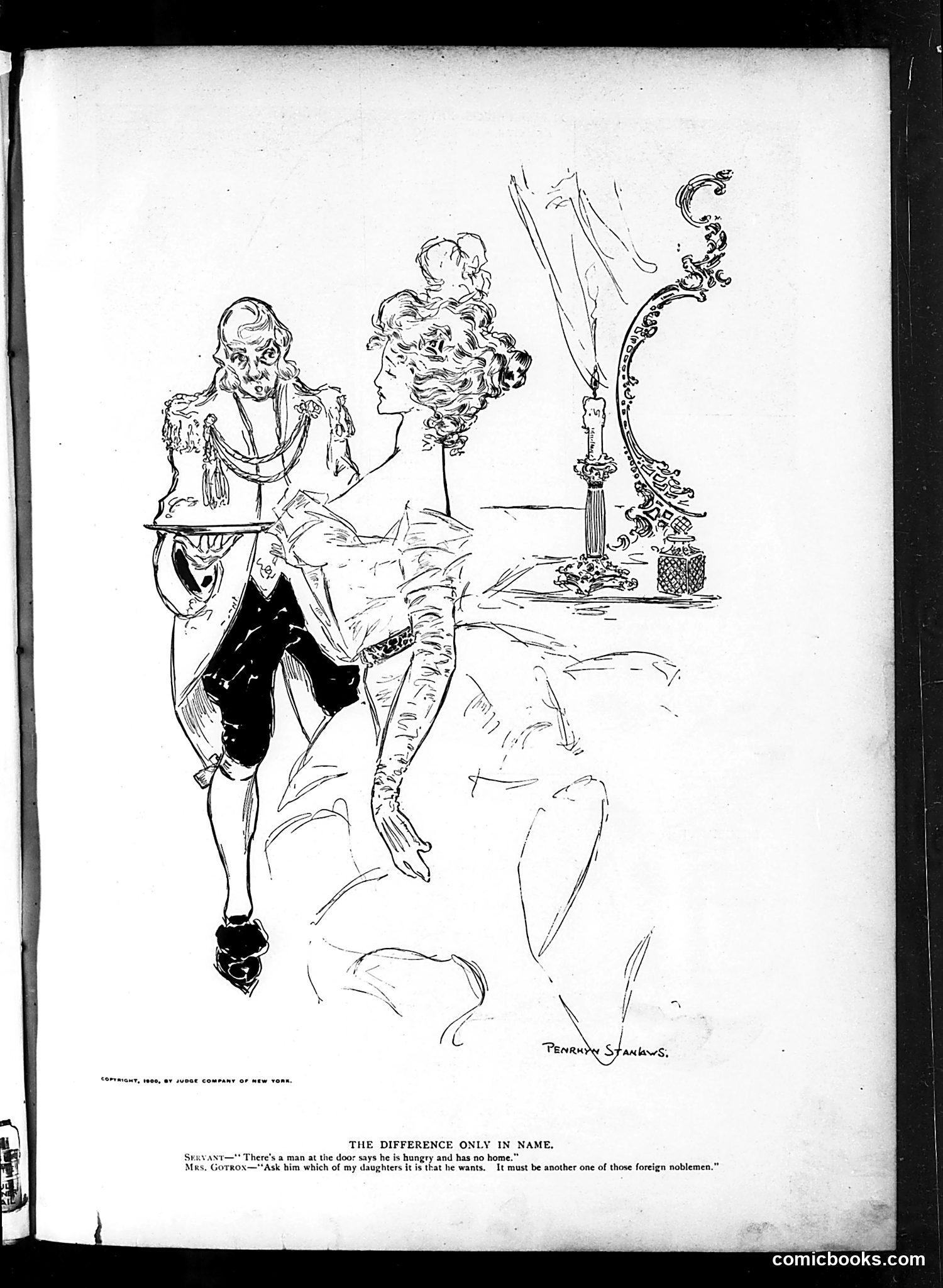
This satirical cartoon from *Judge* magazine depicts a social commentary on class and foreign nobility. A well-dressed servant announces a hungry, homeless man at the door. Mrs. Gordon dismisses him, suggesting he's "another one of those foreign noblemen." The satire mocks wealthy American society's obsession with European aristocracy and titles. The joke is that a destitute vagabond and a foreign nobleman are functionally identical—both potentially parasitic on the household—yet one would be welcomed based purely on his title while the other is turned away. The cartoon critiques the American upper class for valuing European "pedigree" over substance, suggesting that nobility without resources is simply poverty with a fancy name. The elaborate decorative objects visible in the background emphasize the pretentious setting.
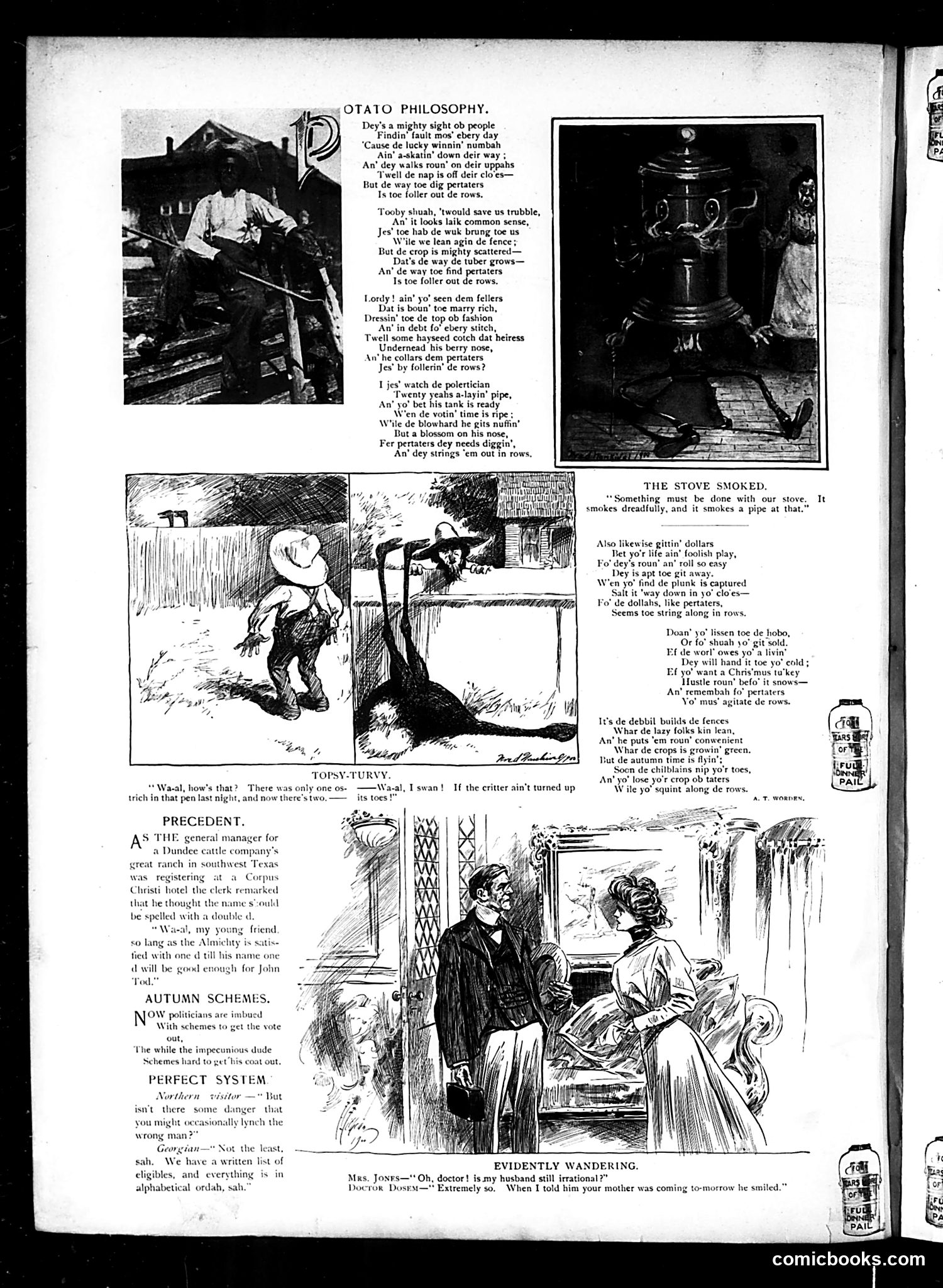
This page contains several satirical pieces targeting different social groups: **"Otato Philosophy"** uses stereotyped African American dialect to present homespun wisdom about hard work and persistence. The extended metaphor compares potato farming (following rows to find scattered tubers) to life pursuits—finding wealth, love, and opportunity requires systematic effort, not shortcuts or luck. **"The Stove Smoked"** is a brief domestic joke about a malfunctioning stove. **"Precedent"** mocks a Texas ranch manager's stubborn refusal to correct his name's spelling, invoking religious authority to defend tradition. **"Autumn Schemes"** contrasts wealthy politicians scheming to manipulate elections with poor men scheming to retrieve their coats from pawn. **"Perfect System"** satirizes the American South's racial violence, darkly suggesting lynching operates with bureaucratic precision via a "written list" of targets—a chilling comment on systematic racial murder. **"Evidently Wandering"** is a domestic humor piece about a husband's irrational behavior. The page reflects Judge's satirical approach across class, regional, and racial topics.
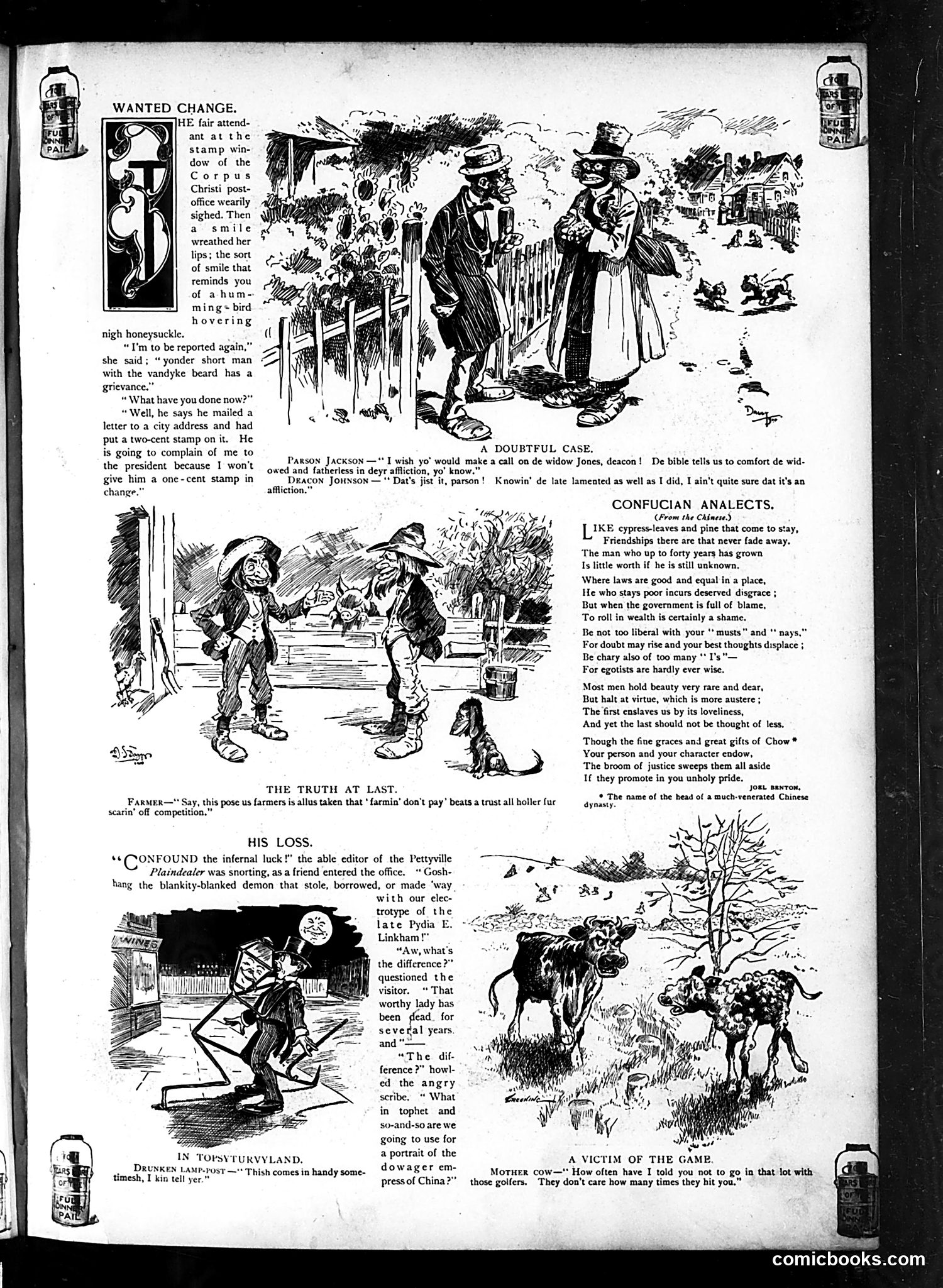
This page contains several satirical pieces typical of Judge's social humor: **"Wanted Change"** mocks petty bureaucratic complaints—a man demands a one-cent refund on postage, threatening to report the postal clerk to the president. The satire targets both trivial grievances and government inefficiency. **"A Doubtful Case"** uses dialect humor (African American vernacular of the era) to joke about a widow's grief. The deacon questions whether her late husband's death is truly an "affliction," implying the deceased was difficult. **"The Truth at Last"** has a farmer claiming farming "doesn't pay" to scare off competition—satirizing rural duplicity. **"His Loss"** jokes about a newspaper editor's lost printing plate of "Lydia E. Pinkham," a famous patent medicine advertiser. The humor lies in the editor's anger despite the subject being long dead. **"In Topsyturvy Land"** and other pieces use visual absurdism and working-class dialect for comedic effect. The page reflects Judge's typical mix of class-based humor, bureaucratic satire, and crude ethnic stereotyping common to early 20th-century American humor.
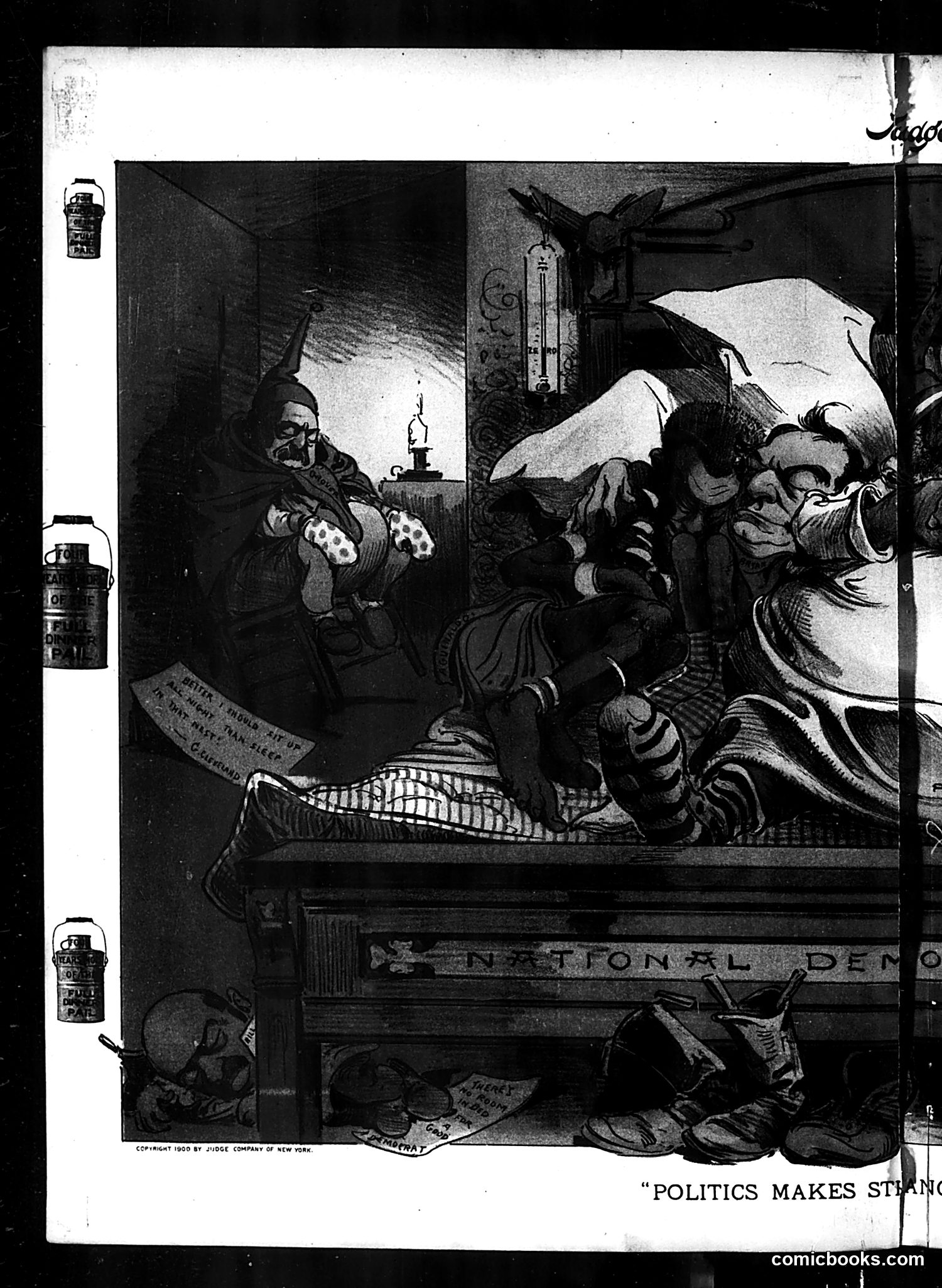
This satirical cartoon depicts a chaotic bedroom scene with the caption "Politics Makes Strange [Bedfellows]" (partially visible). The image shows multiple figures in bed together, suggesting uncomfortable political alliances or partnerships forced by circumstance rather than genuine compatibility. On the left sits a figure in dark clothing holding what appears to be a palette or artist's tool. The composition suggests these are political figures or parties being mocked for unlikely collaboration—a common Judge magazine theme from around 1900. The bedroom setting serves as metaphor: just as strange bedfellows are awkward in intimate spaces, so too are mismatched political allies. However, without clearer identification of the specific figures or date context, the precise political situation referenced remains unclear. The copyright is by Judge Company of New York, 1900.
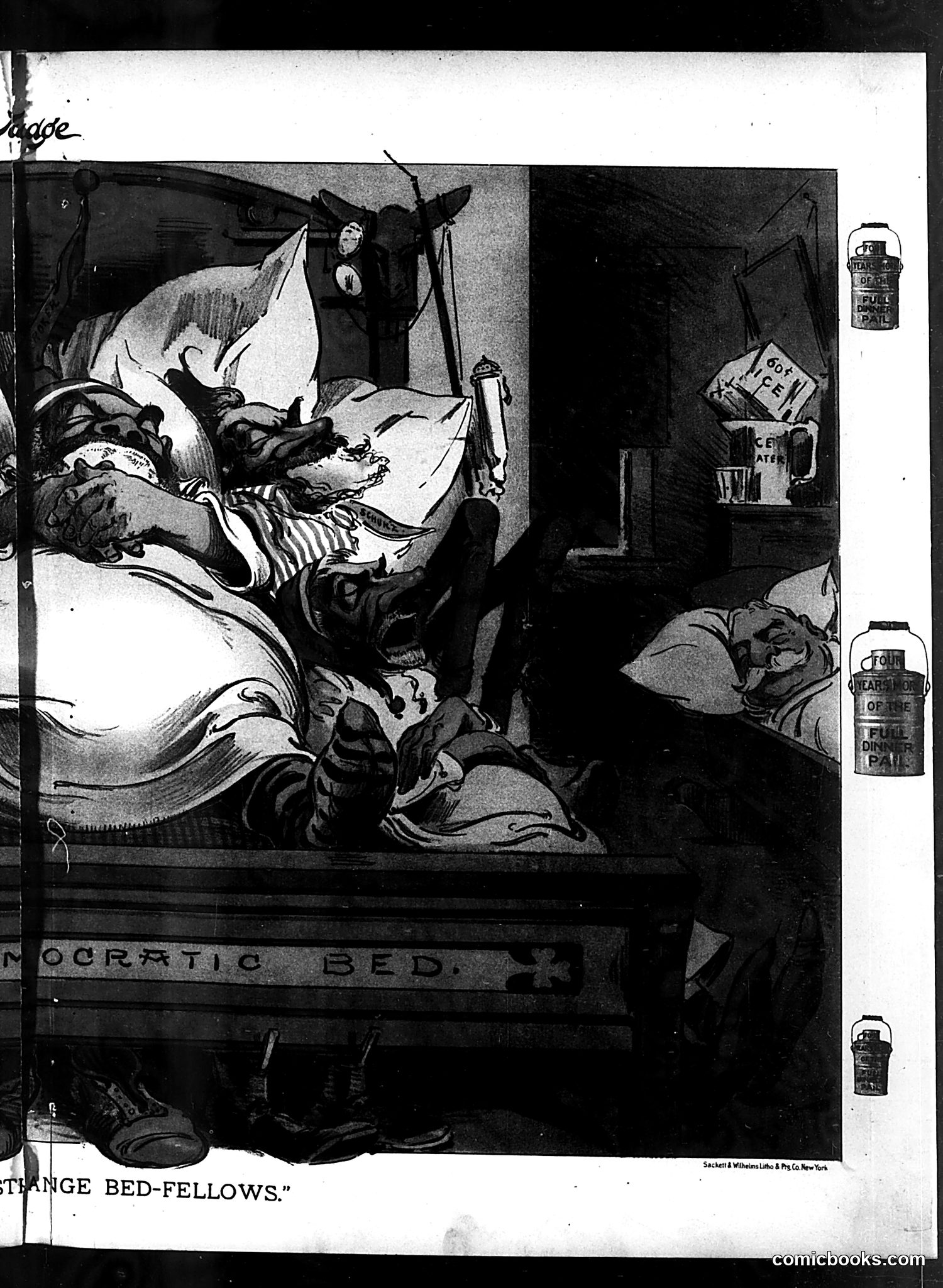
This satirical cartoon depicts multiple figures sharing a bed, labeled "OCRATIC BED" (likely "Democratic Bed"). The image criticizes political alliances or coalitions within the Democratic party that the cartoonist viewed as incompatible or absurd. The figures appear to represent different political factions or interest groups forced together uncomfortably—a common Judge magazine trope for mocking internal party divisions. The central standing figure in dark clothing observing the chaos may represent a political leader or observer commenting on the discord. The title "Strange Bed-Fellows" invokes the proverb that "politics makes strange bedfellows," suggesting the cartoonist found certain Democratic political alliances contradictory or hypocritical. Without a specific date visible, the exact political conflict referenced remains unclear, but the satire targets Democratic party unity issues.
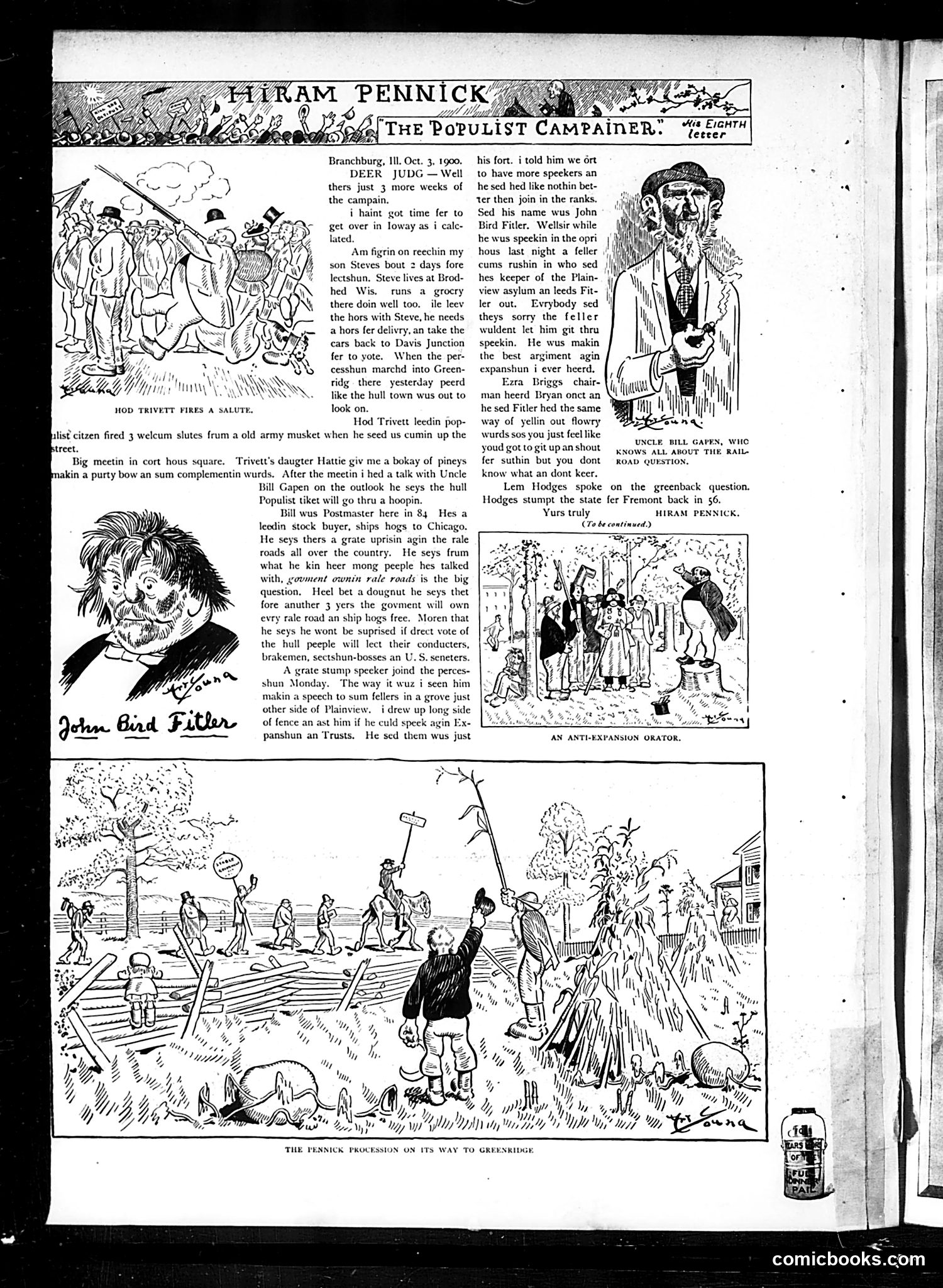
This satirical letter mocks the Populist Party's 1900 campaign, written in exaggerated rural dialect by "Hiram Pennick." The humor targets Populist rhetoric and supporters as unsophisticated farmers with unrealistic demands. Key satirical points: A character named John Bird Fitler campaigns against "expansion" and trusts with passionate, flowery speeches—but turns out to be an escaped asylum inmate, suggesting Populist anti-expansion views are mentally unbalanced. An older supporter, Lem Hodges, is positioned as a relic from the 1856 Frémont campaign, implying Populism attracts outdated political thinking. The accompanying illustrations show a rural parade and townspeople listening to the "anti-expansion orator," depicting Populists as rural, simple, and easily swayed. Judge's elitist stance dismisses the Populist movement's genuine concerns about railroad monopolies and government ownership as the ravings of lunatics and rustics.
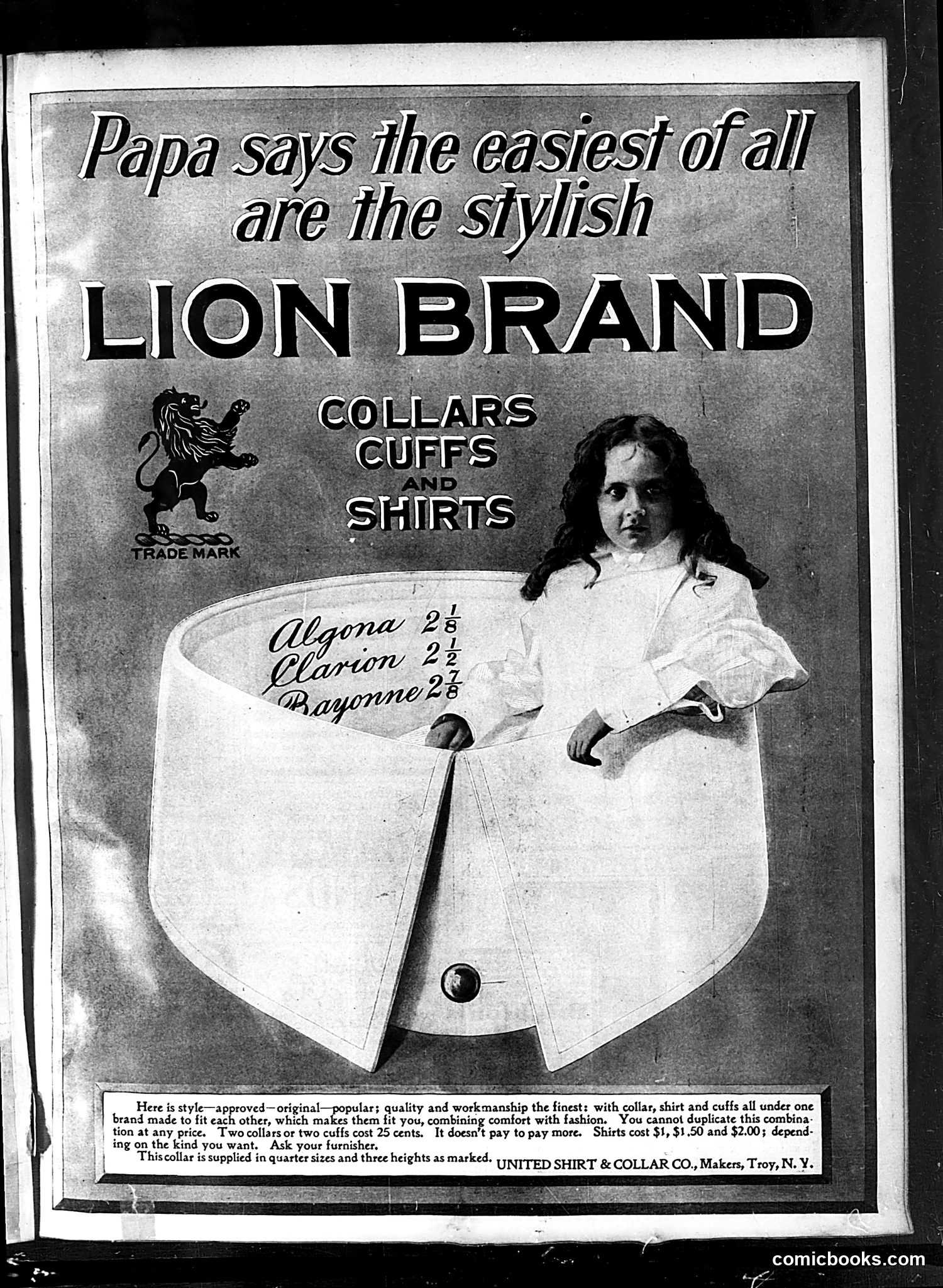
This is a full-page advertisement, not editorial satire. It promotes Lion Brand collars, cuffs, and shirts by the United Shirt & Collar Company of Troy, New York. The ad features a young child modeling a large detachable collar, illustrating the product's key selling point: interchangeable components (collars and cuffs) that work together as a coordinated system. The headline humorously attributes the endorsement to "Papa," suggesting parental approval of the practical design. The lion trademark and product names (Alona, Clarinon, Bayonne) are displayed inside the collar. The ad emphasizes affordability, quality, and convenience—that customers needn't buy expensive complete shirts when collars and cuffs could be replaced separately at 25 cents. This was practical nineteenth-century consumer messaging, as detachable collars extended garment life and reduced laundry burden.
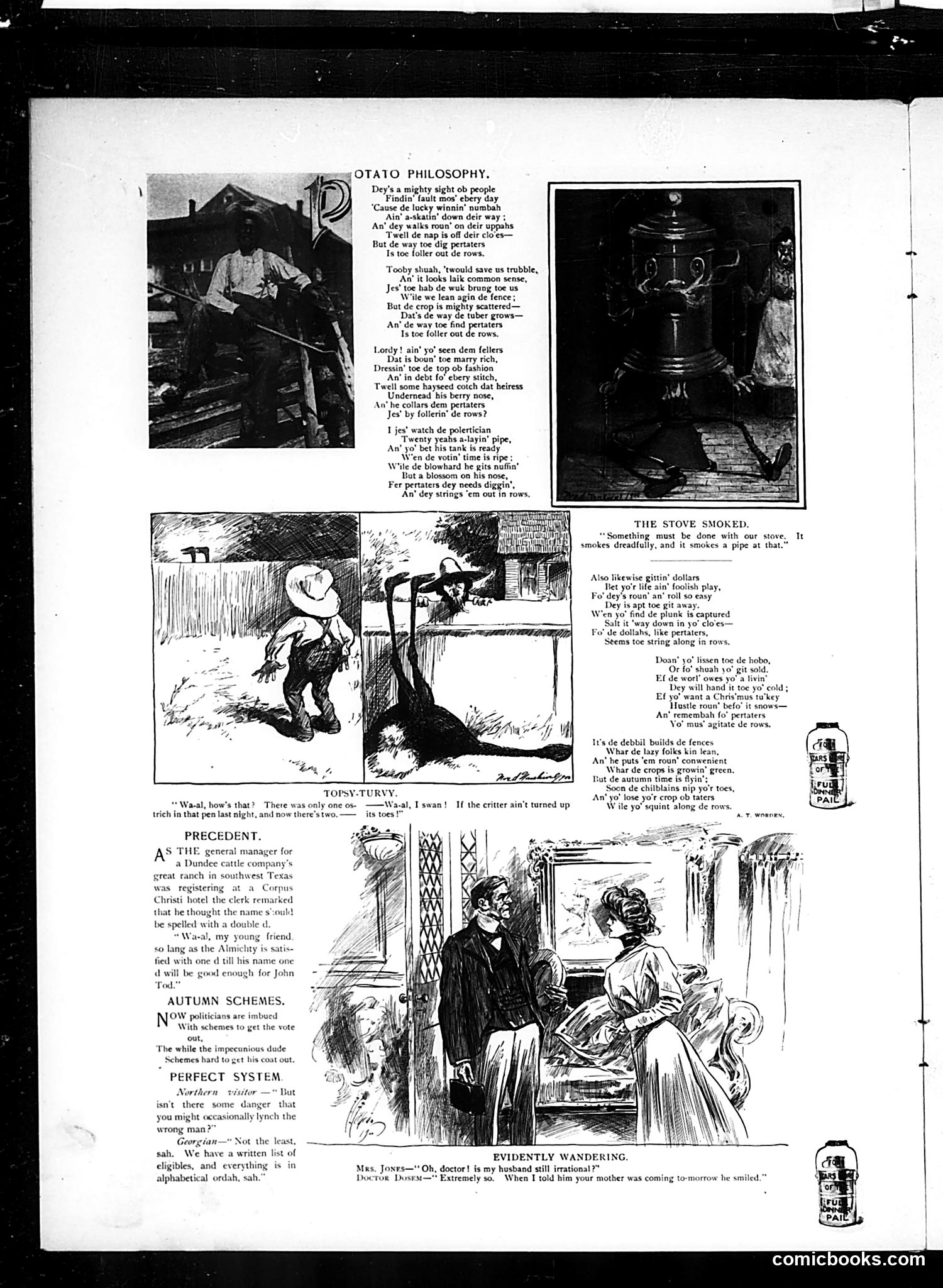
This page contains multiple satirical pieces: **"Potato Philosophy"** presents racist dialect verse using a Black character's voice to deliver homespun wisdom about hard work and persistence—a common trope in period humor. The "potato" metaphor advocates steady effort over shortcuts. **"The Stove Smoked"** is a mild domestic joke about a stove that both smokes and requires smoking a pipe to fix it. **"Topsy-Turvy"** is a brief farm anecdote with no clear political angle. **"Autumn Schemes"** mocks politicians' vote-getting tactics and the contrast with poor people trying to afford clothing—standard class-based satire. **"Perfect System"** makes a dark joke about Southern lynching, presenting it as an organized, orderly process with a written list of "eligible" victims. This satirizes systemic racial violence as bureaucratic efficiency—grotesque social commentary typical of the era. **"Evidently Wandering"** is domestic humor where a doctor notes the husband smiled when told his mother-in-law was visiting—implying he's become deranged. The page reflects early-20th-century American satirical magazine conventions: racist caricature, class mockery, and casual treatment of violence.
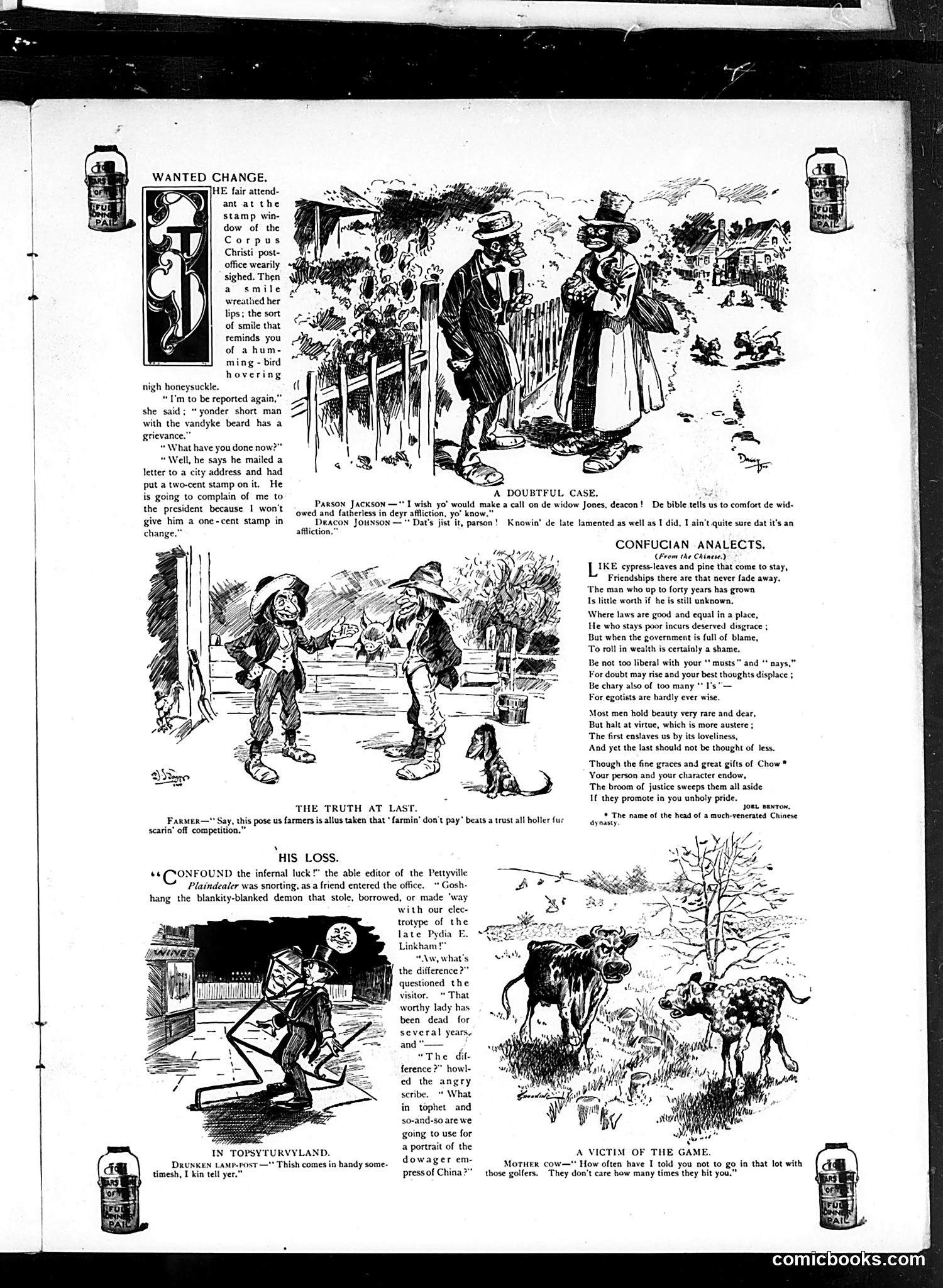
This satirical page contains several unrelated humor pieces typical of late 19th/early 20th-century American magazines: **"Wanted Change"** mocks postal service inefficiency—a man complains to the president about a clerk refusing a one-cent stamp for change, threatening to report her. **"A Doubtful Case"** depicts two men debating widow Jones's bereavement; Deacon Johnson questions whether her late husband's death is truly an "affliction," implying the marriage was unhappy. **"Confucian Analects"** presents pseudo-philosophical wisdom in fake Chinese style, lampooning both Oriental mysticism and pretentious moralizing popular in that era. **"The Truth at Last"** has a farmer claiming farming actually *is* profitable—contradicting common complaint—suggesting agricultural interests suppress this truth to prevent competition. **"His Loss"** jokes about a newspaper editor's frustration losing a portrait of a deceased advertiser (Lydia Pinkham, likely a patent medicine vendor). **"In Topsyturvyland"** presents absurdist humor about a drunken lamppost. **"A Victim of the Game"** shows a cow complaining about golfers hitting her—satirizing golf's growing popularity and carelessness.
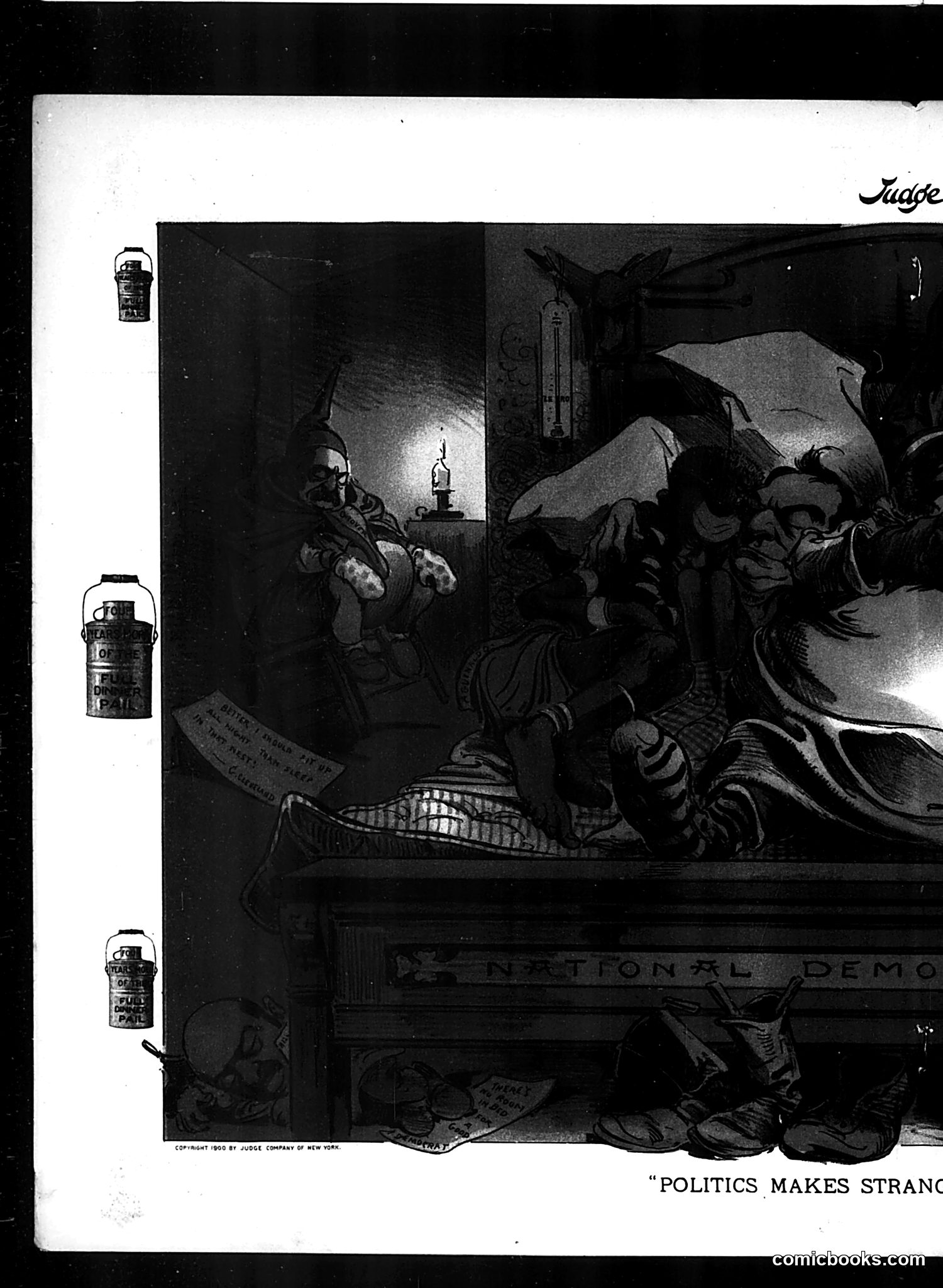
This appears to be a political cartoon from Judge magazine titled "Politics Makes Strange [Bedfellows]" (text cut off at bottom). The illustration depicts a chaotic nighttime scene with multiple figures—likely politicians or political figures—crowded together in what seems to be a bedroom or private chamber, with one figure holding a lamp or light source. The satire critiques how political alliances form based on convenience rather than principle. The cramped, uncomfortable composition suggests the awkwardness and absurdity of such partnerships. However, without seeing the complete caption or knowing the specific historical moment, I cannot identify the particular political figures or events being referenced. The style and reproduction method suggest this is from the early 20th century.
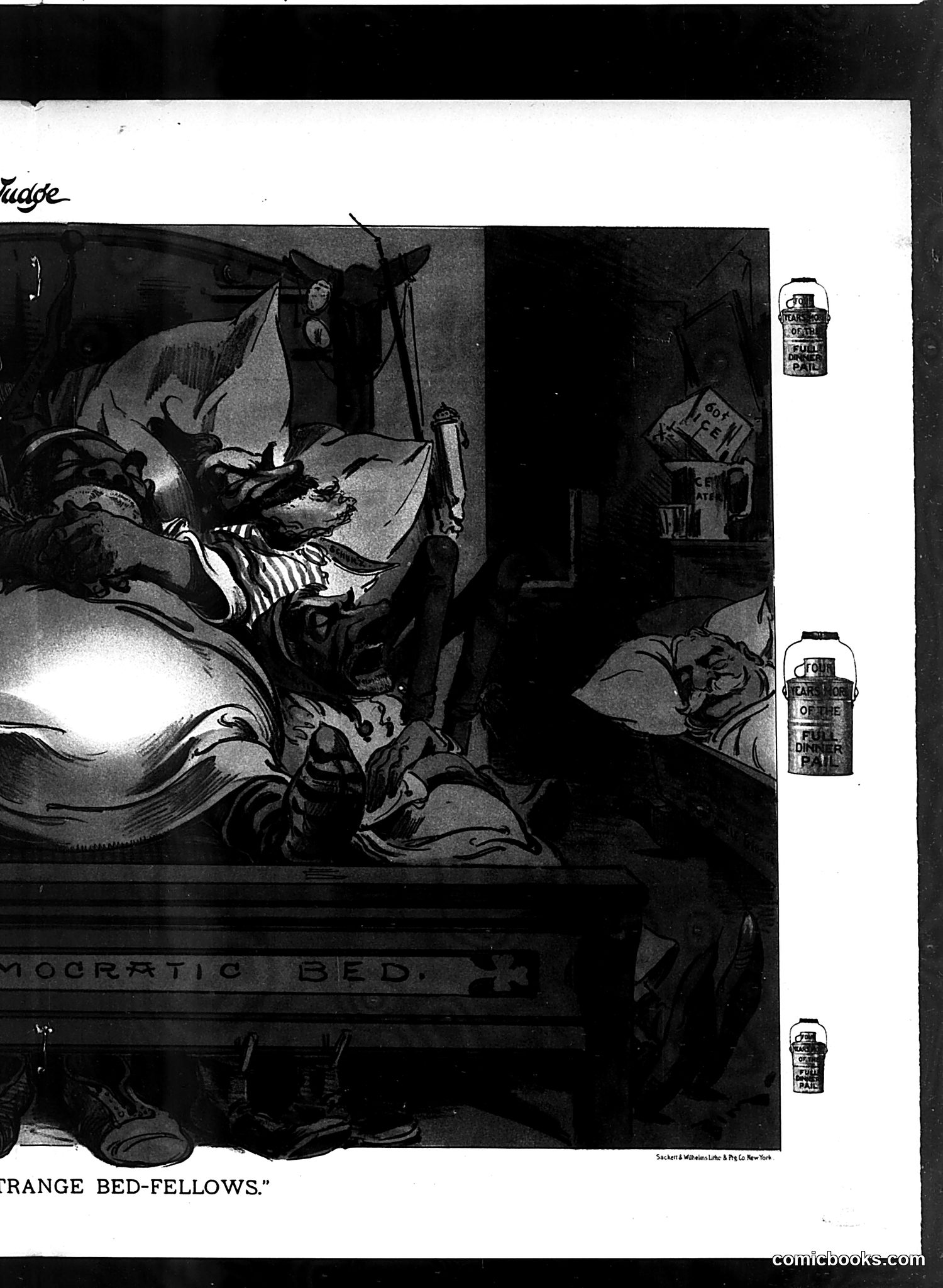
This Judge cartoon satirizes unlikely political or social alliances. The image shows various figures literally sharing a bed labeled "DEMOCRATIC BED," suggesting the Democratic party was an awkward coalition of incompatible groups forced together. The specific identities of the figures are unclear from this reproduction quality, but the satirical point is evident: the cartoon mocks the internal contradictions within the Democratic party by depicting its diverse constituency as uncomfortable "strange bedfellows"—people who would never naturally associate but found themselves in the same political bed. The three small product advertisements on the right margin appear unrelated to the cartoon's message and represent typical Judge magazine advertising filler.
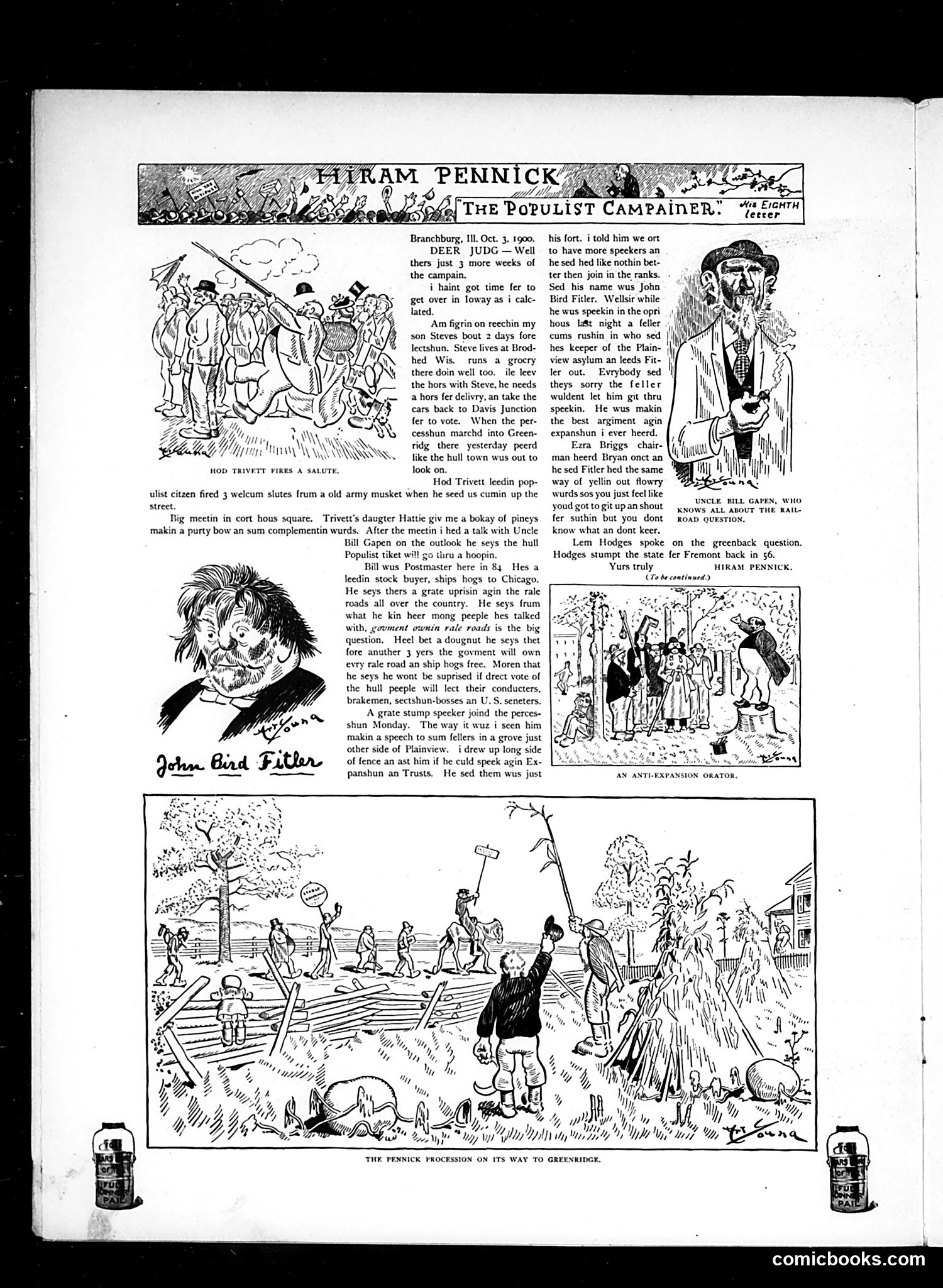
This page satirizes the rural Populist movement through letters from "Hiram Pennick," a fictional Illinois farmer. The satire targets Populist political activism and rhetoric during the 1900 election. **Key figures/references:** - John Bird Fitler: appears to be a real Populist speaker whose passionate oratory is mocked—asylum keepers must remove him mid-speech, yet his flowery anti-expansion/anti-trust arguments are portrayed as emotionally manipulative rather than substantive - Bryan: mentioned as a comparison point (likely William Jennings Bryan, three-time Democratic/Populist presidential candidate) - Lem Hodges: an aged Populist veteran campaigning since 1856 **The satire's point:** Rural Populists are depicted as unsophisticated but earnest—good-hearted farmers mobilized by emotional speeches about railroad regulation and government ownership. The humor comes from phonetic spelling and malapropisms suggesting rural ignorance, while acknowledging genuine popular grievances about railroad monopolies and corporate power. Judge presents Populism as a genuine grassroots movement, but one driven by passion over intellect.
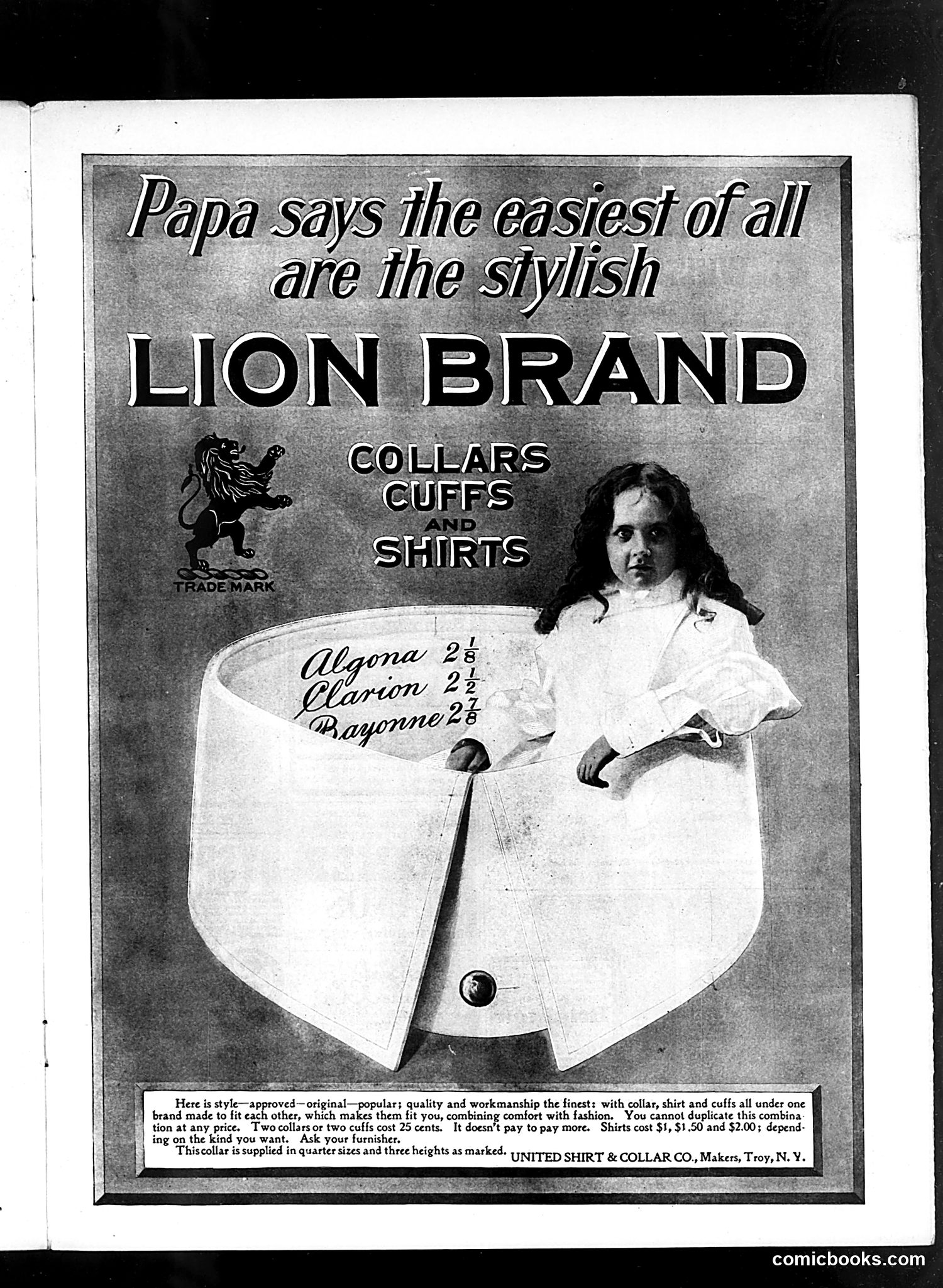
This is primarily a **product advertisement** rather than political satire. It promotes Lion Brand collars, cuffs, and shirts made by United Shirt & Collar Co. of Troy, New York. The "Papa says" headline is a marketing hook suggesting that fathers endorse the product's stylish appearance. The illustration shows a detachable collar—a common men's fashion item of the early 20th century when collars were separate pieces that could be swapped between shirts. The lion trademark and price points (collars at 25 cents, shirts from $1-$2) indicate this targeted middle-class consumers. The ad emphasizes practical value: interchangeable parts that fit together, durability, and affordability. The satirical framing in *Judge* magazine likely played on the advertisement's earnest sales pitch for what modern readers would recognize as an outdated fashion practice.
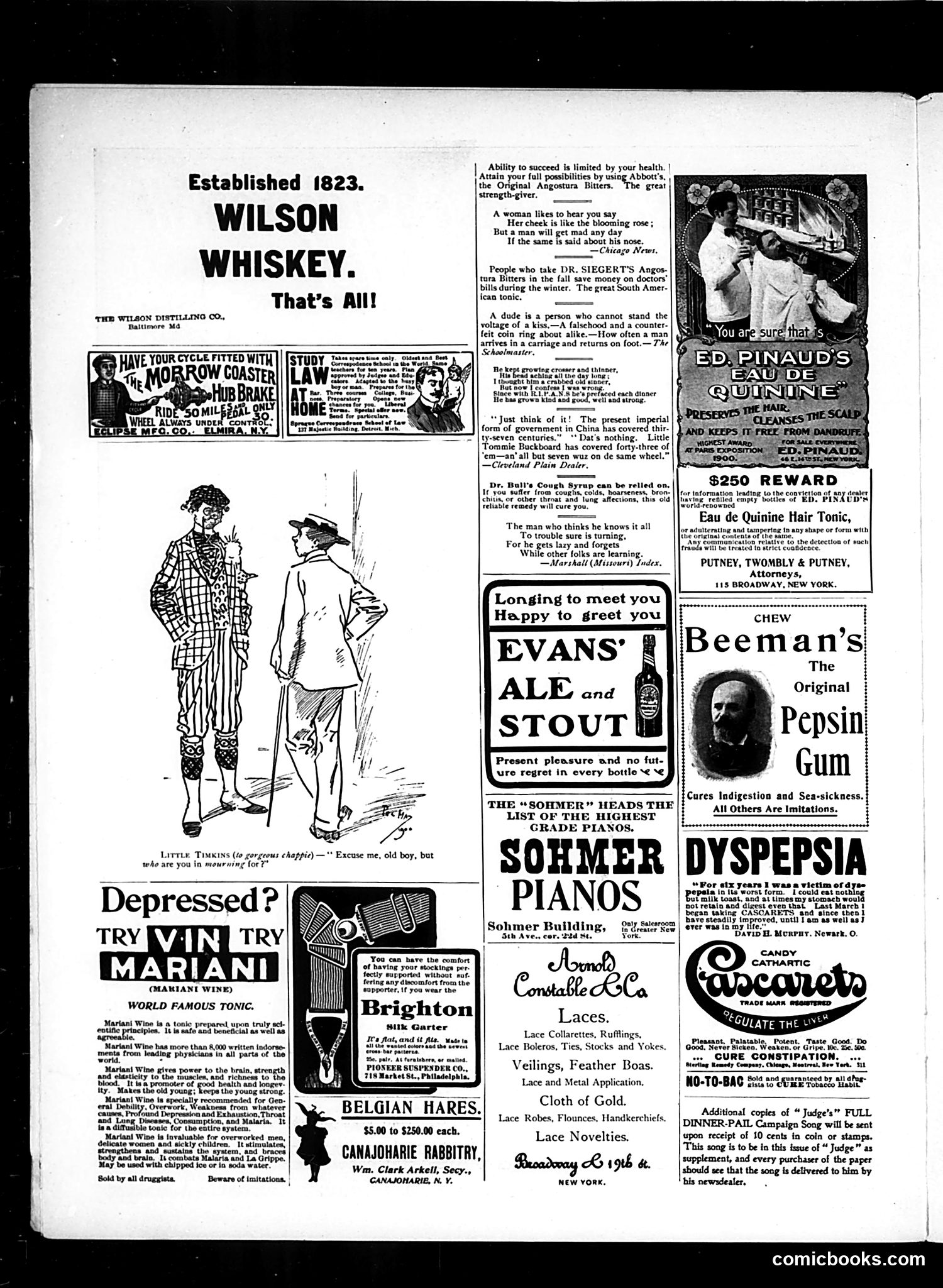
This page is **primarily advertising** with one cartoon. The main satirical cartoon features "Little Timkins (in gorgeous chappie)" — a young dandy in fashionable checked clothing — being asked by another man whom he's mourning. The joke, now obscure, appears to reference either his romantic disappointments or his financial losses, as the caption reads: "Excuse me, old boy, but who are you in mourning for?" The page is otherwise dominated by patent medicine and luxury goods advertisements typical of early 1900s magazines: Wilson Whiskey, Mariani Wine (a tonic), Dr. Ball's Cough Syrup, Sohmer Pianos, and Belgian Hares (bred rabbits). These ads reflect contemporary attitudes toward unregulated medicinal products and consumer goods. The scattered aphorisms and jokes (about vanity, courtship, and Chinese history) are filler content common to Judge's satirical style, though they lack specific political targeting.
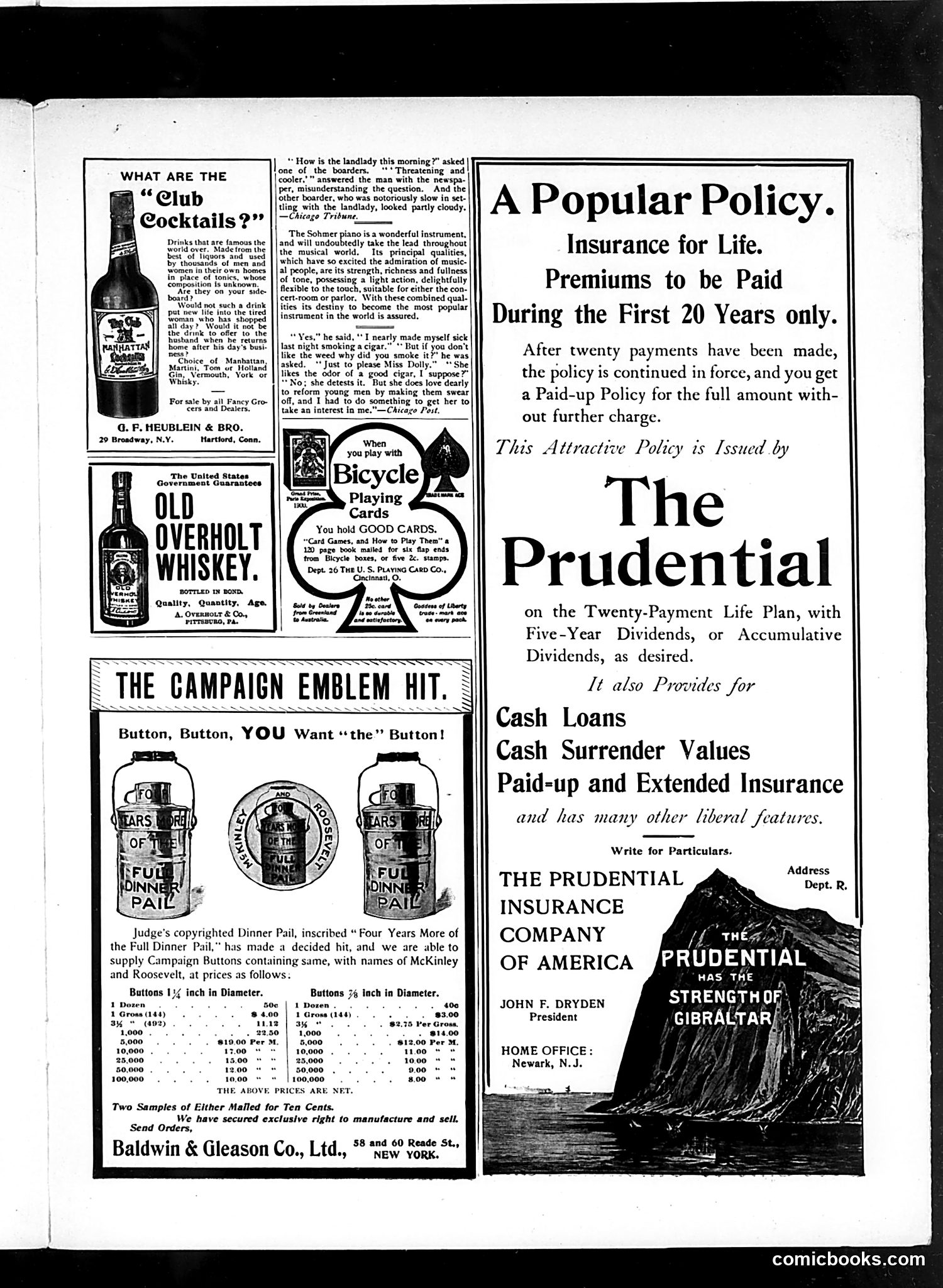
This is primarily an **advertising page** with minimal editorial content. The few jokes present are conventional: - A brief **weather pun** about a landlady's disposition ("threatening and cooler") - A **romantic joke** about a man smoking cigars to impress a woman named Dolly The page is dominated by **product advertisements** typical of early 1900s Judge: - Alcohol ads (Heublein cocktails, Old Overholt Whiskey) - A Sohmer piano advertisement - Bicycle playing cards - Campaign buttons featuring **"Four Years More of the Full Dinner Pail"**—referencing McKinley and Roosevelt's 1900 re-election campaign slogan - The Prudential Insurance Company's life insurance policy **The only political reference** is the campaign button ad, which invokes the popular McKinley administration slogan promising economic prosperity (the "full dinner pail"). This indicates the magazine was published during the **1900 presidential election cycle**. The page demonstrates Judge's reliance on advertising revenue rather than satirical content.
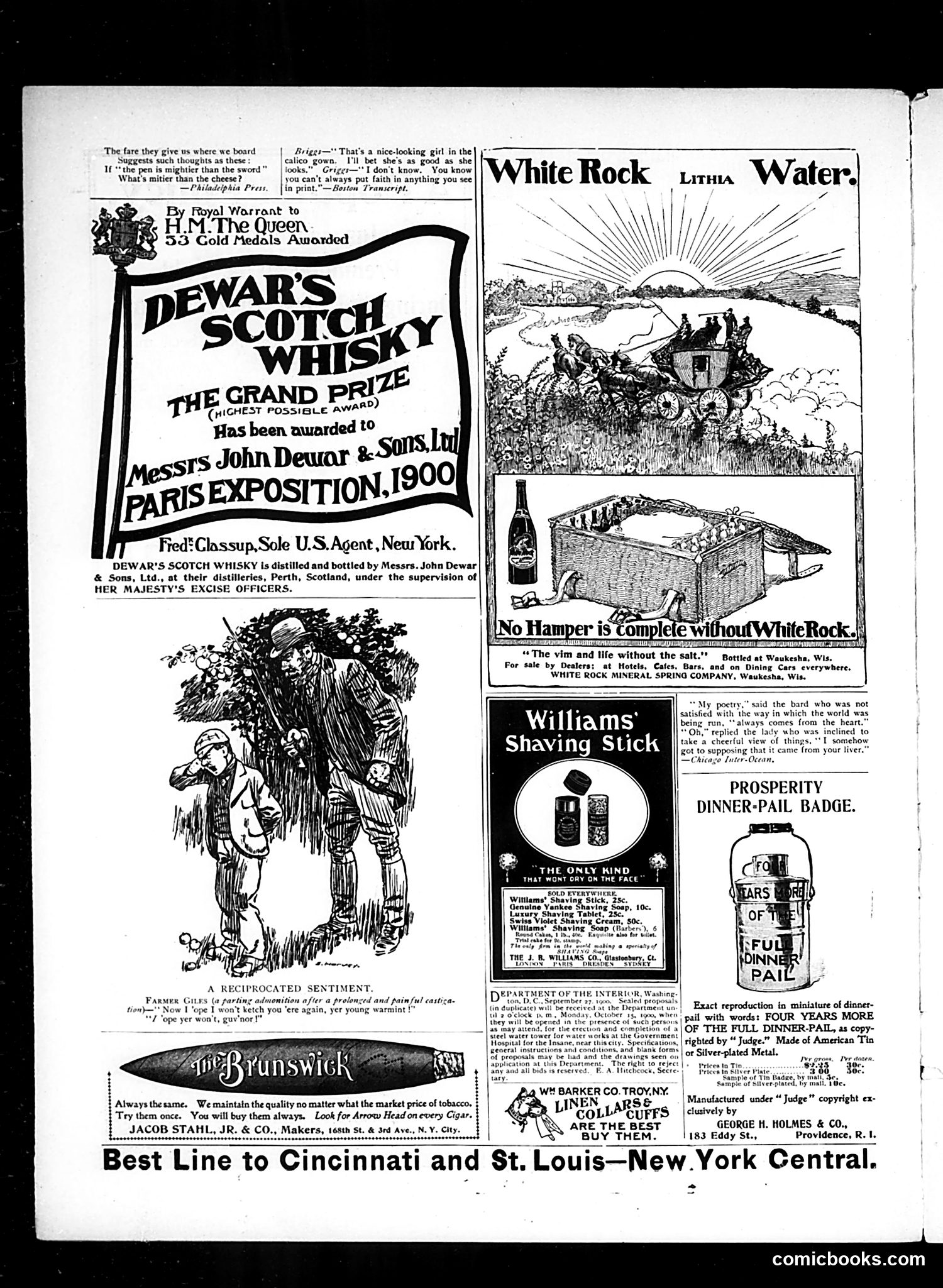
This page is primarily **advertising** rather than editorial cartooning, featuring multiple product advertisements from around 1900. The main cartoon (lower left) shows a farmer in tattered clothes—a visual reference to rural poverty. The caption "A RECIPROCATED SENTIMENT" includes a joke about bad food served to farm workers, with the farmer sarcastically praising cheese as "mighty" (a play on the opening poem about cheese being "mitier than the sword"). The small text jokes above reference common turn-of-century themes: skepticism about print advertising's honesty (a Bridges/Griges dialogue) and a poet's ironic comment that his work comes from his "liver" rather than heart. The advertisements promote whisky, shaving products, cigars, and a "Prosperity Dinner-Pail Badge"—the latter likely referencing McKinley-era political merchandise tied to economic prosperity rhetoric. The page reflects early 1900s consumer culture and light social commentary about rural conditions and advertising credibility.
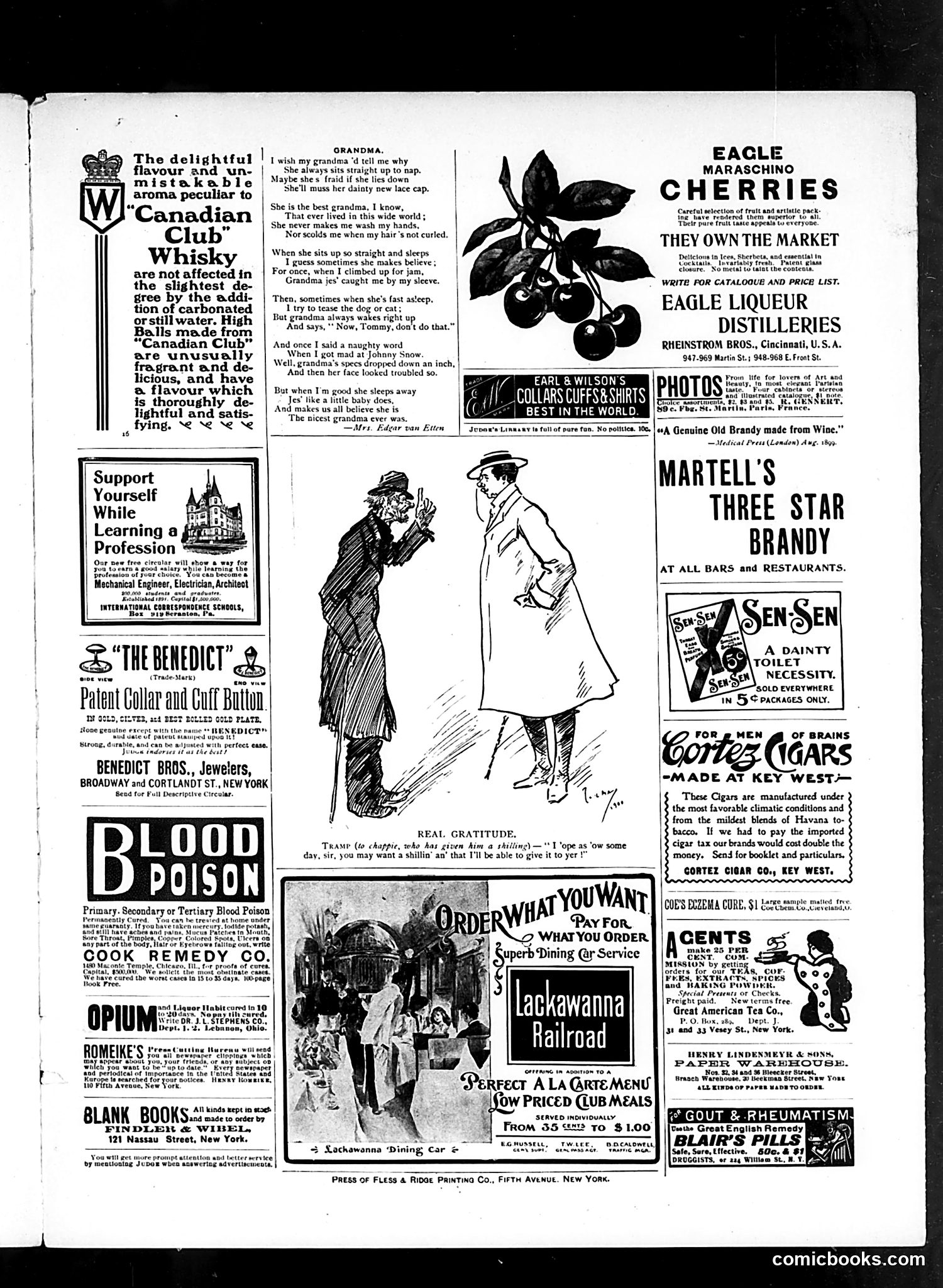
This page is primarily **advertising**, typical of early 20th-century magazines. The notable content includes: **Main Cartoon**: "Real Gratitude" depicts a street beggar who received a shilling from a well-dressed man, promising to repay the favor someday. The joke reflects contemporary class dynamics—a poor person's earnest but unlikely promise of reciprocity to a wealthy patron, illustrating the gap between social classes and the beggar's grateful humility. **Featured Poem**: "Grandma" sentimentalizes an idealized grandmother who pretends to sleep while secretly watching over children, maintaining discipline through loving vigilance. This reflects period family values emphasizing grandmotherly warmth and moral oversight. **Advertisements**: The page heavily features alcohol (whisky, brandy, liqueurs), tobacco, patent medicines (blood poison cure, opium remedies), and luxury goods—typical of Judge's affluent readership during the pre-Prohibition era. The overall tone reflects Gilded Age sentimentality combined with casual promotion of products now recognized as harmful.
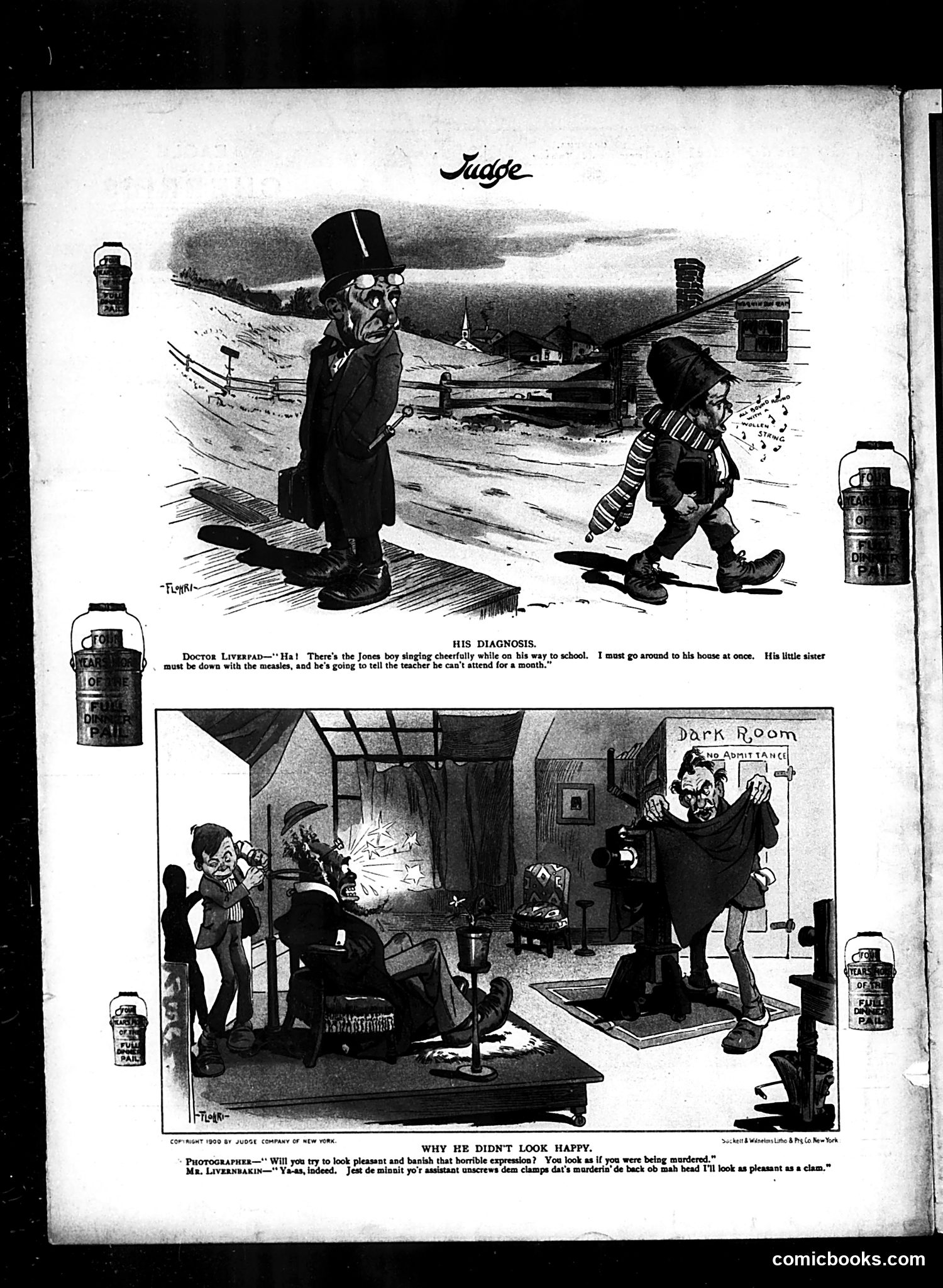
This page contains two satirical cartoons lampooning medical professionals and their dubious diagnostic methods. **Top cartoon:** A doctor (Dr. Liverrap) diagnoses illness in the Jones household based on observing a boy singing cheerfully on his way to school. The satire mocks doctors who make presumptive diagnoses without proper examination—assuming a child's good mood indicates a sick sibling at home who will require absence from school. **Bottom cartoon:** A photographer attempts to take a portrait of "Ma. Liverrap" (the doctor's wife), but she appears visibly uncomfortable. The joke reveals she's being held in painful mechanical clamps behind her head—standard photography equipment of the era that required subjects to remain perfectly still. She sarcastically agrees to look "pleasant as a clam" once the device is removed. The satire criticizes both medical pretension and the discomfort inflicted by period photography technology, using the doctor's household to ridicule both professions.