
A complete issue · 16 pages · 1900
Judge — April 28, 1900
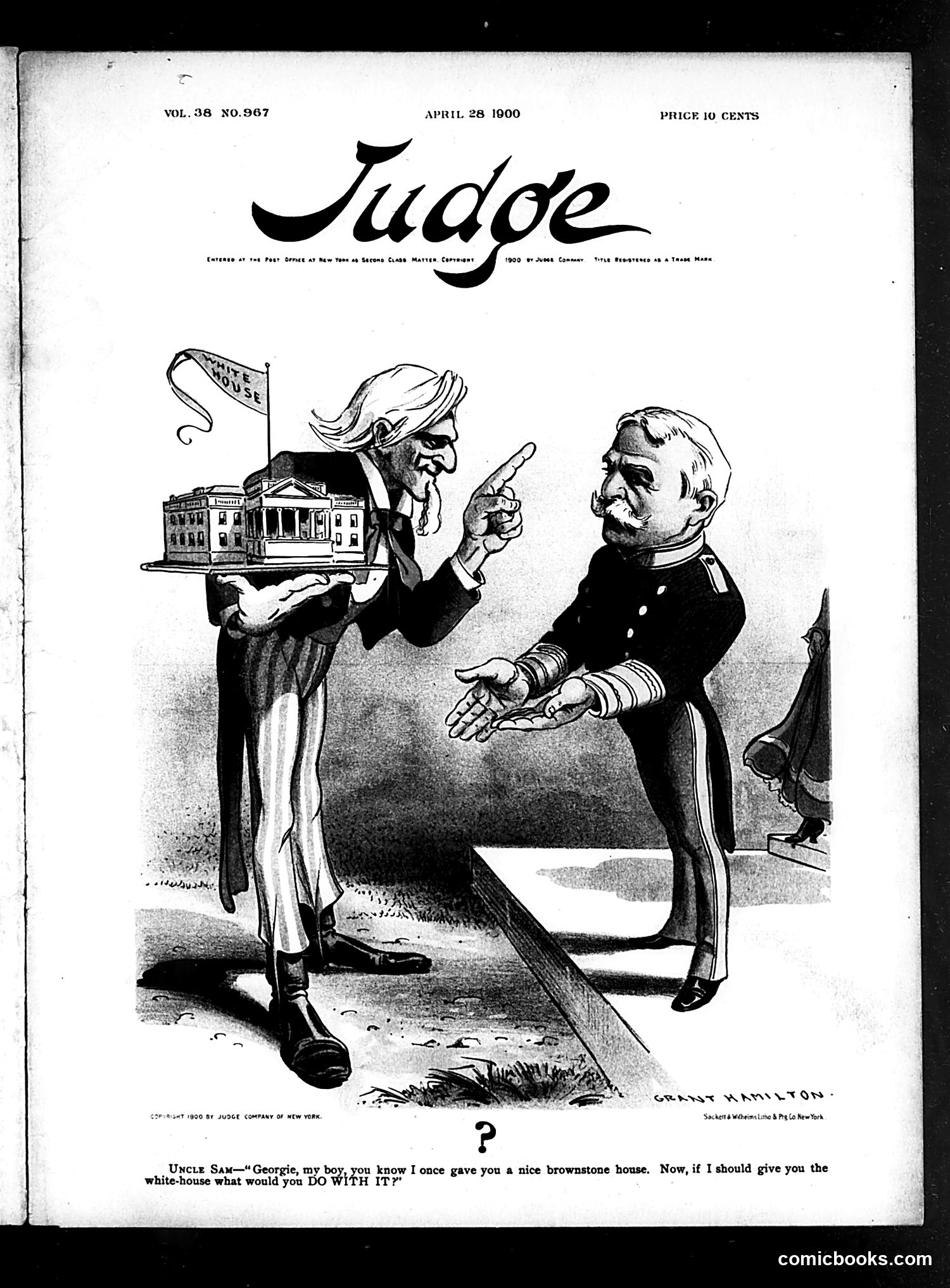
This cartoon depicts "Uncle Sam" (representing the United States government) offering a miniature White House to a figure labeled "George" (likely referring to a politician or foreign leader, possibly Philippine-related given 1900 date context). Uncle Sam's caption poses a rhetorical question: if he gave the White House away, what would the recipient *do* with it—implying the recipient is unfit to govern or undeserving of such authority. The cartoon satirizes American foreign policy decisions around 1900, possibly commenting on U.S. territorial expansion or the Philippines situation. The artist (credited as Grant Hamilton) uses the absurd proposition to mock either imperial ambitions or questions about America's governing decisions during this imperialist period.
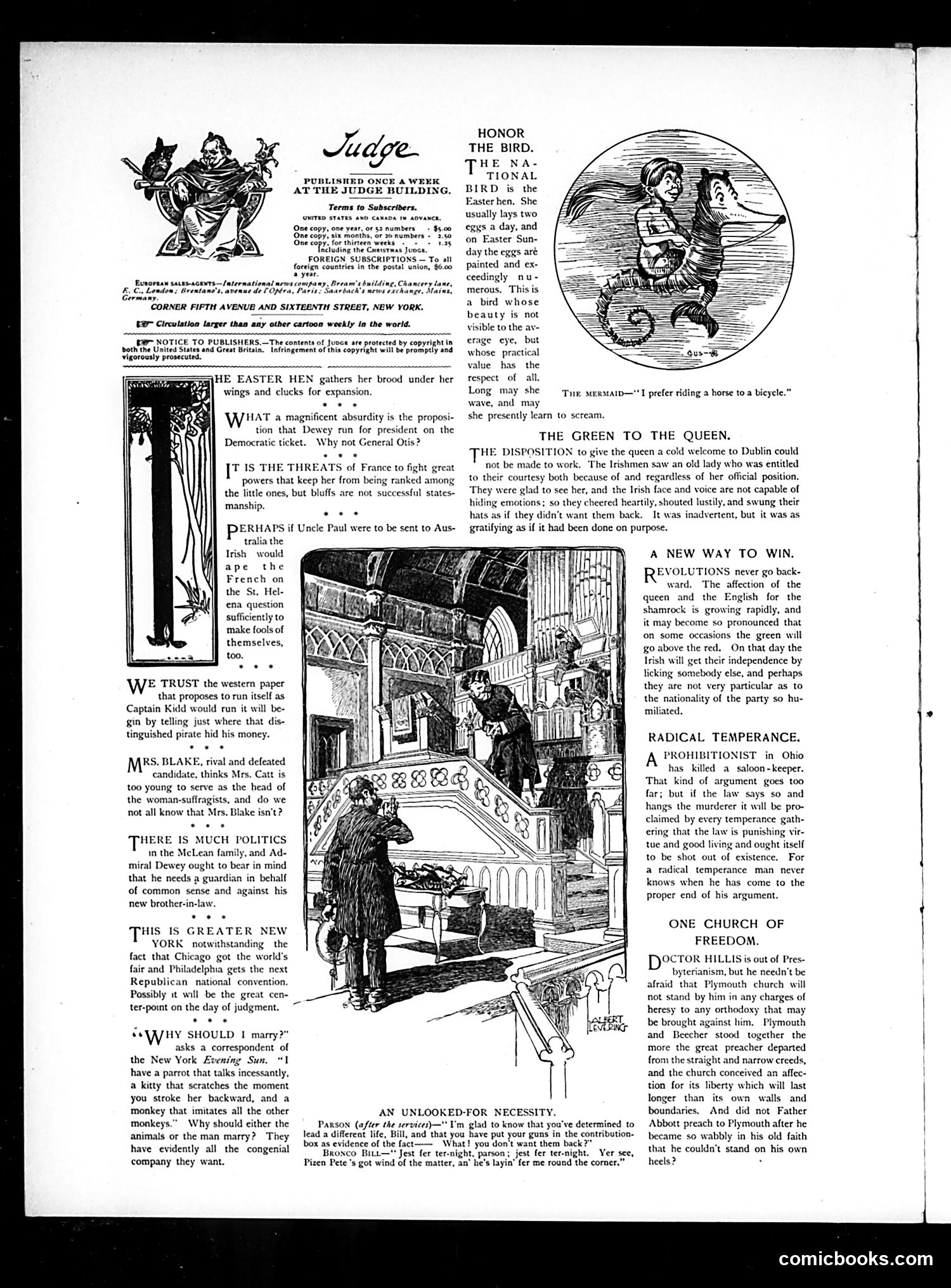
This page contains several short political satires and commentary pieces typical of Judge magazine's style. **"Honor the Bird"** discusses the Easter hen's practical value—laying eggs—suggesting respect should follow utility rather than appearance. **"The Green to the Queen"** satirizes Anglo-Irish relations, mocking the Irish disposition to give Queen Victoria a cold welcome in Dublin. The piece suggests this reflects growing Irish-English tensions. **"A New Way to Win"** references revolutionary sentiment and shamrock symbolism, implying Irish independence movements may eventually surpass English political interest. Other pieces mock radical temperance advocates, Presbyterian church politics, and contemporary social debates. The cartoons use caricature and absurdist scenarios to ridicule political figures and movements of the era, though specific identifications require clearer visual detail.
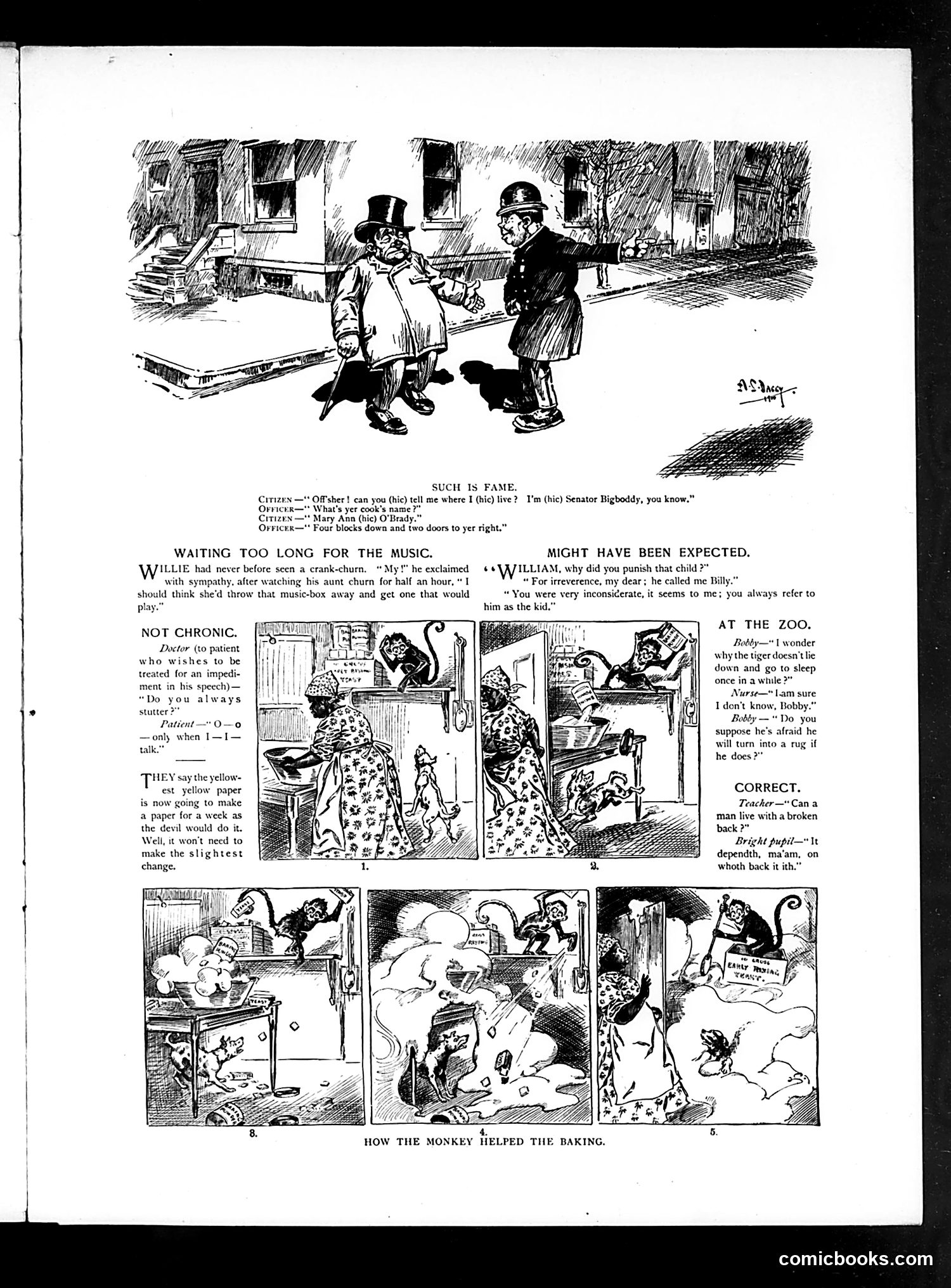
This page contains several unrelated humorous sketches typical of Judge magazine's format. The top cartoon "Such Is Fame" satirizes celebrity obsession through a street conversation where citizens recognize a senator but confuse basic facts about him. "Waiting Too Long for the Music" mocks Willie's impatience with a hand-cranked music box. "Not Chronic" presents a doctor-patient joke about yellow paper (medical prescription pads). "At the Zoo" is a simple animal joke about tiger behavior. "Might Have Been Expected" and "Correct" are brief domestic humor pieces. The multi-panel "How the Monkey Helped the Baking" appears to be a slapstick narrative where a monkey creates chaos in a kitchen. These are disconnected gag cartoons reflecting early-20th-century American humor sensibilities rather than political commentary.
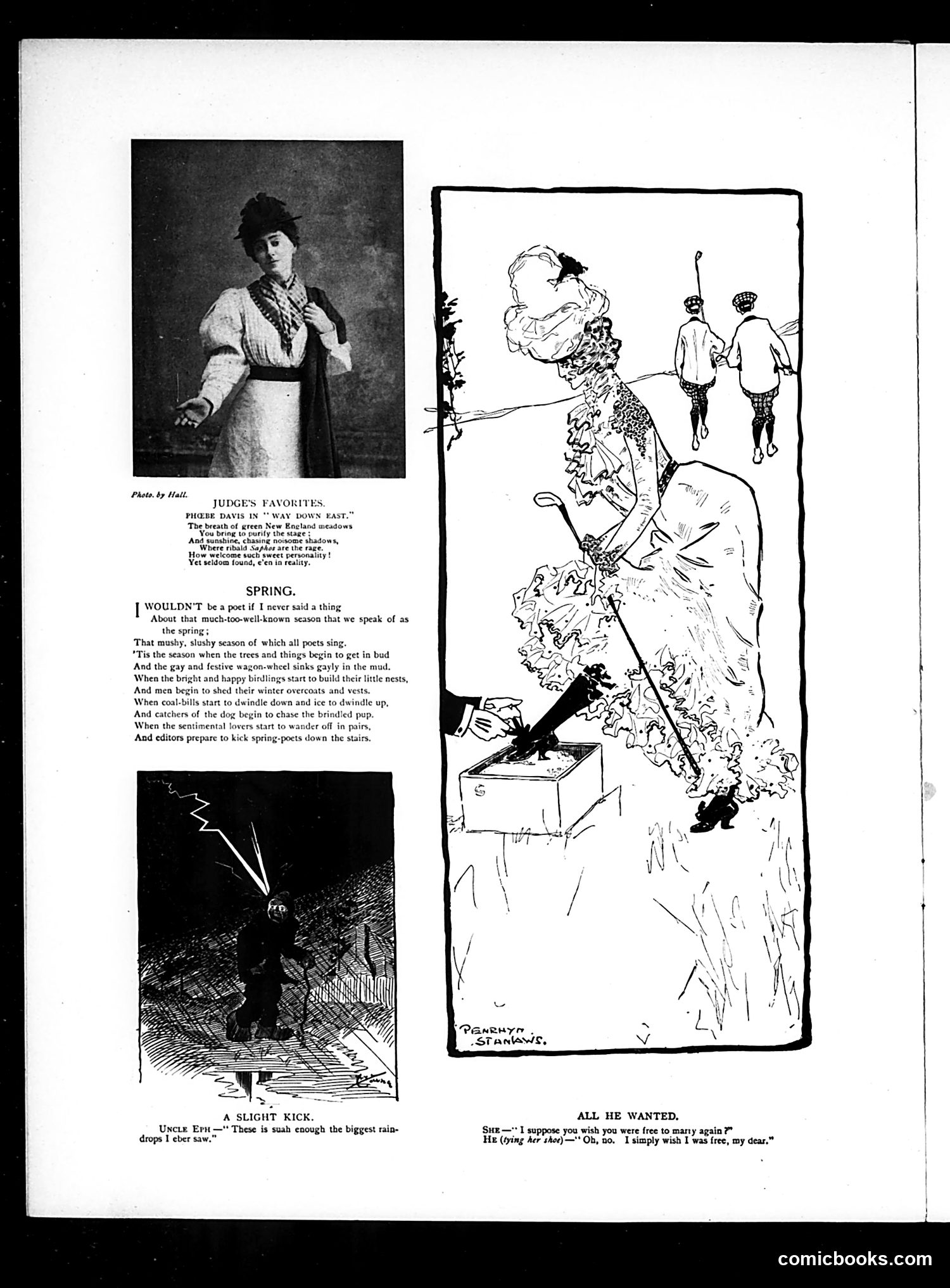
This page contains theatrical and seasonal content rather than political satire. **Top:** A photograph of actress Fidelie Davis in "Way Down East," a popular play of the era. The accompanying verse humorously describes the melodramatic plot. **Center:** A poem titled "SPRING" that celebrates the season through traditional imagery—budding trees, nesting birds, and melting snow—with gentle humor about spring's messiness and editors preparing to "kick spring-poets down the stairs." **Bottom illustrations:** Two separate comic scenes with captions. "A Slight Kick" shows a domestic quarrel joke. "All He Wanted" depicts a woman asking a man about remarrying, with his wry response about lost freedom. The page represents Judge's mix of theatrical promotion, light seasonal verse, and domestic humor—entertainment rather than political commentary.
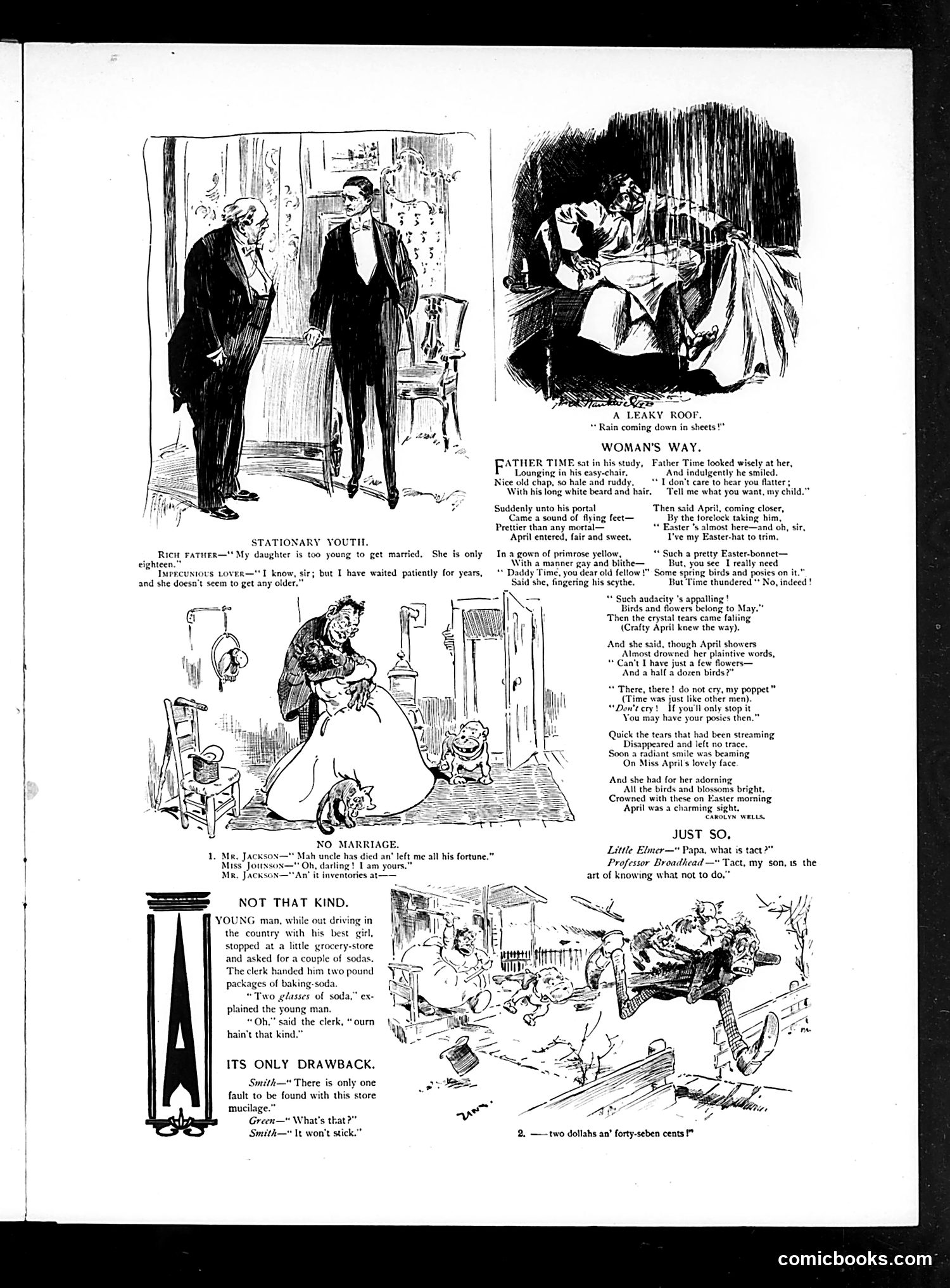
This page contains several humorous sketches satirizing common social situations of the era: **"Stationary Youth"** mocks a wealthy father's absurd logic: his daughter is "too young" to marry at eighteen, yet he's waited years for an uncle's inheritance—implying he values money over his daughter's happiness. **"No Marriage"** plays on a misunderstanding: a young man asks for "sodas" at a country store, but the clerk provides baking soda instead, unfamiliar with the modern beverage term. **"Woman's Way"** is an allegorical poem where April (spring personified) manipulates Father Time into granting her Easter decorations—birds and flowers—through emotional manipulation (crocodile tears). The joke critiques how women supposedly use charm and tears to get what they want. **"Just So"** offers a brief joke about tact as "knowing what not to do." The page reflects early 20th-century attitudes about gender, class, and modernization (sodas as a new urban commodity). The humor relies on stereotypes: stubborn fathers, emotional manipulation by women, and rural-urban cultural gaps.
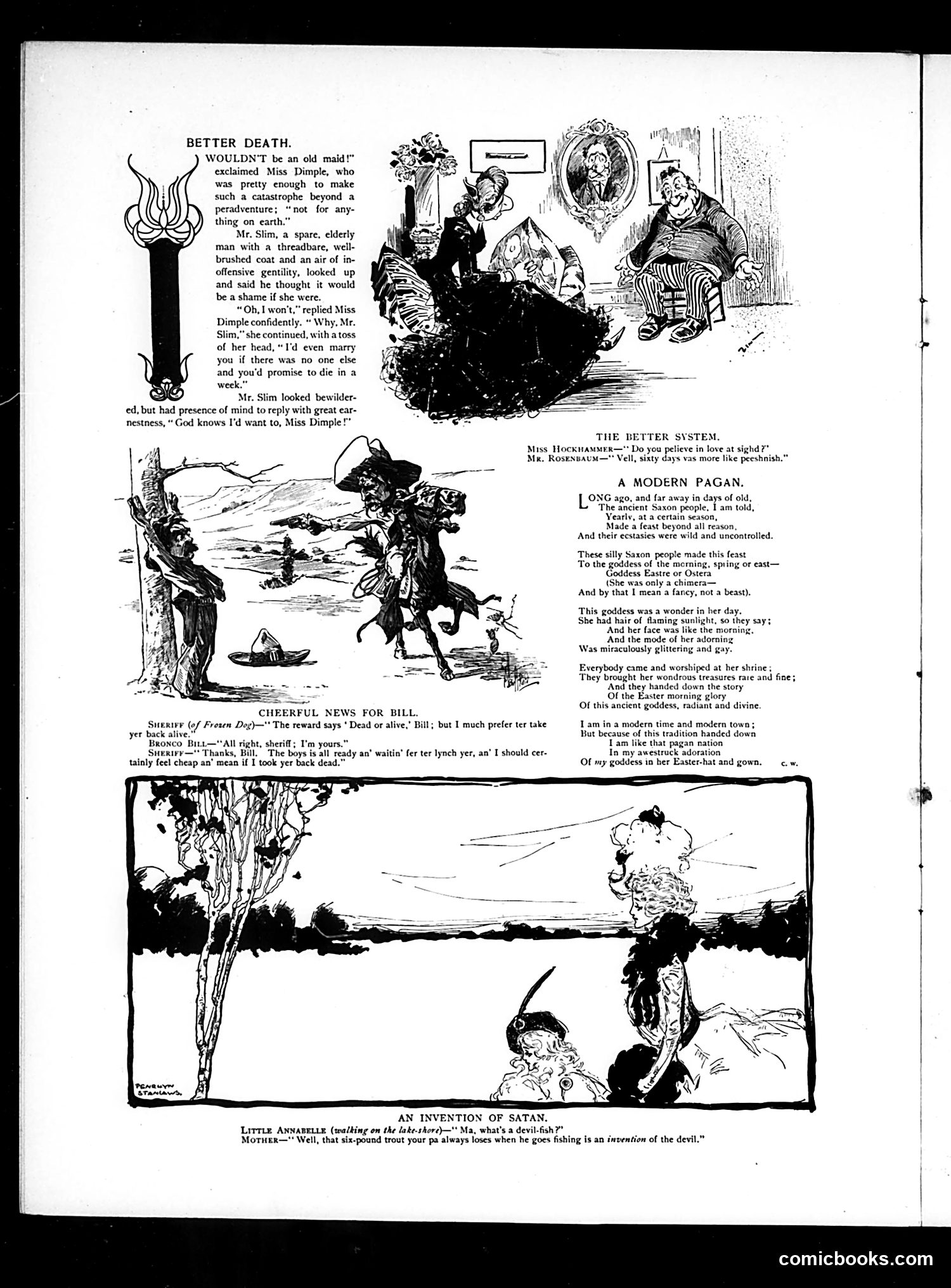
This page contains multiple satirical pieces typical of early 20th-century Judge magazine humor: **"Better Death"** mocks romantic desperation: Miss Dimple, a vain young woman, boasts she'd rather die than be unmarried—even willing to marry the meek Mr. Slim if he promised to die within a week. His eager agreement ("God knows I'd want to") punctures her vanity by suggesting her company is unbearable. **"The Better System"** is a brief ethnic joke playing on Yiddish-accented English, mocking immigrant speech patterns. **"A Modern Pagan"** satirizes Easter celebrations by tracing them to pre-Christian Saxon goddess worship, implying modern Easter observance is pagan superstition dressed in Christian clothing—a common anti-religious critique of the era. **"An Invention of Satan"** uses domestic humor: a fishing story where the husband's lost catches become proof the fish are the devil's creation. **"Cheerful News for Bill"** depicts Wild West frontier justice, with gallows humor about lynching. The page reflects Judge's satirical approach to religion, ethnicity, gender relations, and frontier mythology.
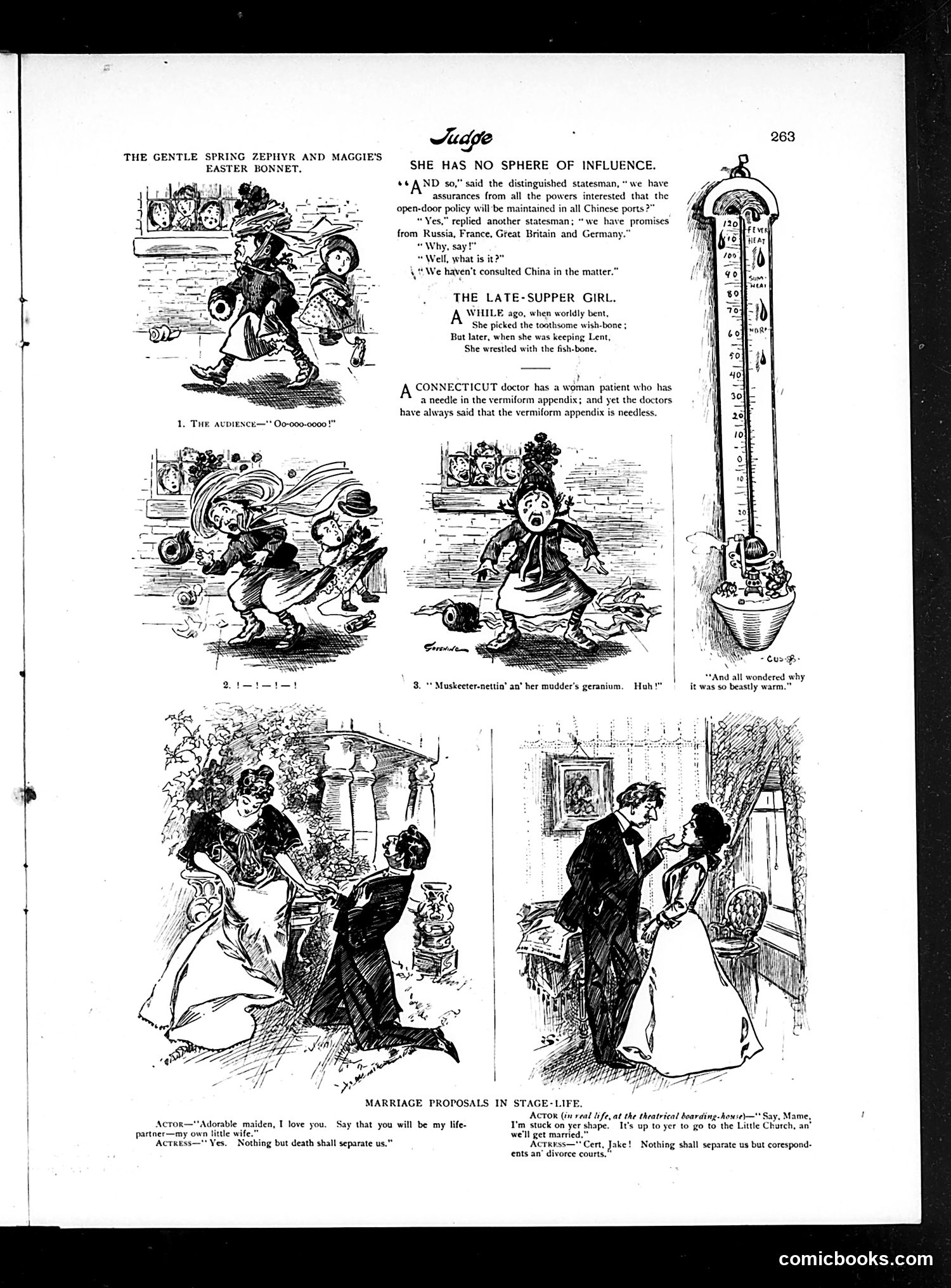
This page from *Judge* contains several satirical pieces mocking contemporary American life circa early 1900s: **"She Has No Sphere of Influence"** ridicules diplomatic negotiations over China's "open-door policy." Statesmen congratulate themselves on securing promises from Russia, France, Britain, and Germany—then realize they never consulted China itself. The satire skewers Western imperial arrogance: powerful nations negotiating China's fate without Chinese input. **"Marriage Proposals in Stage-Life"** contrasts theatrical romance with theatrical reality. On stage, actors deliver flowery vows ("Nothing but death shall separate us"). Off-stage, the same actors use crude, transactional language ("I'm stuck on yer shape"). The joke exposes the gap between theatrical artifice and actors' actual cynicism. Minor pieces mock Easter bonnets, Lenten hypocrisy, and a doctor's joke about a patient with a needle in her appendix ("the vermiform appendix is needless"). The humor relies on recognizing contemporary diplomatic debates and theatrical conventions familiar to 1900s audiences.
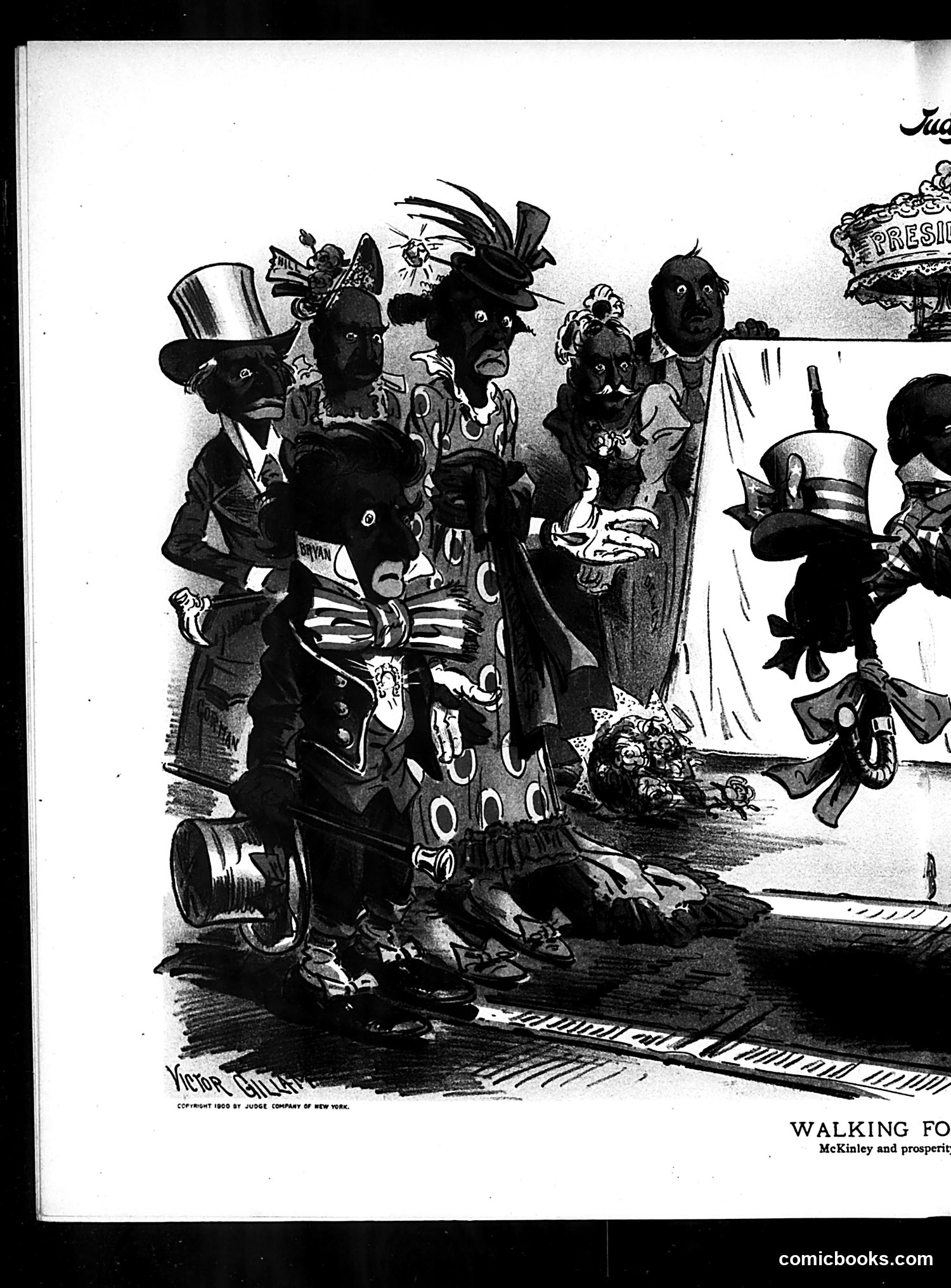
This appears to be a Judge magazine cartoon titled "Walking For McKinley and Prosperity," referencing President William McKinley. The image depicts a group of anthropomorphic animals (likely representing political figures or the public) dressed in formal attire with top hats, parading or marching together. The satire appears to mock the optimistic rhetoric surrounding McKinley's administration and its claims of economic prosperity. The exaggerated formal dress and ceremonial procession suggest irony—possibly critiquing either the hollow nature of prosperity promises or mocking political elites parading prosperity while ordinary citizens faced different realities. The copyright date (1909 by Judge Company) places this during or shortly after McKinley's presidency (ended 1901), likely commenting on his political legacy and economic claims.
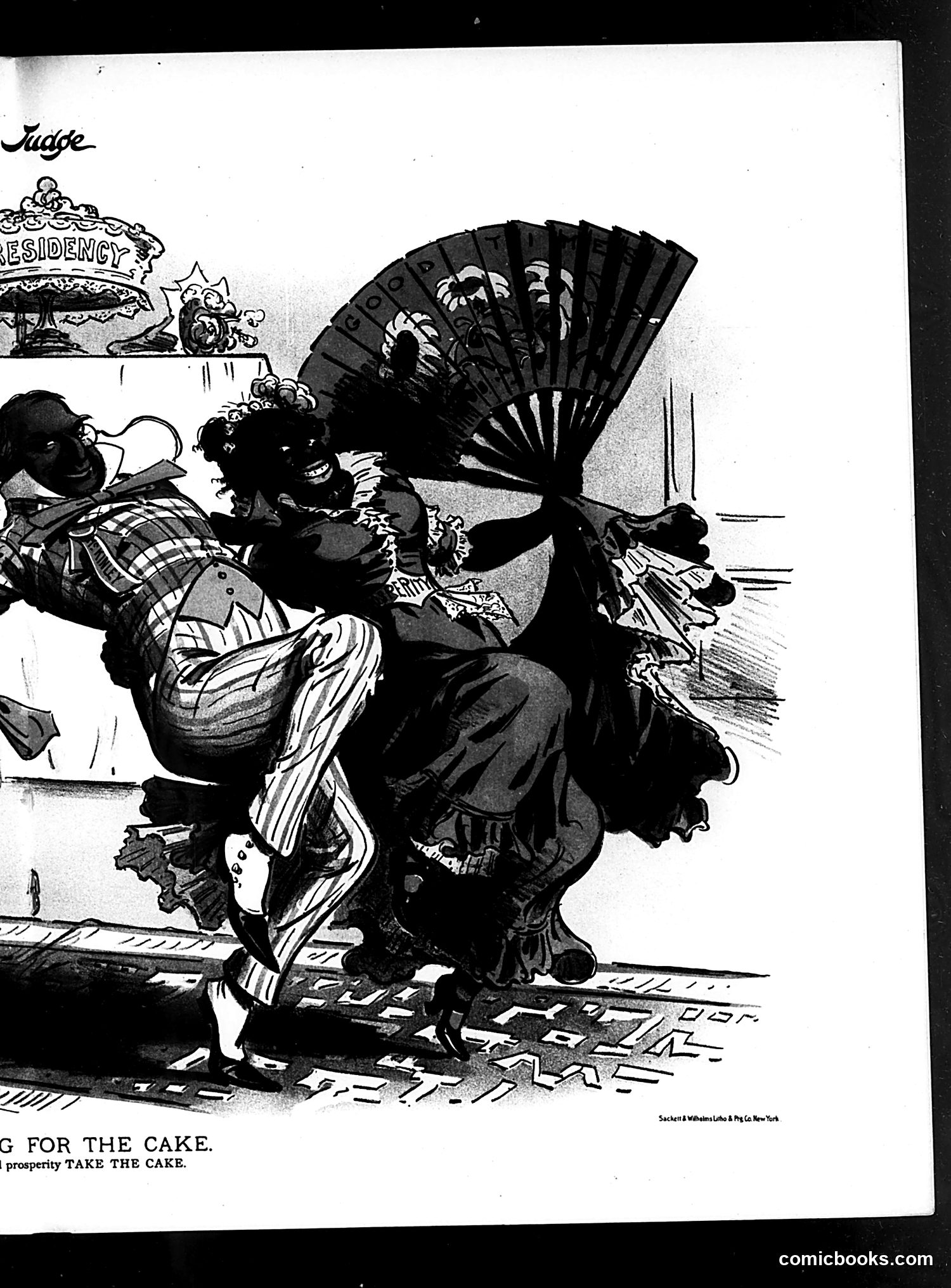
This **Judge** magazine cartoon satirizes competition for economic prosperity, depicted as a literal "cake" to be claimed. The central figure appears to be a wealthy or politically powerful character wielding a large fan, while others jostle around scrambling for the cake below. The title "TAKE THE CAKE" works as a pun—meaning both to win/succeed and to grab a literal dessert. The "Presidency" emblem visible in the upper left suggests this concerns political power and who controls national prosperity. The cartoon likely critiques how political elites or wealthy interests monopolize economic benefits while ordinary citizens compete desperately for scraps. The fan-wielder's dominant posture suggests they're controlling access to prosperity rather than allowing fair distribution. Without a specific date, the exact political context remains unclear, but the satire targets economic inequality and political power dynamics of the Gilded Age or Progressive Era.
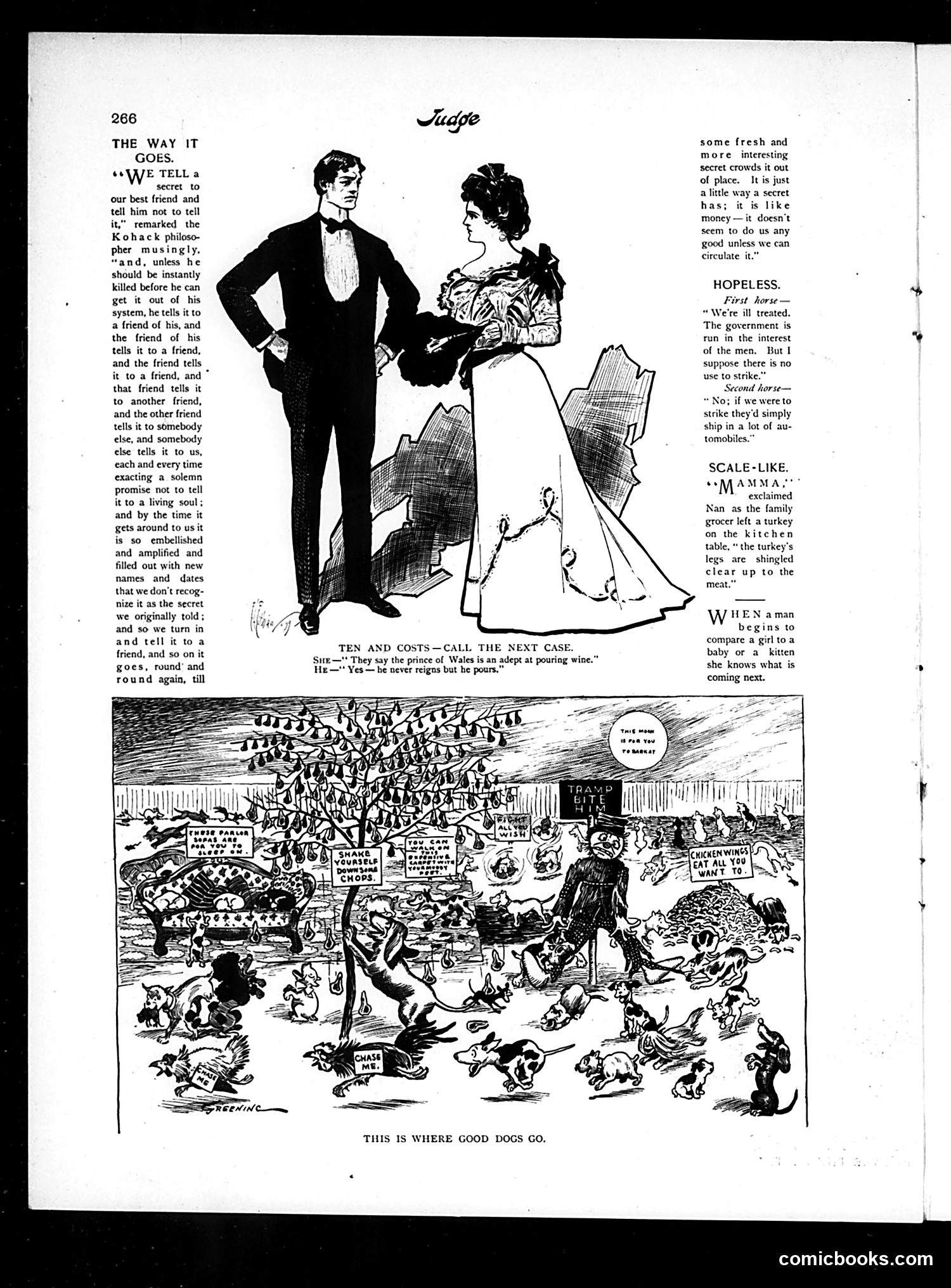
This page contains several satirical pieces reflecting early 20th-century concerns: **"The Way It Goes"** mocks how secrets spread and distort through gossip—a social commentary on rumor mills and information corruption. **"Ten and Costs"** features a legal joke: the Prince of Wales "pours wine" well because he never "reigns but he pours" (a pun on "reigns/rains"). The cartoon suggests aristocratic excess. **"This is Where Good Dogs Go"** is a chaotic street scene satirizing urban conditions—overcrowding, vice, and disorder. Signs reference various social problems and vices, suggesting cities are morally corrupt "dumping grounds." **"Hopeless"** depicts horses discussing labor strikes, with one noting they'd simply be replaced by automobiles—commenting on workers' powerlessness against technological replacement and mechanization. **"Scale-Like"** and other brief pieces offer domestic humor about everyday observations. Overall, the page reflects Progressive Era anxieties about modernization, urbanization, labor displacement, and social corruption masked by humor.
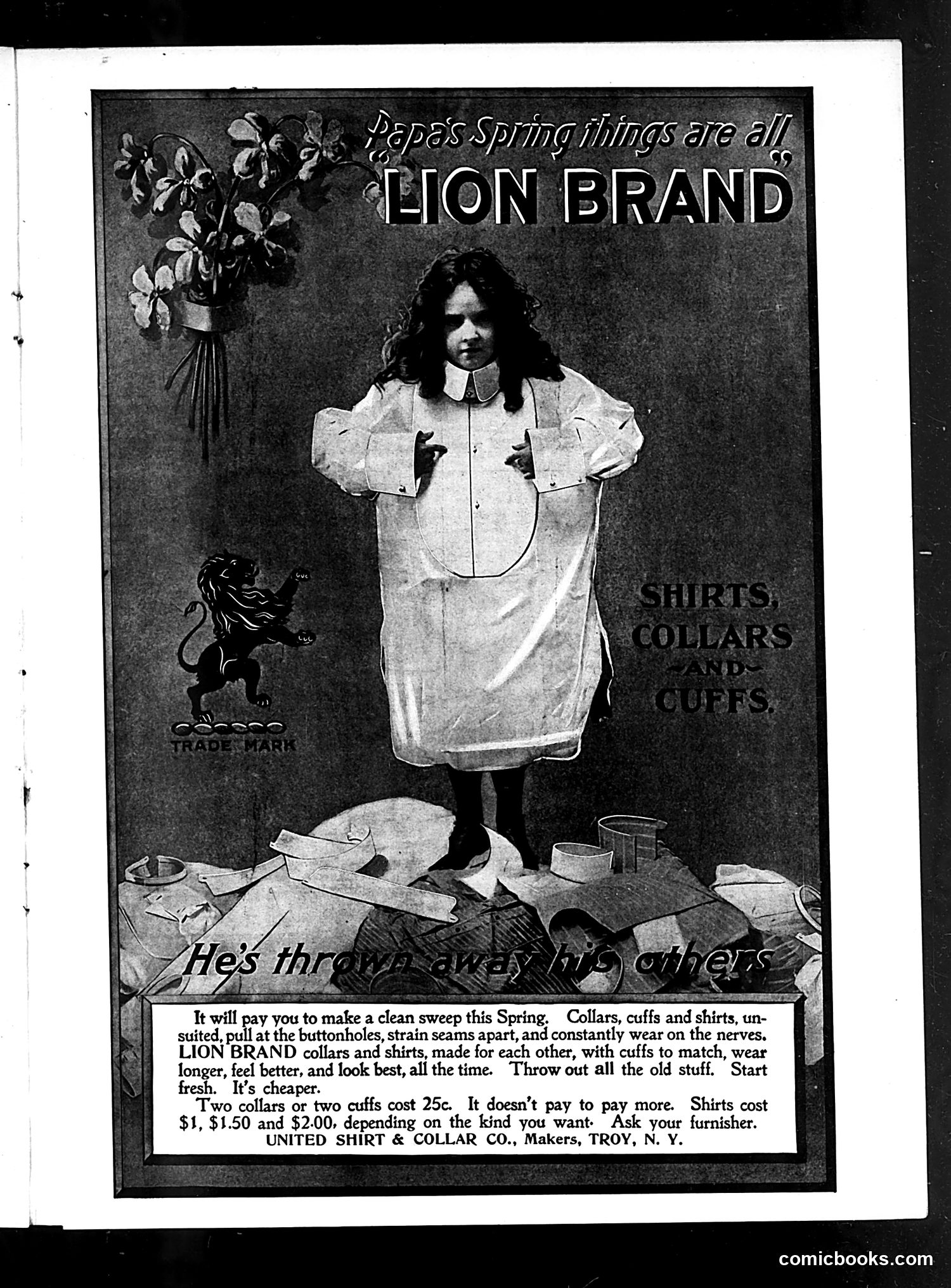
This is a **product advertisement**, not political satire. It promotes Lion Brand shirts, collars, and cuffs made by United Shirt & Collar Co. of Troy, New York. The ad uses humorous imagery: a figure wearing an ill-fitting garment surrounded by discarded clothing and accessories, with the caption "He's thrown away his others." The visual joke suggests that old, worn garments are literally falling apart—collars "pull at buttonholes," seams strain, and they "constantly wear on the nerves." The advertisement's pitch is pragmatic: replacing worn clothing is economical ("It's cheaper") than maintaining old pieces. Prices listed are 25 cents for collars/cuffs and $1-$2 for shirts, reflecting early 20th-century retail costs. The lion trademark (visible lower left) served as the brand's logo and quality marker. This is straightforward commercial messaging in Judge magazine's advertising space, not social commentary.
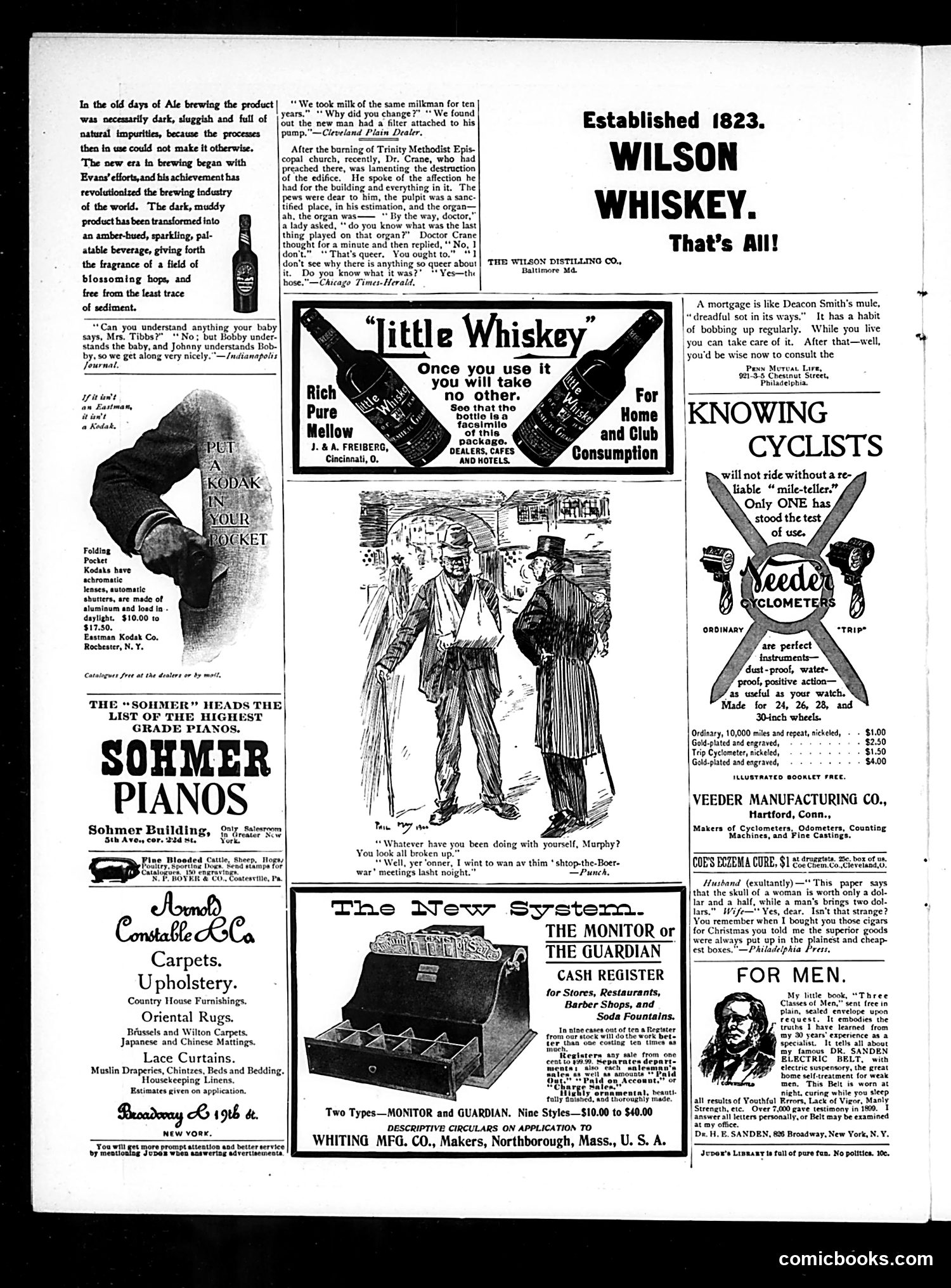
This page is primarily **advertising** with one cartoon. The main satirical cartoon depicts two men in Victorian dress—one appears to be a shabby vagrant or street person, the other a well-dressed gentleman. The caption suggests the ragged man has been attending "stop-the-Boer war" political meetings, explaining his disheveled appearance. **Context**: This references the **Second Boer War** (1899-1902), when British forces fought Dutch settlers in South Africa. Anti-war meetings were held in Britain and America; the cartoon mocks attendees as disreputable or foolish. The surrounding ads promote period products: Wilson Whiskey, Kodak cameras, Sohmer pianos, carpets, and Veeder cyclometers (bicycle odometers). One ad includes a joke about church organ music and firefighting hoses—wordplay typical of Judge's humor. The overall tone reflects early 1900s consumer culture and political mockery of pacifists.
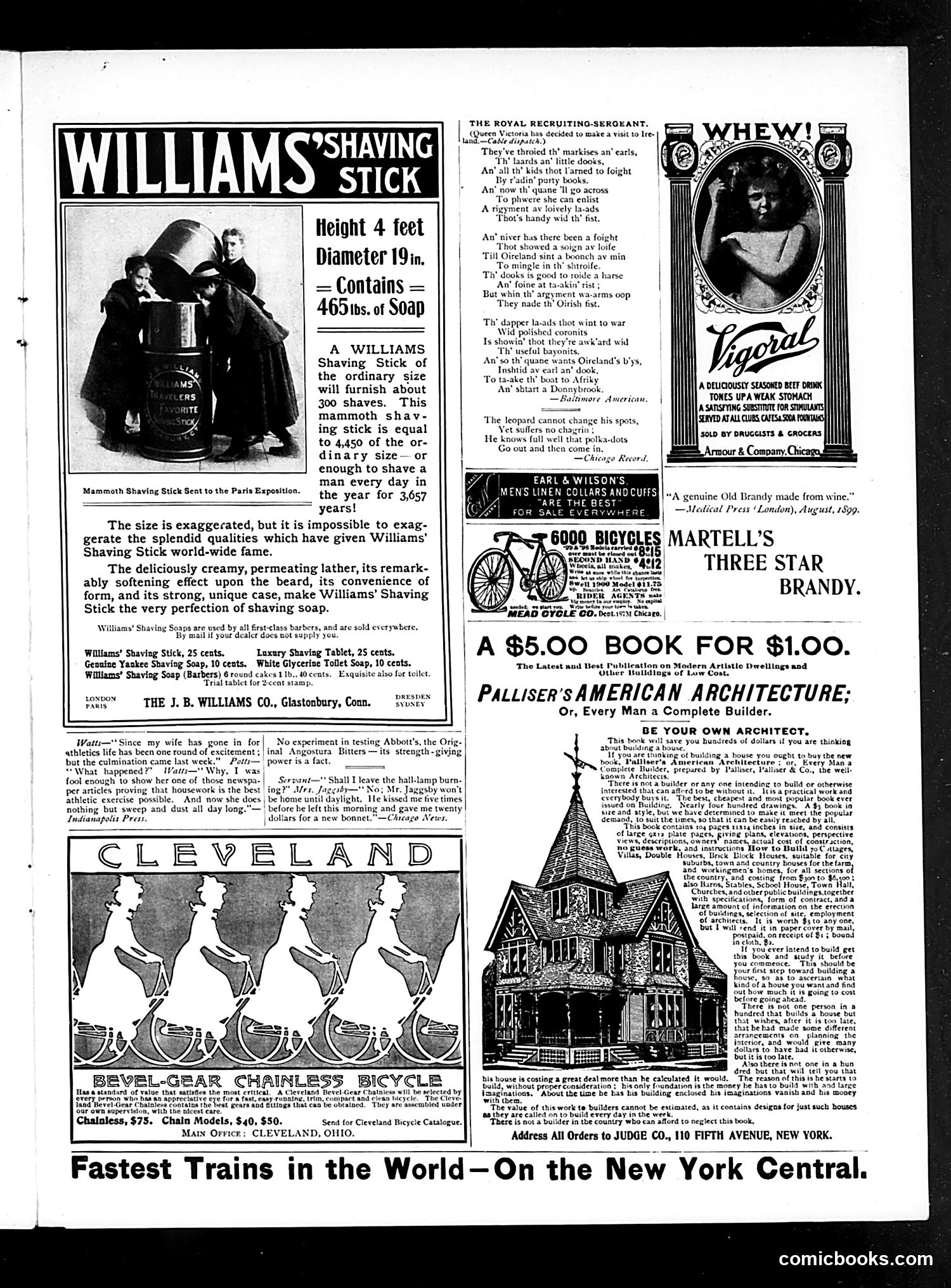
This page is primarily **advertising with one political cartoon**. **The Political Cartoon: "The Royal Recruiting-Sergeant"** The poem satirizes Queen Victoria's planned visit to Ireland (referenced in the dispatch line). The joke is that Ireland is so impoverished and violent that Victoria is going there not as a state visit, but to recruit soldiers—specifically Irish working-class men ("loively la-ads") for the British military. The satire mocks both: - **British recruitment**: Using the Queen's visit as cover for military conscription - **Irish character stereotypes**: The dialect-heavy poem portrays Irish men as naturally pugnacious ("handy wid th' fist"), referencing their reputation for bar fights ("Donnybrook") The final couplet suggests Ireland will inevitably erupt into chaos once again after this "recruitment." This reflects late-Victorian Anglo-Irish tensions and Britain's reliance on Irish soldiers for imperial military campaigns. The remainder of the page consists of period product advertisements (shaving soap, bicycles, brandy, architecture books).
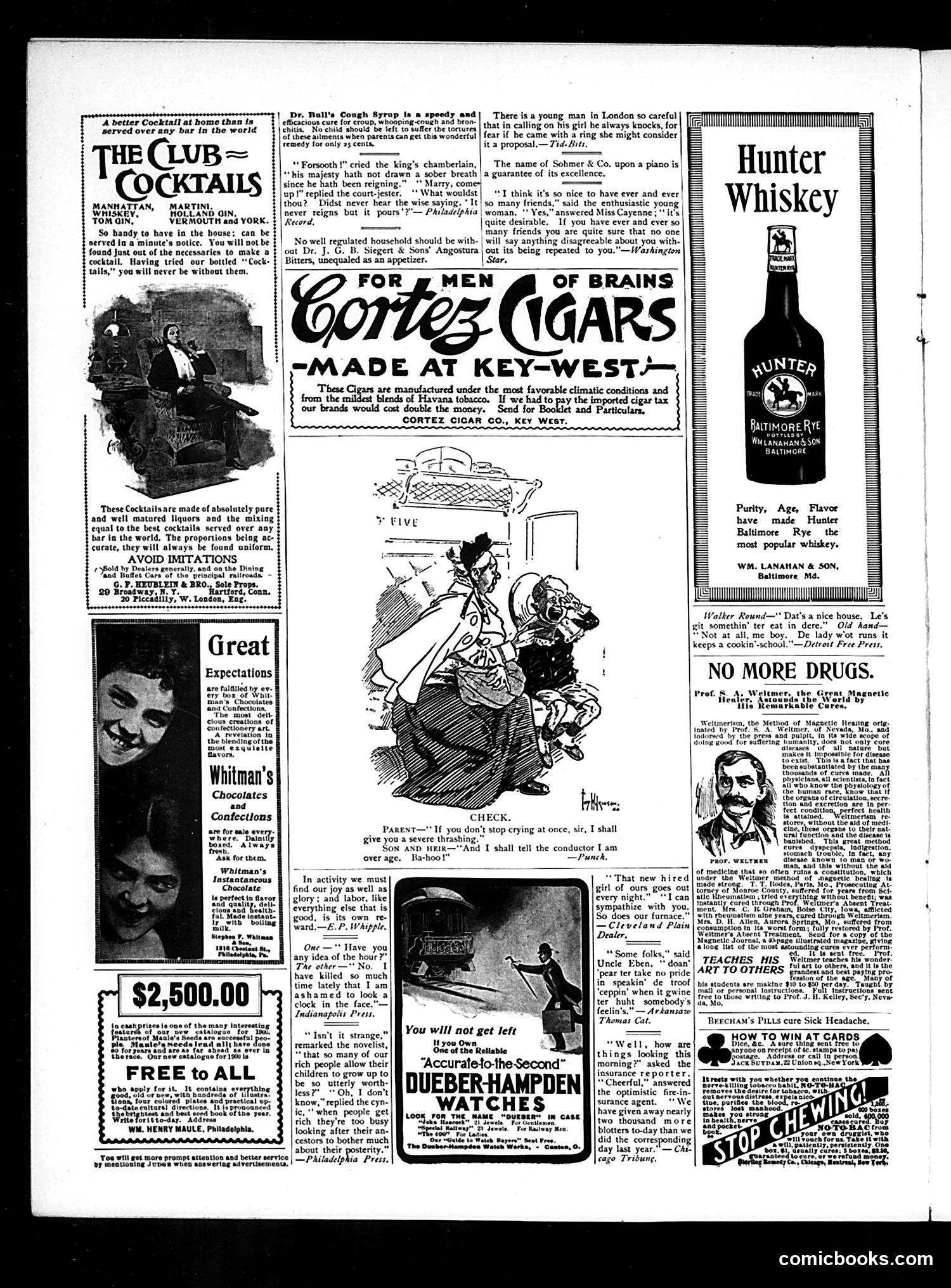
This page is primarily **advertising and filler material** from *Judge* magazine, with minimal political or social satire. The main content includes advertisements for cocktails, cigars, whiskey, chocolates, cough syrup, and watches. Several brief humorous anecdotes appear, such as a joke about a chamberlain criticizing a king for drinking (political satire of royal excess), and jokes about contemporary social life—a young man in London overly cautious on a date, or children of rich people lacking virtue. The cartoon labeled "CHECK" depicts a parent threatening a child, with dialogue about crying and a conductor—this is domestic humor about parenting rather than political commentary. The "NO MORE DRUGS" section advertises Prof. Weltmer's purported cure for morphine addiction through his "remarkable cure," reflecting early-1900s skepticism about patent medicine remedies. Overall, this page contains **light, domestic satire** and consumer advertising typical of *Judge*'s era, without significant political commentary on identifiable contemporary figures or events.
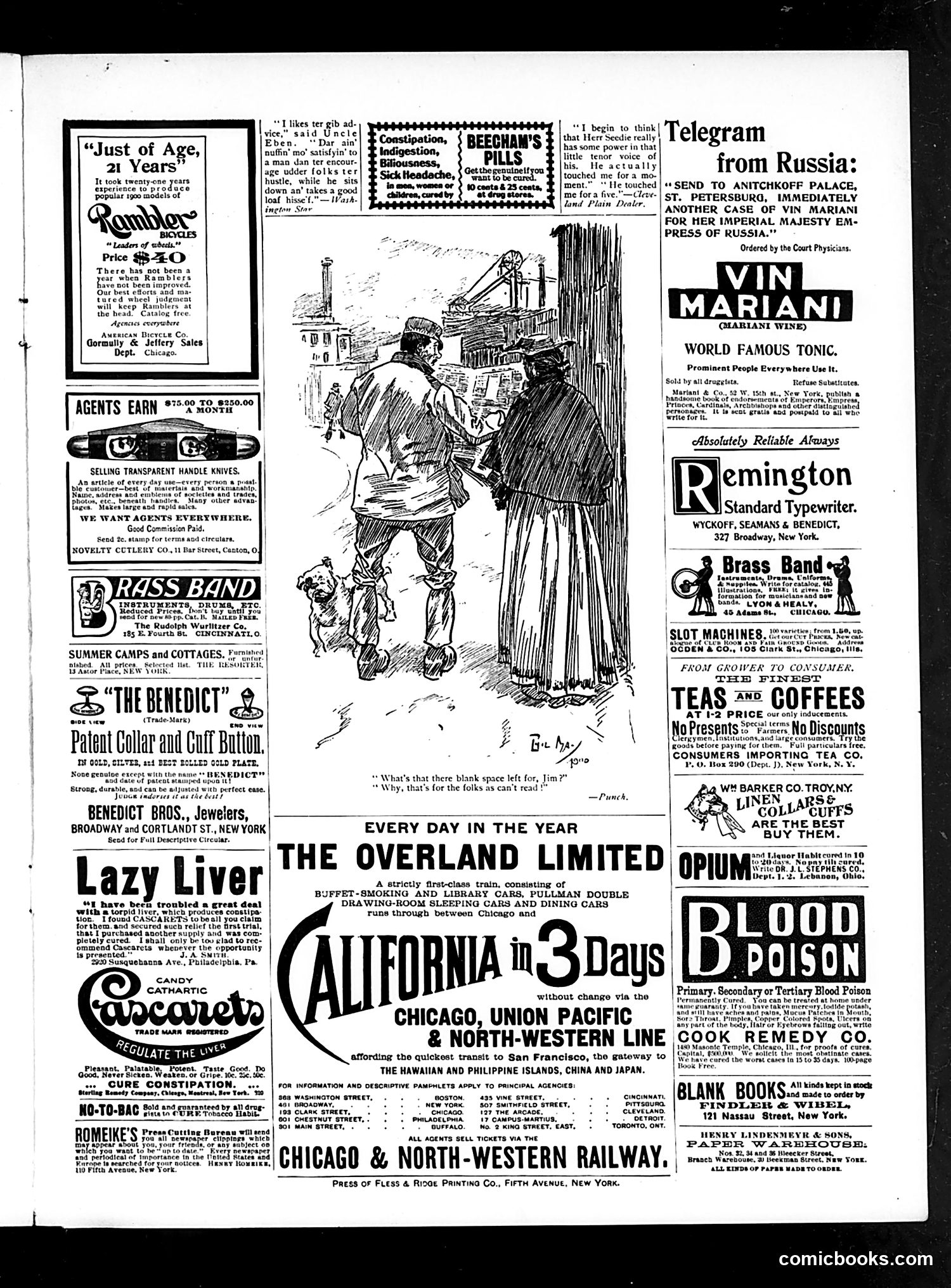
This page is primarily **advertising**, typical of early 1900s magazines. However, it contains two notable satirical cartoons: ## Main Cartoon (Center) A sketch labeled with dialogue: *"What's that there blank space left for, Jim?" / "Why, that's for the folks as can't read."* This is attributed to *Punch* (British humor magazine). The cartoon mocks **illiteracy**, likely referencing contemporary concerns about education levels among working-class Americans. ## "Telegram from Russia" Section An advertisement for **Vin Mariani wine** (a patent medicine/tonic) includes a satirical "telegram" claiming the Russian Empress ordered it through court physicians. This is **fake testimonial advertising**—common in the era—using imperial authority to sell dubious tonics. The joke implies that even royalty needs such remedies, lending false credibility. ## Context Both items reflect turn-of-the-century American attitudes: skepticism about literacy among the poor, and the prevalence of patent medicine fraud marketed through celebrity/authority endorsement. The page is predominantly filled with **legitimate product advertisements** (bicycles, typewriters, trains, tea) typical of *Judge's* revenue model.
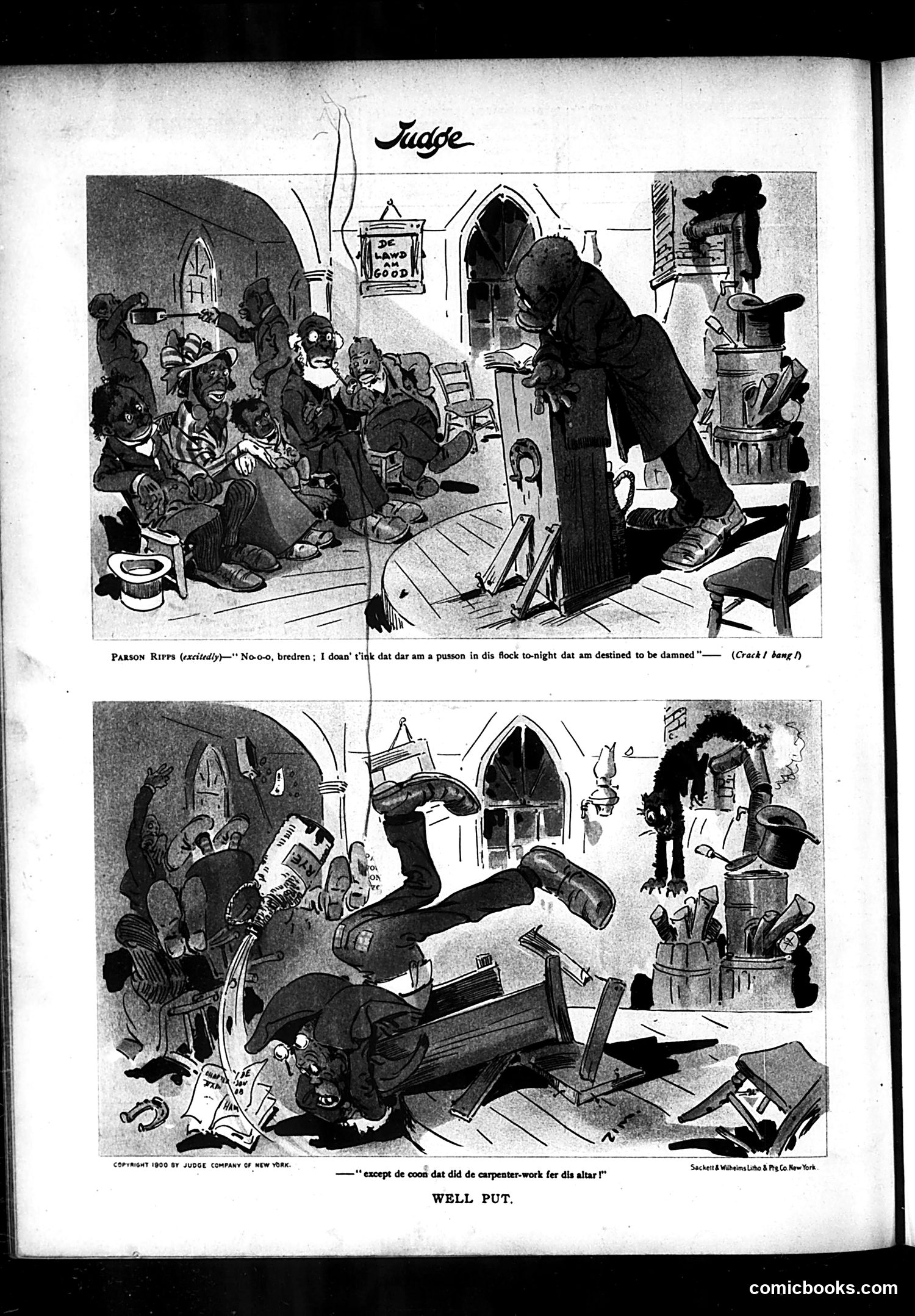
This two-panel cartoon satirizes racist hypocrisy in American churches. In the first panel, "Parson Rurps" (a stereotyped Black preacher) declares confidently that no one in his congregation is destined for damnation. The second panel reveals his contradiction: he immediately exempts "de coon dat did de carpenter-work fer dis altar"—excluding the Black laborer who built the altar from salvation. The satire targets the moral inconsistency of religious figures who preach universal Christian values while simultaneously dehumanizing Black workers. The crude dialect and caricature reflect the period's offensive visual conventions, but the cartoon's point criticizes the preacher's hypocrisy and racism. The title "Well Put" suggests ironic approval of his "honest" admission of prejudice.