
A complete issue · 16 pages · 1900
Judge — March 10, 1900
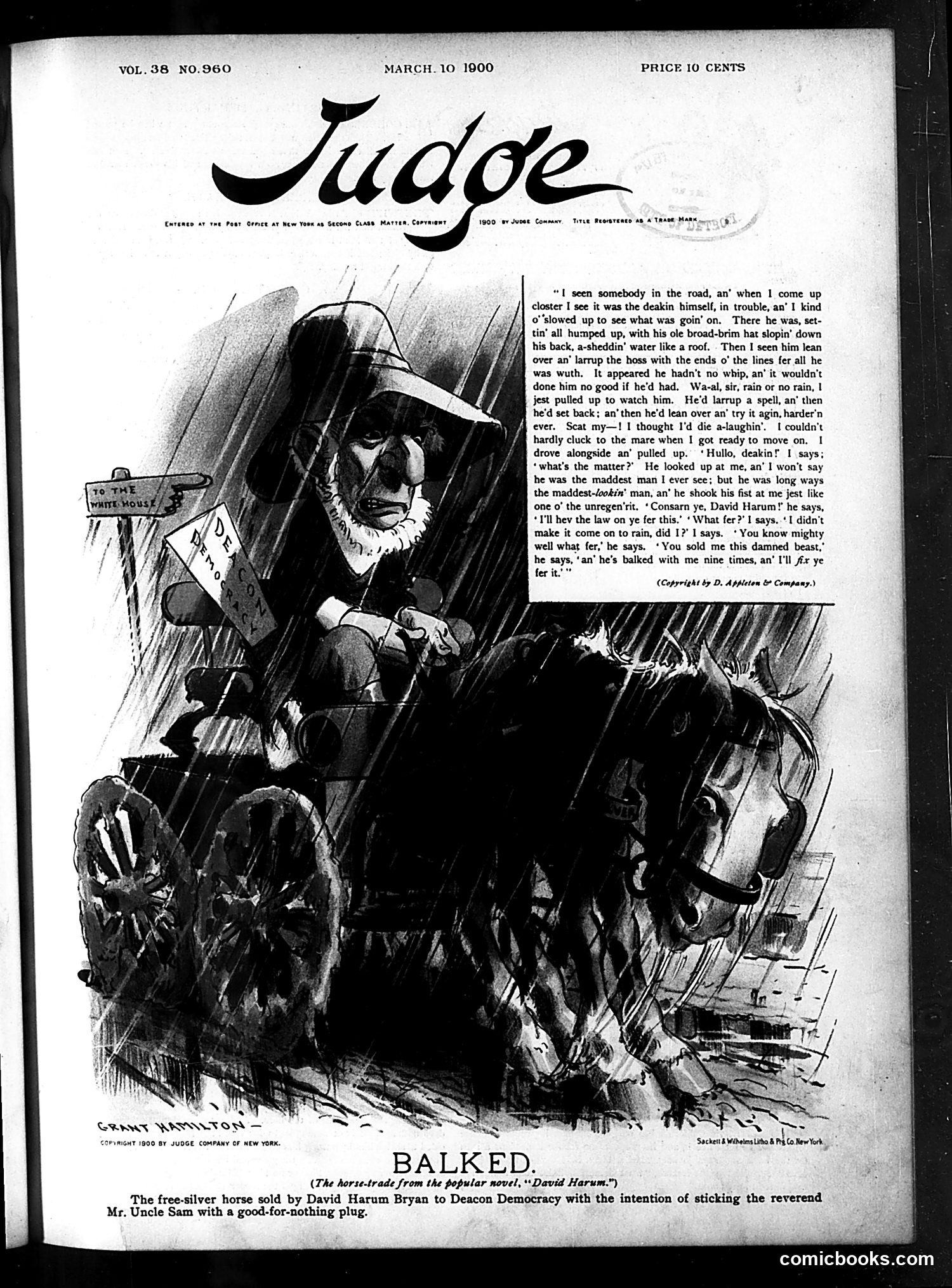
This cartoon satirizes William Jennings Bryan's 1900 presidential campaign and his "free-silver" platform. The illustration depicts a man (representing Bryan or his Democratic faction) with a wagon pulled by reluctant horses, labeled "TO THE WHITE HOUSE." The caption explains this references Bryan's attempt to sell a "free-silver horse" to "Deacon Democracy" with intentions of fooling Uncle Sam—a traditional personification of the American government/people. The satire suggests Bryan's free-silver policy and his political maneuvering were seen by Judge's Republican editors as fraudulent or untrustworthy. The horses "balking" (refusing to move forward) represents public or Democratic resistance to Bryan's agenda. The cartoon mocks both the policy's viability and Bryan's credibility as a candidate.
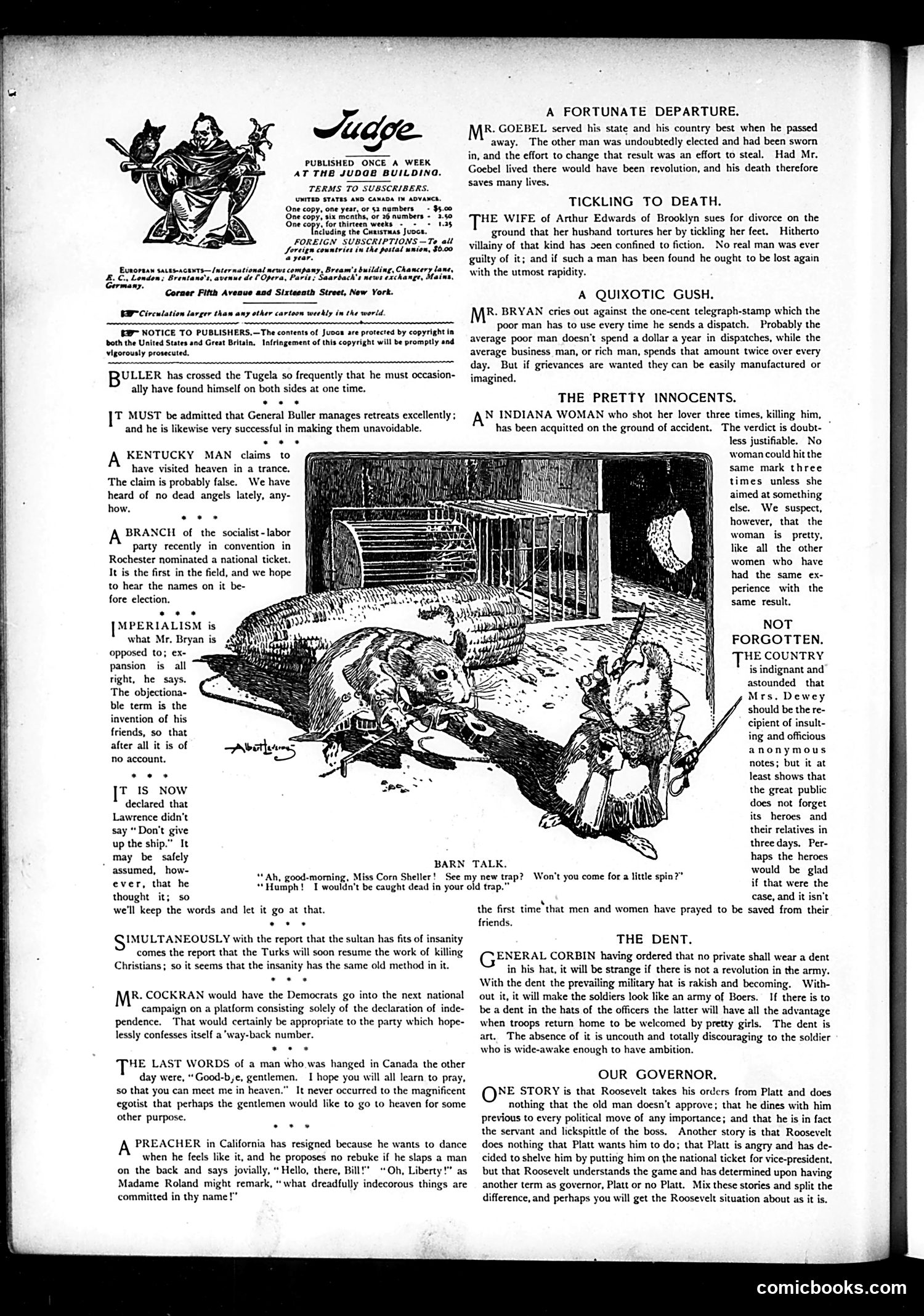
The central cartoon depicts a farmer and woman with a horse and trap (carriage). The dialogue—"Ah, good-morning, Miss Corn Shelter! See my new trap? Won't you come for a little spin?"—plays on the double meaning of "trap" (both a vehicle and a snare). The humor appears to be gentle rural wordplay rather than sharp political satire. The woman's name "Corn Shelter" suggests a farming context, and the farmer's pride in his new conveyance is mocked through the obvious pun. The surrounding text pieces ("A Fortunate Departure," "Tickling to Death," etc.) are separate satirical items typical of *Judge* magazine's format—commentary on contemporary social issues and politics rather than a unified themed page.
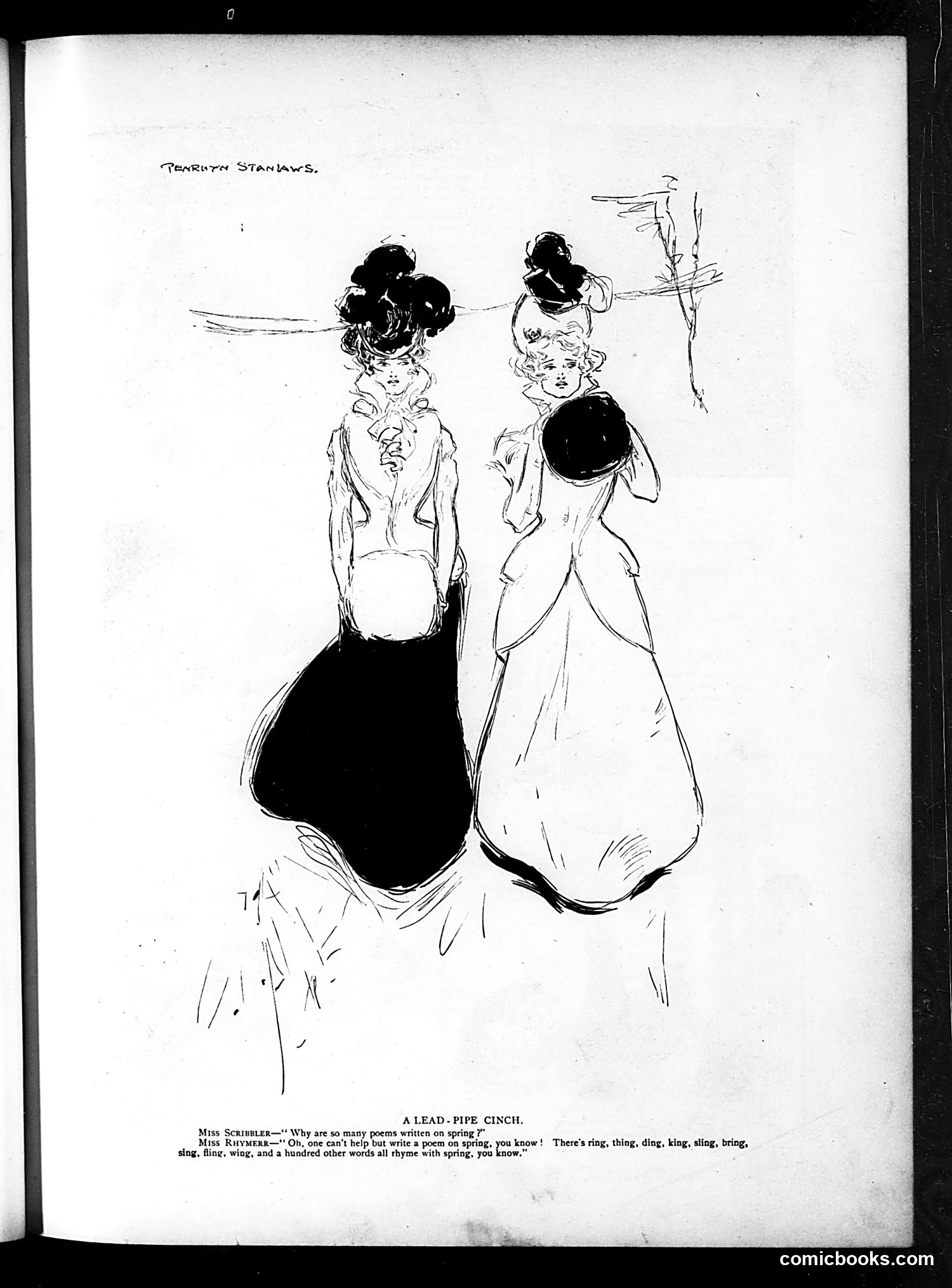
This cartoon satirizes poets and springtime verse. The caption shows Miss Scribbler complaining to Miss Rhymester that too many poets write about spring, making it impossible to avoid clichéd rhyming words (ring, thing, ding, king, sing, bring, etc.). The illustration depicts two women with oversized heads—a visual convention used in satirical comics to exaggerate intellectual pretension. The "lead-pipe cinch" metaphor suggests that writing spring poetry is ridiculously easy, almost guaranteed, because the rhyme scheme is so predictable and worn out. This reflects late 19th/early 20th-century literary culture's frustration with sentimental, formulaic verse that dominated popular publications. The joke mocks both amateur poets and the exhausted conventions of romantic poetry.
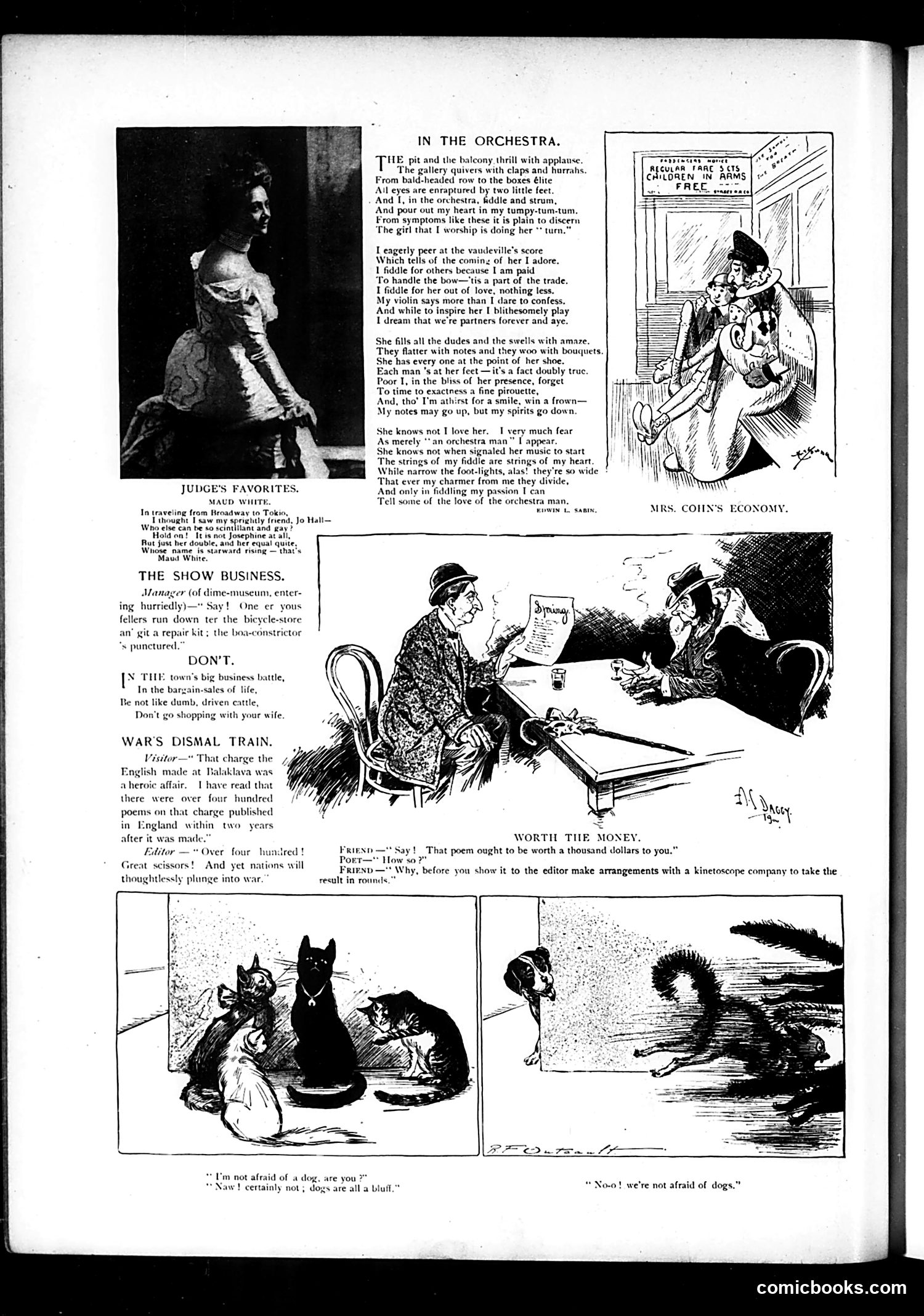
This page contains several distinct satirical pieces: **"In the Orchestra"** (top): A poem about a male musician infatuated with a female performer, expressing jealousy and longing while she plays. The satire mocks romantic obsession in artistic settings. **"The Show Business"** and **"Don't"**: Brief satirical commentary on business dealings and marital dynamics—likely critiquing commercial theater practices and domestic life. **"War's Dismal Train"**: A dialogue between "Visitor" and "Editor" discussing war poetry, satirizing how nations justify military conflict through literary romanticization. **Bottom cartoons**: Two humorous panels showing people with dogs, playing on the phrase "not afraid of dogs" with visual punchlines about dogs' actual fearlessness or aggression. The page blends social commentary on romance, business, war, and everyday life typical of Judge's satirical approach.
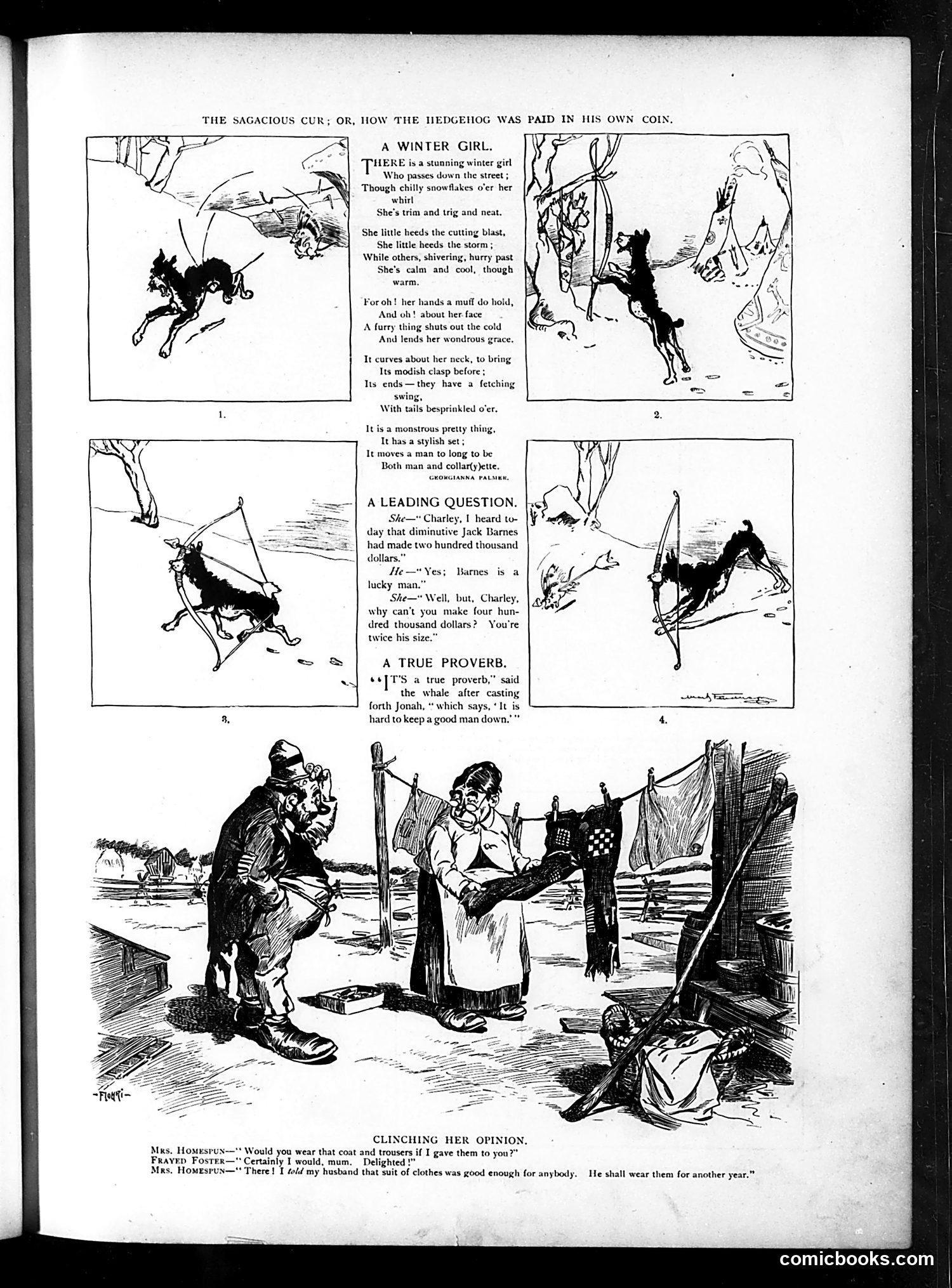
This page contains four distinct satirical pieces typical of Judge magazine's humor: **"A Winter Girl"** celebrates fashionable women's winter wear, particularly furs and muffs—luxurious accessories that signal both status and attractiveness. **"A Leading Question"** satirizes gender dynamics and wealth. A woman questions why her smaller male companion can't earn as much as the diminutive Jack Barnes, suggesting that size should correlate with financial success—an absurd premise used to mock both social climbing and marital pressure. **"A True Proverb"** offers a brief joke about keeping "good men down," playing on the biblical Jonah story. **"Clinching Her Opinion"** mocks domestic economics: a wife uses a servant's enthusiasm for worn-out clothing as proof her husband should wear them another year, turning fashion parsimony into "logic." The page emphasizes period concerns: fashion, marriage economics, and class consciousness. The hedgehog/cur reference in the header remains unclear without additional context.
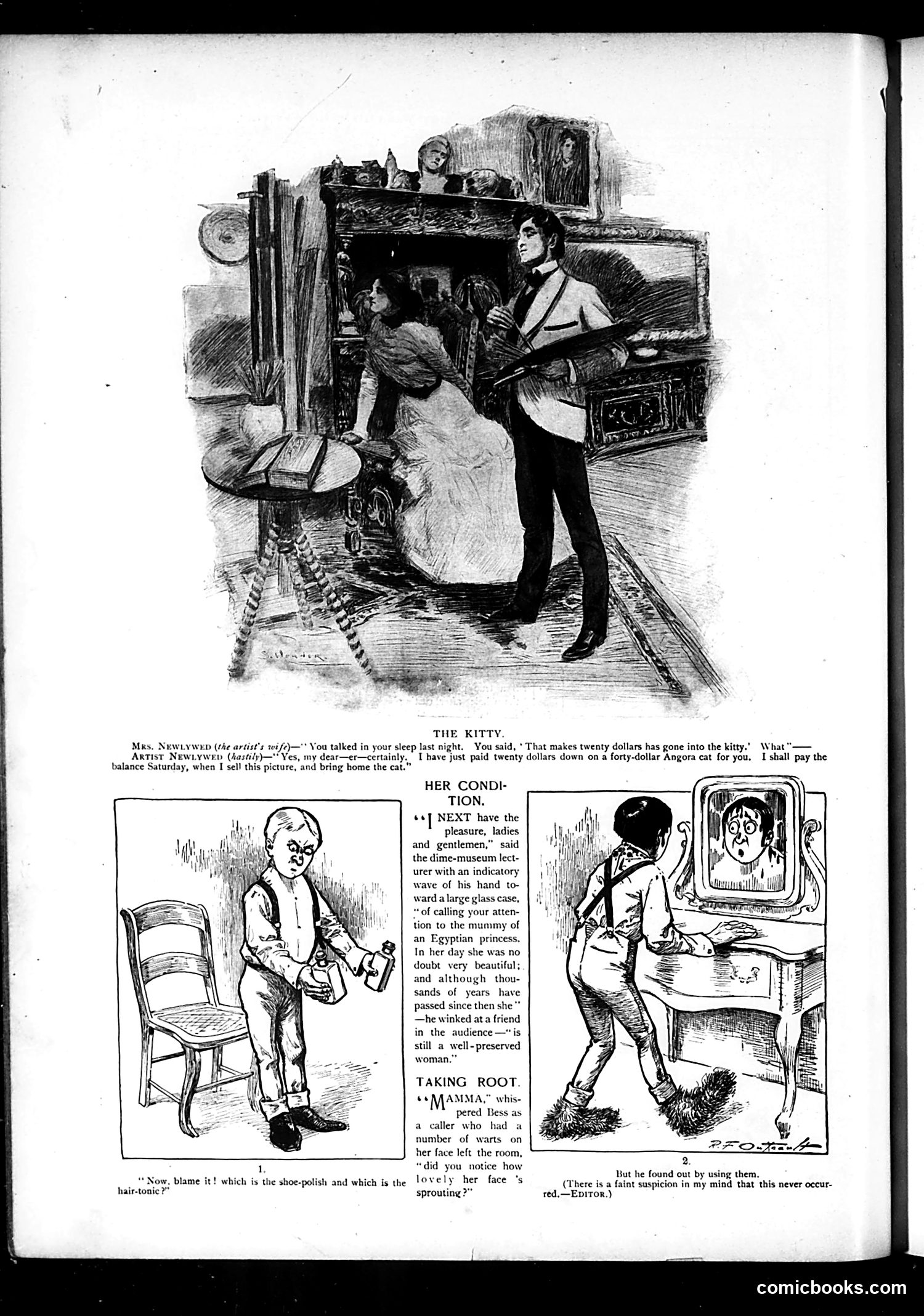
This page contains three separate humorous sketches satirizing domestic life and social pretension: **"The Kitty"**: A husband caught in a lie. His wife overheard him sleep-talking about money going into "the kitty" (a shared household fund). He frantically improvises that he's purchased an expensive Angora cat on credit, promising to pay it off when he sells a picture—a transparent excuse suggesting financial instability and marital friction over spending. **"Her Condition"**: A museum lecturer's crude joke about an Egyptian mummy's preservation, with a wink suggesting she's still sexually attractive despite millennia passing. It mocks both the sensationalism of dime museums and Victorian-era "scientific" exhibitionism. **"Taking Root"**: A child innocently comments that a female visitor's face is "lovely" and "sprouting"—referring to her facial warts. The editor's note suggests using wart-removal products created the problem, satirizing dubious patent medicines and their ineffectiveness. The humor relies on marital conflict, sexual innuendo, and social embarrassment—typical Judge fare for an audience amused by domestic discord and physical humor.
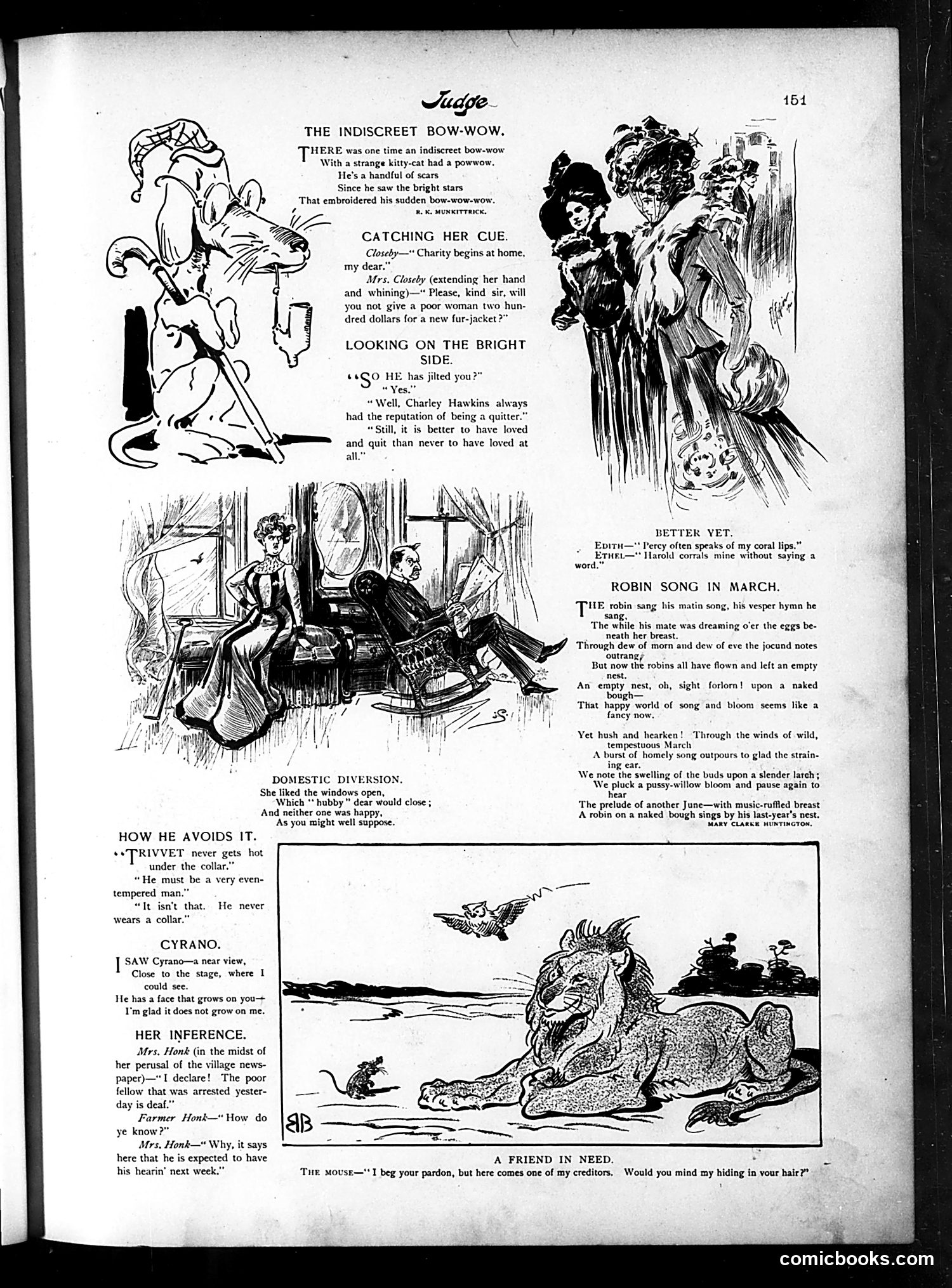
This page from Judge (a late 19th/early 20th-century American satirical magazine) contains multiple brief humorous pieces rather than a single political cartoon. The humor targets social pretense and domestic life: - **"Catching Her Cue"** mocks the hypocrisy of the wealthy preaching charity while Mrs. Closeby shamelessly begs money for a fur jacket. - **"Looking on the Bright Side"** jokes about consoling jilted women—better to have loved and lost than never loved, though the cynical implication undercuts the sentiment. - **"How He Avoids It"** uses wordplay: a man stays even-tempered by literally avoiding collars (which get "hot"). The **"Robin Song in March"** is sentimental poetry about spring's renewal, unrelated to satire. The bottom cartoon shows a mouse seeking shelter in a woman's hair from creditors—commentary on both the desperation of debt and the absurdity of social predicaments. No specific political figures or events are referenced; instead, these are observations on human nature, marital discord, and financial anxiety—timeless subjects.
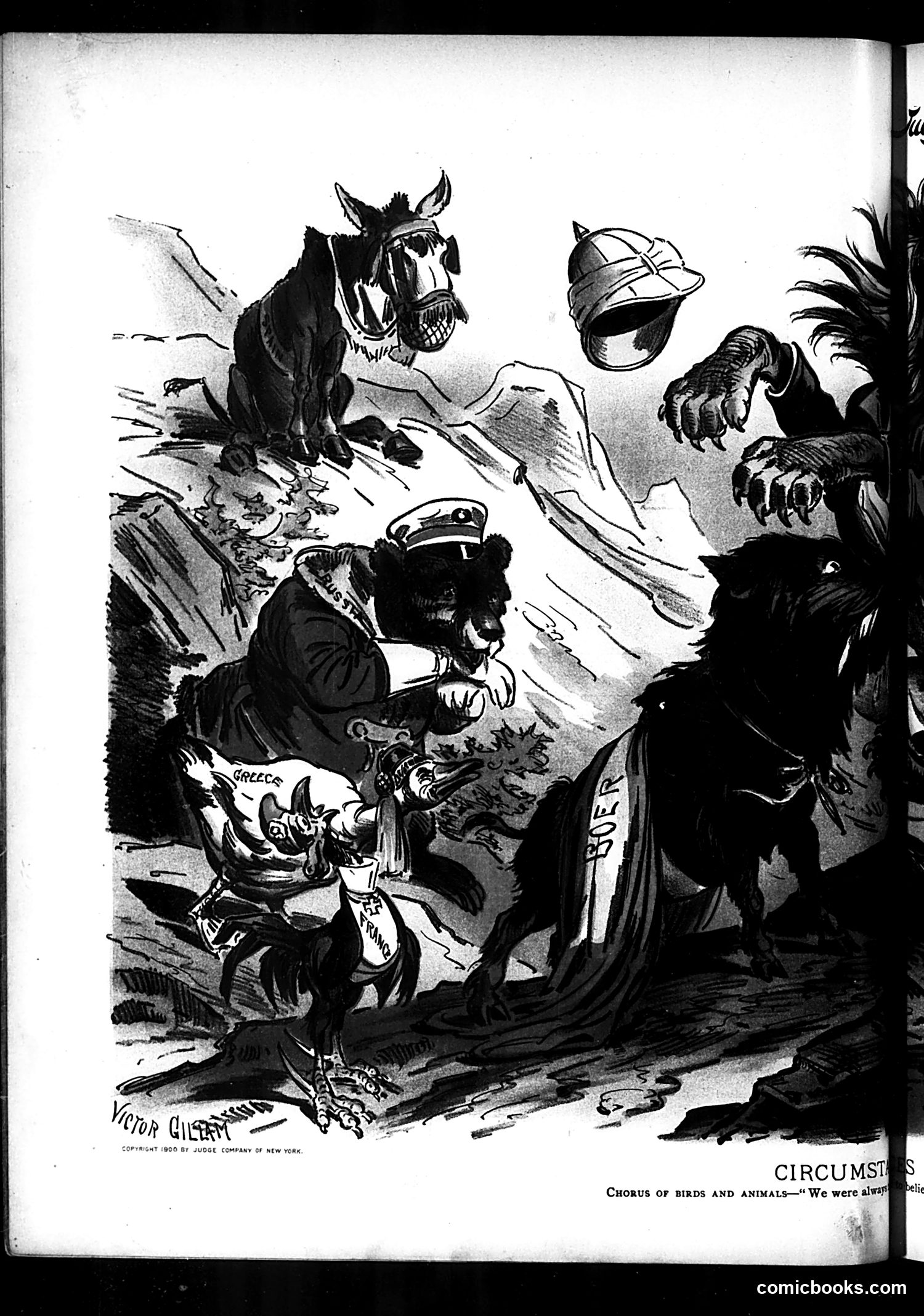
This political cartoon by Victor Gilam satirizes international conflict, likely from the early 20th century. The image shows anthropomorphized animals—including a donkey (labeled "Greece"), what appears to be a bear (likely Russia), and other creatures—in confrontational poses. A military figure in the center observes them. The helmets and military equipment suggest war or military tension. The "chorus of birds and animals" metaphor suggests world powers behaving irrationally or like beasts, unable to cooperate peacefully. The caption "We were always the" (text cuts off) implies commentary on humanity's perpetual warfare. The cartoon uses animal caricatures—common in Judge magazine's political satire—to mock nations for their aggressive posturing and inability to maintain civilization.
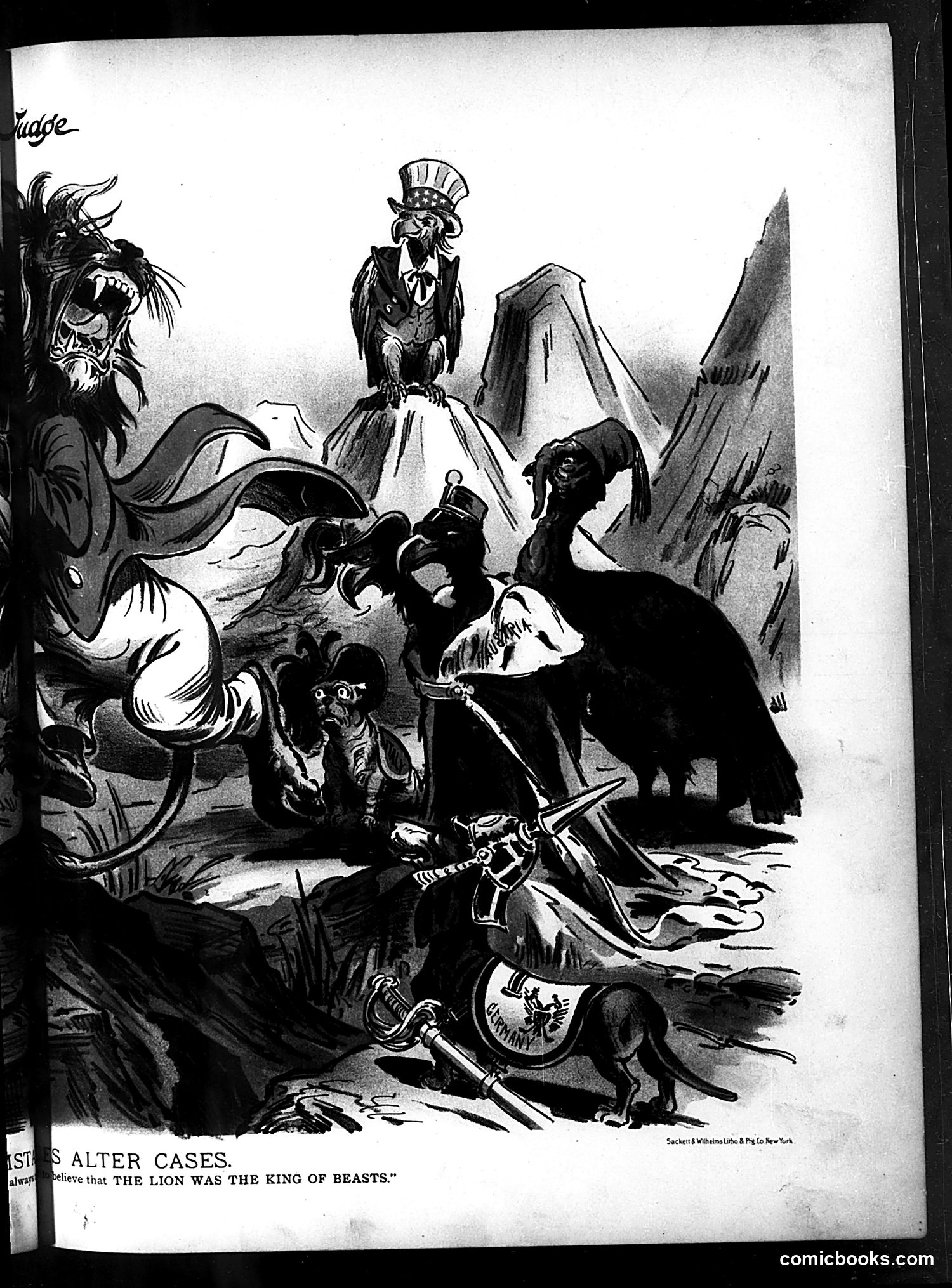
This satirical cartoon titled "Alter Cases" presents an inverted hierarchy of power. Uncle Sam (the tall figure in the top hat bearing the American seal) stands elevated while various animal figures—appearing to represent foreign powers or political rivals—occupy lower positions below him. The caption "Believe that THE LION WAS THE KING OF BEASTS" suggests the cartoon challenges traditional assumptions about who holds supreme authority. The composition deliberately reverses expected power dynamics, with Uncle Sam positioned as dominant authority figure over creatures that traditionally symbolize strength and sovereignty. Without the publication date visible, the specific political context remains unclear, but this appears to be commentary on American diplomatic or military supremacy during a particular historical moment when Judge magazine was asserting American exceptionalism against rival nations or ideologies represented by the animal figures.
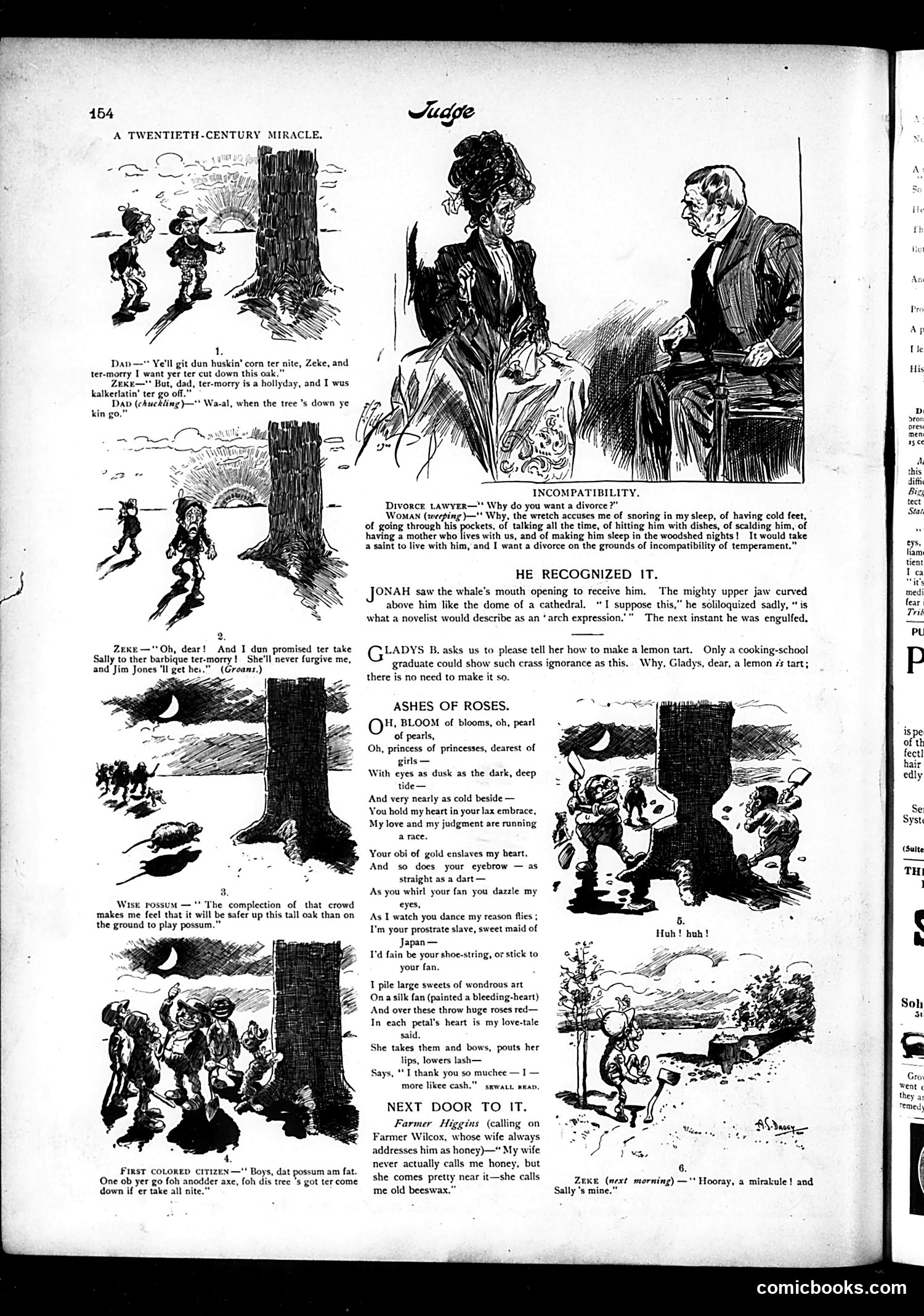
This page contains multiple satirical sketches typical of turn-of-the-century American humor: **"A Twentieth-Century Miracle"** depicts rural/working-class characters (Zeke, Dad, Sally) in a sentimental narrative where a son cuts down an oak tree to attend a barbecue—framed as miraculous compromise. The satire targets provincial life and family dynamics. **"Incompatibility"** mocks contemporary divorce proceedings through a woman listing absurd spousal grievances (snoring, cold feet, pocket-picking, noise, dish-throwing, scalding, obnoxious mother) to justify dissolution. It satirizes both marital discord and the legal entertainment value of divorce cases. **"He Recognized It"** presents a Jonah-and-whale reference with literary pretension—the protagonist recognizes the whale's expression as "arch," mocking novelistic clichés. **"Ashes of Roses"** satirizes sentimental Japonisme—the fashionable fascination with Japanese aesthetics—through exaggerated romantic poetry addressed to a Japanese woman who pragmatically requests "cash" instead of decorative fans. **"Next Door to It"** jokes about marital nicknames, comparing "honey" to "old beeswa[x]." The page blends domestic comedy with contemporary cultural critique.
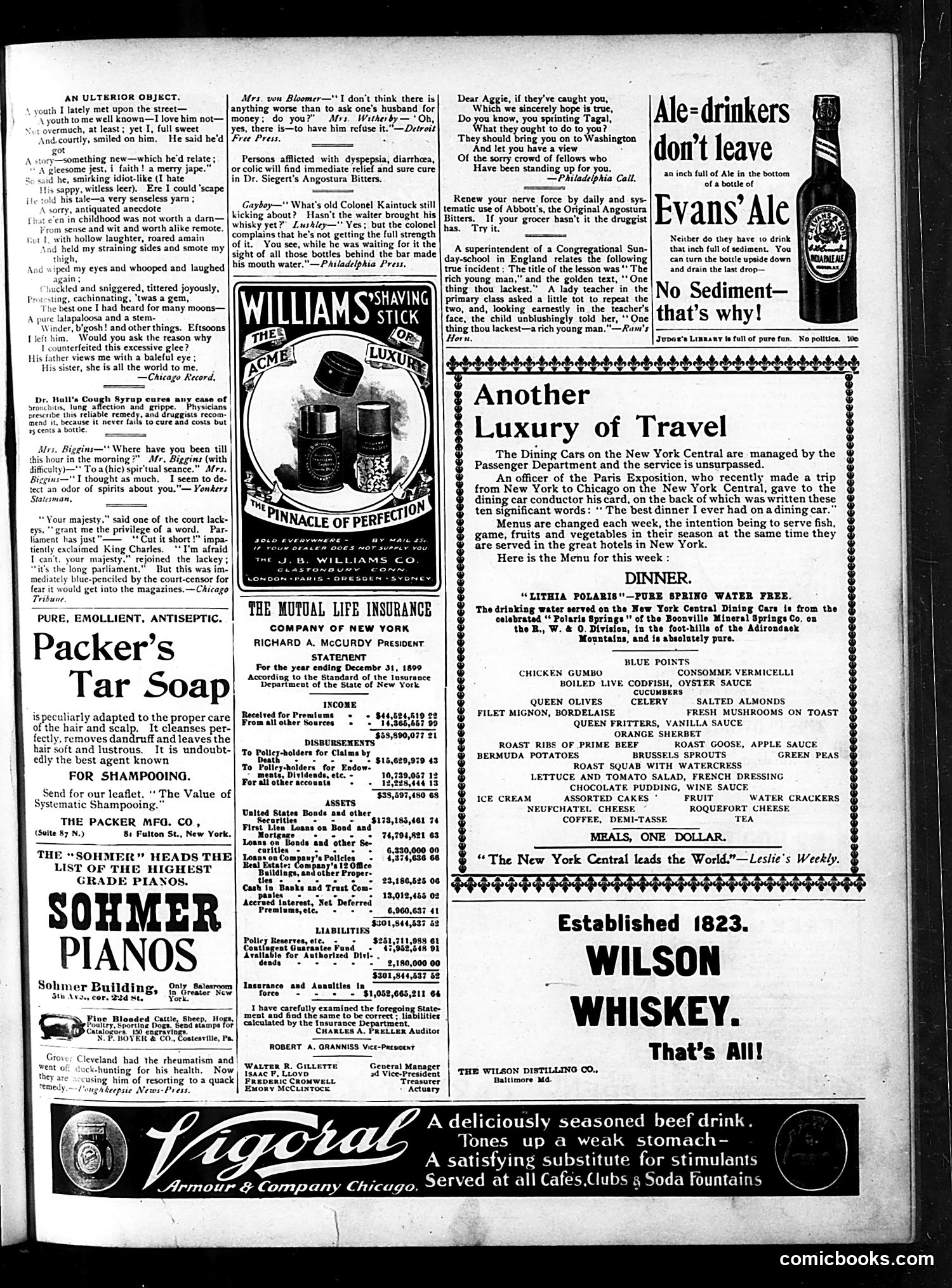
This page is primarily **advertising copy** rather than editorial cartoons or satire. It contains multiple commercial advertisements (Williams Shaving Stick, Packer's Tar Soap, Sohmer Pianos, Evans' Ale, Wilson Whiskey, Vigorol) alongside brief comic anecdotes and light humor pieces. The main satirical content appears in small prose pieces rather than visual cartoons: a poem about feigning laughter to impress a girl's father/sister; jokes about spirits (alcohol pun), Parliament's length, and Cleveland's rheumatism cure. These are gentle, era-appropriate humor with no evident political commentary. The reference to "sprinting Tagal" appears to reference Filipino resistance during the Spanish-American War era, though the context is minimal. Overall, this is a magazine page designed for revenue generation through ads rather than serious satirical commentary.
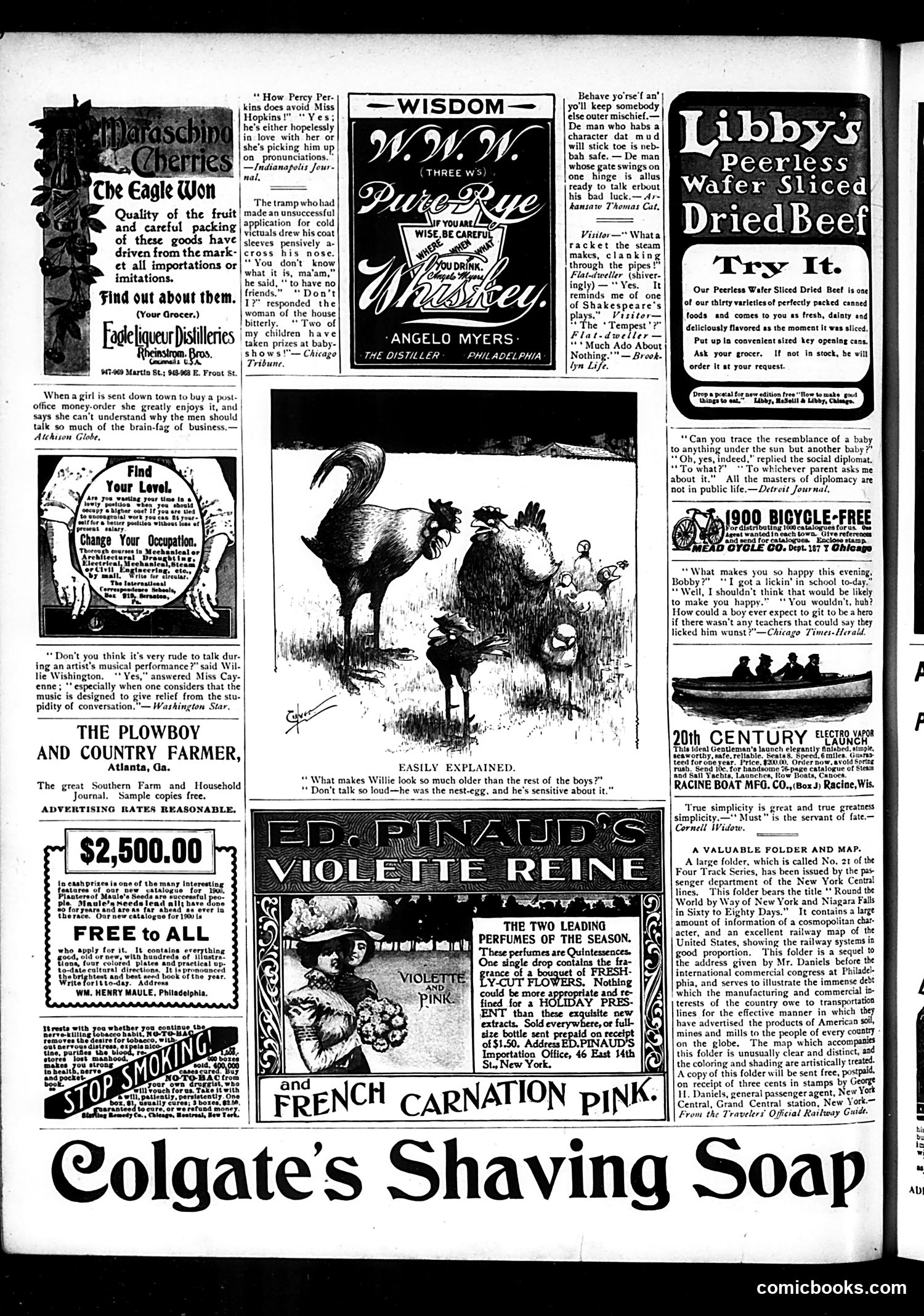
This is primarily an **advertising and humor page** from an early 1900s American satirical magazine. The main content consists of: **Central Cartoon:** "Easily Explained" depicts a boy being asked why his younger brother looks older. The joke relies on period slang—the boy was the "nest-egg" (savings/afterthought child), making him sensitive about his appearance compared to his brother. **Humor Snippets:** Short jokes about social awkwardness—a man avoiding a woman he may be romantically interested in, complaints about steam pipes in apartments, and diplomatic deflection about babies resembling parents. **Advertisements:** The page is dominated by product ads (Colgate's Shaving Soap, dried beef, bicycles, boats) and notices for farming journals and flower seeds—typical of Judge's commercial content. The satire is gentle and domestic, focusing on everyday embarrassments rather than political commentary. The page reflects early 20th-century American middle-class concerns about propriety, courtship, and urban living.
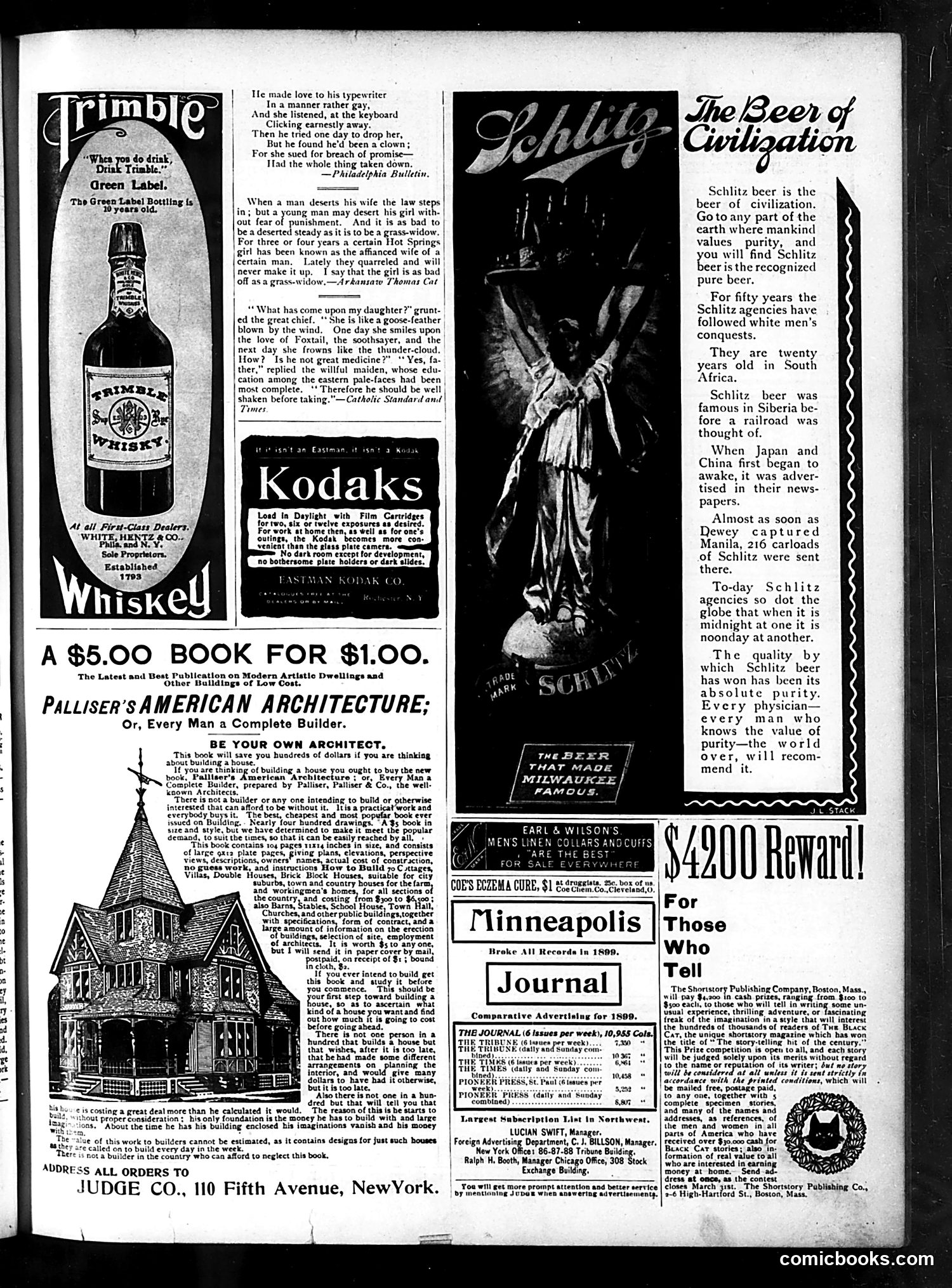
This page is primarily **advertising**, not political satire. It contains several unrelated advertisements mixed with short humorous verses: **Notable Content:** 1. **Trimble Whiskey ad** (left): Standard liquor advertisement with established brand imagery. 2. **Schlitz Beer ad** (right): Emphasizes the beer's "civilization" status and global reach, claiming fifty years of presence worldwide—even in Siberia before railroads existed, and in Manila after Dewey's 1898 capture. This reflects American imperial expansion rhetoric of the era. 3. **Short verses**: Light comic pieces about romance and relationships, typical of Judge's filler content. 4. **Kodak/Eastman ad**: Photography equipment advertisement. 5. **Palliser's American Architecture book**: A $5 book offered for $1—instructional for home builders. 6. **Minneapolis Journal ad**: Newspaper circulation promotion. **Historical context**: The Schlitz ad's references to Dewey and Manila date this to post-1898 Spanish-American War period. The page reflects turn-of-century American optimism about industrial products and imperial reach.
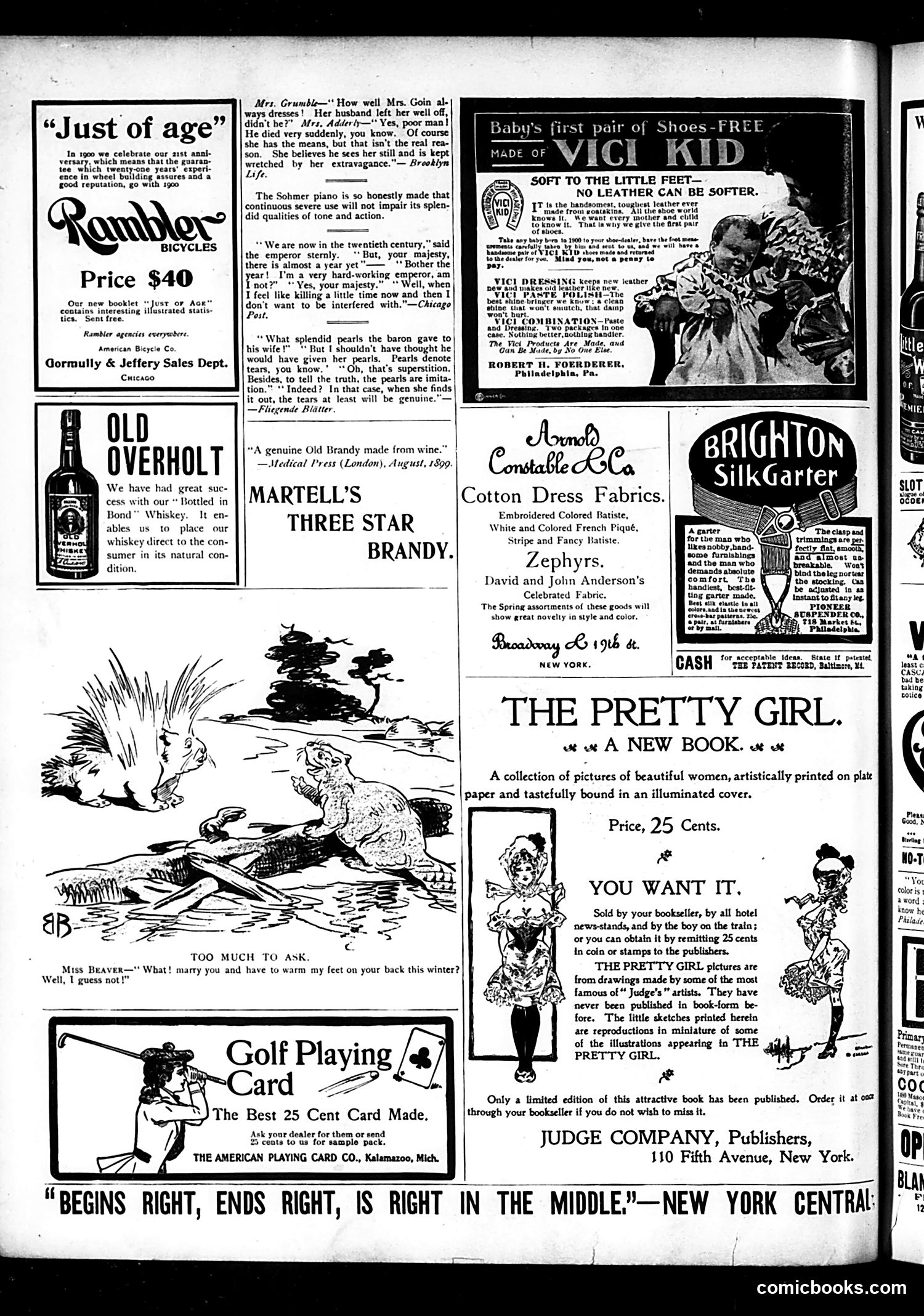
This page is primarily **advertisements and humor pieces**, not political satire. The content includes: **Humor Pieces:** Brief jokes from various publications (Brooklyn Life, Chicago Post, Fliegende Blatter) about marriage, extravagance, and social pretense—typical turn-of-century domestic humor with no specific political content. **Key Cartoon:** The "Too Much to Ask" illustration shows a woman refusing a suitor's marriage proposal because she won't use his back as a footwarmer during winter. This is straightforward romantic comedy, mocking both male presumption and female comfort-seeking. **Advertisements:** The page heavily features consumer goods (bicycles at $40, whiskey, pianos, shoe leather, playing cards, fabric, and a book called "The Pretty Girl" for 25 cents). These ads reflect early 1900s consumer culture and marketing to middle-class readers. **Overall:** This is a typical Judge magazine page mixing light humor with advertisements—no significant political commentary or historical references requiring modern explanation.
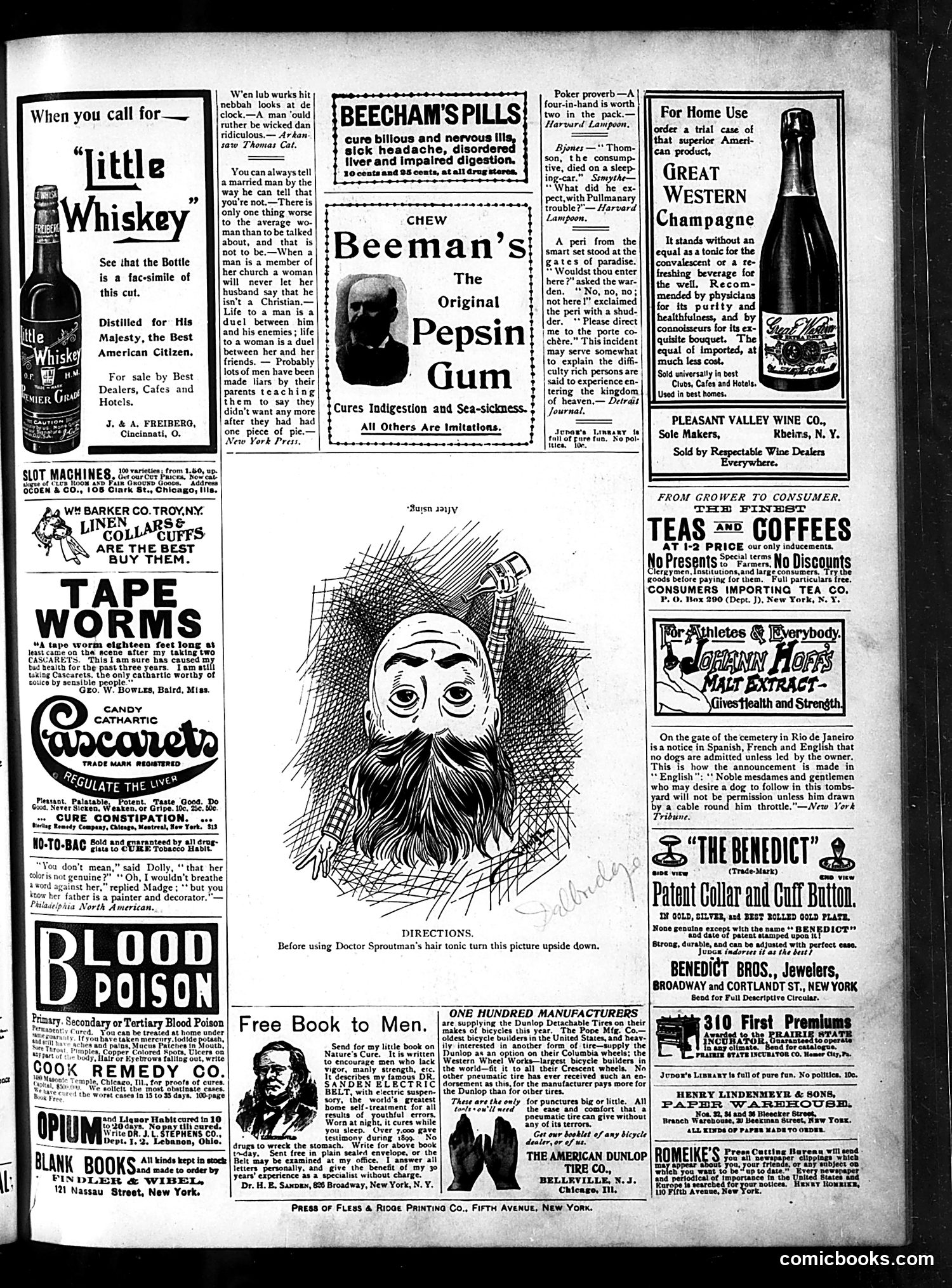
This page is **primarily advertisements** with minimal editorial cartoons. The main visual element is a large caricature of a bearded man's face labeled "Before using Doctor Sproutman's hair tonic turn this picture upside down"—a visual trick common to the era where the image appears different when inverted, likely satirizing dubious patent medicine claims. The page contains numerous product advertisements (Beecham's Pills, Beeman's Pepsin Gum, blood poison remedies, tape worm treatments) typical of Judge's commercial content. Interspersed are short humorous observations and aphorisms about marriage, social behavior, and class differences—the magazine's standard filler material. The only clear satirical content is the hair tonic ad itself, mocking the exaggerated health claims of patent medicines prevalent in early 20th-century advertising. The inverted-image gimmick suggests the product's promises were as unreliable as optical illusions.
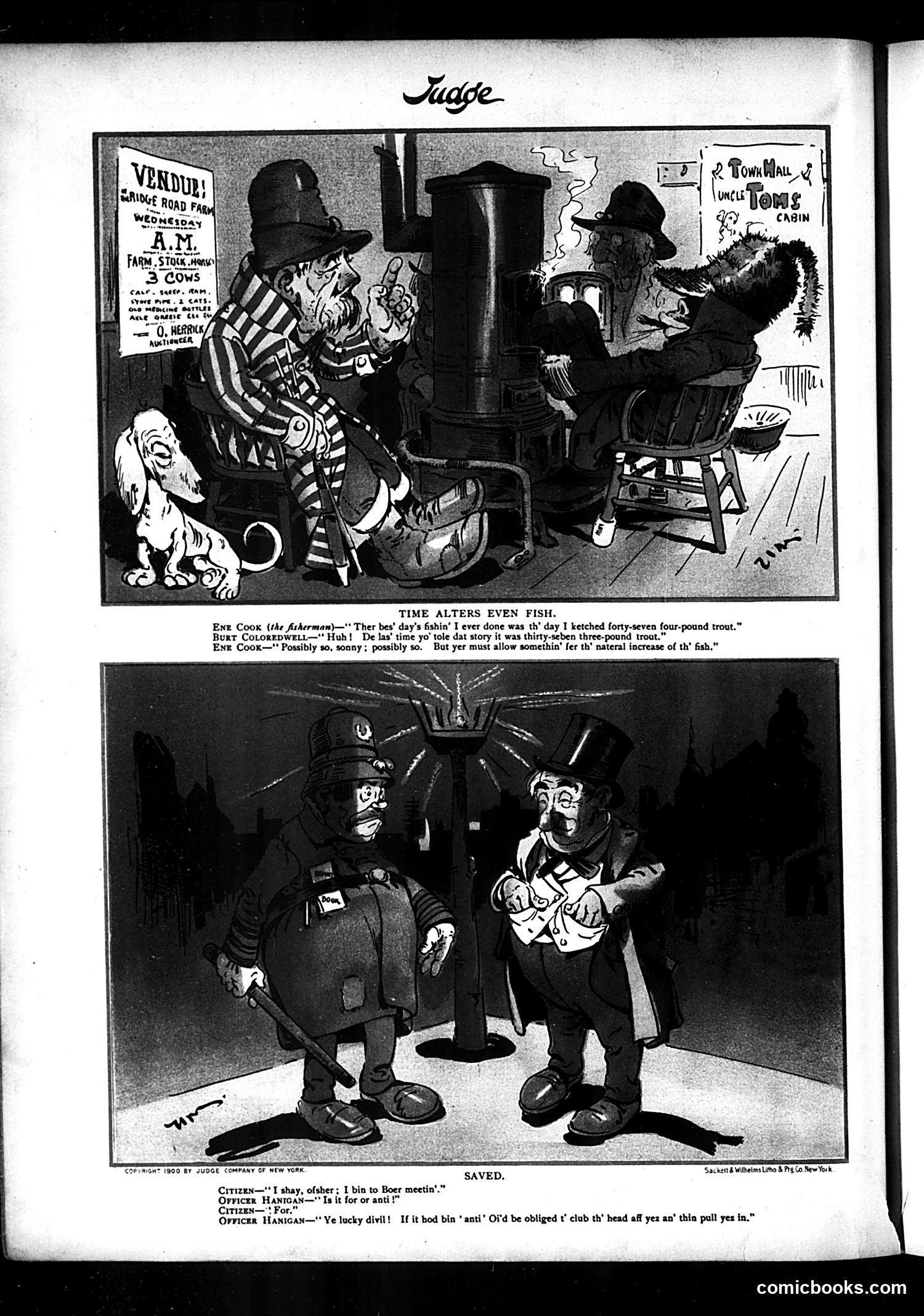
**Top Cartoon ("Time Alters Even Fish"):** Two fishermen dispute a tall tale. One claims his best catch was "forty-seven four-pound trout"; the other recalls him previously saying "thirty-seven three-pound trout." When challenged, the fisherman blames the discrepancy on "the natural increase of the fish"—a humorous excuse for his exaggeration. The joke satirizes how fishermen's stories grow with retelling. **Bottom Cartoon ("Saved"):** An Irish police officer (Officer Hanrahan) stops a citizen, asking if he attended a "Boer meeting." When the citizen says "for" (supporting the Boers), the officer sarcastically remarks he's "lucky"—if the answer had been "anti" (against the Boers), he'd be obliged to beat and arrest him. This likely references the Second Boer War (1899-1902) and Irish-American sympathy for the Boers against British rule, satirizing the officer's biased enforcement.