
Judge, 1900-03-10 · page 4 of 16
Judge — March 10, 1900 — page 4: what you’re looking at
What you’re looking at
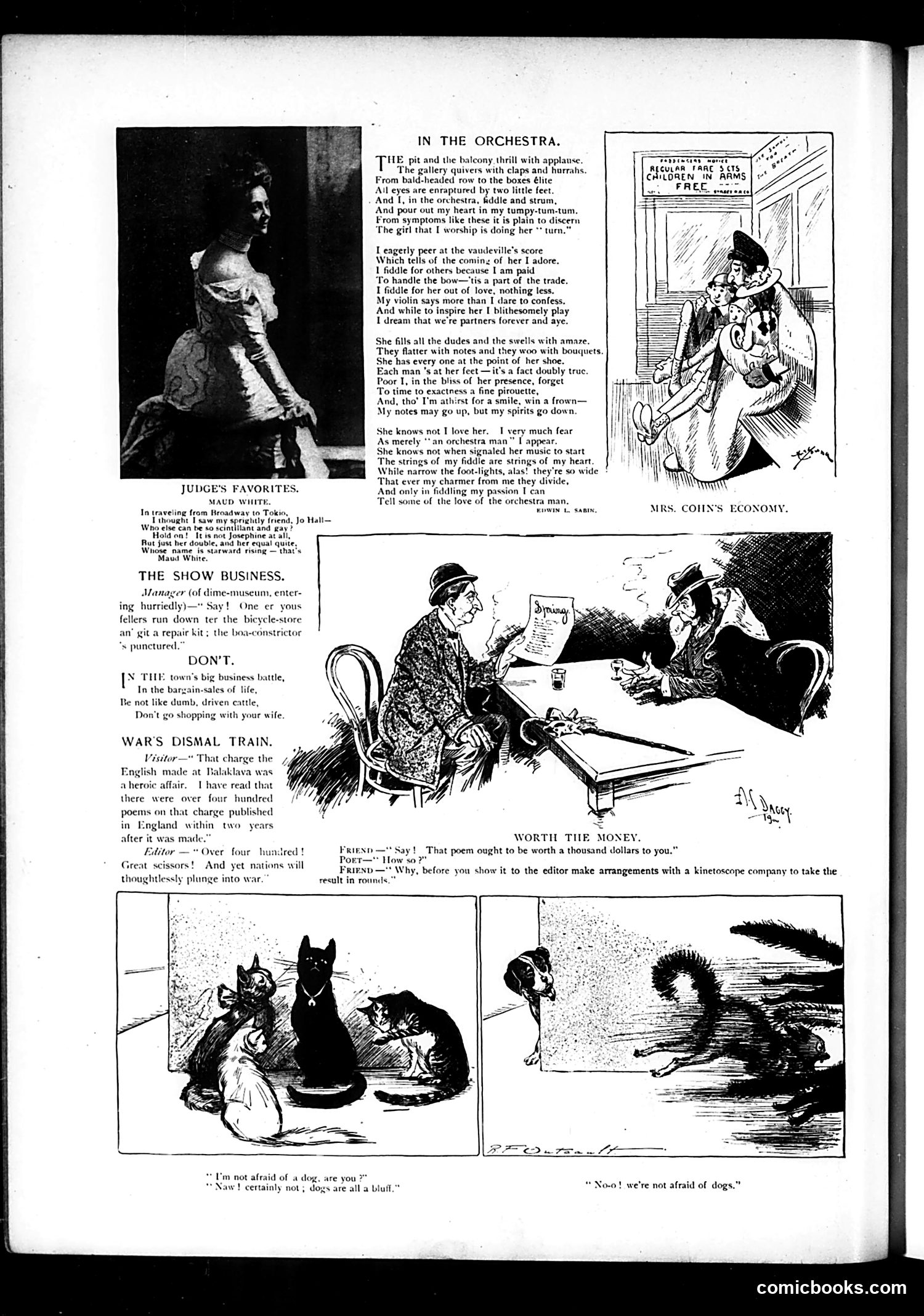
This page contains several distinct satirical pieces: **"In the Orchestra"** (top): A poem about a male musician infatuated with a female performer, expressing jealousy and longing while she plays. The satire mocks romantic obsession in artistic settings. **"The Show Business"** and **"Don't"**: Brief satirical commentary on business dealings and marital dynamics—likely critiquing commercial theater practices and domestic life. **"War's Dismal Train"**: A dialogue between "Visitor" and "Editor" discussing war poetry, satirizing how nations justify military conflict through literary romanticization. **Bottom cartoons**: Two humorous panels showing people with dogs, playing on the phrase "not afraid of dogs" with visual punchlines about dogs' actual fearlessness or aggression. The page blends social commentary on romance, business, war, and everyday life typical of Judge's satirical approach.
📄 Transcribed text from this page (OCR, searchable)
Machine-transcribed from the original scan — historical spelling and the odd misread are preserved.
IN THE ORCHESTRA. HE. pit and the balcony.thrill with applanse The gallery quivers with claps and hurrahs From bald-headed row to the boxes élite Ail eyes are enraptured by two little feet. And I, in the orchestra, fiddle and strum, ‘And pour out my heart in my tumpy-tum-tum, From symptoms like these it is plain to discern ‘The girl that [ worship is doing her “turn.” Leagerly peer at the vaudeville’s score Which tells of the coming of her I adore. 1 fiddle for others because | am paid ‘To handle the bow—'tis a part of the trade, I fiddle for her out of love, nothing less. My violin says more than I dare to confess. And while to inspire her I blithesomely play I dream that we're partners forever and aye. She fills all the dudes and the swells with amaze. They flatter with notes and they woo with bouquets. She has every one at the point of her shoe. Each man 's at her feet —it's a fact doubly truc. Poor I, in the bliss of her presence, forget To time to exactness a fine pirouette, And, tho’ I'm athirst for a smile, win a frown— My notes may go up, but my spirits go down. She knows not I love her. I very much fear As merely ‘*an orchestra man” I appear. She knows not when signaled her music to start he strings of my fiddie are strings of my heart, While narrow the foot-lights, alas! they’ ae ‘That ever my charmer from me they di JUDGE'S FAVORI And only in fiddling my passion T can MAUD WHITE. Tell some of the love of the orchestra man, In traveling from Broadway to Toko HOWIN L. SABIN, T thought I saw my sprightly {rrend, Jo Hall— Woo else can be so selntiilant and gay } Hold on! It is not Josephine at all, Rat just her double, and her equal quite, Whose name is starward rising — that's Maud White. THE SHOW BUSINESS. Manager (of dime-museum, enter- ing hurriedly)— Say! One er yous fellers run down ter the bicycle-store an’ git a repair kit; the boa-constrictor *s punctured.” DON’T, [* THE town’s big business battle, In the bargain-sales of life, Re not like dumb, driven cattle, Don't go shopping with your wife. WAR'S DISMAL TRAIN. Visitor —" That charge the English made at Balaklava was aheroic affair. I have read that there were over four hundred poems on that charge published in England within two years after it was ma WORTH TILE MONEY. Edilée A” ONCE: (out tred! Fates —"* Say! That poem ought to be worth a thousand dollars to you.” Great scissors! And yet nations will Lcceslmalltre tel d Why, before you show it to the editor make arrangements with a kinetoscope company to take the thoughtlessly plunge into war. result in row BPD tT Naw ! certainly not; dogs are all a bluff." “No-o! we're not afraid of dogs.” comicbooks.com