
A complete issue · 16 pages · 1900
Judge — February 24, 1900
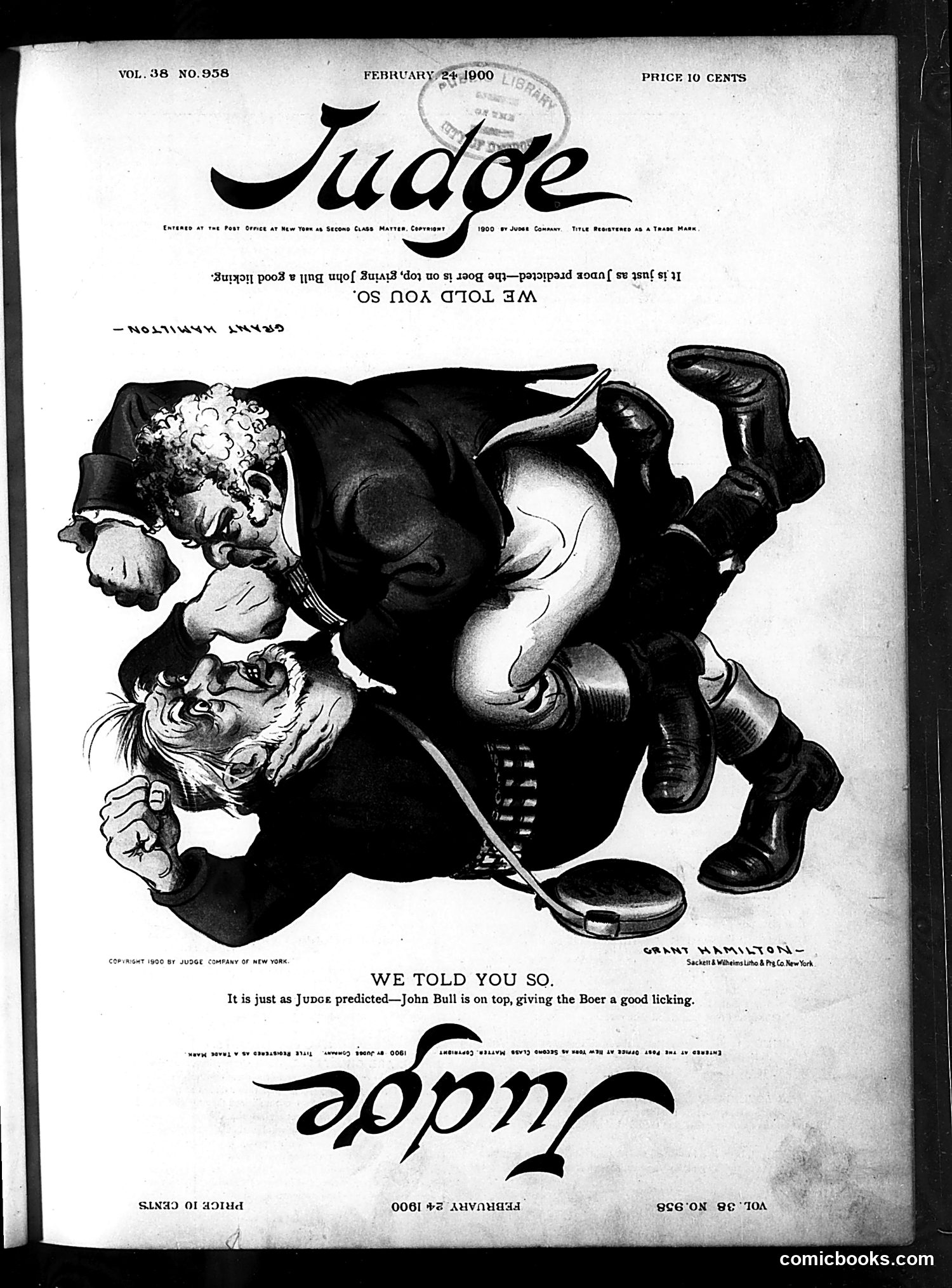
This satirical cartoon by Grant Hamilton depicts a corpulent man in formal attire being tossed upside-down, holding two grotesque puppet heads. The caption states: "WE TOLD YOU SO. It is just as Judge predicted—John Bull is on top, giving the Boer a good licking." This references the Second Boer War (1899-1902) between Britain and the South African Boer republics. The figure represents John Bull (Britain), while the puppet heads likely represent the Boers. The cartoon celebrates Britain's military dominance, suggesting Judge magazine had earlier predicted this outcome. The grotesque caricatures and physical humiliation reinforce period attitudes toward the conflict, presenting Britain's victory as inevitable and just.
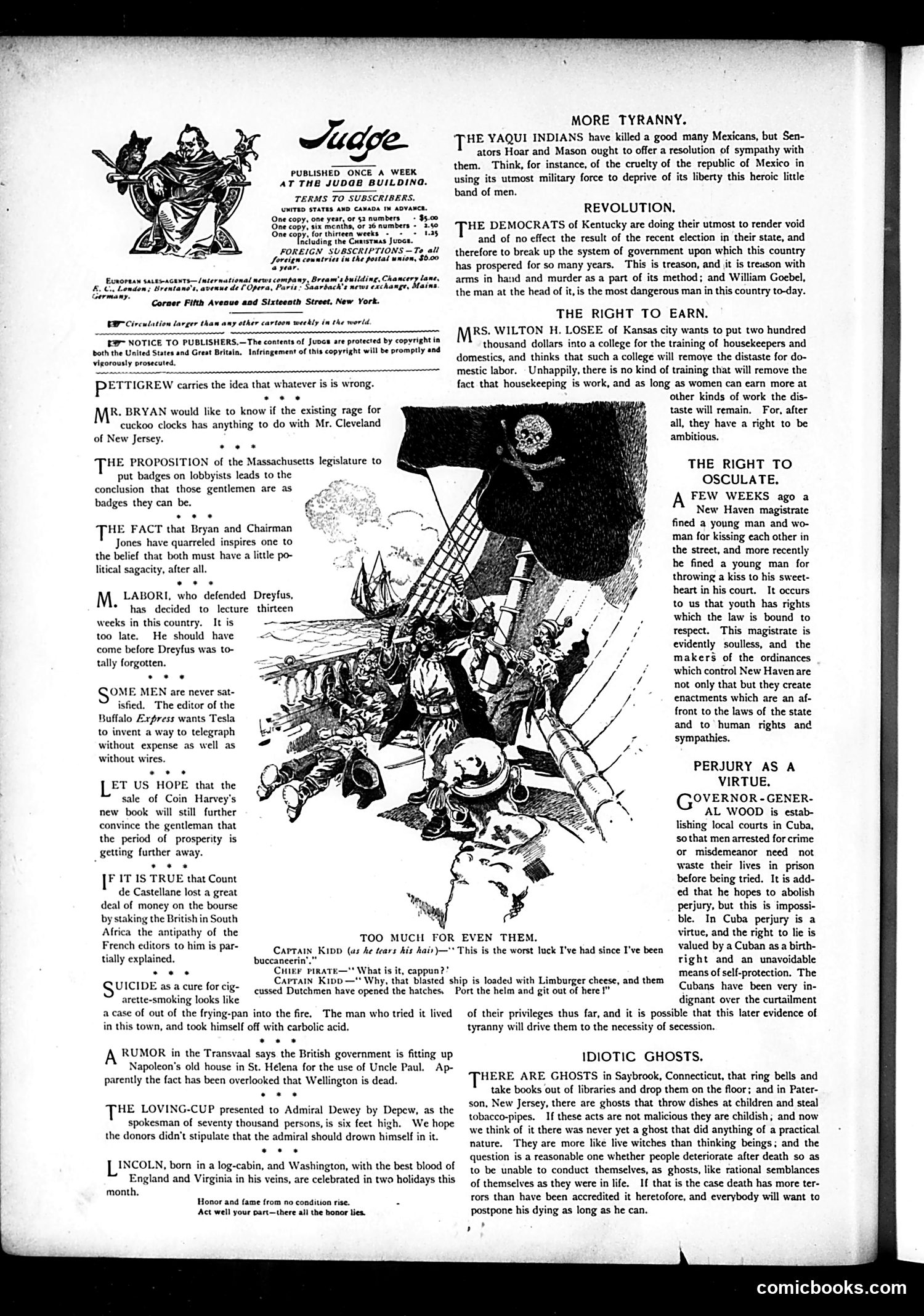
The central cartoon depicts a chaotic shipboard scene with sailors and cargo in disarray. The caption reads: "CAPTAIN KIDD (to a very lazy buccaneers):—'This is the worst luck I've had since I've been a buccaneers.'" The accompanying text references a ship "loaded with Limburger cheese" with a "Port the helm and git out of here!" The satire appears to mock a situation involving extremely unpleasant cargo—Limburger cheese being notoriously foul-smelling. The joke equates even notorious pirate Captain Kidd finding conditions unbearable, suggesting the cheese's odor surpasses even criminal depravity as something intolerable. The cartoon satirizes American commercial excess or poor quality goods through this absurdist comparison, though the specific historical context remains unclear from this excerpt alone.
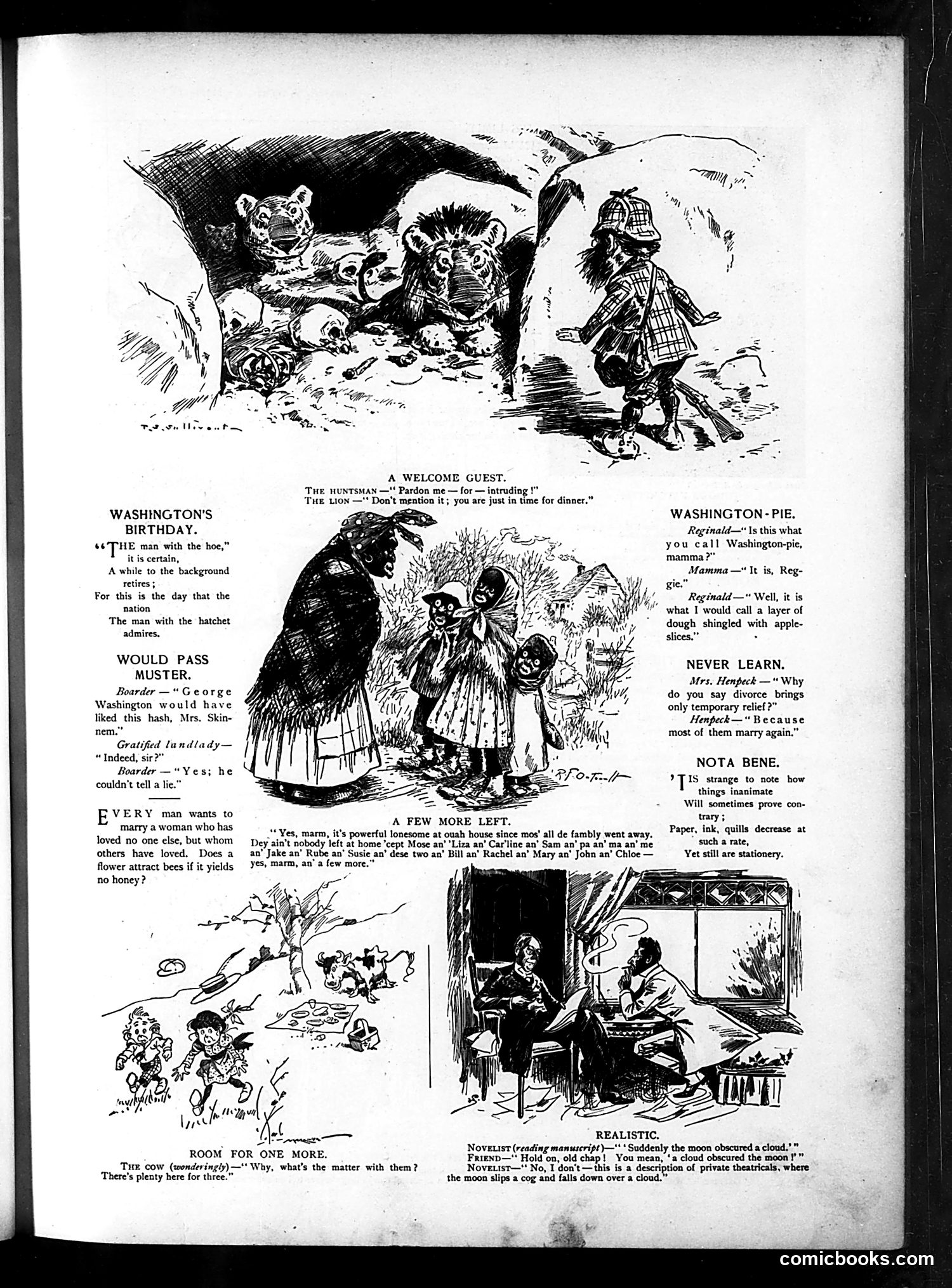
This page contains multiple unrelated satirical pieces and jokes typical of Judge magazine's format. **Top cartoon**: "A Welcome Guest" depicts a huntsman arriving at a lion's den, playing on the phrase "just in time for dinner"—dark humor about being consumed. **Other segments** include jokes about Washington's Birthday, a "Would Pass Muster" quip about George Washington, and various domestic humor pieces like "Washington-Pie," "Never Learn" (about divorce), and "Room for One More" (featuring a cow). The cartoons use visual caricature and wordplay rather than specific political commentary. "Realistic" at bottom appears to mock overwrought literary descriptions of natural phenomena. The overall page reflects late 19th/early 20th-century American humor: family situations, animal jokes, and puns rather than topical satire.
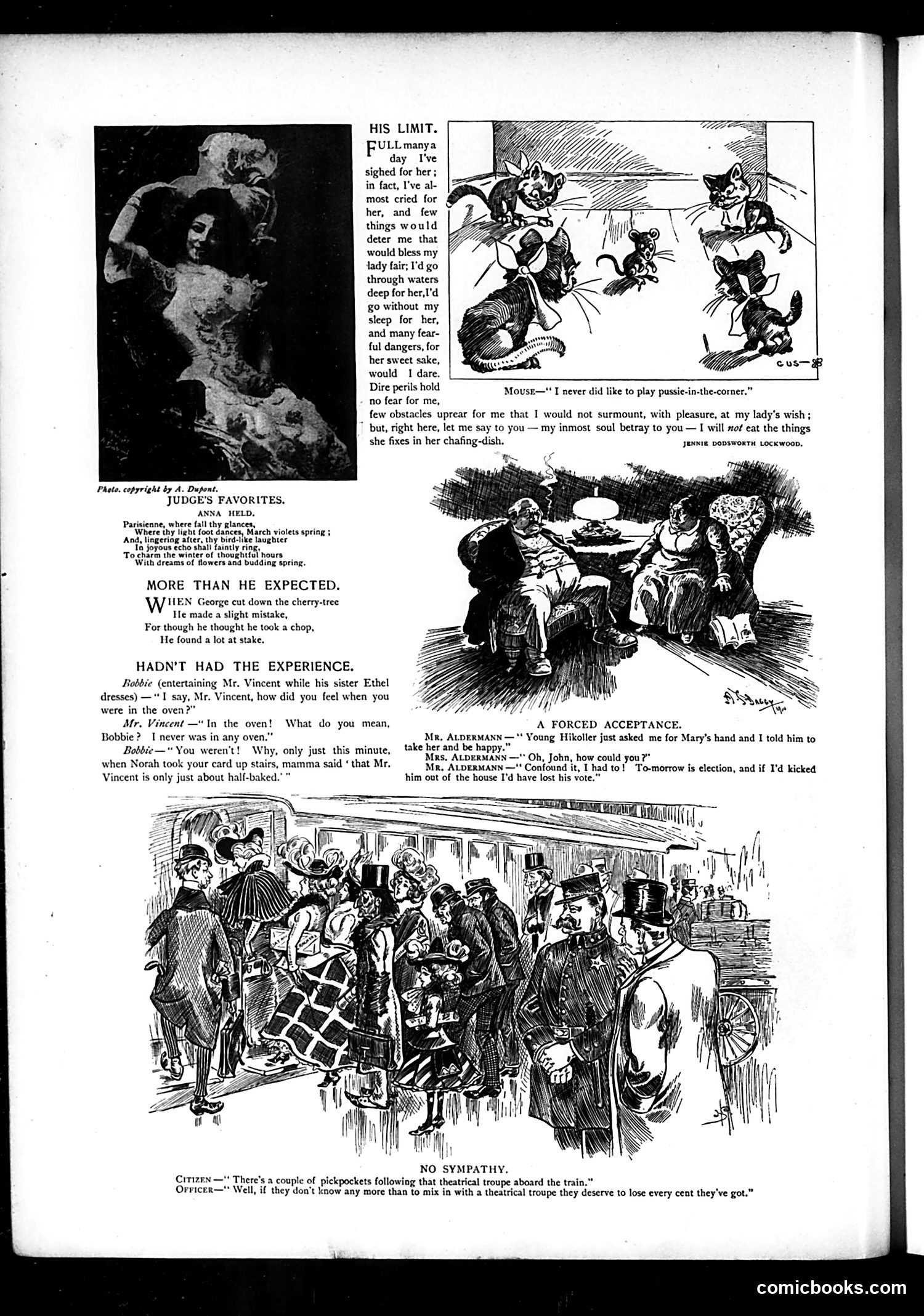
This page contains several humorous sketches and anecdotes typical of early Judge magazine's satirical format. **"His Limit"** features cats playing "pussy-in-the-corner," illustrating a pun on the children's game. **"Judge's Favorites"** is a poem about "Anna Held," likely referencing the popular actress/performer of that era. **"More Than He Expected"** jokes about George cutting down a cherry tree—referencing the apocryphal Washington legend. **"Hadn't Had the Experience"** is a domestic comedy about cooking incompetence. **"Forced Acceptance"** depicts a young suitor's proposal rejection. **"No Sympathy"** shows a train scene where pickpockets target theatrical performers, with commentary that theater folk deserve financial losses for their dishonesty. The page emphasizes wordplay, domestic comedy, and social observation rather than political commentary.
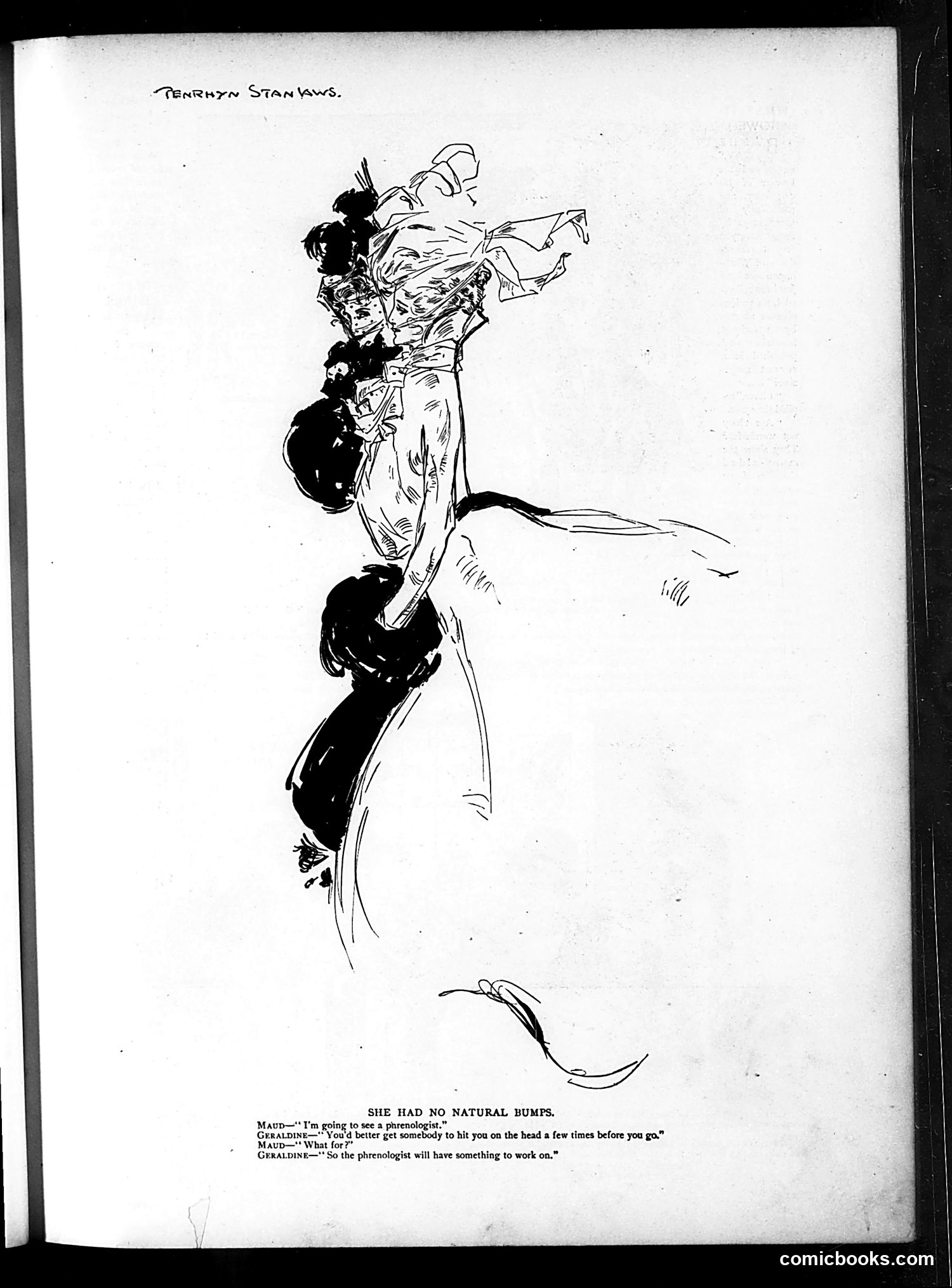
This satirizes **phrenology**, the pseudoscience claiming skull shape revealed character and mental abilities. The joke: Maud plans visiting a phrenologist, but her friend Geraldine suggests she needs someone to bash her head first—implying Maud has no natural "bumps" (skull protrusions) for the phrenologist to analyze, so they'd need to *create* some. The cartoon mocks both phrenology's absurdity and insults Maud's intelligence. Though phrenology was already debunked by the early 1900s when *Judge* published, it persisted in popular culture, making it ripe for ridicule. The female characters and petty insult humor reflect the magazine's typical approach to women's topics.
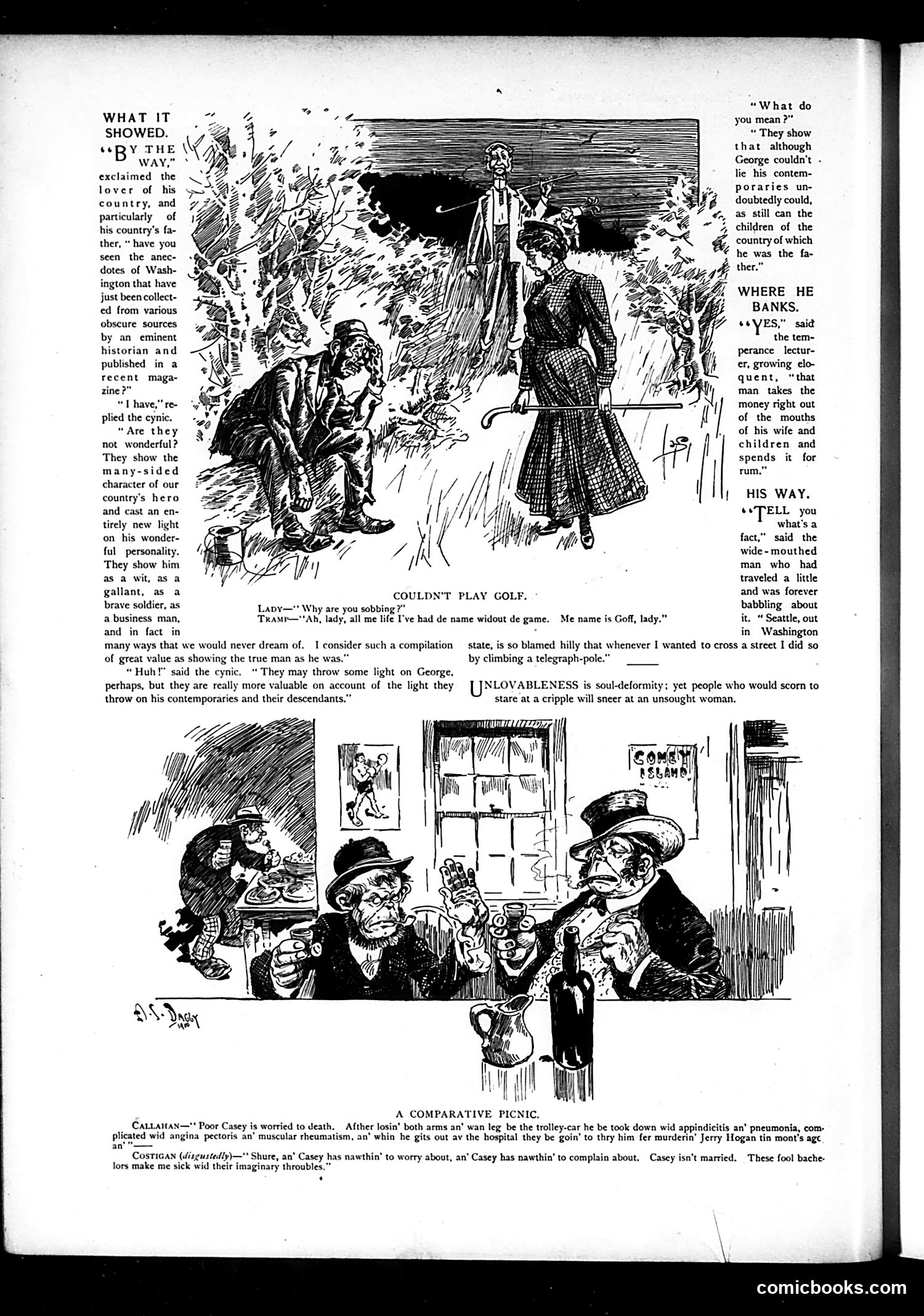
This page contains three distinct satirical pieces: **"Couldn't Play Golf"**: A tramp named Goff laments having his name without the leisure activity—social commentary on class and access to recreation. **"Where He Banks"**: A temperance lecture scene mocking working-class men who spend household money on alcohol instead of supporting families. The drunk figure represents the moral failing targeted by temperance advocates. **"A Comparative Picnic"**: Two Irish-American characters (Callahan and Costigan, indicated by dialect) discuss their friend Casey's catastrophic misfortunes—lost limbs, disease, murder charges—yet Costigan argues unmarried men have it worse. The joke inverts sympathy: marriage is presented as worse than physical devastation, mocking both bachelor complaints and Irish-immigrant stereotypes. The page reflects early 20th-century American anxieties: class divisions, alcohol's social impact, and ethnic humor targeting Irish immigrants. The satirical tone assumes readers share contempt for both drunkenness and male self-pity.
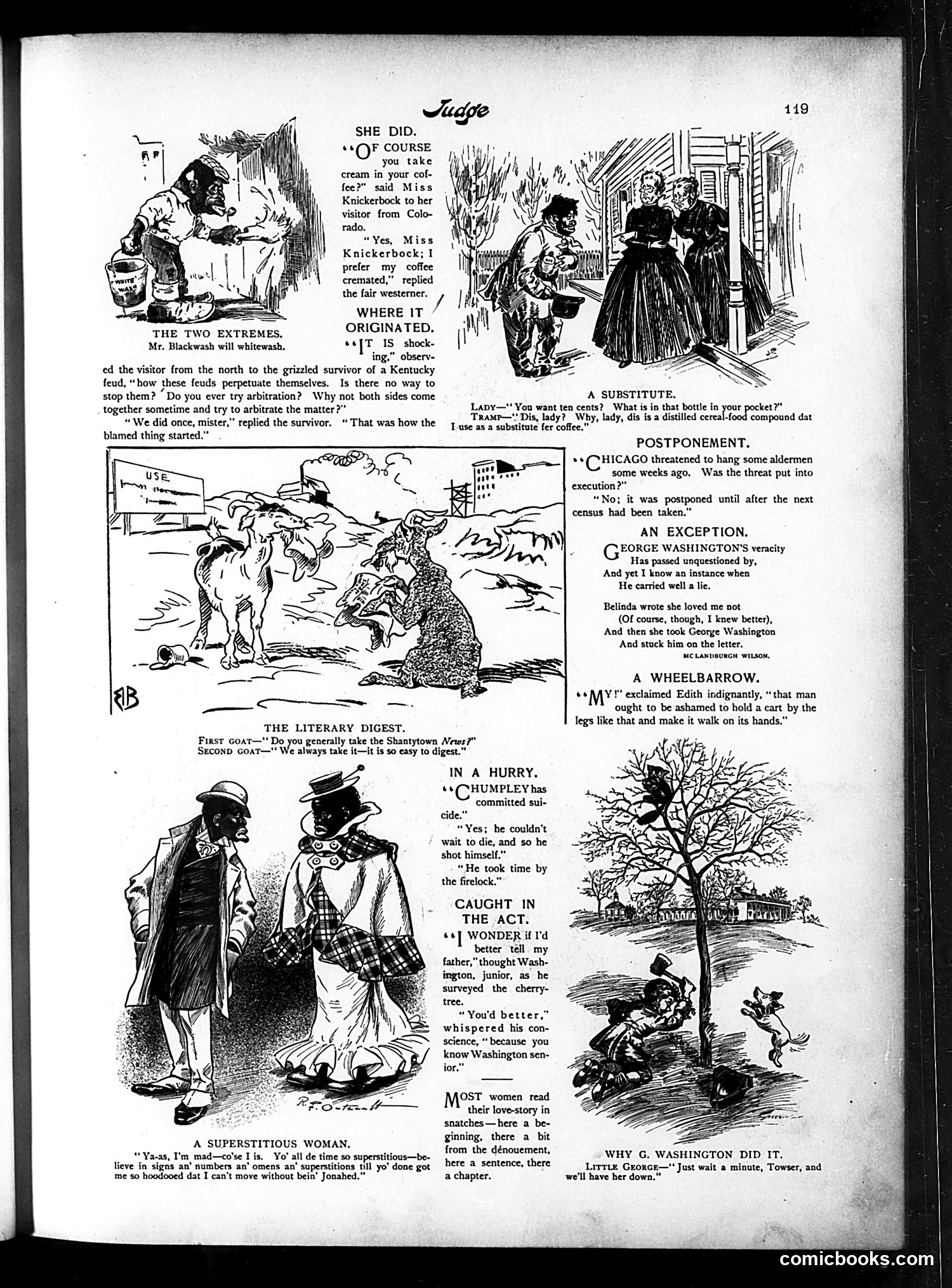
This page contains multiple brief satirical jokes typical of Judge's humor, circa early 1900s: **"She Did"**: A pun on "cremated" coffee—the Colorado visitor mishears/mispronounces "cream" as "cremated," creating absurdist humor. **"The Two Extremes"**: Contrasts Northern and Southern attitudes toward violence. The Kentucky feudist reveals arbitration ironically *started* their feud, satirizing rural backwardness and cycles of violence. **"The Literary Digest"**: A newspaper joke about reading difficulty—comparing newspaper layers to coat applications. **"A Superstitious Woman"**: Mocks superstitious African American speech patterns and beliefs (period stereotyping). **"A Substitute"**: Mocks Prohibition-era substitutes for alcohol, calling it "cereal compound" while clearly being liquor. **"George Washington" items**: Play on the cherry-tree legend, with the child consulting conscience and threatening the dog. The page reflects Judge's mix of puns, ethnic stereotypes, political jabs, and literary wordplay typical of Gilded Age satire.
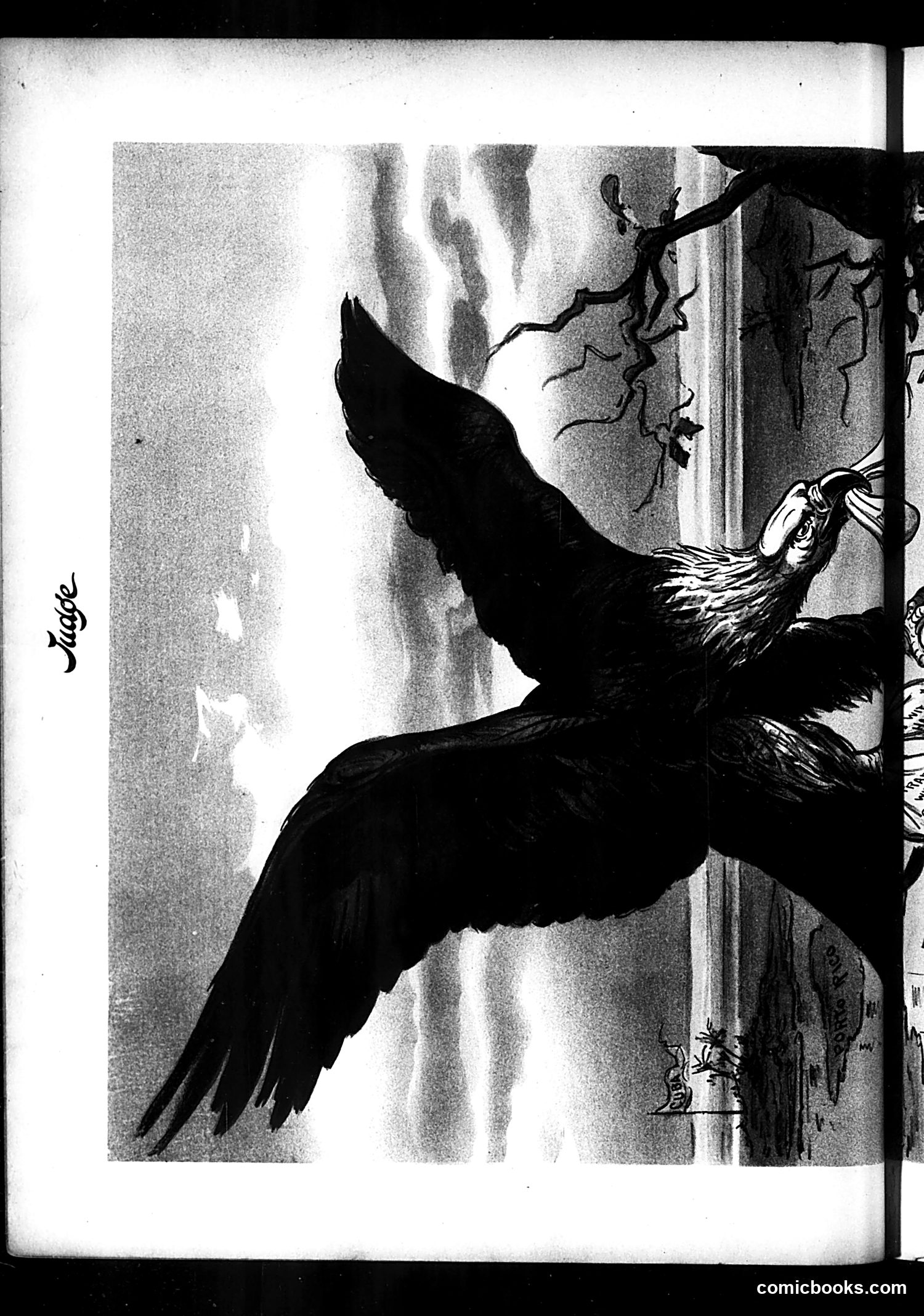
This appears to be a satirical illustration from *Judge* magazine showing a large black rooster in an aggressive posture, wings spread and striking downward at smaller figures below. The rooster's exaggerated stance and threatening demeanor suggest a commentary on aggressive or domineering behavior, likely political or social in nature. The artist's signature "Judge" appears on the left margin. The small figures being attacked appear to be climbing or struggling on what looks like an architectural element, possibly representing the common man or a political opposition being threatened by a powerful force represented by the rooster. Without additional context or visible text explaining the specific reference, the precise political meaning remains unclear, though the image clearly satirizes power imbalance and aggression.
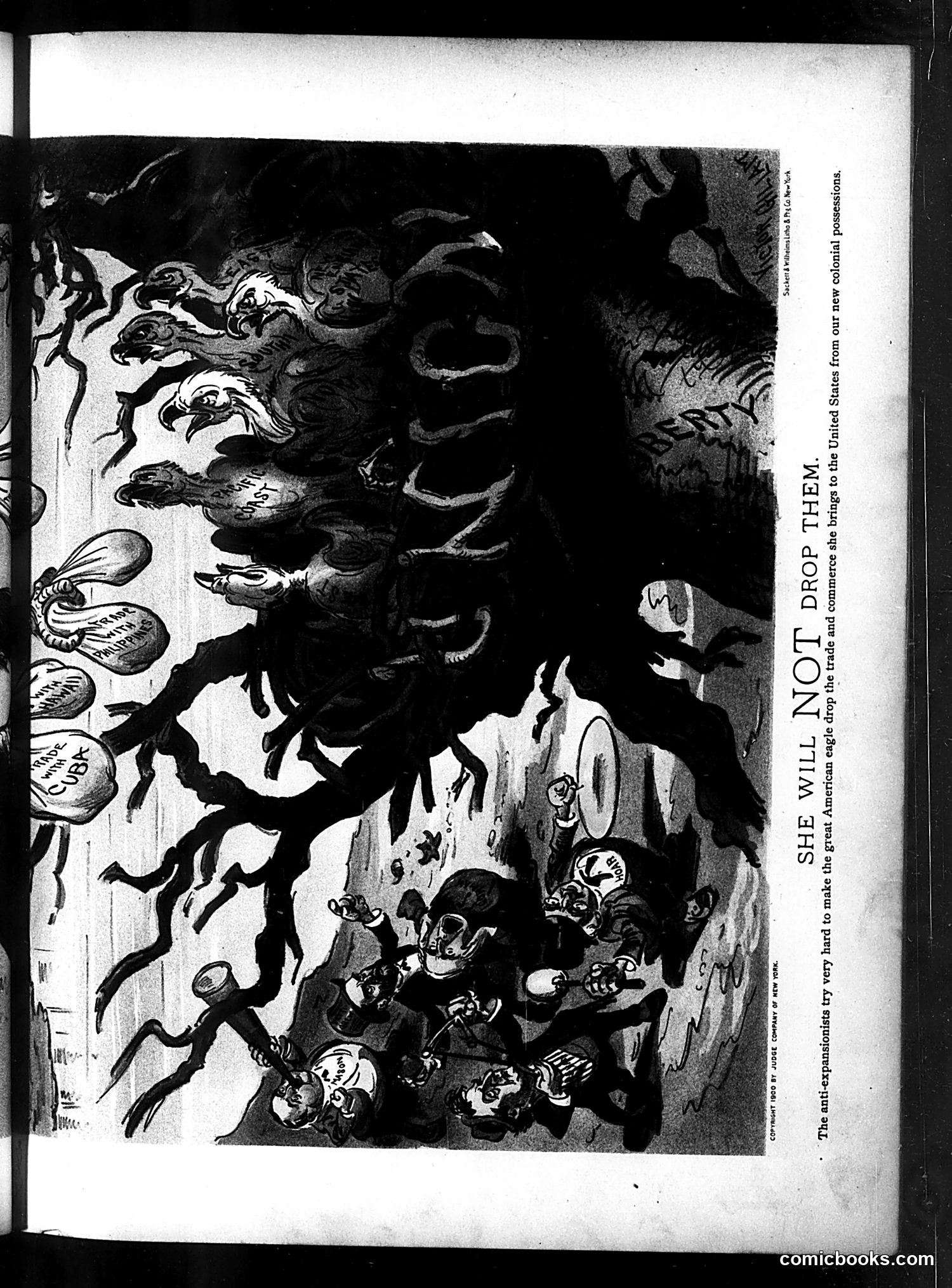
This political cartoon depicts a woman (likely representing the United States or a female political figure) refusing to release several serpents or demonic creatures she's grasping. The caption "SHE WILL NOT DROP THEM" suggests the cartoon criticizes a political figure or administration for refusing to abandon certain policies or positions despite pressure. The OCR text is heavily corrupted and largely unreadable, making precise identification of the specific historical moment difficult. Based on the Judge magazine's satirical style and the imagery of dangerous creatures being deliberately retained, this appears to critique either: - A politician clinging to unpopular or harmful policies - Resistance to relinquishing controversial positions during political debate Without clearer text or dating information visible in the image, I cannot definitively identify which specific political controversy or figures this targets. The artistic style suggests early-to-mid 20th century publication.
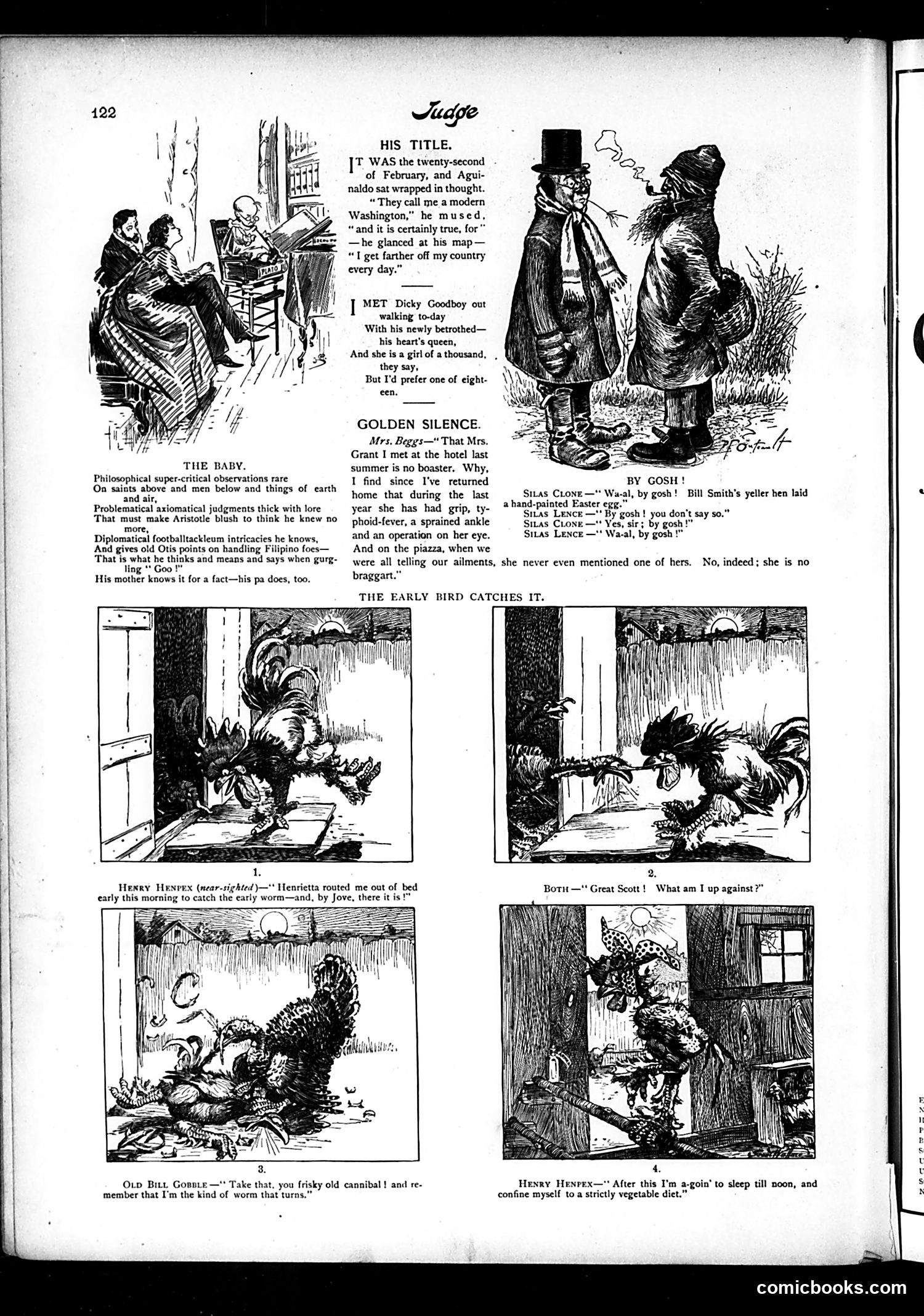
This page contains multiple satirical pieces typical of Judge magazine's commentary on American life and politics circa the early 1900s. **"His Title"** mocks Filipino resistance leader Aguinaldo by having him compare himself to George Washington while admitting he's actually "getting farther off my country every day"—a jab at the Philippine-American War and the insurgency's failing position. **"The Baby"** humorously critiques verbose pseudo-intellectual fathers who pontificate pretentiously while speaking baby talk, impressing no one but themselves. **"Golden Silence"** praises a woman's discretion in not bragging about her ailments, contrasting with the common social habit of cataloging one's medical complaints. **"The Early Bird Catches It"** depicts roosters and hens in a comic scenario where Henry Henper complains about being roused early, then decides to stay awake and eat only vegetables—a gentle satire on health fads and domestic absurdities. The humor relies on recognizable American social types and contemporary anxieties rather than specific current events (except Aguinaldo).
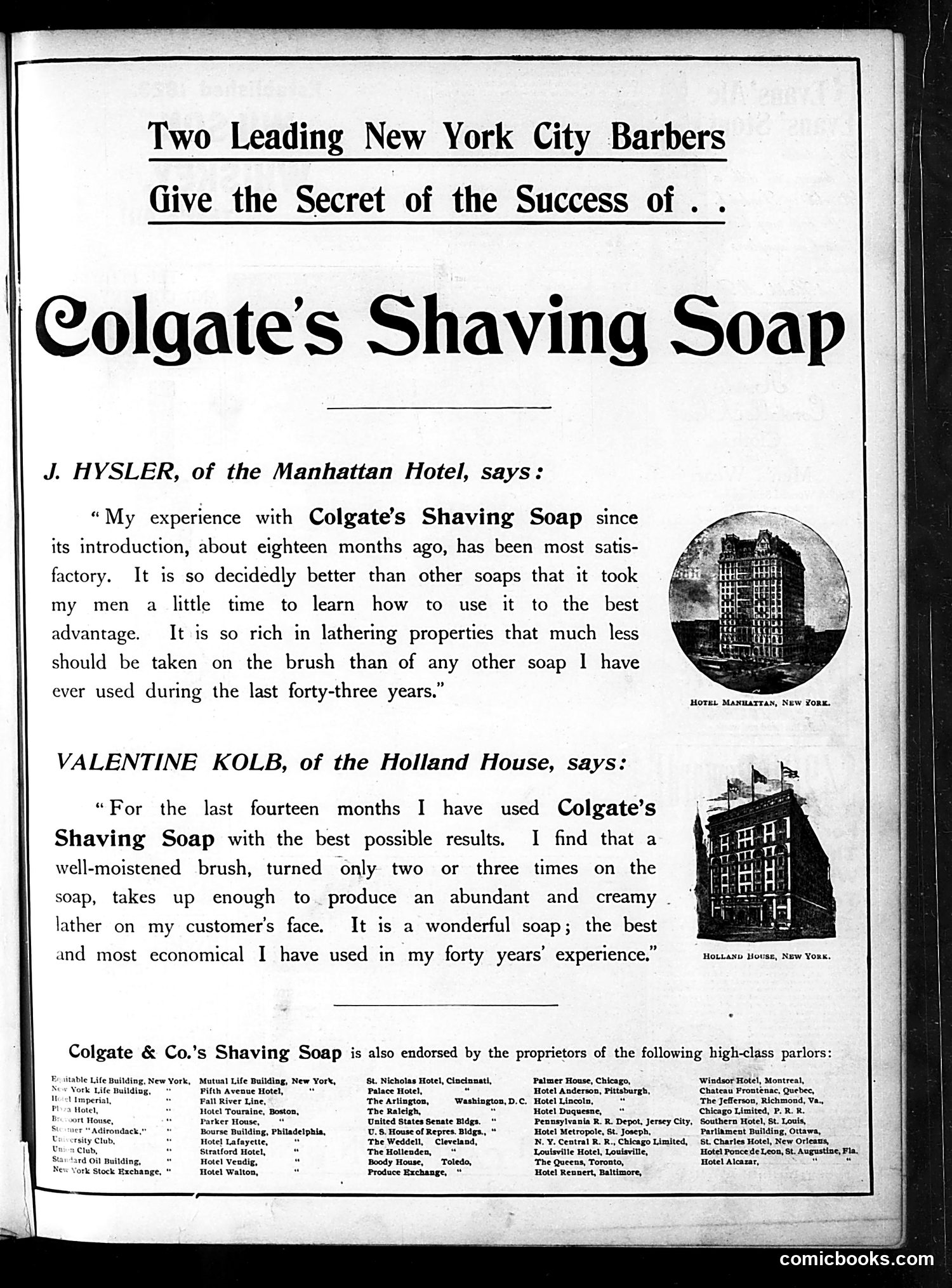
This page is **not a cartoon or satire**—it's a straightforward **product advertisement** for Colgate's Shaving Soap appearing in Judge magazine. Two prominent New York City barbers (J. Hysler of the Manhattan Hotel and Valentine Kolb of the Holland House) provide testimonials endorsing the soap's superior lathering properties and economy. Both claim decades of barbering experience and praise how little soap is needed compared to competitors. The advertisement then lists dozens of prestigious hotels, government buildings, and clubs across America that allegedly use the product, lending it credibility through association with high-class establishments. This represents early 20th-century advertising strategy: using expert endorsements and institutional prestige to market consumer goods. There is no political commentary or satire present—merely commercial promotion using the magazine's pages.
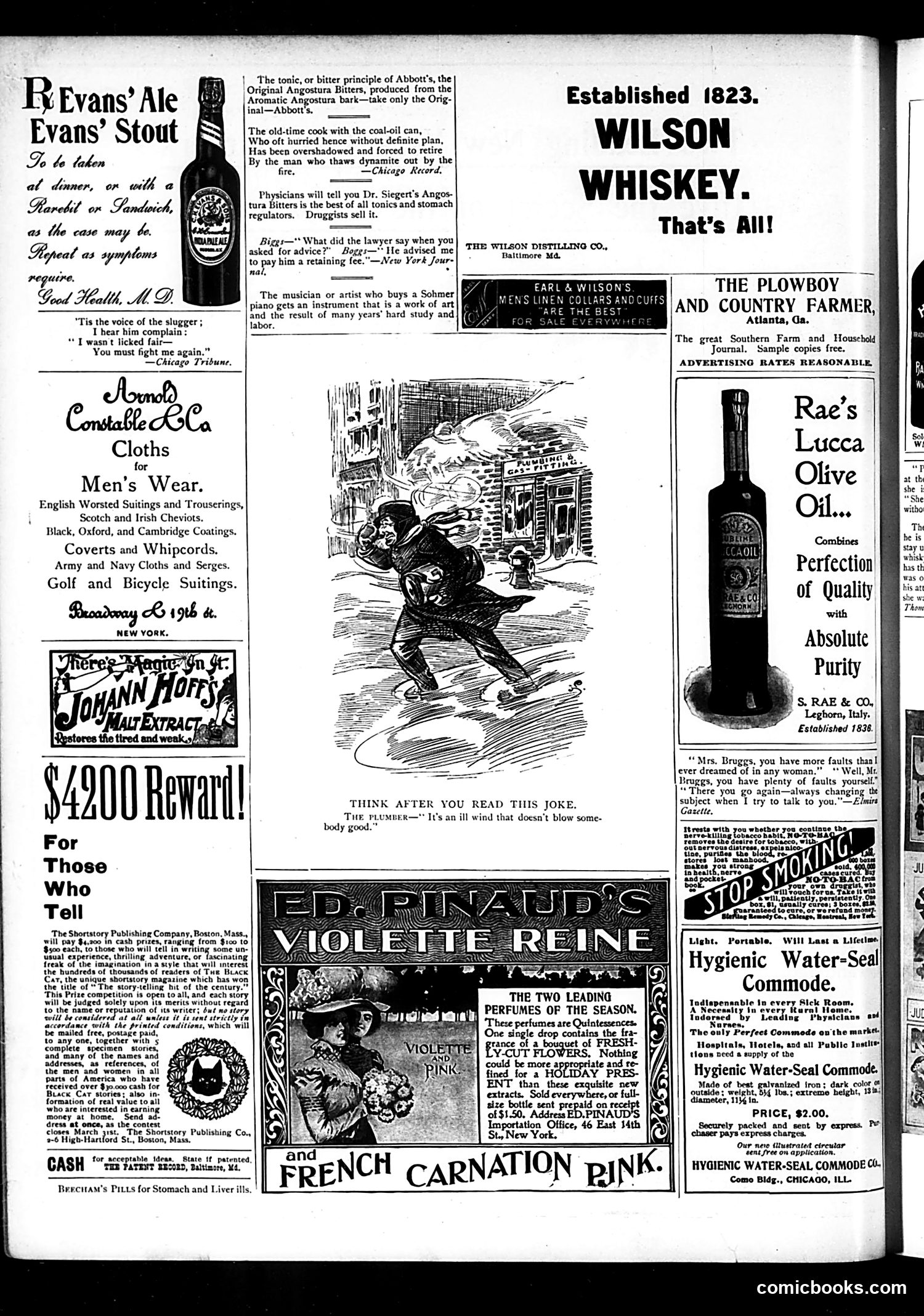
This page is primarily **advertising** rather than political satire. It contains multiple product advertisements for beverages (Evans' Ale and Stout, Wilson Whiskey, Rae's Lucca Olive Oil), clothing (Arnold Constable), and household items (Hygienic Water-Seal Commode). The one cartoon present—captioned "THINK AFTER YOU READ THIS JOKE"—depicts a plumber slipping on ice with the accompanying punchline about "ill wind." This is a mild visual gag with no political content. The page also includes several brief jokes and anecdotes (about lawyers, married couples arguing) typical of Judge's lighter humor content, but these lack satirical political significance. The most notable feature is a large advertisement for a short-story writing competition offering $4,200 in prizes, suggesting Judge's parent company actively promoted creative writing contests to readers.
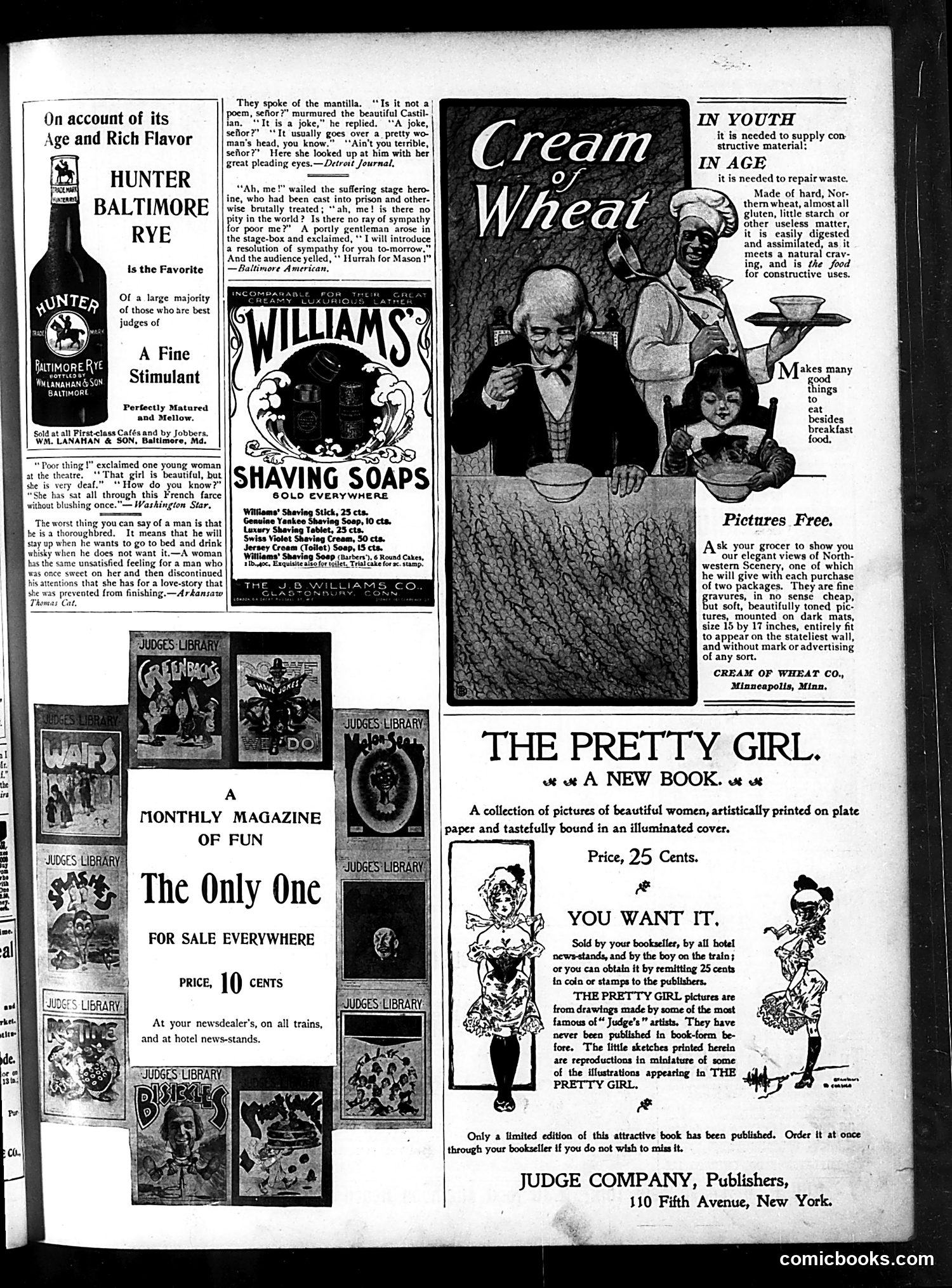
This page is primarily **advertising with brief humorous anecdotes** rather than political cartoons. The jokes are genteel parlor humor typical of early 1900s magazines: **The anecdotes** mock social pretension and gender stereotypes—a woman's virtue questioned for not blushing at French theater; a stage actress's theatrical suffering met with bureaucratic mockery from an audience member offering parliamentary sympathy ("Mason" appears to reference a politician); wordplay about mantillas and a gentleman's jokes going "over a pretty woman's head." **The advertisements** include: - Hunter Baltimore Rye whiskey (targeting "best judges") - Williams' Shaving Soaps - Cream of Wheat cereal (positioned as nutritious for youth and age) - Judge's Library entertainment series (10 cents) - "The Pretty Girl" book (25 cents—a collection of illustrations of beautiful women) The page reflects Gilded Age/Progressive Era commercialism and period attitudes toward women's appearance and intellect, marketed through seemingly sophisticated humor in a satirical magazine aimed at educated, affluent readers.
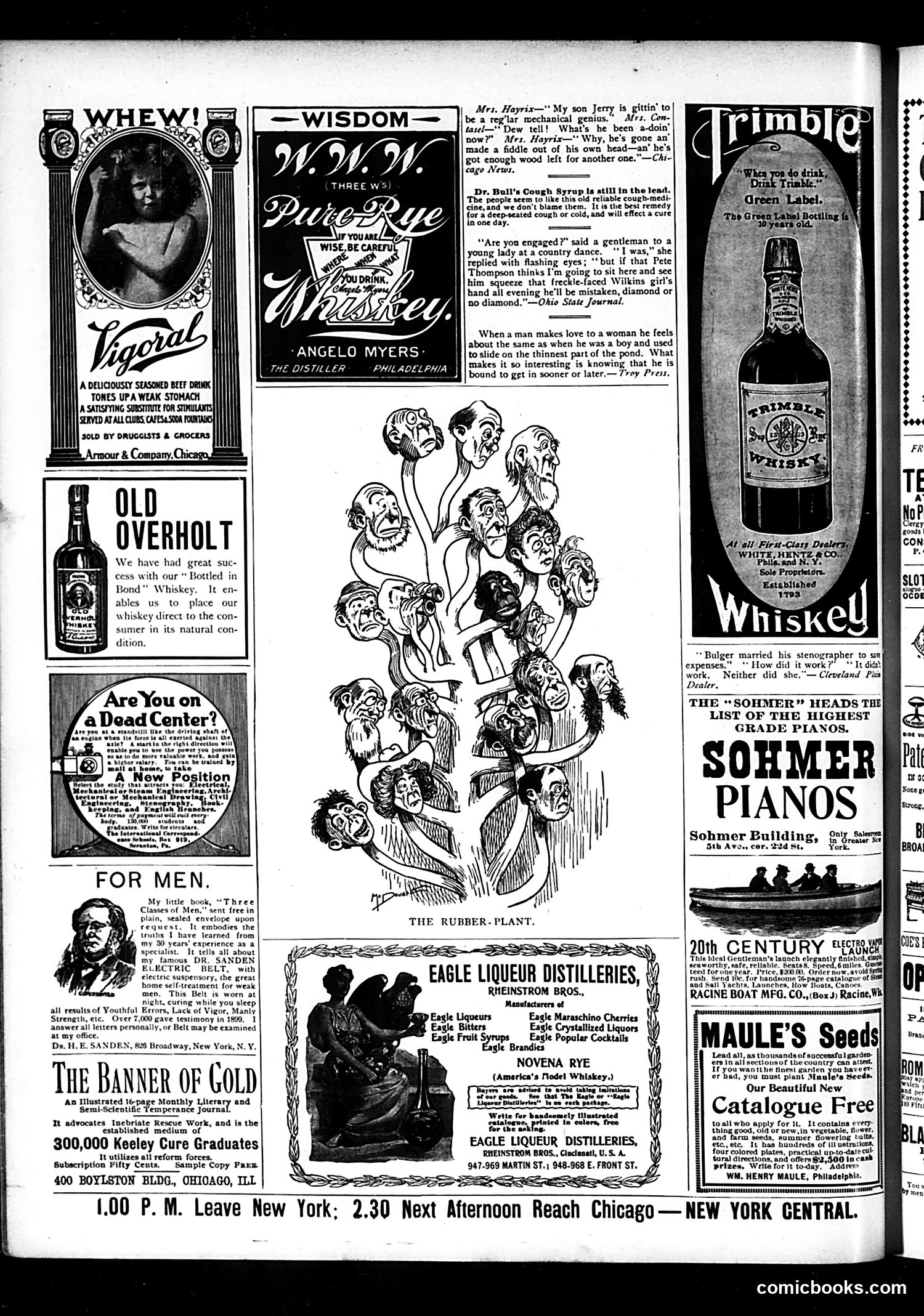
This page is predominantly **advertisements** with several short humorous anecdotes rather than political cartoons. The central satirical cartoon, "The Rubber-Plant," depicts exaggerated human heads sprouting from a plant's branches—likely mocking the era's fascination with pseudo-scientific ideas about heredity and human "breeding" or eugenics, popular pseudoscience in the early 1900s. The brief jokes scattered throughout reflect period attitudes: one mocks a mother's pride in her son's "mechanical genius" (making a fiddle from scrap wood), another satirizes broken engagements and romantic jealousy at country dances, and a third jokes about a man marrying his stenographer to save money—only for expenses to increase. The advertisements—for whiskey, Dr. Sanden's electric belts (dubious "male vigor" treatments), pianos, and seed catalogs—represent typical Judge content, mixing legitimate products with patent medicines and fraudulent health devices targeting men's insecurities, common in publications of this era.
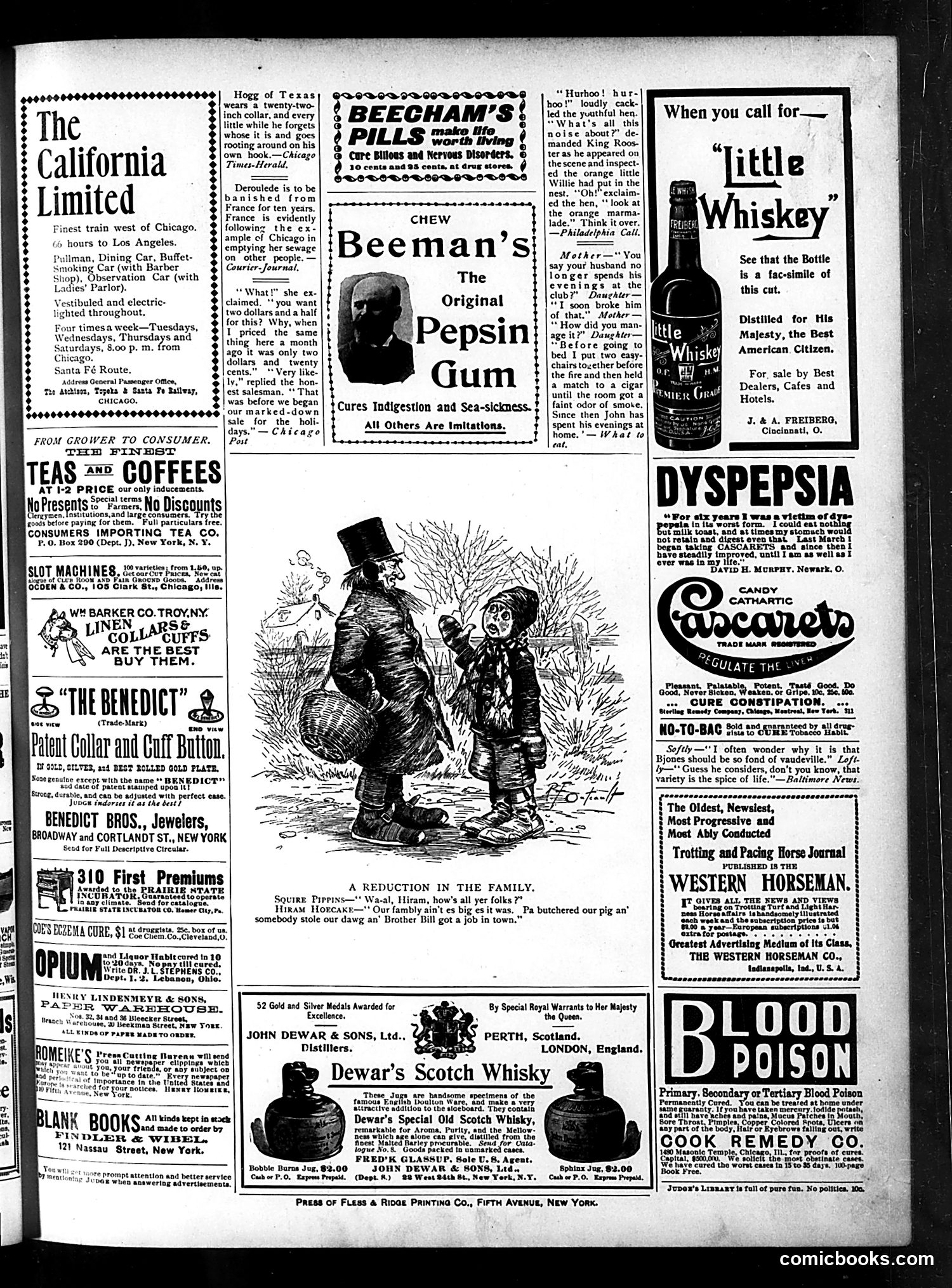
This page is primarily a collection of advertisements rather than a satirical cartoon. The main cartoon titled "A Reduction in the Family" depicts a rural conversation between two men—apparently farmer "Squire Pirpin" and another character named Hiram Horcaxe. The humor derives from the Double meaning of "reduction": while one might expect it to mean a smaller family (people), Hiram clarifies it means only that his family butchered their pig and someone stole their dog—so their household is still the same size in people, though reduced in animals. It's a simple rustic/rural joke playing on the ambiguity of the word "reduction." The remainder of the page contains period patent medicine and consumer goods advertisements typical of Judge magazine's revenue model.
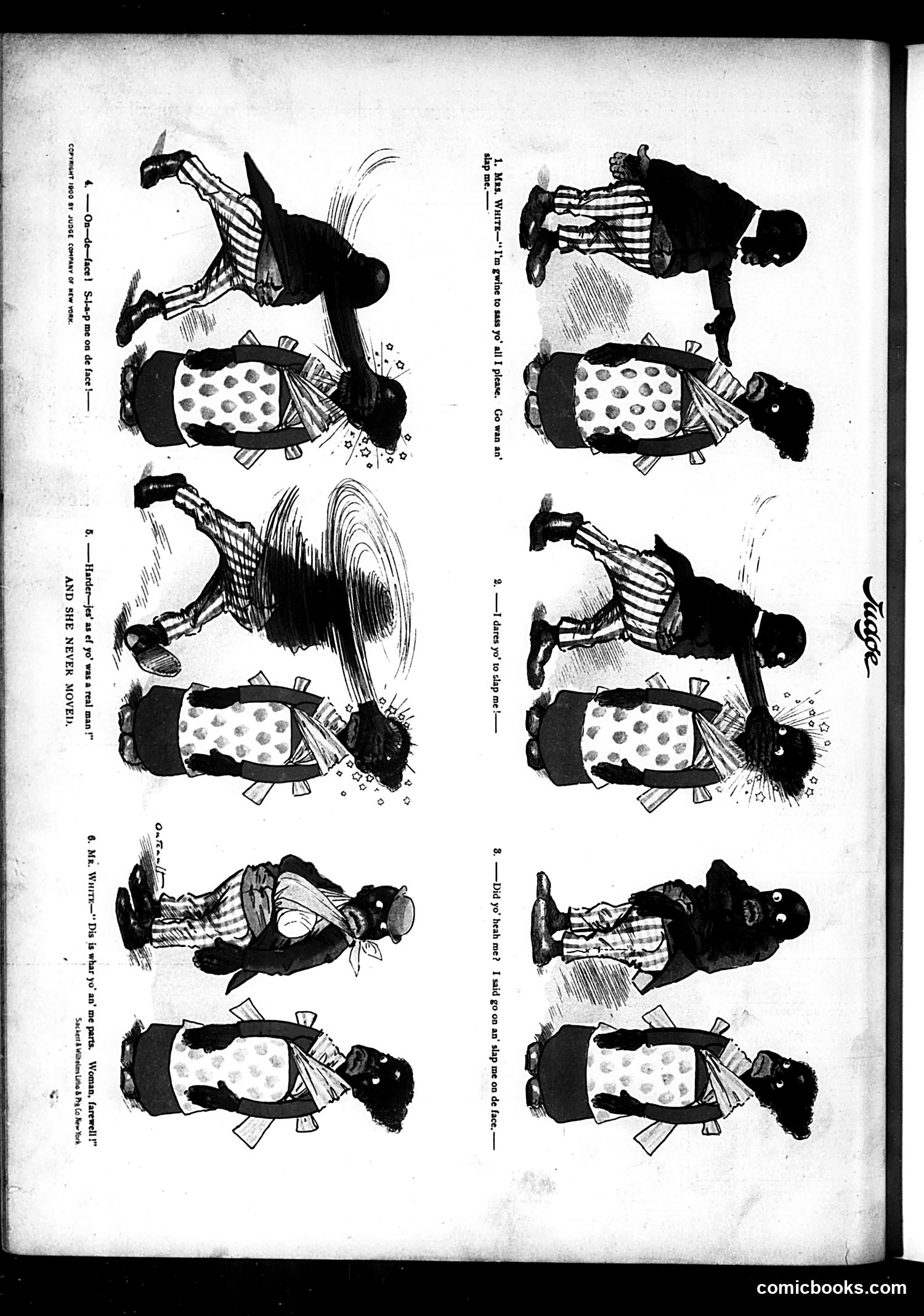
This is a racist comic strip from Judge magazine (circa 1900) depicting a domestic dispute between two Black characters using exaggerated dialect and caricature. The sequence shows a woman (labeled "Mrs. Wittre") challenging her husband to strike her, progressively escalating her taunts ("slap me," "harder," "on the face"). The husband ultimately leaves her ("dis is whar yo' an' me parts"). The satire appears to mock Black domestic relationships through cruel stereotypes—presenting African American couples as prone to violence and crude behavior. The humor relied on audiences' racist assumptions about Black people. The title "AND SHE NEVER MOVED" suggests the wife's defiance. This represents the deeply racist content common in late-19th/early-20th century American popular media, reflecting contemporary prejudices that today would be recognized as offensive caricature and dehumanization.