
A complete issue · 16 pages · 1900
Judge — February 3, 1900
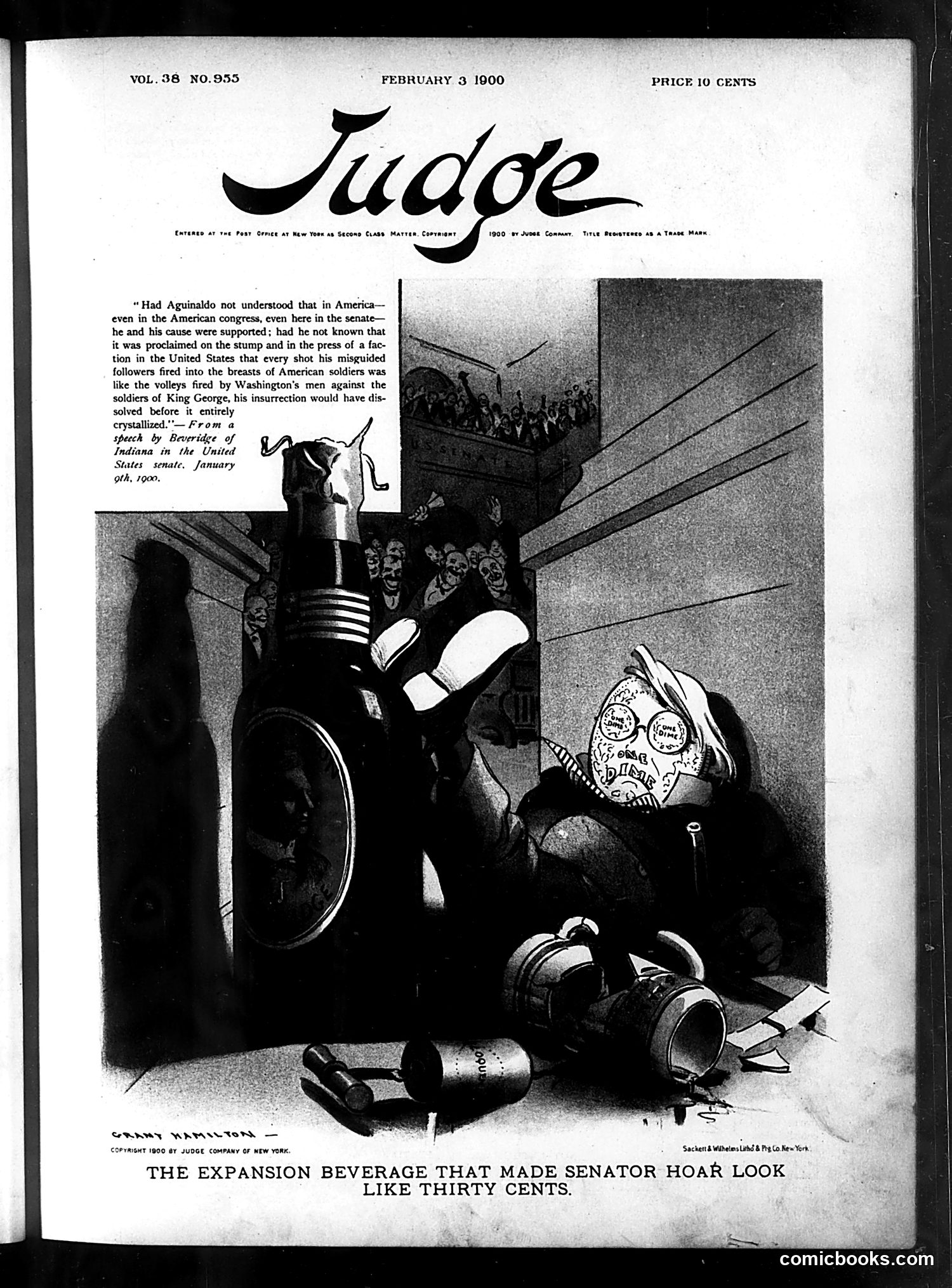
This 1900 political cartoon by Grant Hamilton criticizes Senator Beveridge of Indiana (identified in the quote attribution). The central image shows an explosion labeled "expansion beverage" occurring in what appears to be the Senate chamber, with figures blown back by the blast. The satire mocks Beveridge's support for American imperial expansion—a major political debate of 1900. The explosion metaphor suggests his expansionist rhetoric is dangerous and destabilizing. The quote above references accusations that expansion supporters fired upon American soldiers, comparing them unfavorably to Revolutionary War patriots. The "thirty cents" reference in the caption likely alludes to economic costs or concerns about expansion policy. Hamilton's cartoon presents expansion advocacy as reckless political extremism that threatens American institutions and values.
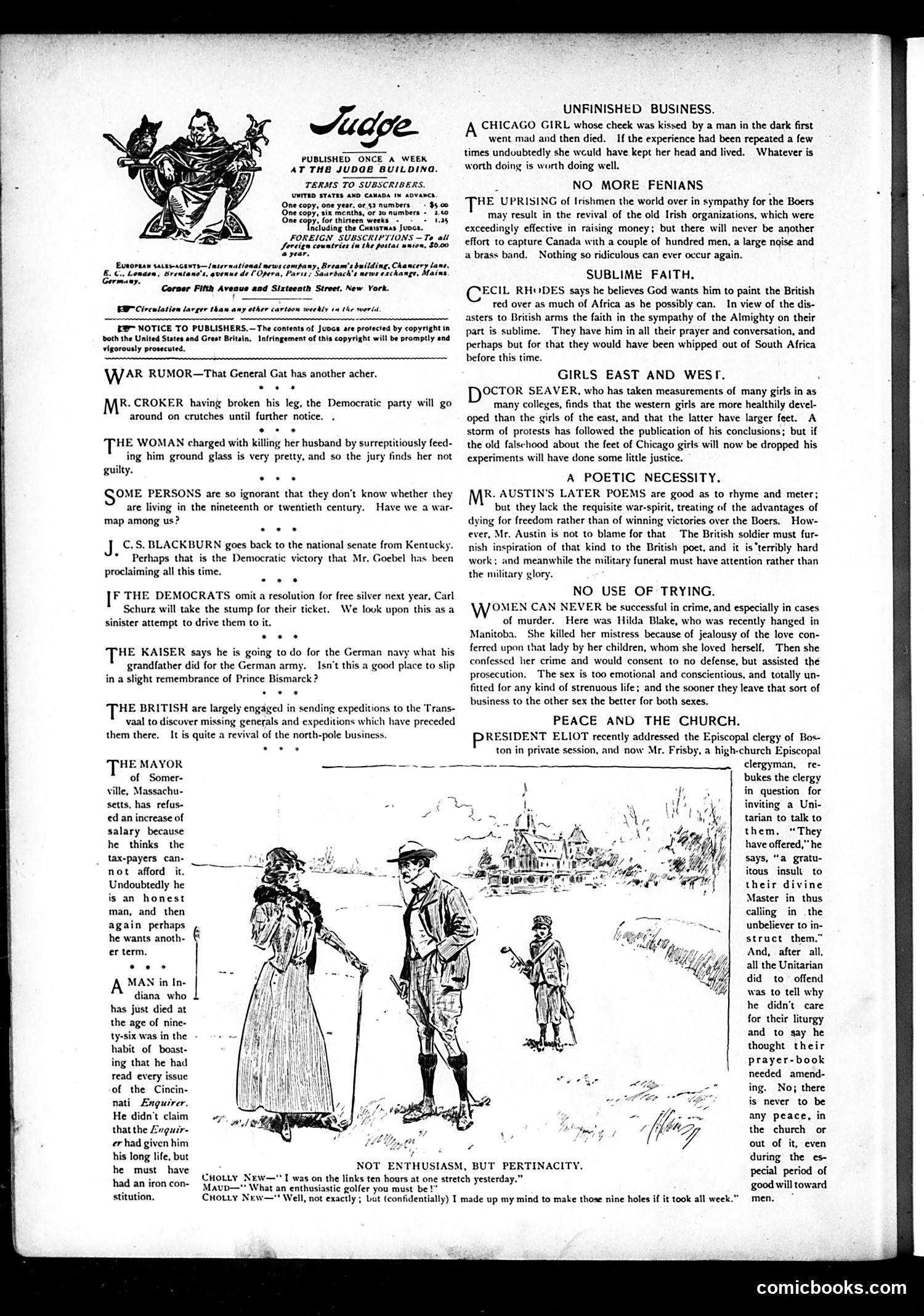
The main cartoon, titled "NOT ENTHUSIASM, BUT PERTINACITY," depicts a conversation between a woman and a man on a golf course. The woman says she was on the links ten hours yesterday, and the man asks what an enthusiastic golfer she must be. She replies that she's not enthusiastic—she made up her mind to make those nine holes if it took all week. The satire mocks excessive determination and stubbornness disguised as sporting enthusiasm. Rather than genuine passion for golf, the woman represents obsessive persistence—playing far longer than reasonable to complete just nine holes. The joke criticizes this joyless, grinding approach to recreation, suggesting it's more about stubborn willpower than actual enjoyment of the sport. It's social commentary on misplaced values in leisure activities.
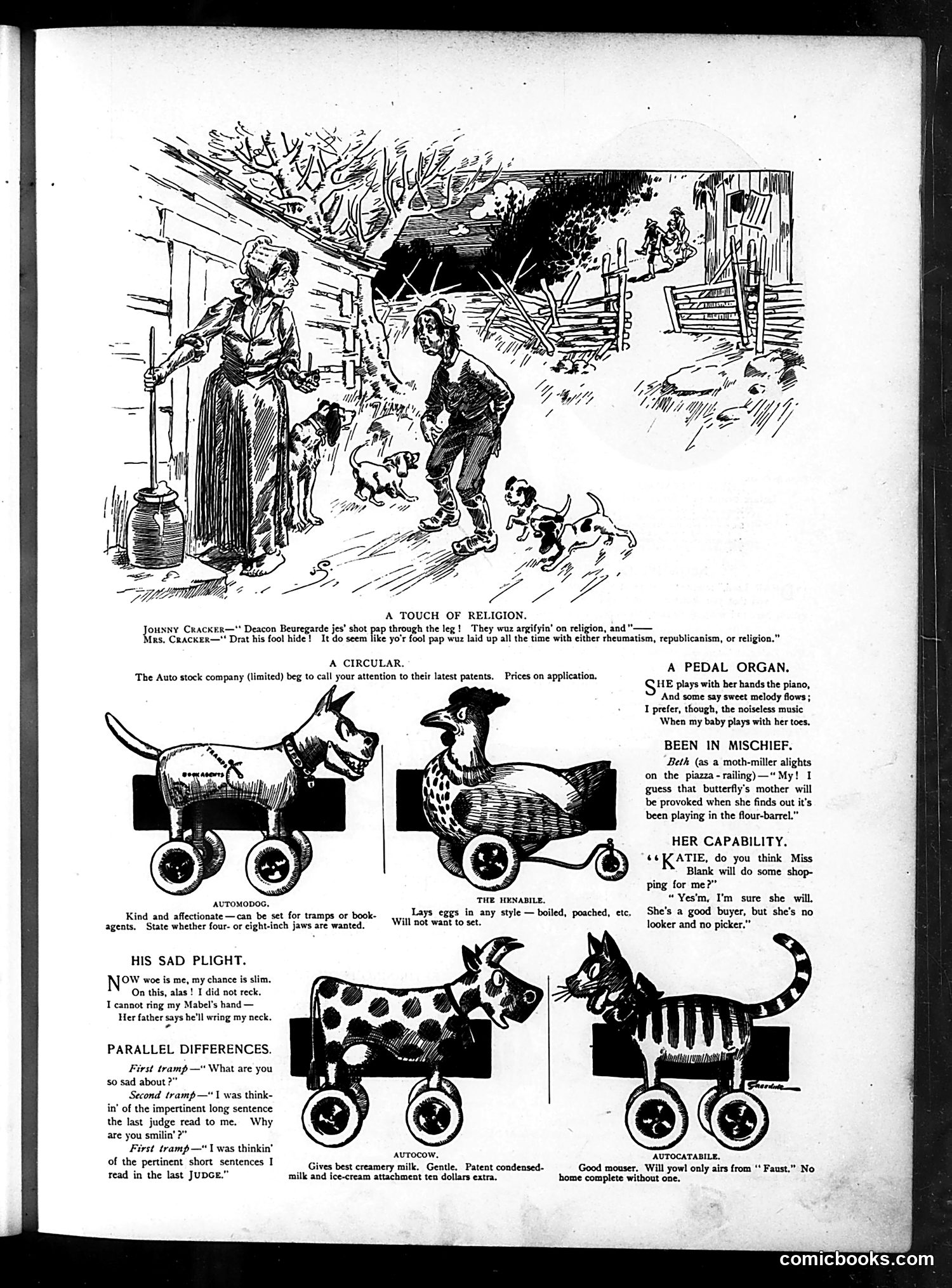
This Judge magazine page combines humor with advertising. The top cartoon, "A Touch of Religion," depicts a rural scene where children argue about religion while their mother and a man look on. The joke plays on childish theological debates—one child claims "They argufyin' on religion" while another counters it's about "rheumatism, republicanism, or religion," suggesting religious arguments are as commonplace and divisive as political ones. Below are whimsical patent advertisements featuring animal-shaped toy vehicles (automobilized cows, hens, cats) with puns as titles ("Automobog," "Autocow," "Autocattle"). These mock-serious patent notices satirize the era's obsession with automobile patents and mechanical innovation by absurdly applying automotive concepts to farm animals, creating humorous wordplay for the advertising section.
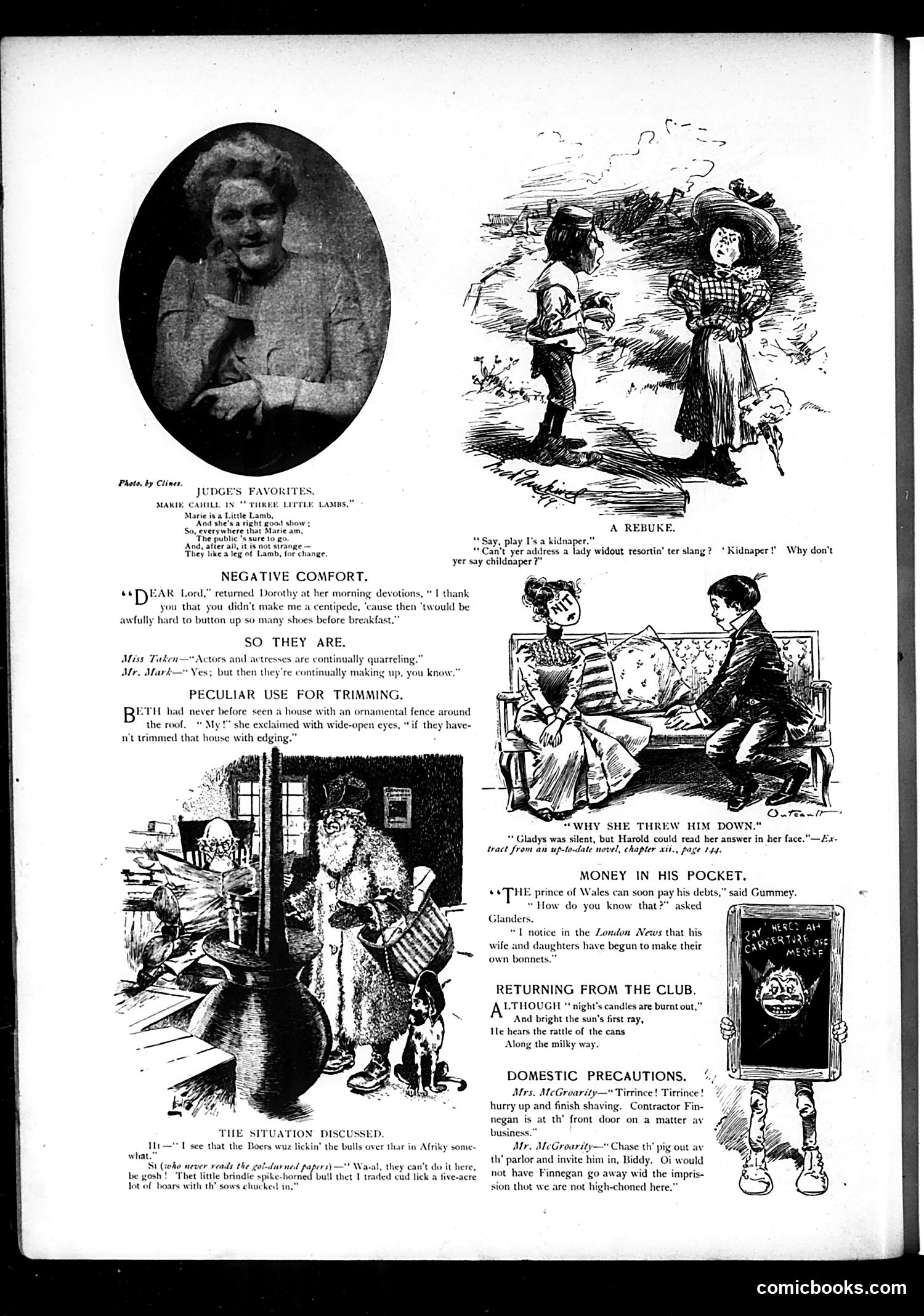
This page contains several **domestic humor sketches** rather than political satire. The main cartoons depict middle-class family situations: - **"A Rebuke"**: Children using slang ("kidnapper"); an adult correcting their language - **"Why She Threw Him Down"**: A woman and child on a couch; the caption suggests marital discord - **"Money in His Pocket"**: Gossip about a Welsh prince's wife and daughters making bonnets, implying financial struggles - **"Returning from the Club"**: A drunk man staggering home - **"Domestic Precautions"**: A husband avoiding his wife by pretending contractors are at the door The humor targets **social anxieties**: improper speech, domestic tension, class pretensions, and marital avoidance. There's no clear political commentary—these are satirical observations of *ordinary Victorian/Edwardian domestic life*, mocking both husbands and wives for their foibles.
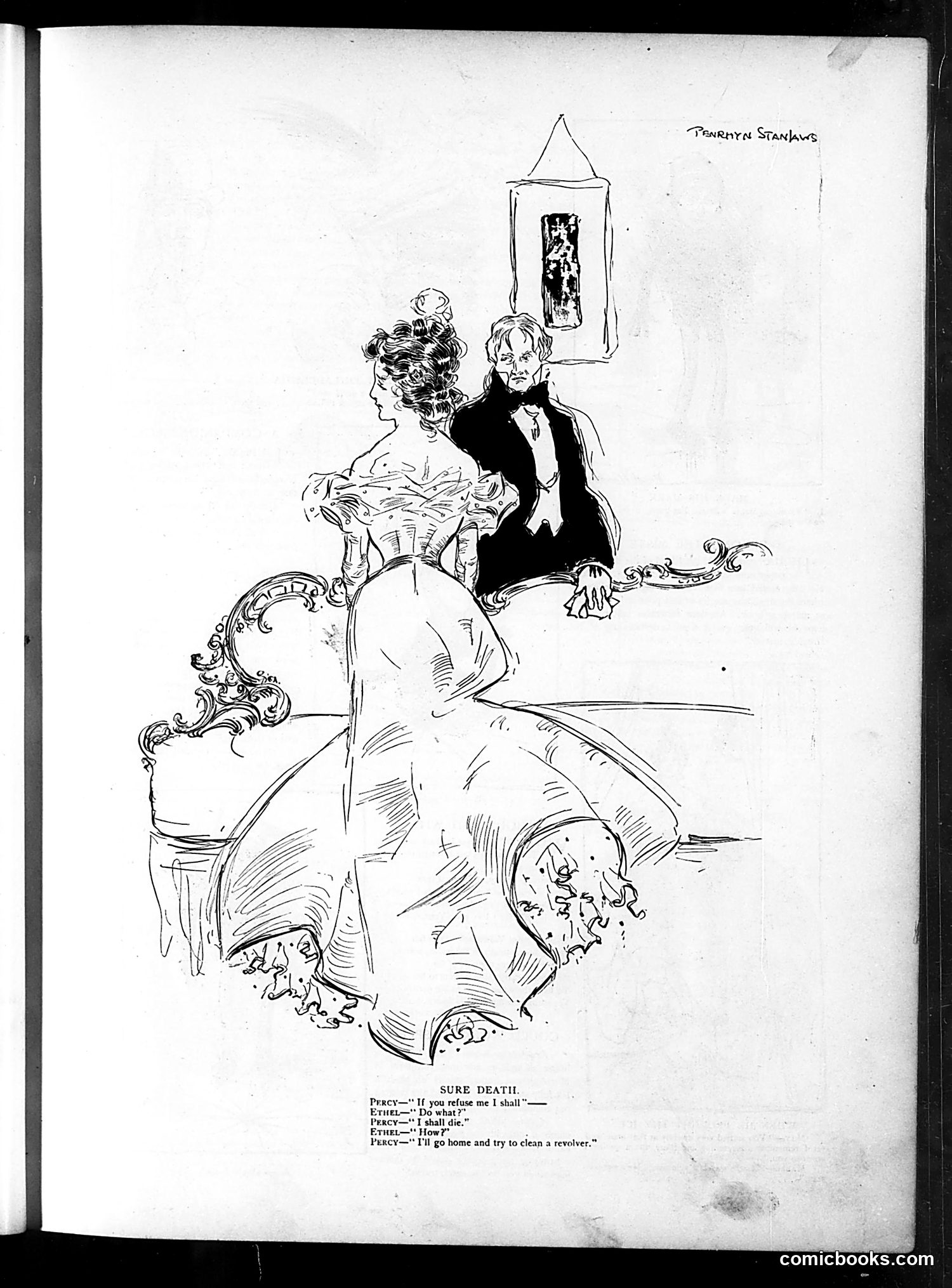
This appears to be a political cartoon titled "Sure Death" from *Judge* magazine, attributed to Pennyth Stanlaw (visible at top right). The image shows a well-dressed couple riding atop a grotesquely caricatured head—possibly representing a political or social figure being literally "ridden" by the upper class. The ornate furniture attached suggests wealth and privilege. The dialogue below indicates a domestic dispute: Percy refuses his wife's demands and threatens suicide ("I shall die"), while Ethel demands he take action ("Do what?"). Percy's final line about going home to "clean a revolver" darkly suggests suicide as his response to marital conflict. The satire likely critiques either class exploitation, martial discord among the wealthy, or male weakness in domestic disputes—though without more historical context, the specific political target remains unclear.
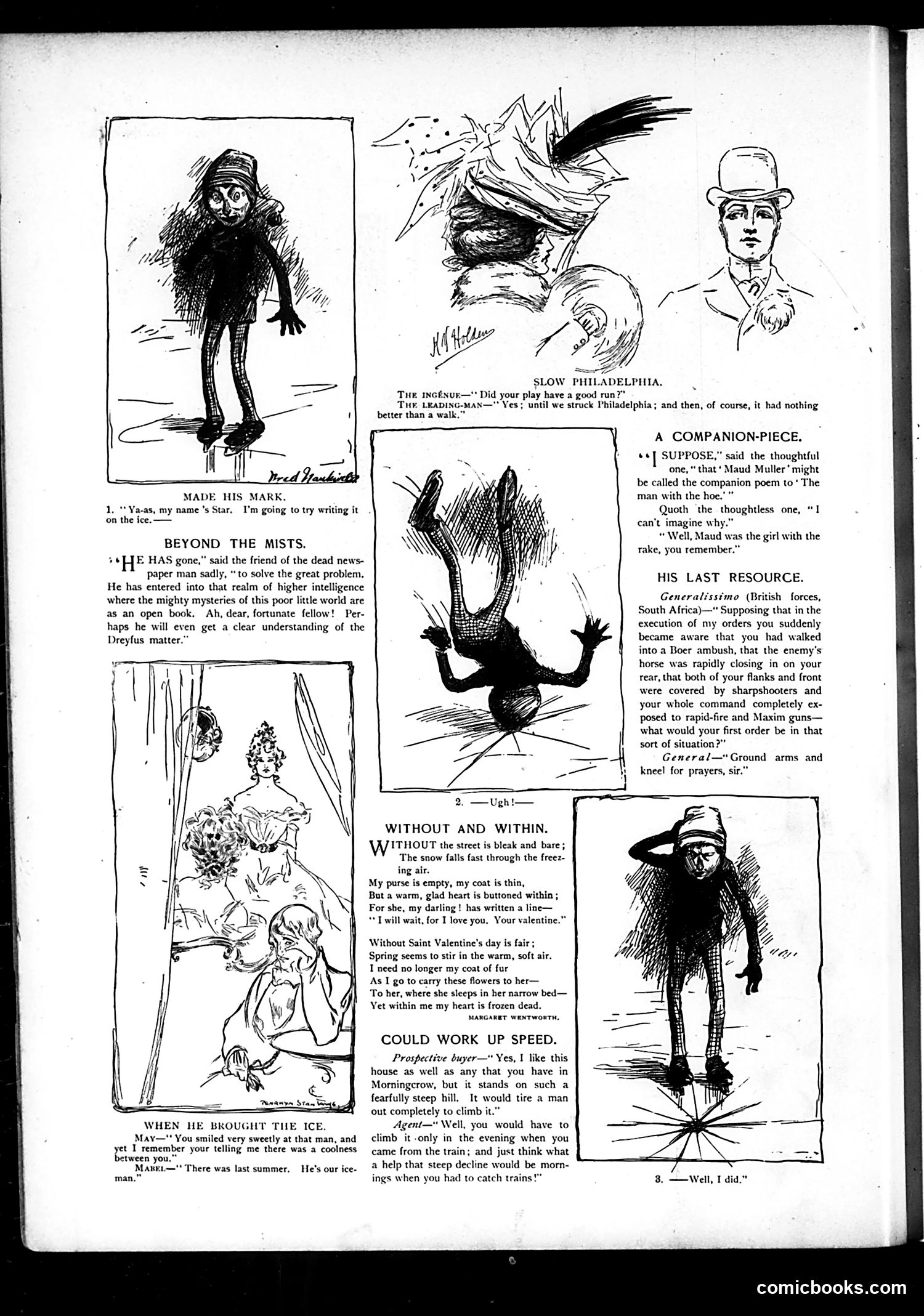
This page contains multiple brief satirical pieces typical of early 20th-century American humor: **"Slow Philadelphia"** jokes about theatrical productions losing momentum in that city—a common vaudeville gag suggesting Philadelphia audiences were less enthusiastic. **"Beyond the Mists"** references the Dreyfus Affair (the famous French military scandal), mocking pretentious talk about "higher intelligence" and mysteries. **"His Last Resource"** satirizes the Boer War (British forces in South Africa). A general asks a soldier what order he'd give if surrounded; the soldier answers "kneel for prayers"—mocking military strategy as ineffectual and suggesting the situation is hopeless. **"Without and Within"** presents sentimental contrasts: poverty with love versus comfort without it. **"Could Work Up Speed"** is a real-estate joke about a steep hill—the agent suggests climbing it only evenings (coming home tired) but the decline helps mornings (catching trains). The cartoons use exaggerated drawings typical of Judge's style. Overall, the page mixes romance, military critique, and gentle domestic humor.
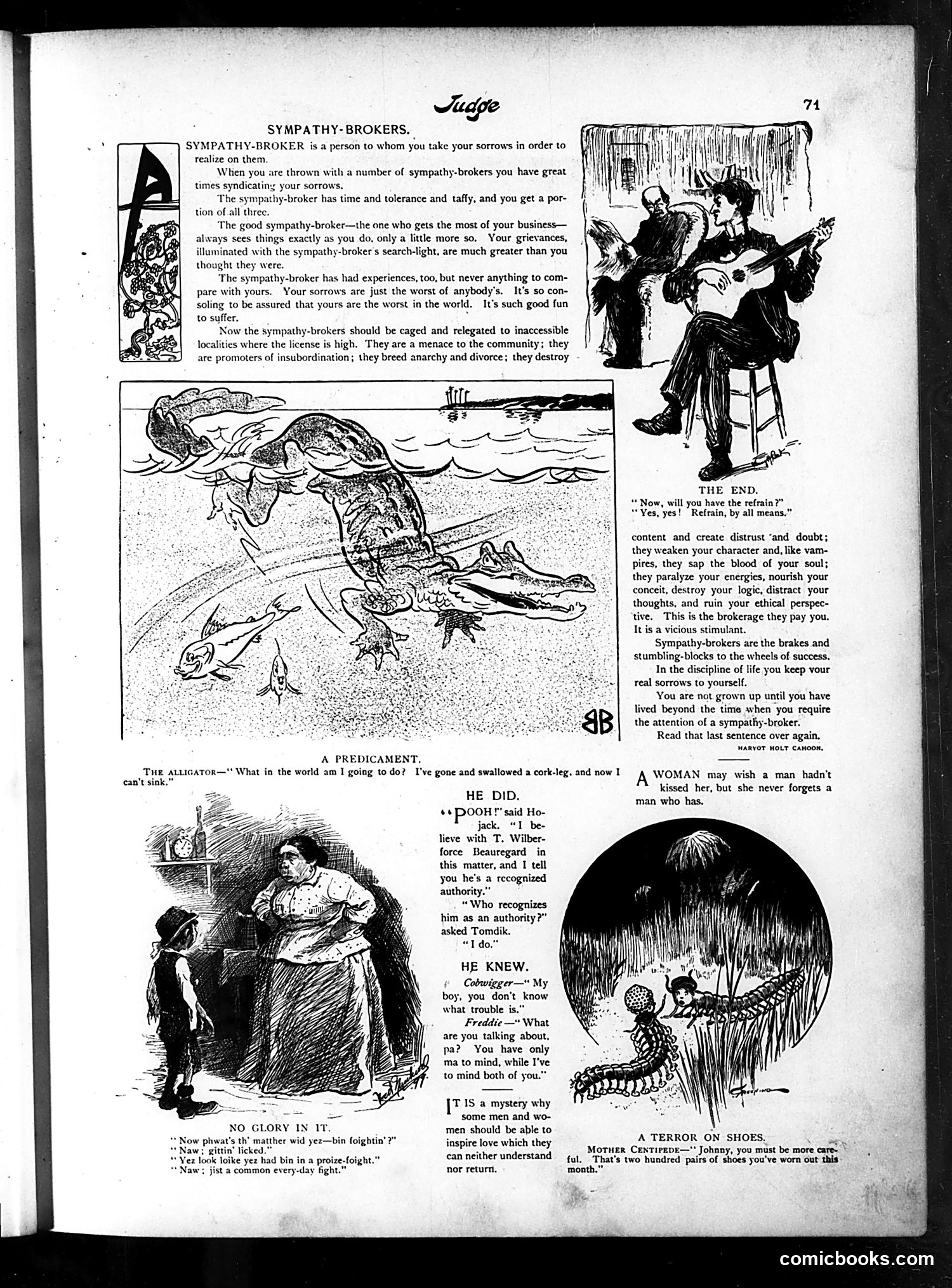
This page satirizes people who exploit others' misfortunes for social or personal gain. The main article defines "sympathy-brokers" as manipulative listeners who exaggerate your problems to make themselves indispensable, sapping your character and weakening your resilience. Judge argues these people are societal menaces promoting "insubordination," "anarchy," and "divorce." The satire targets a specific turn-of-century American social type: well-meaning (or predatory) confidants who professionalize emotional labor, converting genuine sorrows into currency for their own influence. The piece's moral: maturity means handling real suffering privately, without requiring such validation-brokers. The accompanying cartoons on this page—about alligators, domestic squabbles, and children's mischief—appear to be separate humorous vignettes typical of Judge's miscellaneous content, using no particular political references.
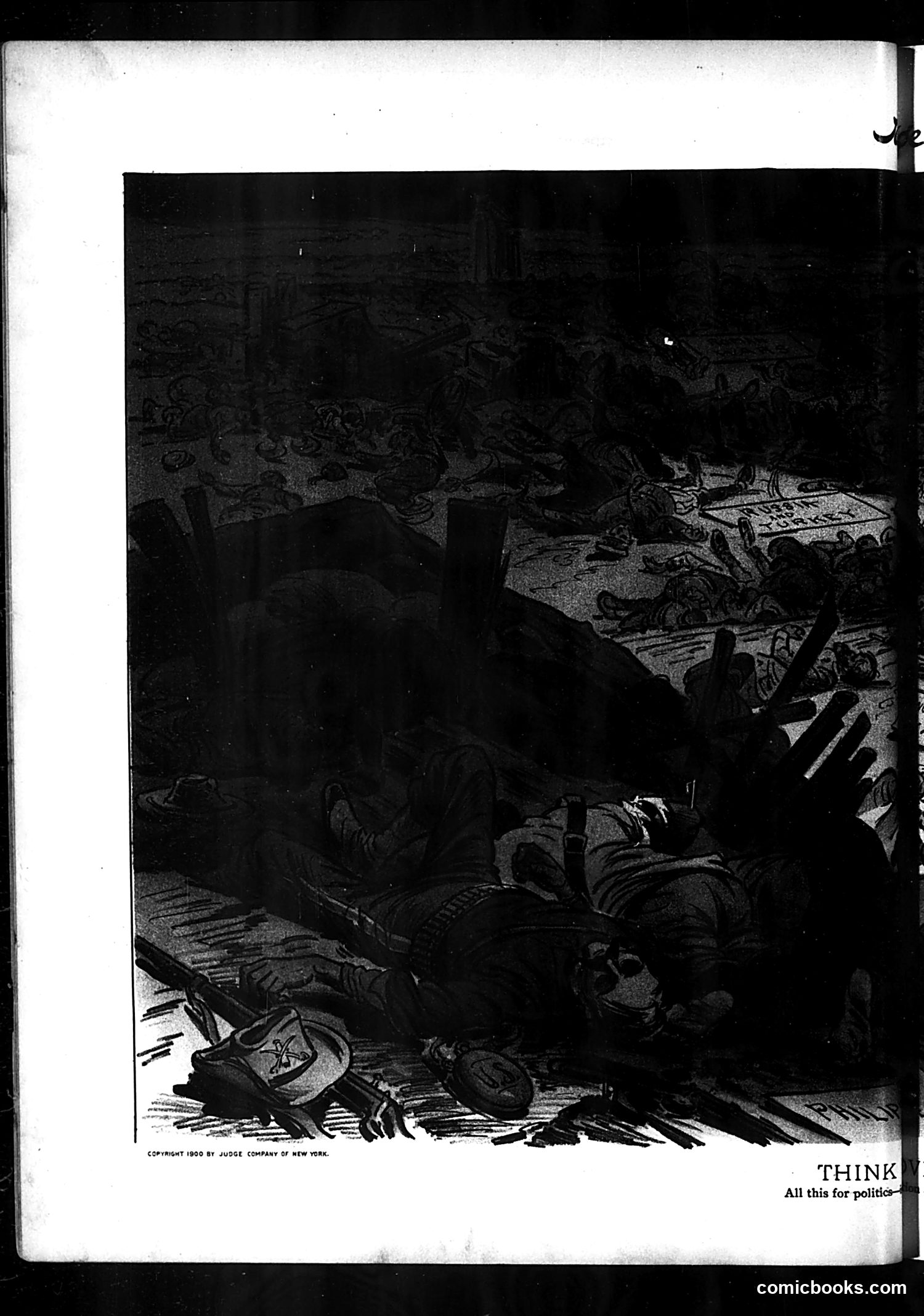
This is a dark, expressionistic cartoon depicting a chaotic interior scene filled with bodies and debris. The visible text "THINK / All this for politics" suggests the cartoon critiques the human and material costs of political activity. The image appears to show casualties or unconscious figures scattered across a floor, rendered in high-contrast black and white. Without clearer visibility of specific figures or identifying details, the exact political event referenced remains unclear—it could reference political violence, electoral corruption, or the general destructiveness of partisan politics in the Gilded Age. The copyright date of 1900 places this during a period of intense American political controversy. The cartoon's message is clearly satirical and condemnatory, questioning whether political goals justify such devastating human consequences.
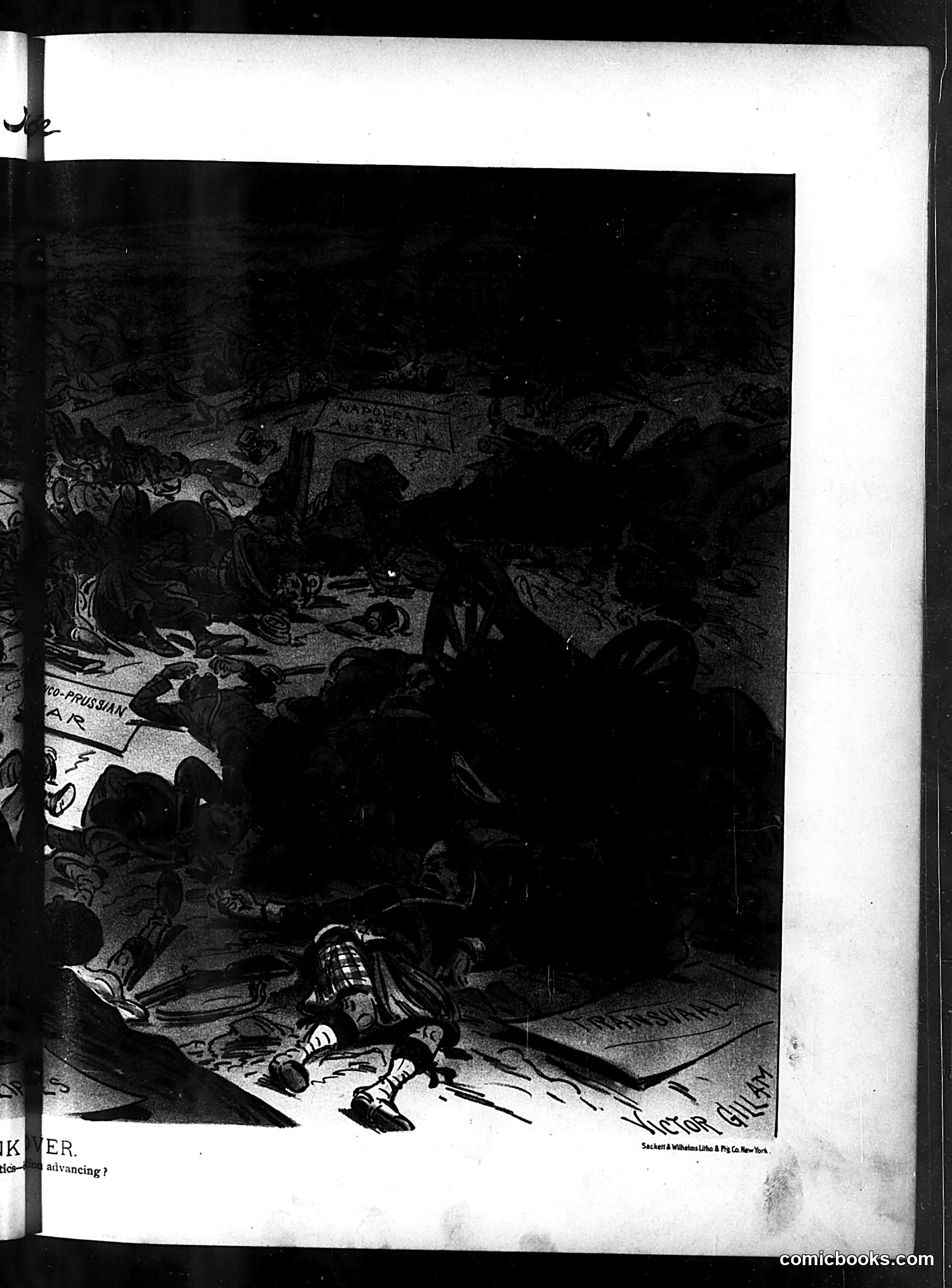
This is a political cartoon from *Judge* magazine, though the specific issue date and title are not fully legible in this reproduction. The image depicts a nighttime scene with multiple figures in what appears to be a chaotic or violent confrontation. The silhouetted figures and dark rendering make precise identification difficult, but the composition suggests a dramatic political or social commentary typical of *Judge*'s satirical style. The text fragments visible ("PRUSSIAN," "advancing") suggest this cartoon addresses military or geopolitical conflict, possibly relating to Prussian expansion or war-related politics. However, without clearer image quality or a visible title, I cannot definitively identify the specific historical event, political figures, or the satirist's exact point being made. More context would be needed for accurate interpretation.
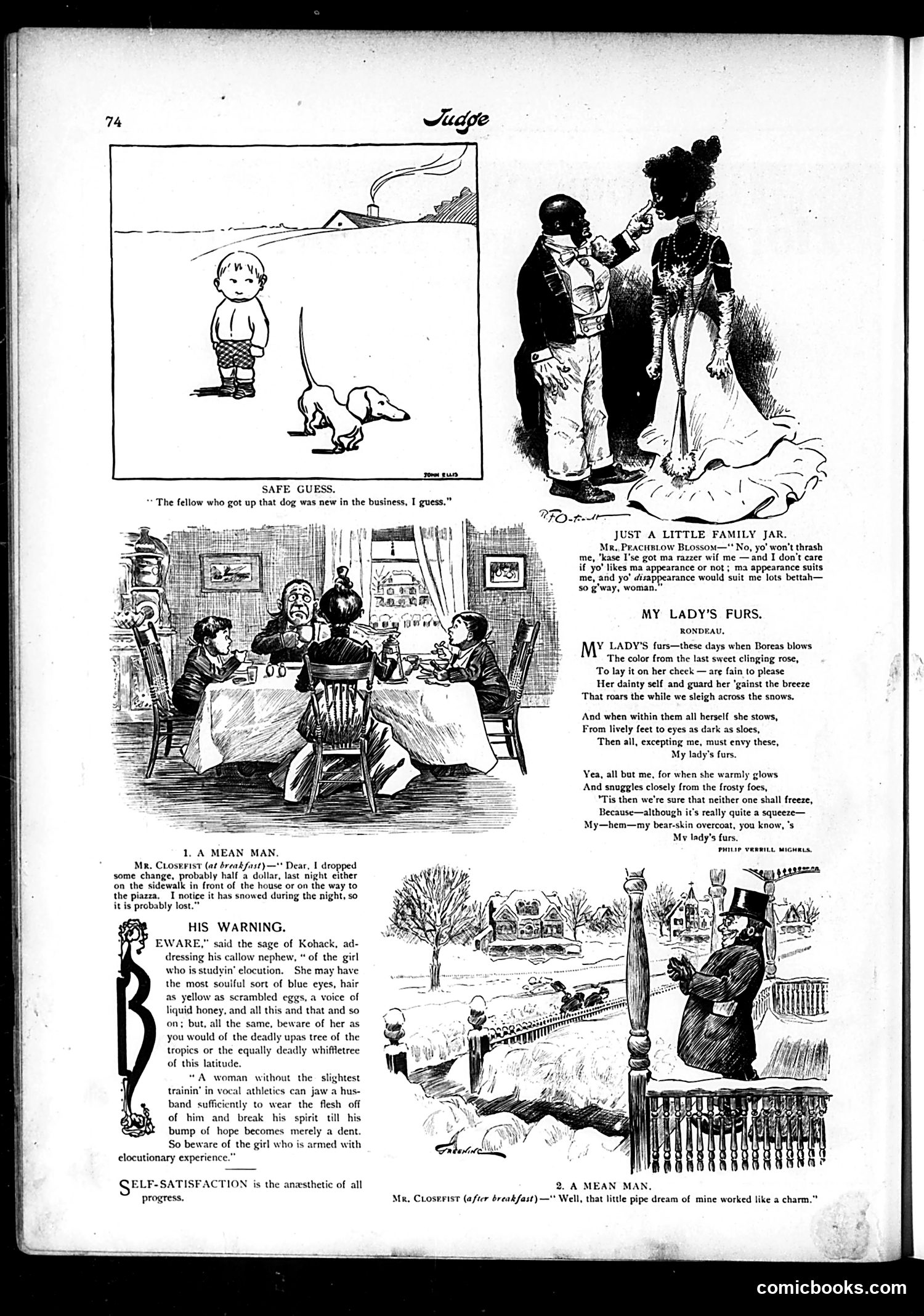
This page contains several satirical sketches typical of early 20th-century American humor: **"Safe Guess"**: A child and dog—likely commentary on a poorly-constructed taxidermied or mechanical animal, with the joke being someone inexperienced created it. **"Just a Little Family Jar"**: A domestic confrontation between an African American man and woman, using racial dialect stereotypes common to period satire. The man threatens violence with a razor while dismissing her concerns about his appearance. **"My Lady's Furs"**: A romantic poem about a man's fur coat keeping both him and his companion warm during winter—the humor deriving from calling his bear-skin overcoat "my lady's furs." **"A Mean Man" and "His Warning"**: Misogynistic sketches about a stingy husband losing money and advice warning against marrying a woman trained in public speaking (elocution), depicted as weaponized nagging. The page reflects period attitudes: casual racism, domestic conflict played for laughs, and skepticism toward women's education and independence.
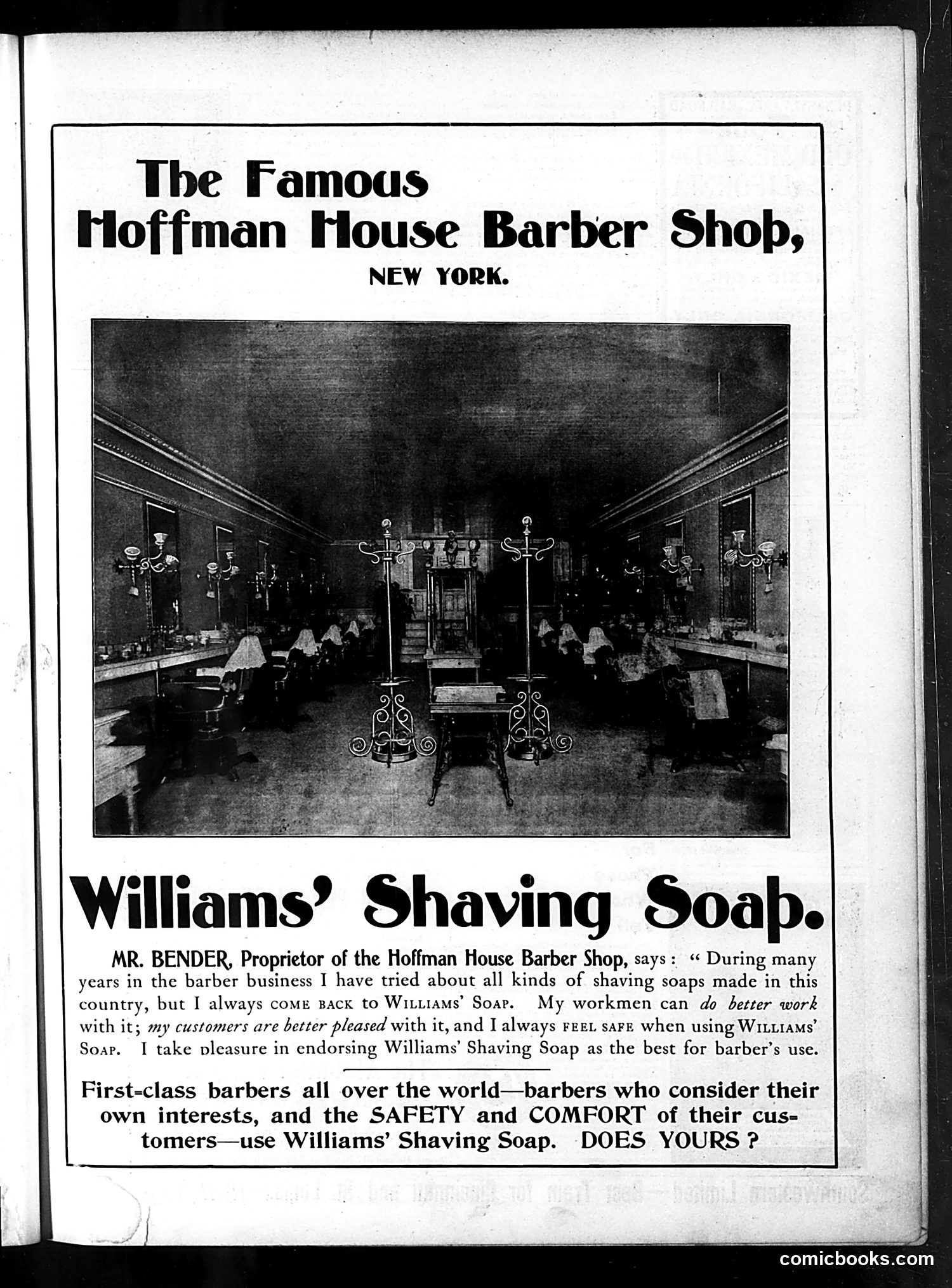
This is a **paid advertisement**, not satire or political commentary. It promotes Williams' Shaving Soap using a testimonial from Mr. Bender, proprietor of the prestigious Hoffman House Barber Shop in New York. The page features a photograph of the barber shop's interior—a luxurious space with multiple stations, ornate wall sconces, and well-dressed customers and barbers. This visual establishes the establishment's upscale reputation to lend credibility to the product endorsement. The advertisement employs a common early-20th-century marketing strategy: leveraging a respected professional's endorsement. Bender claims his workers perform better work and customers are more satisfied when using Williams' soap, emphasizing "safety and comfort." The closing rhetorical question ("DOES YOURS?") targets other barbers, suggesting they should adopt the product for their own competitive advantage. This represents straightforward commercial advertising rather than editorial content or satire.
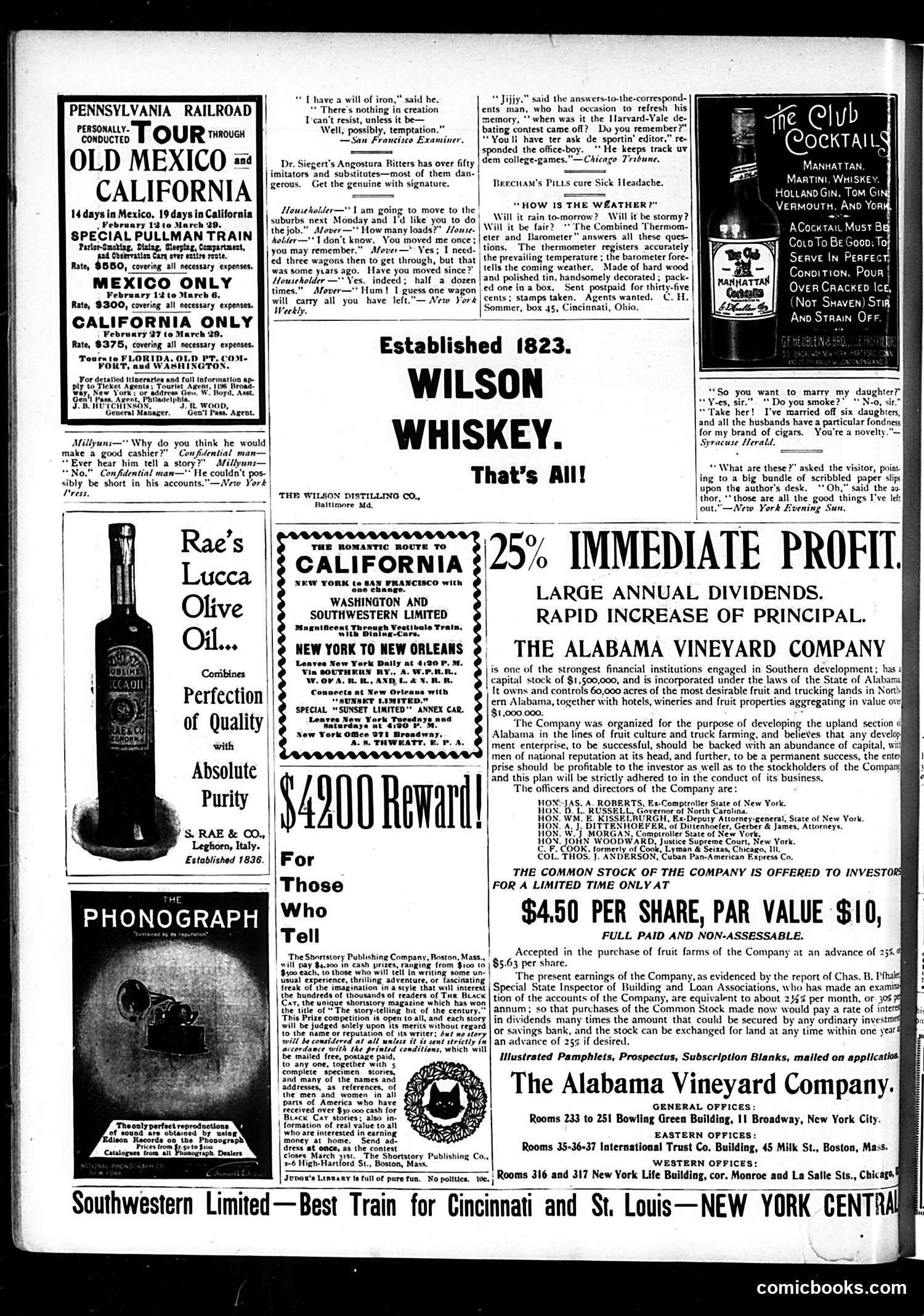
This page is primarily **advertising with minimal editorial content**. The advertisements—for Pennsylvania Railroad tours, Wilson Whiskey (established 1823), Rae's Lucca Olive Oil, and The Alabama Vineyard Company stock offering—dominate the layout. The small humorous items scattered throughout are typical **Judge magazine filler**: brief jokes about a mover's repeated trips, a cashier's storytelling habits, a father eager to marry off daughters to cigar smokers, and an author's discarded manuscript pages. These are generic, timeless humor pieces with no specific political or social satire. The only notable editorial element is **The Phonograph advertisement** (lower left), which discusses the device's cultural significance as a "perfect reproduction" of sound—relevant to early 1900s fascination with this new technology. Overall, this appears to be a **revenue-driven page** rather than satirical content, reflecting Judge's dual nature as both humor magazine and advertising vehicle.
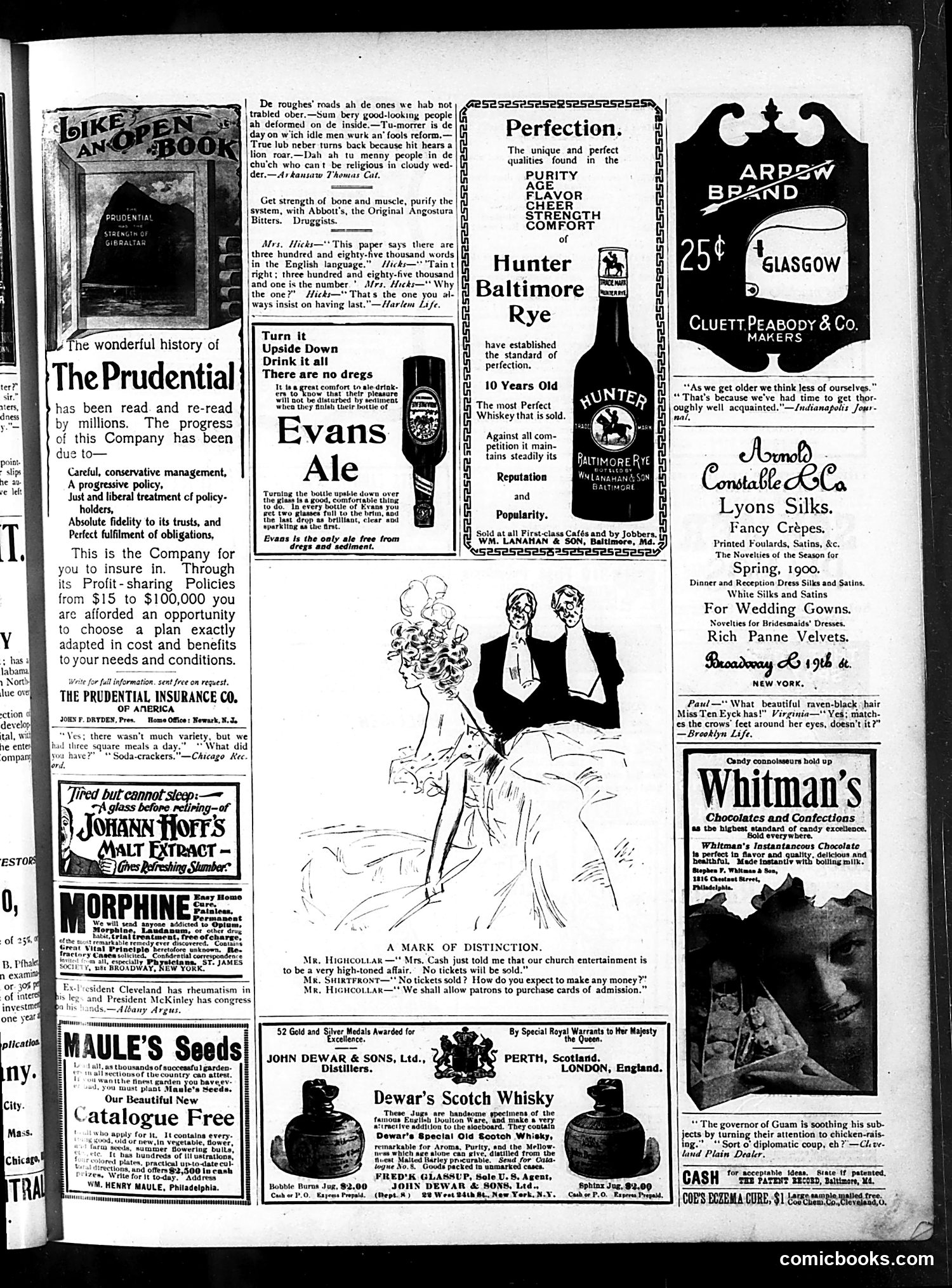
This page is primarily **advertising**—it contains multiple product advertisements (whiskey, ale, insurance, seeds, chocolate, silk) interspersed with brief joke snippets. The notable cartoon appears midpage: a sketch showing two well-dressed figures in conversation, labeled "A MARK OF DISTINCTION." The caption depicts Mrs. Highcollar discussing her church entertainment, claiming "No tickets will be sold" and that patrons must "purchase cards of admission" instead—a transparent euphemism to avoid appearing to *sell* tickets while doing exactly that. The satire targets **upper-class hypocrisy and social pretension**. The joke mocks wealthy churchgoers who use semantic games to maintain respectability: calling paid admissions "patron cards" allows them to profit from church events while preserving the appearance of pious propriety. The term "mark of distinction" underscores the self-satisfied nature of this social class—they distinguish themselves through such transparent linguistic dodges. This reflects early 1900s American anxieties about **commercialism masquerading as virtue** among the wealthy elite.
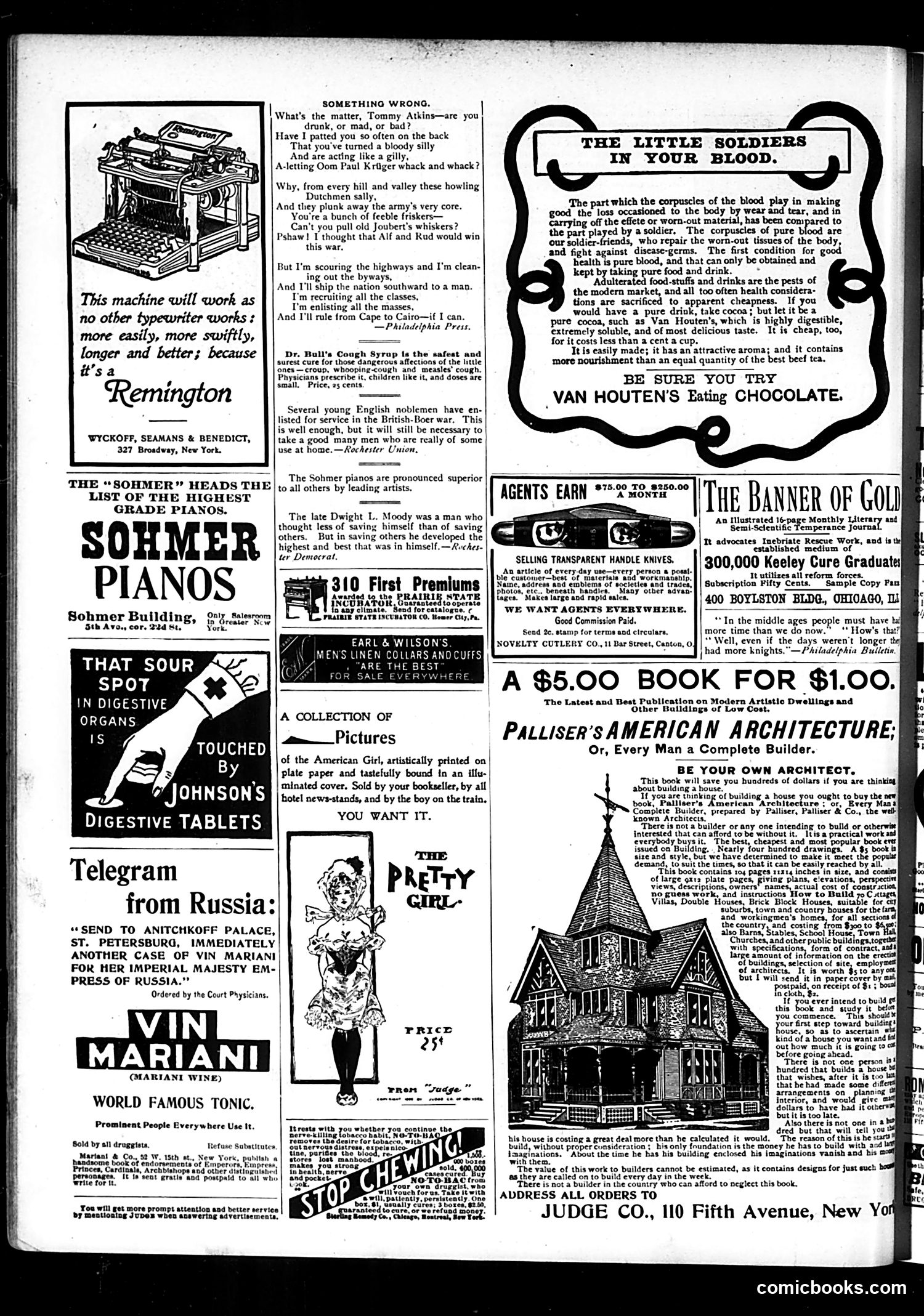
This page is primarily an **advertising page** with one notable satirical poem titled "Something Wrong." The poem, attributed to the Philadelphia Press, satirizes British military performance during the **Second Boer War** (1899-1902). The speaker addresses "Tommy Atkins" (a generic term for British soldiers) with mock indignation: despite Britain's military reputation and repeated "patting on the back," the soldiers are failing against the Boers ("Oom Paul Kriiger" and "Joubert"). The satirist sarcastically suggests the solution is aggressive recruitment and imperial expansion ("rule from Cape to Cairo"). The satire's point: British military prowess was being exposed as overrated by resistance from Dutch/Boer farmers in South Africa. For American readers, this would have been timely commentary on a major conflict dominating 1900s headlines, mocking British confidence while their colonial adventure struggled. The remainder is standard period advertising for typewriters, pianos, medicines, and household goods.
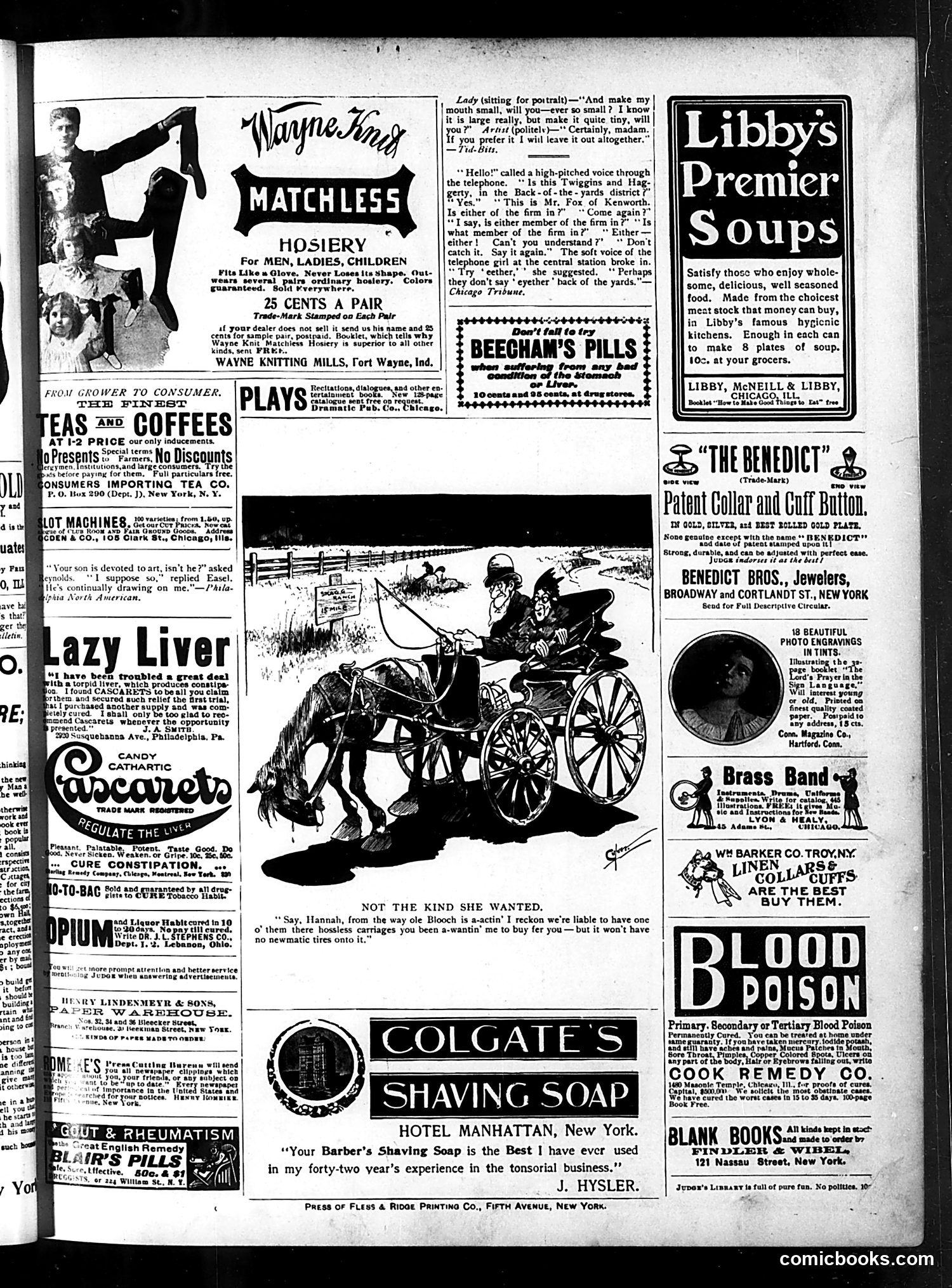
This page is primarily advertisements, with one cartoon joke at the bottom. **The Cartoon ("Not the Kind She Wanted"):** A rural man in a horse-drawn carriage says to a woman named Hannah that he's been wanting to buy her "one of them horseless carriages" but admits it won't have pneumatic (air-filled) tires. The joke reflects early 1900s automotive anxieties: rural people desired modern vehicles but worried about reliability, especially regarding tire technology. "Horseless carriage" was contemporary slang for automobiles. The humor lies in the gap between rural aspiration and the practical limitations of early automotive technology—he wants to court her with modernity but can't deliver the newest features. The rest is advertising for period products: Wayne Knit hosiery, Beecham's Pills, Libby's soups, Cascara candy laxatives, Colgate shaving soap, and dubious medical "remedies" for blood poison and other ailments—typical of Judge magazine's commercial content.
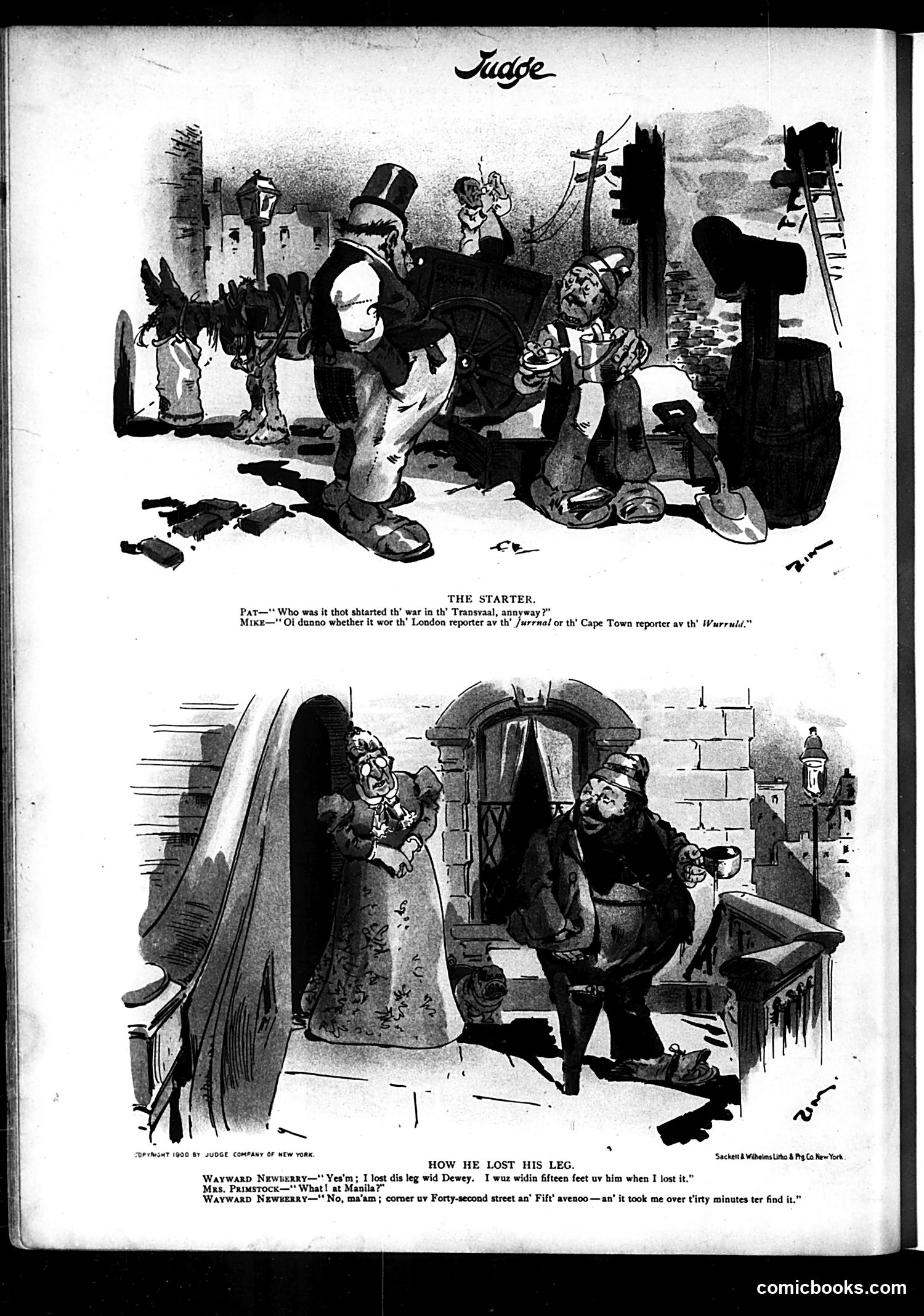
This 1900 page contains two political cartoons mocking contemporary news coverage and American imperialism. **"The Starter"** ridicules competing newspapers' (the *Journal* and *World*) sensationalist coverage of the Boer War in South Africa's Transvaal region. The cartoon suggests newspaper reporters, not legitimate political causes, "started" the war through their inflammatory reporting—a critique of "yellow journalism." **"How He Lost His Leg"** satirizes American jingoism following the Spanish-American War. A man claims he lost his leg fighting with Admiral Dewey at Manila, but the punchline reveals he actually lost it on a Manhattan street corner—suggesting Americans exaggerated or fabricated war service stories to gain status. The humor mocks both false patriotism and the public's gullibility in believing such claims. Together, these cartoons critique 1900s press sensationalism and inflated military heroism narratives.