
A complete issue · 16 pages · 1900
Judge — January 27, 1900
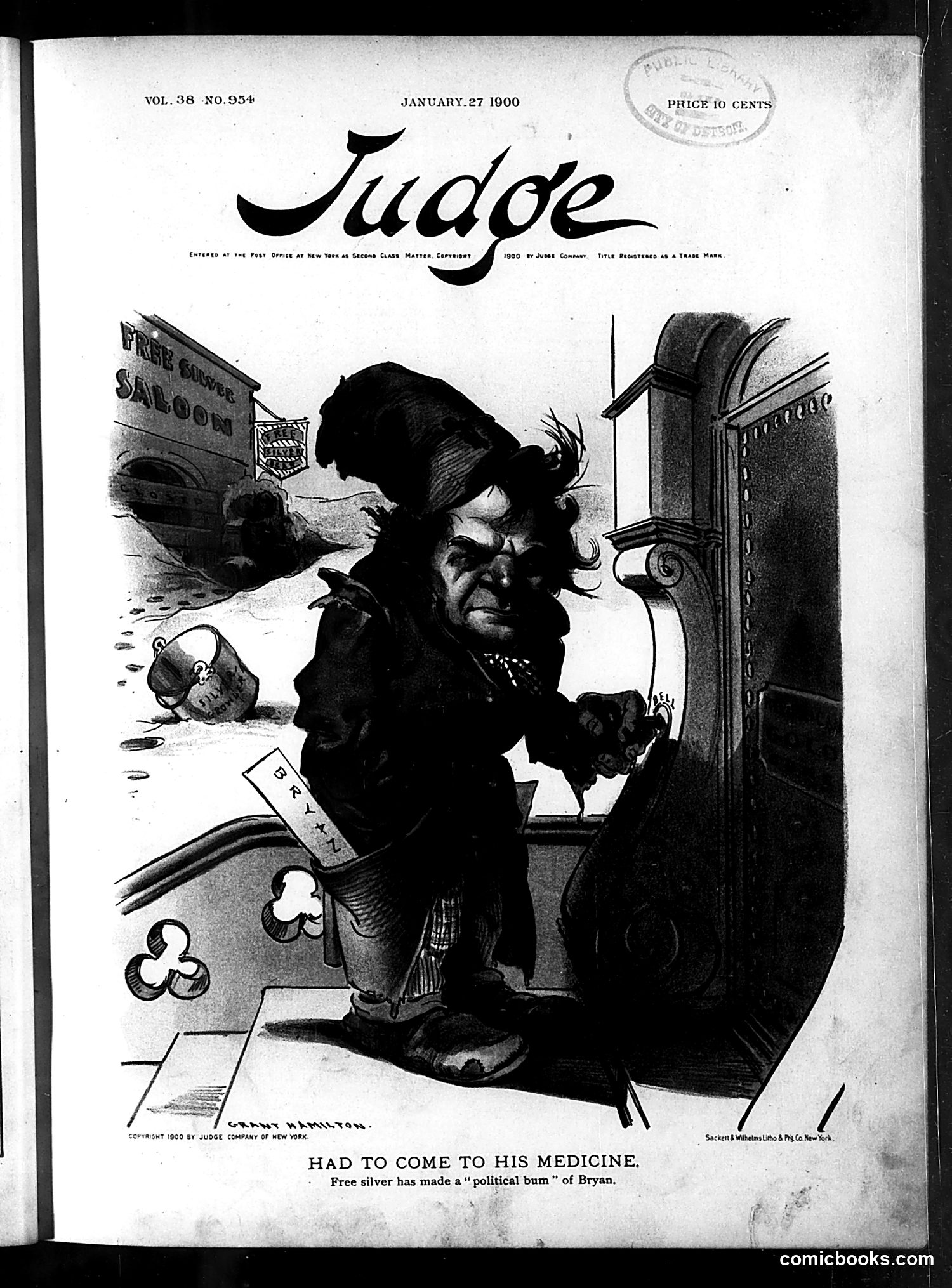
This Judge magazine cover from January 27, 1900 satirizes William Jennings Bryan, the Democratic presidential candidate who championed "free silver" (unlimited coinage of silver). The caption states: "Free silver has made a 'political bum' of Bryan." The cartoon depicts a disheveled, impoverished figure at a doorway—representing Bryan's political decline. The saloon sign in the background and the character's degraded appearance suggest Bryan has become a "bum" due to his free silver advocacy. The playing card marked "Bryan" reinforces this theme of political failure and loss. The satire suggests that Bryan's radical economic policies have destroyed his political viability, forcing him to accept harsh political "medicine" (electoral defeat).
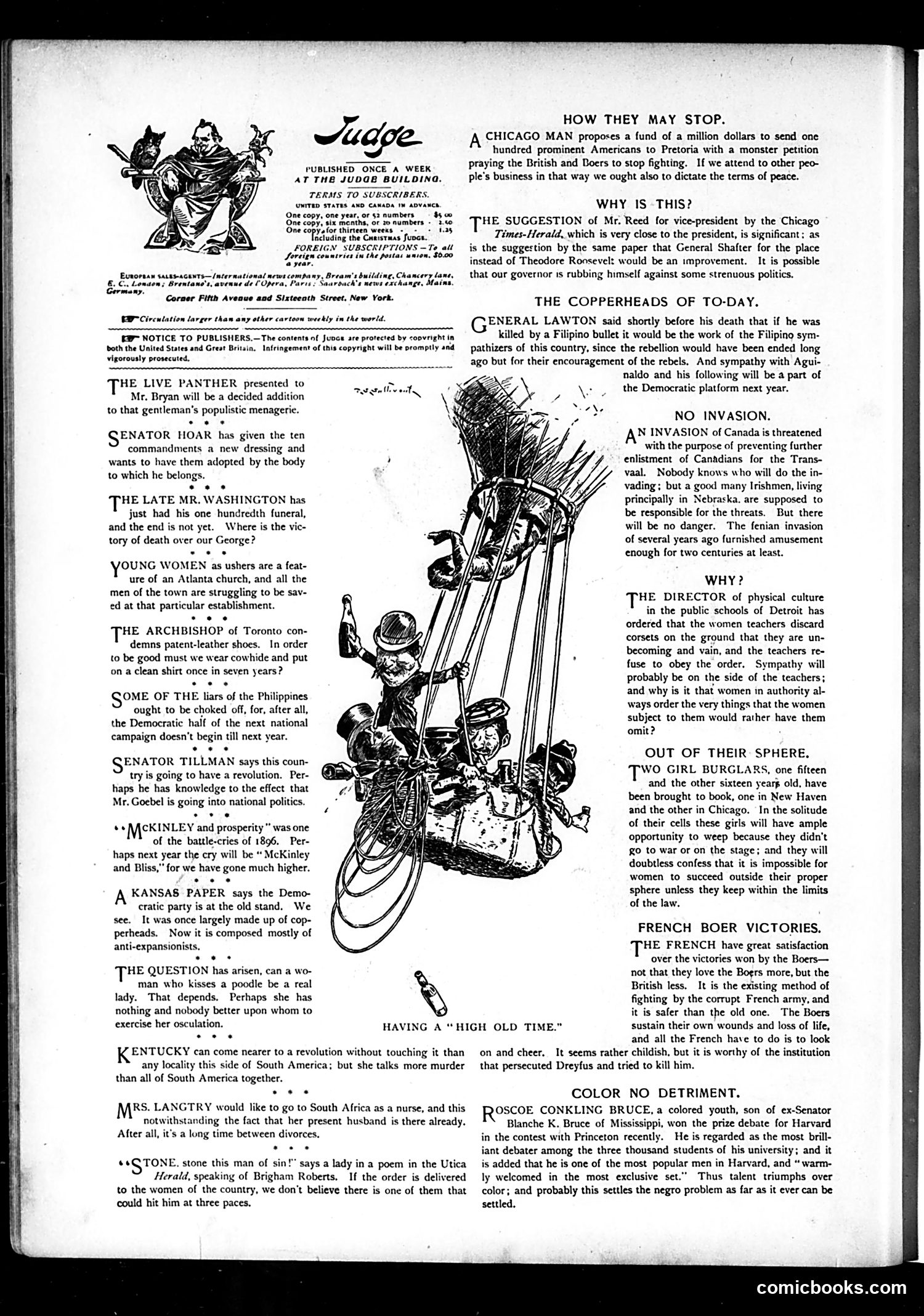
This page contains multiple brief satirical commentary items rather than a single cartoon. The large central illustration shows figures climbing a precarious ladder labeled "HAVING A 'HIGH OLD TIME,'" satirizing reckless behavior during wartime. Key items include: - **"How They May Stop"**: Chicago's proposal to send prominent Americans to Pretoria (South Africa) to negotiate peace—likely referencing the Boer War - **"The Copperheads of To-Day"**: Criticizes General Lawton's death, suggesting pro-peace Democrats encouraged Filipino violence - **"No Invasion"**: Dismisses Canadian invasion threats as exaggerated - **"Out of Their Sphere"**: Attacks a Detroit school director's order forcing female teachers to remove corsets, mocking gender politics - **"French Boer Victories"**: Comments on French support for Boers over the British - **"Color No Deteriment"**: Notes a Black Harvard debater's success
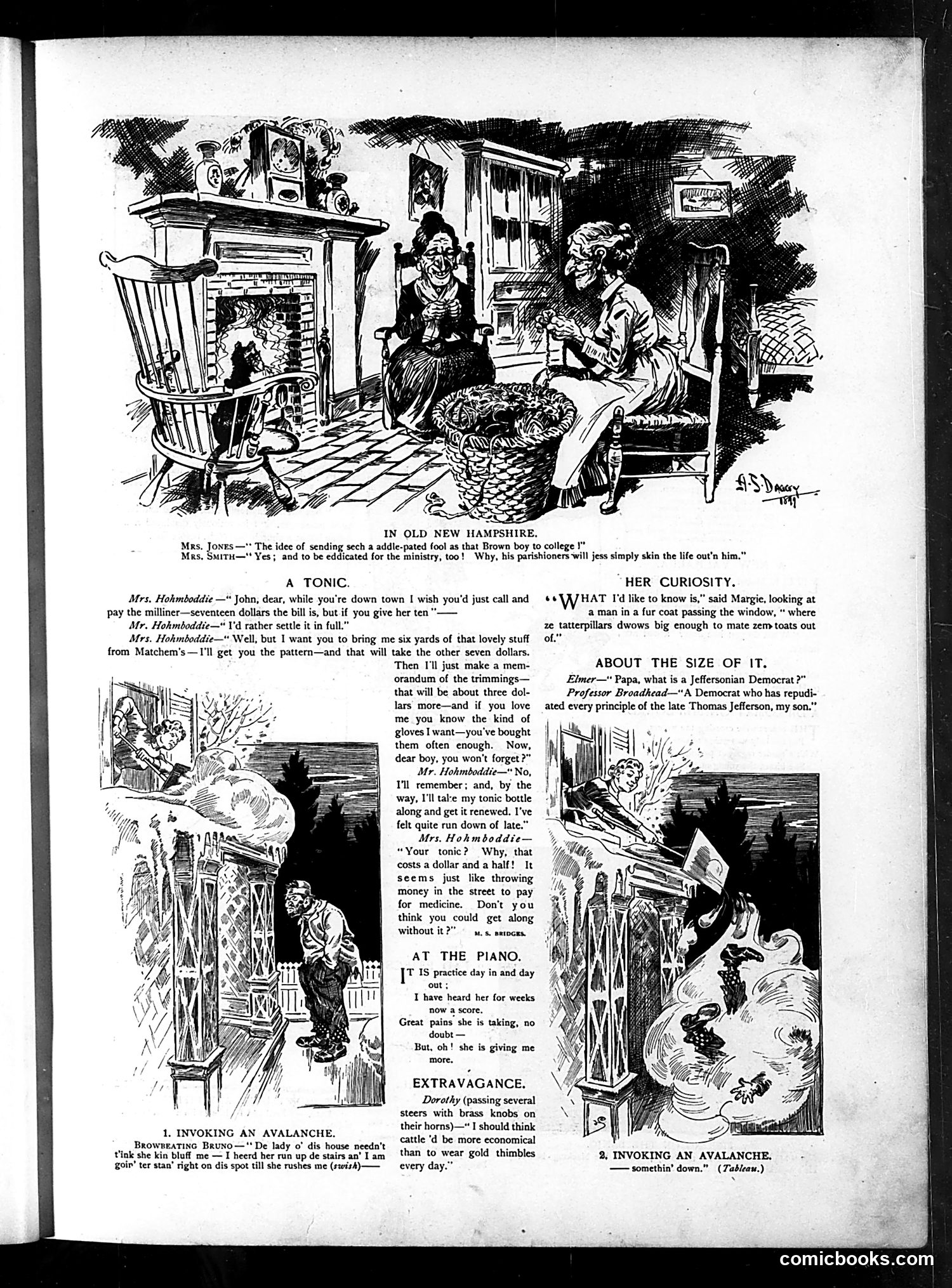
This page contains humorous domestic sketches and satirical commentary typical of early-to-mid 20th century Judge magazine. The top cartoon, "In Old New Hampshire," jokes about educational philosophy—Mrs. Jones advocates sending a "dedicated fool" to college while Mrs. Smith prefers children learn practical skills. Below are several short comedic exchanges: "A Tonic" depicts a wife requesting household money from her husband; "Her Curiosity" shows a woman observing a neighbor; "About the Size of It" features political humor; "At the Piano" mocks practice routines; and "Extravagance" satirizes spending on luxury items like gold thimbles versus cattle. The humor relies on stereotypical domestic situations and marital tensions common to the era's middle-class audience, with no apparent reference to specific political events or identifiable public figures.
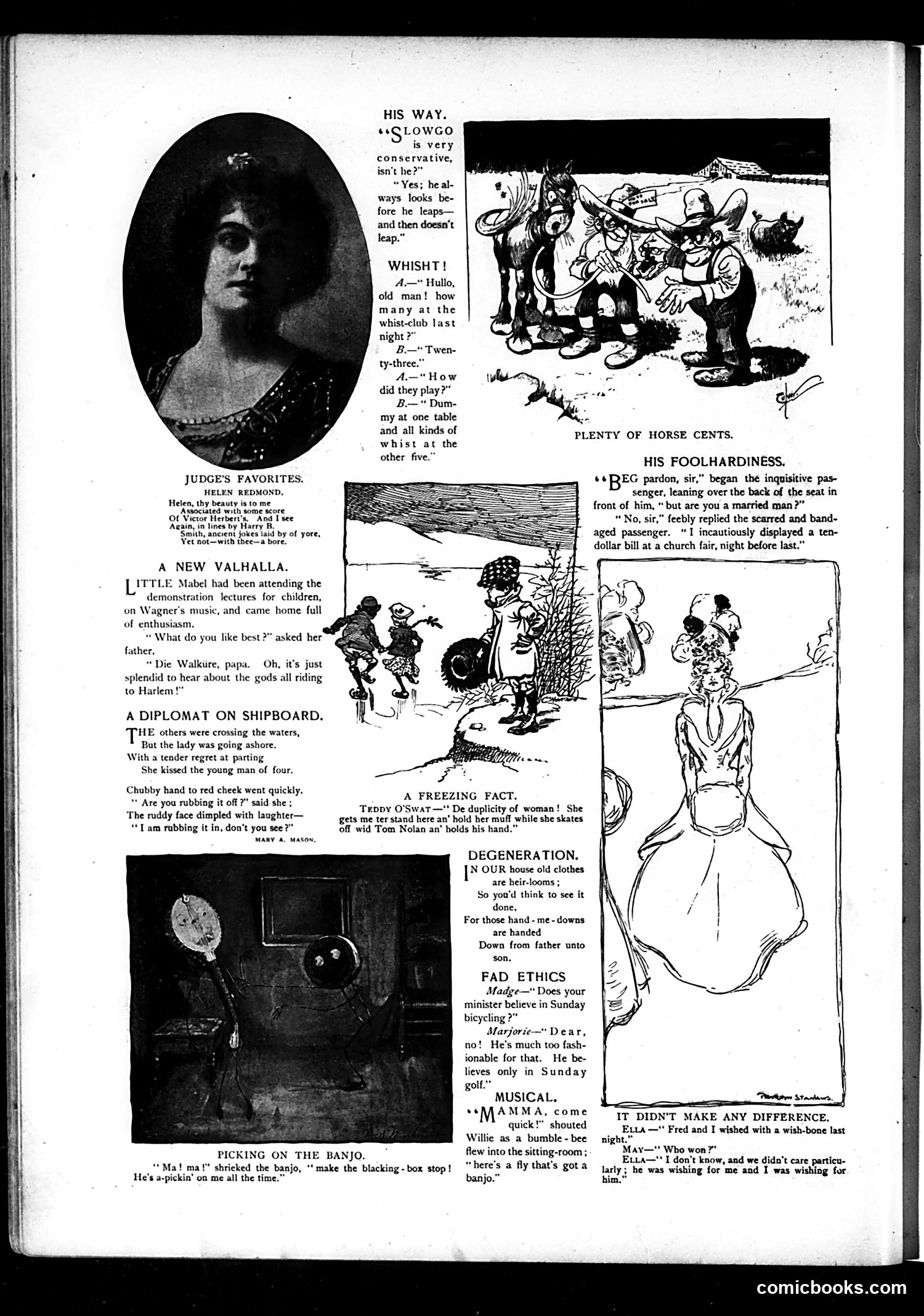
This page contains multiple satirical humor items typical of early 20th-century Judge magazine: **"His Way"** mocks conservative attitudes through dialogue about cautious behavior ("always looks before he leaps"). **"Plenty of Horse Cents"** is a visual pun featuring cartoon characters with horses, playing on the phrase "horse sense." **"His Foolhardiness"** depicts a passenger's reckless behavior on a streetcar. **"A New Valhalla"** references Wagner's mythology in a joke about children's entertainment. **"Degeneration"** satirizes how old clothes become hand-me-downs across generations. **"Bad Ethics"** jokes about a minister's Sunday golf playing versus bicycling. **"Musical"** depicts domestic chaos when a fly enters a home. The final panel, **"It Didn't Make Any Difference,"** shows a couple's indifference about their choice of activities. These are light, domestic humor pieces without apparent major political content.
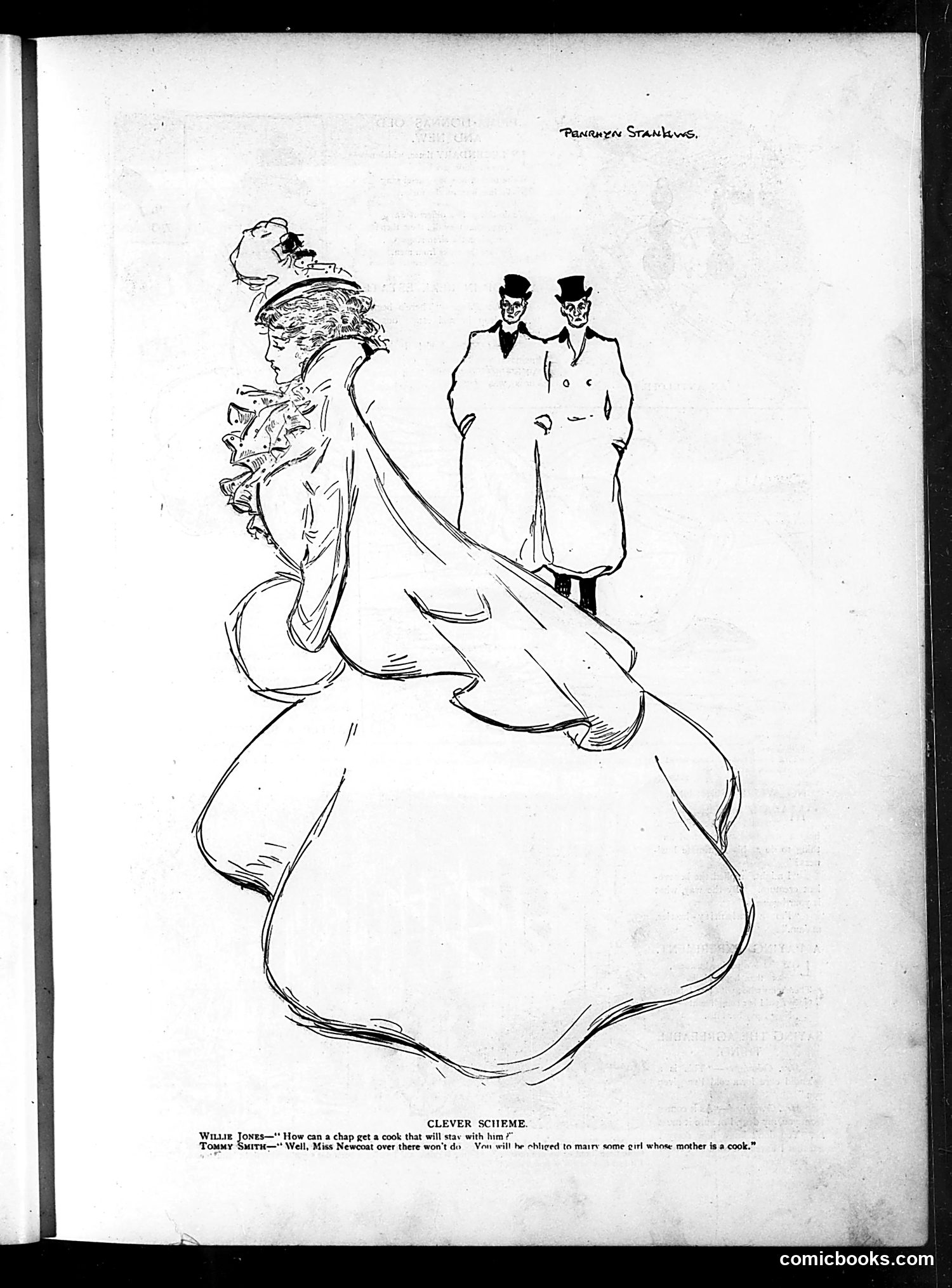
This cartoon satirizes class-conscious marriage prospects among wealthy men. The large female figure represents a woman of means (suggested by her elaborate dress and jewelry), while two gentlemen in top hats observe her. The dialogue reveals the "scheme": Willie Jones asks Tommy Smith how to find a cook who will stay. Tommy replies that "Miss Newcoat over there won't do—You will be obliged to marry some girl whose mother is a cook." The satire targets wealthy bachelors seeking wives from moneyed families while simultaneously needing household staff. The joke suggests that marrying into money is preferable to hiring domestic help, yet implies the ironic sacrifice of marrying a woman whose family background involves working-class labor—something the wealthy would typically disdain. The cartoon reflects Edwardian-era anxieties about class mobility, domestic service shortages, and the practical compromises wealthy men faced when seeking both financial security and "respectable" wives.
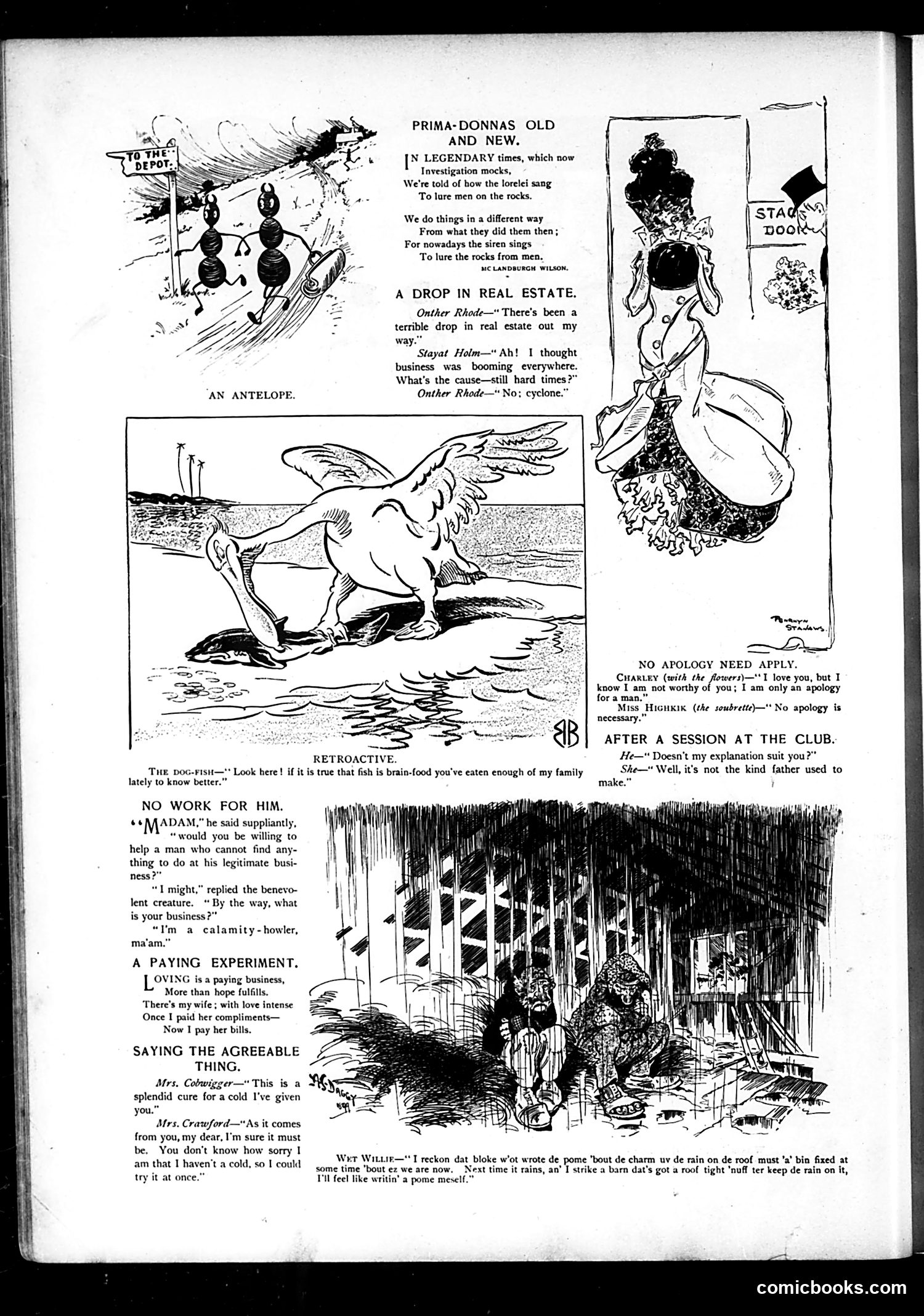
This page contains multiple short humor pieces typical of early 20th-century satirical magazines: **"Prima-Donnas Old and New"** contrasts legendary sirens (the Lorelei) who lured men to rocks with modern "sirens" (likely referring to real estate speculators or developers) who lure rocks/property from men—satirizing speculative bubbles and real estate schemes. **"A Drop in Real Estate"** jokes about a cyclone causing property value collapse. **"No Work for Him"** mocks a "calamity-howler"—a person whose profession was predicting disasters—as unemployable in better economic times. **"A Paying Experiment"** uses marriage as setup: love costs nothing initially, but marriage means paying bills instead of compliments. The remaining pieces are light domestic humor about apologies and marriage misunderstandings. The page reflects early 1900s American anxieties about economic cycles, real estate speculation, and changing social conditions, presented through gentle, pun-based comedy rather than pointed political commentary.
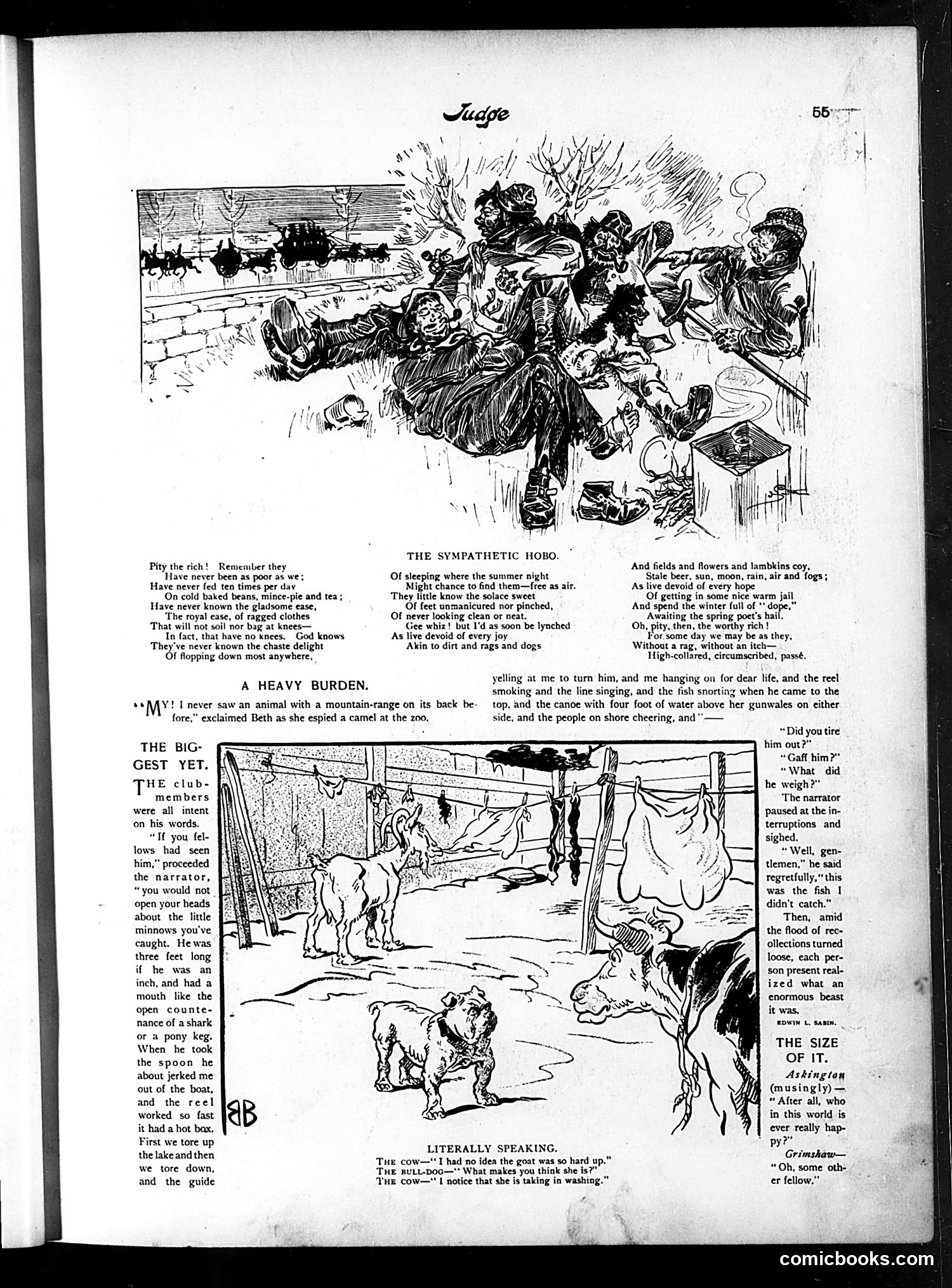
This page contains three distinct pieces satirizing American society: **"The Sympathetic Hobo"** (top) ironically celebrates poverty's supposed superiority over wealth. The hobo claims the rich are pitiful for lacking the "joys" of rags, dirt, jail, and hunger—inverting conventional values. The satire mocks both wealthy complacency and the romanticization of destitution, suggesting class resentment underlying Gilded Age inequality. **"A Heavy Burden"** (middle) shows a fishing story where the narrator's fish "got away," yet club members remain impressed by his exaggerated tale. This satirizes male club culture and the tall-tale tradition—poking fun at how men construct status through storytelling rather than actual accomplishment. **"Literally Speaking"** (bottom) is a brief joke playing on misunderstandings: a cow suggests a goat is "hard up" because she's "taking in washing"—wordplay on economic desperation versus literal laundry work. The cartoons collectively reflect turn-of-century American anxieties about class, masculine pride, and social pretension.
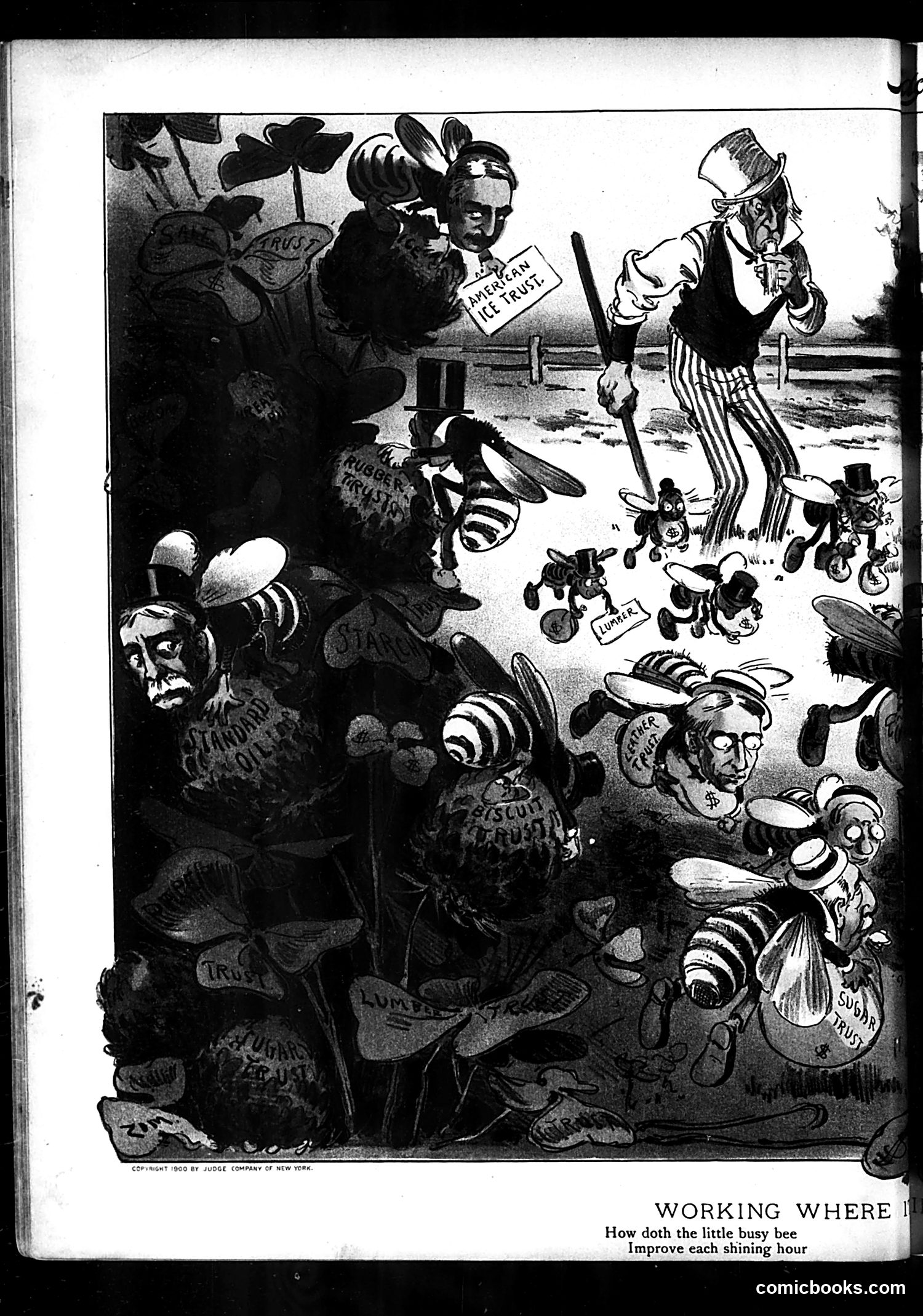
This is a satirical cartoon titled "Working Where..." that opens with the famous Isaac Watts poem "How Doth the Little Busy Bee." The image depicts anthropomorphized bees working industriously in what appears to be a factory or industrial setting, with various figures and establishments labeled as trusts or monopolies (visible text includes "TRUST" references). The satire critiques American industrial monopolies and trusts of the early 20th century, contrasting the innocent children's poem about virtuous labor with the exploitative reality of corporate consolidation. The busy bees represent workers operating within these massive corporate structures. The cartoon likely comments on how workers—despite their industry—were trapped within oppressive trust systems that dominated American commerce during the Progressive Era.
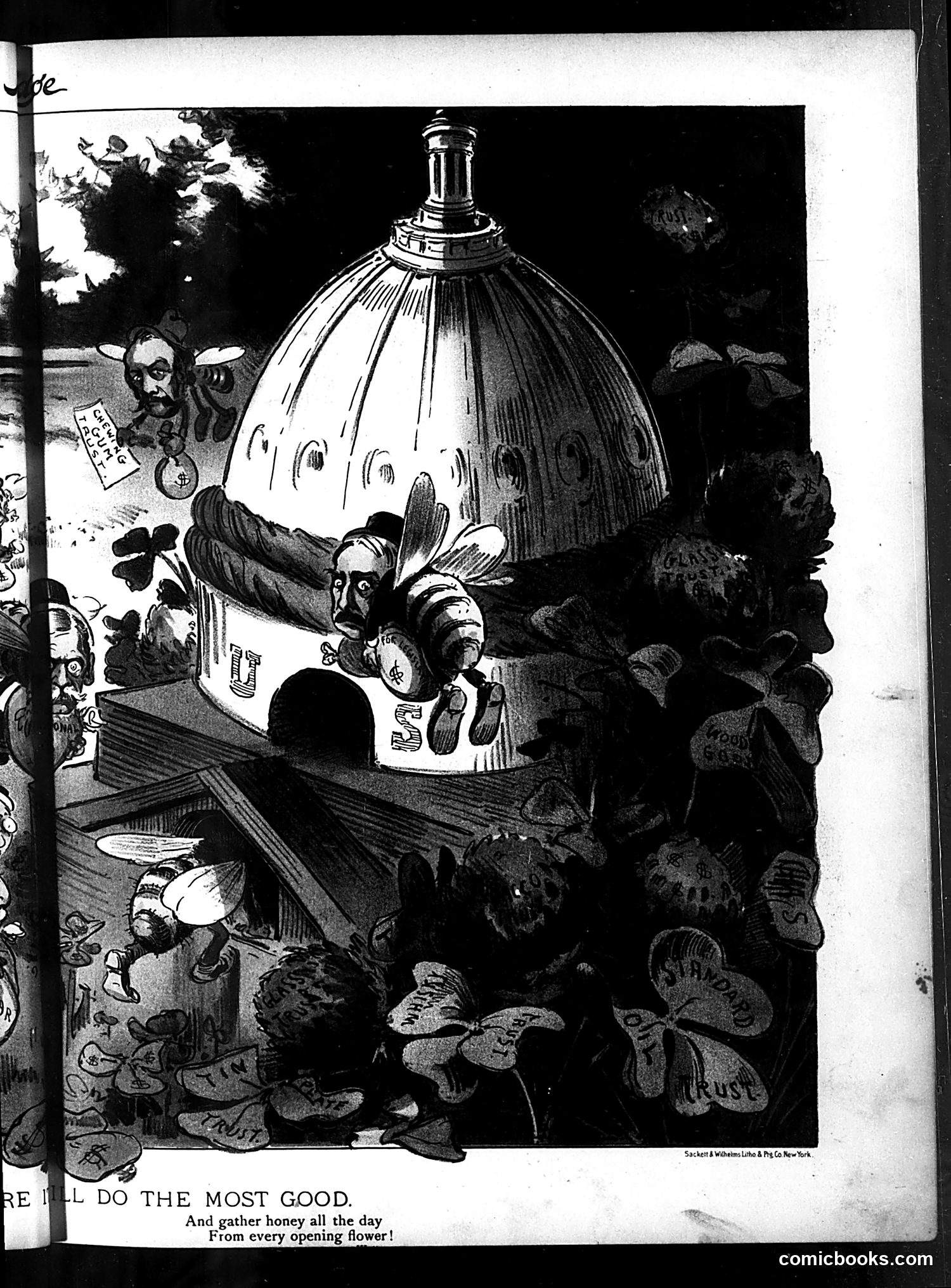
This is a satirical cartoon from *Judge* magazine depicting the U.S. Capitol dome as a beehive, with figures collecting "honey" (likely representing profits or political benefits) from "every opening flower" (government opportunities). The caricatured politicians inside are portrayed as bees or parasites exploiting the Capitol for personal gain. The satire criticizes governmental corruption and self-interest—the notion that politicians gather wealth and advantages from public institutions meant to serve citizens. The beehive metaphor suggests they work collectively in their own interests rather than the public good, despite rhetoric about doing "the most good." The caption references a hymn or idealistic sentiment about gathering honey, contrasting noble aspirations with corrupt reality. This reflects Progressive Era concerns about political corruption and special interests.
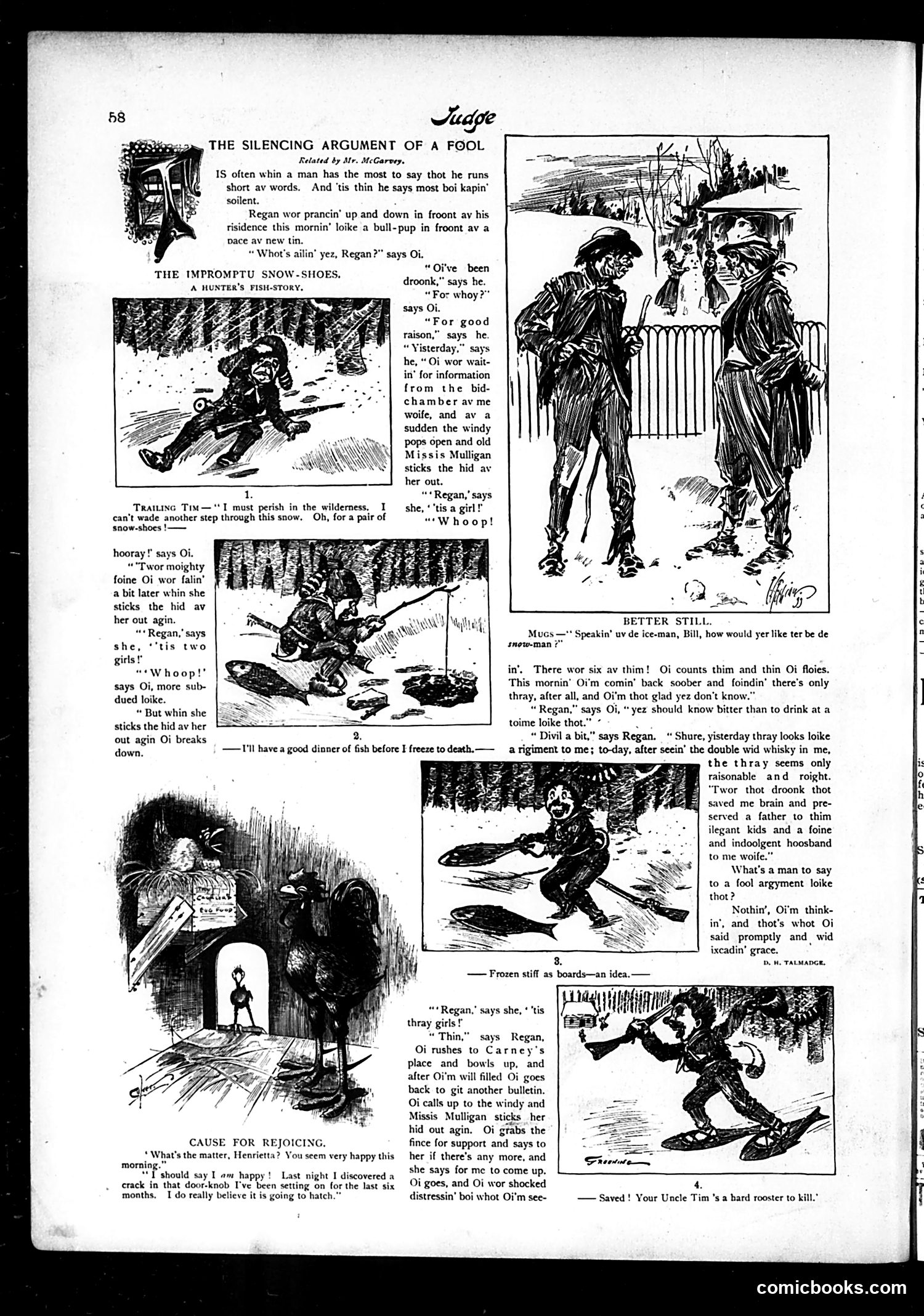
This page contains three humorous Irish-dialect stories satirizing masculine foolishness and poor reasoning. The main story features "Regan," an Irish laborer who gets drunk and uses flawed logic to justify it: seeing triple from intoxication actually *helped* him, he claims, because what appeared to be six children was really three—so the whisky made him "happy" by reducing his family size in his perception. The satire targets how drunk men rationalize their behavior with circular, absurd arguments that silence rational objection. The accompanying stories mock similar male stupidity: a hunter's tall tale about snow-shoes made from fish, and a woman's delight in a cracking doorknob she believes will "hatch." The cartoons are illustrated with sketchy period engravings showing working-class Irish characters in winter settings. The humor relies on exaggerated Irish brogue dialect and the premise that foolish men cannot be argued with—hence "the silencing argument of a fool."
This page is primarily **advertisements interspersed with light humor columns**, typical of Judge magazine's format. The main content is **"Just Thinking"** by S.E. Kiser—a humorous poem about a daydreamer fantasizing about building a mansion, leading armies, and reforming himself, while stuck in mundane reality (his cook is on strike). The satire targets **Victorian-era self-deluding aspirations**—the gap between grand ambitions and actual circumstances. **"Men and Owls"** is a brief verse comparing humans unfavorably to owls: while men boast superior intellect through speech and thought, they often use these gifts foolishly, whereas owls simply blink silently—implying **discretion beats empty chatter**. The remainder comprises **period product advertisements** (Packer's Tar Soap, Williams Shaving Soaps, Sohmer Pianos, Wilson Whiskey, etc.), reflecting Judge's primary revenue source. One brief anecdote jokes about a man celebrating his honeymoon while **never having been married**. The satire is gentle, domestic, and *apolitical*—focused on human folly rather than specific current events or political figures.
This is primarily an **advertising page** from Judge magazine, interspersed with three brief humorous anecdotes typical of the era. The three jokes play on contemporary social anxieties: 1. **Father-daughter marriage negotiation**: A young woman seeks paternal guidance on whether to accept a poor suitor. The humor derives from her father's indifference—suggesting tension between parental authority and daughters' matrimonial agency. 2. **Bachelor magazines**: Two Chicago women plan a magazine "for bachelors' education," with the quip that they should instead promote marriage's domestic benefits—reflecting 1900s concerns about bachelor lifestyle versus family obligation. 3. **Superstitious dinner guest**: A man claims thirteen-years-later death proves dinner superstition, illustrating period belief in numerological bad luck. The **advertisements** reflect early 20th-century consumer goods: champagne, malt extract (health tonic), illustrated beauty books, graphophones (early record players), embroidered textiles, and reformist publications like *The Banner of Gold* (promoting temperance and alcohol-cure programs). "The Pretty Girl" book advertisement explicitly markets artistic images of women at 25 cents.
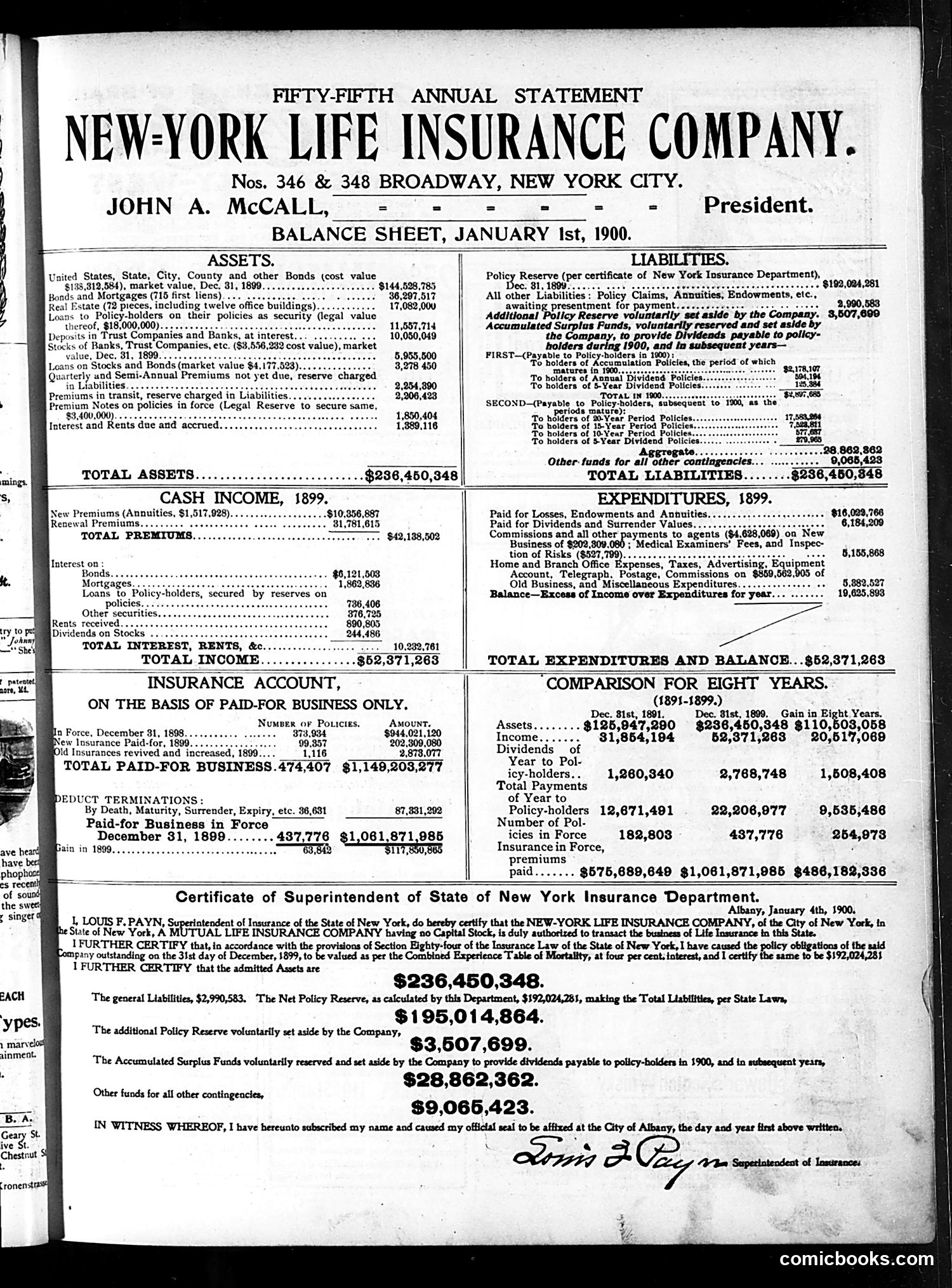
This is **not a cartoon or satirical content**—it's a financial document: the fifty-fifth annual balance sheet for the New York Life Insurance Company, dated January 1, 1900. The page displays detailed assets ($236.45 million), liabilities, cash income ($52.37 million), and expenditures for 1899. It includes a comparison table showing the company's growth over eight years and concludes with an official certificate from Louis F. Payn, Superintendent of Insurance for New York State. **For context**: Insurance company annual statements were sometimes published in Judge magazine as advertising. This document appears to be straightforward corporate reporting rather than satirical commentary. The inclusion in Judge likely reflects the magazine's role in covering business news alongside humor and political satire.
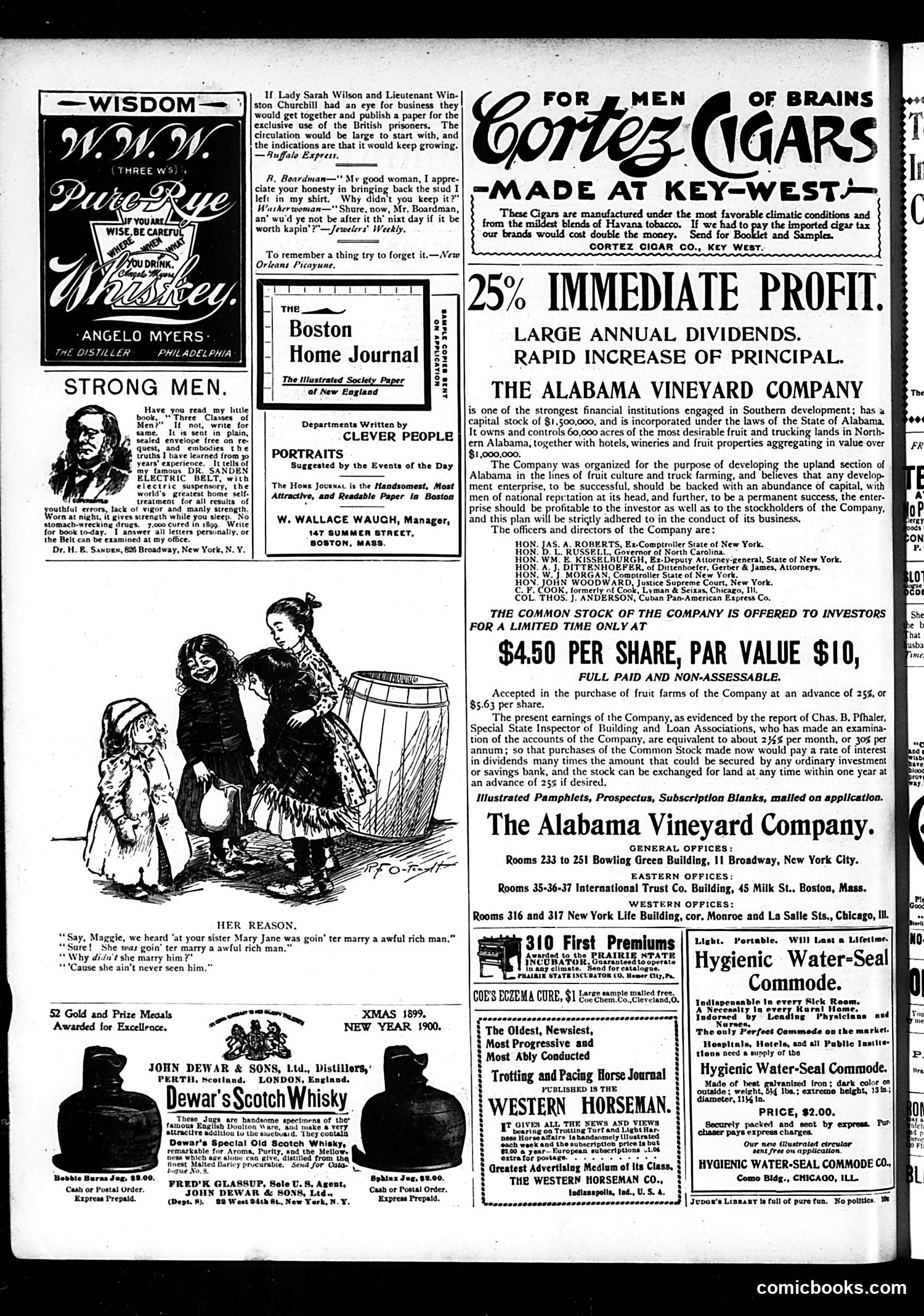
This page is primarily advertisements, not satirical political cartoons. The content shown includes: **Upper left**: A "Wisdom" ad for Angelo Myers' Pure Rye Whiskey and Dr. Sanden's "Electric Suspensory Belt" (a quack medical device marketed to treat male sexual dysfunction and weakness). **Upper right**: Cortez Cigars advertising. **Main attraction**: A small cartoon captioned "Her Reason" showing a woman explaining why she won't marry a rich man—a simple domestic humor joke with no clear political satire. **Lower sections**: Advertisements for Dewar's Scotch Whisky, the Boston Home Journal, the Alabama Vineyard Company (stock offering), and other products. The page reflects typical late-1890s advertising content targeting men with dubious health products, alcohol, and investment schemes. There are no identifiable political figures or social commentary beyond generic gender-role humor.
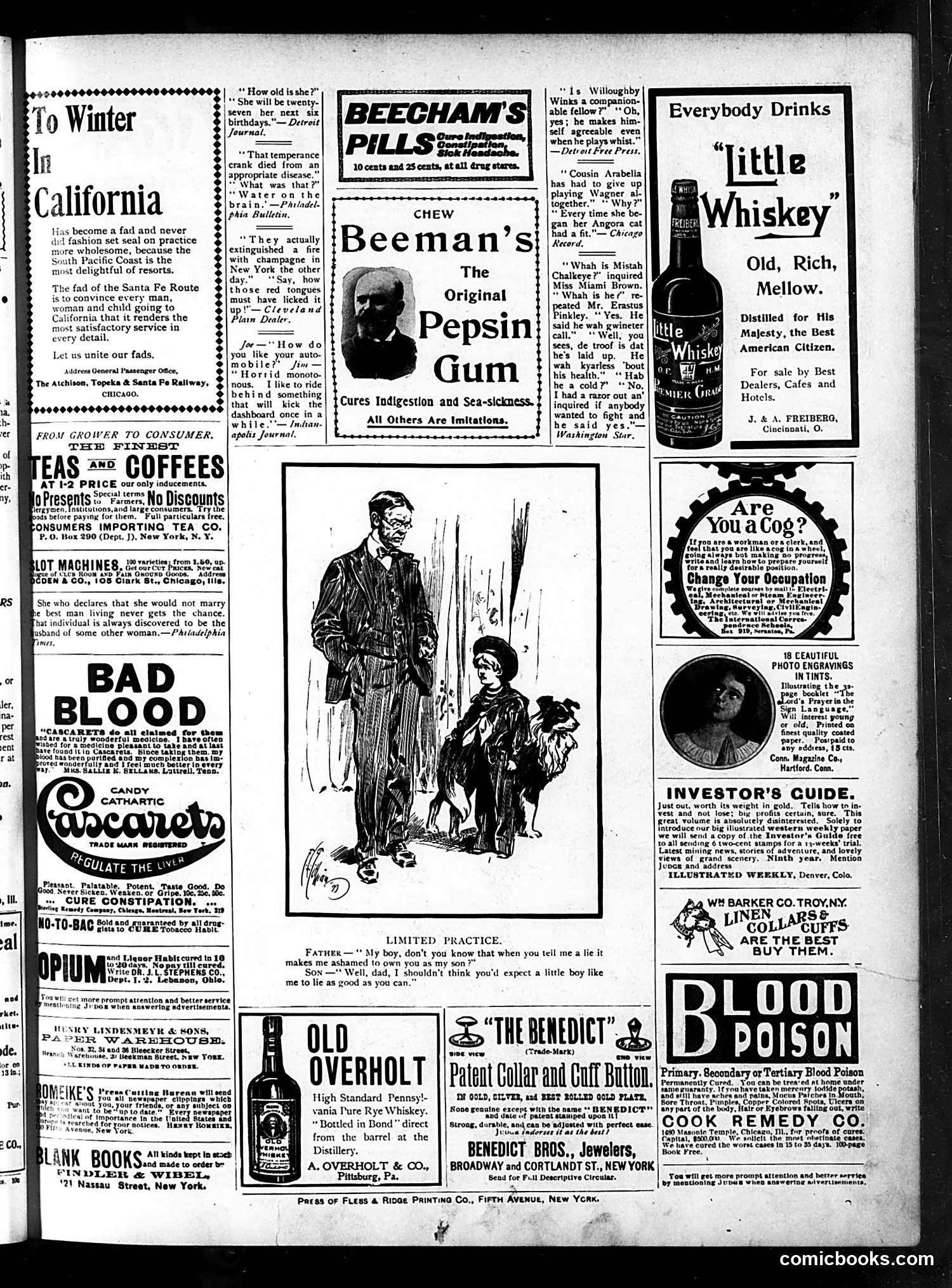
This is primarily an **advertising page** from Judge magazine, with one notable cartoon. ## The Main Cartoon The central illustration depicts a **father and small child** in winter clothing. The caption reads "LIMITED PRACTICE," suggesting the child is learning or practicing something—likely the "limited practice" of telling lies. The accompanying joke shows a father lecturing his son about lying, only for the boy to cheekily respond that he shouldn't expect a child to lie "as good as you can"—a mild satire on adult hypocrisy and parental double standards. ## The Advertisements The page is dominated by patent medicines and consumer products typical of early 20th-century advertising: Beeman's Gum (for indigestion), Beecham's Pills, "Little Whiskey" (marketed as medicinal), Bad Blood Candy, and various other remedies claiming to cure everything from constipation to blood poisoning. The scattered jokes at top left mock human vanity and foolish behavior—standard Judge fare—but are largely disconnected from coherent political satire.
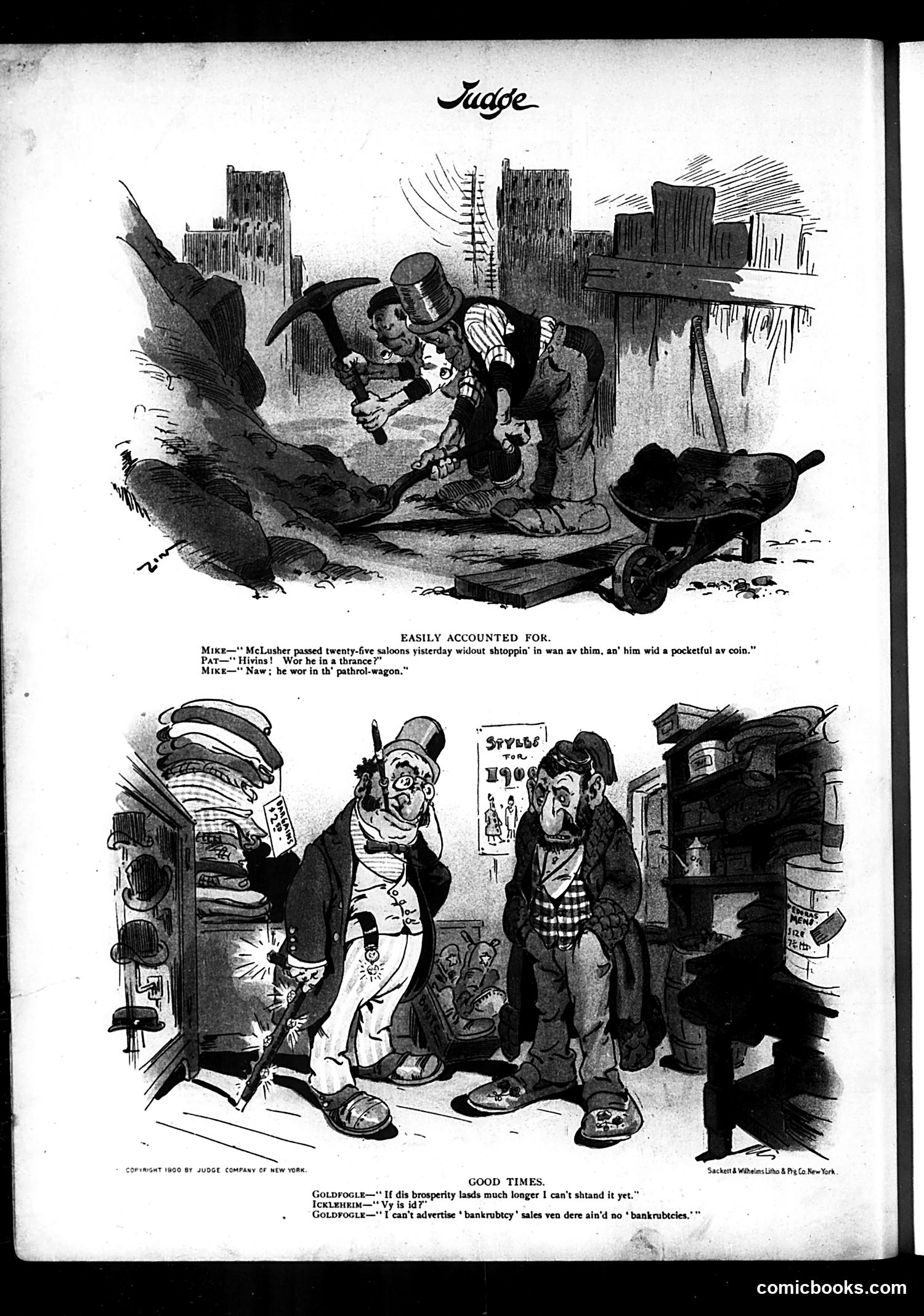
**Top Cartoon: "Easily Accounted For"** Two Irish immigrants (Mike and Pat, identifiable by dialect spelling) discuss why McLusher passed 25 saloons sober despite having money. The joke: he was arrested and in a police wagon, not voluntarily abstinent. This satirizes Irish-American stereotypes about heavy drinking and casual arrests. **Bottom Cartoon: "Good Times"** Two Jewish pawnbrokers (Goldrocix and Tex Levin, indicated by Yiddish-influenced dialect) complain that economic prosperity is ruining their business. Without bankruptcies, they can't advertise repossession sales. The satire mocks Jewish stereotypes about profiting from others' misfortune while ironically commenting on economic booms reducing crime/desperation. Both cartoons rely on ethnic caricature common to 1900s Judge magazine, using exaggerated dialect and occupational stereotypes for humor.